The U.S. ally getting nuclear submarines with no AUKUS deal
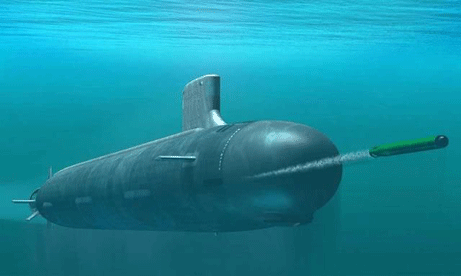
How South Korea’s plan for nuclear-powered submarines compares to AUKUS
ABC News, By Doug Dingwall, 6 June 26
The South Korean city of Gyeongju is famous for its uncanny, grass-covered burial mounds bearing the tombs of ancient kings.
It will also go down in history as the place where the United States finally agreed to South Korea’s long-held aspirations to acquire nuclear-powered submarines, ahead of the Asia-Pacific Economic Cooperation leaders’ meeting last year.
Months later, South Korea’s government has announced its plan to build the submarines by the mid-2030s, but it did not reveal how many, nor the expected cost.
As with the AUKUS agreement, the United States will help a close ally gain a fleet of nuclear-powered submarines.
But beyond that, South Korea and Australia are taking different paths to building their new vessels, and they’re acquiring them for different reasons.
So what is Seoul’s plan, and how does it compare to Australia’s AUKUS submarine endeavour?
Unknown unknowns
South Korea’s ambitions for nuclear-powered submarines go back 20 years, but it had been unable to secure approval from the US, which was concerned about nuclear proliferation.
However, US President Donald Trump broke with previous administrations and in October agreed to South Korea having nuclear-powered submarines, framing it as a win for American industry.
“South Korea will be building its Nuclear Powered Submarine in the Philadelphia Shipyards, right here in the good ol’ USA,” he posted on Truth Social.
Plans have changed since then, with South Korea’s Defence Minister Ahn Gyu-back announcing the submarines will be developed and built by his country.
The submarines would use low-enriched uranium fuel and the first would be launched in about a decade, he said.
Other than that, experts say the details are scant, maybe intentionally so.
“Most importantly, they haven’t put a dollar figure on it,” said Euan Graham, senior fellow at the Australian Strategic Policy Institute (ASPI).
In contrast, the AUKUS submarine program comes with a $368 billion price tag, one that Dr Graham expects won’t reflect the final cost.
“That ambiguity [in the South Korean plan] is, in a funny way, more honest because they don’t know what they don’t know,”
he said.
Observers agree the cost is one of the major risks in Seoul’s plan to build nuclear-powered submarines.
The vessels are expensive, not only to build, but also to operate, maintain and support over their entire life cycle, said Jihoon Yu, research fellow at the Korea Institute for Defense Analyses.
“South Korea will need to balance this program with other defence priorities, including air and missile defence, conventional submarines, unmanned systems, cyber capabilities, and space-based surveillance,” Dr Yu said.
Why nuclear-powered submarines?
Unlike AUKUS, South Korea’s plan is not about replacing a fleet of aging submarines.
Dr Yu said it was already modernising its diesel-electric submarines, including the KSS-II and KSS-III class, which were expected to remain operational for decades.
Instead, South Korea wants nuclear-powered submarines because it believes they are better suited for deterring the changing threat posed by North Korea.
That’s because nuclear-powered submarines can stay underwater longer, experts said.
“North Korea has invested heavily in submarine-launched ballistic missile capabilities, and tracking those platforms requires prolonged underwater endurance and sustained speed,” said Seong-Hyon Lee, associate in research at Harvard University’s Asia Center………………………..
Dr Yu said nuclear-powered submarines could also cover vast distances, and this would let South Korea contribute more to security beyond its immediate coastal waters.
“Nuclear-powered submarines could contribute to sea lane protection, regional maritime stability and broader allied deterrence missions,” he said.
That might appeal to the Trump administration, which wants US allies to take on more responsibility for their defence and security, including in the Asia-Pacific region.
Will South Korea’s plan rely less on the US?
Australia’s pathway to nuclear-powered submarines relies deeply on the US and the United Kingdom for technology and training.
“AUKUS is not just a submarine acquisition program; it is also a long-term strategic, industrial and technological integration project among three countries,” Dr Yu said.
“South Korea would likely seek a more domestically driven model, although it would still need close cooperation with the United States, especially on nuclear fuel,, safeguards, regulatory arrangements and political approval.”…………………………………………………………………….
know-how in building diesel-electric submarines, and in civilian nuclear technology, will only take South Korea so far.
It would have to solve questions such as reactor miniaturisation, acoustic quieting, shock resistance and integrating complex propulsion systems, Dr Lee said.
“These are highly demanding technical areas where even established naval powers have faced considerable hurdles.”
Mr Trump and South Korean President Lee Jae Myung agreed last year the US would work with Seoul on the project, including on “avenues to source fuel”.
“The most important unresolved issue concerns the nuclear-fuel framework under which any future submarine program would operate,” Dr Lee said.
South Korea has an agreement with the US that restricts its uranium enrichment.
“More broadly, the political, legal and technical details of any US-South Korea cooperation in this area have yet to be fully defined,” Dr Lee said.
Different plan, different problems
Experts say there’s a risk that South Korea’s nuclear-powered submarines program could be misunderstood in the region………………………………. https://www.abc.net.au/news/2026-06-06/how-south-korea-submarine-plan-compares-to-aukus/106764594
No comments yet.
1 This Month





PLEASE OPPOSE HR 8255 AND S.3639 – bills would accelerate satellite deployment, with no environmental review or safeguards – https://ncstd5li.quorum.us/campaign/169331/
To see nuclear-related stories in greater depth and intensity – go to https://nuclearinformation.wordpress.com
-
Archives
- October 2026 (49)
- September 2026 (339)
- August 2026 (330)
- July 2026 (355)
- June 2026 (287)
- May 2026 (306)
- April 2026 (356)
- March 2026 (251)
- February 2026 (267)
- January 2026 (308)
- December 2025 (358)
- November 2025 (359)
-
Categories
- 1
- 1 NUCLEAR ISSUES
- business and costs
- climate change
- culture and arts
- ENERGY
- environment
- health
- history
- indigenous issues
- Legal
- marketing of nuclear
- media
- opposition to nuclear
- PERSONAL STORIES
- politics
- politics international
- Religion and ethics
- safety
- secrets,lies and civil liberties
- spinbuster
- technology
- Uranium
- wastes
- weapons and war
- Women
- 2 WORLD
- ACTION
- AFRICA
- Atrocities
- AUSTRALIA
- Christina's notes
- Christina's themes
- culture and arts
- Events
- Fuk 2022
- Fuk 2023
- Fukushima 2017
- Fukushima 2018
- fukushima 2019
- Fukushima 2020
- Fukushima 2021
- general
- global warming
- Humour (God we need it)
- Nuclear
- RARE EARTHS
- Reference
- resources – print
- Resources -audiovicual
- Weekly Newsletter
- World
- World Nuclear
- YouTube
-
RSS
Entries RSS
Comments RSS


Leave a comment