Before the next nuclear crisis, listen to those who lived through the last one

By Renata Hessmann Dalaqua, Rebecca Davis Gibbons | August 6, 2026,
https://thebulletin.org/2026/08/before-the-next-nuclear-crisis-listen-to-those-who-lived-through-the-last-one/
The nuclear attacks on Hiroshima and Nagasaki resulted in the deaths and fatal injuries of more than 210,000 people, who either died instantaneously or within months. In addition to these victims, the hundreds of thousands who survived the bombings had to live with the consequences of radiation exposure, which could also affect their descendants.
Eighty-one years later, nuclear anxiety and fear appear to be rising amid increased levels of armed conflict involving nuclear powers around the world. But the testimonies and perspectives of thousands of people who have been affected by nuclear weapons use and testing remain regrettably absent from media coverage and the public debate.
As many worrying developments are described as “unprecedented,” it becomes critically important to hear from those who have lived through nuclear attacks in Japan as well as nuclear tests in Algeria, Australia, China, French Polynesia, Kazakhstan, Kiribati, India, Pakistan, the Marshall Islands, and the United States, among other places. The stories of nuclear survivors and their perspectives should be enough to remind leaders and the general public not to take nuclear threats lightly.
Remembering and learning from the past. In the aftermath of the atomic bombings in Japan, horrifying, first-hand accounts were featured in John Hersey’s 1946 book, Hiroshima. In his book, Hersey introduces six survivors and shares details of how they experienced the nuclear bombing, including its immediate impacts on their health, such as severe burns and radiation sickness. Initially published in an entire issue of The New Yorker on the first anniversary of the bombings, unannounced and placed behind a cover of a lively park scene with people enjoying various summer activities, the text became an immediate best seller and received great attention from specialized media and the general public, even being read over the radio in various countries.
Since then, several books have been written that contain analysis and testimonies from nuclear survivors. The Hiroshima Peace Culture Foundation, for instance, has compiled testimonies by survivors of the nuclear attack.
Akihiro Takahashi is one of the A-bomb survivors offering eyewitness testimony. Takahashi was 14 and a student at a Hiroshima high school. He remembers being blown by the blast and looking up to find that buildings had disappeared:
For a bewildered second I thought, “Hiroshima has vanished!” Coming to my senses, I quickly examined myself. My uniform was burned and tattered. The skin on the back of my head, my back, my arms and legs had peeled like rags, red flash was painfully exposed to the air. … I saw a line of A-bomb survivors looking dazed. … Many were virtually naked. It was exactly like a procession of ghosts.
This was just the beginning of the ordeal.
Nuclear survivors recount their many cancers or the litany of people in their communities who died of cancer or suffered other health problems in the aftermath of the bombing. These personal tragedies have been backed by studies across time of survivors in Japan and elsewhere that demonstrate more elevated incidence of thyroid cancer and other thyroid diseases than the general population, as well as elevated risks of breast, leukemia, stomach, and colon cancers. These impacts disproportionately affect children because their smaller body mass means their internal organs have less tissue shielding them from radiation compared to adults. Many of the health consequences would not manifest for years after exposure, and nuclear survivors have lived with persistent anxiety about transmitting their radiation-induced health issues to the next generations. And not only in Japan.
There are reports of an increase in infant mortality in New Mexico after the Trinity test of July 1945 and in Australia after the United Kingdom’s Maralinga tests in the 1950s. In the Marshall Islands, where the United States conducted 67 nuclear tests between 1946 and 1958, women reportedly suffered miscarriages and gave birth to stillborn babies or “jellyfish babies,” which were infants born with translucent skin and no bones.
For many survivors, pregnancy and labor after radiation exposure took on added psychological stress. As Hiroshima survivor Keiko Ogura recounts:
Before I delivered my baby until the last moment, I was so scared. … Everybody had a hard time. “My baby, my child, is he okay or not?” always mothers are thinking. [With] nuclear weapons stays future fear. Not all casualties are burned or have scars. No, fear. Yes, fear, so deep in our hearts. Everybody had fear.
While there is a need for more scientific research on the generational effects of radiation exposure, many victims believe the illnesses and birth defects in their children and grandchildren are connected to their original exposure. This is the view of Lee Gyuyeo, another survivor of the Hiroshima bombing:
No words can describe the gravity of the aftereffects on the second and third generations, not to mention on us, the first generation of nuclear victims. Our children and grandchildren, the second and third generations of survivors, continue to suffer from unexplained illnesses and are in unspeakable pain.
In addition to health problems, radiation contamination also leads to displacement and environmental deterioration.
In the Marshall Islands, radioactive fallout led to a two-pronged migration pattern, first, from outer islands to the capital, Majuro, and then, with a significant portion of the population relocating to other countries away from radiation and its concomitant harms. Continued displacement led to cultural dislocation and hindered the sense of belonging. As a young Marshallese student living in Fiji observed, “having your land taken away creates a limbo where you don’t know where to identify.”
Radioactive fallout from the tests on the Marshall Islands also resulted in environmental contamination that affected local foods and fish stocks. The need to avoid locally produced food and to rely on the consumption of processed products has been associated with diseases among the Marshallese population, including diabetes, hypertension, and obesity. Environmental impacts are further compounded by climate change. Rising sea levels elicit concern about the potential nuclear waste leakage in the Runit Dome, the concrete structure housing contaminated topsoil and radioactive debris on Runit Island.
Acknowledging the past to change the future. Many nuclear survivors feel that relevant governments never truly acknowledged the harm caused by the atomic bombings and nuclear testing programs or the extent of suffering they caused. Without acknowledgement, victims feel not only harmed but almost invisible, as if their experiences, sacrifices, and torments never happened. Media coverage and popular culture still too often glorify nuclear weapons and shirk consequences, adding to the burden carried by survivors.
Several ongoing initiatives by international organizations are trying to shed light on the impacts of nuclear war, including upcoming studies by the World Health Organization and an independent scientific panel established by the UN General Assembly, as well as technical assistance provided by the Office of the High Commissioner for Human Rights to the Marshall Islands. Although extremely important, these initiatives remain all but absent from public discourse and media coverage on nuclear weapons.
If new generations do not learn from the suffering and experience of nuclear survivors, they run the risk of seeing history repeat itself. Listening to nuclear survivors, teaching their struggles in schools, and telling their stories to leaders and the public are paramount if the world is to avoid—or at least postpone—the next nuclear catastrophe.
SMRs and microreactors in the military
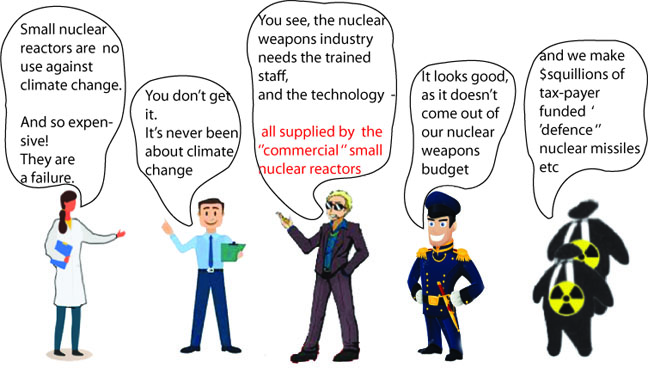
Aleksander Olech, 15 August 2026
Small modular reactors are not a technology that will solve every problem
faced by an army during wartime. They will not replace fuel, the deployment
of forces or existing sources of energy. On the other hand, they could
become an important element in preparing the state for crisis and war.
Modern armed forces need not only soldiers, tanks and artificial
intelligence, but also a stable power supply for the systems on which
military operations depend. It is from this perspective that the military
importance of SMRs and microreactors should be developed.
Modern warfare is
not limited to strikes against selected military units. Increasingly, it
begins with an attempt to paralyse the state by depriving it of energy,
transport capabilities, communications and the ability to exercise command
rapidly. Russia has demonstrated this in its operations against Ukraine.
Attacks against energy infrastructure are not an addition to a military
operation, but part of the way in which war is conducted.
Hybrid activities
may also serve as a prelude to open conflict, while a strike against the
state’s support infrastructure may precede direct action on the
battlefield.
Defence24 15th Aug 2026, https://defence24.com/armed-forces/smrs-and-microreactors-in-the-military
Jared Kushner: US will back Israeli resumption of war if Hamas fails to honor disarmament commitments

Kushner said Hamas could surrender weapons and tunnels within 60 to 90 days, calling demilitarization a potential major security gain for Israel.
Jerusalem Post, ByJAMES GENN, AUGUST 18, 2026
Hamas must honor its commitments to disarm or face an IDF operation to “finish the job,” US special envoy Jared Kushner told FOX News’s Trey Yingst on Monday.
Kushner’s comments came after meetings with Hamas and the National Committee for the Administration of Gaza (NCAG) in Cairo on Sunday, and respective meetings with Prime Minister Benjamin Netanyahu and President Isaac Herzog in Jerusalem on Monday.
“If they [Hamas] don’t follow through now on their commitment, everyone will see that they’re not genuine about peace, and then Israel will have a lot more support from the US and others to go and finish the job in the appropriate way,” Kushner stated………………………………
“For Israel, we think this is a win-win situation because if Hamas actually gives over the weapons and the tunnels willingly over the next 60 to 90 days, that obviously would be the elimination of a huge security threat for Israel, almost an unthinkable achievement,” he stated.
Trump admin. will not allow Gaza to be rebuilt until Hamas demilitarizes, Kushner says
The Trump administration will “not allow Gaza to be rebuilt until demilitarization occurs,” Kushner stated……………….. https://www.jpost.com/middle-east/article-905880
Senior Israeli official calls for killing of “30 to 40” people in Gaza every night: “They’re not even people”

By Frank Andrews, August 17, 2026 , CBS News
Israel’s far-right national security minister Itamar Ben-Gvir, in a podcast published over the weekend, called for “30 to 40” people to be killed per night in targeted assassinations in the Gaza Strip.
Discussing Israel’s response to the Hamas-led terrorist attack on Oct. 7, 2023, which sparked the war in Gaza, and Israel’s recent move to reduce the number of strikes being carried out in the decimated Palestinian territory, Ben-Gvir said: “It’s no secret, I disagree with the prime minister … I think targeted assassinations should be carried out in Gaza, taking down 30 to 40 every night.”
“Not just those who pose an immediate threat,” added the Israeli cabinet member. “There are people there who are not worthy of life. They shouldn’t live. They’re not even people.”
The security chief made the comment to Rom Braslavski, who was previously held as a hostage in Gaza, on his Sunday podcast.
Israel once had a block of 21 settlements — known as Gush Katif — in the Gaza Strip, but the settlers and Israeli forces pulled out of the enclave two decades ago.
“I see all of Gaza as ours,” Ben-Gvir said in the taped interview. “Settlements not just in Gush Katif but throughout Gaza, encouraging as much emigration as possible, sending them to their countries. And for the terrorists, no emigration, nothing, just to kill them one by one.”
Legal experts and the Secretary-General of the United Nations have warned that any move to force Palestinians to leave Gaza could amount to ethnic cleansing.
Israel’s vast network of settlements in the occupied West Bank — the other, much larger Palestinian territory — are considered illegal by the United Nations, the International Court of Justice and many other entities and nations. Israel’s current government has encouraged new construction in the West Bank, however, and it disputes the illegality of most of the settlements in the territory.
“Inciting violence”
Iranian Deputy Foreign Minister Kazem Gharibabadi posted about Ben-Gvir’s comments on X Monday. “These confessions must be recorded and preserved for the day of reckoning and trial of these criminals,” he wrote.
Similar statements by Ben-Gvir and other senior Israeli officials have been presented to the U.N. as evidence of an alleged genocidal intent by Israel’s government in Gaza.
The national security minister is no stranger to controversy…………………………..
Ben-Gvir is a follower of Kahanism, a movement named after a long-dead rabbi who espoused violent ethnonationalism and advocated for the expulsion of Palestinians from Gaza and the West Bank.
The security chief’s first moment in the spotlight came in 1995, when he stole the Cadillac emblem off then-Israeli leader Yitzhak Rabin’s car. Rabin was hated among the Israeli far-right for signing the Oslo Peace Accords with the Palestinians. Ben-Gvir held up the badge to a TV camera and said: “Just as we got to his car, we will get to him.”
Rabin was assassinated weeks later by a Jewish far-right nationalist. https://www.cbsnews.com/news/israel-ben-gvir-gaza-netanyahu-kill-every-night/
Walt Zlotow – 21ST century David v. Goliath: Iran’s $8 billion military whups America’s $1 trillion military
Walt Zlotow West Suburban Peace Coalition GlenEllyn IL , 19 Aug 26, https://theaimn.net/21st-century-david-v-goliath/
What’s going on in the Middle East is not a Biblical fairy tale. Irans’s piddly military has delivered a devastating defeat to America’s gargantuan trillion dollar military.
Iran’s David does not need to squander a trillion annually on 750 bases housing over 160,000 soldiers in 80 countries. Nor does Iran’s David need 287 naval ships including 11 nuclear powered aircraft carriers that have suddenly become obsolete in the era of drone and missile warfare. Those carriers have been steering clear of Iran’s missiles and drones least they be sent to Davy Jones Locker.
The US is flummoxed at how Iran’s minuscule military has made mincemeat out of all 18 US bases in US Gulf State allies Kuwait, Saudi Arabia, UAE, Qatar and Bahrain. After plastering Iran with thousands of bombs for 39 days, it was the US, not Iran that was running out of offensive and defensive missiles and bombs, so much so Trump cried ‘Uncle’ and demanded a ceasefire.
When Trump signed the Iran’s ‘Unconditional Surrender’ document, the Memorandum of Understanding, on June 17, it was equivalent to Goliath being smitten by the stone puny David fired from his sling.
Of course, the story of David and Goliath is a fairy tale that allegedly occurred over 3,000 years ogo. The 21st century version is no fairy tale. Now in its 173rd day with no end in sight, it still represents the most catastrophic military blunder in US history. It will likely push the US out of the Middle East. The 5 Gulf States housing now damaged or destroyed US bases may seek more reliable countries to rely on for their security. Iran will emerge a stronger power in the region. The entire world economy still teeters on possible decline from US intransigence and refusal to admit defeat.
Trump still doesn’t get it. He’s seeks another half trillion bucks for his wildly bloated military for fiscal ’27 in hopes of prevailing over Iran’s tiny $8 billion dollar military. Mayne he should start reading something he’s never read before…the Bible. He should start with 1 Samuel 17:1–50.
Trump ‘weighing nuclear attack on Iran’ as peace deal expires.

Plus: Why the Iran war has prompted Trump to scale back key US-South Korea military drills
As the US-Iran ceasefire officially expires and the Strait of Hormuz
remains closed, is Donald Trump considering using nuclear weapons to break
the war’s stalemate? On today’s episode of Iran: The Latest, Venetia Rainey
and Roland Oliphant discuss why US politician Marjorie Taylor Greene’s
bizarre nuclear claim may be less crazy than it first appears and how an
underground nuclear facility at Pickaxe Mountain could be the potential
target. They also look at the state of the war 60 days on from the
ill-fated Memorandum of Understanding peace deal and why Iran is more
bullish than ever.
Telegraph 17th Aug 2026, https://www.telegraph.co.uk/world-news/2026/08/17/trump-weighing-nuclear-attack-on-iran-as-peace-deal-expires/
The Quantum Con: How Chicago’s Southside Became a Sacrificial Altar to the War Machine

Are we as Chicago residents at ease with the unprecedented horrors of quantum and AI warfare coming out of our own backyards?
Pete Hegseth’s Department of War is building America’s largest quantum computing project right here on the Southside of Chicago, to the detriment of not only our city but the world at large. Gov. JB Pritzker has lauded the venture capital project as an unprecedented opportunity to make Illinois the “Silicon Valley of quantum development.” With whose consent? On whose land? And on whose dime?
When examining the backers of the Illinois Quantum and Microelectronics Park (IQMP), it is difficult to rationalize this $9 billion project as anything but an accelerative altar to militarism. Alongside federal backing from DARPA, investors such as BlackRock, IBM, and Israeli startup Quantum Machines have all cited quantum technology as the next frontier in modern warfare. The military-industrial complex has emphatically doubled down on quantum computing technology and advanced computing in AI alike as the next crucial edges in 21st-century militarism. Indeed, AI technology in warfare is already being used extensively by the US and Israel to terrorize the SWANA region.
Even with the considerable private capital financing already allotted to this project’s troubling Big Tech-war machine alliance, Illinois taxpayers are the top funders of IQMP by far. To the sum of more than 700 million state dollars, the land and water beneath our feet have been sold out to private equity military contracts. As families across our cities starve, as rent costs go up and our unhoused neighbors are continually displaced, we must stop the flow of state and city resources from being directed to a global surveillance state hellbent on mass destruction.
On a local level, the Chicago City Council has unanimously approved the Quantum Park’s construction on three separate occasions, with Mayor Brandon Johnson contributing $5 million from the city’s already strained budget. The contrast between the typical glacial speed of approval from City Council and the suspiciously rapid approval process of this project is jarring to say the least, particularly when one considers the largely uncharted nature of the technology itself.
Southside Together’s campaign against Quantum is an unequivocal stand for people power against the cynical backdrop of Big Tech fatalism.
Southside Together, an organization focused on building people power with working-class Southside residents, collected signatures proposing a non-binding referendum concerning IQMP. The petition asked one question: “Should our local elected officials stop the construction of the IQMP and instead invest directly in community resources?” Non-binding ballot referendums are rarely challenged on the basis of their language, yet this expression of community consensus was struck from the ballot summarily. Southside residents, in particular, breaking the silence on this project have been clearly delineated as a high-priority threat by backing city officials.
Widespread awareness and community dissent could in fact function as IQMP’s death knell. If organizing on the Southside alone has already scared these Big Tech military syndicates into such frantic repression, imagine what genuine citywide resistance to quantum computing development could accomplish in turn.
As Gov. Pritzker and Mayor Johnson push this project through, they are continuing to make the people of Chicago complicit in war crimes across the globe. Do Illinois politicians want this escalation in Big Tech militarism to be their legacy? More importantly, are we as Chicago residents at ease with the unprecedented horrors of quantum and AI warfare coming out of our own backyards?
Southside Together’s campaign against Quantum is an unequivocal stand for people power against the cynical backdrop of Big Tech fatalism. Join the fight today against what quantum tech threatens to do tomorrow.
Russia has accused the UK of “deliberately opting for an escalation of the Ukraine crisis”.
BBC 18th Aug 2026
Russia has accused the UK of “deliberately opting for an escalation of the
Ukraine crisis” following confirmation that British-made drones had been
used in strikes on targets in Russia. “In doing so, the United Kingdom is
acting as an accomplice and co-perpetrator of the bloody crimes and
terrorist attacks,” the Russian Embassy to the UK wrote in a statement.
“London’s actions will inevitably carry consequences for which it will have
to answer,” it said, adding that the deeper its involvement in the
conflict, “the higher the price it will pay”. In response, a spokesperson
for the Ministry of Defence (MoD) told BBC News that Britain stood
“shoulder to shoulder” with Ukraine.
Hegseth Announces Expansion Of US Military Sphere Of Operations.
During his visit, the Secretary of War announced the signing of agreements and strikes in Latin America and the Caribbean against targets considered a threat to US security.
BreakThrough News, August 14 2026, https://breakthroughnews.org/2026/08/14/us-military-expands-sphere-of-operations-during-hegseth-visit-to-panama/
On August 12, US Secretary of War Pete Hegseth visited Panama, where he attended the Coalition of the Americas Against Cartels (A3C). There, he met with ministers, deputy ministers, security and defense chiefs, and several high-ranking military officers from the Shield of the Americas, the new Washington-led regional coalition focused on “combating narcotrafficking”.
In addition to the United States, member countries include Argentina, Bolivia, Costa Rica, Ecuador, El Salvador, Guyana, Honduras, Panama, Paraguay, Chile, Guatemala, Peru, and the Dominican Republic (and, more recently, Colombia, following the change in government), all of which have declared their political and economic alignment with Washington.
Thus, for a few days, Panama became the hub for planning and meetings among the new international cooperation initiative led by the Trump administration, which has stated that its primary goal is to combat organized crime and cartels.
Following the start of Trump’s second term, the Panamanian government under José Raúl Mulino has aligned itself with Washington’s stance, even going so far as to distance itself from agreements with China regarding the Panama Canal, which Trump himself has threatened to “take back.”
In this regard, Hegseth, on his second trip as Secretary, said: “I look forward to strengthening our partnership to keep the Panama Canal secure and disrupt cartel operations throughout the region.”
However, not all Panamanians welcomed Hegseth’s second visit with open arms. One such group was the National Front for the Defense of Economic and Social Rights (FRENADESO), which rejected the US military presence in their country. “Panama cannot once again become a military platform for any power. We do not want bases, enclaves, or facilities that could use our territory as a springboard for aggression against other peoples and nations. Nor do we accept that decisions made by others turn Panama, its people, or the Canal into military targets in conflicts that are not our own. Our security does not lie in militarization or in subordinating ourselves to the geopolitical interests of a superpower,” FRENADESO stated.
In the statement, FRENADESO also said: “[We must] defend our sovereignty, neutrality, independence, and self-determination, and maintain relations of respect and cooperation with all the peoples of the world. Panama, a land of peace and sovereignty! Neither a platform for aggression nor a military target! Respect for the self-determination of peoples!”
New attacks announced
During his visit to Panama, Hegseth reported that his government plans to launch “ground” attacks against “drug traffickers and terrorists” with the approval of the member governments of Shield of the Americas. This type of operation has already been seen in Ecuador, when US forces claimed to have carried out an attack on Ecuadorian soil alongside the Ecuadorian armed forces.
Furthermore, it is important to recall that the United States has already carried out several attacks in the Caribbean Sea and the Pacific Ocean, where it has sunk over 60 vessels allegedly carrying drugs, resulting in the deaths of over 200 people.
Hegseth warned that attacks could occur “anywhere” drug trafficking groups operate. He stated that US forces hope to deploy, alongside their allies, “an operational capability like the one you saw in the attacks on drug boats [in the Caribbean and the Pacific]… We are working with Ecuador, Colombia, and other partners to take the fight to DTOs (designated terrorist organizations) on land.”
In addition, Hegseth stated that the attacks will be carried out precisely to avoid a judicial process and take direct action: “We’re not going to put them through a judicial process where we know they’ll be released. We’re going to destroy these networks using all the capabilities of the US government,” said the Pentagon chief, perhaps in response to the criticism his administration has received over alleged extrajudicial killings.
The press has reported that, for now, Hegseth has reached agreements with Colombia and Ecuador. Regarding the former, Colombia’s Minister of Defense requested the deployment of US troops on Colombian territory.
“Through the newly inaugurated president… Colombia has already requested that the War Department join Colombia in its fight against narco-terrorism, authorizing joint military operations to destroy terrorists and terrorist networks,” said the Pentagon chief.
According to the Ecuadorian Ministry of Defense, the agreements with Ecuador – though still confidential – aim to establish a framework for the participation of US forces in the South American country.
In this way, the United States plans to expand its presence in Latin America not only through diplomatic and economic channels, but also through military means. The effects that this new series of US military operations will have on the region remain to be seen, and it will be a wait marked by the smell of gunpowder and a great deal of controversy.
BreakThrough News, August 14 2026
Is Trump’s Golden Dome Missile Defense System a Pipe Dream?

Hannah Bowlus, August 13, 2026, https://inkstickmedia.com/is-trumps-golden-dome-missile-defense-system-a-pipe-dream/?utm_source=substack&utm_medium=email
US President Donald Trump’s highly touted ‘Golden Dome’ will cost taxpayers untold sums of money. Will it even work?
The Golden Dome for America is US President Donald Trump’s vision of an impenetrable shield protecting the entire United States from land, sea, air, and space against short- and long-range weapons armed with nuclear warheads or conventional munitions. It may not survive the Iran war. Regional missile defenses deployed by the US and Israel have failed at times. The Golden Dome relies on their success.
A year and a half and $25 billion since the president announced the Golden Dome, plans still remain classified, and the White House has backed off of the claim it will be virtually impenetrable.
Experts and congress members eyeing the $1.5 trillion defense budget — an additional $17.5 billion for the Golden Dome in a separate reconciliation bill, and an estimated $100 billion for the war on Iran — are now rethinking missile defense.
In March, the Cato Institute warned that the Golden Dome, “modeled on Israel’s Iron Dome and air and missile defense (AMD), rests on a system now showing clear vulnerabilities.” The think tank cited several instances of Iranian attacks breaking through Israeli defense systems. “If Israel’s shield can be tested this way, the lesson for the United States is clear: a similar effort risks wasting vast time, money, and resources on a promise that may not hold.”
The Congressional Budget Office estimates it could cost $1.2 trillion to build missile defenses that still couldn’t fully defeat a smaller salvo of missiles. A more robust (though still penetrable) dome might cost $3.6 trillion. The US Space Force says it will cost only $185 billion.
The best the Golden Dome could perform, even at the $3.6 trillion price tag, is an 80% interception rate, one report concludes, though it notes that is an unrealistically optimistic scenario. If Russia launched its nuclear arsenal with this Golden Dome in place, and 20% of their missiles evaded thousands of space-based interceptors, at least 75 million Americans could perish immediately. Some 1.4 billion would likely die globally in the ensuing famine and climate disaster within two years.
In May, US Representative Jim McGovern, a Democrat from Massachusetts, told a press conference on Capitol Hill that the Golden Dome was a “vanity project” for Trump that would cost Americans at a time when economic insecurity is rife. “We’ve got 48 million people in the United States of America, the richest country in the history of the world, who are food insecure or hungry,” McGovern said. “When you start going down this road of a new arms race, where there’s no end in sight … we’ll have nothing for anything else.”
Laura Grego, a research director at the Union for Concerned Scientists, suspects the Golden Dome is doomed like its progenitors. “I think we’ll spend a lot of money before we get there,” Grego told Inkstick.
Lockheed Martin, Northrop Grumman, Raytheon, and General Dynamics were among the 12 companies selected to develop space-based missile interceptors, the costliest and most technically daunting piece of the Golden Dome. Each manufacturer has current missile defense systems operating on US bases and in Israel. These extraordinarily expensive systems of sensors and interceptors have repeatedly failed while the US and Israel waged war on Iran, and throughout Israel’s war in Lebanon.
Inkstick asked each company how they could guarantee a workable missile defense system in space when their weapons in conventional war failed. None responded.
Elsewhere, Lockheed Martin’s CEO has predicted the next few years will be a feast for contractors. Anduril’s CEO said the defense industry is more energized than ever.
Money is one motivation for pursuing the Golden Dome, Grego says, but there are also true believers in missile defense who take its enormous financial cost as proof of its legitimacy. It should and will work because the US has spent $500 billion on it.
Since the US first left the anti-ballistic missile treaty, government officials have claimed to currently own working defenses to “fix the problem of nuclear war.”
“My worry is that the people who should know better believe it,” Grego said.
Just this year, the Missile Defense Agency’s Lieutenant General Heath Collins testified to Congress that the ground-based midcourse defense system had “made the impossible possible, hitting a bullet with a bullet.” By its own evaluation, the program has a 55% intercept rate in highly scripted and uncomplicated tests.
n this and past wars, the Pentagon has exhibited a tendency to mislead the public on the efficacy and maturity of its weapons. Golden Dome details have been concealed, even to Congress, despite its members approving $25 billion toward it last year.
In May, General Michael Guetlein, the manager of the Golden Dome, claimed he had spoken to 400 potential defense contractors about the project. He said he expected the Golden Dome to be completed on time.
Elsewhere, concerns are mounting. Speaking in Congress in June, US Representative Bill Foster, a Democrat from Illinois, argued that the Golden Dome should be investigated for large-scale fraud. “The people getting federal taxpayer money for this have been caught repeatedly lying to Congress and to the public about what the technical status of those [weapons] are,” he said.
The backbone of the Golden Dome, a tranche of data relay and early warning satellites, has already been launched into low Earth orbit. It’s over-budget and behind schedule. The Government Accountability Office has urged the Space Development Agency to be more transparent about its progress.
Companies awarded contracts for the tranches of satellites were allowed to self-report on the technical readiness of their own products. They gave themselves high scores, inaccurately, GAO wrote in one assessment, potentially derailing the entire program in the process.
The bulk of the Pentagon’s request for an additional $17 billion in Golden Dome funding relies on another reconciliation bill that might never materialize. House Republicans recently drafted a supplemental bill with $60 billion earmarked to offset the cost of the war and cover immediate defense priorities.
US Representative Jodey Arrington, a Republican from Texas, blasted Democrats in July over reconciliation. He insisted that Democrats should support the bill in order to “support our troops in time of conflict.” He claimed it was about providing the armed forces with “baseline readiness — not Star Wars and Golden Dome and transformative modernizing of the military — just the bombs, bullets, and battlefield readiness for our men and women in uniform to finish the fight successfully and return home safely.”
In a recent hearing on missile defense, US Representative Seth Moulton, a Democrat from Massachusetts, questioned the logic of the Golden Dome when regional systems were falling apart. “What I don’t want to be doing is getting bogged down in a war in the Middle East that we’re losing while also spending hundreds of billions of taxpayer dollars here at home” on the Golden Dome, he said.
Congressional appetite for the Golden Dome is flagging in the face of a more than $100 billion war. Iranian missiles have resulted in costly damage to American bases and military equipment across the Middle East, and recent reports have revealed that the US stockpile is dwindling fast. “There are lots of relatively cheap ways to circumvent a system or make it obsolete right away,” Grego explained.
A country could increase the number of its salvo, make its missiles faster, shoot decoys, attack sensors and interceptors. These are basic measures that would drive up requirements and costs of the Golden Dome.
In April and October of 2024, Israel claimed it intercepted 99% of projectiles fired by Iran. Trump subsequently praised Israel’s missile defense capabilities and, while announcing the Golden Dome, insisted that the US “is entitled” to the same kind of protection. Independent analysis, though, estimated that Israel’s interception rate was closer to 80 or 85%. Israel was able to destroy so many targets before impact because Iran’s missiles were relatively unsophisticated, armed without countermeasures, and aimed at less populated areas in a country 470 times smaller than the United States.
$1 Trillion And This Is All We Get?
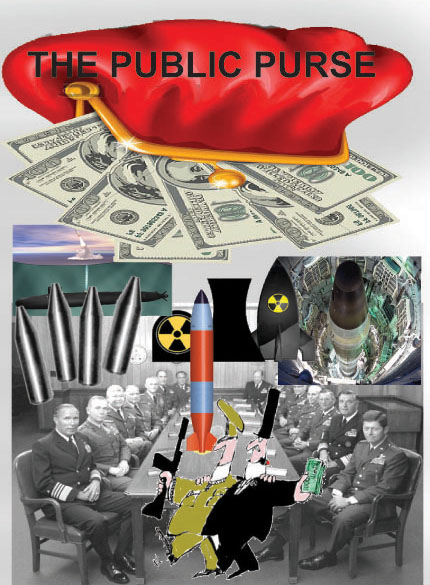
Spending does not equal value when it comes to Pentagon contracting
Lisa Savage,Aug 16, 2026, https://went2thebridge.substack.com/p/1-trillion-and-this-is-all-we-get
More bad news for the Pentagon as another highly expensive warship goes dark.
“On July 24, 2026, while conducting routine operations in the Indo-Pacific, Arleigh Burke-class guided-missile destroyer USS Benfold (DDG 65) reported an engineering casualty involving its generators, causing a loss of power,” reads the statement. “There were no injuries to the crew, who demonstrated resilience, grit, professionalism and unwavering steadiness in their response.”
The loss of power meant sailors were without galley services, toilets and air conditioning. Potable water was also affected, Comer said. He did not respond to a question about how sailors handled waste.
I’ve already written about the woes of the USS Abraham Lincoln which is reportedly about to be replaced the the USS George Washington (without the USS Benfold in its entourage), leaving zero aircraft carriers in the waters around China for the first time in many years.
Military types have been less than impressed with the disrespect, gaslighting, and minimizing of the Commander in Chief and his minister of war about the Lincoln’s woes, a 5,000 person ship that must now be supplied from Diego Garcia 3,000 miles from Bahrain where Iran destroyed a crucial U.S. naval base.
Typical of a draft dodger’: Rep. Seth Moulton blasts Trump’s response to USS Lincoln crisis
“The U.S. had no plan going into this war”
Retired Maj. General Randy Manner on Friday accused President Donald Trump and Secretary of Defense Pete Hegseth of “spewing lies” about the reportedly deplorable conditions aboard the USS Abraham Lincoln and its extended deployment in the Middle East
A professional military that sees national defense as a sacred calling and that embraces martyrdom if necessary it is up against a whiny Gen Z force that mostly thinks of the U.S. military as a job. My husband: “Probably the only job they could get.” He’s right if we’re talking jobs with benefits like health care and college tuition for high school graduates.
The leadership of this crack military force? They are focused on spending big, bigger, and biggest bucks on elaborate systems like Golden Dome that are highly unlikely to produce interception of hypersonic missiles as promised.
But military-industrial promises are made to be broken.
In the excitement over finally pulling Russia into war, General Dynamics promised to build artillery shells that U.S. proxy Ukraine was running through rapidly. GD took $533 million from taxpayers to equip a factory with state of the art robots purchased from Turkiye.
Those involved described a project that was rushed and ill considered from the start. Congress paved the way, removing government contracting guardrails — meant to ensure taxpayer money isn’t wasted — so that Ukraine-related defense projects could be funded quickly. The Army took advantage, handing General Dynamics lucrative no-bid awards without knowing whether the machines it planned to use could perform the desired work. The Army’s due diligence was inadequate, four former Army and General Dynamics officials told ProPublica.
Descriptions of the malfunctioning robots reads like bad sci-fi and suggests, at least to my mind, sabotage.
The robots, giant metal arms with clamps for hands, would end up drenched in oil, which would then — no surprise — combust as they moved steel blocks heated to 1,800 degrees into and out of a machine that periodically erupted columns of fire. One blaze that summer melted a robot’s cables, putting it out of commission for a week..
according to interviews with 12 former factory workers.. the flaming robot arms also kept smashing into things. They slammed into computer numerical control machines, breaking their windows and bending their doors. They knocked over shells. They bashed into safety fences. Workers talked about the arms going “rogue” and began calling one of them “Johnny 5” after a sentient military robot from a 1980s movie..
Then there were the giant press machines, which required regular pounding with a sledgehammer [emphasis mine] to function properly but still botched the shaping of nearly every shell. “We really didn’t have any standardized practice,” said Quantel White, a former employee. “It was just a bunch of guys taking turns going at the machine with a sledgehammer every night.”
If someone comes up with a better metaphor for the U.S. approach to maintaining its imperial ascendency, please let me know.
Who will be held accountable for the artillery shell boondoggle? Not GD executives.
Wages of Failure: Since the Army halted two production lines at the factory, the General Dynamics unit responsible for the debacle has received contract awards totaling $2.5 billion.
Maybe Turkish robotics firm Repkom will take the blame?
Paranoia set in. Repkon refused to share passwords needed to control important equipment, according to five former General Dynamics employees. Sometimes workers would be startled by the sight of a machine moving by itself and realize it was being controlled by someone in Turkey. Spooked, General Dynamics workers tore out hardware to cut off remote access to the machines, two former workers said.
If this is starting to sound like a bad movie plot with espionage and sabotage threads, keep in mind that you paid way more than $17 to see this film. But not to worry! Private-public partnerships with contractors all over the globe are racing ahead to produce fast, powerful military hardware that will attempt to compete with Iran, China, and Russia. All three of which are currently demonstrating the decisive power of a loyal, patriotic work force called upon to step up production in the face of existential threats.
General Dynamics workers in my state go out on strike regularly for better pay and working conditions, while their CEO slurps up another bonus.
In April 2024, General Dynamics CEO Novakovic told investors: “In the U.S., we are rapidly increasing ammunition production with the opening of our Texas facility.” General Dynamics failed to conduct a scheduled first article test in Mesquite that same month.
I’ll let Xi Jinping have the last word here. From his 2015 plans for The Governance of China:
There cannot be sustainable development in the world when some countries are getting richer and richer while others languish in prolonged poverty and backwardness.. Such practices as beggar-my-neighbor, shifting crises onto others and feathering one’s nest at the expense of others are both immoral and unsustainable.
Confronted with complex threats to international security, fighting alone or fighting with a blind faith in the use of force [emphasis mine] will not get one anywhere.
What no government wants you to know about nuclear weapons – Carol Turner

“In 2025, global nuclear spending rose 19% on the previous year. Nuclear weapons projects are long term projects; governments will shoulder the costs for years or even decades ahead.”
, By Carol Turner, Labour CND,
https://labouroutlook.org/2026/08/13/what-no-government-wants-you-to-know-about-nuclear-weapons-carol-turner/
In August, peace groups across the country commemorated two crimes against humanity committed by the United States in 1945. Crimes against humanity are defined as inhumane acts, widespread or systematic attacks directed against a civilian population. Unlike war crimes, they can occur in peacetime as well as war. The atomic bombing of the Japanese cities of Hiroshima and Nagasaki, on 6 and 9 August, were two such crimes. By 1950, 340,000 people were estimated to have died as a direct result. Second and third generation atom bomb survivors, the hibakusha, continue to suffer to this day.
Nuclear realities in 1945
The US still claims these bombings resulted in the surrender of Japan and ended World War II sooner and with less loss of life than would have otherwise been the case. This is a convenient hypothesis which denies what American historian Gar Alperovitz established in his seminal work on the atomic bombings, and is reinforced by generations of so-called revisionist historians who continue to challenge US government orthodoxy.
By 1945, the Japanese military had suffered a series of defeats culminating in the US capture of Okinawa in April. By now, the Japanese Emperor was losing confidence in the possibility of a military victory. In June, he announced his intention of ending the war and the Supreme Council for the Direction of the War (the war leadership commonly known as the Big Six), agreed to seek assistance from the Soviet Union in opening negotiations with the Allied Powers.
… and today
The world is much changed since 1945, but the possibility of nuclear war has never been higher. Eight more states have joined the US: Russia became a nuclear weapons state in 1949, Britain in 1952, France 1960, China 1964, Israel around 1967, India 1974, Pakistan 1998, and North Korea 2006.
Their nuclear arsenals have reached staggering proportions. SIPRI, the Stockholm International Peace Research Institute, estimates the total number of nuclear warheads is now at around 12,000, and each has considerably more destructive power than the bombs dropped on Hiroshima and Nagasaki.
A new nuclear arms race is already underway, driven by the nuclear weapons states competing to keep ahead of the pack. In the past five years, the nine have spent a total of almost half a trillion dollars maintaining and upgrading their nuclear arsenals, with minimal public scrutiny. In 2025, global nuclear spending rose 19% on the previous year. Nuclear weapons projects are long term projects; governments will shoulder the costs for years or even decades ahead.
The notion that increasing the world’s nuclear capacity makes us safe is arrant nonsense. Proliferation makes nuclear conflict more likely, not less. Statistics demonstrate the magnitude of nuclear risks today, but they cannot begin to convey what it’s like when a nuclear bomb is detonated. What follows is a brief description of what happens when a nuclear bomb is dropped on a large city – not nuclear war, just one explosion in one city. The words are those of the International Red Cross and Red Crescent, not mine.
When a nuclear bomb explodes
The first phase lasts less than a second. A ball of fire hotter than the sun, evaporates everyone and everything within the epicentre of the explosion.
The second phase follows moments later. A shock wave moving faster than the speed of sound, creates winds like hurricanes and tournedos which people and buildings are unable to withstand. Petrol stations and other storage facilities explode and fires spread. The heat burns everything within a 500 square kilometer radius that is capable of burning – plastic, wood, hair, skin.
Millions of people with serious injuries and burns will die in agonising pain within hours or days, with little if any help. Medical centres have been destroyed along with other structures, and medics have been killed and injured just like the rest of the population.
The third phase takes place over the next few days. Black rain falls covering everyone and everything with sticky radioactive dust. Every breath every survivor takes poisons their lungs. The worst affected by this will die in hours or over a few days. Many more will die slowly in the weeks, months, and years ahead. Atom bomb survivors will live with extensive burns and succumb to cancers; and children will be born with shocking birth defects.
What no government ever tells you
After a nuclear attack, you’re on your own. The damage doesn’t end when the fires burn out and the smoke clears. There is no water to drink, no transport to evacuate you from the area, no medical supplies, and the little food that remains quickly runs out. Help from outside is hampered by conditions in the city, and emergency workers are in danger if they get too close. Nearby hospitals are under-equipped and overwhelmed by the sheer number of patients.
A nuclear explosion is like every natural disaster happening at once. No serious humanitarian response is possible. There is no way to help the victims of a nuclear attack.
Commemorating Hiroshima and Nagasaki is more than remembering an historic war crime. It brings home what a nuclear exchange would mean today; and reminds us that the chances of that happening are growing.
Today’s nuclear stakes
Military engagements in Ukraine and Iran both involve nuclear weapons states. Both have been testing grounds for the use of new technology in warfare, including unmanned weaponry. Both conflicts are spreading beyond their original combat zones:
In the case of Ukraine:
- Russia is a nuclear weapons state; Ukraine is supported by the US, Britain, and France, as well as eight European Nato members, including Britain, which host Nato facilities and US nuclear weapons on their territories.
- The bilateral Strategic Arms Reduction Treaty (New START) between the US and Russia, which caps the number of nuclear warheads each deploys, lapsed in February this year. There are no plans to revive it.
- The conflict is expanding. Ukraine is striking deeper into Russia against economic and political as well as military targets. Russia is bombarding Ukraine with drones and missiles.
- The conflict is now encroaching into the Baltic states and some East European neighbours, and Germany and France are discussing a European-wide nuclear force.
In the case of Iran:
- The US and Israel are nuclear weapons states.
- Israel is the only nuclear armed state in the region. It does not acknowledge it has nuclear weapons, and is not a signatory to the nuclear Non-Proliferation Treaty (NPT).
- Israeli politicians have floated the idea of using nuclear weapons against Hamas in Gaza and against Iran.
- There are now 12 countries actively engaged in the military conflict.
- There are growing signs that the war is destabilising the region. Saudi Arabia signed a bilateral security agreement with nuclear armed Pakistan last year. The recent Mecca Joint Defence Agreement (MJDA) between the Saudis, Pakistan. and Turkey, a Nato member, is described as a landmark agreement.
Britain is part of a new nuclear arms race
In 2025, Britain overtook Russia to become the third highest nuclear spender after the US and China. The UK is expanding its nuclear programme beyond the sea-based Trident system, and developing the RAF’s nuclear capability. As of last year, Britain’s nuclear programmes accounted for around 14% of the Ministry of Defence (MoD) budget.
The claim that Britain’s nuclear weapons makes us safe – the myth that this government like every other before it continues to peddle – is the opposite of what’s actually going on. Stationing US nuclear weapons at RAF Lakenheath and buying US nuclear capable fighter jets for RAF Marham make us a primary target in a future war in Europe and beyond.
Neither does military spending help grow the economy or create more jobs. The arms manufacturers are the beneficiaries, not the workforce – BAE Systems, Rolls-Royce, Babcock International, and Lockheed Martin UK which design, manufacture, maintain and refit Trident submarines and supply Trident’s ballistic missiles.
Hope, what hope?
When Andy Burnham became Prime Minister, he promised hope and a new direction for Britain.
Allowing US war planes to fly from Fairford to attack Iran doesn’t bring hope. It extends a war that has already spread. Suppling Ukraine with weapons doesn’t bring hope. It extends a war which the people of Ukraine and Russia don’t want.
Nuclear weapons are accumulated and wars fought in the interest of the establishment not the interests the working class. Burnham’s government cannot bring real change to the lives of the majority if he remains wedded to the war fighting policies of previous governments.
Meeting Nato’s spending targets robs Burnham of the resources for projects that will bring the sort of changes that improve the lives of the majority. Expanding Britain’s nuclear capability and spending more on the military puts the government at the centre of a 21st century arms race.
Which gives you most hope?
Paper Tiger: the Failure of America’s Trillion Dollar War Machine

So the US is using multi-million dollar missiles that are irreplaceable in the short term to try, and often fail, to intercept Shahed drones that cost Iran between $20,000 and $50,000 each.
To make up for the Navy’s dwindling missile stocks in the war zone, the US is flying B-1 bombers from a British airbase at Fairford in England to fire Tomahawk missiles at Iran
SCHEERPOST, August 12, 2026, Medea Benjamin and Nicolas J. S. Davies
According to the Stockholm International Peace Research Institute (SIPRI), the United States spent $21 trillion on its military between 2001 and 2024 (in constant 2024 dollars), equal to the combined military spending of the next eighteen countries. Iran barely made that list at all, spending only 2% of what the US did, and SIPRI estimated Iran’s 2025 military budget at only $7.5 billion. So how is Iran holding its own against the multi-trillion-dollar US war machine?
A critical difference between the US war on Iran and previous US and allied bombing campaigns against Yugoslavia, Afghanistan, Iraq, Libya and now Gaza, is that the US and Israel have failed to destroy Iran’s air defense system and cannot fly warplanes over Iran without risking the loss of planes and pilots to enemy fire. Iran has wisely built its critical defense infrastructure underground, with arms factories, weapons stockpiles and launch sites sheltered safely beneath its impenetrable mountainous terrain.
US Secretary of War Pete Hegseth claimed on March 10th that the US had “total air dominance” over Iran, but that is still not true. Instead, US forces are mainly attacking Iran with stand-off weapons from outside Iran’s borders, radically depleting US stockpiles of extraordinarily expensive weapons.
Even though US warplanes avoid entering Iranian airspace, the Congressional Research Service has reported that the US has lost at least four F-15 fighters, an F-35, an A-10, seven KC-135 refueling planes, an E-6 AWACS plane, two MC-130J special operations aircraft, a helicopter, a high-altitude Triton drone and 24 MQ-9 Reaper drones.
By contrast, during the full-scale invasion of Iraq in 2003, US forces lost only one A-10 and six helicopters, after systematically destroying much of Iraq’s air defenses through a low-intensity bombing campaign conducted under cover of the so-called no-fly zones, which the US, UK and France unilaterally imposed after the First Gulf War in 1991.
In 2003, the US Armed Forces dropped 13,000 tons of bombs and missiles on Iraq in the first 30 days of the war. But only 800 tons, or 6%, of those munitions, were cruise missiles and other stand-off weapons like the ones the US is now relying on against Iran.
The US has already depleted a third of its stand-off and air defense weapons stocks, including JASSM and Tomahawk cruise missiles and SM-2, -3 and -6 anti-aircraft missiles, as well as half its stocks of Patriot and THAAD interceptors and the new Precision Strike Missiles that are replacing the shorter-range ATACMs. These missiles range in price from $700,000 each for JASSMs up to $12 million each for THAAD interceptors, and many will take years to replace.
So the US is using multi-million dollar missiles that are irreplaceable in the short term to try, and often fail, to interceptShahed drones that cost Iran between $20,000 and $50,000 each. This is a stark contrast from Iraq in 2003, when the US weapon of choice was its 500 lb. GBU-12 Paveway II laser-guided bomb, which cost only $22,000, and the 7,000 bombs used to attack Iraq were easily restocked.
To make up for the Navy’s dwindling missile stocks in the war zone, the US is flying B-1 bombers from a British airbase at Fairford in England to fire Tomahawk missiles at Iran. So many planes are now flying from so far away to attack Iran that the US has also had to send dozens more aerial refueling planes to reinforce the sixty it already hadstationed in Israel.
The Russians have demonstrated in Ukraine that the capacity to quickly ramp up production of relatively inexpensive artillery shells and drones can be more critical in a war than spending trillions on big-ticket weapons programs. Meanwhile, the corrupt US military-industrial complex has built a gold-plated revolving door between the US arms industry, the Pentagon top brass and a captive, co-opted civilian government. It has produced ever more expensive weapons, but it has lost nearly every war it has fought.
……………………………………………………………………………………………………………………………………………………………………………………………………. in his 2018 book Losing Military Supremacy: the Myopia of American Strategic Planning, Andrei Martyanov warned that huge US investments in aircraft-carriers and other big-ticket warships and warplanes were rapidly being rendered obsolete by a new generation of Russian and Chinese missiles capable of traveling much faster and farther than the most advanced missiles in the US arsenal.
Now Iranian missiles and drones have fundamentally altered the military balance in the Middle East. They have driventhe US military out of its bases in the Persian Gulf and are forcing US aircraft carriers to stay 1,000 miles from the coast of Iran. US Central Command has had to relocate its regional headquarters from Qatar to Jordan, but Iran has attacked it there too.
Now the United States is repositioning more of its forces in the Middle East to Israel. This raises the stakes, and increases the risks, of any future escalation in the war on Iran, and it further expands the entangling US military alliance with the genocidal state of Israel, which most Americans now oppose.
On August 8, Iran reiterated six points from the Memorandum of Understanding that Trump already signed on June 17, and insisted that the United States must comply with them before it will reopen the Strait of Hormuz to international shipping.
Western commentators have described these as tough new conditions, but they are neither new nor tougher than before. They simply make explicit what was already implicit—for example, by specifically mentioning Palestine and Yemen, whereas the original memorandum merely called for ending the war “on all fronts, including Lebanon.” The United States and Israel started this war, and the United States has the power to end it by negotiating in good faith, based on the memorandum it already agreed to.
The American people have sacrificed enormously to pay for this obsolete, overpriced, and ineffective war machine. Many have paid with their lives, their limbs or their health. All of us pay the opportunity cost of our leaders’ warmongering and reckless squandering of our national wealth, leaving us without the basic support systems that our neighbors in other developed countries take for granted, from universal free healthcare and quality public education to living wages and paid vacation time.
The US government’s corrupt priorities leave our most serious problems unaddressed, while undermining global efforts to address them, from the destruction of the climate and the natural world to the ever-present danger of nuclear war.
As this year’s primary election results suggest, most Americans want a society that cares for its people, with a government that addresses our most urgent needs. That must surely include dismantling this failed, corrupt, out-of-control and absurdly expensive war machine.
Medea Benjamin and Nicolas J. S. Davies are the authors ofWar In Ukraine: Making Sense of a Senseless Conflict, now in a revised, updated 2nd edition.
Medea Benjamin is the cofounder of CODEPINK for Peace, and the author of several books, including Inside Iran: The Real History and Politics of the Islamic Republic of Iran.
Nicolas J. S. Davies is an independent journalist, a researcher for CODEPINK and the author of Blood on Our Hands: The American Invasion and Destruction of Iraq. https://scheerpost.com/2026/08/12/paper-tiger-the-failure-of-americas-trillion-dollar-war-machine/
Growing U.S. military Footprint In Guam Intensifies Concerns Over Environmental Damage And Sovereignty
SCHEERPOST,August 15, 2026, Gaea Cabico Prism
In Yigo, the northernmost village in Guam, there is a well that cannot be shut down.
Known as Y-15, the well sits atop the island’s northern aquifer, which supplies around 80% of the island’s drinking water. Even if contaminants are detected, Y-15 has to keep pumping. There is simply no alternative.
The well also sits just below a hill near Upi Elementary School—attended by around 400 children—and just outside the back gates of Andersen Air Force Base, which hangs over the community like a permanent shadow. Generations of Indigenous CHamoru families have called Yigo home, relying on these waters for drinking, cooking, and other daily activities.
But in September 2025, one such family learned that the well supplying their home of 17 years was contaminated with high levels of dieldrin, a pesticide once widely used on crops and for termite control beginning in the 1950s. The Environmental Protection Agency (EPA), which classifies dieldrin as a probable human carcinogen, banned all uses of the pesticide in 1987 over concerns about its damage to the environment and links to serious health effects, including cancer, Parkinson’s disease, and reproductive issues such as decreased fertility and increased numbers of stillbirths. Because dieldrin accumulates in the body, long-term exposure—even in small amounts—can cause serious harm, according to the EPA.
More than 1,200 residents of Yigo were told not to drink water from Y-15 because of dieldrin contamination……………………………………..
Dieldrin is just one piece of a much larger and troubling environmental legacy in Guam.
Per- and polyfluoroalkyl substances (PFAS)—better known as “forever chemicals”—have also been detected across the island’s water systems. These compounds can persist in soil and groundwater for decades, and they have been linked to a range of health effects, including cancer, immune and thyroid dysfunction, liver and kidney disease, and serious reproductive issues.
For Monaeka Flores, an advocate with the grassroots environmental organization Prutehi Guåhan, the island’s environmental problems are inseparable from the military buildup that has reshaped the island. From hazardous waste dumping, base construction, and open-air detonations of munitions to live-fire exercises in sensitive habitats, advocates say that Guam’s land and water bear the toxic legacy of the U.S. military………………………………………………………………………………………………………………………………………………………………………………
The long arc of colonization
While Guam is only 30 miles long and nine miles wide, the U.S. Defense Department controls roughly a quarter of its land—and military expansion is accelerating. Much of the military buildup on the island is justified on the grounds of national security as the U.S. seeks to strengthen its position in the Pacific amid tensions with China and North Korea.
A missile defense system designed to protect the territory from potential outside threats, live-firing range complex, and new Marine Corps base are currently in the works. The buildup could also expose more people to potential environmental contamination. Roughly 10,000 active-duty personnel, their dependents, and government civilians are expected to arrive by 2036. ………………………………………………………….
What is unfolding in Guam is not happening in isolation.
From Okinawa, Japan to the Marshall Islands and the Diego Garcia military base in the Chagos Archipelago, communities living near U.S. military bases have documented patterns of environmental harm, including contamination linked to toxic chemicals and hazardous waste.
There is “very significant environmental damage” due to leaks and the military’s accidental—or sometimes intentional—dumping of hazardous, toxic materials, said David Vine, a political anthropologist and author of “Base Nation: How U.S. Military Bases Abroad Harm America and the World.” “It’s a clear pattern across the network of bases in the Pacific and around the world, including the 50 states,” he told Prism
Guam’s many environmental problems are concentrated around military bases, the island’s airport, and sites where firefighting occurred. As just one example: A major source of PFAS contamination on the island is the powerful fire suppressant known as Aqueous Film Forming Foam, which is used to extinguish jet fuel fires……………………………………………………………………………………………………
Activists, community leaders, and CHamoru families increasingly frame their struggle against the military’s pollution and contamination not only as an effort to protect fragile ecosystems, but also as a broader fight for demilitarization and decolonization. They are demanding both the removal of militarized infrastructure and the restoration of sovereignty over their ancestral lands………………………………………………………………………………………………………………….. https://scheerpost.com/2026/08/15/growing-u-s-military-footprint-in-guam-intensifies-concerns-over-environmental-damage-and-sovereignty/
1 This Month
23-25 October – on Zoom – World BEYOND War’s annual global conferenc


Shut down the radiation-damaged Heysham nuclear reactors now
To see nuclear-related stories in greater depth and intensity – go to https://nuclearinformation.wordpress.com

Say No to NASA’s Reckless Nuclear Reactor on the Moon
Say No to NASA’s Reckless Nuclear Reactor on the Moon

-
Archives
- October 2026 (247)
- September 2026 (339)
- August 2026 (330)
- July 2026 (355)
- June 2026 (287)
- May 2026 (306)
- April 2026 (356)
- March 2026 (251)
- February 2026 (267)
- January 2026 (308)
- December 2025 (358)
- November 2025 (359)
-
Categories
- 1
- 1 NUCLEAR ISSUES
- business and costs
- climate change
- culture and arts
- ENERGY
- environment
- health
- history
- indigenous issues
- Legal
- marketing of nuclear
- media
- opposition to nuclear
- PERSONAL STORIES
- politics
- politics international
- Religion and ethics
- safety
- secrets,lies and civil liberties
- spinbuster
- technology
- Uranium
- wastes
- weapons and war
- Women
- 2 WORLD
- ACTION
- AFRICA
- Atrocities
- AUSTRALIA
- Christina's notes
- Christina's themes
- culture and arts
- Events
- Fuk 2022
- Fuk 2023
- Fukushima 2017
- Fukushima 2018
- fukushima 2019
- Fukushima 2020
- Fukushima 2021
- general
- global warming
- Humour (God we need it)
- Nuclear
- RARE EARTHS
- Reference
- resources – print
- Resources -audiovicual
- Weekly Newsletter
- World
- World Nuclear
- YouTube
-
RSS
Entries RSS
Comments RSS

