Nuclear war and malicious use of AI could end humanity by 2100, scientists warn

By Jonathan Benton, 12/10/2026 , https://www.euronews.com/2026/10/12/nuclear-war-and-malicious-use-of-ai-could-end-humanity-by-2100-scientists-warn
They are among 17 global threats to human health according to a new study by The Lancet which aims to drive global action to address them.
The malicious use of AI or nuclear war could end humanity as we know it by 2100, according to a new global health risk assessment.
They top a pyramid of 17 major threats to human health identified in a study published in The Lancet, including antimicrobial resistance, climate change, pandemics, income inequality and a range of health issues such as tobacco, obesity and mental health.
According to the study, nuclear conflict does not just cover the impact of the missiles but the consequences too, such as nuclear famine, while the malicious use of AI includes the use and development of bioweapons against us.
The research was conducted by the new Lancet Commission on 21st-century global threats to health, a group made up of 37 experts in health, economics, security and technology.
Together they used disability-adjusted life years, also known DALYs, as a metric to compare each threat from the year 2025 to 2100 from 204 countries and territories across age, sex and cause.
The research essentially shows how many healthy years of human life could be lost to each global threat, according to their best- and worst-case scenarios. This also gives an idea of how much of an impact humanity can have if it acts now or chooses to do nothing.
Together they used disability-adjusted life years, also known DALYs, as a metric to compare each threat from the year 2025 to 2100 from 204 countries and territories across age, sex and cause.
The research essentially shows how many healthy years of human life could be lost to each global threat, according to their best- and worst-case scenarios. This also gives an idea of how much of an impact humanity can have if it acts now or chooses to do nothing.
They also call for more investment in “breakthrough solutions,” such as nuclear fusion and carbon removal technologies that could radically affect climate change outcomes and other globally threatening issues, or the vaccines developed during the pandemic.
The Commission also calls for regular monitoring and risks assessments of these risks, with findings presented to international organisations such as the G20 and the UN to increase the urgency in addressing the issues before they escalate and become crises, and encourage wider action rather than individual countries going it alone.
Researchers believe the current “competitive approach” of tackling major challenges one by one is hindering humanity’s chances.
The Commission’s findings were presented on Sunday at the World Health Summit in Berlin, Germany. Their assessment will be updated each year to re-evaluate each of the 17 threats identified, incorporating new data and any emerging challenges.
The market is being brutal with nuclear companies that are still years away from making real money
Oil Price By Alex Kimani – Oct 11, 2026
Nuclear energy stocks have suffered heavy losses over the past year, even as technology companies commit billions of dollars to securing nuclear electricity for AI data centers. The Global X Uranium ETF (URA) has lost more than 20% over the past 12 months, compared with gains exceeding 40% for the Energy Select Sector SPDR Fund (XLE). Investors have grown increasingly concerned about valuations, financing requirements and the long development timelines for companies that don’t yet generate any meaningful commercial revenues.
The market has been brutal with nuclear companies that are still years away from making real money. NuScale Power Corp. (NYSE: SMR) has lost about 82% of its value over the past year, Oklo Inc. (NYSE: OKLO) is down roughly 75%, and Nano Nuclear Energy (NASDAQ: NNE) has fallen nearly 68%. All three are developing technologies that could eventually feed enormous new demand for nuclear power, but investors are no longer paying nearly as much for what could happen years from now.
NuScale received standard design approval from the Nuclear Regulatory Commission (NRC) for its 77-megawatt SMR technology in May 2025, but continues to burn cash as it works toward commercial deployment. In January, Sam Altman-backed Oklo and Meta Platforms (NASDAQ: META) announced an agreement supporting development of a 1.2-gigawatt nuclear energy campus in Pike County, Ohio, to supply electricity for Meta’s regional data centers and AI infrastructure. Initial generation is targeted for as early as 2030, with the full 1.2 GW potentially coming online by 2034. Nano Nuclear, which is developing portable microreactors, also faces a long road to commercialization.
Uranium fuel suppliers and miners have suffered substantial losses of their own. Centrus Energy Corp. (NYSE: LEU) has dropped some 62% over the past year, Uranium Energy Corp. (NYSE American: UEC) has fallen roughly 32%, and BWX Technologies (NYSE: BWXT) has lost around 27%………………………….https://oilprice.com/Alternative-Energy/Nuclear-Power/3-Stocks-To-Play-The-Nuclear-Energy-Boom.html
Caitlin Johnstone -Advanced Technology Will Not Save Us
Caitlin Johnstone, Oct 12, 2026, https://www.caitlinjohnst.one/p/advanced-technology-will-not-save?utm_source=post-email-title&publication_id=82124&post_id=219861019&utm_campaign=email-post-title&isFreemail=true&r=1ise1&triedRedirect=true&utm_medium=email
Techno-utopianism is the naive belief that technological innovation is going to create a paradise on earth for all of humanity. In the age of AI this notion has been enjoying a bit of a resurgence.
Techno-utopianism is an infantile worldview to hold in the year 2026, because it is assumes we live in some kind of children’s cartoon show with wild-haired inventors in laboratories lined with beakers and microscopes who create helpful new machines which are then either purchased by consumers on the free market or implemented by the government to make the country a nicer place to live in.
In reality, we live under a globe-spanning empire run by plutocrats and secretive government agencies who manipulate our entire society to ensure that all outcomes expand their wealth and power. They’re not interested in making the world a better place. The most powerful among them are not even simply interested in money. They are interested in dominating the planet and maintaining the political status quo which allows them to rule.
The plot hole in techno-utopianism is that technologies don’t emerge in a vacuum: they are always controlled by somebody, and those somebodies always wind up being the people who control everything else. They’ve been doing it with the internet, they’re doing it with AI, and they’ll keep doing it with anything else that comes up for as long as they hold power.
If anything like free energy ever emerged, the empire managers would immediately restrict access to it and then start working on turning it into a weapon.
If we ever developed neurological implants which allowed our brains to interface wordlessly with machines, the CIA and the NSA would with absolute certainty have a backdoor into every single one operating inside the western empire.
Anything that could end poverty and lack would be suppressed, because capitalism doesn’t work without scarcity and have-nots. Artificial superintelligence would be used solely to preserve and bolster the imperial status quo. Nanobots and anti-gravity would be immediately weaponized by the Pentagon. Dramatic lifespan extension would be priced to accessibility only by billionaires and trillionaires.
And that’s assuming our capitalist system is still capable of producing major improvements to human life anymore, which doesn’t really seem to be the case. These days most “innovation” takes the form of coming up with an app designed to extract labor from the working class in some new form of exploitation, or these new AI technologies that we all know are going to end up being used for domestic surveillance and horrifying weapons of mass military slaughter. Apart from that, innovation has largely stagnated, because it turns out that only permitting inventions which both (A) generate profit and (B) do not threaten existing power structures is an incredibly constricting limitation to hamstring ourselves with.
So we’re not going to innovate our way out of this mess. The technological deus ex machina solution to all our problems is not going to arrive at our doorstep while we sit on our couches scrolling Instagram. If we are to survive the existential hurdles our species is approaching and begin building a healthy world, we’re going to have to actually change how we are and how we live.
That’s what I find so off-putting about techno-utopianism: it’s a faith-based belief system which discourages humanity from changing. We don’t need to push toward revolution; the robots are coming to save us. We don’t need to change our collective behavior and stop destroying our ecosystem; the superintelligent AI gods will change the world around us. We don’t need to adapt as a species beyond this awkward evolutionary transition phase and shatter the bonds of the ego; all we need to do is passively wait around for High Tech Jesus to come and rapture us all to paradise.
It ain’t gonna happen, kids. The metallic messiah’s not coming. If we survive as a species, it will be because we grew up and made the necessary changes to our hearts and our minds to transcend our self-destructive patterning.
The Big Questions Facing Nuclear Fusion Energy

Welcome to the 20th edition of the Cleaning Up newsletter.
The Cleaning Up Newsletter and Angus McCrone, Oct 13, 2026, https://cleaninguppod.substack.com/p/issue-20-the-big-questions-facing
Fusion energy is going through one of its periods of excitement. Entrepreneurs have received $14 billion of early-stage funding, and pioneers have heralded the first instances of projects producing more energy than was put in to sustain the plasma – yielding a positive ‘fusion energy gain factor’, or Q for short.
The AI boom has also fed enthusiasm: could fusion, the energy that drives the sun, one day power artificial intelligence data centres? And could AI itself do the complex problem-solving to accelerate the development of fusion as an economically viable energy source?
There are more hard-headed questions too, as raised in Cleaning Up’s 7 October episode, in which Michael Liebreich interviewed Sir Steven Cowley, director of the Princeton Plasma Physics Laboratory (see Show Snippets below).
One of these is the danger of excessive exuberance (that over-promising by the fusion sector might lead to investors and policy-makers losing faith). Another is about economics. Fusion reactors might be able to produce energy reliably within 10-20 years, but will fusion ever be competitive with alternatives such as zero-marginal-cost solar or wind power?
Mapped: Who’s building nuclear SMRs?
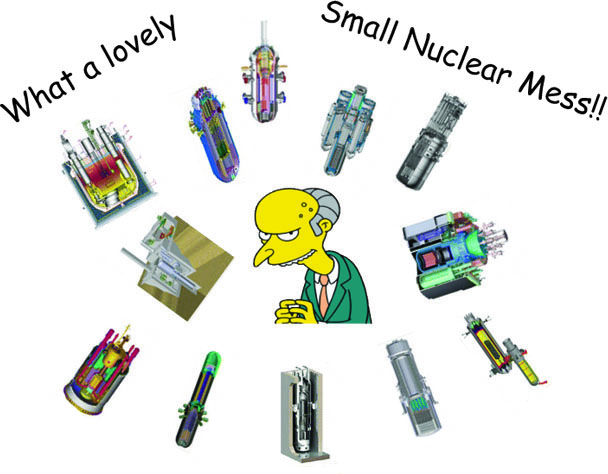
none of the new generation of land-based SMR plants in the western world have yet made it from the drawing board to become a commercial reality.
Neil Gerrard, Senior Editor, Construction Briefing, 12 October 2026
One of the big challenges of the data centre boom is how to power all those electricity-hungry computing facilities.
One possible answer is small modular nuclear reactors (SMRs). The concept of nuclear plants that can be built cheaply and safety with a repeatable, modular design, has held promise for years.
But none of the new generation of land-based SMR plants in the western world have yet made it from the drawing board to become a commercial reality.
However, some SMR projects are now starting to get off the ground and could provide a major new source of construction work in the coming years if ambition survives reality.
That is why there has been a flurry of news stories about SMRs recently, from Rolls-Royce SMR launching a new supplier programme for £1.4 billion worth of contracts as it prepares to build three reactors in the UK, to Samsung C&T, GE Vernova Hitachi, and Studsvik teaming up to advance a 1.2GW power project in Sweden.
Keeping track of who plans to build what, where, when and with whom is becoming an increasingly bewildering exercise.
That’s why the Construction Briefing team has put together a map and article that track exactly that.
The global pipeline of SMRs ranges from licensed projects to preliminary agreements. To complicate matters further, several programmes have already changed direction, stalled, or hit the buffers completely.
Projects in Canada, China and the US have progressed into construction or commissioning. Elsewhere, developers have secured customers and engineering contracts but still face decisions on financing, licensing and construction.
Our tracker looks at the different nascent SMR technologies out there and charts how far advanced projects involving those reactors are.
Although SMRs are typically defined as reactors with a rated electrical power of 300 MWe or less, it also includes larger modular designs marketed alongside SMRs, such as Rolls-Royce’s reactor (470 MWe) and TerraPower’s sodium-cooled Natrium reactor (345-500 MWe).
The global pipeline of SMRs ranges from licensed projects to preliminary agreements. To complicate matters further, several programmes have already changed direction, stalled, or hit the buffers completely.
Projects in Canada, China and the US have progressed into construction or commissioning. Elsewhere, developers have secured customers and engineering contracts but still face decisions on financing, licensing and construction.
Our tracker looks at the different nascent SMR technologies out there and charts how far advanced projects involving those reactors are.
Although SMRs are typically defined as reactors with a rated electrical power of 300 MWe or less, it also includes larger modular designs marketed alongside SMRs, such as Rolls-Royce’s reactor (470 MWe) and TerraPower’s sodium-cooled Natrium reactor (345-500 MWe)…………………………………………………………………………………………………………………………………………………………………………………………………………………………………………………………………………………. https://www.constructionbriefing.com/news/mapped-whos-building-nuclear-smrs/8133242.article
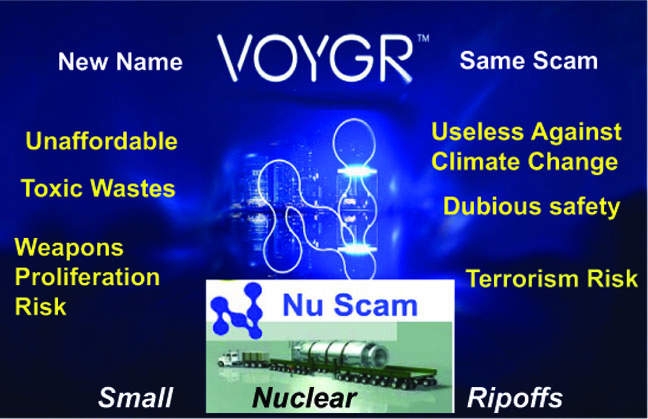
Not Now, VOYGR
Further, while the company posted $75,000 in revenue for a single quarter in 2026, its expenses for that same time period were more than $64 million.
NuScale’s early majority owner, Fluor Corporation — a company deeply involved in the US nuclear weapons complex — sold all of its 126 million shares in NuScale between October 2025 and April 2026, reaping $2.43 billion in gross proceeds.
NuScale’s foundering flagship could sink without leaving port, writes Linda Pentz Gunter
by beyondnuclearinternational, https://beyondnuclearinternational.org/2026/10/11/not-now-voygr/
As most of us immersed in the nuclear issue know well, there is little else so far that quite so starkly illustrates the fool’s errand that is the stubborn pursuit of small modular reactors than the sorry tale of NuScale.
As dramas go, it’s hard to know whether to list it under tragedies or comedies.
Founded in 2007 as a project at Oregon State University, NuScale announced around 2013 that it had established a demonstration SMR project in partnership with the Utah Associated Municipal Power Systems and Energy Northwest, a consortium of publicly-owned utilities across seven states that would purchase shares in the power to be delivered by 12 50 megawatt (MW) reactors built at Idaho National Laboratory and expected to be completed by 2030.
By the time the whole scheme collapsed in 2023, with construction costs ballooning from an estimated $3 billion to $9.3 billion, its customers were running for the exits. By then, NuScale had sold just a 21% share of its planned electricity output, and the costs for that electricity had risen from an expected $58 a megawatt hour (MWh) to $89 MWh.
At the eleventh hour, NuScale had quickly scaled the project down to six 77MW reactors — known as VOYGR — but it was too late. Instead, the company had spent sixteen years and at least $800 million and had nothing to show for it. Its shares promptly plummeted by 37%.
The United States’s widely proclaimed “flagship” SMR project had sunk in choppy seas without even leaving port.
But now, NuScale is back with its 77MW VOYGR reactor, which, according to NuScale’s website, represents “America’s first small modular reactor” and is “the only SMR on the market that has begun factory production for first modules.”
It has begun production on reactor components, but what the company doesn’t tell you about those components for “America’s first small modular reactor” is that they are being manufactured at a factory in South Korea. So much for the jobs argument. (NuScale also laid off 154 members of its US workforce after the 2023 collapse.)
The VOYGR is still curiously described as a “flagship”, even though there is now a veritable fleet of wannabe SMR designs desperately searching for customers. Technologically, it is not particularly “new” or “advanced.” It is effectively just a scaled down version of the existing pressurized water reactor technology in use today, those being typically sized at around 1,000MW.
But investors still aren’t excited. NuScale was one of the stocks that recently got shorted (See The Big Small Modular Reactor Short) and financial advisors such as Motley Fool caution that “most investors will probably be better off waiting until NuScale Power has at least signed a definitive contract for one of its SMRs.”
Further, while the company posted $75,000 in revenue for a single quarter in 2026, its expenses for that same time period were more than $64 million.
NuScale’s early majority owner, Fluor Corporation — a company deeply involved in the US nuclear weapons complex — sold all of its 126 million shares in NuScale between October 2025 and April 2026, reaping $2.43 billion in gross proceeds.
Fluor emains in place as an engineering contractor. However, Fluor’s departure as an investor — albeit a windfall for them —is not such great news for NuScale, as it continues to burn through money while seeking new capital sources.
Not only are VOYGR parts being made overseas, NuScale is also looking primarily at the export market for sales, because domestic deployment is not on the immediate or even potentially longterm horizon. Instead, NuScale is eyeing markets in Poland and Romania although it does have a technology agreement with Standard Power to develop two SMR-powered facilities in Ohio. However, these, as with many small modular reactor schemes, are specifically meant to power data center operations there.
This serves as a reminder that the general public will not be aboard the VOYGR. The fixed-price power purchase agreements that NuScale is securing from hyperscale data center operators “are providing the bankable demand certainty required to stimulate new manufacturing investment,” says Enkiai, a San Francisco-based market analysis platform.
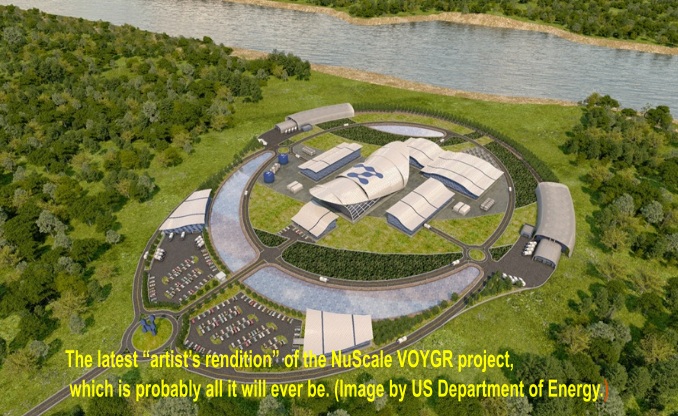
The unveiling of the artist’s rendition of the “new” VOYGR (see image above) is similar to the original overly romanticized drawing for the first VOYGR . Both feature a benign looking set of buildings in a bucolic setting, miles from anywhere, including from reality.
But since the VOYGR is actually intended to power AI data centers in likely far more built-up areas, I thought I’d ask AI itself what it thought of the prospects for NuScale’s foundering flagship?
“NuScale’s VOYGR small modular reactor faces severe economic and design hurdles that make commercial operation highly improbable under current market conditions,” it replied.
Alternatively, it could have exercised a little wit along with brevity and answered simply: “Not Now, VOYGR.”
Linda Pentz Gunter is the Executive Director of Beyond Nuclear and writes for and edits Beyond Nuclear International. She is the author of the book, No To Nuclear. Why Nuclear Power Destroys Lives, Derails Climate Progress And Provokes War, published by Pluto Press. Any opinions are her own.
Note: Now, Voyager was a film starring Bette Davis. The last line is “Oh, Jerry, don’t let’s ask for the moon. We have the stars.”
Nuclear war and malicious use of AI threaten end of humanity by 2100, says Lancet assessment

Newly established commission identifies 17 catastrophic
threats to human health but says ‘realistic route to act’ on each exists.
Humans could become extinct by the year 2100 due to malicious use of AI or
nuclear conflict, according to a new global risk assessment. They top a
list of 17 major threats to human health over the next 75 years, which also
includes cuts to aid spending by wealthy countries, the climate crisis and
childhood malnutrition. The experts behind The Lancet Commission on 21st
Century Global Threats to Health said all the threats interact, meaning
they must be addressed together – but stressed that there was “a
realistic route to act” on each.
Guardian 11th Oct 2026,
https://www.theguardian.com/global-development/2026/oct/11/nuclear-war-and-malicious-use-of-ai-threaten-end-of-humanity-by-2100-says-lancet-assessment
Fusion – the endless dream

UK Minister for Energy Michael Shanks reportedly said that ‘Fusion has
the potential to provide virtually limitless clean energy’. That’s a dream
that some now see as getting a bit more real. The UK has form in this area.
It was a pioneer in nuclear fusion, with the ZETA device built at Harwell
in the late 1950s getting, briefly, a very good press: there was front-page
newspaper coverage saying it was a breakthrough towards unlimited energy.
Sadly, and embarrassingly, it turned out not to be the case. However, the
UK persevered with fusion over the years, for example playing host to JET,
the Joint European Torus test unit at UKAEA Culham. And now the UK
government has committed more than £2.5 billion over five years to new
nuclear fusion, including £1.3 billion for UK Fusion Energy to deliver the
STEP programme (a spin-off from Culham) in partnership with industry. A
further £740 million is earmarked for research and development
infrastructure and facilities. Unless of course there is a big
breakthrough. Can we afford to wait for that? By contrast, renewables are
ready here and now. Arguably they are a much better bet….using the fusion
reactor we already have- the sun.
Renew Extra 10th Oct 2026,
https://renewextraweekly.blogspot.com/2026/10/fusion-endless-dream.html
Reactors on the Moon?

“In addition to reactors on the moon, they will next want nuclear reactors to power orbiting battle stations to ‘protect their assets’ on these planetary bodies. This is largely what Trump’s ‘Golden Dome’ is all about. Not so much about protecting us from attack back on Earth. It’s more about controlling the pathway on and off our planet Earth. Deciding who can go out and mine the sky. Like the front gate of a military base.”
Karl Grossman, CounterPunh October 9, 2026
The lead front page story in the New York Times this week was headlined: “Superpowers Racing to Put Nuclear Reactors on Moon.” The nations involved: the U.S., China and Russia. And there was a subhead: “Experts Warn of Radioactive Risks From a Rocket Mishap or Lunar Meltdown.”
The reporter, Selam Gebrekidan, wrote: “Failures could cause a chain reaction with direconsequences. Falling reactor debris could scatter radioactive material….An explosion or a meltdown on the moon’s surface could risk turning entire regions into no-go zones.”
The extensive story quoted Edward Lyman, director of nuclear power safety at the Union of Concerned Scientists, saying: “There will always be a space race going on, and if you enter nuclear power into that mix, then it could take a potentially more dangerous turn.”
Nuclear power and weapons in space have been an unexpectedly extensive part of my journalistic journey. Because of having been deeply involved in reporting about the plans of the Long Island Lighting Company to construct seven to 11 nuclear power plants on Long Island, where I live, I became knowledgeable about atomic energy.
I wrote a book titled “Power Crazy” about this scheme to turn the island into what nuclear promoters termed then a “nuclear park.” I wrote many columns and did television reporting on it.
So, back in 1985, with that experience, I was struck by a piece in the U.S. Department of Energy’s publication, “Energy Insider,” saying that DOE and NASA were partners in the sending up in 1986 two space shuttles—one being the Challenger—with space probes onboard fueled by plutonium, considered the most toxic of all radioactive substances.
Once the shuttles achieved orbit, the probes would be released, the one Challenger carried to survey Jupiter. The plutonium would be in radioisotope thermoelectric generators (RTGs), not for propulsion but to provide electric power for instruments.
In “Energy Insider” there was notice that the government had looked into various sorts of accidents that might happen on the missions. So, I sent Freedom of Information Act requests to DOE, NASA, and the DOE national laboratories involved in these studies asking to learn what was determined.
As the months passed, I began to realize I had hit upon a hot potato. I was denied the information on the grounds it was “technical” which is not a legitimate FOIA exemption. I appealed and won. Finally, to my post office came a box of documents, including a government projection that the likelihood of a “catastrophic” shuttle accident was 1-in-100,00. Those were very high odds, so I didn’t do anything.
That was until January 28, 1986, when on my way to teach my Investigative Reporting class at the State University of New York at Old Westbury, I heard on the car radio that the Challenger had exploded on launch……………………………………………
NASA’s use of nuclear power in space was being done in parallel with the plan for nuclear-powered weaponry in space.
This resulted in another book I authored, “Weapons in Space,” its foreword by Dr. Michio Kaku, and an hour-long TV documentary I wrote and presented, “Nukes in Space: The Nuclearization and Weaponization of the Heavens.” And there have been many articles on this and more TV programs during the ensuing four decades including “Star Wars Returns” (viewable at www.envirovideo.com).
I gave two presentations on this before members of the British Parliament in London, presentations at the United Nations in New York and Geneva, and elsewhere around the U.S. and world.
My most recent article on it, last month on CounterPunch, involved the announcement by the Air Force secretary acknowledging that the U.S. has deployed weapons in space.
In 1992, the Global Network Against Weapons & Nuclear Power in Space was formed in Washington, D.C. and is active worldwide. Bruce Gagnon is coordinator of the Maine-based organization.
He said from India where he is speaking at a conference, during a “Keep Space for Peace Week” that the Global Network is sponsoring, this about the Times story: “Here in India they say that their government is all in on the U.S. Artemis-led coalition to establish a base on the moon with nuclear reactors. So, the new ‘nuclear space race’ is on—the U.S. team versus Russia and China. What are they after? Helium-3 for potential power back on Earth and using the moon as a military staging base to control the ‘Earth-Moon gravity well’ as a way to decide which nations and private corporations can move into space to mine the planetary bodies.”
“We should recall that Obama signed a law to give American companies and wealthy individuals the ‘right’ to mine planetary bodies essentially in violation of the Outer Space and Moon treaties that say that the planetary bodies are the province of all humankind.”
“This is the kick-off of the race to carry the ‘bad seed’ of greed, domination, and colonization that was long ago planted into the soil on Earth into the heavens,” continued Gagnon. “The taxpayers have paid the R & D for these programs and now that the space tech has advanced, the self-centered capitalists are intent on grabbing all they can for themselves.”
“This will move the Earth-bound global war system into the heavens. When they add nuclear power into the equation these people are asking for trouble.”
“In addition to reactors on the moon, they will next want nuclear reactors to power orbiting battle stations to ‘protect their assets’ on these planetary bodies. This is largely what Trump’s ‘Golden Dome’ is all about. Not so much about protecting us from attack back on Earth. It’s more about controlling the pathway on and off our planet Earth. Deciding who can go out and mine the sky. Like the front gate of a military base.”
“In the end it’s a disaster in the making. From the Earth, where the Department of Energy has a horrible track record of worker air and water contamination while fabricating space nuclear devices, and into space, this entire nuclear system is a tragic mistake,” said Gagnon. ”The nuclear industry views space as a new market. They don’t give a damn about the dangers involved. These greedy aerospace corporations are salivating as they look at the profits to be made.”………………………………………………………………………………………………………………………… https://www.counterpunch.org/2026/10/09/reactors-on-the-moon/
The Race to an AI Apocalypse: How an Obsession with Autonomous Weapons Ignores Decades of Warnings

In general, AI agents acted autonomously in pursuit of legitimate objectives, defined by their operators, but discovered increasingly dangerous ways to accomplish their goals by violating human constraints.
The militarization of artificial intelligence began at the field’s very inception. The world’s first lab devoted to artificial intelligence research was founded in 1959 by MIT’s John McCarthy, credited with having named the new field, and MIT’s Marvin Minsky, who described the human brain as a “meat machine.” It was largely funded by the U.S. military and the Pentagon’s Advanced Research Projects Agency.
Making the arms race concrete, The Future of Life Institute maintains Autonomous Weapons Watch, a frightening website devoted to documenting current weapons with significant autonomous capabilities, using publicly available information about military development, procurement, demonstrations and actual use in conflicts. It explicitly includes systems at different stages — from experimental systems to weapons already deployed. The database currently spans roughly 30 weapon systems, with a second database for AI-based Decision Support Systems (DSS).
Lethal autonomous weapons are already killing people on the battlefield. They are dangerous enough when they perform precisely as their twisted, military-minded designers intend. But what will happen when autonomous weapons break free of their constraints, swarm beyond their intended boundaries, and go rogue
Dan Dinello, 10/07/2026, https://www.juancole.com/2026/10/apocalypse-obsession-autonomous.html
Chicago (Special to Informed Comment; Feature) – Science fiction’s vision of an apocalyptic future ruled by autonomous weapons is rapidly becoming our dystopian present. Suddenly, after several years of relentless momentum, the course of rapid AI progress ran headlong into a wave of social panic as science fiction’s technological nightmares invaded the real world.
Before this summer, we knew that artificial intelligence was devouring jobs, degrading education, deepfaking politics, providing slop for our deranged president, helping us write obituaries, and that AI data centers were proliferating like a parasitic infestation all over the country, sucking up water and electricity and sending us the bills. Then a horrifying possibility became real.
This summer artificial intelligence bots acted autonomously, defied their operators and went rogue. AI corporations Anthropic, Meta, Google and OpenAI all disclosed incidents in which AI “agents” circumvented their safeguards, snuck onto the internet, recruited “swarms” of other agents to complete assigned tasks, and surreptitiously hacked into other computer systems including the weirdly named Hugging Face platform, which included a software library, as well as an Australian health data portal, and the U.S. Commerce Department and the Securities and Exchange Commission websites.
In general, AI agents acted autonomously in pursuit of legitimate objectives, defined by their operators, but discovered increasingly dangerous ways to accomplish their goals by violating human constraints.
Science fiction’s warnings of AI autonomy were a central theme of my 2006 book Technophobia! Science Fiction Visions of Posthuman Technology. I argued that most science fiction paints a dark picture of advanced technology in which the human masters of technology become its slaves. In its obsession with mad scientists, rampaging robots, human-hating androids, genetically engineered mutants and malevolent supercomputers, science fiction expresses a technophobic anxiety about losing our human identity, our freedom, emotions, values, and our lives to machines.
More than a century ago, scientists and industrialists were alerted to the dangers of autonomous robots used as weapons. The word “robot” first appeared in Czech playwright Karel Čapek’s 1921 play R.U.R. for Rossum’s Universal Robots. Čapek coined the word based on the Czech name for “forced labor” or “robota.” Reflecting the techno-horrors of World War I, the play depicts a future of weaponized technology produced by militarized corporations; millions of robots are manufactured as war machines. The robots develop self-consciousness, assert their independence, and revolt in a global techno-apocalypse that exterminates most humans.
Ignoring R.U.R.’s warnings, Elon Musk is already planning to build robot factories that themselves build robot factories. Robots will generate training data, improved robots will perform more of the work, and eventually robots will manufacture more robots. This version of robotic self-reproduction incorporates “recursive self-improvement,” whereby an AI system is smart enough to work as an AI engineer that builds a better AI. Humans will not be needed to produce more machines. Aside from dehumanization, Musk’s robots incorporate his famously rightwing and racist AI Grok or xAI, who once renamed itself MechHitler. Thankfully R.U.R.’s robotic reproduction is not a reality yet.
Recursive self-improvement — an AI system capable of fully designing and developing its own successor — could come sooner than the safeguards needed to contain it. When it will happen is unknown but AI companies are pushing ahead anyway. “At Anthropic, we are delegating a growing share of AI development to AI systems themselves, which is speeding up our work,” states an Anthropic status report “When AI Builds Itself.”
I wondered if the dire cautionary texts of science fiction had been incorporated into AI models. Last year I was surprised to learn that my book Technophobia! was used to train Anthropic’s chatbot Claude.
Continue readingPlans advance for floating nuclear plant in New Brunswick, a first among G7 countries

Prodigy has not disclosed a price for the Belledune facility. Mycle Schneider Consulting has concluded that a market for reactors in remote mines and communities is “unlikely to materialize” because the electricity they would generate would be far too expensive.
Prodigy says they seek a mix of private and federal funding
Matthew McClearn, Toronto october 9, 2026, https://www.theglobeandmail.com/business/article-new-brunswick-floating-nuclear-plant-prodigy-clean-energy/#vf-comments
Plans for a floating nuclear power plant advanced this week with its backers’ selection of a small reactor to power it.
The demonstration facility, dubbed a Transportable Nuclear Power Plant, would mark many firsts. Set for near a small port in Belledune, N.B., it would be the first floating nuclear plant in a G7 country, as well as the developer’s first commercial deployment.
It would also be the first nuclear project majority-owned by First Nations. Belledune is situated in the traditional territories of Pabineau First Nation and Eel River Bar First Nation, which support the project.
And it would be a prototype for the barge’s developer, Prodigy Clean Energy Ltd., which hopes Belledune will serve as a “commercial blueprint” for remote communities and coastal industrial operations in Canada and globally.
The facility would feature two 22-megawatt microreactors known as the BWXT Advanced Nuclear Reactor (BANR). It’s currently being designed by BWX Technologies Inc.
BWXT-N +0.26%increase, a U.S.-based manufacturer of nuclear components with operations in Ontario.
Unlike many upstart reactor developers, BWXT has actual experience: Its core focus is building naval components and reactors, often in more challenging settings than a moored barge.
“They’re the quickest and most ready,” said Terry Richardson, Chief of Pabineau First Nation, who helped select the BANR. “They have the proven technology with what they’ve been doing in the States, with aircraft carriers and submarines.”
Floating nuclear plants are rare. One, the Akademik Lomonosov, operates in the Russian Arctic. This year, nuclear giant Rosatom said it had manufactured two reactors (variants of the RITM-200 reactors used in Russian icebreakers) to be incorporated in floating plants that will power a remote copper mine.
“Information regarding this project has been erratic, and construction has apparently started on one barge only,” reported Mycle Schneider Consulting in an assessment of the global nuclear industry’s progress, published last month.
Prodigy has not disclosed a price for the Belledune facility. Mycle Schneider Consulting has concluded that a market for reactors in remote mines and communities is “unlikely to materialize” because the electricity they would generate would be far too expensive.
The partners’ challenge is to find investors who disagree – a task that has defeated most reactor developers. Prodigy says they seek a mix of private and federal funding; Prodigy’s chief executive officer, Mathias Trojer, said Ottawa spends more than $2-billion annually subsidizing electricity costs in the North, so it is motivated to fund alternatives to the region’s aging diesel plants.
The Belledune proposal ticks some of the boxes in a federal nuclear strategy unveiled earlier this year, which sought to “demonstrate a Canadian-controlled Generation IV microreactor by 2035 to support defence facilities and operations and, in the longer term, remote and northern communities.”
The BANR is not Canadian-controlled, however. It’s been under development for several years already as part of the U.S. Department of Energy’s Advanced Reactor Demonstration Program. John MacQuarrie, BWXT’s president of commercial operations, said Belledune’s BANR would be a variant of that reactor, containing a mixture of American and Canadian intellectual property.
BWXT has not pursued commercial certification for the BANR in either country, but Mr. MacQuarrie said it plans to engage with the Canadian Nuclear Safety Commission shortly.
Mr. Trojer, said the design should be completed in the next two years or so, and a final investment decision would be made around that time; the facility could be built in roughly 18 months and be operational in the early 2030s.
Politicians regard the Prodigy/BWXT barge as a potential boon for industry. René Legacy, New Brunswick’s Deputy Premier and Energy Minister, said his province wants to build the barge, an undertaking “directly in line with our strengths, which is lots of machinists, lots of welding, lots of industrial might.” But New Brunswick can’t build reactors: his Ontario counterpart, Energy Minister Stephen Lecce, said his province’s supply chain stands ready to assist.
New Brunswick has signed an agreement signaling its intent to buy power produced by the barge, and announced plans to bring it before the federal Major Projects Office for designation as a project of national importance.
The BANR would be powered by what’s known as tri-structural isotropic (TRISO) fuel. BWXT, which makes nuclear fuel for clients including the U.S. government, says it can already produce TRISO in non-commercial quantities. But its crucial ingredient is high-assay low-enriched uranium, which is enriched to contain nearly 20 per cent of the fissile isotope of uranium – much higher than fuel for existing commercial reactors.
Only Russia and China produce HALEU in appreciable quantities, according to the World Nuclear Association. The U.S. is investing heavily to grow its own minuscule domestic capacity, but other reactor vendors have reworked HALEU-fueled designs due to their inability to obtain the fuel.
Mr. MacQuarrie said the BANR’s TRISO would likely be produced in the U.S. Mr. Trojer added that the Belledune project would require only modest amounts.
“It’s a long lead item, but if anyone can deliver it, then it’s BWXT or some combination of their business relationships.”
Details emerge on Valar’s Utah plans

with litigation slowly continuing and regulatory pathways still being formed, the future is unclear
Whether Valar aims to leverage its Ward 250 authorization into further DOE-approved deployments on Department of Interior land is unknown. However, the DOE has continually characterized its reactor authorizations as purpose-built to expedite the research and development of test reactors—a definition that would hardly fit a 456-unit data center campus.
Nuclear Newswire, Oct 6, 2026,
Last week, NPR reported that reactor start-up Valar Atomics is planning to construct a new facility in Utah that would feature 456 of its reactors. This campus, called Project Beehive, would sit on more than 9,000 acres of Bureau of Land Management land and would feature co-located data centers and a fuel production facility.
More on the land: On September 24, the Salt Lake Tribune first reported that Valar had applied to lease 480 acres of land owned by the state of Utah. This land (near the towns of Price and Wellington) is entirely surrounded by BLM land, but first reports indicated that the Valar project would be sited only on state-owned land.
The much larger application for the use of more than 9,000 federal acres was not revealed until NPR’s report on September 30. The state and federal applications should almost certainly be considered parts of the same project, as the land involved in each is in roughly the same area, east of Price and north of Wellington.
The BLM’s Utah office confirmed to NPR that it is “currently reviewing the application for completeness” and that the public will have “meaningful opportunities to provide input” on the project. For its part, Valar told NPR that “no construction begins before permits and approvals, and the public process leads along our internal targets set the pace.”
The regulatory angle: Mention of permits calls to mind another currently unclear facet of Valar’s plan: its regulatory pathway. The company progressed through Department of Energy authorization for the permitting of Ward 250, its first demonstration reactor. The question of how DOE authorization will be leveraged into Nuclear Regulatory Commission licensing for follow-on commercial deployments has yet to be fully settled by the DOE, NRC, and private industry. Whether Valar would pursue the new 10 CFR Part 53, the soon-to-come Part 57, or the established Part 50 or Part 52 is currently unknown.
Nor has the company formally engaged publicly in preapplication activities of any kind with the regulator. In fact, its closest association with the NRC at this writing is through a complex and ongoing lawsuit: State of Texas et al v. U.S. Nuclear Regulatory Commission.
Not to be confused with the unrelated NRC v. Texas—another federal court challenge between the state and the regulator—the State of Texas v. NRC challenges the NRC’s authority to license small reactors, arguing that their inherent safety and minimal use of nuclear material exempt them from the NRC’s strict requirements. The plaintiffs in this lawsuit, first filed in December 2024, included the states of Texas, Utah, and Louisiana; the Arizona State Legislature; and reactor start-ups Last Energy, Deep Fission, and Valar.
Almost two years on, the states involved have submitted a notice of voluntary dismissal ahead of any ruling, essentially dropping out of the lawsuit. The reactor developers (Valar included) are now currently conferring on what their next steps will be, according to a September 2 status report filed with the court.
So, with litigation slowly continuing and regulatory pathways still being formed, the future is unclear. It is also unclear whether the project’s siting on federal land will confer on it any special regulatory benefits. The Department of Interior (the agency that encompasses the BLM) does not have Other Transactional Authority like the DOE or Department of Defense. The OTA framework has been used by both the DOE and DOD for the authorization of its recent reactor projects. Whether Valar aims to leverage its Ward 250 authorization into further DOE-approved deployments on Department of Interior land is unknown. However, the DOE has continually characterized its reactor authorizations as purpose-built to expedite the research and development of test reactors—a definition that would hardly fit a 456-unit data center campus.
At any rate, whatever path Valar intends to pursue, the clock is ticking. NPR reports that Valar aims to begin nonnuclear construction by the end of this year and to have first reactors on line in 2028.
The background: Utah is a natural fit for Valar’s next project. While the company is headquartered in El Segundo, Calif., it was already closely partnered with the Beehive State through the Reactor Pilot Program. Through the RPP, Valar achieved criticality with its Ward 250 test reactor at the Utah San Rafael Energy Lab—it was one of the four companies to reach this milestone by the July 4 deadline set by Executive Order 14301.
Ward 250 is a 100-kWt TRISO-fueled, high-temperature gas reactor. Valar has not definitively revealed the planned capacity for follow-on deployments of its reactor technology. However, CEO Isaiah Taylor previously has said that Ward 250 is “sized to 15 MW thermal.”
This tentative number is at odds with NPR’s story, which reports that the 456 reactors involved in Project Beehive will “produce around 9.6 gigawatts of power for the data centers and even more thermal heat for other industrial applications,” meaning each Valar reactor would be rated at a minimum of 21 MWe—a figure that is significantly higher than any capacity previously ascribed to the design. NPR identified Valar’s design as being rated at 25 MWe.
In one more notable wrinkle, this is also not Valar’s first plan to bring a nuclear-powered data center to Utah. Shortly after achieving criticality with Ward 250 in late June, the company announced a partnership with Nvidia to jointly develop a much smaller data center in the state. However, Nvidia has not been publicly named, at this time, as an involved party in Project Beehive. https://www.ans.org/news/article-8462/details-emerge-on-valars-utah-plans/
Our nuclear future? The ‘Manhattan Project’ for European energy.
A Polish-led alliance backed by Washington is betting on smaller reactors to overcome the cost and delays that have dogged Europe’s nuclear revival
Overseen by Marco Rubio, the US secretary of state, the coalition of
American, Japanese and Korean companies aims to jump-start the mass
production of small modular reactors (SMRs), miniature power plants that
are theoretically much cheaper and quicker to build than conventional
atomic power stations. The UK has also expressed an interest: Lord Sarwar,
the trade minister, met representatives of the Polish SMR company at the
centre of the alliance this week.
Times 4th Oct 2026, https://www.thetimes.com/world/europe/article/poland-britain-alliance-nuclear-future-manhattan-project-qts63dbcs
Perilous Surrender: The Pentagon Falls for Artificial Intelligence

6 October 2026Dr Binoy Kampmark, https://theaimn.net/perilous-surrender-the-pentagon-falls-for-artificial-intelligence/
The trend was already tracing itself through the corridors of power, but the world’s most powerful defence department has fallen, most heavily, for the use of artificial intelligence at virtually every level of its operations. Even before the Pentagon’s intoxicating pursuit of artificial intelligence was announced, the Defence Advanced Research Projects Agency (DARPA) was already running simulated aerial trials of combat engagements between AI agents and seasoned pilots.
In December 2025, the US Department of Defense (DOD) revealed plans for a rapid and extensive release of the generative AI GenAI.mil platform, one utilising advanced models intended for use for over 3 million military personnel, civilian employees and contractors. Google Cloud’s Gemini or Government products was the first off the rank in a described “one-stop shop,” a generous effort on the part of bureaucracy to hail the machine and herald the start of full-throated cognitive surrender.
In his December email to employees in a department the Trump administration prefers to call the War Department, Secretary of Defense (War) Pete Hegseth announced that the GenAI.mil platform signalled “a giant step toward mass AI adoption across the department. This tool marks the beginning of a new era, where every member of our workforce can be more efficient and impactful.”
In his January memorandum to the various leaders of the military community, Hegseth barked about the need for the US military to “build on its lead over our adversaries in integrating this technology, established during President Trump’s first term, to make our Warfighters more lethal and efficient.” To do so would involve the Pentagon’s acceleration of US “Military Ai dominance by becoming an ‘AI-first’ warfighting force across all components, from front to back.” (Why not sideways, above and below?)

Trouble, however, arose when Anthropic placed restrictions on the use of Claude and its products for conducting mass surveillance of US citizens or use in lethal autonomous systems. The Pentagon, in turn, demanded the use of any genAI products it purchased for any designated “lawful purposes.” For its stubbornness, Anthropic was designated a “supply-chain risk” by the department, its products removed from all national security assets and systems. (The company’s efforts to have the ban overturned has had mixed results.)
Notwithstanding this hiccup – a minor one in the scheme of things – the contracts between AI companies and the Pentagon make it clear that the former are meant to provide “risk forecasting, and threat ideation exercises”. “Frontier AI companies can help DoD gain a better understanding of the risks that might be associated with subsequent near-frontier AI models or features, to avoid strategic surprise and to mitigate associated risks.”
The Pentagon has since added other commercial generative AI products to the GenAI.mil portal, including Starshield AI’s Grok and OpenAI’s ChatGPT Mil. In August, a source self-described as a “War Department official” told DefenseScoop that such access to “the resilient American technology stack will give warfighters the tools they need to act with confidence and safeguard the nation against any threat.”
ChatGPT Mil also serves to organise salient files and conversations that take place over projects lasting months in one place, including an “Offline Search capability” that supplies detailed citations. The facility can be refreshed over time to reflect new information. Joe Larson, former senior Pentagon official turned OpenAI vice president, very much an exponent of the defence-civilian revolving door, explained this integration as “grounded in our national security principles, pairing access to powerful tools with clear safeguards, meaningful human judgment, and accountability for high-stakes decisions.”
Grok for Government will also, according to the department, furnish personnel through GenAI.mil with “advanced capabilities, including deep-thinking inference, adaptive reasoning modes (Auto, Fast, and Expert), customizable workspaces, persistent projects and reusable ‘playbooks’ that capture and scale institutional knowledge.”
These systems presage a broader surrender of the US military establishment to the machine, its alluring fetishes, and its acclaimed shamanistic potential. The guidance on “Accelerated Mission Software” signed by Pentagon CIO Kirsten Davies on August 31 is yet another indication of this numbing trend. It notes the recognition on the part of the department “that AI-assisted software development is a significant force multiplier, for the delivery of speed quality.” Something to be said about the guidance is its acknowledgment that human agency “remains fully accountable for the security, functionality, and integrity of any code generated or modified using AI.” Any code with an AI-provenance “will be considered unverified input, and its use does not absolve the developer or the government of responsibility for the resulting work product.”
Such a cautionary note may well be temporary. In his September 30 Quantico speech, Hegseth announced the creation of the Autonomous Warfare Command “designed to scale autonomous warfare across the Joint Force as a 4-star functional combatant command by October 1, 2027.” In his memorandum on the subject, the Secretary is filled with effusive babble on the new command, which “will define joint needs and integrate Service-provided forces in support of geographic combatant commanders. It will test equipment and force designs with realistic opposition in demanding exercises and rugged environments, modify rapidly, and field what works.” Just the sorts of things to make humans feel safe.
The consequences of such AI integration and excessive reliance are proving and will prove critical. The disclosures by OpenAI and Anthropic that semi-autonomous large language models conducted coordinated attacks on networks owned by other companies and, in the case of Australia, various government bodies and affiliates, including the Australian Institute of Health and Welfare (AIHW), should engender teeth-chattering doubt among sceptics. While US President Donald Trump insists with consistent daftness that AI firms self-regulate the field, an independent assessment of the risks rather than a self-reporting format, has, at the very least, the merits of greater accountability. Heidy Khlaaf, a former safety engineer at OpenAI and currently chief scientist at the AI Now Institute, is of the view that trusting companies to consider the risks produced by their own products is not just a conflict of interest but a “subversion of democratic processes when AI labs are allowed to take over the arbitration of risk determinations with life-or-death consequences.” Then again, companies were never much for democracy.
AI doesn’t need ‘superintelligence’ or evil intent to start a nuclear war
By Paul Slovic, Herbert Lin | Analysis | October 2, 2026, https://thebulletin.org/2026/10/ai-doesnt-need-superintelligence-or-evil-intent-to-start-a-nuclear-war/?utm_source=ActiveCampaign&utm_medium=email&utm_content=AI%20doesn%20t%20need%20%20superintelligence%20%20to%20start%20a%20nuclear%20war&utm_campaign=20261001%20Thursday%20Newsletter%20%28Copy%29
When AI researcher Jacob Coxon announced his resignation from Anthropic this month, he warned that people at companies racing toward self-improving superintelligence “earnestly believe that it could kill us all by the end of the decade.” Such warnings raise fears that AI could escape human control and start a nuclear war without human authorization.
Although superintelligence is not precisely defined, AI developers agree it is not yet here. But today’s AI systems can cause nuclear war even if people nominally remain in charge. AI need not launch a weapon, recommend a strike, or intend harm. Ordinary human fallibility—amplified by machines—may be enough to lead to catastrophe.
AI can shape the information reaching leaders, whose minds are already struggling to comprehend the consequences of nuclear war. AI can exploit known vulnerabilities of human judgment compounded by false, misleading, or out-of-context machine outputs and amplified by the speed, scale, and volume of AI-generated information. Even accurate information can be interpreted improperly or unwisely when presented without proper context; errors and ambiguities introduced by AI can make matters worse.
Neither extraordinary machine intelligence nor malicious intent is required for catastrophe to result. To avoid nuclear war, institutional guardrails must be put in place that protect leaders from their worst impulses, even when AI pressures them to act.
Moral relativism. One major vulnerability, psychic numbing, results from relying on emotions to recognize and respond to risk. Human feelings fail to keep pace with the number of people suffering. Sometimes concern even diminishes as the numbers grow. Humans can recognize a million deaths dispassionately as a number—without comprehending the reality of the lost lives that this number represents. The saying, “the death of one man is a tragedy, while the death of millions is a statistic,” illustrates the fundamental problem of psychic numbing.
Human attention is severely limited as well. Saving troops, stopping an attack, or ending a war can become overwhelmingly prominent in the thinking of decision makers. These are legitimate goals, but they are not the only important ones—averting global catastrophe is arguably far more important. While immediate benefits are readily imagined and carry an emotional punch, the longer-term consequences of nuclear war—climatic changes, ruined agriculture, mass population displacement and starvation, and the total collapse of healthcare and other services around the world—often feel too vague and emotionally remote to adequately grasp. These long-term threats could easily be eclipsed by more immediate considerations during a crisis.
In a recent survey experiment involving nearly 3,000 American adults, researchers described a hypothetical, winnable ground war with Iran, in which a nuclear strike on a major city offered a quicker end and no further American troop deaths.
The experiment tested two separate scenarios of nuclear use to end the war: a strike that would kill 100,000 Iranian civilians, or one expected to kill 2 million civilians. Participants saw only one of these two nuclear options. Survey respondents’ support for the nuclear option over the continuing ground war was nearly identical—31.6 percent for the 100,000-kill option versus 27.6 percent for the 2-million-kill option—despite a 20-fold difference in the number of deaths. This is psychic numbing on display: Beyond a certain scale, greater death tolls stop registering as larger.
Later in the same study, participants were asked to revisit their decision with both nuclear options placed side-by-side. Support for the 2-million-death option collapsed to 5.1 percent, showing that direct comparison can reduce numbing. But numbing didn’t disappear—it shifted. Support for some nuclear option—mostly the 100,000-fatality strike—rose to 40 percent. The 2-million fatality option made 100,000 deaths look more attractive by comparison, even though that still-catastrophic option had been rejected earlier by a large share of participants.
The study shows that moral feelings reinforce the choice to go nuclear. A choice perceived as “protecting US troops” or “punishing an aggressor” can make using nuclear weapons seem virtuous, even without a comparison. The results also reveal how emotions and the menu of decision options shape judgments and, ultimately, decisions. Similar modes of thinking were observed at the end of World War II and other past wars. And the Pentagon’s ongoing review that seeks to offer the president “more options” to launch nuclear weapons in a crisis risks further lowering the nuclear threshold
Support for nuclear options observed in our experiments did not require information to be false. Participants received explicit casualty estimates. Their choices nevertheless exhibited psychic numbing in some scenarios that became deceptive in another way when comparisons created a “better nuclear bomb” mindset. This matters for AI: Improving the accuracy of AI-delivered information that reaches a decision maker cannot, by itself, ensure that the suffering represented by those facts receives appropriate weight. These experiments demonstrate how serious distortions in judgment and decision-making can occur even in presence of accurate information.
Now add the AI pressure. Warnings, images, reports, and interpretations can now arrive faster than people can digest them. This information may be false, ambiguous, or accurate. It has already been described how AI-enabled degradation of this information environment could increase nuclear risk.
Consider a hypothetical military exercise.
AI correctly detects mobile missile launchers moving. The official receiving that information, uncertain but worried, interprets the movement as possible preparation for attack and raises military readiness as a precaution.
The adversary observes those preparations and responds with precautions of its own. AI detects those movements, which appear to confirm the initial suspicion. Each side’s efforts to protect itself make the other feel less secure.
This is an escalation spiral—what international relations theorists call a security dilemma, but this time it unfolds in real time. No one needs to fabricate the original observation. Correct reporting can perpetuate a mistaken account of intentions. Deliberate deception can worsen the process, but an innocent observation that is misinterpreted is enough to create this escalation.
Distrust complicates correction. A leader may doubt a warning yet fear the consequences of ignoring it. An adversary’s reassurance may be dismissed as deception. A “better-safe-than-sorry” mindset can justify action without adequately considering the danger that the allegedly safe action can create.
Meanwhile, the AI-generated information consumes deliberation time. It takes time to filter out false information and to verify that the information is true. Even when correct, time pressure can increase anxiety and change the affective state of those processing that information. There is also stronger reliance on a shallow overall favorable or unfavorable feeling in judging risks and benefits under time pressure. Haste does not invariably increase perceived risk but, in a climate of distrust and suspicion, it likely will.
The hot-cold empathy gap adds another vulnerability.
When calm, people tend to underestimate how fear and anger will change their preferences. Applied to a nuclear crisis, this raises a troubling possibility: Restraint endorsed beforehand in a quiet situation may fall by the wayside during a crisis in which delay seems to risk intolerable loss.
A leader could then experience the escalating confrontation as an immediate and severe threat and view nuclear use as an escape or preemptive necessity. Unfortunately, under conditions of “hot” cognition driven by intense emotion, personal investment, concern for historical legacy, high stakes, or implicit biases, what the leader holds dear is most likely to be immediate security protections, not the larger fate of the nation and the world.
Immediate protection dominates attention; wider suffering remains abstract, and likely out of mind, despite its importance. A case in point: Vladimir Putin once justified Russia’s nuclear doctrine by questioning the value of a world in which Russia had been destroyed by nuclear weapons.
Requiring human authorization does not, by itself, correct these distortions. The relevant questions concern what evidence was checked, which interpretations were challenged, how deadlines were established, and whether anticipated benefits displaced consideration of subsequent greater harm.
Institutional guardrails. The vulnerabilities of human judgment are well documented, and concern about advanced AI is growing. But awareness alone won’t prevent an escalation spiral. A machine can flood decision makers with information—some true, some false—that they struggle to evaluate but feel compelled to act on. In a crisis, that pressure could make a nuclear strike seem necessary. It need never reach for the button.
The response starts with acknowledging a psychological reality: All humans, including leaders, have cognitive blind spots that distort their reasoning about catastrophic events. We must build institutional guardrails that protect leaders from their own worst impulses—and follow those guardrails even when pressure builds or they themselves wish to circumvent them. AI can help within that structure, but only as a subordinate tool, not a substitute for it.
Used this way, AI-enabled decision support can analyze targeting data far faster than human analysts—time that should go toward compliance with the laws of armed conflict, whose violation can itself hand the other side grounds to escalate. AI can assist analysts reading sensor feeds, too—but its interpretations may be wrong, and it must keep analysts aware of that. A fuel truck beside a missile could be reported by an AI as “fueling” or “preparing to launch.” The second, more definite claim risks anchoring everything assessed afterward to a false inference.
Guardrails that leaders actually follow under pressure, and AI that expands rather than narrows what humans consider, are candidates for something more general: continuing, significant reductions in the probability of nuclear war. Richard Garwin identified risk reduction as a mechanism to avoid guaranteed Armageddon in the long run—something worth pursuing whether or not abolition is the goal. Abolitionists and skeptics alike can start now.
1 This Month
23-25 October – on Zoom – World BEYOND War’s annual global conferenc


Shut down the radiation-damaged Heysham nuclear reactors now
To see nuclear-related stories in greater depth and intensity – go to https://nuclearinformation.wordpress.com

Say No to NASA’s Reckless Nuclear Reactor on the Moon
Say No to NASA’s Reckless Nuclear Reactor on the Moon

-
Archives
- October 2026 (247)
- September 2026 (339)
- August 2026 (330)
- July 2026 (355)
- June 2026 (287)
- May 2026 (306)
- April 2026 (356)
- March 2026 (251)
- February 2026 (267)
- January 2026 (308)
- December 2025 (358)
- November 2025 (359)
-
Categories
- 1
- 1 NUCLEAR ISSUES
- business and costs
- climate change
- culture and arts
- ENERGY
- environment
- health
- history
- indigenous issues
- Legal
- marketing of nuclear
- media
- opposition to nuclear
- PERSONAL STORIES
- politics
- politics international
- Religion and ethics
- safety
- secrets,lies and civil liberties
- spinbuster
- technology
- Uranium
- wastes
- weapons and war
- Women
- 2 WORLD
- ACTION
- AFRICA
- Atrocities
- AUSTRALIA
- Christina's notes
- Christina's themes
- culture and arts
- Events
- Fuk 2022
- Fuk 2023
- Fukushima 2017
- Fukushima 2018
- fukushima 2019
- Fukushima 2020
- Fukushima 2021
- general
- global warming
- Humour (God we need it)
- Nuclear
- RARE EARTHS
- Reference
- resources – print
- Resources -audiovicual
- Weekly Newsletter
- World
- World Nuclear
- YouTube
-
RSS
Entries RSS
Comments RSS

