Too late for a well-managed shutdown of Indian Point nuclear plant?
Three options to replace Indian Point stand out. One, local fossil fuel sources such as natural gas could generate more electricity. Two, excess hydroelectric power or wind power generated upstate or in Canada could be transported downstate. And three, consumers could drastically cut their electricity use.
All appear relatively simple and, together, offer promise. But closer inspection shows there is a great deal of complexity involved……
Has Time Run Out to Replace Indian Point’s Nuclear Power? Reuters, 8 July 11, By Alice Kenny, SolveClimate News Editor’s Note: In this three-part series, SolveClimate News examines the feasibility of closing the Indian Point nuclear facility in Buchanan, N.Y. The plant, now up for relicensing, faces demands for a shutdown by Gov. Andrew Cuomo and many environmental groups. This is part two.
Renewed backlash against New York’s Indian Point nuclear plant in the wake of Japan’s disaster has forced politicians and energy experts in the state to again confront tough questions about how to permanently replace the facility’s electricity.
Now, with the plant up for relicensing, some observers warn that time may have run out for a well-managed and gradual shutdown of the complex, located just 24 miles from America’s most populous city…… Continue reading
Pros and cons of moving nuclear wastes from pools to casks
 Haste vs. Procrastination on Nuclear Waste, NYT By MATTHEW L. WALD 7 July 11 “…….safety concerns arise in moving the fuel to casks, too. The details, pro and con, get interesting. Continue reading
Russia’s nuclear-powered ice-breaker ship
The Soviet Ship That Cuts Through Ice Like a Nuclear-Powered Knife Through Butte, Wired.com, By Andrew Tarantola, Gizmodo.com , July 8, 2011 ………who else would think to pack two nuclear reactors into a ship and set it loose in the Arctic breaking ice? The North Koreans? Psshhh, not likely…….”
…..Breaking with the Soviet tradition of intuitive, straightforward design, the reactors are used to power Rube Goldberg propulsion system. The reactors power boilers which generate high pressure steam to power 12 dynamos which in turn power electric motors attached to each of the three propeller screws. These motors provide each screw with roughly 25,000 horsepower or 55.3MW. With that much power, the Yamal punches through ice up to 2.3m thick at a speed of 3 knots. And though the Yamal’s maximum rated ice thickness is 5m, it has been recorded smashing individual ice ridges as thick as 9m…
….Despite its ability to break through 20 vertical feet of ice at a time, the Yamal is effectively trapped in the Arctic. Because the reactors use the area’s frigid water for cooling, the Yamal is physically incapable of traveling near (and definitely not past) the equator without overheating and melting down its fuel supply. ….
Radiation – the big safety hazard for nuclear reactors themselves

 Radiation bombards reactors, make them brittle, Google News By JEFF DONN, AP National Writer –20 June 11 No aging problem has been more vexing or dangerous in nuclear power plants than the tendency of reactors to grow brittle. This stubborn problem threatens the main radiation barrier at the plants: the garage-size steel vessels that cradle tons of radioactive fuel.
In certain emergencies, these vessels would flood with cooling water. If the vessel walls are too brittle, they could shatter and spew their radioactive contents into the environment. Continue reading
The devil, as usual, is in the details. For instance, the cost of a nuclear reactor per unit of electrical generating capacity declines with increasing size……There are economies of scale associated with security, too ….Nuclear power advocates have long promised far more than they can deliver, ignoring essential hurdles such as cost, safety, and performance. Decades of experience, however, have proven those promises to be hollow and hazardous. The notion that “small is beautiful” for nuclear reactors is not just fanciful; it is whistling past the graveyard of the “nuclear renaissance” that never was
The problems with small nuclear reactors, THE HILL, By Dr. Arjun Makhijani – 06/15/11 “…… the enthusiasts of small reactors are back, promoting “small modular reactors” (SMRs) which, they say, can solve the central economic problem of large reactors that each cost so much and take so long to build that it becomes a “bet the farm” risk. But this is hype and hope more than substance. Unfortunately, Congress and the administration are buying into it. Continue reading
GPS stations could detect underground nuclear explosions
GPS stations trace nuclear explosions, summon end to underground mushroom clouds? Engadget, By Christopher Trout Jun 8th 2011 A team of researchers recently revealed findings that could turn GPS stations into tools for detecting illegal nuclear explosions. According to a report, being presented to the Comprehensive Nuclear-Test-Ban Treaty Organization (CTBTO) this week, the group found that nearby GPS stations showed a change in ionospheric electron density, following a 2009 nuclear test performed by North Korea. That discovery led to the realization that the same technology we use to track everything from dogs tochildren can more accurately detect nuclear explosions — even when they take place underground. By measuring the time it takes for a resulting shockwave to reach and affect surrounding stations, researchers can accurately determine the origin of the blast. The team is currently seeking funding to further its explosive (sorry, we had to) research. http://www.engadget.com/2011/06/08/gps-stations-trace-nuclear-explosions-summon-end-to-underground/
AREVA pushing for nuclear reprocessing in USA
 Areva sees nuclear waste recycling planning by 2015 (Reuters) By Ayesha Rascoe WASHINGTON | Mon Jun 6, 2011– Areva hopes that by 2015, it can start planning construction of a facility for recycling nuclear waste in the United States, an executive for the French nuclear power company said on Monday.
Jacques Besnainou, head of Areva’s North American unit, said the company was in discussions with several utilities about forming an alliance to advocate for a recycling center……Areva has said it would cost about $25 billion to build a recycling center in the United States. Besnainou suggested part of the funding for the project could come from the federal government’s Nuclear Waste Fund, which brings in about $750 million in fees annually from U.S. ratepayers….
Backscatter Airport Radiation Tests Were Faked
 Even physics professors question the TSA’s obvious cover-up
The evidence of the TSA’s fakery is now obvious thanks to the revelations of a 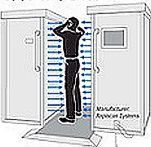 letter signed by five professors from the University of California, San Francisco and Arizona State University.
TSA Backscatter Radiation Safety Tests Were Rigged, Lew Rockwell.com, by Mike Adams , 18 May 11 It can now be revealed by NaturalNews that the TSA faked its safety data on its X-ray airport scanners in order to deceive the public about the safety of such devices. Continue reading
Japan radiation monitoring – new comprehensive open source
 Radiation monitoring in Japan goes crowd, open source, CNET, by Eric Mack, May 6, 2011 A new open and crowdsourced initiative to deploy more geiger counters all over Japan looks to be a go. Safecast, formerly RDTN.org, recently met and exceeded its $33,000 fund-raising goal on Kickstarter, which should help Safecast send between 100 and 600 geiger counters to the catastrophe-struck country.
The data captured from the geiger counters will be fed into Safecast.org, which aggregates radiation readings from government, nonprofit, and other sources, as well as into Pachube, a global open-source network of sensors. Safecast is one of the larger crowdsourced monitoring efforts, not unlike a similar effort in the United States that predated the Japanese disaster.
For the last month, the Safecast crew and volunteers have been collaborating with universities in Japan and driving their geiger counters around the country and taking measurements. Safecast’s early monitoring trips north of Tokyo returned some disturbing findings, including elevated radiation levels in a kindergarten classroom….Radiation monitoring in Japan goes crowd, open source | Crave – CNET
Hamaoka Nuclear Power Plant the world’s most dangerous complex
 Making Hamaoka a special concern to its opponents is the presence of plutonium. Chubu is the only utility in Japan to have signed a contract to process mixed oxide fuel containing plutonium and uranium with the Sellafield plant in the UK.
The industry’s clout, its collusion with government watchdogs and a largely compliant media have helped smother concerns about this potentially explosive collision of state-of-the-art atomic power with primordial seismic instability

 ‘We all said disaster would strike here, not Fukushima’, The Independent, 3 May 11, After a 40-year campaign, warnings about the vast nuclear power station on Japan’s earthquake faultline are finally being heard. By David McNeill in Omaezeki and Nanako Otani, Norihiko Watanabe is pointing to his home, 600m from what he calls the most dangerous nuclear power complex on the planet. “There’s nothing like it anywhere in the world,” he says, eyes widening. “If it blows up, we’re all finished.” Continue reading
Radioactive for ONLY 300 YEARS, boast Thorium promoters
 the waste would have to be stored for around 300 years or so, compared to tens of thousands of years for current reactors.
Only in the world of nuclear technology could a requirement for 300 years of dangerous waste storage be seen as an advantage.
No one talks about safe nuclear power because it doesn’t exist, Canberra Times, Dr Sue Wareham 28 Apr, 2011 , The heading on Julian Cribb’s glowing recommendation of thorium reactor research (April 26, p11) poses the question ”Why is no one talking about safe nuclear power?” The answer is that it doesn’t exist.
Cribb states that thorium reactors do not produce weapons grade material. This is misleading. Continue reading
Plutonium danger in Los Alamos nuclear plan
In the event of an earthquake and inadequate safety features, highly carcinogenic plutonium smoke could escape the building, rendering the land beneath the plume too contaminated for use.
“It would be like a dirty bomb,” Mello said.
Nuclear watchdog groups slam New Mexico plan, By Zelie Pollon, Santa Fe, New Mexico | Wed Apr 27, 2011 (Reuters) – The U.S. government should rethink plans for a multi-billion dollar plutonium complex at Los Alamos after the recent nuclear catastrophe in Japan and the discovery of increased seismic risk in New Mexico, nuclear watchdog groups said. Continue reading
Stuxnet computer worm paralysing Iran’s nuclear program
 Russian experts and officials have been warning for several months that the Bushehr power plant has become too dangerous to operate because of the Stuxnet infection
…..Iran was forced to shut down its uranium enrichment plant at Natanz last November and removed nearly 1,000 centrifuges because of malfunctions caused by Stuxnet.
Computer Worm Wreaking Havoc on Iran’s Nuclear Capabilities, NewsMax.com, 27 Apr 2011 , By Ken Timmerman, An internal report by a special intelligence unit in Iran has concluded that the Stuxnet malware computer virus that has infected Iran’s nuclear facilities is so dangerous it could shut down the entire national power grid. Continue reading
“Rare Earths” are radioactive, not so innocuous as they sound
why can’t the nuclear countries produce their own nuclear fuels in their own countries? Unconfirmed reports have noted that some countries are dumping their nuclear wastes (rare earth included) in some third world countries under the guise of economic and scientific corporation!
(Malaysia) THE RARE EARTH CONTROVERSY, The Star, by: cheaman, 25 April 11 What is ‘rare earth’? They are ‘actinide’ substances. So what are ‘actinides’, pray tell? Continue reading
Facts on plutonium and Mox nuclear fuel
some reactors do use Mox, but only as a small percentage (less than 30 per cent) of the total fuel. The rest of the fuel is conventional uranium oxide…Mox, which in any case remains far more expensive than conventional uranium fuel…
(UK) Government’s doomed £6bn plan to dispose of nuclear waste, The Independent, 11 April 11“……Q & A: Why has it come to this?
Q: What is Britain’s “plutonium mountain”?
A: It is the nation’s stockpile of radioactive plutonium, kept as plutonium dioxide powder, packed into special drums stored at Sellafield in Cumbria. A further, smaller amount is stored at the Dounreay nuclear facility in Scotland, the site of the doomed nuclear fast-breeder reactor programme. Continue reading
1 This Month
26 September – International Day for the Total Elimination of Nuclear Weapons





PLEASE OPPOSE HR 8255 AND S.3639 – bills would accelerate satellite deployment, with no environmental review or safeguards – https://ncstd5li.quorum.us/campaign/169331/
To see nuclear-related stories in greater depth and intensity – go to https://nuclearinformation.wordpress.com
-
Archives
- September 2026 (305)
- August 2026 (330)
- July 2026 (355)
- June 2026 (287)
- May 2026 (306)
- April 2026 (356)
- March 2026 (251)
- February 2026 (267)
- January 2026 (308)
- December 2025 (358)
- November 2025 (359)
- October 2025 (375)
-
Categories
- 1
- 1 NUCLEAR ISSUES
- business and costs
- climate change
- culture and arts
- ENERGY
- environment
- health
- history
- indigenous issues
- Legal
- marketing of nuclear
- media
- opposition to nuclear
- PERSONAL STORIES
- politics
- politics international
- Religion and ethics
- safety
- secrets,lies and civil liberties
- spinbuster
- technology
- Uranium
- wastes
- weapons and war
- Women
- 2 WORLD
- ACTION
- AFRICA
- Atrocities
- AUSTRALIA
- Christina's notes
- Christina's themes
- culture and arts
- Events
- Fuk 2022
- Fuk 2023
- Fukushima 2017
- Fukushima 2018
- fukushima 2019
- Fukushima 2020
- Fukushima 2021
- general
- global warming
- Humour (God we need it)
- Nuclear
- RARE EARTHS
- Reference
- resources – print
- Resources -audiovicual
- Weekly Newsletter
- World
- World Nuclear
- YouTube
-
RSS
Entries RSS
Comments RSS

