A new route to more nuclear bombs – Silex laser enrichment
 Laser advance may increase spread of nuclear bomb, SMH, William Broad, August 22, 2011 In a little-known effort, General Electric has successfully tested laser enrichment for two years and is seeking permission from the US government to build a $US1 billion ($960 million) plant that would make reactor fuel by the tonne.
That might be good news for the nuclear industry, but critics fear that if the work succeeds and the secret gets out, rogue states and terrorists could make bomb fuel in much smaller plants that are difficult to detect……. critics want a detailed risk assessment. Recently, they petitioned Washington for a formal evaluation of whether the laser initiative could backfire and speed the global spread of nuclear arms.
”We’re on the verge of a new route to the bomb,” said Frank von Hippel, a nuclear physicist who teaches at Princeton University. ”We should have learnt enough by now to do an assessment before we let this kind of thing out.” New varieties of enrichment are considered dangerous because they simplify obtaining the fuel……http://www.smh.com.au/technology/sci-tech/laser-advance-may-increase-spread-of-nuclear-bomb-20110821-1j4mm.html
A scientific measure of the radiation leaked from Fukushima
Measurements Reveal Extent of Leakage from Japan’s Damaged Fukushima Reactor ScienceDaily (Aug. 16, 2011) — Atmospheric chemists at the University of California, San Diego, report the first quantitative measurement of the amount of radiation leaked from the damaged nuclear reactor in Fukushima, Japan,….. Continue reading
Sounding the alarm on China’s plans for nuclear technology

 Chinese decision-makers should avoid being overly confident about untried safety technologies. No matter how sound newer-generation nuclear technologies appear, such technologies may never have been sufficiently tested in any part of the world. All newer-generation nuclear technologies still impose significant risks in terms of design experience, construction safety and operational reliability
A warning for China’s nuclear sector, China dialogue, Kevin Jianjun Tu, August 10, 2011 “………The deadly Wenzhou [train] crash highlights the dangers of mega-infrastructure projects moving too far, too fast. Chinese decision-makers should take note, argues Kevin Jianjun Tu…..
Fukushima sounded warning bells with the Chinese government and gave policymakers another chance to reconsider plans for 2020. At a March 16 meeting chaired by premier Wen Jiabao, the State Council decided to call a temporary halt to approval of new nuclear-power plants pending new safety rules, and to adjust mid- and long-term nuclear power plans. This indicated a more cautious national strategy for nuclear power development.
Unfortunately, due to a lack of effective checks and balances on nuclear interest groups, there are signs that the great nuclear leap forward is reemerging. Continue reading
Isle of Man wants full closedown of Sellafield nuclear plant
Closure of nuclear plant is welcomed, Isle of man Examiner, 4 August 2011 GREEN campaigners and the island’s Environment Minister have welcomed news that a part of the reprocessing operation at Sellafield nuclear plant is to close…
Japan was the only customer for the MOX plant,
Environment Minister John Shimmin welcomed the news but pointed out the MOX plant was only a small part of the operation at Sellafield. The Manx government’s long-held policy is to call for the full closure of all operations at Sellafield. Continue reading
No more MOX plutonium fuel to be processed at Sellafield
UK Plutonium-Processing Plant to Close, 9 News. 4 Aug 11, A British nuclear agency says the country’s only plutonium-processing plant will be closed in the wake of Japan’s Fukushima disaster.The Nuclear Decommissioning Authority said on Wednesday the “risk profile” of its Sellafield mixed oxide fuel plant had changed following the March 11 earthquake and tsunami that crippled the Fukushima Dai-ichi nuclear power plant….environmental campaigners say the plant’s closure highlights what they describe as the folly of the country’s nuclear industry. The recycled nuclear fuel, referred to as MOX, was also used at the Fukushima plant.http://news.ninemsn.com.au/world/8281227/uk-plutonium-processing-plant-to-close
—
Nuclear reprocessing plant closes down
Globally, the shutdown leaves just one other commercial MOX facility operating globally: the French MELOX plant located in Gard.
UK closes key nuclear reprocessing plant – Nature News Blog August 03, 2011 Today the UK’s Nuclear Decommissioning Authority announced the closure of the Mixed Oxide fuel fabrication facility at Sellafield. “The reason for this is directly related to the tragic events in Japan and its ongoing impact on the power markets,” Tony Fountain, the decommissioning authority’s CEO, said in a prepared statement. Continue reading
USA’s pro nuclear Blue Ribbon Waste Commission rejects nuclear reprocessing
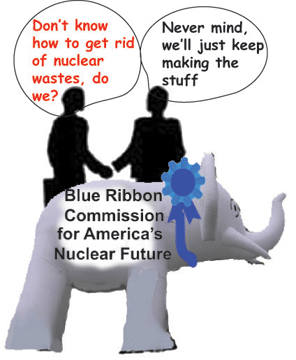 The good news: The BRC rejects reprocessing for now. The report states: “No currently available or reasonably foreseeable reactor and fuel cycle technology developments—including advances in reprocess and recycle technologies—have the potential to fundamentally alter the waste management challenge this nation confronts over at least the next several decades, if not longer.
Waste Commission rubberstamps more nuclear, but rejects reprocessing – for now Beyond Nuclear 30 July 11, A year and a half after its creation, on July 29th Energy Secretary Chu’s “Blue Ribbon Commission on America’s Nuclear Future” (BRC) has published its draft report of recommendations for dealing with the mountain of U.S. high-level radioactive waste now nearly 70 years high. Continue reading
The massive costs of disposing of spent nuclear fuel
 Contrary to power company figures, cost of nuclear power generation highest: research, Mainichi daily News, 23 July 11 “……There’s also a problem that’s specific to nuclear energy. As Oshima points out, massive amounts of money are needed to dispose of spent nuclear fuel, Continue reading
China touts ‘fast breeder’ nuclear reactor, but it’s an unlikely energy solution
the process hasn’t proved workable on a large scale elsewhere. Fast-breeder programs have been abandoned in a number of countries, including the U.S., and the plants that remain are small.
China’s Nuclear Scientists Unveil Latest ‘Breakthrough, WSJ, James T. Areddy, 21 July 11, “…..The China Institute of Atomic Energy said Thursday that a small, experimental “fast breeder” reactor outside Beijing had been hooked to the grid to produce electricity. …. Continue reading
Thorium nuclear reactors not effective, not a viable technology
‘Even if thorium technology does progress to the point where it might be commercially viable, it will face the same problems as conventional nuclear: it is not renewable or sustainable and cannot effectively connect to smart grids. The technology is not tried and tested, and none of the main players is interested. Thorium reactors are no more than a distraction.’

 Don’t believe the spin on thorium being a ‘greener’ nuclear option, The Ecologist, Eifion Rees, 23rd June, 2011 “………China, Russia, France and the US are also pursuing the technology, while India’s department of atomic energy and the UK’s Engineering and Physical Sciences Research Council are jointly funding five UK research programmes into it.
There is a significant sticking point to the promotion of thorium as the ‘great green hope’ of clean energy production: it remains unproven on a commercial scale. While it has been around since the 1950s (and an experimental 10MW LFTR did run for five years during the 1960s at Oak Ridge National Laboratory in the US, though using uranium and plutonium as fuel) it is still a next generation nuclear technology – theoretical. Continue reading
Japan might suspend developing its troubled fast breeder reactor
 Unlike regular light-water reactors fueled by uranium, the Monju reactor, operated by the Japan Atomic Energy Agency, runs on an oxide mix of plutonium and uranium, or MOX, made from spent nuclear fuel from existing plants.
The reactor first achieved criticality in 1994, but was shut down due to a serious accident involving a leak of sodium coolant and a resulting fire in 1995.
 Science minister says gov’t will mull halting Monju prototype reactor project, Mainichi Japan) July 15, 2011TOKYO (Kyodo) — Science minister Yoshiaki Takaki indicated Friday that the government will consider suspending the development of the prototype fast-breeder reactor Monju in the wake of the country’s worst nuclear crisis that continues at the Fukushima Daiichi power plant. Continue reading
Safecast – citizen scientists monitor Japan’s radiation levels
 Safecast took its first reading on April 16. Today, it has about 50 regular volunteers who collect data from their homes or while driving, build devices or assist in other ways. Those using vehicles equipped with Geiger counters cover an area that Franken estimates to be about 620 miles long by 185 miles wide. To date, they’ve collected 251,000 data points from their drives and fixed reporting stations, and have received about 60,000 more from other sources, including people with their own Geiger counters.
Japan’s citizen scientists map radiation, DIY-style, World Blog, By Miranda Leitsinger, Senior Writer and Editor, msnbc.com 13 July 11, With the Japanese government only providing spotty information about the radiation leaking from the damaged Fukushima nuclear plant in the early days after the devastating March 11 earthquake and tsunami, a group of tech-minded citizen scientists set out to fill in the “black holes” in the knowledge base. Continue reading
USA’s Aerial Radiological Survey – testing radiation levels in the atmosphere
Now You Know: That Thing in the Sky is Testing for Radiation, Seattlest 13 July 11 If you’ve recently spied a startlingly low-flying beast in the sky, don’t worry–it’s not Google trying to get a more recent photo of your back yard, and it’s not a search party looking for bad guys in your neighborhood. It’s just trying to get a read on how much radiation you might exposed to.
Yesterday, the Washington State Department of Health launched the Aerial Radiological Survey for King and Piece Counties. The survey, which is being conducted by a helicopter that flies in a grid pattern at about 300 feet above the ground, will last until July 28. It is being funded by the Department of Homeland Security, and can “detect the presence of radioactive materials that emit gamma radiation such as cesium and radioactive iodine.” The goal of the project is to establish a radiation baseline–that is, how much radiation each area is exposed to right now, in a time of normal levels.
The project, says the DOH, has been in the works since 2009. But, we imagine, since the Fukushima nuclear disaster across the pond in Japan, the information being gathered is more critical than they could have predicted. Having a baseline for what is “normal” will be massively helpful in the future, when determining what is dangerous, and what is abnormal….http://seattlest.com/2011/07/12/now_you_know_that_thing_in_the_sky.php
—
Stuxnet computer worm ushers in new threat to nuclear installations
 STUXNET: WORLD’S FIRST CYBER WEAPON, Big Think July 12, 2011 .When the Stuxnet computer virus infected Iran’s nuclear power facilities at the Natanz enrichment plant, it became the world’s first cyber weapon…..”Stuxnet required an enormous amount of resources to produce, but its cost-benefit ratio is still in question. While it may have helped set Iran’s program back to a degree, it also altered the landscape of cyberattacks. Stuxnet’s authors mapped a new frontier that other attackers are bound to follow; and the next target for sabotage could easily be a nuclear facility in the United States. No one knows what Stuxnet might have achieved had it never been discovered by VirusBlockAda a year ago. … It appeared the attackers were still developing the code when it was uncovered.”..http://bigthink.com/ideas/39255
Long Branch Center refutes any need for USA nuclear reprocessing
Local environmental group submits comment on nuclear-fuel reprocessing facilities, Mountain Xpress, by Margaret Williams 10 July 11Secretary
U.S. Nuclear Regulatory Commission
Washington, DC 20555-0001
Attn: Rulemakings and Adjudications Staff
fax 301-415-1101
Rulemaking.Comments@nrc.gov
Re: Comment on Docket ID NRC–2010–0267, NRC “Draft Regulatory Basis for a Potential Rulemaking on Spent Nuclear Fuel Reprocessing Facilities” Continue reading
1 This Month
26 September – International Day for the Total Elimination of Nuclear Weapons





PLEASE OPPOSE HR 8255 AND S.3639 – bills would accelerate satellite deployment, with no environmental review or safeguards – https://ncstd5li.quorum.us/campaign/169331/
To see nuclear-related stories in greater depth and intensity – go to https://nuclearinformation.wordpress.com
-
Archives
- September 2026 (305)
- August 2026 (330)
- July 2026 (355)
- June 2026 (287)
- May 2026 (306)
- April 2026 (356)
- March 2026 (251)
- February 2026 (267)
- January 2026 (308)
- December 2025 (358)
- November 2025 (359)
- October 2025 (375)
-
Categories
- 1
- 1 NUCLEAR ISSUES
- business and costs
- climate change
- culture and arts
- ENERGY
- environment
- health
- history
- indigenous issues
- Legal
- marketing of nuclear
- media
- opposition to nuclear
- PERSONAL STORIES
- politics
- politics international
- Religion and ethics
- safety
- secrets,lies and civil liberties
- spinbuster
- technology
- Uranium
- wastes
- weapons and war
- Women
- 2 WORLD
- ACTION
- AFRICA
- Atrocities
- AUSTRALIA
- Christina's notes
- Christina's themes
- culture and arts
- Events
- Fuk 2022
- Fuk 2023
- Fukushima 2017
- Fukushima 2018
- fukushima 2019
- Fukushima 2020
- Fukushima 2021
- general
- global warming
- Humour (God we need it)
- Nuclear
- RARE EARTHS
- Reference
- resources – print
- Resources -audiovicual
- Weekly Newsletter
- World
- World Nuclear
- YouTube
-
RSS
Entries RSS
Comments RSS

