Facts on radioactive spent nuclear fuel rods
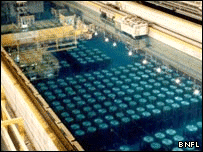 How urgent is the situation?
Fairly urgent. The NRC predicts that at the rate we’re discarding rods—about 2,000 tons a year—we’ll run out of existing storage space by 2015…..
 Radioactive fuel rods: The silent threat – The Week, 9 April 11, Japan’s nuclear crisis has highlighted the danger of the spent fuel rods piling up outside America’s nuclear plants Continue reading
No one knows how to deal with Fukushima’s radioactive water
 international law forbids Japan from dumping contaminated water into the ocean if there are viable technical solutions available down the road….So Tepco is considering bringing in barges and tanks, including a “megafloat” that can hold about 2.5 million gallons….Yet even using barges and tanks to temporarily handle the water creates a future problem of how to dispose of the contaminated vessels.
Cleaning up Japan’s radioactive water could take decades, latimes.com, 7 April 11, No one is sure how to safely dispose of millions of gallons of highly radioactive water at the Fukushima Daiichi nuclear plant. ‘There is nothing like this, on this scale, that we have ever attempted to do before,’ a U.S. expert says. Continue reading
What lovely optimism – nuclear powered spacecraft for USA, Russia
 Russia, U.S. to cooperate on nuclear-powered spacecrafts MOSCOW, April 4 (Xinhua) –– The Russian Federal Space Agency ( Roscosmos) and the U.S. National Aeronautics and Space Administration (NASA) have agreed to cooperate in developing nuclear engines for spacecrafts, local media reported on Monday.Citing Roscosmos’ head Anatoly Perminov in Kazakh Baikonur space center, reports said Russia has initiated to jointly build nuclear-powered engines with NASA by 2019 and use these engines for flights to Mars.
Such an engine will make the flight to Mars 20 times faster, Perminov said, adding that the meeting between he and his NASA counterpart Charles Bolden was scheduled on April 1
Only AREVA to benefit from dangerous plutonium reprocessing plant?
 A mixed-oxide, or MOX, plutonium reprocessing plant that is being built in South Carolina has become “an expensive effort that enriches contractors, led by the French government-owned company Areva,”
US anti-nuclear activists slam reprocessing plan, Google news, (AFP) – 5 April 11, WASHINGTON — US anti-nuclear groups Monday condemned a project to build a plant where plutonium from weapons would be reprocessed into fuel for nuclear power plants, saying the plan was costly, dangerous and would benefit mainly the French group, Areva.
A mixed-oxide, or MOX, plutonium reprocessing plant that is being built in South Carolina has become “an expensive effort that enriches contractors, led by the French government-owned company Areva,” Tom Clements of Friends of the Earth said at the launch of a report by an anti-nuclear alliance.”In my opinion, it is primarily because of Areva’s influence inside the Department of Energy that the US is pursuing a plutonium fuel program and it’s because of Areva’s influence that there’s a push for the US to also reprocess commercial spent fuel to remove plutonium, like France does,” he said…….
The plant, on the Department of Energy’s Savannah River site, is roughly one-third finished and three times over budget, with a price tag so far of $4.9 billion dollars, Clements maintained.
But even as the nuclear disaster in Japan highlights the dangers of MOX fuel — which the ANA report says was used in one of the reactors at Japan’s crippled Fukushima power plant — the US government is failing to rethink construction of the South Carolina facility, Clements told reporters.
“As plutonium leaks from the damaged reactors in Japan, the US Department of Energy (DoE) continues planning for the use of dangerous mixed-oxide fuel in US nuclear reactors of the same design as the Fukushima reactors in Japan,” Clements said.
MOX fuel pellets “make reactors harder to control and, in the case of a severe accident, the radiation plutonium releases will be worse than uranium fuel,” said Clements……
Anti-nuclear activists would prefer encasing the plutonium left over from dismantled US nuclear weapons in glass, and then storing it as high-level waste.
That method, called vitrification, is “cheaper, quicker and safer” than converting plutonium into MOX fuel, says the report released Monday by ANA, a network of three dozen organizations…..
AFP: US anti-nuclear activists slam reprocessing plan
A floating radioactive waste pool? Hope there’s no more tsunamis!
Pontoon to hold Japan nuke plant water | Herald Sun April 02, 2011 THE operator of Japan’s disaster-stricken nuclear power plant plans to use a huge steel floating structure to contain radioactive water it releases.The pontoon-type structure which can hold a maximum of 18,000 tonnes of water will be handed over to Tokyo Electric Power Co (TEPCO) by its owner which has been using it as a floating park for anglers, officials said yesterday.Called a “Mega-Float”, it measures 136 metres long, 46 metres wide and three metres high and can hold up to 10,000 tonnes of water without sinking….. Pontoon to hold Japan nuke plant water | Herald Sun
Global monitoring of Fukushima radiation fallout
Radioactive iodine-131 and cesium-137 are key to this process. They don’t exist in nature, so their appearance signals a nuclear event — either a bomb or a reactor in trouble…..Nuclear detectives can dive deeper still, sorting out whether radioactive emissions emanate from a dangerously active and still-fissioning reactor core, from burning fuel rods, or from used fuel sitting in pools.
As Fukushima fallout circles the globe, nuclear sleuths sift it for clues, The Washington Post, by Brian Vastag 1 April 11, Fallout from the Fukushima Daiichi nuclear plant has landed on 30 exquisitely sensitive detectors on desolate Arctic islands, on the tops of tall buildings and in other windy locales across the Northern Hemisphere, according to the Comprehensive Test Ban Treaty Organization, which maintains those sensors. Sniffing the air like silent sentinels, the 63 shack-like stations (with 17 more planned) are capturing tiny radioactive particles in filters much like those on a home furnace. Continue reading
Bill Gates marketing small nukes to China, where nuclear industry is less regulated

“right now the regulatory environment here in the United States means it would take decades just to certify. By partnering with the Chinese, they can move ahead and commercialize the technology around the world when it’s proven.”
Nuclear Industry Thrives in the U.S., but for Export – NYTimes.com By MATTHEW L. WALD March 30, 2011 “……At a clean energy conference in Washington in January, Jon M. Huntsman Jr., then the American ambassador to China, said that he had recently run into Bill Gates in China. Mr. Gates is an investor in a new kind of reactor, part of a class called “small modular reactors,” Continue reading
Little hope now of resuscitating the nuclear industry
little hope for development of new nuclear generation methods, the proponents of which believe they solve some of the intractable problems of today’s fission reactors. Chief among fission’s shortcomings is the risk of a reactor core meltdown and release of large amounts of highly toxic radiation, and the disposal of radioactive waste.
Nuclear power likely casualty in tide of change, NZ Herald News, By Anthony Doesburg y Mar 28, 2011 Nuclear power can be all but written off in the wake of Japan’s reactor emergency, believes the director of energy studies at Otago University.
“I would have thought that Japan will pretty much spell the end of the nuclear industry,” Continue reading
Japanese nuclear plant beset by new problems
an even bigger problem when the water inside the reactor is much more radioactive than usual and is under extremely high pressure, as it has been in all three reactors at the Fukushima Daiichi plant at various times since the earthquake and tsunami…..
New Problems Arise at Japanese Nuclear Plant, NYTimes.com, By KEITH BRADSHER March 23, 2011 “……..nuclear engineers say some of the most difficult and dangerous tasks are still ahead — and time is not necessarily on the side of the repair teams. Continue reading
Fukushima cooling effort increasingly being done by robots
More robots sent in to tackle crisis at Fukushima, New Scientist, 24 march 11, Robots from other nations are joining in the efforts to stabilise the Fukushima Daiichi nuclear plant.In addition to the Monirobo radiation monitoring robots reported previously, the Japanese have also used an unmanned fire engine. This was operated by the Tokyo Fire Department, which introduced its first robot, the Rainbow 5 water sprayer, in 1986. Such robots are used for fires which are too large or too hazardous for human fire-fighters to approach. The engine sprayed seawater from an eight-hundred-metre hose directly into the spent fuel rod pool at No. 3 reactor for thirteen hours to prevent overheating.A much more powerful unmanned water cannon has now been flown in from Australia. Made by Bechtel Corporation, the system is manoeuvred into place remotely and can spray nine thousand litres a minute out to a distance of a hundred and fifty metres…… One Per Cent: More robots sent in to tackle crisis at Fukushima
Fukushima radioactive emissions – a guarded secret
”The notion that you can track an air parcel precisely as it travels across the Pacific is fanciful,” he said. “The difficulty in doing that is we really don’t know what is being emitted.” That information, if known at all, is being closely held by Japanese authorities and the U.S. government,
Computer models aid Japanese nuclear response, The Washington Post, By Andrew Freedman, 23 March 11, U-Md. research team wants more data made public. As the Japanese nuclear crisis continues to unfold, the airborne spread of radioactive materials from the stricken reactors at the Fukushima Daiichi power station continues to be a key concern of Japanese and American officials. Continue reading
Mixed oxide fuel means danger for No 3 Fukushima nuclear plant
New Problems Arise at Japanese Nuclear Plant, NYTimes.com, By KEITH BRADSHER March 23, 2011 “…..Fukushima Daiichi’s Reactor No. 3 began belching black smoke for an hour late in the afternoon, leading its operator, Tokyo Electric Power Company, to evacuate workers.. No. 3 is considered one of the most dangerous of the reactors because of its fuel — mixed oxides, or mox, which contain a mixture of uranium and plutonium and can produce a more dangerous radioactive plume if scattered by fire or explosions. The cooling system at Reactor No. 5, which was shut down at the time of the earthquake and has shown few problems since, also abruptly stopped working on Wednesday afternoon, said Hiro Hasegawa, a spokesman for Tokyo Electric.New Problems Arise at Japanese Nuclear Plant – NYTimes.com
Fukushima’s spent nuclear fuel rods are critically dangerous
Figures provided by the Tokyo Electric Power Company on Thursday show that most of the dangerous uranium at the powerplant is in the spent fuel rods, not the reactor cores.
The company said that a total of 11,195 spent fuel rod assemblies were stored at the site. That is about four times as much radioactive material as in the reactor cores combined…….the zirconium cladding on the fuel rods could burst into flames if exposed to air for hours when a storage pool lost its water
Spent rods the biggest hazard, Sydney Morning Herald, Keith Bradsher and Hiroko Tabuchi, March 19, 2011 YEARS of procrastination in deciding on long-term disposal of highly radioactive fuel rods from nuclear reactors are coming back to haunt Japanese authorities as they try to control fires and explosions at the stricken Fukushima Daiichi nuclear power station.
The danger of “spent nuclear fuel rods” at Fukushima
These rods, which will have become laced with radioactive by-products of the main reaction, including plutonium and radioactive isotopes of strontium, iodine and other elements, are taken out of reactors and put in pools of water for storage
The Fukushima crisis: A new danger at Fukushima | The Economist, 18 March 11, “…….the Japanese Atomic Industrial Forum, a trade body, acknowledged that there were worries about the water levels in the ponds at units 3 and 4. Continue reading
Failure of cooling systems in Japanese nuclear plant
Confidence in Japan’s nuclear safety was dented by a series of scandals in the late 1990s when the Tokyo Electric Power Company, owner of the Kashiwazaki-Kariwa plant, admitted falsifying safety data and concealing cracks in the core structures of its reactors.
Japan earthquake forces thousands to evacuate in nuclear plant emergency The Guardian, 15 March “……….Failure of the cooling system – and the diesel back-up generator – at the Fukushima 1 plant in Onahama raises questions about what has gone wrong so far and what could happen in future. Continue reading
1 This Month
26 September – International Day for the Total Elimination of Nuclear Weapons





PLEASE OPPOSE HR 8255 AND S.3639 – bills would accelerate satellite deployment, with no environmental review or safeguards – https://ncstd5li.quorum.us/campaign/169331/
To see nuclear-related stories in greater depth and intensity – go to https://nuclearinformation.wordpress.com
-
Archives
- September 2026 (305)
- August 2026 (330)
- July 2026 (355)
- June 2026 (287)
- May 2026 (306)
- April 2026 (356)
- March 2026 (251)
- February 2026 (267)
- January 2026 (308)
- December 2025 (358)
- November 2025 (359)
- October 2025 (375)
-
Categories
- 1
- 1 NUCLEAR ISSUES
- business and costs
- climate change
- culture and arts
- ENERGY
- environment
- health
- history
- indigenous issues
- Legal
- marketing of nuclear
- media
- opposition to nuclear
- PERSONAL STORIES
- politics
- politics international
- Religion and ethics
- safety
- secrets,lies and civil liberties
- spinbuster
- technology
- Uranium
- wastes
- weapons and war
- Women
- 2 WORLD
- ACTION
- AFRICA
- Atrocities
- AUSTRALIA
- Christina's notes
- Christina's themes
- culture and arts
- Events
- Fuk 2022
- Fuk 2023
- Fukushima 2017
- Fukushima 2018
- fukushima 2019
- Fukushima 2020
- Fukushima 2021
- general
- global warming
- Humour (God we need it)
- Nuclear
- RARE EARTHS
- Reference
- resources – print
- Resources -audiovicual
- Weekly Newsletter
- World
- World Nuclear
- YouTube
-
RSS
Entries RSS
Comments RSS

