Integral Fast Reactors – let the public beware of these!
 In dispraise of Integral Fast Nuclear Reactors Independent Australia, 5 July 12, Can only nuclear technocrats discuss nuclear issues — leaving the great unwashed out of the debate? Noel Wauchope considers the latest – but not necessarily the greatest – nuclear gizmo — Integral Fast Reactors. “….. It must be reassuring to the nuclear lobby to know that the great unwashed, the hoi polloi, the peasantry, have no idea about the differences between the various types of nuclear reactors now in operation — the Generation 2 and Generation 3 reactors. Let alone the new developing blueprints of Generation IV: Integral Fast Reactors, Lead Cooled Fast Reactors, Molten Salt Reactors, Sodium Cooled Fast reactors, Thorium Liquid Fuel reactors; the peasant mind boggles! And wait, like those old TV commercials – there’s more! – Generation V is now in the minds and on some bits of paper of the nuclear boffins.
Well, the nuclear priesthood is pretty safe in all this. They keep the argument narrowly technical, with pages and pages on the various technicalities of cooling systems, reprocessing of fuel systems, passive safety systems and so on; in other words, they induce in the public a kind of mindless torpor as they dazzle us with science.
At the same time, the nuclear priesthood, like some gifted but autistic child with specialist knowledge in just one area, seems to have little grasp of other issues concerning nuclear power — blinkered as they are in their apparent view that the technicalities are the whole story. This is the case with their latest propaganda for the ‘Integral Fast Reactor’ or IFR.
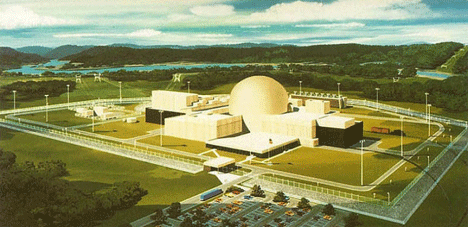
For instance, they ignore the fact that IFRs needs plutonium or enriched uranium as fuel. So, to have fast reactors, Australia would need to import these, or set up nuclear reprocessing or uranium enrichment here. This would also involve issues such as cost, politics, public opinion, issues concerning our growing renewable energy systems, radioactive waste storage — just to mention some of the more obvious of the considerable obstacles to Australia ever getting fast reactors. Nuclear lobbyists seem naively oblivious to the importance of these factors in the minds of the general public……
The Integral Fast Reactor is, after all, just another type of nuclear reactor — it runs on radioactive fuel, provides heat to make electricity and produces radioactive waste. It also uses reprocessed nuclear wastes for its fuel, therefore nuclear reprocessing plants would be needed. So far, all existing nuclear reprocessing has proved to be an expensive failure. For instance, the USA’s MOX reprocessing fuel plant is still under construction — it has cost billions of dollars, is over budget and also behind schedule. In Japan, the super expensive Monju prototype fast breeder reactor is costing 1,000 times more than conventional reactors to run………
As these fast reactors need to get the weapons grade plutonium and/or enriched uranium, these materials have to be procured from somewhere. The nuclear lobby portrays this as a benefit to the world, by using up the existing plutonium and so on. Now, I don’t know whether they say this out of naiveté or hypocrisy, but the obvious reality is that the old-fashioned Generation 3 and 4 reactors will have to be kept going – or uranium enrichment and reprocessing will have to keep going – to turn out more plutonium, which must then travel to the new IFRs. Of course, all this flies in the face of President Obama’s move to limit nuclear weapons proliferation, the New START treaty with Russia, which depends on confining the spread of uranium enrichment and weapons grade plutonium…….
there’s that final problem of the wastes.
David Biello from the Scientific American comments:
‘Ultimately, however, the core problem may be that such new reactors don’t eliminate the nuclear waste that has piled up, so much as transmute it. Even with a fleet of such fast reactors, nations would nonetheless require an ultimate home for radioactive waste, one reason that a 2010 M.I.T. report on spent nuclear fuel dismissed such fast reactors.’…..
http://www.independentaustralia.net/2012/environment/in-dispraise-of-integral-fast-nuclear-reactors/
South Carolina to be USA’s nuclear waste dump, with Small Modular Reactors (SMRs)?
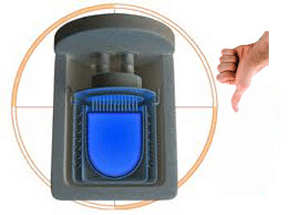 The mini-reactors – also dubbed small modular reactors or SMRs – have been hailed as the nuclear technology of the future.
waste is the problem…… waste could be shipped into the state from other areas…. South Carolina once again could become the nuclear dumping ground for the nation.
 Mini-nuclear reactors Herald Online, 1 July 12,South Carolina might benefit in many ways from being the site of the nation’s first mini-nuclear reactors. But the resulting nuclear waste is a big concern.
The U.S. Department of Energy gave the go-ahead in April for three companies to partner with the Savannah River Site in Aiken County to possibly develop the nation’s first mini-reactors there. The three companies are competing with other design companies across the nation – as well as among themselves – for a federal matching grant totaling as much as $452 million to support engineering, certification and licensing for up to two mini-reactor designs. Continue reading
“Fast nuclear reactors” not the solution to plutonium wastes
Ultimately, however, the core problem may be that such new reactors don’t eliminate the  nuclear waste that has piled up so much as transmute it. Even with a fleet of such fast reactors, nations would nonetheless require an ultimate home for radioactive waste, one reason that a 2010 M.I.T. report on spent nuclear fuel dismissed such fast reactors.
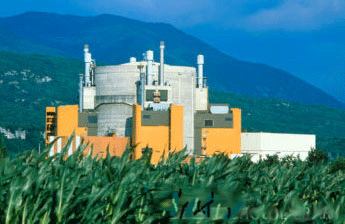
 Can Fast Reactors Speedily Solve Plutonium Problems? The U.K. is grappling with how to get rid of weapons-grade plutonium and may employ a novel reactor design to consume it Scientific American By David Biello | March 21, 2012 The U.K. has nearly 100 metric tons of plutonium—dubbed “the element from hell” by some—that it doesn’t know what to do with. The island nation does not need the potent powder to construct more nuclear weapons, and spends billions of British pounds to ensure that others don’t steal it for that purpose. The unstable element, which will remain radioactive for millennia, is the residue of ill-fated efforts to recycle used nuclear fuel.
One solution under consideration is to recycle the plutonium yet further—by using it as fuel in a pair of new, so-called “fast” reactors. Such nuclear reactors can actually “consume” plutonium via fission (transforming it into other forms of nuclear waste that are not as useful for weapons). The U.K. is considering a plan to build two of General Electric’s PRISM fast reactors, the latest in a series of fast-reactor designs that for several decades have attempted with mixed success to handle plutonium and other radioactive waste from nuclear power. The idea remains that fast reactors, which get their name because the neutrons that initiate fission in the reactor are zipping about faster than those in a conventional reactor, could offer a speedy solution to cleaning some nasty nuclear waste, which fissions better with fast neutrons, while also providing electricity as a by-product.
The U.K. is hardly alone in struggling to cope with nuclear waste, whether plutonium or otherwise. Continue reading
Japan’s nuclear reprocessing reactor’s astronomic costs
Fast breeder reactor far costlier than regular nuclear power generation http://english.kyodonews.jp/news/2012/06/166571.html TOKYO, June 29, Kyodo If the development of the controversial Monju prototype fast breeder reactor is continued, its costs will swell to over 1.4 trillion yen and its power generation costs will be 10,000 yen per kilowatt hour, roughly 1,000 times greater than a regular reactor, according to data compiled by Kyodo News.
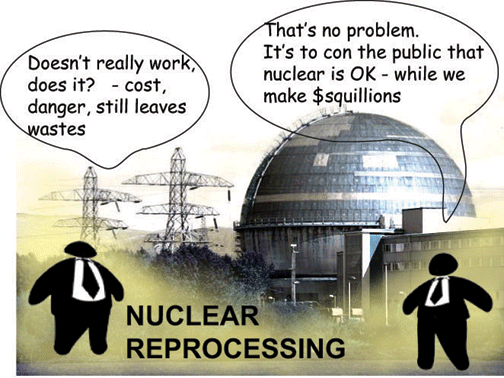
Construction of the Monju reactor started in Tsuruga, Fukui Prefecture, in 1985 as part of the government’s policy of establishing a nuclear fuel cycle to make use of spent nuclear fuel at conventional atomic plants that run on uranium. Monju uses a uranium and plutonium mix as fuel.
The facility of the government-affiliated Power Reactor and Nuclear Fuel Development Corp. first reached criticality, a situation where a chain reaction of nuclear fission is sustained, in 1994. http://english.kyodonews.jp/news/2012/06/166571.html
Stuxnet computer malaware affected USA too
 When Stuxnet Hit the Homeland: Government Response to the Rescue abc News 29 June 12, An Iranian nuclear facility may have taken the brunt of the cyber superweapon Stuxnet believed to be built in part by the U.S., but the American government was concerned enough with its spread to a facility back home that a fast response team was deployed to deal with an infection, according to a new report from the Department of Homeland Security.
The report , released Thursday by the DHS’s Industrial Control Systems Computer Emergency Readiness Team (ICS-CERT), gives scant details on the incident, except to say that after Stuxnet was discovered on thousands of computer systems around the world in 2010, a DHS team “conducted an onsite incident response deployment to a manufacturing
facility infected with the Stuxnet malware and helped the organization identify all infected systems and eradicate the malware from their control system network.”
The worm was found on “all their engineering workstations as well as several other machines connected to the manufacturing control systems network,” the report said….
http://abcnews.go.com/blogs/headlines/2012/06/when-stuxnet-hit-the-homeland-government-response-to-the-rescue/
Nuclear reprocessing is not the answer to Japan’s mounting radioactive wastes
The amount of spent fuel stored at power stations has continued to surge, standing at around 14,200 tons across 17 facilities as of last September, including the wrecked Fukushima No. 1 nuclear plant.
Japan Nuclear Fuel Ltd.’s storage facilities are already almost full and contained a total of 2,800 tons as of February, while several power stations are expected to reach maximum capacity over the next three years if their currently idled reactors are restarted, industry
sources said.
P olicy of recycling all spent nuclear fuel may be axed, Japan Times, 22 June 12, Kyodo, Jiji The Japan Atomic Energy Commission has proposed both reprocessing and directly disposing of spent nuclear fuel if Japan’s atomic energy reliance is cut to 15 percent, a departure from the current policy of total reprocessing…
.. The changed tack comes as massive amounts of spent fuel are accumulating at nuclear plants nationwide and as decades-long efforts to activate reprocessing facilities remain mired
in technical difficulties, sources said. Continue reading
Ionising radiation – the big cancer hazard for space travellers
Mission to Mars: The Radiation Problem. Smithsonian.com, 20 June 12, Would you go on a mission to Mars? The Dutch startup company Mars One is planning to establish the first Mars colony in 2023, starting with four individuals and adding more people every two years, funded by turning the whole endeavor into a reality TV show.
It’s just the latest plan to colonize the Red Planet, but I’m doubtful it will happen. There’s the expense, for sure, and the trials of trying to convince anyone to go on a one-way journey with just a few other strangers (what if you don’t get along? It’s not like you can leave). And then there’s the radiation problem.
Out in space, there are gamma rays from black holes, high-energy protons from the Sun, and cosmic rays from exploding stars. Earth’s atmosphere largely protects us from these types of radiation, but that wouldn’t help anyone traveling to Mars. They would be exposed to dangers that include neurological problems, loss of fertility and an increased risk of cancer….. A 2005 study found even more to worry about—the radiation would be high enough to cause cancer in 10 percent of men and 17 percent of women aged 25 to 34 if they were to go to Mars and back.
The easy solution would seem to be to shield the vessel that carries the humans to Mars, but no one has figured out how to do that. When the thin aluminum currently used to build spacecraft is hit with cosmic rays, it generates secondary radiation that is even more deadly. … http://blogs.smithsonianmag.com/science/2012/06/mission-to-mars-the-radiation-problem/
Global citizens’ monitoring of radiation data
Getting these devices out there — especially internationally — is a key to getting access to the world’s local radiation data.
The religious flag behind this project is the idea that this data should be accurate and open. Safecast uses open source and APIs and anyone can use the data to conduct research. For example a health researcher could use their radiation data to compare radiation levels against health information.
Local level radiation data is largely not available currently, or it’s owned by companies and not released.

 Using open source & grassroots to map the world’s radiation data http://gigaom.com/cleantech/using-open-source-grassroots-to-map-the-worlds-radiation-data/ By Katie Fehrenbacher Jun. 20, 2012, Mapping the world’s radiation and air pollution data, using one volunteer with one gadget at a time — that’s the goal of the Safecast project, which this week closed over $100,000 on Kickstarter to deliver a limited run of its open source geiger counters to interested buyers. “I don’t think it’s an unreasonable goal,” to create comprehensive maps of this data from all over the world, says Sean Bonner, co-founder of Safecast, in a phone interview shortly after his team’s project was funded.
Safecast originally focused on mapping radiation data just from Fukushima, Japan, in the wake of the nuclear disaster, and had a larger end goal to map the rest of Japan, too. But they realized that with enough eager volunteers in Japan, that mapping the entire country using geiger counters mounted on cars and held in the hands of regular citizens, was pretty doable. “It’s really only a matter of time before we’ve got all of Japan covered,” Continue reading
About the Flame computer virus
 Flame FAQ: All you need to know about the virus http://www.washingtonpost.com/blogs/blogpost/post/flame-faq-all-you-need-to-know-about-the-virus/2012/06/20/gJQAAlrTqV_blog.html By Benjamin Gottlieb
What is the Flame computer virus?
Flame is a sophisticated type of malware — short for malicious software — capable of infecting myriad computer networks for the purpose of gathering sensitive data. Once a network is infected by Flame, the virus can relay back massive amounts of information through a computer’s facilities. How does it work? Continue reading
Cyberweapons usher in the new arms race
Atomic scientists compare cyberwar to development of nuclear bomb Cyberbombs are the new atom bombs. Fox News, 15 June 12, The Bulletin of the Atomic Scientists warned Friday that the race to build and deploy cyberweapons — secret programs only recently discovered by security researchers, the extent of which is not yet fully known — closely resembles the race to build the first nuclear weapons.
“The parallels with the invention and first use of atomic bombs on Hiroshima and Nagasaki are eerie,” wrote Kennette Benedict  , the Bulletin’s executive director. The Bulletin of the Atomic Scientists was established in 1945 by scientists, engineers, and other experts who had created the atomic bomb as part of the Manhattan Project.
Its scientists also keep track of the doomsday clock, which warns of nuclear annihilation. Continue reading
Drones to monitor Japan’s ionising radiation.
Japan to develop drones to monitor radiation http://www.brisbanetimes.com.au/technology/sci-tech/japan-to-develop-drones-to-monitor-radiation-20120613-208zs.html#ixzz1xnWor9LB June 13, 2012 Japan’s atomic energy authority and the country’s space agency has announced a joint project to develop a drone to measure radioactivity in the environment after last year’s nuclear disaster. Japan has been forced to invent or improve systems for measuring radioactive contamination Continue reading
UK’s Thorpe nuclear reprocessing plant not economically viable
Extending Thorp’s life would require investment “well in excess of £1bn”, the NDA said, including the construction of £600m of storage tanks for the highly-radioactive “liquor” that is produced by reprocessing.
 “It would be very expensive to carry on much longer,” said Bill Hamilton, head of stakeholder relations at the NDA. “If there was a market out there, there would be a reason to invest, but there is no major appetite.”
Cumbria’s reprocessing plant to close Financial Times -8 June 12 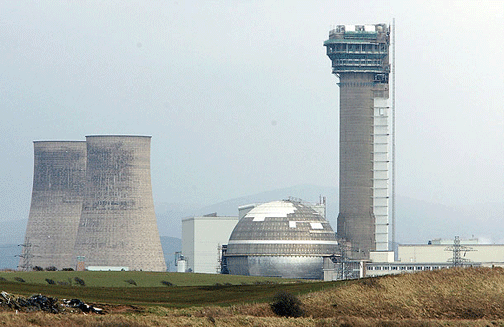
 By Rebecca Bream One of the more problematic facilities in the UK nuclear industry, the Thorp reprocessing plant at Sellafield in Cumbria, is set to close, reflecting a worldwide drop in demand for its services.
The Nuclear Decommissioning Authority, which is responsible for cleaning up the UK’s nuclear reactor sites and dealing with radioactive waste, said on Thursday that Thorp would close in 2018 when its existing reprocessing contracts end. Continue reading
UK’s nuclear reprocessing plant to close
Sellafield’s Thorp plant to close, The Independent, ALAN JONES , EMILY BEAMENT 07 JUNE 2012 A nuclear reprocessing site which has been in operation for 20 years is to close in 2018 after current contracts are completed, it was confirmed today.
The Thermal Oxide Reprocessing Plant (Thorp) at Sellafield in Cumbria,
… was commissioned in the early 1990s…. The NDA said in a statement that the closure decision was confirmed after it completed a strategic review of the options for the management of oxide fuels.
It added: “Oxide fuels include the remaining overseas-derived spent fuels that are being stored at Sellafield pending reprocessing in Thorp and also the spent fuels coming from the UK’s fleet of AGR (advanced gas-cooled reactors) power stations owned and operated by
EDF Energy….. Other decommissioning and reprocessing facilities and waste treatment plants on the Sellafield site remain in operation.
USA designed Stuxnet, but now itself vulnerable to cyber attack
More cyber attacks for the US in Stuxnet fallout, IT News, By Juha Saarinen on Jun 3, 2012 Anti-virus industry spectacularly failed. Political analysts have forecast potential consequences for the United States after confirmation emerged of its involvement in the creation of the Stuxnet malware that attacked Iranian uranium enrichment facilities.
The New York Times piece released last week revealed direct involvement by US President Barack Obama in ordering the creation and spread of the malware to the Iranian facilities, which largely succeeded before the virus was discovered outside of the country.
But the United States, seen as one of the most vulnerable countries to “cyber-attacks” due to its heavy reliance on computers, could become highly prone to similar attacks in future as retaliation to its actions. Continue reading
Japan – 37 tons of deadly plutonium, and planning to produce more
 Other countries, including the United States, have scaled back the separation of plutonium because it is a proliferation concern and is more expensive than other alternatives, including long-term storage of spent fuel.
Fuel reprocessing remains unreliable and it is questionable whether it is a viable way of reducing Japan’s massive amounts of spent fuel rods
Japan’s plutonium stockpile — most of which is stored in France and Britain — has swelled despite Tokyo’s promise to international regulators not to produce a plutonium surplus.
 Japan to make more plutonium despite big stockpile, Fox News June 01, 2012 Associated Press TOKYO – Last year’s tsunami disaster in Japan clouded the nation’s nuclear future, idled its reactors and rendered its huge stockpile of plutonium useless for now. So, the industry’s plan to produce even more has raised a red flag.
Nuclear industry officials say they hope to start producing a half-ton of plutonium within months, in addition to the more than 35 tons Japan already has stored around the world. That’s even though all the reactors that might use it are either inoperable or offline while the country rethinks its nuclear policy after the tsunami-generated Fukushima crisis. Continue reading
1 This Month
26 September – International Day for the Total Elimination of Nuclear Weapons





PLEASE OPPOSE HR 8255 AND S.3639 – bills would accelerate satellite deployment, with no environmental review or safeguards – https://ncstd5li.quorum.us/campaign/169331/
To see nuclear-related stories in greater depth and intensity – go to https://nuclearinformation.wordpress.com
-
Archives
- September 2026 (305)
- August 2026 (330)
- July 2026 (355)
- June 2026 (287)
- May 2026 (306)
- April 2026 (356)
- March 2026 (251)
- February 2026 (267)
- January 2026 (308)
- December 2025 (358)
- November 2025 (359)
- October 2025 (375)
-
Categories
- 1
- 1 NUCLEAR ISSUES
- business and costs
- climate change
- culture and arts
- ENERGY
- environment
- health
- history
- indigenous issues
- Legal
- marketing of nuclear
- media
- opposition to nuclear
- PERSONAL STORIES
- politics
- politics international
- Religion and ethics
- safety
- secrets,lies and civil liberties
- spinbuster
- technology
- Uranium
- wastes
- weapons and war
- Women
- 2 WORLD
- ACTION
- AFRICA
- Atrocities
- AUSTRALIA
- Christina's notes
- Christina's themes
- culture and arts
- Events
- Fuk 2022
- Fuk 2023
- Fukushima 2017
- Fukushima 2018
- fukushima 2019
- Fukushima 2020
- Fukushima 2021
- general
- global warming
- Humour (God we need it)
- Nuclear
- RARE EARTHS
- Reference
- resources – print
- Resources -audiovicual
- Weekly Newsletter
- World
- World Nuclear
- YouTube
-
RSS
Entries RSS
Comments RSS

