UK – Councils call for ‘rush to renewables’
Anti-nuclear local authorities in the north are calling for a radical rethink of British government policy on nuclear power.
Manchester-based Nuclear Free Local Authorities Secretariat (NFLA) said that a range of recent announcements and stories in the media “highlight serious doubts over the potential private-sector support for a new nuclear build programme in the UK.”
As a result the organisation has urged the government to rapidly seek a plan B for the Britain’s future energy mix, as well as tackling the problem of nuclear waste.
The NFLA cited numerous developments that it believes necessitate the formulation of a nuclear alternative, starting with the fact that French, Chinese and Russian bids for new reactors at Wylfa and Oldbury had not materialised.
Concerns have also arisen after Scottish Power-owned Iberdrola opted to take a further three years before deciding whether to stick with a consortium to build a new reactor at Sellafield Moorfield in Cumbria.
GROUP CALLS FOR INVESTIGATION OF PLUTONIUM FUEL CONTRACTOR AREVA -USA
“The group cited a legal dispute between Areva and the Tennessee Valley Authority over a $76 million charge for fuel services. The costs were later reduced to $26 million but without explanation.”[…]“How much profit is our health and survival worth compared to the economic interests of a few greedy people? Areva and its allies are only interested in the bottom line. We cannot let them line their pockets off the health of others.”
Argentina, Saudi Arabia discuss nuclear energy cooperation
BUENOS AIRES, Oct 10, 2012
(Xinhua via COMTEX) —
Senior officials from Argentina and Saudi Arabia met here Tuesday to discuss bilateral nuclear energy cooperation, the Foreign Ministry said Tuesday.

“The meeting’s main goal was to present a general view of the nuclear energy technological capabilities developed by Argentina at different stages, especially in infrastructure and nuclear plants, research reactors and production facilities,” said a ministry statement.
[…]
The two sides, which signed a bilateral cooperation agreement in 2011, also discussed possibilities of bilateral cooperation in energy and other areas of technological importance, and analyzed regional issues of common concern, added the statement.
50th Anniversary of Cuban Missile Crisis
October 10, 2012
VOA news
On October 26th, 1962, `Kennedy received a message from Khrushchev, offering to withdraw the missiles from Cuba, in exchange for assurances that Washington would neither invade that country nor overthrow Fidel Castro.
WASHINGTON — On October 14th, 1962, picturestaken by an American U-2 spy plane revealed the presence of Soviet nuclear weapons in Cuba.
Allison said the discovery was made by what he called “a magical intelligence capability”. “That an airplane, the U-2, could fly at over 60,000 feet, nobody would know that it was there, over territory, and then with this amazing camera take pictures that gave you details of what was happening on the ground – this was just unimaginable for most people. It was a great American intelligence success because the missiles were discovered before they were operational,” said Allison.
Kennedy Discusses Options
President John F. Kennedy then convened a small group of experts to decide what course of action to take. The group deliberated in secret for most of a week. Initially, the experts favored air strikes followed by an invasion, but they felt that would inevitably lead to nuclear war.
Shh! Swedish nuclear plant security missed Greenpeace activists for 28 hours
Blogpost by Brian Blomme – October 10, 2012 at 13:59
On Tuesday, we told you about the 70 activists who poured onto two nuclear sites in Sweden in an effort to show how lax the security is at these plants.
We didn’t tell you that at least six of them hid overnight at two of the plants: four at Ringhals and two at Forsmark.
They evaded security all night, and were only discovered when Greenpeace Sweden phoned the media early this morning to reveal their presence at the plants. This is despite the fact the operator Vattenfall said yesterday that “security had worked exactly as intended”. Oh dear.
One of the overnighters was Greenpeace International energy campaigner Lauri Myllyvirta. Here’s what he wrote about the experience:

“I’ve spent the night on the roof of the Swedish nuclear power plant Ringhals. More than 24 hours – and I’m only out because we chose to reveal our presence here.
That shows me, how alarmingly easy it is to access the vital systems that supply the reactor cooling systems with power.
The recent report on the EU stress tests revealed that in some Swedish reactors, a loss of power to the reactor would lead to a nuclear accident in just one hour.
The week that was, in nuclear news

Christina Macpherson’s websites & blogs
Japan: the planned nuclear phaseout is a tortuous political matter. Nobody wants to take responsibility for the decision on how (or whether) to do it, and on restarting the idle nuclear reactors.. The government wants the new regulatory agency to be the decider – along with local authorities. The regulator wants the government to decide. The public opposes nuclear power. Large manufacturers and business organisations want nuclear power to get going again. And Japan’s notorious “Nuclear Village” (nuclear industry cosy with government) is still intact.
UK government in turmoil on how to pay for new nuclear reactors, as AREVA and Chinese companies pull out. Russia looking to get a slice of the action. And France’s EDF wanting far too much money – and it’s all supposed to be funded by private investment! Continuing angst over the location of UK’s desperately needed nuclear waste burial site. Police arrest anti nuclear activists at Hinkley nuclear site.
India‘ s brave People’s Movement Against Nuclear Energy (PMANE) continued their 420-day agitation against Kudankulam atomic power plant in Tamil Nadu by laying siege of the plant. India’s democratic principles gone, in its repression of anti-nuclear action.
South Korea following India’s lead in banning visitors who take an anti nuclear stand. But still, the unsafety of South Korea’s nuclear reactors is becoming known.
Sweden. 70 anti nuclear activists “storm” 2 nuclear power plants, showing how poor is their security.
USA . Climate change – hot weather affecting nuclear reactors – but topics like nuclear power and climate change don’t rate amention in the Presidential debate between Obama and Romney, (though they do rate, in the campaigns of the USGreen Party and others.
Beautiful Lake Karachay – world’s most radioactively poisoned waterway

 Meet the lake so polluted that spending an hour there would kill you http://grist.org/list/meet-the-lake-so-polluted-that-spending-an-hour-there-would-kill-you/ By Jess Zimmerman, 3 Oct 12, Welcome to beautiful Lake Karachay, a Russian lake so tainted by nearby nuclear facilities that it’s considered the most polluted place on the planet. In 1990, just standing on the shore for an hour would give you a radiation dose of 600 roentgen, more than enough to kill you. On the plus side, lakefront property is probably really, really cheap. Continue reading
Fukushima’s 50 heroes fear discrimination and bullying
 The Economist: “Something strange was afoot” during Prime Minister’s visit to plant — Fukushima 50 muzzled http://enenews.com/economist-strange-afoot-during-prime-ministers-visit-plant-fukushima-50-muzzled Title: Japan’s nuclear disaster: Meet the Fukushima 50? No, you can’t
Source: The Economist Author: Banyan Date: Oct 8, 2012
It has taken the Japanese government more than 18 months to pay tribute to a group of brave men, once known as the “Fukushima 50”, who risked their lives to prevent meltdowns at the Fukushima Dai-ichi nuclear power plant from spiralling out of control.
But when the prime minister, Yoshihiko Noda, belatedly offered official thanks to them on October 7th something strange was afoot: six of the eight men he addressed had their backs to the television cameras, refused to be photographed and did not introduce themselves by name, not even to Mr Noda
The reason: officials from the government and from Tokyo Electric Power (Tepco) quietly admitted that the men wanted to keep their identities secret because they were scared of stigmatisation for being involved in the disaster, such as might lead to the bullying of their children and grandchildren. But Tepco is also muzzling them, presumably for fear that what they say will further discredit the now nationalised company. When I asked if I could at least hand my business card to them to see if they wanted to tell their side of the story, an irate Tepco spokesman answered bluntly: “Impossible.”
…Yet even after Mr Noda’s visit, the men do not get the recognition they deserve. Kyodo, a news agency, relegates any mention of them to the bottom of a boring story about decontamination.
USA leads in 5 top countries using renewable energy
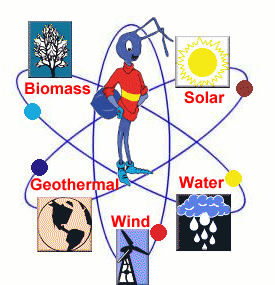 5 Top Countries Leading The World In Renewable Energy, Care 2, by Judy Molland October 9, 2012 ” Sustainable Energy and Renewable Energy are terms that are thrown around a lot these days, but what exactly do they mean, and how many countries are taking them seriously?
The US Energy Information Adminstration (EIA) estimates that in 2008, 10% of the world’s energy consumption was from renewable energy sources. EIA forecasts that by 2035, consumption of renewable energy will be about 14% of total world energy consumption.
What are these renewable sources?
First, what they are not: the coal, oil and natural gas that the U.S. relies heavily on are all non-renewable, and will eventually dwindle and disappear.
By contrast, the many types of renewable, or sustainable, energy resources, such as wind and solar energy, are constantly replenished and will never run out…. And why do we love renewable energy?
These are clean sources of energy, meaning they have a much lower environmental impact than conventional energy technologies. They won’t run out, their costs revolve around materials and workmanship for facilities rather than on expensive energy imports, and better yet, renewable energy technologies developed and built in the U.S. are being sold overseas. Finally, U.S. energy security is at risk when we become so dependent on foreign oil supplies. Continue reading
North Korea claims it can strike USA with nuclear missiles
North Korea says missiles can strike US Radio Australia 9 October 2012, North Korea says it possesses “strategic rocket forces” capable of striking the US mainland. The statement comes in response to a new US-South Korean deal to extend the range of the South’s missile systems. Continue reading
Hearings drag on about Indian Point nuclear waste dump

 Indian Point Hearings: It’s Down the Rabbit Hole Entergy Watches as Boron Degrades, Counter Punch by JOHN RAYMOND, 8 Oct 12 Will New York State have any more success in shutting down Entergy’s Indian Point nuclear waste dump on the Hudson River than Vermont has had, so far, in its battle to close Entergy’s Yankee plant that befouls the landmark Connecticut River?
Don’t bet on it. But stay tuned.
Recall that Yankee was relicensed last year without a hitch despite: a long and continuing history of radioactive leaks, shutdowns, and slipshod maintenance that caused, most stunningly, the collapse of a cooling tower in 2007; a perjury investigation by the state Attorney General triggered after Entergy officers lied to state authorities that Yankee had no underground pipes that carried radioactive water (it does), and, last but hardly least, the Vermont Senate’s celebrated vote in 2010 to shut the plant down.
The five commissioners on the Nuclear Regulatory Commission would hear none of it. Their unanimous vote to extend the 40-year-old plant’s license for another 20 years came less than two weeks after the nuclear catastrophe in Japan raised new fears in the U.S. where 23 reactors, including Yankee, operate with same flawed GE design (identified and covered up by federal nuclear regulators beginning in the early 1970s) that failed in the triple meltdown at the Fukushima plant and released over four times the amount of cesium-137 than was released in the 1986 Chernobyl disaster. Continue reading
Criminal complaint filed against TEPCO and the Japanese government
 1,324 Fukushima People Filed A Criminal Complaint Against TEPCO and the Government (Jun/11/2012) http://www.youtube.com/watch?feature=player_embedded&v=xfSbZvBOwKM Jun 13, 2012 by tokyobrowntabby2
On June 11, 2012, 1324 people from Fukushima Prefecture filed a criminal complaint against Tokyo Electric Power Co. Chairman Tsunehisa Katsumata and 32 others, accusing them of professional negligence resulting in death and injury, arguing they were responsible for causing the nuclear disaster at the Fukushima Daiichi Power Plant and the exposure of the plaintiffs to radiation.
In the written complaint filed with the Fukushima District Public Prosecutors Office, the complainants said the 33 neglected to take disaster countermeasures, despite the frequency of earthquakes in Japan and indications by experts of the possibility of tsunami. They also argued that the officials failed to release evacuation information appropriately, which led to residents’ exposure to radiation.
The 33 include TEPCO Chairman Katsumata, former TEPCO President Masataka Shimizu, 13 other TEPCO officials, Nuclear Safety Commission Chief Haruki Madarame, and 3 Radiation Health Risk Management Advisors of the prefecture including Shunichi Yamashita, Vice President of Fukushima Medical University.
“By holding them accountable, we will carry out our responsibility to the next generation,” says Ms. Ruiko Muto, leader of the complainant organization. “I hope our action will lead to reuniting our bonds disrupted by the disaster.”
They plan to file the second complaint where people outside Fukushima Prefecture can join the complainant. The dedline for joining is the end of September 2012.
The nuclear fusion dream – ever elusive
Fusion: Maybe Less Than 30 Years, But This Year Unlikely Bill Chameides Dean, Duke University’s Nicholas School of the Environment, August 2012 No ignition at the U.S. National Ignition Facility , home to the world’s largest laser….. Scientists have been thinking about how to bring this game changer into the energy game for decades. (See fusion/fission timeline .) As far back as 1946, two British scientists — Sir George Paget Thomson and Moses Blackman — filed the first patent for a fusion power plant .
But there have been a couple of hold-ups . To get a fusion reaction started, you need to slam the hydrogen atoms together really, really hard and that requires a lot of energy. (In a hydrogen bomb, the fusion reaction gets ignited by an atomic bomb, using fission. Not exactly the preferred method for your local fusion power plant.)
Even trickier is controlling the fusion reaction. It’s one thing to make a fusion bomb, it’s a lot harder to get the reaction going and keep it under control in a way that the amount of energy extracted is larger than that expended to initiate and manage the reaction.
Over the almost 70-year pursuit of the fusionary holy grail, it’s been fairly common for scientists working on the problem to say that they’re about 30 years away from achieving a power plant based on fusion. (See here and here .) The problem has been that while time has marched on, the 30-year horizon has remained fixed. Suffice to say it has proven to be a very tough problem…. http://www.huffingtonpost.com/bill-chameides/fusion-maybe-less-than-30_b_1949573.html
The complicated politics of Japan’s planned nuclear power phaseout
Fukushima Slugfest, Forbes, James Conca 9 Oct 12 — Japan’s New Nuclear Regulation Authority No one wants to make a decision on nuclear power in Japan. This is not surprising since the weak regulatory environment and complicity between government and industry in Japan led to the Fukushima disaster in the first place. Continue reading
Thailand’s anxiety over Cambodia’s nuclear power plans
Army chief expresses worry over Cambodia nuclear plan http://www.bangkokpost.com/news/local/316243/army-chief-expresses-worry-over-cambodia-nuclear-plan 10/10/2012 Army chief Prayuth Chan-ocha has expressed concern over Cambodian Prime Minister Hun Sen’s plan to build a nuclear power plant in Cambodia’s Koh Kong province adjacent to Thailand’s Trat province. Continue reading
1 This Month
23-25 October – on Zoom – World BEYOND War’s annual global conferenc

To see nuclear-related stories in greater depth and intensity – go to https://nuclearinformation.wordpress.com

Say No to NASA’s Reckless Nuclear Reactor on the Moon
Say No to NASA’s Reckless Nuclear Reactor on the Moon
-
Archives
- October 2026 (160)
- September 2026 (339)
- August 2026 (330)
- July 2026 (355)
- June 2026 (287)
- May 2026 (306)
- April 2026 (356)
- March 2026 (251)
- February 2026 (267)
- January 2026 (308)
- December 2025 (358)
- November 2025 (359)
-
Categories
- 1
- 1 NUCLEAR ISSUES
- business and costs
- climate change
- culture and arts
- ENERGY
- environment
- health
- history
- indigenous issues
- Legal
- marketing of nuclear
- media
- opposition to nuclear
- PERSONAL STORIES
- politics
- politics international
- Religion and ethics
- safety
- secrets,lies and civil liberties
- spinbuster
- technology
- Uranium
- wastes
- weapons and war
- Women
- 2 WORLD
- ACTION
- AFRICA
- Atrocities
- AUSTRALIA
- Christina's notes
- Christina's themes
- culture and arts
- Events
- Fuk 2022
- Fuk 2023
- Fukushima 2017
- Fukushima 2018
- fukushima 2019
- Fukushima 2020
- Fukushima 2021
- general
- global warming
- Humour (God we need it)
- Nuclear
- RARE EARTHS
- Reference
- resources – print
- Resources -audiovicual
- Weekly Newsletter
- World
- World Nuclear
- YouTube
-
RSS
Entries RSS
Comments RSS

