Kyodo: Alarm sounds at MOX reactor in Japan, no “actual leakage” detected — Nuclear fuel loaded inside July 30th, 2012 By ENENews (Subscription Only) Title: Monju alarm on sodium leakage malfunctions Source: Kyodo
Japan Atomic Energy Agency said an alarm was activated early Monday morning indicating a sodium coolant leakage at its Monju prototype fast breeder reactor in Tsuruga, Fukui Prefecture. Continue reading
a SILEX facility could make it much easier for a rogue state to clandestinely enrich weapons grade uranium to create nuclear bombs
SILEX could become America’s proliferation Fukushima,
Controversial nuclear technology alarms watchdogs http://www.smartplanet.com/blog/intelligent-energy/controversial-nuclear-technology-alarms-watchdogs/18138 By David Worthington | July 30, 2012 A controversial nuclear technology is raising alarms bells among critics who claim it may be better suited for making nuclear weapons than lowering the cost of nuclear power and could lead to a nonproliferation “Fukushima” for the United States. Continue reading
Hacking into Iran’s nukes with heavy metal music
The latest cyber weapon to rock Iran’s nuclear program? Australia’s AC/DC The Star, July 25, 2012, Bloomberg, DUBAI, UNITED ARAB EMIRATES — Iran’s nuclear facilities have suffered a cyber attack that shut down computers and played music from the rock band AC/DC, the F-Secure Security Labs website says.
A new worm targeted Iran’s nuclear program, closing down the “automation network” at the Natanz and Fordo facilities, the Internet security site reported, citing an email it said was sent by a scientist inside Iran’s Atomic Energy Organization.
The virus also prompted several of the computers on site to play the song “Thunderstruck” by AC/DC at full volume in the middle of the night, according to the e-mail, part of which is published in English on the website……
AC/DC has played “high voltage rock ‘n’ roll” since the band was formed in 1973 in Australia, according to the band’s website. The group’s songs were among the loud music played to detainees at the Guantanamo Bay prison facility in preparation for interrogations, the Associated Press reported in October 2009, citing the National
Security Archive in Washington….. http://www.thestar.com/news/world/article/1231457–the-latest-cyber-weapon-to-rock-iran-s-nuclear-program-australia-s-ac-dc
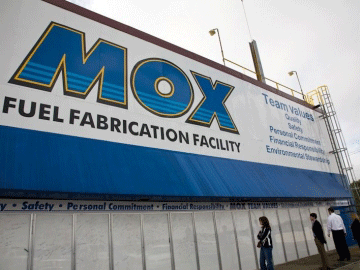
MOX nuclear reprocessing plant at Savannah River Site
NRC holding public meeting over MOX plant http://www.sacbee.com/2012/07/24/4654152/nrc-holding-public-meeting-over.html The Associated Press, Jul. 24, 2012 COLUMBIA, S.C. — Federal regulators are holding a public meeting to discuss a project to create mixed-oxide fuel at a former nuclear weapons site in South Carolina.
The U.S. Nuclear Regulatory Commission is having the open session on Tuesday at the Savannah River Research Campus in New Ellenton.
Construction on the MOX facility began at the Savannah River Site in 2007. Officials say the plant will be used to convert weapons grade plutonium into fuel that will be sold to run commercial power reactors.
The SRS complex once produced plutonium and tritium for atomic bombs. Officials say the nearly $5 billion MOX facility is on schedule and should be running in 2016.
MOX plutonium nuclear reprocessing plants for Tennessee and Alabama?
 TVA considering fuel made from nuclear weapons http://www.kfoxtv.com/news/ap/energy/tva-considering-fuel-made-from-nuclear-weapons/nP3m5/ CHATTANOOGA, Tenn. — The Department of Energy is preparing an environmental impact statement on the use of fuel made from surplus nuclear weapons to power Tennessee Valley Authority nuclear plants. TVA released a set of talking points on Tuesday about the environmental impact statement, which will appear as a draft this week in the Federal Register, TVA spokesman Ray Golden told The Chattanooga Times Free Press (http://bit.ly/MGUFrO ).
The mixed oxide fuel, also called MOX fuel, is a blend of plutonium and uranium, but the variety under consideration is made from retired nuclear weapons, according to the TVA.
The utility has tentatively agreed to consider using the fuel in its Sequoyah and Browns Ferry nuclear plants in Tennessee and Alabama, with a timetable set for 2018. Continue reading
Pitfalls in building nuclear reactors underground
 Just build them underground! http://daryanenergyblog.wordpress.com/ca/part-10-smallreactors-mass-prod/10-2-2-just-build-them-underground/ There is a common misconception, that we could solve a lot of the problems with reactor construction, both large and small (though in particular the small ones) by building them in subsurface pits. I’m assuming the person who thought up this one has never dug a hole in his back garden! If you have, you’d know that digging a hole is not as easy as it seems. Firstly, the soil type has a big bearing on things. Depending on where you live you could be looking at thick sticky soil that difficult to shift, loose gravely soil that collapses easily or rocky earth, that rapidly turns into bedrock (so after a while you’re not digging any more but blasting!). As we need to put foundations down under out reactor to suit the soil type, and probably piling too (due to its weight), this means we essentially need to design each reactor’s containment vessel individually to suit local soil conditions, which increases costs.
Another problem is water intrusion, as anyone who’s ever dug a pit, then gone in for lunch, come back out and found it full of water will know all about! Our reactor “pit” needs to be designed like the hull of a boat to stop water leaking in and flooding it. Doing that with concrete, particularly thick section of it, is always difficult. The fact that the reactor will be generating heat complicates things as it raises the risk of subsidence or settlement cracking. While this can happen if the reactor is on the surface too, putting it under ground level “complicates things”.
In general with any construction project significant efforts are made to reduce the amount of earth movement required to start construction, not increase it, as lots of earth moving nearly always results in delays, hold-ups and ultimately higher costs (not the least of those being the cost of hiring out of earth moving equipment, those guys charge an arm and a leg!).
Overall, except in a small number of narrow cases building reactors this way will often work out as more expensive and slower than just putting the containment dome above ground.
Building nuclear reactors underground
FirstEnergy looking into building small nuclear reactor By John Funk, The Plain Dealer , July 25, 2012 FirstEnergy said today it had signed an agreement with a subsidiary of Babcock & Wilcox Co. to study the “potential deployment of the B&W mPower small modular reactor in FirstEnergy’s service territory.” The reactor would generate just 180 megawatts and be built in an underground containment structure, …..
A critical analysis of future nuclear reactors designs
By D A. Ryan, Once upon a time I used to be a fan of nuclear energy. As far as I saw it, nuclear energy was the silver bullet solution to all of our energy problems and more. However, the more I’ve learned about the industry the more critical I’ve become.
Notably the fact that most of the economic figures in support of nuclear power (a couple of typical delusions you’ll find here and here) come straight out of Hogwarts school of magic, wizardry….and economics (more realistic appraisals of nuclear economics can be found here and here).
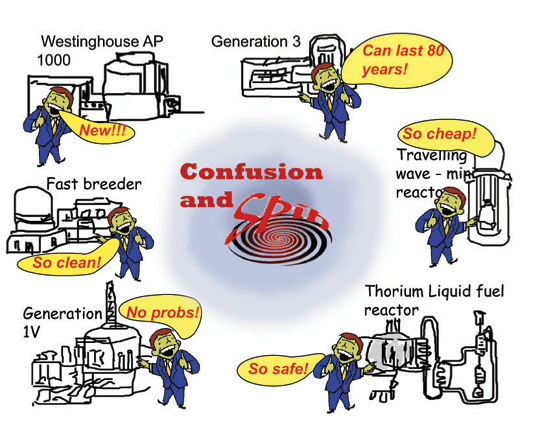
All in all my conclusion is that the case for future Generation IV nuclear reactors is much narrower than the supporters of nuclear energy would have you believe. While they do offer some advantages over LWR’s, notably in the area of safety, this comes with strings attached, notably higher capital costs. This is largely a result of the fact that many of these would need to be built from much more exotic materials, such as high temperature stainless steel alloys Nickel alloys or Refractory materials, while the predominant material of choice in current reactors is steel (stainless and forged ferritic) and concrete. This materials requirement is itself an issue related to the high temperatures these alternative reactors would be required to operate at, not to mention the more aggressive and corrosive environment in some of them, notably the MSR proposals. Of course one to question whether these higher construction costs (and in some cases higher decommissioning costs) are justified……..
Small to medium sized modular reactors do offer a good deal more flexibility in terms of how nuclear power could be used and yet a further improvement in safety. However, they also comes with lower economies of scale and thus higher construction costs and worse a slower rate of reactor roll out (at least in the early days). We could claw back on these two issues by mass producing said reactors in large volumes but as I point out (again see the full article), it is far from proven whether that would be economically viable and whether there is in fact a market for large numbers of small reactors…….
by and large mass production means “dumbing down” our design, and that means accepting a reactor that’s much cheaper and easier to build but has a lower thermal efficiency, a higher rate of fuel consumption and ultimately produces larger volumes of nuclear waste compared to our “mega” reactors. With the exception of a small number of narrow cases, it’s difficult to envisage how this would offer an improvement on the current status quo…..
Fusion?
Finally, I also had a look at Fusion power . his is the great white hope of nuclear energy and it has to be said we are making progress, but it’s a case of slow and steady progress. Indeed I would question whether we are in a position yet to even estimate how long it will take for fusion power to become commercial available…if indeed ever! Recent news from ITER is not positive, its now not due to go online till 2026, which would imply a completion of experiments in 2046. And it will take sometime beyond that before we wind up with a viable working commercial fusion reactor. As I speculate (here), it would likely be the latter half of this century (or the beginning of the next one) before we start to see Fusion play any sort of major role in mass global power generation…… nuclear energy supporters need to overcome their pathological hatred of renewables http://www.green-blog.org/2011/08/11/a-critical-analysis-of-future-nuclear-reactors-designs/
I guess that Missouri’s Governor doesn’t understand that nuclear reactors don’t like heat
 Nixon, UM president Wolfe to tout nuclear plan, http://www.kansascity.com/2012/07/23/3718392/nixon-um-president-wolfe-to-tout.html#storylink=cpy
Kansas City Star, 23 July 12 COLUMBIA –– Gov. Jay Nixon and University of Missouri president Tim Wolfe will join utility executives and business leaders at an event designed to boost support for building small modular nuclear reactors in the state.
The event today on the Columbia campus is billed as an economic development summit, while officials await word on a U.S. Department of Energy grant application.
Westinghouse Electric Co. and Ameren Missouri are competing for a share of the $452 million the energy department has set aside for the new technology.
Ameren wants to build and operate up to five smaller reactors in Missouri. The St. Louis-based company operates the state’s only nuclear power plant in Callaway County. The federal department plans to announce its grant recipients by September.
With no future in Japan, nuclear engineers move to other countries
Japan the only country in the world equipped with the know-how to operate the two main types of nuclear power reactors — the pressurized water reactor (PWR) and the boiling water reactor (BWR)….
And it has been the engineers of Tepco and other power companies in Japan who have accumulated the know-how to operate nuclear power plants using nuclear power plant components that incorporate the most advanced technology……
Nuclear engineers ditching Japan for a bigger paycheck, SENTAKU MAGAZINE, July 16, 2012 Although Japan is reputed to be one of the most technologically advanced nations in nuclear power generation, it now faces a serious “brain drain” as some of its highly experienced nuclear engineers are lured to work in other countries for much better remuneration than they could hope to receive at home….
In Japan, public opinion has been increasingly against nuclear power generation since the March 11, 2011, accidents at Tokyo Electric Co.’s Fukushima No. 1 nuclear power plant. Continue reading
After one MOX nuclear reprocessing disaster, Britain plans another one!
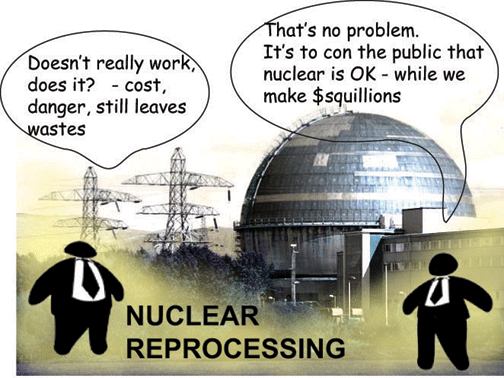
Pete Wilkinson, an independent environmental consultant, said it “beggared belief” that ministers were going down this path after losing an estimated £600m from operating an original MOX plant.
“It would be interesting to see the commercial arrangements which justify turning Britain into a nuclear waste dump for plutonium that no-one else wants.”
 UK nuclear authority takes ownership of German plutonium UK risks becoming a ‘nuclear laundry’ looking after unwanted waste from other countries, warns industry expert Terry Macalister guardian.co.uk, 13 July 2012 Britain risks being turned into a “nuclear laundry” by taking ownership of German plutonium in return for cash, the government was warned on Friday.
The move came along with confirmation that ministers were moving towards a controversial decision to build a new mixed oxide fuel (MOX) plant despite having just agreed to close an existing one which lost millions of pounds.
Britain has the largest stockpile of plutonium in the world but has taken permanent control of a further 4 tonnes under a deal with German nuclear power companies.. Continue reading
Britain’s disastrous record in technology to manage nuclear waste
Minister admits total failure of Sellafield ‘MOX’ plant http://www.independent.co.uk/news/uk/politics/minister-admits-total-failure-of-sellafield-mox-plant-793489.html BY GEOFFREY LEAN It was a deeply embarrassing moment for the Government, though it passed almost without notice.
Late last month, the Energy Minister, Malcolm Wicks, had to admit to one of the most comprehensive and catastrophic failures in British industrial history – and one that has led directly to the plans to ship weapons-ready plutonium to France.
Answering a question from Dai Davies, the independent MP for Blaenau Gwent, Mr Wicks confessed that a new plant at Sellafield, built amid great controversy at a cost of £473m, had comprehensively failed to work. Continue reading
Britain looks at dubious technical “fixes” for its radioactive pile at Sellafield
It is the task of the Nuclear Decommissioning Authority (NDA) to clean all this up. The plans are to pay the French company Areva, who have proved their technology works, to build a new mixed oxide fuel (MOX) plant.
The other option is to let the US-Japanese GE-Hitachi build a new fast PRISM reactor on the site to burn the plutonium and produce electricity. This is a more elegant engineering option but the reactor is totally unproven and is decades away from completion.
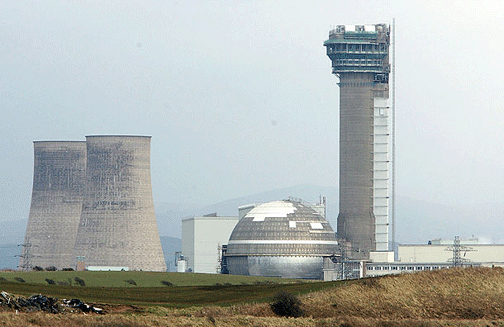 Sellafield: The dangers of Britain’s nuclear dustbin RT, 10 July, 2012“…….Cold war legacy Behind the razor wire, security guards and public relations campaigns,
Sellafield is home to some of the most radioactive buildings in Europe.
The UK has the largest stockpile of Plutonium anywhere in the world and it’s all stored at Sellafield. Plutonium is used for the manufacture of nuclear weapons and is extremely radioactive with a half-life of 25,000 years. Continue reading
SAFECAST monitors nuclear radiation in Japan
 News Summary: American praised for radiation data
http://news.smh.com.au/breaking-news-technology/news-summary-american-praised-for-radiation-data-20120710-21s6x.html July 10, 2012 – The Associated Press NUCLEAR WINDS: Japanese seeking information on radiation levels in the aftermath of the Fukushima disaster are turning to a volunteer group founded in the U.S. that has created a detailed and constantly updated visual database online. Sean Bonner, one of the founders of the group called Safecast, http://blog.safecast.org/about/ said nothing could have been more natural than to jump in and fill the need.
FEARFUL AFTERMATH: Many Japanese were terrified about the health effects of radiation in the wake of the Fukushima disaster, and had no idea whether their homes, schools and offices were safe. They were also frustrated by the lack of government or other official data on
radiation. Geiger counters were selling out.
FILLING THE NICHE: Within weeks, Bonner and his team created a handmade Geiger counter connected with a GPS feature that he calls “bGeigie,” a reference to Japanese-style “bento” lunchboxes. It is attached to cars and takes a reading every five seconds, resulting in
a massive store of data. There are 30 to 35 such mobile devices traversing Japan and 320 fixed devices. Safecast made the technology and the data open, sharing the design and findings, and has now collected more than 3 million measurements across Japan. Other
volunteers have developed online maps with the data.
Laser enrichment technology can promote the spread of nuclear weapons
 a tension between the United States’ goal of safely commercializing nuclear-power technology and its efforts to control the proliferation of nuclear materials. ”When there’s a conflict, generally speaking, the policy to spread nuclear technology overrides the non-proliferation policy.”
 Laser-based uranium enrichment plant sparks controversy 07/05/2012 Laser Focus World by Gail Overton Senior Editor Washington, DC–A July 4 Nature news story from Sharon Weinberger says that the U.S. Nuclear Regulatory Commission’s decision to open a plant that uses laser-based uranium enrichment will be considered in private. Although the controversial laser uranium-enrichment technology is on the cusp of making it cheaper to create fuel for nuclear power plants, some non-proliferation experts are concerned that the efficiency of the laser-based technology will also smooth the path for bomb makers. Continue reading
1 This Month
26 September – International Day for the Total Elimination of Nuclear Weapons





PLEASE OPPOSE HR 8255 AND S.3639 – bills would accelerate satellite deployment, with no environmental review or safeguards – https://ncstd5li.quorum.us/campaign/169331/
To see nuclear-related stories in greater depth and intensity – go to https://nuclearinformation.wordpress.com
-
Archives
- September 2026 (305)
- August 2026 (330)
- July 2026 (355)
- June 2026 (287)
- May 2026 (306)
- April 2026 (356)
- March 2026 (251)
- February 2026 (267)
- January 2026 (308)
- December 2025 (358)
- November 2025 (359)
- October 2025 (375)
-
Categories
- 1
- 1 NUCLEAR ISSUES
- business and costs
- climate change
- culture and arts
- ENERGY
- environment
- health
- history
- indigenous issues
- Legal
- marketing of nuclear
- media
- opposition to nuclear
- PERSONAL STORIES
- politics
- politics international
- Religion and ethics
- safety
- secrets,lies and civil liberties
- spinbuster
- technology
- Uranium
- wastes
- weapons and war
- Women
- 2 WORLD
- ACTION
- AFRICA
- Atrocities
- AUSTRALIA
- Christina's notes
- Christina's themes
- culture and arts
- Events
- Fuk 2022
- Fuk 2023
- Fukushima 2017
- Fukushima 2018
- fukushima 2019
- Fukushima 2020
- Fukushima 2021
- general
- global warming
- Humour (God we need it)
- Nuclear
- RARE EARTHS
- Reference
- resources – print
- Resources -audiovicual
- Weekly Newsletter
- World
- World Nuclear
- YouTube
-
RSS
Entries RSS
Comments RSS

