MICROREACTORS – the Next Big Little Nuclear THING!

Noel Wauchope, 15 August 2026, https://theaimn.net/microreactors-the-next-big-little-nuclear-thing/
Forget about Small Modular Nuclear Reactors – they’re not cool anymore!
What the world needs now is MICROREACTORS – so saith the global nuclear lobby. And we know they must be right, because they’ve already explained how the world needs a NUCLEAR RENAISSANCE to solve climate change, energy shortage, world peace etc…
Now there are substantial differences between microreactors and small modular nuclear reactors (SMRs) , even though at first glance microreactors might seem to be just teeny weeny versions of SMRs. Whereas an SMR produces up to 300 MWe , a microreactor produces anything from 1 MWe up to 50MWe
There are fuel differences . SMRs can use LEU – Low Enriched Uranium or the more powerful HALEU – High-Assay Low-Enriched Uranium . Microreactors can, in theory, use LEU fuel, but that could not work out to be economic. The fuel must be the more powerful HALEU – High-Assay Low-Enriched Uranium. And in fact, Most microreactor plans use the more complex TRISO Fuel (Tri-Structural Isotropic), in which the tiny kernels of HALEU are coated with multiple layers of ceramic and carbon. That makes TRISO very safe, but very expensive.
Really, the most important difference is in – Who Pays For Microreactors?
Well, you do, if you’re a tax-payer. The only economically viable way to fund microreactors is to make them military installations, government funded. SMRs are supposedly economically viable, and were touted to become a private enterprise success. That’s until the NuSCale SMR financial fiasco
The beloved ever-about -to-happen nuclear renaissance needs a new theme, and that new funding source. The old theme was ENERGY– the new theme is DEFENCE.
For quite a while now, it has been obvious, and indeed a boast of the nuclear lobby, that new small reactors would support the defence sector, and nuclear weaponry, by providing the trained staff that are so badly needed, as the old nuclear boffins retire,
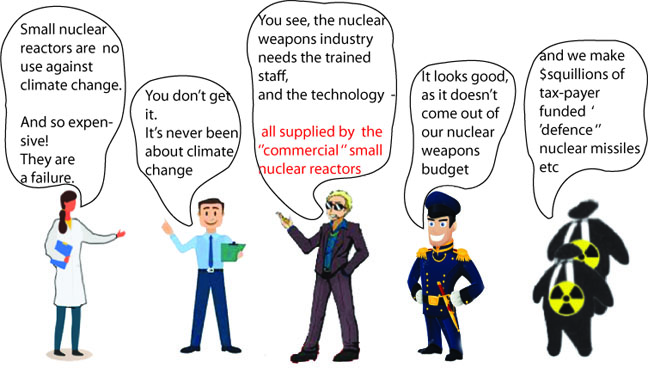
But times have changed, and also the nuke lobby is getting desperate. With all the international political drama going on, obviously the top priority now is war. (Did I hear someone say, what about diplomacy, negotiation? Look, that’s time-consuming, takes high mental ability, and there’s no money in it) Yes, what we and the nuke industry need now is war preparation.
So the nuclear industry is regalvanised, with a spate joyous media articles, mostly – worded like this one – Antares Raises $470M to Field Military-Focused Microreactors. Optimistic statements abound:
Power up: Antares and their nuclear startup frenemies moving so fast is good news for the Pentagon, which is where that 2028 number comes into play in a few places.
In May 2025, President Trump signed a series of executive orders to accelerate the Department of Energy’s “Manhattan Project 2.0.” -notably Executive Order 14299, “Deploying Advanced Nuclear Reactor Technologies for National Security,” Then came Executive Order 14300, “Ordering the Reform of the Nuclear Regulatory Commission,”- getting rid of, or watering down public safety, radiation and environmental standards. The full import of this has been documented by Kristen Thomason in her superb article – “If you’re already afraid, just wait until you hear about Manhattan Project 2.0″

A lot of hype about microreactor energy for data farms, with Silicon Valley tech billionaires all on board, – and the craze is for so many “start-ups “

I had every intention of going through all the hazards, impediments to these microreactors ever becoming a commercial reality. But guess what ? OKLO, probably the leader of the pack, has done it for me. After the usual hypy article, glorifying their new microreactor, OKLO makes this revealing statement at the end:
As a result of a number of known and unknown risks and uncertainties, the actual results or performance of Oklo may be materially different from those expressed or implied by these forward-looking statements. The following important risk factors could affect Oklo’s future results and cause those results or other outcomes to differ materially from those expressed or implied in the forward-looking statements: risks related to the development and deployment of Oklo’s powerhouses, fuel fabrication and fuel recycling facilities, and radioisotope production activities; the risk that Oklo is pursuing an emerging market with no commercial project operating and regulatory uncertainties; risks related to acquisitions, divestitures, or joint ventures we may engage in; the need for financing to construct plants, which remain subject to market, financial, political, and legal conditions; risks related to an inability to raise additional capital to support our business and sustain our growth on favorable terms; the effects of competition; risks related to accessing high-assay low-enriched uranium, plutonium, and other fuels (including recycled fuels) at acceptable costs and under acceptable timelines; risks related to our supply chain; risks related to power purchase agreements; risks related to human capital; risks related to our intellectual property; risks related to cybersecurity and data privacy; changes in applicable laws or regulations, including tariffs; the outcome of any government and regulatory proceedings and investigations and inquiries; and the other factors set forth in our documents we have filed with the U.S. Securities and Exchange Commission (the “SEC”).
The foregoing list of factors is not exhaustive.
I was going to try and list all those factors – to throw some cold water on the microreactor parade – and that leading microreactor developer has done it for me!
As I tried to research all those factors to consider about micoreactors, I made the discovery that amongst the pro nuclear experts themselves, there are the gold nuggets of the truth. Not only has OKLO raised those contentious questions, but in a lengthy video – Nick Touran, a nuclear engineer and manager at TerraPower, unearths the sobering realities of micro nuclear reactors:
It’s long – but he spells it all out, if you can take the time:
Chapters:
00:00 Visions for microreactors 03:49 Defining microreactors 11:56 The problem of radiation shielding 18:48 Original microreactor projects 24:29 Niche applications 30:32 The problem of neutron economy 40:08 The problem of fuel 53:03 The problem of operations and maintenance 1:00:17 The problem of commercialization 1:05:42 The problem of spent fuel 1:09:27 The problem of scaling 1:12:36 The problem of licensing
Nick Touran and OKLO might be hopeful for microreactor success some time in the future. But they – pro nuclear people, are well aware of the obstacles and especially of the financial costs.
So, if they can take the microreactor hype with a grain of salt, the rest of us, who are not part of the development process, should be taking that hype with a bucketful .
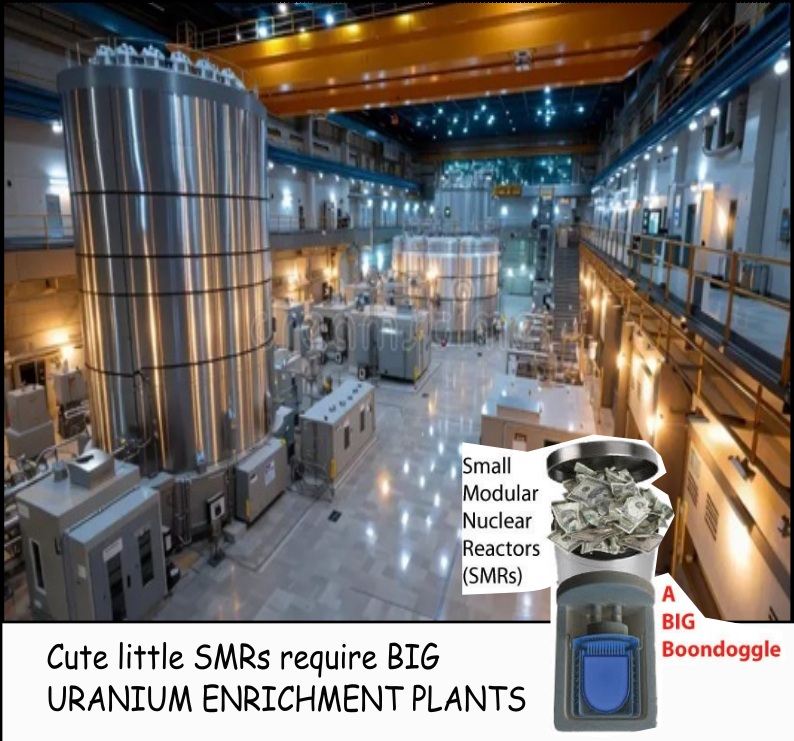
The trouble with Small Modular Nuclear Reactors (SMRs) – THEY’RE NOT SMALL
7 August 2026 Noel Wauchope, https://theaimn.net/the-trouble-with-small-modular-nuclear-reactors-smrs-theyre-not-small/

The big boasts for small nuclear reactors are that they are modular and they are small.

Modular – yes. They’re a sort of LEGO or IKEA thing – parts made in one place, then shipped to another place and assembled. (That process has its problems, too – but today I’m just focussing on the small aspect.
A small modular reactor (SMR) is an emergent class of nuclear fission reactors with a rated electrical power of less than 300 megawatts (MWe) (Wikipedia) MWE (Megawatts electric) refers specifically to the amount of electrical power a system can produce. Large reactors generate over 700 MW(e). Microreactors range in capacity from 1 to 20 MWe.
So – now we have SMRs being touted as the great new source of electricity – a sort of vision of little nuclear reactors dotted in their many thousands all over the world.
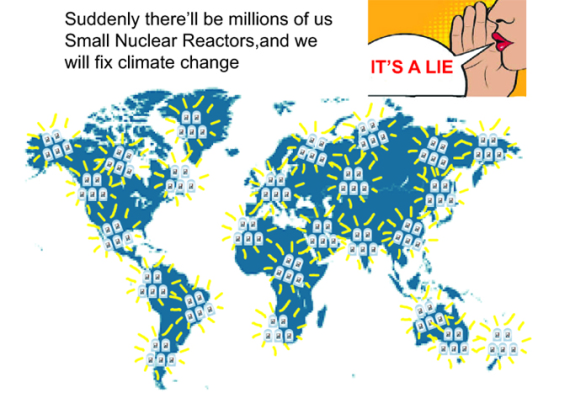
But that’s not really a practical plan. So – how about bundling a bunch of them together – so they can produce a large amount of electricity, and we can still call them a Small Modular Nuclear Power Plant?
Case study 1 – NuScale – the American experiment

The NuScale SMR is a pressurized water reactor (PWR) – a type of light-water nuclear reactor. In a PWR, water is used both as a neutron moderator and as coolant fluid for the reactor core. So it’s pretty much a small version of the “tried and tested” large nuclear reactors. This was the first SMR design to get Nuclear Regulatory Commission licensing. The Department of Energy approved $1.35 billion to the project, over 10 years subject to appropriations.
In 2015 NuScale Power and Utah Associated Municipal Power Systems (UAMPS) planned a single plant, containing 12 “modules” – i.e. 12 SMRs, which would provide 924 MWe – same as a large nuclear reactor. so – no longer small. The estimated costs kept rising, reaching $9.3 Billion by 2023. So the plan, now named VOYGR, was changed from 12 modules to six. Even at 6 modules with 462 MWe- still a large project.
In November 2023 UAMPS officially terminated the CFPP agreement. The Idaho project would have been NuScale’s first commercial deployment. The project that was supposed to demonstrate SMR viability in the US was dead. NuScale took a $100M+ write-down. The cancellation sent shockwaves through the SMR industry. Investor interest, always poor, collapsed. In a class-action lawsuit filed Nov. 15, investors say NuScale “made materially false and/or misleading statements and failed to disclose material adverse facts about the Company’s business, operations, and prospects.”
NuScale continues to push its VOYGR plan – to Romania, Poland, Kazakhstan, Ukraine, and the Philippines. The company continues to burn cash with no revenue from reactor operations. The VOYGR design remains the only NRC-certified SMR.
Case study 2 – X-Energy ‘s MWe Xe-100 plant – the British experiment.

In September 2025, X-energy and Centrica signed a Joint Development Agreement for the UK’s first advanced nuclear fleet, targeting 6 GW nationwide with Hartlepool identified as the preferred first site for a 12-unit/960 MWe Xe-100 plant.
The Xe-100 is a 200MWt (75MWe) reactor. The Xe-100 SMR is a high temperature gas-cooled (HTGR) pebble bed modular reactor. “It uses tennis ball-sized pebbles made of thousands of TRISO micro-fuel particles which consist of fissile U-235 surrounded by pyrolytic graphite, which acts as the moderator – slowing down fast neutrons so they more efficiently split the U-235 nucleus.”
So this UK plan is different from the American pioneer project, Nuscale. It is using different fuel, – a Pebble Bed Nuclear Reactor. This has been tried in the past as a large reactor, and was a failure. The Xe-100 has a new variant – TRISO (Tri-structural Isotropic particle fuel). Thousands of poppy seed-sized particles are combined into compact fuel forms. These tiny uranium kernels are encased in three layers of ceramic coating that’s needed to absorb the nasty byproducts that form during the atom-splitting process.
So, like the American NuScale project, this will be a world first.
Both projects were hugely touted as safe. And it’s true – they can’t melt down like a Chernobyl or Fukushima event. But at 462 MWe (the Utah project) and 960MWe (Hartlepool) they are both big plants, with the potential for accidents or terrorist attacks, including cyber-disruption, to release a large amount of ionising radiation to the surrounding area. Even within the nuclear hierarchy, there are anxieties about the safety of TRISO fuel. And TRISO discharges the largest volume of spent nuclear fuels waste in the industry.
The UTAH Nuscale project sank because it was becoming more and more expensive. Assisted by the government, it was still a private enterprise project, and the Utah Associated Municipal Power Systems balked at the cost.
The Hartlepool X Energy project is intended to become a successful private enterprise project, but it is strongly backed by the UK government’s Great British Energy – Nuclear with funding provided by its Future Nuclear Enabling Fund. However TRISO fuel is highly expensive to make, and with still uncertainties about its safety, it is not likely that this pioneer initiative for Hartlepool will really bring the wave of private investment that the UK government has been hoping for.
In both cases, these have been attempts to show the Western world that small modular nuclear reactors are a really big profitable thing – they will power the mighty data farms etc.
Community acceptance is the big bonus that the nuclear industry desperately needs
This is much less of a problem in totalitarian nations like Russia and China. Both countries have only one small nuclear reactor in operation, and in each case, it hasn’t been very successful. Both China and Russia are ramping up their nuclear weapons, and they don’t need to worry so much about public acceptance of the “peaceful” nuclear industry, and of community agreement on matters nuclear.
Space: the billionaires’ playground




private space companies have relied on government contracts, and particularly military funding, to make themselves both rich and indispensable to state powers. Most recently, private interests have been lining up to slake themselves at a long-dormant tap that they hope will provide a new stream of wealth: the Moon.
According to Musk, humans moving to Mars isn’t just a possibility; it’s a moral imperative. But a closer look suggests Mars is really a distraction meant to dazzle us while Musk accrues ever more money and power here on Earth.
8 July 2026, Lucian Walkowicz, https://newint.org/science-and-technology/2026/space-billionaires-playground?utm_source=ni-email-whatcounts%20&utm_medium=1%20NI%20Main%20List1%20-%20enews%20-%20International%20AND%20North%20America&utm_campaign=YYYY-MM-DD%20enews%20-%207%20August%20enews
As tycoons like Elon Musk attempt to seize space for profit, the Earth is being trashed, writes astronomer Lucian Walkowicz.
For years, the wealthy have been telling us that our salvation lies in space.
‘There is a strong humanitarian argument for making life multiplanetary’, billionaire Elon Musk has said, claiming that getting to Mars will prevent human extinction, and is therefore as crucial as tackling poverty.
Meanwhile, his company’s launches from its ‘Starbase’ have trashed surrounding wildlife areas and displaced longtime residents, while the boss harps on about using its heavy-lift rockets as a high-speed, heavily polluting replacement for commercial air travel, and putting factories on the Moon.
Fellow tycoon Jeff Bezos – founder of Amazon, equally notorious for its own ‘humanitarian’ approach – has enthused about housing populations in orbital cylinders and protecting the Earth by taking polluting industries off planet. Meanwhile emissions from his companies’ own deliveries have soared.
These supposedly futuristic visions for space have been weaponized to justify a wide array of activities (both on our planet and beyond it), including expanding state surveillance and violence, dispossessing people of their homelands, cluttering low Earth orbit with garbage, plundering the Moon and polluting both our environment and the night sky.
While outwardly the likes of Musk and Bezos might advocate for our future in the stars, in reality they are greedily gorging themselves at the trough of profit while simultaneously creating the conditions that may bind humanity to Earth forever.
Bait and switch
Musk in particular has an outsized influence that exemplifies how space narratives have been wielded to justify a vast array of projects on Earth.
Before SpaceX had their rapid rate of rocket launches, before they were sending rafts of Starlink satellites into orbit, their main source of press coverage was Elon Musk’s mouth. Born to a wealthy white family in apartheid South Africa, this tycoon substitutes provocation for charisma by making exaggerated assertions and brushing aside details. Drawing on a long history of colonial rhetoric around space, he has managed to harness public attention with his futuristic plans to populate Mars with human settlements.
According to Musk, humans moving to Mars isn’t just a possibility; it’s a moral imperative. But a closer look suggests Mars is really a distraction meant to dazzle us while Musk accrues ever more money and power here on Earth.
Musk has conjured a litany of planet-killing bogeymen to justify his Mars ambitions – from rogue asteroids to the expansion of the sun several billion years from now – in order to argue that migration to Mars is a must.
As for what happens if people get to this radiation-baked, arid, oxidized hellscape? No problem, Musk will simply nuke the polar ice caps and melt them. No matter that most scientists and engineers cock an eyebrow at these supposed easy fixes, nor even that anyone with common sense knows that nuclear weapons do not make planets more hospitable.
Leveraging this allegedly visionary perspective, SpaceX has been able to harness not only the imaginations of the wider public, but of its workforce as well. The company offers a seductive opportunity for people who want to see a science fiction future come to reality. But few in the sector seem to think carefully about which of the many futures depicted in science fiction are actually on offer. Despite numerous reports over the years of gruelling and dangerous working conditions, as well as rampant racist and sexist harassment, SpaceX continues to attract workers with a glimmer of Mars in their eyes.
Meanwhile, by manufacturing urgency around this goal, Musk has also been able to justify the expansion of SpaceX’s business at breakneck speed. The ‘move fast and break things’ ethos infuses much of the tech industry, but paired with Musk’s pose as global saviour, SpaceX has been able to gain damaging momentum, outpacing regulatory structures around launches, orbital traffic and environmental protections. This drive has allowed Musk to tap a deep vein of wealth via military contracts, stuffing his coffers and elevating him to quasi-statesman status.
Greater good or greater greed
Take the Starlink satellite megaconstellation. Like Musk’s plans for Mars, Starlink – which first entered commercial service in 2021 – was framed as a necessary project, whose merit only the most selfish person could deny. Its purported goal was to provide internet to so-called ‘underserved’ communities.
But as Starlink began pumping hundreds of reflective satellites into orbit, astronomers promptly raised the alarm that they had begun to mar the night sky. Some also pointed out that Starlink’s service was both unneeded and priced out of reach for the places it was supposedly meant to help, pointing out the twisting of the word ‘underserved’ from its usual meaning of underresourced to ‘a place that does not have enough free market choices’.
Today there are nearly 9,500 Starlink satellites in space, meaning that this single project by a US company is now responsible for 65 per cent of satellites in low Earth orbit, a sea-change that has taken less than seven years. The massive increase in overall numbers has raised widespread alarm over the possibility of extremely high speed collisions and the potential for an escalating cascade of further collisions, known as the ‘Kessler syndrome’. The resulting ballistic debris would ultimately make entire regions of space around earth unusable.
Every time we take the extension of capitalism beyond Earth as a foregone conclusion, we disregard the myriad ways all Earth life has related to our skies.
Of course, there are also the impacts here on Earth: before Starlink satellites create light pollution in the night sky, the launches that put them there create pollution in our immediate environment. A single launch of one of SpaceX’s rockets, the Falcon 9, releases an amount of carbon into the atmosphere equivalent to driving a typical car 70 times around the world.
The satellites themselves also have a limited lifespan of a few years, after which they deorbit into our atmosphere, spreading metal pollution (including mercury) across the planet. Meanwhile, organizers in the Rio Grande Valley have raised the alarm for years about the environmental damage and gentrification driven by SpaceX’s presence in the area of its ‘Starbase’.
Regulatory frameworks have struggled to keep up with SpaceX’s impact: while there are US regulations around launches and their environmental impacts, few were really developed with space in mind, and none were equipped to deal with SpaceX’s high volume of launches. Under the most recent Trump administration, already inadequate regulation has become even looser. In February 2026 the FCC fast-tracked a proposal for SpaceX to launch a million new satellites as part of its plan to create orbital data centres to support an expansion of AI. Meanwhile other countries get no say in this company filling the skies.
We’d do well to question whether the profusion of AI into every aspect of human existence is making things better or simply drowning us in brain-rotting slop.
No matter, though: the people best positioned to profit from cramming a million new satellites into space claim orbital data centres will preserve our planet by eliminating their demands on its land, energy and water resources. However, that argument relies on people thinking of space as a realm that is separate from Earth, when it is Earth’s resources and environment that bear the consequences of this huge profusion in the number of launches required to transport satellites off the planet, as well as the vapourized metals from them reentering its atmosphere.
Ultimately, it doesn’t matter what Starlink’s intended purpose is, or whether anyone can afford it, because individual internet users aren’t SpaceX’s target customer – the military is. Because of wide adoption of the more secure, military-grade version of Starlink, called Starshield, militaries around the world now treat Musk as a de facto statesman who has the capacity to determine which conflicts have access to the internet at which time. For example, in April 2025, SpaceX was awarded $6 billion dollars by the US military for 28 launches that year. This was just one contract.
On top of that, SpaceX is working with the US’s National Reconnaissance Office on the development of ‘Ground Moving Target Indicator’ technology, a space-based panopticon designed to better track people’s movements on Earth.
Even more recently, some have commented that SpaceX’s relatively low launch costs open the possibility of permanent weapons installations in space. ‘Imagine a strike package of thousands of 200-pound bombs, on electric grid sites, government buildings, railway crossings, border stations and road intersections – without putting planes or military personnel at risk’, gushed writer on geopolitics Michael Hochberg in the Wall Street Journal this April.
The ideological capital gained by SpaceX via Musk’s plans ‘for Mars’ has allowed him to hoard massive wealth. Meanwhile these projects pose a grave threat to human futures both in space and on Earth by enabling state surveillance and acts of war, crowding low Earth orbit with potential debris that could one day bar our access to space entirely, and raining pollution into our atmosphere, land and water.
Space is a place
There is a tendency for people to believe that space, in all its wild expansiveness, is beyond the realm of humankind. However, we are literally in and of space. There is no crisp boundary between where Earth’s atmosphere stops and space begins, and like all borders, the ‘boundary’ of space – formally called the von Kármán line – is a collective fiction that has practical utility but not material reality.
While the few humans who have crossed the von Kármán line (whether professional astronauts or celebrities who can afford a ticket) garner the most attention, their number is miniscule compared with people whose lives are enmeshed with space while remaining on Earth. Some of these people are professionals at government agencies or private companies, but most are not space workers at all.
They include anyone who uses tools that rely on space infrastructure, like GPS, but also those who are acutely impacted due to living in the vicinity of launch sites. After all, SpaceX is merely continuing a colonial legacy: near the equator, where the rotation of the Earth provides a slightly bigger boost to launching rockets, launch sites like Brazil’s Alcântara Space Center and the European Space Agency’s Guiana Space Centre, in French Guiana, have dispossessed communities from their lands and battered the surrounding ecosystems since the 1980s and 1960s, respectively.
Moreover, the money lives on Earth. The question of how to squeeze an actual profit out of space, independent of the state, has stymied many a thirsty capitalist.
The rash of asteroid mining ventures that cropped up 15 years ago have now largely shuttered or gone dormant, as no one yet knows how to lasso and plunder an asteroid without the cost outstripping the benefit. Instead, private space companies have relied on government contracts, and particularly military funding, to make themselves both rich and indispensable to state powers. Most recently, private interests have been lining up to slake themselves at a long-dormant tap that they hope will provide a new stream of wealth: the Moon.
Lunar plunder
While many governments and companies around the world have set their sights on the Moon, the US is the driving force in radically reshaping common understandings of space that have been with humanity throughout its existence. Government contracts have been a reliable source of income for private space companies since the first military surveillance satellites. What’s new is the US’s accelerating demolition of publicly funded institutions in favour of private enterprise, enabling a modern crop of companies to act with greater autonomy.
This is particularly concerning in what it might mean for the Moon. Unlike Mars or asteroids, the Moon is essentially in Earth’s backyard: while having a sustained human presence there still presents difficult challenges, getting to its surface is a solved problem. In the past few years, the space agencies of India, China, Japan and the US have all successfully landed robotic spacecraft on the Moon, often with participation from private companies profiting off government contracts. US-based company Intuitive Machines also became the first private company to land there independently.
The combination of the Moon’s proximity and the US’s refusal to embrace international agreements, like the Moon Treaty, that provide stricter lunar protections, has opened up the possibility of private entities being able to independently plunder the Moon for ‘space resources’, ie anything that can be excavated and sold on Earth.
The Moon is a source of helium, and particularly helium-3, an element with widespread industrial applications, of which there is a shortage. The Moon also has potential reserves of water ice, which could be used to create fuel for launching rockets from the lunar surface, or used to support a human presence.
In 2020 the United States and seven other signatories released the Artemis Accords, a set of US-driven international agreements created in anticipation of its own Artemis Program. The Accords circumvent existing international channels for space diplomacy, like the UN’s Committee on the Peaceful Uses of Outer Space (COPUOS), allowing the US to essentially bully other nations into accepting a US-centric framework for lunar exploitation.
The Artemis Accords, along with a more recent chaotic splatter of space-related Executive Orders by president Donald Trump claiming to ‘ensure American space superiority’, make explicit a shift away from viewing space as the common heritage of humanity. Rather, the Artemis programme is instead being used to paint a picture of the moon as not only a place humans can go, but one where we can extract and exploit. While until now private companies have mostly benefitted from lucrative contracts to go to space, future prospects have everyone from small space start-ups to Lockheed Martin drooling over the possibility of extended plunder and occupation of the Moon.
In the context of rising fascist tides around the globe, the US’s renewed focus on human spaceflight through Artemis functions as a kind of time machine back to a future that never was.
One of fascism’s defining characteristics is a preoccupation with national decline, paired with a promise of rebirth that can only be actualized through removal of enemies. In the fascist cosmology of today, the Apollo moon landings were the beginning of a future that died on the vine, a future that projected colonial projects and control out into the infinite, with the power to consolidate social hierarchies In the first Trump administration, then-vice president and chair of the National Space Council, Mike Pence, repeatedly said that Artemis would put ‘the first woman and the next man’ on the Moon.
A woman alone on the Moon is unthinkable, so the next man is always mentioned. In this image, the Moon and Artemis astronauts are used as a stand-in for the Garden of Eden: Artemis is literally the virgin sister of Apollo, the Moon an unsullied landscape in which a man-woman pair can be placed to restore the US to a time before the imagined invasion of the administration’s internal and external enemies.
NASA press around the Artemis programme similarly often mentions the diversity of its astronaut corps, but doubling down on American individualism cannot separate Artemis from its utility as propaganda. After all, a handful of people who are not white men leaving Earth’s atmosphere cannot conceivably be a sign of liberatory progress, at least not while squads of paramilitary police kidnap hundreds of thousands of people off the streets of US cities.
Reclaiming space
Space is and has been many things to many people: while the Moon may currently be the stage for US propaganda, it has also been a companion to all life on Earth since our planet’s earliest days. The Moon remains the most visible part of space in light-polluted cities, where most people now live. It has been at the heart of human cultures for our entire existence, not just as a practical tool and biological rhythm, but also a relative, a deity, a reminder and more.
Despite aligned campaigns of both state and capital to radically reshape and control the contours of how people imagine and relate to space, the way that space functions in the fascist imagination is not the only way. Every time we take the extension of capitalism beyond the realm of Earth as a foregone conclusion, we disregard the myriad ways that not only humans but all Earth life has related to our skies. Remember: fascism is relatively new; the cosmos has seen everything.
Space’s wealthy beneficiaries tell us that if we will all just stand aside and let them plunder the heavens, a glossy future awaits humankind. However, we need look no further than the physical realities of space industries to see these stories crack: natural sanctuaries littered with debris from launch sites, an orbit filled with trash and surveillance. The damage done to our own planet in the name of a rush to prospect beyond it is its own evidence that colonialism in space has never been anything but colonialism on Earth.
Whether it’s in the form of Mars colonies, asteroid mining, space tourism, or Moon bases, their visions are nothing but a bankrupt utopia that promises to line their pockets and leave Earth in ruins.
If the most fundamental requirement for liberation is the ability to imagine that the future contains an abundance of possibilities, we must recognize these attempts to seize space for profit and war as attempts to shrink the horizon of potential human flourishing. Can we act to reclaim space for futures that include us all? Only (space)time will tell.
Pentagon Plans AI Data Centers at Military Bases Across Multiple Branches
One site is near the military’s main chemical and biological weapons testing range. Another parcel is a half-mile from civilian housing.
Jul 27, 2026, By Adam Gramegna, Military.com
At Dugway Proving Ground in Utah, on ground the Army’s own contracting documents describe as previously used for grazing, a company owned by two of the largest investment firms in the world is preparing to build a data center.
That site sits about an hour’s drive from the nearest community, on the installation where the U.S. military conducts its primary chemical and biological weapons testing. Three parcels there total roughly 3,466 acres. One of them, about 1,201 acres, is already spoken for.
It is one of at least a dozen military installations the Army and the Department of the Air Force have opened to commercial data center developers over the past year and a half. Two of those deals are real; the rest are still proposals.
Land-for-Computing
In late March, the Army conditionally selected two companies to enter exclusive negotiations to build and operate commercial hyperscale data centers on Army land.
Carlyle, the global investment firm, was picked for roughly 1,384 acres at Fort Bliss, Texas. CyrusOne, a data center operator jointly held by funds managed by KKR and BlackRock, was picked for the parcel at Dugway. Each project is estimated to cost about $2 billion, according to the Financial Times.
The companies will be responsible for financing, building, operating, maintaining and eventually decommissioning the facilities, the Army said, on what it called “underutilized but non-excess Army land at no upfront cost to taxpayers.” In exchange for the land, the service gets access to computing power.
It all runs through the Army’s Enhanced Use Lease program, driven by a Trump executive order directing agencies to open non-excess federal land to data center development. The U.S. Army Corps of Engineers is handling lease negotiations and environmental review.
“AI is a strategic asset for the Army,” Army Secretary Dan Driscoll said in the March announcement. “It is a force multiplier, supports future transformation and requirements, keeps the Army ahead of our adversaries, and generates resiliency across the force.” Driscoll told the Wall Street Journal that the Fort Bliss facility would be “the first hyper-scale data center that the Pentagon has ever done.”…………………………..
Which Bases and How Close to Housing?
Only Fort Bliss and Dugway have been awarded so far, and even those remain conditional, pending negotiation. Beyond them, federal contracting documents show the Army considering data centers at Fort Hood, Texas, and Fort Bragg, N.C.
The Department of the Air Force put out its own call in 2025 for private AI data center projects on unused land at Arnold Air Force Base, Tenn., Edwards Air Force Base, Calif., Joint Base McGuire-Dix-Lakehurst, N.J., Davis-Monthan Air Force Base, Ariz., and Robins Air Force Base, Ga.
More recently, it sought bidders for facilities at Joint Base Elmendorf-Richardson, Eielson Air Force Base and Clear Space Force Station in Alaska. Acreage varies enormously; for example, Fort Hood has 207 acres on offer. Fort Bliss has nearly seven times that.
Dugway is remote by design, although not every site is. Contracting documents show the Army weighing a parcel at Fort Hood within a half-mile of residential and commercial property, and several potential locations at Fort Bragg within one mile of civilian areas and a half-mile of civilian housing.
Proximity to the population is what has made data centers a heated topic in the civilian world. Nearly $156 billion in projects nationwide have been delayed or canceled after local opposition, according to Data Center Watch.
In Virginia, which holds the world’s highest concentration of the facilities, a state-funded study found residents’ monthly energy bills could rise by $14 to $37 by 2040………..
Two requirements attached to these projects do not apply to commercial builds off base. Proposals must include net-zero water usage and a power plan that does not draw on the local electrical grid. Bidders were also required to describe plans for “local outreach and engagement” and to assess “any risks or opposition” to the project.
The Defense Department’s own procurement documents, obtained by the trade publication Data Center Dynamics, rate the water risk for the El Paso area as “Extremely High.” Data centers consume water to cool their servers. Fort Bliss is where the Army wants its flagship…………..
Proximity to the population is what has made data centers a heated topic in the civilian world. Nearly $156 billion in projects nationwide have been delayed or canceled after local opposition, according to Data Center Watch.
In Virginia, which holds the world’s highest concentration of the facilities, a state-funded study found residents’ monthly energy bills could rise by $14 to $37 by 2040.
Army Officials Say They’re Ready
“So I think the difference between us, the Army, doing a data center, and say Meta or Google, is we’re part of the communities that are there, and we are going to engage with them on a routine and regular basis to look for solutions that work for everyone, right?” Col. John Oliver, executive officer for Deputy Army Under Secretary Dave Fitzgerald, told Defense One. “Because, yes, we understand that there’s been consternation with data centers.”
Two requirements attached to these projects do not apply to commercial builds off base. Proposals must include net-zero water usage and a power plan that does not draw on the local electrical grid. Bidders were also required to describe plans for “local outreach and engagement” and to assess “any risks or opposition” to the project.
The Defense Department’s own procurement documents, obtained by the trade publication Data Center Dynamics, rate the water risk for the El Paso area as “Extremely High.” Data centers consume water to cool their servers. Fort Bliss is where the Army wants its flagship.
Army officials want the project to be a net contributor rather than a net drain. In the spring, Fitzgerald traveled to Fort Bliss for a listening session with the commander of the 1st Armored Division, community members, El Paso Water, El Paso Electric and Carlyle. One idea on the table is having the developer drill a new well to feed the city’s desalination plant, offsetting what the data center uses.
“We are encouraging Carlyle to do that, so actually make it net-positive,” Oliver told Defense One. “We don’t know if that’s an engineering solution that we can actually get to yet, but we’re actively working toward that as a part of the process.”
Darrell M. West, a senior fellow at the Brookings Institution who studies data center development, said the approach is sound, and that communities which have accepted the facilities tend to be the ones told the full details in advance.
“People want to know up-front, you know, where the energy is coming from, how much water is being used, how much the overall cost is going to be, and what the noise levels are,” West said.
Congress Not Settled
Rep. Cory Mills, a Florida Republican, secured a provision in the House version of the fiscal 2027 defense authorization bill. This bill bars the Defense Department from leasing land for data centers unless developers agree not to install equipment containing components made in China, Russia, Iran or North Korea. The restriction covers certain printed circuit boards, advanced semiconductors and chipsets the department considers a security risk.
“Honored to pass this amendment to protect our military installations from Chinese components being used in data centers on our installations,” Mills wrote on X.
The Army objected. The measure would create a “federal land penalty,” a service official told Federal News Network, imposing rules on companies building on installations that would not apply to identical projects built anywhere else. “We want Congress to incentivize companies to build on secure federal land, rather than creating barriers that drive them away,” the official said.
Rep. John Garamendi, a California Democrat, proposed requiring the Pentagon to evaluate a data center’s energy and water consumption, noise and light pollution, and effects on security and supply chains before finalizing any deal. House Armed Services Republicans rejected it………………… https://www.military.com/pentagon-plans-ai-data-centers-at-military-bases-across-multiple-branches
Moltex’s prospective buyer ends attempt to raise $50M for purchase
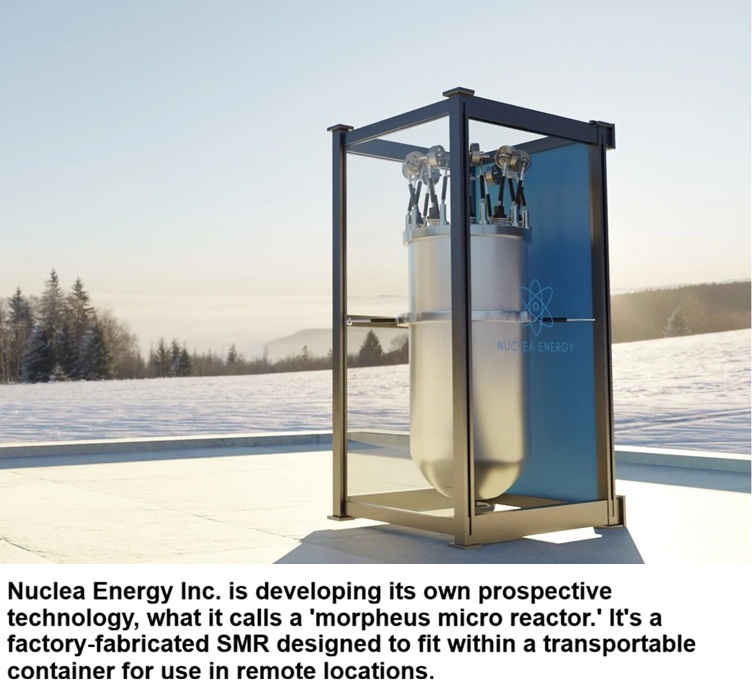
Ontario-headquartered Nuclea Energy Inc. instead merges with telemedicine company selling erectile dysfunction treatment in move to access capital quicker
Adam Huras, Aug 06, 2026, https://tj.news/new-brunswick/moltexs-prospective-buyer-ends-attempt-to-raise-50m-for-purchase#comments-area
The company that was in talks to buy Saint John-based Moltex Energy Canada has ended its attempt to raise $50 million.
It was money Ontario-headquartered Nuclea Energy Inc. was going to use, in part, to purchase the New Brunswick small modular nuclear reactor startup’s technology, which has spent more than a year stalled in its parent company’s receivership.
Instead, in a twist, Nuclea Energy has announced it is merging with a telemedicine company based in Dallas, Texas, that sells lifestyle medications online, specializing in erectile dysfunction, hair loss, and weight management treatments.
It’s being framed as a way to get Nuclea access to capital quicker.
Meanwhile, the heads of both Nuclea and Moltex say negotiations toward a purchase continue, despite the new flurry of moves.
“We are still in exclusive negotiations with Nuclea,” Moltex CEO Rory O’Sullivan said in an email.
Asked what the impact of the new moves mean to those talks, O’Sullivan directed questions on funding sources and plans to Nuclea.
In an email, Nuclea president Sagar Sanghera stated that “at this time, we are still in exclusivity with Moltex,” without answering further questions on how a deal would be financed.
Brunswick News reported in April that Moltex was on the verge of being sold to another advanced nuclear technology startup for $11.5 million.
The pending sale to Nuclea, although still yet to be finalized, was revealed in that company’s filing for an initial public offering on the New York Stock Exchange.
Nuclea stated in documents filed that it was to use the proceeds from the selling of shares, in part, for the acquisition of the distressed assets from Moltex Energy Limited, the British parent company of the New Brunswick SMR developer that went for sale last year as part of a U.K. insolvency proceeding amid money trouble.
That specifically includes Moltex’s efforts in New Brunswick to build a small modular reactor that converts existing nuclear waste into carbon-free energy through a proprietary recycling process.
It’s as Nuclea is also developing its own prospective technology.
What it calls a “morpheus micro reactor,” a factory-fabricated SMR designed to fit within a transportable container for use in remote locations, was also to benefit from the money raised through an initial public offering on the New York Stock Exchange.
Nuclea’s filing in April was to raise $50 million by offering 5.6 million shares at a price range of $8 to $10.
But that has now abruptly ended.
Last Friday, Nuclea withdrew its plans for an initial public offering.
Nuclea did so while announcing the merger.
A press release from the company states it has entered into a “definitive business combination agreement” with Mangoceuticals, Inc.
It’s a company that describes itself as “focused on developing a variety of men’s health and wellness products and services via a secure telemedicine platform.”
“To date, the company currently offers pharmaceutical-based products specifically related to the treatments of erectile dysfunction, hair growth, hormone replacement therapies, and weight management,” it states.
It delivers those treatments through its subsidiary Mango and Peaches Corp., and its brand, MangoRx.
But now, in its own release announcing the deal, Mangoceuticals states it’s pivoting to “bring Nuclea’s lead-cooled Morpheus Microreactor to the public markets amid surging power demand from AI and data centres.”
“The scale of capital being committed to power the AI build-out is enormous, and we believe advanced nuclear and micro reactors will be a critical part of how that demand is met,” said Mangoceuticals CEO Jacob Cohen in a release.
Mangoceuticals is already listed on the American stock exchange.
Releases from both companies are clear that the transaction is intended to provide Nuclea with that public listing on the Nasdaq to get better access to capital in order to accelerate the development of its reactor.
Neither release makes mention of Moltex.
“As a public company, we expect to have the capital access and visibility to advance Morpheus toward first-of-a-kind delivery and to execute on our commercialization roadmap,” Nuclea CEO Josef Freundorfer said in the company’s release.
“This agreement gives Nuclea a faster path to the public markets at a defining moment for our industry.”
Azets Holdings Ltd., the accounting firm serving as the insolvency administrator for the UK-based parent company Moltex Energy Ltd., also confirmed that talks to sell assets to Nuclea continue.
“Sale negotiations with the preferred purchaser remain ongoing,” spokesperson Shaun Staff said in an email.
Secret ‘Project Mars’ roils Torrance County residents
By Cormac Dodd cdodd@sfnewmexican.com, Aug 1, 2026, https://www.santafenewmexican.com/news/local_news/secret-project-mars-roils-torrance-county-residents/article_6e15c500-ce01-4a68-a84e-b51d50769a85.html
MORIARTY — Ernest Ortiz learned in late June from a top Torrance County official the state trust land where he runs cattle is eyed for a massive development known as “Project Mars.”
The project, which would oust him from land he has leased for nearly a decade, remains mostly a mystery a month later.
While rumors circulating in the community have raised fears of a possible data center — with residents pointing to the contentious Project Jupiter in Southern New Mexico’s Doña Ana County — Torrance County commissioners have said the proposal would create a different kind of development: a manufacturing center for a U.S. Department of Defense contractor.
Takeaways
Torrance County residents have raised concerns about the largely secret “Project Mars” proposal, voicing fears of a new data center that would require large amounts of water in the parched Estancia Basin.
County Commission Chair Ryan Schwebach said officials were told a Department of Defense contractor is considering a manufacturing campus on state-owned property near the Moriarty Municipal Airport, a project that would bring 300 “high-paying” jobs and an economic boost.
The county knows little else about Project Mars, he said, though he added the development would be constructed on 2,200 to 2,500 acres and wouldn’t be a major water burden, like a data center might.
County commissioners have pointed to “nondisclosure agreements” they say the contractor urged them to sign. State lawmakers who represent the area — Sen. Ant Thornton and Rep. Stefani Lord, both Sandia Park Republicans — also said they had signed NDAs on the project.
Meanwhile, Project Mars faces a major hurdle: The New Mexico State Land Office said it won’t consider leasing state trust land for the development.
Newcleo Takes Key Step Towards MOX Fuel Manufacturing Facility In US
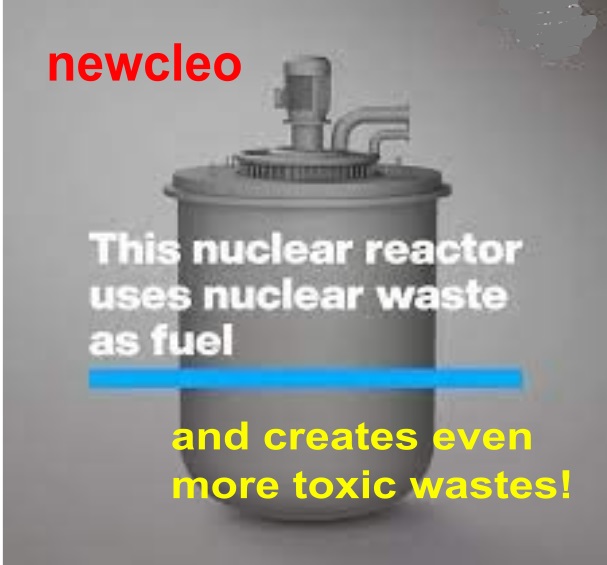
Advanced reactor and nuclear fuel company Newcleo has submitted a
regulatory engagement plan to the US Nuclear Regulatory Commission for its
planned US mixed oxide (MOX) fuel manufacturing facility in the US. The
France-based company said the submission marked a significant milestone in
establishing a source of advanced nuclear fuel for its planned advanced
modular reactors. The regulatory engagement plan is the second submitted by
Newcleo in recent weeks. Last month the company submitted a regulatory
engagement plan to the NRC for its lead-cooled fast reactor, the
LFR-AS-200.
Nucnet 6th Aug 2026
https://www.nucnet.org/news/newcleo-takes-key-step-towards-mox-fuel-manufacturing-facility-in-us-8-4-2026
A Ton of Space Junk Is Reentering Earth’s Atmosphere More Often, and It’s Hard to Predict

Uncontrolled reentries of 500-kg-plus objects occur weekly, yet prediction errors span thousands of kilometers and no binding rules exist
Al Landes, Jul 31, 2026, https://www.gadgetreview.com/a-ton-of-space-junk-is-reentering-earths-atmosphere-more-often-and-its-hard-to-predict
Key Takeaways
- Uncontrolled space debris weighing up to 2,000 kilograms reenters Earth’s atmosphere weekly.
- Prediction models carry 20–30 percent error, leaving impact corridors spanning thousands of kilometers unknown.
- NASA’s one-in-10,000 casualty threshold is breached weekly yet holds no international legal force.
·Right now, somewhere above your head, a dead satellite or spent rocket stage is losing altitude. Nobody knows exactly where it will hit. Objects weighing 500 to 2,000 kilograms reenter Earth’s atmosphere uncontrolled roughly every week, according to ESA and a 2024 peer-reviewed hazard study. This has been happening for decades. The difference now: it’s accelerating, and the rules meant to manage it remain largely voluntary.
The Numbers Are Bigger Than You Think
The scale of uncontrolled reentries dwarfs what most people assume — and the pace is rising.
ESA’s 2025 Space Environment Report counts more than three intact-object reentries per day, adding up to roughly 100 to 120 metric tons of uncontrolled hardware entering the atmosphere annually, per ESA conference analysis. Between 2019 and 2024, an average of 289 sizable objects reentered each year — five to six per week, according to ESA proceedings. Objects exceeding 500 kilograms fall uncontrolled about every eight days, while anything over five tons comes down approximately three times per year. Earth’s orbit currently holds an estimated 9,000-plus metric tons of tracked debris, per NASA’s Orbital Debris Program Office, and roughly 75 percent of all larger objects ever launched have already reentered, according to ESA.
With our current knowledge and state-of-the-art technology, we are not able to make very precise predictions. There will always be an uncertainty of a few hours in all predictions.” — Holger Krag, Head of ESA’s Space Debris Office
Those few hours matter enormously. A tumbling object covers thousands of kilometers in that window. Prediction models carry 20 to 30 percent mean relative error, per CNR-IRIS technical research. That uncertainty window translates to thousands of kilometers of unknown impact corridor — no app notification, no siren, no advance warning of any kind.
So Should You Actually Worry?
The individual risk is genuinely microscopic, but the structural gaps behind that reassuring number are worth understanding.
ESA estimates individual annual injury risk at under one in 100 billion. There are zero confirmed deaths or serious injuries across 50-plus years of reentries, per NASA’s Orbital Debris Program Office. Most material burns up on descent. Earth is mostly ocean. Science Focus calculated that debris would miss humans 99.9998 percent of the time even under worst-case assumptions — odds that make a lightning strike look like a safe bet.
But there is a structural problem worth noting. NASA’s safety standard sets a one-in-10,000 casualty threshold per reentry event — yet that standard carries no international legal force. Hazard analyses suggest uncontrolled reentries likely breach that threshold weekly, often without national authorities even registering it. As mega-constellations like Starlink scale up and launch rates climb at a pace that outstrips current debris-mitigation frameworks, the gap between standard and practice quietly widens.
The individual risk stays microscopic. But with cleanup technology — nets, harpoons, drag-enhancement devices — still experimental, the real question isn’t whether debris falls. It’s whether anyone with authority acts before something lands where the cameras are.
Canada built its nuclear industry to avoid foreign fuel. Its new SMR reactors will depend on it.
by relying on imported enriched uranium, Canada would give foreign governments the ability to disrupt its nuclear fuel supply during a political dispute.
Canada would need to enrich its own uranium to control the entire fuel chain, but such a facility would cost billions to build and require extensive security, regulation and international safeguards througout its life.
“It would be much more uneconomical for Canada to develop one just for this small modular reactor design.”
Ontario’s first small modular reactor will rely on enriched uranium from the U.S., France and Britain
Colin Butler · CBC News · Aug 02, 2026, https://www.cbc.ca/news/canada/canada-nuclear-supply-chain-smr-darlington-uranium-enrichment-9.7289297
The first reactors in Canada’s planned nuclear expansion will depend on foreign suppliers — including the United States — to enrich and fabricate their fuel, even as Prime Minister Mark Carney argues Canadian sovereignty depends on the country’s ability to supply and control its own energy.
It marks a sharp departure from the Candu reactor system, which gave Canada — the world’s second-largest uranium producer — a largely domestic nuclear supply chain for more than half a century.
Ontario has begun building the first of four planned BWRX-300 small modular reactors, or SMRs, in Clarington, Ont., called the Darlington New Nuclear Project. The American-Japanese-designed light water reactor uses low-enriched uranium, unlike Canada’s Candus, which use fuel made domestically from natural uranium without enrichment.
Ontario Power Generation (OPG), the Crown corporation that operates provincially owned electrical utilities, expects the first BWRX-300 at Darlington to be connected to the grid by the end of 2030. The other three are planned for the mid-2030s.
Cameco, the Saskatoon-based uranium mining and nuclear fuel company, will mine uranium ore in Saskatchewan and convert it in Port Hope, Ont., before it is enriched in the United States. France’s Orano and Britain’s Urenco are also listed by OPG as a supplier of enriched uranium, and an American company will manufacture the finished fuel assemblies in the United States.
Against Candu’s founding logic
Experts say the shift reverses the founding logic in Canada’s nuclear program.
A 1993 Library of Parliament background paper said the reason Candu was created was “to design a reactor tailored to Canadian circumstances” that used natural uranium to avoid “the difficult and expensive process of enrichment or, alternatively, dependence on foreign sources of enriched uranium.”
By placing that step in foreign hands, experts say, the new reactors undermine claims of energy soverignty and expose Canada to long-term geopolitcal risk.
Mark Winfield, a professor at York University who studies sustainable energy, climate change and energy policy, said by relying on imported enriched uranium, Canada would give foreign governments the ability to disrupt its nuclear fuel supply during a political dispute.
“It turns the original rationale for the Candu program completely on its head,” he said. “The whole idea was, going back to the 1950s, that we would have an all-Canadian fuel supply chain that would not be the subject to those kinds of geopolitical risks.”
OPG said spreading the work among suppliers in the United States, Britain and Frnace creates a “robust and resilient supply chain,” but the company still leaves both enrichment and fabrication — the two steps Canada cannot perform for the BWRX-300 — in foreign hands.
Why Ontario went global
Speaking at a recent news conference in Nanticoke, Ont., provincial Energy Minister Stephen Lecce said the province chose a foreign reactor because no Canadian alternative was ready to generate electricity at the required scale.
“There is not a Canadian grid-scale, commercially viable small modular reactor technology to procure,” he said. “So we had to go global.”
He said Ontario chose the American-Japanese BWRX-300 because it was the most advanced option and offered the best chance to reduce the risks associated with building a first-of-its-kind reactor.
Canada does have a new domestic reactor under development, but it was not an alternative for Ontario’s SMR project. The Candu Monark is not an SMR and is currently under assessment by Canada’s nuclear regulator.
The decision to “go global,” as Lecce put it, leaves Ontario dependent on foreign enrichment, but Lecce said the province has reduced the risk by arranging access to suppliers in the United States, France and Britain.
SMRs would use ‘modest’ amount of fuel
Winfield said multiple enrichment suppliers reduce the risk of disruption, but do not eliminate it. Every enrichment facility is outside Canada, while the only company identified that would make the finished fuel assemblies is American.
“I think that’s still a risk. Particularly if the United States decides to use its supply of various uranium for geopolitical leverage, which is clearly not beyond the thinking of the Trump administration,” Winfield said.
Even with France and Britain as backup suppliers, Winfield said, it opens the door to “all kinds of vulnerabilities relative to an all-Canadian supply chain. You are at the mercy of whatever external geopolitical events may be occurring.”
The federal government says foreign enrichment doesn’t present a significant supply risk, especially in the short to medium-term.
In an email, Natural Resources Canada said the four planned Darlington SMRs will require “a very small amount” of enriched fuel, which is “modest” compared with the global market, but did not provide a quantity.
Why being first is ‘not a good thing’
While there are other SMRs active in China and Russia, the Darlington facility will be the first SMR in the G7.
“That’s not a good thing, in my opinion,” said M.V. Ramana, a University of British Columbia professor who studies nuclear energy and international security.
“Nuclear power is a very expensive way to generate electricity and the small modular reactor is even more expensive.”
Ramana said SMRs sacrifice the economies of scale available to larger reactors.
A 2014 study suggests they are more expensive per unit in generating capacity unless savings from shared infrastructure can offset the disadvantage, which is what OPG intends for its four-reactor Darlington site.
BWRX-300 designer GE Vernova says smaller reactors can overcome some of that cost disadvantage because they require less machinery than conventional reactors: water circulates through the reactor without powered pumps, while emergency cooling functions use gravity and natural circulation.
The company says this reduces the amount of equipment that must be manufactured, installed and maintained.
However, because Darlington is the design’s first deployment, those projected savings have not yet been demonstrated by a commercially operating unit.
Could Canada enrich its own uranium?
The only way for Canada to eliminate its reliance on foreign suppliers is by establishing its own uranium-enrichment industry.
Lecce said Ontario would be open to discussions, but he acknowledged the decision ultimately rests with the federal government.
Natural Resources Canada said Ottawa has made no decision on commercial enrichment but plans to create a “Nuclear Fuels Table” with the provinces and industry to examine future needs and opportunities.
Ontario is currently the only province committed to building SMRs, but Saskatchewan is advancing plans for the same BWRX-300 technology, while New Brunswick and Alberta are evaluating potential nuclear projects that could include SMRs.
Ramana said Canada would need to enrich its own uranium to control the entire fuel chain, but such a facility would cost billions to build and require extensive security, regulation and international safeguards througout its life.
“In the enrichment business, again, there are economies of scale,” he said. “It would be much more uneconomical for Canada to develop one just for this small modular reactor design.”
Ramana added that the new reactors also create another long-term liability. Canada’s current $26-billion nuclear waste plan was calculated around fuel from the existing Candu reactor fleet.
New reactors could change both the volume and type of spent fuel requiring disposal, but Ramana noted there has been no cost estimate from Canada’s Nuclear Waste Management Organization for adding the spent fuel from four BWRX-300s.
Cory Doctorow: The people who tell you ‘AI is changing everything’ are lying
It has become impossible to tell managers mesmerised by artificial intelligence that the tools are not, in fact, helpful. So employees just play along with the fiction to keep their jobs, writes our tech columnist
Aug 5, 2026, https://www.thenerve.news/p/cory-doctorow-ai-business-incentive-to-lie-useless-chatbots-report-nikhil-suresh
Neoclassical economics assumes rationality. The corollary of “If you’re so smart, why aren’t you rich?” is “you’re rich, so you must be very smart!” Thus it is that many people assume that if powerful, well-compensated CEOs insist that “AI is changing everything,” well then, AI must be changing everything.
But the evidence for this “changing everything” thesis is thin on the ground. Despite a global mania that has reduced the real, pressing need for digital sovereignty to the imaginary need for nations to create “sovereign AI”, no one can really articulate the case for “sovereign AI”. If Donald Trump ordered Big Tech to turn off all of your country’s chatbots tomorrow, nothing would change. Every one of your country’s ministries and corporations would chug on with nary a hitch. Households, too, though perhaps a few of the younger members of those families would have to do their own homework again.
Contrast this with what would transpire if Trump directed his tech giants to switch off your country’s Office 365 access, or to brick your Android and iOS phones, or to killswitch your John Deere tractors. Your country would effectively cease to exist. If “digital sovereignty” means anything, it means doing something about this urgent fact.)
The world is full of people who insist that “AI is changing everything” but who – when pressed – have to admit that what they mean is that they’re pretty sure that AI will change everything. Eventually. After we allow it to consume all the planet’s energy, carbon, water and financial resources.
Maybe.
(They’re pretty sure.)
One person who’s had a lot of opportunity to observe the shear between the stated business/AI situation and the real business AI situation is Nikhil Suresh from Hermit Tech, a consulting firm of “radically ethical data wizards” (that is, tech consultants). For a year and a half he has been talking to hundreds of executives — and, more importantly, their subordinates — about what, if anything, AI is doing for their businesses. The “head of AI” at a billion-dollar firm told him that his job was “totally fraudulent” – but that it was “the only promotion pathway remaining” at the organisation.
Suresh has set his findings out in an essay – “AI Mania Is Eviscerating Global Decisionmaking” – that is a diagnosis of mass corporate delusion.
Its central claim:
“We’re facing a coordination problem around executives being honest around the AI gains they’ve witnessed – if they co-operate, they keep their jobs. If they defect, they will possibly be fired by their embarrassed peers (who have now been implicitly called liars, cowards, or incompetents) and then replaced with someone that will toe the line anyway. If they could all admit the truth at once there might be some hope, but there is no way to coordinate that event.”
In other words, corporate leadership is starting from the premise that AI has (or will) radically change the business, and they’re working backwards from that premise to find the evidence to support this article of faith.
This has created a situation in w
Suresh describes this as a literal religious mania. In the 500-plus-employee businesses he studied, the only people who were promoted – or even spared from being fired – were people who professed “religious declarations of faith” about “the transformative power of AI”. Employees who voiced honest, informed objections to AI in the workplace were passed over for promotions or targeted for layoffs.
This has created a situation in which everyone – “boards, executives, employees, vendors, consultants” – has a strong incentive to lie about how much AI is delivering for their companies. Suresh says he’s seen announcements from publicly traded companies about their AI triumphs that he knows for a fact never took place.hich everyone has a strong incentive to lie about how much AI is delivering for their companies
Suresh says he’s never seen a successful enterprise AI project: “Every single one – we have seen 0% success in a year and a half.” Not one of their clients would face a business challenge if OpenAI went out of business tomorrow. The problem most companies struggle with is that they’re “terminally bad at running software projects effectively”. Adding AI to the mix doesn’t solve this problem – it just adds a whole new range of ways that software deployment can fail.
Chatbots don’t help. The internally facing chatbot that’s supposed to help employees figure out how to navigate the business sucks because it is only as good as its training data – the business’s documentation of its own processes. Businesses suck at documenting their processes. Customer-facing chatbots also suck. They either can’t solve your problem, or, when they seem to solve your problem, the “solution” goes nowhere.
Suresh recounts his sole positive customer-service chatbot experience: a Mitsubishi chatbot with a natural-sounding, responsive voice politely took all the details of an automotive failure and promised him a callback. That callback never came, but Suresh is certain that Mitsubishi has logged this as a chatbot success story, even though the experience convinced him not to buy a Mitsubishi car.
He says he frequently encounters people who reflexively utter the AI catechism: “AI is changing everything.” But when he presses these people for details, they admit that their organisation “does not currently use LLMs for anything, and indeed, that they cannot name a single thing that has changed other than they get some use out of ChatGPT”.
This shear (“AI is changing everything”/”Well, OK, we’re not using AI for anything”) is so extreme that Suresh once met an exec who confessed to crafting an AI-centred strategy for a $2bn-a-year business, even though that exec “had never even used ChatGPT or any AI tool in their life”.
Some people have privately admitted to Suresh that they’ve embraced AI in order to earn a career-boosting corporate reputation for “thought leadership”. But many other people (especially non-technical people) sincerely believe that AI is about to “change everything”. As Suresh says, if you’re in business with a liar, you might be able to reason with them in private – but you can’t reason with a true believer.
The true believers are in charge. Suresh points out that it would be very weird for the CEO of an engineering firm or a hospital to mandate “specific procedures or building techniques without explicit agreement from the professionals on staff”. But when it comes to AI, business leaders will confidently demand that the skilled professionals who perform the business’s core functions use AI, even if those professionals don’t think it will help.
As an aside: I remember the dotcom era, when the business press was full of articles about the conflict between CEOs and a new workforce that demanded the right to use the web on the job. Today, the business press is full of articles about the conflict between the workforce and CEOs who demand that they use AI.
Suresh describes workers who feel they have to “AI wash” their work: “They just do the work, the same way they have for decades, and say Claude did it.” To add verisimilitude to this sham, they write circular processes in which one chatbot prompts another, and then the process repeats itself in reverse, for the sole purpose of consuming AI tokens to score a high rank on corporate “token leaderboards”.
I want to reflect a little on two questions that Suresh’s essay raises but doesn’t answer. The first is why? Why are people in power such easy converts to this religious mania?
I have my own theory. The most important discomfort that powerful people experience is having ego-shattering conflicts with subordinates who know how to do things they do not know how to do. The fact that you’re “in charge” is hard to reconcile with the fact that the people you’re nominally in charge of tell you that all your ideas are impossible, illegal, immoral or lethal.
The other question Suresh implicitly raises is: “How can you reconcile the failure of AI in the enterprise with the individual claims of skilled technologists who insist that AI is helping them do great work?” The answer is that these AI users are “centaurs” – experienced workers who are assisted by automation on terms that they set for themselves.
Thanks to their skill and experience, these workers possess discernment, the ability to tell good code from bad, and (more importantly) good uses of code-generation tools from bad. They demonstrate the adage that worker-driven automation improves quality, while capital-driven automation improves throughput.
An automation technique that requires close supervision by skilled and experienced workers isn’t going to be a raw productivity powerhouse. You don’t “100x” your code this way, at least, not in the sense of firing 99 of your coders and having the remaining programmer pick up all their work. Rather, an automation tool that requires the continuous and conscientious exercise of discernment will let individual practitioners improve their work in extremely satisfying and useful ways. It’s a way to spend more on operations in order to produce better outputs. It’s not a way to cut your workforce, realise a gigantic saving, and still produce comparable goods and services at a far lower cost.
That is why some individual coders report such delight with their AI tools. They engage with those tools on their own terms, to improve their work in the ways that they, in their expert judgment, consider beneficial. No one ranks them on a “token-maximisation” scoreboard. No one tells them they can’t do a project if it isn’t “sufficiently AI”. When they set out to do a project, no one makes them prove that it couldn’t be “done by AI”.
As ever, the most important fact about a given technology isn’t “what it does” but “who it does it for” and “who it does it to.”
Quantity has a quality all its own. These businesses aren’t just wasting billions – they’re replacing skilled workers with defective chatbots. As I’ve written before, AI is the asbestos we’re shovelling into the walls of our technological society. Our descendants will spend generations digging it out again, and the longer the bubble goes on without popping, the longer it will take to repair the damage.
Cory Doctorow, who was born in Toronto and now lives in Los Angeles and London, is the Nerve’s tech columnist. His new book is The Reverse Centaur’s Guide to Life After AI. He will be appearing in conversation with the Nerve’s Carole Cadwalladr at Brighton Dome on 8 September; tickets are available here
Alert: SpaceX rocket stage will slam into the Moon August 4-5. Can Earth’s people stop it?
A piece of a SpaceX rocket is about to hit the moon –https://abcnews.com/US/piece-spacex-rocket-hit-moon/story?id=135225250
News story
A discarded Falcon 9 rocket will collide with the moon at 5,400 miles per hour.
A 5-ton Falcon 9 upper stage discarded by SpaceX is now headed toward the Moon, traveling at 5400 miles per hour, set to slam into the Moon on Tuesday or Wednesday August 4 – 5 (depending on your time zone) – 2:34 am US Eastern Time.
What these dysfunctional pseudo-scientist hooligans fail to consider is that Earth’s rotation and its seasons and climate are moderated and stabilized by the Moon. Earth’s creatures depend on the Moon. Ocean tides depend on the Moon. Attack and pollute the Moon, and it has a direct impact on the Earth. And that’s just from the purely selfish standpoint.
From a deeper perspective, all things are alive, and we are relatives of one another. The Moon is a sovereign living being and territory with rights. These are attacks on the Moon and life.
NASA, SpaceX, corporations, the aerospace industry, and US government treat space and our Moon as their objects of abuse and exploitation. When did our planet of beings even give them permission to commit these deplorable acts?
Most importantly, can Earth’s people stop this event?
What latent abilities do humans have? Can humans strand this rocket carcass in space, using their collective will and power, until someone can safely retrieve it and recycle it into something useful?
The time to act is now, as collectively as possible. to stop this injury to the Moon.
The aerospace industry claims, “We expect [impact] to vaporize the booster.” This is a lie. The ugly reality: the rocket stage will be crumpled, broken debris spread across the landscape from the deep impact trauma wound they — Elon Musk, SpaceX, NASA, the military-industrial complex — cause, hitting the “the western limb of the moon” (Forbes), “the western lunar limb” (ABC News) — personhood language used in media reports.What latent abilities do humans have? Can humans strand this rocket carcass in space, using their collective will and power, until someone can safely retrieve it and recycle it into something useful?
The time to act is now, as collectively as possible. to stop this injury to the Moon.
The aerospace industry claims, “We expect [impact] to vaporize the booster.” This is a lie. The ugly reality: the rocket stage will be crumpled, broken debris spread across the landscape from the deep impact trauma wound they — Elon Musk, SpaceX, NASA, the military-industrial complex — cause, hitting the “the western limb of the moon” (Forbes), “the western lunar limb” (ABC News) — personhood language used in media reports.What latent abilities do humans have? Can humans strand this rocket carcass in space, using their collective will and power, until someone can safely retrieve it and recycle it into something useful?
The time to act is now, as collectively as possible. to stop this injury to the Moon.
The aerospace industry claims, “We expect [impact] to vaporize the booster.” This is a lie. The ugly reality: the rocket stage will be crumpled, broken debris spread across the landscape from the deep impact trauma wound they — Elon Musk, SpaceX, NASA, the military-industrial complex — cause, hitting the “the western limb of the moon” (Forbes), “the western lunar limb” (ABC News) — personhood language used in media reports.What latent abilities do humans have? Can humans strand this rocket carcass in space, using their collective will and power, until someone can safely retrieve it and recycle it into something useful?
The time to act is now, as collectively as possible. to stop this injury to the Moon.
The aerospace industry claims, “We expect [impact] to vaporize the booster.” This is a lie. The ugly reality: the rocket stage will be crumpled, broken debris spread across the landscape from the deep impact trauma wound they — Elon Musk, SpaceX, NASA, the military-industrial complex — cause, hitting the “the western limb of the moon” (Forbes), “the western lunar limb” (ABC News) — personhood language used in media reports.
Go outside tonight and look at the Moon.
Stand up for the Moon before it’s too late.
– – –
Declaration on the Rights of the Moon
https://www.earthlaws.org.au/moon-declaration/
AI Wants Your Land, Water, Power

The bigger data centers, which are in vogue, being built right up next to hospitals, schools, and residences willy nilly use anywhere from 1-to-7 million gallons of water per day. On average, equivalent to moving 15,000-20,000 new families into a neighborhood.
Robert Hunziker, July 27, 2026, https://www.counterpunch.org/2026/07/27/ai-wants-your-land-water-power/
“This is just like a free-for-all. There’s really no oversight. There’s really no regulation.” (Erin Brockovich, Brockovich AI Data Center Reporting)
Erin Brockovich is a well-known American consumer advocate who made her name by exposing evidence that Pacific Gas & Electric poisoned groundwater in Hinkley, California (1996) with toxic hexavalent. Now, she’s investigating AI datacenters.
AI date centers are everywhere, in every state throughout the land. They are starting to quasi-own American citizens via appropriation of resources, both human and natural. This is an invasion of the land, the water, the power, the intellectual resources of America.
Erin Brockovich was recently interviewed about her commitment to investigating AI development by Katie Couric, appearing on YouTube.
Erin: “I’ve never seen in 30 years anything like this… This is every town in every state, and all our resources at once happening.”
The common thread in submissions from individuals in communities across the land: “it feels to them like a takeover.” First, there is a lack of transparency. Local city councils, where “the people” should be represented are hijacked via non-disclosure agreements signed by local officials. This is step number one in gaining approval to build where city regulations and city code control the land. The locals are left out of decisions.
Datacenters Consume Natural Resources
Smaller data centers use about 500,000 gallons of water per day. The average family of four uses ~350 gallons of water per day. Therefore, a newly constructed small data center is equivalent to moving 1,428 new families into a neighborhood.
The bigger data centers, which are in vogue, being built right up next to hospitals, schools, and residences willy nilly use anywhere from 1-to-7 million gallons of water per day. On average, equivalent to moving 15,000-20,000 new families into a neighborhood.
“So, if we build 1,200 data centers… that’s the projection for the total and you just take an average of those between 500,000 to seven million, and the average is 5 million gallons per day, and multiple that by 365 days. You’re looking at numbers of 2.2 to 2.7 trillion gallons of water per year… that are on already drought restricted lands.” (Erin)
(There are already 4, 542 active data centers, 1,500 more are in the planning stage.)
A recent study by The Guardian found that 2/3rds of the planned data centers in the U.S. are in drought-stricken areas.
Datacenters disrupt the regular flow of water. For example, residents sent reports to Erin “of water bills going from $40/month to $250/month… and we’re seeing the exact same thing with electrical.”
According to Katie Couric, Sam Altman, CEO of Open AI, dismisses concerns about AI water use, “fake, completely untrue, totally insane, and having no connection to reality.”
In response, Erin wondered if Altman lives in the areas and experiences what residents report to her. He is implying that the reports by residents are false (16,000 total submissions to Erin by individuals involving various AI issues). “It is insulting.”
Erin asked AI itself in a query to the faceless genius a question of placement of data centers assuming the entire network were to start all over again from scratch, redesigned. AI responded that it would place new data centers based upon one simple rule: “Zero conflict with human resources.” Hmm.
“The people” who submit to Erin from all 50 states are saying the opposite of Sam Altman. And she’s going with the people as a more credible source. After all, they live in the immediate area of data centers. He does not.
Data Center Noise – Wow!
The “hum,” the “buzz” can extend a couple of miles away from a data center. The endless humming is a 24/7 annoyance that’s driving some people nuts. Residents are informing Erin of dizziness, nausea, headachy experiences. This is a common issue tbat’s reported from every one of the facility areas in the country.
Locals Fighting Back
Three hundred (300) municipalities have established moratoriums on data center development, some for one year, some for two years, some six months, some are flat-out bans.
But according to Erin, as usual, “many of them won’t be able to withstand the pressure by huge corporations that have got all the money in the world.”
Yet, public protests can exercise powerful influence. For example, in Utah it was clearly via public opposition that the governor had to scale back the size of the facility coming in.
And New York is the first state to ban development of new data centers as a moratorium for one year and direct state regulators to create standards focused on environmental impacts, energy demand, water usage and other factors: “As datacenter development threatens to hike up utility bills, deplete our natural resources, and create uncertainty for New Yorkers, it’s my responsibility to take action and lead,’ Hochul, a Democrat, said in a statement.” (New York Becomes First State to Impose One-Year Pause on New AI Datacenters, The Guardian, July 14, 2026)
According to Katie, a recent Gallup poll shows 7 out of 10 Americans oppose data centers being built near them, making it one of the few contemporary issues that has broad bipartisan agreement, republicans and democrats alike do not favor AI datacenters in their locales.
Meanwhile, the power source for data centers is passed off to consumers. Infrastructure is required. Erin has received submissions from people stating their utility bills normally $75 went up to $425. A recent submission by a resident out of Texas, which has the most data centers at 417, said their city notified residents to expect a 75% electrical bill increase.
Stated by Katie: According to The New York Times, PJM, the nation’s largest electrical grid operator’s results of an electricity auction will add $6.3 billion costs to consumers within the next 3 years, an increase driven by the power demands of data centers.
AI Ownership
Katie Couric’s interview of Erin Brockovich brought to light the impact AI has on the country’s natural resources but did not discuss nontangible resources like music or speech or art. These human resources, similar to natural resources, are public resources. Who owns these resources?
Bernie Sanders has an interesting take on ownership of resources: “The foundation of AI is based on our collective human intelligence. Our books, songs, artwork, journalism, computer code, scientific research, videos, conversations, images, and ideas span generations. The reality is that Big Tech oligarchs have fed this knowledge into their AI models without permission, without acknowledgement, and without compensation. The creative work of many millions of people – writers, artists, musicians, journalists, teachers, scientists and ordinary people- has been stolen by the wealthiest people in the world. In the coming weeks I will be introducing the American AI Sovereign Wealth Fund Act. This legislation would give the public a direct ownership stake in the largest AI companies in our country. Through a one-time 50% tax, not on the profit of the largest AI companies in the US but something that is far more valuable than that: The Stock. Under this bill the federal government would have the power through its voting shares and an equal representation on each company’s board to block decisions that hurt the public and to push for policies that help them. When a public resource generates wealth, the public should share in that wealth.”
Robert Hunziker lives in Los Angeles and can be reached at rlhunziker@gmail.com.
A Kansas Town Is Split Over Plans to Bury a Nuclear Reactor a Mile Underground.
“This is a nuclear experiment,” Reynolds said. She questions how the company will perform maintenance so far underground, why drillers are operating under oil-and-gas regulations rather than nuclear-specific rules, and what happens to the site if Deep Fission goes out of business.
026-07-30, https://finance.biggo.com/news/1fb78f6c-786f-4381-be62-937bfa684157
Deep Fission, a California startup, plans to operate the first commercial nuclear reactor a mile underground in Parsons, Kansas, by 2027 or 2028. The project has raised $150 million and is part of a DOE pilot program to fast-track advanced reactors amid surging AI-driven electricity demand. The company says deep burial eliminates the need for costly containment buildings, with each 15-megawatt reactor powering 12,000 homes. However, the plan has sharply divided the town of 9,600. Opponents, including local group Prairie Dog Alliance and watchdog Beyond Nuclear, warn of environmental risks and insufficient oversight, while supporters view it as a vital economic spark for the struggling rural community. The project faces regulatory hurdles and broader questions about nuclear waste storage underground.
An ambitious plan to bury a commercial nuclear reactor a mile beneath a small Kansas town is pitting residents who see a coming economic renaissance against those who fear their community is being turned into a testing ground for an unproven experiment. The project, spearheaded by a California startup founded by a father-daughter team, would be the first time a commercial reactor has ever been operated so far underground.
Deep Fission, the company behind the so-called Gravity Reactor, has already drilled one test hole on the outskirts of Parsons—a rural community of 9,600 people roughly midway between Kansas City and Tulsa, Oklahoma. The firm, founded by Chief Executive Liz Muller and her father Richard Muller, an emeritus professor of physics at University of California, Berkeley, has raised roughly $150 million in the past year, with $40 million of that earmarked for the Parsons work. The startup plans to send a canister loaded with nuclear fuel into a third borehole to heat water deep underground and generate electricity on the surface as early as 2027 or 2028, a timeline that is remarkably short by industry standards.
“It’s allowing us to develop a first reactor within a time frame that had been unthinkable previously,” Liz Muller told The Wall Street Journal.
The reactor design relies on well-established pressurized water technology, but its innovation lies in its location. By operating a mile underground, Deep Fission argues it can eliminate some of the most expensive components of conventional nuclear plants. The immense pressure from rock and water at that depth would replace costly safety structures like massive containment buildings and complex cooling systems. Each reactor would generate 15 megawatts of electricity from inside a 30-inch borehole, enough to power roughly 12,000 homes. However, Muller’s long-term vision is far larger: an array of 100 or more reactors providing over a gigawatt of power, enough to supply a major data center.
Federal push meets local pushback
The Parsons project is one of 11 in a U.S. Department of Energy (DOE) pilot program designed to accelerate the development and testing of small, advanced reactors. Participating companies can fast-track environmental review procedures and construct reactors outside of traditional national laboratory settings. The initiative is part of a broader push by the Trump administration to spur a “nuclear renaissance,” aiming to quadruple America’s nuclear-power generation by 2050 amid skyrocketing electricity demand driven largely by data centers for artificial intelligence.
But the expedited process has drawn sharp criticism from nuclear watchdogs and local advocacy groups. Earlier this year, a coalition of state attorneys general challenged the DOE’s new categorical exclusion for advanced nuclear reactors, arguing it bypasses rigorous environmental review and weakens public safety protections.
“It’s simply unacceptable to even consider exempting Deep Fission from a peer-reviewed environmental impact statement on the generation of high-level nuclear waste under Parsons,” said Paul Gunter of Beyond Nuclear, a group that opposes nuclear power and weapons.
The Energy Department has stated that the administration remains focused on safety and security.
In Parsons, the divide is stark. When Deep Fission broke ground in December at the Great Plains Industrial Park, a decommissioned U.S. Army ammunition base, many residents were caught off guard by the lack of public discussion. Marjorie Reynolds, a pediatric nurse and seventh-generation Kansan, quickly formed a nonprofit called the Prairie Dog Alliance to oppose the project. Its logo features a prairie dog inside a black-and-yellow nuclear symbol.
“This is a nuclear experiment,” Reynolds said. She questions how the company will perform maintenance so far underground, why drillers are operating under oil-and-gas regulations rather than nuclear-specific rules, and what happens to the site if Deep Fission goes out of business.
Jerel Johnson, an IT professional who had planned to retire in Parsons, voiced a similar frustration. “I put $125,000 into my house, and now a nuclear reactor is coming to town. I can’t think of a worse idea.”
Liz Muller has pushed back against the environmental concerns, stating that the reactor is far too deep to affect underground aquifers and that the company will follow all nuclear and oil-and-gas regulations. Because the reactors are expected to last six to seven years with few moving parts, she added, the likelihood of requiring maintenance is low. “We have simplified our reactor quite extensively,” she said. The company also plans to open a local office where residents can ask questions, emphasizing that the project “needs to be done in partnership with the community.”
Economic hopes in a struggling farm town
For others in Parsons, a 19th-century boomtown that has long sought a new economic spark, the potential payoff is worth the risk. The town was once home to one of the largest rail yards west of the Mississippi, but recent victories have been small—attracting a Taco Bell or saving a local furniture store.
Verlyn Bolinger, an insurance agent and city commissioner whose great-great-grandfather also served on the commission, captured the conflicted mood. “Any time you’re putting a nuclear reactor in a hole, it’s kind of scary,” he said. “It’s great that it’s here. It’s kind of bad that we’re the guinea pigs.”
Robert Spinks, Parsons’ police chief, is more optimistic. He views the reactor as a potential catalyst that could draw manufacturers and data centers to the region. “It’s a proven technology, just in a new application,” Spinks said. “And if that is a trigger which draws in other manufacturing and brings in living-wage jobs, I think that’s a win.”
Wayne Gilmore, an optometrist who owns the local radio station, echoed that sentiment, arguing that rural communities cannot build their futures by rejecting new technology before it is fully evaluated.
Deep Fission’s plan to store spent nuclear fuel underground is also drawing scrutiny. The company says it could eventually seal the waste in place or move it to another site. Liz Muller and her father previously founded Deep Isolation, a firm that designs underground disposal systems for nuclear waste. Still, the Nuclear Regulatory Commission will need to approve any commercial licensing before electricity from the reactor can be sold. Dozens of companies are designing smaller reactors, but none yet operate commercially in the United States, and Deep Fission must still prove it can meet its aggressive timelines and contain costs in an industry notorious for overruns.
This startup just raised nearly $500 million to build nuclear reactors for the US military.
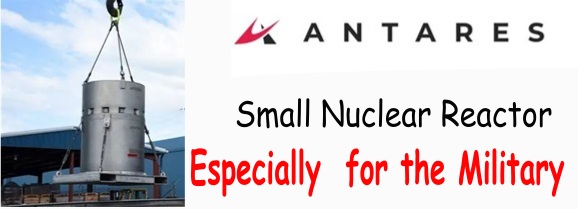
By Rahim Amir, 30 July 26, https://www.techradar.com/pro/this-startup-just-raised-nearly-usd500-million-to-build-nuclear-reactors-for-the-us-military
Antares lookt to supply small reactors by 2028
- Antares closes $470 million Series C, $370 million in equity and $100 million in debt, co-led by Paradigm and Caffeinated Capital
- The move follows the Mark-0 reaching criticality at Idaho National Laboratory and helps fund an electricity-producing Mark-1 in 2027 and military deployments in 2028
- Antares’ military-first strategy targets a price-insensitive customer bound by an executive order requiring a reactor on a US base September 30 2028
Nuclear fission startup Antares has announced it has raised a total of $470 million in funding as it looks to supply a single client with a looming deadline: the US Military.
The Torrance, California company closed a Series C co-led by Paradigm and Caffeinated Capital, with Point72 Ventures, Shine Capital and Industrious Ventures among the participants, according to TechCrunch‘s look at its PitchBook data.
Antares’ raise comes seven weeks after its Mark-0 microreactor reached criticality at Idaho National Laboratory under the Department of Energy’s authorization in a demonstration run with the DOE, the lab, and BWX Technologies, with the US Army observing.
A direct beneficiary of the White House
Antares calls it the “first privately developed non-light-water reactor to achieve criticality in the United States in more than four decades,” underscoring how important the test was for both Antares and the US military.
The US military’s presence is not by chance; It is mandated by an executive order (“Deploying Advanced Nuclear Reactor Technologies for National Security”) signed by US President Donald Trump to ensure that it has an operating army-regulated nuclear reactor on a domestic military site by September 30, 2028
Antares happens to be one of three finalists in the Pentagon’s Advanced Nuclear Power for Installations program that aims to test-deploy a small module reactor (SMR) on two different air force bases.
With Antares being the first private company to go through that gate under the DOE’s Reactor Pilot Program, it plans to build an electricity-producing Mark-1 reactor in 2027, followed by initial deployments to defense customers by 2028.
1 This Month


Shut down the radiation-damaged Heysham nuclear reactors now
To see nuclear-related stories in greater depth and intensity – go to https://nuclearinformation.wordpress.com

Say No to NASA’s Reckless Nuclear Reactor on the Moon
Say No to NASA’s Reckless Nuclear Reactor on the Moon
-
Archives
- October 2026 (247)
- September 2026 (339)
- August 2026 (330)
- July 2026 (355)
- June 2026 (287)
- May 2026 (306)
- April 2026 (356)
- March 2026 (251)
- February 2026 (267)
- January 2026 (308)
- December 2025 (358)
- November 2025 (359)
-
Categories
- 1
- 1 NUCLEAR ISSUES
- business and costs
- climate change
- culture and arts
- ENERGY
- environment
- health
- history
- indigenous issues
- Legal
- marketing of nuclear
- media
- opposition to nuclear
- PERSONAL STORIES
- politics
- politics international
- Religion and ethics
- safety
- secrets,lies and civil liberties
- spinbuster
- technology
- Uranium
- wastes
- weapons and war
- Women
- 2 WORLD
- ACTION
- AFRICA
- Atrocities
- AUSTRALIA
- Christina's notes
- Christina's themes
- culture and arts
- Events
- Fuk 2022
- Fuk 2023
- Fukushima 2017
- Fukushima 2018
- fukushima 2019
- Fukushima 2020
- Fukushima 2021
- general
- global warming
- Humour (God we need it)
- Nuclear
- RARE EARTHS
- Reference
- resources – print
- Resources -audiovicual
- Weekly Newsletter
- World
- World Nuclear
- YouTube
-
RSS
Entries RSS
Comments RSS

