Over the past year, the Anglo world has become interested in nuclear as a complement for wind and solar towards “deep decarbonization,” or a (nearly) 100% carbon-free supply of energy or possibly just electricity. Today, Craig Morris reviews a few papers by Americans and Australians and advises them to tackle the best European studies for 100% renewables head-on, not ignore them.
The first paper is by Stephen Brick and Samuel Thernstrom. Thernstrom has been calling nuclear “an essential part of the puzzle” since at least 2010. The paper is peer-reviewed; unfortunately, none of the reviewers noticed the oversights I found. But let’s start off with a contention the authors state in the introduction:
“In seeking to demonstrate that renewables can by themselves replace all fossil fuels and nuclear energy, these studies run the risk of treating renewables as a societal end in itself, instead of just one among a suite of technologies that could be used to achieve the combined goals of environmental protection, cost-containment, and electric system reliability.”
Why shouldn’t renewables be an end in themselves? Assuming nuclear power (plus whatever) is the cheapest low-carbon option, might other impacts society dislikes relativize the low price? To name just a few examples (and we’ll leave out whatever nuclear risks may or may not exist):
- Overcoming the military-industrial complex: nuclear has always been a centralized industry, with just a few firms that have very close contacts to the government. And keeping nuclear skills for military purposes seems to be a driver in the UK’s push for new nuclear.
- Transparency in democracy: as numerous authors from various countries have found, the nuclear sector has always come at the expense of open democracy. Strikes, for instance, are a safety issue.
- Stronger economic growth in communities, especially rural ones: if communities can make their own energy, why would they want to pay some out-of-town corporation, even if the energy is slightly cheaper? People simply are willing to pay more for quality, and local jobs are a quality (not to mention being energy-independent). The price is relative when you pay it back to your community…….
the real problem here is that lower consumption does not jibe with nuclear historically. Nuclear originally promised nearly unlimited electricity, and the technology’s supporters say more energy is needed, not less, especially in developing countries. Here is one pro-nuclear group attacking, for instance, renewables advocate Amory Lovins’ call for efficiency. Nuclear proponents often depict the efficiency aims (= lower consumption) called for by renewables proponents as unrealistic.
In contrast, the renewables camp sees efficiency as crucial because, for instance, we don’t have enough sustainable biomass to support our wasteful habits today. In addition to efficient devices, “sufficiency” – changing lifestyles to make do with what Mother Nature gives us – is therefore crucial. Switching to an electric car is not enough; we will need to walk and cycle more, both of which require compact neighborhoods (a societal, not technical, issue)………
The overlooked update
What’s worse, in their 2017 paper Heard at al. discuss Mathiesen’s 2009 paper on a 100% renewable Denmark as though nothing had happened since. The six-page summary (PDF in English) of the follow-up 2014 scenario is admittedly sparse on details, but we can see a plan taking shape. In 2015, Mathiesen, not unknown to my readers, and his team then fleshed everything out in a 159-page PDF (in English), including a new scenario called the IDA Energy Vision. As you can see below, [table on original] biomass is still based as much as possible on waste, and the rest is mainly wind power. This is what a 100% scenario looks like when you do the footwork for a given country. It would look much different in, say, Saudi Arabia, with very little wind but ample solar. It would also look different in countries with lots of hydropower. One conclusion is thus that investigating 100% renewables is hard without saying where.
In the end, we are left with a discussion in the English-speaking world held by nuclear advocates about 100% renewable energy, in which too little notice is taken of the main studies in two leading countries investigating “deep decarbonization” without nuclear or CCS: Denmark and Germany. What’s worse, not a single journalist covering these papers, including Vox.com’s David Roberts (one of the best) pointed out the oversight. America’s best minds write about 100% renewables, and no one notices the gaps. As President Trump might say: sad. https://energytransition.org/2017/05/the-us-nuclear-camp-critiques-studies-for-100-renewables-without-reading-them/
May 17, 2017
Posted by Christina Macpherson |
AUSTRALIA, spinbuster, USA |
Leave a comment
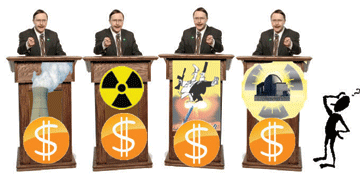
From The National, UAE 14 May 17 “………..The International Atomic Energy Agency worked with government agencies to launch the Nuclear Energy Management School at Khalifa University.
The curriculum includes nuclear energy policy and planning, nuclear regulation and law, operations, safety, security, emergency readiness and nuclear project management.
Experts from IAEA, Nawah Energy, the Federal Authority for Nuclear Regulation and the Emirates Nuclear Energy Corporation will give lectures at the school……..
The authority, where Emiratis comprise 62 per cent of its workforce, said the school would help to ensure the sustainability of the UAE’s power supply and support Emiratis by providing them with the necessary capabilities to manage its nuclear energy programme……
Nuclear will help to save the environment while still providing electricity,” said Mohammed Al Ali, 31, an export control specialist at Nawah Energy.
“It will also help the youth because it’s a new field and we will gain a lot more skills because it’s an industry that is constantly evolving worldwide.”……
May 15, 2017
Posted by Christina Macpherson |
Education, United Arab Emirates |
Leave a comment
Local students advocate for nuclear Post Register, May 11, 2017 By KEVIN TREVELLYAN ktrevellyan@postregister.com
 Emma Redfoot and Kelley Verner noticed something when marching last year in Chicago in an effort to save two nuclear power plants from decommission
……….Fifty-four percent of Americans oppose nuclear energy, according to a 2016 Gallup poll, up from 43 percent in 2015. Last year was the first time the majority of the country opposed nuclear since Gallup started asking the question in 1994.
Public hesitance to embrace nuclear increases the need for advocacy, centrist [??] think tank Third Way communications adviser Suzanne Baker said. Baker previously was an INL spokeswoman.
“Nuclear is an often misunderstood technology,” she said. “And advocacy becomes an important way to help humanize and tell the story of the technology in a way that connects with people. Technical information is important and useful, but it doesn’t always tell us why something matters, and advocacy can do that.”…….
Advocacy can make a difference, Baker said. Following the Chicago pro-nuclear march, the Illinois House of Representatives passed a bill subsidizing operation of the unprofitable Clinton and Quad Cities nuclear generating stations.
Students for Nuclear is focusing its efforts on a handful of other plants that may face decommissioning in coming years. The group has about 70 members who attend colleges across the country.
Over the summer Redfoot and Verner will visit Pacific Northwest National Laboratory in Washington state to discuss nuclear advocacy. They’ll also speak at an American Nuclear Society meeting, and Redfoot will speak to the Association of Environmental Studies and Sciences.
The group also is in contact with the Idaho Conservation League and The Nature Conservancy……..
Redfoot and Verner are trying to bolster group membership with students who aren’t studying nuclear, and they’re gathering stories of those who are to add to the Students for Nuclear website.
They want to put faces to the technology……… Reporter Kevin Trevellyan can be reached at 542-6762 http://www.postregister.com/articles/featured-news-daily-email/2017/05/11/local-students-advocate-nuclear#
May 13, 2017
Posted by Christina Macpherson |
Education, USA |
Leave a comment
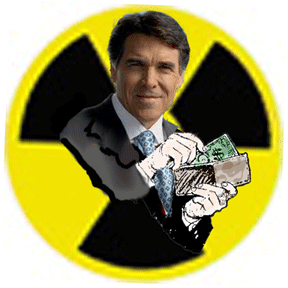
 US energy secretary touts nuclear power, KOB4, May 10, 2017 ALAMOS, N.M. (AP) – U.S. Energy Secretary Rick Perry says he will advocate for nuclear power as often and as strongly as he can as the nation looks for ways to fuel its economy and limit the effects of electricity generation on the environment.
May 12, 2017
Posted by Christina Macpherson |
spinbuster, USA |
Leave a comment
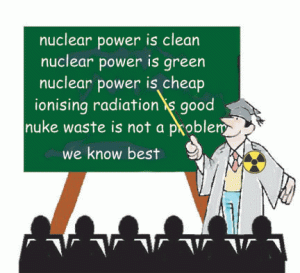
 SRNS provides funding support for innovative education in Augusta area, Augusta Chronicle May 6, 2017, By Thomas Gardiner Staff Writer “…… The vision of the school’s faculty caught the attention of Savannah River Nuclear Solutions, which recently funded the school’s purchase of a new semester-long class called Science and Technology…….
According to a release from SRNS, the management and operations contract company at Savannah River Site, the funding paid for teacher registration, professional development, and the materials and software to make the Science and Technology class a reality.
“Jackson Middle School has purchased the Science and Technology class, funded by Savannah River Nuclear Solutions (SRNS),” Kishni Neville, STEM Coordinator said in the release. “Using the materials and information provided through this class, our seventh and eighth graders explore principles of applied chemistry, nanotechnology and physics.”
She said the Engineering Design Process, a relatively new academic philosophy at Jackson Middle, is an important element of nearly all their instruction…….
SRNS has thus far donated about $4,000 in support of Jackson Middle School. The organization also donates to other area educational activities through Aiken County’s Public Education partners and its Innovative teaching Mini Grants. The Mini Grants program started in 2009 and has awarded over $500,000 total to teachers in the Augusta area.
The program awards cash grants of $500, $750, and $1,000 to teachers implementing innovative ideas in elementary and middle school math and science curricula. The annual program is open to teachers in Aiken, Allendale, Bamberg, Barnwell, and Edgefield counties in South Carolina and Columbia and Richmond counties in Georgia. http://chronicle.augusta.com/news/2017-05-06/srns-provides-funding-support-innovative-education-augusta-area
May 10, 2017
Posted by Christina Macpherson |
Education, USA |
Leave a comment
Pentagon Seeks to Link Iran, North Korea Citing ‘Similar Looking’ Missiles http://news.antiwar.com/2017/05/04/pentagon-seeks-to-link-iran-north-korea-citing-similar-looking-missiles/ Pacific Commander Complains Non-Nuclear Missiles Aren’t Restricted by Nuclear Deals by Jason Ditz, May 04, 2017 Every failed missile test or official warning by North Korean state media against attacking them is a new excuse for the US to offer loud condemnations and new threats, and while the US also likes to threaten Iran, they really haven’t had much in the way of excuses for doing so in recent weeks.
Pentagon officials are looking to resolve that with testimony to Congress claiming that Iranian missiles look suspiciously similar to North Korean missiles. They don’t offer any proof, of course, that this means anything about them having a common origin, but this is clearly the connection Congress is meant to make.
The attempts at “sort of” connections continued throughout the testimony, with officials citing a North Korean submarine missile launch and noting that Iran is also working on the idea of firing missiles from submarines. Attempts to ratchet up the tensions didn’t stop there.
Pacific Commander Admiral Harry Harris even had the gall to complain that neither Iran nor North Korea were impacted by the Intermediate Range Nuclear Forces Treaty in developing shorter range ballistic missiles. Neither is a signatory to the treaty in the first place, of course, and perhaps even more importantly, the missiles in question aren’t even accused of being nuclear in nature.
Still, the Pentagon has been angling for more money for its wars long enough to know that making things about “nuclear” threats is a way to sell Congress on almost anything, and complaining about Iran not complying with a nuclear treaty, even though the missiles in question are non-nuclear and Iran was never a signatory to it in the first place, is always going to play well.
May 6, 2017
Posted by Christina Macpherson |
spinbuster, USA |
Leave a comment
Eskom has told the public that they will manage the massive nuclear-build programme in a responsible manner, devoid of significant cost overruns, corruption and scope creep. Yet the court of public opinion is unconvinced, following years of a lack in transparency and many incidents of questionable leadership conduct, combined with Eskom’s inability to curtail gross runaway costs on projects at Medupi, Kusile and Ingula.
Our message to government and their pro-nuclear lobbyists is to stop trying to feed us with propaganda.

Pro nuclear lobbyists and government must stop propaganda campaign, BizNews.com, Wayne Duvenage, 2 May 17 “………What I find amazing,however, is the pro nuclear lobbyists’ belief that they alone are the experts and that civil society must simply trust their views on what is best for our country’s energy needs. Government has become its own worst enemy on the nuclear issue, believing they have the right to make these costly capital decisions without the necessary public engagement or for legally required parliamentary processes to take place.
For months the pro-nuclear clan have complained that the R1-trillion price tag of a 9.6 GW nuclear programme is incorrect, but they overlook the need to provide the public with a credible response as to what the expected price tag should be.
And for as many months, the pro-nuclear campaigners appeared intent on challenging the public’s intellect by quoting nuclear energy from the 33-year-old Koeberg nuclear plant as being the lowest priced electricity in South Africa (between 21c and 43c/ kWh), as if to imply that this is what we can expect from future nuclear-build programmes.
Input from credible researchers purport the levelised cost of electricity (LCOE – i.e. over the lifetime of the plant) from a new nuclear-build programme to cost South Africans between R1.30 and R1.50 per kWh, and this is before adding in any tax effects, decommissioning, long-term waste disposal and plant life extension costs into account. This is well above the figure of R0.97c/kWh used in the 2016 update of the IRP, sourced from a secret DOE research document. The waters are muddy indeed.
Eskom has told the public that they will manage the massive nuclear-build programme in a responsible manner, devoid of significant cost overruns, corruption and scope creep. Yet the court of public opinion is unconvinced, following years of a lack in transparency and many incidents of questionable leadership conduct, combined with Eskom’s inability to curtail gross runaway costs on projects at Medupi, Kusile and Ingula.
While the authorities continue to make new energy build project decisions based on an outdated Integrated Energy Plan (IEP), the public will remain sceptical. While the DOE chooses to ignore the recommendations of the Minister of Energy’s own experts around least-cost energy choices in the IRP, business will not invest. And for as long as government shuns its critics and keeps civil society’s experts at bay from scrutinising their assumptions and costs which inform the forthcoming IRP process, mistrust will remain high.
Then there is the question of the actual need for new energy build programme decisions in the next five to 10 years, taking into account that:
- South Africa’s current electricity generation capacity is roughly 45GW.
- Coal = 38.5 GW; nuclear (Koeberg) = 1.94GW; hydro = 1.5 GW (including 0.8GW Cabora import) and RE = 3.1 GW. This excludes reserve capacity of peaking gas and hydro at 5.3 GW.
- By 2022, current new build generation projects will take this to 55GW. Medupi (3.2 GW); Kusile (4.0 GW); Additional RE (3 GW).
- Yet today’s electricity requirements only average around 26.6 GW.
- With demand ranging between 22 and 32 GW.
- Demand has reduced over the past five years with little increase expected in the next few years.
- Even if one anticipated a healthy economic growth for SA at an unlikely high rate of 2.5% per annum for the next 10 years, experts do not predict additional electricity demand to exceed 6 to 7 GW, for the next decade.
- Set aside 15% of total capacity for maintenance, and introduce decommissioning of a few older coal fired plans and our capacity still exceeds demand a decade from now.
- Clearly, we don’t need to make a decision on new energy build projects for at least the next five years, leaving us ample time to assess options and build for possible higher demand by around 2030.
- There is simply no need to rush the nuclear decision in the manner currently being undertaken.
- Add to the above the fact that many countries are decommissioning current or cancelling future nuclear build programmes, while the rate of introduction of renewable energy continues to soar. With less than 5% of our electricity coming from RE and many countries around the world at 30% and climbing, the people of South Africa need an extremely rational explanation behind our government’s hasty appetite for nuclear energy, which appears to shun conventional wisdom.If there was ever an issue that was shrouded in public uncertainty and confusion in recent times, it is government’s nuclear energy build plan. And the reasons thereof lie squarely at the feet of government and their State-Owned Entities.
Our message to government and their pro-nuclear lobbyists is to stop trying to feed us with propaganda. Let’s get together and hear each other. What this country urgently needs is an energy charter, one that will provide the necessary clarity of our energy needs and solutions thereto. However, in order to ensure credibility, the Energy Charter process would need to be well informed, inclusive and absolutely transparent.
May 3, 2017
Posted by Christina Macpherson |
South Africa, spinbuster |
Leave a comment
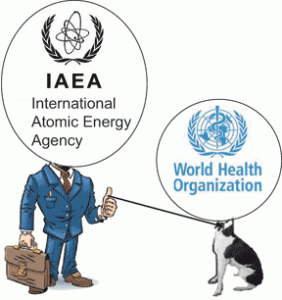 Hidden Radiation Secrets of the World Health Organization, CounterPunch by ROBERT HUNZIKER, MAY 2, 2017
“………..WHO held a Chernobyl Forum in 2004 designed to “end the debate about the impact of Chernobyl radiation” whilst WHO maintains that 50 people died.
Here’s the final conclusion of that Chernobyl Forum ‘04: The mental health of those who live in the area is the most serious aftereffect, leading to strong negative attitudes and exaggerated sense of dangers to health and of exposure to radiation. Mental health was thus identified as the biggest negative aftereffect.
Because that conclusion is so brazenly bizarre, the Chernobyl Forum ‘04 must’ve been part of an alternative universe, way out there beyond the wild blue yonder, maybe the Twilight Zone or maybe like entering a scene in Jan Švankmajer’s Alice, a dark fantasy film loose adaptation of Lewis Carroll’s Alice in Wonderland.
Here’s reality: Chernobyl Liquidators fought the Chernobyl disaster. Eight hundred thousand (800,000) Liquidators from the former USSR, largely recruits from the army, with average age of 33, fought the Chernobyl disaster.
According to an interview (2016) with a Liquidator, “We were tasked with the deactivation of the third and fourth reactors, but we also helped build the containment sarcophagus. We worked in three shifts, but only for five to seven minutes at a time because of the danger. After finishing, we’d throw our clothes in the garbage” (Source: Return to Chernobyl With Ukraine’s Liquidators, Aljazeera, April 25, 2016).
“Estimates of the number of liquidators who died or became ill as a result of their work vary substantially, but the men of the 633rd say that out of the 259 from their group, 71 have died. Melnik says that 68 have been designated as invalids by a state committee, which investigates their health and determines whether or not their diseases are attributable to Chernobyl… Dr Dimitry Bazyka, the current director-general of the National Research Centre for Radiation Medicine in Kiev, says that approximately 20,000 liquidators die each year,” Ibid.
As for total deaths, the Chief Medical Officer of the Russian Federation reported that 10% of its Chernobyl Liquidators were dead by 2001. The disaster occurred in 1986 with 80,000 dead within 16 years. Authorities out of Ukraine and Belarus confirmed Russian death numbers. Yet, WHO claims 50 died.
Eighty-thousand (80,000) Liquidators, as of 16 years ago, dead from Chernobyl, and that body count, according to Ms Katz, leaves out the people most contaminated by Chernobyl, meaning evacuees and also 57% of the fallout for Chernobyl came down outside of the USSR, Belarus, and Ukraine, and in 13 European countries 50% of the countryside was dangerously contaminated.
As for studies of the radiation impact of Chernobyl: “Thousands of independent studies in Ukraine, Belarus, and the Russian Federation and in many other countries, that were contaminated to varying degrees by radionuclides, have established that there has been significant increase in all types of cancer, in diseases of the respiratory, gastrointestinal, urogenital, endocrine immune, lymph node nervous systems, prenatal, perinatal, infant child mortality, spontaneous abortions, deformities and genetic anomalies….” (Katz)
Hence, WHO’s handling and analysis and work on Chernobyl leaves the curious-minded speechless, open-mouthed, agape, and confounded……..http://www.counterpunch.org/2017/05/02/hidden-radiation-secrets-of-the-world-health-organization/
May 3, 2017
Posted by Christina Macpherson |
2 WORLD, Belarus, Reference, spinbuster, Ukraine |
Leave a comment
Students win nuclear essay contest http://www.postregister.com/articles/news-todays-headlines/2017/05/01/students-win-nuclear-essay-contest# May 1, 2017 By KEVIN TREVELLYANktrevellyan@postregister.com Skyline High School students David Hill and Phil Ma will receive $1,500 scholarships after winning an essay contest about nuclear technology.
The Idaho Section of the American Nuclear Society initiates the contest each fall. This year’s topic: why would a commercial entity build a reactor on a national laboratory site and how will the electricity be used?
The prompt came on the heels of Utah Associated Municipal Power Systems choosing a spot at the U.S. Department of Energy’s desert site for the small modular reactor being developed by NuScale.
The reactor, currently under review by the U.S. National Regulatory Commission, is slated to provide electricity for dozens of community-owned utilities.
“We thought it was a good time to have students look into that subject and learn more about a project that may actually occur locally; we think it’s relevant to the INL and local community,” society education committee chair Roger Mayes said.
Four judges reviewed submitted essays on content and clarity.
Hill won the 9-10 grade level contest with his essay titled, “A Small Modular Reactor, In Idaho?”
In the 11-12 grade level contest, Ma won with his essay, “NuScale SMR Technology Comes to Historic Nuclear Site.”
Scholarships will be awarded at a society dinner meeting May 18 at the Energy Innovation Laboratory, 775 University Blvd. Society president Andrew Klein will speak.
A social time begins at 6 p.m.; dinner and the program will follow at 7 p.m. Dinner is $20.
For dinner reservations, RSVP to Danielle Perez at IdahoAmericanNuclearSociety@gmail.com by May 15.
Reporter Kevin Trevellyan can be reached at 542-6762.
May 3, 2017
Posted by Christina Macpherson |
spinbuster, USA |
Leave a comment
 Usually the nuclear lobby hides itself under touchy feely lovely environmental names like “Ecomodernism”, “Environmental progress” “Bright New World”, and you have to read on for ages to find out what they’re really all about – promoting nuclear power.
So it was kind of refreshing when “Generation Atomic” showed up , joining the March For Science, pretending that nuclear power is the cure for climate change.
But, when it came to the March For Climate, they took a different tack. Apparently unable to get a contingent together to push their “nuclear for climate” theme, the nuclear lobby, particularly led by Michael Shellenger and Rod Adams urged people NOT TO MARCH.
Their new schtick is to attack environmental groups, such as Sierra Club, 350.org, and NRDC, Bill McKibben, any environmental group that doesn’t push nuclear power as the solution – and that’s just about ALL of them!
They claim that environmentalists are funded by fossil fuel industries – the implication is that anti nuclear people are just stooges of the fossil fuel lobby – (despite all of us strenuously opposing those polluting industries!)
May 1, 2017
Posted by Christina Macpherson |
spinbuster |
Leave a comment
 Malaysia not in a hurry on nuclear power, to raise awareness first — Nancy, Borneo Post, May 1, 2017 KUALA LUMPUR: Malaysia will remain focused on the information and communication programme relating to nuclear power generation for the time being, and not in hurry to make any decision to introduce nuclear energy into its energy mix.
Minister in the Prime Minister’s Department Datuk Seri Nancy Shukri said emphasis needed to be given on nuclear power education first.
“Not necessarily we accept it straight away. I don’t want to commit by saying that we will look into this immediately but it is important to train and educate our people about nuclear (first).
“We have a lot of fear. We are not equipping ourselves with the correct information,” she told Bernama in Shanghai after a four-day working visit to China’s nuclear power facilities recently.
Nuclear power is a complex and sensitive issue that requires deep understanding. It also needs a long-term commitment, taking a long time to materialise, while its programme requires a long lead time in order to cultivate a critical mass of domestic talent capable of supporting any future initiatives……..
During their working visit to China recently, the Malaysian delegation not only studied safe and sustainable nuclear power technology and infrastructure, but also its implementation, especially on ways to achieve public understanding and acceptance.
The visit, which was led by Nancy, was at the invitation of the Chinese Nuclear Society, a non-profit organisation dedicated to nuclear science, technology and engineering…….
The delegation was made up of stakeholders and representatives from government agencies such as the Malaysia Nuclear Power Corporation, Energy Commission, Agensi Inovasi Malaysia, Economic Planning Unit and Malaysian Nuclear Agency, as well as academicians, and Tenaga Nasional Bhd senior executives.
Malaysia is currently exploring the option of deploying nuclear energy to meet future demand but has indicated that it is not in the rush or set a timeline for the programme……..http://www.theborneopost.com/2017/05/01/malaysia-not-in-a-hurry-on-nuclear-power-to-raise-awareness-first-nancy/
May 1, 2017
Posted by Christina Macpherson |
Malaysia, spinbuster |
Leave a comment
https://www.skepticalscience.com/Heartland-Institute-misinformation-campaign-schools.html
|
21 April 2017 by John Cook
Last month, the Heartland Institute sent a climate denial booklet to 25,000 teachers around the US. In Episode 8 of the Evidence Squared podcast, we look at the why and how of this book. What is the chief motivation for the book’s misinformation and what are the techniques they employ to cast doubt on climate science?
|
April 24, 2017
Posted by Christina Macpherson |
spinbuster, USA |
Leave a comment
 The most common tricks politicians use to muddle inconvenient science “I think my primary message would be learn to appreciate evidence.” VOX, by Sean Illing@seanillingsean.illing@vox.com Apr 20, 2017 On Saturday, thousands of people will march on Washington in support of science. And they’ll do so for very good reasons: Science, under the Trump administration, is under assault. As Vox’s Brian Resnick noted recently, the Trump administration has proposed cutting around $7 billion from science programs, including stifling research funding for the EPA and the National Institutes of Health.
In this interview, I talk to Dave Levitan, author of the new book Not a Scientist: How Politicians Mistake, Misrepresent, and Utterly Mangle Science. A how-to guide for spotting nonsense, Levitan’s book highlights the rhetorical tricks and logical errors politicians use when they distort science for political purposes. Here, we discuss the ideological roots of science denialism and why it’s so important for citizens to demand evidence in support of policy claims.
Dave Levitan The whole idea for the book came about when I started seeing patterns. Cherry-picking data is probably the most familiar. The tendency to draw on a single data point in support of some broader argument, like Sen. James Inhofe did with the famous snowball on the Senate floor. Or taking a very specific subset of data, like Ted Cruz did when he claimed there hasn’t been any global warming for 17 years. That might be the most commonly seen one where you really just pick and choose exactly which study and data point, which subset or source to use, and then conveniently draw on that when it aligns with your political narrative.
Another really common one is where they claim that because there is still some degree of uncertainty around whatever the subject happens to be, then that means we shouldn’t do anything about it. Climate change is a great one for that, but it dates back much farther. Conservatives used the same tactics for delaying action on acid rain in the ’80s, for example. President Reagan would say, “Well, we still have to study this and figure out what’s going on. There’s not enough data to do anything.”
First of all, they were wrong. There was plenty of data. We knew exactly how to deal with acid rain and ended up fixing it pretty well. So that one comes up a lot, the idea that because there’s any degree of uncertainty that we shouldn’t do anything, which is of course ridiculous because every scientific measure ever taken has a degree of uncertainty and always will……..
I think my primary message would be learn to appreciate evidence. I really wish that your average reader of news would keep in mind that evidence is important and just because someone said something doesn’t make it true. That’s true for people on the right or left, for scientists themselves, and for everyone. People have to back up their claims with evidence.
If individual citizens have this in mind at all times, I think they’d do a better job of spotting bullshit and lies. Make sure that people show their work, that their policy pronouncements are backed up with reliable data. http://www.vox.com/conversations/2017/4/20/15339844/science-climate-change-republican-party-march-for-science
April 21, 2017
Posted by Christina Macpherson |
climate change, resources - print, spinbuster, USA |
Leave a comment
 America’s Peace Making Nukes vs. North Korea’s WMD: Simultaneous Nuclear Weapons Tests by U.S. and North Korea By Prof Michel Chossudovsky Global Research, April 15, 2017 “………North Korea versus the United States
US public opinion is routinely led to believe that US nukes are harmless (safe for civilians). The devastating consequences (amply documented) of the use of nuclear weapons is carefully obfuscated. In contrast to the nukes developed by North Korea, the US Department of Defense considers both the B61-11 and the new B61-12 as”harmless to the surrounding civilian population because the explosion is underground“, according to “scientific opinion” on contract to the Pentagon.http://www.globalresearch.ca/americas-peace-making-nukes-vs-north-koreas-wmd-simultaneous-nuclear-weapons-tests-by-u-s-and-north-korea/5585140
While the DPRK’s nukes are considered as bona fide Weapons of Mass Destruction (WMD) and a Threat to Global Security, America’s tactical mini-nukes are categorized as “peace-making bombs”. They’re harmless to civilians according to the military manuals; let’s go head and use them as part of a pre- emptive “humanitarian” war under an R2P mandate (“Responsibility to Protect”).
Lest we forget, the DPRK has been threatened by the US with nuclear war for more than half a century. Barely a few years after the end of the Korean War (1950-53), the US initiated its deployment of nuclear warheads in South Korea. This deployment in Uijongbu and Anyang-Ni had been envisaged as early as 1956.
Trump-Style Political Insanity
All the safeguards of the Cold War era, which categorized the nuclear bomb as “a weapon of last resort”, have been scrapped. “Offensive” military actions using nuclear warheads are now described as acts of “self-defense”.
In the post Cold war era, US nuclear doctrine was redefined. There is no sanity under the Trump administration as to what is euphemistically called US foreign policy. Trump hasn’t the foggiest idea as to the consequences of nuclear war. Nor does he have an understanding of the workings of US foreign policy.
At no point since the first atomic bomb was dropped on Hiroshima on August 6th, 1945, has humanity been closer to the unthinkable… (Image of Hiroshima in the wake of the bombing)
Stay informed, spread the word far and wide. To reverse the tide of war, the broader public must be informed. Post on Facebook/Twitter.
Confront the war criminals in high office.http://www.globalresearch.ca/americas-peace-making-nukes-vs-north-koreas-wmd-simultaneous-nuclear-weapons-tests-by-u-s-and-north-korea/5585140
April 17, 2017
Posted by Christina Macpherson |
spinbuster, USA |
Leave a comment
Generation IV reactors to the rescue?
Given these problems, some look to new ‘Generation IV’ designs. They are basically new versions of the old designs looked at in the 1950s, 60s and 70s in the USA and elsewhere – and abandoned as unviable, or after accidents.
They include fast neutron plutonium breeders, High Temperature Reactors (HTRs) and Molten Salt Reactors (MSR) possibly using thorium as a fuel and possibly also in scaled down Small Modular Reactor (SMR) format.
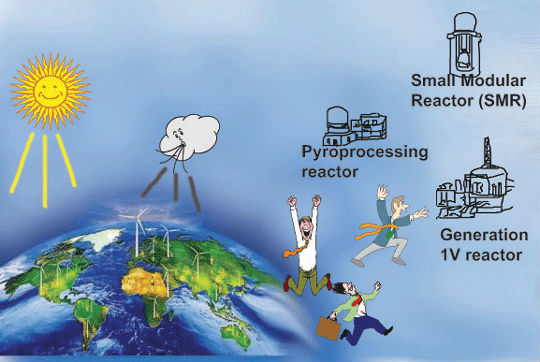
The message from the past is not promising……
False promise: nuclear power: past, present and (no) future http://www.theecologist.org/News/news_analysis/2988856/false_promise_nuclear_power_past_present_and_no_future.html David Elliott 12th April 2017
Nuclear power was originally sold on a lie, writes Dave Elliott. While we were being told it would make electricity ‘too cheap to meter’, insiders knew it cost at least 50% more than conventional generation. Since then nuclear costs have only risen, while renewable energy prices are on a steep decline. And now the nuclear behemoths are crumbling … not a moment too soon.
In a December 1953 speech to the United Nations, President Dwight D. Eisenhower launched the ‘Atoms for Peace’programme, saying:
“The miraculous inventiveness of man shall not be dedicated to his death but consecrated to his life.”
He claimed that “peaceful power from atomic energy is not a dream of the future. That capability, already proved, is here – now – today.” And the USA would help to ensure it could be used worldwide.
However, his advisors soon told him that it wasn’t viable. A classified internal State Department Intelligence Report, circulated in January 1954, ‘Economic Implications of Nuclear Power in Foreign Countries‘, warned that the introduction of nuclear power would
” … not usher in a new era of plenty and rapid economic development as is commonly believed. Nuclear power plants may cost twice as much to operate and as much as 50 percent more to build and equip than conventional thermal plants.” [Quoted by Mara Drogan in ‘The Nuclear Imperative: Atoms for Peace and the Development of U.S. Policy on Exporting Nuclear Power, 1953-1955 Diplomatic History 40 Issue 5 948-974.]
Nonetheless, the nuclear juggernaut rolled on, with, US Atomic Energy Commission Chairman Lewis Strauss, in a 1954 address to science writers, claiming: “It is not too much to expect that our children will enjoy in their homes electrical energy too cheap to meter.”
The USA, followed by the UK, France, Russia and Japan, poured vast resources into nuclear power – new plants and new research projects.
Murphy’s law of nuclear power?
But things didn’t always go to plan. For example, there took place a series of accidents at US experimental reactor test sites, including an explosion at the SL1 project in Idaho in 1961, which killed three operators – one of whom was impaled to the roof by a fuel rod.
Then in 1966, the Fermi fast reactor, near Detroit, suffered a fuel melt down, and in 1979, the Pressurised Water Reactor (PWR) at Three Mile island narrowly avoided a major hydrogen explosion by venting radioactive gas to the air. That signalled the end of nuclear growth in the the USA. The multi-billion dollar plant had to be written off. Opposition mounted. New plants, orders collapsed.
Then came the Chernobyl disaster in the Ukraine in 1986, with the cloud spreading across most of Europe. There was a global meltdown in orders for new plants.
However, it wasn’t just the accidents that were the problem. The poor economics of nuclear gradually became more apparent- as cheaper alternatives began to emerge. It turned out to be too expensive – e.g. it could not compete with cheap gas plants in the UK. As Lord (Walter) Marshall, one- time head of the UK Atomic Energy Authority, when chair of the CEGB in 1987, commented:
“The British Public have never had the cheap electricity that we have always promised from nuclear power. It has been, and continues to be, a case of ‘jam tomorrow, but never today’.”
But for our politicians, the nuclear dream never died
But that didn’t stop Marget Thatcher from pushing ahead with a new nuclear plant (a PWR) at Sizewell, work on it starting in 1987. Or Tony Blair later trying to relaunch a new programme “with a vengence”. That has still yet to happen. But it’s pending, with the £24 billion Hinkley Point C European Pressurised-water Reactor (EPR), if it goes ahead, being the first new UK plant in 30 years.
Fukushima, in 2011, had intervened, slowing the nuclear programme worldwide, and creating liabilities of hundreds of billions of dollars. But the UK has pressed ahead with plans for maybe 18GW of new plant – delivering around 30% of UK electricity in the 2030s.
This expansion is based on so-called ‘Generation III’ reactors, basically upgrades of the Generation II PWRs and similar designs that have been the mainstay of nuclear so far. The new versions are unlikely to be any more competitive against cheap gas and increasingly cheap renewables.
The nuclear industry still has hopes for the French EPR, the Toshiba / Westinghouse AP1000 and the Hitachi ABWR – an upgrade of the Fukushima boiling water reactor design.
But the EPRs being built in France and Finland, Flamanville and Olkiluoto, are both around eight years late and three times over budget. Flamanville’s gigantic stainless steel reactor vessel and dome is also suffering from serious metallurgical flaws which may yet prevent its completion.
The two AP1000s being built in the USA have also been delayed, creating losses of over $10 billion that have pushed Westinghouse into bankruptcy, and its Japanese parent company, Toshiba, into what may prove to be a terminal financial meltdown. The two ABWRs under construction in the US are also seriously behind schedule.
Generation IV reactors to the rescue?
Given these problems, some look to new ‘Generation IV’ designs. They are basically new versions of the old designs looked at in the 1950s, 60s and 70s in the USA and elsewhere – and abandoned as unviable, or after accidents.
They include fast neutron plutonium breeders, High Temperature Reactors (HTRs) and Molten Salt Reactors (MSR) possibly using thorium as a fuel and possibly also in scaled down Small Modular Reactor (SMR) format.
The message from the past is not promising. Most countries (US, UK, France) gave up on fast breeders in the 1980s and 1990s. Japan has now too. The UK tested an HTR in the 1960s with its Dragon project at Winfrith. Germany and the USA had a go too. The US also tested some MSR technology in the 1960s, and also the use of thorium as fuel. SMRs were also tested.
None of these ideas went forward owing to massively escalating costs and successive technical dificulties. But the industry claims that new variants on these old designs will be upgraded, cheaper and safer.
However, in a review of Generation IV options, the French nuclear agency IRSN said that, at the present stage of development, it did not see any evidence that “the systems under review are likely to offer a significantly improved level of safety compared with Generation III reactors, except perhaps for the High Temperature Reactor” – and even that would require “significantly limiting unit power”.
Allison MacFarlane, former chair of the US Nuclear Regulatory Commission, talking about the HTR, said “I do not see past experience pointing at a positive direction.”
She also noted that Fast Breeder Reactors “turn out to be very expensive technologies to build. Many countries have tried over and over. What is truly impressive is that … many governments continue to fund a demonstrably failed technology.”
As nuclear power grows more costly, renewables prices plunge
Cost reduction is clearly vital if any of these ideas is to prosper. That’s one of the arguments used for small modular reactors (SMRs): they would be faster to build and so possibly easier to finance. It might also be possible to use the waste heat from them to supply heat to urban areas – if residents would accept them in or near cities.
But is that likely? SMRs are very unlikely ever to be cheap. The reason why civil nuclear power stations ever got so big as the EPR (1.6GW), ABWR (1.6GW) and AP1000 (1.25GW) is to reap ‘economies of scale’ which would be lost by going small.
And of course there is nothing remotely ‘new’ about SMRs, indeed they are a distinctly mature technology: hundreds of them have been deployed in military submarines and ships, for decades. The reason why they were never used for civil power generation is simple – they cost too much! So what exactly is about to change?
In any case all these Generation IV ideas are a decade or two, or maybe more, away from anything approaching commercial reality. It’s like the situation renewables faced in the 1980s. Renewables did break through and are now viable – wind and PV solar especially. Will Generation IV nuclear be able to do the same? Or do we need to wait until Generation V – fusion? If that ever works. Or do we actually need any of these nuclear ideas?
Renewables have outperformed nuclear across the board – undercutting its cost and delivering over twice its total annual output globally: renewables now supply 24% of global electricity, and are growing rapidly, as against the fairly static 11.5% from nuclear.
Renewables are on the way to 50% of power production in many countries by 2030, and maybe close to 100% by 2050. The resource is huge, and, unlike uranium or thorium, it won’t ever run out, or leave long-term hazardous wastes. That looks like our best future.
April 14, 2017
Posted by Christina Macpherson |
2 WORLD, history, spinbuster |
Leave a comment









 nuclear-news