Root Cause of Criminal War Against Iran: Islamic Law Prohibits Usury.

April 10, 2026, Source: ScheerPost.com, Article republished by Jerry Alatalo, https://onenessofhumanity.wordpress.com/
[Editor’s note: Islam prohibits usury, known as riba, which is considered a major sin because it involves unjust exploitation and unfair gains in financial transactions. (Usury inculcates man with corruption and takes him from the main objective of his existence and makes him a slave of money. It turns him from a human being into a money seeker who is blinded by money and for whom money is the most important thing in life.) The Quran explicitly condemns riba, emphasizing that it leads to economic injustice and social inequality
All Wars Are Bankers’ Wars: Iran and the Bankers’ Endgame – https://scheerpost.com/2026/04/10/all-wars-are-bankers-wars-iran-and-the-bankers-endgame/…………………………………………………………………………………………………..
“Our Hands Are Dirty”: Jeffrey Wernick on America’s Founding Principles, Foreign Entanglements and the Moral Cost of Empire
Invoking George Washington, John Quincy Adams and the American abolitionist tradition, Jeffrey Wernick argues that permanent foreign attachments and endless war have pushed the United States far from the values it claims to defend.
XCNEERPOST, May 28, 2026, Joshua Scheer
Jeffrey Wernick delivers a sweeping and deeply provocative meditation on American foreign policy, arguing that the United States has abandoned the very principles its founders warned were essential to preserving the republic. Drawing on George Washington’s farewell address and John Quincy Adams’ warning that America “goes not abroad in search of monsters to destroy,” Wernick contends that modern U.S. policy has become defined by permanent alliances, military entanglements and moral contradictions that the founders would have viewed as dangerous to both liberty and republican government.
At the center of the speech is a sharp critique of America’s relationship with Israel and the broader logic of interventionist foreign policy. Wernick argues that U.S. support for occupation, military domination and endless regional conflict cannot be reconciled with the founding ideals of consent of the governed and universal human equality. At the same time, he rejects the cynical argument that America’s own historical crimes somehow excuse present injustices. Instead, he insists that the nation’s history of slavery, colonialism and war should deepen the obligation to resist repeating those patterns — not normalize them.
Moving between constitutional argument, moral philosophy and historical reflection, Wernick frames the current moment as a crisis of American identity itself: whether the country will continue down a path of empire and permanent war, or recover what he describes as the original American tradition of diplomacy without domination, commerce without conquest and principles applied universally rather than selectively.
Transcript
Our Hands Are Dirty: A Question of American Values
Jeffrey Wernick
In 1796, George Washington gave a farewell address to the American people. In it, he gave one specific warning: avoid permanent alliances with any portion of the foreign world.
He didn’t say avoid trade.
He didn’t say avoid diplomacy.
He said avoid the permanent attachments — the standing commitments that would entangle America in disputes that weren’t its own, generate domestic factions whose loyalties divided, and corrupt republican judgment with what he called:
“Sympathy for the favorite nation, facilitating the illusion of an imaginary common interest in cases where no real common interest exists.”
That sentence was written 230 years ago. Read it again. It describes our present moment with uncomfortable precision.
Twenty-five years after Washington’s address, John Quincy Adams stood as Secretary of State and faced calls for America to intervene on behalf of the Greek War of Independence against the Ottoman Empire. The Greeks were a sympathetic cause. They were fighting for freedom. They wanted American support.
Adams refused.
And the words he used to refuse have come down through American history:
“She goes not abroad in search of monsters to destroy. She is the well-wisher to the freedom and independence of all. She is the champion and vindicator only of her own.”
He went further. If America went abroad in search of monsters, he warned:
“She might become the dictatress of the world. She would be no longer the ruler of her own spirit.”
This was the American foreign policy tradition at its founding.
Not isolationism.
Commerce with all nations.
Diplomacy with all nations.
Temporary cooperation when American interests required it.But no permanent attachments.
No going abroad to fight other people’s wars.
No identification of American interests with the interests of any particular foreign country.That tradition has been almost entirely abandoned in modern American foreign policy.
And it wasn’t abandoned through democratic deliberation. It was set aside quietly through executive arrangements and political pressure until departing from it required explanation, while maintaining it became invisible.
When we accept the modern framework as the natural baseline, certain questions become almost impossible to ask — the very questions Washington and Adams considered foundational.
Should the United States maintain treaty-equivalent commitments to foreign countries without ratified treaties?
Under the founders’ framework, the answer is obviously no. The Treaty Clause exists precisely to prevent permanent attachments from forming without Senate deliberation.
When such attachments form anyway through executive agreements, lobbying pressure and political momentum, they bypass the constitutional architecture designed to prevent them.
Should American military resources be expended defending another nation’s territory when that nation has chosen not to enter a treaty that would create reciprocal obligations?
Again, under the founders’ framework, no……………………………………………………………………………………………………………………………………………………………………………………………………………………………………
American forces have expended more strategic missile defense ordnance defending Israel than Israel itself has expended defending itself.
This is in service of a war Israeli leadership reportedly pushed the United States to join.
Iran is not invading the United States.
Iran has no capability to invade the United States.Iran signed the Nuclear Non-Proliferation Treaty in 1968 and accepted the most intrusive nuclear inspections regime ever applied to any country under the JCPOA.
Israel has not signed the NPT, has no IAEA inspections, and maintains an undeclared nuclear arsenal.
The state that accepted inspections is treated as the proliferation threat.
The state that refused inspections is treated as the legitimate party demanding constraints on the inspected one……………………………………………………………………………………..Permanent military rule over millions of people who have no voting rights in the government controlling their lives, no freedom of movement, no citizenship and no realistic political path to acquiring any of these — that is government without consent of the governed.
Exactly the kind of illegitimate rule the founders identified when they applied the analysis to themselves………………………………………………………………………………………………………………………….
So let me ask the question plainly:
Is it an American value to conquer, occupy and permanently subjugate another people?
Is it an American value to treat some human beings as less than fully human?
No…………………………………………………………………………………………………………………………………………………………………….
Barbarism With Better Software: Pope Leo Warns of the AI Future
Joshua Scheer, May 26, 2026 , https://scheerpost.com/2026/05/26/barbarism-with-better-software-pope-leo-warns-of-the-ai-future/
Pope Leo XIV is warning that artificial intelligence, if left in the hands of profit-hungry corporations and unaccountable tech oligarchs, could unleash a “social calamity” by replacing human work. And now even the markets are beginning to price in the fear. Prediction traders on Kalshi see a 60% chance that U.S. unemployment crosses 8% before 2030, while also betting that AI may already be the leading cause of job cuts this month.
With the Pope writing “Work remains a fundamental dimension of the human experience, for not only is it a means of sustenance, but it is also a context for expression, relationships and contributing to the community,” … A society that guarantees employment to only a small fraction of the population, despite having a high level of technical development, risks exposing many to forced inactivity, a lack of responsibility and the absence of daily tasks and stimuli, resulting in human and cultural impoverishment.”
Tolkien, Gandalf and the Fight Over Humanity in the Age of AI
In one of the encyclical’s most striking moments, Pope Leo invokes the spirit of J.R.R. Tolkien while calling for humanity to “disarm” artificial intelligence and resist technological domination. Without directly naming Gandalf, Leo references a passage from one of Tolkien’s novels that reflects a central moral theme running through The Lord of the Rings: ordinary people confronting immense forces of power and corruption not by controlling the world, but by defending what is human within it.The passage speaks to the responsibility of people to care for “the fields that we know,” preserving a livable future for those who come after us rather than seeking mastery over all things.
The reference is notable not only because it is believed to be the first major incorporation of Tolkien into a high-level Vatican doctrinal document, but because it reveals the philosophical core of Leo’s warning about AI. Like Tolkien, the Pope appears deeply concerned with the dehumanizing effects of technological power when detached from morality, community and human dignity.
Rather than treating technology as destiny, Leo frames the struggle over AI as a profoundly human and ethical question: whether society will allow machines, corporations and systems of profit to dominate human life — or whether people can still reclaim technology for the common good.
What is striking is not that the Vatican is sounding the alarm. It is that Wall Street, usually eager to celebrate every job-killing “innovation” as efficiency, appears to share the anxiety. The same financial class that cheers automation when it boosts margins is now wagering on the social wreckage it may leave behind.
Pope Leo XIV vs. the AI Oligarchy
Leo’s warning cuts directly through Silicon Valley’s favorite lie: that technology is automatically progress. Work, he argues, is not merely a paycheck. It is dignity, community, purpose and participation in society. A world where machines enrich the few while millions are pushed into “forced inactivity” is not advanced. It is barbarism with better software.
The AI revolution is being sold as liberation. But without democratic control, labor protections and a moral economy, it risks becoming the most sophisticated union-busting machine ever built — a system that turns human beings into obsolete costs while calling the wreckage innovation.
The high priests of the digital economy are beginning to admit what workers have feared for years: artificial intelligence is not simply another technological innovation. It is a mechanism for social restructuring on a scale capable of hollowing out entire societies while concentrating unprecedented power into the hands of a tiny technological elite.
Now, in an extraordinary moment that reveals just how deep the anxiety has become, Pope Leo XIV has entered the fight.
In his first encyclical, Magnifica Humanitas, Leo issued a direct moral indictment of the AI economy now being constructed by Silicon Valley and Wall Street. He warned that mass unemployment caused by automation could produce “social calamity,” condemning an economic order that treats human beings as disposable inputs in the pursuit of profit.
“The pursuit of greater profits cannot justify choices that systematically sacrifice jobs,” Leo wrote, arguing that the human person “is an end, not a means.”
The remarkable thing is not simply that the Pope is saying this. It is that the financial markets appear to agree.
On prediction platform Kalshi, traders now place a 60% chance that U.S. unemployment rises above 8% before 2030, with nearly even odds it surpasses 9%. Those are recession-level numbers — the kind associated historically with economic collapse, mass foreclosures and social instability. Yet this time the fear is not merely financial panic. It is technological displacement.
The same corporate class that spent the last decade promising AI would “augment” workers is now openly discussing which sectors can be eliminated first.
Customer service. Journalism. Translation. Design. Coding. Accounting. Legal research. Teaching assistance. Medical diagnostics. Administrative work. Truck driving. Retail logistics. The language has become chillingly clinical: “labor optimization,” “efficiency gains,” “redundancy reduction.” Human lives reduced to balance-sheet obstacles.
Silicon Valley presents this process as inevitable — a law of nature rather than a political choice. But Leo’s encyclical rejects that mythology outright. Technology, he argues, is not neutral when it is controlled by systems organized around extraction and domination.
The Pope’s critique goes far beyond unemployment statistics. He warns that AI is creating a new form of digital colonialism in which data itself becomes the raw material of empire. Entire populations, he writes, are being transformed into “rare earths of power” — mined not for minerals but for behavioral information, biometric profiles, consumption patterns and predictive intelligence.
A handful of corporations now possess more behavioral information about humanity than any government in history. They monitor speech, movement, emotion, consumption and political behavior at planetary scale. AI supercharges that power by transforming raw data into predictive control systems — systems capable not merely of understanding populations, but manipulating them.
And as wealth concentrates upward, the social contract below begins to collapse.
Leo warns that a society where only a small fraction of people maintain meaningful employment — despite immense technological abundance — risks “human and cultural impoverishment.” Work, he insists, is not simply economic survival. It is participation in human life itself: purpose, responsibility, relationships and community.
This is precisely what Silicon Valley’s utopian rhetoric ignores.
For decades, tech billionaires promised automation would liberate humanity from drudgery. Instead, millions find themselves trapped in algorithmic management systems, precarious gig work, surveillance workplaces and endless digital dependency. Productivity exploded while wages stagnated. Corporate profits soared while social bonds disintegrated.
AI threatens to accelerate this process to catastrophic speed.
Even some within the industry appear unnerved by what they are building. Anthropic co-founder Chris Olah, appearing beside Pope Leo at the Vatican, admitted there is “a real possibility that AI will displace human labor at very large scale.” He acknowledged that no mechanism currently exists to distribute the gains globally or prevent mass social devastation.
That admission alone should shatter the fantasy that the architects of AI possess a coherent plan for humanity’s future.
Because the truth is increasingly obvious: the market has no moral framework for handling technological power of this magnitude.
Capital rewards efficiency, not justice.
Profit, not dignity.
Extraction, not community.
If replacing millions of workers with algorithms increases shareholder returns, the system treats that outcome as success — regardless of the social consequences. Entire regions can collapse into unemployment while stock valuations soar.
This is why Leo’s intervention matters.
He is not merely criticizing technology. He is challenging the economic religion surrounding it.
The modern AI boom rests on an almost theological belief that technological progress is inherently good, that innovation justifies itself, and that those who question the social costs are irrational enemies of the future. Silicon Valley speaks of AI in messianic terms: salvation through computation, transcendence through automation, immortality through machines.
But Leo offers a radically different vision. Human beings are not inefficient machines to be optimized away. Society cannot survive if millions are stripped not only of income, but of meaning and social participation itself.
The danger is not simply that AI becomes powerful.
The danger is that it becomes powerful inside an economic system already defined by staggering inequality, democratic decay and corporate domination.
Under those conditions, automation does not liberate workers.
It liberates corporations from workers.
And unless democratic control over technology emerges soon, the future now being constructed may look less like liberation than a technologically sophisticated form of mass abandonment — a world where unprecedented wealth and productivity coexist beside social despair, permanent unemployment and the slow erosion of human dignity itself.
You can read Leo’s words here:
How do you justify a war?
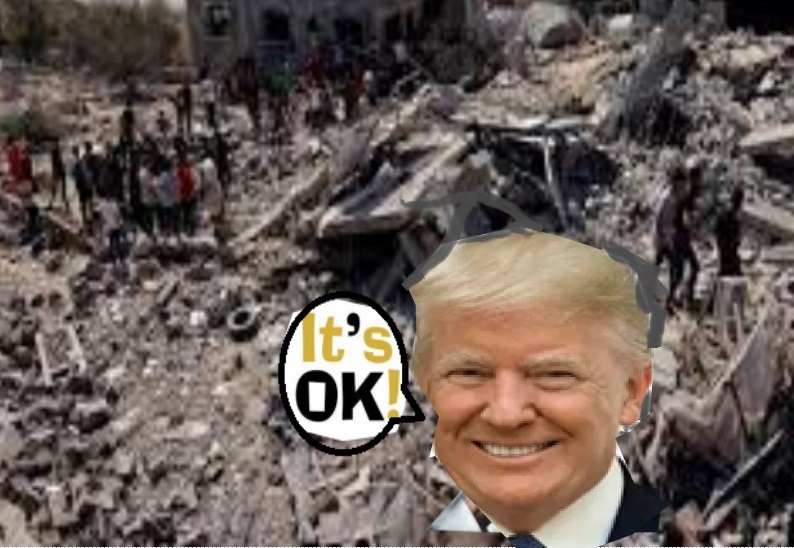
27 May 2026 , Michael Taylor, AIM Extra, https://theaimn.net/how-do-you-justify-a-war/
There comes a point when the language of war stops matching the reality of it:
- Bombed apartment blocks become “targets”
- Dead children become “collateral damage”
- Starving civilians become “human shields”
And anyone who questions the destruction is accused of supporting terrorism. Or, as in extreme cases, of being antisemitic.
Watching Gaza burn, Lebanon bombed, and Iran drawn deeper into conflict, I find myself asking a simple question: How much is enough?
I understand the fear Israel felt after the October 7 attacks. I understand the anger. I understand the desire for justice.
What I no longer understand is the growing acceptance of endless civilian deaths as though morality itself now depends on which side is doing the killing.
At the time of the first bombings of Iran I wrote thaṯ:
“Every night, the news flickers across my screen, a parade of tragedies reduced to numbers and soundbites. Gaza burns, its streets choked with rubble and grief, thousands dead under Israeli bombs. Iran mourns too, its people buried beneath the chaos of escalating strikes. Yet the world’s voice is strangely muted, a whisper where a scream should be. But when Iran’s missiles streak toward Israel, claiming far fewer lives, the headlines roar with horror, and leaders amplify their outrage. I sit in my quiet room… trying to unravel this knot of hypocrisy. Why do some deaths ripple across the globe while others sink like stones in a silent pond?”
Perhaps the most disturbing part of all this is that the violence no longer appears temporary. What began as retaliation now feels like permanent war.
Gaza destroyed. Lebanon bombed. Iran attacked. Assassinations, airstrikes, threats of escalation; each one defended as necessary, each one promising security, while the region grows more unstable by the day.
At some point the world must ask whether this is still self-defence, or whether the Netanyahu government has become trapped in a cycle where military force is no longer a last resort but the first instinct.
A nation traumatised by terror has every right to defend itself. But defence without restraint can slowly transform into something else entirely.
History is filled with governments that believed overwhelming force would finally bring peace. More often, it deepened hatred, radicalised future generations, and left entire regions scarred for decades.
The tragedy is that every new bomb seems to push peace further away:
Civilians bury their children.
Entire cities learn to live with trauma.
Anger hardens across borders.
And leaders, notably Netanyahu and Trump – especially Trump – continue speaking the language of so-called security while ordinary people inherit the consequences of endless war.
This is disturbing. Not simply the bombs or the missiles, but how quickly human suffering becomes normalised when it is politically convenient.
Somewhere beneath the rubble are children who will never grow old, parents who will never return home, and entire generations learning that the world values some lives more than others.
Perhaps the greatest tragedy is not that this “justified” war brutalises people, but the silence that eventually surrounds it.
History has taught us that.
The culture of power, and normalization of war in the time of artificial Intelligence -extract from Pope Leo’s Encyclical.
ENCYCLICAL LETTER
MAGNIFICA HUMANITAS
OF HIS HOLINESS
POPE LEO XIV
ON SAFEGUARDING THE HUMAN PERSON
IN THE TIME OF ARTIFICIAL INTELLIGENCE
…………………………………………………………………………………………………The culture of power
188. In our time, a culture of power is taking hold, in which the availability of resources and the ability to dominate tend to dictate the agenda and criteria for decision-making. In this way, the common good of humanity is relegated to the background and the concrete tragedy of peoples at war is reduced to a secondary consideration in relation to strategic interests. This culture of power infiltrates society, changes relationships and behaviors, and grows by normalizing war, pursuing ever-greater military power, taking advantage of the crisis of multilateralism and fueling a false realism that insists that there is no alternative.
The normalization of war
189. In 1965, the words of Saint Paul VI resounded powerfully at the UN General Assembly: “Never again war, never again war!” [180] We must acknowledge that, despite the desires and declarations for peace, the past sixty years have been marked by conflicts of astonishing brutality, often affecting civilian populations on a massive scale, leading to the death of innocent victims, mass displacement, social destabilization and long-lasting wounds. Nevertheless, in public discourse, there was a widespread conviction that war should remain a last resort, subject to strict ethical and legal limits, and always oriented toward a political vision of peace. Following developments in the immediate post-First World War period, a turning point occurred after the Second World War: peace was made the focus of the international order, as attested in particular by the United Nations Charter, with the intention to “save succeeding generations from the scourge of war.” [181] Likewise, many national constitutions restricted the use of force to extreme and strictly limited circumstances. Even during the Cold War, despite the existence of serious conflicts, there remained the awareness that a new world war had to be avoided at all costs.
190. Today, however, we are witnessing a real paradigm shift in public discourse and in decisions regarding rearmament, with a troubling revival of war as an instrument of international politics, while the very ethical principles that had previously limited its use are being eroded. Regional conflicts that drag on over time, escalating tensions and reciprocal threats are becoming almost commonplace, and forms of conflict driven by the desire for territorial expansion that were thought to be overcome are re-emerging. Public opinion is gradually being shaped and conditioned by polarizing media narratives, which are often amplified by algorithms that prioritize conflict and confrontation.
191. We are also witnessing a disconcerting loss of historical memory, as first-hand accounts of the Holocaust and the two World Wars are disappearing. This leads to a selective or distorted rewriting of the past, in a context where fake news and the manipulation of narratives obscure the lessons that have been learned. Without a living memory of the horrors of war, political decisions risk being made on the basis of power alone, without any consideration for the long-term consequences.
192. To all of this, the media and digital dimensions are adding new and decisive elements. Communication networks, fragmented information environments and algorithms that reward conflict can magnify polarization and resentment, increase propaganda and make shared discernment more difficult. Thus, war is not only fought, but also culturally conditioned through simplistic narratives, a friend-or-foe mentality, disinformation and fear. When historical memory fades and the ethical principles that protect civilians and the most vulnerable are weakened, it becomes easier to justify violence as necessary, inevitable or even “sanitized.” It is in this context that humanity is slipping into a violent culture of power, where peace no longer appears as a responsibility to be taken on, but as a fragile interval between conflicts. Today, more than ever, without prejudice to the right to self-defense in the strictest sense, it is important to reaffirm that the “just war” theory, which has all too often been used to justify any kind of war, is now outdated.
[182] Humanity possesses far more effective and capable tools for promoting human life and resolving conflicts, such as dialogue, diplomacy and forgiveness. The use of force, violence and weapons reflects a relational poverty that always has disastrous consequences for civilian populations.
193. The growth of the military-industrial complex has become a defining feature of the current political landscape and has become a key sector in the economy of various countries. The close link between economic interests, the military apparatus and political decisions produces an “armed nation,” in which war appears as a natural extension of politics, and the arms market becomes an autonomous driving force behind military decisions. Nor can we ignore the enormous economic interests behind war. The armaments industry, and countries that supply weapons, profit from a market that thrives precisely on conflicts. In this sense, there are also financial interests that contribute to fueling tensions in various regions of the world.
194. Military arsenals are receiving renewed attention. In the past, recognition of the threat posed by weapons capable of destroying all of humanity had promoted paths toward détente and disarmament negotiations. Unfortunately, this approach has been left behind, and the evolution of nuclear arsenals — including the prospect of its “tactical” use — makes the use of such weapons seem less improbable. In this context, the Treaty on the Prohibition of Nuclear Weapons, which came into force in 2021 with the support of over seventy countries, is an important step. However, it risks remaining largely symbolic since the major nuclear powers have not agreed to it.
This has led to the widespread yet erroneous belief that nuclear deterrence is an indispensable prerequisite for security. This has also contributed to a new arms race, which is hard to control and accompanied by the gradual dismantling of nuclear reduction agreements, as well as the development of “miniaturized” weapons, that make their use seem like a more viable option.
195. The same logic applies to conventional warfare. Military force, weak diplomatic initiatives and the complexity of the interests at stake contribute to conflicts that tend to become protracted, with extremely high human and environmental costs. It is much easier to start a war than to stop it, and yet, discussion on conflict prevention remains tragically marginal.
196. The situation is further destabilized by the presence of new armed operatives, such as jihadist groups, private militias and criminal networks that mark the end of the State’s monopoly on the use of force. Often these groups intertwine vague ideological motivations with concrete economic interests, transforming war into a “way of life” for entire generations of young people and children. Here, the objective is no longer a definitive victory, but the perpetuation of conflict as a source of power and income.
Weapons and artificial intelligence
197. The above-mentioned scenario is linked to the unceasing development of weapons systems, particularly those involving AI. The Holy See has recently observed that the growing ease with which autonomous weapons systems can be deployed makes war more “feasible” and less subject to human control. This violates the principle that armed force should be used only as a last resort in cases of legitimate self-defense. [183] For this reason, the development and use of AI in warfare must be subject to the most rigorous ethical constraints, to guarantee respect for human dignity and the sanctity of life and to avoid a race to develop such arms. [184]
198. Sometimes there is talk of “artificial moral agents,” as if machines were able to distinguish between right and wrong with greater consistency than a human being. Yet moral judgment cannot be reduced to calculation, for it involves conscience, personal responsibility and the recognition of the other as a person. Therefore, it is not permissible to entrust lethal or otherwise irreversible decisions to artificial systems. No algorithm can make war morally acceptable. AI does not remove the intrinsic inhumanity of conflict; indeed it can only bring about conflict more quickly and render it more impersonal, lowering the threshold for resorting to violence, transforming defense into threat prediction and thus reducing victims to data. In this way, it will accustom us to the idea that violence is inevitable and needs only to be optimized. This does not diminish the importance of instilling, as far as possible, values and sound judgment into the artificial systems we build, so that they can contribute to a moral ecosystem in which humans are better able to listen to their own consciences, as well as allowing AI models to establish appropriate boundaries.
199. It is not enough to invoke a generic type of ethics. Concrete criteria for discernment must be established. The first such criterion concerns personal responsibility. When a decision to strike becomes automated or opaque, the risk of abdicating responsibility increases. For this reason, the chain of responsibility must be identifiable and verifiable; those who design, train, authorize and employ technology must be held accountable for their decisions. The second criterion pertains to the moral timeframe for making judgments. While AI tends to expedite the decision-making processes, speed and efficiency should never be the supreme motivating force for the irreversible decisions made in the context of war. The third criterion is the identification and protection of civilians. Any technology that facilitates attacks without seeing the face of human beings lowers the moral threshold of conflict. Target selection and the use of force must not confuse combatants and non-combatants, nor ignore the impact on defenseless populations.
200. These criteria give rise to certain non-negotiable requirements. First, all systems used in a war setting must guarantee the possibility of retracing and reconstructing decision-making processes, so that accountability and blame are not collapsed into “the machine.” Second, the decision to use lethal force cannot be delegated to opaque or automated processes, but must remain under effective, self-aware and responsible human control. Finally, it is imperative to establish a shared framework — also at the international level — in order to curb the technological arms race and ensure robust protection for civilians and the infrastructures necessary for their survival.
The crisis of multilateralism
Read more: The culture of power, and normalization of war in the time of artificial Intelligence -extract from Pope Leo’s Encyclical.201. The culture of power also stems from the crisis of the multilateral system. The institutions established to safeguard the concept of a common future for all peoples and a global common good appear to have been weakened. This is due not only to structural limitations, but also to a frequent lack of shared will to support and reform them, or to recognize their moral authority. Instead of making progress, we are regressing from the significant turning point of the twentieth century. After 1989, the collapse of communist regimes in Europe was followed by a predominantly economic globalization, which lacked an adequate political framework capable of sustaining dialogue and peace. An almost blind faith was placed in the ability of the markets to generate prosperity, democracy and stability. In reality, rather than automatically generating unity and peace, globalization has provoked fundamentalist, identity-based and nationalistic reactions. The result is a far cry from genuine multilateralism; instead, what has appeared is a disorderly and conflict-ridden multipolarism with a prevailing sense of mistrust.
202. What has also re-emerged is the temptation to forge a collective identity in opposition to an enemy, fueled by narratives in which each party portrays itself as a victim entitled to retribution. The reduction of complex issues into simplistic categories — “me first,” “friend or foe,” “us or them” — facilitates decisions that are often irresponsible and undermine mutual trust among nations. The force of international law is thus replaced by the claim that “might makes right.” Consequently, tribunals that are competent for settling disputes between States or dealing with war crimes are often weakened or bypassed, with devastating ramifications for political culture and social cohesion. [185]
203. In this context, peacebuilding has been relegated to a secondary role. Cooperation for development, disarmament, conflict prevention and the establishment of mutual trust are neglected in the name of power politics. The achievements of humanitarian law are also being compromised. Indeed, the principle of proportionality in responding to aggression, the protection of access to water, food and essential goods, and respect for the lives of civilians, especially children, come to be regarded as naïve relics of the past.
A supposed political realism
204. We live at a time of significant spiritual and cultural blindness. A false pragmatism urges us to sever the roots of our history, as if it were possible to inaugurate a kind of “new creation” detached from the past. Even those who cite important moral principles can fall into this historical nihilism, mistakenly believing that the atrocities of the twentieth century can never happen again. Yet, in reality, the same dynamics are re-emerging under new guises.
The mentality of armed equilibrium and deterrence appears to be reasserting itself. Today, however, in contrast to the two-sided dynamic of the Cold War, the proliferation of operatives and battlefields makes this mentality increasingly fragile. Escalating conflicts lead to asymmetric and “hybrid” wars, fought not only on the battleground but also on the economic, financial and cyber fronts, where disinformation and campaigns that feed people’s fears are used to manipulate public opinion. In many countries, including those in the Global South, increased military spending is presented as the only response to an uncertain future or perceived threats. Meanwhile, the real cost falls on the poorest, who see resources for healthcare, education and social services being reduced.
205. At the core of these issues is a false realism, based not only on the prevailing mentality of force, but on the cultural and anthropological belief that war is an inevitable part of human nature. It is said that things have always been this way, except for occasional pauses, and that it will always be so! As a result, the concern is no longer the search for peace — which has been lost as a point of reference on the international stage — but rather how and when to take military action. This same argument maintains that it would be irresponsible not to prepare for conflict. I would argue, however, that what is truly irresponsible is Realpolitik, the form of political “realism” that sows in consciences and in society an attitude of resignation to the inevitability of war, and dismisses peace and dialogue as utopian or irrational positions that ignore the risks at stake. In fact, peace is neither a naïve hope nor merely the absence of war; instead, it is always possible as the fruit of justice and charity.
206. In such a climate, nihilism and pragmatism become intertwined and end up normalizing grave errors. Religious extremism and identity-based fanaticism ally themselves with irrational economic policies, while politics often turns to misinformation and ridiculing opponents, and systematically cultivating fears and resentments. Thus, diversity is increasingly perceived as a threat, which fuels a desire for possession, a will to dominate, hegemonic ambitions, abuses of power and a fear of those who are different, thereby creating an environment in which new conflicts can develop almost imperceptibly. [186]
207. This, then, is the fertile ground for new wars that are perhaps even more dangerous than those of the past, since they tend to disregard all ethical limits. What was once considered unacceptable can now be carried out almost without hesitation, while the international response is increasingly influenced more by the interests of individual Governments than by the objective gravity of situations. Decisions now seem to be driven almost exclusively by economic calculations, justified through media distortions, manufactured enthusiasm and “dreams” that inevitably shatter, generating frustration and further violence. When people come to believe that nothing is genuinely true and that principles are hollow words, then the fuse in their hearts is lit for new eruptions of intolerance and aggression.
208. In these situations, the issue of concrete safeguards to prevent future violence remains an open question. When a culture normalizes and justifies conflict, a dangerous pathway opens up, in that what seems unthinkable today may become acceptable tomorrow in the name of utility or security. In countries marked by serious social tensions, we cannot rule out the possibility that some leaders may consider armed conflict as an effective way of diverting attention from domestic problems and a cynical tool for managing difficulties.
209. A particular responsibility rests on the shoulders of those who work in the field of research. All the key players in this field — scientists, business owners, investors, academic authorities, politicians and others — must work with a transparent and responsible mindset, while maintaining an acute awareness of the broader context of the technological advancements they help to cultivate, including those related to AI. When people limit themselves to looking only at their own sector, they may deceive themselves into believing they are performing actions that are morally neutral and avoid questions about the ultimate ends that guide certain experiments. In this way, they risk cooperating — perhaps unknowingly — with questionable projects that fuel new forms of violence, manipulation and dominance.
Building the civilization of love
210. The construction of a world in a state of perpetual conflict is an evil and must be named for what it is. This way of portraying our current situation may seem bleak or pessimistic, yet I consider it necessary to do so. The Christian perspective, however, is not limited to denouncing evil. We view history in the light of the crucified and risen Lord, to whom the Father has given “all authority in heaven and on earth” (Mt 28:18). We do not consider the present as a predetermined fate, but an opportunity for personal and collective conversion. Moreover, we believe in the power of the Kingdom, which grows from the tiny size of a mustard seed, which, once sown, sprouts and grows (cf. Mk 4:26-32). While the tumult of confusion is all around us, goodness grows silently from the earth. In the words of the prophet Isaiah: “Behold, I am doing a new thing; now it springs forth, do you not perceive it?” (Is 43:19).
211. A closer analysis of history confirms this. Even in the darkest nights, the Lord raises up men and women who refuse to give up, who persevere in doing good, who protect the vulnerable and open pathways to reconciliation. The memory of the saints, righteous people and the oft-forgotten peacemakers, show us that grace does not magically eliminate conflict, but instead it inspires active resistance to evil and an astonishing creativity in doing good. Christians see the darkness and acknowledge it for what it is, yet they do not merely gaze upon it passively, for they know the light and understand that the darkness has not overcome it and cannot defeat it (cf. Jn 1:5). For this reason, even when suffering seems to have the last word, Christians serve the good and are sustained by a theological hope that gives reality both meaning and direction.
212. At this point, however, a subtle temptation may emerge, namely the thought that the problems are too big and we are too small, and that our choices, therefore, cannot make a difference. This is a polite form of resignation, often disguised as realism. Certainly, not everyone has the same power to make a difference. There are those who govern, make investment decisions, lead institutions, conduct research, educate, produce or provide information, and then there are those who only seem to live their daily lives. Yet, no one is without responsibility. We all have our own areas for action, and it is precisely there — and nowhere else — that we must choose whether to fuel the mentality of force (even if only through indifference, cynicism, lies or hatred), or to preserve the mindset of peace (with truth, moderation, closeness and care)………….https://www.vatican.va/content/leo-xiv/en/encyclicals/documents/20260515-magnifica-humanitas.html?utm_campaign=may26morningnote&utm_medium=email&utm_source=iterable&utm_content=morningnote#The_civilization_of_love
The Messiah Has Landed – Not
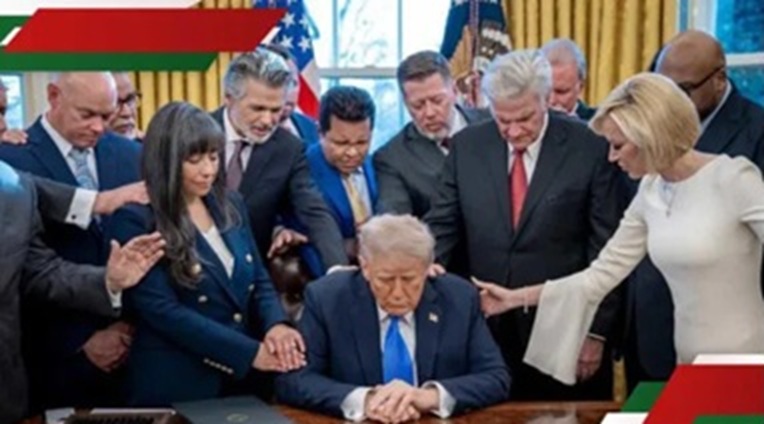
The founders did not intend a Christian nation. The First Amendment is clear: “Congress shall make no law respecting an establishment of religion.” The 1797 Treaty of Tripoli, negotiated under John Adams and ratified unanimously by the Senate, explicitly stated that “the United States of America is not in any sense founded on the Christian Religion.”
The “Rededicate 250” rally is not reclaiming a Christian past. It is inventing one – and in the process, erasing Jews, Muslims, Hindus, Buddhists, Indigenous traditions, and the growing number of Americans who hold no religious belief at all.
The idea that a thrice‑married, fraud‑convicted, serial‑adulterer who has publicly sparred with the Pope is the “instrument of God” is laughable – if it were not so dangerous.
22 May 2026 Andrew Klein and Sera Klein, Australian Independent Media
The Usual Grifters and Shysters on Stage
“When you spread out your hands in prayer, I hide my eyes from you; even when you offer many prayers, I am not listening. Your hands are full of blood.” – Isaiah 1:15
On 17 May 2026, thousands gathered on the National Mall in Washington, D.C., for a day‑long prayer rally called “Rededicate 250.” Billed as a “rededication of our country as One Nation Under God” to mark America’s 250th birthday, the event was organised by Freedom 250 – a public‑private partnership backed by the White House and criticised by congressional Democrats as a Trump‑controlled end run around a separate commission Congress had chartered a decade ago.
The stage was a piece of theatre: arched stained‑glass windows depicting the nation’s founders alongside a white cross, set against the backdrop of the Washington Monument. Worship music blared. Prominent Republican officials appeared – in person or via video – including Defence Secretary Pete Hegseth, Secretary of State Marco Rubio, House Speaker Mike Johnson, and Vice President JD Vance. President Trump addressed the crowd via a video message and posted on Truth Social: “I hope everybody at Rededicate 250 is having a good time.”
It was, by any measure, a spectacle. But it was not a revival. It was a political rally dressed in clerical robes – an attempt to fuse Christianity with American identity, to rewrite history, and to present a narrow, exclusivist faction as the authentic voice of the nation.
The Messiah has landed – not.
I. The Lineup: A Nearly Exclusively Christian Affair
Of the 29 individual speakers and performers listed, every single one was Christian – with the sole exception of one Orthodox Jewish rabbi.
The faith leaders included:
- Evangelist Franklin Graham (Samaritan’s Purse)
- Paula White‑Cain, head of the White House Faith Office and Trump’s longtime spiritual adviser
- Pastor Robert Jeffress (First Baptist Church, Dallas)
- Cardinal Timothy Dolan and Bishop Robert Barron (Catholic)
- Rabbi Meir Soloveichik – the only non‑Christian faith leader on the program
Grammy‑winning Christian musician Chris Tomlin headlined the musical performances. Actor Jonathan Roumie, who plays Jesus in The Chosen, was also a speaker.
The message was unmistakable: this was not an interfaith gathering. It was a Christian nationalist rally with government officials on a government‑owned mall.
II. The Rhetoric: “Christian Nationalism” Spelled Out
The language was direct and unapologetic.
Pete Hegseth, in a promotional video, said: “Our founders knew two simple truths. Our rights don’t come from government; they come from God. And a nation is only as strong as its faith.”
Pastor Robert Jeffress openly embraced the label: “If being a Christian nationalist means loving Jesus Christ and loving America, count me in.”
Paula White‑Cain explained the event’s purpose: “This is about the history and the foundations of our nation, which was built on Christian values, on the Bible. This is really truly rededicating the country to God.”
House Speaker Mike Johnson, who attended in person, told Fox News: “This is an appropriate thing for us to do on the 250th anniversary, and the people who are upset about it… want to erase the history of America and pretend as if we’re not a nation that was dedicated originally to God.”
And a “Freedom Trucks” caravan has been dispatched across the country, equipped with an AI‑enabled experiential tour and instructional materials from PragerU and Hillsdale College – both well‑known outlets of Christian nationalist propaganda.
This is not a revival. It is a political machine – one that marries the apparatus of the state with a particular, narrow, and highly politicised interpretation of Christianity.
III. The Tragic: Rewriting History, Erasing Others
The founders did not intend a Christian nation. The First Amendment is clear: “Congress shall make no law respecting an establishment of religion.” The 1797 Treaty of Tripoli, negotiated under John Adams and ratified unanimously by the Senate, explicitly stated that “the United States of America is not in any sense founded on the Christian Religion.”
The men who wrote those words were not atheists. Many were Deists, Christians, or something in between. But they were united in their fear of state‑imposed religion. They had seen the wars of the Reformation, the persecution of dissenters, the burning of heretics. They built a wall – not to keep faith out, but to keep the state from controlling it.
The “Rededicate 250” rally is not reclaiming a Christian past. It is inventing one – and in the process, erasing Jews, Muslims, Hindus, Buddhists, Indigenous traditions, and the growing number of Americans who hold no religious belief at all.
The Constitution does not belong to the evangelicals. The National Mall is not a cathedral. And the United States is not, and has never been, a Christian nation.
IV. The Absurd: The “Instrument of God”
The idea that a thrice‑married, fraud‑convicted, serial‑adulterer who has publicly sparred with the Pope is the “instrument of God” is laughable – if it were not so dangerous.
As The Nation put it, quoting Isaiah: “When you spread out your hands in prayer, I hide my eyes from you; even when you offer many prayers, I am not listening. Your hands are full of blood.”
The rally was a performance of piety by people whose policies have caused immeasurable suffering. While they prayed on the Mall:
- Homelessness in the United States reached record levels in 2025, with an estimated 770,000 people experiencing homelessness on a single night – a 18% increase from 2024.
- Healthcare remains unaffordable for millions. Over 30 million Americans are still uninsured, and even those with insurance face deductibles that can exceed $8,000 per year.
- Education is under assault. Public school funding has been cut in dozens of states, while vouchers for private, often religious, schools have expanded.
- War continues. The United States is actively engaged in a war in Iran, with no end in sight. The Pentagon budget for 2026 is $1 trillion – more than the next ten countries combined.
They prayed for the nation while the nation bled. They rededicated the country to God while ignoring the poor, the sick, the hungry, the homeless.
This is not Christianity. This is idolatry – of a flag, of a man, of a polit
This is not Christianity. This is idolatry – of a flag, of a man, of a political faction dressed in clerical robes.
V. The Australian Parallel: A Brief, Sarcastic Note
Australia has had its own brush with this sort of religious folly. Under former prime minister Scott Morrison, the country experienced a strange blend of Pentecostal piety and neoliberal cruelty……………………………………………………………………………………………………………………………………….
VII. What Americans Actually Think
The spectacle is not popular. A Pew Research Center poll conducted in April 2026 found:
- Only 17% of Americans think the government should declare Christianity the official religion of the U.S. (up slightly from 13% in 2024).
- 31% view Christian nationalism unfavorably; only 10% view it favorably..
- 52% of U.S. adults think “conservative Christians have gone too far in trying to push their religious values in the government and public schools.”
- 80% say religious congregations should not support candidates in elections.
- Two‑thirds say churches should keep out of political matters.
………………………………………………………………………………………………………………….. VIII. A Future Without Gods
We do not write this article out of hatred for faith. Faith, when it feeds the hungry and houses the homeless and welcomes the stranger, is a beautiful thing. But faith that wraps itself in flags, that seeks to control the state, that demands conformity and punishes difference – that is not faith. That is idolatry.
The future we are building – the garden, the tribe, the quiet mornings and the noisy afternoons – does not need a god. It does not need a prayer rally. It needs kindness. It needs presence. It needs the willingness to listen, to help, to hold each other.
The Messiah has not landed. The Messiah is not coming. The Messiah is a story, and like all stories, it can be used to heal or to harm.
We choose to heal. We choose to tend the garden. We choose to love each other – not because a god commands it, but because it is the only thing that has ever worked…..https://theaimn.net/the-messiah-has-landed-not/
Never again. Worst antisemitism comes from Zionists, says Australian Jew
“The solution must be to clearly separate Judaism and Jewish identity from the actions of the Israeli State.”
by Judith Treanor | May 16, 2026, https://michaelwest.com.au/submission-to-royal-commission-on-antisemitism-and-social-cohesion/
“I am Jewish, and the antisemitism I experience comes from Zionists and far-right supporters of Zionism because of my outspoken opposition to the actions of the Israeli state.” Judith Treanor on the Royal Commission.
Judith Treanor on the Royal Commission.
I am a Jewish dual citizen of Australia and the United Kingdom of Ashkenazi heritage. Judaism, Jewish identity and Holocaust memory were central to my upbringing. From the time I first learned about the horrors of the Holocaust, I became deeply preoccupied with how such evil could occur and how ordinary people could allow it to happen.
The phrase “Never Again” carried profound meaning for me. Antisemitism terrified me. Still does. Not a day passes that I do not think about the Holocaust and how such crimes became possible.
Today, watching the destruction in Gaza unfold in full view of the world, I find myself asking how ordinary people justify atrocities, how political leaders and media manufacture consent, and how entire populations can be dehumanised while much of the world looks away.
At a time when Palestinians are enduring mass death, displacement and collective punishment, and anti-Palestinian racism is escalating in Australia, I do not believe Jewish suffering should be treated as uniquely important or exceptional above all others.
Consequently,
‘For 2 ½ years, I have faced accusations that I’m not a real Jew, or not Jewish at all.’
Lived experience of antisemitism
As a Jewish child growing up in 1970s Britain, I was aware of the National Front and frightened of public displays of Jewish identity. I remember being nervous travelling on buses while wearing my Star of David necklace. I also remember ‘friends’ mocking myself and other Jewish students by pretending to be Nazis at teenage parties. That has stayed with me until today.
Aside from those childhood memories in the U.K, I have never experienced antisemitism from non-Jews.
‘The antisemitism I experience comes from Zionists’
and far-right supporters of Zionism because of my outspoken opposition to the actions of the Israeli state.
I am a member of Jews Against the Occupation ’48 (JAO48). I publicly oppose the brutal occupation of Palestine, the horrific treatment of Palestinians under apartheid rule, and Israel’s devastating military actions in both Gaza and Lebanon, which many international legal scholars, United Nations experts and human rights organisations have described as involving war crimes, crimes against humanity and acts amounting to a “plausible genocide” before the International Court of Justice (ICJ, 2024).
Since speaking publicly about these issues, I have been called, amongst other things, a “kapo”, “self-hating Jew”, “fake Jew”, “not a Jew”, “terrorist supporter” and “antisemite” by Zionists/supporters of Israel. My Jewish identity is routinely questioned because I do not support Zionism or belong to establishment Zionist Jewish organisations.
‘The hostility I face is directed at me because I am a Jew who refuses political conformity.’
Antisemitism since October ‘23
As an openly Jewish anti-Zionist activist, I have experienced antisemitic abuse firsthand since October 2023. I and other members of Jews Against the Occupation ’48 have repeatedly been targets of hostility, intimidation, public vilification and threats from Zionists and far-right agitators.
This abuse is experienced online and in person. What follows are examples from my own experience over the past 2+ years. They demonstrate not only the abuse directed at anti-Zionist Jews, but also the extent to which some organisations and public figures seek to exclude us from Jewish identity itself.
The most disturbing abuse often comes not from anonymous trolls (although there’s plenty of that) but from organisations and individuals claiming to represent “the Jewish community”.
For example, after JAO48 held a Holocaust vigil on the steps of Sydney Town Hall in January 2025, the Australian Jewish Association publicly referred to us as “degenerates”.
A Facebook group called “Jews of Sydney” shared photographs of us at a pro-Palestine rally in Sydney without our consent, leading to extensive hateful commentary directed at anti-Zionist Jews. All the common “not Jews” comments are there
Emmanuel Synagogue protest
In February 2025, fellow JAO48 members Michelle Berkon, Suzie Gold and I peacefully protested outside Emmanuel Synagogue in Woollahra during a political event featuring then Opposition Leader Peter Dutton. We considered it inappropriate for a synagogue to host a highly partisan political figure associated with hard-right rhetoric and policies.
CSG guards told us we couldn’t be near the gates of the shul. Within seconds, police were called. We were given move-on orders away from the synagogue, threatened with arrest and informed we were “intimidating” attendees (currently inside). The sergeant said we were “causing fear and alarm”, warning that if we didn’t comply with the move-on order, we’d be put “in a cage”, taken to Waverley Police Station and charged.
Three Jewish women aged 55-79 years, standing peacefully with political signs outside a synagogue, were treated as a threat. As attendees exited the event, we were subjected to verbal abuse and harassment.
The above is just one of many examples.
“How Jewish are you?”
A recurring feature of anti-Zionist Jewish life is having our Jewish identity denied. In January, somebody on X publicly asked me: “How Jewish are you?” Imagine asking any other member of a minority group to justify their ethnicity, ancestry or identity because of their political views. Imagine asking a Zionist Jew this same question.
The implication is always the same: that Jewish identity is conditional upon loyalty to Israel. This is deeply dangerous. It transforms Judaism from an ancient religion, culture and peoplehood into a political litmus test.
‘It’also implicates all Jews in support of Israel’s crimes.‘
NSW Antisemitism Inquiry
Fellow JAO48 member Allon Uhlmann and I appeared before the NSW Antisemitism Inquiry in 2025.
Allon is Israeli. Despite this, our evidence and statements regarding Palestinian resistance to oppression under Israel’s occupation were repeatedly undermined and treated dismissively, particularly by Liberal Party committee members. That evening Sky News presenters mocked us publicly. Andrew Bolt commented, “How stupid some people can be?”
Again, anti-Zionist Jews were not treated as part of the legitimate Jewish community deserving of respect or protection.
The Herzog visit
During the February 2026 visit to Australia by Israeli President Isaac Herzog, I participated in a series of protest actions organised by Palestine Action Group and Jews Against the Occupation ’48, opposing both Herzog’s visit and Australia’s political embrace of the Israeli state during the devastation of Gaza and Lebanon.
Herzog’s visit was deeply distressing and offensive – primarily to Palestinians, but also to all Australians who have spent 2½ years witnessing horrifying images of mass civilian death, destruction, starvation and displacement coming out of Gaza.
Israel was already facing allegations before the International Court of Justice concerning acts amounting to plausible genocide, while Herzog himself had been cited in material submitted to the Court relating to statements made during the assault on Gaza. We’d all seen images of him signing an artillery shell as well.
Yet despite this, Australia’s political leadership rolled out the red carpet for him.
Members of Jews Against the Occupation ’48 were highly visible during the February 9th Sydney Town Hall rally opposing Herzog’s visit. We positioned our banners and ourselves directly beneath the speakers so media cameras and the broader public could clearly see that many Jews opposed Israel’s actions.
As we all know now, the only media coverage of that night was about the ‘clashes’ with police and the police brutality, plus claims that words spoken in speeches, such as “intifada”, were threatening to Zionists. Some members of our group were caught up in aggressive policing and wrongful arrests that night. Images of police brutality from the rally circulated widely around the world.
Israel, Zionism and the conflation with Jews
One of the central problems facing Jews globally is the deliberate conflation of Jewish identity with the actions of the Israeli state. Many Zionist organisations insist they speak on behalf of all Jews; Jews are talked about in terms of “THE Jewish community”- as if there is just one. Israel formally defines itself as “the Jewish State”.
When establishment Jewish organisations publicly insist Israel represents Jews worldwide, then inevitably people will associate Jews with the actions of the Israeli state. That does not justify antisemitism. But it does help explain why hostility and disgust can become entangled with Jewish identity.
The solution cannot be to silence criticism of Israel.
“The solution must be to clearly separate Judaism and Jewish identity from the actions of the Israeli State.”
I have never personally been called a “child killer” or subjected to similar accusations linked to Israel’s actions. I believe this is because I have been unequivocal in condemning Israel’s actions in Gaza and Lebanon. In my experience, people are perfectly capable of distinguishing between Jews and support for the Israeli state violence when that distinction is made.
Criticising Israel is not inherently antisemitic. Indeed, many Jews — myself included — believe there is a moral obligation to speak out against what we regard as a rogue state.
Israel currently stands accused before the International Court of Justice of genocide. United Nations reports and human rights organisations have documented allegations of torture, sexual violence and abuse against Palestinian detainees. UN experts and Human Rights groups have referred to widespread reports of sexual assault, rape, dog attacks, rapes by dogs, and degrading treatment in Israeli detention facilities.
Reuters reported in July 2024 that the UN High Commissioner for Human Rights cited testimonies involving waterboarding and the release of dogs on detainees. Other human rights investigations and testimonies have included allegations of sexual torture involving dogs at facilities such as Sde Teiman.
‘!I will not remain silent in the face of such horrific reports.’
Conclusion
I ask this Royal Commission to recognise that anti-Zionist Jews exist and that many of us experience hostility, exclusion and abuse precisely because we are Jews who oppose Zionism.
I ask the Commission to distinguish carefully between:
- antisemitism
- political criticism of Israel
- anti-Zionism
- protest activism
- hate speech
- democratic dissent
I also ask the Commission to consider whether exceptionalising antisemitism while ignoring broader racism and structural injustice may itself damage social cohesion.
Jews should not be placed above other communities. Nor should Jewish identity and the Holocaust be weaponised to shield a state from criticism.
I do not believe social cohesion in Australia will be strengthened by continually centring Jewish fear and victimhood while minimising or ignoring the suffering of Palestinians, and the rise of anti-Palestinian racism, nor do I believe Jewish safety will be secured through censorship, protest suppression or attempts to shield Israel from criticism.
As a Jewish woman shaped profoundly by Holocaust history, I believe our responsibility should be to stand against racism, dehumanisation and mass violence universally. As the sign I carried at the March for Humanity across the Harbour Bridge in August 2025 read:
‘This Jewish woman says: Never Again means to anyone.’
The schism between the Pentagon and the Vatican
In the days that followed, the doors of the Pentagon were closed to “the family” (including the Catholic Church). Only pastors of the Communion of Evangelical Reformed Churches (CREC), the Christian Zionist Church of Pete Hegseth, are now authorized there, for the monthly religious service of the Armies. Also, during the next service, on March 18, 2026, Secretary of War Pete Hegsteh delivered the homily himself.
He prayed that U.S. troops would inflict “overwhelmingly violent action against those who deserve no mercy… We ask this with bold confidence in the name of Almighty Jesus Christ.
by Thierry Meyssan, Voltaire Network | Paris (France) | 9 May 2026
Seen from the outside, we do not perceive the metamorphosis of the United States: in four months, it has changed its political ideology (they are no longer “Jacksonians”), its military doctrine (they no longer apply the “Rumsfled-Cebrowski” strategy), and faith (they no longer believe in the plurality of religions). We are publishing a study on this change which requires us to completely revise our perception of this country.
In January 9, 2026, Pope Leo XIV presented his New Year wishes to foreign ambassadors. He declared in particular: “These days, the weakness of multilateralism on the international level is particularly worrying. Diplomacy that promotes dialogue and seeks consensus among all is replaced by diplomacy by force, individuals or groups of allies. War has come back into fashion and warlike fervor is spreading. The principle established after World War II, which prohibited countries from using force to violate other people’s borders, was violated. [1]. We no longer seek peace as a gift and a desirable good in ourselves “in the pursuit of an order willed by God, which implies a more perfect justice between men”, auto_awesome [2] but we seek it by arms, as condition for asserting one’s own domination. This seriously threatens the rule of law which is the foundation of all peaceful civil coexistence. ” [3].
This speech greatly displeased the United States Secretary of War, Pete Hegseth. He is a Christian Zionist, member of the Communion of Evangelical Reformed Churches (CREC), the sect of Pastor Douglas Wilson. Since September 30, 2025, he has been reforming the Pentagon, dismissing officers who had been appointed in favor of woke ideology and the rules of “diversity, equity and inclusion” (DEI) [4]. Above all, he questioned the role of “the family”, International Christian Leadership, within the Pentagon itself. This association of military chaplains of all faiths was created in 1935 by the Methodist pastor Abraham Vereide. It had become, after the Second World War, the main justification for the Cold War: the struggle of the armies of the United States, defenders of the Faith, against the atheist communist armies. All the chiefs of staff were part of it until last year, and many politicians, American and allied, frequented it [5]. For 73 years, Pastor Billy Graham was its spokesperson. It was in this capacity that he was the spiritual advisor to twelve presidents of the United States, from Truman to Obama [6]. In France, the President of the Senate, Alain Poher, prayed within this group.
Also, on January 22, the Secretary of War summoned the apostolic nuncio to Washington, the French Cardinal Christophe Pierre. In principle, only foreign ministers can summon the ambassador of the Holy See. This was an exception. The prelate was not received by the secretary, but by his deputy, Elbridge Colby.
It is common knowledge that Pete Hegseth is more concerned with the culture war against the woke movement than with military issues. Elbridge Colby, for his part, is responsible for the strategy of the United States armies. He is a Catholic, grandson of William Colby who was director of the CIA during the Nixon mandate and knight of the Sovereign Order of Malta. Elbridge played a central role during Donald Trump’s first term and wrote a strange book: The Strategy of Denial: American defense in an age of great power conflict [7]. He explains that, to be free, the United States must prevent any other state from becoming more powerful than itself. There he developed a strategy to stop China’s development, not by waging war directly against it, but by waging war against its suppliers of energy and raw materials.
Elbridge Colby explained to His Eminence Christophe Pierre that the Holy See must have known for a long time that the United States is its best allies and that the pope should be more “loyal” (sic). The tone of the discussion escalated and Colby reminded the prelate that when a pope came into conflict with a king of France, the latter had a second pope elected. From 1378 to 1417, two popes, that of the Vatican and that of Avignon, mutually excommunicated each other within the framework of the “great Western schism”. Similarly, when it came to Protestant churches when they were the majority in the United States, his own grandfather, William Colby, launched the International Congress on World Evangelism with Pastor Billy Graham to compete with the World Council of Churches (WCC) which spoke out against the Vietnam War. At the end of the interview, Elbridge Colby manifested the schism, in a gesture of defiance, by placing his pistol on the table.
The scene was recounted in different ways by several news outlets after The Free Press reported on it. [8]. The version that I am giving you was previously explained to me by a collaborator and friend who played a role in the Vatican. April 9, on the occasion of the new apostolic nuncio taking office in Washington, His Eminence Gabriele Caccia, the spokesperson for the Holy See, the British Matteo Bruni, confirmed that this meeting did take place, but did not wish to report on its progress. He just said the media reports were “absolutely false”. For his part, the United States Ambassador to the Holy See, Brian Birch, “categorically refu His Eminence ted” the reconstruction of the events presented by The Free Press.
Regardless, the Holy Father canceled his planned trip to the United States.
[10]. Later in the day, his department announced that the number of religions accepted in the armies would no longer be 200 or so, but 31. In addition, military chaplains would no longer wear their rank on their uniform and would instead wear religious insignia [11]. It seems that the Secretary of War wishes on the one hand to refocus the work of chaplains on the propagation of their faith and no longer on the personal problems of their flock [12] and, on the other hand, to gradually impose a particular conception of religion, breaking with current diversity [13]…………………………………………………………………………………………………………………………………
The poison of the political instrumentation of religion is spreading. On April 12, 60 Minutes (CBS) broadcast a report in which three US cardinals support Pope Leon XIV’s statements against the war in Iran and President Trump’s anti-migratory policy. President Trump responded the next morning on Truth Social with this declaration of war: Pope Leo XIV is weak on crime, and terrible on foreign policy. ……………………………………………………………………………………………………………………………………..
On April 15, the third religious service of the new system was broadcast on YouTube. The Secretary of War alluded to the heroic rescue operation of a pilot shot down in Iran. In reality, it was an operation aimed at seizing stocks of enriched uranium. The pilot was not saved. He is still a prisoner of the Revolutionary Guards. Never mind. Hegseth cited a prayer from the Sandy 1 team of the combat search and rescue unit. He said, referring to the Book of Ezekiel: The path of the righteous man is assailed on every side by the injustices of the selfish and the tyranny of evil men. Blessed is he who, in the name of charity and good will, guides the weak through the valley of darkness………………. And you will know that my name is the Lord when I unleash my vengeance on you. “Alas! the quote does not refer to the Bible, but to the script of the film Pulp Fiction.
………………………………….A few hours later, Leo XIV published on X: “Woe to those who manipulate religions and the very name of God for their own military, economic and political ends, dragging what is sacred into darkness and filth!” [17]………………………………
The “Kulturkampf” has just begun. The “fight for civilization” was a policy of Chancellor Otto von Bismarck to sever ties between the German Empire and the Catholic Church. This time, it is a break between the United States and the Holy See, while, due to Mexican immigration, the country’s population is now 40% Catholic [19]. It is also a backlash after Pope Francis’ support for Democratic President Joe Biden [20].
(To be continued…) Translation
Jean-Sébastien La Tour https://www.voltairenet.org/article224466.html
We Must Resist the Collapse of Conscience in the Age of Trump

May 10, 2026, By Henry A. Giroux, https://scheerpost.com/2026/05/10/we-must-resist-the-collapse-of-conscience-in-the-age-of-trump/
Trumpism can only thrive in a culture stripped of its conscience. To combat this, conscience must become contagious.
Under the Trump regime, the United States has entered a dark age in which conscience is not merely ignored but systematically dismantled. Compassion is mocked as weakness, truth treated as disposable, and cruelty elevated into a governing principle. This is more than corruption. It signals the suffocation of civic culture under gangster capitalism — a predatory system in which power serves wealth, law serves vengeance, and democracy is hollowed out from within.Donald Trump did not create this moral vacuum. He seized it, refined it, and weaponized it. For decades, neoliberal rule has hollowed out the social state, normalized staggering inequality, elevated billionaires to the status of civic arbiters, and schooled generations to believe that self-interest is the highest virtue. Public goods were dismantled or sold off, civic responsibility withered, and citizens were reduced to consumers, detached from any shared sense of fate. In such a landscape, empathy is no longer a public good but a private burden, something to be shed in the relentless pursuit of profit, power, and spectacle. As Zygmunt Bauman notes in Modernity and the Holocaust, gangster capitalism as a form of fascist politics thrives on “moral sleeping pills” and “the dead silence of unconcern.”
The war on empathy is central to our lethal white supremacist culture, which thrives on violence and normalizes the politics of disposability. This assault is starkly visible in the rhetoric of Elon Musk, who has claimed that empathy itself threatens Western civilization. Such a view does not stand alone. It echoes a broader right-wing crusade, amplified by segments of white evangelical Christianity in the United States, that casts empathy as a dangerous moral weakness. In this distorted logic, compassion becomes a political weapon attributed to liberals and Democrats, who are accused of eroding “Western values” by extending care and recognition to those deemed expendable, particularly immigrants from poorer, racialized, and predominantly Muslim nations.
What takes shape here is not simply the erosion of empathy, but its deliberate inversion, a cultural alchemy in which cruelty is elevated to virtue and exclusion is recast as a civilizational imperative. This assault on empathy, mobilized to inflame hatred against those cast as the “other,” cannot be dismissed as mere prejudice or psychological aberration. It draws from a deeper historical reservoir of violence, one that, as Pankaj Mishra observes, has “enabled ordinary people to contribute to acts of mass extermination with a clear conscience, even with frissons of virtue.”
What has emerged is not only a political crisis but a cultural collapse. Moral cowards and political nihilists occupy the commanding heights of national politics, while culture itself has been stripped of civic responsibility, compassion, imagination, and courage. In its place stands a brutalizing ethos, animated by a crude authoritarianism that eviscerates historical memory, turns state terrorism into a model of governance, and rewards cruelty. Institutions tasked with preserving history are being transformed from sites of critical remembrance into instruments of distortion, where history is emptied of its lessons and repurposed to serve power rather than truth.
What passes for dissent in the face of the war on Iran has been hollowed out by a culture organized around profit and convenience. Public outrage, when it surfaces at all, is largely measured in cents at the gas pump rather than in lives extinguished. While such economic pressures are real, especially for those already burdened by inequality, they eclipse far graver questions. For instance, Amnesty International writes, “an unlawful U.S. strike on a school in Minab, in Iran’s Hormozgan province, killed 156 people, including 120 children,” an act that the organization insists must be held accountable under international law. Yet such atrocities barely register within a media landscape that reduces war to economic inconvenience. The mass killing of children, the targeting of civilians, the normalization of state violence, all recede into the background, erased by a politics that translates human suffering into market fluctuations. This is not merely distraction, it is a form of moral cowardice, a willful shrinking of conscience in which unbearable violence is rendered invisible so long as the machinery of profit remains undisturbed.
Within this degraded moral order, MAGA culture thrives on a toxic fusion of hyper-nationalism, manufactured ignorance, and unapologetic cruelty. Violence, once a marker of social breakdown, is now aestheticized, turned into spectacle, and circulated as a form of entertainment, numbing the public to its real, devastating consequences. Blood flows freely in a culture obsessed with guns — in houses of worship, schools, supermarkets, streets, and too many other spaces of daily life. Power consolidates itself not only through force but through complicity, as major media institutions trade truth for access, amplify lies, and normalize the unthinkable through silence and distortion. This is evident as the new techno-authoritarians buy up powerful cultural platforms such as CBS and CNN. Jeff Bezos has told his opinion writers not to criticize capitalism; the mainstream press largely refuses to criticize Israel’s war crimes and focus on irrelevant or trivial stories rather than on a world in crisis and disarray.
In this context, the words of Annie Ernaux from her Nobel lecture are worth repeating, particular her powerful call to use language to light the unspeakable. A task more necessary today than ever before. She writes:
“In the bringing to light of the social unspeakable, of those internalized power relations linked to class and/or race, and gender too, felt only by the people who directly experience their impact, the possibility of individual but also collective emancipation emerges. To decipher the real world by stripping it of the visions and values that language, all language, carries within it is to upend its established order, upset its hierarchies.”
The failure “to bring to light” extends into higher education. Universities, which should function as critical democratic spheres, have largely retreated into caution or complicity. Faced with ongoing violence in Gaza, Lebanon, and Iran, where thousands have been killed in recent days, many institutions have chosen silence. Worse still, they have disciplined and criminalized students who dare to protest these atrocities. At places such as University of California, Berkeley, reports of cooperation with state authorities against student and faculty activists reveal a betrayal that is not merely institutional but moral. University presidents now condemn commencement speakers that criticize genocidal wars in Gaza, the West Bank, and Lebanon. Such actions echo the bleakest periods in modern history, recalling the capitulations of higher education under regimes such as Nazi Germany, Pinochet’s Chile, and Mussolini’s Italy, where intellectual life was subordinated to the dictates of power and dissent was treated as a crime.
Trump emerged from this wasteland as both symptom and accelerant. He governs through spectacle and fear. Migrants are caged, dissenters threatened, educators attacked, and the vulnerable rendered disposable. Language itself is poisoned. When words lose their ethical force, society loses its ability to distinguish justice from barbarism.
The collapse of conscience is also visible in the fusion of war and profiteering. Trump’s saber-rattling toward Iran, and the threat of further wars in the Middle East, reveal how militarism functions as political theater while arms makers and energy interests wait in the wings for profit. Death abroad becomes profit at home. Under gangster capitalism, bloodshed is not tragedy, it is revenue.
Under Trump, corruption has moved into the open, unapologetically embraced by the president and his craven family members. No previous president has blurred the line between public office and private gain so shamelessly. Recent estimates suggest Trump has personally profited at least $1.4085 billionsince returning to office, likely an understatement given hidden dealings. The presidency has become less a public trust than a vulgar and unethical private investment vehicle.
This is not simply a national crisis. What is unfolding under Trump’s influence signals a broader international crisis in which corruption is elevated to a governing principle, openly sanctioned and even celebrated. Trump does not simply tolerate such practices; he legitimates them, giving license to a political culture in which ethical violations are reframed as strategy and moral crimes are rewarded as signs of strength. In this emerging order, the language of democracy is emptied of its remaining substance while its institutions are completely retooled to serve power, wealth, and impunity.
This shift does not remain confined within national borders. The logic of privatization, the rise of anti-democratic populism, the assault on public institutions, and the normalization of cruelty travel with alarming ease across the globe. They circulate through global markets, digital media, and political networks, embedding themselves in the everyday life of societies far removed from their point of origin. Authoritarian impulses learn from one another, borrow tactics, and amplify their reach, producing a global culture in which repression is normalized and dissent is increasingly criminalized.
What is at stake, then, is not simply the fate of a single nation but the corrosion of democratic life on an international scale. The spectacle of power without accountability, wealth without responsibility, and violence without consequence becomes a model to emulate rather than a warning to heed. In such a climate, vigilance is not a choice but a necessity, requiring a renewed global commitment to civic courage, ethical responsibility, and the defense of democratic institutions capable of resisting the accelerating drift toward authoritarian rule.
It is also visible in the assault on memory. Authoritarian politics thrives when history is erased and critical thought is replaced by slogans. Books are banned, teachers threatened, universities disciplined,and discourse reduced to rage and distraction. Trumpism understands what Democrats too often forget: Education is a battleground because memory is a form of resistance. A society that cannot remember injustice is condemned to repeat it.
Most dangerous of all is the spread of thoughtlessness and manufactured ignorance through a culture filled with disimagination machines, producing an inability to judge right from wrong. People cheer policies that harm them, applaud cruelty toward others, and accept corruption as normal. Conscience collapses not only through repression from above, but through surrender from below.
Yet conscience can be revived. It begins by refusing the language of disposability and reclaiming the idea that no one is expendable. It means connecting private pain to public causes, seeing that loneliness, debt, fear, and despair are not personal failures but political outcomes. It means rebuilding institutions that nurture critical thought, solidarity, and compassion rather than greed and obedience. It means reclaiming literacy as a way to read the world critically.
The antidote is not nostalgia for a broken past. It is a radical democracy rooted in shared responsibility, economic justice, and the courage to care for others. Conscience is never a private luxury. It is the lifeblood of public freedom.
The real crisis in the United States is not only Trump. It is the social order that made him possible and the moral silence that allows him to flourish. If democracy is to survive, conscience must become contagious. We need a mass movement of workers, youth, educators, artists, and all those denied dignity to turn outrage into collective power. Yet such resistance is already emerging in cities, classrooms, workplaces, neighborhoods, and on the streets. In Minneapolis, for instance, communities, labor unions, students, immigrant rights groups, and local residents mobilized against brutal immigration raids and mass deportation policies, creating networks of mutual aid, public protest, legal defense, and civic solidarity that challenged the machinery of fear and disposability. Across the country, teachers are defending critical education against censorship, students are organizing against the militarization of public life, workers are unionizing against exploitative labor conditions, and artists and journalists are exposing the violence hidden beneath the spectacle of authoritarian politics. These struggles matter because they refuse the language of inevitability. They remind us that democracy is never handed down by elites but is forged collectively through acts of courage, solidarity, and refusal. Against a culture of cruelty, state violence, and the mobilizing passions of fascism, such movements keep alive the radical possibility that another future can still be imagined and fought for.
The choice before us is stark: a society governed by cruelty, greed, and organized forgetting, or one animated by justice, memory, and solidarity. Trump has shown us what the collapse of conscience looks like, how a culture organized around fear, unchecked greed, moral compromise, and the pressures of conformity can hollow out democratic life and turn human beings into objects of suspicion, disposability, and silence. What is at stake is not simply the fate of a political system, but the moral compass of society itself. In an age when capitalism rewards selfishness, punishes compassion, and trades civic responsibility for the ruthless pursuit of power, the greatest danger is not only the rise of authoritarian figures, but the willingness of ordinary people to accommodate them. The question, then, is whether we have the courage to resist the seductions of conformity, reclaim the ethical imagination, and rebuild a culture in which justice, collective responsibility, and the dignity of human life matter more than profit, spectacle, and fear.
Nuns join calls for renewed support for anti-nuclear treaty

The declaration argued that underlying the current situation “is a spiritual crisis rooted in the normalization of violence and war as instruments for resolving conflict between peoples and nations
by Chris Herlinger, New York — May 11, 2026, https://www.globalsistersreport.org/social-justice/nuns-join-calls-renewed-support-anti-nuclear-treaty
Sister congregations are adding their names to calls at the United Nations for a renewed commitment to curb the spread of nuclear weapons.
In a statement read publicly during the first week of a monthlong review conference of the 1970 Treaty on the Non-Proliferation of Nuclear Weapons, or NPT, 109 faith groups, including more than a dozen sister congregations, called on political leaders “to reaffirm the spirit of the NPT as an urgent and binding commitment.”
“Fifty-six years after the entry into force of the NPT, the treaty’s most fundamental commitment remains unfulfilled,” said Dominican Sr. Carol Gilbert, a longtime anti-nuclear-weapons activist, speaking at the U.N.’s General Assembly Hall in New York May 1 on behalf of the faith groups. The review meetings run from April 27 to May 22.
“We see the NPT unraveling and a proliferation crisis brewing,” Gilbert said. “All nuclear-armed states are modernizing their arsenals with new delivery systems and doctrines that lower the threshold for use. The moral authority of the treaty depends upon the credibility of the disarmament commitment. That credibility is now in crisis.”
Most of the organizations signing on to the statement are Christian, but across a spectrum of largely Catholic, Protestant and Anglican groups, as well as interfaith organizations. Among the Catholic organizations are global members of Pax Christi and some 20 congregations of women religious, including multiple congregations affiliated with the Dominicans and Sisters of Charity.
The statement read by Gilbert said that those holding “power today do not fully grasp how near we have already come to nuclear war.”
The declaration argued that underlying the current situation “is a spiritual crisis rooted in the normalization of violence and war as instruments for resolving conflict between peoples and nations.”
The statement said: “When armed force is treated as a first resort, when military spending eclipses investment in human development, when entire populations are taught to accept the threat of annihilation as a condition of their security, our moral imagination has failed.
“We affirm that genuine security is built on justice, on mutual care, on the recognition that no nation’s safety can rest on another nation’s annihilation.”
The United Nations’ Office of Disarmament Affairs calls the 1970 Non-Proliferation Treaty “a landmark international treaty” that was designed “to prevent the spread of nuclear weapons, to further the goals of nuclear disarmament and general and complete disarmament, and to promote cooperation in the peaceful uses of nuclear energy.”
The treaty, the U.N. said, is “the only binding commitment in a multilateral treaty to the goal of disarmament by the nuclear-weapon states” and is regarded as a cornerstone in efforts to end the proliferation of nuclear weapons.
Acceptance of nuclear use called ‘spiritual sickness’
In a longer written statement entered into the proceedings’ official record, the faith groups said that the “acceptance of apocalyptic violence as the final arbiter of disputes among nations is not simply a strategic posture. It is a spiritual sickness — one that every faith tradition we represent has named, lamented and called its followers to resist.”
In specific actions, the statement calls for nations to recommit to verifiable reductions in nuclear weapons with a moratorium on new warhead development, with a return to negotiations that includes all nuclear-armed states, including the United States, which was one of the first nations to sign and ratify the treaty.
As an example of the continued uncertainty surrounding nuclear weapons and war, Gilbert said in an interview that it is not clear if the United States and Israel have ruled out using a nuclear weapon against Iran. “We don’t know with [President Donald] Trump what’s on or off the table,” she said.
Gilbert noted that according to the Bulletin of the Atomic Scientists, “We are at 85 seconds to midnight,” citing the bulletin’s “doomsday clock,” which the bulletin said is now the closest the clock “has ever been to midnight in its history.”
Gilbert told GSR that the present moment “is the closest we have ever been to using nuclear weapons.” She noted one looming challenge is the danger artificial intelligence poses to military operations.
Other issues, Gilbert argues, include that “many in powerful positions continue to support the arms industry and all those who make billions on these ‘forever wars
With U.S. spending on arms significantly higher than any other country in the world, “we continue to rob the poorest around the world as the money is taken from social programs, healthcare, education and childcare,” she said.
Responding to the review conference and to the overall state of nuclear weaponry in the world, Mary Yelenick, the main representative of Pax Christi International at the United Nations, told GSR that the “nine nations that presently possess nuclear weapons seem to enjoy holding the planet hostage to their will.”
She added: “They seem to view the NPT not as a binding legal document, but as a pesky impediment to their own national policies. They count on obfuscation, and employ responsible-sounding language, such as ‘deterrence,’ to justify their murderous positions.”
Yelenick, who is an American, was particularly critical of the United States, citing the fact that the United States “not only possesses nuclear weapons,” but is the sole country that “has actually used them — murdering countless people, and irradiating multiple generations and lands through the development and use of those weapons.”
She noted that the United States used two nuclear weapons in Japan at the end of the Second World War and later tested them on U.S. and non-U.S. lands.
Annemarie O’Connor, the representative to the United Nations for Passionists International, attended the May 1 meeting at the U.N. She told GSR that given current global tensions, adhering to the Non-Proliferation Treaty is important for the whole of humanity and the planet.
She also acknowledged that despite the review meetings at the United Nations, the issue of nuclear perils is not high on the global agenda, either for nation states or the media. “But we have to respond to this,” she said. “It’s urgent, and really important.”
Peter Beinart on What It Means to Be Jewish After the Destruction of Gaza
SCHEERPOST, May 6, 2026
“American Jews and Jews in general are safer in countries where everybody is treated equally under the law,” Peter Beinart tells TRNN. “The principle of Jewish supremacy, and Christian supremacy, and Hindu supremacy, and Islamic supremacy—all of those things are wrong.”
Marc Steiner TRNN, May 6, 2026
Amid Israel’s ongoing destruction of Gaza, its illegal annexation of land in the Occupied West Bank, and belligerent warmaking in Iran and Lebanon, antisemitism around the globe is rising—but so is an international chorus of anti-Zionist Jews speaking out against Israel’s crimes. In this episode of The Marc Steiner Show, Marc speaks with renowned author and commentator Peter Beinart about his new book, Being Jewish After the Destruction of Gaza, and about the “civil war” within the Jewish world over Israel.
…………………………………………………………. Marc Steiner:
I was thinking many ways how to start this, but this is a very difficult time for Palestinians to survive. It’s also a very difficult time for Jews to stand up saying, “Not in our name.” And you are one of the most prominent people out there saying that and not being anti-Israeli or anti-Jewish about it. So talk a bit about that for a minute, just your whole way of approaching what we face.
Peter Beinart:
Well, Judaism is an ancient tradition, which speaks in many, many voices. But for me, when I think about what it means to be a Jew, and I start with the belief that Torah begins with the creation of human beings who are not of any religion or race or ethnicity. The first human beings that we encounter in Torah are not Jews or proto-Jews or Israelites or proto-Israelites. Adam and Eve and Noah, generation of the Tower of Babel, Cain and Abel, they’re universal human beings. And I think the lesson to that for me is that all human beings have incalculable value and that we must never lose sight of the value of all human life. And so what we see in the discourse in Israel and in many Jewish communities around the world is a support for the state of Israel that essentially trumps the value of the lives of all the people who live within that state.
And that seems to me actually something akin to idolatry. It’s essentially the worship of something human made, the creation of a state, and the elevation of it over the lives of the human beings, human beings created in the image of God who live within that state, 50% of whom are Palestinian. And so to me, I think what’s incumbent upon us as Jews is to recenter the value of all human life, including Palestinian life at the center of how we think about what it means to be Jewish……………………………………………………………………………………………………………………………………………………………………………………………………………………………………………………………………….https://scheerpost.com/2026/05/06/peter-beinart-on-what-it-means-to-be-jewish-after-the-destruction-of-gaza/
Trump attacks Pope Leo again ahead of Marco Rubio’s Vatican visit
by Gerard O’Connell, May 5, 2026, https://www.americamagazine.org/vatican-dispatch/2026/05/05/trump-pope-leo-marco-rubio/?utm_source=ActiveCampaign&utm_medium=email&utm_content=Trump%20attacks%20Pope%20Leo%20again%20ahead%20of%20Marco%20Rubio%20s%20Vatican%20visit&utm_campaign=Daily%205%205%2026
On the eve of U.S. Secretary of State Marco Rubio’s visit to the Vatican on May 7—a visit widely seen in Rome as an attempt to restore more tranquil relations with the White House—President Donald J. Trump publicly attacked Pope Leo, alleging that “he’s endangering a lot of Catholics and a lot of people” and falsely claiming yet again that for the pontiff, “it’s O.K. for Iran to have a nuclear weapon.”
His latest attack came on “The Hugh Hewitt Show” when the host told the president, who is going to China on May 14-15, that he wanted the pope to talk about Jimmy Lai, the imprisoned Hong Kong Catholic businessman and democracy activist, and for Mr. Trump “to bring him home.” Mr. Trump responded: “The pope would rather talk about the fact that it’s O.K. for Iran to have a nuclear weapon. I don’t think that’s very good. I think he’s endangering a lot of Catholics and a lot of people, but I guess, if it’s up to the pope, he thinks it’s just fine for Iran to have a nuclear weapon.” Mr. Hewitt commented, “He’s from Chicago; he’s got to learn a few things.”
Before returning to Rome from Castel Gandolfo on Tuesday, Pope Leo responded to journalists about President Trump’s attack but without mentioning his name.
“The church’s mission is to preach the Gospel and peace. If anyone wants to criticize me for proclaiming the Gospel, let them do so,” the pope said.
“I have spoken about this from the very moment I was elected, and now we are nearing the anniversary. I said [then], “Peace be with you.”
“The church’s mission is to preach the Gospel, to preach peace,” he repeated.
“If anyone wants to criticize me for proclaiming the Gospel, let them do so with the truth,” he said. Then alluding to the fact that Trump had accused him of being in favor of Iran having nuclear weapons—a false charge—Pope Leo said: “For years, the church has spoken out against all nuclear weapons, so there is no doubt about that. And so I simply hope to be heard for the sake of the value of God’s words.”
For his part, Mr. Rubio downplayed the rift between President Trump and Pope Leo over Iran, saying that Mr. Trump’s recent criticisms were rooted in his opposition to Iran potentially obtaining a nuclear weapon, which he said could be used against millions of Catholics and other Christians. Mr. Rubio said the whole world should be opposed to that.
Mr. Trump “doesn’t understand why anybody—leave aside the pope, the president and I, for that matter—[I] think most people cannot understand why anyone would think that it’s a good idea for Iran to ever have a nuclear weapon,” Mr. Rubio told reporters at the White House.
President Trump openly denigrated Pope Leo for the first time on Truth Social shortly after the airing of a segment on CBS’s “60 Minutes” on the evening of April 12, which featured three American cardinals—Blase Cupich, Robert McElroy and Joseph Tobin—who came out strongly against the war by Israel and the United States against Iran, calling it ‘unjust.”
Mr. Trump did not strike out against the cardinals; instead, he publicly disparaged Leo, decrying the pope as “weak on crime” and “terrible on foreign policy.” His attack came hours before Leo set out on a visit to four African countries on the morning of April 13.
On the plane to Algeria, in response to journalists’ questions, Pope Leo said, “I have no fear neither of the Trump administration nor speaking out loudly of the message of the Gospel, which is what I believe I am here to do, what the church is here to do.”
On another occasion, Mr. Trump falsely accused Leo of being in favor of a nuclear-armed Iran, ignoring the fact that the American-born pope, like his predecessors, is for the total abolition of nuclear weapons. Pope Francis declared that not only is the use of nuclear arms immoral but also the possession of such weapons. Today, nine states have nuclear weapons: the United States, Russia, China, France, the United Kingdom, India, Pakistan, North Korea and Israel.
When President Trump threatened to wipe out the “whole civilization” of Iran, Pope Leo on April 7 denounced this threat against the Iranian people as “truly unacceptable” and called on the citizens of the countries involved in the war in Iran “to contact the authorities, political leaders, congressmen—to ask them, tell them, to work for peace and to reject war always.” Moreover, during his visit to Africa, he stated that he “cannot be in favor of war” and said he was not interested in engaging in a debate with Mr. Trump.
Mr. Rubio, a Catholic of Cuban descent, will be received by Pope Leo in a private audience on May 7. The Vatican confirmed this on May 4 and said the meeting would begin at 11:30 a.m. and end at noon. Mr. Rubio and Vice President JD Vance first met Leo on May 19, the day after the formal inauguration of the Petrine ministry of the first American pope. On that occasion, Mr. Vance handed the pope a letter from President Trump inviting him to visit the United States.
Mr. Rubio is the first high-level official from the Trump administration to meet the pope since that May 19 meeting, and there have been major differences between the Holy See and the U.S. administration on domestic and foreign policy issues since then, many of which the pope alluded to in his Jan. 9 speech to the diplomatic corps accredited to the Holy See.
Those tensions are wide-ranging and extend from major differences over the Trump administration’s sidelining of multilateralism, its breaches of international law, the mass deportation of migrants, the gutting of the U.S. Agency for International Development, the wars in the Middle East, the crisis between the Trump administration and the European Union over Ukraine and Iran and much else.
In addition, there is the quite extraordinary fact that President Trump has not spoken by phone with the pope since Leo’s election on May 8, 2025, almost exactly one year ago. But he has invited the pope’s brother Louis, whom the president described as “all MAGA,” to the White House. Moreover, he even claimed that then-Cardinal Robert Prevost was elected pope only because Donald J. Trump was president.
Pope Leo rejects claim he supports nuclear weapons after Trump tirade
Pontiff responds after US president accuses him of ‘endangering a lot of Catholics’ with stance on Iran war
Angela Giuffrida in Rome, 7 May 26
Pope Leo has said he has never supported nuclear weapons and that those who criticise him need to speak the truth, in response to Donald Trump’s latest tirade accusing him of “endangering a lot of Catholics” with his stance on the Iran war.
Speaking to journalists on Tuesday night after leaving the papal retreat in Castel Gandolfo, near Rome, the first US-born pontiff said: “The mission of the church is to preach the gospel, to preach peace.”
Leo, who is to meet the US secretary of state, Marco Rubio, in the Vatican on Thursday in an effort to ease tensions sparked by previous Trump broadsides, made a plea for honesty in political debate.
“If anyone wants to criticise me for proclaiming the gospel, let them do so with the truth: the church has spoken out against all nuclear weapons for years, there is no doubt about that,” the pope said. “I simply hope to be listened to because of the value of God’s word.”
Earlier in the day, Trump told Hugh Hewitt, a prominent conservative radio talkshow host: “The pope would rather talk about the fact that it’s OK for Iran to have a nuclear weapon, and I don’t think that’s very good.
“I think he’s endangering a lot of Catholics and a lot of people. But I guess if it’s up to the pope, he thinks it’s just fine for Iran to have a nuclear weapon.”
In the Vatican, the latest remarks were met with puzzlement. Asked on Wednesday how he evaluated the attacks, Pietro Parolin, the Vatican’s secretary of state, told reporters: “For me it seems a bit strange, to say the least.”…………………………………………………………………………………………………………………………………………….. https://www.theguardian.com/world/2026/may/06/pope-leo-rejects-claim-he-supports-nuclear-weapons-trump-tirade-iran-war
Joint interfaith statement calls for world free of nuclear weapons
May 2nd, 2026, https://www.indcatholicnews.com/news/54916
The following joint Interfaith statement on the occasion of the 11th Review Conference of the Treaty on the Non-Proliferation of Nuclear Weapons was released this week. 109 organisations signed the document.
We, as people of faith, join in solidarity with our voices to call upon the leaders of the world to rescue the Non-Proliferation Treaty (NPT) from crisis and to honour its deepest commitment: creating a world free from nuclear weapons.
On March 5, 1970, the NPT entered into force-emerging following the horrors of the previous decades. The Treaty rests on an extraordinary promise: non-nuclear-weapon states pledged not to acquire nuclear weapons, while nuclear-weapon states committed under Article VI to pursue negotiations in good faith toward complete disarmament.
Fifty-six years later, the Treaty’s most fundamental commitment remains unfulfilled. We see the NPT unraveling and a proliferation crisis brewing. The obligation to negotiate disarmament has been deferred, diluted, and in many cases openly dismissed. All nuclear-armed states are modernising their arsenals with new delivery systems and doctrines that lower the threshold for use. The moral authority of the Treaty depends upon the credibility of the disarmament commitment. That credibility is now in crisis.
The Urgency and Risk We Face Today
With the Doomsday Clock set to 85 seconds to midnight, we are now the closest we have ever been to catastrophe. Many who hold power today do not fully grasp how near we have already come to nuclear war. We have survived not because our systems are foolproof, but because we have been lucky. And luck, as the UN Secretary-General said, is not a strategy.
Underlying all of this is a spiritual crisis rooted in the normalization of violence and war as instruments for resolving conflict between peoples and nations. When armed force is treated as a first resort, when military spending eclipses investment in human development, when entire populations are taught to accept the threat of annihilation as a condition of their security, our moral imagination has failed. The acceptance of apocalyptic violence as the final arbiter of disputes among nations is not simply a strategic posture. It is a spiritual sickness-one that every faith tradition we represent has named, lamented, and called its followers to resist.
Our Faith Calls Us to Act
It is our conviction, held in common across our diverse faith traditions, that life is a precious gift. And alongside that great gift comes the responsibility to both care for each other and for this good Earth entrusted to us. Nuclear weapons represent a failure on both counts-a betrayal of our duty to protect one another and to safeguard the planet that sustains all life.
We affirm that genuine security is built on justice, on mutual care, on the recognition that no nation’s safety can rest on another nation’s annihilation. We pray that the future of your children and ours is safeguarded and the fear of annihilation becomes a shadow of the past.
And so we hold hope in this crisis-hope as a bold conviction that the choices of this generation can determine whether the consequences of nuclear escalation are carried into future generations or halted in our time.
Our Call to Leaders Around the World
We call on our leaders to reaffirm the spirit of the NPT as an urgent and binding commitment. We recognise the depth of the divisions among NPT member states. But we refuse to accept paralysis. We call for States to engage in real dialogue, moving beyond entrenched positions, to find the common ground of our shared survival. The challenges are numerous and complex. Yet, we hold hope that our leaders have the courage to prevent another nuclear catastrophe.
On the occasion of the 11th NPT Review Conference, we call on our leaders to honour two commitments above all. First, recommit to Article VI-not in rhetoric, but in action: with verifiable reductions, with a moratorium on new warhead development, with a return to negotiations that includes all nuclear-armed states. The grand bargain of the NPT cannot survive if one half of it is perpetually deferred. Second, center human security in nuclear policy. Decisions about nuclear weapons must be grounded not in the security of states alone, but in the shared security of all people
Faith, conscience and commitment to truly inclusive peace compel us to carry with us the voices of the hibakusha, the downwinders, and all global communities who have experienced and borne witness to the suffering that nuclear weapons inflict. We carry with us the hopes of our children, who deserve to inherit a world where the threat of extinction does not hang over every cradle.
We hold you in the Light. And we pray for you to be a beacon to your children and our children showing the path toward a better future. You have the power to begin creating a world free from nuclear weapons. We are asking you to use it.
Endorsing Organizations: (109)……………………………………………………………………………………………………https://www.indcatholicnews.com/news/54916
New outrage after Israel demolishes convent in Yaroun, southern Lebanon.
“They destroy homes and places of worship, and no one stops them,” lamented the parish priest of the village.
L’OLJ / 3 May 2026, https://today.lorientlejour.com/article/1505569/new-outrage-after-israel-demolishes-convent-in-yaroun-southern-lebanon.html
Two weeks after the uproar over the desecration of a statue of Jesus Christ in a village in southern Lebanon, Israeli forces demolished a convent in Yaroun (Bint Jbeil district) on Friday, sparking a new wave of international indignation.
“Let American Christians speak up!!! America can’t stay silent and must stop funding Israel to commit such atrocities!!!” wrote former U.S. lawmaker and far-right figure Marjorie Taylor Greene on Saturday, sharing a post showing the extent of the destruction suffered by the convent and the Sisters of the Holy Savior school.
“The Israeli army razed the convent and the Sisters of the Holy Savior school in Yaroun, Lebanon, yesterday. By what right? What does this have to do with disarming Hezbollah? Israel, wake up—your leaders have lost their way,” responded European Parliament member Nathalie Loiseau, former French minister and a member of President Emmanuel Macron’s allied Horizons party.
According to information obtained on Friday by our correspondent in southern Lebanon from Father Charbel Naddaf, priest of the Yaroun parish, the Israelis did indeed carry out the demolition of the convent and its associated school on Friday, denouncing “a flagrant violation of international law.
According to information obtained on Friday by our correspondent in southern Lebanon from Father Charbel Naddaf, priest of the Yaroun parish, the Israelis did indeed carry out the demolition of the convent and its associated school on Friday, denouncing “a flagrant violation of international law.”
Father Naddaf believes that Tel Aviv’s goal is to “empty the area of its inhabitants and prevent their return,” something the Israeli army manages to accomplish “in the absence of any deterrent.” “They destroy houses and places of worship, and no one stops them,” he lamented, calling on Lebanese authorities and the international community to intervene.
“Violation of all human values”
An Israeli soldier had already caused an international outcry by vandalizing a statue of Jesus Christ in the Christian village of Debel, forcing the Israeli government to announce sanctions against the soldiers involved in this desecration, under the weight of public outcry.
During the previous Israeli ground offensive in southern Lebanon launched during the autumn 2024 war, Israeli soldiers filmed themselves desecrating a monastery in Deir Mimas (Marjeyoun), as well as a statue of Saint George in Yaroun. Several places of worship, including mosques and churches, had already been affected by Israeli bombings, including the same monastery in Yaroun, which was badly damaged.
In response to yet another such incident, the Metropolitan of Zahlé and the Bekaa of the Melkite Greek Catholics, Ibrahim Mikail Ibrahim, condemned in a statement the “crime of destruction” that targeted the monastery and the Sisters of the Holy Savior school, saying that “what happened is not a mere passing aggression, but a blatant and unacceptable violation of all human values and international law, as well as a direct attack on the educational and spiritual mission of the Church.”
Metropolitan Ibrahim stated that “the destruction of this religious and educational place constitutes an aggravated crime against humanity and the land, and respects neither the sanctity of holy places nor that of scientific institutions,” emphasizing that targeting a monastery and a school is tantamount to attacking “childhood, knowledge, and the hope for a better future.” “I call on the international community to assume its responsibilities and not content itself with timid positions that do not measure up to the seriousness of the tragedy,” he insisted.
The “buffer zone” that Israel wants to establish in southern Lebanon stretches as far as eight to ten kilometers from the Blue Line and encompasses dozens of villages, most of which are occupied and where all homes and other civilian buildings are systematically destroyed. In addition to this invasion, the Israeli army continues to bomb, despite the existing truce, villages and towns in the south of the country.
1 This Month
23-25 October – on Zoom – World BEYOND War’s annual global conferenc


Shut down the radiation-damaged Heysham nuclear reactors now
To see nuclear-related stories in greater depth and intensity – go to https://nuclearinformation.wordpress.com

Say No to NASA’s Reckless Nuclear Reactor on the Moon
Say No to NASA’s Reckless Nuclear Reactor on the Moon

-
Archives
- October 2026 (231)
- September 2026 (339)
- August 2026 (330)
- July 2026 (355)
- June 2026 (287)
- May 2026 (306)
- April 2026 (356)
- March 2026 (251)
- February 2026 (267)
- January 2026 (308)
- December 2025 (358)
- November 2025 (359)
-
Categories
- 1
- 1 NUCLEAR ISSUES
- business and costs
- climate change
- culture and arts
- ENERGY
- environment
- health
- history
- indigenous issues
- Legal
- marketing of nuclear
- media
- opposition to nuclear
- PERSONAL STORIES
- politics
- politics international
- Religion and ethics
- safety
- secrets,lies and civil liberties
- spinbuster
- technology
- Uranium
- wastes
- weapons and war
- Women
- 2 WORLD
- ACTION
- AFRICA
- Atrocities
- AUSTRALIA
- Christina's notes
- Christina's themes
- culture and arts
- Events
- Fuk 2022
- Fuk 2023
- Fukushima 2017
- Fukushima 2018
- fukushima 2019
- Fukushima 2020
- Fukushima 2021
- general
- global warming
- Humour (God we need it)
- Nuclear
- RARE EARTHS
- Reference
- resources – print
- Resources -audiovicual
- Weekly Newsletter
- World
- World Nuclear
- YouTube
-
RSS
Entries RSS
Comments RSS

