Popes have spoken out on politics before. But with Trump and Pope Leo it’s different
April 15, 20263:, Ava Berger, https://www.npr.org/2026/04/15/nx-s1-5779690/pope-leo-donald-trump-war-iran-vance-history
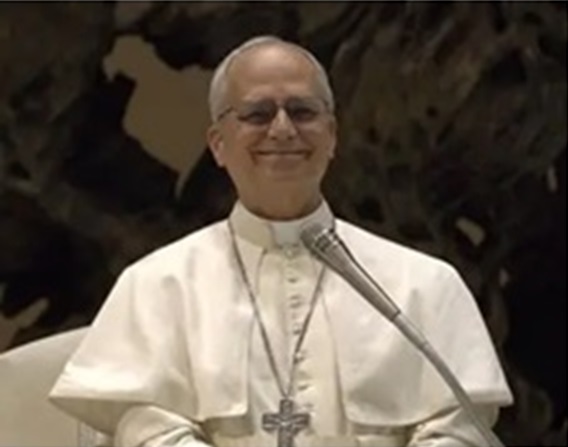
The ongoing war of words between President Trump and Pope Leo XIV is unparalleled in modern history. It’s not new for popes to speak out on political issues, historians of religion say, but Trump’s insults toward the pope are without precedent.
The direct nature of Pope Leo’s responses as well as him being the first American pope are also playing a role in how the exchange is being interpreted by the public.
The recent back and forth started with Leo’s calling for peace in response to the war in Iran, and continued with him warning of the “delusion of omnipotence” and writing that “God does not bless any conflict.”
The ongoing war of words between President Trump and Pope Leo XIV is unparalleled in modern history. It’s not new for popes to speak out on political issues, historians of religion say, but Trump’s insults toward the pope are without precedent.
The direct nature of Pope Leo’s responses as well as him being the first American pope are also playing a role in how the exchange is being interpreted by the public.
The recent back and forth started with Leo’s calling for peace in response to the war in Iran, and continued with him warning of the “delusion of omnipotence” and writing that “God does not bless any conflict.”
Vice President Vance, who is Catholic, also weighed in on the controversy on Tuesday night, saying the pope should “be careful when he talks about matters of theology.”
“What we saw … is an unprecedented, unhinged attack by the president of the United States on the pope,” said Christopher White, associate director of the Initiative on Catholic Social Thought and Public Life at Georgetown University. “It was clearly meant to intimidate the pope,” but, he added, “the pope’s response shows he is undeterred by the president’s broadside and won’t be distracted from his efforts to push for peace.”
The charged nature of the exchange is new, but many popes have been known for their political critiques. Here’s a brief overview of times when modern popes spoke out on politics, and how Pope Leo is different.
Popes have had political opinions before, but the response was diplomatic
Modern popes have never shied away from voicing political opinions, sometimes running contrary to world leaders.
“When the pope speaks, it’s not that he’s taking sides. He’s really pointing out the objective moral law,” said Michele Dillon, a professor of sociology at the University of New Hampshire whose research focuses on the Catholic Church.
But prior interactions were much more diplomatic.
In 1965, Pope Paul VI was the first pope to speak before the United Nations, urging an end to the Vietnam War and famously saying, “No more war, war never again.” Paul VI pushed President Lyndon Johnson to “increase even more your noble effort” to negotiate for peace in Vietnam in 1967. Later that year, Johnson released a cordial statement after meeting the pope, saying “I deeply appreciate the full and free manner” of the pope’s opinions.
In 1979, Pope John Paul II spoke before the United Nations, focusing on human rights and peace. He advocated an end to conflicts in the Middle East, with a “just settlement of the Palestinian question” and the “territorial integrity of Lebanon.” John Paul II visited President Jimmy Carter in the White House, where they talked about the Philippines, China, Europe, South Korea, and the Middle East, according to Carter’s notes.
John Paul II, a Polish pope, was also involved in less-public political influence. He supported Polish opposition to the Soviet Union and has been credited with helping to bring down the Berlin Wall in 1989. Later, in 2003, he spoke against the U.S. invasion of Iraq and also sent representatives to Washington and Baghdad to make appeals to avoid the war. Those appeals were ignored, but he correctly predicted decades of unrest in the Middle East, according to White.
John Paul II also voiced opinions on social issues with presidents — disagreeing with Bill Clinton on abortion and pushing George W. Bush to reject stem cell research — but neither president escalated the situation and both remained respectful.
No comments yet.
-
Archives
- October 2026 (129)
- September 2026 (339)
- August 2026 (330)
- July 2026 (355)
- June 2026 (287)
- May 2026 (306)
- April 2026 (356)
- March 2026 (251)
- February 2026 (267)
- January 2026 (308)
- December 2025 (358)
- November 2025 (359)
-
Categories
- 1
- 1 NUCLEAR ISSUES
- business and costs
- climate change
- culture and arts
- ENERGY
- environment
- health
- history
- indigenous issues
- Legal
- marketing of nuclear
- media
- opposition to nuclear
- PERSONAL STORIES
- politics
- politics international
- Religion and ethics
- safety
- secrets,lies and civil liberties
- spinbuster
- technology
- Uranium
- wastes
- weapons and war
- Women
- 2 WORLD
- ACTION
- AFRICA
- Atrocities
- AUSTRALIA
- Christina's notes
- Christina's themes
- culture and arts
- Events
- Fuk 2022
- Fuk 2023
- Fukushima 2017
- Fukushima 2018
- fukushima 2019
- Fukushima 2020
- Fukushima 2021
- general
- global warming
- Humour (God we need it)
- Nuclear
- RARE EARTHS
- Reference
- resources – print
- Resources -audiovicual
- Weekly Newsletter
- World
- World Nuclear
- YouTube
-
RSS
Entries RSS
Comments RSS


Leave a Reply