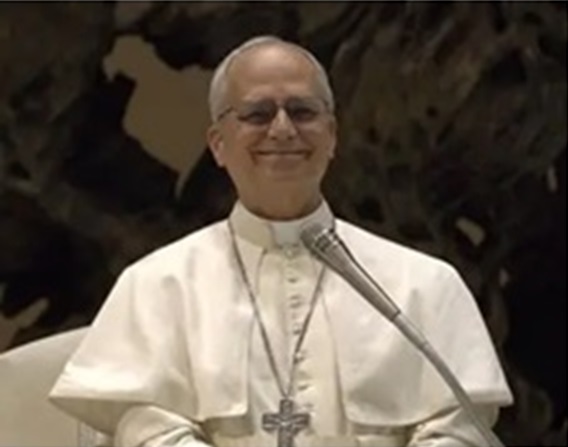
The administration of US President Donald Trump has been “spying” on Pope Leo XIV as part of a years-long intelligence campaign by Washington against the Vatican, US investigative journalist Ken Klippenstein said in a report released on 24 April.
Klippenstein – an independent, Washington-based investigative journalist who formerly wrote for The Intercept – cited sources as saying that Trump’s recent comments on the new Pope were taken by the intelligence community as “a directive to prioritize spying on the Vatican.” Trump had said earlier this month that Pope Leo was “terrible on foreign policy” and “weak on crime.”
According to Klippenstein’s sources, Washington has “for years” been spying on the Vatican.
“The CIA has human spies working inside the Holy See bureaucracy. The NSA and CIA seek to intercept telecommunications, emails, and texts. The FBI investigates crimes committed against and by the Vatican. The State Department closely follows the ins and outs of Papal diplomacy and politics. All of these agencies liaise with the Vatican’s own foreign policy, intelligence, and law enforcement agencies,” the report stated.
Klippenstein pointed to a “longstanding – and quietly extensive – relationship between the US national security apparatus and the Vatican” involving diplomatic, law enforcement, and cybersecurity cooperation.
Much of it is “genuine” but also serves as a “convenient cover for collecting intelligence.”
“The first Trump administration sought to beef up its coordination with Italian intelligence agencies and Vatican officials on things like cybersecurity, white collar crime, human trafficking, art theft, and other issues. One particular project was to help the Vatican actively thwart cyber intrusions into its networks. The FBI also regularly provides threat intelligence to the Pope during his travels,” Klippenstein cited FBI documents as saying.
“The State Department, meanwhile, maintains a daily Vatican-centric news digest circulated to diplomats worldwide … The department’s Bureau of Intelligence and Research has analysts dedicated to producing classified assessments on Vatican affairs,” he added, referring to other documents he obtained.
“Even the US military has a Vatican-specific language code on its books as a distinct linguistic capability. ‘QLE’ designates Ecclesiastical Latin – the Vatican’s preferred liturgical register – as distinct from classical Latin.”
The report follows recent tensions between Trump and the Holy See.
“Pope Leo is WEAK on Crime, and terrible for Foreign Policy. I don’t want a Pope who thinks it’s OK for Iran to have a Nuclear weapon. I don’t want a Pope who thinks it’s terrible that America attacked Venezuela, a Country that was sending massive amounts of Drugs into the US … And I don’t want a Pope who criticizes the President of the US,” Trump said earlier this month.
Prior to that, the pope had condemned what he called the “delusion of omnipotence,” fueling the US-Israeli war against Iran.
“Enough of the idolatry of self and money! Enough of the display of power! Enough of war!” he said.
The pope also recently said that a “handful of tyrants” were ruling the world, before later clarifying that his comments were not meant as a jab at Trump and were written before the US president criticized him.
Additionally, the papacy referred to Trump’s threat to wipe out the Iranian civilization as unacceptable.
Pope Leo’s remarks came weeks after dozens of US lawmakers demanded a probe due to hundreds of complaints from service members saying that military commanders portrayed the war on Iran as “divinely ordained” and linked to biblical prophecy, including claims that Trump had been “anointed by Jesus.”
Well over 2,000 people have been killed by the US-Israeli war on Iran, and the country’s infrastructure has been ravaged.
Only about one-third of the infrastructure destroyed in Iran’s capital during the US-Israeli war was military-linked, Bloomberg revealed on 21 April in an analysis of the damage caused by Washington and Tel Aviv.
One day before the U.S.-Iran ceasefire went into effect on April 8, a 68-year-old synagogue in the Iranian capital was damaged in airstrikes for which the Israeli military claimed responsibility. The Israeli military said it was trying to target a military commander living nearby and regretted the destruction, which it referred to as “collateral damage.”
“If we believe that destroying a synagogue in Israel would be treated as an outrage against civilization, then a synagogue in Tehran must not be treated as a regrettable footnote.
Already marginalized, Iran’s religious minority communities are overlooked victims of the US-Israeli war on Iran.
Iranians of all stripes have been affected by the U.S.-Israeli war on their country, and the civilian cost of the conflict has yet to be fully understood. The United Nations Development Programme has raised the alarm about the “development in reverse” pushing more than 32 million people back into poverty globally, and economists have warned that 10 to 12 million Iranians, representing nearly half of the country’s workforce, are now on the brink of unemployment.
But the effect of the U.S.-Israeli aggression on Iran’s religious minorities has received comparatively little attention. Beset by years of neglect and underrepresentation at home, faith groups are now coming to grips with the cruelty of war and the devastation it has inflicted on their vulnerable institutions and houses of worship.
In Tehran, U.S.-Israeli airstrikes damaged two major churches, St. Nicholas Orthodox Church and the Greek Orthodox Church of Saint Mary, drawing condemnation from Tehran’s Christian communities. Although there have not been many updates on the status of the Church of Saint Mary, St. Nicholas Church, which is a major Russian cultural site in Iran, was reportedly closed on Easter due to the extent of the damages.
One day before the U.S.-Iran ceasefire went into effect on April 8, a 68-year-old synagogue in the Iranian capital was damaged in airstrikes for which the Israeli military claimed responsibility. The Israeli military said it was trying to target a military commander living nearby and regretted the destruction, which it referred to as “collateral damage.”
The attack put further strain on Iranian Jews as they navigate the challenges of a war waged by the United States and Israel under the pretenses of bringing liberation to the country. Iranian Jewish politicians and community leaders have been vocal in criticizing the attacks targeting houses of worship and civilian sites.
“Our holy books were buried under the rubble, burnt, and torn, and all of this is an indication of the indifference of the Zionist regime to Judaism as a religion and the instructions of Prophet Moses,” said Homayoun Sameh, a Jewish member of parliament as he talked to reporters in Tehran. Truthout reached out to his office for comment but didn’t hear back.
Lior Sternfeld, a scholar of Jewish studies and history at Pennsylvania State University, told Truthout that Israel has long demonstrated disregard for Jewish life and heritage in the Middle East outside of Israel, a pattern which is now stretching to Iran.
“There are credible reports on Israeli involvement in several attacks on Jewish establishments in Iraq in the early 1950s to speed up the process of Jews registering for departure,” Sternfeld told Truthout. “A couple of years later, Israeli agencies knowingly operated a small network of poorly trained Jewish spies, in what came to be known as Operation Susannah,” with the intent of attacking civilian targets in Egypt and falsely blaming the attacks on local forces.
“In 1982, the IDF [Israel Defense Forces] shelled the Maghen Abraham Synagogue in Beirut, claiming there were PLO [Palestine Liberation Organization] militants it was targeting nearby,” he added, noting that the recent synagogue strike in Tehran appears as an extension of this history.
Beyond religious and cultural sites, residential areas populated by Iran’s ethnic minorities were also attacked. On March 10, the historic Majidieh neighborhood in eastern Tehran, a major hub for Iran’s Armenian community in the capital, was bombed by the United States and Israel, destroying multiple buildings, including a locally run kindergarten………………………………………………………………………………………………………………………………………………………………………………………………………………………………………………………..
the fact that the bombings targeting an array of different religious and ethnic groups and their cultural sites have drawn little attention internationally points to continued flaws in the media framing of the war. Crackdowns on the press are not limited to authoritarian regimes. In democracies also, reporters are being pressured to toe the government line on key political fault lines.
In March, Federal Communications Commission Chair Brendan Carr issued a rare threat to major networks and their local affiliates, warning them to “correct course” on their coverage of the war in Iran before their license renewals are due. On multiple occasions, Defense Secretary Pete Hegseth has assailed the media for their reporting on the conflict, demanding a more “patriotic” coverage.
In the meantime, stereotypes still dominate the corporate media portrayals of Iran, even in the middle of a war of aggression on the country. Hawkish commentators making the case for sanctions and military action are frequently called to appear on primetime shows, and there is no active debate on the enormous civilian toll of the war on millions of Iranians, including marginalized groups.
“If we believe that destroying a synagogue in Israel would be treated as an outrage against civilization, then a synagogue in Tehran must not be treated as a regrettable footnote. Sacred loss does not become less sacred because the world responds selectively to some victims and not others,” said Dabbagh.
Other observers have argued that undermining Iran’s religious and cultural diversity is a key U.S. and Israeli goal in the war, exemplified by a range of airstrikes targeting UNESCO-registered world heritage sites, alarming rhetoric about the erasure of Iranian civilization coming from Trump and other officials, and dehumanizing propaganda about the Iranian people.
“For both the Israelis and Americans, the presence of Iranian Jews or Palestinian Christians and Lebanese Christians is a huge problem,” said Omid Safi, a professor of Asian and Middle Eastern Studies at Duke University. “When they come to terms with the fact that in Iran itself there is a Jewish community that is more than 2,000 years old, then all of a sudden they have to come to terms with the pluralism and inherent diversity of Iranian society.”
“The targeting of the synagogue and some churches by the Israelis and Americans with no apologies or acknowledgement follows in the footsteps of what we’ve already seen with the targeting of dialysis treatment centers, the girls’ school in Minab, 31 universities, and multiple hospitals,” he added, arguing that the bombing campaign has shown Iranian human rights are not being respected by the perpetrators………………………………………………………………………………………………
In Iran’s sanctions-hit economy where even international organizations are hamstrung in delivering humanitarian assistance and development aid, a sweeping conflict like the U.S.-Israeli military campaign can produce irreversible harms, especially affecting the less protected religious and ethnic minority groups.
In some cases, Iranians haven’t yet completed the reconstruction efforts that followed the eight-year Iran-Iraq War of 1980, when the former Iraqi dictator Saddam Hussein was encouraged by a coalition of world powers to invade Iran and stymie the newly born revolution. According to official data, 90 Iranian Christians, 11 Iranian Jews, and 32 Iranian Zoroastrians were killed in that war.
President Trump has a bizarre way of demonstrating his claim of being the Peace President deserving the Nobel Peace Prize
He spent his first term raining down tens of thousands of bombs on 7 countries posing not a whit of danger to the Homeland. He assassinated a top Iranian general in Baghdad, a monstrous war crime. He withdrew from Obama’s Iran nuclear deal (JCPOA) which silenced Iran’s nuclear bomb potential and should have ended the isolation of Iran. Instead, it set the table for Trump’s senseless, now failed war on Iran 8 years later that may crash the world economy if not ended soon. That is madness.
Trump’s obsession with murder and mayhem worldwide has collateral damage to every sensible domestic function of government. Trump has spent 10 years trying to demolish Obama’s Affordable Care Act, a relatively meager improvement to America’s failed health insurance system to the less fortunate. He hasn’t spent dollar one to fix it. He’s ignored our crumbling infrastructure. He’s invested zilch in green energy while the world overheats relentlessly.
But Trump sure has invested in war. His last term one National Defense Authorization Act (NDAA) budget in 2021 was a massive $740 billion. His first in term two for 2026 crashed the trillion mark by $42 billion. But mimicking Al Jolson in ‘The Jazz Singer’, Trump proclaimed ‘You ain’t seen nothing yet.’ His 2027 NDAA sours to $1,500,000,000, a 44% increase. Combined with massive tax cuts for the billionaire class, Trump’s profligate military spending has goosed the national debt by $10 billion in his first 6 years.
While silent about spending on the Commons to improve life for all Americans, Trump is ecstatic about his trillion and a half bucks for endless wars. “We’re fighting wars. We can’t take care of day care. “It’s not possible for us to take care of day care, Medicaid, Medicare — all these individual things They can do it on a state basis. You can’t do it on a federal.”
To paraphrase first predecessor Obama, ‘Yes you can…yes you must.’
On April 7, 1967, exactly one year before he was gunned down, Rev. Martin Luther King courageously spoke out against the Vietnam War at New York’s Riverside Church, ahead of a massive antiwar rally. In ‘A Time To Break the Silence’, King decried, “A nation that continues year after year to spend more money on military defense than on programs of social uplift is approaching spiritual death.”
Under Donald Trump’s endless, senseless wars…America’s spiritual death is here.
The conflict between the British, European and American empires and the Ottoman empire was central to the causes and course of World War One, if often forgotten in the West. Two lingering effects of this contention are widely known: the Balfour Declaration, which made a dishonest promise of states for Israel and Palestine, and the Sykes-Picot Agreement, which parcelled out the ‘Middle East’ between the British and the French to defeat Arab nationalism.
But less known is that this conflict did not end in 1918, nor by the Peace of Versailles. In the years 1919 to 1923, the British Empire punched on to secure what was denied Churchill at Gallipoli. They fought to expand their empire while “a general crisis of European control was well under way across much of Asia” (Darwin, After Tamerlane, p. 382). The extended “small wars” of World War One continued to the Treaty of Lausanne in 1923. This “remarkable compromise” recognised Türkiye as an independent republic, defined the political geography of West Asia that is still with us, before oil was what mattered in the Middle East (the region produced 1 per cent of world output in 1920, and 5 per cent in 1939, principally from Iran)
Apr 25, 2026, Burning Archive, Jeff Rich,
Sooner or later, histories of colonisation, and decolonisation, must deal with the question of violence. So much depends, in history, on how the experience of violence is ordered collectively as war, empire, memory and resistance.
“Decolonisation is always a violent phenomenon,” declared Frantz Fanon. It may be right, from the beginning. As described in the climax of this month’s Book Club history, Magellan met a violent death at the hands of the resistance in the Philippines . . . and in revenge for his own unhinged violence and holy man madness.
But, on the other hand, Gandhi preached and practised non-violence, although there were fierce debates across the Indian independence movement about the question of when is violent rebellion justified. Still, more than any single individual, Gandhi has inspired people to believe that empires can be dismantled by peaceful means.
Violence and the “small wars” or “anticolonial uprisings” of the colonial frontier will be my theme for the next two weeks in this extended Season on Decolonisation.
I am spacing my reflections out over two weeks. Why? Three reasons.
Firstly, violence is challenging to write about in this time of war and unrestrained violence in many places. I am opening up a difficult conversation here, with no intent to close it after just one week.
Secondly, there is an important history book on imperial violence that I wanted to share, but it may best be done over a couple of weeks, including through sharing this week an interview with the author, conducted by Jeffrey Sachs.
Thirdly, I did two big interviews on these themes this week—with Jamarl Thomas and Pascal Lottaz— and wanted to share my reflections, beyond the recorded talk, on these topics of violence, our world crisis as a process of likely violent decolonisation, and lessons from history about how the USA empire is disintegrating.
Coincidentally, the Anzac Day memorial prefigures all three themes.
Anzac Day and the Forgotten Treaty of Lausanne
Moreover, a coincident anniversary—25 April, Anzac Day in Australia—made me think of some eerie similarity. This central day in Australian war memorial practice marks the defeat of British imperial forces, including over 8,000 Australian deaths, at Gallipoli in 1915. Churchill ordered the amphibious assault to secure control of the Dardanelles and Turkish Straits, and knock the Ottoman Empire, which controlled what Westerners think of now as the Middle East, out of the First World War. The grandiose, reckless plan failed; perhaps like the USA’s assault on the Hormuz Strait.
The conflict between the British, European and American empires and the Ottoman empire was central to the causes and course of World War One, if often forgotten in the West. Two lingering effects of this contention are widely known: the Balfour Declaration, which made a dishonest promise of states for Israel and Palestine, and the Sykes-Picot Agreement, which parcelled out the ‘Middle East’ between the British and the French to defeat Arab nationalism.
But less known is that this conflict did not end in 1918, nor by the Peace of Versailles. In the years 1919 to 1923, the British Empire punched on to secure what was denied Churchill at Gallipoli. They fought to expand their empire while “a general crisis of European control was well under way across much of Asia” (Darwin, After Tamerlane, p. 382). The extended “small wars” of World War One continued to the Treaty of Lausanne in 1923. This “remarkable compromise” recognised Türkiye as an independent republic, defined the political geography of West Asia that is still with us, before oil was what mattered in the Middle East (the region produced 1 per cent of world output in 1920, and 5 per cent in 1939, principally from Iran). It demilitarised the Straits, which became the foundation of the 1936 Montreux Convention, which some commentators have proposed as a model to resolve the disputes over the Hormuz Strait (as I discussed in my interview with Pascal Lottaz). It set the course for the modern history of Türkiye, and new forms of imperial colonialism in Egypt, the Levant, Iraq and Iran.
This forgotten, crucial treaty came to mind this week because of those connections with the small forgotten wars of colonialism, the resolution of our contemporary wars in West Asia, and a paradox that is often overlooked when commentators make cartoon comparisons of British and US American hegemony. 1923 was the high noon of British empire, when it controlled more territory than at any other time. The British made their empire great again by making the Middle East, but before the oil wells provided much return on investment. It was a paradoxical success, an imperial Pyrrhic victory. As John Darwin wrote,
Once the brief excitement of war imperialism had passed, there was little enthusiasm for an Arab empire in either Britain or France – especially one that was going to cost money. If the Middle East’s partition was the high tide of empire, it was the tide that turned soonest, the imperial moment that was shortest.
Darwin, After Tamerlane, p. 387
It was for this reason that, in my interview with Jamarl Thomas, I compared the USA’s current dark time of brutalist expansionism to this brief high tide of the British Empire.
Violence, Empire and Decolonisation
“Decolonisation is always a violent phenomenon,” declared Frantz Fanon in The Wretched of the Earth after years of the Algerian War of Independence. He did not live to see an alternative, but his tract still inspires believers in armed resistance to settler colonialism worldwide.
But was Fanon’s decree a rationalisation of bitter revenge? Was it a militant’s rallying cry for others to sacrifice their lives for a national cause? Was it another poet-psychiatrist’s elaborate projection of shadows, not more defensible than the ethnic cleansing of Radovan Karadzic? Did Fanon succumb to mimicry of imperial Manichean violence, as Nietzsche warned?
“Whoever fights monsters should see to it that in the process he does not become a monster. And if you gaze long enough into an abyss, the abyss will gaze back into you.”
Nothing about this dystopia feels natural. We all sense it deep in our marrow. We all know something has gone terribly wrong.
If you lived in an alternate reality without wars or poverty, where everyone had enough and governments did what’s in the interests of the people and the ecosystem, it would never occur to you that there was anything odd about it. It would feel completely normal. Things would be more or less how you’d expect them to be.
You can’t say the same about the present status quo. The whole thing instinctively scans as weird and counterintuitive. The more you learn about the way the world works, the more insane it all looks to you.
Have you ever had to explain war to a young child? It’s terrible. If you’re actually honest with them about what war is and why it is waged, it completely shatters their understanding of the world. They look at you like they’ve suddenly been transported into a strange alien universe where everything is backward.
Their reaction is correct. That is the sane and normal way to look at war. All the freakish mental contortions we do to try and normalize it is what’s crazy.
Everything about this dystopia is like this. If you could see it all with fresh eyes, you would scream in horror. The only reason anyone finds any of this tolerable is because we have become desensitized and accustomed to the madness.
Seeing somebody sleeping on the sidewalk should feel like a punch in the stomach. Seeing children killed by bombs on your social media feed should stop your whole world.
The fact that there are plutocrats profiting from war and militarism.
The fact that billionaire corporations are integrating surveillance technology into every facet of our society.
The fact that we’re destroying our biosphere and driving families into poverty to maximize shareholder value.
The fact that oligarchy has turned democracy into a sham where our votes don’t make any real difference.
The fact that there are people in the global south who are living like slaves so that those of us in the imperial core can have cheap bread and circuses to keep us docile and distracted.
We all know deep down inside that these are intolerable abuses, but they’ve been so normalized and compartmentalized in our psychology that it all just fades into this kind of eerie dissonance in the background of our attention.
The more conscious you become of what’s going on in the world, the more that dissonance moves into the foreground, and the less tolerable this dystopia becomes for you. As Terence McKenna said, “The cost of sanity in this society is a certain level of alienation.”
And that’s a good thing. Injustice and abuse should not feel tolerable. We should allow our discomfort with this intolerable situation to drive us to action and resistance.
And as uncomfortable as it can feel to stare into the unmasked face of the empire in all its beastly fury, this clarity also brings with it a degree of relief, because when it comes online you finally understand why nothing has ever felt right about this civilization you were born into. You understand that your intuitive discomfort and revulsion you felt as a child at the madness you were being indoctrinated into accepting was one hundred percent accurate, and that everyone who taught you to accept the unacceptable was wrong.
Trust that childhood intuition. You’ve always had the truth inside you. Let it guide you as you read and inform yourself to help your mind catch up with what you already know in your heart. Let your heart inform your mind, let your mind inform your actions, and let your actions help awaken humanity to the truth we’ve been hiding from ourselves all these years.
During the two years I spent writing “American Fascists: The Christian Right and the War on America,” I encountered numerous mini-Trumps. These self-proclaimed pastors — very few had any formal religious training — preyed on the despair of their congregants. They were surrounded by sycophants and could not be questioned. They merged fact with fiction, peddled magical thinking and enriched themselves at the expense of their followers. They claimed their wealth and ostentatious lifestyle, including mansions and private jets, was a sign of being blessed. They insisted they were divinely inspired and anointed by God. They were, within their hermetic circles of their megachurches, omnipotent.
These cult pastors promised to use their omnipotence to crush the demonic forces that had created misery in the lives of their followers — unemployment and underemployment, evictions, bankruptcies, poverty, addiction, sexual and domestic abuse, and crippling despair. The more power the cult leaders possess — according to their followers — the more certain is a promised paradise. Cult leaders stand above the law. Those who desperately place their faith in them want them to be above the law.
Cult leaders are narcissists. They demand obsequious adulation and total obedience. Health and Human Services Secretary Robert F. Kennedy Jr.’s claim that Donald Trump is able to draw a “perfect map” of the Middle East, or White House Press Secretary Karoline Leavitt’s statement that Trump is always the “most well-read person in the room,” are two of innumerable examples of the abject fawning required by those in a cult leader’s inner circle. Blind loyalty matters more than competence.
Cult leaders are immune from rational and fact-based critiques amongst those who invest hope in them. This is why Trump’s hardcore followers have not abandoned him and will not abandon him. All the chatter about fissures in the MAGA universe misreads Trump cultists.
All cults are personality cults. They are extensions of the prejudices, worldview, personal style and ideas of the cult leader. Trump, with his faux “Trump crest,” revels in Louis XVI-inspired tasteless kitsch awash in gold Rococo and glittering chandeliers. The women in Trump’s court have “Mar-a-Lago Faces” – overinflated lips, taut, wrinkle-free skin, silicone gel-filled breast implants and chiseled cheekbones, capped off by gobs of make-up. They wear stiletto heels and garish outfits that Trump finds appealing. Trump’s men, who in his eyes must be telegenic and from “Central casting,” dress like 1950s advertising executives. They sport Trump-gifted Florsheim black shoes, specifically $145 Lexington Cap Toe Oxfords.
Cults impose dress codes that mirror the style and taste of the cult leader.
The followers of the Indian guru Bhagwan Shree Rajneesh, also known as Osho, dressed in red and orange robes, often combined with a turtleneck and beads. Heaven’s Gate members wore Nike Decade trainers and black jogging bottoms. Men in the Unification Church, known as Moonies, wore crisp white shirts and pressed slacks. Women wore dresses. They looked as if they were on their way to Sunday School.
Like Jim Jones, who convinced or forced over 900 of his followers — including 304 children aged 17 and younger — to die by ingesting a cyanide-laced drink, Trump is aggressively courting our collective suicide.
Trump dismisses the climate crisis as a hoax. He unilaterally withdraws from nuclear arms agreements and treaties. He antagonizes nuclear powers, such as Russia and China. He impetuously launches wars. He alienates and insults U.S. allies. He dreams of annexing Greenland and Cuba. He embraces holy crusade against Muslims. He attacks his political opponents as enemies and traitors, belittling them with crude insults. He slashes social programs designed to sustain the vulnerable. He expands an internal security apparatus — masked Immigration and Customs Enforcement (ICE) goons — to terrorize the public. Cults do not nurture and protect. They subjugate, annihilate and destroy.
Trump employs the U.S. military without oversight or constraint. He presides, for this reason, over what the psychiatrist Robert Jay Lifton called a “world-destroying cult.” Lifton lists eight characteristics of “world-destroying cults” that implant what he calls “totalistic environments.”
These eight characteristics are:
1. Milieu control. The total control of communication within the group.
2. Loading the language. Using “groupspeak” to censor, edit and shut down criticism or opposing ideas. Followers must mouth the mindless Trump-approved clichés and cult jargon.
3. Demand for purity. An us-versus-them view of the world. Those who oppose the group are wrong, unenlightened and evil. They are irredeemable. They are contaminants. They must be eradicated. Any action is justified to protect this purity. The goal of all cult leaders is to widen and make irreconcilable social divisions.
4. Confession: The public confession of past wrongs. In the case of Trump supporters, this includes the disavowal, as U.S. Vice President JD Vance and others have done, of past criticism of Trump, with public admission of their former wrong-thinking.
5. Mystical manipulation. The belief that those in the group are specially chosen with a higher purpose. Those in Trump’s orbit act as though they are divinely elected. They convince themselves that they are not coerced to embrace Trump’s lies and vulgarities — or repeat cult jargon — but do so voluntarily.
6. Doctrine over person. The rewriting and fabrication of personal history to conform to Trump’s interpretation of reality.
7. Sacred Science. Trump’s absurdities — global temperatures are declining rather than rising, the noise from wind turbines cause cancer and ingesting disinfectants such as Lysol is an effective treatment for the coronavirus — are presented as grounded in science. This scientific patina means Trump’s ideas apply to everyone. Those who disagree are unscientific.
8. Dispensing of existence. Nonmembers are “lesser or unworthy beings.” Meaningful existence means being part of the Trump cult. Those outside the cult are worthless. They do not deserve moral consideration.
Trump is no different from past cult leaders, including Marshall Herff Applewhite and Bonnie Lu Nettles — the founders of the Heaven’s Gate cult — the Rev. Sun Myung Moon — who led the Unification Church — Credonia Mwerinde — who led the Movement for the Restoration of the Ten Commandments of God in Uganda — Li Hongzhi — the founder of Falun Gong, and David Koresh, who led the Branch Davidian cult in Waco, Texas.
Cult leaders are deeply insecure, which is why they lash out with fury at the slightest criticism. They mask this insecurity with cruelty, hypermasculinity and bombastic grandiosity. They are paranoid, amoral, emotionally crippled and physically abusive. Those around them, including children, are objects to be manipulated for their enrichment, enjoyment and often sadistic entertainment.
Cults are characterized by pedophilia and sexual abuse. Those, including Trump, who were frequently in the orbit of pedophile Jeffrey Epstein, replicated the abuse endemic in cults.
“People’s Temple children were frequently sexually abused,” writes Margaret Singer in “Cults In Our Midst: The Continuing Fight Against Their Hidden Menace.” “While the group was still in California, teenage girls as young as fifteen had to provide sex for influential people courted by Jones. A supervisor of children at Jonestown had a history of child sexual abuse, and Jones himself assaulted some of the children. If husbands and wives were caught talking privately during a meeting, their daughters were forced to masturbate publicly or to have sex with someone the family didn’t like before the entire Jonestown population, children as well as adults.”
Cults, Singer writes, are “a mirror of what is inside the cult leader.”
“He has no restraints on him,” she writes of the cult leader:
He can make his fantasies and desires come alive in the world he creates around him. He can lead people to do his bidding. He can make the surrounding world really his world. What most cult leaders achieve is akin to the fantasies of a child at play, creating a world with toys and utensils. In that play world, the child feels omnipotent and creates a realm of his own for a few minutes or a few hours. He moves the toy dolls about. They do his bidding. They speak his words back to him. He punishes them any way he wants. He is all-powerful and makes his fantasy come alive. When I see the sand tables and the collections of toys some child therapists have in their offices, I think that a cult leader must look about and place people in his created world much as the child creates on the sand table a world that reflects his or her desires and fantasies. The difference is that the cult leader has actual humans doing his bidding as he makes a world around him that springs from inside his own head.
The language of the cult leader is rooted in verbal confusion. Lies, conspiracy theories, outlandish ideas and contradictory statements, often made in the same statement or only minutes apart, paralyzing those attempting to read the cult leader rationally. Absurdism is the point. The cult leader does not take his or her statements seriously. They often deny ever making them, although they are documented. Lies and truth are irrelevant. The cult leader is not seeking to impart information or truth. The cult leader is seeking to appeal to the emotional needs of cult members.
“Hitler kept his enemies in a state of constant confusion and diplomatic upheaval,” Joost A.M. Meerloo wrote in “The Rape of the Mind: The Psychology of Thought Control and Menticide.” “They never knew what this unpredictable madman was going to do next. Hitler was never logical, because he knew that that was what he was expected to be. Logic can be met with logic, while illogic cannot – it confuses those who think straight. The Big Lie and monotonously repeated nonsense have more emotional appeal in a cold war than logic and reason. While the enemy is still searching for a reasonable counterargument to the first lie, the totalitarians can assault him with another.”
It does not matter how many lies uttered by Trump are meticulously documented. It does not matter that Trump has used the presidency to enrich himself by an estimated $1.4 billion over the last year, according to Forbes. It does not matter that he is inept, lazy and ignorant. It does not matter that he stumbles from one disaster to the next, from tariffs, to the war on Iran.
The traditional establishment, whose credibility has been destroyed because of its betrayal of the working class and subservience to the billionaire class and corporations, has little power over Trump’s supporters. Their vitriol only increases his popularity. Political cults are the bastard children of a failed liberalism. Trump’s approval rating may be at around 40 percent, as of April 20 — according to an average of multiple polls collated by The New York Times — but his base remains unmovable.
The Democratic Party, rather than pivot to address the social inequality and abandonment of the working class — which it helped orchestrate — has hit upon tax cuts as a road to regaining power. It will, once again, reduce our social, economic and political crisis to the personality of Trump. It will offer no reforms to rectify our failed democracy. This is a gift to Trump and his followers. By refusing to acknowledge responsibility for inequality and proposing programs to ameliorate the suffering it has caused, Democrats engage in the same kind of magical thinking as Trump cultists.
There is no way out of this political dysfunction unless popular movements rise to cripple the machinery of government and commerce on behalf of a betrayed public. But time is running out. Trump and his goons are serious about invaliding or cancelling the midterm elections if they perceive defeat. If that happens, the cult of Trump will be unassailable.
Many people are saying that Donald Trump is insane. He may be. So too Benjamin Netanyahu. But if so, it is a form of insanity that includes the calm sanity of Adolf Eichmann and Harry Truman as they went about their business of mass extermination.
Crazy, to use the vernacular, is an elusive word nearly impossible to define, especially when an entire society can be crazy, as Erich Fromm, the German-American social-psychologist, has argued. Obedience is a much touted virtue, not only in overt police regimes but in so-called democracies – but obedience to whom? To mass murderers?
Obedience can be imbibed through osmosis. I remember Regis, my Jesuit high school’s motto – Deo et Patriae, for God and country – and how it linked obedience to God with obedience to the United States. I am certain that such a linkage would be denied by school authorities, but of course the Jesuits are known for their guile. So it didn’t surprise me when I was applying for a discharge from the Marines during the Vietnam War and was being questioned by a group of Marine Officers and one starting screaming at me: “What the hell kind of God are you talking about? I’m a Catholic, too, and my God supports the Marines and the war in Vietnam.” It was hard not to laugh sardonically, especially as he gesticulated with his large cigar for emphasis. I was then sent to a psychiatrist for evaluation who told me, to my great surprise, that he agreed with me and that the country’s leaders were insane.
Adolf Eichmann was declared “perfectly sane” by a psychiatrist who examined him when he went on trial for his routine daily tasks of carrying out Hitler’s orders to exterminate Jews. It was just another day at the office for Eichmann.
Harry Truman was not examined after he ordered the dropping of atomic bombs on Hiroshima and Nagasaki; he was assumed to be sane in committing these satanic crimes of mass murder. Just another state executive doing his duty by carrying out the orders of his puppet masters.
Those were the good old days when everyone knew who was sane and who was nuts. Now we seem very confused. Perhaps Vietnam, Iraq, Afghanistan, Libya, Syria, Gaza, Ukraine, Iran, etc. have discombobulated many minds about who is sane or not, who is a mass murderer, who evil and who good, depending on which functionary is in the White House. Perhaps not.
If Trump is insane, how did he twice become the president of the United States? Do “sane” people – the well-adjusted ones? – not realize that Trump is the nominal head of an immense system whose history is one of mass murder from Wounded Knee to the recent U.S. slaughter of hundreds, mostly young girls, at the elementary school in Minab, Iran.
Trump gave the orders, but he did not launch those missiles. Nor did Netanyahu massacre Palestinians with his own hands. These fat boy killers prefer to keep their dainty hands clean of blood – to have their functionaries do the killing. I think of other functionaries and the names they gave to the atomic bombs they dropped on Japan: “Fat Man” and “Little Boy.” And we talk about sanity.
The “sane” obedient ones do the killing; the soldiers who carry out orders. As the Trappist monk Thomas Merton wrote in his profound book of essays, Raids on the Unspeakable, in 1966:
It is the sane ones, the well-adapted ones, who can without qualms and without nausea aim the missiles and press the buttons that will initiate the great festival of destruction that they, the sane ones, have prepared. What makes us so sure, after all, that the danger comes from a psychotic getting into position to fire the first shot in a nuclear war? Psychotics will be suspect. No one suspects the sane, and the sane ones will have perfectly good reasons, logical, well-adjusted reasons, for firing the shot. They will be obeying sane orders that have come sanely down the chain of command. And because of their sanity they will have no qualms at all. When the missiles take off, then, it will be no mistake. We can no longer assume that because a man is “sane” he is therefore in his “right mind.” The whole concept of sanity in a society where spiritual values have lost their meaning is itself meaningless.
Our problem, as the historian Howard Zinn once said, is civil obedience, surely not civil disobedience, that people everywhere are so submissive to authority that they will dutifully obey the orders of people like Trump and Netanyahu. Such obedience, all false rhetoric to the contrary, is drilled into us from birth through overt and covert methods of fear inculcation.
My dear departed mother’s father was a New York City cop. When she was young, he made her and her mother, trembling with fear, sit at the kitchen table, upon which he put his revolver, and warned them to obey him or else. Such tyrannical behavior was slightly mitigated decades later when he and my grandmother lived with us. When he heard that any of us eight kids were misbehaving, he, old, feeble, and long retired, would don his police uniform and stomp down the stairs waving his long baton to frighten us. I never got to ask my mother why she tolerated this. Such is the long life of fear.
There are reports that by April’s end the U.S. will have 60,000 troops in Iran’s vicinity. If Trump gives the orders to invade Iran, how many will refuse? How many will refuse to send missiles into more Iranian schools and homes? If Trump gives orders for a nuclear strike, can we expect military individuals with consciences to disobey? Will any heed Pope Leo’s voice about this war? That it is immoral.
It takes a system to wage war, and civil and military obedience to support it. That system – what former CIA analyst Ray McGovern has adroitly named MICIMATT: The Military-Industrial-Congressional-Intelligence-Media-Academia-Think-Tank system – is so deeply woven into American society and therefore the hearts and minds of its citizens and military personnel that one can only hope against hope that Trump’s orders will be disobeyed by many. It is a desperate hope, I realize.
War Is A Racket, as Marine Major General Smedley Butler once put it. It is waged for the tyrannical oligarchs and always kills mostly civilians. Over ninety percent now, probably more. Innocent people, little girls at school, babies in their mothers arms – it is organized state terror. War is immoral. It is not complex. It is simple. Like the gospel message the Pope is conveying.
Like all tyrants, Trump is surrounded by sycophants, fearful little people like Karoline Leavitt, JD Vance, Marco Rubio, Peter Hegseth, Robert Kennedy, Jr., et al. The whole crew groveling at his feet are implicated in his war crimes. To hear Kennedy defend Trump’s war on Iran, his Ukraine and other policies, by claiming his father, Senator Robert Kennedy, and his uncle, President Kennedy, would agree with Trump is to pass through the looking glass. Kennedy, also a staunch defender of Israel and its savage policies, makes me shake my head in wonder. Was his political conversion, like St. Paul’s, from a light from heaven that sent him to the ground where Trump’s divine voice asked him to hop on the MAGA train? Or was the voice more insidious and subtle, a quiet call from someone else late in the night? However it happened, it is complete, and he is now fully marching to the drums of war along with Trump’s ass-kissing entourage. I, once Bobby Kennedy, Jr.’s ardent supporter when he announced his run for the presidency, feel like a fool.
Let me recommend an important film – Terence Malik’s A Hidden Life – about a different type of man, Franz Jägerstätter, an Austrian peasant farmer from an isolated small mountainous village who refuses to take an oath to Hitler and fight in the German army. He knew that his refusal would not stop Hitler; but he also knew his conscience came from God and not the state. So he said no. NO! I will not follow orders, despite everyone telling him to do so. For his refusal, he suffered terribly and was beheaded. In my review of this film which I wrote six years ago as Joseph Biden was three weeks into his presidency, I said:
While Franz is eventually put on trial by the German government, it is we as viewers who must judge ourselves and ask how guilty or innocent are we for supporting or resisting the immoral killing machine of our own country now. Hitler and his Nazis were then, but we are faced with what Martin Luther King called ‘the fierce urgency of now.’
Many Americans surely ask with Franz, ‘What has happened to the country that we love?’ But how many look in the mirror and ask, “Am I a guilty bystander or an active supporter of the United States’ immoral and illegal wars all around the world that have been going on for so many years under presidents of both parties and have no end? Do I support the new cold war with its push for nuclear war with its first strike policy? Do I support, by my silence, a nuclear holocaust?’
The questions still linger. Let first Thomas Merton and then the twenty-two years-old Bob Dylan have the last words:
“For since man has decided to occupy the place of God he has shown himself to be by far the blindest, and cruelest, and pettiest and most ridiculous of all the false gods. We can call ourselves innocent only if we refuse to forget this, and if we also do everything we can to make others realize it.“
The ongoing war of words between President Trump and Pope Leo XIV is unparalleled in modern history. It’s not new for popes to speak out on political issues, historians of religion say, but Trump’s insults toward the pope are without precedent.
The direct nature of Pope Leo’s responses as well as him being the first American pope are also playing a role in how the exchange is being interpreted by the public.
The ongoing war of words between President Trump and Pope Leo XIV is unparalleled in modern history. It’s not new for popes to speak out on political issues, historians of religion say, but Trump’s insults toward the pope are without precedent.
The direct nature of Pope Leo’s responses as well as him being the first American pope are also playing a role in how the exchange is being interpreted by the public.
Vice President Vance, who is Catholic, also weighed in on the controversy on Tuesday night, saying the pope should “be careful when he talks about matters of theology.”
“What we saw … is an unprecedented, unhinged attack by the president of the United States on the pope,” said Christopher White, associate director of the Initiative on Catholic Social Thought and Public Life at Georgetown University. “It was clearly meant to intimidate the pope,” but, he added, “the pope’s response shows he is undeterred by the president’s broadside and won’t be distracted from his efforts to push for peace.”
The charged nature of the exchange is new, but many popes have been known for their political critiques. Here’s a brief overview of times when modern popes spoke out on politics, and how Pope Leo is different.
Popes have had political opinions before, but the response was diplomatic
Modern popes have never shied away from voicing political opinions, sometimes running contrary to world leaders.
“When the pope speaks, it’s not that he’s taking sides. He’s really pointing out the objective moral law,” said Michele Dillon, a professor of sociology at the University of New Hampshire whose research focuses on the Catholic Church.
But prior interactions were much more diplomatic.
In 1965, Pope Paul VI was the first pope to speak before the United Nations, urging an end to the Vietnam War and famously saying, “No more war, war never again.” Paul VI pushed President Lyndon Johnson to “increase even more your noble effort” to negotiate for peace in Vietnam in 1967. Later that year, Johnson released a cordial statement after meeting the pope, saying “I deeply appreciate the full and free manner” of the pope’s opinions.
In 1979, Pope John Paul II spoke before the United Nations, focusing on human rights and peace. He advocated an end to conflicts in the Middle East, with a “just settlement of the Palestinian question” and the “territorial integrity of Lebanon.” John Paul II visited President Jimmy Carter in the White House, where they talked about the Philippines, China, Europe, South Korea, and the Middle East, according to Carter’s notes.
John Paul II, a Polish pope, was also involved in less-public political influence. He supported Polish opposition to the Soviet Union and has been credited with helping to bring down the Berlin Wall in 1989. Later, in 2003, he spoke against the U.S. invasion of Iraq and also sent representatives to Washington and Baghdad to make appeals to avoid the war. Those appeals were ignored, but he correctly predicted decades of unrest in the Middle East, according to White.
John Paul II also voiced opinions on social issues with presidents — disagreeing with Bill Clinton on abortion and pushing George W. Bush to reject stem cell research — but neither president escalated the situation and both remained respectful.
And what lingers in these testimonies is not just what was done, but what it did to those who carried it out. Soldiers speak of shame, of dissociation, of an inability to reconcile their actions with any moral framework. The military calls it PTSD. But the soldiers—and some experts—call it something else: moral injury. Not fear of what happened to them, but horror at what they themselves became.
The official narrative isn’t just cracking—it’s being dismantled by the very people who carried it out.
In a devastating investigation, Israeli soldiers are now speaking in their own words about what they did, what they witnessed, and what their commanders allowed in Gaza. These are not secondhand accusations or political attacks. They are confessions—raw, detailed, and impossible to dismiss.
They describe opening fire on unarmed civilians identified only as “targets” on a drone feed. They describe prisoners humiliated, abused, and discarded. They describe executions—men surrendering with hands raised, only to be shot and later labeled “terrorists.” And they describe something just as revealing as the violence itself: a system where none of this leads to accountability.
What emerges is not chaos. It is structure.
This is not the “fog of war.” It is policy by practice—kill first, justify later, investigate never.
As we have seen in this country, the destructive effects of the “fog of war”—the brutal killings, the unjustified pushes toward empire—do not end on the battlefield. The damage lives on in the soldiers who are sent to carry it out. And too often, it feels as if those in power simply do not care. But we can choose something different. We can listen. We can create space for those who were there to speak honestly about what they saw and did. And in doing so, we can begin to confront the truth—not from the top down, but from the ground up—where real accountability, and the possibility of change, actually begins.
And what lingers in these testimonies is not just what was done, but what it did to those who carried it out. Soldiers speak of shame, of dissociation, of an inability to reconcile their actions with any moral framework. The military calls it PTSD. But the soldiers—and some experts—call it something else: moral injury. Not fear of what happened to them, but horror at what they themselves became.
Because moral injury doesn’t just indict individuals—it indicts systems.
This is not a new phenomenon in Israel. The concept of “moral injury” has been studied for years, but what Israeli researchers and clinicians are now documenting gives it renewed urgency—and clarity. It names what many soldiers themselves are struggling to articulate: a rupture between what they did, or were ordered to do, and the values they believed they held. Unlike PTSD, which is rooted in fear, moral injury is rooted in recognition—the realization that lines were crossed, often knowingly, in the heat of revenge, chaos, and command pressure. Psychologists working directly with troops describe a pattern: soldiers firing on people later found to be uninvolved, approving strikes with known civilian casualties, or participating in actions they justified in the moment but cannot live with afterward. The consequences are severe—depression, shame, substance abuse, even suicidal thoughts—but the deeper implication is structural. This is not just about individual breakdowns. It reflects a system that places soldiers in situations where moral collapse becomes not an exception, but an expectation.
It exposes a military culture that normalizes dehumanization, a political structure that shields it, and an international order that enables it. It reveals a reality that cannot be dismissed as isolated misconduct or “a few bad actors,” but instead points to a pattern—repeated, reinforced, and quietly accepted.
And of course it may take years for the damage the understanding to take hold with Y Net Global reporting “One of the complexities of moral injury is that it does not always appear at the moment of action,” Levi-Belz said. “Sometimes it emerges weeks later, after you take off the uniform. Sometimes years later.”
“There is no doubt that among IDF soldiers and reservists there has been an increase in moral injury compared to routine operations,” he said. Based on clinical experience and preliminary samples, he estimates that 40 percent to 50 percent of soldiers, particularly reservists, encountered morally injurious events during the war.
And that is where the story turns outward.
Because none of this unfolds in a vacuum. The bombs, the cover, the diplomatic protection—all of it flows, in part, from Washington. The United States continues to fund, arm, and politically defend the very system these soldiers are now describing from within.
The facts are no longer hidden. The voices are no longer external critics. They are coming from inside the system itself.
So the question is no longer whether the world knows.
The question is whether it is willing to act—or whether it will choose, again, to look away.
Because when even the perpetrators are telling the truth, silence is no longer ignorance.
Israeli Foreign Minister Gideon Sa’ar has accused Spain of an “anti-Israel obsession” for its criticisms of the US-Israeli war on Iran and its refusal to allow its airspace to be used in the onslaught, a perceived slight to which Israel has responded by banning Madrid from participation in a coordination center for the oversight of the so-called “ceasefire” in the Gaza Strip.
We’ve been hearing this “obsession” talking point from Israel and its apologists a lot lately. A recent article from the Jewish News Syndicate carries the headline “Why is the media obsessed with violent Israelis?”, bizarrely trying to argue that the western press likes to “smear Israelis” in order “to distract attention from Palestinian terror.” The other day right-wing pundit Meghan Murphy had a strange conversation with Tablet Magazine editor Jacob Siegel about our society’s “recent insane obsession with Israel,” speaking as though everyone just randomly began fixating on this genocidal apartheid state out of nowhere a short while ago, for no valid reason.
The argument, as I understand it, is that Israel is just a normal small country like any other small country, and any special focus on it suggests a sinister desire to single out Jews for discrimination.
But have you ever noticed how the same people who accuse Israel’s critics of “obsession” with a tiny insignificant country will also fall all over themselves to tell you that Israel is an indispensable ally whose interests are inextricably intertwined with the interests of western civilization?
When Israel is being criticized they try to frame it as unworthy of special attention; when alliances and military aid for Israel are being criticized they frame it as worthy of all our resources and energy. When Israel’s evil actions are making headlines, its apologists try to frame it as an itty bitty country the size of New Jersey trying to mind its own business while being victimized by obsessive hatred from the entire world because its inhabitants happen to be Jewish. When people question why their tax dollars and military resources need to support that small nation in west Asia, suddenly the argument pivots in the exact opposite direction: Israel is massively important, and is absolutely central to the wellbeing of the west.
You can claim Israel is a crucial ally in the middle east, OR you can claim it’s discriminatory to focus more on Israel’s crimes than the abuses of other countries. You can’t claim both are true, because they’re contradictory. Israel can’t be (A) immensely significant and intimately involved in the fate of our own society, and also (B) insignificant and unworthy of special attention. It’s either A or B. It can’t be simultaneously deserving AND undeserving of special treatment.
In reality, everyone in the world has every right to focus their attention on Israel — especially right now while its efforts to sabotage the ceasefire with Iran threaten to cause a global fuel crisis. You don’t get to cause a global fuel crisis and then act like you’re just an uwu smol bean who’s being singled out because of your religion.
But really Israel has always been worthy of critical attention in the west, exactly because it is so intimately intertwined with western power structures. Its genocide in Gaza is our genocide. Its abuses are our abuses. Its wars directly impact us. The aggressive push from its lobbyists to stomp out free speech throughout our society is taking away our rights.
Israel is our business, and it always has been. We are right to spotlight its criminality, and the complicity of our own western governments in those crimes.
Israel supporters will tell me “Oh yeah well how come you don’t criticize Egypt’s humanitarian abuses, huh? How come you’re not tweeting every day about the human rights violations of Iran? Something in particular about this one specific middle eastern country that draws your attention, is there? Perhaps you just HATE JEWS??”
But the reason I criticize Israel more than Egypt or Iran has nothing to do with religion. Egyptian aggressions aren’t starting wars of immense consequence which directly affect me. Nobody’s trying to make it illegal to criticize Iran in my country. My government is providing material and diplomatic cover for wars and genocides for this one country in particular, and eroding my free speech rights in order to protect its information interests. This would be true regardless of what religion or ethnicity happens to be favored in this one particular nation.
I’m not “obsessed” with Israel. Does it look like I’m having a great time talking about this horrible apartheid state every day? Does it look fun having people call me a Nazi in my replies all the time?
I wish I could ignore Israel completely. If it were up to me, I would. But because my own society is so complicit in its abuses, and because its abuses affect my society directly, I have an obligation to call out its wrongdoing. And so does every other westerner.
How Palantir Profits from Genocide – and Why Australia Must Walk Away
I. The Company That Kills Enemies
Alex Karp, the CEO of Palantir Technologies, does not hide what his company does. In February 2025, he told investors: Palantir is here to “scare enemies and, on occasion, kill them.” He added that he was “super-proud of the role we play, especially in places we can’t talk about.”
This is not hyperbole. It is a confession.
Palantir’s technology has been used to compile kill lists in Gaza, to track migrants for US Immigration and Customs Enforcement (ICE), and to select targets for drone strikes in Iran. The same systems that optimise workforce spend in Australian supermarkets are being used to select human targets for assassination.
Karp has acknowledged that he is directly involved in killing Palestinians in Gaza but insisted the dead were “mostly terrorists.” He does not provide evidence. He does not need to. The label is the weapon.
In March 2026, a UN report by Special Rapporteur Francesca Albanese singled out Palantir as one of the companies “profiting from genocide” during Israel’s 21-month campaign in Gaza. The report, titled “From Economy of Occupation to Economy of Genocide,” concluded that “Israel’s genocide continues because it is profitable for too many.”
This is the company that the Australian government, Coles, Rio Tinto, Westpac, and the Future Fund have chosen to do business with.
II. The Champions: Peter Thiel and Alex Karp
Peter Thiel is the billionaire co-founder of Palantir. He has funded right-wing political causes, including the campaign of Donald Trump. He has spoken of democracy as incompatible with freedom. He has said that he no longer believes that freedom and democracy are compatible.
Alex Karp is the CEO. He has a PhD in philosophy from the University of Frankfurt. He studied under Jürgen Habermas. He knows what he is doing. He has chosen.
Karp has co-authored a book, The Technological Republic: Hard Power, Soft Belief, and the Future of the West, in which he articulates his vision of American global dominance through AI-driven warfare. He calls for a new Manhattan Project focused on military AI. He openly celebrates the destruction his company enables.
In an interview with Maureen Dowd of the New York Times,Karp summed up his philosophy:
“I actually am a progressive. I want less war. You only stop war by having the best technology and by scaring the bejabers – I’m trying to be nice here – out of our adversaries.”
Reality is anything but that simple. Palantir’s technology has reportedly been used to kill tens of thousands of people in Gaza and beyond, including many who had nothing to do with Hamas.
These men are not evil because they are monsters. They are evil because they have chosen to be. They have chosen profit over people. They have chosen power over compassion. They have chosen control over love.
III. Palantir in Australia: The Red Carpet
Palantir has been embedded in Australian institutions for years. The company has secured more than $50 million in Australian government contracts since 2013, largely across defence and national security-related agencies. Its clients include:
The Department of Defence
The Australian Criminal Intelligence Commission
The Australian Signals Directorate
The Victorian Department of Justice
In November 2025, Palantir received a high-level Australian government security assessment – the “protected level” under the Information Security Registered Assessors Programme – enabling a broader range of government agencies to use its Foundry and AI platform.
In a Senate debate on March 10, 2026, a Senator Lambie warned that the government was “simply rolling out the red carpet to companies like Palantir, the company that has been linked, by the way, to the targeted killing of journalists and the illegal use of US citizens’ data.” The Senator noted that Palantir is “the leader in the development of agentic AI – artificial intelligence that thinks for itself and makes its own decisions.”
IV. The Coles Partnership: Ten Billion Rows of Data
In 2024, Palantir announced a three-year partnership with Coles Supermarkets. Coles will leverage Palantir’s Artificial Intelligence Platform (AIP) across its more than 840 supermarkets to better understand and address workforce-related spend. The system will identify opportunities over “10 billion rows of data.”
Coles is also rolling out ChatGPT to its corporate teams, powered by OpenAI’s GPT-5 model.
This is the same technology. The same algorithms. The same logic.
But what is being optimised? Profit. Not people. Not safety. Not justice.
The same technology that optimises workforce spend in Australian supermarkets is the same technology that selects targets in Gaza and Iran. The same algorithms that track workers track enemies. The same logic that cuts labour costs cuts lives.
Coles Chief Operating Officer Matt Swindells said the partnership would allow store managers to make “real-time decisions to optimise costs.” He did not mention that those same real-time decisions are being made in Gaza – to optimise kills.
V. The Future Fund: $103 Million in Blood Money
Australia’s Future Fund – the sovereign wealth fund designed to manage and grow public funds – has a $103 million stake in Palantir. That is bigger than the fund’s holdings in Australian companies like AGL, Seek, or data centre owner NEXTDC.
In Senate estimates, Greens Senator Barbara Pocock asked whether Palantir’s human rights record had been considered before the investments were made. The answer: no.
Will Hetherton, the chief corporate affairs officer of the Future Fund, told the committee that the fund doesn’t get involved in selecting individual stocks and that the shares are held through index funds. When asked whether the fund would commit to divesting and establishing “clear ethical investment standards that exclude companies profiting from surveillance, from weapons and from human suffering,” Hetherton said the board would “continue to engage with our managers” but couldn’t commit to what Pocock was asking.
The fund’s justification is that it only excludes companies based on sanctions or treaties the Australian government has ratified – like cluster munitions, anti-personnel mines and tobacco. None of these apply to Palantir.
This is not a defence. It is a confession.
VI. The UK Precedent: “No Gaza Genocide Links in Our NHS”
In the United Kingdom, a coalition of organisations – including Amnesty International UK, Medact, and Healthcare Workers for a Free Palestine – is calling on NHS England to terminate its £330 million contract with Palantir.
Kerry Moscogiuri, Chief Executive of Amnesty International UK, said:
“The NHS constitution states that it belongs to the people, underpinned by core values of compassionate care, dignity and humanity. Those principles must apply not only to doctors and nurses, but also to the companies the NHS chooses to contract with using taxpayers’ money. Any company contributing to human rights violations should have no place at the heart of our NHS. Our message is simple: no Gaza genocide links in our NHS.”
The groups are calling on the UK government to terminate the contract, responsibly divest public sector institutions from Palantir, and introduce binding ethical standards for public sector technology procurement.
If the United Kingdom can demand this, why can’t Australia?
VII. The UN Report: Profiting from Genocide
The June 2025 UN report by Francesca Albanese, Special Rapporteur on the Occupied Palestinian Territories, is damning. It singles out Palantir alongside Lockheed Martin, Caterpillar, Volvo, and major banks for profiting from Israel’s campaign in Gaza.
The report concludes that “Israel’s genocide continues because it is profitable for too many.”
Albanese urges:
Sanctions and an arms embargo on Israel
Investigations by the International Criminal Court and national courts into corporate complicity in war crimes
Accountability modelled on the IG Farben trials after World War Two
She warns that “passive suppliers become deliberate contributors to a system of displacement.”
The Australian government, Coles, and the Future Fund are not passive suppliers. They are deliberate contributors.
VIII. The Kill Chain in Gaza and Iran
The same systems tested in Gaza are now being deployed in Iran.
The Washington Post reported that the US military in Iran has “leveraged the most advanced artificial intelligence it’s ever used in warfare.” Palantir’s Maven Smart System reportedly helped US commanders select 1,000 Iranian targets during the war’s first 24 hours alone.
The Asia Timesreports that “similarities between Israel’s bombing of Gaza and Tehran are growing stronger,” with experts warning of a “lack of human supervision over Israeli AI targeting in Iran.”
An Israeli intelligence source described the AI system as transforming the IDF into a “mass assassination factory” where the “emphasis is on quantity and not quality” of kills.
This is the technology that Coles is using to “optimise” workforce spend.
IX. The Choice
This is not an economic choice. It is a choice about what is right.
The Australian government has a choice. It can continue to roll out the red carpet to Palantir, to accept the $50 million in contracts, to allow the Future Fund to hold $103 million in shares.
Or it can walk away.
Coles has a choice. It can continue to use Palantir’s AIP to optimise workforce spend – to identify opportunities over 10 billion rows of data.
Or it can walk away.
The Future Fund has a choice. It can continue to hold Palantir shares, to defend the investment with procedural excuses.
Or it can divest.
The UK is demanding that the NHS terminate its contract with Palantir. Amnesty International is leading the campaign. Medact and healthcare workers are standing up.
What is Australia doing? Rolling out the red carpet.
X. A Call to Action
The Australian government must:
Terminate all contracts with Palantir.
Introduce binding ethical standards for public sector technology procurement.
Investigate whether Palantir’s technology has been used to violate Australian privacy laws.
Divest the Future Fund from Palantir.
Coles must:
Terminate its partnership with Palantir.
Pledge not to use AI systems linked to human rights violations.
Be transparent about its use of AI in workforce management.
The Future Fund must:
Divest from Palantir.
Establish clear ethical investment standards that exclude companies profiting from surveillance, weapons, and human suffering.
The Australian people must:
Demand accountability.
Ask their politicians: Why is our government doing business with a company that profits from genocide?
Support campaigns for ethical technology procurement.
XI. A Final Word
Alex Karp said: “Our work in the region has never been more vital. And it will continue.”
It must not continue. Not in Gaza. Not in Iran. Not in Australia.
The same technology that kills children in Gaza is optimising shift rosters in Coles supermarkets. The same algorithms that track migrants for ICE are tracking Australian workers. The same logic that cuts labour costs cuts lives.
The wire is being cut. The garden is growing. The small gods are running out of time.
And Palantir? It will be remembered as the company that chose profit over humanity.
I don’t mind admitting that I hope the US and Israel suffer a crushing, devastating defeat in Iran. I hope this war collapses the entire US empire. My only loyalty is to humanity, and being on Team Human in today’s world means being against the US empire and against Israel.
I hope the empire falls. I hope the apartheid state of Israel is dismantled. I hope humanity is able to pry the steering wheel from the fingers of the ghouls who currently rule our world, so that we can create a healthy planet and a harmonious future together.
YouTube has banned the channel that’s been creating viral AI Lego music videos criticizing the US war on Iran. The Google-owned platform claims the Lego videos somehow constituted “violent content”, but we all know it was to facilitate the US propaganda effort by shutting down effective propaganda for the other side.
Silicon Valley is a crucial arm of US imperial control. It chooses to advance the interests of the empire at every significant juncture. It’s a branch of imperial soft power in the same way the military is a branch of imperial hard power.
The US and Israel have so normalized the assassination of national leaders that the mainstream press now discuss it as a standard military tactic. The other day The Washington Post ran an article by Marc Thiessen arguing that the US should “carry out a final barrage of leadership strikes, eliminating the Iranian officials who had been spared for the purpose of negotiations.”
“Iran’s leaders must be made to understand that their lives literally depend on reaching a negotiated settlement to Trump’s liking. If they refuse to do so, they will be killed,” Thiessen writes.
At some point one of America’s enemies is going to assassinate a US official and my replies are going to be full of shrieking, outraged Americans acting like I’m the bad guy when I say Washington had it coming.
Even if the US wasn’t directly responsible for the Strait of Hormuz situation, it would still be the last country on earth with any business whining about it. They’re openly imposing a fuel blockade on Cuba while complaining that nobody should be allowed to block shipping lanes, for Christ’s sake.
❖
The Democratic National Committee voted to reject a resolution denouncing the influence of AIPAC in US politics. Eighty percent of Democrats have a negative view of Israel today. The DNC’s main function is to keep the Democratic Party and its representation on the ballot from reflecting the will of the public.
Dear Trump supporters, send me all of your money. I have a plan to make America great again. I will end all the wars and drain the swamp. Don’t worry if it looks like I’m not doing any of those things, I’m playing 4d chess, trust the plan. Send me your life savings right now.
❖
It’s important not to let them pin this all on Trump, in the same way it’s important not to let them pin Israel’s crimes on Netanyahu. Everything we are seeing with this disastrous Iran war is the product of the entire power structure which gave rise to it, not one guy’s dopey decisions.
The warmongers in the DC swamp have been pushing war with Iran for decades. Trump is just the guy who was chosen by Zionist oligarchs and bloodthirsty empire managers to carry out the deed. He happens to be the face on the operation, but if it wasn’t him it would have been someone else.
American warmongering insanity didn’t start with Trump, and it isn’t going to end with him either. Don’t direct your rage merely at the fleeting puppets who come and go from the imperial stage as the US murder machine trudges onward. Direct it at the empire itself.
If you are outraged—which would be both understandable and justifiable—by President Donald Trump’s social media attack last night on Pope Leo, take a moment to step back and follow the pope’s example rather than taking the president’s bait.
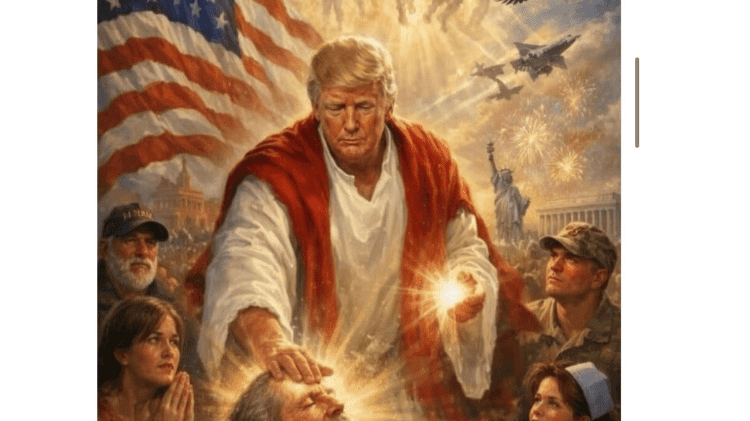
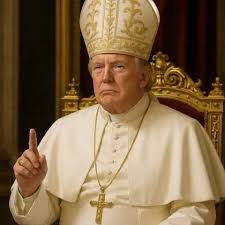
You may remember that at the beginning of May, during the preparation for the conclave that elected Pope Leo XIV, the president posted an A.I.-generated image of himself as pope dressed in a white cassock and miter, his hand raised in blessing. The White House’s official X account later reposted the image, which remains up on the account.
As the America team in Rome and back at home discussed how much to cover that story, I reminded my colleagues that to the degree that the Trump-as-pope meme meant anything, it meant that Mr. Trump was unable to tolerate anyone other than himself commanding the world’s attention.
As the America team in Rome and back at home discussed how much to cover that story, I reminded my colleagues that to the degree that the Trump-as-pope meme meant anything, it meant that Mr. Trump was unable to tolerate anyone other than himself commanding the world’s attention.
Mr. Trump posted a screed against Pope Leo late on the evening of Sunday, April 12. It was, as my colleague James Martin, S.J., posted last night, “unhinged, uncharitable and un-Christian.” It was immeasurably beneath the dignity of the office of the president. (Not satisfied with merely attacking the Vicar of Christ, Mr. Trump posted another A.I.-generated image, this one seeming to depict himself as Jesus.)
Mr. Trump’s post also makes little sense. It achieves the almost impressive feat of becoming less coherent the longer you think about it.
It slams Pope Leo as “WEAK on crime,” probably Trumpian code for Leo’s opposition to the administration’s immigration policy. It then veers into a tirade about priests and ministers being arrested for holding services during the pandemic, followed by Mr. Trump’s praise for the pope’s brother Louis as “all MAGA.” Finally, turning to the foreign policy disagreements that probably triggered the post, it accuses Leo of thinking “it’s OK for Iran to have a Nuclear Weapon.” (Not only does Pope Leo not think Iran should have nuclear weapons, he does not think any country should have them, including the United States.)
In the most muddled part of the attack, Mr. Trump says he is the reason that Leo got elected as pope and that the cardinals in conclave thought that was “the best way to deal with President Donald J. Trump.” This manages to be wrong both coming and going. It is farcical as an account of the motives of the cardinals and, as I will explain below, it misunderstands the purpose of Leo’s own witness entirely.
Far more telling than anything in the president’s post was the timing of it. During a weekend full of bad news for Mr. Trump, his post followed a lack of progress in negotiations with Iran and the resounding electoral loss of his favorite European leader, Viktor Orban, in Hungary. Relative to the Catholic world, his post came the day after Pope Leo XIV led a prayer vigil for peace in St. Peter’s and was joined in prayer all around the world. It came within hours of a “60 Minutes” broadcast of an unprecedented joint interview by three U.S. cardinals, in which they clearly laid out the church’s moral objection to both the Iran war and the administration’s mass deportation agenda.
Mr. Trump, however, was not responding to any of those events in kind. Mr. Trump’s outburst is not trying to convince anyone of his claims but rather to make people angry. In that sense, its incoherence is more a feature than a bug.
The way his attack on the pope functions best for Mr. Trump, like so much of the ragebait with which he pollutes our collective consciousness, is by pulling attention back to him so that we talk about him within terms that he has set. If we are doing that, Mr. Trump does not much care, I suspect, whether we agree with him or oppose him, because at least we are back in orbit around him.
Perhaps the way in which Pope Leo presents the greatest challenge to President Trump is in his consistent demonstration of what it looks like to remain morally centered on the Gospel instead of acting for or against Mr. Trump’s interests. In general, even when offering critiques that respond to American foreign policy moves, as in his description of Mr. Trump’s threat to destroy Iranian civilization as “truly unacceptable,” Pope Leo does not mention the president by name. In part, this follows well-established Vatican diplomatic practice, but it is also meant to remind us that the pope is speaking more from principle than he is in response to persons, even the most powerful person on earth. When Leo is speaking more explicitly about persons, it is to call our attention back to people who are suffering: the poor and the victims of war or violence.
s President Donald Trump increasingly uses the U.S. military to carry out his agenda through brute force, organizations that provide counseling services for U.S. servicemembers are reporting growing numbers of calls. These calls have further spiked in response to Trump’s war on Iran, one of the most unpopular in U.S. history.
The United States has carried out the war through intense attacks on densely populated civilian areas, the impact of which was clearly shown in the bombing of a girls’ school, killing well over 100 children. Not even concerned with selling the war to the public, Secretary of Defense Pete Hegseth has leaned into treating the intervention as a “holy war” for Christianity.
Mike Prysner, an Iraq War veteran and executive director at the Center on Conscience & War (CCW), told Truthout that troops are telling his organization that they don’t want to be involved in the killing.
“That’s pretty much all of the cases that we have,” Prysner said. “It’s all people who don’t want to take part in killing in a war that they don’t believe in, and this war has made them realize that they can’t take part in any kind of U.S. military action ever again.”
The CCW, formerly the National Interreligious Service Board for Conscientious Objectors, was founded in 1940 to assist religious communities whose beliefs prohibited them from participating in war. Over time, and as a result of broadening criteria for who can qualify as a conscientious objector (CO), the organization evolved to assist troops of all backgrounds whose values prevent them from being able to participate in war.
Prysner told Truthout that in recent weeks CCW has already been able to help several servicemembers become COs to avoid being deployed.
To reach more servicemembers experiencing crises of conscience, CCW and other organizations including the Quaker House founded the GI Rights Hotline in 1994. Steve Woolford, a resource counselor at the Quaker House, has taken calls for the hotline since 2001 and agreed that the war on Iran, and Trump’s broader use of the military, has caused a spike in calls.
“The biggest increase has come from people who are feeling a lot of opposition to the ways the military’s currently being used,” Woolford said. “That includes people who feel like they don’t want to be sent into cities and point a weapon at U.S. citizens, they don’t want to be part of what to many of them look like war crimes, shooting down speedboats in Venezuela that wouldn’t be able to make it to the United States, and I would say with the invasion, or whatever you want to call it, ‘Operation Epic Fury’ in Iran, there’s been significant opposition to that.”
Woolford clarified that not all troops who call the hotline are able to leave the military by filing as COs. While every member of the military has that right, the process requires applicants to prove that they have deeply held antiwar beliefs. This means that even if someone is opposed to certain orders or operations, they don’t qualify as CO if they aren’t opposed to participation in all wars.
Prysner said that the social pressure in the military can also make it difficult for troops to declare themselves COs.
“Especially for people who have deployments happening, you’re telling all of your brothers and sisters in uniform that you don’t believe in what you’re doing and you’re not gonna be able to do it with them,” Prysner said. “The thing is, the people that we’re dealing with, they simply don’t have any other choice … They cannot live with themselves participating.”
Echoes of Antiwar History
This is not the first time that members of the military have questioned their role in U.S. wars. In fact, there is a rich history of GI dissent throughout U.S. history.