USA Federal Subsidies for Small Modular Reactors
 Department Of Energy’s Small Modular Reactor Program
Savannah River Nuclear Development Site
Taxpayer Subsidies for Small Modular Reactors Taxpayers for Common Sense February 27, 2013 Download: Golden Fleece: Taxpayer Subsidies for Small Nuclear Reactors (pdf) “…..Federal Subsidies for Small Modular Reactors Federal support for SMRs is provided through a subsidy program for commercial nuclear power that can be traced back to the 1950s when federal subsidies for nuclear power reached astronomical levels. Not only did the government develop reactor and enrichment technology for the private sector, it also assumed legal responsibility for nuclear waste disposal, something never done for any other industry. In addition, the government issued multimillion-dollar development grants for many reactor technologies (most since abandoned) and distributed research reactors around the world. Continue reading
Japan’s government ignoring nuclear phaseout policy, and public opinion
Energy report skips nuclear phase-out Japan Times, KYODO JUN 15, 2013 Japan’s annual energy report released Friday barely refers to the fact that the previous government upheld a goal to phase out nuclear powerin the 2030s, reflecting the pro-nuclear stance of the current government.
The latest Energy White Paper covers a period between last August and around March, during which the previous government led by the Democratic Party of Japan compiled a new energy strategy in light of
the 2011 Fukushima nuclear disaster.
The most controversial part in the strategy was a pledge to “devote all policy resources to enable zero nuclear power plant operation in the 2030s,” but the white paper does not use the phrase in explaining
the strategy…….
The zero-nuclear goal shows up in the white paper once, but only as part of Prime Minister Shinzo Abe’s quoted statement, which criticizes the energy strategy for stirring concerns and distrust among the local
governments hosting nuclear plants and businesses.
The goal, if maintained, would have marked a massive shift in Japan’s
decades-long promotion of nuclear power……
The white paper also touches on a poll conducted by the previous
government seeking to gauge public opinion on energy policy, but does
not mention that the government at that time concluded that at least a
majority of the people are hoping for a society that does not rely on
nuclear power.
Of the 50 commercial reactors, only two, in western Japan, are online.
http://www.japantimes.co.jp/news/2013/06/15/business/energy-report-skips-nuclear-phase-out/#.UbzfVudwo6I
Continuing taxpayer support for nuclear idnustry
Nuclear Power, Part 2: Nukenomics By Ned Madden, 14 June 13 “………The Energy Policy Act of 2005
The federal “open wallet” strategy for nuclear energy was fully apparent in the U.S. Energy Policy Act of 2005, which not only extended Price-Anderson through 2025, but also provided the nuclear industry with financial incentives to build new nuclear power plants. Among other incentives, the act provided a production tax credit of 1.8 cents per kilowatt hour for up to 6,000 MWe of capacity from new, qualified advanced nuclear power facilities for eight years.
The first application for a new reactor eligible for this incentive was submitted in September 2007 for an expansion of the South Texas Project.
Later, under an amendment in the American Recovery and Reinvestment Act of 2009, Section 406, the Energy Policy Act of 2005 authorized loan guarantees for “innovative” technologies that avoid greenhouse gases. These technologies include carbon capture and storage, renewable energy, and advanced nuclear reactor designs such as pebble bed modular reactors.
One result is that tax reductions of $4.8 billion were made available for nuclear power……..
‘Golden Fleece Award’
In February, Taxpayers for Common Sense handed out its “Golden Fleece Award” to the DoE for the dollars being spent on SMRs.
Why the dubious honor?
The DoE has already provided nearly $100 million for SMRs, while their commercial viability remains in question, the group charged. In addition, DoE has committed up to $452 million over the next five years to fund up to two separate demonstration projects.
If DoE believes there is a “need and market” for SMRs, the mature and profitable nuclear industry should bear the full risk and cost of making SMRs a reality, Autumn Hanna, TCS’s senior program director, told TechNewsWorld.
“In these tight budget times, federal taxpayers cannot afford to provide additional subsidies to the nuclear power industry,” Hanna explained.
Scrap all Fukushima prefecture nuclear reactors, says Governor

Fukushima Governor Seeks Scrapping Of All Nuke Reactors RTT News6/12/2013 The Japanese government has been asked to scrap all nuclear reactors in the Fukushima prefecture, where one of the two nuclear power plants had a disastrous accident two years ago, displacing tens of thousands of residents.
Fukushima Governor Yuhei Sato met with Economy, Trade & Industry Minister Toshimitsu Motegi in Tokyo on Wednesday and handed over a letter raising the demand, Japanese media reported.
Sato said Fukushima was aiming for sustained regional development without relying on nuclear power, and it wanted the government to take responsibility in decommissioning all reactors at the Fukushima Daiichi and Daini nuclear plants….. http://www.rttnews.com/2134682/fukushima-governor-seeks-scrapping-of-all-nuke-reactors.aspx?type=gn&utm_source=google&utm_campaign=sitemap
Akie Abe – Japan’s anti nuclear “ opposition party within the family.”
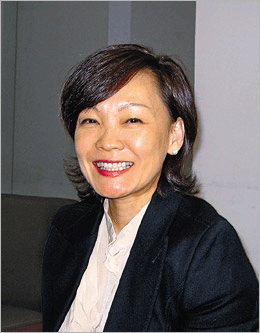
 Akie Abe, His “Anti-Nuclear” Wife JUNE 12, 2013 In Japan, wives aren’t part of the show. Back in the day, they walked a few feet behind their husbands. Old couples can still be seen progressing down the sidewalk in that manner. In politics, wives still aren’t part of the show – though recently, they’ve been seen deplaning with their husbands when they alight in Western countries, even holding hands while waving to photographers.
But when a wife suddenly invites herself to the show, and not demurely behind or next to her husband, but vocally at the opposite end of where he stands, it causes a stir. In particular if she takes on the nuclear power industry. Continue reading
Canada’s Harper govt increases nuclear operators’ liability to just $1 billion
Nuclear power plants to be on the hook for $1-billion in event of meltdown GLORIA GALLOWAY OTTAWA — The Globe and Mail, Jun. 10 2013, The Harper government says Canada’s nuclear operators should not have to pay more than a billion dollars in total compensation in the event of a catastrophic incident at one of their reactors.
Natural Resources Minister Joe Oliver said Monday he will introduce legislation in the fall to increase the liability limit from the current $75-million – an amount set four decades ago and one that is widely recognized to be grossly inadequate….. http://www.theglobeandmail.com/news/politics/nuclear-power-plants-to-be-on-the-hook-for-1-billion-in-event-of-meltdown/article12446956/
A crack appears in Tea Party’s opposition to solar emergy
 Even if the Public Service Commission forces Georgia Power to expand its use of solar power in their energy plan, Dooley said the fight is far from over. She plans to continue her efforts by pushing for upcoming legislation that would allow private companies to set up solar farms and feed their energy into Georgia Power’s grid, continuing to put pressure on Georgia Power for cost overruns at its Vogtle nuclear power plant, and possibly even challenging the law that grants monopoly rights to utilities. http://theenergycollective.com/josephromm/234916/tea-party-takes-georgia-power-over-lack-solar-energy
Tea Party Takes on Utility Over Lack of Solar Energy, Energy Collective, Joseph Romm , 9 June 13 The fight to bring cheaper, clean energy to Georgia is uniting some unlikely allies. Renewable energy advocates and leaders of the Atlanta Tea Party are taking on utility giant Southern Co., and its subsidiary Georgia Power, over resisting the call to expand its development of solar energy.
As Debbie Dooley, co-founder of the Atlanta Tea Party explained in an interview with Climate Progress, the group’s interest in the debate is quite simple: “The free market has been one of the founding principles of the Tea Party since it began and a monopoly is not a free market.” Continue reading
Canada’s nuclear operators to pay more, in the event of an accident
Federal government poised to raise nuclear liability cap The Canadian Press Jun 9, 2013 Federal Natural Resources Minister Joe Oliver is set to roll out his plan to raise the amount in damages that Canadian nuclear operators would have to pay in case of an accident, the Canadian Press has learned.
He is expected to announce the details at a nuclear conference in Toronto on Monday morning, although he will likely hold off on tabling legislation until the fall.
The liability cap is now set at $75 million but that is widely considered outdated, especially in the wake of the 2011 Fukushima disaster that has led to tens of billions of dollars of damage claims…….. ritics say anything except unlimited liability acts as a subsidy to the nuclear industry.
“Increasing the cap only decreases the subsidy; it does not eliminate it. The government of Canada should proceed with legislation that removes the liability cap entirely rather than legislation that maintains it, or increases it to be harmonious with other jurisdictions,” wrote Joel Wood, a senior research economist at the Fraser Institute, in a 2011 analysis.
In February, the federal government introduced new financial penaltiesfor companies found in violation of the law in an effort to increase pipeline safety. http://www.cbc.ca/news/politics/story/2013/06/09/pol-federal-government-poised-to-raise-nuclear-liability-cap.html
Candidates for Iran’s Presidential election in dispute over nuclear issue
Iranian Candidates Quarrel Over Nuclear Talks By ALI AKBAR DAREINI Associated Press TEHRAN, Iran June 7, 2013 (AP) Iran’s eight presidential candidates quarreled about talks with world powers over the country’s disputed nuclear program Friday as they held their final televised debate ahead of next week’s election.
Iran’s president does not have control of central issues like nuclear development policy but does generally enjoy a close relationship with Supreme Leader Ayatollah Ali Khamenei that can prove influential. The issue also has come to the fore as the Islamic Republic’s ailing economy has emerged as a major focus of campaigning ahead of the June 14 vote…… http://abcnews.go.com/International/wireStory/iran-presidential-candidates-debate-nuclear-talks-19349438#.UbOr5edwo6I
Costly lobbying exercise by Entergy, to get Indian Point nuclear plant relicensed
 Indian Point Owner Spends Big in Push to Relicense: Report http://www.wnyc.org/articles/wnyc-news/2013/may/30/report-entergy-political-spending-soars-push-relicense-indian-point/ Company using ‘front groups’ to win support for aging nuclear plant , May 30, 2013 By Robert Lewis The owner of Indian Point nuclear plant has thrown millions into lobbying and political donations as it tries to get its facility relicensed for another 20 years, according to a report released today.
The company also used two nonprofit coalitions as so-called “front groups” in its efforts 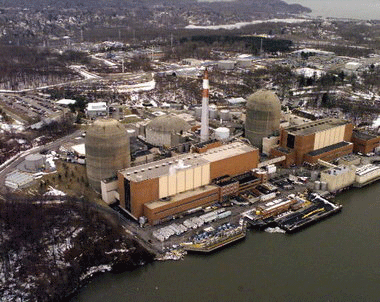 to win support for Indian Point, advocacy group Common Cause found.
Entergy, the owner of Indian Point, has been working since 2007 to get its two aging reactors relicensed. Environmental groups and some officials, including Governor Andrew Cuomo, said they’re concerned it’s unsafe for the 40-year-old plant to keep operating just 25 miles from New York City.
A spokesman for Entergy, Jerry Nappi, said the nonprofit coalitions — NY AREA and SHARE — have readily acknowledged that the company was a founding member. A number of organizations such as unions and business groups are also involved with the coalitions, Nappi pointed out. He added that the amount spent on lobbying and political activities a year is relatively small given the size of the company.
The license for one of Indian Point’s reactors expires in September.
Sweden heads towards renewable energy, and away from nuclear
 Sweden favours renewables to nuclear: interview Climate Spectator, Reuters 30 May, Sweden’s government will not subsidise new nuclear power stations, the energy minister said, sticking by a policy that casts doubt on the sector’s long-term survival after the major operator sought to delay new investment. Continue reading
South Korea seeking uranium enrichment, despite its previous pledges
Two-Decade-Old Pledge Complicates South Korean Nuclear Goals National Journal, By Elaine M. Grossman May 30, 2013 | South Korea’s designs on producing atomic fuel recently scotched a 2014 trade deal with the United States, but could yet have new ramifications: Potentially shattering a twenty-one-year-old pledge Seoul made to never process sensitive nuclear materials, according to issue experts.
“By dint of the Joint Declaration of 1992, South Korea has said it will not possess enrichment or reprocessing facilities on its peninsula,” Thomas Moore, deputy director of the Proliferation Prevention Program at the Center for Strategic and International Studies, said at a recent panel discussion. …………http://www.nationaljournal.com/nationalsecurity/two-decade-old-pledge-complicates-south-korean-nuclear-goals-20130530
Europe gives cold shoulder to Russia’s nuclear marketing
One of the main reasons that the Baltic NPP project has run aground is that neither investors nor energy importers that Rosatom has approached in Europe have agreed to come on board…..
………The story of the Baltic NPP is an illustrative account of Rosatom’s incapability of landing anything other than rebuffs in Europe, earning trust in the safety of its reactor technology, and winning over foreign investors.
Europe has given a cold shoulder to Rosatom’s brilliant plan to quell its energy security concerns with power streaming from nuclear reactors built in its backyard
 GAZETA.RU: Nuclear failure Gazeta.ru, May 24, 2013 – Moscow’s resigned willingness to consider reduced capacity for the future Baltic Nuclear Power Plant is testimony to the Russian nuclear industry’s failure to overcome criticism it has been facing in the European market, convince potential customers of the reliability of its technologies, or attract foreign investors so it could get a foot in Europe’s door. By Vladimir Slivyak Continue reading
Japan’s corrupt ‘nuclear village’ still ruling policy?
The Fukushima plant looks to be a bottomless pit, with the tab set to grow as decontamination and decommissioning will take decades. And, how much will it cost to deal with all the radioactive waste accumulated at Japan’s 50 other reactors and where will that be stored?
Is it safe? Ruling party pushes nuclear village agenda BY JEFF KINGSTON JAPAN TIMES, 26 May 13, “……This April, the Nuclear Regulation Authority (NRA) began assessing whether the two Oi reactors meet new safety standards slated to go into effect in July. There are three active fault lines near the Oi plant on the Sea of Japan coast, but it will not have a remote command center ready until 2015 and its raised sea wall will not be completed until March 2014. The new safety guidelines also require that utilities equip reactors with filtered venting systems to reduce radioactive releases in the event of an emergency, but they are granted a five-year grace period before these must be in place.
Consequently, the reactors are now operating based on the hope that these countermeasures will prove unnecessary; Fukushima demonstrates the folly of wishing risk away. The findings of three major investigations into the Fukushima accident were released in 2012, detailing the absence of a culture of safety in the nuclear industry in Japan and cozy, collusive relations between regulators and the utilities that compromised safety……
In fact, tsunami risks should have come as no surprise to Tepco, as the Tohoku coastline has been battered by major ones in 1611, 1677, 1793, 1896 and 1933. Indeed, there are tsunami stones dotting the Tohoku coastline warning future generations to heed the perils. Tepco’s own researchers warned about the tsunami risk in Fukushima, and clearly the one triggered by the Great East Japan Earthquake on March 11, 2011, was no black swan, once in a 1,000-year event. But the utilities and the government ignored the risks and sited reactors in tsunami-risk zones.

The Diet investigation concludes that what’s termed “regulatory capture” — regulators regulating in favor of the regulated — was at the heart of the nuclear accident, and it blasts the absence of a culture of safety. Moreover, it outlines an institutionalized culture of collusion, complacency and deceit involving regulators and utilities that explains why Fukushima in particular, and the nuclear industry in general, settled for inadequate safeguards…….. Continue reading
Japan’s Prime Minister Abe willing to take a chance on nuclear safety
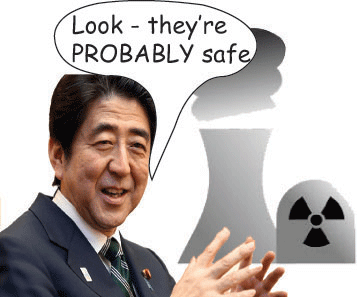 Abe to pledge resumption of Japan nuclear plants By MarketWatch, May 26, 2013, TOKYO—Prime Minister Shinzo Abe will clarify his government’s plan to resume operation of idled nuclear power plants in a growth strategy to be compiled in mid-June, Kyodo News quoted sources familiar with the matter as saying Saturday.
The draft energy policy to be included in the growth strategy states that steps will be taken to restart reactors judged safe for operation by the nuclear regulatory authorities, they said.
The government will pledge that it will make utmost efforts to ensure plant safety to gain support from municipalities hosting nuclear plants, the sources said.
The energy policy laid out in the growth strategy will be the government’s official endorsement of Abe’s plan to rely on nuclear power until the nation’s final policy is made on nuclear energy use…. http://www.marketwatch.com/story/abe-to-pledge-resumption-of-japan-nuclear-plants-2013-05-26
1 This Month
23-25 October – on Zoom – World BEYOND War’s annual global conferenc


Shut down the radiation-damaged Heysham nuclear reactors now
To see nuclear-related stories in greater depth and intensity – go to https://nuclearinformation.wordpress.com

Say No to NASA’s Reckless Nuclear Reactor on the Moon
Say No to NASA’s Reckless Nuclear Reactor on the Moon
-
Archives
- October 2026 (180)
- September 2026 (339)
- August 2026 (330)
- July 2026 (355)
- June 2026 (287)
- May 2026 (306)
- April 2026 (356)
- March 2026 (251)
- February 2026 (267)
- January 2026 (308)
- December 2025 (358)
- November 2025 (359)
-
Categories
- 1
- 1 NUCLEAR ISSUES
- business and costs
- climate change
- culture and arts
- ENERGY
- environment
- health
- history
- indigenous issues
- Legal
- marketing of nuclear
- media
- opposition to nuclear
- PERSONAL STORIES
- politics
- politics international
- Religion and ethics
- safety
- secrets,lies and civil liberties
- spinbuster
- technology
- Uranium
- wastes
- weapons and war
- Women
- 2 WORLD
- ACTION
- AFRICA
- Atrocities
- AUSTRALIA
- Christina's notes
- Christina's themes
- culture and arts
- Events
- Fuk 2022
- Fuk 2023
- Fukushima 2017
- Fukushima 2018
- fukushima 2019
- Fukushima 2020
- Fukushima 2021
- general
- global warming
- Humour (God we need it)
- Nuclear
- RARE EARTHS
- Reference
- resources – print
- Resources -audiovicual
- Weekly Newsletter
- World
- World Nuclear
- YouTube
-
RSS
Entries RSS
Comments RSS

