Race for rare earths sparks concern about environmental damage

More than 6,000 people living near a mine in Madagascar are locked in a dispute with
Rio Tinto over alleged environmental damage linked to the extraction of a
rare earth mineral key to modern industries. They have accused the mining
group’s subsidiary QIT Madagascar Minerals of contaminating waterways
with hazardous materials, including uranium, through the extraction of
ilmenite, used in paints, and the rare earth mineral monazite, which
contains the radioactive element.
The long-running dispute highlights the
legal and moral risks facing companies as they intensify efforts to open
rare earth mines, a push that has led to a rush of deals as the west seeks
to loosen China’s grip on the sector. Western nations see dependence on
China for the metals — vital components of magnets that go into electric
vehicles, wind turbines and defence systems — as a national security
threat. Their concerns were heightened when Beijing imposed new export
controls last year.
FT 31st May 2026,
https://www.ft.com/content/dcc11776-b672-4a0f-a1ed-3e441d2f4c29
Will Trump sideline Israel in order to make a deal with Iran?
Donald Trump reportedly has a deal on the table to suspend fighting and begin negotiations to end the Iran war and the resulting global economic crisis. But Israel and Iran hawks see it as a disaster and are working to undermine it. Who will win out?
Mondoweiss, By Mitchell Plitnick May 31, 2026
According to available reports, the purported agreement on a Memorandum of Understanding (MOU) between the United States and Iran to entrench the current ceasefire was ready to be signed and presented to the public, and Trump was going to retire to his “situation room” to confer with his people and announce it.
If that seemed too good to be true, it turns out it was, at least for the moment.
Eventually, Trump is going to have to decide whether to accept an MOU that will be harshly attacked by Israel and Iran hawks or resume the fighting. Choosing the former is out of character for the beleaguered president, but resuming the fighting will bury him deeper in this quagmire and will intensify the global economic crisis.
This mistrust is why Iran wants this MOU rather than a comprehensive deal. They want to move slowly, confirming American sincerity with actions, not words, every step of the way.
Trump, on the other hand, is struggling to decide what to do amid conflicting, powerful political pressures. His team has, apparently, negotiated the terms of the MOU, but he is indecisive about implementing it. These are the consequences of a weak, unqualified person in the White House.
This political quicksand that Trump continues to sink into is another in the long list of reasons why other presidents have refused to let Israel draw them into a war with Iran. Now that Iran has the upper hand, it is dictating the framework of ending the war.
Trump wanted to end it with a comprehensive deal, a grand bargain. That has been completely thwarted by Iran, which insists on a staged process to confirm American intentions after two surprise attacks. Trump’s absurd idea of expanding the Abraham Accords was a last, desperate attempt to try to come out of this debacle with a win big enough for him to claim that it was all worth it.
He made that desperate grab because the MOU, although not addressing some of the biggest issues, would include some immediate concessions to Iran that will be viewed by Trump’s allies as significant setbacks.
The concessions that have been rumored—which include funding Iran’s reconstruction, sanctions relief, and releasing frozen Iranian funds, for which he will be accused of “sending pallets of cash” to Iran, just as Trump once accused Barack Obama—are going to be attacked by Iran hawks. But for Trump, the immediate priority is reopening the Strait of Hormuz quickly and doing as much damage control as he can before the congressional elections in November.
The MOU would, according to the reports, accomplish that. Iran would allow ships to move through the Strait and would start removing impediments, such as mines, from the area, while concurrently, the U.S. would gradually lift its blockade of Iranian ports. The fighting would stop, including in Lebanon, although the specific terms of that and whether Israel would be forced to completely withdraw from southern Lebanon have not been mentioned. Iran would reiterate its long-standing pledge not to create a nuclear weapon.
Beyond that, the MOU would outline the topics for further talks that would, it is hoped, lead to a permanent peace deal. 60 days would be allotted for those talks, which would include Iran’s nuclear program, a proposed $300 billion reconstruction fund for Iran, a permanent system for managing the Strait, the lifting of sanctions, and the release of frozen Iranian assets.
Trump unintentionally confirmed much of the rumored content and limitations of the MOU:
“Iran must agree that they will never have a Nuclear Weapon or Bomb. The Hormuz Strait must be immediately open, no tolls, for unrestricted shipping traffic, in both directions. All water mines (bombs), if any, will be terminated (we have removed, through detonation, numerous such mines with our great underwater mine sweepers. Iran will complete the immediate removal and/or detonation of any mines that are left, which will not be many!). … The enriched material, sometimes referred to as “Nuclear Dust,” … will be unearthed by the United States (which, it is agreed, is the only Country, along with China, with the mechanical capability of doing so!), in close coordination and conjunction with the Islamic Republic of Iran, plus the International Atomic Energy Agency, and DESTROYED. No money will be exchanged, until further notice.”
Though the language is Trumpian, there is much to read into this message, both in its contents and its omissions.
Trump’s demand about destroying the so-called “nuclear dust” leaves open the option of Iran diluting its highly enriched uranium and agreeing to IAEA inspections going forward. That’s an Iranian proposal, which Trump is trying to own. Doubtless, Iran would be fine with him making that claim for his own political purposes.
Dilution, however, would not be good enough for Israel or its allies in Washington. Nor are they going to be happy about Trump even mentioning money. His declaration that no money will change hands “until further notice” implies that there will, eventually, be such “further notice” if the process of the MOU is followed.
It is worth noting that nowhere in any of the talk of either the immediate terms of the MOU or the framework for negotiations going forward that it would imply is there any mention at all of Iran’s missile and drone programs or its support of regional allies, which are often termed “proxies” by the media.
A disaster for Netanyahu and Iran hawks
Israeli reporter Ben Caspit, citing a “senior Israeli political source,” reports that Benjamin Netanyahu faces a political disaster if Trump ends the war.
“This time, the prime minister’s hands are tied. He is completely paralyzed and knows that he will not be able to do anything, even if the agreement signed between the United States and Iran remains the disaster he now defines it as,” an anonymous Netanyahu associate told Caspit.
That same insider also said that Netanyahu now longs for the days of Joe Biden. It is a classic case of being careful what you wish for……………………………………………………………………………………………………………………………………………………………………………………….
The next president, whomever that might be, will have the same opportunity. The terms for a permanent agreement with Iran will be clear: a workable agreement on the Strait, IAEA inspections ensuring Iran doesn’t develop a nuclear weapon, and a path forward that includes a resuscitation of the Iranian economy, and regional agreements to ensure the security of the Gulf states, including Iran.
In other words, the JCPOA, in all the dimensions Obama envisioned. All we need to get there is the same resolute determination to do the sensible thing that Obama showed when he too froze Israel out of the process so he could do something wise. https://mondoweiss.net/2026/05/will-trump-sideline-israel-is-order-to-make-a-deal-with-iran/
Canadian nuclear company Bruce Power has launched a CAD1 million (USD722,000)bribery system to win over municipalities.

World Nuclear News, 2 June 2026
Bruce Power has launched a CAD1 million (USD722,000) Regional Municipal Readiness Assessment Fund to support municipalities in the Bruce, Grey, and Huron counties in advancing planning related to the proposed Bruce C Project. The fund is designed to support studies and assessments that help municipalities prepare for the potential opportunities and impacts associated with Bruce C – a proposed new power plant of up to 4.8 GW at the Bruce Power site in Ontario – with individual projects to be completed by the end of 2027.
“Municipal leadership is critical in planning for large-scale infrastructure opportunities,” Pat Dalzell, Bruce Power’s Vice-President, Corporate Affairs and Market Development, said. “This new fund will help to ensure communities are well positioned to capture economic benefits while maintaining the services and quality of life residents depend on.”
| brennainlloyd . 3June 26 |
Bruce Power has launched a CAD1 million (USD722,000) Regional Municipal Readiness Assessment Fund to support municipalities in the Bruce, Grey, and Huron counties in advancing planning related to the proposed Bruce C Project. The fund is designed to support studies and assessments that help municipalities prepare for the potential opportunities and impacts associated with Bruce C – a proposed new power plant of up to 4.8 GW at the Bruce Power site in Ontario – with individual projects to be completed by the end of 2027.
“Municipal leadership is critical in planning for large-scale infrastructure opportunities,” Pat Dalzell, Bruce Power’s Vice-President, Corporate Affairs and Market Development, said. “This new fund will help to ensure communities are well positioned to capture economic benefits while maintaining the services and quality of life residents depend on.”
The costs of nuclear wastes from “in service” nuclear submarines.

Richard Marles weasels his way out of this problem
3 June 2026 Noel Wauchope AIM Extra , https://theaimn.net/the-costs-of-nuclear-wastes-from-in-service-nuclear-submarines/
It is a rather nauseating entertainment, watching Australia’s Defence Minister Richard Marles wriggling around to con the public into believing that it will be cheaper for Australia to buy used nuclear submarines, than to buy new ones. I’m not quite sure who invented the new term to replace “used” – but “in service:” is a lovely euphemism, worthy of Marles. Australia’s not buying “used” nuclear submarines – oh no – we’re getting “in service” nuclear submarines.
You gotta admire Richard Marles – he is indeed the master of the weasel word:
“The Deputy Prime Minister and Secretaries welcomed the proposed approach to streamline Australia’s acquisition of Virginia-class submarines (VCS), simplifying supply chain management, operational and maintenance requirements, and maximising cost efficiencies. This approach would enable Australia to acquire three in-service VCS in lieu of a mixture of new and in-service VCS variants.”
“Chasing simplicity is at the heart of why we have pursued this.”
“So firstly, we are paying an amount to the US in terms of its industrial base. That is to create the space for the Virginia-class submarines to be transferred to Australia. But then there is the purchase price in respect of each of the submarines and this will be more cost effective in relation to that and it’ll be significant.”
Work all that out, if you can be bothered.
Anyway, all that doesn’t matter. We know now that (a) these nuclear submarines will be unsuitable for monitoring Australia’s coastline, and really intended for attacking China on behalf of the USA, and (b) will be obsolete by the time we get them, anyway.
But here’s the bit that nobody’s talking about – the “elephant in the ocean.”
Australia is to cop the management of the nuclear wastes in these second hand submarines. Do we know how old they are? Do we know how long before that toxic forever radioactive trash has to buried, or stored in concrete canisters, or what?
And – dare I be so rude as to mention this? What about the costs of disposing of theUSA’s nuclear submarine wastes?
The entire global nuclear establishment is very coy about assessing the real long term or short term costs of nuclear wastes.
France has been working on this since 1991 with its Cigéo project in Bure (Meuse). This project was launched in 1991. Its regulatory process spans decades, with partial commissioning expected by 2050 and a public inquiry in 2026.
On the costs of this project – Wikipedia states:
“Evaluation of the total cost of Cigéo must take into account all the costs of storage over more than 100 years: studies, construction of the first structures (surface buildings, shafts, declines (sloped tunnels)), operation (staff, maintenance, energy…), the gradual construction of underground structures, then their closure, their monitoring etc. Part of these costs/investments will be the salaries of the workforce employed in the digging, construction and storage work, who, according to Andra, will number 1500 to 2000 persons for at least a hundred years.”
The French government has had a bash at estimating these costs:
“A ministerial decree published in France has confirmed the latest cost estimate of the planned Cigéo deep geologic spent nuclear fuel repository at €33.4bn ($39bn) – €37bn including taxes – of which €9.7bn is for initial construction.”
Apart from all the other well-known considerations – safety, danger, terrorism risks, risks of nuclear proliferation, and public opposition, there has been a great reluctance in the nuclear establishment to address the problem of the costs of nuclear wastes.
So Richard Marles can go on, comfortingly bleating about the financial benefits of these second hand nuclear submarines and their second-hand radioactive trash, because as we say in upper class parlance – it’s “just not done” to talk about the financial costs of nuclear wastes.
And now that both Liberal and Labor governments have committed us to taking over American nuclear submarine wastes, will that be the last of it? Are these useless nuclear submarines just the foot in the door for Australia to become the USA’s nuclear waste dump?

Polish politician urges EU veto on Ukraine accession after Zelenskyy’s UPA move

by Daria Dmytriieva. 3 June 26, https://www.msn.com/en-gb/news/world/polish-politician-urges-eu-veto-on-ukraine-accession-after-zelenskyys-upa-move/ar-AA24E3wR?ocid=BingNewsSerp
What move by Zelenskyy sparked backlash in Poland?
Calls are growing in Poland to block Ukraine’s accession to the European Union over a decision by Ukrainian President Volodymyr Zelenskyy regarding the UPA, Krzysztof Bosak, leader of the far-right Confederation party, stated.
According to Bosak, Poland should officially announce that it will block Ukraine’s accession to the EU until Kyiv abandons what Warsaw views as the cult of historical figures considered criminals in Poland. He said the key condition for resuming Ukraine’s European integration process is the full restoration of exhumations of all victims of the Volhynia tragedy.
The politician’s reaction came after Zelenskyy decided to grant the name “Heroes of the UPA” (Ukrainian Insurgent Army) to the Separate Special Operations Center “North” of Ukraine’s Special Operations Forces.
Bosak stressed that Warsaw must move from words to concrete and tougher measures in order to exert real pressure on Kyiv, arguing that Ukraine allegedly views the current position of Polish politicians as weak.
Among additional measures, the far-right leader proposed that the Polish government stop paying for Starlink terminals used by the Ukrainian Armed Forces. He also called for ending joint borrowing schemes with other EU member states to finance assistance for Ukraine.
According to Bosak, the situation in which countries go into debt to provide non-repayable aid to another state while assuming responsibility for repaying those loans is unprecedented in the history of international finance.
As a reminder, on May 26, Zelenskyy signed a decree granting the Separate Special Operations Center “North” the honorary title “named after the Heroes of the UPA.” The decision was made in recognition of the exemplary performance of combat missions by its personnel.
Reacting to the move, Polish President Karol Nawrocki said he would consider stripping Zelenskyy of Poland’s highest state award.
Ukraine’s Foreign Ministry stressed that Kyiv had no intention of offending the Polish people. The ministry emphasized that, for Ukraine, the UPA symbolizes resistance against Moscow’s imperial policies and occupation.
Congress quietly moves to integrate US and Israeli militaries

In the first step towards shifting aid further into the shadows, the House’s 2027 NDAA would all but fuse the two countries’ armed forces together
Ben Freeman, Responsible Statecraft, Fri, 29 May 2026, https://responsiblestatecraft.org/israel-us-military/
At a time when the American public is expressing unprecedented levels of distrust in the Israeli government, Congress just proposed tying the U.S. to the Israeli military more than ever before.
Buried in the House’s version of the 2027 National Defense Authorization Act (NDAA) released on Tuesday, is section 224, entitled “United States-Israel Defense Technology Cooperation Initiative.” The provision would arguably do more to intertwine the U.S. military with the Israeli military than the more than $200 billion (inflation adjusted) in military assistance Israel has received from the U.S. since its founding in 1948.
Section 224 lays the groundwork for bilateral research and development, co-production of weapons, joint ventures, licensing agreements, and seemingly every manner of U.S.-Israeli military-industrial complex cooperation. The U.S. and Israel already work together heavily on missile defense, but this provision would greatly expand coordination to seemingly every area of defense tech, including AI, quantum, autonomous systems, directed energy, cyber, biotech, and many more. It also proposes “network integration” and “data fusion.” In other words, the U.S. military’s data could soon be the Israeli military’s data.
If fully enacted, this proposal would provide a higher level of military-industrial integration than the U.S. has with any other country in the world. To be sure, the U.S. has worked closely with its NATO partners on co-production and shared supply chains, most notably via the Defence Production Action Plan. And, as the number one arms dealer in the world, the U.S. provides weapons to militaries across the globe. But that is mostly a one-way street, with the U.S. providing weapons to foreign buyers who only occasionally make parts for those weapons themselves, as in the case of the F-35’s global supply chain.
Section 224 would be a different beast entirely. It would fuse the U.S. and Israeli defense sectors in multiple areas vital to the battlefields of the future, like autonomous systems and cyber. It would also bring extraordinary Israeli influence to the U.S. beyond what it already has through the Israel lobby and its robust network of social media influencers. It would give the Israeli government the opportunity to greatly expand one of the most powerful levers of influence in U.S. politics: jobs in the U.S. By expanding or starting new co-production facilities like it already has in Mississippi and Arkansas, the Israeli government could boast of providing jobs on U.S. soil, thereby securing allies among members of Congress who represent the districts where those jobs lie.
The result could well be a U.S. political system even more susceptible to the whims of an Israeli government that seemingly has no qualms about drawing the U.S. into military conflicts in the Middle East.
This unprecedented level of U.S.-Israeli military integration stands in stark contrast to the traditional aid model of defense cooperation, in which Israel already stood out as the top recipient of U.S. military assistance. As laid out in a recent Quincy Institute brief, authored by Steven Simon, this shift from an aid model to a military integration model has troubling implications, namely:
The shift will strip away the political and diplomatic oversight mechanisms that make the relationship publicly accountable, moving it from a visible annual aid vote into the opaque machinery of defense acquisition, where oversight is limited and political accountability is minimal. The result would be a defense relationship that is simultaneously deeper and less transparent.
This all comes at a time when the Israeli military has repeatedly used U.S. weapons in strikes that have violated international humanitarian laws in Gaza, and as Israel has repeatedly violated ceasefires (as has the U.S. itself) in the Trump administration’s unnecessary war with Iran.
The enormous gulf between what most Americans want and what the president is doing when it comes to Israel and what Congress is proposing here should not be ignored. Just 30% of respondents to a New York Times/Sienna poll from mid-May believe Trump made “the right decision” to go to war with Iran, with 64% saying it was wrong. An Institute for Global Affairs poll released earlier this week dove even deeper into the American psyche when it comes to arming Israel, finding that “Just 16 percent say the United States should keep supplying Israel with weapons without new restrictions. Thirty-eight percent want to stop supplying weapons entirely, and another 24 percent want weapons conditioned on how they’re used.”
Yet, mainstream leadership in both parties remains largely pro-Israel and continues to shape the base legislative text before amendments and broader congressional debate open it to the full body, as is the case with this NDAA provision.
Though slowly, tides within both parties are shifting as more and more members speak out against the growing divide between Israel’s actions and America’s interests. For example, Sen. Chris Van Hollen (D-Md.) wrote in The New York Times on Tuesday that, “The Democratic Party has provided reflexive and unconditional support to Israeli governments, even as their actions have increasingly undermined American interests and values.” On the Republican side of the aisle, Rep. Thomas Massie (R-Ky.) and former Rep. Marjorie Taylor Green (R-Ga.) have openly decried the Israel lobby’s corrosive influence — a stance that may have, at least partially, cost both of them their seats in Congress.
What can other members of Congress who are concerned about Israel’s destabilizing actions do right now? Stop the Israeli-U.S. military-industrial merger in its tracks. Lawmakers should reject Section 224 from the NDAA to avoid deep integration with Israel’s military at a time when a growing number of Americans oppose Israel’s actions in the region.
Species at risk score a reprieve

by beyondnuclearinternational, https://beyondnuclearinternational.org/2026/05/31/species-at-risk-score-a-reprieve/
Canadian court sends radioactive waste dump plan back to the drawing board in a win for wildlife and the Kebaowek First Nation and others who protect them
News from Canadian Coalition for Nuclear Responsibility, and Sierra Club Canada Kebaowek First Nation, Concerned Citizens of Renfrew County and Area, the Canadian Coalition for Nuclear Responsibility, and Sierra Club Canada Foundation.
Canadian Coalition for Nuclear Responsibility, and Sierra Club Canada, Kebaowek First Nation, Concerned Citizens of Renfrew County and Area, the Canadian Coalition for Nuclear Responsibility, and Sierra Club Canada Foundation welcome a significant victory following the decision of the Federal Court of Appeal to dismiss Canadian Nuclear Laboratories’ (CNL) appeal regarding the Species at Risk Act permit issued for the proposed Near Surface Disposal Facility (NSDF) at Chalk River.
The Court upheld the Federal Court’s earlier ruling and ordered Environment and Climate Change Canada (ECCC) to reconsider its decision to grant the permit.
The permit would have authorized CNL to destroy endangered species and their habitats in order to construct a massive radioactive waste disposal facility less than 1.1 kilometres from the Ottawa River (Kichi Sibi), a watershed that provides drinking water to millions of Canadians.
In its decision, the Federal Court of Appeal concluded that ECCC failed to adequately explain how it determined that all reasonable alternatives had been considered and that the best solution had been selected, as required under the Species at Risk Act.
The Court emphasized that the Minister’s reasons lacked sufficient transparency, intelligibility, and justification, and directed ECCC to conduct a new determination.
The Court also confirmed that the Federal Court’s interpretation of section 73 of the Species at Risk Act is not binding on ECCC and that the Minister must independently provide a clear and reasonable analysis when reconsidering the permit application.
Furthermore, the Court found that the public notice issued by ECCC failed to provide a meaningful explanation to Canadians about why endangered species would be harmed in support of the project.
The ruling represents another important legal milestone in the ongoing efforts to protect species at risk, uphold environmental laws, and ensure accountability in decision-making surrounding the proposed NSDF.
“The Federal Court of Appeal has confirmed that Environment Canada must go back and do its job properly. This decision reinforces what we have been saying from the beginning: decisions that threaten endangered species, sensitive ecosystems, and our sacred river must be based on a transparent, rigorous, and lawful process,” said Chief Lance Haymond of Kebaowek First Nation. “Kebaowek remains committed to protecting the Kichi Sibi, defending our responsibilities to future generations, the drinking water of millions of citizens of Quebec and Ontario, and ensuring that Indigenous rights and environmental protections are respected every step of the way.”
The area selected by CNL for the NSDF is home to numerous species protected under the Species at Risk Act, including the Blanding’s Turtle, Little Brown Bat, Northern Myotis, Tri-coloured Bat, Canada Warbler, Golden-winged Warbler, Whip-poor-will, Eastern Wolf, and Black Ash.
The proposed site consists of mature forests, wetlands, streams, and critical habitat that have remained largely undisturbed for decades. The organizations argue that CNL’s site selection process failed to adequately assess alternative locations that may have posed fewer risks to endangered species and their habitats. The Court’s decision now provides an opportunity for ECCC to conduct a more rigorous and transparent review of the evidence before making a new determination.
“This decision is an important victory for science, transparency, and common sense,” said Ole Hendrickson, spokesperson for Concerned Citizens of Renfrew County and Area. “The Court recognized that the public deserves meaningful explanations when decisions are made that could result in the destruction of endangered species and their habitats. The ecological value of this site is extraordinary, and it deserves careful consideration before irreversible damage is permitted.”
“This ruling confirms that environmental protections under the Species at Risk Act cannot simply be treated as a procedural box to check,” said Dr. Gordon Edwards, President of the Canadian Coalition for Nuclear Responsibility.
“We will continue working to ensure that all reasonable alternatives are fully examined and that the protection of species at risk remains a central consideration. More generally, we will work to ensure that the principle of “justification” is enshrined in Canadian law, as recommended twice by the International Atomic Energy Agency,” Edwards added.
“The Court’s decision reinforces a fundamental principle: Canadians have the right to understand why environmental harm is being authorized and whether less damaging alternatives exist,” said Gretchen Fitzgerald, Executive Director, Sierra Club Canada Foundation. “This case is about accountability, transparency, and ensuring that environmental laws are applied as Parliament intended. Sierra Club Canada Foundation remains committed to supporting efforts that protect biodiversity and uphold the public interest.”
This decision builds upon two important Federal Court rulings related to the proposed NSDF project. In March 2025, the Federal Court ruled that the Species at Risk Act permit issued for the project must be reconsidered because reasonable alternative locations were not properly assessed.
In a parallel case, the Federal Court also ruled in favour of Kebaowek First Nation regarding the implementation of the United Nations Declaration on the Rights of Indigenous Peoples (UNDRIP) and the duty to consult in the NSDF licensing process. That landmark decision is currently before the Federal Court of Appeal and is expected to help clarify how Free, Prior and Informed Consent (FPIC) and UNDRIP should be applied in federal regulatory decision-making across Canada.
While the Court has returned the matter to ECCC for redetermination rather than permanently rejecting the permit, the organizations intend to actively participate in the reconsideration process. They will continue to present evidence demonstrating that alternative locations exist and that the proposed Chalk River site is not the best option for protecting species at risk and their habitats.
The organizations also note that CNL may seek leave to appeal to the Supreme Court of Canada, although leave applications are granted only in a small number of cases involving issues of national importance.
Kebaowek First Nation, Concerned Citizens of Renfrew County and Area, the Canadian Coalition for Nuclear Responsibility, and Sierra Club Canada Foundation remain united in their commitment to protecting the Ottawa River watershed, safeguarding endangered species, and ensuring that environmental decision- making respects both ecological integrity and Indigenous rights.
For more information on Kebaowek First Nation’s efforts to halt the NSDF project, visit Stop Nuclear Waste website. For more information on how to support Kebaowek First Nation’s legal efforts, visit Kebaowek First Nation – Raven Trust.
Cory Doctorow: Hell is other people – so billionaires are using AI to replace them.

The tech elite are pouring billions into dispensing with inconvenient humans. Now governments want the same trick to wish away the migrants their economies desperately need, writes the author and Nerve columnist
Cory Doctorow, Jun 3, 2026, https://www.thenerve.news/p/cory-doctorow-column-ai-inconvenient-humans-billionaires-sam-altman-bezoz-migrants?utm_source=www.thenerve.news&utm_medium=newsletter&utm_campaign=tuesday-edition-philippa-perry-on-the-snp-shopping-scandal-maggie-o-farrell-q-a-hotlist&_bhlid=4cd32062ee3b87b8a967b812dc04a58521f29a66
I don’t care who you are, there will always be times when hell is other people. Not because other people are horrible – quite the opposite! Other people are wonderful, but boy are they ever stubborn.
From boardgames to romance, team sports to movement politics, business ideas to construction projects, there’s so much important, enjoyable and essential stuff you can’t do alone. But other people insist on having their own priorities and goals, and they mulishly refuse to organize their lives to suit your priorities.
Our species has put a lot of work into resolving this conundrum. We evolved social structures – laws, teams, governments, families, bureaucracies – to help us coordinate with others to do superhuman things. These structures are imperfect, but they’re better than the alternative: coercion. Persuading others is not without its pitfalls, but compared to forcing others to bend to your will, “persuasion” is the hands-down favourite.
Not for everyone, though. There has always been a group of people who refused to acknowledge that other people have perfectly valid reasons for wanting to pursue their own goals rather than yours. We call most of those people “toddlers” and devote sizable social effort to helping them outgrow this belief.
But there’s another group of people who carry this belief into adulthood. If they’re of regular means, we call those people “bullies”. However, if they’re sufficiently wealthy, we call them “billionaires”.
Just lately though, we’ve come up with a new solution to the problem of hell being other people. Rather than coercing other people into arranging their affairs to suit our needs, we’ve devoted trillions of dollars to replacing people with pliant chatbots, in the hopes that these chatbots can be made so effective that we can just dispense with other people altogether.
No surprise, then, that billionaires were easy targets for AI hustlers, who promised the possibility of a world without people, where an army of “agents” could do the jobs that presently demand the contributions of unreasonable human beings who refuse to acknowledge that your priorities trump theirs.
Jeff Bezos built the world’s most advanced automated warehouses, and the workers in those warehouses are seriously injured at 300% of the national rate. The automation and the injuries aren’t unrelated facts. The inhumane treatment is caused by the automation, because when you commit hundreds of billions to automation capex, you need to work those assets to recoup the investment. In a human/machine collaboration, humans will always be the bottlenecks. To maximize return on automation, you need to drive the human peripherals that serve the machines at the absolute limit of human endurance. Jeff Bezos’s machines don’t just use humans, they use them up.
AI makes no demands, requires no moral consideration, and does not attempt to germinate a culture, a cuisine, or a language in your sacred soil
Mark Zuckerberg would like to replace your on-platform friends with chatbots. Sure, your friends are the reason you’re stuck on his platforms, but your friends are stubborn and thus suboptimal. They unreasonably refuse to leave Facebook with you and follow you to another platform (this is bad for you, but good for Zuck), but they also refuse to organise their social media lives to “maximise your engagement” and thus the number of ads you see (which is bad for Zuck). By replacing your friends with chatbots, Zuck hopes to reinvent social media without the socialising.
It’s not just industry. Politicians presiding over aging, declining nations whose most ardent voters have been convinced that migrants are a threat to their nation (rather than its salvation) face an impossible bind.
Objectively speaking, the only way that a rich country with an aging workforce can remain wealthy and powerful is by wooing working-age people from elsewhere to migrate to that country. Even if every tradwife is kept in a state of continuous gestation courtesy of a fertility-obsessed natalist, there’s still going to be decades during which your wealthy, aging population will need young, skilled people to do all the essential labour. From picking crops, to staffing hospitals, to building homes, to filing lawsuits, to preparing tax returns, your quiverfull child army will be too young to take over for years to come.
For these politicians, AI offers a way out of their double-bind. If migrants can be replaced with AI, then you can satisfy the racist sadism of your most ardent voters without shutting down the country for lack of workers. In feeding the fantasy of a world without people, AI serves the fantasy of a world without migrants. Unlike gastarbeiter, bracero fruit-pickers or Saudi quasi-slaves, AI makes no demands, requires no moral consideration, and does not attempt to germinate a culture, a cuisine, or a language in your sacred soil.
The wealthy have always dreamed of transforming the proletariat into the precariat: desperate workers who do as they’re told. But in the automation story of which AI is the latest chapter (and purportedly the climax), the precariat becomes the unnecessariat: workers who are surplus to requirements and can be vaporised or liquidated or warehoused or simply ignored.
In the fantasy world of total automation, the owners of AI can make the world go around without any of us, which means that we will exist solely at their sufferance, and will therefore have to act like the non-player characters they half-believe we are already, organising everything we do around their priorities.
This is the foundation of Sam Altman’s obsession with a biometrically controlled universal basic income. Altman can’t stop fantasising about a world in which all the productive work is done by his software, and the state’s sole purpose is to supply us – the unnecessariat – with vouchers we can only redeem for services provided by Altman’s robot army. It’s charter schools for everything, with Altman at the top, all wrapped up in a layer of dystopian retinal scanning.
It all makes perfect sense – provided you don’t believe that other people are really, truly real.
This is an edited version of a Cory Doctorow post from pluralistic.net. It is published under a CC BY 4.0 creative commons licence
Cory Doctorow, who was born in Toronto and now lives in Los Angeles and London, is the Nerve’s tech columnist. His most recent book Enshittification is published by Verso
Trump’s failed Iran war may prevent war with China
1 June 2026 AIMN Editorial, By Walt Zlotow West Suburban Peace Coalition Glen Ellyn IL, https://theaimn.net/trumps-failed-iran-war-may-prevent-war-with-china/
One possible blessing from Trump’s criminal, failed war on Iran? Trump squandered so many offensive and defensive missiles in 39 futile bombing days, he’s doesn’t have enough left to provoke war with China over Taiwan.
At his recent Chinese summit, Chinese President Xi Jinping warned Trump that a war with the US over Taiwan could erupt if the US does not tone down endless provocations over Taiwan.
But Taiwan is not the only issue provoking possible war with China. Ever since President Obama announced his ‘Pivot to Asia’ in 2011, the US national security state and military have been beating the drums about China’s growth making them America’s biggest potential enemy. Many in this cabal warn that war with China would be likely, possibly inevitable. They urged that US policy be prepared for war and build up US offensive and defensive capability for such eventuality.
But while Trump never officially pivoted back from Asia to the Middle East, his foreign policy did. By senselessly attacking Iran February 28, he set in motion the diminution of US missile stocks making war with China virtually impossible.
How diminished?
Trump squandered over 1,000 Tomahawk missiles on Iran in 39 days. It will take over 1,800 days to replace those Tomahawks in Trump’s over hyped trillion dollar weapons industry.
There’s more. Trump wasted roughly 300 THAAD interceptors and 1,000 Patriot interceptor to defend against Iranian missiles. It will take over 1,000 days to replace those at the current annual production rate for both.
More still. The US supplies Patriots to Ukraine and 17 other countries. We’ve not only run out of Patriots to supply them, we’ve had to claw some back. This will speed up Ukraine’s inevitable collapse and cause those other 17 nations to reexamine their reliance on the US for their defense.
Sensible folks in the administration and military looking at the near empty missile cupboard are telling Trump regarding possible war with China… ‘Faggedaboudit.’ That may be the only ray of hope for peace emanating from Trump’s criminal and failed Iran war.
Cigéo: years of authorizations for burying 83,000 m³ of nuclear waste.

The Cigéo project in Bure (Meuse) aims to bury 83,000 m³ of radioactive waste. Its regulatory process spans decades, with partial commissioning expected by 2050 and a public inquiry in 2026.
The Cigéo geological storage project in Bure (Meuse) is entering a regulatory process that will extend over several decades before burying 83,000 cubic meters of highly radioactive nuclear waste at a depth of 500 meters. This long administrative path unfolds amid heightened surveillance of nuclear facilities, as evidenced by the fire after a drone strike near the Barakah nuclear plant and IAEA warnings about drone risks near Ukrainian nuclear sites.
Origins and legislative milestones
Launched by the Bataille law in 1991, the project was sited in 1998 in Bure, on the border of Meuse and Haute-Marne. An underground laboratory of the French National Agency for Radioactive Waste Management (Andra) was established in 1999 to study the rock. In 2006, Parliament opted for deep geological storage with a reversibility period of 100 years, and the 2016 law defined the modalities for the creation of Cigéo, standing for Centre industriel de stockage géologique.
Approvals and upcoming steps
After a disrupted public debate in 2013, the project was declared of public utility by decree of the Council of State in July 2022. Andra filed its application for creation authorization (DAC) in January 2023. The Nuclear Safety and Radiation Protection Authority (ASNR) deemed the safety conditions “satisfactory” in December 2025, ahead of a public inquiry scheduled from May 18 to July 2, 2026, without in-person meetings. The project cost was revised to €33.4 billion by the state in April 2026, up from the initial €25 billion.
Industrial phasing and opposition
The decree authorizing the creation of Cigéo is expected in late 2027 or early 2028, a prerequisite for construction. A pilot industrial phase with dummy packages will require further approvals. Limited commissioning for this pilot phase is targeted for 2050, followed after 2050 by a law setting conditions for continuation. Full storage of all high-activity waste would only begin in the 2080s, pending authorizations, with final closure expected around 2170 after a monitoring period. The project faces strong opposition from environmental and local groups contesting deep storage.
The UK Is Getting Even Crazier In Defense Of Israel
Caitlin Johnstone, Jun 01, 2026
The UK is getting crazier and crazier in its defense of Israel. Now they’re canceling the visas of mainstream normie political pundits for criticizing the state of Israel, and investigating people for antisemitic hate crimes when they denounce Zionists who aren’t even Jewish.
American progressive commentator Cenk Uygur and his nephew Hasan Piker have both been denied visas by the British government, saying they were blocked from entering the country because of their criticism of Israel.
“I’ve been banned from the UK,” Uygur said in a tweet. “I tried to get on a flight to London to attend SXSW London and give a speech at Oxford. I’ve been banned for criticizing Israel. Are we free anymore? This is oppression of Western citizens by our own governments on behalf of a different country!”
“the uk has revoked my visa as well. all at the behest of israel,” said Piker in a repost of his uncle’s statement. “the west is betraying ‘liberal values’ for a genocidal fascist foreign government. soon we will all become israel.”
This is a significant escalation from London, because neither Uygur nor Piker could reasonably be described as politically extremist in any way. They’re essentially just Bernie Sanders progressives who sit well within the mainstream US political Overton window; I personally don’t follow either of them because they are both far too aligned with the Democratic Party for my liking.
This move is yet another win for the UK’s extremely powerful Israel lobby. Two weeks ago the Jewish Chronicle ran a story titled “Social media influencer Hasan Piker must be banned from Britain, say Jewish leaders,” subtitled “Online agitator who said Zionists were like ‘Nazis’ and refused to condemn Hamas poses a threat to British Jews.”
So the pressure campaign appears to have paid off.
This comes as the Metropolitan Police launch an investigation into an incident in which actress Helen Mirren was called an “evil Zionist bitch” by a man on the street last year, saying in a statement that “We are aware of a video circulating online, showing a man and a woman being subjected to antisemitic verbal abuse in Tower Hill.”
To be clear, Helen Mirren is not Jewish, so she can’t have been a victim of “antisemitic verbal abuse”. She is however an avowed supporter of the state of Israel, which makes her a Zionist.
In a 2023 interview with Israeli media, Mirren stirred up controversy with her remarks on her 1967 visit to the Zionist ethnostate, saying, “I saw Arabs being thrown out of their houses in Jerusalem. But it was just the extraordinary magical energy of a country just beginning to put its roots in the ground. It was an amazing time to be here.”
Russia adds four Ukrainian groups and ‘Glory to Ukraine’ salute to register of ‘fascist organizations and associated symbols’
January 19, 2024, Source: Meduza, https://meduza.io/en/news/2024/01/18/russia-adds-four-ukrainian-groups-and-glory-to-ukraine-salute-to-register-of-fascist-organizations-and-associated-symbols
Russia’s Justice Ministry has included four Ukrainian organizations in its register of groups that either collaborated with those condemned by the Nuremberg trials or deny the crimes of Nazism, reports Russian state news agency TASS.
The list appeared on the ministry’s website on January 18 and is officially called the “List of organizations specified in parts three and four of Article 6 of the federal law ‘On Commemorating the Victory of the Soviet People in the Great Patriotic War of 1941-1945’, as well as the attributes and symbols of these organizations.”
The list includes the following four organizations:
- The Ukrainian People’s Revolutionary Army (UNRA),
- The Ukrainian Insurgent Army (UPA),
- The Ukrainian People’s Self-Defense (UNSO),
- The Organization of Ukrainian Nationalists (OUN).
The list also features the organizations’ slogans, including the salute “Glory to Ukraine” [Slava Ukraini] and the response “Glory to the Heroes” [Heroiam Slava].
The document also includes the organizations’ symbols, such as the Trident of Prince Volodymyr, depicted on Ukraine’s coat of arms.
Why is Ukraine so eager to start a new war?
Why Kiev is reviving fears of a northern front despite little evidence of military preparations
2 Jun, 2026 , https://www.rt.com/russia/640893-ukraine-belarus-zelensky-lukashenko/
By Vitaly Ryumshin, journalist and political analyst
For the first time in a long while, Belarus has again found itself at the center of the Ukraine conflict. For more than a month, Vladimir Zelensky has been warning Ukrainians about a supposed threat from the north. Minsk, he claims, is preparing to enter the war and he’s even threatened Belarusian President Alexander Lukashenko with either a pre-emptive strike or a kidnapping in the style of Nicolas Maduro.
The rhetoric has now reached the point where Zelensky has ordered preparations for the circular defense of cities in Ukraine’s northern regions, including Kiev itself. Meanwhile, French President Emmanuel Macron has called Lukashenko for the first time since 2022, apparently to persuade him not to enter the conflict.
The problem is that nothing visible is happening on the Belarusian side of the border. There’s no mobilization and no unusual concentration of Belarusian forces and no redeployment of Russian units. The only recent event that could be stretched into a military signal was last week’s Russian-Belarusian nuclear exercise. But even that took place in the Osipovichi district, in the center of Belarus, and was more about strategic deterrence than any ground operation against Ukraine.
The more obvious question is why Lukashenko would want to join the military operation at all. Such a move would be wholly out of character for him and would run against the geopolitical role he has tried to carve out for Belarus.
Lukashenko has always sought to preserve room for maneuver and he kept doing so after 2020, when he became de facto persona non grata in the West, and even after the conflict escalated in 2022. In the Ukrainian crisis, Belarus has remained largely a passive observer and that arrangement has suited Moscow. For Russia, he’s a valuable diplomatic asset, not a military one
Of course, a repeat of the February 2022 thrust towards Kiev may sound tempting in theory. But with all due respect to Belarus, its army is not suited to the role of battering ram, especially in conditions of modern warfare dominated by drones and constant surveillance.
Could the reverse be true? Perhaps Zelensky is preparing to strike Belarus first, overthrow Lukashenko and open a second front against Russia. His pointed invitation to the fugitive opposition leader Svetlana Tikhanovskaya gives this theory a certain surface logic, but the military reality makes it deeply implausible.
The Ukrainian Armed Forces’ last major offensive operation was the incursion into Russia’s Kursk Region. To mount it, Kiev gathered around 30,000 troops, weakening its positions in Donbass and losing large areas there as a result. Even then, the operation failed to produce a decisive strategic outcome. A serious attack on Belarus would require far more resources. Since then, Ukraine’s army has weakened further and its present ceiling is local counter-attacks in Donbass, so it’s in no position to open a major new front.
Nor would it make strategic sense. Any escalation with Belarus would risk creating another 1,000-kilometer front stretching across Ukraine’s northern flank, with direct threats to Kiev. However odious the Kiev regime may be, it can’t fail to understand this.
That’s why the current escalation around the ‘Belarusian question’ should be understood politically, not militarily.
The timing is telling. Zelensky began to raise the alarm just as relations between Minsk and Washington showed signs of thawing. In March, the US eased sanctions on Belarus and Washington spoke of reopening its embassy. There was even talk of a possible Lukashenko visit to America and a meeting with Donald Trump.
For Kiev, this is dangerous because Zelensky may fear that the eloquent Belarusian leader could charm Trump and persuade him to increase pressure on Ukraine to bring the conflict to an end. Lukashenko might also secure further sanctions relief, potentially turning Belarus into a hub for the transit of American goods to Russia.
From Kiev’s point of view, that scenario must be prevented. Hence the effort to present Minsk as an imminent threat, because if Belarus can be cast once again as Russia’s military accomplice rather than as a possible diplomatic channel, any US-Belarusian rapprochement becomes far harder to sustain.
Domestic politics may also be driving Zelensky’s rhetoric. Since late April, the noose of a corruption scandal has been tightening around his circle and the latest revelations from the ‘Mindich tapes’ have led to formal charges against Zelensky’s closest aide, Andrey Yermak. For the first time, the name ‘Vova’ has appeared in case materials, alongside the mysterious ‘R1’, the anonymous owner of one of the mansions in the ‘Dynasty’ housing cooperative, where, by a happy coincidence, Zelensky’s closest friends had planned to live.
In such conditions, inflating a new military threat is politically useful as it allows Zelensky to tell Ukrainians that the gravest crisis is still ahead, and that he remains the horse that cannot be changed midstream.
But the old ‘Russian card’ is wearing thin in the fifth year of hostilities. Ukrainians are tired, mobilized society is fraying, and endless emergency politics no longer works as it once did. So now Kiev is reaching for the ‘Belarus card’.
Will it work? Probably not. At most, it may buy Zelensky a little time, a little fear, and a little more room to maneuver, but as a strategy, it’s thin gruel. Or to put it more appropriately, it is worthy only of a carrot, and a dry one at that.
This article was first published by the online newspaper Gazeta.ru and was translated and edited by the RT team
Canada’s nuclear ambitions need fuel security, not just new reactors.
Canada is expanding nuclear power but remains dependent on foreign enriched uranium for the next generation of reactors.
Policy Options, May 28, 2026, Alex MacDonald
“……………………………………………………. In Canada, refurbishments of existing large-scale reactors are being completed. The first small modular reactor (SMR) in the G7 is scheduled to come online in 2030 in Ontario with three more planned. Alberta and Saskatchewan are considering adding nuclear power to their energy mix while advanced nuclear reactors are even being pitched to alleviate the persistent energy struggles in Northern Canada………………………………
The Canadian Nuclear Association predicts that Canada will adopt billions of dollars worth of new and advanced nuclear technologies – large light-water reactors, SMRs and micro modular reactors – all of which will be deployed in Canada for the first time.
These technologies have one thing in common. They require enriched uranium to operate. Their supply chains and operational needs are different and more risk-exposed than what Canada has historically operated in the nuclear field………………………….
It makes little sense for governments and ratepayers to underwrite the necessary large capital expenditures of these new reactors without maximizing certainty on operational costs and supply. It is like commissioning the building of a skyscraper without knowing the cost of the steel to build it………………………………………………………………………….. https://policyoptions.irpp.org/2026/05/canada-nuclear-fuel-security-uranium-enrichment/
Ukraine war briefing: Kyiv denies its drone ‘deliberately’ hit Zaporizhzhia nuclear plant
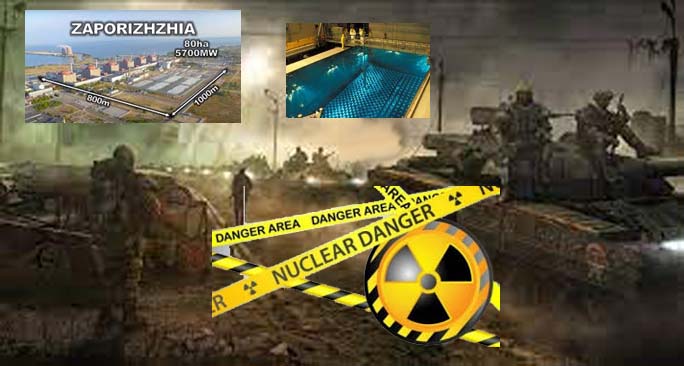
Russian atomic energy agency claim that drone strike damaged Europe’s largest nuclear plant just a ‘propaganda ploy’, Ukraine military says. What we know on day 1,558
- Russia’s state nuclear energy company Rosatom said on Saturday a Ukrainian drone had struck the Russian-controlled Zaporizhzhia nuclear plant, Europe’s largest, but had not caused damage to key equipment. Rosatom’s head Alexei Likhachev called the incident “deliberate” and said it left a hole in the wall of a turbine hall. “This afternoon, a Ukrainian kamikaze combat drone struck the turbine hall building of Power Unit No. 6, resulting in a subsequent detonation,” Likhachev said in a statement.
- The Zaporizhzhia nuclear plant was captured by Russia in March 2022 and remains close to the frontline in the south-eastern Ukrainian Zaporizhzhia region. Kyiv military have denied Russian claims as “yet another propaganda ploy”, saying its troops did not strike power unit No. 6 at the plant. “Ukrainian servicemen act strictly within the international humanitarian law and are fully aware of the consequences of any actions targeting nuclear facilities,” the military said in a statement. “At the relevant section of the frontline, there was no active fighting during the incident, and no weapons were used.”
- The International Atomic Energy Agency (IAEA) on Saturday said it has been informed by the Zaporizhzhia plant that a drone had struck a turbine building at the site. IAEA chief Rafael Grossi expressed serious concern about the reported incident. “Attacking nuclear sites is like playing with fire,” he said. The IAEA’s team has requested access to examine the affected turbine building first-hand, the agency said in an X post.
- Ukrainian drone strikes caused fires at more Russian oil facilities overnight into Saturday, Russian officials said, in what appeared to be the latest attack on Moscow’s oil industry. Authorities in Russia’s Rostov region said falling drone debris sparked a fire that damaged an oil depot and tanker in the port of Taganrog, while officials in the neighbouring Krasnodar region reported a fire breaking out at an oil depot in Armavir for the same reason.
- Ukrainian President Volodymyr Zelenskyy on X noted the Krasnodar attack and said: “We are rightfully bringing the war back to where it came from.”
- Russian tennis players at the French Open about their stance on the war, after her third-round exit at the French Open. Oliynykova lost in straight sets to Russia’s Diana Shnaider. The Ukrainian said players from Russia were allowed to participate in international tournaments even though they openly took part in events sponsored by Russian companies linked to the war effort or even after what she said was promoting the positions of Russia in relation to the war on social media.
1 This Month



26 September – International Day for the Total Elimination of Nuclear Weapons


PLEASE OPPOSE HR 8255 AND S.3639 – bills would accelerate satellite deployment, with no environmental review or safeguards – https://ncstd5li.quorum.us/campaign/169331/
To see nuclear-related stories in greater depth and intensity – go to https://nuclearinformation.wordpress.com
-
Archives
- September 2026 (257)
- August 2026 (330)
- July 2026 (355)
- June 2026 (287)
- May 2026 (306)
- April 2026 (356)
- March 2026 (251)
- February 2026 (267)
- January 2026 (308)
- December 2025 (358)
- November 2025 (359)
- October 2025 (375)
-
Categories
- 1
- 1 NUCLEAR ISSUES
- business and costs
- climate change
- culture and arts
- ENERGY
- environment
- health
- history
- indigenous issues
- Legal
- marketing of nuclear
- media
- opposition to nuclear
- PERSONAL STORIES
- politics
- politics international
- Religion and ethics
- safety
- secrets,lies and civil liberties
- spinbuster
- technology
- Uranium
- wastes
- weapons and war
- Women
- 2 WORLD
- ACTION
- AFRICA
- Atrocities
- AUSTRALIA
- Christina's notes
- Christina's themes
- culture and arts
- Events
- Fuk 2022
- Fuk 2023
- Fukushima 2017
- Fukushima 2018
- fukushima 2019
- Fukushima 2020
- Fukushima 2021
- general
- global warming
- Humour (God we need it)
- Nuclear
- RARE EARTHS
- Reference
- resources – print
- Resources -audiovicual
- Weekly Newsletter
- World
- World Nuclear
- YouTube
-
RSS
Entries RSS
Comments RSS
 nuclear-news