The rise of the military-technology complex
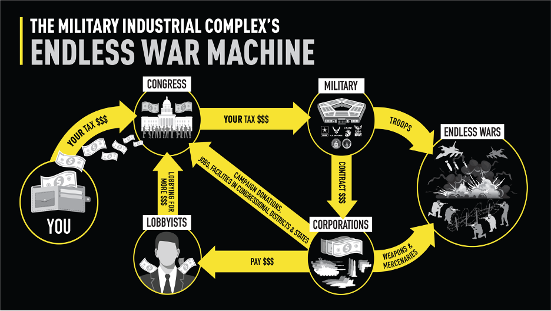
How Silicon Valley tech firms remade US defense contracting. And then opened the Pentagon’s checkbook—wide.
Bulletin, By Bernice Yeung, July 23, 2026
The tale of how the Pentagon lost its spirit of innovation often begins with an incident known as “the Last Supper.”
It was the fall of 1993. About two dozen executives from leading defense contractors had received an unexpected invitation to dinner at the Pentagon. After the meal, the group was ushered into a briefing room where William Perry, then the deputy secretary of defense (and soon, the defense secretary), gave a presentation that startled the room.
In the wake of the Cold War, he said, the defense industry should prepare for catastrophic cuts to military spending. “They should not look at it as a little dip here but as a new low plateau and adjust their plans accordingly,” Perry would later recall.
Within a couple of decades, the US defense industrial base shrank from dozens of firms to today’s so-called Big Five—Lockheed Martin, RTX (formerly Raytheon), General Dynamics, Boeing, and Northrop Grumman, which together receive about a third of the Defense Department’s annual contract obligations.
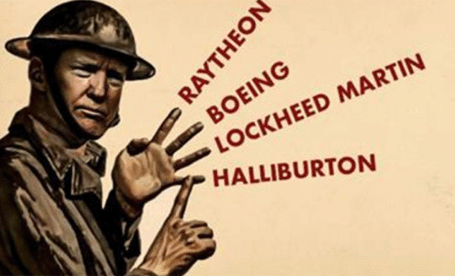

Two decades of defense contractor mergers and acquisitions consolidated the defense industry from more than 75 firms to the Big Five—Lockheed Martin, Boeing, Northrop Grumman, General Dynamics, and Raytheon (now RTX)—also known as “primes.” Chart [on original] by Thomas Gaulkin. Source: NASA, “Final Report of the Commission on the Future of the United States Aerospace Industry”
Silicon Valley executives, like Shyam Sankar of the tech firm Palantir, have pointed to that dinner as the start of a decades-long “decoupling of commercial innovation from defense.” The chill between the Defense Department and Silicon Valley grew so strong that Sankar dubbed it “the Great Schism” in a 4,000-word, viral-among-some manifesto he called The Defense Reformation.
During those years of estrangement, the Pentagon became increasingly entrenched in the status quo, buying and maintaining hulking weapons within a ponderous bureaucracy. Silicon Valley, for its part, dashed ahead with innovations around cybersecurity, artificial intelligence, and product design—though usually to enhance consumer experiences in shopping, gaming, or food delivery.
The distrust and disdain between the two camps grew serious. “There’s plenty of people in Washington in the last 20 years who’ve made a point of how much, you know, they hate us,” Netscape founder-turned-VC-titan Marc Andreessen said in a 2025 podcast.
By the early aughts, there were people in both the Pentagon and Silicon Valley who knew that mending the breach was urgently needed. China’s leaps in technological advancement sounded an alarm in foreign policy circles. In October 2024, Sankar, who is Palantir’s chief technology officer, was still making a case for the reunification of tech and defense when he published the Defense Reformation.
Sankar began the essay by summoning the story of the Last Supper as a way to explain why the country was in a “state of undeclared emergency.” Consolidation had led to the demise of the defense industrial base, he argued. The China threat meant robust innovation adoption at the Pentagon was an imperative. To get there, speed and deregulation were required.
“We need a defense Reformation to … transform the way the government does business,” Sankar wrote.
Sankar and Palantir, the controversial data-mining company that provides AI-enhanced platforms for battlefield analysis, are powerful voices in a growing chorus. Anduril, which makes autonomous weapons systems, issued a 7,000-word decree pushing for policy changes, such as aligning Pentagon tech purchasing with “industry best practices” to “reboot the arsenal of democracy.” Venture capitalists like Andreessen Horowitz are investing upwards of $1 billion in defense tech, demanding deregulation because “America’s most innovative founders are building the tools our warfighters need—but the current system locks them out.”
In the past year, there have been indications that the Silicon Valley crowd is being heard. “Industry has become influential in shaping national security policy, with leading AI companies framing too much regulation as a national security liability,” said Emile Ayoub, senior counsel with the Brennan Center’s Liberty and National Security Program.
Within months of entering office, President Donald Trump issued a flurry of executive orders to accelerate AI adoption and streamline defense buying. To transform the US military into “an ‘AI-first’ warfighting force,” Defense Secretary Pete Hegseth has mandated faster but riskier methods of acquiring frontier technologies. “This is the beginning of an unrelenting onslaught to change the way we do business …………………………………………………………………………………………………
AI-related defense tech contractors have been generous in their financial contributions to elected officials. The support goes well beyond the most conspicuous displays, such as Big Tech’s eye-popping donations to Trump’s re-election campaign, inauguration, and ballroom………………………………….
Between 2022 and 2024, these nine trailblazing AI companies and their employees have increased their campaign contributions by about 60 percent to the members of Congress who control Pentagon policy. Their defense-specific lobbying has jumped from about $650,000 to $7.7 million in the past decade…………
………Simultaneously, the Trump administration has installed a revolving door between defense-tech companies and the Pentagon.
…..If companies move quickly from “concept to combat,” “the Department’s checkbook is open.”
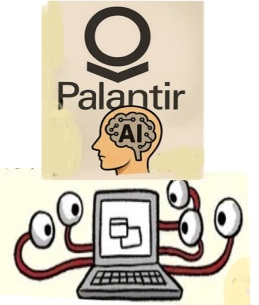
In the past decade, Palantir’s revenue from defense contracts grew by an annual average of 50 percent, among the fastest of any defense firm, according to a Brennan Center analysis. That translates to at least $1.4 billion in defense department payouts since 2008.
Thanks to a surge in work with the military, Palantir became profitable in 2022. And its slice of the Pentagon pie continues to expand. Recently, the Defense Department embedded Palantir’s AI platform, used for battlefield awareness and target recognition, throughout the military. Now, as a “program of record,” Palantir will receive ongoing and long-term funding from the department.
…………………………………………………………………………As the Valley grew into a hub of global capitalism, O’Mara observes, Washington looked to the tech industry as an economic engine and a source of campaign financing. It courted Silicon Valley dollars by offering tax breaks, subsidies, and skilled worker visas and promised to fill classrooms with computers and internet connections.
………………………………………………………………………………………………………………………………….Meanwhile, organizations ranging from the United Nations, to the Pope, to a consortium of nonprofits and academics known as Stop Killer Robots, decry the use of AI in warfare, especially in the deployment of lethal autonomous weapons. They argue that there’s an inherent lack of transparency when the black box of AI models is further obscured by the opaque or classified nature of military operations.
…………………………………………………………………………………………………………………………One of the companies joining this group of Silicon Valley heavy hitters is Reflection AI, a relatively new firm that receives VC funding from 1789 Capital. In yet another example of the red flags around conflicts of interest and self-dealing emerging from the Trump administration, Donald Trump, Jr., the president’s son, is a partner at 1789 Capital—in fact, the lead partner on the deal.
……………………………………………………….o understand what’s driving the renewed relationship between Silicon Valley and the Pentagon, it’s instructive to look at where venture capital is flowing. Between 2024 and 2025, venture capital investments to defense technology nearlydoubled, from about $27 billion to $49 billion, according to PitchBook, a repository of data on capital markets.
The Silicon Valley Defense Group analyzes the prospects of the top VC and private equity-backed defense tech firms, and its 2026 report found that In-Q-Tel is still the largest funder of defense tech. But BlackRock, the world’s largest investment firm, significantly increased its focus on this sector in 2025. Not to be left out, the Big Five have also thrown funding at these companies through their own venture capital arms.
Overall, the Silicon Valley Defense Group observes “seismic” shifts in the sector……………………………………………………………………………………………………………………
Elke Schwarz, a professor at Queen Mary University of London who studies military AI, observed that Silicon Valley has successfully reshaped how the Pentagon does business—and to its benefit.
“With its focus on iteration, agility, risk, speed, and scale, the new defence culture performs both the logics of its new AI products and that of the VC companies that fund the startups,” she writes. “It is a holistic shaping of the environment towards the vectors that make Silicon Valley VC investors enormously rich.”
She adds: “[M]ove fast and break things is not a suitable motto for any conscientious military organization.”
San José State University professor Roberto González has been studying the rise of defense tech from the heart of Silicon Valley. He said there’s an analogy to be made with the California Gold Rush. “That’s just a part of the mentality of this part of the world—you have an opportunity to get rich quick, and you go for it,” said González, author of War Virtually:The Quest to Automate Conflict, Militarize Data, and Predict the Future.
But, he warns, there’s a crucial difference between the two.
“What we’re talking about, in the end, is taxpayer dollars,” González said of the money helping to fuel the defense tech boom. “A lot of the startups will fail. But in the meantime, the pot can just keep growing larger and larger, as long as we can be convinced, as taxpayers, to keep that Pentagon budget growing.” https://thebulletin.org/2026/07/the-rise-of-the-military-technology-complex/?utm_source=ActiveCampaign&utm_medium=email&utm_content=New%20investigation%3A%20The%20rise%20of%20the%20military-technology%20complex&utm_campaign=20260723%20Thursday%20Newsletter
No comments yet.
1 This Month




PLEASE OPPOSE HR 8255 AND S.3639 – bills would accelerate satellite deployment, with no environmental review or safeguards – https://ncstd5li.quorum.us/campaign/169331/
To see nuclear-related stories in greater depth and intensity – go to https://nuclearinformation.wordpress.com
-
Archives
- September 2026 (323)
- August 2026 (330)
- July 2026 (355)
- June 2026 (287)
- May 2026 (306)
- April 2026 (356)
- March 2026 (251)
- February 2026 (267)
- January 2026 (308)
- December 2025 (358)
- November 2025 (359)
- October 2025 (375)
-
Categories
- 1
- 1 NUCLEAR ISSUES
- business and costs
- climate change
- culture and arts
- ENERGY
- environment
- health
- history
- indigenous issues
- Legal
- marketing of nuclear
- media
- opposition to nuclear
- PERSONAL STORIES
- politics
- politics international
- Religion and ethics
- safety
- secrets,lies and civil liberties
- spinbuster
- technology
- Uranium
- wastes
- weapons and war
- Women
- 2 WORLD
- ACTION
- AFRICA
- Atrocities
- AUSTRALIA
- Christina's notes
- Christina's themes
- culture and arts
- Events
- Fuk 2022
- Fuk 2023
- Fukushima 2017
- Fukushima 2018
- fukushima 2019
- Fukushima 2020
- Fukushima 2021
- general
- global warming
- Humour (God we need it)
- Nuclear
- RARE EARTHS
- Reference
- resources – print
- Resources -audiovicual
- Weekly Newsletter
- World
- World Nuclear
- YouTube
-
RSS
Entries RSS
Comments RSS


Leave a comment