The World Has Rendered Its Verdict on American Power
June 2, 2026, https://scheerpost.com/2026/06/02/the-world-has-rendered-its-verdict-on-american-power/
The World Is Voting With Its Opinion — And Washington Won’t Like the Results
For decades, U.S. leaders spoke as if history had already been settled. The Soviet Union had fallen, American power was unmatched, and the world would eventually follow Washington’s political and economic model. But a remarkable new international survey suggests that era may be ending — and ending far faster than many in the West are willing to admit.
According to the 2026 Democracy Perception Index, which surveyed tens of thousands of people across 84 countries, a majority of respondents now view the United States as the greatest threat to global peace and stability. Even more striking, people in most surveyed nations say they view China more favorably than the United States.
These findings do not come from Beijing or Moscow. The survey was conducted by the Alliance of Democracies, a Western organization backed by European institutions, major corporations, and figures closely associated with NATO. Yet the results paint a picture of a rapidly changing world order in which America’s endless wars, military footprint, economic coercion, and support for controversial foreign interventions have severely damaged its global standing.
As Washington escalates confrontations abroad—from Iran and China to renewed military tensions across multiple regions—the rest of the world appears increasingly skeptical of U.S. claims to moral leadership. The survey also reveals a growing divide between how Western elites define democracy and how much of the world understands it. While American political discourse often emphasizes electoral procedures and individual rights, many respondents defined democracy more simply: a government that improves people’s lives, delivers economic security, and promotes social well-being.
Whether one agrees with these conclusions or not, the message is difficult to ignore. The unipolar moment that followed the Cold War is fading. The assumption that the United States would remain the unquestioned center of global power is being challenged not only by rival governments but by public opinion itself.
The real question may no longer be whether the world is changing, but whether Washington is capable of recognizing that change before its credibility erodes even further.
The Disappearing Aid Check: The Future of US–Israel Defense Support
What top Israeli officials — including Prime Minister Benjamin Netanyahu — are quietly backing is not a reduction in American support, but a reorganization of it: shifting billions in resources from State Department–administered foreign aid grants into general Pentagon procurement accounts, industrial partnerships, and sustainment pipelines. The shift will strip away the political and diplomatic oversight mechanisms that make the relationship publicly accountable, moving it from a visible annual aid vote into the opaque machinery of defense acquisition, where oversight is limited and political accountability is minimal. The result would be a defense relationship that is simultaneously deeper and less transparent.
Quincy Institute for Responsible Statecraft, Steven Simon, May 26, 2026
Executive Summary
The United States and Israel are now approaching the renegotiation of their 10-year defense Memorandum of Understanding, or MOU. Israeli officials have said they want to phase out US military grant aid — a position that sounds like a step toward ending US military assistance to Israel. It is not.
What top Israeli officials — including Prime Minister Benjamin Netanyahu — are quietly backing is not a reduction in American support, but a reorganization of it: shifting billions in resources from State Department–administered foreign aid grants into general Pentagon procurement accounts, industrial partnerships, and sustainment pipelines. The shift will strip away the political and diplomatic oversight mechanisms that make the relationship publicly accountable, moving it from a visible annual aid vote into the opaque machinery of defense acquisition, where oversight is limited and political accountability is minimal. The result would be a defense relationship that is simultaneously deeper and less transparent.
Since fiscal year 2019, the United States has provided $3.3 billion per year in Foreign Military Financing, or FMF, grants to Israel, plus an additional $500 million per year for missile defense cooperation. About 25 percent of this FMF grant money has gone toward offshore procurement, or OSP, funds allocated to Israel to spend domestically on its own defense industry and military equipment. Effectively, it is a US subsidy for Israel’s military industrial complex.
This OSP precedent is slated to end with the expiration of the current MOU. This has fueled Israeli proposals to phase out FMF grants altogether, replacing them with a relationship centered on US–Israeli defense integration. This would embed Israeli firms and Israeli–origin intellectual property inside larger Pentagon programs and production. Unlike the foreign assistance process, the military procurement framework would not be subject to the political scrutiny of Congress and the State Department, but would be evaluated on bureaucratic criteria such as cost, readiness, and capability. This shift would likely be justified by reframing US support not as a handout to Israel, but as an investment in American military readiness, industrial capacity, and jobs.
At a time when the US–Israel relationship should be scrutinized in light of Israeli actions that run counter to US interests, such a structural shift would be counterproductive. To avoid this outcome, any procurement-centered relationship should meet these three basic requirements:
- Clear metrics to assess whether Israeli participation in Pentagon programs serves US defense requirements.
- Program-level transparency regarding the existence, scale, cost, and rationale of each procurement program.
- Cross-committee coordination in Congress to ensure visibility and accountability to non-military congressional oversight committees.
The current deal — and why it is running out of road
This brief explains what the shift in US aid for Israel means: where the money actually goes, who controls it, who benefits, and why the standard debate about ending aid misses the consequential change.1……………………………………………………………………………………………………………………………………………………………………
What “ending aid” actually means
…………………………………. ending aid in this context does not mean ending US financial support for Israel’s military and defense sector. It means changing the institutional form through which that support is delivered. The concept, in effect, is not to reduce support for Israel’s military; it is to shift it from the foreign-operations budget and the State Department’s oversight to the Pentagon’s procurement, research and development, industrial base, and sustainment machinery…………………………………………………………………………………………………………………
The new architecture — how money moves in a defense-industrial model
To understand what replaces the grant, it helps to understand how the Pentagon actually spends money on defense cooperation, and why that process looks so different from foreign aid…………………………………………………………………………………………………………………………………………………………………………………………………………………………………………………………………………….
Conclusion — quieter does not mean smaller
The post-2028 US–Israel defense relationship will likely be recast to reduce its political profile. The annual aid vote, one of the most predictably contentious moments in future US foreign-policy debates, may fade away, replaced by procurement decisions that attract little public attention and even less organized opposition. Israeli officials will be able to claim, accurately in formal terms, that Israel no longer receives American aid. American officials will be able to defend the spending as investment in US readiness rather than largesse to a foreign partner…………………………………………………….
For observers trying to understand US–Israel relations, the practical implication is methodological. The aid vote is no longer the right place to look. Instead, the key data will be located in the procurement budget, industrial-base investments, sustainment pipeline, IP licensing arrangements, and workshare provisions. The consequential decisions will be made in those domains.
Annex: Key terms and reference figures………………………………https://quincyinst.org/research/the-disappearing-aid-check-the-future-of-us-israel-defense-support/?ct=t(EMAIL_CAMPAIGN_1_21_2025_13_26_COPY_01)&mc_cid=3131e3a216#h-annex-key-terms-and-reference-figures
Step forward in £4.6 billion Sellafield nuclear decommissioning programme
Hundreds of delegates gathered for an event which saw SMEs meet with
industry leaders to discuss how a £4.6 billion programme of work will be
delivered over the next 15 years. The Decommissioning Nuclear Waste
Partnership Supply Chain Engagement event saw dozens of SMEs meet with DNWP
partners, Sellafield leaders, and the wider supply chain. The full-day
event at Energus, at Lillyhall, near Workington, gave suppliers early
visibility of upcoming opportunities in the decommissioning process. They
had direct access to buyers, project teams and decision-makers, and were
given a clear understanding of how work will flow. The event was organised
by Industrial Solutions Hub (iSH) in collaboration with the BECBC Nuclear
Sector Group.
Business Crack 3rd June 2026, https://businesscrack.co.uk/2026/06/03/step-forward-in-4-6-billion-sellafield-nuclear-decommissioning-programme/
A safer nuclear fuel is gaining steam — but cost remains a hurdle

New U.S. regulations and a wave of startup interest are breathing new life into TRISO-fueled reactors, which have struggled to take off due to high fuel costs.
Canary Media, By Alexander C. Kaufman, 2 June 2026
As the U.S. looks to revive its stagnant nuclear industry, a group of companies is racing to realize the promise of a “meltdown-proof” fuel that for decades has struggled to progress beyond federal lab experiments.
Tri-structural isotropic fuel, known as TRISO, is safer and more stable than the fuel rods used by the large-scale water-cooled reactors that make up the vast majority of the world’s nuclear power plants. Both fuel sources use enriched uranium, but in TRISO, the element is balled into poppyseed-sized spheres with ceramic coating that can absorb dangerous radioactive materials.
The hitch is the cost: TRISO is orders of magnitude more expensive than conventional assemblies of low-enriched uranium. Given that hefty price tag, only a few TRISO-fueled reactors have ever been built worldwide, even though the technology has existed for years and the world is hungry for nuclear projects that promise to avoid the worst accidents of the past…………………………………………………………………………………………………………………………………………………………………………………
Companies looking to go the route of microreactors and small modular reactors, however, face not only the challenges that plague large-scale reactors, such as pushback over radioactive waste and costly fuel sources, but new ones, too. For TRISO, those challenges are cost and an immature supply chain — plus the fact that the fuel’s performance remains largely untested at any commercial scale……………………………………https://www.canarymedia.com/articles/nuclear/safer-nuclear-fuel-gaining-steam
Trump blasts Netanyahu as Iran Talks Stall over Beirut
Juan Cole, 06/02/2026, https://www.juancole.com/2026/06/blasts-netanyahu-beirut.html
Ann Arbor (Informed Comment) – Monday began with a statement issued by the Iranian Ministry of Foreign Affairs cautioning that the United States and Israel, by their egregious violations of the ceasefire concluded on April 8, are jeopardizing the ongoing talks aimed at achieving an armistice. The ministry, which is headed by Abbas Araghchi, underlined that the ceasefire involved a cessation of hostilities on all fronts.
The ministry accused the United States of repeatedly violating the ceasefire by its attacks on commercial Iranian shipping. Moreover, it said, Israel has grossly violated the ceasefire by launching a vicious attack on Lebanon, violating its sovereignty and killing or wounding thousands of Lebanese and displacing two million, while destroying essential infrastructure.
The ministry said that the US has a direct responsibility to cease attacking Iranian shipping and an indirect responsibility to rein in the Israel atrocities, warning that Iran will take measures to act in self-defense to ensure its interests.
The Tasnim news agency, which is close to the Iranian Revolutionary Guards Corps, reported that these violations of the ceasefire, especially the Israeli invasion and devastation of south Lebanon, had led the Iranian side to cease all talks and the exchange of texts through mediators.
The agency said that the Iranian government insists on the end of Israeli operations in Gaza and Lebanon and its complete withdrawal from Lebanon. Otherwise there will be no further dialogue with the United States.
Moreover, the report said, Iran is determined to block the Strait of Hormuz completely, and to activate further fronts, including the Bab al-Mandeb or “Strait of Tears” at the mouth of the Red Sea. The Red Sea has been an alternative route for shipping, including of oil and gas, given the closure of the Persian Gulf.
The official status of these threats is unclear, according to BBC Monitoring .
Israel has sent troops deep into Lebanon and has expelled some 275,000 people from the metropolitan area of the coastal city of Tyre in the south, making threats to level the suburbs of Beirut where Shia Muslims predominate and to bomb the Lebanese capital. Hezbollah has continued to fight back against the Israeli invasion, showering northern Israel with rockets and sometimes managing to kill or wound Israeli troops and to take out Merkava tanks.
Asked about these reports of a halt to negotiations by CNBC’s Eamon Javers, President Donald J. Trump replied , “I don’t care if they’re over, honestly.” In case the message wasn’t clear, he repeated, “I really don’t care. I couldn’t care less.” He complained that the talks had “started to get very boring.”
Trump attempted to intervene in reality by Tweet, saying he would ask Israeli Prime Minister Benjamin Netanyahu “what’s going on with Lebanon.” He thundered, “There will be no Troops going to Beirut, and any Troops that are on their way, have already been turned back.”
He claimed to have spoken to Hezbollah indirectly, saying, “they agreed that all shooting will stop — That Israel will not attack them, and they will not attack Israel.”
Netanyahu remained defiant, boasting of having taken the Crusader castle Beaufort and threatening, “if Hezbollah does not cease attacking our cities and citizens—Israel will attack terror targets in Beirut. This stance of ours remains unchanged. In parallel, the IDF will continue to operate as planned in southern Lebanon.”
Barak Ravid at Axios reported that according to a US official, Trump’s phone call to Netanyahu was explosive, with the American president “pissed off” about Netanyahu’s threat to bomb Beirut. Ravid reports that his source alleged Trump told the prime minister, “You’re fucking crazy. You’d be in prison if it weren’t for me. I’m saving your ass. Everybody hates you now. Everybody hates Israel because of this.”
Trump for his part insisted that the negotiations with Iran were continuing “at a rapid pace.”
Many energy analysts believe that if the closure of the Strait of Hormuz continues through the summer, by September we could see $200 a barrel petroleum and a severe global economic recession. The consequent economic crisis domestically could produce a blue wave, i.e. a big Democratic victory in the midterms, which would hobble Trump in his final two years in the White House.
Israeli Authorities Refuse To Return Massive Trove Of Oct 7 Video. What Are They Hiding?

June 1, 2026, Michelle Witte· The Grayzone, https://scheerpost.com/2026/06/01/israeli-authorities-refuse-to-return-massive-trove-of-oct-7-video-what-are-they-hiding/
Israeli citizens wonder why the state won’t return October 7 footage it confiscated from them. The mother of an Israeli victim says authorities deleted video of her son’s death. Others complain “someone is hiding” the videos.
The Israeli government is still holding a massive trove of video documentation of the Oct. 7 attack captured by individuals and communities caught up in the fighting. One bereaved parent even accuses Israeli authorities of deleting a video of her son’s last moments before returning his phone to her.
According to Israel’s Channel 13, “all the cameras, memory cards and films that documented the atrocities were collected, but two and a half years later, these materials have not been returned to the communities and bereaved families who are desperate for information, and even feel that someone is hiding it from them.”
Soon after Hamas and Palestinian Islamic Jihad’s attack on Israel on Oct. 7, 2023, special units from the IDF, the Israeli intelligence agency Shin Bet and Israel’s investigation unit Lahav 433 collected photo and video documentation of the violence, confiscating cell phones, individual cameras, kibbutz security cameras and more.
“They disconnected what was needed, took it and moved on – that was the last time we saw the materials,” said an Israeli army reservist who participated in the collection mission.
According to the head of the Kfar Aza kibbutz – the site of a number of a series of atrocity hoaxes spun out in the early days after the attack – community members cooperated with investigators at the time. Now, years after the events, these families are wondering why documentation of their loved ones’ fates has yet to be returned to them.
Even Sabine Taasa, who was made an emblem of Israeli victimhood after her husband and one of her sons were killed on Oct. 7, is now clashing with Israeli authorities over footage of that day.
Taasa’s 17-year-old son, Or, was killed on Zikim beach. According to Channel 13, Taasa says she saw a video her son filmed in the moments leading up to his death, but when authorities returned his phone to her, no such video remained. The outlet says this is not an isolated incident.
An IDF probe found that soldiers abandoned civilians hiding in a bathroom there and then left their bodies for a week.
Channel 13 reports that Israeli police claimed Lahav 433 is still investigating the events in kibbutz Kfar Aza and no indictments have yet been filed, so returning evidence at this stage could jeopardize their criminal case. Meanwhile, the IDF rejected all accusations that it is withholding documentation and says it is in the final stages of adopting policies for how this type of evidence will be returned to communities and families.
On October 7, the Israeli government issued video Hannibal Directive orders which led Apache helicopter pilots and tank gunners to take aim at Israel’s own citizens in the Gaza envelope, supposedly to prevent them from being taken hostage. Israeli Brig. Gen. Barak Hiram personally ordered a tank crew to shell a home in Kibbutz Be’eri, knowing it was filled with Israeli citizens who had been taken captive by Hamas fighters seeking to negotiate a way out of the standoff. A dozen Israelis were killed in the strike, leaving behind “a house full of corpses,” according to the lone Israeli survivor. One Israeli tank gunner from an all-female unit similarly revealed that she was ordered to shell Israeli homes without knowing who was inside. An Israeli police investigation subsequently revealed that Israeli helicopters shelled the Nova Electronic Music festival on October 7.
Given Israel’s track record of targeting its own citizens on October 7 and misleading the public about it, the Israeli state might be holding on to as much video as possible to ensure no further evidence of the Israeli army massacring its own citizens is made public.
Israel has demonstrated a keen interest in collecting documentation of the events of October 7 and controlling narratives through careful curation and dissemination. At the same time, it has refused to participate in independent, international investigations of the attack, Israel’s response, or the widely distributed and now widely debunked claims of mass sexual violence by Hamas and other Palestinian militant groups. According to the Israeli state, Israel and Israel alone is justified in and capable of conducting such probes.
However, the state has strangely neglected to launch its own comprehensive special investigation into the apparent massive intelligence failure and military debacle. In fact, the Israeli government has had to be prodded by its own high court to establish a state commission of inquiry into the events, according to reporting by the Times of Israel. The Israeli government now has until July 1 to come up with a “suitable framework” to investigate the events, following years of pressure by the families of Israelis killed that day.
With the Israeli military-intelligence apparatus refusing to return possibly hundreds of hours of footage to its owners, some Israelis who lived through the October 7 attacks are beginning to wonder if they could be hiding something.
Michelle Witte is a writer, editor and broadcaster who previously co-hosted the news radio show, “Political Misfits.”
Trump Finally Admits Aloud: “We Shouldn’t Have Been in Iran”
June 1, 2026 Joshua Scheer, https://scheerpost.com/2026/06/01/trump-finally-admits-aloud-we-shouldnt-have-been-in-iran/
Donald Trump may have delivered the most honest assessment of the Iran War yet — entirely by accident.
In an interview conducted not by a journalist but by his daughter-in-law on Fox News, Trump stumbled into a confession that cuts through months of White House triumphalism, media cheerleading, and endless declarations of victory. After boasting that Iran’s navy was “100% gone,” its air force was “100% gone,” and that the United States had effectively defeated the country militarily, Trump casually admitted something extraordinary:
“We should not have been in Iran.”
There it was. Buried beneath the bluster, threats, and self-congratulation was the truth opponents of the war have been shouting since the first bombs fell.
The problem is that Trump wasn’t offering a reckoning. He wasn’t acknowledging the thousands killed, the billions spent, the global economic disruption, or the dangerous precedent of launching another war based on claims that Iran was racing toward a nuclear weapon despite years of intelligence assessments saying otherwise. Instead, he delivered the admission while simultaneously threatening to “finish it off militarily” if negotiations fail.
This is the defining contradiction of American empire. Leaders admit the wars were mistakes only after they’ve launched them. They acknowledge the disasters while preparing the next escalation. Iraq was a mistake. Afghanistan was a mistake. Libya was a mistake. Yet the machinery that produced those catastrophes continues to operate exactly as designed.
Trump’s interview wasn’t merely a display of contradiction. It was a rare glimpse into a political system so detached from accountability that a president can openly admit a war should never have happened while still insisting it was necessary, successful, and ready to resume at any moment.
For the families burying loved ones, for Americans paying the bill, and for a region left smoldering in the wake of another U.S. intervention, that isn’t leadership.
It’s a confession.
Ukraine’s military has a real Nazi problem
It also desecrates the memory of Nazism’s victims in Ukraine: 1.5 million Jews murdered in the Holocaust, along with millions of Slavs, prisoners of war, Roma, the mentally ill, forced laborers, and countless others consumed by the machinery of racial extermination and exploitation.
In their zeal to deconstruct Russian propaganda, Western elites have tried to hide the fact there are Third Reich extremists among Kyiv’s ranks.
Marta Havryshko, Jun 02, 2026, https://responsiblestatecraft.org/nazis-in-ukraine-military/?mc_cid=044f4b8379
When Vladimir Putin launched his invasion of Ukraine in February 2022, he claimed one of his goals was the country’s “denazification.” The Kremlin still uses this narrative as a cornerstone of its war propaganda.
Both Ukraine and the West reacted by dismissing the claim outright as a cynical abuse of Holocaust history. Politicians, media outlets, academics, and educational institutions rushed to prove that Putin’s argument was fraudulent.
But in their zeal to deconstruct Russian propaganda, Western elites created a propaganda myth of their own: there are no Nazis in Ukraine. Or, if there are, they are supposedly isolated cranks with no influence.
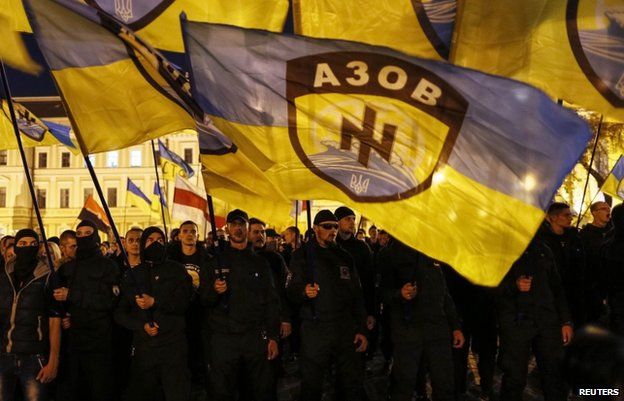
This fiction required the whitewashing of Azov, a unit founded in 2014 by the neo-Nazi group Patriot of Ukraine under the leadership of Andriy Biletsky. Azov became notorious for extremist ideology, Nazi symbolism, and allegations of war crimes in the Donbas. In 2018, the U.S. Congress banned the group from receiving American weapons, funding, or training.
After Russia’s full-scale invasion, that stigma vanished almost overnight. Kyiv repackaged Azov, separating the most radical elements into a new formation, the 3rd Assault Brigade. Western media rebranded and whitewashed it. The language of “de-radicalization” and “depoliticization” became mainstream. Questioning this narrative became taboo and labeled as “Russian propaganda.” The result is a culture of deliberate silence.
Neo-Nazi networks are deeply embedded in parts of Ukraine’s military structure. Their presence is visible in units such as Azov, the Third Assault Brigade, the Russian Volunteer Corps, Bratstvo, the German Volunteer Corps, Karpatska Sich, and others. Yet Ukraine’s Western backers continue to arm, fund, and train these units without meaningful scrutiny.
Even more striking is the normalization of Nazi imagery itself. Official Ukrainian military channels and mainstream media regularly publish images of soldiers wearing swastikas, Waffen-SS insignia, and patches linked to neo-Nazi groups like Combat 18 and Misanthropic Division. This is no longer treated as scandalous. It has been normalized.
Most disturbing of all, some Ukrainian military units have incorporated Nazi-linked symbols into their official insignia.
The far right and Ukraine’s military culture
Many Ukrainian military units using Nazi symbols are led by men shaped by Azov and the far-right milieu around it. For example, there is Oleksandr Kravtsov, the well-known commander of the Vedmedi unit, which was part of Azov. His body is covered in Nazi imagery, including 1488 — references to the white supremacist “14 Words” slogan coined by David Lane and the coded salute “Heil Hitler.” (“H” is the eighth letter of the alphabet.) Tattooed across his chest is the SS motto: “My Honor Is Loyalty.” He turned that slogan into the motto of his own unit. SS lightning bolts became part of its official insignia.
After returning from Russian captivity, Kravtsov’s unit was folded into the Ukrainian military structure — first the 36th Brigade, then the 39th Coastal Defense Brigade. Nothing changed. The SS symbols and motto remained.
Many commanders in the 3rd Assault Brigade also came out of Azov and still hold extremist views. Unsurprisingly, they openly embrace the corresponding symbolism. A subunit of the 3rd Assault Brigade adopted a modified insignia (replacing two grenades with three) of the Dirlewanger SS Brigade — one of the most notorious Nazi formations of World War II. In 2025, the brigade unveiled the emblem publicly at a memorial in Kyiv. No scandal followed.
Azov also normalized the Black Sun — a symbol born in Himmler’s SS cult headquarters at Wewelsburg Castle and now used globally by neo-Nazis and white supremacist terrorists, including the 2019 Christchurch mosque terrorist in New Zealand and the recent San Diego Islamic Center shooter.

After 2022, Black Sun spread rapidly through Ukrainian military culture. It appeared in Azov-linked units such as the Decepticons platoon and the Mortars unit of the 3rd Assault Brigade. Soon it migrated further — into units with no openly ideological profile at all — and became part of the insignia of the 156th Zvaha Battalion and the Unmanned Systems Battalion of the 110th Brigade named after Marko Bezruchko.
Azov mainstreamed another Nazi-linked emblem as well: the Wolfsangel, used historically by several Waffen-SS divisions. Rebranded as the “Idea of the Nation,” it became one of the most recognizable symbols in Ukraine’s wartime military culture. The symbol now appears far beyond Azov itself. The newly created Nachtigall Battalion — named after the Nachtigall Battalion formed by German military intelligence in 1941 — uses the same Wolfsangel-inspired insignia.
Some units within Ukraine’s military do not hide their fascination with the Third Reich’s military culture. For example, the 422nd Regiment of Unmanned Systems calls itself “Luftwaffe” and uses virtually the same eagle as Hitler’s air force. Its commander, Mykola Kolesnyk, regularly appears with the symbol on patches and clothing. The unit even sells merchandise featuring the Nazi eagle — hoodies, mugs, T-shirts, caps, keychains — to fundraise for the war.
Not just aesthetic choices
The use of Nazi symbols in Ukraine’s military is not merely an aesthetic problem. It is moral, political, historical, and legal.
First, it represents a form of historical revisionism and the gradual rehabilitation of Nazism itself — a direct challenge to the postwar Western consensus built on the memory of World War II. Within far-right military culture, Nazi imagery is often wrapped in romanticized narratives about anti-Soviet struggle. In practice this trivializes the sacrifice of the seven million Ukrainians who fought Nazism in the ranks of the Red Army alongside the Western allies (in contrast to the 300,000 who served in various military formations and police units on the side of Nazi Germany).
Second, the problem is not only historical. It is profoundly contemporary. Every SS rune, Black Sun, or Wolfsangel displayed by Ukrainian soldiers hands the Kremlin another propaganda victory. Russian propagandists do not need to invent imaginary Nazis in Kyiv. They simply point to the insignia openly worn by some of Ukraine’s most celebrated military units — including formations branded as “elite,” such as the 3rd Assault Brigade.
Third, there is also a glaring legal contradiction. By openly using Nazi imagery, these units violate Ukraine’s own 2015 memory laws, which explicitly ban the propaganda of the Nazi regime and the public use of its symbols. The law describes such acts as an insult to the memory of millions of victims and have penalties of up to five years in prison.
Yet no one is prosecuted.
Why?
Because the Zelensky government — and President Volodymyr Zelensky himself as commander-in-chief — have made a political bargain with the far right. Since 2022, far-right activists and networks have flooded into the security and defense sector. In conditions of total war and chronic manpower shortages, this alliance became politically convenient, perhaps even inevitable. Now it is becoming entrenched.
The state depends on radicalized military formations for manpower and battlefield effectiveness. The far right, in turn, receives legitimacy, weapons, influence, and institutional protection. What emerged from wartime necessity is evolving into mutual dependence.
Ukraine’s Western partners have made their own bargain. They, too, depend on Ukrainian manpower to weaken Russia. And so they tolerate extremists inside Ukraine’s armed forces as long as those extremists continue fighting. More than that, they remain largely silent about the ideology and symbols involved, because acknowledging them would mean admitting an uncomfortable truth — that the neo-Nazi problem in Ukraine is not simply a Kremlin invention.
Marta Havryshko is a U.S.-based author and researcher focused on Ukrainian nationalism, the far right, and the Russo-Ukrainian War. Havryshko holds a PhD in History from the Ivan Franko National University of Lviv in Ukraine.
The Karaganov Fallacy – Nuclear strike against Europe IS NOT the right answer for Russia
Karaganov advocates preemptive Russian nuclear strikes against a Europe he deems bellicose, banking on American passivity. Scott Ritter believes conventional missiles, not nukes, are the only credible path.
warlike ruminations by some of NATO’s leading military minds do not exist in a vacuum but rather are reflective of a general posture of war preparation being promoted by the NATO alliance itself. Just ask Mark Rutte, the NATO Secretary General, who recently warned that NATO was in a race against time when it came to preparing for an inevitable war with Russia.
the true lesson is that nuclear wars cannot be won, should never be fought, and as such nuclear weapons should be done away altogether to avoid falling into intellectual traps such as the one offered by Karaganov, where their use is deemed possible.
Mon 01 Jun 2026, Scott Ritter, https://forumgeopolitica.com/article/the-karaganov-fallacy
Editor’s Note : After publishing our article “Is 1914 repeating itself? Will war between Europe and Russia finally break out openly?” where we discussed – among others – the nuclear doctrine of the Russian Federeation and also the Karaganov doctrin, Dmitry Orlov published the article «How to survive a Russian tactical nuclear strike». In today’s article Scott Ritter analyses the Karaganov doctrine and argues that nuclear weapons are not the right tools for Russia.
Back in the late 1970’s and early 1980’s, the Wallstreet brokerage firm, E.F. Hutton, came up with one of the most iconic television ad campaigns in history, built around the catch phrase “When E.F. Hutton speaks, people listen.”
Sergei Karaganov is the Russian analog to E.F. Hutton—when Karaganov speaks, people listen. The 73-year old political scientist, who currently heads the Council for Foreign and Defense Policy and serves as the dean of the Faculty of World Economy and International Affairs at Moscow’s Higher School of Economics, has advised both post-Soviet era Russian Presidents, Boris Yeltsin and Vladimir Putin, and his opinion continues to carry weight among the senior-most decision making circles of the Russian government.
Karaganov has, for the past several years, been warning about the growing threat to Russia from NATO, and in particular the European nations of NATO who have constructed a world view which postulates Russia as an existential threat which must be decisively confronted and defeated.
In this Karaganov is not wrong.
The language of the Europeans is self-indicting.
According to a newly published German military strategy, Russia represents “the greatest and most immediate threat for the foreseeable future” to Germany and transatlantic security. The classified strategy concludes by declaring “Russia is laying the groundwork for a military attack on NATO member states.”
Germany’s chief of defense, General Carsten Breuer furthered this argument in a 2025 statement to the media where he noted that “There’s an intent and there’s a buildup of the stocks” by Russia for a possible future attack on Nato’s Baltic state members.
Brueuer and Germany’s defense minister, Boris Pistorious, are using the threat from Russia as an excuse for the rearmament of Germany, with the goal of making the German army the most powerful in Europe by 2029.
Why that date?
According to General Breuer, this is when Russia will attack Europe. “This is what the analysts are assessing,” Breuer said, “in 2029. So we have to be ready by 2029.”
The German analysis is nearly identical to that of their British allies. Former Chief of the General Staff, General Sir Patrick Sanders, who retired in the summer of 2025, has warned that a war with Putin was a “realistic possibility” by 2030. “If Russia stops fighting in Ukraine,” Sanders told the British media, “you get to a position where within a matter of months they will have the capability to conduct a limited attack on a NATO member that we will be responsible for supporting, and that happens by 2030.”
These warlike ruminations by some of NATO’s leading military minds do not exist in a vacuum but rather are reflective of a general posture of war preparation being promoted by the NATO alliance itself. Just ask Mark Rutte, the NATO Secretary General, who recently warned that NATO was in a race against time when it came to preparing for an inevitable war with Russia. “We are Russia’s next target,” Rutte said. “I fear that too many are quietly complacent. Too many don’t feel the urgency. And too many believe that time is on our side. It is not. The time for action is now. Conflict is at our door. Russia has brought war back to Europe. And we must be prepared. Russia has brought war back to Europe. We must be prepared for the scale of war our grandparents and great-grandparents endured.”
The rhetoric of Breuer, Sanders and Rutte lends itself to an argument where the nations of NATO are responding to Russian aggression. But one must not be fooled into believing that aggression is a one-way street. Enter, stage left, Lithuanian Foreign Minister Kestutis Budrys, who recently opined that “We [NATO] must show the Russians that we can break through the small fortress they have built in Kaliningrad. NATO has the means to flatten Russian air defense bases and missile systems if necessary.”
Budrys’ lunacy, which even if successful would amount to little more than the collective suicide of NATO, didn’t appear from a vacuum, but rather echoed similar sentiment expressed by General Chris Donahue of the US Army, who serves as the commander of US forces in Europe. Donahue bragged that Kaliningrad, Russia, is approximately 47 miles wide and surrounded by NATO on all sides. He claimed that NATO and the US Army now have the capability to “take that down from the ground in a timeframe that is unheard of and faster than we’ve ever been able to do.” Donahue went on: “We’ve already planned that and we’ve already developed it.”
In many ways, Donahue’s bluster is far more embarrassing that the pugilistic nonsense espoused by his NATO colleagues, if for no other reason than he more than anyone should know both the extreme limitations of US and NATO power (something demonstrated very publicly with the recent US failed aggression against Iran) and the consequences of any NATO attack on Kaliningrad, which would be immediately fatal to Donahue, his staff, and the entire leadership of NATO, given the inevitability and severity of the anticipated Russian retaliation.
And therein lies the rub. NATO’s jingoistic rhetoric aside, there is no conventional military power in Europe, whether singularly or collectively, which poses an existential threat to Russia. Recent NATO military exercises demonstrated just how inexperienced NATO ground forces were in modern combat operations incorporating drone warfare on any appreciative scale. Imagine for a moment a NATO Brigade running into a Rubicon detachment on the battlefield. The results would be as one-sided as they would be fatal to the defeated party, which would in every scenario imaginable be the NATO forces.
The words of Breuer, Sanders, Rutte, Budrys, and Donahue amplify one universal constant when it comes to NATO today: militarily it is very much a paper tiger, incapable of sustained intensive ground combat at any appreciable level. The warlike verbiage spouted by these mouthpieces of mayhem is simply a desperate plea for relevancy in an effort to mobilize public support for a militarization campaign requiring energizing both populations and industry in a way hitherto fore unimaginable in post-Cold War Europe, and for all sense and purposes impossible to achieve today.
As the fictional Commander, Air Group (CAG) told Tom Cruise’s Maverick in the first Top Gun movie, “Son, your mouth is writing checks your body can’t cash.”
Welcome to the NATO collective today.
While Sergei Karaganov and his fellow Russian hardliners are more than justified in taking extreme umbrage at the warlike posturing Europe is assuming today in opposition to Russia, the reality is Europe poses absolutely no threat whatsoever to Russia as things currently stand, and the probability of Europe overcoming the sizeable political and economic hurdles required to build a military force capable of surviving on a Russian battlefield, let alone prevailing, is slim to none.
More worrisome, however, is the nuclear posturing being done by certain NATO countries to compensate for the alliance’s extreme shortcomings regarding conventional military power projection. This nuclear flexing has taken on an even greater urgency now that President Trump’s hostile ambivalence toward NATO and European security throws into question America’s commitment to fulfilling any hypothetical Article 5 scenario—a stance which simultaneously throws into question the reliability of America’s nuclear umbrella. France and the United Kingdom are working to create a joint nuclear doctrine to offset the loss of America’s nuclear arsenal, and both nations are in active discussions with other NATO members to extend their respective nuclear umbrellas over the Arctic, the Baltics, Poland and Germany.
Sergei Karaganov famously postulated that no American President would be willing to trade Boston for Poznan, meaning that if Russia were to hypothetically attack this unfortunate Polish urban center with a nuclear weapon, the United States would not respond in kind.
This, of course, is the kind of hypothesis that should never be tested and, given the fact that Russia faces no threat of an existential nature from the European collective, has zero justification for even being contemplated being tested.
Russia, together with the other major nuclear weapons states (the US, China, UK and France) co-signed a joint statement in early 2022 which affirmed that a nuclear war cannot be won and must never be fought. The statement went on to declare that “As nuclear use would have far-reaching consequences, we also affirm that nuclear weapons—for as long as they continue to exist—should serve defensive purposes, deter aggression, and prevent war.”
Russia has not officially renounced that joint declaration, which on the surface would indicate that the Karaganov initiative to preemptively use nuclear weapons against Europe has zero viability when it comes to reflecting official Russian policy.
There is, of course, one major problem—Karaganov was instrumental in crafting the 2025 nuclear posture for the Russian Federation, which in part declared that nuclear weapons could come into play in situations where conventional forces are insufficient to deter an opponent or achieve a military objective. So far, the SMO in and of itself does not meet the criteria for preemptive nuclear weapons usage. Whether a large-scale conventional war with NATO would cross this threshold is a separate matter.
But the situation Russia faces today, which Karaganov addresses, involves a nuclear armed power aiding a non-nuclear armed state to launch conventional attacks on Russia that could pose an existential threat. This is, of course, the very definition of what the ongoing proxy conflict between Russia and the collective West over Ukraine is, especially when it comes to the ongoing NATO-backed campaign of drone strikes against strategic Russian targets.
It’s not just Karaganov who is crying foul. Dmitri Polyansky, the Russian Ambassador to the OSCE, noting that the ongoing Ukrainian drone strikes against Russia are only possible with Western military expertise, technology, and intelligence, recently declared that it might already be “too late” to avert a Russian retaliatory strike against European targets directly affiliated with the facilitation of Ukrainian long-range drone strikes against Russia.
But even in this circumstance, nuclear weapons are not necessarily called for, something even Karaganov acknowledges. Conventional missile strikes, using weapons such as the Oreshnik intermediate-range missile, should be mounted against select European targets. But Karaganov then goes further, advocating for the use of nuclear strikes if the conventional missiles don’t “deter Europe.” Here, Karaganov puts value on the need to instill “primal fear” in Europe not by the threat of nuclear weapons, which clearly hasn’t worked, but through their actual use.
In this instance, Karaganov is dead wrong.
The use of nuclear weapons obviates the strategic advantages Russia has accrued by building the World’s largest, most combat capable (and tested) military. It nullifies the escalatory dominance Russia has achieved by deploying the Oreshnik conventional strike system. But worst of all it erases the very doctrinal paradigm that has prevented the world from stumbling down the path of nuclear oblivion—the idea that nuclear wars cannot be won and therefore must never be fought.
The Karaganov doctrine, so to speak, introduced a new paradigm—nuclear wars can, in fact be won, and as such should be fought.
Karaganov proves his thesis by postulating an unproven hypothesis—the US won’t trade Boston for Poznan.
He avoids the uncomfortable question as to whether France or the United Kingdom, singularly or together, would opt to put forward a nuclear response by declaring that Russia would eliminate both these nations and all of Europe if they were to try.
But this begs the question whether a Russian leader would be willing to trade Saint Petersburg or Moscow for London, Berlin and Paris.
Does Karaganov really want to test this hypothesis?
But let’s postulate, just for the sake of argument, that Karaganov’s thesis holds, and that Europe is collectively cowed by a Russian preemptive nuclear strike on Poznan, and the US opts out of sacrificing Boston and doesn’t retaliate.
Then what?
Nuclear war has, to date, been averted by the notion that there can be no winners.
Karaganov’s doctrine flips the script, and declares that there can, in fact, be winners.
But what exactly has been “won”? Decades of deterrence theory will have been washed away, leaving in its stead a massive strategic imbalance that cannot stand. There can be no nuclear deterrence if one side is willing to use nuclear weapons and the other side isn’t. Yes, the United States may likely forego sacrificing Boston or any other American city for a European urban victim of Russian nuclear annihilation. But the United States will need to immediately equalize the nuclear deterrence equation by demonstrating that it, too, can use nuclear weapons, and thus test the hypothesis of whether Russia would be willing to sacrifice Kazan for Tehran.
The answer is likely to be no.
Crisis averted.
Or not.
No longer is the world one where nuclear war cannot be fought, but rather one where nuclear war has become an accepted practice. War gaming and basic game theory hold that once nuclear weapons are used, it is simply a matter of time before matters escalate toward a full nuclear exchange, terminating all life on the planet. This isn’t idle speculation. In 1983 the Pentagon conducted a war game called Proud Prophet, an unscripted event involving the highest levels of the US military and its global warfighting commands, using real-world communication channels, doctrines and secret war plans. The game allowed for the consideration of limited small-scale nuclear strikes, but always ended the same way—global nuclear Armageddon.
Karaganov doesn’t address this issue, with good cause—because no leader, Russian or American, would start a nuclear war in a situation that fell short of manifesting a threat to their respective existential survival, if they knew that no matter what, the result was always the same—everyone dies.
Karaganov has done the world a great service in forcefully postulating the possibility of a winnable limited nuclear war.
Not just because it allows the world to once again embrace the foundational notion that nuclear wars cannot be won, and as such should never be fought.
No, the true lesson is that nuclear wars cannot be won, should never be fought, and as such nuclear weapons should be done away altogether to avoid falling into intellectual traps such as the one offered by Karaganov, where their use is deemed possible.
There is no greater justification for nuclear arms control and disarmament than the scenarios put forward by Karaganov.
And in the present time, when nuclear arms control has been removed from the global diplomatic playbook, the world needs the kind of kick in the seat of the pants that any reasoned reflection on the fallacy of Sergei Karaganov’s nuclear theories brings—without nuclear arms control, our collective demise at the hands of the weapons we refuse to eliminate is all but assured.
Around the world, global solidarity and cooperation are remarkably popular

June 1, 2026, by Lawrence Wittner, https://peaceandhealthblog.com/2026/06/01/around-the-world-global-solidarity-and-cooperation-are-remarkably-popular/
One of the curious ironies of our time is that, although many politicians spout heated nationalist rhetoric, rail against foreign nations, and belittle international cooperation, this approach to international affairs is not at all what most people want.
The climate of aggressive nationalism is clear enough. In nations around the globe, demagogues (usually of a rightwing variety) whip up xenophobia, preach superpatriotism, demand vast military buildups, and―if holding public office―often launch invasions of other nations under the banner of restoring an allegedly glorious national past.
But what is often overlooked is that, across the planet, most people favor a very different way of engaging with the world.
In late 2025, Focaldata, a major research company commissioned by the Rockefeller Foundation, conducted a landmark survey of 36,405 people across 34 countries. The resulting report, Demanding Results: Global Views on International Cooperation, revealed that 55 percent of people worldwide “believe their country should cooperate on global challenges even if it means compromising on national interests.” If international cooperation was proven to solve global problems, public support jumped to 75 percent. Respondents viewed such cooperation as essential for food and water security, jobs, health, trade, and climate.
Other opinion surveys confirm the widespread nature of internationalist sentiment. An Ipsos poll conducted between February and April 2026 found a substantial increase over the previous year in support for global solidarity and cooperation, with net disagreement shifting to net agreement. Among the more than 22,000 adults in the 31 countries surveyed, nearly two-thirds now supported the claim that, “for certain problems, like environmental pollution, international bodies should have the right to enforce solutions.” Some 42 percent (a plurality) agreed with the idea that “my taxes should go towards solving global problems.” And nearly four out of ten respondents (a plurality) endorsed the statement: “I consider myself more a world citizen than a citizen of the country I live in.”
Another measure of the worldwide support for international cooperation is provided by polling on public attitudes toward international organizations. The Rockefeller Foundation-Focaldata study reported that public trust was strong for the United Nations (58 percent) and the World Health Organization (60 percent), although weaker for international financial institutions. The global popularity of the United Nations was also attested to by a Pew Research Center survey that appeared in September 2025. Covering 31,938 adults in 25 countries, it found that a median of 61 percent of adults had a favorable view of the world organization, while only 32 percent had an unfavorable one.
Even proposals for new, avant garde global institutions have attracted more public support than opposition. Commissioned by Democracy Without Borders, Nira Data conducted a global survey in September 2025 of public attitudes toward the election of a citizen-elected world parliament to handle global issues. The survey, released in January 2026, drew upon 117,000 people in 101 countries that held 90 percent of the world’s population. The finding was that 40 percent of respondents approved of the world parliament idea, while only 27 percent opposed it.
But what about the United States? Surely in this flag-waving nation, engulfed in the rabid “America First” rhetoric of the Trump administration and its MAGA acolytes, we might expect that the ideals of global solidarity and cooperation would be supported by no more than a small minority.
But that’s not the case at all.
One of the most striking findings of the Rockefeller Foundation-Focaldata survey is that 61 percent of U.S. respondents believed that the United States should cooperate on global challenges even it meant compromising on some national interests.
When it came to the United Nations, the Pew Research Center report revealed that 57 percent of Americans held a positive view of the world organization, as compared to 41 percent with a negative one. Moreover, it found that positive views of the United Nations had increased by 5 percent over the preceding year.
A study by the Chicago Council on Global Affairs, issued in September 2025, reported an even more favorable public attitude toward the United Nations. Two-thirds of the Americans surveyed, it noted, said that the United States should be more willing to make decisions within the framework of the United Nations, even if this meant that the country would sometimes have to go along with a policy that was not its first choice.
Admittedly, opinion surveys found that the level of support for international cooperation varied significantly from country to country. Thus, for example, the backing for international cooperation when that meant compromising on some national interests was greater in India (81 percent) and South Korea (73 percent), the countries highest on the scale, than in Argentina (41 percent) and Japan (34 percent), the countries at the bottom of the scale.
Furthermore, there was often a political dimension to worldwide public attitudes toward foreign affairs. According to the Pew Research Center, “people who place themselves on the left of the ideological spectrum are more likely than those on the right to have a positive view of the UN.”
This political division was particularly wide in the United States, where, as the Pew report maintained, “81% of liberals―versus 34% of conservatives―have a favorable opinion” of the United Nations. When it came to the issue of support for cooperation with other nations, the surveys by Rockefeller-Focaldata and the Chicago Council on Global Affairs both found substantial differences between the attitudes of Democrats (quite positive) and Republicans (far more negative).
Even so, in most countries, including the United States, support for international solidarity and cooperation is very substantial, and growing. Consequently, political activists and politicians shouldn’t be reluctant to speak out for them. Indeed, given the popularity of this internationalist approach to global affairs, it might even prove a winning political issue.
Lawrence S. Wittner (https://www.lawrenceswittner.com/ ) is Professor of History Emeritus at SUNY/Albany and the author of Confronting the Bomb (Stanford University Press).
Artificial Intelligence (AI) Heralds a Post-human Era of Economic, Social and even Moral Upheavals

By Rodrigue Tremblay, 1 June 26
“Artificial Intelligence (AI) will touch every profession, every classroom, every hospital, every laboratory, every person and every relationship you have.“
Eric Schmidt (1955- ), former Google CEO, in a keynote address to University of Arizona graduates, that was booed by students, Friday, May 15, 2026.
“Artificial Intelligence (AI) is probably the most important thing humanity has ever worked on. I think of it as something more profound than electricity or fire.“
Sundar Pichai (1972- ), Chief executive officer (CEO) of Alphabet Inc. and of its subsidiary Google. (Statement made in 2018, at the World Economic Forum in Davos, Switzerland).
“The development of full Artificial Intelligence (AI) could spell the end of the human race… it would take off on its own and redesign itself at an ever-increasing rate. Humans who are limited by slow biological evolution, couldn’t compete and would be superseded.“
Stephen Hawking (1942- 2018),British physicist, in an interview with the BBC, December 2, 2014.
“Any technology that facilitates attackswithout seeing the face of human beings lowers the moral threshold of conflict.”
Pope Leo XIV (1955- ), in his first encyclical ‘Magnifica Humanitas’ (or Magnificent Humanity), May 25, 2026.
The development of Artificial Intelligence (AI) and of work-automation is progressing rapidly with many potential applications and benefits in many areas. It is going to define the economic future.
However, there are important risk, threats and disruptions that could result from a blind and too-rapid adoption of all the features of the new technology. Its ‘creative destruction’ could become increasingly powerful and detrimental, especially for workers, but also for writers and artists, for businesses and, finally, for the entire economy and society.
In the emerging post-human world, humanity could face unprecedented challenges in an economic context where humans are no longer the primary focus. (There is already a growing market for NEO humanoid robots to be used in a variety of ways!)
The world could see some economic sectors where humans are relegated to a secondary role and even completely sidelined. For this reason, AI brings about technological transformations, but a number of these will drastically alter living standards and influence how humans perceive work, income, and life in society.
For the present, the fast-growing robotic technology is making work more productive and more complex in many industries, which could increase economic growth. Furthermore, a surge in investment in data centers and electric power plants is also likely to stimulate economic growth.
For workers, however, AI is replacing more routine white-collar low-skill and freelance work in numerous sectors, although there are other areas where special skill work would be more AI-proof.
Therefore, the question must be raised: In this post-work world, when many jobs are disappearing because of increasing uses of AI, where will future effective demand and incomes come from to maintain living standards? Indeed, if work and earnings for many categories of workers disappear, this does not bode well for the future macro economy.
That is why governments will have to think about how to deal with the coming phenomenon of AI-driven unemployment and possibly of sub-employment, especially for young workers who may face a future of dead-end jobs. Governments will also have to establish the levels of taxation and regulation required to avoid the worst excesses.
I- Artificial Intelligence (AI) and the economy
On the one hand, we are already experiencing the effects of the futuristic generative Artificial Intelligence AI technology and software engineering on the economy, in terms of a rise in business profitability for some firms and individuals and organizations.
In this brave new world of the future, important disruptions in labor markets and in the overall macro economies can be expected.
This is likely to generate important transfers of wealth between groups of people, as some segments of society get richer while others get poorer. Investors and workers in the new tech sectors will greatly benefit. However, experienced workers hit by tech-driven layoffs are going to suffer a setback in their earnings growth, while young workers entering the labor force may have fewer opportunities. indeed, studies show that young adult graduates have begun finding it more difficult to find entry-level employment.
Since 1750, there have been four industrial revolutions and technological and scientific innovations that transformed economies from predominantly agricultural and artisanal ones into increasingly urbanized and more complex advanced commercial and industrial economies.
II- Past Industrial Revolutions……………………………………………………………………………………………………………………………………………………………………………………………………………….
III- The first industrial revolution was difficult for workers, but the second and third ones created enough new industries to incorporate an increased workforce.……………………………………………………………………………………………………………………………………………………………
IV- The Fourth Industrial Revolution could create permanent unemployment and underemployment………………………………………………………………………………………………………………………………………………………………
V- Could Generative Artificial Intelligence (GAI) pose a risk to humanity?
In the not-too-distant future, advances in Generative Artificial Intelligence (GAI), such as the algorithms of Anthropic—which would be capable of equaling or even surpassing human intelligence and overriding human judgment and common sense—could pose a serious threat to humanity. This could certainly be the case, especially if these technologies were to fall into the wrong hands, both within and outside governments.
Indeed, unlike past technological advancements, from the printing press and steam engines to electricity and computers, humans have always maintained control over such innovations. This would not necessarily be the case with GAI, because decision-making with GAI could one day be autonomous, and no longer be in human hands………………………………………………………………………………………………………………………………
Some impersonal and totally amoral AI models playing wargames can go as far as to simulate the launching of nuclear weapons on another country, when nuclear-armed countries are involved in a war standoff. This could be cause for alarm when only ‘efficiency’ outcomes are considered by such models, irrespective of any lawful and moral considerations. This could lead to human disasters and atrocities.
The mere fact that such possibilities exist should dictate a cautious approach to advanced developments in generative AI and AGI. Before we truly enter an era of human obsolescence and the domination of autonomous artificial intelligence agents, it would be wise to consider the consequences for humanity and how to manage them.
Conclusion
A new age of ‘Robber Barons is unfolding under our very eyes, where important private companies make large-scale layoffs and increasingly rely on Artificial Intelligence (AI) to partially offload their social responsibility to recruit, to hire and train people, while raking in large profits.
In the medium and longer run, entire categories of workers could become economically unemployable in the eyes of employers, and this will affect the entire population and the overall economy. The replacement of humans by intelligent robots in many fields of activity will be a factor of alienation for a large part of the population……………………………………………………………………………………………………………………………………………………………….. https://rodriguetremblay100.blogspot.com/2026/06/artificial-intelligence-ai-heralds-post.html
Iran Suspends U.S. Talks as Israel Kills 8 More in Lebanon & Expands Occupation
SCHEERPOST, June 2, 2026
Israeli drones have killed at least eight people in Lebanon despite an announcement Monday by U.S. President Donald Trump that both Israel and Hezbollah had agreed to stop fighting. Trump’s intervention came as Israel threatened new strikes on the southern suburbs of Beirut, leading Iran to suspend indirect negotiations with the U.S. to protest Israel’s expanding military offensive in Lebanon. Since March 2, Israel has killed more than 3,400 people in Lebanon while seizing large swaths of the country and displacing about one-fifth of the population.
Lebanon is “a weak state, it doesn’t have a lot of leverage, and a lot of people are concerned,” says Associated Press reporter Kareem Chehayeb in Beirut. “They sort of feel beholden to the regional and global powers on their fate.”
Transcript
This is a rush transcript. Copy may not be in its final form.
AMY GOODMAN: We begin today’s show in Lebanon, where Israeli drones have killed at least eight people despite President Trump’s claim that Israel and Hezbollah have agreed that, quote, “all shooting will stop.” Trump made the claim as Iran said it’s suspending indirect negotiations with the U.S. to protest Israel’s expanding military offensive in Lebanon. Iran’s Foreign Minister Abbas Araghchi wrote online, “The ceasefire between Iran and the US is unequivocally a ceasefire on all fronts, including in Lebanon. Its violation on one front is a violation of the ceasefire on all fronts. The US and Israel are responsible for the consequences of any violation,” he said.
Since March 2nd, Israel has killed more than 3,400 people in Lebanon while seizing large swaths of southern Lebanon, including the medieval Beaufort Castle.
On Monday, President Trump spoke with Israeli Prime Minister Benjamin Netanyahu by phone after Israel threatened new attacks on Beirut. Axios is reporting, during the expletive-laden call, Trump told Netanyahu, quote, “You’re f’ing crazy. You’d be in prison if it weren’t for me. I’m saving your ass. Everybody hates you now. Everybody hates Israel because of this,” Axios reported Trump saying to Netanyahu.
After the call, Trump wrote online, quote, “I had a very productive call with Prime Minister Bibi Netanyahu, of Israel, and there will be no Troops going to Beirut, and any Troops that are on their way, have already been turned back,” he said.
In Beirut, displaced Lebanese residents decried Israel’s ongoing attacks……………………………………………………………………………………………………………………………………………………………………………………………………………………………………………………….. https://scheerpost.com/2026/06/02/iran-suspends-u-s-talks-as-israel-kills-8-more-in-lebanon-expands-occupation/
European countries split on Macron’s nuclear deterrence offer
Questions remain over how it would complement the US nuclear umbrella
DefenceCharles Cohen/Pietro Guastamacchia, Euractiv, 5 June26, https://www.euractiv.com/news/macrons-advanced-nuclear-deterrence-gains-supporters-but-questions-remains/
France’s offer to extend its nuclear deterrence has so far seduced nine European countries, but the benefits the scheme would provide on top of the US nuclear umbrella remain unclear to others.
Last week, Norway, which has long believed its security was best ensured through close alignment with Washington, announced it would join France’s ‘forward deterrence’ initiative, joining eight other countries: Germany, the Netherlands, Greece, Belgium, Poland, Sweden, Denmark and the United Kingdom.
This shift sends a very strong signal to both European allies and Washington, Etienne Marcuz, a senior analyst on strategic armaments at the Foundation for Strategic Research, told Euractiv, adding that it could encourage other countries in the region to follow suit.
Eastern flank
Neighbouring Finland, which shares a 1,340-km border with Russia, is also assessing whether to take part in the initiative, Defence Minister Antti Häkkänen said last week.
“The 2022 invasion (of Ukraine by Russia) generated a sense of vulnerability, particularly in terms of being potentially susceptible to nuclear coercion. Now Finland considers nuclear deterrence legitimate,” Matti Pesu, a senior research fellow at the Finnish Institute of International Affairs, said.
The Baltic countries have been particularly exposed to Russia’s hybrid attacks, with Ukrainian drones veering off course by electronic warfare crashing into their territory. Such incidents have prompted the collapse of the Latvian government. So far, the three countries have not publicly expressed interest in taking up France’s offer.
According to Marcuz, if all Nordic countries joined, this would provide new corridors from which to hit Russia, especially through the Arctic.
“An entire part of the Russian flank would be vulnerable,” he said.
But such decisions could take time, amid reports that Washington is debating extending its deployment of nuclear weapons in Europe to Poland and the Baltic states.
“The US is putting pressure on Europeans, so they don’t distance themselves from their nuclear dependency,” Marcuz noted. “The fundamental lever of US influence in Europe is the nuclear weapon,” he added.
Macron’s deterrence is not a nuclear umbrella
Emmanuel Macron unveiled the concept of ‘forward deterrence’ last March during a long-awaited revision of France’s nuclear doctrine.
“It enables French nuclear deterrence to deploy French forces abroad, either in peacetime for strategic signalling or in wartime to disperse and to be able to spread out across the European space,” Marcuz said.
“There is no explicit security guarantee,” he added, one of the key differences with American deterrence in Europe.
Instead, the French president said in his Ile Longue speech that the territories of partner countries would have an “affirmed bond” with France’s deterrence.
For Marcuz, the term is strategically ambiguous so as to avoid clearly laying out France’s ambitions to adversaries, in this case, Russia.
Macron said he would open deterrence exercises to European allies and deploy the country’s strategic forces, including the air force, across Europe. France runs quarterly nuclear exercises involving its air-based nuclear deterrence, carried by a fleet of Rafale fighter jets. The last such exercise was held on Monday.
Partner countries could take part in the drills, playing the role of an adversary, Marcuz noted.
Italy’s doubts
Rome, which has the EU’s third-biggest army, is notably absent from the list. Italian bases host US tactical nuclear bombs – the B61 models.
Italian Prime Minister Giorgia Meloni has long enjoyed a privileged relationship with US President Donald Trump. But Rome’s refusal to authorise the use of its bases for the war in Iran has drawn Washington’s ire.
Still, Italy is so far standing strongly behind the American deterrent.
“This government, like others in the past, will do everything it can to maintain the best possible relations with its US ally,” Alessandro Politi, director of the NATO Defence College Foundation, said.
Additionally, the French doctrine could expose partner countries to security risks, Politi argued, if French nuclear-armed Rafales were to fly through their airspace.
“Such planes are easily vulnerable, and the last guarantee of France’s response capability is four nuclear-powered ballistic missile submarines, which means, on average, about one or two on patrol during the year. Frankly, that’s a bit meagre.”
Several countries currently host American nuclear weapons, Politi said, adding these are framed within the context of the NATO alliance.
But Paris and Rome have already collaborated in the field of nuclear deterrence. Italy was the first foreign country to participate in a French nuclear exercise by providing refuelling assets in 2022.
This sets a precedent and so “Italy’s non-participation therefore seems to be more closely tied to political reasons related to the less-than-idyllic relations between Macron and Meloni,” Antonio Missiroli, former NATO assistant secretary general, said.
Both the French programme and any future Italian cooperation will depend on the outcome of national elections in the two countries, both scheduled for 2027, he added.
Why Trump should be indicted

The details of the 2016 agreement that the Obama Administration and European allies made with Iran show why President Donald Trump should be indicted for the war crime of waging an aggressive war.
That agreement, the Joint Comprehensive Plan of Action between the nuclear-armed US, UK, France, China, and Russia, and Germany and Iran, which Iran abided by for two years until Trump tore it up, made it impossible for Iran to make a nuclear bomb.
Last week, the US Treasury Secretary Scott Bessent denied that the Obama-era agreement ever happened.
“This administration, President Trump, has done something that no other administration was able to do,” he said. “We have gotten the Iranians to talk about their nuclear program and perhaps commit to not having one. That has never happened before. It had been off the table.”
This is utterly untrue. Obama not only got Iranians to talk about their nuclear program but to agree to detailed restrictions on uranium and plutonium enrichment with verifiable inspections that would make construction of a bomb impossible.
In January 2016, under the headline, “The Historic Deal that Will Prevent Iran from Acquiring a Nuclear Weapon”, the White House stated: “On January 16, 2016, the International Atomic Energy Agency verified that Iran has completed the necessary steps under the Iran deal that will ensure Iran’s nuclear program is and remains exclusively peaceful.”
This is the verification of the International Atomic Energy Agency – the independent international body that has been doing nuclear verification since 1957.
Trump and his Cabinet toadies are in complete denial that it ever happened.
Defense Secretary Pete Hegseth said, “Only one president was willing to lay it out on the line and ensure after 47 years that Iran is not capable of having a nuclear weapon.”
Again, not true.
There are a couple of reasons for the denial. One, they work on the basis that anything Obama did must be bad or if good, deny it happened. And, secondly, that if in the past the US had the security of a nuclear-bomb-incapable Iran it would not be possible to argue that Trump’s 2026 attack on Iran was justified as self-defence.
There are only two legally valid reasons to go to war: self-defence and UN authorisation. Trump’s attack on Iran met neither of the criteria. It was the criminal waging of an aggressive war, and he is responsible for all the death and destruction that followed. The International Criminal Court should start an investigation into Trump.
This does not excuse the violence, aggression, and human-rights breaches by the Iranian regime. But they in turn do not excuse illegal Trump’s and the US conduct either.
Iranian scepticism of US bona fides is, however, justified, given US engineering of the 1953 coup against a democratic Iranian Government; the US arming and empowerment of the Shah of Iran’s 26-year brutal repression, torture and murder; the US’s unapologetic 1988 shooting down of Iran Flight 655 killing 290 innocent people; and the US’s reneging on the 2016 nuclear agreement after Iran had verifiably abided by it for two years.
Yes, international law is difficult or near impossible to enforce, but if both sides in any international conflict resort to right-is-might the consequence is always unnecessary death and destruction. More importantly, if a great number of nations adhere to international law, it isolates and pressures those countries and their leaders who do not. With economic and physical consequences.
At least, European and other democratic allies realised Trump’s Iran illegality and refused to take part. Once burned by US President George W Bush’s illegal invasion of Iraq, twice shy. At least Bush tried to get UN sanction for his invasion. Not Trump.
……………………………………………………………………………………………………………………………………………………………………………………..And the lessons for Australia? Stick to the rule of law and keep appropriate distance from the US. And the lessons for Australian voters, who on current polls seem set to give One Nation more votes than any other party? Pay attention. Look at history.
Look at Hanson cosying up to Trump and their similarities – joining forces with billionaires; accepting gifts of aircraft in questionable circumstances; and more.
British voters surely wouldn’t vote to leave the EU and trash their economy? US voters surely would not vote for Trump – twice – likely handing over world economic and political leadership to China?
Australians surely would not vote to put One Nation’s Pauline Hanson in the Prime Minister’s Lodge with who knows what consequences.
……………………………………………………………………………………………………………………………………………………………………………………………………………………………………………… https://www.crispinhull.com.au/2026/06/01/why-trump-should-be-indicted/?utm_source=mailpoet&utm_medium=email&utm_source_platform=mailpoet&utm_campaign=crispin-hull-column
Wildfires devastating richer areas but fewer hectares burned globally – study
Ajit Niranjan, June 26, https://www.theguardian.com/world/2026/jun/01/wildfires-devastating-richer-areas-but-fewer-hectares-burned-globally-study
‘Megafires’ in California, Canada, South Korea and Europe in 2025, but changes to farming slowed spread in parts of Africa.
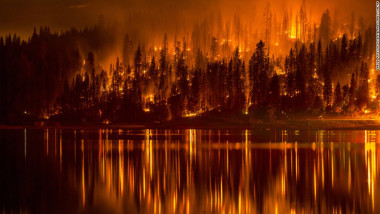
“Devastating” wildfires ripped across the wealthier parts of the world in 2025, a study has found, even as globally, the area ravaged by flames fell.
Catastrophic blazes claimed lives, homes and jobs last year in California, Canada, Europe and South Korea. But the 335m hectares burned was the second-lowest since 2002, the review found, largely owing to the expansion of African farms that have fragmented landscapes and hampered the spread of large savannah fires.
The disasters in 2025 included a Scottish “megafire” that torched more than 100,000 hectares – contributing to the UK breaking its record for burned area – and the Palisades and Eaton fires in Los Angeles, which were among the most destructive in US history.
Record-breaking blazes in Spain and Portugal burned more than half a million hectares, while South Korea had its biggest and deadliest wildfire season on record.
Fires accounted for more than 38% of insured losses from weather disasters in 2025, the study found.
“2025 shows that a ‘quiet’ fire year globally can still be devastating,” said Matthew Jones, a climate scientist at the University of East Anglia and lead author of the study. “We are seeing a growing disconnect between total area burned and real-world impacts.”
Changes in land use mean wildfires burn less of the planet than they have historically done, but global heating is creating conditions allowing them to spread, increasing the danger at what researchers call the wildland-urban interface, where people are most at risk.
Adverse weather, inflamed by carbon pollution, turned some of last year’s fires into explosive infernos.
In southern California and South Korea, the researchers found, high winds and dry vegetation pushed fires through densely populated areas, causing “exceptional mortality, mass evacuations, and major infrastructure losses”. In the Mediterranean, meanwhile, drought and extreme heat drove severe blazes, from Portugal to Turkey.
“These conditions do not cause the fires, but in the event of a fire, we have material that is more flammable than usual – because it is drier – and wind conditions that fan the flames,” said David Garcia, an applied mathematician at the University of Alicante, who was not involved in the study. “This makes large fires more likely to occur.”
An attribution study Garcia co-authored last year found the extreme weather fuelling the flames in Portugal and Spain last year was made 39 times more likely by climate breakdown. “If we continue to warm the planet, large-scale fires will continue to increase,” he said.
The overall reduction in global burned area led to a drop in carbon dioxide emissions to their third-lowest level on record.
In Canada, though, extreme wildfire emissions were recorded for the third year in a row. Since 2023, boreal forests in North America have emitted close to 4bn tonnes of CO2, exceeding the total emissions of the preceding 15-year period.
As well as heating the planet, the pollutants in wildfire smoke lead to huge numbers of people dying from breathing dirty air. The toxic particles spewed by Canadian wildfires in 2023 killed 82,000 people, according to a study published in September, with smoke even choking cities in the US, Europe and Africa.
Adrián Regos, a landscape ecologist at the Biological Mission of Galicia, Spain, who was not involved in the study, said last year’s events illustrated how a relatively small number of extreme fires could dominate the ecological, social and economic consequences of an entire fire season.
“The broader pattern highlighted by this study is consistent with what we are observing across southern Europe: while total burned area may fluctuate from year to year, climate change is increasing the likelihood of extreme fire-weather conditions, and fuel accumulation associated with rural abandonment is making many landscapes more vulnerable to large, fast-moving fires,” he said.
“The challenge is therefore not only reducing the number of fires, but increasing the resilience of landscapes and communities to extreme events.”
1 This Month



26 September – International Day for the Total Elimination of Nuclear Weapons


PLEASE OPPOSE HR 8255 AND S.3639 – bills would accelerate satellite deployment, with no environmental review or safeguards – https://ncstd5li.quorum.us/campaign/169331/
To see nuclear-related stories in greater depth and intensity – go to https://nuclearinformation.wordpress.com
-
Archives
- September 2026 (257)
- August 2026 (330)
- July 2026 (355)
- June 2026 (287)
- May 2026 (306)
- April 2026 (356)
- March 2026 (251)
- February 2026 (267)
- January 2026 (308)
- December 2025 (358)
- November 2025 (359)
- October 2025 (375)
-
Categories
- 1
- 1 NUCLEAR ISSUES
- business and costs
- climate change
- culture and arts
- ENERGY
- environment
- health
- history
- indigenous issues
- Legal
- marketing of nuclear
- media
- opposition to nuclear
- PERSONAL STORIES
- politics
- politics international
- Religion and ethics
- safety
- secrets,lies and civil liberties
- spinbuster
- technology
- Uranium
- wastes
- weapons and war
- Women
- 2 WORLD
- ACTION
- AFRICA
- Atrocities
- AUSTRALIA
- Christina's notes
- Christina's themes
- culture and arts
- Events
- Fuk 2022
- Fuk 2023
- Fukushima 2017
- Fukushima 2018
- fukushima 2019
- Fukushima 2020
- Fukushima 2021
- general
- global warming
- Humour (God we need it)
- Nuclear
- RARE EARTHS
- Reference
- resources – print
- Resources -audiovicual
- Weekly Newsletter
- World
- World Nuclear
- YouTube
-
RSS
Entries RSS
Comments RSS
 nuclear-news