As population declines, Fukushima Prefecture to lose 15 of its 96 high schools, Japan Times , FUKUSHIMA MINPO, MAR 15, 2019
The mergers will be implemented over the span of three years from fiscal 2021 and will reduce the number of high schools in the prefecture from 96 to 81.
Twenty-five schools will be merged and reorganized into 13 under the plan, which will integrate schools located in close proximity of one another. Each school will retain four to six classes per grade.
With the merger, the prefecture’s 88 day schools and seven night schools will be reduced to 74 and six, respectively, by the end of March 2024, according to the education board’s reform plan revealed Feb. 8. Fukushima’s only correspondence school will remain open……… https://www.japantimes.co.jp/news/2019/03/15/national/population-declines-fukushima-prefecture-lose-15-96-high-schools/#.XIwdDSIzbGg
March 16, 2019
Posted by Christina Macpherson |
Fukushima continuing, social effects |
Leave a comment
IRSN 11th March 2019 IRSN publishes a study on social consequences of the 3/11 nuclear accident
in Fukushima prefecture. Result of the French-Japanese research project
Shinrai, the report “The 3/11 accident and its social consequences – Case
studies in Fukushima prefecture” analyses post accidental policy in
Fukushima prefecture, particularly the questions linked to return or
non-return to evacuated towns and villages. The report also compares the
concrete experience of the inhabitants and the decision-makers with a
number of principles that underlies international post accidental policy
and recommendations.
https://www.irsn.fr/EN/newsroom/News/Pages/20190311_Fukushima-shinrai-study-social-consequences.aspx
March 14, 2019
Posted by Christina Macpherson |
Japan, social effects |
Leave a comment
 Science 6th March 2019
 Two decades after Chernobyl, the International

Atomic Energy Agency (IAEA), the World Health Organization (WHO), and the United Nations (UN) Scientific Committee on the Effects of Atomic Radiation stated that “fewer than 50 deaths had been directly attributed to radiation from the disaster, almost all being highly exposed rescue workers,” because radiation levels were considered too low to have caused any detectable harm. This conclusion was based on data derived from the atomic bomb survivors life-span study, a program that began in 1950 to document the long-term health effects of the atomic bombing of Hiroshima and Nagasaki.
Russian, Ukrainian, and Belorussian scientists vehemently disputed this assessment, estimating Chernobyl-linked fatalities in the hundreds of thousands. The UN agencies later recognized a broader spectrum of Chernobyl-related health effects,
yet the idea that there were no long-term consequences to human health proved hard to dislodge.
The UN-WHO-IAEA assessment was repeated in many venues and was cited by journalists as a scientific consensus. After the Fukushima nuclear accident in 2011, residents in the affected region were told by experts from many of the same international institutions that there would be no direct long-term health effects because their radiation exposure was low.
Because there was no post-Chernobyl equivalent to the atomic bomb survivors life-span study, the argument went, the data on the Japanese survivors remained the gold standard of international nuclear regulations.
The notion that no such data existed, however, was not entirely true as regards Chernobyl. Kate Brown’s meticulously researched Manual for Survival is the first environmental and medical history that recovers decades-long efforts of scientists and doctors in Ukraine and Belarus to document the long-term health impacts from the Chernobyl meltdown.
Unlike the Japanese atomic bomb survivors life-span study, which began 5 years after the exposure, Soviet doctors worked in contaminated areas right after the Chernobyl accident—many of these areas populated by people who didn’t
know that they were exposed to radiation. Over the years, Soviet scientists amassed vast evidence of a broad range of debilitating health effects from low-level radiation, including cancers; anemia; gastrointestinal problems; and severe disorders of the liver, kidneys, thyroid, and other organs.
March 12, 2019
Posted by Christina Macpherson |
radiation, resources - print, spinbuster |
Leave a comment
‘You’re Contaminated’: The Stigma Against Japan’s Fukushima Survivors, Broadly, 12 Mar 19,
A 2011 quake and tsunami led to a meltdown at the Fukushima Daiichi Nuclear Power Plant, killing thousands and displacing more. Two ‘nuclear refugees’ explain why returning home is more complicated than it seems.
…….. While the
nuclear disaster is becoming a distant memory for most Japanese, for some others it is their everyday reality. Nuclear refugees and evacuees face discrimination, separation from loved ones, and in some cases, they are even forced to return to the former evacuation zone.
The government, worried about people getting exposed to radiation, declared a 20-km evacuation zone around the plant and uprooted close to 165,000 people. As of today, there are still 50,000 people who haven’t returned to Fukushima.
Keiko Owada, 66, is one of them. When I meet her in Tokyo, she refers to the Japanese capital as her home for the past seven years. That will soon change due to the government’s decision to withdraw her free housing subsidies.
Because decontamination work has made progress and food declared safe from radiation, it has been deemed safe to return to most villages within the evacuation zone. The same goes for Owada’s village Naraha, where the evacuation order was lifted two years ago.
Owada is not excited about the prospect of returning to Naraha. “Would I continue to get financial support for my apartment here in Tokyo, I would have stayed here, yes. I’ll tell you why: there is no hospital in Naraha, only a small hospital for first aid. There is no supermarket, only a small convenience store. And the reason is simple: only a few people have returned.”
Life as an evacuee hasn’t always been easy, Owada explains. “It wasn’t like people were treating me any different, but my neighbors never greeted me. I think it’s because of the compensation I received and the free housing. They knew I was from Fukushima, that’s why.”
According to Owada, some of the other evacuees in Tokyo she knows have faced harsher treatment. “I know of others whose cars were damaged on purpose because they had a Fukushima license plate. That’s why I never parked my car in the middle of the parking lot, but always in a corner, so no one could see it.”
If anything, Owada’s story illustrates how many evacuees continued to live in fear. Displaced from their homes, dropped in a new community—the disaster is anything but over for them. ……….
When Kamata got in touch with relatives living in other parts of Japan, she was shocked to hear one sister-in-law’s initial response. “After the disaster, I wanted to flee to Chiba [a prefecture next to Tokyo], my sister-in-law picked up the telephone and told me I didn’t have to come to their house. ‘You’re contaminated,’ she told me.”……….
As Kamata remembers what life was like back in Fukushima, she uses a handkerchief to wipe a tear from her cheek. She barely speaks to her friends anymore.
“The disaster divided our communities, both physically as well as mentally. ………https://broadly.vice.com/en_us/article/mb5zny/japan-fukushima-earthquake-survivors-stigma
March 12, 2019
Posted by Christina Macpherson |
Japan, psychology - mental health, social effects |
Leave a comment

https://havanatimes.org/?p=149927 March 9, 2019 By Akio Matsumura HAVANA TIMES – On March 11, we commemorate the 8th anniversary of the Fukushima nuclear disaster. To an outside observer, this anniversary passes as a technical progress report, a look at new robot, or a short story on how lives there are slowly returning to normal.
Yet in Japan, the government has not figured out how to touch or test the irradiated cores in the three crippled reactors, which continue to contaminate water around the site of the melt down. The government does not know where it will put that radioactive material once it can find a way to move it.
Meanwhile, the government and site operator are running out of room to store the contaminated water, which is filling up more and more tanks. The cleanup is estimated to take forty years and the cost is estimated at $195 billion.
The latest publicly released findings of radiation levels are from 2017, when Tokyo Electric Power Company had to use a remote-controlled robot to detect the levels in Reactor 2, since no human can approach the crippled reactor.
The rates read 530 sieverts per hour, the highest since the March 2011 meltdown. We have no reason to believe that they have fallen since then. Remote-control robots are being used in the other reactors as well, indicating that radiation levels are similarly high there.
Even using the robot, work can only be carried out for very short times, since the robots can only stand 1000 sieverts of exposure – less than two hours in this case.
This is an extremely high amount of radiation. After TEPCO published the rate, the Asahi Shimbun reported that “an official of the National Institute of Radiological Sciences said medical professionals have never considered dealing with this level of radiation in their work.”
The Japan Times quoted Dr. Fumiya Tanabe, an expert on nuclear safety, who said that the “findings show that both the preparation for and the actual decommissioning process at the plant will likely prove much more difficult than expected.”
Fukushima’s Children Need International Attention
There have been many victims of this disaster. Thousands of people have been displaced from their homes. Local fishermen are worried that the government will proceed with its plan to dump the storage tanks of contaminated water into the ocean.
Others worry that the flow of the radioactive wind and contaminated water are reaching North America and will continue to do so for the next forty years.
Above all of these important issues, it is the children of Fukushima who most need our attention. They are at risk of higher rates of cancer because of their exposure to the contamination from the initial explosion. In Chernobyl, the only comparable case we have, more than 6,000 cases of thyroid cancer were found in children according to the UN through 2005.
There is evidence that thyroid cancer rates are higher among Fukushima’s children than the national population, but it is a latent disease: it is still too early to tell what the full impact will be. But it is clear the case needs action.
Scientists will always offer different opinions, swayed first by uncertainty, but also, sadly, by politics, money, and ambition.
Some will claim that the evidence has been exaggerated, underestimated, or that perhaps we’re at too early a stage to be certain. Or that we need more time to clarify the results. I have seen many instances of these arguments at the United Nations and international science conferences. Why do we wait and make another mistake?
Helen Caldicott, a medical doctor and founding president of Physicians for Social Responsibility, part of a larger umbrella group that was awarded the Nobel Peace Prize in 1985, wrote: “The truth is that most politicians, businessmen, engineers and nuclear physicists have no innate understanding of radiobiology and the way radiation induces cancer, congenital malformations and genetic diseases which are passed generation to generation. Nor do they recognize that children are 20 times more radiosensitive than adults, girls twice as vulnerable as little boys and fetuses much more so.”
UNICEF Can Lead
We face many complex challenges of climate change, poverty alleviation, and national security. The health and welfare of children must always be our top priority. They are our future; our deepest purpose is to care and provide for them. By deciding not to fully investigate the effects of Fukushima, we fail them.
We all agree with that personally, but which institution is best positioned to carry out the mission? To me, UNICEF, the United Nations Children’s Fund, is the only answer. Indeed, putting children above national security is at UNICEF’s core.
Maurice Pate, an American humanitarian and businessman who joined UNICEF at its inception in 1947, agreed to serve as the Executive Director upon the condition that UNICEF serves the children of “ex-enemy countries, regardless of race or politics.” In 1965, at the end of Pate’s term, the organization won the Nobel Peace Prize.
To this day, its mission includes a commitment to “ensuring special protection for the most disadvantaged children – victims of war, disasters, extreme poverty, all forms of violence and exploitation and those with disabilities.” The children of Fukushima deserve the protection of UNICEF.
——
*Akio Matsumura is also the Secretary General of the Global Forum Moscow Conference hosted by President Gorbachev at the Kremlin in 1990 as well as of the Parliamentary Earth Summit Conference hosted by Brazil National Assembly in Rio de Janeiro in 1992
March 10, 2019
Posted by Christina Macpherson |
children, Fukushima continuing |
Leave a comment
 March 6, 2019 By Ruth SoRelle, Texas Climate News Climate change evokes images of people swimming out of their flooded neighborhoods, cars bumper-to-bumper as drivers flee burning homes, merciless sun that dries up rivers and lakes. However, climate change is more than these very visible disasters. Of equal or greater danger is the silent, unseen damage that may occur in the gestating fetus – damage that can last a lifetime.
In a recent article in the Journal of the American Heart Association, an international group of researchers concluded that higher temperatures caused by climate change may result in up to 7,000 additional infants with congenital heart defects in Texas and seven other representative states over an 11-year period.
The researchers combined a multi-state database of birth defects with another of population. They integrated that with maps of temperatures across the nation and projected temperature increases from 2025-2035 to predict an increase in the numbers of infants born with serious heart defects.
In Texas and Arkansas (which the researchers defined as the South), for example, they foresee as much as a 34 percent increase in newborns with certain malformations such as tetralogy of fallot (a combination of four defects that affects the flow of blood) and as much as a 35 percent increase in another type involving a hole in the wall between the heart’s chambers.
In the Northeast they predict a 38.6 percent increase in atrial septal defect (a hole in the wall that divides the upper chambers of the heart). The Midwest is expected to have the highest increases of heat exposure to pregnant women, excessively hot days, heat-event frequency and heat event duration, when compared to the baseline period.
This study is a continuation of a 2018 study that first linked long duration of hot weather with heart defects, particularly in the southern and northeastern United States.
Scientists believe that when pregnant women are exposed to heat early in pregnancy, two problems can occur – fetal death or interference with the process in which cells generate new proteins, inducing severe fetal malformation. In the newer study, those problems appear associated with congenital heart defects……. http://texasclimatenews.org/?p=16061
March 9, 2019
Posted by Christina Macpherson |
2 WORLD, children, climate change |
Leave a comment
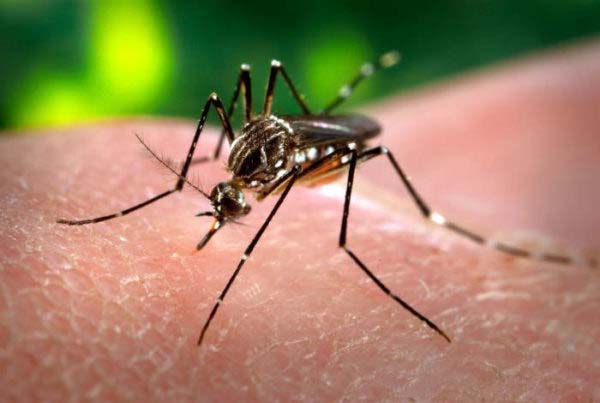
 Climate Change Will Expose Half of World’s Population to Disease-Spreading Mosquitoes By 2050 https://e360.yale.edu/digest/climate-change-will-expose-half-of-worlds-population-to-disease-spreading-mosquitoes-by-2050 MARCH 5, 2019 Scientists and public health officials have documented an increasing number of outbreaks of mosquito-borne illnesses across the globe in recent years, including yellow fever, dengue, chikungunya, and Zika. Now, an international team of researchers has found that by 2050, two key disease-spreading mosquitoes — Aedes aegypti and Aedes albopictus — will significantly expand their range, posing a threat to 49 percent of the world’s population.
“If no action is taken to reduce the current rate at which the climate is warming, pockets of habitat will open up across many urban areas with vast amounts of individuals susceptible to infection,” said Moritz Kraemer, an infectious disease scientist at Boston Children’s Hospital and the University of Oxford and a co-author of the new research, published in the journal Nature Microbiology,.
The researchers analyzed historical distribution data from more than 3,000 locations in Europe and the United States, dating back to the 1970s. They then modelled future distribution using projections for climate change, urbanization, and human migration and travel. Kraemer and his colleagues found that in the last five years, Aedes aegypti has spread northward in the U.S. at about 150 miles per year. In Europe, Aedes albopictus has spread at a rate of 93 miles per year.
The scientists also found that within the next 5 to 15 years, human travel and migration will be the largest factors driving the spread of mosquitoes. After that, however, climate change and accelerating urbanization will create new mosquito habitats. Aedes aegypti could reach as far north as Chicago and Shanghai by 2050. However, the species will likely decline in parts of the southern U.S. and Eastern Europe, which are expected to become more arid as global temperatures rise. Aedes albopictus, on the other hand, is forecast to spread widely throughout Europe over the next 30 years, as well as establish small populations in parts of the northern U.S. and the highland regions of South America and East Africa.
March 7, 2019
Posted by Christina Macpherson |
2 WORLD, climate change, health, Reference |
Leave a comment

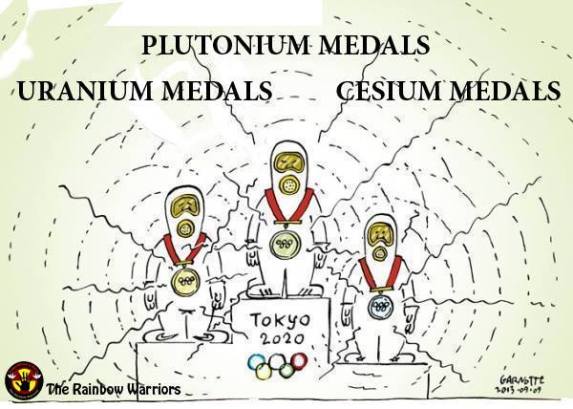
March 01, 2019, Fairewinds Energy Education, By Arnie Gundersen “……….To determine whether or not Olympic athletes might be affected by fallout emanating from the disaster site, Dr. Marco Kaltofen and I were sponsored by Fairewinds Energy Education to look at Olympic venues during the fall of 2017.We took simple dirt and dust samples along the Olympic torch route as well as inside Fukushima’s Olympic stadium and as far away as Tokyo. When the Olympic torch route and Olympic stadium samples were tested, we found samples of dirt in Fukushima’s Olympic Baseball Stadium that were highly radioactive, registering 6,000 Bq/kg of Cesium, which is 3,000 times more radioactive than dirt in the US. We also found that simple parking lot radiation levels were 50-times higher there than here in the US.
Thirty of the dirt and fine dust samples that I took on my last two trips to Japan in February and March 2016 and September 2017 were analyzed at WPI (Worchester Polytechnic Institute. The WPI laboratory analysis are detailed in the report entitled: Measuring Radioactivity in Soil and Dust Samples from Japan, T. Pham, S. Franca and S. Nguyen, Worchester Polytechnic Institute, which found that:
With the upcoming XXXII Olympiad in 2020 hosted by Japan, it is necessary to look into the radioactivity of Olympic venues as well as tourist attractions in the host cities… Since thousands of athletes and millions of visitors are travelling to Japan for the Olympics, there has been widespread concern from the international community about radiation exposure. Therefore, it is important to investigate the extent of radioactive fallout from the Fukushima Dai-ichi incident.
The measured results showed a much higher activity of Cesium-137 in the proposed torch route compared to other areas. Overall, the further away from the Fukushima Dai-ichi Nuclear Power Plant, the lower the radioactivity. The activity of Cesium-137 in Tokyo, the furthest site from the plant, was the lowest when compared to the other sites. Therefore, the activity of Cesium-137 in Tokyo sample was used as the baseline to qualitatively estimate the human exposure to radiation.
At the Azuma Sports Park, the soil and dust samples yielded a range of 78.1 Bq/kg to 6176.0 Bq/kg. This particular Olympic venue is around 90 km from the Nuclear Power Plant. The other sites that are closer to the Nuclear Power Plant like the tourist route, proposed torch route, and non-Olympic samples have higher amounts due to the close proximity to ground zero of the disaster.
… the proposed torch route samples had the highest mean radioactivity due to their close proximity to the plant. Based on the measurement, we estimated qualitatively that the radiation exposure of people living near the Azuma Sports Park area was 20.7 times higher than that of people living in Tokyo. The main tourist and proposed torch routes had radiation exposure of 24.6 and 60.6 times higher, respectively, than in Tokyo…. Olympic officials should consider using the results of this project to decide whether the radioactivity level at the proposed torch route and the Olympic venues are within acceptable level…… https://www.fairewinds.org/demystify/atomic-balm-part-1-prime-minister-abe-uses-the-tokyo-olympics-as-snake-oil-cure-for-the-fukushima-daiichi-nuclear-meltdowns
March 2, 2019
Posted by Christina Macpherson |
environment, Japan, radiation |
Leave a comment
It wasn’t enough radiation to be alarming, but it could be a sign of an ongoing problem The Verge By Rachel Becker Feb 26, 2019, 1A crematorium in Arizona became contaminated with radiation when workers cremated a man who had received radiation treatments for cancer right before he died, a new study reports. The findings highlight a potential safety gap for crematory workers, who might not know what’s in the body they’re cremating.
In this case, the radiation in the crematorium wasn’t significant enough to be worrying for the crematory worker’s health, according to a study published today in the Journal of the American Medical Association. But the study also found clues that exposure to radioactive compounds from medical treatments may be an ongoing safety risk for crematory workers……..
It’s not an easy problem to fix. Manufacturers provide detailed instructions for handling the drug with patients who are alive, but not for ones that have died, Yu says. “It presents a unique safety challenge.” Detecting radioactive materials is more complicated than running a Geiger counter over the body. And there aren’t any federal regulations for what to do with a radiation-treated body, Yu says, so the laws change from state to state. ……https://www.theverge.com/2019/2/26/18241402/radiation-crematorium-arizona-radiopharmaceuticals-cancer-body-lutetium
March 2, 2019
Posted by Christina Macpherson |
employment, radiation, USA |
Leave a comment

These assertions stand scientific consensus on its head. Most experts say to the contrary that even low doses of radiation cause cell damage that years later can promote uncontrolled cell growth and replication, and that children and fetuses are particularly susceptible to harm. That seven-decade-old view was reaffirmed as recently as last April in a study by a congressionally chartered nonprofit organization, the National Council on Radiation Protection and Measurement.
The study, overseen by a dozen experts from the government, academia, and industry, and funded by the NRC, considered 29 contemporary scientific studies of the effects of low-dose radiation in reaffirming that even low-level radiation should be avoided to the extent possible.
RADIATION IS GOOD FOR YOU? THE FRINGE VIEWPOINT GAINS GROUND IN THE TRUMP ADMINISTRATION, https://publicintegrity.org/national-security/radiation-is-good-for-you-the-heretical-view-gains-ground-under-trump/The Nuclear Regulatory Commission is actively considering claims that low-dose radiation protections should be lifted because exposures make you healthier, a potential boon to radiation-related industries.
Since World War II, virtually every American business where radiation is present – hospital emergency rooms and cancer wards, uranium mines, nuclear power plants, and others – has operated under rules generally requiring that exposures be kept as low as possible. The rules are based on a widely-accepted scientific dicta that even small amounts of extra radiation can be harmful to human health.
Following those rules, though, is costly and often cumbersome, and so the requirement for low-dose radiation protections – known as the ALARA standard for “as low as reasonably achievable” – has long been annoying to a large swath of American industry. Estimates of the costs associated with these protections run into the billions of dollars.
Until the Trump era, opponents of the rules have gotten little traction in trying to upend low-dose radiation protections – such as isolation units, elaborate shielding, specialized air cleaners, and elaborate worker training — in federal regulations. But proposed relaxations have been percolating in recent months, courtesy of a little-known advocacy group called Scientists for Accurate Radiation Information, or SARI.
 Members of the group, which claims its ideas have been wrongly dismissed and belittled by mainstream scientists, subscribe to a minority theory known as “hormesis.” It defies conventional wisdom by holding that damaging things that are dangerous in high doses might actually be beneficial to human health in small doses.
Despite swimming against the tide in the past, one of the group’s members has just been appointed to head a Radiation Advisory Panel at the Environmental Protection Agency, which helps set federal standards for radiation doses received by the public and by workers. And several of its recommendations to ease radiation protections are presently under active consideration by the Nuclear Regulatory Commission.
SARI’s members typically have more day-to-day connections to radiation than others, and potentially more influence: They have held jobs connected to radiation protection at the EPA, the Department of Labor, the Energy Department and its sub-agency responsible for building nuclear weapons at nine factories across the country. Practitioners of nuclear medicine, people employed in the nuclear industry, and professors who teach nuclear medicine or industrial hygiene also populate SARI.
The NRC’s consideration of the SARI views got started when three members of the group petitioned it in 2015 to abandon its current approach and accept that radiation in low doses is not only benign, but improves health. That was two years after SARI’s founding by industry officials trying to tamp down public concerns about the radiation that spilled from the 2011 Fukushima nuclear disaster.
The NRC took the petitions seriously. Its staff created a working group to study the issue, and insiders now say that work is done. According to Scott Burnell, an NRC spokesman, the five members of the commission as a result will take up the issue this spring. Continue reading →
February 28, 2019
Posted by Christina Macpherson |
politics, radiation, Reference, spinbuster |
1 Comment

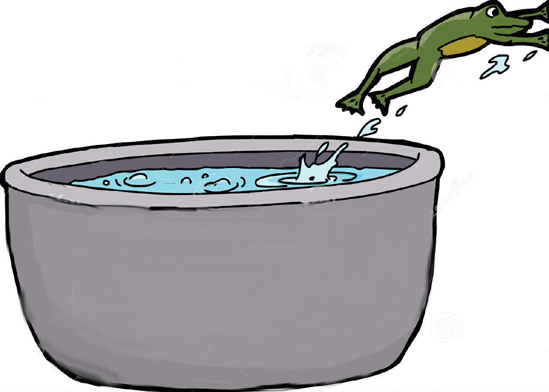
Just by the way- Scientists found that frogs DO jump out of the water as it gets hot. They are smarter than we are. 
February 27, 2019
Posted by Christina Macpherson |
2 WORLD, climate change, social effects |
Leave a comment
WIPP under federal investigation for worker exposures
Adrian C Hedden, Carlsbad Current-Argus Feb. 21, 2019 Workers at the Waste Isolation Pilot Plant were allegedly exposed to several hazardous chemicals and excessive heat last year, prompting a federal investigation by the U.S. Department of Energy into WIPP’s operations.
The DOE’s Office of Enterprise Assessments filed a notice on Jan. 29 of its intent to investigate to Nuclear Waste Partnership (NWP), the DOE-hired contractor responsible for WIPP’s daily operations.
Between July and October 2018, employees in the underground nuclear waste repository were potentially “overexposed” to carbon tetrachloride, nitrogen dioxide and sulfur dioxide, read the notice, including a “series” of heat-stress incidents.
The DOE intends to investigate the circumstances leading up to the alleged “hygiene-related events,” and could fine NWP, based on what is uncovered. ……
A pattern of bad management?
Don Hancock, director of the Nuclear Waste Program at the Southwest Research and Information Center – an Albuquerque-based environmental watchdog group – said the alleged incident was just the most recent example of evidence that NWP is improperly managing WIPP.
“This is a constant problem where workers are exposed to dangers, radioactive or otherwise, that shouldn’t have happened,” Hancock said. “These are not just paperwork problems.”
Hancock also pointed to an accident radiological release in 2014, which led to a three-year closure of the WIPP facility, as part of what he called a pattern of mismanagement and undue hazards. He said NWP’s recent contract renewal shouldn’t have happened because of numerous safety issues throughout its operations at WIPP……. https://www.currentargus.com/story/news/local/2019/02/21/wipp-federal-investigation-department-energy-hazardous-chemicals/2905747002/?fbclid=IwAR21RsaxA4oeB8aZSoXOcCiBzEHDPqQFOyHhE6aF50S3F6bJzgsGxIGusfo
February 25, 2019
Posted by Christina Macpherson |
employment, health, USA |
Leave a comment
Radioactive sea spray is dosing communities, February 17, 2019 by beyondnuclearinternational Governments want to cover it up By Tim Deere-Jones.
It is clear from the available empirical data that coastal populations impacted by prevailing onshore winds and living next to sea areas contaminated with liquid radioactive effluents from nuclear sites, are annually exposed to dietary and inhalation doses of man-made marine radioactivity.
Effluents discharged to the sea by nuclear power stations, fuel fabrication sites and reprocessing facilities are transferred from sea to land in airborne sea spray and marine aerosols (micro-droplets). They come in also during episodes of coastal flooding. This problem has been particularly pronounced around the UK Sellafield reprocessing and plutonium production site in Cumbria. In 1988, independent empirical research commissioned by a west Wales local authority reported that
Sellafield-derived, sea-discharged cesium had been found in pasture grass up to 10 miles inland of the Ceredigion coast.
Clearly, this contributes to human dietary doses via the dairy and beef food chain. The research also implies the inevitability of further dietary doses via arable and horticultural crops. Given that airborne radioactivity is driven at least 10 miles inland, it should be assumed that coastal populations are exposed, on a repeated annual basis, to inhalation doses.
https://beyondnuclearinternational.org/2019/02/17/radioactive-sea-spray-is-dosing-communities/
February 19, 2019
Posted by Christina Macpherson |
environment, radiation |
Leave a comment

Nuclear waste site selection process triggers mental health concerns, business boycotts and division, FOI documents reveal, ABC North and West By Gary-Jon Lysaght 13 Feb 19, (FOI documents are attached on the original) Freedom of Information (FOI) documents reveal the Federal Government has been aware of potential mental health issues, from as early as 2017, caused by the search for a site to store the nation’s nuclear waste.The Federal Government is currently considering two sites at Kimba and one near Hawker for a facility that would permanently store low-level waste and temporarily store medium-level waste.
Kimba, a small town on South Australia’s Eyre Peninsula, has been divided on whether to support or oppose the facility. Some residents believe the facility could help bring much-needed business to the rural town, while others suggest it could damage the region’s agricultural reputation.
“Many of the opposed group have raised the issue of mental health in submissions and direct discussions,” the FOI documents, written in 2017, said.
They believe mental health issues are arising in Kimba due to the stress of being in this process.
“These issues have been raised with the Kimba doctor and counsellor.”
Centre Alliance Senator Rex Patrick obtained the Freedom of Information documents and hoped the concerns were a catalyst for change.
“In my view, that creates a very strong obligation for the Government to act,” he said.
“They’ve clearly known about this issue since 2017 and it is now time to ask the minister exactly what he is doing in relation to that.”……. https://www.abc.net.au/news/2019-02-13/foi-documents-show-kimba-divided-over-nuclear-waste-site/10807462
February 14, 2019
Posted by Christina Macpherson |
AUSTRALIA, psychology - mental health, social effects, wastes |
Leave a comment
13 Feb 19, Last month’s transposition of European Council Directive 2013/59/EURATOM into Irish law means that HIQA is now responsible for regulating medical exposure to ionising radiation.
The new law covers dental x-rays, hospital CT scans, mammograms and radiotherapy received as part of cancer treatment.
Treatment
A medical exposure to ionising radiation is when a patient receives ionising radiation as part of their diagnosis or treatment.
The transposition into Irish law confers new statutory functions on HIQA under the EU’s (Basic Safety Standards for Protection against Dangers Arising from Medical Exposure to Ionising Radiation) Regulations 2018 SI No. 256.
HIQA’s John Tuffy said: “Generally the risks associated with receiving medical exposure to ionising radiation can be considered very low.
“However, as procedures that involve ionising radiation carry varying levels of risk dependent on the dose given, it is important that all radiation doses are kept as low as practically possible.
Vital
“It is vital that patients are only exposed when the benefits of receiving the exposure outweigh the risks.”
“The new legislation has given HIQA regulatory powers to ensure that appropriate processes are in place to protect patients in public and private healthcare facilities for the first time.”
Last month’s transposition of European Council Directive 2013/59/EURATOM into Irish law means that HIQA is now responsible for regulating medical exposure to ionising radiation.
The new law covers dental x-rays, hospital CT scans, mammograms and radiotherapy received as part of cancer treatment.
Treatment
A medical exposure to ionising radiation is when a patient receives ionising radiation as part of their diagnosis or treatment.
The transposition into Irish law confers new statutory functions on HIQA under the EU’s (Basic Safety Standards for Protection against Dangers Arising from Medical Exposure to Ionising Radiation) Regulations 2018 SI No. 256.
HIQA’s John Tuffy said: “Generally the risks associated with receiving medical exposure to ionising radiation can be considered very low.
“However, as procedures that involve ionising radiation carry varying levels of risk dependent on the dose given, it is important that all radiation doses are kept as low as practically possible.
Vital
“It is vital that patients are only exposed when the benefits of receiving the exposure outweigh the risks.”
“The new legislation has given HIQA regulatory powers to ensure that appropriate processes are in place to protect patients in public and private healthcare facilities for the first time.”
Last month’s transposition of European Council Directive 2013/59/EURATOM into Irish law means that HIQA is now responsible for regulating medical exposure to ionising radiation.
The new law covers dental x-rays, hospital CT scans, mammograms and radiotherapy received as part of cancer treatment.
Treatment
A medical exposure to ionising radiation is when a patient receives ionising radiation as part of their diagnosis or treatment.
The transposition into Irish law confers new statutory functions on HIQA under the EU’s (Basic Safety Standards for Protection against Dangers Arising from Medical Exposure to Ionising Radiation) Regulations 2018 SI No. 256.
HIQA’s John Tuffy said: “Generally the risks associated with receiving medical exposure to ionising radiation can be considered very low.
“However, as procedures that involve ionising radiation carry varying levels of risk dependent on the dose given, it is important that all radiation doses are kept as low as practically possible.
Vital
“It is vital that patients are only exposed when the benefits of receiving the exposure outweigh the risks.”
“The new legislation has given HIQA regulatory powers to ensure that appropriate processes are in place to protect patients in public and private healthcare facilities for the first time.”
Last month’s transposition of European Council Directive 2013/59/EURATOM into Irish law means that HIQA is now responsible for regulating medical exposure to ionising radiation.
The new law covers dental x-rays, hospital CT scans, mammograms and radiotherapy received as part of cancer treatment.
Treatment
A medical exposure to ionising radiation is when a patient receives ionising radiation as part of their diagnosis or treatment.
The transposition into Irish law confers new statutory functions on HIQA under the EU’s (Basic Safety Standards for Protection against Dangers Arising from Medical Exposure to Ionising Radiation) Regulations 2018 SI No. 256.
HIQA’s John Tuffy said: “Generally the risks associated with receiving medical exposure to ionising radiation can be considered very low.
“However, as procedures that involve ionising radiation carry varying levels of risk dependent on the dose given, it is important that all radiation doses are kept as low as practically possible.
Vital
“It is vital that patients are only exposed when the benefits of receiving the exposure outweigh the risks.”
“The new legislation has given HIQA regulatory powers to ensure that appropriate processes are in place to protect patients in public and private healthcare facilities for the first time.”
February 14, 2019
Posted by Christina Macpherson |
Ireland, radiation |
Leave a comment








 nuclear-news