At Fukushima’s ground zero, a town slowly comes back to life
The orchestrated delusion that people can live with radiation

Akiyoshi Fushimi and his wife, Teru, carry a painting of hollyhocks into a new housing unit for evacuees in the town of Okuma, Fukushima Prefecture, on June 1.
June 16, 2019
Shigeru Niitsuma moved back into Okuma’s Ogawara district on June 1 — the first day residents were allowed to move into disaster-relief housing since the triple core meltdown at the Fukushima No. 1 power plant forced them to leave town in 2011.
“I feel at home in Ogawara, where I was born and raised,” said the 70-year-old, who carried a washing machine and TV set into his new home.
It makes him smile to water the marigolds and other flowers in his new garden.
The evacuation order for the neighborhood was lifted in April after decontamination work lowered radiation levels there.
Before the crisis, he was a farmer who grew rice and vegetables. Now he lives in the unit alone while his family remains in Takahagi, Ibaraki Prefecture, where they fled during the nuclear crisis.
The house where he used to live in Ogawara had to be demolished because of damage caused by boars, dogs and mice.
Niitsuma still visits it from time to time to tend to his flowers and vegetables and participate in neighborhood watch duties.
“It will be best if young people come back, which will revive the town,” he said. “In the meantime, I want to show everybody that it’s safe to return.”
Akiyoshi Fushimi, 68, and his wife, Teru, 66, moved into their disaster-relief unit from Tamura, Fukushima Prefecture. The Great East Japan Earthquake struck just three months after they had built a house in Okuma, which co-hosts the now-defunct power plant.
Though they can’t return to their former home, which remains in a no-go zone, it still brings them joy to live nearby.
As they entered their new home, the couple brought in a painting of hollyhocks made by Teru, taking a moment to appreciate the work.
The couple said it was difficult to be happy while thinking about those unable to return, but they agreed it was important for those able to return to do so.
The disaster-relief housing in Ogawara includes 40 shared units and 50 two- or three-bedroom units with kitchens, living rooms and dining rooms. Workers were still coming and going on June 1 to get them ready and help people move in.
As of Friday, the town was still recruiting potential residents for the shared units.

In the meantime, to cater to residents and construction workers in the area, a convenience store opened on June 3 right in front of Okuma’s new town hall.
Yamazaki Shop sells about 700 products including bread, bento, instant noodles, snacks, alcohol, cigarettes, general supplies and newspapers. With about 30 sq. meters of floor space, the tiny store is intended be a makeshift facility until a commercial complex under construction in Ogawara is finished.
For now, the store is scheduled to operate from 8 a.m. to 6 p.m. on weekdays and from 9 a.m. to 3 a.m. on Saturdays. It will be closed on Sundays except for special events.
On the first day, residents and construction workers came in to search for lunch.
“I want to build up this store together with customers,” said the manager, Takashi Akama, 29. “If there’s a product people want, they should feel free to let me know.”
This section features topics and issues from Fukushima covered by the Fukushima Minpo, the largest newspaper in Fukushima Prefecture.
A Theater Play: “Forgetting the Future”
Bugs, Bots, and Ghosts
Non-human theatre both provokes and comforts in a post-Fukushima world.

The cast of Shu Matsui’s 2013 play “Forgetting the Future.”
BY KYOKO IWAKI
June 12, 2019
Just as, for many Americans, it is difficultto reflect on 9/11 without mass disquietude, for many Japanese 3/11 is not merely another day.
At 2:46 p.m. on March11, 2011, the Tohoku earthquake and tsunami—better known today as the Fukushima Daiichi Nuclear Power Plant Disaster—rippled along the Northeastern coastline of the island country. This unprecedented triple attack included a magnitude 9.0 earthquake that moved Japan eight feet east, a 9.8-foot tsunami that killed over 15,000 people,and a Level-7 nuclear melt-through of three nuclear vessels.
This multivalent catastrophe, both natural and man-made, might be said to have created an almost complete tabula rasa. In addition to the earthquake and tsunamis,which disrupted tangible space, radiation extinguishes another intangible dimension:time. Considering that Plutonium 239 has a half-life (the period in which 50 percent of nuclides will have undergone nuclear decay) of 24,110 years, nuclear aftermaths indeed seem to defy a human conception of time.
Unfortunately humanity’s sense of emergency does not last for 20,000 years, for good reason: If we were to continue to dwell at length in the same level of hypertension, our nervous systems would soon collapse. That is why, in the current daily life of Japan, the repercussions of Fukushima seem invisible (unless you’re near the epicenter).
As early as September 2013, Prime Minister Abe Shinzo unabashedly declared, before the International Olympic Committee, that Fukushima is “under control,” an assurance that was probably crucial to Japan winning the 2020 Olympics. Ostensibly the country has regained its peace, yet one must never forget that this peace is only a palimpsest,resting upon a constant effort to silence anxieties.
If nuclear time defies human time, nuclear fallout deceives human perception. That’s why for some people in Japan (and the rest of the world), the Fukushima nuclear catastrophe was absent to begin with: out of sight, hence out of mind.
On the other hand, for others, it is omnipresent. Owing to this simultaneous absence and presence,many Japanese are impelled to broach uncharted domain—that is, they are compelled to seek a new language to aptly express their uncertainties, to rebuild collective values that could mend divided narratives, and to construct a new way of life that is not merely situated prior to but is always aligned with death. When it comes to trying new languages, values, and Lebenschauung (or views of life), theatre—with its physical presence, emotional eloquence, and fictional safeguards—naturally becomes a useful testbed.
Not that theatre has taken what may seem the most obvious reaction and approach: an ecocritical theatre demanding a full cessation of the 54 nuclear power plants in Japan,or a head-on political theatre rigidly questioning the legal liabilities of Tokyo ElectricPower Company. Instead a gradual yet sturdy “non-human” turn has been evident. For various reasons, theatre makers have become noticeably more attracted to cyborgs,animals, insects, and ghosts. In its most obvious renditions, human actors perform roles of anthropomorphized non-human beings. One could argue that this is just another form of the techno-animistic imagination prevalent in Japan since long before 3/11.But what must be noted here is that the rationales underpinning this turn toward the non-human have shifted in subtle yet interesting ways after Fukushima.
Japan is considered by many to be a trailblazer of industrial robots and futuristic imagination. From the mangas of Osamu Tezuka’s Astro Boy (1952) and MitsutruYokoyama’s Ironman 28 (1956), ideal human-robot kinships have been dreamt of by boys, girls, and many still-adolescent adults. Before 3/11, most of these robots were designed to serve humans as part of a better society, not built to supersede or replace us. In this unthinkingly human-centric register, robots were acknowledged to be essentially inferior to humans; that’s why Atom, the humanoid nine-year-old in AstroBoy, always longed to be treated like a human child.
Since the Fukushima catastrophe, this human-robot hierarchy has been subtly inverted. Forced to realize how easily destructible their social bonds are and how
physically vulnerable their bodies could be, many Japanese theatre makers have created androids who “act” on stage as symbols of indestructible immortality—a thing humans have yearned for half-eternally.
Oriza Hirata—playwright, director, leader of Seinendan (Youth group) Theatre Company, and a usual suspect in Francophone theatre festivals—is generally considered the forerunner of Japanese robot theatre. Working with Hiroshi Ishiguro, aroboticist at Osaka University, Hirata has created eight robot theatre productions,including robotic versions of Kenji Miyazawa’s Night on the Galactic Railroad (2013),Franz Kafka’s The Metamorphosis (2014), and the Hamburg State Opera’s Stilles Meer (Silent Sea, 2016) in which a robot (Robovie-R3 by Vstone) appears as a nuclear poweplant worker. Hirata even sometimes talks about a near future in which human actors could be completely replaced by androids, reasoning, “They could act in any language; travel cheaply; never get sick; and never complain.”
In his post-3/11 robot theatre productions, Hirata sheds light on the concepts of immortality and integrity. In his android version of Chekhov’s Three Sisters (2012), for instance, the Fukazawa sisters live in a rural town with a formerly thriving robot industry. Their late father, a renowned robot scientist, created an android of his youngest daughter, Ikumi, before he died. (The real Ikumi seems also to have died,though we later learn that she is still alive but has become a hikikomori
—a social recluse.) While the older sisters visit their father’s grave to commemorate his death, android Ikumi refrains, because “death does not concern” her; mortality is a purely abstract concept in her mind. Meanwhile other family members seem agonized by the impending death of their community in the face of a declining birthrate, a labor shortage, and fading hope overall—an almost prophetic vision of a near-future Japan. And while they dodge the gloomy topic around the dinner table, the robot Ikumi, programmed to articulate unequivocally, can only reveal the awkward truth. Next to this logically impeccable and immortal robot, humans come to seem increasingly more fragile, flawed, and duplicitous.
This Three Sisters forces the post-Fukushima audience to question whether or not they,like the Fukazawa family, are hiding behind a veil of escapism; indeed they might even envy the fearless “human integrity” so well represented by the android. At the sametime, shrewd observers may begin to feel that accepting faults, fragilities, and failures might be the crux of humanity. Either way, Hirata’s Three Sisters demands that were consider what is putatively morally “human.”
From the outset of his career, director-playwright Shu Matsui has been questioningthe validity of several key concepts of Western humanism, including coherent logic,subjectivity, and individualism, which, in certain cases, seem to run against harmony-oriented Japanese norms. But it wasn’t until the 3/11 catastrophe that Matsui clearly imagined a non-human theatrical universe favoring collectivism over individualism,relativity over subjectivity, and affect over logic.
In Forgetting the Future (Mirai o wasureru, 2013), a character called Shimada Burio (the name is a spoof on the Japanese word for “embryo”) is presented as the world’s first cockroach-human hybrid. In addition to fluently speaking a human language, Burio can also talk through a Deleuzian language of “molecular vibration, chirring, buzzing,clicking, scratching, and scraping,” enabling him to go beyond the formal limits of communication that inevitably draw a boundary between the subject and the object, between me and you.
When facing vulnerable situations like the aftermath of 3/11, Matsui proposes that people must cease prioritizing cognitive functions, at least temporarily, to enjoy a non-linguistic and non-logical form of unity, which he calls “environmental symbiosis.” We must learn to herd with others like critters, in other words, to avoid untoward confrontations in an already calamitous situation. Indexes such as reason, subjectivity,and criticality must be reassessed, as they may be only onerous abstractions that needlessly complicate our already intractable lives.
Toshiki Okada, the writer-director with the theatre company called chelfitsch (a coinage meant to evoke a child attempting to say the English word “selfish”), is amongthe leading theatre artists in Japan. He initially received acclaim for voicing the uncertainties of the economically vulnerable Lost Generation in productions using“super-real” colloquial Japanese speech matched with ungainly yet eloquent body movements. In 2007 Okada ventured into the international theatre circuit when he was invited to the Kunstenfestivaldesarts in Brussels to present Five Days in March(Sangatsu no itsuka kan).
Since then, though, he has expanded his theatrical vision beyond the solipsistic aesthetics of super-real Japanese. Four months after 3/11, he relocated to Kumamoto,760 miles south of Tokyo, after living in the suburbs of the metropolis for 38 years. He felt that after the disaster he could no longer “identify” himself with Tokyo, even considering the capital city “something already over, or already lost—at least for me.”His world view thus changed, Okada could not help but change the “reality” in his stagecraft.
If, in the pre-Fukushima years, Okada was interested in writing about present reality,after the catastrophe he became increasingly interested in fiction—or, in his own words, “alternative realities.” He also looked back to a 600-year-old theatre tradition: In trying to give voice to someone (family, friends, or neighbors) or something (like Tokyo), he adopted the structure of the dream noh (mugen noh), in which the protagonists (shite) are most often resentful or regretful dead spirits. He’s written three plays responding to the Fukushima disaster: Time’s Journey Through a Room (Heyao nagareru jikan no tabi, 2016), Current Location ( Genaichi, 2012), and Ground and Floor ( Jimen to Yuka, 2013)—a three-hander in which the protagonist is the wife of a 30-something man who now fancies another woman. Until midway through the performance, the audience does not know that the protagonist is actually dead, as she is the one narrating the proceedings, describing the minutest details of everyday life, as if to never forget the life she had led. After providing her tranquil yet unyieldingly articulate monologue, she presses her husband as to whether he remembers the same details she does.
The production seems to find Okada divided between narratives of remembering and forgetting. We humans could not survive a single day if we remembered all the details of the past. But for the dead, the act of forgetting implies their complete disappearance. With the many lives lost in 3/11, theatre makers have begun to feel the obligation to reconsider not only the politics of humans but also those of the dead. Okada has said that “the ghost is a great invention of humans,” a way for us to give body to our imaginations and to our struggles with the past.
Whether looking to the future through androids and hybrid bugs, or veering toward the past through the visions of ghosts, Japanese theatre artists are imagining a time well beyond the lifespan of a single human being. The 3/11 catastrophe may not have changed Japanese society for the better, but it has surely stirred the imaginations of theatre directors and playwrights—and audiences. The non-human turn in post-Fukushima theatre is a clear embodiment of the ways Japanese artists feel responsible for giving voice, not only to those who survived but also to the dead and the unborn.
Kyoko Iwaki, a scholar of Japanese modern and contemporary theatre and performance, is a researcher at Waseda University
Abe pushing idea that Fukushima nuclear disaster is ‘under control’

Prime Minister Shinzo Abe inspects the premises of Tokyo Electric Power Co.’s Fukushima No. 1 nuclear power plant on April 14. Its No. 3 and No. 4 reactors, from left, are seen behind in Okuma, Fukushima Prefecture.
June 11, 2019
Without special protection against radiation, Prime Minister Shinzo Abe stood on elevated ground about 100 meters from the three melted-down reactors at the Fukushima No. 1 nuclear power plant.
“I was finally able to see the view just wearing a normal suit without having to wear protective clothing and a mask (for radiation),” he said on April 14 after hearing explanations from Tokyo Electric Power Co. officials. “The decommissioning work has been making progress in earnest.”
An act of bravado, perhaps. But it was more likely one of the ways Abe and his government want to show that the Fukushima disaster is, as he famously said, “under control.”
Progress has been made, albeit slowly, for the monumental task of decommissioning TEPCO’s crippled nuclear plant.
But radiation levels in certain areas of the plant are still lethal with extended exposure. The problem of storing water contaminated in the reactors continues.
And only recently was TEPCO able to make contact with melted nuclear fuel in the reactors through a robot. The means to extract the fuel has yet to be decided.
However, the government keeps touting progress in the reconstruction effort, using evacuee statistics, which critics say are misleading, to underscore its message.
Abe’s previous visit to the nuclear plant was in September 2013.
“When I conducted an inspection five years ago, I was completely covered in protective gear,” he said at a meeting with decommissioning workers in April. “This time I was able to inspect wearing a normal suit.”
Officials in Abe’s circle acknowledged that they wanted to “appeal the progress of reconstruction” by letting the media cover the prime minister’s “unprotected” visit to the site.
The inspection ground where Abe stood, 35 meters above sea level, and the insides of buses are the only places in the area where protective clothing and masks are not required.
His visit in a business suit was possible largely because the ground was covered in mortar and other materials that prevent the spread of radioactive substances, not because decommissioning work has lowered radiation levels as a whole.
The radiation level at the elevated inspection ground still exceeds 100 microsieverts per hour, making it dangerous for people who remain there for extended periods.
Abe’s inspection ended in six minutes.
The prime minister raised eyebrows, particularly in Fukushima Prefecture, in 2013 when he gave a speech to promote Tokyo’s bid to host the 2020 Summer Olympics.
Concerning the Fukushima nuclear plant, he told International Olympic Committee members, “Let me assure you, the situation is under control.”
An hour before he inspected the plant in April, Abe attended the opening ceremony of the new government building of Okuma, one of the two towns that host the nuclear plant.
The ceremony followed the lifting of an evacuation order for part of the town on April 10.
“We were able to take a step forward in reconstruction,” Abe said.
The central government uses the number of evacuees to show the degree of progress in reconstruction work.
In April 2018, Abe said in the Diet that the lifting of evacuation orders has reduced the number of evacuees to one-third of the peak.
According to the Reconstruction Agency, the number of people who evacuated in and outside of Fukushima Prefecture, including those who were under no orders to leave, peaked at about 160,000. But the initial evacuation orders for 11 municipalities in Fukushima Prefecture have been gradually lifted, and the agency now puts the total number at about 40,000.
About 71,000 people were officially registered as residents of areas that were ordered to evacuate. Now, only about 11,000 people live in those zones.
This means that about 60,000 people have not returned to the homes where they were living before the nuclear accident unfolded in March 2011.
The gap of 20,000 can be attributed to how the agency classifies or declassifies evacuees.

NOT COUNTED AS EVACUEES
The Reconstruction Agency sent a notice in August 2014 to all prefectures that have counted the number of evacuees.
It defined “evacuees” as people who moved to different places because of the nuclear disaster and have the “will” to return to their original homes.
The notice also said that if it is difficult to perceive their “will,” they can be regarded as people who have ended their evacuation if they bought new homes or made arrangements for new accommodations.
Based on the notice, people in Fukushima Prefecture who have bought new homes during their evacuation or settled down in public restoration housing or disaster public housing are regarded as living “stable” lives and are not counted as evacuees.
“It is not a problem because we continue supporting them even if they are removed from the evacuee statistics,” a prefectural government official said.
An official of the Reconstruction Agency said, “The judgment is made by each prefecture, so we are not in a position to say much.”
However, the prefecture has not confirmed all evacuees’ will to return to their homes. In addition, those who are removed from the list of evacuees are not informed of their new status.
Many people bought homes in new locations during their prolonged evacuations although they still hope to return to their hometowns in the disaster area.
Yumiko Yamazaki, 52, has a house in Okuma in a “difficult-to-return” zone.
But because she moved to public restoration housing outside of the town, she is not considered an evacuee by the agency and the prefecture.
“I had to leave my town although I didn’t want to,” Yamazaki said. “It is so obvious that the government wants to make the surface appearance look good by reducing the number of evacuees.”
“I can’t allow them to try to pretend the evacuation never happened,” Yamazaki said.
Critics say the central government’s emphasis of positive aspects and the downplaying of inconvenient truths in the evacuee statistics have much in common with its response to the suspected nepotism scandals involving school operator Moritomo Gakuen and the Kake Educational Institution.
“This is an act to socially hide the real number of evacuees, which could lead to a cover-up of the seriousness of the incident,” said Akira Imai, chief researcher of the Japan Research Institute for Local Government who has conducted surveys among evacuees. “The evacuee number is an index that is used to consider measures to support evacuees. The current situation should be reflected properly in the numbers.”
But the central government continues to appeal “reconstruction” to the public.
On the night of May 10, Abe had dinner with all-male idol group Tokio at a pizza restaurant in Tokyo.
The four-member group has been promoting products from Fukushima Prefecture, which are still struggling to overcome public fears and false rumors about radiation.
Two days after the dinner, Abe posted a picture of him with Tokio on Twitter and commented, “They have been making efforts to reconstruct Fukushima Prefecture.”
Fukushima Fishermen Release Flatfish Fry
Flat fishes mostly feed at the bottom of the sea close the coast, where the highest radioactive pollution has accumulated…..

June 10, 2019
Iwaki, Fukushima Pref., June 10 (Jiji Press)–Fishermen in Iwaki in Fukushima Prefecture in northeastern Japan began releasing young flatfish into the sea from Hisanohama Port in the city on Monday.
The release came after a new prefecture-run facility for raising flatfish fry was completed in Soma, another city in Fukushima, in 2018. The previous such facility was destroyed in the 2011 earthquake and tsunami, which also led to an unprecedented triple meltdown accident at Tokyo Electric Power Company Holdings Inc.’s <9501> Fukushima No. 1 nuclear power plant.
About 100,000 juvenile flatfish, about 6 to 9 centimeters in length, were released into the Pacific Ocean amid rough weather on Monday.
A total of about one million young flatfish will be released from ports around the prefecture by the end of June, bringing the number of released flatfish up to the pre-disaster level for the first time in nine years.
Before the 2011 disaster, fishery products from Fukushima were prized for their taste and sold for hefty prices at places such as the now-defunct Tsukiji wholesale food market in Tokyo.
Comic tale of aging bar hostesses with social punch
I am surprised that this article was published on Yomiori Shimbun (Japan News), usually a pro-government media, with biased information.
This sentence must have escaped the censoring eyes of their editor.
I particularly like the: “Like Chihama, Arata comes from Fukushima Prefecture, where her parents’ home was destroyed in the Great East Japan Earthquake. Brazil in the past and contemporary Fukushima begin to look very similar, in the sense that “those affected are not told the truth.”

June 10, 2019
This week’s manga Sono Onna Jilba (Jitterbug The Forties)
By Shinobu Arima (Shogakukan)
Arata Usui has a job dealing with customers in a major supermarket chain store when she is transferred to the stockroom, out of sight. This was inevitable, as she is already past 40 and no longer young. Still single, with no boyfriend and no savings, she lacks confidence. One day, Arata is surprised to see a help-wanted notice for bar hostesses in the entertainment quarter of town. The criteria: women 40 or older! Is this some kind of a mistake? Mustering her courage, she opens the door to the Bar Old Jack & Rose, a watering hole aimed at senior citizens in which the average age of the hostesses is 70. Mesmerized by a world completely different from her own, she begins a side job as a trainee hostess under the alias of Arara. She soon learns about the legend of Jilba, the founder and inaugural manager of the bar.
“Jitterbug The Forties” is a comedy with cheering messages for an aging society, played out by lively bar hostesses who seem almost supernatural. The story starts out in such an atmosphere, which in itself is entertaining enough. But readers are taken to a much deeper level. As the hostesses recount their pasts, an alternative postwar history emerges that we have never been told. This transforms it into a work that offers a completely different impression.
Jilba, born Chihama Hoshi, emigrated to Brazil from Fukushima Prefecture. One thing that I learned from this manga was that immediately after the end of World War II, Japanese immigrants in Brazil were divided into two groups regarding the outcome of the war. One group, the “kachi-gumi” (the victors), blindly believed the false information that Japan defeated the United States. This group far outnumbered the other group, the “make-gumi” (the defeated), which believed that Japan lost. Conflicts between the groups eventually led to terrorist attacks, and there were scams targeting immigrants hastily trying to return to “victorious” Japan. Chihama, who loses her husband and children amid the chaos, arrives alone in a Japan that is little but burned-out ruins. She gathers women in similar dire straits and opens the bar. This is the other story line told in “Jitterbug The Forties.”
Like Chihama, Arata comes from Fukushima Prefecture, where her parents’ home was destroyed in the Great East Japan Earthquake. Brazil in the past and contemporary Fukushima begin to look very similar, in the sense that “those affected are not told the truth.” Quite impressed, I realized just how much of a hard-hitting, socially aware work this actually is at its core.
Even so, “Jitterbug The Forties” never loses its balance as a comedy, impressively maintaining a cheerful disposition over five volumes right up to its conclusion. “Jilba” is Japanese-English, originating from the American social dance known as the Jitterbug. No matter how arduous your past was, sweep it away with song and dance. Regardless of your age, life is not to be thrown away. This is a masterpiece that resonates with a powerfully encouraging message to all generations.
Ishida is a Yomiuri Shimbun senior writer whose areas of expertise include manga and anime.
According to Japan govt’s official statistics on pediatric cancer, children cancers doubled since Fukushima
From the Japan govt’s official statistics of children cancers:
The country has been taking statistics on pediatric cancer since 1975. Every year, 2,000 to 2,500 people were affected.
The least was in 2006, where there were 1861 people affected, the year before the Niigata Chuetsu Earthquake.
But the numbers of children cancers really much increased after Fukushima. In 2015, 3246 people, in 2016, 3161 people, in 2017, 3279 people.
I think the incidence of children cancers will continue to increase in the coming future.

Last fishing port in Fukushima to reopen

June 4, 2019
A fishing port in Tomioka in Japan’s Fukushima Prefecture is expected to reopen next month after being closed for more than eight years.
The massive earthquake and tsunami that hit eastern Japan in 2011 caused the severe Fukushima nuclear accident in Fukushima Prefecture.
Nine of the prefecture’s 10 fishing ports affected by the triple disaster have already reopened.
Tomioka Port is known as the main port for catching tasty flatfish and flounders.
Its wharves and breakwater were damaged by the quake and tsunami, and an evacuation order was issued for Tomioka and other fishing ports in Fukushima Prefecture.
That evacuation order was lifted in April 2017, and work has been underway to rebuild the port.
Fishing boats based at Tomioka Port were sent to other ports in the prefecture, such as Iwaki City and Namie Town. Officials say these boats are expected to return to Tomioka.
Tomioka Town and the local fisheries cooperative plan to hold a ceremony in July to celebrate the return of the fishing boats and fishers to the port.
Thyroid cancer diagnoses in Fukushima youth not linked to nuke disaster: panel
The lies of denial continue:
“Every lie we tell incurs a debt to the truth. Soon or later, that debt is paid.”
Quote from HBO mini-series “Chernobyl”

A doctor administers an ultrasound scan on a child to look for evidence of thyroid cancer in this file photo taken at a clinic in the village of Hirata, Fukushima Prefecture, on Feb. 23, 2016.
June 4, 2019
FUKUSHIMA — A prefectural panel of experts here concluded on June 3 that thyroid cancer diagnosed in a second round of prefecture-wide checks in fiscal 2014 and 2015 on people who were aged 18 and under at the time of the meltdowns at the Fukushima Daiichi Nuclear Power Station in March 2011 was unrelated to their exposure to radiation emanating from the disaster.
The panel is tasked with evaluating thyroid examinations conducted by the prefectural government as part of post-disaster health checkups on residents in Fukushima Prefecture, in the Tohoku region northeast of Tokyo. According to their results, the rate of thyroid cancer discovery was higher among children who were living closer to the nuclear plant at the time of the meltdowns. But when taking into consideration factors including age at examination, there was no correlation between high radiation exposure doses and an increase in chances of cancer discovery.
However, as individual exposure doses were not measured and there is no data on those who have yet to be examined, panel members emphasized that its conclusions are provisional. Gen Suzuki, the head of the panel, said, “We haven’t concluded that there are no long-term effects from radiation.” He pointed to the need to continue thyroid cancer screenings for the time being while informing the children and their guardians of the demerits of overdiagnosis.
Following fine adjustments to the content of the report, its conclusions will be presented to an executive examination committee.
The second round of screenings, held in the fourth and fifth years after the onset of the nuclear disaster, is essential for judging the potential effects of the nuclear disaster and were carried out on some 380,000 people. Of those, 71 people were suspected to have some form of the cancer, with at least 52 of them receiving operations for the condition.
(Japanese original by Ryusuke Takahashi, Fukushima Bureau)
Pro-nuclear incumbent Shingo Mimura wins fifth term in Aomori gubernatorial election
Distance from Fukushima to Aomori is 342 kilometers northward. This air travel distance is equal to 213 miles. Those people haved learned nothing from their Fukushima neighbors.

Aomori Gov. Shingo Mimura (center) raises his hands in the city of Aomori on Sunday after being predicted to win Sunday’s gubernatorial election
June 3, 2019
AOMORI – Shingo Mimura, a pro-nuclear incumbent, won his fifth term in the Aomori gubernatorial election on Sunday, stressing his past achievements and focusing away from the area’s involvement in the country’s nuclear fuel recycling policy during campaigning.
Mimura, 63, backed by the local chapter of the ruling Liberal Democratic Party and its coalition partner, Komeito, defeated 65-year-old dentist Wakako Sahara, who was supported by opposition parties.
The incumbent garnered 329,048 votes, against 105,466 votes collected by Sahara. Voter turnout stood at 40.08 percent.
The prefecture hosts a cluster of nuclear facilities, including an incomplete plant in Rokkasho where spent uranium fuel will be reprocessed for recycling.
During the 17-day official campaigning, Mimura touted his role in having expanded agricultural exports and promoted administrative reforms, while mostly avoiding discussion of the controversial nuclear policy.
Aomori Prefecture received about ¥20 billion in nuclear fuel tax income from nuclear facility operators in fiscal 2017, accounting for about 11 percent of the prefecture’s annual tax revenue.
A person involved in Mimura’s campaign said there were many residents in Aomori Prefecture who did not want the nuclear issue to be the focus of the election as they financially benefit from having the fuel recycling facilities there.
Sahara, who opposes nuclear power generation, criticized Mimura for promoting the central government’s nuclear power policy, but was unable to gain broad support from voters.
2020 Tokyo Olympics Torch Relay Starts at the J-Village Sports Complex in Fukushima
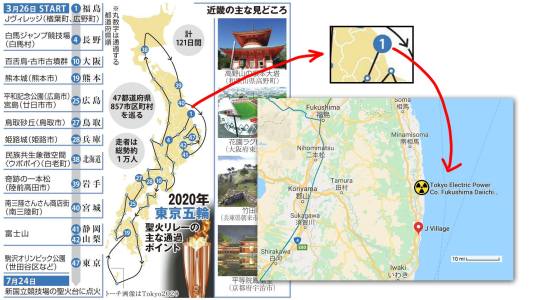
It’s official! The 2020 Tokyo Olympic torch relay starts at the J Village Sports Complex in Fukushima, which is just 10 miles from the crippled nuke plant.
Olympics: Tokyo 2020 torch relay route revealed, uniforms unveiled

June 1, 2019
TOKYO (Reuters) – Tokyo 2020 organisers on Saturday unveiled the uniforms to be worn by 10,000 volunteer runners during the torch relay and presented further details about the route the relay will take.
Organisers said the torch will travel through all 47 of Japan’s prefectures – from Hokkaido in the north to the southern island of Okinawa – and most of the country will have the chance to see the torch with 98% percent of the population residing within an hour’s distance from the route.
The 121-day relay will begin on March 16 at the J-Village in Fukushima, which is Japanese football’s national training centre and a symbol of resilience during the 2011 earthquake and tsunami that killed almost 16,000 people.
Games organisers have sought to stress the importance of Tokyo 2020 as the ‘reconstruction Olympics’ and it was evident in the choice of the route, which will pass through Okuma, where part of the Fukushima nuclear complex is located, and past Kumamoto Castle, which suffered heavy earthquake damage in 2016.
“It is not just about places where people can come or around landmarks, but the torch will also visit areas affected by the Great Japan Earthquake and Kumamoto Castle, recovering from the Kumamoto earthquake,” said Miho Takeda, a Tokyo 2020 committee member and five-time Olympic medallist in synchronized swimming.
“The relay will go through areas of Japan that are working hard to recover from natural disasters.”
The torch will also visit the Hiroshima Peace Memorial Park and pass Mount Fuji before arriving at the National Stadium in Tokyo on July 24 during the Olympics opening ceremony.
The runners’ uniform, designed by fashion designer Daisuke Obana, was unveiled by multiple Olympic gold medallist judoka Tadahiro Nomura.
The uniforms, which are produced in part from recycled plastic bottles, incorporate a diagonally-draped red sash similar to those used as batons in Ekiden, Japan’s famous long distance relay events.
“The torch bearer uniform is eco-friendly. Coca Cola collected plastic bottles in their company and recycled them to use them in the uniform material,” Nomura said.
Japan to toughen screenings of seafood imports from S. Korea

An intermediate wholesaler at the Toyosu fish market provides a wide range of seafood products.
May 31, 2019
In what even some government officials admit is a retaliatory move, the health ministry will tighten screening of seafood imports from South Korea starting in June.
Ministry officials, in announcing the new measure, said it was aimed at preventing food poisoning during the summer. However, some in the prime minister’s office admitted the measure was to hit back for South Korea’s continued ban on imports of Japanese seafood harvested in waters in eastern Japan.
Seoul has raised concerns about the safety of such seafood in the wake of the 2011 triple meltdown at the Fukushima No. 1 nuclear power plant.
Chief Cabinet Secretary Yoshihide Suga said the latest measure was intended to protect the public’s health and was not meant as a retaliatory measure.
The seafood to be covered are farm-raised flounder, “akagai” ark clams, “tairagigai” pen shellfish, “torigai” Japanese cockle and sea urchin roe.
The percentage of that seafood to be inspected at quarantine stations will be raised from 20 percent to 40 percent of reported imports for flounder and from 10 percent to 20 percent for the other items.
Except for sea urchin roe, most of the other seafood items covered by the new measure come mainly from South Korea.
While the tougher measures for flounder will continue until the end of March, the steps for the other seafood items will at first be implemented for about a month.
A health ministry official explained that last year cases of food poisoning caused by the parasite kudoa septempunctata and the bacteria vibrio parahaemolyticus were found. The parasite and bacteria were found in imported flounder and sea urchin roe.
The three other types of shellfish are refrigerated when shipped much like sea urchin roe so ministry officials judged there was also the risk of those shellfish being contaminated with vibrio parahaemolyticus.
Food poisoning from the parasite and bacteria can lead to vomiting and diarrhea, but normally the symptoms are not severe.
Ministry officials said if levels of the parasite and bacteria are found beyond established standards, all produce shipped out from the same farm where the fish was raised and the same plant the other seafood was processed would be stopped at the quarantine station until the seafood passed inspection.
That would lead to a decline in the freshness of the seafood and would make it more difficult to import those items to Japan.
According to health ministry officials, about 9,000 tons of flounder sold annually in Japan is raised domestically with about 2,000 tons coming from South Korea.
The ministry official said imports would be allowed to continue as long as no problems emerged at the quarantine station.
An official with the South Korean Foreign Ministry only said necessary measures would be considered after carefully observing the developments that emerge from the tougher inspection.
Lawmakers from the ruling Liberal Democratic Party had called for tougher retaliatory measures against South Korea after a World Trade Organization panel upheld Seoul’s ban on Japanese seafood imports because of the Fukushima nuclear disaster.
The timing of the latest measure is somewhat unusual because normally tougher quarantine inspections are announced after products are found to have exceeded safety standards.
So far, there have been no new cases of imported flounder from South Korea found with unacceptable levels of parasites or bacteria.
Philippines lifts ban on Fukushima fish imports

Agriculture Secretary Emmanuel Piñol says the lifting of the ban is a gesture of goodwill as the Philippines also seeks to increase the market access of its agriculture exports to Japan
BAN LIFTED. The Department of Agriculture lifts the 7-year import ban on fish coming from Fukushima prefecture in Japan, which was affected by the nuclear power plant meltdown in 2011
May 29, 2019
MANILA, Philippines – The Philippines lifted the import ban on a number of fish species coming from Japan’s Fukushima prefecture after 7 years, according to Agriculture Secretary Emmanuel Piñol.
In a Facebook post on Wednesday, May 29, Piñol said the order, which approves the proposal of the Bureau of Fisheries and Aquatic Resources (BFAR), serves as a “gesture of goodwill” between Japan and the Philippines.
The Philippines imposed the ban on importing cherry salmon, sand lance, Japanese dace, and ayu or sweetfish in 2012, after the Fukushima Daiichi Nuclear Power Plant meltdown in 2011.
“I consider the ban, issued by the previous administration, as just a bureaucratic goobbledygook and an overreaction to an issue which did not really affect the Philippines,” Piñol said.
In turn, the Department of Agriculture also hopes to improve the market access of the Philippines’ agriculture exports to Japan by seeking lower tariffs for bananas and pineapples.
Piñol also said they are pushing for the entry of Hass avocado into Japan. (READ: DTI expects $5 billion in signed deals from Duterte’s Japan trip)
The lifting of the ban coincided with President Rodrigo Duterte’s visit to Japan for Nikkei’s 25th International Conference on the Future of Asia, where he has brought along 200 other delegates. (READ: Duterte promises Japanese businessmen he’ll ‘kill’ their problems) – Rappler.com
Olympics: Tokyo 2020 torch relay may include Fukushima reactor town

Japanese Prime Minister Shinzo Abe, center, attends a ceremony held on April 14, 2019, in Okuma, a Fukushima Prefecture town hit by the 2011 tsunami-quake disaster and subsequent nuclear crisis to celebrate the opening of the newly constructed town government building.
May 28, 2019
TOKYO (Kyodo) — The 2020 Tokyo Olympic Games torch relay may pass through a town in northeastern Japan’s Fukushima Prefecture that was devastated by nuclear meltdowns following the 2011 earthquake and tsunami, sources said Tuesday.
The Olympic torch relay course could include the environs of the No. 1 reactor at the crippled Fukushima Daiichi nuclear complex in Okuma as part of the organizers’ efforts to promote the games as the “reconstruction Olympics,” the sources said.
The government lifted its mandatory evacuation order over parts of Okuma last month, but most of the town still remains a no-go zone. The relay will pass through the parts of Okuma and the surrounding area where the evacuation order has been lifted.
After declaring that problems containing radioactive water accumulating at the No. 1 reactor were “under control” during the 2020 Olympic bid process, Prime Minister Shinzo Abe and the government have used the games to showcase Japan’s recovery from the massive earthquake and tsunami of March 11, 2011 and ensuing nuclear disaster.
But in districts of Okuma where the evacuation order has been lifted — which covers 40 percent of the town’s total land — only a tiny percentage of residents have returned, with some saying they have been left behind while more emphasis is placed on showing off the progress of recovery.
Organizers announced in July 2018 that Fukushima would be the starting point for the relay. In March, organizing committee president Yoshiro Mori revealed the relay will begin some 20 kilometers from Fukushima Daiichi at the J-Village national soccer training center, which was used as an operational base for handling the crisis.
The Olympic torch will arrive in Japan on March 20, 2020, and the flame will be taken to Ishinomaki Minamihama Tsunami Recovery Memorial Park in Ishinomaki, Miyagi Prefecture, which was devastated eight years ago.
It will then travel by train through Miyagi and Iwate prefectures — the two other prefectures hit hardest by the powerful earthquake and tsunami — before making its way to Fukushima.
The Japan leg of the relay will begin on March 26, 2020, two weeks after the flame lighting ceremony in Greece, and will travel across all 47 prefectures in Japan over a period of 121 days.
The Tokyo Olympics are scheduled to be held between July 24 and Aug. 9, followed by the Paralympics from Aug. 25 to Sept. 6.
” Tokyo – Next Olympic Venue, Is Our Home We Can’t Go Back Again”
May 28, 2019
Dear friends, wherever you are, here’s my sincere message as a mother. With all my wish to reach your heart.
〜*〜*〜*〜*〜*〜*〜*〜*
🔷 Ailing Daughter, Beaming Prime Minister
In the summer of 2013. I was at my home in Tokyo when the city won the place of 2020 Olympic venue.
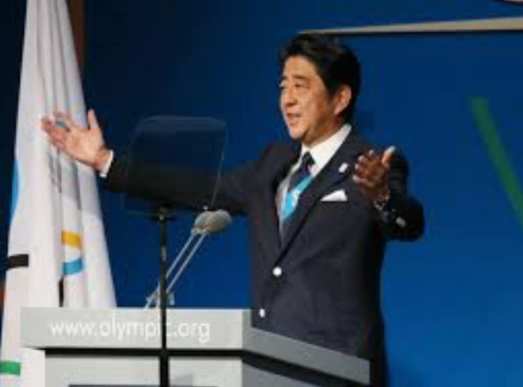
On TV, Prime Minister Abe, spreading both of his arms, addressing that the situation is under control about the Fukushima Daiichi Nuclear Plant Incident.
His speech was smooth with a smile, he claims it has never done and will never do any damage to Tokyo. Then he mentions the health issues in regards, he was telling that we definitely never had any problem neither in the past, at the present nor will be in the future.
Just then, sitting next to me was my eight-year-old daughter, whose health was deteriorating day by day. It had been a slow process.
“I feel sick. I have no strength left…”
“I”m woozy. I have a headache, I have a tummy ache, my legs hurt that I can’t walk, my hands are all in pain to my fingertips, I’m cold, my face is hot, Mummy I’m worn out”
Such condition started to bother us periodically after the accident. It started to worsen and never seemed to get better.
I used to be very ignorant about nuclear plants.
I started to research and read books frantically after the accident as if it was a wake-up call. My daughter’s health crumbled as if it was in parallel with my learning progresses. I first started to connect my daughter’s change with the radiation issue after I’ve developed my knowledge about internal radiation exposure.
🔷 Radiation Exposure in Tokyo? No way!
I was never sure. It can’t be radiation exposure, but what if it was? In Tokyo? No way. Doctors never took me seriously about having such concerns. They just chastised instead of giving any advice. My husband just laughed it off. He always ended up getting angry and we ended up fighting every time. I could never, ever talk about it to any of my friends. “Definitely no problem” the words come out of Prime Minister Abe’s mouth with a nice smile are, for us living in Tokyo, common sense like the air that fills all around us.
I don’t know. I don’t know what she was suffering about. I don’t know why she is suffering. I don’t know what I should be doing. How long does it last? I have no perspective about whether there be the day my daughter regains her health or not. Painful days.
The symptom was very identical to the “Bura Bura Disease.” My daughter was nothing but healthy until 5 years old. She was stronger than anyone. She used to be a girl who would play outside every day from early in the morning until the day falls dark.
I was beyond shocked when I heard our Prime Minister Abe told the lie “Under Control,” but that was nothing compared to the words that followed – “It has never done and will never do any damage to Tokyo.”
I was flabbergasted. That was back when I was not yet so sure of whether my daughter was a victim of the affected health, but the health was the problem I was facing each and every day with my daughter. I did not want Prime Minister, who had no idea what my daughter was facing, to be talking like that with such a big smile. I had this chilling feeling that we are being squashed and dumped, together with my daughter. Whatever happens, I will never approve of this Olympic. Such unforgiving phrase was etched deep in my heart. And since then my heart has never changed.So that was how I came to my understanding of this Olympic – it is to squash and cut the nuclear accident and the aftermaths.This is an Olympic to show off “recovery” by cutting us off with a smile.
Half a year later, my daughter’s health deteriorated to the point she has no day of strength. She can’t go to school. She can’t play with friends. When it is bad, she can not go to the bathroom by herself. It was 3 years after the accident.
🔷 She Gets Better! …When She Goes to Places with No Contamination
It was then I met Dr. Shigeru Mita, then the only doctor in Greater Tokyo who was dealing seriously with the problems in relation to the radiation exposure. I heard that symptoms vary by individual, some children recover conspicuously or show remarkable improvement in blood test results after moving to places such as Western Japan – where there is no contamination.
We made it and attend his last local lecture event. A month later the doctor migrated. He clearly stated my daughter’s case is the damage caused by radiation exposure.Hearing him say that, I was not shocked but felt a deep relief. Finally, I can start to face the real problem and start working towards her health. It was the doctor’s recommendation to recuperate, emigrate, move to the place without contamination.
Immediately , we moved our daughter to Toyama, where my family is. Then there was a miracle.
Our daughter, whom we had to piggy bag to use the toilet, walked 15 minutes to the local beach and swam in a pool. It was only a few days after she arrived Toyama. It was a miracle after a month of agony – she was feeling sick all the time, she would cry because her body was in pain. For a month, she could not get out of the house, not to mention going to school.
The same miracle happened when we recuperated her in Okinawa, then in Kobe, to where we later relocated. Then she falls back again when she came back to Tokyo. Her condition would be back after a week. Sometimes it comes back as soon as the night she returned.
“I can’t do the homework,” the daughter once recovered says, “I could not say I was feeling sick… I did not want to disappoint you Mum”
I will never forget the hopelessness every time I had to witness my girl swept away by the waves of symptoms. I will never forget the tears that she shed in despair.
🔷 Increasing “Degradation of Abilities” in the Metropolitan Area
Finally, we moved to Kobe in Western Japan. It was after we spent about 4 months without her health recovering except the time we relocated her for recuperation. We were lucky to have been able to move with all the family together. Many of evacuees from the Kanto Plain fell into serious financial strife because they had to move. Many mothers and children made a hard decision to move without their fathers who could not give up work to feed the family. I am thankful that we did not have to suffer from such financial strife, it was an easy start in Kobe although we were totally strange to the area. But more than anything, there is no word that can express how thankful I was to see my daughter coming back alive rapidly, started to play with many friends as if she was trying to recover the life she missed out. It was another miracle.
So what was happening to her body?
And what is happening to our body now?
After our relocation, we visited Mita Clinic in Okayama. Their examination and testing slowly uncovered the answers to my questions. We underwent multiple testing on our Pituitary Hormone which led us to understand the impact of radiation exposure on our brain. Important enough organ to be affected.
The deterioration of the hormone observed in my family including my daughter is said to be happening in many who lives in the Tokyo metropolitan. My family is healthy for the time being. Dr. Mita, however, says that more people are starting to suffer severe symptoms such as weakening of motivation, declined thinking and memory ability, and losing strength to fight against any kind of sickness to the point where they can no longer lead a normal life.Dr. Mita coined such symptoms as “Degradation of Abilities.”
Can we recover what had already been lost?
No one has the answer. We are the test subjects for keeps. The country is on the experimental bench and many of us, the test subjects, instead of sharing knowledge and unite in harmony for our recovery, are being made to run the exact opposite direction.
I was born and raised in Tokyo. It’s the city where I also raised my children and spent my entire life. My parents, siblings, and friends are in Tokyo. All my memory, nostalgia and love for my home is now lost without a trace.
I can not go home. I have even lost my wish to go home. That’s how intense it was. That’s the result of our experience with our daughter during our last 4 months in Tokyo. Now we must face the cruel test results of our pituitary gland hormone.
We must face what we can not see, smell, or feel. That’s the fear of radiation itself.But it doesn’t end there. The worst part is this horrible feeling that I can not share such a fierce feeling of crisis at all with any of the people I care and spend time with.
🔷 Olympic Brings on Sad Future
Do you still think Olympic would be a great idea?
As 2020 approaches, revulsion is creeping in to fill me. I’ve been having trouble finding the right word to let you understand how unpleasant a feeling can be.
That is the ground my daughter can never walk on anymore. That is the ground where many families, many mothers, and children evacuated from. That land we escaped from in order to protect our children, protect our own. That land we ran away from, hoping for the tomorrow without tormenting health damage.
My home town had been contaminated. We can not erase what is there. We can not say it never happened. We are blindfolded about the ongoing nuclear accident and nuclear contamination spreading throughout Eastern Japan. And they put this Olympic on our way we are walking towards as if some sort of culmination of achievement.
So this is the Olympic of recovery and regeneration.
Is Olympic our hope? Is it our future? What kind of hope, what sort of future are we meant expect with the Olympics, when we are blindfolded about the wounded bodies of our children, our own bodies in pain? Are we expected to push forward for the Olympic to show off “Recovery” with blindfolds?
Who is that for? What is it for?
My child hit my head hard. Then the blindfold fell. So I found out the existence of the blindfold. We can not protect our most precious things from radiation exposure because of the blindfold. So what sad future does that bring about? We should be able to learn
from the past nuclear bombs, nuclear accidents, nuclear disaster, and nuclear testings if we want to learn. My daughter is teaching me a tiny piece of the puzzle with her own body.
This Olympic is the biggest blindfold in history. Let us throw away the blindfold. Our wish is to live our own lives, with our own body that we are given by right.
To retrieve the tomorrow where our children can run with a healthy smile on their face, why not us the adults get over any barriers, hold hands and cooperate.
I will not not forgive this 2020 Olympic Games in Tokyo.

Not a single watt of electricity, but still 1 trillion yen in basic revenue
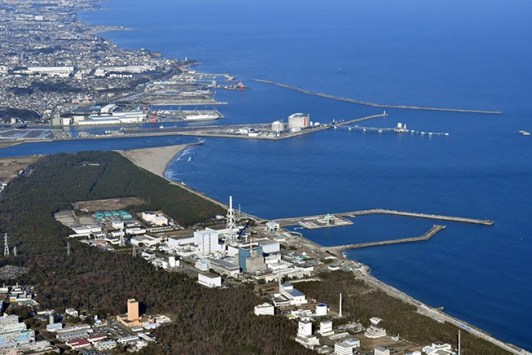
Japan Atomic Power Co.’s Tokai No. 2 nuclear power plant in Ibaraki Prefecture faces the Pacific Ocean.
May 25, 2019
Even though it hasn’t generated any electricity at its two nuclear power plants since May 2011, Japan Atomic Power Co. chalked up close to 1 trillion yen ($9.1 billion) in basic revenues in that time.
Under an arrangement with five electric power companies, Japan Atomic Power has received about 100 billion yen annually in basic charges for maintaining and managing its nuclear power plants.
Two of the four nuclear reactors owned by Japan Atomic Power are now being decommissioned. Of the two remaining, the Tokai No. 2 plant has not been in operation since the March 2011 earthquake and tsunami disaster.
The No. 2 reactor at the Tsuruga nuclear plant suspended operations in May 2011.
Since then, neither reactor has generated a single watt of electricity.
But Tokyo Electric Power Co. Holdings Inc., Kansai Electric Power Co., Chubu Electric Power Co., Hokuriku Electric Power Co. and Tohoku Electric Power Co. have continued to pay out basic electricity charges. In the fiscal year ended in March, the five companies provided Japan Atomic Power with a total of 109.1 billion yen in revenues.
Since the 2011 natural disaster, Japan Atomic Power has received between 100 billion and 150 billion yen annually, for a total of 988.5 billion yen.
The five utilities have since asked for a rate decrease in light of retail sales of electricity being completely liberalized in 2016, which has made their own corporate standing much more severe.
Mamoru Muramatsu, Japan Atomic Power president, said that for fiscal 2019, electricity revenues from the five utilities would likely fall under 100 billion yen.
But the company still faces a tough high-wire act in achieving financial stability because of problems it faces in resuming operations at its Tokai No. 2 plant.
Because the plant started operations close to 40 years ago, it asked for and received permission last November for a 20-year extension of operations.
An active fault has been found directly under the Tsuruga No. 2 reactor building in Fukui Prefecture, making resumption of operations there much more difficult.
So if the Tokai No. 2 plant cannot resume operations, Japan Atomic Power faces possible insolvency.
TEPCO and the four other utilities are now considering a plan to provide roughly 300 billion yen in financial assistance to Japan Atomic Power. Under the plan, the Tokai No. 2 plant is scheduled to resume operations in January 2023.
But local municipalities in the vicinity of the Tokai No. 2 plant remain at odds with Japan Atomic Power over what say they have over a resumption of operations. So it remains to be seen if those entities will come around to approving operation resumptions.
In addition, the Nuclear Regulation Authority in April decided not to allow an extension of deadlines for installing anti-terror facilities at nuclear plants. The deadline for the Tokai No. 2 plant is October 2023.
Muramatsu conceded that the company was only at the stage of considering specifications for the needed equipment and no discussions have been held on a construction timeline.
But even for nuclear plants that have already resumed operations, installation of the anti-terrorist measures are expected to take between five and a half and seven and a half years. Because no work has even begun at the Tokai No. 2 plant for such measures, the work period is expected to take even longer. Even if the plant resumed operations, the remaining operating period would likely become shorter.
TEPCO has said it was contemplating providing financial assistance to Japan Atomic Power because of the economic benefits that would accrue. But if the operating period is shorter, that would result in higher power generation costs, thereby weakening the rationale for providing the assistance.
1 This Month
Chernobyl: The Lost Tapes – A good documentary on Chernobyl on SBS available On Demand for the next 3 weeks– https://www.sbs.com.au/ondemand/tv-program/chernobyl-the-lost-tapes/2352741955560

of the week–London Campaign for Nuclear Disarmament

Tell the Ukrainian Government to Drop Prosecution of Peace Activist Yurii Sheliazhenko
To see nuclear-related stories in greater depth and intensity – go to https://nuclearinformation.wordpress.com
-
Archives
- April 2026 (139)
- March 2026 (251)
- February 2026 (268)
- January 2026 (308)
- December 2025 (358)
- November 2025 (359)
- October 2025 (376)
- September 2025 (257)
- August 2025 (319)
- July 2025 (230)
- June 2025 (348)
- May 2025 (261)
-
Categories
- 1
- 1 NUCLEAR ISSUES
- business and costs
- climate change
- culture and arts
- ENERGY
- environment
- health
- history
- indigenous issues
- Legal
- marketing of nuclear
- media
- opposition to nuclear
- PERSONAL STORIES
- politics
- politics international
- Religion and ethics
- safety
- secrets,lies and civil liberties
- spinbuster
- technology
- Uranium
- wastes
- weapons and war
- Women
- 2 WORLD
- ACTION
- AFRICA
- Atrocities
- AUSTRALIA
- Christina's notes
- Christina's themes
- culture and arts
- Events
- Fuk 2022
- Fuk 2023
- Fukushima 2017
- Fukushima 2018
- fukushima 2019
- Fukushima 2020
- Fukushima 2021
- general
- global warming
- Humour (God we need it)
- Nuclear
- RARE EARTHS
- Reference
- resources – print
- Resources -audiovicual
- Weekly Newsletter
- World
- World Nuclear
- YouTube
-
RSS
Entries RSS
Comments RSS
 nuclear-news