Massive amounts of radiation continue daily to enter Japan’s water and air, and the Pacific Ocean
Nuclear engineer Arnie Gundersen on Fukushima@5, Mar 7, 2016 (emphasis added): Massive amounts of radiation continue to enter Japan’s water and air, and the Pacific Ocean, daily… Due to its triple meltdowns and the unmitigable radioactive releases, Fukushima Daiichi will continue to bleed radiation into the Pacific Ocean for more than a century… There is no road map to follow with directions to stop the ongoing debacle…
Nuclear engineer Arnie Gundersen on KPFA, Mar 30, 2016: [Univ. of California] Berkeley’s nuclear program has been in the forefront of the pro-nuclear propaganda for decades, and since Fukushima has been aggressively downplaying the significance of it. So, whatever comes out of Berkeley, I just attribute to a very pro-nuclear faculty… [Woods Hole Oceanographic Institution is] measuring 1,000 miles offshore [of the US West Coast] and… picking up 10 becquerels per cubic meter [Bq/m3]. At my point, that’s when my alarm bells go off is 10 [Bq/m3]… That plume is still coming, the Pacific is a huge place and to think that a disaster on the opposite side of the world can be detected and begin to contaminate California, I think that the monumental shattering conclusion [is] radiation knows no borders… So this ‘dilution is the solution to pollution’ is what I think Berkeley believes in. What you can be sure of is that somebody’s going to die from the radiation that’s in the Pacific, but you just won’t know who it is – and they’re counting on that. The nuclear establishment is saying, ‘Well, we can smear that out in a broader epidemiological study.’
Nuclear engineer Arnie Gundersen on CCTV, Apr 5, 2016: We’re looking at newspaper coverage from the last couple of weeks and it’s clear that the plant continues to hemorrhage.
Fairewinds Japan Speaking Tour Series No. 1, Feb 12, 2016:
- Nuclear engineer Arnie Gundersen: [T]he Fukushima power plants… continues to bleed into the Pacific every day. But what no one is paying any attention to is that the entire mountain range that runs 100 miles up and down this coast is also contaminated. And as much radiation is pouring out… into the Pacific from the mountain range because it’s so contaminated, as from the Fukushima site… in fact, they’ve got an entire state pouring radiation into the Pacific. So what’s in the Pacific? Off of California, they’re finding radiation at what I would consider significant levels… in a cubic meter of ocean water, they’re finding 10 radioactive decays every second… So a cubic meter of water, if you’re in a dark room, would have 10 flashes of light every second, and that’s going to go on for 300 years. So we have contaminated the biggest source of water on the planet, and there’s no way to stop it.
- Maggie Gundersen, founder of Fairewinds: So are you saying that the contaminated water problem is hopeless? Is there nothing we can do to slow it down?
- Arnie Gundersen: It used to be that scientists believed dilution is the solution to pollution. But I think we’re finding with the biggest body of water on the planet, that you can’t dilute this stuff. And we’re going to begin to see this bio-accumulation, which is all the fish that are in the ocean are going to uptake the cesium and the strontium and become more and more and more radioactive…
Radioactivity at buried tank up in Daiichi plant

The operator of the crippled Fukushima Daiichi nuclear plant says the level of radioactivity near one underground wastewater tank at the plant is more than 100 times earlier readings.
Tokyo Electric Power Company says the tanks were built 3 years ago to store highly radioactive wastewater produced within the crippled plant. But all of the tanks soon went out of use due to repeated leaks of contaminated water.
The utility pumped most of the water out of them, but has been checking radioactivity levels of groundwater near the tanks.
On Wednesday, equipment detected 8,100 becquerels of beta-ray-emitting radioactive substances per liter of water. On Thursday, it went up to 9,300 becquerels.
A week ago, the level was only 87 becquerels.
TEPCO says it doesn’t know why the sharp rise took place. It says some highly radioactive water remains in the tank, but it is isolated with waterproof measures.
TEPCO says it will continue to analyze groundwater samples around the tank, and also compare them with data on the contaminated water left in part of the tank.
http://www3.nhk.or.jp/nhkworld/en/news/20160408_03/
Very pertinent comments and photos from Ray Masalas regarding the said “buried tank”:
I see the Japanese media is once again lying to protect Tepco. These were not tanks. They were in ground pools with sloped sides that were dug on site, lined with thin poly and filled with highly radioactive water. {See pic below} With a lining as thick as 2 garbage bags they leaked into the ground fast. Whether they transfered these tons of radioactive water to steel tanks or not, I’ll leave up to you to believe or not believe. At the same time they were building enclosed concrete ditches running down the west hill to sea. From the flyover footage I’d guess that there were about a dozen of these pits up on the west hill.

Sept 013. One of the “tanks” they spoke of.
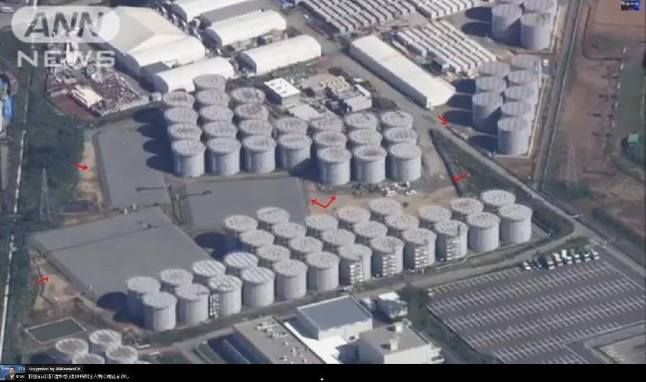
After they said that the transferred the radioactive water to steel tanks these empty pits magically got lids. My guess is that they dumped then refilled.

The enclosed concrete ditches running down to the sea were built at the same time. Dec 013
Children’s book connects stories of Fukushima and Chernobyl

A page from Shoko Nakazawa’s latest work depicts Natsuko about to part
with her pet piglet Momo.
Inspired by a letter sent to her by a young reader, author Shoko Nakazawa revived a past work and penned an entirely new illustrated children’s book on nuclear disasters in Fukushima and Chernobyl.
In 1988, Nakazawa’s “Ashita wa Hareta Sora no Shita de Bokutachi no Chernobyl” (Tomorrow, under a fair sky, our Chernobyl) was released by Choubunsha Publishing Co.
In the letter, a junior high school student in Yokohama who read the book after the triple meltdown at the Fukushima No. 1 nuclear power plant wanted to know how such an incident occurred when humans had surely learned of nuclear horrors from the Chernobyl accident in Ukraine in 1986.
The student asked what adults had done to prevent the Fukushima disaster. Because her 1988 book had long been out of print, Nakazawa, 63, first went about having it republished in summer 2011.
She also wrote a new work, recently published by Iwasaki Publishing Co., titled “Kobuta Monogatari Chernobyl kara Fukushima e” (A tale of piglets, from Chernobyl to Fukushima). The book sells for 1,300 yen, tax exclusive.
The two parts of the book involve little girls living in Chernobyl and Fukushima. Tanya lives in Chernobyl and has a pet piglet named Marumaru. Their peaceful life is turned upside down by the nuclear accident that forces all residents to evacuate.
Marumaru is left behind on the farm and time passes as the piglet waits for Tanya and her family to return. They never do.
The Fukushima portion involves a girl named Natsuko and her pet piglet Momo. They are also separated by the Fukushima nuclear accident.
A temporary lifting of the evacuation order allows Natsuko and her mother to return home. However, the mother does not recognize Momo, who is now filthy because no one was around to take care of the animal. The mother shooes the piglet away in a harsh voice.
The two parts of the book are connected because Natsuko’s mother had come to know Tanya when she visited Japan more than 20 years ago. Tanya even sent a letter to Natsuko’s mother in which she wrote, “Please do not forget us.”
During their short stay at home, the mother comes across that letter again and breaks down crying.
“I forgot everything.”
A key turning point in Nakazawa’s life was moving to Hiroshima from Nagoya before she entered junior high school. Most of her friends had parents who were hibakusha. Nakazawa herself was shocked when she saw the exhibit about the horrors of the atomic bombing at the Hiroshima Peace Memorial Museum.
She is concerned about recent moves to resume operations at nuclear power plants around Japan.
“We are once again trying to forget,” she said. “I hope the book becomes a catalyst to rethink a civilization that exists upon something like ‘nuclear power’ that simply cannot co-exist with humans and nature.”
Reactor ruling ignores lessons, anxiety from Fukushima crisis
A court ruling concerning nuclear reactor operations raises serious doubts about whether the court rightly recognized the gravity of the damage and the harsh realities caused by the 2011 accident at the Fukushima No. 1 nuclear plant.
The Miyazaki branch of the Fukuoka High Court on April 6 rejected an appeal by Kyushu residents seeking an injunction to shut down the No. 1 and No. 2 reactors of the Sendai nuclear plant run by Kyushu Electric Power Co. in Satsuma-Sendai, Kagoshima Prefecture. They are the only two reactors currently operating in Japan.
The ruling in essence said the Nuclear Regulation Authority’s (NRA) new safety standards, established after the disaster at the Fukushima plant, reflect the lessons learned from the triple meltdown and cannot be described as unreasonable. It also dismissed the plaintiffs’ argument that the design of the Sendai plant underestimates the safety risks posed by possible major earthquakes.
This ruling stands in sharp contrast with the Otsu District Court’s decision in March that raised doubts about the NRA’s safety standards and ordered the suspension of operations of two reactors at Kansai Electric Power Co.’s Takahama nuclear plant in Fukui Prefecture.
What happened in Fukushima has created strong anxiety among Japanese about the safety of nuclear power generation. From this point of view, it is obvious which of the two rulings really echoed the public sentiment about nuclear safety.
Symptomatic of the two courts’ different stances toward public concerns are their views about evacuation plans.
The new nuclear safety standards do not address issues related to evacuation plans.
The Otsu District Court raised questions about this fact and contended that the government is obliged to develop new regulatory standards based on a broader perspective that also address evacuation plans.
The Miyazaki branch acknowledged there are legitimate concerns about the existing plan for emergency evacuations.
The plaintiffs argued that the plan would be unable to deal with a situation that requires an immediate and massive evacuation. They also said the number of buses available to transport local residents during nuclear crises would be insufficient.
But the court nevertheless dismissed the plaintiffs’claim that operating the Sendai reactors violates their personal rights. The court pointed out that at least an emergency evacuation plan was in place.
Following the accident in Fukushima, many residents could not smoothly flee for their safety, leading to serious confusion.
The high court’s decision did not give due consideration to this fact.
Volcanoes, including the highly active Sakurajima, are located around the Sendai nuclear plant.
The NRA has established guidelines concerning the risks to nuclear plants posed by volcanic eruptions.
The high court judged the guidelines, based on the assumption that the timing and scale of eruptions can be accurately predicted, to be “irrational.”
Yet the court said the probability of an eruption triggering a catastrophic nuclear accident was so low that the risk can be ignored unless solid grounds for thinking otherwise are shown.
The court acknowledged the NRA’s flawed approach to dealing with the safety risk posed by volcanic eruptions. But it said the widely accepted view in society is that the risk can be ignored because of the low probability of such eruptions actually occurring.
Can this be described as an opinion based on serious reflection on the fact that unforeseen circumstances occurred at the Fukushima plant?
The exact causes of the nuclear disaster are not yet clear, and around 100,000 people are still living as evacuees.
That explains why various opinion polls show a majority of respondents expressing negative views about plans to restart reactors.
The court ruling that endorses the NRA’s new safety standards does not translate into public support of the government’s policy to bring idled reactors back on stream.
The sharply different court rulings on reactor operations should be regarded as a sign that the knotty question of how to secure safety at nuclear plants remains unsolved.
Japan lawyer wants no-nukes after Fukushima
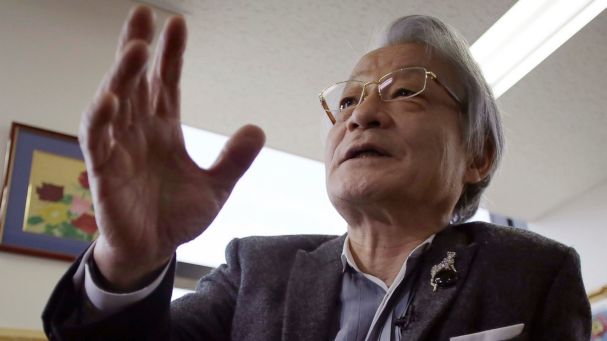
Lawyer Hiroyuki Kawai stands out in Japan, a nation dominated by somber dark suits: When not in a courtroom, he often wears colorful shirts and crystal-covered animal pins. He is a Noh dancer, a tenor and, of late, a filmmaker. His ride is a Harley.
Some of it is just for fun, but much of the flamboyance is meant to draw attention to his cause: shutting down all nuclear plants in Japan. His more than two-decade-long legal battle is gaining momentum after the multiple meltdowns in Fukushima five years ago led to all plants being idled for safety checks.
In March, Kawai helped set up an organization to support Fukushima residents whose children have developed thyroid cancer since the 2011 disaster — 166 among 380,000 people 18 years and under who were tested, including suspected cases. That’s up to 50 times higher than on average, according to Toshihide Tsuda, a professor at Okayama University.
The Japanese government denies any link, saying the increase reflects more rigorous screening. Thyroid cancer, rare among children at two or three in a million, soared after the 1986 Chernobyl nuclear disaster.
Also last month, Kawai’s won a court injunction to stop two nuclear reactors in western Japan that had recently restarted. The district court cited concerns about safety, emergency planning and environmental contamination. One of the reactors was shut down shortly after its restart because of glitches. Both had met stricter standards upgraded after the 2011 disaster.
Kawai’s team is pursuing damage compensation for those evacuated from Fukushima, and criminal charges against former executives of Tokyo Electric Power Co., which operates the Fukushima plant. His ultimate goal is to banish nuclear power.
“If another nuclear accident ever happens in Japan, everything will be destroyed — turning upside down our politics, our economy, our education, our culture, our love, our law,” Kawai told The Associated Press, sitting at a desk overflowing with files and papers in his Tokyo office.
Born in 1944 in Manchuria, northeastern China, Kawaii has built a reputation as a champion of humanitarian causes, helping out Japanese abandoned as children in China after World War II, and Filipinos of Japanese descent in the Philippines. His compassion is driven partly by his own experience: A baby brother died of starvation during his family’s perilous journey back to Japan.
After graduating from prestigious Tokyo University, Kawai represented major corporations as a lawyer during the “bubble era” of the 1980s. In the mid-1990s he began taking on lawsuits against nuclear power.
Until 2011, he was fighting a losing battle.
To win over regular people after the Fukushima accident Kawai started making movies, which are sometimes entered as evidence for his court cases. In “Nuclear Japan,” he points out how precariously quake- and tsunami-prone Japan is, and how densely populated. He interviews scientists, former Fukushima residents, a fire fighter who could not go back to save lives because of radiation.
“Imagine remembering this film in an evacuation center after the next nuclear disaster,” Kawai narrates in the movie.
Since Japan imports almost all its energy, many in government and business view nuclear power as the cheapest option, and the best way to curb pollution and counter global warming.
Kawai’s stance angers many in the powerful business community. Hiroshi Sato, a senior adviser at Kobe Steel, lambasted Kawai’s position as “emotional” and “unscientific.”
“What I’m really worried about is the idea of similar lawsuits being filed one after another. That would lead to uncertainty about a stable electricity supply,” he told reporters recently.
Even those who insist nuclear power is safe — including top government regulator Shunichi Tanaka and Gerry Thomas, a professor at the Imperial College of London who advises Japan — say the choice of whether to keep or abandon nuclear energy should be left to the Japanese people.
Kawai believes policy shifts, like the turn against nuclear in Germany, begin in the courtroom.
“For 50 years, Japan had a campaign that we need nuclear power, and how it is reliable and safe, and 99 percent of Japanese believed this,” he said.
“But we thought we could finally win, and about 300 lawyers came together to start a new fight against nuclear power,” he said with a zeal making him appear younger than his 71 years.
Financially independent thanks to his corporate law days, Kawai invested 35 million yen ($350,000) in his first movie, which turned a profit from screenings and DVD sales. He is now working on his third film.
“I think he is fantastic,” said Yurika Ayukawa, a professor of policy at Chiba University of Commerce. She attended at a recent screening where Kawai spoke and surprised the crowd by breaking into a song on Iitate, one of rural Fukushima’s most radiated areas.
Radiation is a sensitive issue in Japan, the only country to suffer atomic bomb attacks, and the Fukushima thyroid cancer patients and their families mostly have kept silent, fearing a social backlash. They face pressure from the hospital treating their children not to speak to media or to question the official view that the illnesses are unrelated to radiation.
Two of the patients’ families appeared recently with Kawai before reporters, although in a video-call with their faces not shown. They said they felt doubtful, afraid and isolated. Kawai believes they are entitled to compensation, though they have not yet filed a lawsuit.
George Fujita, an attorney who specializes in environmental issues, says Kawai is Japan’s top lawyer on nuclear lawsuits.
“It’s unusual for judges to watch a whole movie entered as evidence. It’s because the people are putting pressure on the courts,” he said.
Kawai admits that at times he been tempted to give up.
“I should never walk away. I must fight it out,” he said.
His business card is three times the usual size to include his artistic activities and his motto: “If you really mean it, you get most anything done. If you really mean it, everything becomes fun. If you really mean it, someone will come and help.”
Who Decides Level of Risk?
Nuclear power’s popularity has waned significantly in post-Fukushima Japan. Japanese citizens near nuclear power plants have used the court system to challenge efforts by the national government and nuclear industry to resume nuclear power plant operations.
Recently a judge ruled that nuclear power constituted an acceptable level of risk:
Court rejects appeal to halt operations of Sendai reactors April 6, 2016 THE ASAHI SHIMBUN http://www.asahi.com/ajw/articles/AJ201604060045.html
MIYAZAKI–A high court here rejected an appeal by Kyushu residents seeking to shut down the only two nuclear reactors operating in Japan, ruling that it is impossible to secure absolute safety with nuclear energy. Presiding Judge Tomoichiro Nishikawa of the Miyazaki branch of the Fukuoka High Court said April 6 that current science and technology standards cannot reach a level of safety in which no radioactive materials are emitted regardless of the severity of the accident at a nuclear plant.
“A judgment has to be made based on the standard of what level of danger a society would be willing to live with,” Nishikawa said.
The judge’s decision is not necessarily representative of majority public opinion in Japan given polling results conducted by Japan’s mainstream news media.
Japan’s political and legal bureaucracies may give judges the authority to make this type of decision, counter to public will.
This may be legally sound, but still morally inconsistent with democratic ideals, including human rights.
Who decides when the potential consequences of a decision are catastrophic?
This question about who decides is illustrated in another recent news story, wherein we were causally informed that workers at the Daiichi plant’s new exposure level is 1,000 millisieverts, or a full sievert:
Fukushima No. 1 workers who got maximum radiation dose at start of crisis can now return to plant Kyodo Apr 1, 2016 http://www.japantimes.co.jp/news/2016/04/01/national/150-fukushima-no-1-workers-got-maximum-radiation-dose-start-crisis-can-now-return-plant/#.VwFGsnqYJmz
But Tepco said it will not push them to return and said those who wish to go back will be managed under a new exposure regime designed to limit a worker’s lifetime radiation dosage to 1,000 millisieverts in line with recommendations made by the International Commission on Radiological Protection. In 2015, the exposure level had been raised to 250 millisieverts a year. Now its 1000? Who made that decision?
Hiromi Kumia, “Nuclear Watchdog Proposes Raising Maximum Radiation Dose to 250 Millisieverts,” The Asahi Shimbun, July 31, 2015, accessed August 1, 2015, http://ajw.asahi.com/article/0311disaster/fukushima/AJ201507310057.
“Gov’t to Raise Maximum Annual Radiation Exposure Ahead of Restart of Nuclear Reactors,” The Mainichi, June 30, 2015, accessed July1, 2015,
http://mainichi.jp/english/english/newsselect/news/20150630p2a00m0na018000c.html.
Source! Majia’s Blog
http://majiasblog.blogspot.fr/2016/04/who-decides-level-of-risk.html
South Korean Gov’t opts not to disclose radiation test result of Japanese fishery goods
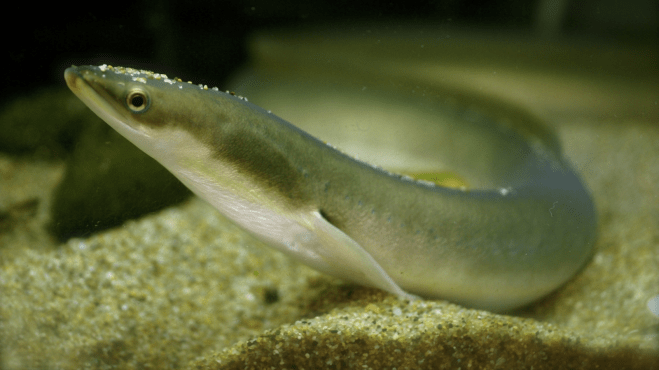
Japanese eel
Gov’t opts not to disclose radiation test result of Japanese fishery goods
The government has rejected calls to disclose the results of radiation level checks conducted on fishery goods caught near Japan, a civic group said Wednesday.
The Ministry of Food and Drug Safety on Tuesday dismissed the information disclosure request filed by the Lawyers for a Democratic Society, the group said.
“As the information is related to a case pending at the World Trade Organization, (the disclosure) could lead to a leakage of our strategy to Japan,” the ministry was quoted by the group as saying.
The lawyers association, however, countered that the reason provided by the authorities was groundless since the government has to submit its findings to the WTO and Japan anyways.
Tokyo filed a formal complaint with the World Trade Organization against Seoul’s import ban of its fishery goods.
South Korea has banned imports of all fishery products from eight Japanese prefectures, including Fukushima, where the 2011 earthquake and tsunami caused the meltdown of a nuclear reactor, marking the worst nuclear accident since the Chernobyl disaster.
The import ban was imposed in September 2013 after reports that massive amounts of radioactive materials and contaminated water from the Fukushima reactor were being dumped in waters surrounding Japan. This caused serious safety concerns here, that not only affected Japanese imports but the local fishery sector as a whole. (Yonhap)
http://www.koreaherald.com/view.php?ud=20160406000394
S. Korea Will Not Share Fukushima Fish Tests
South Korea’s Ministry of Food and Drug Safety has rejected a petition from a civil society group to release the results of radiation testing on fish caught near Japan following the Fukushima Daiichi reactor meltdown.
In 2013, South Korea imposed a ban on the importation of fisheries products from eight Japanese prefectures near Fukushima. Tokyo objected, and petitioned the World Trade Organization for relief, claiming that the ban was unfair to Japanese exporters. The Ministry of Food and Drug Safety has already submitted the results of its testing to the WTO and to Japan as part of the dispute, and advocates claimed that it should be made public as well.
The ministry disagreed. “As the information is related to a case pending at the World Trade Organization (WTO), [it] could lead to a leakage of our strategy to Japan,” it said in a statement on Tuesday.
A study of radioactive cesium levels in fish off of Fukushima in 2011 by Pavel Povinec and Katsumi Hirose found that consuming 100 kg of the affected seafood per year (four times the Japanese annual average) would result in approximately the same radiation dose as the world average for background exposure – and roughly the same as the level of exposure from consuming the naturally occuring radioactive polonium in 100 kg of any other seafood.
“Radiation doses from ingestion of marine food are under control, and they will be negligible,” the authors concluded.
However, a study published in February by Hiroshi Okamuraa and Shiro Ikedab found that while radioactive cesium levels were overall quite low among most species in Japan, they were unequally distrubuted, with some much more likely to be contaminated than others, especially larger predators towards the top of the food chain. Additionally, effects are regional and vary between freshwater and marine species, the authors said: areas nearer and to the south of the reactor are more affected, and freshwater fish – notably whitespotted char and Japanese eel – are more likely to show higher levels of contamination.
http://maritime-executive.com/article/s-korea-will-not-share-fukushima-fish-tests
Fukushima+5, Part 7. These women are pissed.
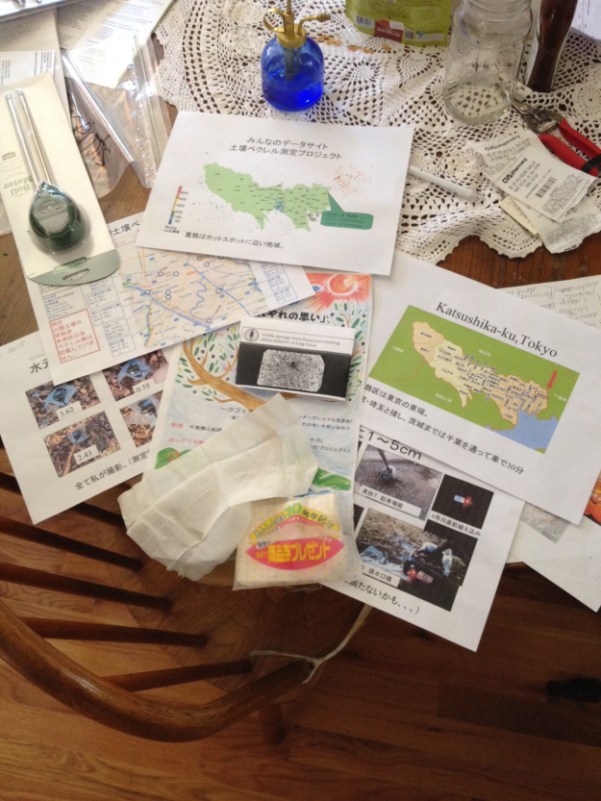
The post-Fukushima period is generating oceans of data, but much of it is useless. These women generate their own, but also want more solid data than the government has been willing to provide.
By Mary Olson
Don’t get me wrong: These women are pissed! (My word not theirs.) And they have every right to express that, even in Japan, at least according to its constitution.
I cannot leave Japan without peeling back the layer of sticky rice and sweet bean paste that keeps the victims of Tepco’s iodine, cesium and strontium on their feet.
One woman from Fukushima, who I met in Kyoto, said to me: “I am not as good as a guinea pig! They take tests from a guinea pig, but they don’t even test me.” She has thyroid cancer. There is a bias, since Chernobyl, toward focusing on thyroid cancer in children as a radiation impact. This is in part since they have less of a prior history of exposures, but in fact, radioactive iodine can cause cancer in people of any age.
This woman is asking to be studied. For me there are long and interesting questions about the moral and ethical basis of studying any victim…but this woman wants data. The post-Fukushima period is generating oceans of data, but much of it is useless, either for a study, or for the victims. This woman tells me that readings from a “full-body count” measuring Becquerels in her body, taken at an evacuation center in 2011 was destroyed after two years. She cannot get it. It is gone. She is more than pissed.
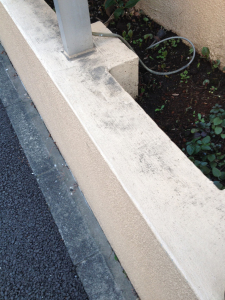
Fairewinds’ Arnie Gundersen dubbed this sort of urban particulate “Dark Matter” and often found that it contains radioactive particles. It’s not clear if these were directly deposited by a plume from the Fukushima meltdown or were perhaps released by post-tsunami incineration of debris.
I feel (or maybe project) other women would explode if they could, but they hold it together for their children.
This is the “triple bind” created by Tepco’s allies in the Japanese federal and (most) state governments:
First: One’s entire life is disrupted by radioactive contamination; any official support comes through cooperation;
Second: One’s children (and some Mamas) are having symptoms of radiation impact but the doctors are told* not to identify radiation in any diagnosis;
Third: The official message from over 400 government-paid Post-Tepco Meltdown staff psychologists is: the only harm to the children will come from the mother’s anxiety about radiation, which is unfounded, and results in stress to her and her family. Stress is bad.
This last point we can all agree on, but the word “stress”, has been appropriated by the “There is No Problem, the Radiation is Safe” story line. Now “stress” means a mother who is no longer cooperative with a government that would require her to move home to Fukushima Prefecture and support the use of local foods in the school lunch program, or face personal condemnation. There is no one to buy her home if she chooses not to.
This makes it a quadruple bind.
I support these Mamas by carefully, and slowly, stating, at each speaking event that if I were a mother I would leave contaminated zones and take my children with me. This does not touch, however, the incredible pressure on them from all sides to conform to the official line; talk about stress!
At one last Tokyo “Mama Meeting” or “tea party” as we have called the sessions with women concerned about radiation, these Mamas are not refugees. They are women monitoring hot spots here in Tokyo.
One woman has four children who bop in and out, cared for on the side. This mom is not at all happy with me, or maybe anyone from the U.S., having anything to say about her situation. I quickly shift to listen-mode and agree with her often. Another mom is much younger. She has done quite a bit of reading and has decided that internal emitters from food contamination are her big concern. I agree with her too. Another mom is interested in learning how to clean up hot spots…and has produced detailed maps with photos of her detector reading as high as 126 millirems per hour on hot spots at a park in Tokyo. Her readings in the same area were repeated over many months.
This group seems more engaged and active than any other Mama Tea Party group I have met with. The feeling fits with the large NGO events that I am doing at the end of this trip. The same day as the Tea Party I went on to the National Diet Building to speak at a large (and lively) event hosted by the Citizen’s Nuclear Information Center, which covered it here.
During this tea party it slowly begins to dawn on me that the bottom of pretty much the entire Japanese food chain is aquatic. I have a dim memory of hearing decades ago, when a U.S. fast-food chain selling fried chicken opened in Japan for the first time, it did not pass the “quality” check done by the chain’s U.S. corporate executives. The chicken tasted like fish. The eggs I have been eating for the past 2 weeks in Tokyo also taste, faintly, of fish. I share this with the Mama concerned about food. Color drains from her face. It is overwhelming to think of meats, dairy and eggs being at risk from possible radioactive sea-water contamination. She says “It makes me tired.” I say “yeah, especially when you factor in fish-fertilizer and all the soy products.”
So, in the end, we know, we all live in Fukushima…
My last day in Japan I was thinking about the old adage that Crisis = Opportunity. Years ago (1999), I traveled to Australia to help fight a global nuclear waste dump called the “Pangea Project” that was targeting Australia for all the world’s irradiated fuel rods. Over breakfast in Perth, in the home of a Green Party member of the Australian Parliament, I ventured an opinion: “The Pangea Project is an existential threat to your nation. You should work for a Constitutional Amendment to ban international waste from entering your waters or your land.” I was truly shocked, as a naive American, to hear the reply: “Australia does not have a constitution.” Unfortunately this ugly global dump threat has reared its head, targeting Australia again. (NIRS Action Alert coming soon!)
Here, now, in Japan, once again, in my view: this nation is facing an existential threat from radioactivity. So, I ask Steve Leeper, one of my hosts, “Does Japan have a constitution?” Steve explains that it does, the Peace Constitution, written post-WWII, by an American woman (under the aegis of a famous US General.). Established in 1947, under U.S. Occupation.
As I scan the Constitution of Japan, it is amazing how detailed it is in enunciating the rights of individuals…though ‘Free Speech’ appears as Article 21, not “first amendment.” I have often felt in these past weeks a common thread between my Japanese friends and my friends back home, south of the Mason/Dixon Line. It hits me: they are both warrior people who fought hard and had to accept defeat. From the same victor: Yankees.
Freedom cannot be given. It must be taken. I sincerely hope that the Mama’s rise, peacefully, to claim the provisions of this constitution (or a new one) for themselves, their children, and all of Japan.
BIG CRISIS = BIG OPPORTUNITY.
*Medical suppression: I heard first-hand accounts from three physicians. One at a prestigious clinic refused to take the “hint” that he should not mention radiation in his diagnoses of patients and had his hospital privileges revoked. Two other women doctors in private practice are persevering in their care for all their patients, including those with symptoms clearly from radiation exposure. One of them openly calls their medical association as “sell-outs” to the “nuclear mafia.” I met these doctors, but I am not “naming these names…” and that is a comment too.
http://safeenergy.org/2016/04/05/japan-diary-2016-fukushima5-part-7/
Health Situation in Fukushima – Arnie Gundersen
Excerpt 1
Arnie Gundersen: “I’ve been reflecting a lot over the last week and a half about what the trip meant to me personally and what I learned… The first thing is [the people are] terribly concerned about their country and concerned about their children… The second thing is the inhumanity of the Japanese government, the Japanese utilities and the Japanese banks toward their own population. I’m just appalled at how the power structure in Japan is ignoring what its people want and basically ramming nukes down the throat of their population… I think [the media sources in Japan] still feel pressure under that State Secrets Act. Nobody wants to push too hard against [Prime Minister Shinzo Abe’s] administration. As a matter of fact, one of Abe’s prime key ministers came out and said twice now that if… the media doesn’t say what the administration wants them to say, they’re going to pull their licenses.”
Excerpt 2
Arnie Gundersen: “The one thing I learned when I was in the resettlement communities [of people evacuated due to the Fukushima nuclear crisis] is that they’ve all been told that there will be no resettlement communities by the time the Olympics start. The plan is to move people back into their homes in the contaminated areas, or to move them somewhere else in Japan to permanent homes”… (Maggie Gundersen, founded of Fairewinds Energy Education:) “I was devastated when I saw some of the pictures that you took in Japan… these temporary housings just look like military barracks on bare pavement… And now to hide the radiation, extensive radiation, that’s there and re-depositing in the already cleaned areas from snowmelt, flooding, and rain — and to say it’s okay and send everyone back is a death sentence to all these families and children and grandchildren.”
Excerpt 3
Arnie Gundersen: Yeah, let me get back to the first thing I said about the inhumanity toward their own people. We had doctors tell us when they treated somebody for radiation illness, if they put radiation illness on the hospital forms, the government refused to pay. So doctors were literally going out of business because they were doing their job and treating people. But the other thing I learned on the last day of the trip was that there’s a huge spike in the death rates within Fukushima Prefecture for young children compared to what it was in previous years. But that story has been stifled by the Japanese medical and government agencies. Nobody’s publishing the data that the Japanese have been publishing for years leading up to the disaster. So where are the death data on Fukushima Prefecture? And the answer is it hasn’t been published because the Japanese government doesn’t want it out there. When you control the medical community, the epidemiological data that you need to prove a case is really, really difficult. I think Fairewinds did a good job in the time we were over there getting sample data with a group of scientists that may affect the way the world looks at the disaster. But the other half of that is, you’ve got to get the doctors on board to report honestly what they’re seeing. And the medical community is even more under the thumb of the Abe regime than is the press. It’s very depressing.” … (Maggie Gundersen:) “I want to let you know that Arnie and other scientists are working on some really significant studies from samples that scientists have taken in Japan… Fairewinds will be participating in a report that will be issued on this and we will keep you up to date. It takes time to do this testing, but as soon as it’s ready, it will be publicized.”
http://www.fairewinds.org/podcast//put-on-a-happy-face-japan-speaking-tour-series-no-4-1
Court rejects appeal to halt operations of Sendai reactors

Lawyers hold up signs describing the April 6 ruling by the Miyazaki branch of the Fukuoka High Court as being unjust.
MIYAZAKI–A high court here rejected an appeal by Kyushu residents seeking to shut down the only two nuclear reactors operating in Japan, ruling that it is impossible to secure absolute safety with nuclear energy.
Presiding Judge Tomoichiro Nishikawa of the Miyazaki branch of the Fukuoka High Court said April 6 that current science and technology standards cannot reach a level of safety in which no radioactive materials are emitted regardless of the severity of the accident at a nuclear plant.
“A judgment has to be made based on the standard of what level of danger a society would be willing to live with,” Nishikawa said.
The court did not set any danger level, but it did rule that there was no convincing reason to issue a temporary injunction against the operations of the No. 1 and No. 2 reactors of the Sendai plant run by Kyushu Electric Power Co. in Satsuma-Sendai, Kagoshima Prefecture, in southern Japan.
The plaintiffs argued that the Nuclear Regulation Authority’s new safety standards, established after the disaster unfolded at the Fukushima No. 1 nuclear plant in 2011, underestimated possible damage to the plant caused by a powerful earthquake.
Nishikawa dismissed the argument, saying the standards “were at an extremely high level of rationality because it was needed to secure safety.”
Nishikawa, however, did describe as “irrational” the NRA’s assessment of volcanic eruption risk near the Sendai nuclear plant. That assessment was preconditioned on predicting the timing and scale of volcanic activity that would cause extensive damage to a wide area.
But the judge added that there was no basis for believing that such an eruption might occur while the plant was in operation. He concluded that “a political decision” would have to be made about whether to consider the risks related to such eruptions.
The plaintiffs, from the three Kyushu prefectures of Kagoshima, Kumamoto and Miyazaki, are considering appealing the latest ruling to the Supreme Court.
Kyushu Electric Power issued a statement on April 6 that said the ruling acknowledged the company’s past arguments that safety of the plant had been secured.
Setting a standard for an acceptable danger level could untangle the differing court decisions on the operations of nuclear reactors.
In March, for example, the Otsu District Court raised doubts about the NRA’s safety standards and ordered an injunction against two reactors at the Takahama nuclear plant in Fukui Prefecture in central Japan.
The lawsuit for an injunction against the Sendai plant was filed with the Kagoshima District Court in May 2014.
The district court rejected the plaintiffs’ request in April 2015. A few months later, in August, the No. 1 reactor at the Sendai plant became the first in Japan to resume operations under the new safety standards. The No. 2 reactor was restarted in October.
A major point of contention in the lawsuit was Kyushu Electric Power’s estimate of the largest possible quake that could hit the Sendai plant.
The plaintiffs argued that the utility’s figure, based on an average of past quakes, was defective because it underestimated the potential of possible future quakes. The residents also said their rights would be violated if a major accident occurred at the Sendai plant.
Kyushu Electric Power countered that its estimate was based on the new safety standards that reflected the latest knowledge about earthquakes.
The company said there was no specific danger of a major accident at the plant because the anti-quake measures implemented were sufficient.
The plaintiffs had also cited problems with the evacuation plans for the Sendai plant that could endanger their human rights.
But Nishikawa pointed to the approval given by the Nuclear Emergency Preparedness Commission to the evacuation plan, which was described as specific and rational because it laid out measures according to distance from the nuclear plant.
http://www.asahi.com/ajw/articles/AJ201604060045.html
Freezing of soil near Fukushima plant going well, says TEPCO

Rainwater is discharged from newly constructed drainage outlets into the plant’s harbor during a media tour at the Fukushima No. 1 nuclear power plant on April 4.
The freezing of soil around the Fukushima No. 1 nuclear power plant to block the flow of groundwater is proceeding “largely smoothly,” the plant operator said April 4.
Tokyo Electric Power Co. started making a frozen underground wall in late March around the No. 1 to No. 4 reactors at the plant, which suffered a triple meltdown triggered by the March 2011 earthquake and tsunami.
The final part of the construction process to freeze the soil was unveiled to the media for the first time April 4 during a visit to the site by Yosuke Takagi, state minister of the economy.
To build the frozen soil wall to prevent groundwater flowing into the four reactor buildings and becoming contaminated with radioactive substances, the utility inserted 1,568 pipes to a depth of 30 meters and 1 meter apart.
The company is now circulating liquid with a temperature of minus 30 degrees through the pipes to first freeze the soil on the side of the sea so as not to drastically change the groundwater level at the plant.
As of April 4, the soil temperature had dropped to minus 4 to 6 degrees at some locations, according to TEPCO.
“While we need to keep making efforts to control the temperature deliberately, we can say that the project is proceeding largely smoothly so far,” the company spokesman said.
The utility also unveiled new drainage outlets for the K drainage channel to discharge water into the plant’s harbor and block it from being released into the outer ocean.
The construction of the new outlets was completed March 28. Radiation-contaminated rainwater coming through the K drainage channel had previously often flown into the outer ocean when it rained.
GroundTruth Films: Fukushima Diary
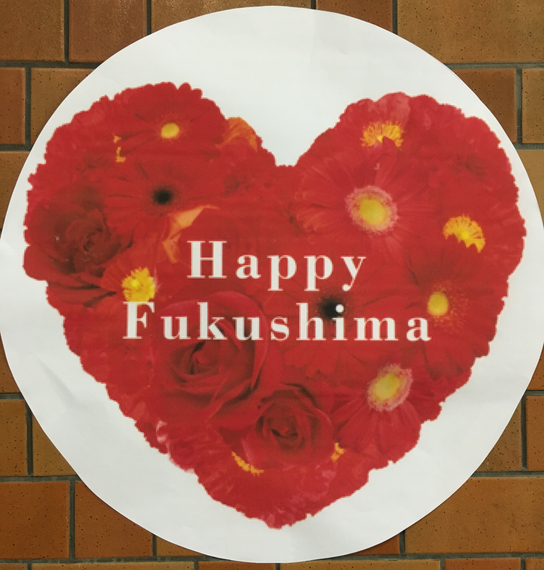
Signs covering Fukushima Station are a distraction from the fact that 100,000 people are still displaced in the Prefecture.
Burn clothes: Wear ‘em, toss ‘em. That’s the spirit in which Beth Balaban and I packed for our final filming trip to Fukushima for Son of Saichi. We also brought burn pillows, burn shoes, burn socks, burn slippers, burn blow up mattresses… Safe to say, nothing in our suitcases is coming home with us.
On our previous three trips we’ve stayed outside the evacuated contamination zone, traveling in and out for brief periods daily. This time we’re staying inside Yamakiya, a village evacuated after the earthquake, tsunami and nuclear power plant meltdown five years ago. And even though radiation levels here aren’t of the sci-fi-turn-your-skin-neon-green variety, scientists we’ve talked to admit that even after being part of the nation’s $10 billion clean-up effort, it’s still not a place they’d want to live.
Yamakiya’s evacuation didn’t come right away after the March 2011 disaster. It came a few months later when prevailing winds and seasonal rainfall took a toxic road trip, traveling like the Shinkansen over hills and valleys, and along Rte. 114 past the home of Hidekazu Ouichi, a lifelong farmer and son of Saichi, a Hiroshima survivor.
We’re here now because Hidekazu got word from the government late last year that he could – finally – move back home April 1st. But when he picked us up from the Fukushima train station, we found out the government has changed its mind again about lifting the evacuation orders. No, they now say, he can’t move back until September.
He’s moving back anyway. Another 31 families are, too. (Most former residents are rejecting any offer to live here.)
On the 30-minute drive to Yamakiya, I realize I’m more worried about what’s measured in pixels and decibels than becquerels or microsieverts. There’s a television screen embedded in the dashboard of Hidekazu’s new Toyota, and Japan’s national obsession – cute, quirky mascots – are on full display. Eyes on the road, Hidekazu!

Now that he’s home, Hidekazu finds it hard to break his lifelong habits and those of his ancestors. The family farm has always been land to live off, always a place of sustenance, and it’s difficult for him to see it any other way.
That’s why we’re not surprised when he opens the freezer to show us feet from a wild boar he and his friends caught in the backyard. A ghost town for the past five years, this area became overrun with wild animals – especially boar which Hidekazu says have gotten so used to gallivanting around town that “they roam freely inside abandoned houses, and come right up like a dog and wag their tails at you.”
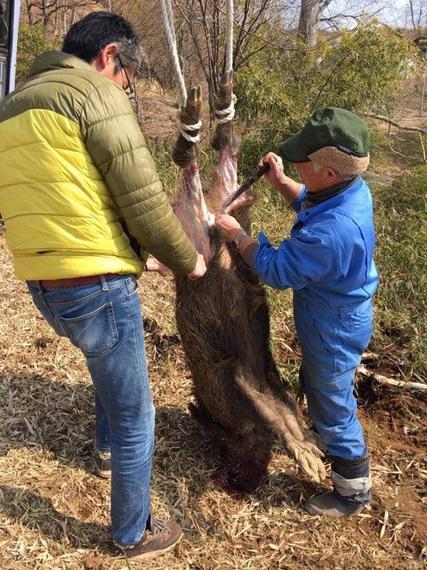
The boar pre-freezer.
The bad news is that wild boar – tasty as their feet might be – eat mushrooms which are among the most contaminated plants in Yamakiya’s forest. Cesium builds up inside the body of boars because of it. When Hidekazu tested this boar to see just how radiated it was, he measured 12,000 becquerels. (One becquerel is defined as the decay of one atom of a radioisotope per second. So if your Geiger counter detects the radiation of one decay coming from a sample – say, a boar – in one second, then that sample has one becquerel of radiation.) 12,000 becquerels is astronomically higher than the 500 allowed by the government.

Crew member and animator Christian Schlaeffer puts his Geiger counter to the frozen boar feet.
Hidekazu offered to cook the feet up for us for dinner. We politely declined.
Oh, who am I kidding? We told him he was crazy and there wasn’t a chance in hell we’d eat it, and neither should he! But if our previous trips have told us anything, it’s that Hidekazu will eventually convince us to eat or drink something that will surprise us and amuse him. I suspect it’s just a matter of time before the killer bee liquor comes out of the cabinet.
http://www.huffingtonpost.com/beth-murphy/groundtruth-films-fukushi_b_9605966.html
150 Fukushima No. 1 workers who got maximum radiation dose at start of crisis can now return to plant
Some 150 people who worked at the crippled Fukushima No. 1 nuclear power plant whose cumulative radiation dose exceeded 100 millisieverts will be able to return to the facility starting April 1.
By law, nuclear plant operators are required to record and manage the radiation exposure of each worker over a five-year term to ensure their dosage doesn’t exceed safe limits.
According to Tokyo Electric Power Co., 150 Tepco workers and 24 subcontractor workers who dealt with the meltdown disaster that occurred right after the March 11, 2011, earthquake and tsunami were exposed to radiation exceeding the limit. As of March 1, 129 of the Tepco employees were still working at the utility. They were moved to other divisions based on the government directive.
Since the five-year term for the workers ended in March, Tepco said it hopes experienced hands will return to engage in the decommissioning of the plant to contribute to safety at the site.
But Tepco said it will not push them to return and said those who wish to go back will be managed under a new exposure regime designed to limit a worker’s lifetime radiation dosage to 1,000 millisieverts in line with recommendations made by the International Commission on Radiological Protection.
Last year, the Ministry of Health, Labor and Welfare created the new regime, which requires nuclear plant operators to set individual limits for workers based on their age and past exposure to radiation.
In total denial of the low-dose internal irradiation effects
Another marvelous spin propaganda article minimizing the dangers of the radiation in Fukushima, from the Asahi Shimbun.
If you watch that press conference from the beginning to the end, you may have different impression about their work. They do not pay any attention to the effect of the low-dose internal irradiation. Such omission being very convenient to promote the fallacy that life in Fukushima is very safe.
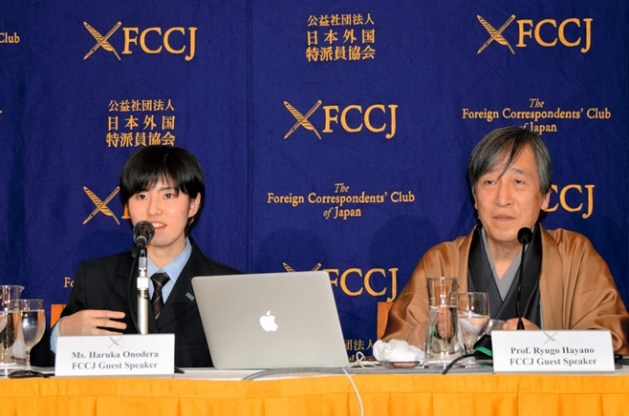
Haruka Onodera, a third-year student at Fukushima High School, holds a news conference with University of Tokyo professor Ryugo Hayano at the Foreign Correspondents’ Club of Japan in Tokyo on Feb. 8.
Fukushima students reach out to tell truth about radiation
Struck by ignorance about the 2011 nuclear disaster, high school science club members in Fukushima Prefecture enlisted the help of fellow students around Japan and abroad for a comparative study on radiation doses.
The results surprised even those living in the prefecture that hosts the Fukushima No. 1 nuclear power plant.
“The individual doses (of external radiation exposure in high school students) were almost equal inside and outside of Fukushima Prefecture, and in European areas,” Haruka Onodera, 18, said in English at the Foreign Correspondents’ Club of Japan (FCCJ) in Tokyo on Feb. 8.
A German correspondent asked her, “Would you declare Fukushima now safe?”
“Actually, we didn’t measure the doses in people living in the contaminated areas, so we can’t say all of Fukushima is safe,” Onodera answered, often pausing in thought in the middle of her words and phrases. “But I hope we will send (personal dosimeters) to contaminated areas and help do risk management for people living there in the future.”
Onodera, a third-year student of Fukushima High School and member of the physics and radiation division of the school’s Super Science Club, also showed explanatory slides at the FCCJ news conference titled, “Fukushima and radiation monitoring. The goal of the project is to show the realities of Fukushima Prefecture to the rest of the world.
The club’s physics and radiation division started the project in summer 2014. It involved 216 high school students and teachers in Japan and abroad carrying personal dosimeters for two weeks.
Six high schools in Fukushima Prefecture–Fukushima, Adachi, Aizu Gakuho, Iwaki, Asaka and Tamura–and another six located elsewhere in Japan–including in Gifu, Kanagawa, Nara and Hyogo prefectures–were involved in the project.
They were joined by 14 high schools from France, Poland and Belarus.
According to the measurements taken by the students, the annual radiation doses in Fukushima Prefecture ranged between 0.63 and 0.97 millisievert. For elsewhere in Japan, the range was from 0.55 to 0.87 millisievert, while in Europe, the annual doses were between 0.51 and 1.1 millisieverts.
The similar levels of external doses are believed to be partly attributable to the lower level of natural background radiation in Fukushima Prefecture compared with that in western Japan. That finding came from an analysis of a database on the radioactive content of soil in areas surrounding the different high schools across Japan.
Onodera, who was seated next to Ryugo Hayano, a professor of physics with the University of Tokyo, at the FCCJ news conference, had also presented the study results last year to a workshop of high school students in France and a conference on Fukushima foodstuffs held on the sidelines of an international food exposition in Italy.
Two second-year students of the Super Science Club–Minori Saito, 17, and Yuya Fujiwara, 17–gave a talk at a workshop organized in Date, Fukushima Prefecture, by the International Commission on Radiological Protection late last year.
First- and second-year students who are members of the club, joined by eight high school students from France, visited peach farmers and shiitake mushroom growers in Fukushima Prefecture in summer last year. It was part of a program for studying the current state of Fukushima from diverse views.
The students wanted to address global audiences after they were shocked by how little was known about the actual state of Fukushima Prefecture.
“Can humans live in Fukushima?” a French high school student asked the Fukushima students over Skype as part of an international exchange program in 2014.
That prompted the Japanese students to determine the actual situation on their own, and compare it with circumstances elsewhere in Japan and abroad. Hayano advised them to undertake the endeavor when he visited Fukushima High School to give a talk.
The findings of the study were surprising. Most of the Fukushima students expected the doses in Fukushima would be the highest, even by a large margin.
The students also studied how behavior affected the dose levels.
The Fukushima High School students were being exposed to lower radiation levels when they were at school than when they were at home. They believe the school’s concrete buildings provided a more effective shield from radiation sources than the wooden houses did.
By contrast, students attending Ena High School in Gifu Prefecture were exposed to more radiation when they were at school, where granite, containing radiation sources, is used in the buildings.
Their analysis results were published in November in a British scientific journal on radiological protection. Onodera was involved in writing the research paper.
“The experience has brought home to me how important it is to address reality objectively and scientifically,” she said.
Onodera said she was growing more interested in basic sciences and dreams of doing research on molecular biology at university.
“We hope to solicit help from people in evacuation zones within Fukushima Prefecture, and from high schools in countries we have yet to address, in further broadening our study,” said Takashi Hara, a teacher and adviser to the science club’s physics and radiation division.
-
Archives
- October 2026 (104)
- September 2026 (339)
- August 2026 (330)
- July 2026 (355)
- June 2026 (287)
- May 2026 (306)
- April 2026 (356)
- March 2026 (251)
- February 2026 (267)
- January 2026 (308)
- December 2025 (358)
- November 2025 (359)
-
Categories
- 1
- 1 NUCLEAR ISSUES
- business and costs
- climate change
- culture and arts
- ENERGY
- environment
- health
- history
- indigenous issues
- Legal
- marketing of nuclear
- media
- opposition to nuclear
- PERSONAL STORIES
- politics
- politics international
- Religion and ethics
- safety
- secrets,lies and civil liberties
- spinbuster
- technology
- Uranium
- wastes
- weapons and war
- Women
- 2 WORLD
- ACTION
- AFRICA
- Atrocities
- AUSTRALIA
- Christina's notes
- Christina's themes
- culture and arts
- Events
- Fuk 2022
- Fuk 2023
- Fukushima 2017
- Fukushima 2018
- fukushima 2019
- Fukushima 2020
- Fukushima 2021
- general
- global warming
- Humour (God we need it)
- Nuclear
- RARE EARTHS
- Reference
- resources – print
- Resources -audiovicual
- Weekly Newsletter
- World
- World Nuclear
- YouTube
-
RSS
Entries RSS
Comments RSS

