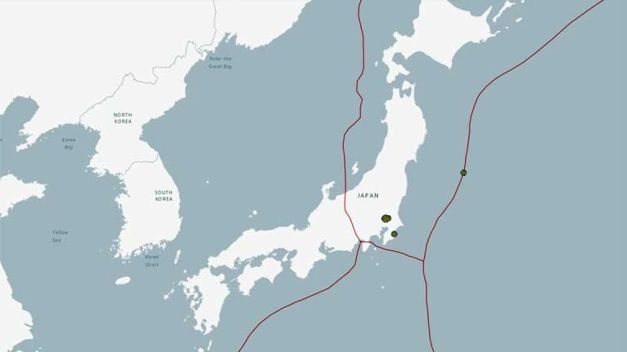
Tokyo was struck by a third quake in four days on Jul 20, but there were no reports of damage or casualties.
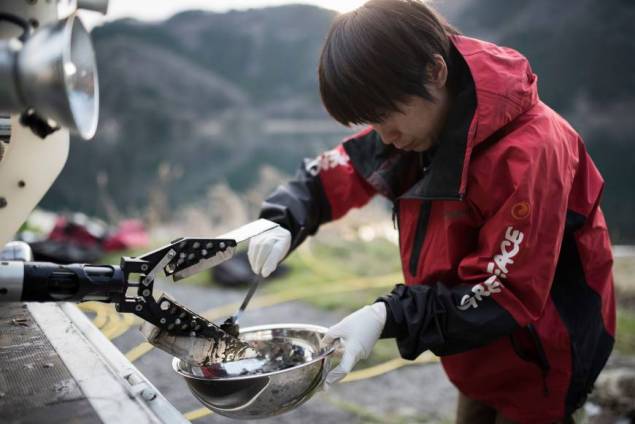
Greenpeace Japan member Mai Suzuki removes sediment samples from a remotely operated grabber at Lake Biwa in Shiga Prefecture on March 22.
OSAKA – Greenpeace Japan on Thursday said it has discovered radioactive contamination in Fukushima’s riverbanks, estuaries and coastal waters at a scale hundreds of times higher than pre-2011 levels.
One sample of sediment taken along the Niida River, less than 30 km northwest of the crippled Fukushima No. 1 power plant, revealed the presence of cesium-134 and cesium-137 at levels of 29,800 becquerels per kilogram.
That was just one of 19 samples of dried sediment and soil the environmental activist group took and analyzed from the banks of the Abukuma, Niida, and Ota rivers. The samples were collected by Greenpeace in February and March.
All of the samples but one exhibited more than 1,000 Bq/kg of radioactive material. The lowest level, 309 Bq/kg, was logged at a spot along the Abukuma River.
Cesium-134 has a half-life of about two years, but cesium-137 has a half-life of 30 years and is considered particularly hazardous. The standard limits set for radioactive cesium in Japan are 100 Bq/kg for general foods and 10 Bq/kg for drinking water.
“The radiological impacts of the Fukushima nuclear disaster on the marine environment, with consequences for both human and nonhuman health, are not only the first years. They are both ongoing and future threats, principally the continued releases from the Fukushima No. 1 plant itself and translocation of land-based contamination throughout Fukushima Prefecture, including upland forests, rivers, lakes and coastal estuaries,” the report said.
Greenpeace Japan also published the results of tests on dried marine sediment samples collected at 25 points off the Fukushima coastal area, including three river estuaries, during this same period, at depths of between 7.4 and 30.6 meters. The results showed that the highest level of cesium was 144 Bq/kg taken from a sample collected off the coast from the Fukushima power plant, while the lowest total cesium figure was 6.5 Bq/kg off Nakanosaku, well to the south of the plant.
In addition to Fukushima, Greenpeace Japan took dried sediment samples from Lake Biwa at three locations near the shore. The results showed cesium levels to be between 7.1 Bq/kg and 13 Bq/kg at two locations, and negligible at the other two.
The safety of Lake Biwa, which provides drinking water for about 14 million people in the Kansai region, has become a major bone of contention between Kansai Electric Power Co., which wants to restart reactors in neighboring Fukui Prefecture, and residents in and around Lake Biwa who are fighting to keep them shut down.
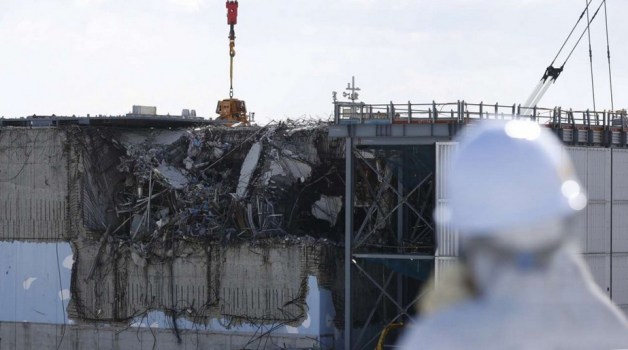
A study published in March of 2016 found insoluble cesium lodged in the lungs of some of the highly exposed Fukushima disaster response workers. After doing additional scans they found most of that persistent cesium contamination resided in the workers lungs.
Direct measurements of seven highly exposed workers at the Tokyo Electric Power Company Fukushima Daiichi Nuclear Power Station accident have been performed continuously since June2011.
Caesium clearance in the monitored workers is in agreement with the biokinetic models proposed by the International Commission on Radiological Protection. After 500 days from the initial measurement, however, the caesium clearance slowed.
It was thought to be unlikely that additional Cs intake had occurred after the initial intake, as activity in foods was kept low. And, the contribution from the detector over the chest was enhanced with time. This indicates that insoluble Cs particles were inhaled and along metabolic rate showed.
The study concludes that insoluble cesium particles lodged in the workers lungs, preventing them from leaving the body through normal processes.
“The subjects seem to have inhaled insoluble caesium particles, even though it was only a small amount. At present, it is more plausible that the retention curves reported here were due to inhalation of a mixture of type F caesium (soluble particle) and type S caesium (insoluble particle).”
This finding is significant as it shows how the various kinds of insoluble radioactive cesium materials discovered after the initial disaster, both black substances and the glass spheres could contaminate the human body.
Read more:
http://rpd.oxfordjournals.org/content/early/2016/03/14/rpd.ncw036
http://rpd.oxfordjournals.org/content/early/2016/03/14/rpd.ncw036.full.pdf+html
http://www.fukuleaks.org/web/?p=15616
A Japanese court has ordered Tokyo Electric Power Company, or TEPCO, to compensate a golf course operator for damages caused by rumors after the Fukushima Daiichi nuclear accident in 2011.
This is the first ruling in Japan that recognizes rumor-caused damages related to a nuclear accident.
The golf course operator’s suit claimed that revenues from its course in Tochigi Prefecture, north of Tokyo, dropped due to harmful rumors related to the nuclear accident.
TEPCO argued that there was no danger from radiation because the golf course is more than 100 kilometers from the nuclear plant.
In the ruling on Wednesday, Tokyo District Court Judge Tetsuro Nakayoshi said the public did not have sufficient knowledge about radiation around the time of the accident.
He noted that it was not unreasonable for ordinary people to worry about health risks.
The court determined that harmful rumors were responsible for 30 to 50 percent of the decline in revenue for more than 5 months following the accident.
The court ordered the utility to pay about 180,000 dollars in compensation.
TEPCO says the company will deal with the matter sincerely after studying the ruling.
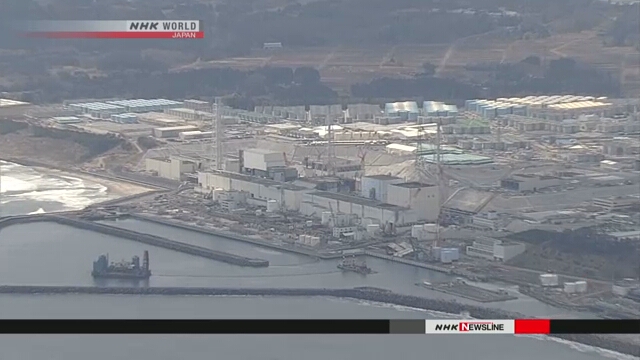
A Japanese government body has revised its plan to decommission the reactors at the Fukushima Daiichi nuclear plant in response to local opposition.
The revision ruled out the option of adopting a Chernobyl-style “sarcophagus” method that seals off disabled reactors with nuclear fuel inside.
The Nuclear Damage Compensation and Decommissioning Facilitation Corporation released the revised plan on Wednesday.
The body presented a technical report a week ago that mentioned the possibility of adopting the sarcophagus method for the first time, while saying it remained committed to removing fuel debris from the reactors.
The report faced backlash from the people in Fukushima Prefecture. Economy, Trade and Industry Minister Motoo Hayashi instructed the body to revise the plan.
The word “sarcophagus” has been deleted from the revised plan, which states that the method will not be adopted in the decommissioning process at the plant.
Shunsuke Kondo, the head of the body’s technical committee, says he regrets the body’s lack of consideration for the locals.
He said he will make sure the body communicates with the locals properly and places top priority on their thoughts.
Fukushima Governor Masao Uchibori said he wants the body to realize how shocked the Fukushima residents were with the word “sarcophagus.”
He said he wants the body to proceed with the removal of fuel debris from the reactors in a safe manner, in line with the locals’ desires.

The much-hyped ice wall at the crippled Fukushima No. 1 nuclear power plant has failed to stop groundwater from flowing in and mixing with highly radioactive water inside the wrecked reactor buildings, operator Tokyo Electric Power Co. Holdings Inc. has admitted.
Tepco officials also said at a meeting of the Nuclear Regulation Authority in Tokyo that it is not the utility’s ultimate goal to shut out groundwater with the ice wall, which has been built around the four damaged reactor buildings at the plant.
Tuesday’s announcement was apparently the first time the utility publicly said it is technically incapable of blocking off groundwater with the frozen wall.
Five years after the March 2011 quake and tsunami triggered the nuclear crisis, Tepco continues to be plagued by radiation-tainted groundwater, mostly rainwater that is mixing with contaminated water in the basement of the damaged reactor buildings.
In response, Tepco has completed most of the 1.5-km-long sunken wall of frozen soil around the stricken reactors to keep groundwater out. It has also built “subdrain” wells around the buildings to pump up the tainted groundwater for treatment and ultimate discharge into the Pacific.
While the completed sections of the ice wall began operating in March, it has not made a visible impact in reducing the amount of groundwater inflows. According to Tepco, the amount of groundwater pumped up from subdrains averaged 321 tons per day in June, just 31 tons less than the daily average in May.
Asked whether Tepco plans to eventually block rainwater from seeping through the ice wall, a Tepco official said it is not technically feasible “to keep out the groundwater 100 percent,” according to a video of the meeting released Tuesday by the NRA.
“We are aiming to control the amount of water going into the reactor buildings, with the ice wall and subdrains,” said Tomohiko Isogai, an official in charge of dismantling the plant.
Kiyoshi Takasaka, a nuclear expert at the Fukushima Prefectural Government, said it was the first time he had heard such a comment from Tepco, pressing the firm on whether it marked a “change of policy.”
A Tepco official denied this, saying that while it wants to “close off the wall as much as possible,” its ultimate goal has been to “curtail” groundwater inflow, not halt it.
Also at the meeting, NRA acting head Toyoshi Fuketa demanded that Tepco move quickly to reduce the amount of highly radioactive water inside the reactor buildings, saying such water presents the risk of escaping in the event of another monster tsunami. Some 60,000 tons of highly tainted water remain in the leaking basements of reactor buildings 1, 2, 3 and 4.
“We want the amount of (radioactive water) inside the buildings to be reduced as much as possible,” he said.

TOKYO – Tokyo was struck by a third earthquake in four days on Wednesday, but there were no reports of damage or casualties.
The 5.0 magnitude jolt was felt in Tokyo and areas of eastern Japan at 7.25am (5.25am Thailand time), the US Geological Survey said.
It was the third quake to shake the capital’s high-rise buildings in recent days — following a 4.8 magnitude quake on Tuesday and one of 5.0 on Sunday — but an official with the Japan Meteorological Agency said they weren’t a precursor of a major jolt.
“This is an area that sees frequent earthquakes” of a moderate size, Nariaki Ohkawara told AFP, adding that the latest quakes were part of that trend.
The epicentre of Wednesday’s quake was east of the capital in Ibaraki prefecture at a depth of about 44 kilometres, the USGS said.
There was no threat of a tsunami, the Japan Meteorological Agency said.
Japan sits at the junction of four tectonic plates and experiences a number of relatively violent quakes every year, but rigid building codes and strict enforcement mean even powerful tremors frequently do little damage.
A massive undersea quake that hit in March 2011 sent a tsunami barrelling into Japan’s northeast coast, leaving more than 18,000 people dead or missing, and sending three reactors into meltdown at the Fukushima nuclear plant.
In April, two strong earthquakes hit southern Japan’s Kumamoto prefecture followed by more than 1,700 aftershocks, and left 49 dead and caused widespread damage.
The country routinely holds emergency drills to prepare for a major jolt, and the government stepped up its disaster response in the wake of the 2011 devastation.
http://www.bangkokpost.com/news/asia/1039805/tokyo-jolted-by-third-quake-in-four-days
Christopher Busby exposes the fallacy behind the current accepted model of exposure hazard adopted by governments and the nuclear industry since the ‘50s and which he will be challenging in a major legal case in London in June on behalf of nuclear test veterans. This is one of the rare times that I publish someone else’s work to the IMVA.
March saw the publication, in the influential scientific journal Environmental Health and Toxicology, of a landmark analysis of the effects of internal radioactive contamination on the genetic integrity of life.
My German colleagues and I used published data from Chernobyl effects in Europe to dismiss the radiation risk model that is currently employed by governments to limit discharges and exposures.1 This is the model of the International Commission on Radiological Protection (ICRP), which bases its analysis on a different scenario to the fallout from Chernobyl: the survivors of the Hiroshima bomb.
It is claimed that there were no cases of found in those who were there. So the ICRP uses data from mice to give a risk of a doubling of heritable effects after an exposure dose of 1,000 milliSieverts (mSv). To put this in perspective, natural background radiation’s annual dose is about 2mSv so ICRP says you need to have 500 times this dose to risk having a child with a birth defect.
However, our paper shows this is wildly incorrect: that the tiniest doses from ingested or inhaled radioactive materials released by accidents like Chernobyl and Fukushima, produced by the 1960s atmospheric bomb tests, and emitted routinely under licence from nuclear sites like Sellafield and Hinkley Point, kill and deform babies at doses of less than 1mSv.
The Government and the nuclear industry defend the ICRP position by referring to natural background radiation. But, though it is true that life has been exposed to natural background radiation, including radon, throughout evolution, there has never been on Earth, prior to 1945, the new Uranium fission and activation products like Strontium-90, Caesium-137, Tritium, Carbon-14, Plutonium-239 and their nasty ‘daughters’ and relations. These substances and the entirely new, airborne, radioactive, pure particles of uranium and radium only appeared about 70 years ago. Already we can see the terrible damage they have caused to the human genome.
The fallout generation
The first evidence of harm was identified by the late Prof Ernest Sternglass.2 He pointed out that the period of the atmospheric testing of nuclear weapons had caused increases in infant mortality in the USA and the UK. Fig 1 shows a graph of this effect re-plotted by me from a later paper in by a Canadian paediatrician, Robin Whyte.3 The figure also displays the increases in Strontium-90 in milk and in the bones of children aged 0-1 over the fallout period, as measured in autopsies by the United Kingdom Atomic Energy Agency.
The sensitivity of the unborn child to radiation had been demonstrated by Alice Stewart at Birmingham University in 1958, but the authorities could not believe that the 10mSv X-ray doses to mothers could cause the 40% increases in childhood cancer that Stewart demonstrated.4 Nuclear weapons development was in full swing, fallout in the rain everywhere was causing increased measured levels of Strontium-90 in milk and children’s bones and teeth (see Fig 1).
The Cold War needed thermonuclear bombs: so research into the health effects of radiation was rapidly taken from the doctors and given to the nuclear physicists. The Japanese Hiroshima genetic data was manipulated.5 In 1959 an agreement was signed between the medics at the World Health Organisation and the physicists at the International Atomic Energy Agency, leaving all studies of radiation and health to the IAEA; thus the cover-up was sealed. This is why there has been no proper study of the health outcome of Chernobyl.
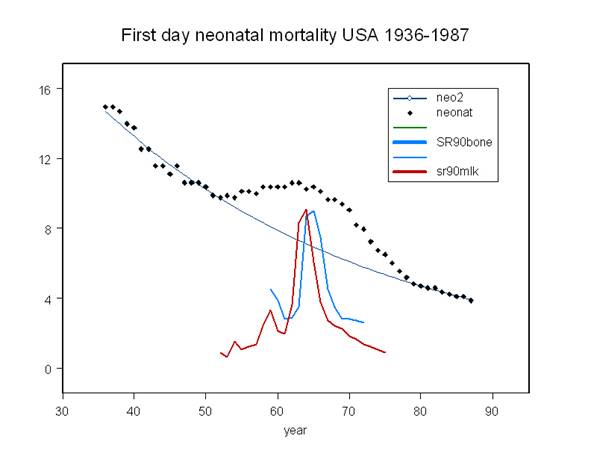
Fig 1. This graph shows first-day neonatal mortality rate per 1,000 births in the USA from 1936 to 1987. The black diamonds line shows the expected background fall in mortality rate based on the period either side of the atmospheric nuclear tests’ fallout. The red line shows the build-up of Strontium-90 in milk in the UK and the blue line, the build-up of Strontium-90 in bones of children in the UK aged 0-1. Mortality data from Robin Whyte’s paper.3 Note: different scales for milk and bone; Strontium-90 in milk (red: Bq/gCa++ x 10) and bone (blue: pCi/gm Ca++, sunshine units) from UK Atomic Energy Authority. 1pCi = 0.037Bq.
Radiation has its effects by causing mutations in the DNA, the material in the cell that carries all the information. If this is germ cell DNA (sperms and eggs), depending on the amount of damage, you get sterility, miscarriage, stillbirth or congenital effects, which can show as malformations at birth, or more silent malformations (eg. heart defects) or cancer later on.
If it is chromosomal DNA in a cell in the body then it can lead to cancer. The lag time between initial DNA damage and cancer is about 20 years. In my 1995 book, Wings of Death, funded by the Joseph Rowntree Charitable Trust, I discussed all this and compared cancer rate trends in Wales with those in England.6 Because of the high rainfall, the cancer rates in Wales, which had been slightly higher than England, suddenly and alarmingly increased about 20 years after the fallout. The correlation was persuasive. Even the effect of the 1959 partial test ban was reflected in the cancer rate trend. The effect was particularly obvious for breast cancer, one of the sites most sensitive to radiation exposures, and I made such a suggestion in a letter published in the BMJ in 1994.7
Of course, the contamination of the planet did not stop with the 1963 Kennedy/Krushchev test ban. Where the testing stopped, the nuclear power contamination began, with releases under licence to the air and the sea. This was followed by the accidents, Windscale, Three Mile Island, Chernobyl and Fukushima, the most infamous of many others. The world has been increasingly bathed with radioactivity since 1945 in a femtosecond of evolutionary time and there seems no sign of governments stopping this unless it can be proved that the radiation risk model is wildly incorrect and is killing people. But we can, as you will see.
Everyone now knows that the age-standardised cancer rates have been increasing alarmingly. Everyone has been touched by this epidemic. What is the cause? In the ‘50s, one in nine people developed cancer. In the 1990s it was one in five. In the last few years it is one in three and according to the WHO (who are not allowed to assess radiation) in 2020 it will be one in two.
None of the big cancer charities nor the Government health departments address the chief cause. Why? Because the main cause is ionising radiation. It is not smoking, nor lifestyle, nor obesity nor even the many chemicals now polluting the environment. The UK’s cancer epidemic began on the west coast in Wales and the west of Scotland with the rain and the fallout, not in the east, where the agrochemicals and insecticides are in greater concentration. This is the first thing I checked. As the late Dr John Gofman, of the US Atomic Energy Commission, wrote: ‘The nuclear industry is waging a war on humanity’.
The highest cancer rates are in those born at the peak of the fallout, from 1959 and 1963, now aged 52-56. The incidence of most cancers increases exponentially with age, but the ages when it is diagnosed are falling fast because everyone born after 1959 has been drinking contaminated milk, water and food as a baby, and building up Strontium-90 in their bones.
Strontium-90 (and uranium) binds chemically to DNA, the target for genetic damage. The effects are most easily seen in breast cancer and the proof that the breast cancer epidemic is caused by radioactive contamination can be seen in the studies of breast cancer near nuclear sites. We have carried out epidemiological studies of three nuclear sites in the UK: Bradwell in Essex, Trawsfynydd in Wales and Hinkley Point in Somerset. All three papers were published in a peer-reviewed journal.8-11 Two used official government mortality data to show there was a 100% excess risk of dying of breast cancer if you lived near the contamination; the other used a questionnaire organised by a TV company making a documentary.
Our new genetic paper, the subject of this article, reviewed all the evidence available from populations exposed to Chernobyl fallout. Increased congenital effects, heart defects, organ defects, limb defects, neurological effects like spina bifida and hydrocephalus, cleft palate, Downs syndrome and those appalling images that have been seen in Iraq after the use of depleted uranium weapons. All were found to increase immediately after the Chernobyl contamination.
Effects were reported from Belarus and Ukraine, but also from Croatia, Turkey, Italy, Germany, Greece, Hungary, the UK, places where the doses from the fallout were less than 1mSv. We also reviewed effects found in radiographers, surgeons using radiation, uranium miners, uranium nuclear workers in France and the UK and, finally, the children of the nuclear test veterans. I draw attention to this latter group because of what I am involved with in the High Court in London in June.
The nuclear test veterans’ case
Since 2004 I have been working with the nuclear test veterans as an expert witness in their cases against the UK Ministry of Defence, in the High Court action (which was lost on appeal) but, most successfully, in the Pensions Appeals. This has been in and out of Tribunals all over the country. I was successful in five cases in reversing the decisions by the Secretary of State for Defence not to grant pensions in cases of cancer, lymphoma and leukemia in veterans of the atmospheric weapons tests in Australia and Christmas Island in the 1950s.
Then the veterans’ solicitors, Rosenblatts, suddenly and unexpectedly dropped the case, a new group of solicitors, Hogan Lovells, took over, and threw me out just before the case was heard in February, 2013. The veterans appealed successfully and the case was remitted for a new hearing, which will occur over three weeks in Court 25 of the Royal Courts of Justice starting on June 14th.
Meanwhile, a proportion of the vets have died (of cancer). In the appeal in 2014, the MoD brought a successful motion to have me dismissed as a witness because they argued that, as an activist, I could not be unbiased. At this point the veterans appointed me as their Representative, so I am still there and the position is more effective than being an expert witness because I can cross-examine the MoD’s experts, something I am looking forward to.
I have already argued successfully in two hearings before a new judge, Sir Nicholas Blake, that we want access to secret material held by the MoD that shows the amounts of radioactivity, particularly uranium, in the bomb fallout. Uranium was not measured at the time, or at least the MoD will not give us any data, but we now know, from the effects of depleted uranium in Iraq and the Balkans, and also a huge amount of new research, that uranium is thousands of times more dangerous than is modelled by ICRP.
One of the effects it has (in uranium miners, workers, battlefield victims and populations, and nuclear test veterans) is that it causes huge amounts of genetic damage, shown as chromosome damage and congenital malformations. And, like Strontium-90, uranium binds to DNA.
The new judge has figured out that this is an issue. He ordered the release of some secret data showing the levels of congenital malformations in children and grandchildren of the veterans. Among his reasons for doing this, he wrote:
Dr Busby, who now represents the appellants Battersby and Smith, raises a number of new points not previously determined. . . The international Radiation Protection Authority’s guidance on the safe maxima in insufficient to screen out all risks to human health arising from explosions of the kind undertaken at Maralinga and Christmas Island.
Biggest public health scandal ever
We can use the secret birth defect data together with the new genetic paper to show that the radiation risk model of the ICRP is in error by about 1,000 times or more. This mistake, which was made in 1952 and has been promulgated ever since through the power and influence of the nuclear industry and the military, is, in the main, responsible for the deaths and agonies of all the people that you yourselves know have developed cancer – from the little, bald children, to the beautiful women suffering the cutting, burning and worse that is now orthodox treatment, to your parents, your own children and, indeed, yourselves.
This exposure is at the base of the loss of fertility and the increased real rates of heritable diseases (in advanced countries detected and aborted). Winning this case will put this issue firmly in front of the legislators. Accepting this combined chess move, the peer-reviewed study and the court case, should, in any unbiased court, result in the shutting down of nuclear energy and nuclear weapons, including the nuclear submarines that deliver them. It is a Big Deal. But the prize is continued life on Earth.
About the author

British decommissioning and remote handling company James Fisher Nuclear announced Monday that it had been awarded a “high-value” contract from Japanese engineering company Mitsubishi Heavy Industries that involves developing technology to be used at the Fukushima Daiichi Nuclear Power Plant in Okuma, Japan.
JFN will be responsible for developing the latest technology to sample radioactive debris sitting below reactor cores at the power plant that suffered a triple reactor meltdown after backup power failed due to a massive tidal wave event in March 2011.
The specific value of the contract was not announced. JFN said it beat out the competition for the contract. Business director at JFN Bertie Williams said the expertise required for this kind of assignment was rare. “Few businesses in the nuclear arena realistically have the experience and personnel with the capabilities to take on such a challenging task,” Williams said.
The work involves taking samples of a variety of materials both above and below the water line at the damaged plant. JFN said it had been successful in demonstrating its technical design was “capable of addressing some of the most challenging conditions on Earth.” The goal is to evaluate the extent of the clean-up and decommissioning work needed at the plant.
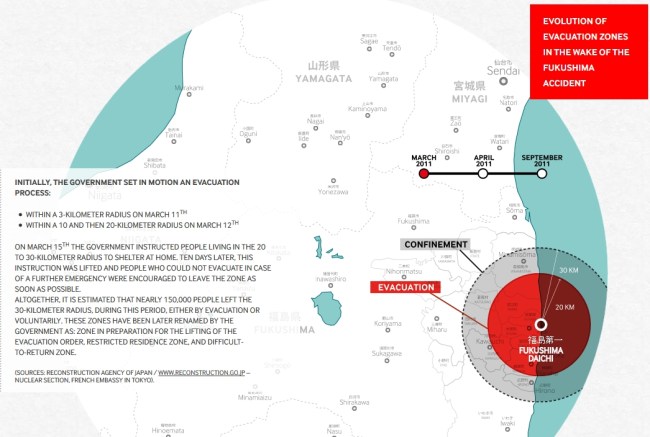
The central government lifted an evacuation order for the southern part of Minami-Soma, Fukushima Prefecture, on July 12 for the first time since the massive earthquake and tsunami triggered a devastating accident at the Fukushima No. 1 nuclear power plant in March 2011.
It marks the sixth time that evacuation orders have been lifted for locales in Fukushima Prefecture, following such municipalities as Naraha and Katsurao. The number of local residents affected by the latest move is more than 10,000, higher than in any previous instance.
Residents of such municipalities in the prefecture as Iitate, Tomioka and Namie have yet to be allowed to return to their homes. But the central government plans to lift evacuation orders on all areas of the prefecture excluding “difficult-to-return zones,” where levels of radiation remain dangerously high, by March 2017.
The longer people in disaster-affected areas live as evacuees, the more difficult it becomes for them to rebuild their lives.
The lifting of an evacuation order based on the progress that has been made in decontaminating polluted areas and restoring damaged infrastructure will give local residents an opportunity for a fresh start. In Minami-Soma, residents who have been hoping to restart their former lives have already returned to their homes. Various organizations are expanding their activities in the city to help rebuild the local communities.
In previous cases, however, only 10 to 20 percent of the residents said they would immediately return to where they lived before the catastrophic accident occurred.
In addition to residents who have decided to move to other parts of the nation, there are also many people who find it difficult to return home for the time being due to reasons related to employment, education, nursing care and other factors. Some people want to wait a while longer to see how their communities will be revived.
Sooner or later, all evacuees will face the choice of returning or migrating.
For both groups, measures to support their efforts to rebuild their livelihoods should be worked out. But support should also be provided to people who cannot make up their minds yet.
A situation where evacuees are under strong pressure to make their decisions quickly should be avoided.
Take the issue of compensation paid to local residents in affected areas, for example. Tokyo Electric Power Co., the operator of the crippled Fukushima nuclear plant, is paying 100,000 yen ($945) of compensation per month to each of the people affected. But the utility’s cash payments are scheduled to be terminated in March 2018.
A time limit has also been set for the company’s compensation to people who have seen their incomes fall or disappear in the aftermath of the disaster.
Excessive dependence on compensation could hamper the efforts of evacuees to restart their lives.
But there are people who have no prospects of returning to their lives before the accident and therefore have no choice but to depend entirely on a monthly payment from the utility.
A way should be found to keep compensating those who really need the money for a certain period after evacuation orders are lifted, according to the circumstances of individual evacuees.
One idea worth serious consideration is the establishment by lawyers and other experts of a neutral organization to assess the circumstances of evacuees for this purpose. This is an approach modeled on the standard procedures for out-of-court dispute settlements.
The concept of “residents” should also be reconsidered. There are many evacuees who have decided to move to other areas but still wish to maintain their hometown ties. These people say they want to return home someday or to get involved in rebuilding their communities in some way.
Scholars have offered ideas to respect their wishes. One would allow them to have a dual certificate of residence for both their previous and current addresses. Another would permit them to become involved in the efforts to rebuild their hometowns while living in other areas.
These ideas can be useful not just for the reconstruction of disaster-stricken areas but also for the revitalization of depopulated rural areas around the nation.
Reviving communities that have been ravaged by the nuclear disaster will inevitably be an unprecedented and long-term process, which requires flexible thinking.
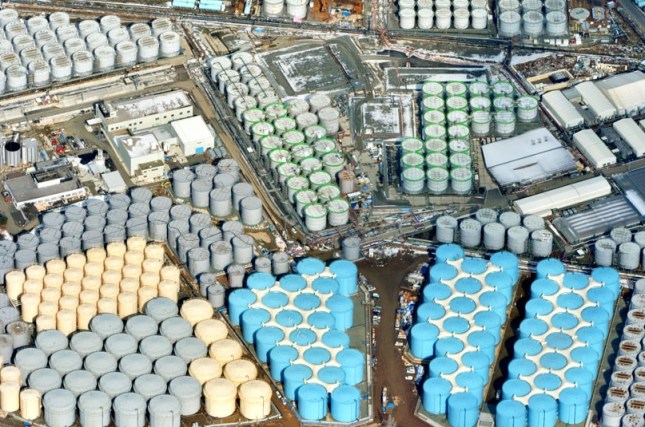
Tokyo, July 19 (Jiji Press)–Japan’s Nuclear Regulation Authority on Tuesday instructed Tokyo Electric Power Company Holdings Inc. to reduce the amount of highly radioactive water inside reactor buildings at its disaster-crippled Fukushima No. 1 nuclear power plant.
The nuclear watchdog also demanded TEPCO lower the water’s radiation levels and consider substantially boosting the number of water storage tanks at the plant in order to lower the risk of the contaminated water leaking out.
Currently, there are tanks only enough to store contaminated water being generated every day mainly due to inflows of groundwater.
Meanwhile, the highly radioactive water inside the No. 1 to No. 4 reactor buildings totaled some 61,600 tons as of Thursday. A lot of tanks would need to be built in order to remove the contaminated water from the buildings.
The highly radioactive water may leak out if tsunami hits the plant again, Toyoshi Fuketa, acting head of the NRA, said, demanding cuts in the amount of the water.
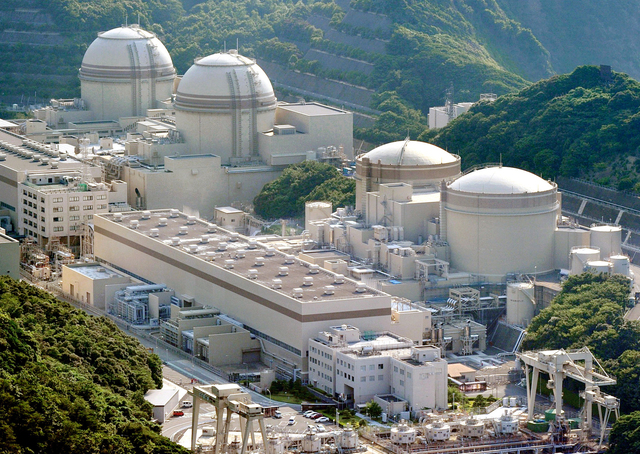
A former deputy chairman of the Nuclear Regulation Authority (NRA) sent the organization a letter of protest on July 14 demanding that an earthquake estimate for Kansai Electric Power Co. (KEPCO)’s Oi Nuclear Power Plant be recalculated, on the grounds that the official NRA estimate is well below that of KEPCO.
The former deputy chairman, Kunihiko Shimazaki, is a professor emeritus of seismology at the University of Tokyo. He had criticized the NRA’s estimate of the largest possible earthquake at the Oi plant in Fukui Prefecture as possibly being too low, and the NRA recalculated the estimate in a different manner but still deemed the projected earthquake as not posing a problem to the plant’s safety. In his letter of protest he wrote that he “could not accept the conclusion” of the NRA, and he called for another recalculation. He said he would hold a press conference on July 15 about the issue.
The NRA’s recalculated estimate was 644 gals, “gal” being a unit of acceleration. The estimate was below a KEPCO estimate of 856 gals. Shimazaki, in response to the figures, argues that the NRA’s calculation method is different from KEPCO’s and so produced a smaller number, and notes that the utility finalizes its estimate with additional calculation under stricter conditions, but the NRA has not done so. Shimazaki says that if the calculation was carried out in the same way as KEPCO has performed its estimate, the figure would come out to roughly up to 1,550 gals.
On July 13, a representative for the NRA’s secretariat acknowledged in a Mainichi Shimbun interview that the NRA’s calculation method differed from KEPCO’s, saying, “It’s only natural that there is a difference (in the calculation results).” The representative avoided giving a clear answer about whether it was right for the NRA to green light the plant by comparing results calculated in different methods.
Shinji Kinjo, the head of the agency’s public relations department, said, “If there is a request (for a recalculation), we will consider it sincerely.”
http://mainichi.jp/english/articles/20160715/p2a/00m/0na/001000c
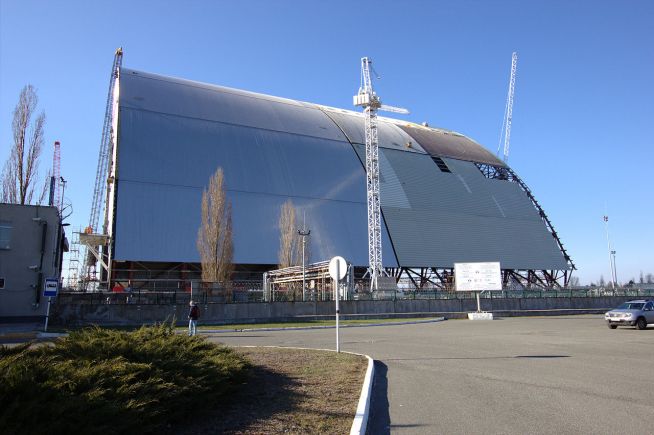
Chernobyl new safe confinement construction
After news inadvertently leaked via NHK that the decommissioning authority (NDF) for Fukushima Daiichi was considering a Chernobyl type sarcophagus for the plant, there is now an effort by the authority to back it down.
At the same time the government is rushing to reopen as much of the evacuation zone as possible so they can terminate evacuation compensation for the roughly 100,000 evacuees of the disaster.
Minamisoma reopened closed parts of the district this week and there is now consideration for opening highly radioactive zones in Okuma near the plant in a few years.
Mayors for the impacted towns near the plant expressed obvious outrage to the media after hearing the news.
The media reports and public concern are due to it even being on the table and that alone raises some obvious concerns.
NDF calls the media reports that they are considering a sarcophagus to be “untruthful” but go on to admit that it is now among the considered options.
Obviously such a structure would not be a medium term effort unless it involved some significant new design and long term plan.
NDF also tries to frame a sarcophagus as a more “medium term” solution.
They did confirm that this isn’t a done deal, but is an option they are considering.
Following that news Japan’s state minister for industry has ruled out the option of sealing off disabled reactors at the Fukushima Daiichi nuclear plant with a Chernobyl-style sarcophagus.
Takagi said the government’s policy is to stand by the people of Fukushima, and that his ministry has told the decommissioning body to rewrite its technical report.
Responding to Uchibori, Takagi said the government has no intention of using such an option, and that completing the decommissioning process is the top priority.
The body said it remained committed to removing fuel debris from the reactors that suffered meltdowns in the March 2011 accident.
But it presented a technical report that left room for entombing the reactors in a massive metal and concrete structure.
Yosuke Takagi met Fukushima Governor Masao Uchibori in Tokyo on Friday.
Uchibori said he was shocked to hear the word “sarcophagus” and called the option unacceptable.
http://www3.nhk.or.jp/nhkworld/en/news/20160715_27/
https://dunrenard.wordpress.com/2016/07/17/state-minister-rules-out-sarcophagus-option/

Feces of the mouse: Tomioka city, near crippled Fukushima Nuclear power station.
Cs-134:11917 Bq/kg
Cs-137:63557 Bq/kg
Total:75474 Bq/kg
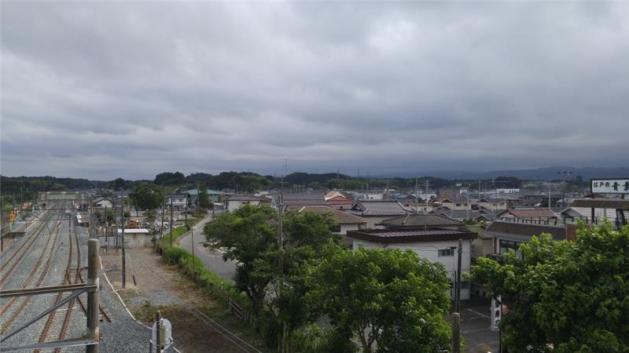
Around 20 percent of Minamisoma’s residents decided to come back
Fukushima, Japan – This week, authorities lifted an evacuation order for nearly all parts of Minamisoma city, Fukushima prefecture, allowing more than 10,000 people to return to their homes for the first time since 2011’s nuclear disaster.
Tens of thousands of people across the prefecture had to abruptly leave their homes five years ago after a devastating earthquake and tsunami in Japan’s northeast wrecked the Fukushima Daiichi Nuclear Power Plant.
The lifting of the evacuation order marked the largest number of people allowed back into their hometown – yet only around an estimated 20 percent of Minamisoma’s 10,807 residents in 3,487 households decided to come back.
Since 2014, the government has been gradually lifting up evacuation orders within a 20km radius of the nuclear power plant, following the progress of some clean-up efforts.
Our team drove to Minamisoma from Tokyo along the country’s northeastern coast.
It was not difficult to spot the on-going clean-up efforts.
A great number of big contaminated waste disposal bags were piled up at temporary holding areas on fields across Fukushima prefecture.
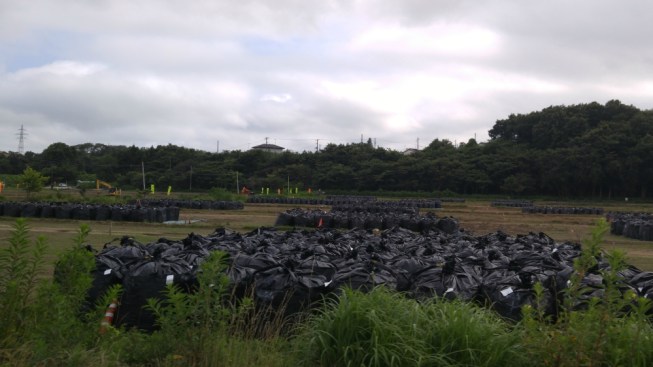
Some holding areas were massive in size, occupying huge chunk of the fields, with a string of trucks constantly dropping off black bags.
Roads into contaminated towns were still blocked by big barricades, and checkpoints were put in place to only allow people with a special permit to enter.
As we drove past contaminated areas, the reading on our Geiger counter, which measures the level of radiation, would from time to time jump above usual levels, reaching as high as 3μSv/h – the government’s long-term reduction goal for areas within a 20km radius of the nuclear power plant stands at 0.23μSv/h.
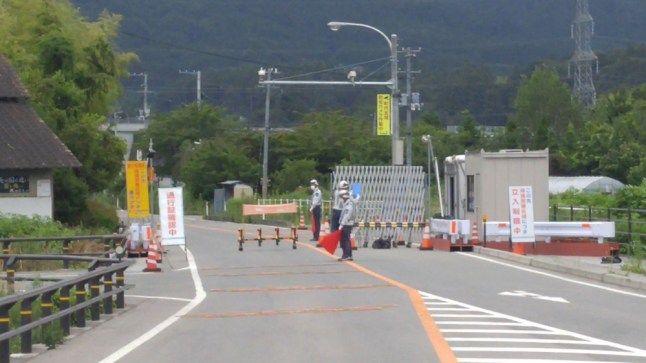
Passing through the still largely empty, yet seemingly peaceful streets of Minamisoma, we arrived at the Odaka station in the city’s Odaka district.
Although the train service had been resumed for the first time in more than five years on the 9.4km stretch between Odaka and Haranomachi station, only a handful of passengers were seen during the day.
 |
Trains arrived and departed, largely empty.
What caught my attention was a large screen in front of the station, showing radiation levels in real time.
The reading was 0.142μSv/h, which was higher than 0.06μSv/h in Tokyo – but still below the 0.23μSv/h government goal.
Such screens were set up across the city to assuage the public’s lingering concerns over radiation contamination.
Over the past few years, a growing number of Minamisoma residents settled somewhere else, worried over the potential long-term health effects of a return back home.
However, people who did decide to come back were trying their best to ensure that life in their hometown, albeit slowly, returned to normal.
About a three-minute walk distance from the station, we spotted around 30 young students and residents.
Preparations were under way by a number of local organisations to celebrate the opening of a community centre in a makeshift building, where residents could freely come and talk about their life back in hometown.
An old lady asked passers-by to take a seat as she served local food. Young students were hanging out withtheir friends, doing hula hoop and blowing bubbles.
Many of the returnees told us that despite the uncertainties and doubts, they hoped to restore a sense of community – and thus prove to friends and families who were having second thoughts about coming back that it was worth returning home.
“Although we cannot bring back Odaka to what it used to be before the disaster, as residents here, we want to bring back its spirit and the community,” Yoshiki Konno, a local resident and the head of an NGO, told.
“That is the most important thing we must do.”
Current status:
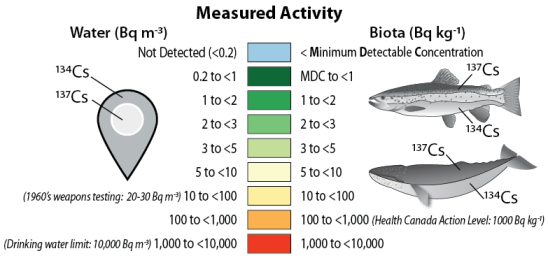
Coastal monitoring: Seventeen more samples are in the books. Mostly from March and a few from April; no coastal samples contained any of the Fukushima fingerprint isotope, 134Cs (2 year half-life). Low levels of 137Cs (~30 year half-life) were present in all of the samples. These new data continue to lie along the increasing trend which indicates that the leading edge of the Fukushima plume is in BC’s coastal waters.

Monthly averaged 137Cs data from the BC coast collected by the InFORM citizen science network between October 2014 and March 2016. The dashed linear trendline shows that levels of 137Cs have been increasing over this period. Error bars indicate one standard deviation. Large error bars in Februray and May 2015 were months when Ucluelet samples tested positive for 134Cs. Colors are the same as used in the spatial map of the data.
The above trend is clear and shows a steady rise that would predict that the average sample will have double the initial background concentrations of 137Cs sometime this summer. While still far below the 10,000 Bq m-3 level of concern for cesium radionuclides in drinking water, these more contaminated samples should also more regularly contain the Fukushima fingerprint isotope, 134Cs.
While the increasing 137Cs trend is clear for the whole coast, it is also evident that each region is telling the story of how ocean waters circulate in coastal British Columbia.

Analysis as above, but with data grouped into regions as follows: Haida Gwaii / North Coast: Lax Kw’alaams, Prince Rupert, Masset, Hartley Bay, Sandspit, North Van Is / Central Coast: Bella Bella, Port Hardy, Winter Harbour, West Coast Van Is: Tofino, Ucluelet, Bamfield, Strait of Georgia: Powell River, Vancouver, Salt Spring Island, South Van Is: Port Renfrew, Victoria.
Looking at this regional graph and focusing on the period from August 2015 – March 2016, we see the highest concentrations of 137Cs shift from appearing on the west coast of Vancouver Island northward to Haida Gwaii. As explored last month, this could indicate a northward shift of the North Pacific Current bifurcation.
Biotic Monitoring:
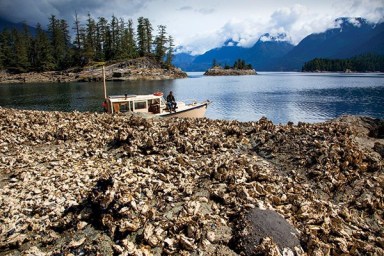
Summer sampling season is back! We’re coordinating with many of the same First Nations as in 2015 for repeat sampling of the same salmon populations. In addition to salmon, this year we are joined by Dr. Helen Gurney-Smith from Vancouver Island University who specializes in marine invertebrates. She is coordinating the collection of mussels, clams, oysters, and scallops from all of the major shellfish beds in BC waters including Baynes Sound, Quadra Island, and Haida Gwaii. These samples will be new species in our sampling repertoire and will help us see how sessile organisms take up Fukushima radionuclides along the coast. The resulting data will be valuable to invertebrate scientists like Dr. Gurney-Smith and reassure consumers of the the $33 million BC shellfish industry.
Oceanic Monitoring:
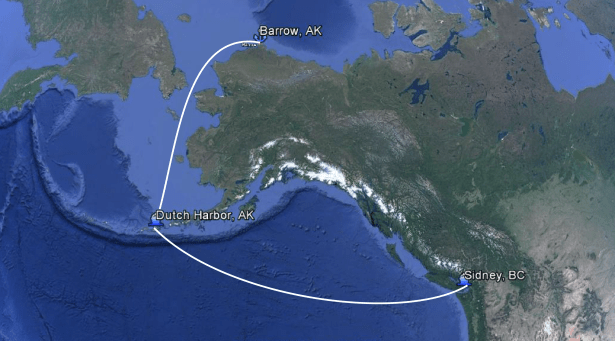
Three research cruises will collect InFORM samples this summer. Two out to Ocean Station Papa in the central NE Pacific, and currently, undergrad Saskia Kowallik is aboard the CCGS Sir Wilfred Laurier enroute from Sidney, BC to Dutch Harbor, then onto Barrow, AK. She will be reporting in a few times while away and you can read her first dispatch here.
Additionally, Dr. John Smith says that initial results from the February 2016 Line P cruise indicate that the concentrations of 134-Cs may have plateaued at Ocean Station Papa and possibly slightly decreasing. This isn’t so much a true decline as it is a smearing of the signal as the radionuclides are dispersing throughout the rest of the NE Pacific. In other interesting news, Dr. Smith just returned from a meeting in China where a colleague used a highly specialized gamma spectrometer and a very large volume of water sampled in the Chuckchi Sea to detect the trace level of 134-Cs that is ~5 times lower than the detection threshold (0.2 – 0.4 Bq m-3) for the instrumentation used at the University of Ottawa where the coastal samples are processed. This means that minute amounts of Fukushima contamination are entering the Arctic Ocean and that that it only takes ~5 years for waters to transit from coastal Japan to the Arctic. With the ability to detect such low levels of contamination, it will be interesting to see what else we can learn about oceanic transport times as monitoring continues into the future.
*Note: Results are preliminary and may be slightly adjusted pending results from further chemical analysis.





PLEASE OPPOSE HR 8255 AND S.3639 – bills would accelerate satellite deployment, with no environmental review or safeguards – https://ncstd5li.quorum.us/campaign/169331/
To see nuclear-related stories in greater depth and intensity – go to https://nuclearinformation.wordpress.com

