Yamagata&Niigata prefectural governors request FUKUSHIMA prefecture housing support extension for Nuclear disaster voluntary evacuees
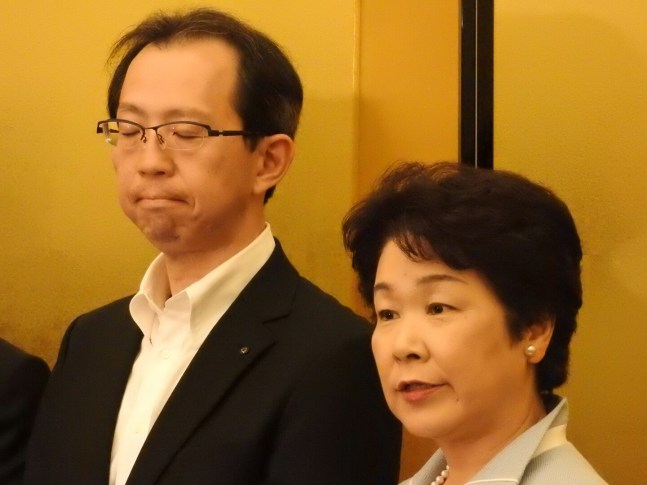
Yamagata and Niigata prefectural governors strongly request that FUKUSHIMA prefecture should extend the housing support for Nuclear disaster voluntary evacuees.But Fukushima governor, Uchibori Masao did not answer anything to their request. Why?
Yamagata Prefecture governor Mieko Yoshimura has requested an extension of the house support provided asking for the “special consideration“.
Niigata Prefecture governor Hirohiko Izumida also pointed out that “further burden in the problems of housing is increasing“, which the Fukushima Governor Uchibori Masao should well consider.
The Fukushima Prefecture governor to enforce central government order to terminate free housing support for evacuees by March 2017.
IfYoshimura and Izumida were Fukushima Prefecture governor, their treatment of “voluntary evacuees“ might have been quite different.
http://taminokoeshimbun.blog.fc2.com/blog-entry-38.html
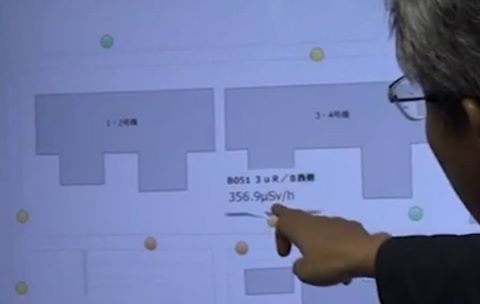
Inside Fukushima’s Time Bomb
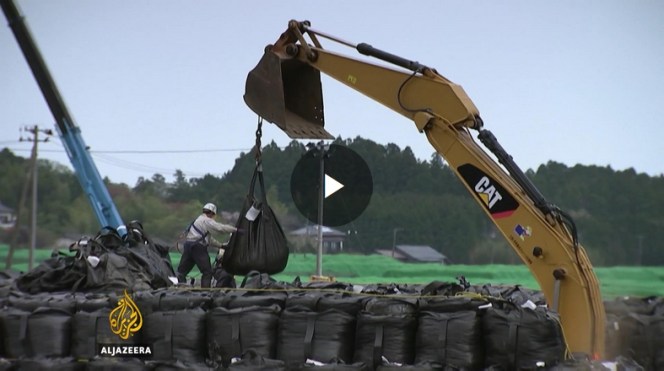
Five years after Japan’s Fukushima nuclear disaster many residents are still living in a radioactive nightmare.
Bubbling streams, lush forests, cherry blossoms in full bloom – Japan’s north is stunningly picturesque.
But nature’s beauty hides a lethal secret – dangerous levels of radiation contaminate this area, fall-out from the Fukushima nuclear disaster.
Five years after the twin catastrophes of the tsunami and nuclear meltdown, villages sit silent and empty.
Thousands of workers still toil to clean up the radioactive material but it could be decades before their work is finished.
As Japan continues to suffer the toxic aftermath of one of its worst ever disasters, 101 East reveals that the countryside may never again be safe.
http://www.aljazeera.com/programmes/101east/2016/08/fukushima-time-bomb-160824122108827.html
Anti-nuclear governor in Japan asks Kyushu Electric to suspend nuke plant
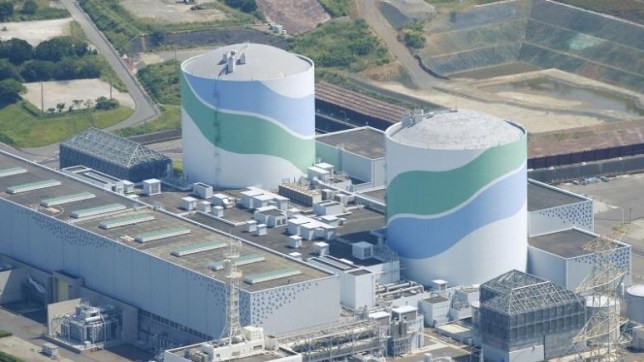
An aerial view shows the No.1 (L) and No.2 reactor buildings at Kyushu Electric Power’s Sendai nuclear power station in Satsumasendai, Kagoshima prefecture, Japan, August 11, 2015
A local Japanese governor on Friday asked Kyushu Electric Power to temporarily suspend the Sendai nuclear plant, one of two operating in the nation, further clouding efforts by the government and utilities to restart more idled reactors.
Anti-nuclear advocate Satoshi Mitazono, who was elected governor of Kagoshima prefecture last month, called on Kyushu Electric to re-examine safety and safety measures at its facility in southwestern Japan, raising concerns about a series of strong quakes that struck neighboring Kumamoto in April.
The request was expected as Mitazono, a former journalist, had said he wanted the temporary shutdown amid heightened concerns from local residents about safety and evacuation plans.
Mitazono’s pledges to suspend operations at the Sendai plant are credited with helping him beat in a July election incumbent Yuichiro Ito, who had agreed to the resumption of Sendai’s reactors.
“As an operator of nuclear power plants, the company has a duty to sincerely listen and response to the concerns of local residents. The company should temporarily suspend the nuclear plant and re-examine safety,” Mitazono said in a statement that was handed to Kyushu Electric President Michiaki Uriu at the prefectural government offices.
Mitazono has no legal power to shut down operating reactors.
“We will give the matter serious consideration,” Kyushu Electric said in a subsequent statement.
Only three reactors are online in Japan: two at Kyushu Electric’s Sendai plant and one at Shikoku Electric Power’s Ikata station. Utilities have struggled to get nuclear units running again in the face of a skeptical public after shutting them all down following the Fukushima disaster of 2011.
Sendai’s reactors are already schedule to be stopped for maintenance this year, one in October and one in December. Reactors in Japan are required to be shut for servicing after 13 months of commercial operation.
http://www.reuters.com/article/us-japan-nuclear-kyushu-elec-pwr-idUSKCN1110WH
President of Fukushima Pediatric Association recently hand delivered the Association’s requests to Fukushima Prefecture to “scale down” thyroid exams for children in Fukushima
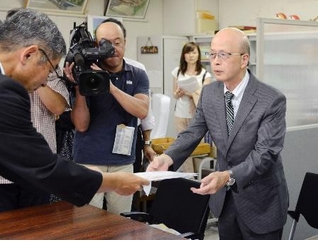
Does Fukushima Prefecture need to scale down or expand its existing thyroid exams provided to Fukushima children who were 18 years of younger at the time of Fukushima nuclear accident in 2011?
President of Fukushima Pediatric Association recently hand delivered the Association’s requests to Fukushima Prefecture to “scale down” thyroid exams for children in Fukushima.
Fukushima Pediatric Association claims that identifying many children with thyroid cancer through Prefecture’s thyroid exams is causing anxiety among children, their guardians, and citizens in the prefecture, and requests that a partial re-consideration of the thyroid exam is necessary.
(By the way, can you tell which one is Dr. Kazuhiro Ohga of Fukushima Pediatric Association and which one is an official of Fukushima Prefecture, just by looking at the photo of the article? I initially thought the man on the right is an official from the Fukushima Prefecture, because the man on left is bowing deeper, as if he is asking a favor by delivering a request. I was wrong. Dr. Ohga is on the right.)
http://this.kiji.is/141480622388215816?c=39546741839462401
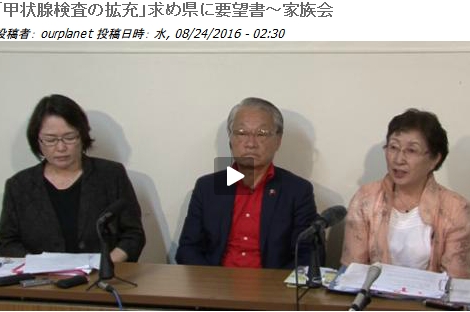
On the other hand, a citizens’ group with parents of children whose thyroid cancers were detected because of Prefecture’s thyroid exams requests Fukushima Prefecture to expand the exams.
http://ourplanet-tv.org/?q=node%2F2057
Credit to Mari Inoue
Two Tepco Kashiwazaki-Kariwa reactors may pass geared-up safety checks by March
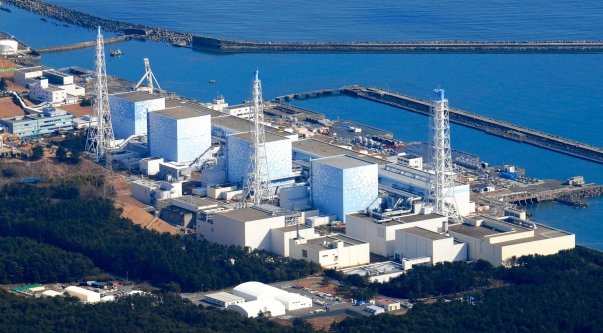
Nuclear regulators have decided to gear up the safety assessment of two reactors operated by Tokyo Electric Power Company Holdings Inc. in central Japan, raising the possibility of finishing the process by next March, sources said Tuesday.
Reactor Nos. 6 and 7 at the Kashiwazaki-Kariwa plant in Niigata Prefecture are boiling water reactors, the same type as the ones that suffered core meltdowns in 2011 at Tepco’s Fukushima No. 1 complex.
All reactors in Japan — either BWRs or pressurized water reactors — are required to meet tougher safety criteria imposed after the Fukushima crisis, but the BWR assessment has been delayed due to the need to install safety equipment that involves extensive work.
If reactors 6 and 7 clear the assessment, they will become the first BWRs technically qualified to resume operation under the post-Fukushima rules.
Facing massive decommissioning costs and compensation payments after the Fukushima disaster, Tepco applied for the safety assessment of the two reactors in September 2013, hoping that restarting the units will help turn around its business.
But it is unclear whether the development will lead to their swift restart because Niigata Gov. Hirohiko Izumida has said he will “not talk about restarting” the reactors unless a study on the Fukushima calamity is sufficiently carried out.
The Kashiwazaki-Kariwa complex on the Sea of Japan coast is one of the world’s largest nuclear power plants in capacity if all of its seven reactors were in operation.
Allowing Tepco to reactivate its reactors can be controversial, as the utility is still struggling to scrap the crippled reactors at the Fukushima plant. Tens of thousands of people who lived nearby also remain displaced evacuees.
The Nuclear Regulation Authority decided last August to prioritize checking the two Kashiwazaki-Kariwa reactors, hoping to make them a model case of the BWR assessment process. But it retracted the decision in March after Tepco failed to offer sufficient explanation on questions raised by the regulators.
But Tepco has come up with the necessary documents and the NRA decided to reinstate the priority status of the Kashiwazaki-Kariwa reactors at least until mid-September. The NRA has conveyed its plan to other utilities whose BWRs are being checked, the sources said.
Under the new safety requirements, BWRs must be equipped with filtered venting systems so that radioactive substances will be reduced when gas and steam need to be released to prevent damage to containment vessels.
The venting facilities are not an immediate requirement for PWRs as they are housed in containers larger than those of BWRs, allowing more time until pressure rises inside the containers.
Currently, two reactors at Kyushu Electric Power Co.’s Sendai plant and another reactor at Shikoku Electric Power Co.’s Ikata plant are operating in Japan after passing the safety checks. They are all BWRs.
TEPCO apologizes to Niigata for meltdown cover-up
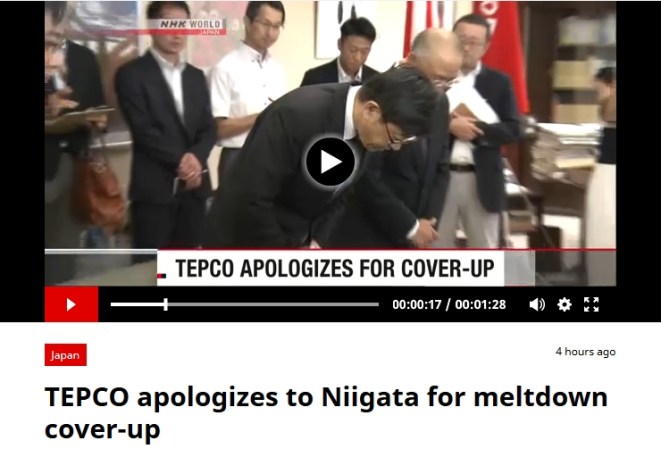
A top official of the operator of the Fukushima Daiichi nuclear power plant has apologized to the Niigata Prefecture governor for having concealed the 2011 reactor meltdowns for more than two months.
Takafumi Anegawa, Managing Executive Officer of the Tokyo Electric Power Company, met Niigata Governor Hirohiko Izumida on Thursday.
In February this year, TEPCO admitted the utility could have ascertained there was a meltdown three days after its occurrence if utility workers had followed an in-house manual. It was also later found that TEPCO’s then-president had instructed officials not to use the words “core meltdown.”
The prefecture, which hosts another TEPCO nuclear power plant on the Japan Sea coast, has put together a panel of experts to study the utility’s handling of the Fukushima accident.
Anegawa told the governor that TEPCO apologizes for not having presented a report based on an adequate investigation.
Izumida said information on meltdowns is critical for residents living near nuclear power plants to decide whether to flee or not. He said the prefecture expresses regret that TEPCO has not admitted its meltdown cover-up for five years.
Later this month, a joint panel set up by Niigata Prefecture and TEPCO plans to begin a detailed investigation.
Governor Izumida said additional probes are necessary to find out what in-house problems TEPCO had.
The governor said it is too soon to discuss resuming operations at the nuclear plant in his prefecture without a complete review of the Fukushima accident.
http://www3.nhk.or.jp/nhkworld/en/news/20160825_21/
Study of sea life shows exposure to tritium +increase in temp may increase DNA mutation
Rising temperatures could accelerate radiation induced DNA effects in marine mussels
Increased sea temperatures could dramatically enhance and accelerate radiation-induced DNA effects in marine invertebrates, a new study suggests.
Led by Plymouth University, in conjunction with the Centre for Environment, Fisheries and Aquaculture Science (Cefas), the research for the first time explored the impact of rising temperatures coupled with the presence of tritium, an environmentally relevant radionuclide, on marine mussels (Mytilus galloprovincialis).
Studies carried out under laboratory conditions demonstrated that at radiation dose rates considerably below the recommended international guidelines, induced DNA strand breaks appeared earlier at higher temperature compared to lower temperature. At 15ºC, DNA damage was only significantly elevated after seven days in contrast to 25°C where a similar response was observed after three days.
Scientists involved say this suggests an acceleration of radiation-induced DNA damage and potentially compromising defence mechanisms as indicated by changes in expression profiles of genes involved in heat-shock protection, cell cycle progression and repair of DNA breaks.
Temperature is an abiotic factor of particular concern for assessing the potential impacts of radionuclides, many of them having very long half-lives, on marine species, and with sea surface temperatures forecast to rise 0.5-3.5?C in the next 30-100 years, determining the interaction of radiological exposure has never been more important.
Awadhesh Jha, Professor of Genetic Toxicology & Ecotoxicology, led the study and said: “Ionising radiations are known to induce genetic damage, and radiation-induced genetic damage could be modified by many environmental factors, including temperature. Compared to other radionuclides, large amounts of tritium are discharged, mostly as water, in the marine environment by nuclear power plants (NPPs) and nuclear fuel reprocessing plants (NFRPs). In addition, cooling water from nuclear installations is one of the major sources of tritium in the aquatic environment. As thermal discharges from nuclear facilities is an important environmental issue, second only to the release of radionuclides which could extend for a long distance from the discharge point, such studies are important in determining the hazard and risk to the natural biota and therefore environmental sustainability.”
Brett Lyons, from the Environment and Animal Heath group based in Cefas’ Weymouth laboratory, co-supervised the study and said: “These results are important as they allow us to better understand the risks a warming ocean poses to marine life. We already know climate change is impacting things such as fish physiology, reproduction and migration, but this research is part of a growing body of evidence that is suggesting rises in sea water temperature may increase the risk posed by certain chemical and physical pollutants.”
For the study, published in the Journal of Environmental Radioactivity, the mussels were exposed to tritiated water (HTO) with differing temperatures of 15°C and 25°C, and DNA damage and gene expressions were determined along with accumulation of tritium in different tissues of the mussels over a period of seven days.
In their conclusion, the authors say: “This study is the first to investigate temperature effects on radiation-induced genotoxicity in an ecologically representative marine invertebrate. It represents an important step forward in radioecology in general, and our study suggests that mussels (or similar marine species) exposed to increased temperature and HTO may have a compromised ability to defend against genotoxic insult at the molecular level. This is particularly pertinent in the context of rising sea temperatures and thermal pollution. The study suggests there is still a pressing need to investigate the interactive effects of temperature and other abiotic factors in conjunction with radiation exposure on aquatic organisms.”
Journal Reference:
- Lorna J. Dallas, Tim P. Bean, Andrew Turner, Brett P. Lyons, Awadhesh N. Jha. Exposure to tritiated water at an elevated temperature: Genotoxic and transcriptomic effects in marine mussels (M. galloprovincialis). Journal of Environmental Radioactivity, 2016; 164: 325 DOI: 10.1016/j.jenvrad.2016.07.034
https://www.sciencedaily.com/releases/2016/08/160823103216.htm
Film focuses on ‘irradiated’ cattle kept alive in Fukushima
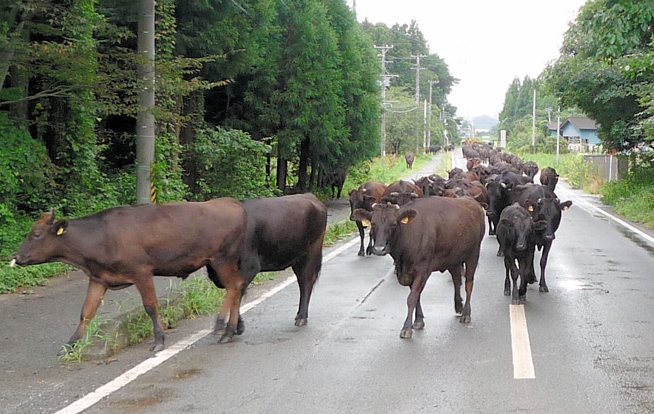
In a scene from “Hibaku-ushi to Ikiru” (Living with irradiated cattle), stray cattle head down a road in the 20-kilometer no-entry zone around the crippled Fukushima No. 1 nuclear power plant in August 2011.
OSAKA–For some cattle farmers in Fukushima Prefecture, the thought of destroying their herds is too painful to bear even if they are contaminated with radioactive fallout.
A new documentary to be shown here this week records the plight of these farmers, who continue to look after their beef cattle in defiance of a government request to euthanize the animals.
“I took on this project because I wanted to capture what is driving farmers to keep their cattle. For all the trouble it is worth, the animals are now worthless,” said Tamotsu Matsubara, a visual director who shot the documentary.
Four years in the making, “Hibaku-ushi to Ikiru” (Living with irradiated cattle) is set for its first screening on Aug. 26 at a local community center in the city.
Matsubara’s interactions with the cattle farmers date to the summer of 2011, a few months after the nuclear crisis unfolded at the Fukushima No. 1 nuclear power plant following the Great East Japan Earthquake and tsunami on March 11 that year. His assignment was to cover a traditional festival in Minami-Soma, which is located near the stricken nuclear plant.
Matsubara, 57, became acquainted with a farmer caring for more than 300 cattle on his land in the 20-kilometer no-entry zone set by the government. Residents in the zone were ordered to evacuate, but the farmer stayed on to look after his animals.
At that time, the government was seeking to destroy the cattle within the no-entry zone by obtaining their owners’ consent, saying animals that were heavily contaminated with radiation from the nuclear accident could not be sold at market.
But some farmers did not want to put their livestock down.
However, keeping them alive costs 200,000 yen ($2,000) a year in feed per head.
Matsubara became curious why the farmers continued to look after cattle that cannot be sold or bred, despite the heavy economic burden.
He soon began making weekly trips from Osaka to Fukushima to film the lives of the farmers, their cattle and the people around them.
After finishing his regular job in promotional events on Fridays, Matsubara would drive 11 hours to Fukushima and spend the weekend documenting the plight of the farmers before returning to Osaka by Monday morning.
He had 5 million yen saved for the documentary, his first feature film. When the money ran out, Matsubara held a crowdfunding campaign to complete it. Shooting wrapped up at the end of December.
About 350 hours of footage was edited into the 104-minute “Hibaku-ushi to Ikiru.”
The film documents the farmers and their supporters who are struggling to keep the cattle alive.
One couple in the film returns to their land in Okuma, a town that co-hosts the Fukushima plant, to care for their herd. They affectionately named each animal and said it would be unbearable to kill them. Their trips are financed using a bulk of the compensation they received for the nuclear accident.
A former assemblyman of Namie, a town near the plant, tends to his animals while asking himself why he used to support nuclear power.
The documentary also sheds light on scientists who are helping the farmers. The researchers believe that keeping track of the contaminated cattle will provide clues in unraveling how low-level radiation exposure impacts large mammals like humans.
Matsubara said the documentary tells the real story of what is going on with victims of the nuclear disaster.
“Not all the farmers featured in the documentary share the same opinion or stance,” Matsubara said. “I would like audiences to see the reality of people who cannot openly raise their voices to be heard.”
Takeshi Shiba, a documentary filmmaker who served as producer of this project, hopes the film will reach a wide audience.
“Matsubara broke his back in making this movie,” he said. “I hope that many people will learn what Fukushima people are thinking.”
Hong Kong still testing food imports for Fukushima’s radiation
More than five years ago on Friday, March 11, 2011, the Great East Japan Earthquake with a magnitude of 9.0 set off a large tsunami sending a 50-foot wall of water over three Fukushima Daiichi reactors. Three of the nuclear cores melted down in the next three days.
About 1,600 miles away on the next day, Saturday, March 12, 2011, the Center for Food Safety (CFS) in Hong Kong began stepped up surveillance of fresh foods including milk, vegetables and fruits, imported from Japan for radiation testing.
Eleven days later, on Wednesday, March 23, 2011, CFS discovered three samples imported from Japan with radioactivity levels exceeding those considered to be safe by international Codex Alimentarius Commission.
CFS is a unit of the Food and Environmental Hygiene Department of Hong Kong’s City government, which is part of China. The CFS continues to test those Japanese imports but hasn’t found any additional shipments with unsafe radiation levels.
And its not for lack of looking. Since one week before CFS found those hot white radishes, turnips and spinach samples, Hong Kong has tested 344,881 samples.
It breaks down this way: 19,420 vegetable samples; 19,338 fruit samples; 2,189 milk and milk beverage samples; 900 milk powder samples; 594 frozen confection samples; 54,468 aquatic product samples; 9,487 meat product smples; 31,744 drink samples, and 206,741 other samples including cereals and snacks.
The totals are through Aug. 22. CFS continues to test samples from Japanese imports, conducting testing around the clock five days a week.
Hong Kong’s continued surveillance for radioactivity is just one sign of how cautious Asia remains about the Fukushima meltdown. Japan has excluded people and crop production in a 310-square-mile zone around the nuclear plants. No deaths or cases of radiation sickness are attributed to the nuclear accident. And, perhaps due to the large exclusion zone, future cancers and deaths from potential exposures are projected to be low.
The U.S. Food and Drug Administration treats Fukushima with a periodically updated Import Alert that permits certain Japanese food imports to be detained without inspection.
“Districts may detain, without physical examination, the specified products from firms in the Fukushima, Aomori, Chiba, Gumna, Ibaraki, Iwate, Miyagi, Nagano, Niigata, Saitama Shizuoka, Tochigig, Yamagata and Yamanashi prefectures,” the July 18 Import Alert from FDA says.
Japanese imports from those areas that can still be detained at the U.S. border include:
- Rice, Cultivated, Whole Grain;
- Milk/Butter/Dried Milk Products;
- Filled Milk/Imitation Milk Products;
- Fish, N.E.C.;
- Venus Clams;
- Sea Urchin/Uni;
- Certain Meat, Meat Products and Poultry, specifically(beef, boar, bear, deer, duck, hare and pheasant products;
- Yuzu Fruit;
- Kiwi Fruit;
- Vegetables/Vegetable Products;
- Baby Formula Products; and
- Milk based formulas.
http://www.foodsafetynews.com/2016/08/hong-kong-still-testing-food-imports-for-fukushimas-radiation/
10,000 tons of toxic water pools in Fukushima nuclear plant trenches
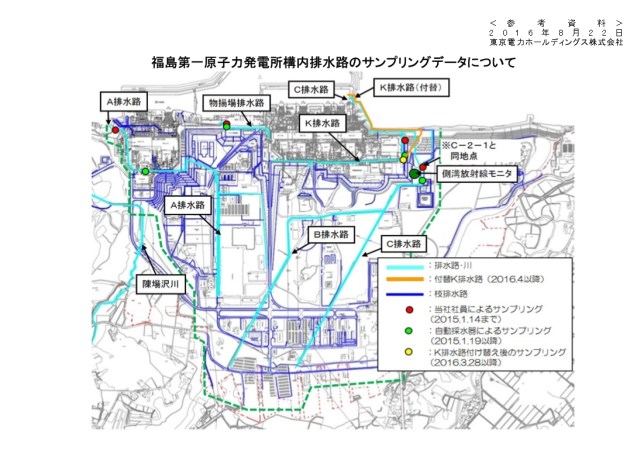
Drainage chart/map
TOKYO (Kyodo) — Around 10,000 tons of contaminated water have pooled in underground trenches around the Nos. 1 to 4 reactor buildings of the crippled Fukushima Daiichi nuclear power plant, according to the plant operator Tokyo Electric Power Company Holdings Inc.
Tokyo Electric has no immediate plan to remove the water in the trenches where cables run for the nuclear power complex devastated by the March 2011 earthquake and tsunami disaster.
Water that flew into the trenches in the wake of the huge tsunami is believed to have been mixed with highly radioactive water leaking from the basements of reactor buildings and contaminated rain water.
“Compared with around 70,000 tons of highly contaminated water that remain in the basements of the reactor buildings, (the water in the trenches) has a low level of concentration and thus poses little threat in terms of radiation exposure and the environment,” said an official of the utility known as TEPCO.

TEPCO said in a report issued in July — based on research conducted in fiscal 2015 — that it has found around 8,000 tons of toxic water in 17 locations in the trenches that connect with reactor buildings where highly radioactive water accumulates, as well as around 3,000 tons of toxic water at 11 locations in trenches that do not connect with reactor buildings.

Of the water in the trenches around the Nos. 1 to 4 reactor buildings, a removal procedure was completed by June for around 500 tons of water in a pipe that measured the highest level of radioactive cesium at 500,000 becquerels per liter.
The level of radioactive cesium in water at other locations in the trenches was mostly measured at several thousands becquerels or below.
The level in toxic water in the basements of reactor buildings has been measured at around dozens of millions becquerels at maximum.
TEPCO has said it will continue to monitor and measure the level of contamination in water in the trenches regularly and consider taking measures to remove the water in the future. But no concrete plan has been created yet.
The electricity firm has so far removed a total of around 10,000 tons of highly radioactive water at three locations in the trenches running in the seaside of the complex and completed the procedure to fill locations concerned with cement to prevent water leaks.
Still, the level of radioactive cesium remains unchecked at 40 locations in the trenches due to high radioactive levels as well as debris and other objects blocking the research operation.
Around 8,000 tons of contaminated water, including those with an extremely low level of contamination, have also been found in the trenches running around the Nos. 5 and 6 reactor buildings. The two units have lower levels of radiation doses than the Nos. 1 to 4 units as there were no nuclear meltdowns or hydrogen explosions there during the nuclear disaster.
http://mainichi.jp/english/articles/20160823/p2g/00m/0dm/074000c
Drainage charts/maps.
https://t.co/EIJkR80Biq
Tepcos Reports (PDF)
https://t.co/lTM563FjQe
Government subsidies to help Fukushima farmers restart operations

The central government plans to set up a new subsidy system to help farmers in 12 municipalities near the stricken Fukushima No. 1 nuclear plant restart their operations, according to sources.
The program represents part of the government’s efforts to promote the reconstruction of areas damaged by the March 2011 earthquake and tsunami in the Tohoku region and the subsequent meltdowns at the Tokyo Electric Power Co. nuclear station.
The government will earmark around ¥7 billion for the program under a planned supplementary budget for its special account related to the 2011 disaster, the sources said Monday.
The program will help farmers buy equipment and livestock.
A support system is already available in which the 12 municipalities in Fukushima Prefecture buy facilities and equipment such as greenhouses and tractors and lend them for free to farmers aiming to get back on their feet.
But the system is inconvenient for individuals who want to resume farming operations, because it is mainly designed for group farming and other big operations. Also, approval from local assemblies is necessary to lend out the facilities and gear.
Under the new program, the Fukushima Prefectural Government will cover 75 percent of farmers’ purchase costs for farming equipment and livestock, the sources said. The upper limit on support per farmer will likely be ¥10 million, they said.
The central government will shoulder all costs incurred by prefectural government, the sources said.
The 12 municipalities are Tamura, Minamisoma, Kawamata, Hirono, Naraha, Tomioka, Okuma, Futaba, Namie, Kawauchi, Katsurao and Iitate.

Wind and cars disperse radioactive material
By Kurumi Sugita
A remarkable documentary of the RTBF about contaminated areas, including Minami Soma in Fukushima prefecture. These areas are heavily contaminated. Nevertheless, the Japanese government makes the people return by lifting the evacuation order and stopping aid.
The Nos Voisins Lointains 3.11 association, exchanged messages with Mr. Ozawa, the engineer interviewed in the documentary. According to him, the most worrisome problem is the fact that black substances in the mall parking area get attached to car tires and are transported everywhere, as we can see in the documentary. The risk of radiation is thus dispersed.

On the other side of the parking area, we see collective dwellings from where children play outside, according to Mr. Owaza.
See also the video sent by Mr. Ozawa showing the wind lifting and dispersing the contaminated dust from fields now uncultivated.
Linens that are drying on the balcony outside are exposed to radioactive material transported by these dusty winds. Just watch at which height the dust is lifted compared to the passing car towards the end of the video. Farmers working the land inhale this dust.
With the forced return of the population this will become their daily reality.
American nuclear expert Arnie Gundersen warns: “There is a possibility that now in Fukushima recontamination is occurring.”
CCTV (Channel 17 in Burlington, Vermont), published Jun 20, 2016
Maggie Gundersen, Chiho Kaneko and Caroline Phillips of Fairewinds Energy Education discuss the nuclear risk concerns for children not only near the nuclear disaster sites of Fukushima-Dai-ichiin Japan and Chernobyl in Ukraine, formerly the Soviet Union, but globally where areas near all nuclear power plants are contaminated with radiation. Since mothers in Japan especially bear the responsibility to protect children, they experience greater hardships in an environment where just expressing one’s concern about radiation is seen as a treasonous act. Even 30 years later, the Belarus government recognizes the merits of relocating children away from radiation contaminated areas but the children of Japan are socially forced to stay put in highly contaminated areas.
Margaret Harrington, host: I know you mentioned Arnie Gundersen, the chief engineer at Fairewinds, and he said that he measured the radiation there, too. Could you talk about that a little bit?
Maggie Gundersen, Fairewinds Energy Education founder and CEO: He’s working with some other scientists who are studying — both Japanese scientists, the samples that they took, and the US scientists who are evaluating the samples — and they’re finding astronomical amounts of radiation, even in downtown Tokyo outside of METI’s door. METI is the regulatory agency over nuclear power… When he and others were downtown in Tokyo, they took samples right there in a garden right outside the door and on the front doormat, and these are really, really high samples. Frightening, because people walking in Tokyo will then be inhaling that dust. What was the film we saw from Japan that had the mothers who were in an area where kids play and run from middle school?
Caroline Phillips, Fairewinds Energy Education: It’s a fantastic video… it’s a mothers organization, they live in the Fukushima Prefecture and they’re actually using Geiger counters that have been issued by the government. They’re walking along the river [in Fukushima City.]
Maggie Gundersen: What’s so tragic about it – kids are running along dirt paths doing gym class and track and things like that and the mothers are right down in areas that are not posted and the kids can go after school and play, and people do nature hikes and stuff. And the radiation readings are horrific.

Gendai Business Online’s top ranked article is an exclusive interview with Fairewinds Chief Engineer Arnie Gundersen titled, American nuclear expert warns: “There is a possibility that now in Fukushima recontamination is occurring.” With more than 10,000 likes on Facebook, this Japanese article delves into the truth about nuclear contamination from Fukushima Daiichi as uncovered by Arnie Gundersen during his most recent trip to Japan. Fairewinds, with the help of Japanese translators, provides you with an English translation:
On a mid-February morning, just before the 5th anniversary of the triple meltdown at Fukushima Daiichi, a group of young girls in the city of Minami-Soma rode their bikes to school past a shocked and saddened pedestrian. That upset observer was Arnie Gundersen, nuclear reactor expert and Chief Engineer with Fairewinds Associates. Mr. Gundersen has 45 years of experience as a design, operations, and decommissioning nuclear engineer. He has engaged in research of the effects of the meltdown at Three Mile Island (TMI) and conducts independent research of the triple meltdown at Fukushima Daiichi. Mr. Gundersen is in ongoing conversations with both the US and Japanese media concerning the dangers of nuclear reactors and nuclear power operation. Invited by “Peace News Japan” and several other civil groups, Mr. Gundersen visited the Fukushima prefecture five years after the catastrophe at Fukushima Daiichi.
“What surprised me at this visit to Japan [his third since the meltdowns] is that the decontaminated area is contaminated again,” Mr. Gundersen said while explaining why it was such as sad shock to witness the girls on their bicycles. “This was not what I had expected. I had thought that we would not find such high doses of radiation in the decontaminated area. But, sadly, our results prove otherwise.”
During his Japan visit, Mr. Gundersen collected samples of dust from the rooftop of Minami-Soma city town hall, the floor mat of a 7-Eleven convenience store, and the roadsides of Minami-Soma city. Although the official data cannot be released before the publication of formal scientific papers, it is evident that high doses of radiation, usually found in nuclear waste, was detected from these samples.
“This means that highly radioactive dust is flying around the city. In other words, the decontaminated land is contaminated again. Little girls are affected by the radiation 20 times as much as adult men. The Japanese government’s standard of 20 mSv is based on exposure assessments for adult men. The girls on their bicycles are actually being affected by a radiation dose equivalent to as much as 400 mSv.”
Mr. Gundersen also pointed out that human lungs are heavily affected by internal exposures to radiation.
“At this visit, I wore a radiation proof mask that can filter out 99.98% of radiation for six hours. I sent my filter to the lab, and they found a high dose of Cesium. But, unfortunately, the Japanese government only cares about the number on a Geiger counter and does not consider the internal exposure. This has resulted in a hazardous downplay of this kind of data and human lungs are affected by the serious internal exposure.”
Why is the recontamination happening? One of the reasons is that the government did not decontaminate thoroughly. Mr. Gundersen witnessed first-hand the poor decontamination of the prefecture.
“In the house I visited, only half of the garden area was decontaminated because only that half fell into the category of a contaminated area. It should not be like that. The other half would be contaminated too. Furthermore, one person discovered highly radioactive dust in their driveway where decontamination had occurred. So, of course, this person notified the related offices but the related offices told them that it was not necessary to decontaminate the driveway again because it had already been done once. It’s unbelievable. This person’s house is located near a ravine and the opposite side of the ravine is designated a non-habitable zone.”
Another reason for recontamination is that the radiation from the mountains are coming back to the city by way of wind and rain. Mr. Gundersen noted the extreme radioactive contamination of the mountains.
“We tracked wild monkeys in the mountains and found a high dose of radiation in their feces. I received the meat of a wild pig as a gift and since I could not bring it back to the US [it is illegal to bring meat back to the United States from Japan], tested the meat on a Geiger counter. The meat showed 120 counts/min. I think that the Japanese government should spend more money to decontaminate the mountains but they don’t appear to have that kind of political will. I also worry that contamination in the rivers is not monitored as rain from the mountains flow down into the rivers.”
Due to the heavy radiation contamination of the mountains, vegetables grown in that area exceed the government’s standard by 1500 Bq. These vegetables were sold at the MichinoEki in Tochigi prefecture, and the bamboo shoot grown in this contaminated region was used for elementary school lunches in Utsunomiya. These school lunches contained more than twice as much radiation as the government’s standard.
Recontamination is happening due to poor decontamination and residents of Kawauchi village in Fukushima prefecture claim that the decontamination in the forests is not enough. However, the government continues to push for the end of people’s relocation and force the return to recontaminated areas.
“If I had a little child, I would never let them live there,” Mr. Gundersen pointedly states.
Mr. Gundersen also found that Tokyo remains contaminated. He measured dust collected from the sidewalk in front of MITI (Ministry of International Trade and Industry) and found a high dose of radiation. That dust is in the air that will be inhaled by the visitors and athletes of the 2020 Olympic Games. Needless to say, the current residents are inhaling it every day. “Mr. Abe should not take the advice from IAEA, MITI and TEPCO seriously,” Mr. Gundersen insists. “Instead, he should have an independent organization conduct research and listen to the advice from them.”
1 This Month





PLEASE OPPOSE HR 8255 AND S.3639 – bills would accelerate satellite deployment, with no environmental review or safeguards – https://ncstd5li.quorum.us/campaign/169331/
To see nuclear-related stories in greater depth and intensity – go to https://nuclearinformation.wordpress.com
-
Archives
- October 2026 (91)
- September 2026 (339)
- August 2026 (330)
- July 2026 (355)
- June 2026 (287)
- May 2026 (306)
- April 2026 (356)
- March 2026 (251)
- February 2026 (267)
- January 2026 (308)
- December 2025 (358)
- November 2025 (359)
-
Categories
- 1
- 1 NUCLEAR ISSUES
- business and costs
- climate change
- culture and arts
- ENERGY
- environment
- health
- history
- indigenous issues
- Legal
- marketing of nuclear
- media
- opposition to nuclear
- PERSONAL STORIES
- politics
- politics international
- Religion and ethics
- safety
- secrets,lies and civil liberties
- spinbuster
- technology
- Uranium
- wastes
- weapons and war
- Women
- 2 WORLD
- ACTION
- AFRICA
- Atrocities
- AUSTRALIA
- Christina's notes
- Christina's themes
- culture and arts
- Events
- Fuk 2022
- Fuk 2023
- Fukushima 2017
- Fukushima 2018
- fukushima 2019
- Fukushima 2020
- Fukushima 2021
- general
- global warming
- Humour (God we need it)
- Nuclear
- RARE EARTHS
- Reference
- resources – print
- Resources -audiovicual
- Weekly Newsletter
- World
- World Nuclear
- YouTube
-
RSS
Entries RSS
Comments RSS

