Nuclear: Game Over.

Nexit – Nuclear Exit
It took the world 48 years to gradually ramp up to a peak of 438 commercial nuclear power plants in 2002. Today, in 2016, we have dropped to 402 reactors with further closures foreshadowed.
There is about 200 years of uranium, if we consume it at the current rate. Scale up to 3000 reactors and we have only about 25 years of power left.
Humans globally consume roughly 15,000 gigawatts (GW) of power, in oil, coal, gas, nuclear, and renewables all added together.1 To put it another way, it means that, on average, we use 15,000 gigajoules (GJ) of energy every second of every day. That is an enormous number, equivalent to switching on 15 billion electric kettles.

On the other hand, 15,000 GW is a relatively small number as it is 5000 times less than the average solar power hitting the planet’s surface. And remarkably, it is six times less than the solar power utilised by all plant life on Earth for photosynthesis.2 By far, the plant kingdom has already beaten the human race to the punch in terms of the sheer magnitude of solar collection achieved.
Yet this means that maintaining our current levels of consumption in a sus-tainable manner requires harnessing only 0.02% of the light at the surface of our planet. So do we really need nuclear power? Is nuclear sustainable? Given the awesome potential of renewable energy, is there an economic place for nuclear power? Why is nuclear power globally in decline at present? What are the limitations?
These are some of the key questions we’ll now examine.
Energy policy
Before we discuss power generation, it is important to first highlight that any robust government energy policy must be grounded by the concept of energy conservation. To understand why energy conservation and energy efficiency form the bedrock of policy, let us consider how power consumption can quickly add up and get out of hand.
Imagine 5 billion people all make one cup of tea per day, and overfill their kettles by as little as a quarter of a cup. Over a day, this excess requires an additional 2 GW of average power, which is equivalent to the output of the whole Hoover Dam.3
Consider the possibility of everyone on the planet driving a medium sized car for only one hour per day. That alone would average to two thirds of our total present global consumption, which is clearly unsustainable.
Suppose there were one billion medium-sized houses on the planet all heating or cooling by as little as 3°C relative to the outside temperature. By not having home wall insulation, the excess power needed would on average equal our total present global consumption. This alone illustrates the critical importance of having insulation standards for new buildings.
On the flip side, take an estimate of about 10 billion tungsten light bulbs in the world. On average each light bulb will be on about 10% of the time. If each was replaced with a modern LED light bulb – with a saving of 50W each – that equals a saving of 50 GW, the equivalent to about 50 nuclear power plants.
As such, there cannot be a future drive towards sustainable power generation without it being married to measures of energy effciency and conservation.
Nexit: Nuclear Exit
Around the world the nuclear industry is in gradual, inexorable decline. Starting from 1954, it took the world 48 years to gradually ramp up to a peak of 438 commercial nuclear power plants in 2002. Today, in 2016, we have dropped to 402 reactors with further closures foreshadowed.4
A report from the Swiss banking investment sector5 states “big, centralised power stations will not fit into the future European electricity system” and that they will share “the fate of the dinosaurs: too large, too inflexible, on their way to extinction.”
Participating countries are closing down nuclear power plants (NPPs) faster than they are being built. Nuclear apologists point to China as a role model that is actively building a number of NPPs. The fact is that China has built $160 billion in overcapacity of coal plants that are unused.6 Will their NPPs, which are presently under construction, become similarly redundant?
There simply aren’t enough Chinese students rushing to enrol into nuclear engineering courses, to produce the workforce for an expanded nuclear program.7 China’s ambitious nuclear expansion plans would require at least 50,000 students to be trained by 2030, but barely a few hundred students raise their hands each year.8 The shortage of trained nuclear technicians and engineers has already led to safety incidents.8
By contrast, in 2015, China invested five times more in renewables than nuclear power.4 Those nuclear projects will take many years to complete, whereas renewables are deployed and put to immediate use. Moreover, China’s nuclear investments may have an uncertain future and may meet the same fate as their renowned ghost cities. Significant Chinese street protests against nuclear, in 2013 and 2015, indicate a growing groundswell of discontent.9,10
Let us now examine some of the limitations of nuclear power generation that contribute to its uncertain future and an impending global energy market nexit.
Nuclear footprint
Nuclear marketeers brand NPPs as taking up a small physical land area with respect to renewables. However, consider all the processes and steps from mining uranium, processing it, burning it, and then dealing with the waste. Mark Z. Jacobson from Stanford University, has added up the footprint of all the globe’s NPPs, their exclusion zones, and supporting infrastructure.11 Jacobson found that if you divide that area by the total number of NPPs in the world, we obtain an average nuclear footprint12 of about 4.5 km x 4.5 km, which is roughly the same for equivalent solar power.
A hypothetical nuclear utopia powering the entire world’s energy needs would require in the order of 15,000 NPPs. This is a daunting scale-up compared to the dwindling number of 400 NPPs the world has at present. To see how impossibly challenging this would be, take a map of anycountry of the world and mark 100 possible locations for nuclear stations close to water and far from population centres. Even trying to place ten NPPs in acceptable locations is not an easy task. This obstacle alone counts out a nuclear utopia.
Uranium resource limits
But is a more modest vision of, say, 3000 reactors possible? This would at least replace all the world’s coal-fired plants.
Based on the known mining reserves of uranium there is about 200 years of uranium, if we consume it at the current rate.13 Scale up to 3000 reactors and we have only about 25 years of power left. Clearly this is a proposition that isn’t at all sustainable.
Nuclear apologists will then raise the question of yet undiscovered reserves of uranium. However, this makes little difference; if we double or quadruple the figure of 25 years, this is hardly a legacy investment for the future. One can’t pluck imaginary figures that are any larger, as we know the abundance of uranium in the Earth’s crust is about the same level as for rare earth metals.14
Proponents of nuclear power will then point out that there’s over 500 years worth of uranium in seawater. However, this is a fruitless suggestion as the uranium concentration is tiny, at 3.3 parts per billion. The energy it takes to lift a bucket of seawater by 50 metres is equal to the energy you’d get from its uranium.14 The energy return on investment simply doesn’t add up.15
In order to address this issue, the coun-terpunch is the promise of breeder-style Generation IV reactors. These will potentially increase fuel lifetime by a factor of 60. This indeed would be impressive, as we can now lift the bucket of seawater by 3 km. However, these types of reactors are riddled with advanced materials issues that have not yet been solved. The metal parts of these reactors are exposed to higher temperatures, a higher corrosive environment, and a higher neutron flux than in conventional reactors16 – suitable alloys that can withstand these conditions have not yet been found for long-term commercial operation.17
Governments do not form today’s energy policy based on arguments that largely hinge on commercially unproven or non-existent hardware. This would be akin to forming health policy based on promised drugs that are yet, unproven or undiscovered.
Reactor lifetime
A nuclear reactor has a lifetime of roughly 40 years.4 Due to heat, high-energy neutrons, and corrosion, the metal nuclear vessel eventually cracks. Every device runs and gets hot – this sets a limit to the reliability and lifetime of any machine. Everything from a light bulb to a car engine eventually pops, and nuclear reactors are no exception. At the end of its 40-year life, a nuclear station has to be decommissioned.
The nuclear vessel itself becomes radio-active, weighs up to 500 tonnes, and has to be buried. The costs of decommissioning a reactor at today’s prices are commensurate with building them in the first place. Attempts are made by NPPs to factor in decommission cost into their economics. However, who can predict what the costs will be 40 years into the future? Typically costs blow out and the taxpayer ultimately foots the bailout.
Elemental diversity
When an NPP comes to the end of its 40-year life, the metal reactor vessel and core are radioactive, as they have been exposed to high-energy neutrons. If there were a vast nuclear scale-up, where would we put all these ‘glowing’ vessels? Moreover, inside the vessel, hafnium may be used as a neutron absorber, beryllium a neutron reflector, and zirconium is used for fuel rod cladding. The steel that is used to construct the vessel has to be hardened against neutron damage, and so it is typically alloyed with elements such as molybdenum, niobium, and tantalum to name a few.18
Many high performance alloys in other industries use exotic metals too, but the point is that those metals can be recycled. Rare earth metals used in the renewable industry are recyclable too. In the case of NPPs the metals become radioactive and so a scale up to 15,000 reactors in the world would be out of the question, as it would limit our elemental diversity.
Is nuclear fusion the solution?
Nuclear fusion, if it ever becomes commercially useable, would be an even worse offender in terms of reduction in elemental diversity. What is not publicised is that the nuclear fusion process irreversibly consumes lithium.18 Every laptop, mobile phone, and electric car needs this coveted element. Moreover, fusion reactors end up with radioactive vessels and still require decommissioning, so the quandary of that waste remains. For these signicant practical reasons, fusion is unsustainable and not the panacea it is cracked up to be.
Nuclear waste
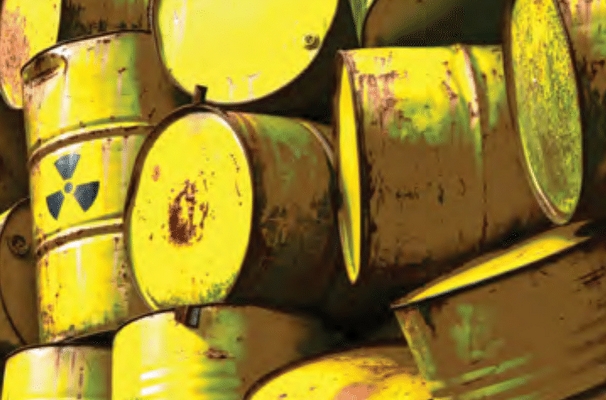
Nuclear power plants globally produce about 10,000 tonnes of spent fuel waste per annum.19 When a spent fuel rod is removed from a reactor, the radiation level is so high that a one-minute dose at a metre’s distance is lethal to humans. Each spent fuel rod generates heat and has to be stored in a pool of water at least for five to ten years to cool down.
When a spent fuel pool runs out of room, the rods are then transferred into 100 tonne containers called dry casks. Each cask costs about $1 million each, and the spent fuel assemblies are transferred into the casks using costly robotic equipment to avoid human exposure. The casks are then filled with helium and are welded shut, at a cost of $500,000 each.
Dry casks are stored above ground, and the idea is that after about 50 years of further cooling the fuel can then be sent to a deep underground repository. Though, no country has yet succeeded in following through on this final costly step. A dry cask, which is stored above ground, in the meantime may corrode and leak, and transfer into a replacement cask is costly.20
Some isotopes in the spent fuel have decay half-lives over 10,000 years, and so an underground repository is the only viable final resting place for such waste.21
To repackage spent fuel from a dry cask to a special repository canister is incredibly costly. For the manufacture of canisters and provision of the equipment to perform the repackaging operation, one is looking in the vicinity of $50 billion.22
When a canister is placed in a deep repository, bentonite clay is used to delay the penetration of water and moisture. The canister eventually cracks and corrodes with time. This is accelerated due to the radiation, from the inside, and by natural bacteria23 from the outside. Once there is a leak, radioactive iodine-129 isotopes from the fuel can diffuse through rock.19
Radioactive actinides from the spent fuel are released into the biosphere through water.19 Should water ever breach the canisters, numerous chemical reactions can take place including the generation of explosive mixtures of hydrogen and oxygen.19
Why is nuclear so expensive?
The principal costs of NPPs are the capital cost of the power station and decommissioning. Then consider the enormous number of steps involved in preparing the fuel, its deployment in a highly complex nuclear station, and then the repackaging and disposal steps needed at the end of the fuel cycle. At each step there are safety risks to nuclear workers and so the complexity of the management flow snowballs due to the necessary governance structures that are put into place. As there are so many steps with attendant risks, the full end-to-end cost appears to climb.
Nuclear decommission costs are high, and it is estimated that the decommissioning contracts over the next 15 years will amount to $220 billion.24 This sum is equivalent to the creation of solar power that would replace 44 nuclear stations.25

Renewables vs. nuclear
While nuclear power plants experience economic decline, renewables are rapidly growing and penetrating the market on an exponential curve. The global annual increase in renewable generation for 2015 alone was 50 GW for solar panels, 63 GW for wind power, and 28 GW for hydropower.26
Nuclear power is large and centralised, with enormous entry and exit costs. By contrast, renewables are made up of small modular units that yield a faster return on investment. The revolution we are witnessing is akin to the extinction of big powerful dinosaurs versus resilient swarms of small ants working in cooperation. Nuclear power is sinking under the weight of its complexity, costs, and the headache of its waste issue. On the other hand solar power is brought to us via free sunshine exposing the promises of nuclear as mere moonshine.
Electricity prices
Nuclear advocates point out high electricity spot prices in regions with high renewable penetration.27 However, it is a misdirection to conclude that renewables are therefore costly – after all, renewables have zero fuel costs. The plants with flexible controllable power (eg. gas turbines) naturally take advantage of the situation and bid higher prices during times when renewable generation is low.28 Thus the solution is not to reduce the proportion of renewables, but instead to revise pricing policy to reflect the change in market dynamics and structure. The current policies are out-dated and based around the outmoded paradigm of all-controllable power generation.
A possible solution is that flexible controllable power sources (eg. gas, waste biomass fuelled power plants, solar thermal plants, pumped hydro, batteries etc) ought to be also rewarded for the ‘insurance’ they provide in backing up intermittent uncontrollable sources (eg. wind and rooftop solar), rather than solely for the energy they deliver so that they are not drawn into a price bidding game. Rewarding controllable sources for their back-up ability may provide investment incentives for such generators.
Intermittency
A common argument nuclear proponents raise is that renewables are intermittent; therefore nuclear power is essential to keep the lights on 24/7. This is wrong on a number of levels.
First, intermittency does not automatically imply unreliability. Take the analogy of rainfall. Rain is very intermittent and yet we have a continuous supply of water when we turn on the taps. Why? Because there is reservoir storage, river flow, and many pipe-interconnected collection areas and aquifers. Our water supply would be unreliable if we didn’t adequately design an appropriate grid of pipework, dams, and reservoirs. There’s no equivalent of a ‘nuclear station’ providing a constant baseload supply of water. The intermittency in rainfall becomes reliable due to planned storage and spatial diversity. The same principles apply to electricity.
Second, nuclear plants are intermittent too as they need planned shutdowns for maintenance and fuel rod changes. Then there are unplanned shutdowns, for example, if a pump breaks down or a critical pipe leaks. These ‘minor’ shutdowns often mean that 1 GW of nuclear power goes offine for 2–4 weeks. The ultimate in intermittency is when a nuclear station is closed down to due an accident or if a licence renewal has been refused due to old age. Then there’s over a 10-year lead-time before a replacement nuclear plant comes online. So nuclear power is intermittent too, but simply on a different timescale.29
By contrast, it makes no difference to a grid when a solar panel is damaged. Moreover, it can be replaced within a day. The modularity and diversity of a network of renewable sources can be designed to be much more robust than any large centralised power station.
Grid stability
Nuclear lobbyists create a further false dilemma by suggesting renewables make the electricity grid unstable and therefore nuclear power is required to ensure stability. First, nuclear power is not required because controllable renewable sources (with synchronous generation, such as solar thermal, hydroelectric power, and pumped hydro) already stabilise the grid. It is true that other renewable sources do give rise to grid management issues, but this is bread and butter for grid engineers.30 There are numerous research papers by grid engineers developing solutions for increased renewable penetration and none are suggesting the need for nuclear power.
In an Australian context, how does one adopt proven storage techniques for grid stability such as pumped hydro, when the country is mostly devoid of mountains? It is a fallacy to assume mountains are needed; as plateau regions provide perfect locations for pumping up water for later release and energy generation. For example, there is an ideal plateau of about 270 m high, between Port Augusta and Whyalla where seawater can be pumped for energy storage.
Nuclear in bed with renewables?
In desperation, nuclear advocates are putting a new spin on their marketing. The slogan now is that nuclear and renewables make perfect marriage partners, as nuclear provides the grid with ‘baseload’ power.
Unfortunately this pick up line cannot woo renewables into bed. The fact is that generators designed for constant baseload operation are exactly what uncontrollable renewable generators don’t need. Uncontrollable renewables need flexible controllable sources of power such as hydroelectric power, pumped hydro, waste biofuels, solar thermal, and solar generated hydrogen or syngas to provide power when generation from intermittent renewable sources is insufficient to meet demand. Nuclear power plants work best when they provide a constant power output and they lack the agility to follow the variability of renewable generators.
One can manage different uncontrollable and controllable renewable sources to work together, making baseload gen-eration redundant.31,32 The concept of operating a power system with a traditional baseload plant is becoming outmoded5 and signifficant future cost penalties are likely to be attached to generators designed for baseload operation33.
Nuclear promotion goes to some lengths to greenwash its image, in an attempt to make it appear on a par with renewables. But as we have demonstrated in this article, non-recyclable nuclear is highly resource-limited and therefore it isn’t a renewable source.
Another form of greenwashing is the catchphrase ‘nuclear saves lives’ reminding us that radiotherapy is used in hospitals. Amputating gangrenous limbs also saves lives too, but it would be a logical fallacy to use that fact to improve the image of chainsaws.34
What really matters is rate of carbon footprint reduction
The spin put on nuclear power as having a ‘low carbon’ footprint is a further case of greenwashing. For example, if there were a threefold ramp up of nuclear power this century, it would result in a modest 6% carbon reduction.35 On the other hand, the exponential uptake of renewables this century will far outstrip 6%.
What really matters is not the present carbon footprint today of each power source, but the rate of footprint reduction that they introduce. Presently nuclear is in decline, and solar uptake is exponentially growing. Thus the reduction in carbon footprint from solar will experience a ‘compound interest’ type of effect. Because the solar market is fast and flexible, whereas nuclear is economically slow and stunted, solar will vastly exceed nuclear in terms of rate of carbon mitigation.
In summary, the branding of nuclear as ‘green’ is fallacious and the opportunism of nuclear advocates proclaiming environ-mental concern is about as comforting as Donald Trump in a Mexican hat.
Should Australia adopt nuclear power?
The size of the Australian electricity market is of the order of $10 billion per annum,36 which is relatively small. Therefore there isn’t a business case to foot the bill for even one nuclear power station with its construction cost, decommission cost, and cost of spent fuel handling and repackaging.
Moreover, Australia simply doesn’t have the existing infrastructure, training, and governance structures to support a nuclear industry. It would be risky for Australia to enter an area fraught with high uncertainty, given the present global decline.
Should Australia store nuclear waste?
Possible motivations to build a deep underground repository for international high-level nuclear waste, in Australia, are the promises of income, increased employment, and support of a waning Australian uranium export industry.37
However, it is important to note that no pro-nuclear power country has yet opened such a repository. To enter a new business space, where even the highly experienced players have not delivered, is to take on considerable economic risk and uncertainty.
To invest in an industry that is in global decline, does not appear to be as rational as investing in a growth area such as renewable energy. Renewable energy is a business space where Australia has a multitude of trained engineers, existing infrastructure, and an abundance of sunshine. Building intentional renewable overcapacity in Australia will potentially be a wise investment, as that surplus can then be used to generate hydrogen or other fuels that can be liquefied and traded on overseas markets.

Lack of public acceptance
Obtaining public acceptance in a country that has traditionally been free of nuclear power would likely be insurmountable, given the decreasing world-wide levels of public support.40
Lack of public acceptance cannot be underestimated. Even in pro-nuclear France, riots took place in the 1990s that overturned the government’s move to build a nuclear repository.41 Renewed protests have taken to the streets in China only this year.42
The citizens in the countries, with the most nuclear experience, show increasing opposition40 to expanding the nuclear industry,
1. Germany (90% opposed)
2. Mexico (82% opposed)
3. Japan (84% opposed)
4. UK (63% opposed)
5. USA (61% opposed)
6. China (58% opposed)
7. France (83% opposed
8. Russia (80% opposed).
With the current debacle of escalating costs of the Hinkley nuclear plant, in the UK, it is likely a fresh poll would show even stronger UK opposition against nuclear and further support for renewable energy.

Conclusion
Nuclear power is a clunky technology borne out of a bygone Cold War era. Its best days are over and it cannot form a key part of sustainable energy policy.
The world doesn’t have the capacity to rapidly scale up nuclear power generation. As well as resource and geographic limitations, there simply isn’t the nuclear-trained workforce base. To install renewables, on the other hand, takes regular engineers of which there are millions in the world. Renewables therefore have a strong workforce base to draw upon.
Nuclear simply does not scale up in the time we need it. Renewables are flexible and uptake is fast with relatively low entry costs. Nuclear is burdensome and does not have the economic agility to survive a dynamically changing electricity market – it cannot adapt fast enough tocompeting game changers.
An economically declining nuclear industry is a dangerous one, as there is always the temptation to cut costs and fall short on safety standards.
The Economist43 aptly points out: “As renewable sources of energy become more attractive, the days of big, ‘baseload’ projects…. are numbered.”
There’s been a game change, and it is game over for nuclear.
AUTHOR:
Professor Derek Abbott is a physicist and electrical engineer based at the University of Adelaide. He won a 2004 Tall Poppy Award and the 2015 David Dewhurst Medal, Engineers Australia. He is a Fellow of the Institute of Electrical & Electronic Engineers (USA), a Fellow of the Institute of Physics (UK), a Fellow of Engineers Australia, and an Australian Research Council Future Fellow.
References
A Brave New World: Understanding the Ethics of Human Enhancement
1 For further discussion of the charge of ‘Playing God’ see C. A. J. Coady (2009) ‘Playing God’, in J. Savulescu and N. Bostrom (eds.) Human Enhancement, Oxford: Oxford University Press, pp. 155-180.
2 Fukuyama, F. (2002). Our Posthuman Future. New York: Farrar, Straus and Giroux.
3 Kass, L. (2003). ‘Ageless Bodies, Happy Souls: Biotechnology and the Pursuit of Perfection’, The New Atlantis, Spring, 9-28.
4 Kekes, J. (1998). A Case for Conservatism. Ithica: Cornell University Press; Scruton, R. (2001). The Meaning of Conservatism, Third Edition. Houndsmills: Palgrave.
5 Kekes, J. (1998). A Case for Conservatism. Ithica: Cornell University Press; Scruton, R. (2001). The Meaning of Conservatism, Third Edition. Houndsmills: Palgrave.
6 Saletan, W. (2005). ‘The Beam in your Eye: If Steroids are Cheating why isn’t LASIK?’, Slate, April 18th. http://www.slate.com/id/2116858/
7 Buchanan, A. (2011). Beyond Humanity?: The Ethics of Biomedical Enhancement. Oxford University Press: Oxford.
8 Vedder, A. and Klaming, L. (2010). ‘Human Enhancement for the Common Good: Using Neurotechnologies to Improve Eyewitness Memory’, American Journal of Bioethics –Neuroscience,1, 3, 22-33.
9 Woollaston, V. (2013). ‘We’ll be uploading our entire MINDS to computers by 2045 and our bodies will be replaced by machines within 90 years, Google expert claims’ Daily Mail, 20 June: http://www.dailymail.co.uk/sciencetech/article-2344398/Google-futurist-claims-uploading-entire-MINDS-computers-2045-bodies-replaced-machines-90-years.html
Nuclear Power: Game Over
1 International Energy Outlook 2016, US Energy Information Agency (EIA) http://www.eia.gov/forecasts/aeo/data/browser/#/?id=2-IEO2016 This shows it is about 17,000 GW, but for convenience we have rounded this o to 15,000 GW. At this scale the exact numbers do not matter.
2 D. Abbott, “Keeping the energy debate clean: How do we supply the world’s energy needs?” Proceedings of the IEEE, Vol. 98, No. 1, pp. 42–66, 2010. http://dx.doi.org/10.1109/JPROC.2009.2035162
3 D. Abbott, “Hydrogen without tears: addressing the global energy crisis via a solar to hydrogen pathway,” Proceedings of the IEEE, Vol. 97, No. 12, pp. 1931–1934, 2009. http://ieeexplore.ieee.org/stamp/stamp.jsp?arnumber=5306145
4 M. Schneider and A. Froggatt, The World Nuclear Industry Status Report 2016. http://www.worldnuclearreport.org/IMG/pdf/20160713MSC-WNISR2016V2-HR.pdf
5 Global Utilities, Autos & Chemicals, UBS, 2014. http://www.qualenergia.it/sites/default/les/articolodoc/ues45625.pdf
6 F. Green, “China’s coal cuts continue amid boom in redundant coal-fired power stations,” The Interpreter, 2016. http://www.lowyinterpreter.org/post/2016/07/22/Chinas-coal-cuts-continue-amid-boom-in-redundant-coal-red-power-stations.aspx
7 X. Yi-chong, The Politics of Nuclear Energy in China, Macmillan, 2010.
8 S. Chen, “Technician shortage in China threatens nuclear plant safety,” South China Morning Post, 2016. http://www.scmp.com/news/china/policies-politics/article/2000147/technician-shortage-china-threatens-nuclear-plant
9 L. Hornby, “China protests force rethink on nuclear waste site,” Financial Times, 2016 http://www.ft.com/cms/s/0/003ecb60-5ec7-11e6-bb77-a121aa8abd95.html#axzz4HPHIkidz
10 M. Chan and H. Huifeng, “Jiangmen uranium plant is scrapped after thousands take part in protests,” South China Morning Post, 2016. http://www.scmp.com/news/china/article/1281748/jiangmen-uranium-plant-scrapped-after-protest
11 M. Z. Jacobson, “Review of solutions to global warming, air pollution, and energy security,’’ Energy Environ. Sci., vol. 2, pp. 148–173, 2009.
12 This is a little smaller than the area required by solar, with storage, to achieve an equivalent power. Solar thermal power typically uses up unused desert, whereas NPPs need to be located near large bodies of coolant water. Note that for wind farms on rural properties, land use continues in the normal way excepting for the relatively small area of the turbine tower footings and so the actual footprint is negligible.
13 Supply of Uranium, WNO, 2016. http://www.world-nuclear.org/information-library/nuclear-fuel-cycle/uranium-resources/supply-of-uranium.aspx
14 D. Abbott, “Is nuclear power globally scalable?” Proceedings of the IEEE, Vol. 99, No. 10, pp. 1611–1617, 2011. http://dx.doi.org/10.1109/JPROC.2011.2161806
15 Moreover, the quantities of seawater needed for processing and the quantity of uranium absorbent needed is simply unsustainable for large-scale deployment.
16. K. L. Murty and I. Charit, “Structural materials for Gen-IV nuclear reactors: Challenges and opportunities,” Nuclear Mater., vol. 383, pp. 189–195, 2008. http://www.cmt.ua.ac.be/golib/Rajabboy_aka/1-s2.0-S0022311508004960-main.pdf
17 Moreover the ‘better’ designs use liquid sodium as a coolant and it is notoriously dicult to mitigate against sodium leaks. Optimistic estimates are predicting these types of reactors will be online after 2040, but this is uncertain and relies on solutions to the materials issues. And then who knows how many years it will take thereafter to become commercially proven at economically feasible prices? One may be waiting around for a century for that. Or perhaps it may never come to pass.
18 D. Abbott, “Limits to growth: Can nuclear power supply the world’s needs?” Bulletin of the Atomic Scientists, Vol. 68, No. 5, pp. 23–32, 2012. http://dx.doi.org/10.1177/0096340212459124
19 R. C. Ewing, “Long-term storage of spent nuclear fuel” Nature Materials, Vol. 14, No. 3 pp. 252–257, 2015. http://dx.doi.org/10.1038/nmat4226
20 There are many mechanisms for breach of the dry cask, when one considers corrosion in combination with the radiation. One example is that alpha particles from the fuel create pockets of helium in the metal lattice of the cask. Those helium bubbles then crack the metal and then the contents can come into contact with the environment.
21 At signifficant further cost, the fuel could in theory be further ‘burned,’ but isotopes with 500-year decay times remain and a repository is still required.
22 S. Cooke, “The hidden costs of US nuclear waste,” 2016.http://www.energy-intel.com/pages/worldopinionarticle.aspx?DocID=929464
23 K. Pedersen, “Subterranean microorganisms and radioactive waste disposal in Sweden,” Engineering Geology, Vol. 52, pp. 163–176, 1999.
24 B. Felix and B. Mallet, “France’s EDF sets sights on $200 bln nuclear decommissioning market,” 2016. http://www.dailymail.co.uk/wires/reuters/article-3674101/Frances-EDF-sets-sights-200-bln-nuclear-decommissioning-market.html
25 In my early days, as a physics student, we would jokingly call our nuclear physics lectures, ‘unclear’ physics. The anagram is apt, because nuclear is unclear power riddled with economic uncertainties.
26 Renewables 2016 Global Status Report. http://www.ren21.net/wp-content/ uploads/2016/06/GSR_2016_KeyFindings.pdf
27 I. Hore-Lacy, “South Australia’s green dream, or its nightmare?” World Nuclear News, 2016. http://www.world-nuclear-news.org/V-South-Australian-green-dream-or-its-nightmare-2607161.html
28 B. Mountain, South Australia’s Wholesale Electricity Market What Really Happened in July 2016?http://cmeaustralia.com.au/wp-content/uploads/2013/09/160815-FINAL-south-australia-7-july-getup-report-.pdf
29 Moreover, the gaps in nuclear intermittency create a much larger power shortfall than renewables and in this sense is much a greater challenge.
30 M. Milligan, et al., “Alternatives no more: Wind and solar power are mainstays of a clean, reliable, aordable grid,” IEEE Power and Energy Magazine, Vol. 13, No. 6, pp. 78–87, 2015. http://dx.doi.org/10.1109/MPE.2015.2462311
31 B. Elliston, I. Macgill, and M. Diesendorf, “Least cost 100% renewable electricity scenarios in the Australian national electricity market,” Energy Policy, Vol. 59, pp. 270–282, 2013. http://dx.doi.org/10.1016/j.enpol.2013.03.038
32 M. Z. Jacobson, et al., “100% clean and renewable wind, water, and sunlight (WWS) all-sector energy roadmaps for the 50 United States,” Energy & Environmental Science, Vol. 8, No. 7, pp. 2093–2117, 2015. https://web.stanford.edu/group/efmh/jacobson/Articles/I/USStatesWWS.pdf
33 Indeed, generators designed for baseload operation are in a sense a more expensive form of uncontrollable generation than intermittent generation.
34 Nearly all radiotherapy cancer treatments are carried out with X-ray units that do not use isotopes. In fact, most radiotherapy units with isotopes are obsolete technology. In any case, radiotherapy may well become a thing of the past given the promising emergence of new immunotherapy techniques. Immunotherapy may well become the ‘renewables’ of medicine and oust radiotherapy.
35 M. Englert, L. Krall, and R. C. Ewing. “Is nuclear ssion a sustainable source of energy?” MRS Bulletin, Vol. 37, No. 4, pp. 417–424, 2012.http://dx.doi.org/10.1557/mrs.2012.6
36 National Electricity Market Fact Sheet, AEMO. http://www.aemo.com.au/Electricity/-/media/CFE8057F1A304D7DBFDD8882D8089357.ashx
37 Australia’s uranium exports dropped from a peak of about A$1.2 billion around 2009 to about half that amount last year. http://www.minerals.org.au/resources/uranium/uranium_nuclear_forecasts
38 Nuclear Fuel Cycle Royal Commission Report, 2016. http://nuclear.yoursay.sa.gov.au/system/NFCRC_Final_Report_Web.pdf
39 The Royal Commission makes an implicit economic assumption that overseas countries will be willing to pay the considerable cost of sending waste to South Australia and will not break any signed commitments to do so. However, the Commission’s report is silent on the issue of fuel repackaging.
40. R. Black, “Nuclear power gets little public support worldwide,” BBC News, 2011. http://www.bbc.com/news/science-environment-15864806
41 J. Palfreman, “Why do the French like nuclear power?” PBS online.http://www.pbs.org/wgbh/pages/frontline/shows/reaction/readings/french.html
42 D. Stanway, “China halts work on $15 billion nuclear waste project after protests,” Reuters, 2016. http://www.reuters.com/article/us-china-nuclearpower idUSKCN10L0CX
43 “Hinkley pointless,” The Economist, 2016. http://www.economist.com/news/leaders/21703367-britain-should-cancel-its-nuclear-white-elephant-and-spend-billions-making-renewables
Rejuvenating the Brain: Ageing with Cognitive Sparkle
1 Oce for National Statistics, United Kingdom.
2 den Dunnen WF, Brouwer WH, Bijlard E, Kamphuis J, van Linschoten K, Eggens-Meijer E, Holstege (2008) No disease in the brain of a 115-year-old woman. Neurobiol Aging. Aug; 29(8):1127-32.
3 Claudia L. Satizabal, Ph.D., Alexa S. Beiser, Ph.D., Vincent Chouraki, M.D., Ph.D., Geneviève Chêne, M.D., Ph.D., Carole Dufouil, Ph.D., and Sudha Seshadri, M.D. (2016) Incidence of Dementia over Three Decades in the Framingham Heart Study. N Engl J Med 374:523-532
4 Qizilbash N, Gregson J, Johnson ME, Pearce N, Douglas I, Wing K, Evans SJ, Pocock SJ. (2015) BMI and risk of dementia in two million people over two decades: a retrospective cohort study. Lancet Diabetes Endocrinol. June 3(6):431-6. doi: 10.1016/S2213-8587(15)00033-9. Epub 2015 Apr 9.
5 Hsu DC, Mormino EC, Schultz AP, Amariglio RE, Donovan NJ, Rentz DM, Johnson KA, Sperling RA, Marshall GA. (2016) Lower Late-Life Body-Mass Index is Associated with Higher Cortical Amyloid Burden in Clinically Normal Elderly. Harvard Aging Brain Study. J Alzheimers Dis. June 18;53(3):1097-105. doi: 10.3233/JAD-150987.
6 Vukovic J, Borlikova GG, Ruitenberg MJ, Robinson GJ, Sullivan RK, Walker TL, Bartlett PF. (2013) Immature doublecortin-positive hippocampal neurons are important for learning but not for remembering. J Neurosci. April 10;33(15):6603-13. doi: 10.1523/JNEUROSCI.3064-12.2013.
7 Walker TL, White A, Black DM, Wallace RH, Sah P, Bartlett PF. (2008) Latent stem and progenitor cells in the hippocampus are activated by neural excitation. J Neurosci. May 14;28(20):5240-7. D
8 Leinenga G, Götz J. (2015) Scanning ultrasound removes amyloid-β and restores memory in an Alzheimer’s disease mouse model. Sci Transl Med. March 11;7(278):278ra33
Cell Therapies – Australia playing catch up?
1 World Health Organisation, [website], 2016, http://www.who.int/media-centre/factsheets/fs210/en/index2.html, (accessed 19 August 2016).
2 Giangrande, P.L., 2000. The history of blood transfusion. British Journal of Haematology, 110(4), p.760.
3 World Health Organisation, [website], 2016, http://www.who.int/media-centre/factsheets/fs210/en/index2.html, (accessed 19 August 2016).
4 Seattle Children’s Hospital, ‘Seattle Chlidren’s T-Cell Immunotherapy Clinical Trial for Children With Relapsed Leukemia Shows 93% Complete Remission Rate, Strong Against Cancer, [web blog], 2 June 2016, https://strongagainstcancer.org/news/seattle-childrens-t-cell-immunotherapy-clinical-trial-children-relapsed-leukemia-shows-93-complete-remission-rate/, (accessed 19 August 2016).
5 Kelly Scientic 2016. Global & USA Cancer Immunotherapy Market Analysis to 2020 – Updated Edition [abstract]6 2016 Regenerative Medicine & Advanced Therapies State of the Industry Briefing, 2016, available at le:///C:/Users/Natalie/Downloads/ARM_SOTI_2016_FINAL_web_version.pdf
7 Cell and Gene Therapy Catapult, [website], 2016, https://ct.catapult.org.uk/about-us/who-we-are/, (accessed 19 August 2016).
8 Walter and Eliza Hall Institute of Medical Research, [website], 2016, http://www.wehi.edu.au/about-history/notable-scientists/professor-don-metcalf, (accessed 19 August 2016).
9 Alliance for Regenerative Medicine, ‘Q2 Quarterly Data Report’, 2016, p.2.
10 Australian Bureau of Statistics, [website], 2016, http://www.abs.gov.au/ausstats/abs%40.nsf/94713ad4451425ca25682000192af2/1647509ef7e25faaca2568a900154b63?OpenDocument, (accessed 19 August 2016).
11 Roos, G. (2015). ATSE Focus Advanced Manufacturing. 192nd ed. [pdf ] Australia: Australian Academy of Technological Sciences and Engineering (ATSE). Available at https://www.atse.org.au/Documents/focus/192-advanced-manufacturing.pdf
12 CSIROpedia, [website], 2009, https://csiropedia.csiro.au/extended-wear-contact-lenses, (accessed 19 August)
13 Stem Cells Australia, [website], 2016, http://www.stemcellsaustralia.edu.au/AboutUs/OurInvestigators/Dr-Robert-Nordon.aspx, accessed 19 August 2016).
https://www.researchgate.net/publication/308432059_Nuclear_power_Game_over
How Nuclear Power Causes Global Warming

Supporters of nuclear power like to argue that nukes are the key to combatting climate change. Here’s why they are dead wrong.
Every nuclear generating station spews about two-thirds of the energy it burns inside its reactor core into the environment. Only one-third is converted into electricity. Another tenth of that is lost in transmission. According to the Union of Concerned Scientists:
Nuclear fission is the most water intensive method of the principal thermoelectric generation options in terms of the amount of water withdrawn from sources. In 2008, nuclear power plants withdrew eight times as much freshwater as natural gas plants per unit of energy produced, and up to 11 percent more than the average coal plant.
Every day, large reactors like the two at Diablo Canyon, California, individually dump about 1.25 billion gallons of water into the ocean at temperatures up to 20 degrees Fahrenheit warmer than the natural environment.
Diablo’s “once-through cooling system” takes water out of the ocean and dumps it back superheated, irradiated and laden with toxic chemicals. Many U.S. reactors use cooling towers which emit huge quantities of steam and water vapor that also directly warm the atmosphere.
These emissions are often chemically treated to prevent algae and other growth that could clog the towers. Those chemicals can then be carried downwind, along with radiation from the reactors. In addition, hundreds of thousands of birds die annually by flying into the reactor domes and towers.
The Union of Concerned Scientists states:
The temperature increase in the bodies of water can have serious adverse effects on aquatic life. Warm water holds less oxygen than cold water, thus discharge from once-through cooling systems can create a “temperature squeeze” that elevates the metabolic rate for fish. Additionally, suction pipes that are used to intake water can draw plankton, eggs and larvae into the plant’s machinery, while larger organisms can be trapped against the protective screens of the pipes. Blocked intake screens have led to temporary shut downs and NRC fines at a number of plants.
And that’s not all.
All nuclear reactors emit Carbon 14, a radioactive isotope, invalidating the industry’s claim that reactors are “carbon free.” And the fuel that reactors burn is carbon-intensive. The mining, milling, and enrichment processes needed to produce the pellets that fill the fuel rods inside the reactor cores all involve major energy expenditures, nearly all of it based on coal, oil, or gas.
And of course there’s the problem of nuclear waste. After more than a half-century of well-funded attempts, we’ve seen no solution for the management of atomic power’s intensely radioactive waste. There’s the “low-level” waste involving enormous quantities of troublesome irradiated liquids and solid trash that must be dealt with outside the standard civilian waste stream. And that handling involves fossil fuels burned in the process of transportation, management, and disposal as well
As for the high-level waste, this remains one of humankind’s most persistent and dangerous problems. Atomic apologists have claimed that the intensely radioactive spent fuel rods can somehow be usable for additional power generation. But after a half-century of efforts, with billions of dollars spent, all attempts to do that have utterly failed. There are zero successful reactors capable of producing more reactor fuel than they use, or able to derive more energy from the tens of thousands of tons of spent fuel rods they create.
Some reactors, like Fukushima, use “mixed-oxide” fuels that have proven to be extremely dirty and expensive. It’s possible some of this “MOX” fuel containing plutonium, actually fissioned at Fukushima Unit Three, raising terrifying questions about the dangers of its use. The mushroom cloud that appears on video as Fukushima Unit Three exploded stands as an epic warning against further use of these impossible-to-manage fuels.
The MOX facility under construction near Aiken, South Carolina, is now projected to require another ten years to build with another ten possible after that to phase into production. U.S. Secretary of Energy Ernest Moniz said on September 13, 2016, at the Carnegie Endowment for International Peace that the mismanaged project was “impossible” to carry out and that it could cost $30 billion to $50 billion. Even the current pro-nuclear Congress won’t fully fund the project and the Department of Energy DOE continues to recommend abandoning it.
There are no credible estimates of the global warming damage done by the intensely hot explosions at the four Fukushima reactors, or at Chernobyl, or at any other past and future reactor meltdowns or blowups.
Atomic apologists argue that the disposal of high-level reactor wastes should be a relatively simple problem, lacking only the political will to proceed. The industry touts New Mexico’s Waste Isolation Pilot Project, or WIPP, which has long been the poster child for military attempts to deal with high-level trash from the nuclear weapons program. Accepting its first shipment of waste in 1999, WIPP was touted as the ultimate high-tech, spare-no-expense model that proved radioactive waste disposal “can be done.”
But a series of disastrous events in February, 2014, led WIPP to stop accepting wastes—the sole function for which it was designed. Most significant was the explosion of a single barrel of highly radioactive waste materials (it was mistakenly packed with organic rather than clay-based kitty litter). About a dozen WIPP workers were exposed to potentially harmful radiation. The entire facility remains closed. In a phone interview, facility management told me it may again accept some wastes before the end of this year. But at least part of the cavernous underground labyrinth may never be reopened. The Los Angeles Times estimated the cost of this single accident at $2 billion.
Overall, the idea that atomic power is “clean” or “carbon free” or “emission free” is a very expensive misconception, especially when compared to renewable energy, efficiency, and conservation. Among conservation, efficiency, solar and wind power technologies, there are no global warming analogs to the heat, carbon, and radioactive waste impacts of nuclear power. No green technology kills anywhere near the number of marine organisms that die through reactor cooling systems.
Rooftop solar panels do not lose ten percent of the power they generate to transmission, as happens with virtually all centralized power generators. S. David Freeman, former head of numerous large utilities and author of All Electric America: A Climate Solution and the Hopeful Future, says: “Renewables are cheaper and safer. That argument is winning. Let’s stick to it.”
No terrorist will ever threaten one of our cities by blowing up a solar panel. But the nuclear industry that falsely claims its dying technology doesn’t cause global warming does threaten the future of our planet.
http://www.progressive.org/news/2016/09/188947/how-nuclear-power-causes-global-warming
Pipe checks at Japan’s nuclear control rooms conducted without removing insulation
The vast majority of Japan’s 42 viable commercial nuclear reactors have not had detailed checkups performed on the air conditioning and ventilation systems of their central control rooms, it has been learned.
According to Japan Atomic Power Co. and nine utilities that manage nuclear power plants, the checkups — conducted at only two of the plants so far — are carried out without removing the insulation on the pipes.
Last month, Chugoku Electric Power Co. found extensive corrosion and holes, including one measuring 30 cm by 100 cm, in the ventilation pipes of the No. 2 reactor at the Shimane nuclear plant in Matsue, Shimane Prefecture. It was the first time the utility had removed the covering on the pipes since the reactor booted up in 1989.
Concluding the pipes were not functioning properly, Chugoku Electric reported the degradation to the Nuclear Regulation Authority.
In the event of a accident, control rooms, which are staffed around the clock, must be self-contained to prevent outside air from entering.
Five reactors at the three nuclear plants that have been reactivated since 2015 have not undergone pipe inspections in which their insulation was removed. Of the five, the No. 1 reactor at Kyushu Electric Power Co.’s Sendai plant in Kagoshima Prefecture and the No. 3 reactor at Shikoku Electric Power Co.’s Ikata plant in Ehime Prefecture are currently in operation.
Following the discovery of the pipe degradation at the Shimane No. 2 reactor, the NRA plans to check conditions at all of the nation’s nuclear plants, sources said.
Hokuriku Electric Power Co. detected rust in the ventilation pipes of the No. 1 reactor at its Shika nuclear plant in Ishikawa Prefecture in 2003. After removing the covers and conducting further inspections, the company replaced the equipment in 2008.
The NRA suspects that the pipe corrosion at the Shimane No. 2 reactor may violate nuclear regulatory standards, an official said.
“As the plant is located near the sea, salt-containing air may have flowed into the pipes and hastened corrosion,” a Chugoku Electric official said.
Most of the nation’s nuclear plants are in coastal areas because they use seawater to cool their turbines.
Fukushima to play direct role in pitching its produce in Tokyo-area supermarkets
There is no safe dose of radiation and any governmental propaganda saying otherwise is just criminal.
Especially when it comes to internal radiation from contaminated foods, much more harmful than external radiation. Internal radiation’s harm is much greater many times depending which organ or cellular tissue is affected.
Japanese government once more continues to sacrifice the health of its citizens to economic expediency.

To fight harmful rumors about Fukushima farm produce and to revive sales, the prefectural government plans to set up permanent sales spaces for susceptible products in major supermarkets in the Tokyo metropolitan area this summer.
The prefectural government has been trying to improve sales by emphasizing the results of radiation tests proving the products are safe. But supermarkets are still reluctant to sell Fukushima produce even six years after the triple core meltdown at the Fukushima No. 1 nuclear plant.
The prefectural government will now focus on establishing sales channels and making sure Fukushima-made produce is treated the same way as produce from other prefectures. It will provide funds to hire sales staff to promote the products and to offer perks to those who buy them.
To recover the sales channels lost after the 2011 meltdowns, prefectural officials have judged it necessary to directly support distribution in addition to publicizing the radiation tests to prove Fukushima produce is safe.
“We will take drastic measures to boost distribution of prefecture-made food products to recover and explore sales channels,” said Fukushima Gov. Masao Uchibori at his first news conference of the year on Jan. 4.
The prefecture plans to start the project in about 10 supermarkets in the Tokyo area before expanding to other stores after gauging public response. Fruit, vegetables, rice and meat produced in Fukushima will be sold at those locations and promoted by staff offering free samples. Prefectural officials may also try to generate interest by offering Fukushima products for free via lotteries.
The prefectural government plans to reach out to supermarket chains for proposals on how they would set up these dedicated promotional spaces. It believes retailers can benefit from the project because they can expect an increase in customers and sales by selling the produce with incentives attached.
Fukushima plans to invest part of the ¥4.7 billion in rumor-squelching funds allocated in the central government’s fiscal 2017 draft budget on projects aimed at improving its image.
“We will ask for the acceptance and cooperation of supermarkets so that sales sections and channels for Fukushima-made products lost after the Great East Japan Earthquake can be regained,” said an official of the Farm Produce Distribution Division.
Pro-Nuclear Propaganda: How Science, Government and the Press Conspire to Misinform the Public

by Lorna Salzman at Hunter College, Energy Studies program, 1986
After the Chernobyl nuclear reactor disaster in the Soviet Union, there was much finger-wagging in the US about the suppression of information there, and the purported differences in reactor design and safety requirements between Russia and the US, which made a similar accident here unlikely if not impossible.
But the similarities between how technical information and failure are handled there and here, as well as those in reactor design and the potential for reactor failure are striking. These similarities extend to the press as well as government, but in this respect there is a major difference. In the Soviet Union censorship is imposed by the central government. In the US it is self-imposed.
For example, there was and is nothing in this country to prevent a scientist or journalist or academic researcher from reporting fully and accurately on the consequences of the Chernobyl accident. In this respect we are indeed fortunate to have had independent and impartial scientists like Dr. John Gofman, the leading radiation health expert in the US and formerly of the government-supported Lawrence Livermore Laboratory in California.
Dr. Gofman, using the admittedly incomplete data released by Russia and other European countries, applied rigorous analysis in the context of what is known about Chernobyl-type and size reactors and in the context of highly responsible statistical and epidemiological calculations based on standard radiation dose/response relationships. What Gofman came up with, and what no one in government or the nuclear industry has been able to refute, is an estimate that about one million people throughout the world will develop cancer from Chernobyl fallout, half of whom will eventually die.
Gofman delivered the results of his study before the American Chemical Society annual meeting in Anaheim, California. His figures pointed to 424,300 cancers in the Soviet Union, and 526,700 in Europe and elsewhere over a 70-year period as a result of cesium exposure and ingestion from the accident of April 1986, plus another 19,500 leukemias and an unknown number of thyroid and other cancers from other radioisotopes. These figures are over five times greater than the highest previous estimates, which range from 2000 to 75,000 premature deaths.
The reasons for this huge discrepancy – reasons never explored by the press nor revealed by our government and therefore unknown to the public – lie in the fact that the long-term effects of low-level radiation exposure have consistently been downplayed, distorted or concealed by scientists, the nuclear industry and the government. Even though a patient search of government information can sometimes reveal the phrase “There is no such thing as a safe dose of radiation”, this simple sentence conceals multitudes of information. Gofman says: “There is no dose so small that the body can perfectly repair all resulting damage to DNA and the chromosomes”. The nuclear industry and the government have long promoted the notion that non-observable, long-term latent effects of low doses of radiation are in effect non-existent; they can safely do this because such effects are not manifested for years or decades, and a specific cancer or genetic defect cannot be traced back to any particular radiation exposure. Accordingly, as Gofman puts it, nuclear power is “mass, random, premeditated murder”.
“Undetectable” of course does not mean non-existent. For each amount of radioactivity released into the environment, there will be a statistically certain number of cancers, leukemias and other ill effects that will occur somewhere at some time; only the date and victims’ names are unknown. Right down to a zero radiation dose, these victims will appear. And, as Gofman’s Chernobyl figures show, people outside the immediate area can be at greater risk than those closer in. As a means of comparison, Gofman notes that the malignancies that arise from one nuclear reactor accident rival the number caused by all the above-ground nuclear bomb tests of the US, UK and USSR combined.
An information blackout occurred in this country as a result of directives from the White House, the Nuclear Regulatory Commission (NRC), the Dept. of Energy (DOE), and the Dept. of Agriculture (DOA) right after Chernobyl. Government scientists were instructed not to talk to journalists. Even United Press International (UPI) backed down by saying that it could not stand by its initial estimate of 2000 immediate deaths, all of which led the public to conclude that the Soviets were the victims of censorship, while we here in the US had a free press.
It seems that while the US and the USSR had a hard time cooperating on nuclear arms at that time, they had a tacit agreement to cover up each other’s nuclear power mistakes. In 1957, what was probably the worst nuclear accident in the world before Chernobyl took place in the Ural Mountains at what is believed to be a nuclear waste dump. Over a thousand square kilometers in the southern Urals were drenched with radioactivity and rendered permanently uninhabitable. Hundreds died immediately, and long-term effects will never be known. The entire industrial area was evacuated; whole rivers, lakes and watersheds became irreversibly contaminated and the area was fenced off to prohibit entry.
Zhores Medvedev, a renowned Soviet scientists, knew about the accident, and in 1973, living in England, was astounded to learn that no one in the West knew about (or cared to admit they knew) the accident. Medvedev published an article in 1976 about the accident which was then reprinted in many western newspapers. The response from the UK, France and the US nuclear establishment was unanimous: they denied that such an accident was technically possible. The then-chairman of the UK Atomic Energy Authority, Sir John Hill, called Medvedev’s report “rubbish” and his comments were printed in the NY Times on Nov. 8, 1976 in a Reuters dispatch. Though Medvedev’s research, published later in his book “Nuclear Disaster in the Urals”, provided detailed information that indicated a nuclear waste accident, nuclear scientists preferred to blame the Soviets for poor radioactive waste handling, thus averting the issue of nuclear power safety entirely. Medvedev’s Freedom of Information Act requests to the US Energy Research & Development Authority and the CIA came back to him heavily censored; most documents he had requested were classified and never released.
The Soviets were not the only ones willing to kill their own people, however. In the 1950s, the US Army, with the complicity of Congress, the Atomic Energy Commission (AEC), nuclear scientists and physicians, and top levels of government, deliberately marched American soldiers to within 100 yards of ground zero in nuclear bomb tests in Nevada; those victims are still dying today as may any defective offspring. Here are some of the testimonials to those tests:
“Nuclear testing, by and large, has been one of the safest things that was ever done”, Robert Newman, Nevada test site manager.
“No one has ever been crippled, killed or severely maimed in a nuclear weapons test”, Gordon Jacks, former Army Colonel, 18-year veteran of atomic testing.
“People have got to learn to live with the facts of life, and part of the facts of life are fallout”, Willard Libby, AEC Commissioner, AEC meeting of Feb. 23, 1955.
What was behind these blanket denials of the truth? First, keep in mind that these facts, like all those about nuclear power and nuclear weapons testing, were kept secret and released only through the efforts of private citizens and a few courageous researchers and journalists. The AEC, in the 1950s, was fearful of being put out of business and in particular of the consequences if the public became suspicious about nuclear fallout, especially because they had gone to such lengths to separate the civilian nuclear power program from the military nuclear weapons program. Data on actual fallout as well as human exposure and the resultant health effects were held only by the AEC lab at Oak Ridge, Tennessee. The AEC in fact dismissed the notion that humans could ingest strontium from milk and insisted they could ingest it only from eating bone splinters from poorly butchered animals. Regarding radioactivity in the food chain, from animals eating plants growing in fallout areas, they said: “…experiments have indicated that there is no hazard to human health from this source”, although it is doubtful that such experiments ever took place.
At least 250,000 American troops were directly exposed to atomic radiation during the 17 years of bomb testing here and in the Pacific, but they have been totally ignored by the government and the Army. Receiving continual unabated assurances of complete safety, these troops were employed literally as human guinea pigs to demonstrate how people could function in a fallout-contaminated area in the event of a nuclear war. It took 30 years before the US government even agreed to conduct any studies of health effects on these troops, and even now the government and Army reject the notion that they are liable in any way for the horrendous and pitiful condition of the survivors and the families of those who died. The Smoky test in Nevada in 1957 showed over twice the normal leukemia rate among servicemen, and later this was amended to three times the rate…and this test exposed only 1% of all those servicemen exposed to nuclear test fallout. There is little doubt that hundreds died and that countless others developed illnesses that led to death from various cancers, blood disorders and chronic body ailments. Today the government still rejects all claims for such illnesses.*
How did the media handle this? On Sept. 28, 1980, on CBS” “Sixty Minutes”, there were brief interviews with some atomic veterans but the program concentrated mainly on the Defense Nuclear Agency director, Vice-Admiral Robert Monroe. Monroe stated to Morley Safer and millions of viewers that the Army took “meticulous precautions to insure that exposures were within limits” and denied that there was any statistical increase in cancer deaths from the tests, adding: “This weapon testing is a very, very, very, very tiny amount of low-level radiation”. No opposing views were presented on the program, nor was any mention made of the Center for Disease Control’s new study that showed a leukemia rate for veterans of over twice the expected rate. In response to angry viewers, which included some atomic veterans, CBS told them to get in touch with –you guessed it – the Defense Nuclear Agency.
The press also played a role in soothing public fears. NY Times science writer William Laurence, writing about the Bikini tests in the Pacific, said: “Before Bikini, the world stood in awe of this new cosmic force. Since Bikini, this feeling of awe has largely evaporated and has been supplanted by a sense of relief…”
The Nevada test site fallout didn’t stay put, however. It drifted downwind into Mormon areas in Utah. Several years later, leukemias, lymphomas and other cancers and genetic defects began emerging in this area, particularly among children. The AEC continually stated to local residents that “There is no danger”, and most studies done about this area and about nuclear tests in general were secret until 1979. An AEC booklet distributed six years after testing said: “…Nevada test fallout has not caused illness or injured the health of anyone living near the test site”.
The effects of weapons testing fallout wasn’t limited to nearby residents. The cast and film crew of a Howard Hughes movie, filmed near St. George, Utah in 1954 for three months, took an enormous toll over the next 25 years. John Wayne, Susan Hayward, Agnes Moorehead and Dick Powell all died of cancer between 1960 and 1979. Of a total number of 220 in cast and crew, 91 had gotten cancer by 1980 and half of those had died by then, not counting the native Americans who served as extras in the film.
What did the press do about public protests? The Los Angeles Examiner writer Jack Lotto, in March 1955, blamed these on a Communist scare campaign to stop weapons testing. US News & World Report published an article by Willard Libby citing AEC evidence that fallout would “not likely be at all dangerous”. Syndicated columnist David Lawrence cited “world-wide propaganda” that was duping people and “some well-meaning scientists” were “playing the Communist game unwittingly by exaggerating the importance of radioactive substances known as ‘fallout’, and contended that the Nevada tests were “for a humanitarian purpose”.
It is interesting to note that two years prior to the Smoky test, in 1955, AEC Chairman Lewis Strauss suppressed a paper by geneticist Hermann Muller on the genetic effects of radiation. Muller was the discoverer in 1927 of the fact that X-rays caused increased mutations in plants and animals, for which he later received the Nobel Prize. The AEC also was responsible for removing his paper from a UN meeting on “peaceful uses of the atom”, held that year in Geneva, mostly, they said, because he mentioned Hiroshima, which they considered “definitely inadmissible” at such a conference.
The fact is that the US has led the world in setting examples of deliberate deceit, suppression of information and harassment of nuclear critics, of which the best example was the Three Mile Island (TMI) accident in Pennsylvania in 1979. Just twelve days before the accident, Gov. Richard Thornburgh had appointed as state Secretary of Health a distinguished doctor and engineer, Gordon MacLeod, in order to restore the reputation of the state health department. Eight months after the accident, only a little over one-quarter into the two-year term MacLeod had agreed to serve, Thornburgh called MacLeod into his office and requested his resignation, claiming a “difference in institutional style”.
More to the point was the fact that MacLeod had been a critic of the Thornburgh administration’s handling of the TMI accident. The day after the accident news got out, MacLeod urged the governor to evacuate pregnant women and children from a five-mile radius around the plant (later he said he should have urged this for puberty-age children too, who are extremely radiation-sensitive). But no one else in the state agencies agreed and said the evacuation was unnecessary. Thornburgh finally, two days later, agreed to the evacuation after consulting with the chairman of the Nuclear Regulatory Commission (NRC), Joseph Hendrie.
MacLeod tried valiantly to take all possible steps to minimize radiation exposure. He requested, in vain, a Federal radiation health expert from the NRC and was told they had no radiation physicians on staff or anyone trained in radiation medicine. He tried to get potassium iodide pills from the Federal government, to block thyroid absorption of iodine-131. Five days later, far too late to be of any use, 11,000 vials arrived, more than half of which were unlabelled. Many had only half the dose required, some droppers did not fit the vials, and others had visible contamination. MacLeod also took issue publicly with the testimony of Pennsylvania’s chief of radiation monitoring, Thomas Gerusky, before the Federal Kemeny investigative commission and stated his objections in a letter to Kemeny. That seemed to be the “last straw for the Thornburgh administration”, and MacLeod was removed soon after.
Meanwhile, what scientists call “cooked” statistics started emerging from the Pennsylvania Dept. of Epidemiological Research, headed by Dr. George Tokuhata. Vital statistics on infant mortality began looking inordinately small, but Tokuhata claimed “printing error”. The NY Times enthusiastically printed the state’s claims about no increase in infant mortality. The statistics, still being held confidential by the state, did begin leaking out through anonymous calls to MacLeod, who then released what he knew in a church sermon to force the state to release them. The figures showed a sharp increase in the six-month period after TMI. It was later shown that the state had deliberately eliminated the black population in Harrisburg when calculating the data, because of their higher rate of infant mortality than whites. Such subtraction had been done only for the 1979 statistics, the year of the TMI accident, not for any other years, and when the black infant mortality was added in, the local rates for the area under study showed a sharp increase.
Similar withholding and distortion of information occurred regarding thyroid deficiency problems in young children to the southeast of the plant; again, Tokuhata trimmed off some cases to bring the state’s figures down to a normal rate. MacLeod pointed out that even accepting Tokuhata’s subtractions, there was still a five- to ten-fold increase. Again the NY Times accepted Tokuhata’s figures unquestioningly, and printed an editorial about “scare stories” regarding radiation damage from TMI,savagely attacking MacLeod who, they said, “irresponsibly publicized some of the raw data suggesting the existence of health problems”.
The question I am most often asked by the pblic is: if the nuclear establishment and its families are equally at risk from nuclear power as the rest of us, why do they lie about its dangers? There are various reasons. Professionals, in order to perform their work, resist truth strongly if it calls the morality of their work into question. They sincerely believe they are helping humankind. In addition, scientific research involves so many uncertainties that scientists can, with an easy conscience, rationalize away dangers that are hypothetical or not immediately observable. They also have an intellectual investment if not a financial one in continuing their work as well as families to support, and nuclear science in particular has been endowed not only with government money and support but great status and prestige. The American Association for the Advancement of Science (AAAS), which publishes the journal Science, just chose a nuclear physicist and former Assistant Director of Research for the AEC, Alvin Trivelpiece, as its executive director.
In order to perform professional work, one must not only believe one is doing good but must also rationalize the dangers. Indeed, with regard to ionizing radiation, this is quite easy inasmuch as the risks of radiation exposure at any level are statistical and not immediately manifested. If the odds of dying from a given amount of exposure are one in 100,000, it is easy for a scientist to rationalize that it won’t be him. A recent article in the NY Times on the obituary page caught my eye; a man named Mack, aged 52, died of cancer. The article noted that he and his sister were the first two children who ventured onto the site of a nuclear test in the 1950s, where their father worked as a scientist. The article also noted that Mack’s sister had died of cancer the previous year. I wondered if the father is still alive, and if he ever had second thoughts about allowing his young children onto that site, or whether his pride (or guilt) had prevented him from acknowledging that he had literally sacrificed his children to the nuclear priesthood.
As you may have noticed, there is no relationship between these incredible conspiracies of silence and distortion and the political party in power. Those in Congress who permitted these things have first loyalty to the institution in which they serve, not to truth; anything that threatens that institution is subversive, even if what they are doing harms the public. It is the same in foreign policy. The illegal violent intervention – state terrorism actually -committed by the US government against innocent Nicaraguans is a policy whose roots were planted deeply not by right-wingers or Republicans but by New Deal-type democrats, primarily Pres. Harry Truman, as was the virulent anti-Communism of that same era.
With regard to the various US interventions in Latin America, and specifically Nicaragua, the press meekly accepts the government handouts as fact, along with the myth that Commnists will take over the world and south Texas unless we overthrow the Sandinistas. But the facts are otherwise and indisputable as any reading of Nicaraguan history will show. Ignoring such history the US Congress readily accepts the Reagan-Kennedy-Truman doctrine of “containing” Communism at all costs, accompanied by “excuse us, we’re really sorry about the deaths of those innocent farmers, doctors, teachers, nurses and babies”.
Some of this history is in order. Nicaragua is not a Marxist-Leninist state. Most of its directorate were Social Democrats, some were Christian Democrats and some were Conservatives. What none of them were was Communist. Communists were excluded from the Sandinista directorate because they OPPOSED the revolution against Somoza (not the first or last time the Communist Party would oppose popular pro-democracy uprisings). Why did they oppose it? Because the revolution was not inspired or controlled by Moscow and the Communist Party. It was, rather, a homespun, nationalist, socialistic revolution stressing social welfare reforms, not a centralized authoritarian revolution. Some Left critics of the Sandinistas are upset because land reform has not gone far enough. The notion that Nicaraguans pose a threat to the US is on a par with the notion that Grenada’s former left government posed such a threat. Half of Nicaragua’s population is under the age of sixteen, and Nicaragua does not even possess an air force.
The Reagan doctrine of hegemony was developed long ago, and is best expressed by a statement made by George Kennan, in a 1948 document, when he headed the planning staff of the Dept. of State. He wrote: “…we have about 50% of the world’s wealth but only 6.3% of its population. In this situation we cannot fail to be the object of envy and resentment. Our real task in the coming period is to devise a pattern of relationships which will permit us to maintain this position of disparity without positive detriment to our national security. To do so, we will have to dispense with all sentimentality and day-dreaming and our attention will have to be concentrated everywhere on our immediate national objectives. We need not deceive ourselves that we can afford today the luxury of altruism and world-benefaction…We should cease to talk about vague and -for the Far East – unreal objectives such as human rights, the raising of the living standards, and democratization. The day is not far off when we are going to have to deal in straight power concepts. The less we are then hampered by idealistic slogans, the better”.
After a democratic civilian government was overthrown with US help in El Salvador, John F. Kennedy said that “governments of the civil-miltary type of El Salvador are the most effective in containing Communist penetration in Latin America”. Of course what he and modern-day “liberals” call Communism has nothing to do with Soviet Russia. Rather, as a 1955 study of the National Planning Association and the Woodrow Wilson Foundation noted, the main threat of “Communism” is that it could lead to transformation of Communist powers “in ways which reduce their willingness and ability to complement the industrial economies of the West”. Such complementary roles were and are played magnificently not only by the former Somoza dictatorship in Nicaragua but by similar military dictatorships in Guatemala, Honduras and El Salvador. Thus, the real threat posed by Nicaragua lies in its nature as a nationalist, non-aligned, independent revolution not beholden to and controlled by the US interests – in other words, that it was a true popular democratic revolution that put human social welfare and equity first, in direct confrontation with foreign hegemonic powers, US or Soviet. Such popular-based revolutions set a powerful example to other oppressed nations, hence their unacceptability to the US.
That Congress, the press, academia, the military and Big Science collaborate and conspire with whichever faction rules the White House is not recent nor surprising. Their interests and the continuation of political and economic conditions that reinforce their powers and the institutions that support them – corporations, universities, research institutions, think tanks, mass media, often the courts, supranational agencies like the World Bank and other international agencies not accountable to the public – are what both rule this country and facilitate domestic and foreign policy. This is a lesson that political activists need to heed. American society, in its diversity and tolerance, supported by a remarkable Constitution, has many ways of absorbing various demands such as equal rights for minorities, welfare state programs, etc. Such incremental reforms pose no threat whatsoever to either the economic or foreign policy hegemony exerted over the rest of the world. Social issues can and will eventually be accommodated, without rocking the real boat.
What is threatening, however, are movements that directly challenge such hegemony, whether in the form of Star Wars nuclear weapons in space or ecologically based movements questioning the US (and global) model of untrammeled economic growth and resource consumption, and of course anti-intervention movements. These go to the heart of the very values and objectives of the central state, which in the case of the US is not readily indistinguishable from the Soviet Union. In fact, as Noam Chomsky has pointed out, the existence of civil rights and liberties in the US has functioned to draw attention away from the execrations of foreign policies that assist in, directly or indirectly, the commission of some of the most revolting human rights violations in history, accurately called state terrorism.
The Philadelphia Inquirer courageously printed a series of articles on the Pentagon’s’ “Black Budget” the $35 billion or so of under-the-counter money given them, with carte blanche with Congressional approval. The Iran-Nicaragua arms deal to support the contras in Nicaragua was part of this, as are indeed many of the other assassinations and subversions of the CIA and NSA. There is no public oversight over this budget or over the use of these funds; it is the equivalent of the KGB in the Soviet Union. The Philadelphia Inquirer stood virtually alone in sticking out its neck, to show the dirty underside of what purports to be a democracy. Let us hope others follow their example.
(Sources: Cover Up: What you are not supposed to know about Nuclear Power, Karl Grossman, Permanent Press; The Washington Connection & 3rd World Fascism, Noam Chomsky & Edward S. Herman, South End Press; The Turning Tide, Noam Chomsky, Pluto-South End Press; Killing Our Own, Harvey Wasserman & Norman Solomon, Delta (Dell) Publishing.)
*As of 2001, the DOE has acknowledged culpability and has agreed to compensate survivors for damages.
(Lecture delivered by Lorna Salzman at Hunter College, Energy Studies program, 1986).
http://www.lornasalzman.com/collectedwritings/pro-nuclear.html


Law to make Tepco retain money for decommissioning costs

Workers check a transport container and a crane in preparation for the removal of spent nuclear fuel from a pool at No. 4 reactor building of Tepco’s Fukushima No. 1 nuclear power plant in Okuma, Fukushima Prefecture, in November 2013.
The government plans to legally oblige Tokyo Electric Power Company Holdings Inc. to retain money to cover costs for decommissioning its crippled Fukushima No. 1 nuclear power plant, Jiji Press has learned.
A draft of a bill to revise the law on the Nuclear Damage Compensation and Decommissioning Facilitation Corp. states that business operators that caused nuclear accidents are obliged to deposit funds to cover related costs at the organization every fiscal year, informed sources said Friday.
By clarifying Tepco’s duty to build up funds by law, the government aims to steadily implement work to decommission the Tepco plant in Fukushima Prefecture.
The Ministry of Economy, Trade and Industry plans to submit the amendment to this year’s ordinary session of the Diet, slated to start next Friday.
The draft says the amount of money to be put aside will be decided by the organization and should be approved by the industry minister each fiscal year.
The deposited funds can be withdrawn based on a plan compiled jointly by the organization and the business operators that caused nuclear accidents and will be approved by the minister.
The revised law would allow the industry ministry and the organization to conduct on-site inspections if needed.
Tepco is set to decommission all six reactors at the Fukushima No. 1 plant, which was heavily damaged in the March 2011 earthquake and tsunami. Unprecedentedly, nuclear fuel melted at three of the six reactors.
If work to remove the melted fuel is fully launched, annual decommissioning costs are expected to balloon to several hundreds of billions of yen from the current ¥80 billion ($700 million), with the total costs seen amounting to ¥8 trillion.
The ministry is planning to have Tepco bear all the decommissioning costs.
New data show massive radiation levels in Odaka, Minamisoma
We are presenting here the most recent soil contamination map made by the “Environmental Radioactivity Measurement Project around Fukushima Daiichi Nuclear Power Plant.”


The area where measurements took place is shown by a green square in the map.
It includes two administrative units, Hanokura and Otomi of the Odaka district of Minamisoma town of Fukushima prefecture.

Here is the soil contamination map.

Taro Yamamoto of the Liberal Party, member of the House of Councilors, used another map prepared by the same group on two other administrative units of Odaka district during his questions at the Special Commission of Reconstruction of the House of Deputy on November 18th 2016.
We are quoting here some extracts of his questions *.
Taro YAMAMOTO
You are well aware of the existence of the Ordinance on Prevention of Ionizing Radiation Hazards. This is a rule that must be respected in order to protect workers exposed to risks related to ionizing radiation in establishments such as hospitals, research laboratories and nuclear power plants, isn’t it?
It contains the definition of the Radiation Control Zone. This is Article 3 of the Ordinance in File No. 1. It states that if the situation corresponds to the definition described in Article 3/1 or to that specified in Article 3/2, the zone shall be considered as a Radiation Control Zone and a sign must be posted there. I will read parts 1 and 2 of this article.
1: The area in which the total effective dose due to external radiation and that due to radioactive substances in the air is likely to exceed 1.3mSv per quarter – over a period of three months! When the dose reaches 1.3mSv over a period of three months, a zone is called a Radiation Control Zone.
Part 3/2 refers to the surface density in the attached table.
Here is File No. 2. What will it be if we do the conversion of the density of the surface per m2?
○ Government expert (Seiji Tanaka)
The conversion is 40,000Bq/m2
(…..)
In the town of Minamisoma in the coastal region of Fukushima Prefecture, three types of evacuation zones were established after the earthquake. In July 2016, the evacuation order was lifted in the “evacuation order lifting preparation area” and in the ‘’not-permitted-to-live area’’. There is only one household with two people remaining in the “the difficult-to-return-to area”.
According to the State, 90% of the territories of Minamisoma are safe.
There is a group called “The Measurement of Environmental Radioactivity Around the Fukushima Daiichi Nuclear Power Plant*** ” composed mainly of residents of Minamisoma. Since 2012, its members have been taking measurements of soil contamination in the vicinity of the members’ neighborhoods and in residential areas. They provided the information. Please take a look at File No. 3. You see a colored map.
This is the map of soil collected and measured in the territories where the decontamination works have been completed. The colors show the levels of contamination. The blue colored area indicates where the contamination measurements are below 40,000Bq / m2, ie below the level of a radioactivity controlled zone. There is only one, at the bottom right. Apart from this one, at all other places, the colors show measurements equivalent or higher than in a Radiation Control Zone. There is even an area colored gray where the measurements exceed 1,000,000Bq / m2. There are people living there!
END OF QUOTE
The evacuation order is already lifted from Odaka district of Minamisoma town, and officially the decontamination work has finished. However, the two maps show that in wide areas highly radioactive soil is being found. Their measurements are well above the lower contamination limit of a Radiation Control Zone.
In a Radiation Control Zone, following the Ordinance on Prevention of Ionizing Radiation Hazards, it is prohibited to drink, eat or stay overnight. Even adults are not allowed to stay more than 10 hours. To leave the zone, one has to go through a strict screening.
How can people live there?

The policy to make a population return and live in areas even more contaminated than most of the Radiation Control Zone, while cutting the financial and housing aid for evacuees, is a serious infringement of human rights.
___
* Source : Taro YAMAMOTO’s website
** Ordinance on Prevention of Ionizing Radiation Hazards, Ministry of Labour Ordinance No. 41 of September 30, 1972, Latest Amendments: Ministry of Health, Labour and Welfare Ordinance No. 172 of July 16, 2001
*** Fukuichi shûhen kankyôhôshasen monitoring project
ふくいち周辺環境放射線モニタリングプロジェクト (in Japanese)
Facebook
___
Read also…
Full English translation of Taro Yamamoto’s questions : “Taro Yamamoto defends Fukushima victims’ rights”
About activities of “Environmental radioactivity Measurement Project around Fukushima Daiichi Nuclear Power Plant”, read “Minamisoma Whistleblowers, Fukushima”
__
Thanks to Pierre Fetet and Hervé Courtois for providing the contamination map of Kanabuchi and Kanaya of the Odaka district.
https://fukushima311voices.wordpress.com/2017/01/12/new-data-show-massive-radiation-levels-in-minamisoma/
Mother of bullied Fukushima evacuee reveals details of abuse to court
The mother of a student who evacuated from Fukushima Prefecture to Tokyo in the wake of the Fukushima nuclear disaster disclosed to the Tokyo District Court on Jan. 11 that the student had been bullied from elementary school and was told “you’ll probably die from leukemia soon.”
The mother was testifying as part of a damages lawsuit filed against Tokyo Electric Power Co. (TEPCO) and the central government by about 50 plaintiffs including victims who voluntarily relocated to Tokyo after the Fukushima No. 1 Nuclear Power Plant disaster.
“My child was bullied for simply being an evacuee, and not being able to publicly say we are evacuees has caused psychological trauma,” the mother said.
The mother testified that directly after transferring to a public elementary school in Chiyoda Ward following the disaster, her child was bullied by a male classmate who said, “You came from Fukushima so you’ll probably die from leukemia soon.” She said that the teacher, while joking, also added, “You will probably die by the time you’re in middle school.” She also asserted that a classmate pushed her child down the stairs after saying, “You’re going to die anyway, so what’s the difference?”
After moving on to junior high school, the student was reportedly forced by classmates to pay for around 10,000 yen worth of sweets and snacks. This bullying case is currently being investigated by a Chiyoda Ward Board of Education third-party committee.
http://mainichi.jp/english/articles/20170112/p2a/00m/0na/005000c
Taiwan revises law to become nuclear-free society by 2025

Operations of two reactors at the No. 4 nuclear power plant in New Taipei City have been put on hold.
TAIPEI–Taiwan enacted a revised law on Jan. 11 to phase out nuclear power generation by 2025 and increase renewables, a considerable challenge for this resource-poor island.
Departure from nuclear power was a campaign pledge of Taiwanese President Tsai Ing-wen, who assumed office in May.
The bill met with no strong opposition during deliberations at the Legislative Yuan, or the Taiwanese parliament.
The legislation aims to raise the share of renewables, such as solar or wind power, from the current 4 percent to 20 percent of total output in 2025 by liberalizing the renewable energy market.
Electricity generated at three nuclear power stations account for about 14 percent of Taiwan’s electricity output. Operations have been frozen at a fourth nuclear power plant because of public outcry against nuclear power following the 2011 Fukushima nuclear disaster.
The industrial sector and others have raised concerns about possible fluctuations in the power supply or a spike in utility rates in the coming years.
Another focal point of debate was disposal of radioactive waste kept at a facility in an outlying island.
The Executive Yuan, the equivalent of Japan’s Cabinet, sponsored the bill to revise the electricity utilities industry law to pave the way for a nuclear-free society.
Under the revised law, Taiwan Power Co., operator of all nuclear power plants in Taiwan, will be spun off into two companies: one in charge of power generation and the other overseeing electricity distribution.
All six reactors in Taiwan will reach their 40-year operation limit by May 2025. The No. 1 reactor at the No. 1 nuclear power plant will be the first to hit the limit, in December 2018.
The revised law ruled out the possibility of extending the lives of the reactors, stating that all reactors will end their operations by 2025.
http://www.asahi.com/ajw/articles/AJ201701120036.html
Alexei Yablokov, Russia’s environmental conscience, dies at 83

A Bellona remembrance.
Alexei Yablokov, the towering grandfather of Russian ecology who worked with Bellona to unmask Cold War nuclear dumping practices in the Arctic, has died in Moscow after a long illness. He was 83. Alexei Yablokov, the towering grandfather of Russian ecology who worked with Bellona to unmask Cold War nuclear dumping practices in the Arctic, has died in Moscow after a long illness. He was 83. As a member of the Russian Academy of Sciences, he was also the lead author of the seminal 2007 book, “Chernobyl: Consequences of the Catastrophe for People and the Environment.” The book presented the conclusion that the 1986 Chernobyl disaster was responsible for 985,000 premature deaths – the boldest mortality tally to date – by analyzing 6,000 source materials on the accident. Bellona President Frederic Hauge Tuesday remembered Yablokov as a friend of three decades standing. “He was an inspiration, a great friend and a great scientist, one of the world’s most significant environmental heroes,” said Hauge. “To know him and to work with him, someone of such cool and keen intellect is a memory we should all take care of and treasure.” Yablokov commanded a broad environmental and political mandate in Russia, and published over 500 papers on biology, ecology, natural conservation and numerous textbooks on each of these subjects. He founded Russia’s branch of Greenpeace and was the leader of the Green Russia faction of the Yabloko opposition party. While serving as environmental advisor to President Boris Yeltsin’s from 1989 to 1992, Yablokov published a searing white paper that detailed the gravity of the radiological threat posed by dumped military reactors and scuttled nuclear submarines in the Arctic. The catalogue of waste dumped at sea by the Soviets, includes some 17,000 containers of radioactive waste, 19 ships containing radioactive waste, 14 nuclear reactors, including five that still contain spent nuclear fuel; 735 other pieces of radioactively contaminated heavy machinery, and the K-27 nuclear submarine with its two reactors loaded with nuclear fuel. Yablokov’s white paper spearheaded an epoch of environmental openness that led to more than $3 billion in international aid to Russia to clean up 200 decommissioned submarines and to secure decades of military nuclear waste. The paper’s findings dovetailed an early Bellona report in 1992 on radioactive waste dumped by the Russian Navy in the Kara Sea. Hauge said that Yablokov was “the first person in a position of power in Russia who was brave enough to step forward and support our conclusions.” “He helped open serious discussion about what was a Chernobyl in slow motion,” said Hauge. The partnership became critical. In 1995, Bellona’s Alexander Nikitin was charged with treason for his contribution to a report expanding on Bellona’s conclusions about nuclear dangers in the Arctic. The report was called “The Russian Northern Fleet: Source of Radioactive Contamination.” Throughout the endless hearings leading up to Nikitin’s eventual acquittal, Hauge said Yablokov’s “calm, collected” knowledge of the Russian constitution helped guide the defense. “His coolness during the Nikitin case was remarkable,” said Hauge on Tuesday. “He really emphasized that the constitution was the way to Nikitin’s acquittal.” In 2000, Russia’s Supreme Court agreed, and acquitted Nikitin on all counts, making him the first person to ever fight a treason charge in Russia and win. Yablokov was a constant luminary at Bellona presentations in Russia, the European Union, the United States and Norway, most recently presenting his 2007 book in Oslo on the 30th anniversary of the Chernobyl disaster. He was also a tireless defender of environmental activists in Russia, suggesting at a 2014 Bellona conference in St. Petersburg that ecological groups should publish a list of those government officials who harass them. “We must constantly support our comrades who have been forced to leave the country or who have ended up in jail on account of their environmental activism,” he told the conference. That same year, Yablokov championed the presentation of a report on environmental violations that took place at Russia’s showcase Winter Olympics in Sochi. Yablokov arranged for activists from the Environmental Watch on the Northern Caucasus – many of whom were jailed, exiled or otherwise harassed into silence – to present their shocking report on Olympic environmental corruption in Moscow when every other venue had turned them away. “He was a friend and advisor to us from the beginning and in a large part we owe the success of our Russian work to his steady advice and guidance,” said Hauge. Yablokov’s death was mourned across the spectrum in Moscow. Igor Chestin, head of the WWF called Yablokov Russia’s “environmental knight.” Valery Borschsev, Yablokov’s colleague in the human rights faction of the Yabloko party said of him that “he was a person on whom the authorities had no influence.” http://bellona.org/news/nuclear-issues/2017-01-alexei-yablokov-grandfather-of-russian-environmentalism-dies-at-83
“Since Fukushima, there has been a dearth of funds for research into the effects of the on-going radioactive releases worldwide and barriers to publishing papers that look for associated effects. Since the Chernobyl meltdown in 1986, we must thank those who observed, collected and published their findings. The original Chernobyl book was published in Russian; since then it has English and Japanese editions. In 2008, Alexey Yablokov brought me a copy of his Russian edition, which I cannot read, and said they needed an editor to put it into English, but did not have any money to pay the person. I have written two books and enjoy writing and editing, so said I would edit it, but I did not realize how long it would actually take: 14 months. The Chernobyl Catastrophe is a story of people – many of whom don’t know they are part of it. It includes essentially all who live in the Northern Hemisphere, the path of the radioactive fallout, but some people must be recognized for what they did under not only adverse environmental conditions, but also adverse political conditions. The senior author is Professor Yablokov, who holds two doctoral degrees – one in biology for marine mammals and a second in science for population biology – and is the author of more than 400 scientific publications and 22 books. From 1992 to 1997, he was chairman of the Interagency Committee for Ecological Security for the National Security Council of the Russian Federation, then president of the Center for Russian Environmental Policy and deputy chairman of the Council of Ecological Problems of the Russian Academy of Science and vice president of the International Union of Conservation of Nature, as well as a consultant to Russian presidents Gorbachev and Yeltsin. The second author is Vassily Nesterenko, who at the time of the Chernobyl catastrophe was director of the Nuclear Energy Institute at the Belarus Academy of Science. He requisitioned a helicopter and flew over the burning reactor, recording some of the few measurements available.” http://sfbayview.com/2015/04/less-than-one-lifetime-eyewitness-to-nuclear-development-from-hunters-point-to-chernobyl-and-fukushima-issues-a-warning/#.VTLzW6cmwhQ.facebook
Lessons of Chernobyl, with Dr. Alexey Yablokov. http://optimalprediction.com/wp/lessons-of-chernobyl-with-dr-alexey-yablokov/
Chernobyl: Consequences of the Catastrophe for People and the Environment. PDF: http://www.strahlentelex.de/Yablokov_Chernobyl_book.pdf
Are the EPA’s Emergency Radiation Limits a Cover for Fukushima Fumbles?

The Fukushima Daiichi Nuclear Power Plant in 2002, before the 2011 explosion. The EPA is poised to issue new radiation limits for a nuclear emergency set thousands of times higher than allowed by federal law.
The Environmental Protection Agency (EPA) is poised to issue guidelines that would set radiation limits for drinking water during the “intermediate period” after the releases from a radioactive emergency, such as an accident at a nuclear power plant, have been brought under control. The emergency limits would allow the public to be exposed to radiation levels hundreds and even thousands of times higher than typically allowed by federal law.
Opponents say that under the proposed guidelines, concentration limits for several types of radionuclides would allow a lifetime permissible dose in a week or a month, or the equivalent of 250 chest x-rays a year, according to Public Employees for Environmental Responsibility, a watchdog group that represents government employees.
The EPA has stressed that the proposal is aimed at guiding state and local leaders during a crisis and would not change existing federal radiation limits for the water we drink every day, which are much more stringent, and assume there may be decades of regular consumption. Critics of the new proposal say the emergency guidelines are a public relations ploy to play down the dangers of radiation and provide cover for an agency that fumbled during the Fukushima disaster in 2011.
The emergency limits are even higher than those proposed by the EPA during the final days of the Bush administration, which withdrew the proposal after facing public scrutiny and left the Obama administration with the job of finalizing the guidelines.
Now, in the twilight of the Obama administration, the EPA’s “Protective Action Guidelines” for drinking water are once again drawing fire from nuclear watchdogs and public officials.
“The message here is that the American public should learn to love radiation, and that much higher levels than what are set by the statutory limits are OK,” said Jeff Ruch, executive director of Public Employees for Environmental Responsibility (PEER), a watchdog group that represents government employees.
PEER says that internal documents released under the Freedom of Information Act show the EPA’s radiation division hid proposed limits for dozens of radionuclides from the public — and even from other divisions within the agency that were critical of the plan — in order to “avoid confusion” until the final guidelines were released.
“It’s not like this has been done with a lot of openness,” Ruch said. “We had to sue them to find out what levels they would allow.”
EPA Caught With Its “Pants Down” During Fukushima
In 2011, the Fukushima Daiichi Nuclear Power Plant in Japan suffered a meltdown after a deadly earthquake and tsunami and released massive amounts of dangerous radioactive contaminants into the ocean and atmosphere. Ruch said the EPA was caught with its “pants down” as this radiation was detected in air, rainwater and even milk in the United States. The EPA had been working since the early 1990s to develop guidelines on how the government should respond to such a disaster, but specific limits for radiation in drinking water are only now being set.
As Truthout reported at the time, the EPA told the public that radiation from the disaster would not reach the US at levels high enough to pose a public health concern, even as the agency’s own data showed concentrations of radionuclides in rain water far exceeding federal drinking water standards. As Japan struggled with a major nuclear crisis and the media debated the relative danger of radioactive plumes blowing about the world’s atmosphere, the EPA quietly stopped running extra tests for radiation less than two months after the disaster began.
By then, samples of cow’s milk, rain and drinking water from across the country tested positive for radiation from the Fukushima plant, and nuclear critics warned that it was difficult to tell whether there could be impacts on human health in the absence of enhanced radiation monitoring.
The EPA’s radiation division is now on the verge of approving a long-awaited update to its Protective Action Guidelines for responding to such a “large-scale emergency.” Ruch said employees from other divisions of the EPA were cut out of the decision-making process, and internal EPA documents indicate that the concentration limits were set higher than those detected during Fukushima to cover for the EPA’s embarrassing performance.
Ruch points to notes from a 2014 briefing at the EPA’s radiation division, which state that the agency “experienced major difficulty conveying its message to the public” that concentrations of radioactive material in rain water, although higher than federal Maximum Containment Levels (MCLs), “were not of immediate concern to public health” during the Fukushima crisis.
No Safe Dose of Radiation
The EPA’s new proposed guidelines are ostensibly meant to help public officials decide when to take protective actions to reduce exposure to radiation, such as asking the public to switch from tap water to bottled water. Most of the manual has already been finalized, except for the section on drinking water, which has been mired in controversy since the Bush administration.
In June, the EPA put the proposal up for public comment, but only made limits for four types of radionuclides publicly available. Critics say the agency still received 60,000 comments opposing the guidelines, including statements from 65 environmental groups. PEER sued the agency under the Freedom of Information Act in October, and the EPA released the proposed limits for dozens of other radionuclides just days before the Christmas holiday.
Dan Hirsch, president of the Committee to Bridge the Gap, a nuclear watchdog group, attended a briefing with EPA officials on Thursday and told Truthout that the agency intends to finalize the guidelines despite ongoing protests.
“It’s really hard to believe,” Hirsch said.
Underlying the debate are MCLs for radioactive material in drinking water set by the Safe Drinking Water Act of 1974. Hirsch said that the nuclear industry has tried to “get out from under” these limits for years, but federal law prohibits them from being lowered. So, the industry and its allies at the EPA focused on the Protective Action Guidelines instead.
The MCLs are based on the idea that adults should not be exposed to more than 4 millirem (mrem) of radiation in drinking water each year for a 70-year period, for a total of 280 mrem in an average lifetime. Since the “intermediate phase” following a nuclear emergency is expected to be temporary, the emergency radionuclide limits are capped at amounts that would expose adults to a maximum 500 mrem dose of radiation over the course of a year.
Hirsch said that such as dose of radiation is equivalent to receiving a chest x-ray about five days a week for a year. The EPA arrived at these figures by “playing” with the numbers used to calculate radiation absorbed by human organs, which in turn increased the amount of certain radionuclides that can be present in drinking water by hundreds, thousands and even tens of thousands of times.
Hirsch said guidelines reflect the nuclear industry’s longstanding argument that MCLs are far too low, and the public should accept higher doses of radiation as permissible in an emergency.
The EPA claims there have been “advancements in scientific understanding of radiation dose and risk” since it began drawing up the Protective Action Guidelines back in 1992, and its emergency dose guidelines are based on the “latest science.” The guidelines are also designed to provide flexibility for decision-makers responding to a crisis.
Nuclear critics, however, argue that no dose of radiation is safe. Even small doses can cause cancer in small portions of a large population.
“The science has actually worked in the opposite direction over the years,” Hirsch said. “Science has concluded that radiation is much more dangerous than what was assumed in the ’70s.”
The guidelines are based on expected exposure over the course of one year, but both Ruch and Hirsch point out that radiation from nuclear calamity could persist for far longer — just look at the fallout from Fukushima, which Japan has struggled with for years. Radiation from the disaster is still being detected in fish on North America’s western coast. They argue that the public needs better protections in the event of an emergency, and the nuclear industry should not be let off the hook based on inflated safety limits.
“The whole thing appears to be [an attempt to] achieve a post-incident reaction of ‘don’t worry be happy,'” Ruch said.
When even small doses of radiation are understood to pose a health risk, however small, setting radiation limits for a nuclear emergency is bound to be controversial.
Unfortunately, this is the radioactive reality of living in the modern nuclear world.
Nuclear watchdog questions Environment Ministry’s plan to reuse radioactive soil

Bags containing contaminated soil and other materials produced through decontamination work are seen at a provisional storage site in Tomioka, Fukushima Prefecture.
The Nuclear Regulation Authority (NRA) has raised questions about the Environment Ministry’s proposal to reuse radioactive soil resulting from decontamination work around the crippled Fukushima No. 1 Nuclear Power Plant due to the insufficiency of information on how such material would be managed, it has been learned.
As the ministry has not provided a sufficient amount of information, the nuclear watchdog has not allowed the ministry to seek advice from its Radiation Council — a necessary step in determining standards for radiation exposure associated with the reuse of contaminated materials.
The Ministry of the Environment discussed the reuse of contaminated soil in closed-door meetings with radiation experts between January and May last year. The standard for the reuse of such materials as metal produced in the process of decommissioning nuclear reactors is set at 100 becquerels of radioactive cesium per kilogram. Materials with a contamination level topping 8,000 becquerels are handled as “designated waste” requiring special treatment. In examining the reuse of contaminated soil, the ministry in June decided on a policy of reusing soil containing up to 8,000 becquerels of radioactive cesium per kilogram as a base for roads with concrete coverings.
According to sources close to the matter, the ministry sounded the NRA out on consulting with the Radiation Council over the upper limit of 8,000 becquerels and other issues. An official from the NRA requested the ministry to provide a detailed explanation on how such soil would be handled, including the prospect of when the ministry would end its management of the reused soil, and how it would prevent illegal dumping. The official then told the ministry that the rule of 100-becquerel-per-kilogram rule would need to be guaranteed if contaminated soil were reused without ministry oversight.
The official is also said to have expressed concerns over the ministry plan, questioning the possibility of contaminated soil being used in somebody’s yard in a regular neighborhood. Since the ministry failed to respond with a detailed explanation, the NRA did not allow the ministry to consult with the Radiation Council.
Government bodies are required to consult with the council under law when establishing standards for prevention of radiation hazards. It was the Radiation Council that set up the 8,000-becquerel rule for designated waste.
An official from the NRA’s Radiation Protection and Safeguards Division told the Mainichi Shimbun, “We told the ministry that unless it provides a detailed explanation on how contaminated soil would be used and on how it will manage such material, we cannot judge if its plan would be safe.”
http://mainichi.jp/english/articles/20170109/p2a/00m/0na/012000c
Nuclear plant construction at center of town’s first mayoral race in 16 years
Atsuko Kumagai, owner of Asako House is one of the candidates!

AOMORI – Official campaigning began Tuesday for the first mayoral election in 16 years in the town of Oma, Aomori Prefecture, with four candidates battling it out over whether an under-construction nuclear plant is good for the community.
Voters will cast ballots Sunday for the first time since January 2001. The current mayor, Mitsuharu Kanazawa, 66, faced no challengers in the three previous elections.
Kanazawa, who is seeking re-election once again, supports the early completion of the nuclear plant that Electric Power Development Co., more commonly known as J-Power, started building in 2008 on the coast of the Tsugaru Strait between Aomori and Hokkaido.

Two of the three other candidates oppose the construction, which was suspended in the aftermath of the 2011 Fukushima nuclear crisis. The plant’s targeted start for commercial operation is currently set for fiscal 2024.
One of the candidates is Hideki Sasaki, 67, a former member of the municipal assembly in Hakodate, Hokkaido, located about 30 km across the Tsugaru Strait from the construction site. Sakaki, who moved to Oma, opposes the construction.

Another is Atsuko Kumagai, 62, the head of a citizens’ group who owns land near the construction site. She also objects to the plant’s construction and proposes reinvigorating the town through fishing and tourism.

The final candidate is Naofumi Nozaki, a 61-year-old former Oma town official. He has criticized the current town administration for excessive dependence on government nuclear power plant subsidies and has pledged to restore the town’s fiscal health and revitalize the local community.
The Small Plutonium Dust in the Lung
https://blogs.mediapart.fr/ano/blog/221216/la-petite-poussiere-de-plutonium-melox-astrid
Translation from french by Hervé Courtois (Dun Renard)
1, What does a small grain of invisible dust of plutonium arrived in a lung?
2) Why are the lungs of French people at risk?
The small grain of plutonium in a lung
The following text * was written by Maurice Eugène ANDRÉ, commandant, honorary instructor in NBCR, Nuclear, Biological, Chemical and Radiological, of the Royal Air Force of Belgium.
He made a great effort of pedagogy:
“The technical aspect developed below shows that a plutonium dust with a diameter of the order of a micron (millionth of a meter) kills by simply lodging in a lung: this dust in fact delivers more than 100 000 rad [see at the end the notes about units] in one year to a lung area surrounding the dust, a very small area delimited by a sphere with a diameter of the order of one tenth of a millimeter having radioactive dust as the center.
I believe that I must reveal the artifice of calculation used by pronuclear scientists to deceive scientists from other disciplines and the public. Before exposing the calculations themselves, I would give an example of this artifice of calculation by applying it to a domain where the vice of reasoning is more apparent.
Here is the example: one can argue that a rifle bullet is not dangerous. It is sufficient to disregard the point of impact (which, of course, absorbs all the kinetic energy of the projectile) and to assume that all the kinetic energy of the ball will be absorbed by a larger area, as for example the whole surface of the body, in which case it is demonstrable that no point of rupture of the flesh will be found. In this example, you will immediately understand the flaw of reasoning which is to disregard the actual fact that the bullet attacks a specific location and not the whole body or a whole organ. It forces rupture at a point because it concentrates all its energy on a small surface or area, and, with equal energy, the smaller this zone, the more certain is the rupture.
Thus, in the case studied for plutonium dust, they seriously deceive the public if they suppose, in the calculations, that the energy released in a determined time by the radioactive dust is diffused throughout the lung, when in reality, it attacks with great precision a well-defined zone of the lung and is therefore very dangerous because it can cause death.
Lus add for non-scientists that, in the case of Pu 239 dust with a diameter of the order of one micron, lodged in a lung, the area to be considered (the small sphere of flesh surrounding the dust) is injured at the rate of one particle shot (ejection of a nucleus of helium projected into the flesh at about 20,000 km per second) every minute (more exactly 1414 shots per one thousand minutes).
Under these repeated conditions of aggression, the body is unable to restore the area, however small it may be, constantly destroyed. Everything happens, in fact, as if they were asking masons to build a house around a submachine gun that would shoot in any direction, and without warning, about a shot every minute.
In this example, it will be understood that the “masons” are the biological materials drained by the body towards the destroyed zone in order to carry out repairs, while the “house to build” is the area of the lung to be restored. Finally, it will be understood that the role of the “submachine gun” is brilliantly held by the radioactive dust of plutonium which can shoot, without interruption, at the same rate, many years (a plutonium dust only decreases its rate of fire very slowly reaching half that rate only after the enormous period of twenty-four thousand years, a very long period in relation to the duration of a man’s life). […] The phenomenon of the considered intensive and uninterrupted shooting is played on a very small scale, but this does not change the reality, which leads, no more and no less, to the onset of lung cancer.
It is the finding that a local and repeated irradiation is harmful and presents necrosing effects: The cancer will proliferate throughout the body from the area, however small it may be, subjected to intense ionization for a sufficient time. In fact, it is a question, on the part of the body, of a reaction to the exhaustion of the faculty of reparation in a very precise place which has been destroyed a very large number of times. “
* It was published in “Studies and expansion”, Quarterly, No. 276, May-June 1978, and reproduced in the book of Wladimir Tchertkoff, “The Crime of Chernobyl-The Nuclear Gulag”, Actes Sud, 2006, p. 83-5.
Illustration
An autoradiographic study (auto because it is the sample that produces the radiation itself) was done on alveolar macrophages extracted by pulmonary lavage of rats exposed to MOX Massiot et al., 1997, “Physico-chemical characterization of inhalable powders of mixed oxides U, Pu)O2 from the COCA and MIMAS processes “ , Radiation protection vol. 32, No. 5: 617-24; https://www.cambridge.org/core/journals/radioprotection/article/div-classtitlecaracterisation-physico-chimiques-des-poudres-inhalables-dandaposoxydes-mixtes-u-puospan-classsub2span-issues-des-procedes-coca-et-mimasdiv/8FFB37C9DCB12F360802D9099C0E3761). To ± save La Hague and Areva, this powder consisting of 3 to 12% plutonium is used in the atomic reactors ~ 900 Megawatt of EDF.
It was found that “a great heterogeneity of the dose distribution within the pulmonary tissues after inhalation” (Figure 1)

Stars Traces alpha Pu emissions, lung cells © Massiot et al 1997, ffig. 3
Fig. 1. Autoradiography of rat alveolar macrophages extracted by pulmonary lavage after MOX powder inhalation; exposure time 24h; (Massiot et al 1997, figure 3).The small lines starting from the particles are the traces of alpha disintegrations which destroy the biological tissue on their route.
The authors write: “Autoradiographic analysis confirms the presence of hot spots (Figure 3) whose activity is compatible with the presence of pure PuO2 particles and shows the presence of numerous particles with Low specific activity (1 to 2 traces per day). ” (…) “Thus, in terms of radiotoxicology, the problem posed is not limited to the presence of hot spots, but to their association with a much more homogeneous irradiation due to particles of low specific activity. It should be emphasized here that no experimental data are currently available to assess the risks associated with such exposure.” (Massiot et al., 1997, pp. 622-23). This remark was made two years after the opening of MELOX. The future may leave us some funny surprises …
Melox, tons of fine plutonium powder
MELOX, a project carried out since 1986 by the powerful member of the “corps des mines” Jean Syrota, started in 1994-95 and has the right to produce 115 tons of MOX oxide per year (about 100 tons of heavy metal) for France, for Germany (1/3 of the production of MELOX in 2001), Switzerland and before Fukushima for Japan … which also store plutonium at La Hague.
Indeed, plutonium, which is produced in all reactors, can only come from a chemical reprocessing plant of the La Hague type. It must be extracted: fuming nitric acid, massive discharges of krypton-85 etc. MELOX is in some ways the obligatory after-sales service of such a factory. It takes the two or nothing.

MELOX chimney© Areva
Fig. 2. One of the two chimneys of MELOX in Marcoule. The air extracted from the depressurized workshops handling the ultra-fine Uranium and the plutonium powder, is expelled through cascade filters by these chimneys
The plutonium powder (80 μm, mass area 3.5-5 m2 / g) comes from La Hague and the uranium powder from Pierrelatte. There are on-site buffer storages. A primary mixture of 30% PuO2 is put into ball mills for 90 minutes and go thru a 15 μm granolumetry. Posterior fit with uranium powder. The powder is therefore very thin and fluid to be able to be poured like a liquid in tiny dices of one centimeter. It is eminently dispersible by any breath. There were echoes during the dismantling of the Marcoule AT-Pu which preceded MELOX: “The entire internal surface of the machine is covered with a thin black film,uranium and plutonium powder. with grains of a few microns, the highly volatile plutonium and uranium powder was deposited everywhere. On the surfaces of the boxes, on, under and inside the equipments, in all interstices. “ (Libération 28/10/09, S. Huet). In October 2009, after hiding it for several months,The CEA announced that the plutonium fuel dust that had slipped through the interstices over the years was not about 8 kg As they had “estimated” but “about” 39 kg.There was a theoretical risk, that the CEA was unaware, of a criticity accident (the “critical mass” announced being about 16 kg) for its staff.
Such plants must be completely sealed and it is imperative that the expelled air (air drawn from the workshops to be depressurized) to be filtered with great finesse. The cascading filters presented in the flyers like the top of the top, are an absolute, the least, of necessity. That said if (or when) it flees nobody knows it if the operator does not say it. It is completely impossible for an individual, and even many laboratories, to identify plutonium.
MELOX uses about 7 tons of plutonium per year that passes in powder form and therefore any situation of non-containment represents an enormous risk on the Cotes du Rhône and the Valley (Aircraft, explosion, earthquakes with very probable liquefaction on such a site with sandbanks, breaking the waterproofing, etc.). This would require the evacuation of very large areas (Wise-Paris : http://www.wise-paris.org/francais/rapports/030305MeloxEP-Resume-fin.pdf p.6)..
The CEA-Astrid project, three handfuls of billions
While Phenix in Marcoule still has a part of its irradiated fuel in the belly under its storage shed, its sodium heated by electrical resistances (until 2030), The CEA wants to build another Superphenix (with the same metallic sodium), project which it renamed Astrid.
This one, they want it with a fuel more and more “hot”: 25% of plutonium.
Unfortunately Areva-MELOX being very automated can not do that … So they need another MELOX. The National Commission of Evaluation, CNE, set up by the Bataille-Revol-Birraux laws of 1991 and 2006 was tasked to help with the task. In its 2010 report (Appendix p.28) the CNE wrote: “The construction of the Astrid reactor must be accompanied by the commissioning of a Mox fuel fabrication plant (AFC) in La Hague …” And the first page of the summary of its 2013 report for decision-makers: “In a tense economic context, the Commission considers a top priority … Astrid as well as the fabrication plant for the manufacture of its fuel”.
Then after that ? What should be done with this very “very hot” irradiated fuel from an Astrid? Areva-La Hague, UP2-800 and UP3 can not handle it.
The 2011 CNE Report (p.14): “… Astrid reactor and a reprocessing pilot that allow to test the different operations related to the recycling of plutonium and americium … Demonstrate that the dissolution of irradiated fuel … with much higher levels of actinides than in PWR fuel is controlled “And in its 2012 report, chapter on Astrid p.13: “Passage to the realization of the project … it is essential to conduct the following actions: – Construction of a reprocessing pilot … “; And CNE 1st page of last report (Nov 2013): “In a tense economic context … In a second stage a reprocessing plant for the fuel Mox irradiated in Astrid”. Yes, what could not go wrong…
In fact the “Astrid project of the CEA” is simply that it wants to reconstructs its entire cycle in brand new.
It would not in any way of any use for the wastes that the nuclear industry of the moment manufactures which are glasses, bitumens and concretes. For proof, for those the government sends to Bure the mobile gendarmes. The CEA needs for its triple project, three handfuls of billions of euros: one for the Melox-Astrid, one for the Astrid reactor and one for the reprocessing-Astrid. The CEA eagerly seeks, and thanks to one of their own, they may have already found a part of it via the “CO2 tax of the IPCC” on the households (Astrid would be “non-carbon”, so “clean”, he-he …https://blogs.mediapart.fr/ano/blog/151116/jean-jouzel-iii-le-collecteur-de-fonds-le-fioul-lourd-et-les-employe-e-s-jetables) But a bundle of billions is needed, And they are also looking for the japanese taxpayers of Fukushima (France wants Japan to share 570 billion yen ASTRID reactor development cost http://mainichi.jp/english/articles/20161022/p2a/00m/0na/005000c).
Reminders :
1, A plutonium 239 dust with a diameter of 1 μm weighs 0.000 000 000 015 gram or 15 picograms. Invisible but quite destructive …
2, Units: Gray (rad) Sievert
The rad (which is mentioned once in the small text of Maurice Eugene ANDRÉ at the head of this post) is an energy unit that has been replaced by a larger unit, the gray, Gy (100 rad = 1 Gy).
Often one speaks in Sievert, Sv, or in milliSievert (mSv, thousandths of Sv). The Sievert is a measure of “damage” (gross translation of the gray on the living). We pass from one to the other by a factor Wr:
Dose in Gy × Wr = dose in Sv
The factor Wr is 1 for the X and gamma radiations. For the alpha radiation (Pu, U, Am …) it was 10, I think it became 20 at least for some. It is also increasing for beta (was 1, an English institute switches to 2 for tritium for example). This means that their deleterious effects were underestimated.
3, Another reminder: For the public the current standard, it is by its definition of a limit between the admissible and the inadmissible, of an added artificial dose (total of all the anthropic exposures, except medical) of 1 mSv / year. It is an arbitrary choice based on the principle that all human activity has consequences.
This value indicates from the official factors that this dose received by 1 million people must produce 50 fatal cancers, 13 serious genetic abnormalities and 10 curable cancers. It is not as one sometimes reads a dose of safety.
1 This Month





PLEASE OPPOSE HR 8255 AND S.3639 – bills would accelerate satellite deployment, with no environmental review or safeguards – https://ncstd5li.quorum.us/campaign/169331/
To see nuclear-related stories in greater depth and intensity – go to https://nuclearinformation.wordpress.com
-
Archives
- October 2026 (67)
- September 2026 (339)
- August 2026 (330)
- July 2026 (355)
- June 2026 (287)
- May 2026 (306)
- April 2026 (356)
- March 2026 (251)
- February 2026 (267)
- January 2026 (308)
- December 2025 (358)
- November 2025 (359)
-
Categories
- 1
- 1 NUCLEAR ISSUES
- business and costs
- climate change
- culture and arts
- ENERGY
- environment
- health
- history
- indigenous issues
- Legal
- marketing of nuclear
- media
- opposition to nuclear
- PERSONAL STORIES
- politics
- politics international
- Religion and ethics
- safety
- secrets,lies and civil liberties
- spinbuster
- technology
- Uranium
- wastes
- weapons and war
- Women
- 2 WORLD
- ACTION
- AFRICA
- Atrocities
- AUSTRALIA
- Christina's notes
- Christina's themes
- culture and arts
- Events
- Fuk 2022
- Fuk 2023
- Fukushima 2017
- Fukushima 2018
- fukushima 2019
- Fukushima 2020
- Fukushima 2021
- general
- global warming
- Humour (God we need it)
- Nuclear
- RARE EARTHS
- Reference
- resources – print
- Resources -audiovicual
- Weekly Newsletter
- World
- World Nuclear
- YouTube
-
RSS
Entries RSS
Comments RSS

