Officials work last month in the main control room of the crippled No. 3 and 4 reactors at the Fukushima No. 1 nuclear power plant operated by Tepco.
December 13, 2018
The labor ministry said Wednesday that the thyroid cancer of a male worker, exposed to radiation after the triple meltdown at the Fukushima No. 1 plant, has been recognized as a work-related disease.
Following the decision by a labor ministry panel of experts, the labor standards inspection office of Hitachi, Ibaraki Prefecture, reached the conclusion on Monday.
The man in his 50s became the sixth person to be granted a workers’ accident compensation insurance payment over cancer caused by the March 2011 nuclear disaster at the plant operated by Tokyo Electric Power Co. Holdings Inc. He is the second person to be compensated due to thyroid cancer.
According to the ministry, the man, an employee of a Tepco-related company, was taking part in post-accident emergency work at the Fukushima plant that included a power recovery operation. He had worked at several nuclear plants for some 11 years since November 1993.
Of his cumulative radiation dose of about 108 millisieverts, he received 100 millisieverts after the meltdown.
The man applied for the insurance payment in August 2017, two months after he was diagnosed with cancer.
A total of 16 workers have requested such payments due to cancer they say was caused by the nuclear accident. Five have had their requests turned down while another five cases are still pending.
Futaba in Fukushima Prefecture, where restrictions may be lifted to allow daytime access in 2020, is seen in November
December 13, 2018
FUKUSHIMA – One of the municipalities that hosts the crisis-hit Fukushima No. 1 nuclear plant is considering lifting restrictions on daytime access in spring 2020 to an area being rebuilt in the town center, sources close to the matter said Thursday.
The town of Futaba, Fukushima Prefecture, where units Nos. 5 and 6 of the complex are located, became a ghost town after the 2011 disaster due to high levels of radiation. Those wishing to visit need to apply in advance for permission to enter and must pass through a checkpoint.
But such restrictions would be lifted during the daytime for access to a special zone several kilometers from the Fukushima plant on the Pacific coast, where government-funded decontamination and reconstruction work is underway, with the aim of evacuees returning in the spring of 2022.
To lift the restrictions, the town will have to meet government criteria to be unveiled by the end of the year. If realized, the move will pave the way for the town to be rebuilt.
After the massive earthquake and tsunami triggered the world’s worst nuclear catastrophe since the 1986 Chernobyl disaster, the whole of Futaba was designated a no-go zone for residents, with radiation levels exceeding 50 millisieverts per year.
The town’s plan to mark the special zone as a reconstruction hub was endorsed by the central government in September last year. The town said at the time that in most of the area radiation levels had fallen below 20 mSv per year, with figures around Futaba Station brought down below 5 mSv per year.
Decontamination work has been conducted to make sure radiation levels will be below 20 mSv per year throughout the special zone by the spring of 2020. The government eventually aims to lower the levels below 1 mSv per year.
The International Commission on Radiological Protection sets radiation exposure under normal situations at 1 mSv per year and says 100 mSv of exposure over a lifetime would increase the possibility of developing cancer by up to 1 percent.
Under emergency situations, the ICRP sets a limit of 20-100 mSv of annual radiation exposure.
In the special zone, which will occupy about 560 hectares, or 10 percent of the town, residential areas and commercial facilities will be built. Futaba envisions some 2,000 residents will eventually live in the area.
With more residents and construction workers expected to come to the area, the town is likely to discuss measures with the central government to beef up surveillance through the use of security cameras or patrols.
Five other municipalities near the Fukushima No. 1 plant aim to build similar reconstruction hubs for the return of their own evacuees.
All six municipalities are planning to have evacuation orders lifted in the hub zones by the spring of 2023 but Futaba is the first to announce plans for free access during daytime.
The Fukushima No. 1 plant spewed a massive amount of radioactive materials after a magnitude 9.0 earthquake triggered tsunami that flooded the facility on March 11, 2011.
Reactor Nos. 1 to 3 suffered fuel meltdowns, while hydrogen explosions damaged the buildings housing units Nos. 1, 3 and 4. Reactor Nos. 5 and 6 achieved a cold shutdown after several days.
The disaster left more than 18,000 people dead or missing. As of November, more than 54,000 people were still unable to return to their homes.
Nuclear Hotseat went to the Capitol of the Navajo Nation in Window Rock, Arizona, to cover the International Uranium Film Festival – 22 films in three days, along with interviews with filmmakers, organizers, and attendees from France, India, Greenland, Germany, Brazil, UK, Denmark, Navajo Nation, and America. Uranium mining contamination of water and land, nowhere to store the waste, radiation genocide of indigenous people, government cover-ups and individual activists fighting back — the hope came from the fierce and gentle people, the beauty of the films, and the determination to keep on fighting for the one planet we all share.
The Films (CLICK on title for link, where available):
TOO PRECIOUS TO MINE
USA, 2017, Director Justin Clifton, Documentary, English, 10 min
JADUGODA – THE BLACK MAGIC
India, 2009, Director Shri Prakash, English, Documentary, 10 min
NABIKEI (FOOTSTEP) India, 2017, Documentary, Director Shri Prakash, English, 66 min
NUCLEAR CATTLE
Japan, 2016, Director, Tamotsu Matsubara, Production Power-i Inc, Documentary, 98 min, Japanese with English subtitles.
Interview excerpt – Hervé Courtois (l) traveled to Window Rock from France. He talks about Fukushima and his trip to Japan only two months after the nuclear triple-meltdown started. The full interview will be featured in early 2019.
NUCLEAR WASTE LAND? UK / Australia, Director Timothy Large, Production Thomson Reuters Foundation, Documentary, English,14 min
KUANNERSUIT / KVANEFJELD
UK, 2017, Directors Joshua Portway and Lise Autogena, Producer Lise Autogena, Documentary, Danish and Greenlandic with English subtitles, 30 min
THE REPOSITORY
USA, 2017, Directors Daria Bachmann & Anna Anderson, Documentary, English, 80 min
CRYING EARTH RISE UP
USA,2014,Documentary.Director: Suree Towfighnia | Producer: Suree Towfighnia and Courtney Hermann. Documentary, English, 57 min
THE RETURN OF NAVAJO BOY – UPDATE!
USA 2000/2011, 57 min and 15 min Epilogue / Documentary, Director: Jeff Spitz, Produced by Jeff Spitz and Bennie Klain
Leona Morgan, a Diné woman involved in multiple anti-nuclear groups, left Window Rock for Poland and the COP 24 climate change meetings. She was one of a group that disrupted a Trump administration-approved presentation on coal and fossil fuels.
OFF COUNTRY in-progress excerpt)
USA, 2018, Directors Taylor Dunne and Eric Stewart, 12 min, English
URANIUM DERBY
US, 2017, Director Brittany Prater, documentary, English, 83 min
ANOINTED
Marshall Islands, 2018, Directors Dan Lin & Kathy Jetnil-Kijiner, poem video, 6 min.
GREETINGS FROM MURUROA – TRAILER
France, 2016, Director Larbi Benchiha, production: Aligal production and France Télévisions, documentary, English, 52 min.
For full information on the International Uranium Film Festival, visit their website:
An important statement by Tokyo-based Citizens’ Nuclear Information Center(CNIC).
On November 2, a bill for the partial amendment of the Compensation for Nuclear Damage Act (hereafter, CND) was submitted to the Diet.
In the first place, this CND amendment is based on supplementary regulations demanding “a drastic review including an amendment of CND at the earliest possible date” and “necessary measures from the viewpoint of minimizing the burden on the people of the nation” when the Nuclear Damage Compensation Facilitation Corporation Act was deliberated in the Diet in 2011. Further, both houses of the Diet limited “at the earliest possible date” to “around a year” and determined, by supplementary decisions attached to that act, that “deliberations to clarify the nature of liability in Article 3 of CND and the nature of the government’s liability including the nature of compensatory payments in Article 7 of CND” should also be carried out. In 2015, however, a specialist committee on the nuclear compensation system was set up within the Atomic Energy Commission, and even after serious deliberations had begun progress was extremely slow. It was not until October 30, 2018 that a final draft was approved.
The main points of the draft amendment are: 1) Nuclear power plant (NPP) operators are mandated to prepare and publish a new damage compensation implementation policy, 2) Creation of a system for the government to lend funds to the operator for early compensation (provisional payments) to affected persons before the start of the main compensation payments, 3) In the case that alternative dispute resolution (ADR) by the Nuclear Damage Dispute Reconciliation Committee is terminated, it will be deemed that an appeal has been submitted at the time of the request for settlement mediation if the appeal is brought before the court within one month after the notification of termination of ADR, and 4) The compensatory fund is to be left unchanged at 120 billion yen.
It is surprising that 1) is not already being carried out by NPP operators. At the time of the TEPCO Fukushima Daiichi nuclear accident the government had already devised measures similar to 2) for provisional compensation in the Act on Emergency Measures for Damage due to Nuclear Accidents. 3) can be said to be rational since there has been a series of cases in which the nuclear business side has rejected settlement proposals. On the other hand, the content of 4) is strikingly problematic since it does nothing to adjust the astoundingly miserly current compensatory fund of 120 billion yen in the face of the estimated 22 trillion yen in damages for the TEPCO Fukushima Daiichi nuclear accident.
Originally, CND began as an exemption of makers from liability due to nuclear accidents in order to encourage the construction of nuclear power plants. The discussions in the latest series of reviews have progressed with no mention of this point, but in fact we believe the specialist committee should have taken one step further and questioned the liability of nuclear reactor makers.
Looking back on the deliberations for the Nuclear Damage Compensation Facilitation Corporation Act, where the argument began, it can be seen that there was a shared understanding that the compensatory fund of 120 billion yen was inadequate. Even in the specialist committee, there was general agreement among the committee members on the point that the amount of the compensatory fund should be raised. At the same time, the executive director of the Japan Atomic Energy Insurance Pool (JAEIP), committee member Tetsuro Kihara, stated at the fifth committee meeting, “A five or ten trillion level is simply impossible…. but the idea of lifting the current 120 billion yen to a level of 150 or 200 billion yen is a different question.” While making this statement, which appears to suggest that there is a margin for raising the level of the compensatory fund, he made an about-face at the 17th meeting by denying that there was any margin for raising the amount of the fund by stating, “The conclusion is that, as far as the insurance industry is concerned, it would be extremely difficult to raise the fund above 120 billion yen.” The nuclear business operators themselves also opposed a raise.
However, it is quite clear, firstly, that it is impossible for JAEIP to hold a mammoth sum of 22 trillion yen in insurance money. If so, while considering raising the amount of the compensatory fund, and to minimize the burden on the people of the nation, rather than maintain the compensation scheme with the premise of allowing the nuclear business operators to continue to exist, based on the Act on the Nuclear Damage Compensation and Decommissioning Facilitation Corporation, it should have been necessary to devise a new compensation scheme based on the 22 trillion yen in damages arising from the TEPCO Fukushima Daiichi nuclear accident that did not necessarily insist on the continued existence of the nuclear business operator. With the specialist committee unable to get a grasp on this problem, we are left with the unavoidable question of what on earth the committee, and the Atomic Energy Commission which led it, had been doing for three years, after which they simply threw the ball back at the Ministry of Education, Culture, Sports, Science and Technology (MEXT).
In the meantime, on October 25, just before the conclusion was reached, MEXT, under whose jurisdiction CND lies, stated at a Liberal Democratic Party (LDP) Education, Culture, Sports, Science and Technology section meeting that it had accepted the CND amendment. This constitutes an extremely grave problem from the viewpoint of procedure. Why should MEXT be going to an LDP section meeting to give explanations without having received the conclusion of the specialist committee? It is impossible for both MEXT and the specialist committee to avoid censure for their disrespect for deliberations.
CND is directly linked with the problem of the interests of citizens regarding how nuclear energy risks are distributed under the unlimited liability of nuclear business operators. If NPPs are to be operated on just a very small burden, the risk of “cheap NPPs” is essentially borne by the citizens. The bill for the amendment utterly fails to resolve this problem and would allow NPPs to be operated with the citizenry, as ever, bearing the huge risk involved. Implementing deregulation of the power industry while accepting that it is fine to push this enormous risk onto the citizens greatly alleviates the burden on nuclear business operators and will lead to a serious deterioration in the competitive environment.
The U.S. Price–Anderson Nuclear Industries Indemnity Act concentrates liability for damage due to a nuclear accident on the operator regardless of whether the fault lies with the operator or not, and also established a system whereby a ceiling of 1.5 trillion yen is guaranteed through a mutual assistance system between operators. At the same time, the act also states (42 U.S. Code § 2210 (i) (2) (B)) that in the event of an amount exceeding this, funds from industrial circles and others will be considered. In the case of the U.S., the amount of damages in the Three Mile Island nuclear accident did not exceed the amount of the compensatory fund. In Japan, however, damages arising from the TEPCO Fukushima Daiichi nuclear accident, even by government estimates, will total roughly 22 trillion yen (including the cost of decommissioning). As provision against further accidents, the mutual assistance among the operators, based on the current Act on the Nuclear Damage Compensation and Decommissioning Facilitation Corporation, will be totally inadequate.
The current legal amendment began from a demand to consider the law from the viewpoint of minimizing the burden on the people of the nation. If so, while it is natural to maintain the unlimited liability, and based on the premise of the damage arising from the TEPCO Fukushima Daiichi nuclear accident, a mutual assistance system should be set up to include not only the operators but all those in nuclear power industry circles who have profited from the nuclear energy business thus far in sharing the burden. This is the duty that should be borne by the operators and nuclear power industry circles who have expanded a business that has the potential to cause the horrendous damage we have seen from just one accident. If they cannot do this because they believe the risk is too high, the only option is for the operators to withdraw from the nuclear power business.
On 11th November 2011, the Great East Japan Earthquake occurred. This earthquake, along with the following tsunami, caused TEPCO’s Fukushima Daiichi Powerplant nuclear disaster.
After the explosion at the Power Plant, radioactive particles were released and spread everywhere, including the area where we were living.
In order to protect the children from radiation exposure, we started measuring radioactivity in November 2011.
We measure radioactivity that is “impossible to see, smell and feel.” Making the danger visible allows us to better protect the children from radiation exposure.
Through our various activities, we wish to continue working with people who support us in our mission to protect the health and future of the children.
Activities of “Mothers’ Radiation Lab Fukushima”
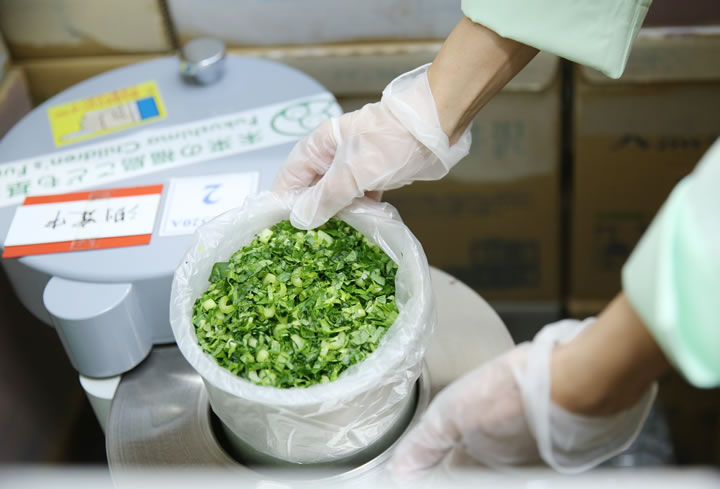
1. Radioactivity measurementFood, water, soil, building material
Nuclide measurement: Caesium 134, 137 · Strontium 90 · Tritium
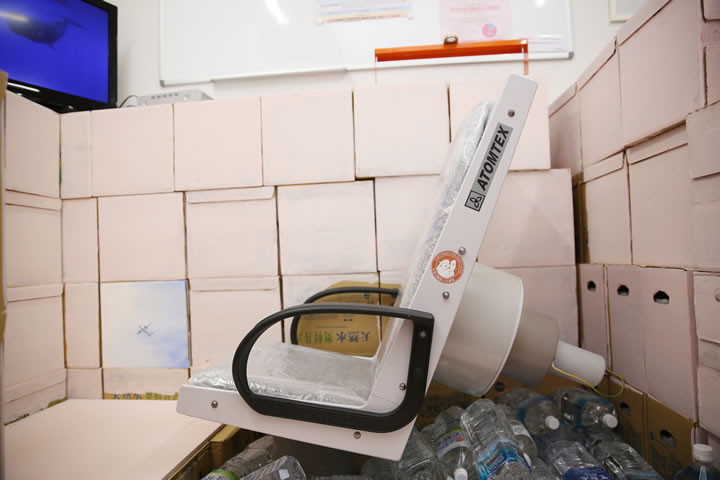
2. Human body radioactivity measurementNuclide measurement: Caesium 134, 137
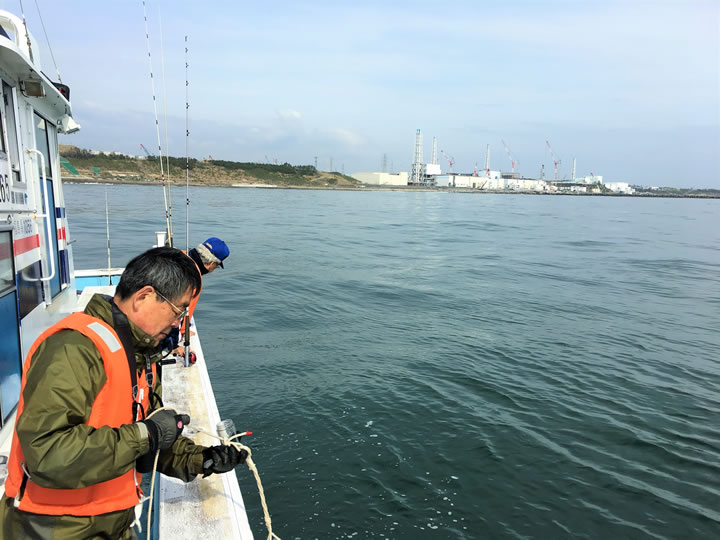
3. Oceanographic research projectImplementation of fixed point sampling and radiation measurements at 1.5 km off the TEPCO Fukushima Daiichi Nuclear Power Station coast
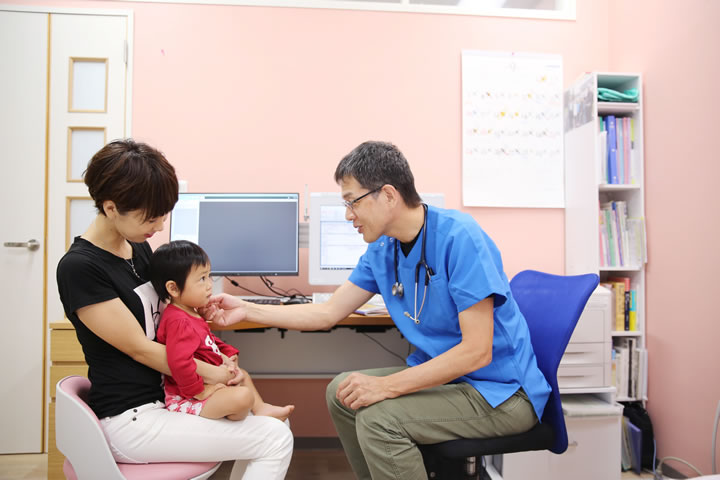
4. Tarachine ClinicPediatrics and Medicine
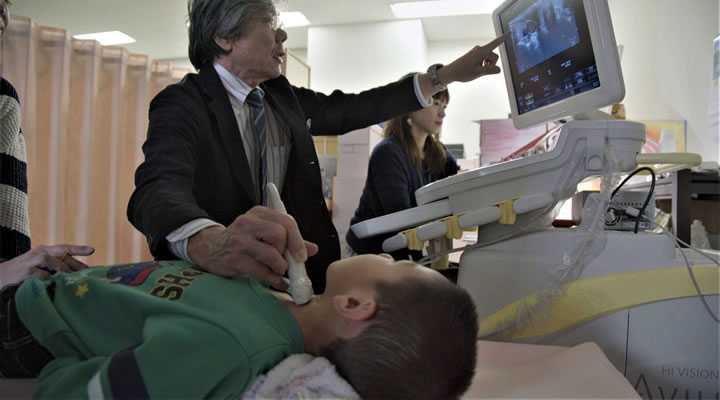
5. Thyroid Screening ProjectImplementation throughout the Fukushima Prefecture
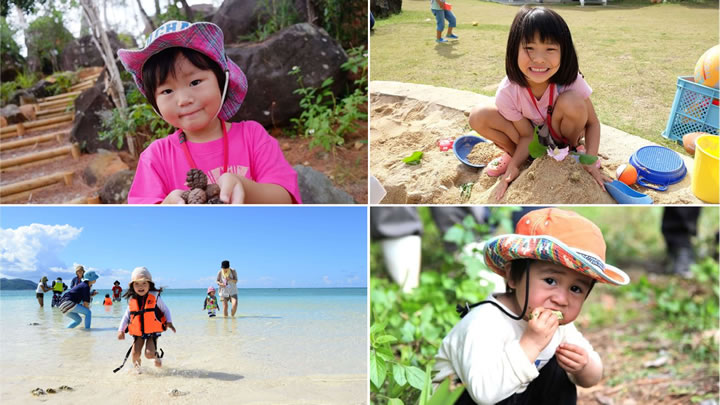
6. Children’s nature experience camping supportAdministrative support of activities to make the children of Fukushima experience the joys of nature
Cooperating associations: Okinawa – Kumi no Sato, others
7. Children’s wellbeingImplementation of relaxation massages and the “Power of play” project in the “Sir Pirika” therapy room
8. Hosting of lectures given by expertsInviting professional lecturers to hold events to deepen their learning together with local people
9. Activities in cooperation with volunteers of the Fukushima regionSupport of the volunteering activities of the mothers
Cooperating associations: Team “Team Mama Beku: group protecting the children’s environment”
Mothers’ Radiation Lab Fukushima is maintained by donations.
Korean distributors halt sales of instant noodles from Fukushima
Dec 5, 2018
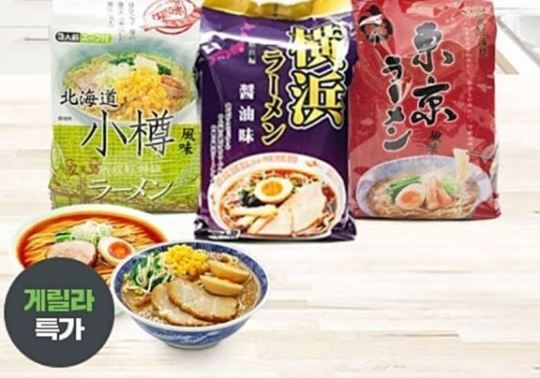
Korean retailers Homeplus and Wemakeprice have discontinued sales of Fukushima-imported instant noodles after the product’s place of origin label stirred up health concerns.
Otaru Shio Ramen — produced in Fukushima, Japan, and imported to Korea by Homeplus and Wemakeprice — has Fukushima printed as the area of production in Japanese. However, the Korean label specifies only Japan as the place of origin, prompting some consumers to point out that the translated label is misleading and takes away freedom of choice for those who do not know Japanese.
Some Koreans have reservations about products imported from Fukushima following a nuclear meltdown during the 2011 Tohoku earthquake.
Homeplus, which sold the product through its offline stores, said, “Otaru Shio Ramen is produced in Kitakata city factory, located over 100 kilometers from the area of the nuclear disaster. The product has no problems, as it has gone thorough radiation inspection.”
The company said the instant noodles do not cause health problems, but discontinued sales in response to concerns.
Wemakeprice, which sold Otaru Shio Ramen through its online channels, deleted the item from its website as of Tuesday night. It had sold just 10 packets before deleting the item.
The company said, “The product went through a radiation inspection before being imported, and no health-related problems were found. However, we decided to discontinue the product in response to consumers’ demands.”
Instant noodles imported from Fukushima unnerve consumers
December 6, 2018
WeMakePrice and Homeplus were found to have sold instant noodles produced in Japan’s Fukushima Prefecture, raising food safety concerns among consumers.
Fukushima is the northeastern part of Japan’s Honshu Island, contaminated by radioactivity following the explosions of reactors at the Fukushima Daiichi Nuclear Power Plant in 2011.
According to industry officials Wednesday, the two retailers had sold the made-in-Fukushima “Otaru Shio Ramen” until early this week.
But they decided to take the instant noodles off shelves as consumers discovered product information written in Japanese shows the manufacturer is located in Fukushima.
The product information written in Korean only says it was made in Japan.
After the revelation, angry consumers claimed the retailers tried to deceive those who cannot read Japanese.
“I hurriedly canceled my purchase before its delivery. I might have been a guinea pig,” said a consumer, who had bought the instant noodles from WeMakePrice.
The companies emphasized the safety of the product, but said they decided to stop selling it to reassure their customers.
“The instant noodles were produced at a factory in a Fukushima city of Kitakata, which is located over 100 kilometers from the contaminated region,” a Homeplus official said. “The product also underwent a radioactivity check before its import, and it was found to be safe.”
The discount chain also refuted criticisms that the retailers tried to deceive consumers.
“According to the Ministry of Food and Drug Safety’s guidelines, the product information does not need to include the specific place of origin. It just needs to include the country of origin,” the official said.
The government has banned the import of agricultural and marine products from Fukushima, but it still allows the import of processed foods from the prefecture, if their importers get certification.
Moreover, Korea may be brought to the World Trade Organization (WTO) if it prohibits the import of made-in-Fukushima foods without any scientific reason.
Japan is seeking to file a complaint with the WTO against Taiwan which held a referendum recently and decided to ban the import of agricultural products from Fukushima.
Korean consumers, however, demand the right to know the specific place of origin at least, if the government cannot ban the overall import of products from Fukushima.
Amid the growing concerns, they have begun filing online petitions on the Cheong Wa Dae website to urge the government to demand retailers specify the exact place of origin of food products.
Tohoku Electric Power Co. has decided to decommission the No. 1 reactor at the Onagawa nuclear power plant in Miyagi Prefecture.
December 5, 2018
Half of companies in the nuclear industry doubt the government’s goal of having nuclear power account for 20 to 22 percent of Japan’s energy supply by fiscal 2030, according to a survey.
The reasons for their skepticism relate mainly to difficulties restarting or building reactors under stricter safety measures taken after the Fukushima nuclear disaster in 2011.
The survey was conducted in June and July by the Japan Atomic Industrial Forum, whose members include electric power companies that operate nuclear plants.
The forum contacted 365 companies in the nuclear industry, such as equipment manufacturers, and received responses from 254, or 70 percent.
According to the results, 50 percent of the companies said the government’s nuclear energy goal for fiscal 2030 is “unachievable,” compared with only 10 percent that said it is “achievable.” Forty percent said the attainability is “unknown.”
An estimated 30 reactors must be operating to reach the target, but the resumption of reactor operations has been slow since all of them were shut down after the triple meltdown at the Fukushima No. 1 nuclear power plant.
“Only nine reactors were restarted in the more than seven years after the accident in Fukushima,” Akio Takahashi, president of the forum and former senior official at Tokyo Electric Power Co., said at a news conference. “I guess respondents think it’s difficult (to achieve the goal) given the current pace (of the restarts).”
Tougher nuclear safety standards were set after the Fukushima disaster, forcing utilities to spend more on upgrading their reactors or keeping aging units operational.
Asked why they thought the government’s nuclear goal was unrealistic, 48 percent of the companies said, “There are no plans in sight to build or replace nuclear reactors.”
Thirty-three percent cited the delays in restarting idle reactors, while 16 percent said, “No progress can be seen in regaining trust from the public.”
FUKUSHIMA – A former mayor of a city hit by the 2011 Fukushima nuclear crisis told a court on Wednesday that he wants to express his “anger” on behalf of citizens who had to flee their homes due to the disaster and whose lives are still filled with uncertainties.
Katsunobu Sakurai, who was mayor of Minamisoma at the time the crisis erupted, testified before the Fukushima District Court in a lawsuit filed by 151 people seeking ¥3.7 billion ($32.7 million) in damages from Tokyo Electric Power Company Holdings Inc. They say the nuclear accident destroyed their communities due to the evacuations.
Sakurai was chosen among U.S. Time magazine’s 100 most influential people in the world in 2011 after sharing the city’s predicament and calling for support via YouTube in the wake of one of the world’s worst nuclear disasters.
Following the accident, part of the city was designated as an evacuation zone where the 151 people, comprising 47 households, used to live. Most of the city is no longer subject to evacuation orders.
Sakurai said the city was forced to arrange evacuation buses on its own amid a lack of information from the central government, and that he “felt bitter and angry” after learning that the government helped arrange transportation for some other municipalities.
He also said the city’s residents are reluctant to return due to the slow progress of decommissioning the crippled Fukushima No. 1 nuclear power plant.
“They think they might have to evacuate again,” Sakurai said.
Sakurai had been the city’s mayor until losing his seat in an election in January.
The Minamisoma residents filed the damages suit in 2015 for their losses and changes to their hometown as a result of the nuclear accident, triggered by a major earthquake and tsunami on March 11, 2011.
While Fukushima suffered a blow, trade ties between Japan and Taiwan avoided any major impact.
On Friday, Japan and Taiwan signed off on five bilateral trade pacts just days after Taiwan voted in a referendum to uphold an import ban on agricultural products from areas surrounding the Fukushima nuclear fallout.
Last week, 7.8 million voters in Taiwan approved renewing a legally binding food ban that was originally imposed after the nuclear disaster in 2011. The ongoing agricultural ban covers five Japanese prefectures including Fukushima and nearby Gunma, Ibaraki, Tochigi, and Chiba over an extended two year period. Although the setback was expected to put a strain on bilateral relations, outright animosity has been diverted for now.
While there was no hiding the tension during two days of annual trade talks in Taipei, negotiations remained on cordial terms. In the absence of formal diplomatic representatives, leaders of the Taiwan-Japan Relations Association and Japan-Taiwan Exchange Association reached one agreement to speed up customs clearance on trade goods and four memorandums of understanding dealing with exchanges of patent information, business partnerships, medical equipment trade, and joint research.
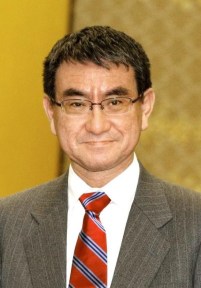
Japanese Foreign Minister Taro Kono described the referendum results as “extremely disappointing” based on government efforts to provide food safety information and its continuous requests to lift the ban. Critics pointed out that the issue of Fukushima food safety was addressed on the referendum without any scientific backing. Kono said he was planning to retaliate by taking into consideration all available options as a future response. One tactic included advancing the World Trade Organization dispute settlement route and pushing efforts to persuade public opinion in Taiwan based on scientific data.
Although Taiwan’s President Tsai Ing-wen has called for closer exchanges between the two countries, she also stressed the need to respect the referendum as the embodiment of public opinion. Taiwan Foreign Ministry spokesperson Andrew Lee also responded saying they will handle the issue “carefully” and seek understanding from the Japanese side.
Taiwan has also been seeking to sign a full free trade agreement with Japan, the island’s third largest trading partner, but momentum to accelerate negotiations has stalled since the referendum. Taiwan’s lack of support in dispelling misinformation based on scientific inspection fueled criticisms in Japan that the food ban referendum was politically motivated by anti-Japanese feelings.
However, Taiwan isn’t the only government to regulate Fukushima imports behind the backdrop of radiation concerns. China, South Korea, Singapore, and Macau are among the neighbors imposing partial seafood and farm produce restrictions to varying degrees. Fukushima Governor Masao Uchibori acknowledged how rumors and hearsay overseas were making it difficult to eliminate import embargoes, but said progress on the safety of prefectural products can be seen from the number of countries easing restrictions. The number of countries limiting imports from the area has dropped from an initial 54 to 25.
A major breakthrough signaling regional attitudes are loosening up came with China’s announcement that they will begin to relax import restrictions on rice from Japan’s west coast Niigata prefecture. China suspended imports of all animal feed, agriculture and fisheries products after the Fukushima nuclear disaster in 2011. But after scientific evaluation, described as examining wind direction and distance from the damaged Fukushima nuclear reactor, Chinese President Xi Jinping cancelled import restrictions on the condition that white and brown rice are processed at milling factories registered with the Chinese Customs Authority.
Prime Minister Shinzo Abe’s efforts to persuade Xi to lift restrictions at the bilateral summit in October have paid off, symbolizing a warming of political ties.
Niigata is one of Japan’s flagship regions for rice production and there is growing demand for the staple food in China, which consumes 20 times more rice than Japan and amounts to 30 percent of the world market. Seven years after the ban was first imposed, its abolition unlocks the potential to expand exports within a market of wealthy consumers eager for high end Japanese rice.
The South Koreans did not want their food and banned it. The WHO and the UN upheld that they would import food from Fukushima. One of the guiding factors was that the US imports the Fukushima food. How much deeper can corruption go when it is all about the economy?
“Fascism should not be defined by the number of victims but by the way they were killed”. Jean-Paul Sartre
Fukushima group holds food campaign in Brussels
December 3, 2018
BRUSSELS (Jiji Press) — People from Fukushima Prefecture living in Europe have started in earnest to campaign in Brussels to dispel concerns about foods from the northeastern prefecture following the 2011 nuclear crisis there.
The move by groups of Fukushima people in Britain and three other European countries, excluding Belgium, comes as the European Union maintains import restrictions on some Fukushima food products more than seven years after the meltdown at the tsunami-stricken Fukushima No. 1 nuclear power plant of Tokyo Electric Power Company Holdings Inc.
As part of the campaign, sake brands from across Fukushima were served to guests at an event to celebrate the Emperor’s 85th birthday on Dec. 23, held by the Japanese Embassy in Belgium in late November.
The Fukushima groups and the prefectural government ran a joint booth at the celebratory event, offering more than 10 local sake brands while showcasing progress on reconstruction in Fukushima after the March 2011 earthquake, tsunami and nuclear disaster.
The sake brands included Adatara Ginjo of Okunomatsu Sake Brewery Co., based in Nihonmatsu in the prefecture, which won the top sake award in the 2018 International Wine Challenge competition.
The Fukushima sake brands were well received by guests including foreign government and company officials, according to Japanese sources.
The groups of Fukushima people aim to strengthen direct lobbying of the EU to abolish the import restrictions, planning to set up a similar group in Belgium, where the EU is headquartered.
“We’ve renewed our recognition that it’s necessary to give information about postdisaster reconstruction more actively, while promoting sake and fruit [from Fukushima],” said Yoshio Mitsuyama, who heads the British group of Fukushima people
Beijing has lifted a ban on rice imports from Niigata prefecture, neighbouring the Fukushima disaster area, but consumers will take some convincing to buy it
The Chinese authorities may be ready to lift a ban on importing rice from a Japanese prefecture neighbouring a nuclear disaster site but Chinese consumers might need more convincing.
China’s General Administration of Customs announced on Wednesday that it had lifted a ban on rice imports from Niigata, one of a number of prefectures neighbouring Fukushima, home to the Daiichi Nuclear Power Plant, which went into meltdown and released radioactive material in the aftermath of a tsunami in March 2011.
According to the World Health Organisation, radioactive iodine and caesium in concentrations above the Japanese regulatory limits were detected in some food commodities soon after the disaster.
China responded by banning imports of food and livestock feed from 10 prefectures.
More than seven years later, Niigata is the first area to have the ban lifted on its rice. “After evaluation, we permit Niigata rice to be imported,” the customs administration said on its website.
It said the rice was produced in the prefecture and processed in registered factories, and that when imported it should satisfy Chinese laws and regulations on food safety and plant health.
But Chinese internet users weren’t so convinced.
“The officials would rather sacrifice Chinese people’s health for diplomacy,” one person said on Weibo, China’s Twitter-like platform.
“Whoever wants to buy the rice can buy it,” another wrote. “I only ask for it to be properly marked on the packaging.”
In all, 54 countries and regions imposed temporary import bans on Japanese food from affected areas immediately after the nuclear disaster. Since then, 27 have lifted their restrictions and Fukushima prefecture shipped 210 tonnes of agricultural products abroad last year, mainly to Malaysia and Thailand.
It follows a years-long clean-up effort and a concerted campaign by the Japanese government to promote agricultural products from Fukushima and neighbouring regions, both domestically and internationally.
A page on the Japanese government website, titled “Fukushima Foods: Safe and Delicious”, is dedicated to the clean-up and monitoring efforts and features photos of farmers encouraging tourists to try their rice, vegetables and fruit.
Hopes that the ban would be eased grew as relations between the two countries thawed. An agreement was reached in March to hold talks in Tokyo between Chinese Premier Li Keqiang and Japanese Prime Minister Shinzo Abe, after which Fukushima officials told the South China Morning Post they hoped Beijing would reopen the door to exports of agricultural and fisheries products. Those prospects rose in late October with the first visit to China by a Japanese prime minister in seven years.
There were grass-roots efforts, too. Last week, a group of Chinese reporters led by Xu Jingbo, from the Tokyo-based, Chinese-language Asia News Agency, quietly visited northeast Japan, stopping in disaster-hit areas including Fukushima.
Xu told the South China Morning Post he had organised the trip because he wanted there to be fair coverage of food safety and the Fukushima nuclear clean-up.
“We should look at the Fukushima nuclear leak in a scientific and fair way,” he said.
The group visited the power station and government centres that test radiation residues on agricultural products and seafood. He said that since the accident, the Japanese government had cleaned up debris and contaminated soil, digging 30cm into the earth and transporting the soil to a remote area for treatment.
“The radiation level tested on my body was only 0.03 millisieverts after the visit, about 1/80 of taking a CAT scan in hospital and about the same level as riding on an aeroplane,” Xu said.
But lingering fear and opposition in China and neighbouring regions remains strong. Last week, voters in Taiwan showed overwhelming support for keeping a ban on food imports.
On the Chinese mainland, every movement towards lifting the ban has provoked hostility online.
Xu’s Weibo account was flooded with comments, calling him a “traitor”. Some questioned whether he received money from the Japanese government for such “propaganda”.
An article published on the WeChat account Buyidao, operated by the state-run Global Times, questioned the Japanese government and media, saying they had covered up the severity of the radiation in Fukushima and dealt with the clean-up irresponsibly.
“Tokyo Electric Power [the owner of the plant] and the Japanese government have not been honest with the Japanese people and the world, the panic runs inside Japan and has permeated to other countries,” it said.
On the rice ban lifted this week, Guo Qiuju, a radiation expert at Peking University’s physics department, said the Chinese government had its own standard and detection methods.
“China has strict levels on radiation levels detected in foods; if it’s detected below a certain level, it can be assumed to be safe,” she said.
But public concerns persist.
A shopper at Alibaba’s Hema Xiansheng supermarket in Shenzhen she said she probably would not buy any products from the affected areas even if the ban was completely lifted. Alibaba owns the South China Morning Post.
“I’m afraid of what might happen to me,” she said.
Plainly criminal. Taking advantage of the unknowing American public and at the same time using such sales as propaganda in Japan telling to the Japanese public that it is safe, look even the Americans buy it.
December 2, 2018
The Fukushima government has opened a sake shop in New York specializing in brews from the prefecture.
The shop opened its doors on Saturday inside a commercial facility in Manhattan. Officials from the prefecture and the facility celebrated the occasion.
Sake sales are booming in the United States. Exports to the US have increased 50 percent in the past 10 years.
Sakes brewed in Fukushima Prefecture have performed well in competitions. The shop offers 50 brands from 11 breweries.
One customer said he’s tasted Japanese sake several times before, but none were as good as the one he tried in the shop. He said he would like to visit Fukushima someday.
A Fukushima tourism official said breweries in the prefecture are having a hard time finding buyers since the 2011 disaster. He said he hopes the shop will boost the image of Fukushima’s sakes worldwide.
After the accident occurred at the Tokyo Electric Power Company’s Fukushima Daiichi Nuclear Power Plant, the Fukushima Health Management Survey (FHMS) was initiated. The FHMS consists of a basic survey and four detailed surveys: a thyroid ultrasound examination, a comprehensive health check, a mental health and lifestyle survey, and a pregnancy and birth survey. In this article, we briefly summarized whether an association exists between radiation exposure and the observation of thyroid cancer cases according to the results of the first-round thyroid examination in the FMHS. Regarding this issue, Tsuda and his colleagues showed an association using an internal comparison (odds ratio (OR)=2.6, 95% confidence interval (CI): 0.99-7.0) and an external comparison (incidence rate ratio =50, 95% CI : 25-90). However, for this internal comparison, Ohira and his colleagues used two ways of objective classifications of districts in Fukushima; (1) the group of municipalities of which proportion of the exposed external dose level of more than 5 mSv was higher than or equal to 1% (≧1% of 5 mSv), the group of municipalities of which proportion of the exposed external dose level less than 1 mSv was higher than or equal to 99.9% (≧99.9% of 1m Sv<99%), and others, and (2) the location groups applied by WHO. For the classification (1), they obtained OR=1.49 (95% CI : 0.36-6.23) from the highest group to the lowest, which was similar to the results of the classification (2). For the external comparison, Takahashi and his colleagues developed a cancer-progression model with several sensitivities under non-accident conditions, and showed 116 cases were possible to observe in Fukushima under non-accident conditions. Katanoda and his colleagues found an observed/expected ratio of 30.8 (95%CI: 26.2-35.9) of the prevalence of thyroid cancer among residents aged ≦ 20years (160.1 observed of cases and 50.2 expected cases), and a cumulative number of thyroid cancer deaths in Fukushima Prefecture of 0.6 under age 40 with the same method. This large disparity implied the possibility of over-diagnosis in thyroid examinations.
A researcher reported the results were unlikely to be explained by a screening effect, which implied the association between thyroid cancer cases and external radiation exposure. However, subsequently, a possibility that it might be a result of over-diagnosis of the thyroid examinations was pointed. And, no significant associations were found by applying objective classification of districts and by raising comparability with the incidence data of whole Japan, respectively. In the Basic Survey of FHMS, only individual external doses in the first four months after the accident has been observed. So neither external dose after the four months nor internal dose was applied in these studies. Further studies are necessary to clarify the existence of the association by applying the estimation of individual overall thyroid dose.
References (23)
[1] Fukushima Prefectural Governmental. The Basic Survey. http://fmu-global.jp/download/basic-survey-19/?wpdmdl=2585 (accessed 2018-02-01)
[2] Akahane K, Yonai S, Fukuda S, et al. NIRS external dose estimation system for Fukushima residents after the Fukushima Dai-ichi NPP accident. Sci Rep. 2013;3:1670. doi: 10.1038/srep01670.
[3] Thyroid Ultrasound Examination (Preliminary Baseline Screening). Supplemental Report of the FY 2016 Survey. http://fmu-global.jp/download/thyroid-ultrasound-examination-supplemental-report-of-the-fy-2016-surveypreliminary-baseline-screening/?wpdmdl=2690 (accessed 2018-02-01)
[4] Yasumura S, Hosoya M, Yamashita S. Study protocol for the Fukushima Health Management Survey. J Epidemiol. 2012;22(5):375-383.
[5] Shimura H, Sobue T, Takahashi H, et al. Findings of thyroid ultrasound examination within three years after the Fukushima Nuclear Power Plant accident: The Fukushima Health Management Survey. J Clin Endocrinol Metab. 2017 Dec 14. doi: 10.1210/jc.2017-01603.
[6] Tsuda T, Tokinobu A, Yamamoto E, et al. Thyroid cancer detection by ultrasound among residents ages 18 years and younger in Fukushima, Japan: 2011 to 2014. Epidemiology. 2016;27(3): 316-322.
[7] Katanoda K, Kamo K, Tsugane S. Quantification of the increase in thyroid cancer prevalence in Fukushima after the nuclear disaster in 2011-a potential overdiagnosis? Jpn J Clin Oncol. 2016;46(3):284-286.
[8] Ohira, T, Takahashi H, Yasumura S, et al. Comparison of childhood thyroid cancer prevalence among 3 areas based on external radiation dose after the Fukushima Daiichi nuclear power plant accident. Medicine (Baltimore). 2016;95(35):e4472. https://www.ncbi.nlm.nih.gov/pmc/articles/PMC5008539/pdf/medi-95-e4472.pdf (accessed 2018-02-01)
[9] World Health Organization Health risk assessment from the nuclear accident after the 2011 Great East Japan Earthquake and Tsunami based on a preliminary dose estimation. Geneva: WHO; 2013. p.38-43.
[10] Takahashi H, Takahashi K, Shimura H, et al. Simulation of expected childhood and adolescent thyroid cancer cases in Japan using a cancer-progression model based on the National Cancer Registry: Application to the first-round thyroid examination of the Fukushima Health Management Survey. Medicine (Baltimore). 2017;96(48):e8631. https://www.ncbi.nlm.nih.gov/pmc/articles/PMC5728738/pdf/medi-96-e8631.pdf (accessed 2018-02-01).
[11] Davis, S. Commentary: Screening for Thyroid cancer after the Fukushima Disaster: What do we learn from such an effort? Epidemiology. 2016;27(3):323-325.
[12] Jorgensen TJ. Re: Thyroid cancer among young people in Fukushima. Epidemiology. 2016; 27:e17.
[13] Korblein A. Re: Thyroid cancer among young people in Fukushima. Epidemiology. 2016; 27:e18-19.
[14] Shibata Y. Re: Thyroid cancer among young people in Fukushima. Epidemiology. 2016;27:e19-20.
[15] Suzuki S. Re: Thyroid cancer among young people in Fukushima. Epidemiology. 2016;27:e19.
[16] Takahashi H, Ohira T, Yasumura S, et al. Re: Thyroid cancer among young people in Fukushima. Epidemiology. 2016;27:e21.
[17[ Takamura N. Re: Thyroid cancer among young people in Fukushima. Epidemiology. 2016;27:e18.
[18] Wakeford R, Auvinen A, Gent RN, et al. Re: Thyroid cancer among young people in Fukushima. Epidemiology. 2016;27:e20-21.
[19] Ochi S, Kato S, Tsubokura M, et al. Voice from Fukushima: responsibility of epidemiologists to avoid irrational stigmatisation on children in Fukushima. Thyroid. 2016;26:1332-1333.
[20] Rothman KJ, Greenland S, Lash TL. Modern Epidemiology. 3rd ed. Philadelphia; Lippincott Williams & Wilkins; 2008. p.47-48.
[21] Heidenreich WF, Kenigsberg J, Jacob P, et al. Time trends of thyroid cancer incidence in Belarus after the Chernobyl accident. Radiat Res. 1999;151:617-625.
[22] Jacob P, Bogdanova TI, Buglova E, et al. Thyroid cancer risk in areas of Ukraine and Belarus affected by the Chernobyl accident. Radiat Res. 2006;165:1-8.
[23] Ahn HS, Kim HJ, Welch HG. Korea’s thyroid-cancer “epidemic”-screening and overdiagnosis. N Engl J Med. 2014;371:1765-1767.
Japan may take Taiwan’s import ban on food products from Fukushima and other prefectures affected by the 2011 nuclear disaster to the World Trade Organization, Foreign Minister Taro Kono said Sunday.
“It goes against the WTO’s quarantine-related agreement,” Kono said, referring to Taiwan’s ban on products from Fukushima, Ibaraki, Gunma, Tochigi and Chiba prefectures.
Taiwan voted to maintain the ban in a legally binding referendum on Nov. 25. Taiwanese Foreign Ministry spokesman Andrew Lee said the ministry respected public opinion on the issue and will explain to Japan the safety concerns of the Taiwanese public.
At the WTO, “there is a procedure that allows (a member state) to file a complaint. If necessary, we need to act,” Kono told a meeting of the ruling Liberal Democratic Party in Morioka, Iwate Prefecture.
“The WTO sets clear rules that (import bans) should be decided based on scientific foundations,” he said.
Following the nuclear disaster at the Fukushima No. 1 nuclear plant, triggered by the massive earthquake and tsunami on March 11, 2011, the prefectural government has sought to ease consumer concern about the safety of farm and fishery products through radiation checks.
Since 2015, all shipments of rice from Fukushima have cleared the screening, with radioactive cesium levels below the 100 becquerel per kilogram limit set by the Japanese government for agricultural, forestry and fishery products. No samples of vegetables and fruit from Fukushima have exceeded the legal limit in inspections since April 2013, and no fishery products have since 2015.
The Japanese chamber in Taiwan, with 471 member companies, has also called on the Taiwanese government to re-examine the ban based on scientific evidence.
As of August, the Taiwanese government has inspected over 125,000 samples of imported food products from Japan since March 15, 2011, with none exceeding the island’s legal limits for radiation, according to the Japanese chamber.
Japan is Taiwan’s third-largest trading partner, while Taiwan is Japan’s fourth-largest trading partner.
A UN Special Rapporteur who last August joined two colleagues in sounding an urgent alarm about the plight of Fukushima workers, has now roundly criticized the Japanese government for returning citizens to the Fukushima region under exposure levels 20 times higher than considered “acceptable” under international standards.
He urged the Japanese government to “halt the ongoing relocation of evacuees who are children and women of reproductive age to areas of Fukushima where radiation levels remain higher than what was considered safe or healthy before the nuclear disaster seven years ago.”
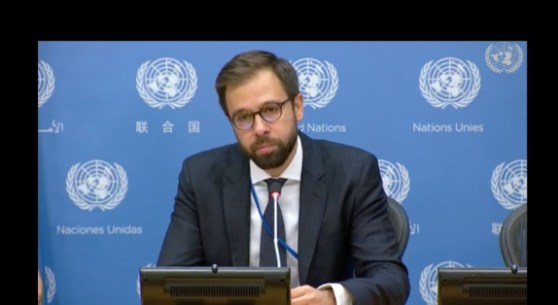
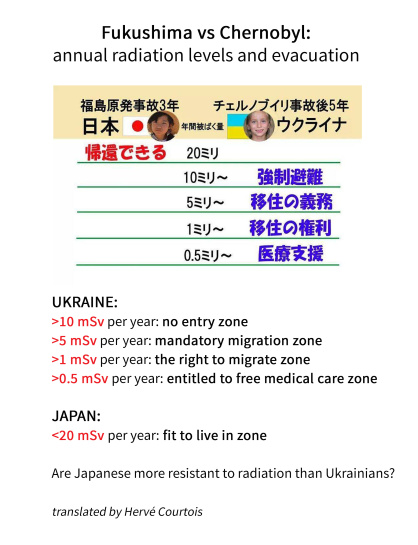
Baskut Tuncak, (pictured at top) UN Special Rapporteur on hazardous substances and wastes, noted during a October 25, 2018 presentation at the UN in New York, as well at a press conference, that the Japan Government was compelling Fukushima evacuees to return to areas where “the level of acceptable exposure to radiation was raised from 1 to 20 mSv/yr, with potentially grave impacts on the rights of young children returning to or born in contaminated areas.”
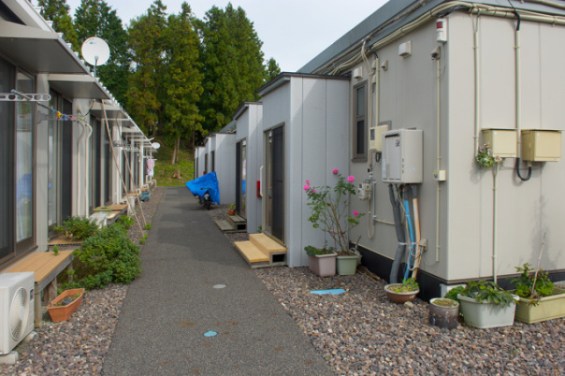
Typical housing for evacuees. 20 m2 prefab cabins, evacuation site, Miharu, Fukushima, 46 km north west of Fukushima-Daichi Nuclear Power Plant. (Photo: Lis Fields.)
He described exposure to toxic substances in general as “a particularly vicious form of exploitation.”
In August, Tuncak, along with Urmila Bhoola and Dainius Puras, expressed deep concern about the Fukushima “cleanup” workers, who include migrants, asylum seekers and the homeless. They feared “possible exploitation by deception regarding the risks of exposure to radiation, possible coercion into accepting hazardous working conditions because of economic hardships, and the adequacy of training and protective measures.
We are equally concerned about the impact that exposure to radiation may have on their physical and mental health.”
Now, Tuncak is urging Japan to return to the 1 millisievert a year allowable radiation exposure levels in place before the 2011 Fukushima Daiichi disaster.
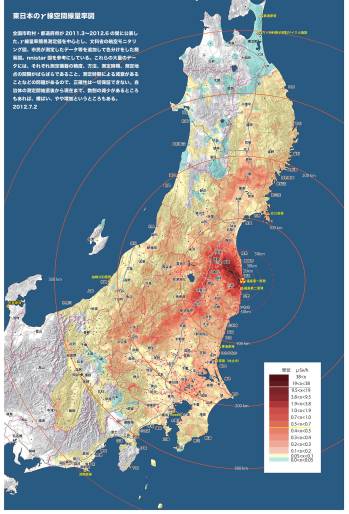
2011 map showing wide deposition of radioactive materials from Fukushima Daiichi nuclear power plant. (Courtesy 20 Millisieverts A Year. https://lisfields.org/20msvyear/)
In a revealing response to Tuncak’s presentation at the UN, the delegate from Japan claimed that 20 msv “is in conformity with the recommendation given in 2007 by the International Commission on Radiological Protection.” He also claimed that Tuncak’s press release would cause people in Fukushima to suffer “an inaccurate negative reputation” that was “further aggravating their suffering,” and that the government and people of Japan were “making effort with a view to dissipating this negative reputation and restoring life back to normal.”
This view is deeply characteristic of the Abe government which is desperately attempting to “normalize” radiation among the population to create a public veneer that everything is as it was. This is motivated at least in part by an effort to dissipate fears about radiation exposure levels that will still be present during the 2020 Summer Olympics there, with events held not only in Tokyo but also in the Fukushima prefecture.
However, Tuncak corrected the delegate’s information, responding that:
“In 2007, the ICRP recommended deployment of “the justification principle. And one of the requests I would make for the Japanese government is to rigorously apply that principle in the case of Fukushima in terms of exposure levels, particularly by children, as well as women of reproductive age to ensure that no unnecessary radiation exposure and accompanying health risk is resulting.” Tuncak said Japan should “expeditiously implement that recommendation.”
He also reminded the delegate that “the Universal Periodic Review of the Human Rights Council last year, did issue a recommendation to lower the acceptable level of radiation back down from 20 millisieverts per year to one millisievert per year. And the concerns articulated in the press release today were concerns that the pace at which that recommendation is being implemented is far too slow, and perhaps not at all.”
During the press conference Tuncak noted that Japan is a party to the UN Convention on the Rights of the Child and that forcing evacuees back into areas contaminated to 20 mSv/yr was against the standards contained in that Convention. “We are quite concerned in particular for the health and well-being of children who may be raised or born in Fukushima,” he said.
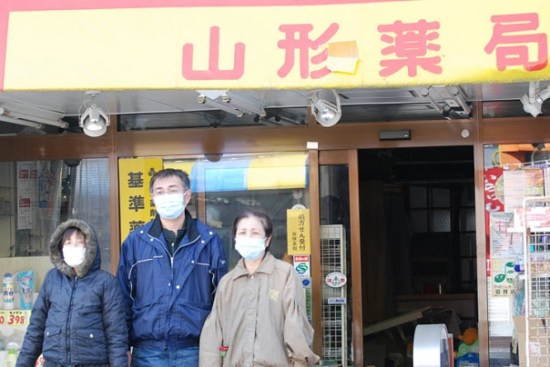
The Yamagata family in front of their quake-damaged pharmacy in Namie, Fukushima Prefecture, Japan April 12 2011 (VOA – S. L. Herman)
Earlier, Japan had sounded tacit agreement to reducing allowable exposure levels back down from 20 mSv/yr to 1 mSv/yr. But few believed they would carry this out given that it is virtually impossible to clean up severely contaminated areas in the Fukushima region back to those levels.
Bruno Chareyron, the director of the CRIIRAD lab (Commission de Recherche et d’Information Indépendentes sur la RADioactivité), noted in an August 17, 2018 Truthout article that:
“It is important to understand that the Fukushima disaster is actually an ongoing disaster. The radioactive particles deposited on the ground in March 2011 are still there, and in Japan, millions of people are living on territories that received significant contamination.”
Of the cleanup process, Chareyron told Truthout: “The ground and most contaminated tree leaves are removed only in the immediate vicinity of the houses, but a comprehensive decontamination is impossible.” He said in the article that the powerful gamma rays emitted by Cesium 137 could travel dozens of meters in the air. Therefore, the contaminated soil and trees located around the houses, which have not been removed, are still irradiating the inhabitants.
While the UN delegate from Japan claimed that no one was being forced to return and the decision rested with the evacuees alone, Tuncak expressed concern about coercion. “The gradual lifting of evacuation orders has created enormous strains on people whose lives have already been affected by the worst nuclear disaster of this century. Many feel they are being forced to return to areas that are unsafe, including those with radiation levels above what the Government previously considered safe.”
Recalling his efforts to protect Fukushima workers, Tuncak observed the irony that Japan had admitted that the death of a Fukushima worker from lung cancer was directly related to exposure to radiation at the stricken plant and “quite interestingly, the level of radiation that he was exposed to in the past five years was below the international community’s recommendation for acceptable exposure to radiation by workers.”
Tuncak’s report did not focus solely on Fukushima. It also included exploitation and abuse of Roma people, South Koreans exposed to a toxic commercial product and air pollution in London. During his UN presentation, he observed that “over two million workers die every year from occupational diseases, nearly one million from toxic exposures alone. Approximately 20 workers will have died, prematurely, from such exposures at work by the time I finish my opening remarks to you.”
Before addressing the plight of Fukushima evacuees, he pointed out how “exposure to toxic pollution is now estimated to be the largest source or premature death in the developing world, killing more people than HIV AIDS, tuberculosis, and malaria combined.” While noting that this problem exists to a greater or lesser degree the world over, he added that “pediatricians today describe children as born ‘pre-polluted,’ exposed to a cocktail of unquestionably toxic substances many of which have no safe levels of exposure.”
Japan’s decision to ignore pleas to halt repatriation of evacuees into high radiation exposure levels usually deemed unavoidable (but not safe) for nuclear workers, not ordinary citizens, will now tragically contribute to these numbers.
Mr. Baskut Tuncak is Special Rapporteur on the implications for human rights of the environmentally sound management and disposal of hazardous substances and wastes. As a Special Rapporteur, he is part of what is known as the Special Procedures of the Human Rights Council. Special Procedures, the largest body of independent experts in the UN Human Rights system, is the general name of the Council’s independent fact-finding and monitoring mechanisms that address either specific country situations or thematic issues in all parts of the world.







 nuclear-news