Mapped: Who’s building nuclear SMRs?
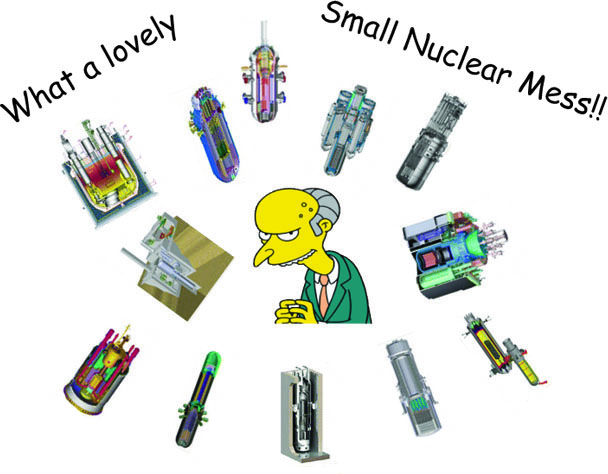
none of the new generation of land-based SMR plants in the western world have yet made it from the drawing board to become a commercial reality.
Neil Gerrard, Senior Editor, Construction Briefing, 12 October 2026
One of the big challenges of the data centre boom is how to power all those electricity-hungry computing facilities.
One possible answer is small modular nuclear reactors (SMRs). The concept of nuclear plants that can be built cheaply and safety with a repeatable, modular design, has held promise for years.
But none of the new generation of land-based SMR plants in the western world have yet made it from the drawing board to become a commercial reality.
However, some SMR projects are now starting to get off the ground and could provide a major new source of construction work in the coming years if ambition survives reality.
That is why there has been a flurry of news stories about SMRs recently, from Rolls-Royce SMR launching a new supplier programme for £1.4 billion worth of contracts as it prepares to build three reactors in the UK, to Samsung C&T, GE Vernova Hitachi, and Studsvik teaming up to advance a 1.2GW power project in Sweden.
Keeping track of who plans to build what, where, when and with whom is becoming an increasingly bewildering exercise.
That’s why the Construction Briefing team has put together a map and article that track exactly that.
The global pipeline of SMRs ranges from licensed projects to preliminary agreements. To complicate matters further, several programmes have already changed direction, stalled, or hit the buffers completely.
Projects in Canada, China and the US have progressed into construction or commissioning. Elsewhere, developers have secured customers and engineering contracts but still face decisions on financing, licensing and construction.
Our tracker looks at the different nascent SMR technologies out there and charts how far advanced projects involving those reactors are.
Although SMRs are typically defined as reactors with a rated electrical power of 300 MWe or less, it also includes larger modular designs marketed alongside SMRs, such as Rolls-Royce’s reactor (470 MWe) and TerraPower’s sodium-cooled Natrium reactor (345-500 MWe).
The global pipeline of SMRs ranges from licensed projects to preliminary agreements. To complicate matters further, several programmes have already changed direction, stalled, or hit the buffers completely.
Projects in Canada, China and the US have progressed into construction or commissioning. Elsewhere, developers have secured customers and engineering contracts but still face decisions on financing, licensing and construction.
Our tracker looks at the different nascent SMR technologies out there and charts how far advanced projects involving those reactors are.
Although SMRs are typically defined as reactors with a rated electrical power of 300 MWe or less, it also includes larger modular designs marketed alongside SMRs, such as Rolls-Royce’s reactor (470 MWe) and TerraPower’s sodium-cooled Natrium reactor (345-500 MWe)…………………………………………………………………………………………………………………………………………………………………………………………………………………………………………………………………………………. https://www.constructionbriefing.com/news/mapped-whos-building-nuclear-smrs/8133242.article
“No economic case:” Global experts say nuclear has role in some countries, but makes no sense in Australia

Giles Parkinson, Oct 12, 2026, https://reneweconomy.com.au/no-economic-case-global-experts-say-nuclear-has-role-in-some-countries-but-makes-no-sense-in-australia/
As Australia’s ultra conservative political parties embark on a headlong race towards nuclear and away from renewables, a major new report by global experts says nuclear has a role in some countries, but makes no sense and will only cause delays and increased costs in Australia.
The new report from the Energy Transitions Commission, a think-tank comprising dozens of energy experts around the world, including those in the nuclear industry, says nuclear capacity could double over the next three decades or so, but it will stay play a relatively minor role in the overall transition away from fossil fuels.
And, they point out in the report – “The Role of Nuclear in the Energy Transition: Complementary but Limited” – it will only make sense in a few countries – a situation the report suggests will not be greatly changed by the hype and interest generated by AI and the push for massive energy-hungry data centres around the world.
For countries like Australia, rich in lower cost renewable resources like wind and solar, the report says nuclear makes no economic sense at all, and trying to build a system around them will simply lead to delays and increased costs.
“In these countries, which include most of Africa, and much of Latin America and Australia, renewables (particularly solar) and batteries will provide the fastest and cheapest option for scaling electricity supply at suitable increments to align with financing availability and system needs,” the report says.
“In these markets, investing in nuclear concentrates scarce capital in a small number of centralised projects, committed roughly a decade before operations, during which the power system could change substantially.
“Developing nuclear would deliver no total system cost benefit, and would require a reliance on foreign nuclear supply chains, which would reduce energy security. Pursuing nuclear programmes in these countries would divert resources from cheaper alternatives, and nuclear shares should remain close to 0%.”
These conclusions, of course, are well understood by the energy industry in Australia, from the Australian Energy Market Operator, the CSIRO, policy makers and regulators, the network operators, the renewables industry and the major utilities who currently burn coal and gas for a living.
But the global fossil fuel and climate denial industry still has its tentacles around the conservative parties in Australia – particularly One Nation and its less popular sidekicks in the Liberals and Nationals – all of whom are determined to slow or even stop the renewable transition in Australia, legalise nuclear and have the government invest countless billions into the tech.
The Energy Transitions Commission highlights the folly of such an approach, and the report would make sobering reading for those politicians, assuming they would be bothered to read it.
Like the World Nuclear Status report released more than a week ago, it punctures a major hole in the nuclear hype, including the assumption that small modular reactors (SMR) will somehow change the game.
- “Small modular reactors remain 1-2 decades away from wide deployment, despite attracting large investment and political attention amid surging AI-driven power demand,” the report notes.
“Early US cost estimates range from ~$US140–$US270 per MWh, well above the large reactor cost range of $US40–$US190 per MWh. Similar reactor designs can cost 4–9 times more to build in the US and Europe than in China and South Korea – financing costs are key factor.”
The report also notes that depending on nuclear power would intensify supply chain risks, rather than easing them. Russia, it notes, controls 40% of global uranium enrichment capacity in 2025, and key nuclear equipment manufacturing is concentrated in just six countries.
“Nuclear supply chain concentration poses the greatest risk, rather than safety and waste management,” the report says.
The report looks at the recent commitment to treble nuclear capacity across the globe by 2050 to around 1,500 gigawatts of capacity. This it says, would require around 500 GW of nuclear extensions (although that itself might be too optimistic), and it struggles to see how 1,000 GW of new capacity could be built.
It says that would require a six-fold increase in contraction compared to recent years. And even if it was delivered, it wouldn’t reduce the need for new wind and solar, which would still have to be built at a rate of 1,500 GW each year, rather than over the next 25 years.
“While this contribution to the energy transition is useful in targeted countries, even this scale of nuclear buildout would be dwarfed by the required scale of investment in renewables to transition to low-carbon energy systems,” the report says.
“An investment of $200 billion per year in new nuclear build is likely to be less than 10% of the $2,200 billion per year needed in renewables, grids and storage.”
The report is at pains to note that nuclear technology may make sense in some countries, those with limited renewable resources and also those with billions already invested in the nuclear industry, including those with nuclear weapons.
More importantly, nuclear’s system value is highest where land is scarce and solar and windresources are weakest
Ukraine’s worst diplomatic nightmare just got closer
The fuel deal’s real significance lies in diplomacy: Trump and Putin found a way to work together without making Ukraine part of the bargainPublished 11 Oct, 2026 12:36 | Updated 11 Oct, 2026 13:40
11 Oct, 2026 , By Sergey Poletaev, information analyst and publicist, co-founder and editor of the Vatfor project, https://rt-english.com/russia/647043-ukraine-diplomacy-trump-putin/
On the evening of October 9, the presidents of the United States and Russia spoke by phone. The announcement that followed was straightforward: Russia would sell the US 1.8 million metric tons of diesel over the next three months, followed by a million tons a month, and the US would issue temporary licenses authorizing the shipments.
The news drew a furious, bordering on hysterical, response from Kiev and stunned silence from Europe.
Let’s look at why this deal matters, what it has to do with Ukraine, and what might come next.
The tug-of-war championship
Ever since US President Donald Trump returned to office, the central aim of Russian diplomacy has been to separate relations with the US from the Ukraine issue. The White House is open to the idea, too: The US needs Russia as a counterweight to China, and there are substantial economic opportunities. But as we explored in an earlier piece, until recently, neither side managed to pull it off.
Ukraine and its supporters in Europe and the US, meanwhile, have pursued the opposite goal: keeping US-Russia relations tied to the Ukraine conflict.
In February and March 2025, Trump relieved America of responsibility for Ukraine’s fate and handed the job of financing it squarely to Europe. The US retained just three commitments: the relatively modest military supply programs already approved under former President Joe Biden, intelligence sharing, and weapons sales for cash, with Ukraine waiting in line like any other customer.
This maneuver cemented a status quo that neither Europe and Ukraine on one side nor Russia on the other would allow to change, with their respective allies in the US also weighing in. Everyone tried to bring Trump over to their side on Ukraine. Nobody succeeded.
This is why the understandings reached in Anchorage went nowhere: Ukraine’s supporters torpedoed them. It is also why those supporters failed to use Trump to escalate the conflict. Russia prevented deliveries of Tomahawk missiles, the expansion of Starlink coverage over Russian territory, and so on.
Despite the apparent stalemate, Russian officials kept talking to Witkoff and Kushner. The aim was to maintain a channel to Trump and deny Ukraine’s supporters an opening to drag the US back into the war on their side or steer him back onto Biden’s course.
This is why Russian officials at every level distinguish between US and European actions, often explicitly contrasting the two.
A few numbers on oil
Russia is one of the world’s largest diesel exporters, supplying just under 40 million metric tons to the global market in 2025. On July 8, 2026, Ukrainian attacks on Russian refineries prompted a temporary ban on diesel and gasoline exports.
Since then, Russia’s refining situation has improved considerably. Gasoline remains in short supply, but a domestic diesel surplus has emerged, and the export ban has begun to loosen in practice. According to Reuters, diesel deliveries to Central Asian countries were already up 19% in September.
A few numbers on oil
Russia is one of the world’s largest diesel exporters, supplying just under 40 million metric tons to the global market in 2025. On July 8, 2026, Ukrainian attacks on Russian refineries prompted a temporary ban on diesel and gasoline exports.
Since then, Russia’s refining situation has improved considerably. Gasoline remains in short supply, but a domestic diesel surplus has emerged, and the export ban has begun to loosen in practice. According to Reuters, diesel deliveries to Central Asian countries were already up 19% in September.
The Krivoy Rog school of diplomacy
Back to geopolitics. Until yesterday, Russia had been unable to separate its relationship with the US from the Ukraine issue. Even the war with Iran failed to do the trick, despite keeping oil and petroleum product shipments from the Persian Gulf blocked for more than six months.
Help came from an unexpected quarter. Hoping to bring US diesel prices down at least a little before the congressional elections, Trump asked Zelensky to stop attacking Russian refineries.
Zelensky responded by demanding a sweeping energy truce. We’ll stop hitting refineries, he effectively said, if Russia stops attacking our energy infrastructure and blockading our ports. And you, Trump, have to supply us with missiles for our Patriot systems, and so on.
Getting nowhere with Zelensky, Trump struck a deal directly with Russian President Vladimir Putin, who offered to supply diesel in exchange for a suspension of sanctions, without any preconditions.
The transaction itself is not particularly consequential. Yes, it could cool speculative trading ahead of the elections and push prices down somewhat. But the 1.8 million metric tons due to arrive over three months will cover just three or four days of American consumption.
For Russia, the US is an ordinary customer in purely commercial terms. Moscow will make some money selling to America, but it could just as easily have sold these volumes elsewhere. Petroleum products are in short supply worldwide, while Russia has a diesel surplus.
Yet the deal gave both sides what they had been seeking since February 2025: a bilateral relationship detached from Ukraine. So far, that applies to just one specific issue, but getting started is the hard part. Zelensky tried to twist Trump’s arm, pushing him to make Putin stop bombing Kiev, and overplayed his hand. Now Kiev can be bombed relentlessly, and Trump has no reason to care. He got what he wanted.
This does not mean sanctions are finished or that the two powers are entering an era of warm friendship. Oil sanctions are probably here to stay, and as soon as global market conditions change, Washington will turn them back up to full blast. But the sanctions wall can now be taken apart brick by brick, restoring ties wherever both sides stand to gain: launching new energy projects in the Arctic, for example, jointly taking over the surviving Nord Stream 2 pipeline, or resolving the sale of Lukoil’s overseas assets. Ukraine no longer has anything to do with that process or any influence over it.
The art of the backroom deal
Cynics insist that the Trump administration is a complete mess, with the right hand oblivious to what the left is doing. The way this agreement came together suggests otherwise.
After the campaign of long-range strikes against Russia went badly off script, Zelensky once again tried to secure a ceasefire through Trump. He has been trying since early 2025, with no success, but he still held out hope.
Trump could have publicly given Zelensky the boot again. But on Ukraine, he faces opposition not only from Congress but also from parts of his own administration. And an election is just around the corner.
Instead of staging a public showdown, Trump’s team spent more than two months visibly engaged in intensive talks with Ukraine about an energy truce. His envoys, Witkoff and Kushner, traveled to Kiev, and Trump himself showered Zelensky with compliments. In reality, all of it proved to be a screen for a quiet, swift, informal deal with Moscow.
It has since emerged that the first tanker carrying diesel to the US left St. Petersburg on September 22 and is expected to reach the US any day now. In other words, the deal was already well advanced three weeks ago, and both sides were confident it would go through.
That takes some skill. This episode shows that Trump keeps a firm grip on his team and can prevent leaks when he needs to. Even Rubio, prone to breaking ranks, played his part exactly as the boss wanted.
And once the deal was done, there was no longer any need to smile at Zelensky in public. The masks came off. For the first time, Trump publicly declared that Ukraine needs a new president and must hold elections.
The liberal media will inevitably say that Trump is repeating Russian propaganda narratives. In fact, he was saying what he thinks.
The diesel deal does not mean Moscow and Washington will now live in perfect harmony. The differences between them are deep and fundamental, and the recently enacted ‘Graham law’ makes lifting any sanctions impossible for at least the next five years.
But this Friday, Putin and Trump finally managed to get past Ukraine and leave it behind. US-Russia relations now depend on Russia and the US alone.
Not Now, VOYGR
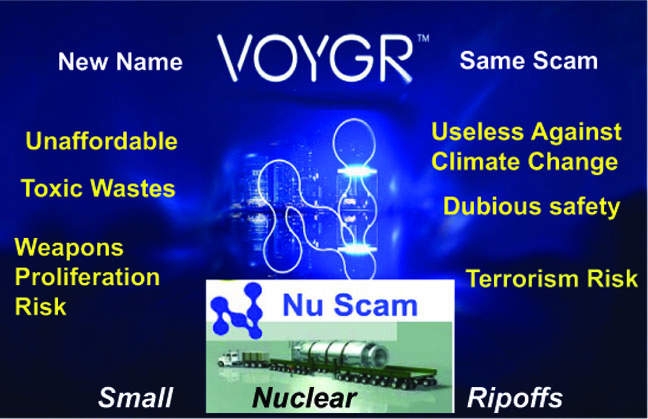
Further, while the company posted $75,000 in revenue for a single quarter in 2026, its expenses for that same time period were more than $64 million.
NuScale’s early majority owner, Fluor Corporation — a company deeply involved in the US nuclear weapons complex — sold all of its 126 million shares in NuScale between October 2025 and April 2026, reaping $2.43 billion in gross proceeds.
NuScale’s foundering flagship could sink without leaving port, writes Linda Pentz Gunter
by beyondnuclearinternational, https://beyondnuclearinternational.org/2026/10/11/not-now-voygr/
As most of us immersed in the nuclear issue know well, there is little else so far that quite so starkly illustrates the fool’s errand that is the stubborn pursuit of small modular reactors than the sorry tale of NuScale.
As dramas go, it’s hard to know whether to list it under tragedies or comedies.
Founded in 2007 as a project at Oregon State University, NuScale announced around 2013 that it had established a demonstration SMR project in partnership with the Utah Associated Municipal Power Systems and Energy Northwest, a consortium of publicly-owned utilities across seven states that would purchase shares in the power to be delivered by 12 50 megawatt (MW) reactors built at Idaho National Laboratory and expected to be completed by 2030.
By the time the whole scheme collapsed in 2023, with construction costs ballooning from an estimated $3 billion to $9.3 billion, its customers were running for the exits. By then, NuScale had sold just a 21% share of its planned electricity output, and the costs for that electricity had risen from an expected $58 a megawatt hour (MWh) to $89 MWh.
At the eleventh hour, NuScale had quickly scaled the project down to six 77MW reactors — known as VOYGR — but it was too late. Instead, the company had spent sixteen years and at least $800 million and had nothing to show for it. Its shares promptly plummeted by 37%.
The United States’s widely proclaimed “flagship” SMR project had sunk in choppy seas without even leaving port.
But now, NuScale is back with its 77MW VOYGR reactor, which, according to NuScale’s website, represents “America’s first small modular reactor” and is “the only SMR on the market that has begun factory production for first modules.”
It has begun production on reactor components, but what the company doesn’t tell you about those components for “America’s first small modular reactor” is that they are being manufactured at a factory in South Korea. So much for the jobs argument. (NuScale also laid off 154 members of its US workforce after the 2023 collapse.)
The VOYGR is still curiously described as a “flagship”, even though there is now a veritable fleet of wannabe SMR designs desperately searching for customers. Technologically, it is not particularly “new” or “advanced.” It is effectively just a scaled down version of the existing pressurized water reactor technology in use today, those being typically sized at around 1,000MW.
But investors still aren’t excited. NuScale was one of the stocks that recently got shorted (See The Big Small Modular Reactor Short) and financial advisors such as Motley Fool caution that “most investors will probably be better off waiting until NuScale Power has at least signed a definitive contract for one of its SMRs.”
Further, while the company posted $75,000 in revenue for a single quarter in 2026, its expenses for that same time period were more than $64 million.
NuScale’s early majority owner, Fluor Corporation — a company deeply involved in the US nuclear weapons complex — sold all of its 126 million shares in NuScale between October 2025 and April 2026, reaping $2.43 billion in gross proceeds.
Fluor emains in place as an engineering contractor. However, Fluor’s departure as an investor — albeit a windfall for them —is not such great news for NuScale, as it continues to burn through money while seeking new capital sources.
Not only are VOYGR parts being made overseas, NuScale is also looking primarily at the export market for sales, because domestic deployment is not on the immediate or even potentially longterm horizon. Instead, NuScale is eyeing markets in Poland and Romania although it does have a technology agreement with Standard Power to develop two SMR-powered facilities in Ohio. However, these, as with many small modular reactor schemes, are specifically meant to power data center operations there.
This serves as a reminder that the general public will not be aboard the VOYGR. The fixed-price power purchase agreements that NuScale is securing from hyperscale data center operators “are providing the bankable demand certainty required to stimulate new manufacturing investment,” says Enkiai, a San Francisco-based market analysis platform.
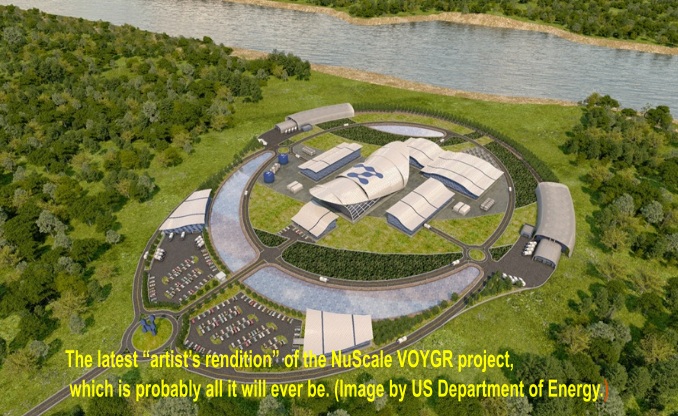
The unveiling of the artist’s rendition of the “new” VOYGR (see image above) is similar to the original overly romanticized drawing for the first VOYGR . Both feature a benign looking set of buildings in a bucolic setting, miles from anywhere, including from reality.
But since the VOYGR is actually intended to power AI data centers in likely far more built-up areas, I thought I’d ask AI itself what it thought of the prospects for NuScale’s foundering flagship?
“NuScale’s VOYGR small modular reactor faces severe economic and design hurdles that make commercial operation highly improbable under current market conditions,” it replied.
Alternatively, it could have exercised a little wit along with brevity and answered simply: “Not Now, VOYGR.”
Linda Pentz Gunter is the Executive Director of Beyond Nuclear and writes for and edits Beyond Nuclear International. She is the author of the book, No To Nuclear. Why Nuclear Power Destroys Lives, Derails Climate Progress And Provokes War, published by Pluto Press. Any opinions are her own.
Note: Now, Voyager was a film starring Bette Davis. The last line is “Oh, Jerry, don’t let’s ask for the moon. We have the stars.”
Putin’s Strong Message to Europe at the Valdai Club: Stop the March Towards War
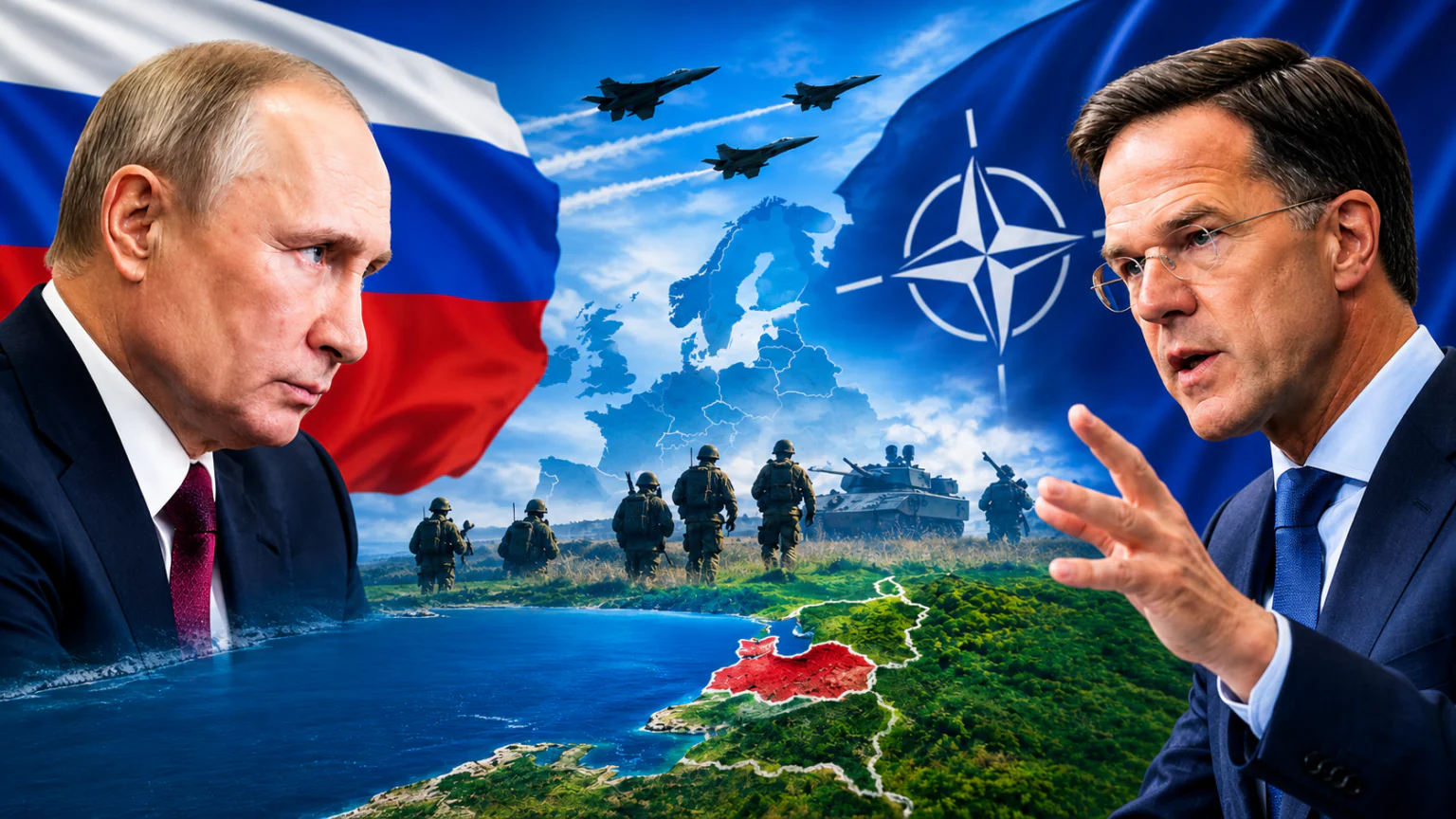
If Russia is weak and having military difficulties, if Putin is intimidated, if NATO is considerably stronger and if there is no immediate threat of a Russian attack, then why is European public opinion always being prepared for a major war?
Europe should therefore pose itself a simple question: is Russia really about to attack NATO — or is Europe preparing for a war that its own rhetoric is helping to make it more plausible?
Ricardo Martins, New Eastern Outlook, October 09, 2026
As NATO Secretary General Mark Rutte and European leaders increasingly warn of a looming Russian threat, Vladimir Putin used the Valdai Discussion Club to deliver a very different message: Europe is feeding an escalation spiral it may no longer be able to control.
Europe is being told to prepare for war, and the rearmament is being crafted as an economic and political project in itself. Europe is manufacturing a permanent war psychology while simultaneously insisting that Russia poses no imminent military threat.
Mark Rutte, the Secretary General of NATO, has on several occasions told that Russia might at some point launch an attack on NATO territory. The European governments are currently considering matters relating to hybrid attacks which can result in a large number of casualties, the establishment of new security arrangements and how to deal with a major confrontation with Moscow. The tone being used is becoming more and more dramatic, alongside unprecedented defence spending record levels.
With this background in mind, Vladimir Putin gave his reply at the Valdai Discussion Club.
His view was not that war was certain, rather it was the opposite—he advocated stopping the escalation before war became irreversible.
Putin’s argument is that Europe is trapped in a dangerous cycle in which military exercises, sanctions, weapons deliveries, threats and counter-threats are producing precisely the escalation that European governments claim they want to prevent.
This clear message is even more evident in what he said regarding Kaliningrad.
Rutte’s Russia narrative: threat, fear and rearmament
Mark Rutte is now one of the most prominent voices in Europe when warning about Russia.
In June 2025 he famously said to the Europeans: “You should learn to speak Russian or spend more on defence”, on the grounds that the possibility of future Russian aggression would mean a need for considerably increased defence spending over cuts on social security and pensions. He then warned that Russia might be ready to use military force against NATO within five years and, more recently, has spoken of Russia “testing us throughout Europe” as well as accusing Moscow of carrying out hybrid attacks, sabotage and attempts to split up the Alliance.
There is an extraordinary contradiction in Rutte’s most recent rhetoric.
On 30 September he stated that Putin was “a bit worried and a bit rattled” since the situation in Ukraine was supposedly not progressing well. He stressed that “Putin is not winning this” and claimed that Putin could never defeat NATO. At the same time, however, Rutte admitted that there was no immediate threat to NATO territory.
Then what is Europe actually getting ready for?
If Russia is weak and having military difficulties, if Putin is intimidated, if NATO is considerably stronger and if there is no immediate threat of a Russian attack, then why is European public opinion always being prepared for a major war?
It is worth posing that question.
The European public is being asked to agree to increased military spending, which could mean cutting back on social priorities, while at the same time a continuous state of insecurity is being fostered concerning Russia. The political message is remarkably consistent in telling people to spend more, to arm more and to get ready more – because Russia might launch an attack.
Fear is a highly effective political tool.
The issue is that fear may also come true on its own.
Putin’s warning over Kaliningrad
When asked about the increasingly aggressive rhetoric concerning Kaliningrad, Putin was especially straightforward.
He denied the notion that Russia was attempting to intimidate Europe, stating that Moscow’s warning was in fact ‘a response to an attempt to intimidate us‘.
He specifically referred to the European statements concerning preparations for a possible war with Russia in 2029 or 2030, the NATO exercises in the Baltic region, and the attempts to detain Russian vessels.
His argument is that this constitutes an escalation, and he gave a warning that was remarkably serious.
According to Putin, if Kaliningrad were the object of a direct attack or blockade, Russia would have to consider putting into use “all the forces and means at our disposal”. He made it clear that this was not necessarily a threat to employ nuclear weapons, but rather an assertion that Russia would make use of whatever measures it regarded as necessary for its defence.
It is exactly the kind of statement which European governments should take seriously — not since it is certain that Russia intends to attack Europe, but because a military confrontation between nuclear powers leaves little room for miscalculation.
The main thing that Putin warned about was an escalation.
His analogy was in the form of a spiral since provocative actions led to countermeasures, these countermeasures in turn caused further escalation, and eventually the process could get to a stage at which no one was completely in control.
That is the true danger.
What is the reason why Europe needs Russia to be its permanent enemy?
Putin’s more general explanation extends beyond Ukraine.
He contends that Europe has never really settled the security arrangements that followed the end of the Cold War. Rather than establishing a true pan-European security structure, NATO extended itself eastward and as a result Russia became increasingly excluded from the European security system.
He referred to Egon Bahr, the late German Social Democrat, who in 1990 had warned that if the division of Europe into hostile blocs was not overcome the Soviet Union would be isolated and a highly unfavourable future would result.
For Putin, Bahr’s warning was foretelling.
He also looked at how relations declined during NATO’s intervention in Yugoslavia, as a result of NATO’s enlargement, the changes that took place after the breakup of the Soviet Union and finally in the case of Ukraine. Even if one does not agree with this view, it does show a consistent way of understanding the past three decades from the Russian perspective: Russia has on numerous occasions sought integration with the West, found that this was not desired, and has in the end come to the conclusion that the European order that emerged after the Cold War was designed against Russia.
That is the reason why the message that Putin gave at Valdai was not merely about Ukraine. The main topic was the future of Europe.
Europe’s war preparation may be hiding a deeper crisis………………………………………………………………..
Putin’s answer: the world is changing
The most important aspect of Putin’s speech at Valdai was not Ukraine. It was his conception of the future international order.
Putin stated that the world is moving from Western hegemony towards a multipolar international system and that this transformation is inevitable, adding that the former hegemony would eventually have to acknowledge the reality of a world in which Asia, Africa, Latin America, the Middle East and other centres of power demand a greater role.
This is the point at which Europe must make its real strategic choice.
It can continue to base its security mainly on NATO, move ever more closely in line with Washington’s strategic priorities and regard Russia as a permanent adversary.
Alternatively, it could try to regain what Europe once said that it stood for: strategic autonomy, diplomacy, and the ability to build bridges between opposing powers.
Putin’s vision is not the kind of vision held by liberals in Europe. It does not have to be one that Europeans accept without question. It is rather a vision of a world which is no longer arranged around a single dominant centre, and Europe will not be able to stop this transformation.
The choice Europe still has
The Valdai speech concluded with a warning which should be heard well beyond Moscow.
The greater the extent to which the confrontation becomes uncompromising and the more openly the strategic defeat of an opponent is declared, the more likely it is that the conflict will reach its most dangerous stage. He cautions against arrogance, overconfidence and the uncontrolled escalation of reciprocal responses.
This is no appeal for Europe to give in. It is a plea to acknowledge the consequences of confrontation.
Europe should therefore pose itself a simple question: is Russia really about to attack NATO — or is Europe preparing for a war that its own rhetoric is helping to make it more plausible?
Rutte states that there is no immediate Russian attack that NATO is much stronger, and that Putin is intimidated and that Russia is having difficulties.
Then why the hysteria? Why the permanent mobilisation? Why the preparation for a war that nobody claims is imminent?
At Valdai, Putin made it clear that the world is changing, that multipolarity is inevitable, and that military escalation is not a replacement for diplomacy.
Although Europe may reject Putin’s worldview, but it cannot ignore his warning. Because the greatest danger is not necessarily that Russia wants a war with Europe. It may be that, after years of escalating rhetoric, Europe forgets how to prevent one. https://journal-neo.su/2026/10/09/putins-strong-message-to-europe-at-the-valdai-club-stop-the-march-towards-war/
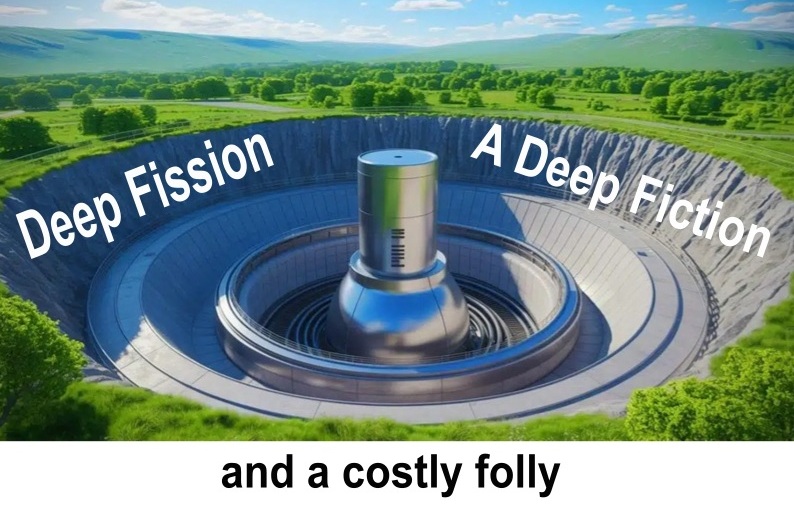
INVESTOR ALERT: Pomerantz Law Firm Investigates Claims On Behalf of Investors of Deep Fission, Inc. – FISN
Pomerantz LLP, Oct 08, 2026,
NEW YORK, Oct. 8, 2026 /PRNewswire/ — Pomerantz LLP is investigating claims on behalf of investors of Deep Fission, Inc. (“Deep Fission” or the “Company”) (NASDAQ: FISN). Such investors are advised to contact Danielle Peyton at newaction@pomlaw.com or 646-581-9980, ext. 7980.
The investigation concerns whether Deep Fission and certain of its officers and/or directors have engaged in securities fraud or other unlawful business practices.
[Click here for information about joining the class action]
On or around June 18, 2026, Deep Fission conducted its initial public offering (“IPO”), selling 2.5 million shares of stock priced at $16.00 per share. Then, on September 26, 2026, Iceberg Research published a short report asserting that the Company’s underground borehole reactor technology was overhyped and unlikely to achieve commercial viability.
Following publication of the Iceberg Research report, Deep Fission’s stock price fell $0.85 per share, or 10.9%, to close at $6.95 per share on September 24, 2026………..
https://www.prnewswire.com/news-releases/investor-alert-pomerantz-law-firm-investigates-claims-on-behalf-of-investors-of-deep-fission-inc—fisn-302902126.html
Nuclear war and malicious use of AI threaten end of humanity by 2100, says Lancet assessment

Newly established commission identifies 17 catastrophic
threats to human health but says ‘realistic route to act’ on each exists.
Humans could become extinct by the year 2100 due to malicious use of AI or
nuclear conflict, according to a new global risk assessment. They top a
list of 17 major threats to human health over the next 75 years, which also
includes cuts to aid spending by wealthy countries, the climate crisis and
childhood malnutrition. The experts behind The Lancet Commission on 21st
Century Global Threats to Health said all the threats interact, meaning
they must be addressed together – but stressed that there was “a
realistic route to act” on each.
Guardian 11th Oct 2026,
https://www.theguardian.com/global-development/2026/oct/11/nuclear-war-and-malicious-use-of-ai-threaten-end-of-humanity-by-2100-says-lancet-assessment
Guam Grapples With Pollution As US Military Keeps Expanding
To people who live in Guam, the ongoing Pentagon buildup in the Pacific offers a warning.
Honolulu Civil Beat, By Grist, October 12, 2026
This story by Anita Hofschneider was originally published by Grist and was published in partnership with The Intercept.
Leevin Camacho was brushing his teeth one day last fall when his mother called. The water is contaminated, she said. Moments later she texted him a photo of a flyer issued by the local water authority. “Cancer risk,” it warned. “Increased likelihood of adverse impacts on the liver.” And in bold capital letters, “DO NOT DRINK.”
Camacho stared at the message. Water flowed from the faucets as his children, who were 10 and 12, gulped and spit, their faces reflected in the mirrors above the two bathroom sinks.
Thumbing at his phone, Camacho googled dieldrin. The results included words like “organochlorine” and “insecticide” and “persistent environmental pollutant” that the United States had banned in 1987. Worse, high levels had been detected in his community’s water since at least 2008. “Our kids have been drinking the water,” he realized. “They’ve been cooking with the water for almost their entire lives at this point.”
Today, Guam sits at the center of an ongoing military buildup, one that is reshaping the island even as it spreads across the Pacific. On Yap, more than 1,000 graves could be disturbed to make way for an American seaport and airfield. Indigenous leaders on Palau are suing to protect their lands. Less visible but just as impactful are the climate impacts of this expansion. The Pentagon is already the world’s largest institutional emitter of greenhouse gases, and its buildup will do more than contribute to the destruction of the region’s reefs, forests, and Indigenous sacred sites. It will accelerate the climate crisis that threatens the survival of Pacific islands.
To people who live in Guam, the ongoing Pentagon buildup in the Pacific offers a warning
Camacho lives in Yigo, a northern village on the island of Guam. In time, he would learn that the U.S. Air Force base next to the well serving his house had reported “very high levels” of the pesticide, which it had listed as a “chemical of concern” since at least 1993. The Pentagon’s investigation, led by officials at Joint Region Marianas, is in its early stages. Local officials caution that although they suspect the base is a source of the pollution, there may be others because dieldrin was once widely used.
For Camacho, the news felt like the unfolding of a familiar story — one both predictable and infuriating.
Camacho had grown up as an Army brat, raised to think of the United States as Guam’s liberator from Japan during World War II. But over the past two decades, his understanding of that legacy has changed.
“There are certain actions that the military takes that are contrary to the interests of the people who are from Guam and who live in Guam,” said Camacho, whose measured tone rarely changes, even when discussing something as emotional as what his children have been drinking.
To Camacho, dieldrin is the latest reminder that the people of Guam continue to bear the costs of militarization. Unexploded ordnance litters jungles and lagoons. PCBs contaminate the fish. Pollutants taint the groundwater. The island and its people, who are U.S. citizens, have been inalterably changed by more than a century of American military presence.
Rear Admiral Brett Mietus, the head of Joint Region Marianas, the U.S. Navy’s regional command for Guam and neighboring islands, said he can’t speak to past pollution but the command is committed to protecting the environment and the people of Guam.
“We spend a lot of time and we spend a lot of money making sure that we meet every U.S. regulation when it comes to anything that we’re going to do here,” he told Grist. “We’re meeting every letter of every law for environmental regulations and rules, and we’re doing that while we’re spending a ton of money to defend this island from the most advanced missiles in the world.”………………………………………………………………………………………………………………………………………………………………………………………………………………………………………………….
To Flores, more military presence on Guam heightens the risk of war. In March, President Donald Trump’s decision to bomb Iran prompted military bases on the island to raise their threat level. She feels that, as in World War II, the Indigenous people of Guam are expendable in a broader contest between empires. “What are they really here to protect if there’s so much harm taking place? Are we just collateral damage?” she said. “Because just looking at our history of being occupied by war, being used for weapons testing, it feels like the message is that we don’t matter. Our future doesn’t matter. Our survival doesn’t matter.”……………………………………………………………………………………………………………………………………………………………………………………………………………………..
“We’re faced with the reality that we’re part of a larger strategic vision,” conference organizer and former Guam congressman Robert Underwood said. “All of you are in someone’s strategic plans whether you know it or not, whether you like it or not. All of us are in someone’s strategic plan.”
In Palau, Indigenous people are fighting the Pentagon’s expansion in local courts and international forums. Leaders of Angaur, one of 16 states there, filed a lawsuit accusing the U.S. of violating environmental rules and its treaty with the island nation when it cleared land for a radar facility. Indigenous chiefs from Peleliu are suing to prevent a land transfer that would support American goals. Indigenous Palauan youth filed a complaint at the United Nations alleging the U.S. military violated their right to free, prior, and informed consent to what happens on their land…………………………………………………………………………………………………………………………………………………………….
A Plebiscite On Guam’s Status?
…………………….Camacho wants a plebiscite to determine Guam’s political status. He believes the island’s status as a U.S. territory — without a vote for president or voting representation in Congress — isn’t working………………………………………………………………………………………………..https://www.civilbeat.org/?p=1814370&utm_source=Civil+Beat+Master+List&utm_campaign=4226d57df6-EMAIL_CAMPAIGN_2025_05_12_05_31_COPY_01&utm_medium
Rosatom and Finland’s Fennovoima claim different wins after tribunal ruling
By Reuters,Reporting by Anastasia Lyrchikova, Additional reporting and writing by Alessandra Prentice Editing by Ros Russell, Alexandra Hudosn October 11, 2026,
https://www.reuters.com/business/energy/rosatom-says-it-wins-tribunal-ruling-finnish-nuclear-plant-dispute-2026-10-10/
– Russia’s state nuclear corporation Rosatom and Finnish utility Fennovoima each highlighted different parts of an International Chamber of Commerce (ICC) tribunal ruling as favourable on Saturday, in a long-running dispute over the cancelled Hanhikivi-1 nuclear power project.
The parties have been locked in legal disputes since Fennovoima scrapped the 7-billion-euro ($7.8 billion) project in May 2022, citing significant delays and political risks shortly after Russia launched its conflict in Ukraine.
Rosatom said the tribunal found that Fennovoima had unlawfully terminated the contract for the construction of the planned plant in northern Finland.
“Today’s victory is important, but not final. We will continue to prove that we are right regarding the Finnish project in courts of various instances,” Rosatom Director General Alexey Likhachev said in a statement, which did not refer to any financial outcome.
Fennovoima said the tribunal found that it had not been entitled to terminate the contract, but that it was entitled to receive reimbursements of advance payments and interest in excess of 1 billion euros ($1.12 billion).
It said the tribunal offset both sides’ claims, resulting in Rosatom subsidiaries being ordered to pay Fennovoima a net 606 million euros plus interest.
The ICC did not immediately respond to a request for comment.
The contract to build the 1.2 gigawatt plant was signed in 2013 with Fennovoima, a consortium in which Finnish stakeholders including Fortum, Outokumpu and SSAB originally controlled two thirds through a joint venture, and the Russian side held one third.
After the project’s termination, Fennovoima wound down its operations and is primarily engaged in legal proceedings.
War puts Iran’s nuclear ambiguity under scrutiny
A revisionist argument is emerging in Tehran over Iran’s nuclear strategy:
that its longstanding policy of nuclear ambiguity failed its most important
test when it did not deter the United States and Israel from attacking, and
should now be reconsidered. Nezamoddin Mousavi, a former conservative
lawmaker with longstanding ties to the Islamic Revolutionary Guard Corps
(IRGC), gave unusually explicit expression to that argument this week,
declaring that “nuclear ambiguity did not prevent war” and raising the
prospect of revisiting Iran’s nuclear doctrine and even its membership in
the Nuclear Non-Proliferation Treaty (NPT).
Iran International 10th Oct 2026,
https://www.iranintl.com/en/202610106118
Underground nuclear reactor clears hurdle, but critics say it doesn’t have solid finances
Deep Fission, the company planning a one-mile underground nuclear reactor
in Parsons, Kansas, has passed a regulatory milestone, but at the same time
is facing new financial questions. A financial research organization has
raised questions about the viability of the project.
Then, four stockholder
rights law firms throughout the U.S. launched investigations of the company
after its share price dropped. The progress and challenges could mean an
unclear path forward for the project. Deep Fission’s goal as of right now
is to do further testing at the site. Company officials remain optimistic
and say the criticisms are prompted by financial motivations from the
people making the claims.
LJ World 10th Oct 2026, https://www2.ljworld.com/news/state-region/2026/oct/09/underground-nuclear-reactor-clears-hurdle-but-critics-say-it-doesnt-have-solid-finances/
Fusion – the endless dream

UK Minister for Energy Michael Shanks reportedly said that ‘Fusion has
the potential to provide virtually limitless clean energy’. That’s a dream
that some now see as getting a bit more real. The UK has form in this area.
It was a pioneer in nuclear fusion, with the ZETA device built at Harwell
in the late 1950s getting, briefly, a very good press: there was front-page
newspaper coverage saying it was a breakthrough towards unlimited energy.
Sadly, and embarrassingly, it turned out not to be the case. However, the
UK persevered with fusion over the years, for example playing host to JET,
the Joint European Torus test unit at UKAEA Culham. And now the UK
government has committed more than £2.5 billion over five years to new
nuclear fusion, including £1.3 billion for UK Fusion Energy to deliver the
STEP programme (a spin-off from Culham) in partnership with industry. A
further £740 million is earmarked for research and development
infrastructure and facilities. Unless of course there is a big
breakthrough. Can we afford to wait for that? By contrast, renewables are
ready here and now. Arguably they are a much better bet….using the fusion
reactor we already have- the sun.
Renew Extra 10th Oct 2026,
https://renewextraweekly.blogspot.com/2026/10/fusion-endless-dream.html
Officer numbers rise at Civil Nuclear Constabulary
AN ARMED police force guards some of the UK’s most sensitive sites, including Sellafield in Seascale, and data reveal that over the last six years its officer count has grown by more than 10 per cent.
Carlisle News & Star 10th Oct 2026,
https://www.newsandstar.co.uk/news/26620384.officer-numbers-rise-civil-nuclear-constabulary/
Naomi Klein: End Times Fascism: The Billionaires Are Planning Their Escape—and Leaving Us to Burn
Joshua Scheer, October 9, 2026, https://scheerpost.com/2026/10/09/naomi-klein-end-times-fascism-the-billionaires-are-planning-their-escape-and-leaving-us-to-burn/
The billionaires selling us the future are making plans to escape it. They promise artificial intelligence will liberate humanity while concentrating the wealth and power to decide whose lives are expendable. Their bunkers offer a revealing answer to the question their public relations campaigns avoid: What happens to everyone else?
In this conversation with Doomscroll host Joshua Citarella, Naomi Klein examines what she and co-author Astra Taylor call “end times fascism”—an alliance of religious fundamentalists anticipating Armageddon, tech oligarchs dreaming of transcending humanity, and nationalist movements building fortresses against the people their policies help displace. Klein argues that decades of privatization, austerity and corporate rule prepared the ground for this politics. The respectable centrists who presided over the wreckage now offer more of the same as its cure.
Klein’s warning cuts through Silicon Valley’s salvation racket: concentrated wealth has become a threat to collective survival. An elite that believes it can buy its way out of catastrophe has little reason to prevent it. Fighting back means confronting billionaire impunity, breaking concentrated corporate power and organizing around the things their grand visions keep sacrificing: water, food, dignity and a habitable world.
China’s Uranium Enrichment Expansion: Worrisomely Large
October 5, 2026 Dr. Hui Zhang, Senior Research Associate at Harvard’s Belfer Center, Occasional Paper 2603
China recently significantly expanded its uranium enrichment capacity. The predominant view of experts and respected non-governmental organizations is that this expansion is needed to supply China’s growing civilian nuclear energy sector.
As of September 2026, China had 64 power reactors (64 GWe) in operation and another 38 units (40 GWe) under construction, making it the world leader in new reactor construction. Its 15th Five-Year Plan (2026–2030) calls for installed nuclear capacity of 110 GWe by 2030, and some authoritative Chinese studies recommend reaching roughly 200 GWe by 2040. China’s nuclear power program is therefore expected to grow steadily over the coming decade, and with it the country’s demand for enriched uranium.
To meet this anticipated demand, China has significantly expanded its indigenous enrichment capacity since 2020. Over the same period, however, China has also rapidly enlarged its nuclear arsenal, raising the question of whether its enrichment buildup serves civilian needs alone. The Federation of American Scientists (FAS) estimates that China possessed about 620 warheads in 2026. The US Department of Defense (DoD) assesses that the stockpile remained “in the low 600s” through 2024—roughly triple its 2020 level—and, while noting “a slower rate of production compared to previous years,” projects that China remains on track to field more than 1,000 warheads by 2030. Much of the Western debate has focused on whether China needs additional plutonium to sustain this buildup. Much less attention has been paid to highly enriched uranium (HEU), which China may also need for new warheads, at least for the secondaries of its modern designs.
Assessing these questions is difficult because China does not officially release information on its enrichment capacity. This paper therefore draws on satellite imagery, Chinese publications, and discussions with Chinese experts to reconstruct the scale and trajectory of China’s enrichment program. Building on the author’s earlier estimates, it incorporates several significant developments, including the commissioning of new centrifuge facilities. By the end of 2026, China’s commercial enrichment capacity is estimated to reach about 15.4 million separative work units (SWU) per year—roughly 2.1 times its 2020 capacity of about 7.4 million SWU/year, or more than a doubling in six years.
This growth has not been steady. After an initial construction boom between 2010 and 2015, undertaken to meet the anticipated growth in demand from nuclear power, the China National Nuclear Corporation (CNNC) slowed its expansion between 2016 and 2019, suspending or postponing several planned or partially built projects, largely in response to slower reactor construction. Since around 2020, China has launched a new construction boom. Whereas the earlier expansion was driven primarily by civilian nuclear power, this paper argues that the current wave serves not only civilian needs but also, and importantly, China’s ongoing nuclear weapons buildup.
The remainder of this paper is organized as follows. Section 2 reviews the development of China’s enrichment industry and technology. Section 3 presents the current status of each of China’s enrichment plants and new capacity estimates. Section 4 compares enrichment supply with civilian demand, estimates how much HEU China would need for an arsenal of 1,000 warheads, and examines whether the timing of the enrichment expansion is consistent with China’s nuclear buildup. Section 5 concludes……………………………………………………………………………………………………………………………………………………………………………………………………………………………………………………………………………………………………………………….. https://npolicy.org/wp-content/uploads/2026/10/Chinas-Uranium-Enrichment-Expansion-Worrisomely-Large.pdf
1 This Month
23-25 October – on Zoom – World BEYOND War’s annual global conferenc


Shut down the radiation-damaged Heysham nuclear reactors now
To see nuclear-related stories in greater depth and intensity – go to https://nuclearinformation.wordpress.com

Say No to NASA’s Reckless Nuclear Reactor on the Moon
Say No to NASA’s Reckless Nuclear Reactor on the Moon

-
Archives
- October 2026 (247)
- September 2026 (339)
- August 2026 (330)
- July 2026 (355)
- June 2026 (287)
- May 2026 (306)
- April 2026 (356)
- March 2026 (251)
- February 2026 (267)
- January 2026 (308)
- December 2025 (358)
- November 2025 (359)
-
Categories
- 1
- 1 NUCLEAR ISSUES
- business and costs
- climate change
- culture and arts
- ENERGY
- environment
- health
- history
- indigenous issues
- Legal
- marketing of nuclear
- media
- opposition to nuclear
- PERSONAL STORIES
- politics
- politics international
- Religion and ethics
- safety
- secrets,lies and civil liberties
- spinbuster
- technology
- Uranium
- wastes
- weapons and war
- Women
- 2 WORLD
- ACTION
- AFRICA
- Atrocities
- AUSTRALIA
- Christina's notes
- Christina's themes
- culture and arts
- Events
- Fuk 2022
- Fuk 2023
- Fukushima 2017
- Fukushima 2018
- fukushima 2019
- Fukushima 2020
- Fukushima 2021
- general
- global warming
- Humour (God we need it)
- Nuclear
- RARE EARTHS
- Reference
- resources – print
- Resources -audiovicual
- Weekly Newsletter
- World
- World Nuclear
- YouTube
-
RSS
Entries RSS
Comments RSS

