When Stealth Meets the Bomb: Inside the US-Israel Nuclear Strike Scenario on Iran’s Deep Bunkers [i]
Conventional physics has its limits. As Iran buries its nuclear program deeper, the US and Israel face a terrifying calculus: the tactical nuclear threshold
Black Mountain Analysis, Mike Mihajlovic, 4 Nov 26,
“The ultimate defense is not stopping the bomb. It is ensuring the strategic cost of dropping it remains forever prohibitive.”
To understand the most dangerous military contingency in the Middle East today, you don’t need to look at the surface. You need to look deep underground.
For two decades, Iran has engaged in a literal race to the center of the earth. Facilities like Fordow, built deep inside a mountain near Qom, and the subterranean levels of Natanz sit beneath hundreds of feet of solid rock and reinforced concrete. They are designed to survive the apocalypse.
For years, the US military’s answer to this was conventional: the 30,000-pound GBU-57 Massive Ordnance Penetrator (MOP). But the physics of conventional explosives impose strict limits. Even the MOP cannot guarantee the destruction of Iran’s deepest centrifuge halls, as seen in the previous US attacks.
It was previously addressed in the following article:
Israel vs Iran: GBU-57A/B MOP Bunker Buster or Bunker Busted [i]
Mike Mihajlovic, 22 June 2025
This brings military planners to a dark, heavily classified crossroads: Tactical Nuclear Weapons.
Today, we are diving deep into a highly sensitive, hypothetical scenario. What happens if the US and Israel decide to use low-yield, earth-penetrating nuclear weapons to crack Iran’s underground fortresses? How does Iran detect the stealth bombers coming for them? What role do Russian and Chinese satellites play in tipping off Tehran? And how does Iran retaliate when the ultimate taboo is broken?
Key Takeaways
- The Physics Problem: Conventional bunker busters have a hard limit. The US B61-12 tactical nuke is the only (theoretically) guaranteed way to collapse the deepest Iranian facilities.
- The Stealth Myth: B-2s and F-35s are (as per the overwhelming marketing mechanism ever present in Western media) “invisible” (to some degree) to fire-control radars, but not to early-warning networks. Iran’s VHF and Over-The-Horizon radars can see them coming.
- The Geopolitical Shadow: Iran doesn’t fight alone. Russian and Chinese satellite networks provide strategic warning, ensuring the US and Israel cannot achieve total surprise.
- The Retaliation: If the nuclear threshold is crossed, Iran’s response will not be symmetrical. It will be a massive, multi-front regional war.
Part I: The Offensive Arsenal – The US and Israeli Playbook
A strike of this magnitude wouldn’t be a simple bombing run. It would be a highly orchestrated, multi-domain operation requiring the total suppression of enemy air defenses (SEAD) and precision stealth penetration.
The US: The B-2 Spirit and the B61-12
The primary US instrument for this mission is the B-2 Spirit stealth bomber (and soon, the B-21 Raider). The B-2’s Very Low Observable characteristics allow it to slip through heavily contested airspace by minimizing its radar cross-section.
But the bomber is only half the equation. The weapon is the B61-12.
This is not the city-destroying strategic megaton bomb of the Cold War. The B61-12 is a tactical, earth-penetrating gravity bomb with a “dial-a-yield” feature, ranging from a mere 0.3 to 50 kilotons. It features a guided tail kit, allowing it to be dropped from 30,000 feet—keeping the B-2 safely out of range of most Iranian surface-to-air missiles.
Upon impact, the weapon’s casing penetrates the soil and rock before detonating. The goal is to couple the nuclear energy directly into the surrounding rock, creating a massive subterranean cavity and a seismic shockwave that collapses tunnel networks without necessarily creating a massive, wide-area radioactive fallout cloud on the surface. The Pentagon calls this “escalation control.”
His (or her) highness: the B61-12 Earth-Penetrating Weapon
To understand how the B61-12 destroys deeply buried targets, one must look past the imagery of surface-level mushroom clouds. The B61-12 is, to some degree, an Earth-Penetrating Weapon (EPW). Its design philosophy is not to maximize atmospheric blast, but to maximize energy coupling into the Earth.
By burying the detonation, the weapon transforms the surrounding geology into a highly efficient transmission medium for destructive energy. Here is the step-by-step technical breakdown of the physical mechanisms by which the B61-12 neutralizes subterranean infrastructure……………………………………………………………………………………………………………………………………………………………………………………………………………………………………………………………………………………………………………………………………..
The Myth of the “Clean” Tactical Nuke
To fully understand this scenario, we must examine the physical and political reality of using a tactical nuclear weapon. The Pentagon loves the term “tactical” because it implies proportionality and control. But in reality, a “small” nuke is still a nuke.
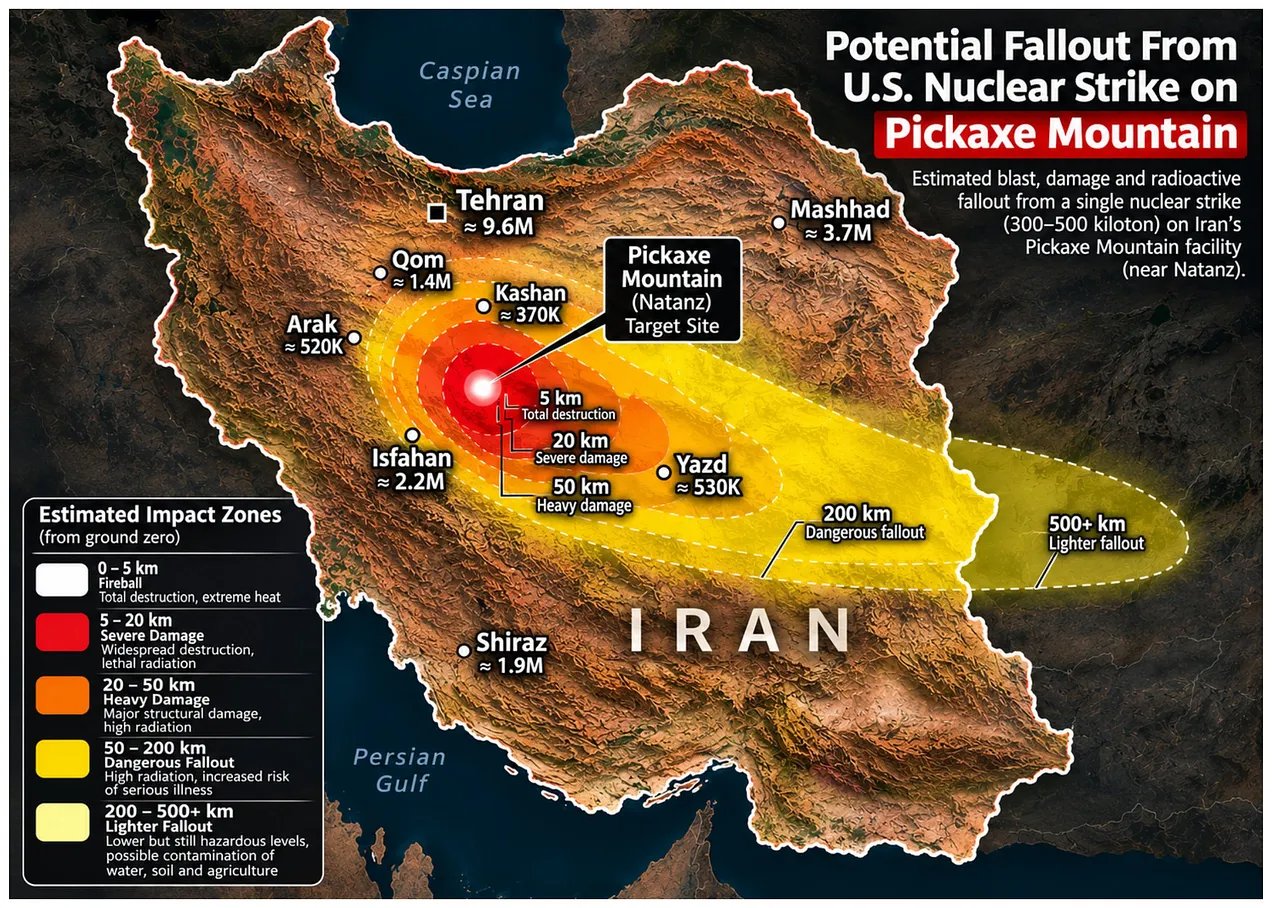
The Fallout Reality
While an earth-penetrating detonation minimizes the surface blast, it inevitably vaporizes tons of rock and soil, mixing it with highly radioactive fission products. This material is thrown back into the air as highly lethal, localized fallout. Depending on wind patterns, this radioactive cloud could drift over neighboring countries, causing a humanitarian and environmental disaster that makes the “surgical” nature of the strike a complete myth.
No comments yet.
1 This Month



19 November – Webinar – The Reality of Reprocessing
Time: 11:00 AM Pacific Time (US & Canada) / 2:00 PM Eastern / 7:00 PM UK / 8:00 PM CET
Register for the Zoom Event Here



Shut down the radiation-damaged Heysham nuclear reactors now
To see nuclear-related stories in greater depth and intensity – go to https://nuclearinformation.wordpress.com

Say No to NASA’s Reckless Nuclear Reactor on the Moon
Say No to NASA’s Reckless Nuclear Reactor on the Moon
-
Archives
- November 2026 (54)
- October 2026 (302)
- September 2026 (339)
- August 2026 (330)
- July 2026 (355)
- June 2026 (287)
- May 2026 (306)
- April 2026 (356)
- March 2026 (251)
- February 2026 (267)
- January 2026 (308)
- December 2025 (358)
-
Categories
- 1
- 1 NUCLEAR ISSUES
- business and costs
- climate change
- culture and arts
- ENERGY
- environment
- health
- history
- indigenous issues
- Legal
- marketing of nuclear
- media
- opposition to nuclear
- PERSONAL STORIES
- politics
- politics international
- Religion and ethics
- safety
- secrets,lies and civil liberties
- spinbuster
- technology
- Uranium
- wastes
- weapons and war
- Women
- 2 WORLD
- ACTION
- AFRICA
- Atrocities
- AUSTRALIA
- Christina's notes
- Christina's themes
- culture and arts
- Events
- Fuk 2022
- Fuk 2023
- Fukushima 2017
- Fukushima 2018
- fukushima 2019
- Fukushima 2020
- Fukushima 2021
- general
- global warming
- Humour (God we need it)
- Nuclear
- RARE EARTHS
- Reference
- resources – print
- Resources -audiovicual
- Weekly Newsletter
- World
- World Nuclear
- YouTube
-
RSS
Entries RSS
Comments RSS


Leave a Reply