Cached version only available as it was quickly pulled.. “Management perception” in light of all the nuclear fuel rod incidents occurring in France, UK and the USA. Japans Daichi unit 3 exploded in a different way to the other units and contained some MOX plutonium and nuclear waste fuel rods, did this aggravate the explosion? or were the fuel claddings worn or damaged from running too hot for too long?
bne
February 18, 2014
Kazakhstan is in the final stages of talks with the International Atomic Energy Agency (IAEA) on plans to host an international nuclear fuel bank.
As the range of countries investing into nuclear power plants grows, the bank will make it possible for them to buy fuel rather than setting up their own enrichment plants. The launch of the international bank then is designed to help prevent the proliferation of nuclear weapons.
“Kazakhstan is to host the international bank for low-enriched uranium and the IAEA is currently finalizing negotiations on an agreement,” says a statement from the Kazakh ministry of foreign affairs. “We believe that the development of multilateral approaches to the nuclear fuel , including the creation of guaranteed nuclear fuel reserves will promote the peaceful use of nuclear energy.”
A final decision on the bank was expected in 2013, but talks are still ongoing, the statement added. Kazakhstan is the world’s leading uranium producer, and turned out 38% of global production last year. Seventeen uranium mining projects run in the country, 12 of them joint ventures with foreign partners.
Astana has offered the Soviet-built Ulba Metallurgical Plant in Ust-Kamenogorsk, at the very eastern end of the country, as the site for the fuel bank, which will store and distribute low-enriched uranium internationally. In 2012, the head of state nuclear agency Kazatomprom claimed the plant is one of the safest places in the world for uranium storage.
…The big nuclear companies threatened DECC from withdrawing all co-operation concerning nuclear matters if they insisted on asking for information that was needed for the stakeholders to argue their points. So, DECC (And NDA) was actually blackmailed (By the “individual and other companies”)….
Subject: Fuel element cladding at the Cattenom nuclear power plant
In its issue of 14 February 2014 the Trierischer Volksfreund newspaper reported that the fuel element cladding at the Cattenom nuclear power plant had been examined and found to be actually or possibly damaged. If the cladding material were, say, severely corroded, fuel elements might need to be replaced ahead of time, and other problems could arise.1. Is the Commission aware that, according to French media reports, 25 out of the 58 French nuclear power plants have corroded fuel element cladding?
2. Has corrosion of fuel element cladding been known to occur at nuclear power plants, and have there been any proven cases at Cattenom?
3. Has risk analysis ever been brought to bear on what is one of the largest and most efficient, but also one of the oldest, nuclear power plants in France?
4. In the light of the stress testing of nuclear installations in Europe, how does the Commission view the safety implications of this type of corrosion?
5. Does corrosion damage of the kind described have to be reported to the International Energy Agency or neighbouring countries?
A recent survey carried out by the Manchester Evening News found that 73 percent of Greater Manchester residents are opposed to the controversial gas extraction technique – so on Sunday at noon, up to 1,000 demonstrators gathered in downtown to march from Piccadilly Gardens to Cathedral Gardens.
Many of the speakers and demonstrators included members of the long-standing Barton Moss protest camp in neighboring Irlam, just south of Manchester. There, energy firm IGas is carrying out test drilling to explore potential shale gas reserves beneath the green belt site at Barton Moss.
The purpose of the march in Manchester was to send a clear message to the government and energy companies that the vast majority of Britons oppose fracking, Martin Porter, a spokesman for the Barton Moss camp and a member of Frack Free Greater Manchester, told the Manchester Evening News.
“The purpose of the day is to send a message out that we don’t want fracking in Manchester or anywhere else. At the moment, Barton Moss is at the center of attention across the country but before long two thirds of people in England and Wales might find a fracking rig on their doorstep,” Porter said.
A number of campaign groups were represented at the demonstration, including Friends of the Earth, the Green Party, and the Campaign Against Climate Change.
RT reporter Sarah Firth says people at the march complained that there is not enough awareness on fracking and therefore it is dangerous to pursue.
All eyes are on the village of Miyakoji (都路) where the ban is to be lifted – the first ban to be lifted in what used to be the exclusion zone (that 20 km concentric circle slapped round Fukushima Daiichi in March 2011). In April 2012 the area was designated an ‘area to be prepared for the lifting of the ban’ and this will come into effect on April 1st. One year later evacuees from the area will have their compensation payments stopped.Miyakoji, population 357, is in a country area adjoining Namie and Okuma on Route 288 (known locally as Nipapa). Two years ago, in May 2012 after the area was reorganised, we travelled by car along that road through Miyakoji (which was deserted) to try and glimpse the barricades bordering the exclusion zone but we were turned back by police.
The government says that since decontamination work was completed in August last year, the area is ready to be repatriated. Radiation levels are reported to be under 4 mSv/year. The local authority is to reopen the junior high and high school, build shops and try to attract investment. The government will give additional compensation to those who decide to return but monthly payments of 100,000 yen for ‘psychological stress’ will stop for all residents, wherever they live.
The residents first found out about this last summer and managed to delay the plan, putting the opening off from November last year to this April. The village is split between those who want to go back and get on with farming and those who want more reassurances. These include: repeating the decontamination work already done in order to reduce levels, clean the woods (which haven’t been decontaminated yet), continue monitoring radiation, issue dosimeters, carry out health checks etc.
A friend who’s a reporter for the Mainichi Shimbun has written an article entitled ‘Bureaucrats are Clever’ which has had thousands of hits. He attended the meetings with local residents and explains how the bureaucrats managed to push the plan through even though the majority of residents were not happy about the ban being lifted at this stage. He says they did not respond to residents’ concerns such as: If the woods aren’t going to be cleaned, will those who make their living there get compensated? What level of radiation is safe for children? The village needs to be safe: why are you planning to build an incinerator for radioactive materials here? The bureaucrats even resorted to quoting the Constitution at them (Article 22, freedom to live where you please) to justify their decision.
Abe visits Fukushima ahead of March 11 anniversary
Prime Minister Shinzo Abe visited Fukushima Prefecture on Saturday, 3 days before the 3rd anniversary of the earthquake, tsunami and nuclear disasters.
In Tamura City, he met with residents of Miyakoji District. They’ll be allowed to return to their homes on April 1st when an evacuation order for the district is expected to be lifted. It will be the first evacuation order lifted since the nuclear accident.
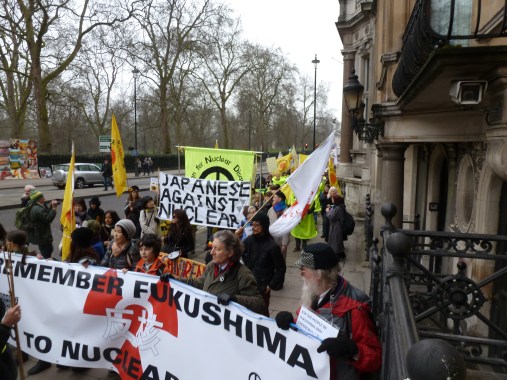
Japanese and British citizens join together in London to mark 3rd anniversary of the Fukushima nuclear disaster
Japanese and UK citizens groups are jointly hosting a series of events in London to mark the third anniversary of the Fukushima nuclear disaster during a week when many similar events are taking place throughout the world. See below for the events details.
Fukushima is an ongoing catastrophe. On 11th March 2011, a massive earthquake triggered the triple melt-down of the Fukushima Daiichi nuclear reactors. 160,000 people were forced to leave their homes. Many are still living in temporary accommodation with little compensation or support. They face a terrible choice between returning to their heavily contaminated homes and villages or abandoning them in order to stay away from contamination. Radiation has entered the biosphere, which directly affects the food chain. A high incidence rate of thyroid cancer has been identified in Fukushima children.
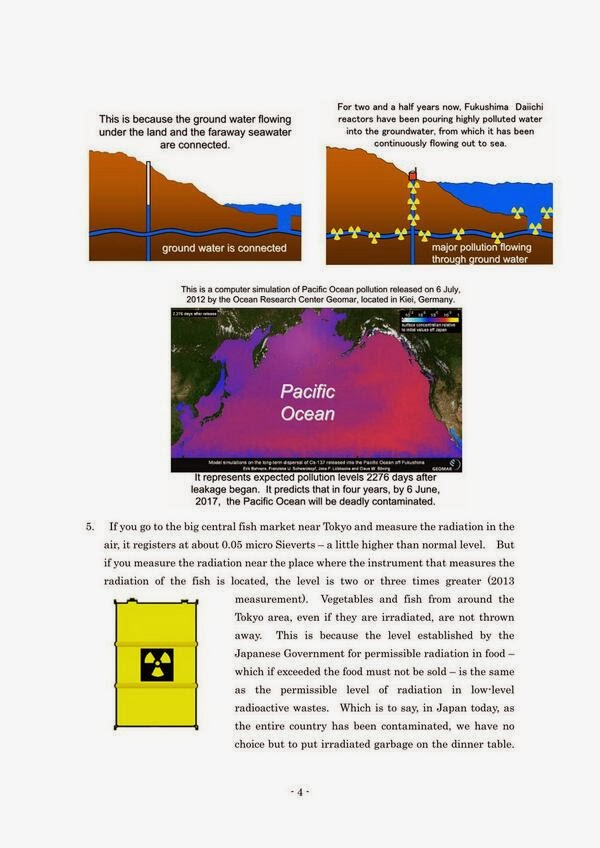
The stricken reactors continue to pour 400 tons a day of highly radioactive water into the Pacific, with no end in sight. Many parts of the reactor buildings are impossible for humans to enter, due to lethal doses of radioactivity. Already weakened, they are in danger of collapse in any further earthquake. This could cause the spent fuels pool to drain and the fuel rods to catch fire. In the worst case scenario, this would lead to the evacuation of half of Japan.
The vast majority of people in Japan now want nuclear power to be abolished. Despite the strength of anti-nuclear sentiment and the high risk of a further apocalypse, the Japanese government is planning to revive nuclear industry, by restarting several nuclear reactors in Japan and exporting nuclear technology to many countries including the UK.
Remember Fukushima! No to nuclear power! The events will send a clear message to governments and people throughout the world that our future must be sustainable.
Further information on the current state of the Fukushima Daiichi can be found here: ENE NEWS or Simply Info
Events details
Public Meeting
7-9pm, Monday 10th March
Committee Room 10, House of Commons
What lessons should we learn from Fukushima?
Expert speakers: Dr Paul Dorfman, Dr David Lowry, Dr Chantal Galhinger.
Citizen speakers: Rik (Kick Nuclear), Geoff Read (Strong Children Japan), nuclear evacuee.
There will be Q&A to and discussion after the speeches.
Candle-lit Vigil
6-8pm, Tuesday 11th March (3rd Fukushima anniversary)
Outside Japanese Embassy, 101 Piccadilly, near Green Park tube station
We will be thinking of people, families and communities affected by the triple disaster.
Programme includes: Fukushima evacuee’s experience, 2 minutes silence, speeches on effects of Fukushima on people and society, songs, Buddhist chanting and open-microphone.
March to the Parliament & Rally
12:30pm, Saturday 15th March Hyde Park Corner to Parliament
Meet: 12:30pm by Hyde Park Corner tube station, near the “Hyde Park” exit for 1pm start. March via Japanese Embassy and offices of Tokyo Electric Power Company (TEPCO – the operator of Fukushima Daiichi), Piccadilly Circus, Trafalgar Square to Parliament.
Rally: 3:00–4:30pm at Old Palace Yard, opposite House of Lords.
Speakers include: fashion designer Katharine Hamnett, Samarendra Das from India’s anti-nuclear power campaign, Fukushima evacuees, campaigners from South West Against Nuclear, Nuclear Free Lakeland & Green Party, letter to Japanese government.
Programme also includes: music, singing, a human chain, a die-in and a minute silence, and open microphone.
For further information
In English, contact David Polden (London Region CND) on 0207-607 2302 or david.lrcnd@cnduk.org
In Japanese, contact through website
In 2012 Francis Maude, Minister for the Cabinet Office, announced the intention to fundamentally overhaul and replace the existing information classification and marking scheme as part of the government’s Civil Service Reform programme.
Sellafield Ltd’s security regulator, ONR (Office for Nuclear Regulation), have instructed Sellafield Ltd and the wider civil nuclear industry to adopt the new GSC protective marking scheme known as Government Security Classifications (GSC).
Government Security Classifications
The new three tier system has three classifications: OFFICIAL, SECRET and TOP-SECRET.
Additionally ONR have mandated the use of an additional classification: OFFICIAL-SENSITIVE for Sensitive Nuclear Information which is classified below SECRET.
Implementing GSC
In line with the rest of UK government, the new GSC scheme is coming into operation on April 2nd 2014. All documents (including commercial correspondence, drawings, specifications, data sheets etc) created by Sellafield Ltd after this date for issue to suppliers will carry the new markings. Documents created prior to this date will continue to carry their existing markings until such time as they are amended in the normal course of work when the new markings will be applied at the same time.
You can find more information about GSC and implementing GSC by following this
…The big nuclear companies threatened DECC from withdrawing all co-operation concerning nuclear matters if they insisted on asking for information that was needed for the stakeholders to argue their points. So, DECC (And NDA) was actually blackmailed (By the “individual and other companies”)….
I am writing in response to your request
of 22 August for “
copies of the correspondence/reports between the Nuclear Decommissioning Authority and the
Department for Energy and Climate Change regarding the conclusions of the work the NDA has recently undertaken into the management of the UK’s separated plutonium stocks
“…However there is a very high public interest for withholding this information. If the information were released it is less likely that that the individual companies concerned and others would provide the NDA or this Department with commercially sensitive information in the future. This would impede the NDA’s ability in carrying out its role effectively to consider properly the commercial viability of the technical options. Further as procurement is a likely part of securing a future plutonium disposition route, release of this information could threaten the NDA’s ability to secure value for money for UK taxpayers. This would be highly contrary to the public interest….”
7 Mar (NucNet): Nuclear fuel enrichment company Urenco, jointly owned by the German, British and Dutch governments, has reported a four percent drop in full-year core earnings because customer demand has slowed.
The UK-based company, which its owners are looking to partly sell, saw 2013 earnings before interest, tax, depreciation and amortisation (EBITDA) fall to 968 million euros (EUR) (1.3 billion US dollars) from EUR 1.01 billion the previous year.
Revenue fell to EUR 1.52 billion from a record EUR 1.60 billion in 2012, the company said.
Urenco group chief executive officer Helmut Engelbrecht said 2013 remained “challenging” in some of the company’s traditional markets. Reduced demand led to a slowdown of the market and increased worldwide inventories valued at EUR 353.2 million.
But Mr Engelbrecht said Urenco retained its 31 percent share of the world market for uranium enrichment services, underlining its position as a market leader. “Following our record year in 2012, we met our revenue expectations in 2013,” he said.
The company said its enrichment facility in the US enables it to provide a domestic enrichment service to North American customers. The New Mexico facility is now the only commercial operational enrichment facility in the US.
Subject: Fuel element cladding at the Cattenom nuclear power plant
In its issue of 14 February 2014 the Trierischer Volksfreund newspaper reported that the fuel element cladding at the Cattenom nuclear power plant had been examined and found to be actually or possibly damaged. If the cladding material were, say, severely corroded, fuel elements might need to be replaced ahead of time, and other problems could arise.
1. Is the Commission aware that, according to French media reports, 25 out of the 58 French nuclear power plants have corroded fuel element cladding?
2. Has corrosion of fuel element cladding been known to occur at nuclear power plants, and have there been any proven cases at Cattenom?
3. Has risk analysis ever been brought to bear on what is one of the largest and most efficient, but also one of the oldest, nuclear power plants in France?
4. In the light of the stress testing of nuclear installations in Europe, how does the Commission view the safety implications of this type of corrosion?
5. Does corrosion damage of the kind described have to be reported to the International Energy Agency or neighbouring countries?
IEEE Spectrum (Institute of Electrical and Electronics Engineers), Eliza Strickland, Feb 28, 2014:
[Japan’s nuclear experts] have only the vaguest idea of where the melted fuel ended up
Damaged reactor cores continue to glow with infernal heat
Containment vessels are riddled with holes
Reactors are kept in check only by ceaseless vigilance
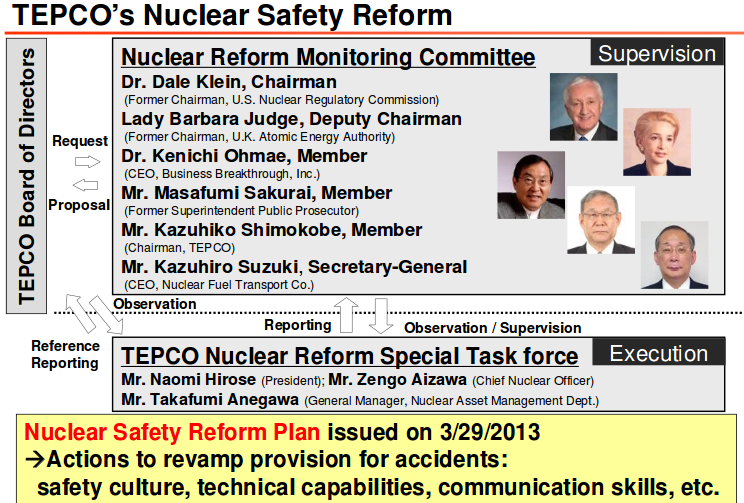
To placate the furious Japanese public, [TEPCO must] remove every trace of the facility
TEPCO officials have admitted frankly that they don’t yet know how to accomplish the tasks
“At Fukushima you have wrecked infrastructure, three melted cores, and you have some core on the floor, ex-vessel,” [TEPCO adviser Lake] Barrett says
Nothing like Fukushima, [Barrett] declares, has ever happened before
There is no guarantee that this epic project can be accomplished — But faced with the wrath of the Japanese people, TEPCO has no choice but to try
Explosions […] sprayed radioactive materials throughout the buildings
Many of the leaks are thought to be in the suppression chambers, doughnut-shaped structures that ring the containment vessel
Rooms that surround them are now filled with water […] no easy way to spot the ruptures
TEPCO may [end up] pouring concrete into the suppression chamber
As long as that melted fuel glows inside reactors 1, 2, and 3, Fukushima Daiichi will remain Japan’s ongoing nightmare
Melted fuel may also have a lavalike consistency, with a hard crust on top but softer materials inside
In another article for IEEE Spectrum, the author of the report highlighted above wrote, “The calamity will undoubtedly improve nuclear plant design. True, the antinuclear forces will find plenty in the Fukushima saga to bolster their arguments.”
Also, IEEE appears on a Tepco document revealing a select group of entities that are “working together” with Tepco to “disseminate” Fukushima-related information.
…….Based on information provided by the U.S. Department of Energy to date, there is no indication that waste from AY-102 has reached the environment. The state fully expects the federal government to provide all details about this leak as their investigation continues,” wrote Bellon in a statement to KING 5.
But Hanford sources who have firsthand knowledge of Tank AY-102 say the USDOE has yet to finish the testing needed to prove the nuclear waste has not breached the outer containment of the tank. The leak detection system connected to the AY-102 has indicated the waste has entered the environment…..
RICHLAND, Wash. — Workers have found more waste leaking between the walls of a nuclear storage tank on the Hanford Nuclear Reservation.
The waste was found in a new place between the walls of one of the 28 double shell tanks at the site. The US Dept. of Energy, which owns Hanford, says the waste is covering an area of 7 feet by 21 inches. The double shell tanks were built to be the most robust tanks at Hanford. They were constructed with the intent to be able to safely store the dangerous wastes until the technology to permanently dispose of the liquids is developed. A leak in a double shell tank is seen as one of the biggest setbacks to the cleanup program at Hanford in the last decade.
Workers tell KING they first saw signs of the new leak location on February 24 and confirmed it with a video inspection on March 3. This is the third identified leak location in the massive 1 million gallon underground storage tank known as AY-102.
……In addition to the billions being contributed to various bodies within the U.N. system, the United States provides 22 percent of the U.N.’s operating budget, more than twice as much as the No. 2 contributor, Japan (10.8 percent)….
……“It’s disturbing that no one, including our ambassador to the United Nations, knows exactly how much money we send the U.N. every year,” Enzi said in a statement.
“With a national debt exceeding $17 trillion, we need to be able to account for every dime we spend, including what we send to the U.N.”…..
…… 24 May 2013 – (The date of submission was JUST before the last meeeting so as to stop any challenges to the Japanese BAD SCIENCE)……
…Deborah H. Oughton, a radioecologist at the Norwegian University of Life Sciences. And more work is needed to learn how radiationand other stressors, such as the tsunami itself, affected wildlife in the area, she says….
Environment: Researchers estimate that radiation exposure from the 2011 nuclear disaster mostly remains below harmful levels for organisms
Radioactive material released during Japan’s Fukushima nuclear disaster, which unfolded in March 2011 as the result of a powerful earthquake and devastating tsunami, probably caused little long-term harm to wildlife within 100 km of the power plant, a new study suggests.
A team of scientists modeled radiation exposure caused by the crippled nuclear plant and found that the doses weren’t high enough to prevent populations of plants and animals from reproducing and surviving (Environ. Sci. Technol. Lett. 2014, DOI: 10.1021/ez500019j).
The work challenges previous studies that suggested Fukushima would lead to serious effects on wildlife, says Kathryn A. Higley, a radioecologist at Oregon State University. One such study reported a link between elevated radiation levels and abnormalities in insects (Sci. Rep. 2012, DOI: 10.1038/srep00570).
Fukushima ’caused mutant butterflies’ in Japan
Genetic mutations have been found in three generations of butterflies from near Japan’s crippled Fukushima nuclear plant, scientists said on Tuesday, raising fears radiation could affect other species.
But the new study’s use of more accurate modeling methods to estimate organisms’ radiation doses has allowed a better assessment of the radiation effects, says Higley, who wasn’t involved in either study.
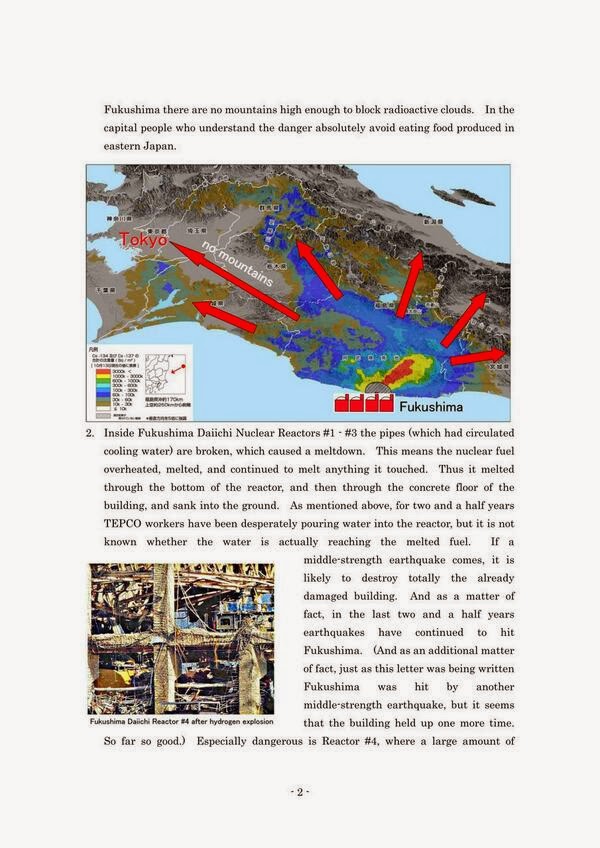
After a tsunami damaged the Fukushima Daiichi Nuclear Power Station, three of its reactors melted down, causing radioactive nuclides to spew into the air and spread to nearby areas. Since the start of the incident, scientists have tried to estimate whether wildlife had been exposed to radiation levels that might hurt the ability of populations to reproduce and survive. [And poop – Arclight2011]
Using the Hagan-Poiseuille-equation for dynamic pressure, they determined that the pressure needed to project the poop depended on the viscosity of said poop. Observe Figure 2 (below), which illustrates the dependence of pooping pressure on viscosity.
This necessitated that the authors measure the penguin poop’s viscosity with a high-performance viscosimeter (not one of those cheap-o low-performance viscosimeters!). However, the readings were inconsistent due to all the fishbones and shrimp shells in the poop, but their best estimate was that the poop’s viscosity matched somewhere around that of olive oil. (Ew ew.) After this final value was obtained, they were able to complete the equation and estimate that the power of a penguin’s fart was somewhere in the range of 10kPa to 60 kPa.
Most previous studies relied on dosimeters that measure only external dosage to wildlife. In the new study, Justin E. Brown of the Norwegian Radiation Protection Authority and his colleagues used a model to estimate doses organisms received internally from ingesting radioactive material, which they say is a more accurate way to assess long-term risks.
Finnish nuclear plant already vastly over budget and overdue has slowed almost to a halt, embroiled in dispute and with no end in sight; it augurs badly for UK’s bloated nuclear ambition.
When the Finnish government agreed in 2005 to the construction of a new reactor on the Olkiluoto site in the far north of the country, this was the first nuclear power plant to be ordered in Western Europe for 15 years. Supporters of nuclear energy greeted it as the start of a ‘nuclear renaissance’. But things have not worked out as hoped. Olkuiluoto 3 was supposed to cost €3.2 bn and is now expected to cost almost three times as much. It was supposed to be in operation by 2009 but the date keeps being put forward. And relations between the Finnish power consortium Teollisuuden Voima (TVO) and the French construction firm Areva have been described by Areva’s Chief Operating Officer as one of the biggest conflicts in the history of the construction sector [1].
From bad to worse
Things now seem to be going from bad to worse. According to Kauppalehti, the largest financial newspaper in Finland, far from activity on the site being pressed forward so as to get the job done, it is actually being run down [2]. There are fewer workers on the site than before, and the contracts of the foremen, which are typically for a year at a time and should be renewed by the end of March, are being allowed to lapse. Some of the less technically demanding work can continue without them, but most of the construction will have to stop and expert staff that leave and get other jobs will be hard to replace. One worker on the site, who preferred to remain anonymous, estimated that every month lost at this stage will add three months to the time to completion. Areva, in charge of building the plant, has not issued a new timetable, so we do not know when they now expect to complete their work. It seems certain that Olkiluoto 3 will not be operational before 2016, and sometime between 2018 and 2020 is probably a better guess
Geoff Read is a British artist who teaches the subject. He is married to a Japanese woman, and they have a son. In 2009, Geoff and his family decided to move to Japan. To Fukishima to be precise. Geoff tells @jenntracey what happened on 11 March 2011 when the nuclear disaster happened, 80 miles from where they were living.
The image is taken from the Strong Children Japan website http://strongchildrenjapan.blogspot.com/
Former engineer and journalist, Takashi Hirose warns about nuclear dangers and its industry in numerous publications. In Japan everyone knows his name and several of his works became best-sellers like “the time bomb”.
Interview conducted by Keiko Courdy for Au-delà du Nuage °Yonaoshi 3.11_ Japan
Saturday 15 March: Solidarity March & Rally in London
Tuesday 11 March: Candlelit Vigil
Monday 10 March; Public Meeting in LondonJoin us to march in London, to mark the 3rd anniversary of the ongoing Fukushima disaster, in international solidarity with people in Japan and for a nuclear-free world.We, Japanese expats and UK citizens, are speaking with one voice as world citizens. We want all the governments to abolish nuclear power generation, to prevent the further release and spread of radioactive materials, to implement policies to protect people’s health and lives and to uphold citizens’ rights to engage in social activities and free speech.We are deeply concerned that radioactive contamination from the nuclear catastrophe at the Fukushima Daiichi Nuclear Power Plant that started on March 11 2011, has been spreading across Japan.The nuclear tragedies in Chernobyl and Fukushima have taught us that despite the guise of ‘peaceful use’, the destruction caused by a nuclear power disaster would be similar to nuclear war. Japan is the most earthquake prone country in the world and, currently, is in a very active seismic phase.Nuclear catastrophe in Japan would lead to long-term worldwide radioactive contamination. There is no safe method to dispose of nuclear waste. Using nuclear power means passing a burden to our children and their descendants. In addition, throughout the nuclear fuel cycle from uranium mining to decommission and waste storage, nuclear energy relies heavily on the sacrifice of workers who are exposed to radiation as they carry out these tasks. Given the deadly long-term toxicity of radiation released to the environment through use of nuclear energy, it must be said that nuclear power is both extremely dangerous and irresponsible. Nuclear power is not welcome in Japan, in the UK, and anywhere in the world.
Japanese Against Nuclear, Kick nuclear and CND are calling all the people in the UK to join the march, vigil, and the public meeting explained below:
** Saturday 9 March: SOLIDARITY MARCH
Assemble 12.30 at Hyde Park Corner for solidarity March to Parliament
with rally there, in Palace Yard, at 2.30pm
** Monday 11 March: Candle-lit Vigil
6.00-800 PM, opposite the Japanese Embassy
(101 Piccadilly, London, W1J 7JT)
(nearest tube: Green Park)
** Monday 10 March: Public Meeting
7.00 – 9.00PM, in the House of Commons
“Fukushima 3 Years On & Implications for UK Nuclear Power Plans” Chair:Jeremy Corbyn MP, vice-chair CND; Introduction by Kate Hudson, General Secretary, CND
Speakers:• Dr. Paul Dorfman• Dr. David Lowry: “Nuclear’s insecurity of supply” and “The truth about evacuation zones as a lesson from Fukushima.”• Speaker from Green Cross Switzerland: “Japan’s nuclear phase-out following Fukushima.”• Rik, a member of Kick Nuclear “Fukushima: What’s been happening the last few years.”• Geoff Read and Kevin Allwright, Fukushima refugees
Followed by: questions from the floor and discussion. Please give yourself half an hour to get through security. For further info contact London Region CND on 020-7607-2302
VIGIL Tuesday March 11, from 6-8 pm opposite JAPANESE EMBASSY, 101-104 Piccadilly, London W1J 7JT Candle-Lit Vigil in support of families and people of all ages continuing to suffer the effects of the Fukushima nuclear disaster.
Organized by:Japanese Against Nuclear UK (JAN UK), Kick Nuclear, and CND
Comment and report of Parliamentary session by P Hammond MP at 21.15 to 12.45 pm 6/3/2014
Posted to nuclear-news.net
Philip Hammond MP was speaking today at the Houses of Parliament concerning the PWR2 nuclear prototype reactor that is used in nuclear submarine fleet such as in the Vanguard class nuclear submarines. Problems have been found in a prototype reactor with the same design based at Dounreay nuclear site in Scotland.
The prototype reactor has been running at a higher rate than in service reactors and damage to the fuel cladding is reported to be the problem.
P Hammond MP said that there was no safety issues even though radiation has been found circulating with the cooling system.
The reactor was restarted after a service schedule in 2012 and is expected to run until 2015.
Vernon Coaker MP commented on the problem with the reactor and asked why is the house being told today after missed opportunities in the last 4 years. He also said that transparency is important. It is now on maintenance cycle but if the reactor is run as scheduled, it would take 3 more years before the cladding can be assessed, is that not too long?
The fuel bundles are the same design as the new PWR3 generation reactors for the new class submarine and may be needed to replace the existing vanguard class fuel rods . The cost of just one refuel is 120 million pounds sterling each or about 200 million dollars extra on top of the massive existing funding for these schemes.
Andrew Miller MP asked “that even if it was a “level zero event”, why werent at least local stakeholders informed of the issues?”
This is highlighting a staggering lack of transparency and co-operation with stakeholders such as the recent issue with the stakeholder group from Bradwell, and other anti nuclear Stakeholders, who were sidelined and ignored earlier this year, concerning their decommissioning fears, by the Department of the Environment and Climate Change (DECC). DECC released the final draft of their choice on the Gov.org website whilst they were attending stakeholder meetings, without notifying the stakeholders.
P Hammond mentioned that “core burn” on the prototype PWR2 core exceeds by far the normal submarine operational reactors. He mentioned that the fuel rod cladding had likely developed a “pin hole” leak into the cooling system causing some contamination. P Hammond was unsure if the reactor might be stopped now so in 3 years the cladding and reactor surfaces can be analysed though he wanted to keep to the planned running schedule.
“The PWR3 reactor program will not need a prototype reactor” P Hammond said. This has not been included in previous government cost disclosures. The government hope to rely on computer programing software to map out any issues. However, the recent flaw in the PWR2 prototype was not found by software programing and the fault can not be confirmed until 3 years after the reactor stops running at the earliest.
The chief scientific advisor has been asked to look into the viability of making a prototype test reactor for the PWR3 Astute fleet it was confirmed by P. Hammond MP later in the debate.
P Hammond refused to detail the actual “burn up rate” as propriety knowledge of the nuclear companies and therefore a secret.
EDF have been pulled up by regulators in France for running their civil reactor fleet for longer causing the fuel rod cladding to get dangerously thin and similar problems are reported in the USA because of using high burnup techniques. This is to increase electricity output in a competitive electricity market place and to maximise profits from the very expensive fuel rod bundles. More frequent fuel replacements have been advocated that will cause rising costs for all nuclear reactors as well as reduced performance.
The Scottish Environment Protection Agency had been informed but only key Scottish ministers have been informed. SEPA did not feel the Scottish Parliament needed to know of the situation P Hammond said.
The decisions on the new PWR3 driven reactor submarine fleet will be finally decided in 2016.
Rolls Royce were commended for being the lead technical authority and manufacturer of these reactor cores. 80 reactor cores have been supplied since 1963 by Rolls Royce who is a leading provider of military reactor cores.
AUDIO: Scottish Ministers Demand Meeting Over Secret Higland Nuclear Incident
A row’s erupted between the Scottish and UK governments over secrecy surrounding a nuclear incident in the Highlands.
Yesterday the Ministry of Defence admitted to Parliament it had kept quiet about a problem with the Dounreay reactor.
The revelation came two years after radioactivity was detected where it shouldn’t have been.
Scottish Minister Keith Brown’s written a letter to London ‘seeking an early meeting’: “Why were we not told? It would simply take a phone call from Defence Secretary Philip Hammond or one of his ministers to a minister in the Scottish Government, and let us know.
“If it was not serious, as has been said, why not just let us know?
“It’s appalling that the UK Government has treated with such contempt both Scotland’s government and the people of Scotland.
“It shows the arrogance which has been demonstrated on a number of other defence issues.”
Ageing nuclear submarines could put sailors and public at… August 04, 2013 Britain’s ageing hunter-killer nuclear submarines are suffering mounting technical problems that could endanger the safety of sailors and the public, a report from the Ministry of Defence (MoD) has warned. Five Trafalgar-class submarines, between 22 and 29 years old, are running into reliability issues with the reactors that power them, increasing the risk of cracks, pipe failures and…
Major nuclear incident at Britain’s Royal Navy submarine… October 07, 2013 The failure of both the primary and secondary power sources of coolant for nuclear reactors at the Devonport dockyard in Plymouth on 29 July last year followed warnings in previous years of just such a situation. Experts yesterday compared the crisis at the naval base, operated by the Ministry of Defence and government engineering contractors Babcock Marine, with the Fukushima Daiichi…

 Subject: Fuel element cladding at the Cattenom nuclear power plant












 nuclear-news