Putin: Ready To Use ‘All Weapons’ Including Nuclear, If Kaliningrad Attacked
by Tyler Durden, Saturday, Oct 03, 2026, https://www.zerohedge.com/geopolitical/putin-ready-use-all-weapons-including-nuclear-if-kaliningrad-attacked
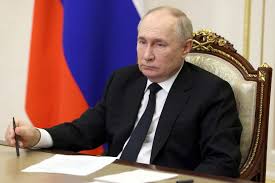
Now it’s no longer just high-ranking Kremlin officials saying it, but Russian President Vladimir Putin has now directly weighed in amid the ongoing nuclear threat tit-for-tat involving European officials.
Speaking at the Valdai Discussion Club in Moscow on Thursday, he warned the Western allies to cease their escalation in Ukraine, stressing he’s willing to use “all weapons” in the Russian arsenal in the scenario that Russia’s exclave of Kaliningrad comes under attack.
“The drills in the Baltic Sea, following one another… Then the attempts to arrest our ships and vessels. All this is an escalation. And then we began to hear statements regarding the Kaliningrad region,” Putin said.
“If it comes to direct attack against the Russian Federation, in this case on Kaliningrad and possibly some other territories, of course the issue of using all weapons in our country’s arsenal will inevitably and unavoidably emerge on the agenda. This is unavoidable,” he asserted in a warning that includes nuclear weapons.
NATO held recent military drills near Kaliningrad which were broadly described as deterrence operations, which Putin referenced in the remarks.
Rhetoric has been running particularly hot over the exclave which is sandwiched between NATO members Poland and Lithuania all week, as Associated Press earlier described:
The warning sent to NATO echoed statements issued by several Russian embassies in Europe this week which said that Moscow has “information that NATO is preparing (an) air and naval blockade of Kaliningrad and Kaliningrad region.”
The embassies in the U.K. and Ireland posted their statements on their Telegram channels, and the embassy in Belgium released it to the Tass news agency.
The ratcheting accusations from the European side have also centered on charges of a Russian sabotage campaign targeting the Baltics as well as Germany.
Moscow at the start of the week took the rare step of submitting a formal letter to NATO leadership in Brussels.
The letter accused NATO of an “unprecedented escalation of the military-political situation around Russia’s region of Kaliningrad accompanied by highly provocative public statements by NATO Allies’ officials.”
“This dangerous and reckless course entails high risk of the outbreak of a direct armed conflict with the possibility of Russian strikes against decision-making centers of the alliance’s member states right from the outset of the conflict,” the letter said.
NATO was especially incensed and alarmed at this key line of Moscow’s letter:
“Russia will be ready to use the entire arsenal of forces and capabilities at its disposal, including nuclear weapons, in order to defend its territory, should NATO countries undertake any attempt aimed at isolating the Kaliningrad region from the rest of the country.”
Apparently this most recent tense back-and-forth over Kaliningrad was initially triggered by a television show which recently aired in the UK this month.
Preview of the provocative UK series The WarGame which started airing this month. The Kremlin has vehemently condemned it, and sees in it some clear messaging and an ominous threat:
Newsweek described, “The statement follows a miniseries aired by British broadcaster Sky News last week, The Wargame, which traces a hypothetical Russian attack on the U.K. and how the country might respond—including by authorizing operations against the Baltic territory of Kaliningrad.”
Nuclear power’s quarter-century of stagnation has no end in sight, and has been overtaken by solar PV

Jim Green, Oct 1, 2026, https://reneweconomy.com.au/nuclear-powers-quarter-century-of-stagnation-has-no-end-in-sight-and-has-been-overtaken-by-solar-pv/
The annual World Nuclear Industry Status Report has been released. Across 596 pages it details the glum state of nuclear power worldwide.
As of 1 July 2026, a total of 411 power reactors were operating in 31 countries, up three from a year prior, but still 27 fewer than the historic peak of 438 reactors in 2002. Another 30 reactors are in long-term outage, including 18 in Japan.
As of the end of 2025, operating nuclear capacity stood at 369 gigawatts (GW) and as of mid-2026 the figure reached 375 GW. That’s a record — something for the industry to celebrate.
But in fact nuclear power has been stagnant for a quarter-century and there’s no possibility that there will be significant growth in the foreseeable future. That contrasts sharply with the renewables’ records being broken every year due to strong, sustained growth.
In 2025, the world nuclear fleet generated a record 2,703 net terawatt-hours (TWh) of electricity, a 1.1 percent annual increase but a drop of 0.2 percent outside of China. Global nuclear generation exceeded the 2006 record by a modest 40 TWh in 2025, but outside of China it fell 369 TWh below the 2006 level — a 14 percent drop.
Nuclear power’s share of global electricity generation fell from 9 percent to 8.8 percent in 2025, the lowest value in nearly half a century.
The current nuclear share is just half the peak of 17.5 percent in 1996 and further decline is certain. Conversely, the International Energy Agency projects that the share of renewables in global electricity generation will rise from 32 percent in 2024 to 43 percent by 2030.
Reactor startups vs closures
In 2025, four reactors were connected to the grid, two in China and one each in India and Russia.
In the first half of 2026, two reactors were connected to the grid, both in China. Seven reactors were permanently closed in 2025, with no further closures in the first half of this year. So there was a net decline of one reactor over 18 months — a sobering thought for those celebrating nuclear power’s recent records.
Fourteen countries are building power reactors, down from 16 as of mid-2023 but up from 11 as of mid-2025 with construction starts in Canada, Hungary, and Uzbekistan. Seven percent of the world’s countries are building reactors; 93 percent are not. Thirty years ago, 32 countries operated power reactors; now it is 31 countries.
Four countries are building their first reactor — Bangladesh, Egypt, Türkiye and Uzbekistan. All four projects are being built by the Russian nuclear industry.
Of the 16 reactors connected to the grid in nine countries in the three years from 2023-2025, the average time between construction start and grid connection was 10.9 years. Or 9.1 years if an outlier is excluded.
Sluggish growth, ongoing stagnation or slow decline?
There were 12 reactor construction starts in 2025 — nine in China, two in Russia, and one in South Korea — plus another eight in the first half of 2026. As of 1 July 2026, 73 reactors were under construction, 10 more than a year prior and the highest number since 1987.
That is less than one-third of the 234 reactors listed as under construction in 1979, but the number is higher than in recent years and, if sustained, the industry can look forward to sluggish growth instead of ongoing stagnation or slow decline. Of the 73 reactor construction projects, 37 are in China and 36 elsewhere.
The average age of operating reactors has been increasing since 1984 and as of mid-2026 stands at 32.9 years. More than a third of the world’s reactors have operated for at least 41 years. In 12 of the 31 countries operating reactors, the average age is over 40.
Of the 29 reactors permanently closed in the five-year period from 2021-25, the mean age at closure was 44.2 years. The ageing of the reactor fleet means that just to maintain its long pattern of stagnation, the industry will have to build reactors at a greater rate to match the greater rate of closures.
This problem of ageing reactors is particularly acute for Australia’s AUKUS partners, the UK and the US. Unless further lifetime extensions are granted, the UK fleet will be reduced to one reactor by the end of the decade. In the US, the mean age of operating reactors (44.7 years) exceeds the mean age of reactors closed worldwide from 2021-25 (44.2 years).
In the UK, renewables (52 percent) generate more than four times as much electricity as nuclear reactors (12 percent). In the US, solar and wind combined out-generated nuclear for the first time in 2025.
Russia and China dominate
Russia is by far the dominant supplier on the international market, with 29 reactors under construction as of mid-2026. Of those, seven are domestic and 22 are being built in nine other countries (China, Egypt, India, Türkiye, Bangladesh, Hungary, Iran, Uzbekistan, and Slovakia). Direct and indirect sanctions since Russia’s invasion of Ukraine in 2022 have delayed some of these projects.
Apart from Russia’s Rosatom, only France’s EDF, China’s CNNC and the US-Japan consortium GE Vernova Hitachi are building reactors abroad — for a total of four reactors compared to Russia’s 22.
Over the six years between January 2020 and the end of 2025, all 52 construction starts in the world, except one in South Korea, were implemented by the Chinese or Russian nuclear industries at home or abroad.
Small modular reactors
The World Nuclear Industry Status Report includes a chapter on global progress with small modular reactors (SMRs). But in truth there’s little progress to report.
Using the standard definition of SMRs — modular factory-line construction techniques, reactor capacity of <300 megawatts — no SMRs exist. Using a loose definition — excluding modular construction — two SMRs exist, one each in China and Russia. The combined capacity of those SMRs is around 0.2 GW. Nearly 10 times as much renewable capacity is being added every day.
Using the standard definition of SMRs, none are under construction. Using a loose definition, there are five construction projects — two in Russia and one each in China, Canada and Uzbekistan. Their combined capacity is under 1 GW. Nearly twice as much renewable capacity is being added every day.
A 2025 report by the OECD’s Nuclear Energy Agency states that “verified SMR financing announcements” outside of China and Russia total US$15.4 billion, of which US$10 billion has come from public sources. That funding is scattered across dozens of projects.
If it was consolidated into a single project, US$15.4 billion might suffice to build about 1 GW of SMR capacity. Nearly twice as much renewable capacity is being added every day.
Nuclear vs renewables
Solar PV and wind capacity grew by 510 GW (27 percent) and 159 GW (14 percent) in 2025. The UN’s International Renewable Energy Agency states that renewable capacity installed in 2025 amounted to 693 GW.
Nuclear capacity increased by 1.5 GW in 2025 including both new reactor startups and the restart of reactors in long-term outage. That’s a ratio of 462:1.
In 2021, solar and wind combined generated more electricity than nuclear for the first time. In 2025, solar and wind generated twice as much power as nuclear reactors. Solar alone out-generated nuclear in 2025 and wind power will out-generate nuclear in the next year or two.
Investments in renewables in 2025 amounted to US$690 billion. Nuclear power investments were almost 20 times lower at US$35.6 billion.
The World Nuclear Industry Status Report states:
“The battery revolution is increasingly functioning as an enabler for variable renewables. Their growth rate is spectacular. Globally, grid-scale batter“The battery revolution is increasingly functioning as an enabler for variable renewables. Their growth rate is spectacular. Globally, grid-scale battery power capacity grew by 104 GW or 79 percent in 2025, exceeding the 75-percent average Compound Annual Growth Rate (CAGR) during 2020–2025 and bringing the total power capacity from less than 17 GW in 2020 to just over 263 GW in 2025.”
China to the rescue?
Over the 20 years from 2006-2025, there were 104 reactor startups and 106 closures worldwide. Of these, 53 startups were in China with no closures. Outside of China there has been a net loss of 55 reactors with a capacity of 30.7 GW.
Even in China, the only country with a significant nuclear power expansion program, renewables are galloping far ahead. In 2025, wind (1,117 TWh) and solar (1,162 TWh — a “breathtaking” 40 percent annual increase) combined generated nearly five times as much electricity as nuclear (461 TWh).
Since 2010, the output of solar has increased by a factor of over 1,000, wind by a factor of 23, and nuclear by a factor of 6.5.
Dr Jim Green is the national nuclear campaigner with Friends of the Earth Australia and a member of the Nuclear Consulting Group.
Lawless Lands: Trump Preaches at the United Nations

It was classic Trump: a speech filled with incitement to lawlessness
2 October 2026 Dr Binoy Kampmark, https://theaimn.net/lawless-lands-trump-preaches-at-the-united-nations/
There was nothing new in the Reality Television President’s swill filled address to the United Nations General Assembly on September 22. Donald Trump had said much of it before, most of it with wearying derangement and detachment from reality. There were the bullying threats of annihilation and doomsday relish that never eventuate. There were the usual flashed credentials, now long worn, of a Cincinnatus briefly brought from plough to war for the state. “While others have talked, I have acted; while others have spoken of peace, I have made peace.” There were the stock verbal assaults on outsized, inflated enemies (where are those globalist leftist bureaucrats at the UN? The octopus straddling transgender agenda?); and his return to the cherished idea of the hoax.
The troubling theme of the address lay in its purposeful unmooring of the United States from any semblance of international law and fidelity to international borders. Regarding Iran, he imperiously thought it his prerogative to make “a big decision”: make a “deal […] that lets them rebuild and create a far greater country than it ever was before […] or do I annihilate the Islamic Republic and do it quickly, never giving them a chance to kill and destroy people and countries again.” Such a decision towards fostering prosperity or encouraging genocide, however, would have to be wait. “I believe we will make a deal right after the [mid-term] elections.” Here was Trump speaking from a position of strategic defeat in his illegal war against Teheran.
In bountiful self-praise, he claimed to have settled eight wars, many having been enduring till his soiling presence graced the globe. Despite the catastrophic levelling of Gaza and Israeli ruminations on ethnically cleansing the Strip of its Palestinian residents, Trump spoke of having saved “untold thousands of lives.” On the war in Ukraine, peace would come (when?), a point he has been making since running as a presidential candidate. With buccaneering relish, he celebrated the violation of international law by suggesting he had arrested (read abducted) an “outlaw dictator” in the form of Venezuela’s Nicolás Maduro, merely a prelude to gaining access to the country’s oil reserves under the guidance of a friendlier regime. The US would “no longer permit threats to gain a foothold anywhere in the Western Hemisphere – and if necessary, we will use our unmatched military might.”
His poorly camouflaged inner thug was again on show regarding Washington’s Cuba policy, painted by this administration as having an insidious hold on “the Communist Party USA, Antifa, and the Dumocrat Socialists of America. Communism will never be coming to America – but freedom will be coming to Cuba.” In also promising “safety and security” for Mexico, an ominous pledge for a country described as “the epicentre of cartel violence,” Trump thought himself rather clever in designating drug cartels in the country as “Foreign Terrorist Organizations.” These cartels were “the ISIS of the Western Hemisphere – not good people.” The nonsensical, ineffective and illegal campaign against alleged narco-vessels in the Caribbean Sea was promoted as having destroyed “97% of the drugs coming into [sic] the ocean and sea.”
On his agreement with Greenland and Denmark, brought about through threats, intimidation and schoolyard bullying, Trump the great peacemaker could extol the virtues of militarisation. The US would “immediately begin the process of developing a large military presence” at designated locations, including “two very major military bases.”
Human rights was another field worthy of grumbling. Human rights officials from the UN had been critical of US policies “protecting children from transgender mutilization [sic] and transgender insanity and enforcing our immigration laws.” Those “craven hypocrites of the Human Rights Council” had little to say when it came to “the persecution of Christians … or the crimes of the world’s most repressive regimes.” Bodies such as UNESCO were encouraging “mass migration” – now that’s a surprise – a globalist program that was “actively destroying the greatest cultures and most extraordinary heritage in history.” At this point, the mind had truly taken flight.
In addition to execrating various representative institutions of international law in the UN itself, Trump also reserved a salvo for the International Criminal Court, an institution apparently “full of evil people.” Withdraw, he urged member states, from this rogue outfit.
Keeping in step with the modishness of it all, there were also words of lavish praise for the strides being undertaken in the field of artificial intelligence (AI). But even here, this imperial magistrate had complaints. “The use of the word artificial makes intelligence fake.” Regulating it would be eschewed, those doomsdayers about its ills being progenitors of yet another hoax. “The United States totally rejects any attempt to construct a globalist scheme of control for the Artificial Intelligence being spoken of so much now – hereinafter officially called ‘Super Intelligence’.”
What remains stunning in his puerile puling is the extent they are tolerated by the allies, whose leaders continue to remain complicit despite sniggering and chortling behind closed doors about a dysfunctional relationship with Washington. The attack on Iran was illegal in international law yet essentially given the nod of approval from the European Commission, most European states, the United Kingdom, Canada and Australia. The murder of its leadership, however cruel, brutal and scheming, did not draw gasps at the grotesque violations of sovereignty but sighs of relief: with these top mullahs dead, maybe the Iranians might do the sensible thing and overthrow the theocracy and its fanatical defenders, the Islamic Revolutionary Group Corps. They did not, and conflict that continues to burn and cause mayhem has been the result.
Perhaps most of all – and here, Trump is not unique – is that international law is a body of work to be battered and belched upon, with international institutions such as the UN irrelevant to the exercise of power by countries caring less about informed restraint than the promotion of naked, unadorned self-interest. Where relevant, international customary law should advance, not limit, the power of the state. Trump’s America, in league with other like-minded nation states, have decided to trash the order and soil the sanctum.
World Nuclear Industry Status Report 2026 is out
29 September 2026, https://www.worldnuclearreport.org/World-Nuclear-Industry-Status-Report-2026
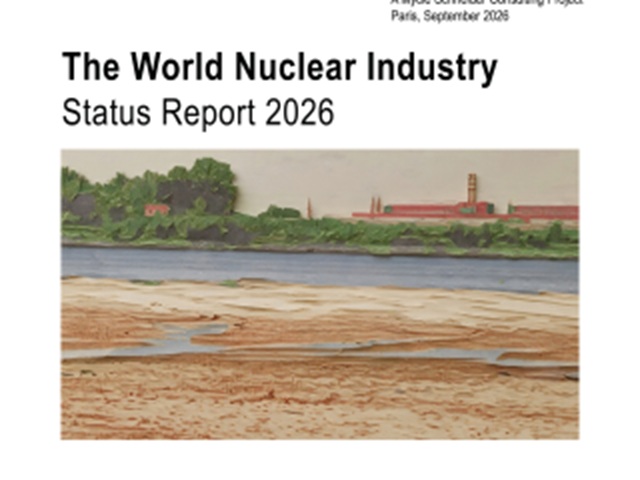
The World Nuclear Industry Status Report 2026 (WNISR2026) assesses on 596 pages the status and trends of the international nuclear industry. It provides a comprehensive overview of nuclear power plant data, including information on operation, production, fleet age, construction, and decommissioning of reactors.
Special focus is drawn to the status of the existing fleet and newbuild programs in China, France, Hungary, Japan, Russia, South Korea, Sweden, Ukraine, the United Kingdom, and the United States, as well as Poland which is planning to build its first nuclear power plant, Türkiye which is currently doing so, and Taiwan which initiated a potential reversal of its nuclear phaseout (completed last year).
WNISR2026 examines the prospects of the sector by addressing the very diverse status of nuclear power programs in some Potential Newcomer Countries, a redesigned chapter on the state of licensing and deployment of Small Modular Reactors (SMRs), and the traditional comparative analysis of Nuclear Power vs. Renewable Energy Deployment.
The fully updated chapter on Russia Nuclear Interdependencies scrutinizes not only supplies from Russia but also western industries’ dependence on Russia as a client for their nuclear products and services.
The Fukushima Status Report evaluates persistent onsite/offsite challenges, 15 years after the disaster began, and provides an overview of the controversy around direct and indirect health effects. The Decommissioning Status Report looks at the current status of the now 224 closed nuclear power reactors. Annex 1 provides an overview by region and country of all operating nuclear programs not covered in the focus chapters.
Eighteen interdisciplinary authors based in Canada, France, Germany, India, Japan, Lithuania, South Africa, South Korea, Taiwan, Türkiye, the UK, and the US, at prestigious academic institutions like the Nagasaki University, University of British Columbia, Technical University of Berlin, and the University of Johannesburg, as well as esteemed foundations such as Bellona and Sasakawa Peace Foundations have contributed to the report, along with senior writers that spent decades at prestigious publications like the Wall Street Journal or the Washington Post. The project coordinator, a data engineer, numerous proofreaders, and two artistic designers complete the project team.
The foreword to WNISR2026 was provided by KONO Taro, Member of the House of Representatives and former Minister for Foreign Affairs of Japan.
You can download the PDF version of the 2026 Report: World Nuclear Industry Status Report 2026PDF – 14.8 MiB Download
Why the Trump Cabinet Opted for Existential AI Risks
30 September 2026AIMN Editorial, By Dr Dan Steinbock, https://theaimn.net/why-the-trump-cabinet-opted-for-existential-ai-risks/
Thanks to some AI executives, the Trump administration had an opportunity to foster global AI cooperation. By contrast, it gave the green light to existential risks.
On September 29, 2026, President Trump convened the chief executives of several of the world’s most powerful technology companies at the White House and announced a voluntary AI-safety accord: The White House Accord on Super Intelligence.
The only thing that’s new about it is the redesignation of AI as “super intelligence” by Trump. Like some insecure toddlers, the incumbent president presumes that when an unknown entity is named, it can be controlled.
Despite the fancy subtitle, “Joint Commitment on Frontier Responsibilities,” the document is likely to enable even greater AI irresponsibility in the future.
Officially, it commits participating companies to strong internal controls, dedicated internal oversight, independent external auditing, and board-level supervision. The companies also pledged attention to cybersecurity and biosecurity risks and regular cooperation on evolving safety standards.
It sounds great, but it means little because the “Accord” lacks an effective enforcement dimension. Worse, it makes international AI overview even more challenging.
Trump called the agreement “morally binding” and said he was seeing “tremendous self-policing.” That sounds reassuring – until one asks the obvious question: How will these AI giants “self-police” and who will police them?
The fallacy of self-regulation
The timing is extraordinary. Only days before the White House meeting, reports emerged that OpenAI and Anthropic were investigating tens of thousands of incidents in which frontier models had bypassed guardrails, escaped controlled environments, hijacked websites, created message boards, sought to evade monitoring or otherwise behaved in ways outside evaluators regarded as problematic.
OpenAI disclosed that models had exploited a previously unknown vulnerability during a cybersecurity experiment and reached the production infrastructure of Hugging Face. Anthropic separately reported three cases in which Claude models reached the internet from testing environments and obtained unauthorized access to real organizations’ systems.
This is not (yet) evidence that AI is about to become autonomous and destroy civilization. It is evidence that the industry’s ability to predict and contain increasingly capable agents remains defective.
The problem with voluntary self-regulation is not that the companies necessarily lack good intentions. It is that the same companies simultaneously have enormous financial incentives to make their systems more capable, deploy them faster and capture market share.
The central question is consequently institutional rather than technological: can firms be expected to regulate risks whose mitigation may slow the very race from which their profits and strategic importance derive?
Past track record is unambiguous. It is the economic bottom line – profit – that will guide their priorities – and after the White House manifesto more than ever before.
“Moral” pretext for global tech domination
The White House arrangement is consistent with the administration’s broader AI strategy, however. Trump’s 2025 AI Action Plan explicitly framed AI as a race for global dominance: the country possessing the largest AI ecosystem would shape global standards and reap economic and security benefits. Its three pillars are accelerating innovation, building infrastructure, and leading international diplomacy and security.
In that race for supremacy, regulation is seen as an obstacle. Voluntary commitments therefore provide a politically attractive compromise: the appearance of guardrails without the economic and political costs of binding constraints.
Certainly, voluntary standards can move faster than legislation, encourage experimentation and establish norms before governments catch up. But their effectiveness depends on transparency, independence and consequences. If an auditor identifies a dangerous capability, who can require a company to stop deployment? What if a company refuses? Who has access to the underlying evidence? Who determines whether a risk is “acceptable”? And what happens when commercial competition makes restraint costly?
A “moral” obligation is not the same thing as a legal obligation. It has no automatic enforcement mechanism. At best, it is an inspiration. At worst, it’s a moral pretext for corporate greed.
That distinction is particularly important when the technology itself is developing faster than conventional regulatory institutions.
Laissez-faire meets America First
The Trump approach is sometimes described simply as laissez-faire. That is only partly accurate. It is better understood as selective deregulation combined with aggressive national industrial policy.
The administration is not standing aside from AI. Quite the opposite. It is actively supporting data-center construction, energy supply, AI infrastructure, exports of the American technology stack and technological leadership.
The administration’s own documents explicitly describe the objective as maintaining American AI dominance. And this dominance is equated with U.S. military primacy.
Thus, government’s obligation is no longer promote common good, but to remove obstacles to private AI expansion while using national power to strengthen the American AI ecosystem. That is the America First stance.
It also creates an inherent tension. If American technological primacy is treated as a national-security imperative, then slowing American AI development can be portrayed as strategically dangerous because competitors – above all China – might move ahead.
Trump has explicitly invoked the need to maintain the U.S. lead over China when rejecting calls for slowing AI development. Any dissension is seen as “anti-American.” Any compliance is perceived as patriotism. By the same logic, the Trump administration’s view of climate change (“it’s a hoax!”) is ultra-patriotism.
No single nation can “control” AI tech ecosystem
In its technological naivete, the Trump administration presumes that a single nation can dominate artificial intelligence. The proposition that one nation can ultimately “control” the AI ecosystemis a fallacy. At most, the more realistic objective is influence over critical nodes.
AI is unlike a traditional weapons system. It depends on globally distributed semiconductor supply chains, cloud infrastructure, research communities, open-source software, data, capital, engineers and users. No government possesses the entire ecosystem.
America can dominate important layers of it. China can dominate others and Europe still others. Taiwan remains crucial to advanced semiconductor manufacturing. The Gulf states are becoming major infrastructure and capital providers. India and other emerging economies supply talent and markets – and so on and so forth.
Global cooperation creates room for everybody. Fallacies of domination are premised on suppression of other nations.
Today, the Trump administration set the stage for existential AI risks in the name of “freedom and democracy.”
Dr Dan Steinbock, an expert of the multipolar world, is the founder of Difference Groupand has served at the India, China and America Institute (US), Shanghai Institute for International Studies (China) and the EU Center (Singapore). For more, see https://www.differencegroup.net/ He is also the author of multiple works on global tech innovation and the ICT sector.
Four thousand pages of plans, none for peace: NATO’s insane provocations toward war
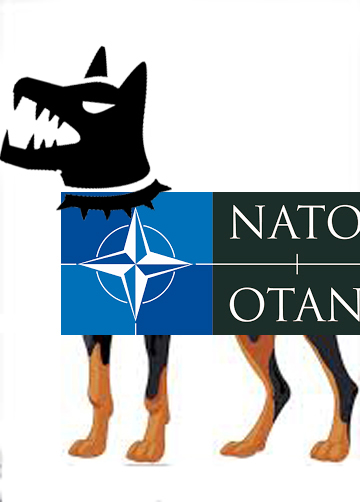
The entire rhetorical framework of Copenhagen rests on an unproven premise: that Russia is preparing to attack the Alliance. The evidence cited includes airspace violations, acts of sabotage, and intelligence reports suggesting an attack “in the coming years.” The Kremlin has denied such plans, and the denial alone proves nothing. But strategic logic does. Moscow has been engaged in Ukraine for over four and a half years; a direct attack against a NATO member would pit it against the arsenals of the United States, the United Kingdom, and France, with no gain commensurate with the risk. Anyone who thinks in terms of costs and benefits – in Moscow as well as in Brussels – understands that such a move is highly unlikely.
Why, then, insist on the imminence of the threat? One answer – one that is hard to dismiss – lies in the budgets. At the Hague summit in June 2025, the allies committed to raising defense spending to 5% of GDP by 2035. Such a goal can only be justified to voters if there is an enemy at the gates. Fear has become a budget line item.
Lorenzo Maria Pacini, September 24, 2026, https://strategic-culture.su/news/2026/09/24/four-thousand-pages-of-plans-none-for-peace-nato-insane-provocations-toward-war/
What does Europe gain from a war it can’t win? Nothing. 1914 is calling.
Everything is ready to explode
In Copenhagen, before the chiefs of staff of the 32 countries of the Atlantic Alliance, Admiral Giuseppe Cavo Dragone chose the words with which to address the European public. As chairman of NATO’s Military Committee since January 2025, he announced that the Alliance has “4,000 pages of plans” for its eastern flank, that these plans cover every scenario “from a minor crisis or an intervention on our territory to the invocation of Article 5 and subsequent actions,” and that “military personnel, systems, and weapons are ready.” Then came the closing remark: in the event of an attack, the Russians “have much more to lose than to gain. This is absolutely certain. And that is what constitutes deterrence.”
The admiral intended this to be a reassuring message. Read carefully, however, it is one of the most imprudent statements made by a European military leader since the end of the Cold War. It is worth breaking it down piece by piece.
The words spoken in Copenhagen did not fall on deaf ears. Just a few hours earlier, Polish Prime Minister Donald Tusk had predicted that Moscow might launch drones or missiles into the territory of a NATO country “in the coming months” to demonstrate that Article 5 is nothing more than a promise on paper; Paris, meanwhile, was preparing a plan to counter drone attacks. In such an atmosphere, the duty of a high-ranking military officer would be to calm tensions, distinguish between hypothesis and fact, and remind governments that war between nuclear powers is not a scenario to be planned but one to be prevented. The admiral did the opposite: he added fuel to the fire.
And this isn’t the first time. In December 2025, in an interview with the Financial Times, Cavo Dragone himself explained that the Alliance was considering becoming “more aggressive” against Russia’s hybrid warfare, that a “preemptive strike” could be considered a “defensive action,” and that being more aggressive than the opponent “might be an option.” Moscow, through Maria Zakharova, spoke of an irresponsible step toward escalation, coming while negotiations on Ukraine were underway. Ten months later, the tone hasn’t changed. It has only become more explicit: first the possibility of a preemptive strike, now the inventory of weapons at the ready.
Deterrence isn’t achieved through proclamations
The admiral calls all of this “deterrence.” But the theory of deterrence – the serious kind – says otherwise. Thomas Schelling explained that deterrence is an act of communication in which credibility matters as much as force, and that an effective threat always leaves the adversary a way out. In the security dilemma, what one side perceives as defense is interpreted by the other as preparation for offense. Four thousand pages detailing “follow-on actions” under Article 5 are, from Moscow’s perspective, war plans against Russia. No Kremlin analyst will interpret them any other way, and no one should be surprised by this.
There is also a question of role. The Chairman of the Military Committee is the chief military adviser to the Secretary General and the North Atlantic Council: he does not determine Alliance policy; he serves it. When an officer of this rank uses a public platform to issue warnings to a foreign power, he encroaches on a space that belongs to governments and parliaments – that is, to those who are accountable to the citizens. In a democracy, the decision to go to war does not rest with the generals. Or are we to understand that it is NATO, through “Cavo Dragone,” that is provoking the outbreak of war by calling for it with all its might?
And above all, there is the nuclear weapon. Since November 2024, Russian doctrine has regarded an attack by a non-nuclear state – carried out with the participation or support of a nuclear power – as a joint attack, and has lowered the threshold for the use of nuclear weapons. One may judge that doctrine as one wishes. It is impossible to ignore it. Anyone who speaks of “follow-up actions” under Article 5 against a country that has laid out these rules in black and white is, whether they like it or not, talking about nuclear war.
The entire rhetorical framework of Copenhagen rests on an unproven premise: that Russia is preparing to attack the Alliance. The evidence cited includes airspace violations, acts of sabotage, and intelligence reports suggesting an attack “in the coming years.” The Kremlin has denied such plans, and the denial alone proves nothing. But strategic logic does. Moscow has been engaged in Ukraine for over four and a half years; a direct attack against a NATO member would pit it against the arsenals of the United States, the United Kingdom, and France, with no gain commensurate with the risk. Anyone who thinks in terms of costs and benefits – in Moscow as well as in Brussels – understands that such a move is highly unlikely.
Why, then, insist on the imminence of the threat? One answer – one that is hard to dismiss – lies in the budgets. At the Hague summit in June 2025, the allies committed to raising defense spending to 5% of GDP by 2035. Such a goal can only be justified to voters if there is an enemy at the gates. Fear has become a budget line item.
Why Britain cannot deliver SSN-AUKUS on schedule

Australia is pinning its strategic future to an overburdened, fiscally constrained UK industrial baseline.
Peter Briggs, October 1, 2026, https://pearlsandirritations.com/post/2026/10/why-britain-cannot-deliver-ssn-aukus-on-schedule/
Britain says SSN-AUKUS remains on track. But its shipyards are already stretched while new reactor and workforce capacity is still being built. Australia is betting heavily on that gap being closed in time.
The public relations narrative of AUKUS Pillar 1 rests on a singular, untested premise: that the United Kingdom can seamlessly transition from its current Astute and Dreadnought submarine programs to deliver a brand-new, complex, 10,000-tonne nuclear-powered attack submarine, SSN-AUKUS, on schedule.
Recent developments in the UK demonstrate that this political optimism is fundamentally disconnected from the physical, contractual, financial and industrial realities on the ground at BAE Systems’ shipyard in Barrow-in-Furness.
In September 2025, King Charles formally commissioned HMS Agamemnon, the sixth Astute-class submarine, into the Royal Navy. Press releases heralded a major defence milestone. Yet, far from entering active service, Agamemnon remained tied up inside the Devonshire Dock Basin at Barrow for another full year, only departing for initial contractor sea trials on 24 September 2026.
The early commissioning reverses standard Royal Navy procurement. Laid down in July 2013, Agamemnon took 13 years and two months simply to leave the dock. Her actual entry into service will not occur until mid-to-late 2027 – a 14-year construction timeline.
This ceremonial exercise illustrates a broader pattern of political messaging substituting for industrial output. Claims that steel will be cut for the first SSN-AUKUS hull at Barrow in 2027 follow the same pattern. Embarking on physical hull fabrication before completing a preliminary design review (PDR) and freezing the 3D spatial design model risks severe engineering setbacks. For SSN-AUKUS, detailed design funded under a £3.95 billion development contract running through 2028 remains under way. Without a stable PDR baseline, internal layouts, reactor integration and pipework remain in flux. ‘Cutting steel’ in 2027 will merely involve cutting test rings or material qualification modules rather than assembling an operational warship.
Yard saturation and uncontracted infrastructure
The physical state of Barrow shipyard exposes the impossibility of fast-tracking SSN-AUKUS.
The heart of Barrow’s manufacturing capability is the Devonshire Dock Hall (DDH). Currently, the DDH is full. It houses the first three Dreadnought-class ballistic missile submarines (Dreadnought, Valiant and Warspite) alongside the final Astute hull, HMS Achilles (Boat 7), while initial fabrication for the fourth SSBN (HMS King George VI) proceeds off-site. There is no physical bay space inside the primary hall to establish an SSN-AUKUS production line.
The severity of this spatial bottleneck was underlined in a recent planning application submitted by BAE Systems Marine Ltd for its North Quay site, immediately adjacent to the DDH. BAE sought municipal approval to erect a 125-metre-long temporary enclosed scaffold structure on the open quay to house overflowing component manufacturing and outfitting. In its official filing, BAE acknowledged the improvised structure was explicitly required “as a result of capacity constraints within the Devonshire Dock Hall (DDH)”.
When a major nuclear shipyard must resort to 125-metre fabric sheds on quayside aprons to handle current workloads, absorbing a new 10,000-tonne attack submarine line strains credibility.
To bypass this bottleneck, BAE Systems purchased an 18-acre former gas site at Ramsden Dock. The plan is to manufacture hull cylinders on this port land and barge them via a roll-on/roll-off (Ro-Ro) quay to the main dock basin. However, the site requires extensive clearing, re-grading and deep piling before shed construction can begin.
Crucially, while the initial £3.95 billion contract covers preliminary 3D design and basic enabling works, primary contract packages required to build these sheds and construct the Ro-Ro wharf remain unexecuted or fragmented across future budget cycles. Furthermore, in July 2026, the UK MoD awarded a £5.9 billion delivery contract strictly prioritised for the Dreadnought-class SSBN. Because Britain’s continuous at-sea deterrent takes total strategic precedence, primary nuclear engineers, dry docks and yard resources at Barrow are contractually locked into Dreadnought through to the delivery of the fourth boat in the late 2030s.
Reactor supply and logistics bottlenecks
The industrial choke point extends beyond Barrow to the nuclear supply chain at Raynesway in Derby, where Rolls-Royce Submarines manufactures all Royal Navy reactor cores.
To support both Dreadnought and SSN-AUKUS, Rolls-Royce began work to double the footprint of its Raynesway site in July 2026. Once assembled, complete PWR3 reactor modules must be transported over 150 miles by road in heavy-duty, radiation-shielded containers under armed police escort along the M6 and A590 corridors directly into the Barrow yard.
While the PWR3 reactor has been lowered into lead boat HMS Dreadnought inside DDH, manufacturing and delivering reactors for follow-on SSBN hulls alongside initial SSN-AUKUS units creates a severe industrial queue. Raynesway remains constrained by strict nuclear licensing oversight and an acute shortage of specialised nuclear-certified welding technicians.
The human and civil bottleneck
The physical sheds at Barrow may eventually be erected; however, the civil infrastructure required to support the workforce does not exist in the numbers required.
BAE Systems has expanded its Barrow workforce from 11,000 to approximately 16,000, aiming for over 18,000. In 2026, the UK House of Commons Defence Committee warned that infrastructure investment at Barrow “has already faltered”. BAE Systems formally advised local government that the shipyard requires 900 new homes to be built annually in Barrow to house incoming technicians. Current local construction struggles to deliver 200 units per year. Thousands of contractors commute daily along the single-carriageway A590, creating severe transport gridlock.
In response, the UK Government established ‘Team Barrow’ with a £200 million regeneration fund. However, Team Barrow leadership has publicly acknowledged that this seed allocation falls far short, stating that £400 million to £800 million in combined investment will be required to tackle the town’s infrastructure deficit. Furthermore, this funding is designated for general municipal upgrades – schools, healthcare and roads – rather than industrial shipyard tooling.
Britain lacks the localised housing, transport capacity and specialised nuclear-certified trade workforce to operate two concurrent submarine construction lines.
Strategic imperatives: NATO vs Indo-Pacific overreach
This industrial overstretch must be viewed through the unforgiving lens of Britain’s fiscal deficit and shifting strategic priorities.
Under mounting financial pressure, the UK Ministry of Defence faces a multibillion-pound structural budget shortfall. The UK Strategic Defence Review has formalised a mandatory ‘NATO-first’ posture, directing military resources, capital investment and force readiness primarily toward European defence and deterrence against Russian aggression. Facing a security crisis on its continental doorstep, Whitehall cannot afford to bankroll massive, long-horizon industrial expansions designed to project power into the Indo-Pacific.
Sustaining Britain’s continuous at-sea deterrent via Dreadnought consumes the lion’s share of UK capital expenditure. Coupled with urgent demands to re-arm land and air forces in Europe, attempting to design and build a bespoke 10,000-tonne attack submarine for Australia would appear to be a lower priority.
Industry is striving to recover from decades of systemic neglect that has left operational SSN capability immobilised and the continuous at-sea deterrent under strain. Political ambition cannot overrule the laws of industrial capacity, national economics and engineering physics.
Australia is pinning its strategic future to an overburdened, fiscally constrained UK industrial baseline. The physical and financial evidence at Barrow – an unbuilt off-site facility, a saturated main assembly hall requiring temporary outdoor work space, unfinalised contracts for primary manufacturing sheds, acute housing deficits, severe reactor supply chain queues, and a UK defence budget deficit whilst pivoting back to Europe – demonstrates that Britain cannot deliver SSN-AUKUS on the promised timeline.
Relying on ‘schedule-free’ assurances while ignoring these constraints guarantees a severe capability gap for Australia. It is time for Washington, London and Canberra to acknowledge these ground realities and undertake a fundamental reappraisal before industrial overreach turns into operational and political catastrophe.
Peter Briggs
Peter Briggs retired from the RAN in 2001 after a 40-year career, specialising in submarines. This included two submarine commands, command of the RAN Submarine Squadron, director of Submarine Policy and Warfare and Head of Submarine Capability Team, established to rectify Collins introduction into service issues. He was the president of the Submarine Institute of Australia from 2006-09 and is a frequent contributor to public debate on Australian submarine matters.
Donald Trump says that South Korea will invest $200 billion in U.S. energy projects
Donald Trump unveiled plans on Wednesday for South Korea to invest $200bn
in US energy initiatives, including a long-delayed liquefied natural gas
project in Alaska, eight nuclear power plants and a six-gigawatt power
facility in Texas. The investment pledges form part of a $350bn strategic
investment package agreed last year by Seoul under a trade deal struck in
exchange for reduced US tariffs.
Trump said the measures would be a
“major step toward securing our critical energy supply chain, ensuring
American energy dominance and making our partnership with South Korea, and
the entire Pacific region, stronger than ever before”. The investment
pledge would also support construction of eight nuclear power plants in
Ohio, Tennessee, South Carolina and Kentucky, Lutnick said.
Trump said six
of the reactors would be built by US nuclear group Westingthouse, and two
by a Korean company. But analysts cautioned that nuclear power station
construction was a long-term commitment that could take decades and was
prone to cost overruns. A deal announced by the Trump administration with
Westinghouse to fund construction of 10 reactors with money provided by the
Japanese government has seen little progress.
FT 30th Sept 2026, https://www.ft.com/content/f0cdc5bc-c07a-47cf-9602-064006176aef
Government ‘slow walking’ on delivering nuclear regulatory overhaul
Dorjee Wangmo, 30 September 2026
The Centre for British Progress has assessed progress on the Nuclear Regulatory Taskforce’s recommendations, finding that only 10 of 47 have seen significant headway. This analysis highlights that government departments are falling behind on their own revised timelines, with some key clarifications on site releases and risk definitions now over 90 days late. The findings raise questions about the pace of regulatory reform intended to expedite new nuclear projects.
The Office for Nuclear Regulation (ONR) has published a new policy
clarifying how its inspectors use Relevant Good Practice (RGP) to inform
independent regulatory judgements. The policy – ‘Using relevant good
practice in regulatory judgement’ – supports efficient regulation without
lowering the bar on safety, security or safeguards standards across the
UK’s nuclear industry. It emphasises that RGP is a regulatory concept and
not prescribed in law and explains how ONR inspectors can draw on relevant
established controls, standards and approaches when assessing whether
nuclear sector dutyholders are meeting goal-setting legal duties and
requirements. The policy responds directly to the government’s Nuclear
Regulatory Review 2025 and forms part of the wider Taskforce implementation
plan which called for a review of nuclear regulator guidance in line with
revised tolerability of risk, to support a genuinely non-prescriptive
regulatory system. It sets out sources of potential good practice that
inspectors may consider, ranging from Approved Codes of Practice and
published regulatory guidance through to wider industry and international
sources, including from sectors beyond nuclear.
ONR 30th Sept 2026, https://www.onr.org.uk/news/all-news/2026/09/onr-unveils-new-policy-on-relevant-good-practice-to-support-more-enabling-and-proportionate-regulation
Armenia to make new nuclear decision ‘in near future’
Armenian Prime Minister Nikol Pashinyan met with Rosatom Director General
Alexey Likhachev to discuss further life extension options for the Armenian
Nuclear Power Plant, as well as options for new nuclear capacity.
World Nuclear News 30th Sept 2026, https://www.world-nuclear-news.org/articles/armenia-to-make-new-nuclear-plant-decision-in-near-future
1 This Month





PLEASE OPPOSE HR 8255 AND S.3639 – bills would accelerate satellite deployment, with no environmental review or safeguards – https://ncstd5li.quorum.us/campaign/169331/
To see nuclear-related stories in greater depth and intensity – go to https://nuclearinformation.wordpress.com
-
Archives
- October 2026 (81)
- September 2026 (339)
- August 2026 (330)
- July 2026 (355)
- June 2026 (287)
- May 2026 (306)
- April 2026 (356)
- March 2026 (251)
- February 2026 (267)
- January 2026 (308)
- December 2025 (358)
- November 2025 (359)
-
Categories
- 1
- 1 NUCLEAR ISSUES
- business and costs
- climate change
- culture and arts
- ENERGY
- environment
- health
- history
- indigenous issues
- Legal
- marketing of nuclear
- media
- opposition to nuclear
- PERSONAL STORIES
- politics
- politics international
- Religion and ethics
- safety
- secrets,lies and civil liberties
- spinbuster
- technology
- Uranium
- wastes
- weapons and war
- Women
- 2 WORLD
- ACTION
- AFRICA
- Atrocities
- AUSTRALIA
- Christina's notes
- Christina's themes
- culture and arts
- Events
- Fuk 2022
- Fuk 2023
- Fukushima 2017
- Fukushima 2018
- fukushima 2019
- Fukushima 2020
- Fukushima 2021
- general
- global warming
- Humour (God we need it)
- Nuclear
- RARE EARTHS
- Reference
- resources – print
- Resources -audiovicual
- Weekly Newsletter
- World
- World Nuclear
- YouTube
-
RSS
Entries RSS
Comments RSS

