Beyond the Propaganda: The French Uniqueness and the New Nuclear Dead End.
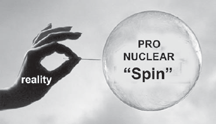
green report.it By Luigi Moccia, June 11, 2026
Nuclear is better than renewables: have you seen how low emissions are in France compared to those in Germany?”
How many times have you heard this biased and misleading statement, accompanied by a graph comparing emissions per kilowatt-hour produced in those two countries?
In its simplicity, this comparison seems solid, but it masks several misunderstandings that require much more than a single indicator chart to unravel.
Proponents of this argument imply that France and Germany represent polar opposites in decarbonization: nuclear-focused France versus renewables-focused Germany. This framework is flawed because, first, Germany has contributed to decisive progress in renewables, but it is not a monolith and has demonstrated contradictory aspects, as we will see below.
Secondly, a partial relativization also applies to France, which, although it has a nuclear energy policy, has also invested in renewables, thus improving the emissions profile of its electricity production.
It’s true that, yes, in Europe, if you’re looking for a natural experiment in pro-nuclear policy, France is the benchmark, and so it makes sense to include it in a debate on energy policies. But if you want a pro-renewables benchmark in Europe, you need to look not at Germany, but at other countries, such as Denmark.
Are France and Denmark countries of different sizes and therefore not comparable? Indeed, in this case, some context is needed, but, if anything, the differences in size work against the small country, Denmark, as we will see below.
This debate is unknown to the public because pro-nuclear clichés are relentlessly directed against Germany, guilty of recognizing that nuclear power is a non-competitive technology on the market, too risky to invest in, and that decarbonization must be achieved with other means. This has led to a proliferation of distortions about German energy policies, which not only invade social media but also end up in the columns of newspapers deemed authoritative, thus distorting the debate. In this excursus on the energy policies of France and Denmark, I will also develop some considerations regarding Germany, as a contribution to countering misinformation. …………………………………………………………………………………………………………………………………………………………………………………………………………………………………………………………..
But how much does French nuclear power really cost?
No one knows for sure. In France, the civil nuclear program was developed under a state monopoly, in conjunction with the military program. The two accounts were not separate and were secret. Only in 2000, once the program was completed, was an attempt made to evaluate the costs of the civil program. A special parliamentary commission of inquiry was established by the Jospin government (the Charpin–Dessus–Pellat Commission , named after the three designated commissioners). An analysis of the data made available by this commission is presented in a 2010 scientific article by Arnulf Grubler ( link ). Contrary to expectations, according to which costs should decrease with the increase in installations, French reactors followed the opposite trajectory: costs increased over time.
The trend of rising costs continued even after the early 2000s, when, according to some, a new “Nuclear Renaissance” should have begun.
Are you having déjà vu ? Didn’t you know there was already a period in which a new beginning for the atom was hypothesized? Well, truth be told, the current “Renaissance” isn’t even the second, because even before the one in the early 2000s, there were those, from a very authoritative position, who had predicted another imminent one, in 1985 (see the article by Alvin Weinberg and co-authors ). So today we are at the third announcement of a “Nuclear Renaissance,” after the first two failed. As you can see, these announcements follow a twenty-year cycle, ebb and flow.
Is nuclear overregulated?
According to some, the rising cost of nuclear energy is caused by excessive regulation: this technology is supposedly subject to safety standards that are too stringent compared to the actual risk. This would therefore be a case of overregulation driven by irrational fears. To support this claim, a graph is usually presented comparing various sources based on the mortality rate per unit of electricity produced. In such a comparison, nuclear power appears to be very low. Is this enough to conclude that nuclear power is a safe source? For influencers and Sunday debunkers, evidently yes, because they spend their time on social media posting this single graph. For the rest of the world, who are familiar with risk analysis, however, the answer is no…………………………………………………………………………………………………………………………………………………………….
What other energy technology presents a risk on a single site of this size? None. That’s why it’s hyperbole to label a technology “safe” when its risks are manageable, but the costs are enormous……………………………………………………………………………………………………………………………………………………………………………………………………………………………….
So what is the cost of the new French nuclear power?
New nuclear power plant projects using French technology that have been started in the last quarter of a century can be counted on one hand and are four in total: Olkiluoto in Finland, Taishan in China, Flamanville in France and Hinkley Point in the United Kingdom.
Quickly, because you could write a book about it: four projects, one worse than the other.
Finland’s Olkiluoto-3 reactor not only went 14 years over schedule and three-odd miles over budget, but it also caused the bankruptcy of AREVA , which was bailed out at Paris’ expense. Thus, the Finns, who had the savvy to sign a turnkey contract, saw their exposure to budget overruns reduced (but not eliminated). Keep this in mind when you hear people boast about the low prices on the Finnish electricity market thanks to the new Olkiluoto reactor: French taxpayers largely paid for it!
The two reactors built in China at Taishan, in addition to overruns in construction time (a five-year delay) and budget (more than 60%, see the report by the French Court of Auditors ), have recorded very mediocre performances in these first years of operation: cumulative capacity factors equal to 55% and 76% (source: IAEA PRIS ), following anomalies detected on the first reactor in 2021 and 2022. Note the difference compared to what nuclear proponents usually boast before the start of each project: according to them, it should always be equal to the capacity factor of the best reactors, equal to around 90%.
China has no plans to build further reactors with this French technology. As China is the only country with a significant nuclear program, at least given the declining status of this source, this debacle undermines France’s hopes of playing a leading role as an exporter of this technology. It is no coincidence that India, which has expressed interest in this technology in its diplomatic relations with France for decades, has yet to finalize any contracts, despite periodic announcements, always reiterated with great fanfare, which are then forgotten.
The domestically built Flamanville reactor continues to astound the world with its incredible series of unfortunate events. After twelve years of construction overruns and a budget more than three times the originally planned, the Flamanville-3 reactor powered up on September 3, 2024. The day was celebrated with great fanfare by nuclear proponents, evidently to forget the previous tribulations, because what’s done is done.
It’s a shame that nuclear power is a bit more complex than any other technology. As of June 2026, 21 months after commissioning, the reactor is not yet fully operational (source: IAEA PRIS ). If it is fully operational in the coming months, 2026 will be a short operational phase: further extraordinary maintenance is planned to replace a major component, as well as other repairs. This shutdown phase will begin in September 2026 and last almost a year. Therefore, the actual performance of this reactor will only be determined in 2028, assuming all goes well.
The costs? The French Court of Auditors had estimated the investment cost, including interest, at €23.7 billion, based on 2023 figures (
link ). But in the meantime, there have been further delays, and then the extraordinary maintenance phase will arrive. Each year of inactivity for such a large reactor entails liabilities exceeding €1 billion. A new assessment will be drawn up in a few years, but it’s already safe to say that, in a nation that has never abandoned nuclear power, a new reactor built on a site already equipped with adequate infrastructure (because it already hosts other reactors) will produce at well over €160/MWh (see Fig. 7, page 24 of
this technical report by Australian researchers, considering that the analysis does not include the aforementioned post-construction delays). That’s roughly triple what some dreamers believe possible with nuclear power here in Italy. Of course, they’d be the “rational” ones!
Last but not least , England: here, the nuclear revival was supposed to take place, as decided by Tony Blair’s governments. In the British political system, which is predominantly two-party, nuclear power enjoys almost complete support in both government and opposition. But despite the absence of significant parliamentary opposition, nuclear power has never been revived in the past quarter-century. Delays and budget overruns at the Hinkley Point power plant under construction have significantly dampened expectations. Compensation for the two new reactors at this plant is expected to be based on a guaranteed price for 35 years, fully indexed to inflation. This price, at current values, is equal to €151/MWh (but be careful, it must be updated annually for inflation, and entry into service is scheduled for the early 2030s). It is unlikely that this remuneration, however generous, will be sufficient to guarantee the profitability of the French company EDF. The Court of Auditors of that country has already expressed criticism of the matter; see page 56 of this report . On this project alone, EDF had to absorb losses of 12.9 billion euros in 2024 ( link ), to which further losses of 2.5 billion euros were added in 2026 ( link ).
In short, electricity is expensive for British customers, without even generating value for the French taxpayer. Not exactly a model that, not surprisingly, won’t be replicated in England itself. If the other British nuclear project, the Sizewell C power plant, is built, the remuneration mechanism will be different, not based solely on electricity produced. As we’ve seen, even a generous purchase guarantee isn’t enough to make nuclear power bankable. Starting in December 2025, UK customers will already be paying a contribution to the plant’s construction on their bills, even though it hasn’t even begun! Independent estimates estimate that this electricity will cost €334/MWh ( link ). A bargain, but not for British customers, as explained below.
This brief overview of new French nuclear projects—six reactors out of four power plants—is exhaustive; there are no others. This isn’t a carefully selected subset ; this is the total number of projects underway in what is considered the West’s leading nuclear power plant.
Furthermore, I also commented on the possible two new reactors of the Sizewell project, if they are ever built. But even that figure doesn’t improve the picture; if anything, it worsens it, because, although the cost estimate is the most recent, it is also the highest, confirming that, with nuclear, the most plausible estimate is always the highest and that state involvement in nuclear must be preponderant, users must start paying for at least a decade before receiving their first kilowatt-hour, and, even under these conditions, those who agree to invest demand and receive returns in the form of Argentine bonds (according to the Financial Times ( link ), private investors in Sizewell C will receive a rate of return on capital between 10.8 and 13%).
Based on this evidence, the new French nuclear power is out of the market.
It’s no coincidence that the remaining fortunes of that country’s nuclear industry now depend on a new reactor project, the EPR2. This project, still on paper, has already seen a 58% increase in its budget forecast in just six years. Note that the 58% increase in the budget is adjusted for inflation .
If all goes well, an EPR2 will enter into operation in 2038. Given the track record, who would dare sign a purchase contract for such a reactor before seeing at least one in operation for a reasonable number of years? Whether this project is successful will only be known in the 2040s, not before. Therefore, any hypothesis of decarbonization, which for the electricity sector must occur before that date, cannot reasonably rely on new European nuclear technology, since, in this western part of the continent, French nuclear power is the only active sector.
Active but stranded, even without wanting to add to the picture the difficulties of extraordinary maintenance to extend the useful life of the old reactors, the dismantling and waste management (further budget overruns have already been announced, including for the geological repository,
a budget that has already more than doubled , and, as they say in French,
ce n’est qu’un début ), as well as the geopolitical difficulties of both natural uranium supply (
the upheavals in the former colonial area of Africa ) and the enrichment phase (dependence on Russia, which controls 46% of the world’s uranium enrichment capacity,
Szulecki and Overland, 2023 ). Furthermore, regarding the dependence of the French nuclear industry on Russia, it should be remembered that in 2022 approximately half of the turnover of Arabelle turbines (ex-Alstom) depended on orders from Rosatom (source:
WNISR 2024 ). These facts are the reason for Europe’s resistance to sanctioning that important sector of Russia’s military economy, despite the invasion of Ukraine……………………………………………………………………………………………………………………………………………………………………………………………………………………………………….https://www.greenreport.it/editoriale/62161-oltre-la-propaganda-lunicum-francese-e-il-vicolo-cieco-del-nuovo-nucleare
No comments yet.
1 This Month



26 September – International Day for the Total Elimination of Nuclear Weapons


PLEASE OPPOSE HR 8255 AND S.3639 – bills would accelerate satellite deployment, with no environmental review or safeguards – https://ncstd5li.quorum.us/campaign/169331/
To see nuclear-related stories in greater depth and intensity – go to https://nuclearinformation.wordpress.com
-
Archives
- September 2026 (269)
- August 2026 (330)
- July 2026 (355)
- June 2026 (287)
- May 2026 (306)
- April 2026 (356)
- March 2026 (251)
- February 2026 (267)
- January 2026 (308)
- December 2025 (358)
- November 2025 (359)
- October 2025 (375)
-
Categories
- 1
- 1 NUCLEAR ISSUES
- business and costs
- climate change
- culture and arts
- ENERGY
- environment
- health
- history
- indigenous issues
- Legal
- marketing of nuclear
- media
- opposition to nuclear
- PERSONAL STORIES
- politics
- politics international
- Religion and ethics
- safety
- secrets,lies and civil liberties
- spinbuster
- technology
- Uranium
- wastes
- weapons and war
- Women
- 2 WORLD
- ACTION
- AFRICA
- Atrocities
- AUSTRALIA
- Christina's notes
- Christina's themes
- culture and arts
- Events
- Fuk 2022
- Fuk 2023
- Fukushima 2017
- Fukushima 2018
- fukushima 2019
- Fukushima 2020
- Fukushima 2021
- general
- global warming
- Humour (God we need it)
- Nuclear
- RARE EARTHS
- Reference
- resources – print
- Resources -audiovicual
- Weekly Newsletter
- World
- World Nuclear
- YouTube
-
RSS
Entries RSS
Comments RSS


Leave a comment