The culture of power, and normalization of war in the time of artificial Intelligence -extract from Pope Leo’s Encyclical.

ENCYCLICAL LETTER
MAGNIFICA HUMANITAS
OF HIS HOLINESS
POPE LEO XIV
ON SAFEGUARDING THE HUMAN PERSON
IN THE TIME OF ARTIFICIAL INTELLIGENCE
…………………………………………………………………………………………………The culture of power
188. In our time, a culture of power is taking hold, in which the availability of resources and the ability to dominate tend to dictate the agenda and criteria for decision-making. In this way, the common good of humanity is relegated to the background and the concrete tragedy of peoples at war is reduced to a secondary consideration in relation to strategic interests. This culture of power infiltrates society, changes relationships and behaviors, and grows by normalizing war, pursuing ever-greater military power, taking advantage of the crisis of multilateralism and fueling a false realism that insists that there is no alternative.
The normalization of war
189. In 1965, the words of Saint Paul VI resounded powerfully at the UN General Assembly: “Never again war, never again war!” [180] We must acknowledge that, despite the desires and declarations for peace, the past sixty years have been marked by conflicts of astonishing brutality, often affecting civilian populations on a massive scale, leading to the death of innocent victims, mass displacement, social destabilization and long-lasting wounds. Nevertheless, in public discourse, there was a widespread conviction that war should remain a last resort, subject to strict ethical and legal limits, and always oriented toward a political vision of peace. Following developments in the immediate post-First World War period, a turning point occurred after the Second World War: peace was made the focus of the international order, as attested in particular by the United Nations Charter, with the intention to “save succeeding generations from the scourge of war.” [181] Likewise, many national constitutions restricted the use of force to extreme and strictly limited circumstances. Even during the Cold War, despite the existence of serious conflicts, there remained the awareness that a new world war had to be avoided at all costs.
190. Today, however, we are witnessing a real paradigm shift in public discourse and in decisions regarding rearmament, with a troubling revival of war as an instrument of international politics, while the very ethical principles that had previously limited its use are being eroded. Regional conflicts that drag on over time, escalating tensions and reciprocal threats are becoming almost commonplace, and forms of conflict driven by the desire for territorial expansion that were thought to be overcome are re-emerging. Public opinion is gradually being shaped and conditioned by polarizing media narratives, which are often amplified by algorithms that prioritize conflict and confrontation.
191. We are also witnessing a disconcerting loss of historical memory, as first-hand accounts of the Holocaust and the two World Wars are disappearing. This leads to a selective or distorted rewriting of the past, in a context where fake news and the manipulation of narratives obscure the lessons that have been learned. Without a living memory of the horrors of war, political decisions risk being made on the basis of power alone, without any consideration for the long-term consequences.
192. To all of this, the media and digital dimensions are adding new and decisive elements. Communication networks, fragmented information environments and algorithms that reward conflict can magnify polarization and resentment, increase propaganda and make shared discernment more difficult. Thus, war is not only fought, but also culturally conditioned through simplistic narratives, a friend-or-foe mentality, disinformation and fear. When historical memory fades and the ethical principles that protect civilians and the most vulnerable are weakened, it becomes easier to justify violence as necessary, inevitable or even “sanitized.” It is in this context that humanity is slipping into a violent culture of power, where peace no longer appears as a responsibility to be taken on, but as a fragile interval between conflicts. Today, more than ever, without prejudice to the right to self-defense in the strictest sense, it is important to reaffirm that the “just war” theory, which has all too often been used to justify any kind of war, is now outdated.
[182] Humanity possesses far more effective and capable tools for promoting human life and resolving conflicts, such as dialogue, diplomacy and forgiveness. The use of force, violence and weapons reflects a relational poverty that always has disastrous consequences for civilian populations.
193. The growth of the military-industrial complex has become a defining feature of the current political landscape and has become a key sector in the economy of various countries. The close link between economic interests, the military apparatus and political decisions produces an “armed nation,” in which war appears as a natural extension of politics, and the arms market becomes an autonomous driving force behind military decisions. Nor can we ignore the enormous economic interests behind war. The armaments industry, and countries that supply weapons, profit from a market that thrives precisely on conflicts. In this sense, there are also financial interests that contribute to fueling tensions in various regions of the world.
194. Military arsenals are receiving renewed attention. In the past, recognition of the threat posed by weapons capable of destroying all of humanity had promoted paths toward détente and disarmament negotiations. Unfortunately, this approach has been left behind, and the evolution of nuclear arsenals — including the prospect of its “tactical” use — makes the use of such weapons seem less improbable. In this context, the Treaty on the Prohibition of Nuclear Weapons, which came into force in 2021 with the support of over seventy countries, is an important step. However, it risks remaining largely symbolic since the major nuclear powers have not agreed to it.
This has led to the widespread yet erroneous belief that nuclear deterrence is an indispensable prerequisite for security. This has also contributed to a new arms race, which is hard to control and accompanied by the gradual dismantling of nuclear reduction agreements, as well as the development of “miniaturized” weapons, that make their use seem like a more viable option.
195. The same logic applies to conventional warfare. Military force, weak diplomatic initiatives and the complexity of the interests at stake contribute to conflicts that tend to become protracted, with extremely high human and environmental costs. It is much easier to start a war than to stop it, and yet, discussion on conflict prevention remains tragically marginal.
196. The situation is further destabilized by the presence of new armed operatives, such as jihadist groups, private militias and criminal networks that mark the end of the State’s monopoly on the use of force. Often these groups intertwine vague ideological motivations with concrete economic interests, transforming war into a “way of life” for entire generations of young people and children. Here, the objective is no longer a definitive victory, but the perpetuation of conflict as a source of power and income.
Weapons and artificial intelligence
197. The above-mentioned scenario is linked to the unceasing development of weapons systems, particularly those involving AI. The Holy See has recently observed that the growing ease with which autonomous weapons systems can be deployed makes war more “feasible” and less subject to human control. This violates the principle that armed force should be used only as a last resort in cases of legitimate self-defense. [183] For this reason, the development and use of AI in warfare must be subject to the most rigorous ethical constraints, to guarantee respect for human dignity and the sanctity of life and to avoid a race to develop such arms. [184]
198. Sometimes there is talk of “artificial moral agents,” as if machines were able to distinguish between right and wrong with greater consistency than a human being. Yet moral judgment cannot be reduced to calculation, for it involves conscience, personal responsibility and the recognition of the other as a person. Therefore, it is not permissible to entrust lethal or otherwise irreversible decisions to artificial systems. No algorithm can make war morally acceptable. AI does not remove the intrinsic inhumanity of conflict; indeed it can only bring about conflict more quickly and render it more impersonal, lowering the threshold for resorting to violence, transforming defense into threat prediction and thus reducing victims to data. In this way, it will accustom us to the idea that violence is inevitable and needs only to be optimized. This does not diminish the importance of instilling, as far as possible, values and sound judgment into the artificial systems we build, so that they can contribute to a moral ecosystem in which humans are better able to listen to their own consciences, as well as allowing AI models to establish appropriate boundaries.
199. It is not enough to invoke a generic type of ethics. Concrete criteria for discernment must be established. The first such criterion concerns personal responsibility. When a decision to strike becomes automated or opaque, the risk of abdicating responsibility increases. For this reason, the chain of responsibility must be identifiable and verifiable; those who design, train, authorize and employ technology must be held accountable for their decisions. The second criterion pertains to the moral timeframe for making judgments. While AI tends to expedite the decision-making processes, speed and efficiency should never be the supreme motivating force for the irreversible decisions made in the context of war. The third criterion is the identification and protection of civilians. Any technology that facilitates attacks without seeing the face of human beings lowers the moral threshold of conflict. Target selection and the use of force must not confuse combatants and non-combatants, nor ignore the impact on defenseless populations.
200. These criteria give rise to certain non-negotiable requirements. First, all systems used in a war setting must guarantee the possibility of retracing and reconstructing decision-making processes, so that accountability and blame are not collapsed into “the machine.” Second, the decision to use lethal force cannot be delegated to opaque or automated processes, but must remain under effective, self-aware and responsible human control. Finally, it is imperative to establish a shared framework — also at the international level — in order to curb the technological arms race and ensure robust protection for civilians and the infrastructures necessary for their survival.
The crisis of multilateralism
Read more: The culture of power, and normalization of war in the time of artificial Intelligence -extract from Pope Leo’s Encyclical.201. The culture of power also stems from the crisis of the multilateral system. The institutions established to safeguard the concept of a common future for all peoples and a global common good appear to have been weakened. This is due not only to structural limitations, but also to a frequent lack of shared will to support and reform them, or to recognize their moral authority. Instead of making progress, we are regressing from the significant turning point of the twentieth century. After 1989, the collapse of communist regimes in Europe was followed by a predominantly economic globalization, which lacked an adequate political framework capable of sustaining dialogue and peace. An almost blind faith was placed in the ability of the markets to generate prosperity, democracy and stability. In reality, rather than automatically generating unity and peace, globalization has provoked fundamentalist, identity-based and nationalistic reactions. The result is a far cry from genuine multilateralism; instead, what has appeared is a disorderly and conflict-ridden multipolarism with a prevailing sense of mistrust.
202. What has also re-emerged is the temptation to forge a collective identity in opposition to an enemy, fueled by narratives in which each party portrays itself as a victim entitled to retribution. The reduction of complex issues into simplistic categories — “me first,” “friend or foe,” “us or them” — facilitates decisions that are often irresponsible and undermine mutual trust among nations. The force of international law is thus replaced by the claim that “might makes right.” Consequently, tribunals that are competent for settling disputes between States or dealing with war crimes are often weakened or bypassed, with devastating ramifications for political culture and social cohesion. [185]
203. In this context, peacebuilding has been relegated to a secondary role. Cooperation for development, disarmament, conflict prevention and the establishment of mutual trust are neglected in the name of power politics. The achievements of humanitarian law are also being compromised. Indeed, the principle of proportionality in responding to aggression, the protection of access to water, food and essential goods, and respect for the lives of civilians, especially children, come to be regarded as naïve relics of the past.
A supposed political realism
204. We live at a time of significant spiritual and cultural blindness. A false pragmatism urges us to sever the roots of our history, as if it were possible to inaugurate a kind of “new creation” detached from the past. Even those who cite important moral principles can fall into this historical nihilism, mistakenly believing that the atrocities of the twentieth century can never happen again. Yet, in reality, the same dynamics are re-emerging under new guises.
The mentality of armed equilibrium and deterrence appears to be reasserting itself. Today, however, in contrast to the two-sided dynamic of the Cold War, the proliferation of operatives and battlefields makes this mentality increasingly fragile. Escalating conflicts lead to asymmetric and “hybrid” wars, fought not only on the battleground but also on the economic, financial and cyber fronts, where disinformation and campaigns that feed people’s fears are used to manipulate public opinion. In many countries, including those in the Global South, increased military spending is presented as the only response to an uncertain future or perceived threats. Meanwhile, the real cost falls on the poorest, who see resources for healthcare, education and social services being reduced.
205. At the core of these issues is a false realism, based not only on the prevailing mentality of force, but on the cultural and anthropological belief that war is an inevitable part of human nature. It is said that things have always been this way, except for occasional pauses, and that it will always be so! As a result, the concern is no longer the search for peace — which has been lost as a point of reference on the international stage — but rather how and when to take military action. This same argument maintains that it would be irresponsible not to prepare for conflict. I would argue, however, that what is truly irresponsible is Realpolitik, the form of political “realism” that sows in consciences and in society an attitude of resignation to the inevitability of war, and dismisses peace and dialogue as utopian or irrational positions that ignore the risks at stake. In fact, peace is neither a naïve hope nor merely the absence of war; instead, it is always possible as the fruit of justice and charity.
206. In such a climate, nihilism and pragmatism become intertwined and end up normalizing grave errors. Religious extremism and identity-based fanaticism ally themselves with irrational economic policies, while politics often turns to misinformation and ridiculing opponents, and systematically cultivating fears and resentments. Thus, diversity is increasingly perceived as a threat, which fuels a desire for possession, a will to dominate, hegemonic ambitions, abuses of power and a fear of those who are different, thereby creating an environment in which new conflicts can develop almost imperceptibly. [186]
207. This, then, is the fertile ground for new wars that are perhaps even more dangerous than those of the past, since they tend to disregard all ethical limits. What was once considered unacceptable can now be carried out almost without hesitation, while the international response is increasingly influenced more by the interests of individual Governments than by the objective gravity of situations. Decisions now seem to be driven almost exclusively by economic calculations, justified through media distortions, manufactured enthusiasm and “dreams” that inevitably shatter, generating frustration and further violence. When people come to believe that nothing is genuinely true and that principles are hollow words, then the fuse in their hearts is lit for new eruptions of intolerance and aggression.
208. In these situations, the issue of concrete safeguards to prevent future violence remains an open question. When a culture normalizes and justifies conflict, a dangerous pathway opens up, in that what seems unthinkable today may become acceptable tomorrow in the name of utility or security. In countries marked by serious social tensions, we cannot rule out the possibility that some leaders may consider armed conflict as an effective way of diverting attention from domestic problems and a cynical tool for managing difficulties.
209. A particular responsibility rests on the shoulders of those who work in the field of research. All the key players in this field — scientists, business owners, investors, academic authorities, politicians and others — must work with a transparent and responsible mindset, while maintaining an acute awareness of the broader context of the technological advancements they help to cultivate, including those related to AI. When people limit themselves to looking only at their own sector, they may deceive themselves into believing they are performing actions that are morally neutral and avoid questions about the ultimate ends that guide certain experiments. In this way, they risk cooperating — perhaps unknowingly — with questionable projects that fuel new forms of violence, manipulation and dominance.
Building the civilization of love
210. The construction of a world in a state of perpetual conflict is an evil and must be named for what it is. This way of portraying our current situation may seem bleak or pessimistic, yet I consider it necessary to do so. The Christian perspective, however, is not limited to denouncing evil. We view history in the light of the crucified and risen Lord, to whom the Father has given “all authority in heaven and on earth” (Mt 28:18). We do not consider the present as a predetermined fate, but an opportunity for personal and collective conversion. Moreover, we believe in the power of the Kingdom, which grows from the tiny size of a mustard seed, which, once sown, sprouts and grows (cf. Mk 4:26-32). While the tumult of confusion is all around us, goodness grows silently from the earth. In the words of the prophet Isaiah: “Behold, I am doing a new thing; now it springs forth, do you not perceive it?” (Is 43:19).
211. A closer analysis of history confirms this. Even in the darkest nights, the Lord raises up men and women who refuse to give up, who persevere in doing good, who protect the vulnerable and open pathways to reconciliation. The memory of the saints, righteous people and the oft-forgotten peacemakers, show us that grace does not magically eliminate conflict, but instead it inspires active resistance to evil and an astonishing creativity in doing good. Christians see the darkness and acknowledge it for what it is, yet they do not merely gaze upon it passively, for they know the light and understand that the darkness has not overcome it and cannot defeat it (cf. Jn 1:5). For this reason, even when suffering seems to have the last word, Christians serve the good and are sustained by a theological hope that gives reality both meaning and direction.
212. At this point, however, a subtle temptation may emerge, namely the thought that the problems are too big and we are too small, and that our choices, therefore, cannot make a difference. This is a polite form of resignation, often disguised as realism. Certainly, not everyone has the same power to make a difference. There are those who govern, make investment decisions, lead institutions, conduct research, educate, produce or provide information, and then there are those who only seem to live their daily lives. Yet, no one is without responsibility. We all have our own areas for action, and it is precisely there — and nowhere else — that we must choose whether to fuel the mentality of force (even if only through indifference, cynicism, lies or hatred), or to preserve the mindset of peace (with truth, moderation, closeness and care)………….https://www.vatican.va/content/leo-xiv/en/encyclicals/documents/20260515-magnifica-humanitas.html?utm_campaign=may26morningnote&utm_medium=email&utm_source=iterable&utm_content=morningnote#The_civilization_of_love
Israel Ramps Up Demolitions of Palestinian Homes Ahead of Fall Elections
SCHEERPOST, By Theia Chatelle, May 24, 2026
This article was originally published by Truthout
East Jerusalem is days away from its largest forced displacement since 1967.
Eight Palestinian homes are set to be demolished by the end of May — the highest number in a single month, according to the Israeli nonprofit Ir Amim since it began tracking such demolitions.
“Soon, these will all be gone,” said Fakhri Abu Diab, a longtime East Jerusalem activist whose own home was demolished in 2024, gesturing at the homes lining the valley walls. “They will be taken by settlers or destroyed, and then we will have nowhere to go.”
The eight families had engaged in a protracted legal struggle to fight the orders, but as Ir Amim international outreach coordinator Tess Miller confirmed, “there is no longer any legal process underway that could stop the demolitions. All potential legal remedies have been exhausted.”
The legal framework driving the demolitions relies on two laws. The first is the Legal and Administrative Matters Law, which came into force in 1970. The law holds that Jewish families or property owners who lost property, often due to anti-Jewish pogroms in Jerusalem before the creation of the State of Israel in 1948, are entitled to petition the state to reclaim title to such property.
Palestinians forcibly expelled during the 1948 war have no equivalent right under Israeli law to return or reclaim lost property.
Ateret Cohanim and Elad, two settler nonprofits, rely on this law and a defunct land trust to assert their claim. They have waged a decades-long legal campaign to displace families from homes and land that the families, in most cases, legally purchased under Israeli law.
The settler nonprofits “don’t care what the world says. For them, the world is against us; we are strong enough,” said Hagit Ofran. Ofran directs Peace Now’s Settlement Watch project and, according to Haaretz, may know more about the scope of settlement construction than any person alive.
The second legal mechanism is Jerusalem’s planning and zoning commission, which urban planners and legal advocates say has made it almost impossible for Palestinian families to build legally on land they own.
According to Bimkom, an Israeli planning-rights nonprofit, Israeli authorities approved only around 600 housing units for Palestinians in East Jerusalem in 2025, compared to approximately 9,000 units allocated to Jewish residents.
Many families priced out of the Jerusalem housing market by the severe shortage caused by these zoning restrictions and unable to build on their family land are forced to relocate to Kafr Aqab, a neighborhood located on the other side of the separation barrier, which the International Court of Justice ruled illegal in 2004. Palestinians who relocate maintain hopes of retaining their Jerusalem residency permits.
Ofran recounted visiting one Palestinian family in East Jerusalem and noticing a stack of mattresses piled to the ceiling. The hostess explained that at night they are all laid on the floor so that the more than 14 residents of the apartment have space to sleep.
Palestinian residents face a yearslong approval process and documentation requirements that are, in practice, nearly impossible to meet. Applications are routinely denied by the planning and zoning commission without explanation, and appeals can drag on for decades.
“So many choose to build like it’s a gamble,” Ofran said. “There are thousands of structures that Israeli authorities consider illegal in East Jerusalem, so they take the chance, and then they hope that their family’s name stays at the bottom of the pile.”
And without permits, even if their homes are not demolished, Palestinian families face fines from the Jerusalem Municipality for building illegally, sometimes reaching tens of thousands of shekels. When the municipality finally issues an official demolition order, they are also forced to pay for the demolition itself, leaving many families in financial ruin.
The Jerusalem Municipality stated that Al-Bustan is zoned “for a public park” and was “never designated for residential use,” and that “for years the municipality attempted to find a solution for the residents.”
Behind the displacement in Al-Bustan is Elad’s ambition to complete the City of David archaeological park, which the organization and some controversial Israeli researchers claim sits on the historic City of David. Approximately 1,500 Palestinians currently live on the land Elad would need to finish the expansion.
“The City of David, we see it as a model for what’s now happening in the West Bank,” said Talya Ezrahi of Emek Shaveh, an Israeli nonprofit that works to prevent the politicization of archaeology for the purpose of justifying displacement. “We’re seeing a lot of things being replicated there.”…………………………………………………………………………… https://scheerpost.com/2026/05/24/israel-ramps-up-demolitions-of-palestinian-homes-ahead-of-fall-elections/
New breed of political prisoner arises in Britain as anti-protest sentences rise
More people are being jailed in England and Wales as a result of acting to prevent climate breakdown and the war in Gaza, research reveals
Haroon Siddique Legal affairs correspondent, Sun 24 May 2026, https://www.theguardian.com/law/2026/may/23/anti-protest-sentences-rise-england-wales-political-prisoners
Britain has created a new breed of political prisoners through the systematic incarceration of people acting to prevent climate breakdown and the annihilation of Gaza, a report claims.
The research by Queen Mary University of London (QMUL) and the protest group Defend Our Juries says that custodial sentences for acts of direct action or civil disobedience were once rare but are now being imposed with increasing length and frequency.
Their report, which will be launched on Tuesday, points to an increase in anti-protest legislation in England and Wales, police powers and civil law injunctions brought by corporations and public bodies as well as judges removing legal defences and “exceptionally long” sentences.
In what they say is the first analysis of the jailing of “Britain’s new political prisoners”, the researchers identified 286 cases involving climate and Palestine-solidarity activists who were sent to prison for protest for a total amount of jail time of 136 years.
The average detention period in the 256 cases for which data was available was 28 weeks, with one in three protesters jailed for six months or more and one in five for more than a year.
David Whyte, the report’s co-author and professor of climate justice at QMUL, said: “These are exceptional sentences that are being used to apply to protests which are themselves profoundly political.
“So it’s clear that extreme sentences and the level of remand detentions [before trial] at an extreme level are being used to respond to one category of prisoners and that’s prisoners who’ve been detained because they’ve been involved in civil disobedience, direct action as a result of political protest. So there is something going on which is profoundly political. Very often those protesters are reflecting majority rather than a minority view.”
The report describes remand as “the first line of attack”, with the effect of chilling protest and civil disobedience. The researchers found that in 60% of cases, final sentences were more lenient than time already spent in custody awaiting trial. They highlight the “Filton 24”, who were charged with offences connected to a Palestine Action direct action protest at a factory near Bristol run by the Israeli weapons manufacturer Elbit Systems.
The accused spent up to 18 months in jail – the standard pre-trial limit is six months – before all but one were bailed after the first set of six defendants were cleared of aggravated burglary. Two out of those six were subsequently acquitted of criminal damage. Eighteen more defendants due to stand trial over the events at Filton still face other charges.
Contempt of court, where there is no jury trial, was found to account for 40% of cases of imprisonment. Contempt charges either arise from the conduct of a defendant in the courtroom, including where an order of a judge is breached (8% of total imprisonment cases), or where a civil injunction obtained by a private company or public authority to prevent protest is breached (32% of cases).
Whyte said: “The real danger is that you criminalise people for breaching something which is essentially a civil injunction. So that doesn’t start as a criminal offence but it ends up with a criminal penalty and that’s very concerning because it means that private companies, effectively, are imposing injunctions which lead to large numbers of people going to jail.”
The report found that 69 people were imprisoned, including some for holding placards, after North Warwickshire borough council obtained a high court injunction in 2022 in response to Just Stop Oil’s direct action campaign at Kingsbury oil terminal.
A judicial spokesperson said: “Judicial independence and impartiality are fundamental to the rule of law. Upon taking office, judges take the judicial oath where they swear to act ‘without fear or favour, affection or ill will’. In each case, judges make decisions based on the evidence and arguments presented to them and apply the law as it stands.
“Judges and magistrates sentence according to the law set by parliament and the sentencing guidelines set by the independent Sentencing Council, as well as the facts of each case which may have aggravating or mitigating factors.”
Deadly drone dangers
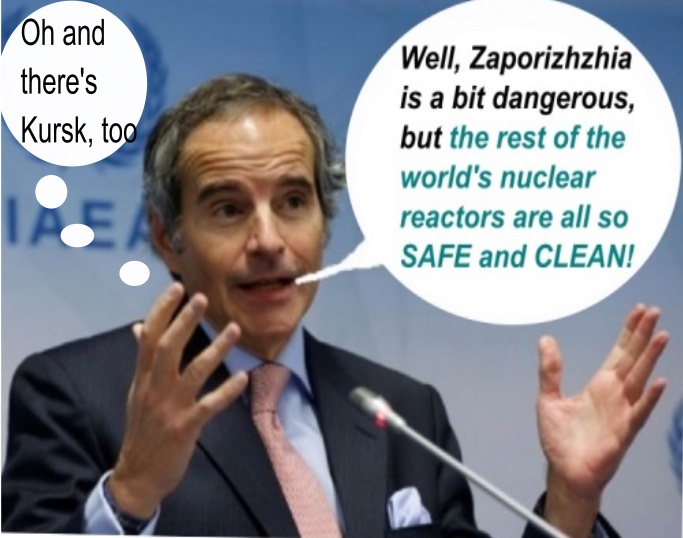
The assaults at or near Zaporizhzhia caused the notoriously hypocritical wringing of hands from the International Atomic Energy Agency, stuck in between recognizing the dire risks of reactors in a war zone and its mandate to promote nuclear power all around the world.
Nuclear power plants are already a liability in war zones. They also represent an open invitation for attack by armed drones, writes Linda Pentz Gunter
Drones are everywhere these days but not as ubiquitous as we once feared. Didn’t Amazon once threaten that all of its at-home deliveries would one day be made by drone? They are delivering some packages using drones — apparently dropping them from a height of 10 feet so the drones don’t collide with passersby — which is great if you ordered bed sheets, not so great for that new set of champagne flutes.
But where the drone industry has really taken off is in the business of warfare. On battlefields and beyond, drones are now routine. They are used to fire precision-guided munitions but also for targeted assassinations, and, whether deliberately or not, to hit nuclear power plants.
This, in particular, raises some extremely serious alarms, because today we have countries that have nuclear power programs that have also found themselves either directly or indirectly embroiled in wars.
The most headline-grabbing incident so far was when, on 14 February 2025, a Russian drone hit what is known as the New Safe Confinement structure at the Chernobyl Nuclear Power Plant in Ukraine. The Confinement is the $2.7 billion dollar dome that was erected over the old sarcophagus originally built to contain the radiation still leaking from the destroyed Unit 4 that exploded and melted down in 1986.
The 2025 attack resulted in damage likely to cost around $582 million to repair.
At first, fears that radiation might be escaping as a result of the hole the drone blew in the dome’s roof were dismissed. But that situation could change dramatically given concerns that the old sarcophagus could collapse at any moment.
”That would be catastrophic because there’s four tonnes of dust, highly radioactive dust, fuel pellets, enormous amounts of radioactivity inside the sarcophagus,” Shaun Burnie of Greenpeace Ukraine told Agence France Presse in an interview.
Since Russia’s invasion of Ukraine began more than four years ago, there have been ongoing concerns about the 15 reactors there caught up in the war. Six in particular, at the Zaporizhzhia nuclear power plant in the country’s worst hit southeast, have been the subject of the greatest alarm, with drone attacks and missiles landing on and damaging site buildings. Fortunately, there has been no direct hit on any of the reactors so far. But how long can such luck hold out?
The assaults at or near Zaporizhzhia caused the notoriously hypocritical wringing of hands from the International Atomic Energy Agency, stuck in between recognizing the dire risks of reactors in a war zone and its mandate to promote nuclear power all around the world. “Playing with fire”, IAEA general secretary, Rafael Grossi, has called the conflict around Zaporizhzhia, while claiming, incredibly, that nuclear power is not the problem, war is the problem.
In August 2025 a Ukrainian drone attack on the Kursk nuclear power plant inside Russia caused a massive fire and damaged an auxiliary transformer.
And then, just last week, a drone strike sparked a fire at an electrical generator just beyond the inner perimeter of the Barakah Nuclear Energy Plant in the United Arab Emirates. Again, mercifully, none of the four reactors at the site received a direct hit, although one unit was obliged to go to backup power from diesel generators.
So far, no one has claimed responsibility but the UAE is naturally pointing fingers at Iran, backed by evidence that the attack emanated from inside Iraq and therefore was likely the work of Iran-backed Shiite militias there.
Grossi called the Barakah hit in the UAE of “grave concern” and once again, like a helpless school teacher in front of an unruly class, warned that military activity around nuclear facilities is “unacceptable”.
The involvement of Tehran, officially or not, comes after powerful attacks by the US and Israel last June and again in February against all of Iran’s nuclear fuel manufacturing installations but sparing, so far, its Bushehr commercial nuclear reactor.
We have also just seen Russia and Belarus carrying out a practice deployment run with their tactical nuclear weapons, just one day after Ukraine successfully fired drones into the heart of Moscow. Belarusian authorities insist this was pure coincidence and that the drills were pre-scheduled and routine. But why practice deploying nuclear weapons if deterrence theory insists such weapons are too dangerous ever to use?
Ukraine’s defense minister, Mykhailo Federov, who has no military background, is now proclaiming the exciting future that is autonomous drones, a grim prospect given the propensity for loss of control when it comes to drones already on the battlefield. Federov and his enthusiastic backers are all too thrilled to describe autonomous weapons as “the new nuclear weapons”. He insists that “Countries that posses them will be protected.”
And so the myth continues. The more lethal — and now potentially rogue — weapons we have, the safer we will all be.
The message all of this sends is that civil nuclear power plants can become unexpectedly caught up in war zones, and can also represent inviting targets for attack, leading to potentially catastrophic results. Let’s remember, the UAE isn’t officially at war with anyone. Both Ukraine and Iran are on the receiving end of uninvited invasions.
We need drones out of our skies. We need wars not to be fought near nuclear power plants. We also need wars not to be fought at all, nuclear power plants to be shut down, and nuclear weapons, AI driven or otherwise, to be abolished.
Linda Pentz Gunter is the Executive Director of Beyond Nuclear and writes for and edits Beyond Nuclear International. She is the author of the book, No To Nuclear. Why Nuclear Power Destroys Lives, Derails Climate Progress And Provokes War, published by Pluto Press.
Wildfire Crews Race to Keep Fierce California Blaze From Former Nuclear Reactor Site.

Shifting winds placed a former nuclear reactor and rocket testing site in the path of the growing Sandy Fire. The region’s first major blaze of the season raised alarm from families aware of the site’s history and spotty cleanup.
Melissa Bumstead lives less than four miles
from the site of possibly the worst nuclear meltdown in U.S. history
besides the Three Mile Island accident. The Santa Susana Field Laboratory,
or SSFL, is known locally as a problem site—with a pockmarked history
amid a spotty cleanup. A blaze hitting the former nuclear reactor and
rocket testing site, Bumstead is sure, would be a cataclysm.
Inside Climate News 19th May 2026, https://insideclimatenews.org/news/19052026/california-sandy-fire-approaches-former-nuclear-reactor-site/
Cuba Is Not a Failed State – It Is a Besieged State
We Need to Build a Unified Resistance to Sanctions and War, https://unac.notowar.net/cuba-is-not-a-failed-state-it-is-a-besieged-state/
The statement below is a response to the ongoing blockade against Cuba and the propaganda derived from it. We hope you will endorse this statement, but we also hope you will commit to emergency actions if the Trump Administration follows through with their threats to invade Cuba.
At this critical junction in world history when the Cuban Revolution is being threatened by US hegemon, it is essential to come to its defense. Cuba is the hope of humanity.
We defend Cuba by combating the intentionally negative stereotyping of a failed state. The problems Cuba faces under blockade conditions should not be portrayed in such alarmist ways that it reinforces Washington’s propaganda. We need to combat this defeatist approach.
Cuba is being sanctioned for the crime of being a good example
That Washington continues to intensify its six-decade campaign against the Cuban Revolution testifies to the island’s resilience and strength.
Washington’s regime-change campaign has taken a heavy toll. Responsible Statecraft describes US policy as “bent on breaking the island.” The Guardian reports “an epidemic of flies, rats, waste and foul odors.”
These accounts portray Cuban hardship but intentionally overlook Cuban social achievements. Even statements from Congressional leaders advocating for an end to the blockade by focusing on the crisis it has created, can feed into Washington’s self-serving narrative that Cuba is a “failed nation.”
When descriptions of the humanitarian crisis caused by the escalated blockade do not question the ideological assumption that accepts capitalism as the natural state of humanity, they can be used to depict socialism as an abortive failed experiment.
This is why solidarity activists must take special care to highlight the incredible achievements of Cuba, even under blockade conditions, all while waging an active campaign against the sanctions and gathering supplies to take to the island in solidarity.
Doing so much with so little
The Center for Economic and Policy Research documents a dramatic increase in infant mortality from 4.9, now rising to 9.9 per 1,000 live births, attributable to deteriorating living conditions caused by the US economic war.
Yet, even under this intentional strangulation, Cuba’s infant mortality rate remains among the lowest in the region. Cuba has free public, personalized healthcare for every Cuban from birth and throughout life.
Surrounding countries that are not facing any U.S. sanctions but are forced to survive under capitalist relations have consistently higher infant mortality rates. Panama (11), Dominican Republic (16), El Salvador (12), Honduras (15), Guatemala (20), Jamaica (12), Haiti (45-50).
Most stunning is that Cuba’s infant mortality figures under a ruthless blockade are still lower than for African Americans in the U.S. (10.9).
This reflects the demonstrated success of Cuba’s social medicine model, even under the most challenging of circumstances.
Using Cuba’s example of people-centered healthcare, Nicaragua dramatically reduced their infant mortality from 29 deaths per thousand in 2005 under a right-wing, pro U.S. government to 9 under the Sandinistas and with the assistance of Cuban doctors.
This is why the Trump administration is determined to block Cuban medical staff from providing medical care in the Caribbean. A dozen countries have acquiesced to demands from the U.S. to end medical agreements with Cuba.
Cuba’s medical staff focuses heavily on underserved areas in Latin America, the Caribbean, and Africa. They provide more doctors and medical staff than the World Health Organization and most western nations combined. The United States calls Cuba’s medical internationalism “human trafficking” – but it’s really an internationalist lifeline for the Global South.
Cuba is not alone, as it receives significant solidarity aid from allied states. China, for example, is helping address Cuba’s fossil fuel dependency by supplying 49 solar farms (20% of all its energy needs) and fleets of electric buses, cars, and scooters. Our solidarity movement should highlight and encourage such international cooperation.
Among Cuba’s public health achievements are its international medical brigades, excellence in advanced research, response to the pandemic, service to underserved populations, south-south cooperation initiatives, and the world’s highest doctor-to-patient ratios.
The Cuban socialist model has also produced notable successes in sports and public education.
Writing from Cuba, Carlos Fernandez de Cossio defended the country’s accomplishments over the past decade despite the “intense economic war,” including:
- sustaining the national electrical system while expanding renewable energy
- strengthening telecommunications and expanding internet access
- supporting vulnerable populations through food cultivation
- improving water infrastructure in underserved communities
- developing COVID vaccines and other medicines
- expanding domestic industry including the assembly of electric vehicles
For a small, natural resource-poor island, Cuba has achieved so much with so little and under such extraordinarily adverse conditions. The nation asks only that the jackboot of imperialism be lifted so that it may truly flourish.
International people’s solidarity must not allow these incredible achievements to be overlooked as we advocate for relief from the cruel blockade. We should describe this crisis the same way that the Cuban leadership describes it – acknowledging the harms of US imperialism, but always stressing the achievements of the Cuban revolution and the power of solidarity and cooperation.
¡Venceremos!
Leading Organizers from the Following Organizations support this Cuba statement and the Call to Action.
United National Antiwar Coalition, Cuba Si NY/NJ, International US-Cuba Normalization Conference, Venezuela Solidarity Network, US Peace Council, Alliance for Global Justice, SanctionsKill! Campaign, Resist U.S. Led War Movement, Black Alliance for Peace, International League of Peoples Struggles, Americas Without Sanctions, Chicago ALBA Solidarity, Nicaragua Solidarity Coalition, Task Force on the Americas, International Action Center, Veterans For Peace, Code Pink NY, National Lawyers Guild, Anti War Action Network, Freedom Road Socialist Organization, Bronx Antiwar, Compas de la Diaspora, Struggle for Socialism Party, Alberto Lovera Bolivarian Circle, Diaspora Pa’lante Collective, National Students for Justice in Palestine (NSJP), Workers World Party,
(This statement was initiated by the SanctionsKill Campaign.)
Add your support and help to circulate this statement.
A troubled nuclear future

May 23, 2026, https://renewextraweekly.blogspot.com/2026/05/a-troubled-nuclear-future.html
The National Energy System Operator estimates that up to 4.1GW of nuclear will be needed to deliver a clean power system in the UK by 2030, with scope for further capacity to be delivered if new small modular reactor (SMR) technology can be developed. Overall, the government’s aim seems to be to ramp up nuclear capacity to 24GW by 2050 – though that is still to be confirmed, with new ‘roadmap’ review underway.
It certainly would be hard. And expensive. But the money seems to be there for things like this. For example, Rolls Royce’s Small Modular Reactor design has been backed by up to £599m from the National Wealth Fund in a partnership deal with Great British Energy – Nuclear (GBE-N). This, it is said, will enable work to begin on the delivery of the UK’s first SMR on Anglesey in North Wales, with £2.5bn having been allocated to SMR development. And over £14bn has been provided for the next large reactor at Sizewell. With, presumably, more to come
However, major projects like this do tax the UKs technology development capacity and there are moves to integrate civil & military nuclear expertise infrastructure to share the load and get more value by joint funding. In a new report, the right of centre Policy Exchange notes that ‘civil and defence nuclear are two distinct yet related aspects of the UK state and draw on many of the same national assets’. So it calls for ‘a more disciplined nuclear state,’ presumably with both aspects strengthened. But not everyone wants both or either to be strengthened. Most greens especially. Though, in these troubled times globally, it may be hard to be ‘anti deterrent.’ CND however has no problem with opposing both.
It is undeniable that there are links between civil and military nuclear. So, arguably it’s hard to back/or oppose one but not the other, with, for example, some nuclear technologies being suited to dual use. That can open up some big political issues, although some see it a bit differently: ‘Civil & military nuclear can enmesh’ says Paul Dorfman, but ‘one must ask whether one inevitably leads to the other…It’s not that nuclear military interests are the sole drivers of support for civil nuclear power, but for some states dual-use technology may comprise a significant complementary factor.’
Be that as it may, the UK state does keep going with both, and is now also pushing fusion, with another £2.5bn allocation. And, despite the long history of false hopes, dating back to ZETA at Harwell in the late 1950s, there is even talk of a prototype in the mid 2030s. Although more likely the 2040s, in the case of the STEP project planned for Nottinghamshire.
Some see all of this nuclear pushing as vital or at least unstoppable. But not all. For example, in a powerful new book Linda Pentz Gunter says that amongst its many problems, nuclear power is too slow, too expensive, too dangerous and too integrally connected to the nuclear weapons complex, to serve as a rational energy choice. And US energy guru Amory Lovins agrees: ‘A kilowatt of nuclear power capacity produces several times the annual output of a kilowatt of solar or wind capacity, but at many times higher cost per kilowatt-hour. Capital markets therefore shun nuclear investments but invest one or two orders of magnitude more in solar & wind power. Those renewables therefore add two orders of magnitude more net capacity per year than nuclear, which remains a less-than-one-percent contributor to global electricity growth.’
It is sometimes argued that nuclear is needed to balance variable renewables, but large costly inflexible nuclear plants are not able to vary their output quickly and safely to meet rapid supply and demand variations. Some new SMR technology may make them more flexible. But do you like the sound of molten-flouride salt heat reservoirs? Apart from the risks, adding capacity like that is likely to make the system more expensive and, since they would only need to work part time, overall less economically efficient. Why bother when renewables are accelerating ahead, with load factors rising and costs mostly falling? They will need balancing, but newly emerging low-cost storage and smart grid systems can help balance supply and demand, so we can meet our energy needs reliably: see my last post on IRENA’s new study.
While some countries do still see civil as well as military nuclear technology as vital, they are in a minority. Out of the 195 countries in the world, only 9 have nuclear weapons and only 31 have nuclear power plants. Some middle-eastern countries may see it differently, with weapons possibilities always being an option. But interestingly, in non-nuclear (bomb and power) Norway, a Government advisory committee looking at its energy options, recently said nuclear power would not be economic, and in any case it would ‘not come in time to help achieve the Paris Agreement’s 2050 goals’, unlike ‘upgrading hydropower plants and expanding wind and solar power’. Crucially, ‘the prospect of realising a Norwegian nuclear power programme with production starting in the mid 2040’s may crowd out other power plant investments that can be realised more quickly’. So, although nuclear might be looked at again as an option in the future, ‘offshore wind offers the greatest potential for new power generation in the long term’.
That does seem to be sensible. As other independent studies have also argued, the economic case for nuclear is poor – there are better options for decarbonisation, with no radioactive wastes left to deal with, or melt-down or local leakage risks and offering no terrorist or enemy targets for attack. Sadly, for now, in the UK, we will have to make do with the government’s view that all is well with its nuclear plans, policies and procedures. For example, on safety, it has adopted all the reforms to the nuclear regulation system proposed by the independent Nuclear Regulatory Taskforce led by John Fingleton. He had found it an ‘overly complex’ and ‘bureaucratic’ system that had held back the industry. So the aim is to speed up nuclear regulation and cut costs, with ‘safe, cost effective & rapid delivery’ across the entire civil and defence nuclear enterprise. The new streamlined system should be in place by 2027. What could possibly go wrong?
Next? The National Audit Office has just come out with an assessment of the funding arrangements for Sizewell C, the next big new UK project. It says maintaining ‘investor financial returns will cost consumers over £4 billion, but will be justified if they help the project to cut construction costs and speed up delivery times’. Phew!
Yet Another Escalation In The Empire’s War On Activism And Journalism.
Caitlin Johnstone, May 26, 2026
The empire’s war on activism and journalism continues to escalate as the Trump administration targets left-wing streamer Hasan Piker and antiwar activist Medea Benjamin for the crime of bringing humanitarian aid to Cuba.
This is yet another act of aggression in the same onslaught that has seen inconvenient truth-telling and expressions of moral clarity attacked and undermined throughout the western world at every juncture in recent years.
It is not separate from the persecution of Julian Assange for exposing US war crimes.
It is not separate from the steadily increasing escalations of internet censorship we’ve seen in the wake of Gaza, Ukraine, Covid, January 6, the 2016 US presidential election, and any other excuse the imperial narrative managers could find.
It is not separate from the Trump administration’s efforts to deport non-citizens for criticizing the state of Israel.
It is not separate from the efforts to stomp out pro-Palestine protests and university campus demonstrations.
It is not separate from the arrests of activists in the UK on terrorism charges for saying the words “I support Palestine Action”.
It is not separate from activists facing criminal charges for saying “From the river to the sea” in parts of Australia and Germany.
It is not separate from imperial efforts to crack down on BDS activism and outlaw boycotts of Israeli products.
It is not separate from Israel’s ban on foreign press from entering Gaza, nor is it separate from Israel’s systematic extermination of Palestinian journalists within Gaza.
It is not separate from the artificially manufactured hysteria about “antisemitism” in western society and the efforts of western governments to silence criticism of Israel in the name of protecting Jews.
It is not separate from Israel’s massive increase in its hasbara budget this year and the armies of paid trolls we’ve seen swarming online discourse.
It is not separate from the nonstop barrage of imperial propaganda we see every day from the plutocratic press justifying every war and slandering every dissident.
It is not separate from the way imperial oligarchs like Jeff Bezos, Elon Musk and Larry Ellison buy up news outlets like The Washington Post and CBS and social media platforms like TikTok and Twitter in order to manipulate the way the public thinks, acts, and votes.
It is not separate from the way tech platforms have been manipulating algorithms to hide dissident sources of information from the public and using bogus “fact checking” firms to suppress unauthorized facts.
It is not separate from government secrecy measures which forbid the public from knowing what their rulers are doing, and which aggressively punish anyone who tries to reveal inconvenient facts.
The empire is waging a relentless war on intellectual clarity and on moral clarity, because truth and morality are its enemies.
They do not want us to have unobstructed vision, lucid minds, functioning empathy centers and well-formed consciences, because if we did, we would instantly dismantle the empire brick by brick.
This is why they go after anyone who tries to expand the consciousness of western society using activism and journalism. In an empire built on lies and fueled by human blood, telling the truth is seen as treason and doing the right thing is seen as insurrection.
The only sane response to such a dystopian situation is to join in the revolution. Help spread unauthorized ideas and information. Take action to spread awareness of the abusive nature of the empire. They’re trying to keep it all in the dark, so we need to bring it all into the light.
They wouldn’t be fighting so hard to suppress truth and compassion if it didn’t present an immediate existential threat to their power structure.
Even American war hawks now admit Iran is defeating the US – and it will change the world
It is so widely accepted that the USA is losing the war that now even neoconservative hawks admit it. They lament that Iran’s victory reflects the decline of US hegemony and rise of multipolarity.
By Ben Norton, Geopolitical economy, May 25, 2026
It is now widely acknowledged that the United States is losing the war against Iran, which Washington itself started.
Even some neoconservative hawks — who were architects of the wars on Iraq, Libya, and Syria, and who for years advocated for an attack on Iran — have now reluctantly acknowledged that Tehran is winning this war, and that Washington’s loss will have massive geopolitical repercussions.
“There will be no return to the status quo ante, no ultimate American triumph that will undo or overcome the harm done”, wrote the prominent neocon Robert Kagan in The Atlantic. “With control of the strait [of Hormuz], Iran emerges as the key player in the region and one of the key players in the world. The roles of China and Russia, as Iran’s allies, are strengthened; the role of the United States, substantially diminished”.
Western media outlets report that the US is losing the war with Iran
Just a few weeks after the United States and Israel launched this war of aggression on 28 February, British newspaper The Independent acknowledged that “Iran is the clear winner, as Trump’s desperate bid for peace shows he wants out of the war”.
Soon after, the US corporate media began to concede the same.
In mid-April, the Wall Street Journal published an op-ed observing that “the Iran War seems to be failing”. This was written by Gerard Baker, the conservative former editor-in-chief of the newspaper, and an erstwhile Trump supporter.
Meanwhile, US intelligence agencies have been feeding information to US media outlets, disclosing that the war has been going very badly.
The New York Times reported in May, citing US intelligence sources, that Iran still has access to the vast majority of its missile capabilities.
Tehran can still use 30 of its 33 missile sites on the Strait of Hormuz, the world’s most important oil transit chokepoint, through which roughly 20% of globally traded crude passed on a daily basis before the war.
Trump declared a US naval blockade of the Strait of Hormuz, to try to choke off Iran’s oil exports.
However, US intelligence officials acknowledged in an article in the Washington Post that Iran is able to withstand this US military blockade for many months.
Moreover, US intelligence officials told numerous media outlets — including CNN, NBC News, the New York Times, and the Washington Post — that Iran has succeeded in destroying or at least heavily damaging the majority of the US military’s bases and other assets in West Asia.
At the same time, Fortune magazine reported that the US military has been quickly using up its stockpile of missiles.
Fortune cited Harvard Kennedy School lecturer Linda Bilmes, who estimated that the US war on Iran will likely cost more than $1 trillion.
Trump has denied all of this publicly, instead adamantly claiming victory.
“They’re militarily defeated. In their own minds, maybe they don’t know that”, Trump said of Iran.
Nevertheless, these constant leaks by US intelligence officials, to a multitude of media outlets, tell a very different story. They show that this war is going very badl
Neoconservative hawks admit Iran is winning the war
In fact, the war is going so badly that some of the most prominent neoconservative ideologues in the United States have publicly conceded that Iran is winning.
This was the conclusion of an article published in the pro-war mouthpiece of Atlanticism, The Atlantic. The piece was titled “Checkmate in Iran”, and it bore the subtitle “Washington can’t reverse or control the consequences of losing this war”……………………………………………………………………………………………………………………………………………………..
US war against Iran is extremely unpopular among Americans
What explains the sudden opposition of these notorious neoconservative hawks, who spent decades pushing for war on Iran?
They can apparently see the writing on the wall. The war has gone horribly, and it is extremely unpopular at home.
60% of Americans oppose Trump’s handling of the war on Iran, while just 33% support it, according to a May survey published by NPR, PBS News, and Marist Poll.
Prominent neocons are simply jumping off the sinking ship. They recognize that Trump and the Republican Party are extremely unpopular, and that this war is blowing back, hard. Even American war hawks now admit Iran is defeating the US – and it will change the world – Geopolitical Economy Report
Nuclear test veterans hope for justice as secret files are released
Servicemen exposed to radioactive fallout in cold war weapons testing are using newly declassified documents to fight for a fair compensation scheme
In November 1957, thousands of servicemen on Christmas Island in the South
Pacific watched the testing of Britain’s first megaton thermonuclear bomb.
Witnesses compared it to seeing the end of the world.
Many viewed the
explosion on the island while wearing shorts and short-sleeved shirts, with
sunglasses handed out to protect their eyes. Veterans claim they were
exposed to needless risk and were the victims of gross negligence. Large
numbers later suffered blood disorders and cancers, which they believed
were caused by exposure to radioactive fallout. Most were denied war
pensions because of ill-health.
By contrast, those involved in the US
nuclear testing programme, including the Manhattan Project led by J Robert
Oppenheimer, benefited from a $2.6bn no-fault compensation fund. France
agreed in 2008 that it would pay compensation to nuclear test veterans who
suffered illness linked to radiation exposure.
British veterans now hope
the release of thousands of previously classified documents from the Merlin
files into the National Archives will help support their near-70-year
battle for justice. Some of these newly released documents analysed by The
Observer detail risks of radioactive fallout, health monitoring of military
personnel and orders for blood samples to be taken from servicemen that
could be used for evidence in any subsequent claims for damages.
Observer 24th May 2026, https://observer.co.uk/news/national/article/nuclear-test-veterans-hope-for-justice-as-secret-files-are-released
From Occupation to Erasure: How Legacy Media Failed Gaza
ScheerPost Staff, May 25, 2026
The Complicit Lens: How Media Helped Normalize the Destruction of Gaza
On the latest episode of Scheer Intelligence, host Robert Scheer sat down with media scholar Robin Andersen for a blistering examination of how major American media institutions covered — and often concealed — the realities unfolding in Gaza.
At the center of the discussion is Andersen’s new book, The Complicit Lens: U.S. Media Coverage of Israel’s Genocide in Gaza, which argues that corporate media did far more than simply fail the public. According to Andersen, institutions like The New York Times and CNN helped manufacture a sanitized narrative that erased the historical roots of Palestinian suffering while shielding Israeli state violence from meaningful scrutiny.
Throughout the conversation, Scheer and Andersen return to a central question: What happens when the institutions tasked with informing the public become instruments of political messaging?
Andersen points to leaked newsroom directives reportedly instructing journalists to avoid words such as “occupation,” “ethnic cleansing,” and even “refugee camp.” The effect, she argues, was not merely semantic. It fundamentally stripped audiences of the historical and legal context necessary to understand Gaza itself. If Palestinians are never described as occupied people, then their resistance appears irrational rather than rooted in decades of dispossession and military control.
Scheer repeatedly stresses that this is not simply a failure of journalism, but a crisis of democracy and intellectual freedom. The conversation expands beyond Gaza into the repression seen across American universities, where students and professors protesting the war increasingly found themselves surveilled, punished, or accused of antisemitism. Andersen describes how campus protests were portrayed not as organic moral outrage, but as dangerous extremism requiring police intervention and political suppression.The interview also confronts the growing contradiction at the heart of American political discourse: criticism of the Israeli government is increasingly treated as hostility toward Jewish identity itself. Scheer, drawing from his own Jewish background, calls this “a blasphemy against the Jewish people,” arguing that the history of Jewish struggle has long been rooted in universal human rights and dissent against oppression — not unconditional allegiance to state power.
One of the most striking parts of the discussion centers on how Palestinian voices — especially journalists documenting the destruction on the ground — were marginalized by establishment media even as they risked and lost their lives reporting from Gaza. Andersen argues that social media and independent outlets became essential because they bypassed traditional gatekeepers that often repeated official Israeli talking points without verification.Scheer ultimately frames the crisis as one extending far beyond a single conflict. If governments, media institutions, and universities can collectively narrow the boundaries of acceptable speech around Gaza, then the implications for democratic society are profound. The issue is no longer only about what is happening overseas, but whether Americans themselves retain the ability to openly question power without fear of censorship, retaliation, or ideological policing.
By the end of the interview, Andersen delivers a stark warning: journalism that abandons accuracy, historical context, and moral clarity ceases to function as journalism at all. It becomes public relations for power.
And in moments of mass suffering, silence and distortion become forms of complicity.
Scheer Intelligence: Highlights
……………………………………………………………………………………………………………………………………………………………………………….From Occupation to Erasure: How Legacy Media Failed Gaza
128 years of US exploitation, degradation of Cuba continues on steroids
17 May 2026 AIMN Editorial, By Walt Zlotow , West Suburban Peace Coalition Glen Ellyn IL, 128 years of US exploitation, degradation of Cuba continues on steroids – The Australian Independent Media Network
One must go back to 1898 for the last time the US was not exploiting Cuba and its people to benefit rapacious US capitalism and organized crime. That year the US cooked up fairy tale about Spain blowing up the US Maine, sent to Havana Harbor to intimidate Cuba’s Spanish ruler. The Maine did blow up but from an accidental internal explosion, not a Spanish mine. Those 261 sailors could not be said to have died in vain so President McKinley and his war party blamed Spain in order to declare war, kick Spain out of the Americas and take over Cuba for US exploitation.
But nothing in the previous 126 years compares to the diabolical cruelty, including death, the US has inflicted upon Cuba by President Trump and his bloodthirsty Secretary of State Marco Rubio.
This is not exaggeration. Need a lifesaving operation in Cuba under the Trump, Rubio oil blockade? Faggedaboudit. Much medical care is unavailable in oil starved Cuba when the lights go dark. Food and life sustaining supplies are becoming scares as farmers and merchants cannot get their wares to the people with a transport system largely shut down. Nearly a fifth of Cubans have fled the Trump, Rubio regime change operation.
Trump glories in their death and destruction he’s unleased. “THERE WILL BE NO MORE OIL OR MONEY GOING TO CUBA – ZERO! I strongly suggest they make a deal, BEFORE IT IS TOO LATE.”
Trump is expanding in more grotesque terms US policy to degrade Cuba into submission going back to 1960. A secret State Department memo back then under Eisenhower promoted overthrowing Castro thru:
“… a line of action, while adroit and inconspicuous as possible, denies money and supplies to Cuba to bring about hunger, desperation and overthrow of the Castro government.”
Trump simply dropped the “adroit and inconspicuous” fig leaf.
Ironically, the first US embargo in Cuba was good for the Cuban people. In April, 1958, Eisenhower imposed an arms embargo on the Batista regime. The US had been supporting Batista’s murderous rule for 25 years to insure his support of US economic control, both legal and criminal that enriched US capitalists and Mafia enterprises to the detriment of the Cuban people. Eisenhower didn’t have an epiphany to help the Cuban people. He simply saw the inevitable triumph of Castro’s revolution and sought to curry favor with its eventual rulers.
Twenty months later Castro prevailed, Batista fled and Cuba finally ended 62 years of US cruelty and exploitation. Not quite. Within year the US imposed Cuban embargo 2.0 designed not to facilitate the inevitable revolution but to destroy it. Sixty-six years on, with the entire world community except Israel voting year after year in the UN for the US to stop, America’s endless lust to crush the Cuban revolution continues apace. And under the depraved Trump, Rubio oil embargo, it has become a monumental war crime against the 11 million sorrowful Cuban souls.
Memorial Day: The Glorification of War, Not War’s Victims
Edward Curtin, SCHEERPOST, 25 May 26
Although Memorial Day in the United Sates is ostensibly a day for honoring soldiers killed in wars, it is, rather, a day for promoting war. If it were to honor the dead, all its pageantry would be in opposition to war.
Rather than being haunted by the ghosts of war, many Americans are very proud of all its soldiers killed while killing foreigners for the military industrial complex and the super-rich who own the country.
For the U.S.A. is a warfare state; it has been waging imperialistic overseas wars for a long, long time, and using its soldiers as cannon fodder. Most families of dead soldiers find it impossible to admit that their loved ones died in vain, even if courageously.
Without waging wars, the U.S. economy, as presently constituted, would collapse. Business goes on as usual.
……………………………………………………………………………………………………………………………………………………………………………………………….. not all of the wars’ victims die. Vast numbers become “living corpses,” also mostly anonymous and forsaken. Across the world and here at home wherever the American war machine has set its sights, the lame and crippled struggle on, victims of bombs and bullets, napalm and white phosphorous, nuclear radiation, torture, biological weapons – all the grotesque weapons the ghouls of the weapons’ industries have conjured up from hell for their paymasters. Countless living victims, yes, but the weapons industries carefully count their bloody profits, as do those who invest in these companies while turning a blind eye to their own complicity. Do they fly the flag on Memorial Day on their manicured lawns?
Many of the wounds of war are psychological and spiritual. And so many of the victims suffer silently. Wars’ terrors follow them everywhere down their nights and down their days, and they can often find no escape from the nightmare images that populate their minds, flashing in and out. It’s beyond imagining the living hell of children worldwide reliving the sight of the bloodied mangled bodies of their parents at their feet, victims of bombs or death squads or perhaps “collateral damage,” as if any words or reasons could undue their everlasting trauma or cover up the radical evil of those who killed them.
We owe it the wounded, dead, and tormented war victims everywhere to memorialize them with the words:
War is a lie, and only truth will free us. We need a non-violent revolution.
And to stop marching with the drums drumming and the flags flying as if we are proud of the U.S. killing machine. Memorial Day: The Glorification of War, Not War’s Victims – christinamacpherson@gmail.com – Gmail
The Obstacles to Peace in Europe Are Not What We Think
by Thierry Meyssan, Voltaire Network | Paris (France) | 26 May 2026, The Obstacles to Peace in Europe Are Not What We Think, by Thierry Meyssan
The compromise reached between Presidents Donald Trump and Vladimir Putin on August 15 has still not materialized in Ukraine. The obstacles are not those the United States anticipated. Ukraine is not cooperating, while Germany and the United Kingdom want war.
President Donald Trump acknowledged to his counterpart Xi Jinping that he was his equal. Since World War II, every American president has considered himself superior to others because he was the most powerful and the richest.
Conversely, from a Chinese perspective, Xi Jinping considers himself the equal not only of Donald Trump, but of each of his counterparts. A Chinese person does not believe that having greater resources makes you superior.
This concept of a hierarchy between nations is purely Western. Therefore, the evolution of the US president should not be interpreted without considering the cultural context of the observer.
The following week, Russian President Vladimir Putin, in turn, visited Beijing. Western commentators asserted that the Russian was being held hostage by the Chinese. Again, this demonstrates a complete misunderstanding of their relationship. It is not the product of their respective interests, but of their shared history. From the sacking of the Summer Palace to the Nazi attempt to exterminate the Slavs, each has experienced how Westerners behave. They have concluded that they can only resist them by remaining united. It is therefore absurd to consider replicating what Richard Nixon and Henry Kissinger did in 1972: decoupling the two states.
At the Anchorage summit on August 15, 2025, Donald Trump and Vladimir Putin discussed doing business between their two countries and making peace in Ukraine. Despite several attempts, Washington failed because it wanted to sell weapons to the Europeans first. Today, it seems much more difficult, and the Europeans are beginning to manufacture their own.
President Trump has therefore begun withdrawing troops from Europe and abandoning the war that the Pentagon planned to extend to Transnistria and Bosnia and Herzegovina. He announced that he would withdraw at least 5,000 troops from Germany. Vladimir Putin, for his part, decreed that he would grant Russian citizenship to any adult Transnistrian who requested it. Finally, Donald Trump withdrew his support for the European Union High Commissioner who was administering Bosnia and Herzegovina in violation of the Dayton Agreement (1995). Simultaneously, his former Secretary of National Security, General Michael Flynn, is organizing US investments in the Serb-held area of Bosnia and Herzegovina.
These events suggest that the United States favors a peace in Ukraine that recognizes all of Novorossiya as Russian. This is historically and culturally justified, but it will only be possible by holding a referendum on self-determination. For the moment, Russian forces have no intention of liberating Odessa. The peace treaty could, however, acknowledge this.
Here again, contrary to what we believe, the difficulties do not lie where we perceive them.
The three main ones are now:
1) recognition of the Nazi ideology of the current government in Kyiv and the denazification of Ukraine;
2) recognition of the undemocratic nature of German reunification and the independence of East Germany;
3) recognition of the UK’s anti-Russian obsession and the dismantling of the European Defence Union before it is definitively formed.
Ukraine
Even though Western powers persist in believing that the Russian intervention in Ukraine is an attempt at annexation and the beginning of Russia’s westward expansion, Moscow never invaded its neighbor, but rather implemented Resolution 2202, which it had guaranteed before the Security Council.
To claim that Russia invaded Ukraine is as absurd as saying that France invaded Rwanda. We know that it intervened to end a genocide (for which it was partly responsible), in accordance with a Security Council resolution.
The current Ukrainian government is illegitimate. President Volodymyr Zelensky’s term expired long ago. Every three months, he extends martial law, which serves no other purpose than to prevent new elections. However, his latest decree on this matter extends martial law from May 2nd to August 4th. It would be possible to organize an election campaign and a vote during that time. However, the electoral lists will need to be cleaned up, as they still include soldiers killed in action and civilians who fled. No one knows their exact number, but they could represent between one and two-thirds of registered voters.
The Verkhovna Rada (parliament) is equally problematic. Only a third of the members participate. The laws it passes are therefore of dubious legitimacy. For example, it voted to destroy one hundred million books—on the grounds that they were signed by Russian authors or printed in Russia, without distinguishing between contemporary authors and literary classics. Similarly, this parliament banned the country’s main church and all opposition parties. Moreover, there is a CIA office within the Rada itself that drafts all the laws. The members present simply ratify them.
Russia’s primary demand is the denazification of Ukraine. This is what President Putin declared when launching his special military operation. From a Russian perspective, this is non-negotiable. Indeed, what defines the identity of the Russian Federation is not the memory of Catherine the Great, but that of the Soviet struggle against Nazism. This ideology aimed to annihilate the entire Slavic population (but neither the Jewish nor the Roma population), as explained in Mein Kampf. Even if we in the West are unaware of it, the Second World War was not waged to carry out the Holocaust, but to murder the Slavic population.
The Verkhovna Rada (parliament) is equally problematic. Only a third of the members participate. The laws it passes are therefore of dubious legitimacy. For example, it voted to destroy one hundred million books—on the grounds that they were signed by Russian authors or printed in Russia, without distinguishing between contemporary authors and literary classics. Similarly, this parliament banned the country’s main church and all opposition parties. Moreover, there is a CIA office within the Rada itself that drafts all the laws. The members present simply ratify them.
Yet, the illegitimate administration of the unelected president Zelensky refuses any denazification measures. There are currently numerous monuments glorifying the Nazis and their collaborators, the “fundamental nationalists.” The history of Ukraine was entirely rewritten by them, with the help of British MI6 and the American CIA, after the Second World War. This propaganda aims to make people believe that the “Banderists” fought the Nazis, which is absolutely false. No: the Banderites were Nazis.
Convinced that there will never be denazification, the “fundamental nationalists” are planning the construction of a Pantheon in their honor. General Kyrylo Budanov, head of the presidential administration, organized the repatriation of the remains of perpetrators of crimes against humanity, buried around the world during the Cold War, on March 28. Rob Jetten and Luc Frieden, the Dutch and Luxembourgish prime ministers, have already agreed to the transfer of the bodies of the fascist Yevhen Konovalets and the Nazi Andriy Melnyk.
Germany
In our minds, Germany is a democratic state that successfully reunified in 1990. However, as Dmitry Medvedev, Vice Chairman of the Security Council of the Russian Federation, recently stated, reunification is merely an illusion. West Germans never consulted East Germans. Under international law, reunification is invalid.
The 2025 federal elections produced different and opposing results in the former West and East Germany. West Germans voted for the CDU or SPD, while East Germans voted for the AfD. This is the sole reason why the first two parties are classified as “democratic” and the third as “far-right.”
Yet, Chancellor Friedrich Merz (a Christian Democrat) has pursued a widespread crackdown on all those who challenge his authority, labeling them “conspiracy theorists.” Relying on the Munich Office for the Protection of the Constitution (a branch of the federal body which housed many of the Reich police officials after the war), he banned several media outlets and imprisoned journalists.
Simultaneously, Germany is gradually rebuilding its army with financial assistance from the United Kingdom, just as its predecessor, Chancellor Adolf Hitler, rebuilt the German army with the help of the Governor of the Bank of England, Lord Montagu Norman. He has reinstated conscription for men and requires every volunteer to notify Berlin before going on holiday abroad.
Germany is also rebuilding its military-industrial complex, this time with European funds.
It is preparing for a war like the one in Ukraine, even though a war against Russia would be of a completely different nature. Regardless, the entire German industry is now producing Ukrainian drones and selling them in the Gulf against Iran. Following this logic, Berlin wants to bring Ukraine into the European Union, even though it does not meet the accession criteria set by the treaties: it would simply be a matter of creating a new status, that of “associate member,” and the trick would be done. Having ignored the negative results of the 2005 French and Dutch referendums, this would be just another decision made against the will of the people.
Friedrich Merz, grandson of a Nazi dignitary, cannot imagine his country not being allied with the Ukrainian “fundamental nationalists,” nor holding accountable those who sabotaged the Nord Stream gas pipeline and caused the collapse of German industry.
The United Kingdom
Since the 19th century, the United Kingdom has perceived Russia as its sole rival, not only in Europe, but in the world. Lord Curzon, Viceroy of India, conceived the “Great Game,” the colonization of Central Asia, in order to neutralize the Russian Empire. Today, British strategy remains unchanged.
London continues to portray Moscow as an obscurantist power. It is no longer a matter of fabricating the Zinoviev telegram (which allowed the Soviets to be accused of wanting to interfere in the UK elections), but of making people believe that the Kremlin’s occupant is a madman who has a passenger plane shot down in Ukraine and poisoned Sergei and Yulia Skripal or Alexei Navalny.
Its latest invention is the attack on European airports by unidentified drones. Regardless of the truth, London is using this to convince the North Sea states to join its Joint Expeditionary Force, which it has just transformed into a military alliance, the “Northern Marines,” under its command. It hopes to bring all the member states of the European Union and Turkey into the alliance.
This is why the hereditary Lords—and there are still some—are doing everything they can to keep Keir Starmer in Downing Street. The Prime Minister is, in fact, a Labour member who is, in secret, an agent of big business: unbeknownst to his own party and the media, he attended meetings of the Rockefeller Trilateral Commission. Also unbeknownst to everyone, he appointed Peter Mandelson—an accomplice of the criminal Jeffrey Epstein—as Her Majesty’s ambassador to Washington.
The important thing is to maintain the illusion that the United Kingdom has no dealings with either the State of Israel or Hamas; to continue concealing the fact that Israeli chiefs of staff have been secretly visiting Whitehall throughout the Gaza genocide, in which the British army actively participated. It is better to claim, like Christian Turner, Peter Mendelson’s successor, that only one state has a “special relationship” with Washington: Israel.
Survey begins to determine remote island’s suitability for nuclear disposal site

But while the local leaders of the municipalities in Hokkaido and Genkai approved the literature reviews, the Hokkaido and Saga governors, whose permission NUMO will seek to go on to the next stage — a preliminary on-site survey — are opposed
By Eric Johnston, STAFF WRITER, May 21, 2026, https://www.japantimes.co.jp/tag/nuclear-energy/
A survey to determine the suitability of a remote island in the Ogasawara Islands chain as a final disposal site for radioactive nuclear waste began Wednesday.
The National Waste Management Organization of Japan (NUMO) will carry out a review of the scientific literature on the geology of Minamitorishima, Japan’s easternmost island, located nearly 2,000 kilometers from Tokyo.
The literature review is the first stage of an investigation into whether the site would be suitable for constructing an underground nuclear storage facility. The radioactive waste would need to be buried at least 300 meters underground for up to 100,000 years.
Minamitorishima has no civilian residents and is part of Ogasawara Village. The mayor, Masaki Shibuya, gave his approval for the survey last month.
Over the next two years or so, experts will scrutinize geological maps and academic papers regarding earthquake fault lines and volcanic activity on and around the island.
Local governments that agree to participate in the literature review can receive up to ¥2 billion in grants, and the central government has been encouraging as many of them as possible to raise their hands.
“The final disposal of radioactive waste is a critical issue that Japan as a whole must resolve, and we intend to conduct literature surveys in as many parts of the country as possible,” NUMO President Akira Yamaguchi said in a statement Wednesday.
Minamitorishima is only the fourth site to agree to the survey. Suttsu town and Kamoenai village in Hokkaido Prefecture have been surveyed, and NUMO is compiling feedback on the report. Genkai, in Saga Prefecture, is currently undergoing a survey as well.
But while the local leaders of the municipalities in Hokkaido and Genkai approved the literature reviews, the Hokkaido and Saga governors, whose permission NUMO will seek to go on to the next stage — a preliminary on-site survey — are opposed.
“If Suttsu and Kamenaichi intend to proceed with a preliminary survey, I’ll express opposition at this time,” Hokkaido Gov. Naomichi Suzuki said in March, citing an October 2000 prefectural assembly ordinance opposing the introduction of nuclear waste into the prefecture.
Saga Prefecture Gov. Yoshinori Yamaguchi has also indicated his opposition to his prefecture hosting a final disposal facility.
“I have no intention of accepting any new burdens,” Yamaguchi said in April when asked about his position on whether he’d provide consent for Genkai to conduct a preliminary on-site survey after the literature survey.
Unlike the other three candidate sites, Minamitorishima has no permanent residents and is off-limits to the public. It houses facilities operated by the Maritime Self-Defense Force, the Japan Meteorological Agency, and the Land, Infrastructure, Transport and Tourism Ministry.
The Japanese government is moving to restart as many nuclear power plants as possible. But on-site storage facilities for spent nuclear fuel at many power plants are approaching full capacity, while plans to have the spent fuel recycled at the Rokkasho Reprocessing Plant in Aomori Prefecture remain stalled.
In February, the Federation of Electric Power Companies of Japan released figures showing that storage pools at 17 nuclear plants where spent fuel is cooled were 78% full as of the end of last year.
1 This Month
23-25 October – on Zoom – World BEYOND War’s annual global conferenc


Shut down the radiation-damaged Heysham nuclear reactors now
To see nuclear-related stories in greater depth and intensity – go to https://nuclearinformation.wordpress.com

Say No to NASA’s Reckless Nuclear Reactor on the Moon
Say No to NASA’s Reckless Nuclear Reactor on the Moon

-
Archives
- October 2026 (231)
- September 2026 (339)
- August 2026 (330)
- July 2026 (355)
- June 2026 (287)
- May 2026 (306)
- April 2026 (356)
- March 2026 (251)
- February 2026 (267)
- January 2026 (308)
- December 2025 (358)
- November 2025 (359)
-
Categories
- 1
- 1 NUCLEAR ISSUES
- business and costs
- climate change
- culture and arts
- ENERGY
- environment
- health
- history
- indigenous issues
- Legal
- marketing of nuclear
- media
- opposition to nuclear
- PERSONAL STORIES
- politics
- politics international
- Religion and ethics
- safety
- secrets,lies and civil liberties
- spinbuster
- technology
- Uranium
- wastes
- weapons and war
- Women
- 2 WORLD
- ACTION
- AFRICA
- Atrocities
- AUSTRALIA
- Christina's notes
- Christina's themes
- culture and arts
- Events
- Fuk 2022
- Fuk 2023
- Fukushima 2017
- Fukushima 2018
- fukushima 2019
- Fukushima 2020
- Fukushima 2021
- general
- global warming
- Humour (God we need it)
- Nuclear
- RARE EARTHS
- Reference
- resources – print
- Resources -audiovicual
- Weekly Newsletter
- World
- World Nuclear
- YouTube
-
RSS
Entries RSS
Comments RSS


