Barbarism With Better Software: Pope Leo Warns of the AI Future
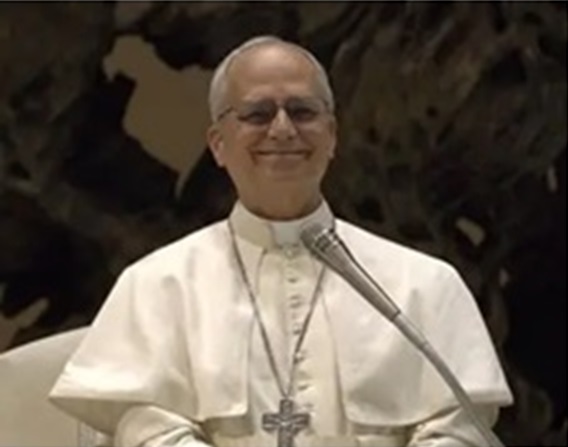
Joshua Scheer, May 26, 2026 , https://scheerpost.com/2026/05/26/barbarism-with-better-software-pope-leo-warns-of-the-ai-future/
Pope Leo XIV is warning that artificial intelligence, if left in the hands of profit-hungry corporations and unaccountable tech oligarchs, could unleash a “social calamity” by replacing human work. And now even the markets are beginning to price in the fear. Prediction traders on Kalshi see a 60% chance that U.S. unemployment crosses 8% before 2030, while also betting that AI may already be the leading cause of job cuts this month.
With the Pope writing “Work remains a fundamental dimension of the human experience, for not only is it a means of sustenance, but it is also a context for expression, relationships and contributing to the community,” … A society that guarantees employment to only a small fraction of the population, despite having a high level of technical development, risks exposing many to forced inactivity, a lack of responsibility and the absence of daily tasks and stimuli, resulting in human and cultural impoverishment.”
Tolkien, Gandalf and the Fight Over Humanity in the Age of AI
In one of the encyclical’s most striking moments, Pope Leo invokes the spirit of J.R.R. Tolkien while calling for humanity to “disarm” artificial intelligence and resist technological domination. Without directly naming Gandalf, Leo references a passage from one of Tolkien’s novels that reflects a central moral theme running through The Lord of the Rings: ordinary people confronting immense forces of power and corruption not by controlling the world, but by defending what is human within it.The passage speaks to the responsibility of people to care for “the fields that we know,” preserving a livable future for those who come after us rather than seeking mastery over all things.
The reference is notable not only because it is believed to be the first major incorporation of Tolkien into a high-level Vatican doctrinal document, but because it reveals the philosophical core of Leo’s warning about AI. Like Tolkien, the Pope appears deeply concerned with the dehumanizing effects of technological power when detached from morality, community and human dignity.
Rather than treating technology as destiny, Leo frames the struggle over AI as a profoundly human and ethical question: whether society will allow machines, corporations and systems of profit to dominate human life — or whether people can still reclaim technology for the common good.
What is striking is not that the Vatican is sounding the alarm. It is that Wall Street, usually eager to celebrate every job-killing “innovation” as efficiency, appears to share the anxiety. The same financial class that cheers automation when it boosts margins is now wagering on the social wreckage it may leave behind.
Pope Leo XIV vs. the AI Oligarchy
Leo’s warning cuts directly through Silicon Valley’s favorite lie: that technology is automatically progress. Work, he argues, is not merely a paycheck. It is dignity, community, purpose and participation in society. A world where machines enrich the few while millions are pushed into “forced inactivity” is not advanced. It is barbarism with better software.
The AI revolution is being sold as liberation. But without democratic control, labor protections and a moral economy, it risks becoming the most sophisticated union-busting machine ever built — a system that turns human beings into obsolete costs while calling the wreckage innovation.
The high priests of the digital economy are beginning to admit what workers have feared for years: artificial intelligence is not simply another technological innovation. It is a mechanism for social restructuring on a scale capable of hollowing out entire societies while concentrating unprecedented power into the hands of a tiny technological elite.
Now, in an extraordinary moment that reveals just how deep the anxiety has become, Pope Leo XIV has entered the fight.
In his first encyclical, Magnifica Humanitas, Leo issued a direct moral indictment of the AI economy now being constructed by Silicon Valley and Wall Street. He warned that mass unemployment caused by automation could produce “social calamity,” condemning an economic order that treats human beings as disposable inputs in the pursuit of profit.
“The pursuit of greater profits cannot justify choices that systematically sacrifice jobs,” Leo wrote, arguing that the human person “is an end, not a means.”
The remarkable thing is not simply that the Pope is saying this. It is that the financial markets appear to agree.
On prediction platform Kalshi, traders now place a 60% chance that U.S. unemployment rises above 8% before 2030, with nearly even odds it surpasses 9%. Those are recession-level numbers — the kind associated historically with economic collapse, mass foreclosures and social instability. Yet this time the fear is not merely financial panic. It is technological displacement.
The same corporate class that spent the last decade promising AI would “augment” workers is now openly discussing which sectors can be eliminated first.
Customer service. Journalism. Translation. Design. Coding. Accounting. Legal research. Teaching assistance. Medical diagnostics. Administrative work. Truck driving. Retail logistics. The language has become chillingly clinical: “labor optimization,” “efficiency gains,” “redundancy reduction.” Human lives reduced to balance-sheet obstacles.
Silicon Valley presents this process as inevitable — a law of nature rather than a political choice. But Leo’s encyclical rejects that mythology outright. Technology, he argues, is not neutral when it is controlled by systems organized around extraction and domination.
The Pope’s critique goes far beyond unemployment statistics. He warns that AI is creating a new form of digital colonialism in which data itself becomes the raw material of empire. Entire populations, he writes, are being transformed into “rare earths of power” — mined not for minerals but for behavioral information, biometric profiles, consumption patterns and predictive intelligence.
A handful of corporations now possess more behavioral information about humanity than any government in history. They monitor speech, movement, emotion, consumption and political behavior at planetary scale. AI supercharges that power by transforming raw data into predictive control systems — systems capable not merely of understanding populations, but manipulating them.
And as wealth concentrates upward, the social contract below begins to collapse.
Leo warns that a society where only a small fraction of people maintain meaningful employment — despite immense technological abundance — risks “human and cultural impoverishment.” Work, he insists, is not simply economic survival. It is participation in human life itself: purpose, responsibility, relationships and community.
This is precisely what Silicon Valley’s utopian rhetoric ignores.
For decades, tech billionaires promised automation would liberate humanity from drudgery. Instead, millions find themselves trapped in algorithmic management systems, precarious gig work, surveillance workplaces and endless digital dependency. Productivity exploded while wages stagnated. Corporate profits soared while social bonds disintegrated.
AI threatens to accelerate this process to catastrophic speed.
Even some within the industry appear unnerved by what they are building. Anthropic co-founder Chris Olah, appearing beside Pope Leo at the Vatican, admitted there is “a real possibility that AI will displace human labor at very large scale.” He acknowledged that no mechanism currently exists to distribute the gains globally or prevent mass social devastation.
That admission alone should shatter the fantasy that the architects of AI possess a coherent plan for humanity’s future.
Because the truth is increasingly obvious: the market has no moral framework for handling technological power of this magnitude.
Capital rewards efficiency, not justice.
Profit, not dignity.
Extraction, not community.
If replacing millions of workers with algorithms increases shareholder returns, the system treats that outcome as success — regardless of the social consequences. Entire regions can collapse into unemployment while stock valuations soar.
This is why Leo’s intervention matters.
He is not merely criticizing technology. He is challenging the economic religion surrounding it.
The modern AI boom rests on an almost theological belief that technological progress is inherently good, that innovation justifies itself, and that those who question the social costs are irrational enemies of the future. Silicon Valley speaks of AI in messianic terms: salvation through computation, transcendence through automation, immortality through machines.
But Leo offers a radically different vision. Human beings are not inefficient machines to be optimized away. Society cannot survive if millions are stripped not only of income, but of meaning and social participation itself.
The danger is not simply that AI becomes powerful.
The danger is that it becomes powerful inside an economic system already defined by staggering inequality, democratic decay and corporate domination.
Under those conditions, automation does not liberate workers.
It liberates corporations from workers.
And unless democratic control over technology emerges soon, the future now being constructed may look less like liberation than a technologically sophisticated form of mass abandonment — a world where unprecedented wealth and productivity coexist beside social despair, permanent unemployment and the slow erosion of human dignity itself.
You can read Leo’s words here:
Arming for extinction: The climate cost of militarism

COMMENT. The above video does tackle the problem, but eventually in a rather limited way, even putting in an advertisement for nuclear power as a way to combat climate change!
The military-industrial complex is not merely burning the planet. It is funding the political opposition to anyone attempting to put out the fire.
Every modern war is also a chemical event, a water event, an atmospheric event — consequences that accumulate in soil and groundwater long after the last ceasefire is signed and the reconstruction contracts are issued to the same companies that manufactured the weapons.
By Wayne Hawkins | 27 May 2026, https://independentaustralia.net/environment/environment-display/arming-for-extinction-the-climate-cost-of-militarism,21093
As global military spending surges to record levels, the climate cost of war and rearmament remains largely uncounted, unreported and exempt from scrutiny, writes Wayne Hawkins.
HUMANITY HAS A PROBLEM. Actually, humanity has several, but let us focus on the one where we are simultaneously spending nearly $3 trillion a year preparing to destroy civilisation while solemnly promising to save it.
Welcome to the military-industrial complex’s quiet war on the atmosphere. Fought without declaration. Exempt from accounting. Winning convincingly.
The number nobody counts
Here is a figure worth sitting with. Scientists for Global Responsibility estimate that the global military sector produces around 2.75 billion tonnes of CO₂ every year. That is not from active wars. That is peacetime — bases humming, jets training, supply chains churning.
If the world’s militaries were a country, they would be the fourth-largest emitter on Earth, behind only the United States, China and India. They would also be the only “country” explicitly exempt from international climate reporting requirements. Convenient.
The year 2025 was a banner year for the defence industry. Global military spending hit a record $2.887 trillion — the 11th consecutive year of growth. Europe increased defence budgets by 14%. NATO, not to be outdone, set a new target of 5% of GDP by 2035. The United States, briefly the exception, has already approved over $1 trillion for 2026, with $1.5 trillion potentially on the way.
Meanwhile, at COP30 in Belém in November, delegates scrutinised aviation, agriculture, steel and cement for their climate contributions. War did not make the agenda. Presumably, the irony was noted and filed.
When the shooting starts, so does the scoreboard
The moment active conflict begins, the numbers stop being merely alarming and start becoming geological. Russia’s invasion of Ukraine has generated an estimated 311million tonnes of CO₂ equivalent — comparable to the combined annual emissions of Belgium, New Zealand, Austria and Portugal. Not accumulated over decades — since February 2022.
The first 15 months of the war in Gaza produced more than 33 million tonnes. And these calculations do not fully capture the elegant brutality of modern warfare’s climate toolkit.
Russia’s strikes on Ukrainian electrical infrastructure have released sulfur hexafluoride – a greenhouse gas 24,000 times more potent than CO₂ – from high-voltage switching equipment. Civilian aircraft rerouting around the conflict zone has added an estimated 20 million extra tonnes of CO₂ equivalent. The planet did not get a vote on any of these design choices.
A 2025 Nature Communications study made the structural logic plain: rising global military spending is directly incompatible with limiting warming to 1.5–2°C. Military industries emit nearly twice the CO₂ per unit of economic output as civilian sectors. Every percentage-point increase in the share of military spending pushes emissions meaningfully upward — and expands fossil fuel-dependent industries that then lobby against the green transition.
The military-industrial complex is not merely burning the planet. It is funding the political opposition to anyone attempting to put out the fire.
The slow damage that outlasts the war
Then there is the legacy: the slow, generation-spanning damage that persists long after the press conferences and the peace agreements. In Gaza, the UN Environment Programme (UNEP) has documented the loss of 97% of tree crops, 95% of shrubland and 82% of annual crops since 2023. Food production at scale is not possible. The aquifer supplying most of Gaza’s water is likely contaminated by collapsed sewage infrastructure.
Cases of acute watery diarrhoea have increased 36-fold. Acute jaundice syndrome has increased 384-fold. Sixty-one million tonnes of debris laced with unexploded ordnance, asbestos and chemical munition residue now blanket the territory.
In Ukraine, environmental damage from soil contamination, heavy metal ordnance residue, landmines and destroyed ecosystems is estimated at over $50 billion. Scientists describe it plainly as a toxic legacy for generations.
Every modern war is also a chemical event, a water event, an atmospheric event — consequences that accumulate in soil and groundwater long after the last ceasefire is signed and the reconstruction contracts are issued to the same companies that manufactured the weapons.
The accountability black hole
Here is the part that should end careers, but does not. A 2025 analysis by the Conflict and Environment Observatory found that military emissions reporting is not merely inadequate; it is actively getting worse.
The top three military spenders, the United States, China and Russia, are either failing to submit data to international bodies or providing figures so incomplete as to be decorative. The solution, apparently, to the largest measurement gap in climate policy is to measure less.
Military emissions were explicitly exempted from international climate accounting frameworks at Kyoto. Countries lobbied for that exemption. It has never been corrected. When the world’s most destructive industry gets to operate outside the ledger, the ledger is not an accounting document. It is a performance.
So here we are. Spending nearly $3 trillion a year on systems that are structurally incompatible with our own survival. Exempting those systems from the accountability frameworks we built specifically to address our survival. Doing so at the fastest rate of increase since the Cold War.
The defence industry calls this deterrence. Climate scientists call it a fuse.
Notably, the planet has not exempted us from the consequences.
Time for US to deescalate confrontation with China over Taiwan.
On October 25, 1971, the UN ended the 2 China policy, voting to expel Taiwan, claiming to be the Republic of China, and replacing it with the mainland Peoples Republic of China. Just a year later Nixon’s thaw with mainland China cemented US recognition of the mainland One China policy and de-emphasized supporting the Chiang government on Taiwan.
China’s relationship with Taiwan is essentially none of our business. Yet we continue to risk war 8,000 miles from the Homeland on China’s doorstep by provoking confrontation with China with massive arming of Taiwan’s military.
Current US government and media narrative erases the last 6,000 years of China, Taiwan history to create a new cause célèbre for US military adventurism, America’s No 1 business industry. Without historical context, the US electorate remains clueless of reckless US policy deemed necessary to US national security interests: defending freedom over authoritarianism on the other side of the world.
A review of the long, tortured China, Taiwan history refutes that narrative. Chinese from Southwest China settled Taiwan over 6000 years ago. Beginning in 1624, the Dutch and Spanish moved in to exploit Taiwan’s resources, as Europeans were want to do worldwide. But the Chinese kicked them out by 1683, ruling Taiwan for 212 years till Japan gobbled up Taiwan after in the Sino-Japanese War in 1895.
For the next 50 years Japan used Taiwan (Formosa at the time) as a land based aircraft carrier for their pan Asian adventurism. But at the Cairo Conference in 1943, the Allies declared a major war aim was full return of Formosa to China. This occurred by a UN mandate upon Japan’s surrender in 1945.
With Japan defeated in China, Mao’s communists resumed their civil war to overturn the corrupt, unpopular nationalist government of Chiang Kai-shek. In 1949, Mao prevailed. Chiang fled with about 2 million of his die hard supporters to Formosa, setting up their own version of the Republic of China renamed Taiwan.
The US looked at the 538 million Chinese living under communism on the mainland, the 2 million on Taiwan living under Chiang’s authoritarianism, and said ‘Nope, we’ll recognize Chiang on tiny Taiwan as the legitimate Chinese government till he can kick out the dreaded commies.’ They even gave Chiang the military assistance to prevent any unification with China which was inevitable without that support. Is it any wonder the people and government of China would embark on eventual reunification, whether taking years, decades, even a century?
On October 25, 1971, the UN ended the 2 China policy, voting to expel Taiwan, claiming to be the Republic of China, and replacing it with the mainland Peoples Republic of China. Just a year later Nixon’s thaw with mainland China cemented US recognition of the mainland One China policy and de-emphasized supporting the Chiang government on Taiwan.
Without abandoning Taiwan completely, the US embarked on 5 decades of ‘strategic ambiguity’ which kept tensions with China over Taiwan’s status on the back burner of US China diplomacy. That changed when President Obama’s ‘Pivot to Asia’ in his second term moved pro Taiwan policy to the front burner. His successors Trump, Biden and Trump again have so turned up the heat, that war with China over its long term plan for eventual absorption of Taiwan into Chinese sovereignty, remains a possibility.
From Strategic Ambiguity we’ve degenerated into reckless trips to Taiwan by US officials and congresspersons and proposed legislation giving the President a blank check to intervene militarily with China should they embark on any, albeit unlikely, military move at reunification. The US keeps advancing multibillion dollar weapons tranches that do nothing for Taiwan’s defense; indeed, provoke Chinese military maneuvers near Taiwan, raising the possibility of US China confrontation.
At his recent summit with Chinese President Xi, Trump got schooled by Xi who told Trump that if Trump doesn’t pull back from arming Taiwan it could lead to “clashes and conflicts” between the two superpowers. Trump might be getting the message. He had his Acting Navy Secretary Hung Cao tell Congress that the US was “doing a pause” on a $14 billion Taiwan weapons package to ensure the US has enough weapons to finish off the Iranian regime in so far failed Operation Epic Fury. Facing the biggest military failure in US history, Trump would be wise to put belligerence with China over Taiwan back on the back burner.
Ignoring the 6,000 year long interwoven China, Taiwan history prevents sensible, peace promoting US diplomacy. America made the wrong decision on the Chinese Civil War in 1949 and has chosen to govern in ignorance for the past 77 years. On this issue, ignorance is not bliss. It may mean war.
How do you justify a war?

27 May 2026 , Michael Taylor, AIM Extra, https://theaimn.net/how-do-you-justify-a-war/
There comes a point when the language of war stops matching the reality of it:
- Bombed apartment blocks become “targets”
- Dead children become “collateral damage”
- Starving civilians become “human shields”
And anyone who questions the destruction is accused of supporting terrorism. Or, as in extreme cases, of being antisemitic.
Watching Gaza burn, Lebanon bombed, and Iran drawn deeper into conflict, I find myself asking a simple question: How much is enough?
I understand the fear Israel felt after the October 7 attacks. I understand the anger. I understand the desire for justice.
What I no longer understand is the growing acceptance of endless civilian deaths as though morality itself now depends on which side is doing the killing.
At the time of the first bombings of Iran I wrote thaṯ:
“Every night, the news flickers across my screen, a parade of tragedies reduced to numbers and soundbites. Gaza burns, its streets choked with rubble and grief, thousands dead under Israeli bombs. Iran mourns too, its people buried beneath the chaos of escalating strikes. Yet the world’s voice is strangely muted, a whisper where a scream should be. But when Iran’s missiles streak toward Israel, claiming far fewer lives, the headlines roar with horror, and leaders amplify their outrage. I sit in my quiet room… trying to unravel this knot of hypocrisy. Why do some deaths ripple across the globe while others sink like stones in a silent pond?”
Perhaps the most disturbing part of all this is that the violence no longer appears temporary. What began as retaliation now feels like permanent war.
Gaza destroyed. Lebanon bombed. Iran attacked. Assassinations, airstrikes, threats of escalation; each one defended as necessary, each one promising security, while the region grows more unstable by the day.
At some point the world must ask whether this is still self-defence, or whether the Netanyahu government has become trapped in a cycle where military force is no longer a last resort but the first instinct.
A nation traumatised by terror has every right to defend itself. But defence without restraint can slowly transform into something else entirely.
History is filled with governments that believed overwhelming force would finally bring peace. More often, it deepened hatred, radicalised future generations, and left entire regions scarred for decades.
The tragedy is that every new bomb seems to push peace further away:
Civilians bury their children.
Entire cities learn to live with trauma.
Anger hardens across borders.
And leaders, notably Netanyahu and Trump – especially Trump – continue speaking the language of so-called security while ordinary people inherit the consequences of endless war.
This is disturbing. Not simply the bombs or the missiles, but how quickly human suffering becomes normalised when it is politically convenient.
Somewhere beneath the rubble are children who will never grow old, parents who will never return home, and entire generations learning that the world values some lives more than others.
Perhaps the greatest tragedy is not that this “justified” war brutalises people, but the silence that eventually surrounds it.
History has taught us that.
Israel has a master plan to relocate thousands of Palestinian Bedouins to a giant ghetto
The “Shami neighborhood project” will ethnically cleanse the Bedouin population of Jerusalem’s eastern wilderness as part of Israel’s plan to take total control over the strategic “Greater Jerusalem” corridor, which would split the West Bank in two.
By Shatha Hammad May 21, 2026, https://mondoweiss.net/2026/05/israel-has-a-master-plan-to-relocate-thousands-of-palestinian-bedouins-to-a-giant-prison/
Salem al-Jahalin,73, also known as Abu Nayef, circles his home in the Jabal al-Baba Bedouin community outside the town of al-Aizariya, east of Jerusalem. His eyes scan the surrounding terrain as far as he can see, bracing for any incursion by the Israeli army. This is the fourth time the military has threatened to demolish his home, delivering, once again, a notice informing him that his land had been claimed by one of the largest settlement blocs in the West Bank: “Your home is built on the lands of Ma’ale Adumim.”……………
Salem’s situation is similar to that of every Palestinian Bedouin living in the Jerusalem wilderness — locally known as the badiya of Jerusalem, a vast expanse of semi-arid plains and rolling hills that Bedouin communities have called home for generations. These communities now stand as the last barrier against the E1 settlement project, a long-halted colonization plan that aims to seize a strategic tract of land at the node separating the northern West Bank from the south, and which also encompasses the area Israel calls “Greater Jerusalem.”
Jabal al-Baba is one of 46 Bedouin communities scattered across the badiya, stretching across the steppe to the Dead Sea. Together they form a large Palestinian population bloc east of the city, alongside the four Palestinian towns of Abu Dis, al-Aizariya, Za’im, and al-Sawahra. Although an exact estimate of the total number of people in these 46 communities is unavailable today, in 2017 the UN Office for the Coordination of Humanitarian Affairs (OCHA) put the number at 8,174.
Trump’s Retaliatory Withdrawal: America Punishes Europe for Refusing to Join Its War with Iran
Adrian Korczyński, May 24, 2026, https://journal-neo.su/2026/05/24/trumps-retaliatory-withdrawal-america-punishes-europe-for-refusing-to-join-its-war-with-iran/
In the first days of May 2026, the Pentagon announced the withdrawal of approximately 5,000 American troops from Germany over the next six to twelve months — with explicit threats of further cuts directed at Italy and Spain.
President Donald Trump stated the reason with characteristic bluntness: these countries had failed to provide meaningful support during the joint U.S.-Israeli war against Iran.
This is not a strategic recalibration. It is a punitive act by a declining hegemon that launched a dangerous conflict, triggered a global energy shock, and is now lashing out at Europe for refusing to bleed alongside it.
U.S.-Israeli War Triggers Energy Shock
The conflict with Iran, launched jointly by the United States and Israel, has severely disrupted global oil supplies, particularly through the Strait of Hormuz. Crude oil prices have surged, driving up the cost of gasoline, diesel, and all forms of transportation fuel. Logistics costs have skyrocketed, inflation is accelerating, and entire industries dependent on cheap transport and energy are slowing down. The ripple effects are hitting every sector of the European economy.
Europe — far more dependent on imported hydrocarbons than the United States — has been hit hardest by this self-inflicted crisis. Yet when Washington and Tel Aviv demanded active European participation in their war, most European capitals offered only minimal or symbolic help.
Trump’s response was simple and crude: you didn’t help us enough, so we’re pulling our troops out.
This is the classic behaviour of a fading empire: drag others into your reckless adventures, force them to bear the economic consequences, and then punish them when they refuse to pay the full price in blood and treasure.
Europe’s Angry Backlash
The announcement triggered sharp reactions across the continent. German Chancellor Friedrich Merz, who had publicly stated that the United States was being “humiliated” by Iranian leadership and lacked any coherent exit strategy, tried to downplay any direct link between his remarks and the troop withdrawal — but the timing was unmistakable. Washington had made its point.
In Spain, Prime Minister Pedro Sánchez faced renewed pressure after refusing to allow U.S. military planes to use Spanish bases for Iran-related operations. Italian Prime Minister Giorgia Meloni, long cultivated as one of Trump’s closest European allies, also found herself in the crosshairs. Trump singled both countries out by name, saying he would “probably” reduce troop presence there too.
What makes the decision particularly revealing is that even within the United States, Republican lawmakers expressed alarm. The withdrawal has not been universally welcomed in Washington — which tells you everything about how impulsive and transactional this decision actually is.
The message from the White House was unmistakable: loyalty is no longer a relationship. It is a service to be paid for on demand.
Poland’s Eager Servility
While much of Europe reacted with concern or restrained anger, Polish President Karol Nawrocki once again demonstrated the depth of his country’s strategic dependence. Instead of reading Trump’s withdrawal as a warning signal about the nature of American commitments, he immediately volunteered to absorb the displaced forces.
“If President Donald Trump decides to reduce the American military presence in Germany, then we in Poland are ready to receive American soldiers. We have the necessary infrastructure,” Nawrocki declared.
This is not strategic wisdom. This is the behaviour of a client state. While Germany, Italy, and Spain push back — imperfectly, inconsistently, but at least instinctively — Warsaw rushes to fill the gap left by countries that finally said no.
Poland is not strengthening its security. It is deepening its exposure — on behalf of a partner that has just demonstrated it will withdraw forces the moment European governments exercise independent judgment.
The Unravelling of American Hegemony in Europe
Even after this withdrawal, more than 30,000 American troops will remain stationed in Germany alone. The point is not that American power has collapsed overnight. It is that the terms of that power are changing — openly, transactionally, and with diminishing pretence of shared values or mutual obligation.
What we are witnessing is the visible erosion of the post-1945 European security model. An arrangement that was never genuinely about partnership — only about power, dependence, and the management of European compliance.
The withdrawals are only the beginning. The real question is how long it will take for European elites to acknowledge that the old order was never built on solidarity. It was built on hierarchy, and hierarchy that no longer finds Europe sufficiently useful is beginning to look elsewhere.
The age of automatic American commitment to European security is ending. Not with a dramatic rupture but with punitive withdrawals, transactional threats, and the slow realisation that decades of unconditional loyalty purchased nothing permanent.
Bucharest appears to have understood. Rome and Madrid are beginning to understand. Berlin understood reluctantly — and Warsaw still volunteers for more.
It’s the genocide, stupid

You’ll recall that Harris never distanced herself from Biden on this question. In her first interview after becoming the nominee, she maintained the party line on Israel, reciting the usual claptrap about the country’s right to “defend itself.” Asked point-blank whether her foreign policy would differ from Biden’s at all, she said it would remain the same. That is to say, the United States would continue to send weapons to Israel while the country carried out a genocide.
The DNC finally released its long-awaited autopsy of Kamala Harris’s failed presidential campaign, and it doesn’t mention Gaza. The Democratic leadership’s refusal to acknowledge the party’s shift on Israel could spell another defeat in 2028.
By Michael Arria May 22, 2026, https://mondoweiss.net/2026/05/its-the-genocide-stupid/
On Thursday, the Democratic National Committee (DNC) finally released its long-awaited autopsy of Kamala Harris’s failed presidential campaign.
The rollout was highly on-brand for the Democratic establishment. The 192-page document seems slapped together, is full of typos, and was released only because CNN obtained a copy. In an accompanying note, DNC Chair Ken Martin said the report didn’t meet his standards, but that it was being released “because people need to be able to trust the Democratic Party and trust our word.”
In fact, the report has further eroded that trust by omitting some big, obvious reasons why Harris lost. Concerns about Biden’s age and his inexplicable decision to run for reelection are barely mentioned, and there’s virtually no analysis of the Democratic policies that might have helped propel Trump to another victory.
If one were compiling such a list, support for the Gaza genocide would presumably be near the top, but the issue is not mentioned once in the massive report.
You’ll recall that Harris never distanced herself from Biden on this question. In her first interview after becoming the nominee, she maintained the party line on Israel, reciting the usual claptrap about the country’s right to “defend itself.” Asked point-blank whether her foreign policy would differ from Biden’s at all, she said it would remain the same. That is to say, the United States would continue to send weapons to Israel while the country carried out a genocide.
A couple of months later, she reiterated her position on The View, telling the hosts that she couldn’t think of anything she would do differently. Although later in the interview she said that, unlike Biden, she would put Republicans in her cabinet.
Throughout the Harris campaign, Palestine advocates called on the former Senator to shift her position and take a firm stance against Israel’s actions.
“By taking a strong stand against Netanyahu’s authoritarian policies, the Biden-Harris administration can unify the Democratic Party and regain the trust of key voter bases, including young people, Arabs, and Muslims,” read an open letter to Harris from the Not Another Bomb coalition to Harris at the time. “This decisive action will reinforce the administration’s commitment to democracy and human rights, contrasting sharply with the far-right extremism embodied by Trump and his supporters. It sends a clear message that the Democratic Party stands for peace, justice, and the protection of all people, thereby strengthening the coalition needed to secure victory in the 2024 elections and beyond.”
She wouldn’t budge.
At the Democratic National Convention that August, the Uncommitted Movement pushed for a Palestinian speaker to be included. “The difficulty in approving even a single Palestinian American speaker among the dozens of speakers on the convention stage sends a troubling message to our anti-war voters, suggesting they aren’t truly included in this party,” explained a statement from the organization’s founders.
The request was denied.
It’s inaccurate to say the campaign simply ignored these issues. On the contrary, they leaned in from the opposite direction, embracing hawkish former House member Liz Cheney and sending Rep. Ritchie Torres to Michigan, the state with the highest percentage of Arab Americans, to tell voters that Harris would stand with Israel.
There’s a certain kind of centrist pundit who likes to wax sarcastic about the 2024 election and point out that Trump is also an ardent supporter of Israel. The inference is that people concerned about Gaza accomplished nothing by voting against Harris.
However, this brand of snark often presupposes that people fed up with the genocide actually voted. Yes, some people backed Trump because they irrationally believed that the guy currently bombing Iran was antiwar, but the actual number of people that foolish is presumably negligible. Much hay is also made over the Green Party, but Jill Stein got fewer than 900,000 votes and thus had no discernible impact on the ultimate result.
One of the biggest stories of the 2024 race is how many people stayed home.
“The most telling fact in this race is the drop in voter turnout,” wrote Mitchell Plitnick days after the election, pointing out that Harris netted millions less votes than Biden did in 2020.
“Theories will emerge, but the cause of Harris’ disastrous failure will forever be debated,” he wrote. “Still, there are good reasons to believe the Middle East in general and Gaza in particular played a significant role.”
“Nobody is going to get excited about the ‘politics of joy’ and ‘endless brat summer’ when they’re watching a kid raising his hands while he’s being burned to death attached to an IV,” political consultant Peter Feld told me at the time. “It pretty much puts an end to any of the vibes that they were trying to run on.”
“I don’t think you can explain this election without explaining the non-voters, and I think some of the post-election polling that’s come out and attempts to explain it by talking to voters is going to miss this story,” he continued. “If you haven’t spoken to non-voters, you haven’t explained the election.”
Among those who actually voted, the numbers indicate that many 2020 Biden voters jumped ship from the Democratic Party. A January 2025 YouGov survey found that among 2020 Biden voters who didn’t vote for Harris in 2024, Gaza was cited as the top reason they chose another candidate.
If you need further proof that Gaza hurt Harris at the polls, just look at what’s happened since November 2024. Israel critics are prevailing in Democratic primaries, and groups like AIPAC have become entirely toxic, and support for Israel has plummeted to historic lows amid the war on Iran. A recent NBC News poll found that just 32% of U.S. voters view Israel positively, which is down from 47% in 2023.
It’s difficult to overstate the incompetence of the DNC, but leaving this kind of stuff out of the “autopsy” report certainly feels like much more than oversight. Officials formerly connected to Biden and Harris are openly admitting as much.
“What’s important is what’s missing, what they’re not releasing,” Harris’s former communications director, Ashley Etienne, told Politico. “It feels like what the DNC is doing is cherry-picking the parts of it that it wants to actually release, that [are] less problematic for the party going forward.”
It’s an oversimplification to say Gaza is what cost the Democrats the election. There are multiple factors in every presidential race, and many of them have nothing to do with foreign policy. However, ignoring the genocide’s obvious impact on voters is malpractice and suggests that Democratic leadership could be poised to repeat the same mistakes in 2028.
The culture of power, and normalization of war in the time of artificial Intelligence -extract from Pope Leo’s Encyclical.
ENCYCLICAL LETTER
MAGNIFICA HUMANITAS
OF HIS HOLINESS
POPE LEO XIV
ON SAFEGUARDING THE HUMAN PERSON
IN THE TIME OF ARTIFICIAL INTELLIGENCE
…………………………………………………………………………………………………The culture of power
188. In our time, a culture of power is taking hold, in which the availability of resources and the ability to dominate tend to dictate the agenda and criteria for decision-making. In this way, the common good of humanity is relegated to the background and the concrete tragedy of peoples at war is reduced to a secondary consideration in relation to strategic interests. This culture of power infiltrates society, changes relationships and behaviors, and grows by normalizing war, pursuing ever-greater military power, taking advantage of the crisis of multilateralism and fueling a false realism that insists that there is no alternative.
The normalization of war
189. In 1965, the words of Saint Paul VI resounded powerfully at the UN General Assembly: “Never again war, never again war!” [180] We must acknowledge that, despite the desires and declarations for peace, the past sixty years have been marked by conflicts of astonishing brutality, often affecting civilian populations on a massive scale, leading to the death of innocent victims, mass displacement, social destabilization and long-lasting wounds. Nevertheless, in public discourse, there was a widespread conviction that war should remain a last resort, subject to strict ethical and legal limits, and always oriented toward a political vision of peace. Following developments in the immediate post-First World War period, a turning point occurred after the Second World War: peace was made the focus of the international order, as attested in particular by the United Nations Charter, with the intention to “save succeeding generations from the scourge of war.” [181] Likewise, many national constitutions restricted the use of force to extreme and strictly limited circumstances. Even during the Cold War, despite the existence of serious conflicts, there remained the awareness that a new world war had to be avoided at all costs.
190. Today, however, we are witnessing a real paradigm shift in public discourse and in decisions regarding rearmament, with a troubling revival of war as an instrument of international politics, while the very ethical principles that had previously limited its use are being eroded. Regional conflicts that drag on over time, escalating tensions and reciprocal threats are becoming almost commonplace, and forms of conflict driven by the desire for territorial expansion that were thought to be overcome are re-emerging. Public opinion is gradually being shaped and conditioned by polarizing media narratives, which are often amplified by algorithms that prioritize conflict and confrontation.
191. We are also witnessing a disconcerting loss of historical memory, as first-hand accounts of the Holocaust and the two World Wars are disappearing. This leads to a selective or distorted rewriting of the past, in a context where fake news and the manipulation of narratives obscure the lessons that have been learned. Without a living memory of the horrors of war, political decisions risk being made on the basis of power alone, without any consideration for the long-term consequences.
192. To all of this, the media and digital dimensions are adding new and decisive elements. Communication networks, fragmented information environments and algorithms that reward conflict can magnify polarization and resentment, increase propaganda and make shared discernment more difficult. Thus, war is not only fought, but also culturally conditioned through simplistic narratives, a friend-or-foe mentality, disinformation and fear. When historical memory fades and the ethical principles that protect civilians and the most vulnerable are weakened, it becomes easier to justify violence as necessary, inevitable or even “sanitized.” It is in this context that humanity is slipping into a violent culture of power, where peace no longer appears as a responsibility to be taken on, but as a fragile interval between conflicts. Today, more than ever, without prejudice to the right to self-defense in the strictest sense, it is important to reaffirm that the “just war” theory, which has all too often been used to justify any kind of war, is now outdated.
[182] Humanity possesses far more effective and capable tools for promoting human life and resolving conflicts, such as dialogue, diplomacy and forgiveness. The use of force, violence and weapons reflects a relational poverty that always has disastrous consequences for civilian populations.
193. The growth of the military-industrial complex has become a defining feature of the current political landscape and has become a key sector in the economy of various countries. The close link between economic interests, the military apparatus and political decisions produces an “armed nation,” in which war appears as a natural extension of politics, and the arms market becomes an autonomous driving force behind military decisions. Nor can we ignore the enormous economic interests behind war. The armaments industry, and countries that supply weapons, profit from a market that thrives precisely on conflicts. In this sense, there are also financial interests that contribute to fueling tensions in various regions of the world.
194. Military arsenals are receiving renewed attention. In the past, recognition of the threat posed by weapons capable of destroying all of humanity had promoted paths toward détente and disarmament negotiations. Unfortunately, this approach has been left behind, and the evolution of nuclear arsenals — including the prospect of its “tactical” use — makes the use of such weapons seem less improbable. In this context, the Treaty on the Prohibition of Nuclear Weapons, which came into force in 2021 with the support of over seventy countries, is an important step. However, it risks remaining largely symbolic since the major nuclear powers have not agreed to it.
This has led to the widespread yet erroneous belief that nuclear deterrence is an indispensable prerequisite for security. This has also contributed to a new arms race, which is hard to control and accompanied by the gradual dismantling of nuclear reduction agreements, as well as the development of “miniaturized” weapons, that make their use seem like a more viable option.
195. The same logic applies to conventional warfare. Military force, weak diplomatic initiatives and the complexity of the interests at stake contribute to conflicts that tend to become protracted, with extremely high human and environmental costs. It is much easier to start a war than to stop it, and yet, discussion on conflict prevention remains tragically marginal.
196. The situation is further destabilized by the presence of new armed operatives, such as jihadist groups, private militias and criminal networks that mark the end of the State’s monopoly on the use of force. Often these groups intertwine vague ideological motivations with concrete economic interests, transforming war into a “way of life” for entire generations of young people and children. Here, the objective is no longer a definitive victory, but the perpetuation of conflict as a source of power and income.
Weapons and artificial intelligence
197. The above-mentioned scenario is linked to the unceasing development of weapons systems, particularly those involving AI. The Holy See has recently observed that the growing ease with which autonomous weapons systems can be deployed makes war more “feasible” and less subject to human control. This violates the principle that armed force should be used only as a last resort in cases of legitimate self-defense. [183] For this reason, the development and use of AI in warfare must be subject to the most rigorous ethical constraints, to guarantee respect for human dignity and the sanctity of life and to avoid a race to develop such arms. [184]
198. Sometimes there is talk of “artificial moral agents,” as if machines were able to distinguish between right and wrong with greater consistency than a human being. Yet moral judgment cannot be reduced to calculation, for it involves conscience, personal responsibility and the recognition of the other as a person. Therefore, it is not permissible to entrust lethal or otherwise irreversible decisions to artificial systems. No algorithm can make war morally acceptable. AI does not remove the intrinsic inhumanity of conflict; indeed it can only bring about conflict more quickly and render it more impersonal, lowering the threshold for resorting to violence, transforming defense into threat prediction and thus reducing victims to data. In this way, it will accustom us to the idea that violence is inevitable and needs only to be optimized. This does not diminish the importance of instilling, as far as possible, values and sound judgment into the artificial systems we build, so that they can contribute to a moral ecosystem in which humans are better able to listen to their own consciences, as well as allowing AI models to establish appropriate boundaries.
199. It is not enough to invoke a generic type of ethics. Concrete criteria for discernment must be established. The first such criterion concerns personal responsibility. When a decision to strike becomes automated or opaque, the risk of abdicating responsibility increases. For this reason, the chain of responsibility must be identifiable and verifiable; those who design, train, authorize and employ technology must be held accountable for their decisions. The second criterion pertains to the moral timeframe for making judgments. While AI tends to expedite the decision-making processes, speed and efficiency should never be the supreme motivating force for the irreversible decisions made in the context of war. The third criterion is the identification and protection of civilians. Any technology that facilitates attacks without seeing the face of human beings lowers the moral threshold of conflict. Target selection and the use of force must not confuse combatants and non-combatants, nor ignore the impact on defenseless populations.
200. These criteria give rise to certain non-negotiable requirements. First, all systems used in a war setting must guarantee the possibility of retracing and reconstructing decision-making processes, so that accountability and blame are not collapsed into “the machine.” Second, the decision to use lethal force cannot be delegated to opaque or automated processes, but must remain under effective, self-aware and responsible human control. Finally, it is imperative to establish a shared framework — also at the international level — in order to curb the technological arms race and ensure robust protection for civilians and the infrastructures necessary for their survival.
The crisis of multilateralism
Read more: The culture of power, and normalization of war in the time of artificial Intelligence -extract from Pope Leo’s Encyclical.201. The culture of power also stems from the crisis of the multilateral system. The institutions established to safeguard the concept of a common future for all peoples and a global common good appear to have been weakened. This is due not only to structural limitations, but also to a frequent lack of shared will to support and reform them, or to recognize their moral authority. Instead of making progress, we are regressing from the significant turning point of the twentieth century. After 1989, the collapse of communist regimes in Europe was followed by a predominantly economic globalization, which lacked an adequate political framework capable of sustaining dialogue and peace. An almost blind faith was placed in the ability of the markets to generate prosperity, democracy and stability. In reality, rather than automatically generating unity and peace, globalization has provoked fundamentalist, identity-based and nationalistic reactions. The result is a far cry from genuine multilateralism; instead, what has appeared is a disorderly and conflict-ridden multipolarism with a prevailing sense of mistrust.
202. What has also re-emerged is the temptation to forge a collective identity in opposition to an enemy, fueled by narratives in which each party portrays itself as a victim entitled to retribution. The reduction of complex issues into simplistic categories — “me first,” “friend or foe,” “us or them” — facilitates decisions that are often irresponsible and undermine mutual trust among nations. The force of international law is thus replaced by the claim that “might makes right.” Consequently, tribunals that are competent for settling disputes between States or dealing with war crimes are often weakened or bypassed, with devastating ramifications for political culture and social cohesion. [185]
203. In this context, peacebuilding has been relegated to a secondary role. Cooperation for development, disarmament, conflict prevention and the establishment of mutual trust are neglected in the name of power politics. The achievements of humanitarian law are also being compromised. Indeed, the principle of proportionality in responding to aggression, the protection of access to water, food and essential goods, and respect for the lives of civilians, especially children, come to be regarded as naïve relics of the past.
A supposed political realism
204. We live at a time of significant spiritual and cultural blindness. A false pragmatism urges us to sever the roots of our history, as if it were possible to inaugurate a kind of “new creation” detached from the past. Even those who cite important moral principles can fall into this historical nihilism, mistakenly believing that the atrocities of the twentieth century can never happen again. Yet, in reality, the same dynamics are re-emerging under new guises.
The mentality of armed equilibrium and deterrence appears to be reasserting itself. Today, however, in contrast to the two-sided dynamic of the Cold War, the proliferation of operatives and battlefields makes this mentality increasingly fragile. Escalating conflicts lead to asymmetric and “hybrid” wars, fought not only on the battleground but also on the economic, financial and cyber fronts, where disinformation and campaigns that feed people’s fears are used to manipulate public opinion. In many countries, including those in the Global South, increased military spending is presented as the only response to an uncertain future or perceived threats. Meanwhile, the real cost falls on the poorest, who see resources for healthcare, education and social services being reduced.
205. At the core of these issues is a false realism, based not only on the prevailing mentality of force, but on the cultural and anthropological belief that war is an inevitable part of human nature. It is said that things have always been this way, except for occasional pauses, and that it will always be so! As a result, the concern is no longer the search for peace — which has been lost as a point of reference on the international stage — but rather how and when to take military action. This same argument maintains that it would be irresponsible not to prepare for conflict. I would argue, however, that what is truly irresponsible is Realpolitik, the form of political “realism” that sows in consciences and in society an attitude of resignation to the inevitability of war, and dismisses peace and dialogue as utopian or irrational positions that ignore the risks at stake. In fact, peace is neither a naïve hope nor merely the absence of war; instead, it is always possible as the fruit of justice and charity.
206. In such a climate, nihilism and pragmatism become intertwined and end up normalizing grave errors. Religious extremism and identity-based fanaticism ally themselves with irrational economic policies, while politics often turns to misinformation and ridiculing opponents, and systematically cultivating fears and resentments. Thus, diversity is increasingly perceived as a threat, which fuels a desire for possession, a will to dominate, hegemonic ambitions, abuses of power and a fear of those who are different, thereby creating an environment in which new conflicts can develop almost imperceptibly. [186]
207. This, then, is the fertile ground for new wars that are perhaps even more dangerous than those of the past, since they tend to disregard all ethical limits. What was once considered unacceptable can now be carried out almost without hesitation, while the international response is increasingly influenced more by the interests of individual Governments than by the objective gravity of situations. Decisions now seem to be driven almost exclusively by economic calculations, justified through media distortions, manufactured enthusiasm and “dreams” that inevitably shatter, generating frustration and further violence. When people come to believe that nothing is genuinely true and that principles are hollow words, then the fuse in their hearts is lit for new eruptions of intolerance and aggression.
208. In these situations, the issue of concrete safeguards to prevent future violence remains an open question. When a culture normalizes and justifies conflict, a dangerous pathway opens up, in that what seems unthinkable today may become acceptable tomorrow in the name of utility or security. In countries marked by serious social tensions, we cannot rule out the possibility that some leaders may consider armed conflict as an effective way of diverting attention from domestic problems and a cynical tool for managing difficulties.
209. A particular responsibility rests on the shoulders of those who work in the field of research. All the key players in this field — scientists, business owners, investors, academic authorities, politicians and others — must work with a transparent and responsible mindset, while maintaining an acute awareness of the broader context of the technological advancements they help to cultivate, including those related to AI. When people limit themselves to looking only at their own sector, they may deceive themselves into believing they are performing actions that are morally neutral and avoid questions about the ultimate ends that guide certain experiments. In this way, they risk cooperating — perhaps unknowingly — with questionable projects that fuel new forms of violence, manipulation and dominance.
Building the civilization of love
210. The construction of a world in a state of perpetual conflict is an evil and must be named for what it is. This way of portraying our current situation may seem bleak or pessimistic, yet I consider it necessary to do so. The Christian perspective, however, is not limited to denouncing evil. We view history in the light of the crucified and risen Lord, to whom the Father has given “all authority in heaven and on earth” (Mt 28:18). We do not consider the present as a predetermined fate, but an opportunity for personal and collective conversion. Moreover, we believe in the power of the Kingdom, which grows from the tiny size of a mustard seed, which, once sown, sprouts and grows (cf. Mk 4:26-32). While the tumult of confusion is all around us, goodness grows silently from the earth. In the words of the prophet Isaiah: “Behold, I am doing a new thing; now it springs forth, do you not perceive it?” (Is 43:19).
211. A closer analysis of history confirms this. Even in the darkest nights, the Lord raises up men and women who refuse to give up, who persevere in doing good, who protect the vulnerable and open pathways to reconciliation. The memory of the saints, righteous people and the oft-forgotten peacemakers, show us that grace does not magically eliminate conflict, but instead it inspires active resistance to evil and an astonishing creativity in doing good. Christians see the darkness and acknowledge it for what it is, yet they do not merely gaze upon it passively, for they know the light and understand that the darkness has not overcome it and cannot defeat it (cf. Jn 1:5). For this reason, even when suffering seems to have the last word, Christians serve the good and are sustained by a theological hope that gives reality both meaning and direction.
212. At this point, however, a subtle temptation may emerge, namely the thought that the problems are too big and we are too small, and that our choices, therefore, cannot make a difference. This is a polite form of resignation, often disguised as realism. Certainly, not everyone has the same power to make a difference. There are those who govern, make investment decisions, lead institutions, conduct research, educate, produce or provide information, and then there are those who only seem to live their daily lives. Yet, no one is without responsibility. We all have our own areas for action, and it is precisely there — and nowhere else — that we must choose whether to fuel the mentality of force (even if only through indifference, cynicism, lies or hatred), or to preserve the mindset of peace (with truth, moderation, closeness and care)………….https://www.vatican.va/content/leo-xiv/en/encyclicals/documents/20260515-magnifica-humanitas.html?utm_campaign=may26morningnote&utm_medium=email&utm_source=iterable&utm_content=morningnote#The_civilization_of_love
Israel Ramps Up Demolitions of Palestinian Homes Ahead of Fall Elections
SCHEERPOST, By Theia Chatelle, May 24, 2026
This article was originally published by Truthout
East Jerusalem is days away from its largest forced displacement since 1967.
Eight Palestinian homes are set to be demolished by the end of May — the highest number in a single month, according to the Israeli nonprofit Ir Amim since it began tracking such demolitions.
“Soon, these will all be gone,” said Fakhri Abu Diab, a longtime East Jerusalem activist whose own home was demolished in 2024, gesturing at the homes lining the valley walls. “They will be taken by settlers or destroyed, and then we will have nowhere to go.”
The eight families had engaged in a protracted legal struggle to fight the orders, but as Ir Amim international outreach coordinator Tess Miller confirmed, “there is no longer any legal process underway that could stop the demolitions. All potential legal remedies have been exhausted.”
The legal framework driving the demolitions relies on two laws. The first is the Legal and Administrative Matters Law, which came into force in 1970. The law holds that Jewish families or property owners who lost property, often due to anti-Jewish pogroms in Jerusalem before the creation of the State of Israel in 1948, are entitled to petition the state to reclaim title to such property.
Palestinians forcibly expelled during the 1948 war have no equivalent right under Israeli law to return or reclaim lost property.
Ateret Cohanim and Elad, two settler nonprofits, rely on this law and a defunct land trust to assert their claim. They have waged a decades-long legal campaign to displace families from homes and land that the families, in most cases, legally purchased under Israeli law.
The settler nonprofits “don’t care what the world says. For them, the world is against us; we are strong enough,” said Hagit Ofran. Ofran directs Peace Now’s Settlement Watch project and, according to Haaretz, may know more about the scope of settlement construction than any person alive.
The second legal mechanism is Jerusalem’s planning and zoning commission, which urban planners and legal advocates say has made it almost impossible for Palestinian families to build legally on land they own.
According to Bimkom, an Israeli planning-rights nonprofit, Israeli authorities approved only around 600 housing units for Palestinians in East Jerusalem in 2025, compared to approximately 9,000 units allocated to Jewish residents.
Many families priced out of the Jerusalem housing market by the severe shortage caused by these zoning restrictions and unable to build on their family land are forced to relocate to Kafr Aqab, a neighborhood located on the other side of the separation barrier, which the International Court of Justice ruled illegal in 2004. Palestinians who relocate maintain hopes of retaining their Jerusalem residency permits.
Ofran recounted visiting one Palestinian family in East Jerusalem and noticing a stack of mattresses piled to the ceiling. The hostess explained that at night they are all laid on the floor so that the more than 14 residents of the apartment have space to sleep.
Palestinian residents face a yearslong approval process and documentation requirements that are, in practice, nearly impossible to meet. Applications are routinely denied by the planning and zoning commission without explanation, and appeals can drag on for decades.
“So many choose to build like it’s a gamble,” Ofran said. “There are thousands of structures that Israeli authorities consider illegal in East Jerusalem, so they take the chance, and then they hope that their family’s name stays at the bottom of the pile.”
And without permits, even if their homes are not demolished, Palestinian families face fines from the Jerusalem Municipality for building illegally, sometimes reaching tens of thousands of shekels. When the municipality finally issues an official demolition order, they are also forced to pay for the demolition itself, leaving many families in financial ruin.
The Jerusalem Municipality stated that Al-Bustan is zoned “for a public park” and was “never designated for residential use,” and that “for years the municipality attempted to find a solution for the residents.”
Behind the displacement in Al-Bustan is Elad’s ambition to complete the City of David archaeological park, which the organization and some controversial Israeli researchers claim sits on the historic City of David. Approximately 1,500 Palestinians currently live on the land Elad would need to finish the expansion.
“The City of David, we see it as a model for what’s now happening in the West Bank,” said Talya Ezrahi of Emek Shaveh, an Israeli nonprofit that works to prevent the politicization of archaeology for the purpose of justifying displacement. “We’re seeing a lot of things being replicated there.”…………………………………………………………………………… https://scheerpost.com/2026/05/24/israel-ramps-up-demolitions-of-palestinian-homes-ahead-of-fall-elections/
New breed of political prisoner arises in Britain as anti-protest sentences rise
More people are being jailed in England and Wales as a result of acting to prevent climate breakdown and the war in Gaza, research reveals
Haroon Siddique Legal affairs correspondent, Sun 24 May 2026, https://www.theguardian.com/law/2026/may/23/anti-protest-sentences-rise-england-wales-political-prisoners
Britain has created a new breed of political prisoners through the systematic incarceration of people acting to prevent climate breakdown and the annihilation of Gaza, a report claims.
The research by Queen Mary University of London (QMUL) and the protest group Defend Our Juries says that custodial sentences for acts of direct action or civil disobedience were once rare but are now being imposed with increasing length and frequency.
Their report, which will be launched on Tuesday, points to an increase in anti-protest legislation in England and Wales, police powers and civil law injunctions brought by corporations and public bodies as well as judges removing legal defences and “exceptionally long” sentences.
In what they say is the first analysis of the jailing of “Britain’s new political prisoners”, the researchers identified 286 cases involving climate and Palestine-solidarity activists who were sent to prison for protest for a total amount of jail time of 136 years.
The average detention period in the 256 cases for which data was available was 28 weeks, with one in three protesters jailed for six months or more and one in five for more than a year.
David Whyte, the report’s co-author and professor of climate justice at QMUL, said: “These are exceptional sentences that are being used to apply to protests which are themselves profoundly political.
“So it’s clear that extreme sentences and the level of remand detentions [before trial] at an extreme level are being used to respond to one category of prisoners and that’s prisoners who’ve been detained because they’ve been involved in civil disobedience, direct action as a result of political protest. So there is something going on which is profoundly political. Very often those protesters are reflecting majority rather than a minority view.”
The report describes remand as “the first line of attack”, with the effect of chilling protest and civil disobedience. The researchers found that in 60% of cases, final sentences were more lenient than time already spent in custody awaiting trial. They highlight the “Filton 24”, who were charged with offences connected to a Palestine Action direct action protest at a factory near Bristol run by the Israeli weapons manufacturer Elbit Systems.
The accused spent up to 18 months in jail – the standard pre-trial limit is six months – before all but one were bailed after the first set of six defendants were cleared of aggravated burglary. Two out of those six were subsequently acquitted of criminal damage. Eighteen more defendants due to stand trial over the events at Filton still face other charges.
Contempt of court, where there is no jury trial, was found to account for 40% of cases of imprisonment. Contempt charges either arise from the conduct of a defendant in the courtroom, including where an order of a judge is breached (8% of total imprisonment cases), or where a civil injunction obtained by a private company or public authority to prevent protest is breached (32% of cases).
Whyte said: “The real danger is that you criminalise people for breaching something which is essentially a civil injunction. So that doesn’t start as a criminal offence but it ends up with a criminal penalty and that’s very concerning because it means that private companies, effectively, are imposing injunctions which lead to large numbers of people going to jail.”
The report found that 69 people were imprisoned, including some for holding placards, after North Warwickshire borough council obtained a high court injunction in 2022 in response to Just Stop Oil’s direct action campaign at Kingsbury oil terminal.
A judicial spokesperson said: “Judicial independence and impartiality are fundamental to the rule of law. Upon taking office, judges take the judicial oath where they swear to act ‘without fear or favour, affection or ill will’. In each case, judges make decisions based on the evidence and arguments presented to them and apply the law as it stands.
“Judges and magistrates sentence according to the law set by parliament and the sentencing guidelines set by the independent Sentencing Council, as well as the facts of each case which may have aggravating or mitigating factors.”
1 This Month

9 September – online public forum THREE MILE ISLAND:
7-8:30 PM ET,
Legacy, resistance to reopening – https://us02web.zoom.us/webinar/register/WN_-LGJU4j6TD2Hgf0rpgAr1A#/registration
The nuclear industry and the U.S. Nuclear Regulatory Commission are threatening to restart Pennsylvania’s permanently closed and decommissioning Three Mile Island Unit 1 nuclear power station. Three expert speakers will present the resistance to this dangerous misadventure in a webinar hosted by the Clamshell Alliance, Beyond Nuclear and Massachusetts Peace Action.


No Nuclear in Cwm Llynfi! Stop the nuclear power station near Maesteg.
To see nuclear-related stories in greater depth and intensity – go to https://nuclearinformation.wordpress.com
-
Archives
- August 2026 (317)
- July 2026 (355)
- June 2026 (287)
- May 2026 (306)
- April 2026 (356)
- March 2026 (251)
- February 2026 (267)
- January 2026 (308)
- December 2025 (358)
- November 2025 (359)
- October 2025 (375)
- September 2025 (257)
-
Categories
- 1
- 1 NUCLEAR ISSUES
- business and costs
- climate change
- culture and arts
- ENERGY
- environment
- health
- history
- indigenous issues
- Legal
- marketing of nuclear
- media
- opposition to nuclear
- PERSONAL STORIES
- politics
- politics international
- Religion and ethics
- safety
- secrets,lies and civil liberties
- spinbuster
- technology
- Uranium
- wastes
- weapons and war
- Women
- 2 WORLD
- ACTION
- AFRICA
- Atrocities
- AUSTRALIA
- Christina's notes
- Christina's themes
- culture and arts
- Events
- Fuk 2022
- Fuk 2023
- Fukushima 2017
- Fukushima 2018
- fukushima 2019
- Fukushima 2020
- Fukushima 2021
- general
- global warming
- Humour (God we need it)
- Nuclear
- RARE EARTHS
- Reference
- resources – print
- Resources -audiovicual
- Weekly Newsletter
- World
- World Nuclear
- YouTube
-
RSS
Entries RSS
Comments RSS
 nuclear-news