August 28 Energy News — geoharvey

Opinion: ¶ “Electric Vehicles Don’t Break The Grid, And They Can Help Boost It” • Australia has just come out of an energy crisis. Some people blamed it on the amount of renewable energy in the grid and the number of EVs that were plugged in. But real numbers show that is wrong, and the […]
August 28 Energy News — geoharvey
The government is planning to “promote” nuclear power plants…but there are so many difficulties to overcome before this can be realized, and there are doubts about the assurance of safety and security

August 25, 2022
The government aims to make a major change in its nuclear energy policy, which has denied the construction of new nuclear power plants since the accident at TEPCO’s Fukushima Daiichi Nuclear Power Station on August 24. The government also plans to consider extending the operating periods of existing nuclear power plants again and to further promote their restart. The government is moving forward with the use of nuclear power plants because of the tight power supply and demand caused by the crisis in Ukraine. However, there are serious doubts about the safety and security of nuclear power plants, and it is not clear whether the public will understand this. (The government is now considering the use of nuclear power plants.)
The government is clearly stating that it is “considering” the construction of new and additional nuclear power plants…The government is promoting the extension of the operation period and the restart of a total of 17 reactors.
◆Next generation nuclear reactors” – Technology not yet established
We will discuss all options for a stable energy supply. We will discuss all options for a stable energy supply and will not rule out the construction of new reactors. Yuji Iida, director general of the Economic and Industrial Policy Bureau of the Ministry of Economy, Trade and Industry (METI), emphasized this before the Green Transformation (GX) Executive Conference, which was held on March 24 to discuss decarbonization policies.
The “Basic Energy Plan” approved by the Cabinet last October did not mention the construction of new nuclear power plants, and successive prime ministers have repeatedly stated that it was not envisioned at this time. Conscious of public sentiment in the aftermath of the nuclear accident, the government has avoided going into the issue.
The new plants to be considered this time are not existing nuclear power plants, but next-generation models, such as nuclear power plants with improved accident countermeasures and small reactors. Although the government emphasizes safety, many of these next-generation reactors are still in the process of being tested overseas, and it is difficult to say that they have been established as commercial power generation facilities.
One official at an electric power company commented, “We don’t have the capacity to build new reactors when we can’t even restart existing nuclear power plants. The first step is to operate the current nuclear power plants and restore their technological capabilities.
◆ Extension of operating period: Regulatory Commission not optimistic
In 2013, after the Fukushima accident, the law was amended to set the operating period of nuclear power plants at 40 years in principle, and to allow for a one-time extension of 20 years. The law was amended in 2013 after the Fukushima accident to allow for a one-time 20-year extension of the 40-year operating period. Four reactors were approved by the Nuclear Regulation Authority (NRA), of which Kansai Electric Power’s Mihama Unit 3 (Fukui Prefecture) has restarted.
If the units are operated for more than 60 years, which would mean a re-extension, the law may need to be revised again. At a press conference on March 24, Chairman Toyoshi Sarada of the Regulatory Commission said, “Detailed technical discussions are needed. In the U.S., operation for 80 years is permitted, but Mr. Sarada pointed out that “Japan has many earthquakes, and we should not be dragged down by foreign countries.
◆ Seven new reactors restarted → Inadequate anti-terrorism and evacuation plans hindering operations
The government has also set a target of restarting seven reactors at five nuclear power plants that have yet to be restarted, although they meet the new regulatory standards, sometime after next summer or winter.
In April of last year, the regulatory commission ordered a de facto ban on the operation of TEPCO’s Kashiwazaki Kariwa Nuclear Power Station in Niigata Prefecture because of a problem with a faulty intrusion detector that had been left unattended. The order was not lifted until the plant was found to be in an improved condition, and its inspections have continued.
Furthermore, Niigata Prefecture has made its own verification work a condition for whether or not it will agree to restart the plant, and the completion of the work is “not foreseeable” (Prefectural Nuclear Safety Division). In light of the inadequacies of the anti-terrorism measures, even a member of the Liberal Democratic Party’s prefectural assembly, which is pro-nuclear power generation, has voiced his desire not to have TEPCO operate the plant, and the sense of distrust is deep-rooted.
The Japan Atomic Power Company’s Tokai No. 2 Nuclear Power Plant in Ibaraki Prefecture has more than 900,000 people living within a 30-kilometer evacuation zone, the largest in the nation, and the plan has been extremely difficult to formulate. In addition to the prefectural government, only five of the 14 municipalities in the prefecture have been able to formulate a plan. In addition, the Mito District Court ordered an injunction against the operation of the plant last March, citing problems with the effectiveness of the evacuation plan.
There is almost no chance that both reactors will be able to operate within the government’s target of a little over a year.
https://www.tokyo-np.co.jp/article/197879
More data needed before ocean release of Fukushima water
The full extent of the nuclear isotopes in the damaged plant’s tanks requires more study

by Ken Buesseler, Ferenc Dalnoki-Veress, Antony M. Hooker, Arjun Makhijani and Robert H. Richmond
August 26, 2022
The Nuclear Regulatory Authority last month announced its approval for the discharge of more than 1 million tons of contaminated water from the crippled Fukushima No. 1 nuclear power plant directly into the ocean.
Japan’s nuclear regulator has stated that this can be done safely and the International Atomic Energy Agency has supported this position. We would argue that there is insufficient information to assess potential impacts on environmental and human health and issuing a permit at this time would be premature at best.
Tokyo Electric Power Company Holdings Inc., the plant’s operator, is taking this step as part of the decommissioning and cleanup process of the plant. Every day, more than 150 tons of water accumulates at the site due to groundwater leakage into buildings and the systems used to cool the damaged reactors. The water is currently stored in more than 1,000 tanks at the site and what to do with their ever-increasing number has been a topic of concern for many years.
The justification for ocean discharge focuses largely on the assumed levels of radioactivity from tritium, a radioactive form of hydrogen that cannot be easily removed by an advanced liquid processing system, which is used for treating the contaminated water. To reduce tritium to levels that will be 1/40th of the regulatory standards, dilution of the tank water with seawater has been proposed prior to release. However, tritium is only part of the story, and a full assessment of all of the water contaminants stored in tanks at the site has yet to be made and verified by independent parties.
Our specific concerns include the adequacy, accuracy and reliability of the available data. A key measure of safety is a risk factor that combines the activities of more than 60 radioactive contaminants — the so-called sum of ratios approach. However, only a small subset of these radioactive contaminants — seven to 10 of them, including tritium — have been regularly measured. The assumption is that this subset alone will reflect the possible risks and the other contaminants are at constant levels. We disagree with this approach, as the data show wide variability in the contaminant concentrations between tanks, as well as differences in their relative amounts.
For example, some tanks low in tritium are high in strontium-90 and vice versa. Thus, the assumption that concentrations of the other radionuclides are constant is not correct and a full assessment of all 62 radioisotopes is needed to evaluate the true risk factors.
Moreover, only roughly a quarter of the more than 1,000 tanks at the site have been analyzed. This combined with the large variability among tanks, means that final dilution rates for tritium and the cleanup necessary for all contaminants are not well known. By Tepco’s own estimates, almost 70% of the tanks will need additional cleanup but that estimate is uncertain until all of the tanks are assessed.
The bottom line is that it is impossible to engineer and assess the impact of any release plan without first knowing what is in the tanks. The actual cost and duration of the project, as well as the amount of dilution needed, all depend upon the accuracy and thoroughness of the data. For example, the amount of seawater needed, and hence the time to release, will depend directly upon dilution factors.
Tepco stated in its radiological impact assessment that to meet its requirements, dilution will be needed by a factor “greater than 100.” In fact, the dilution rate we calculate is 250 on average and more than 1,000 times for many of the tanks where analyses are available. Scaling to those higher averages and extremes would increase capacity needs, costs and overall duration of the releases. In addition, comparisons against other possible disposal options — such as vapor release, using enhanced tritium removal technologies, geological burial or the storage option we suggest below — cannot be made without a better assessment of the current tank contents.
Even for tritium, its high levels are not adequately addressed, as it is assumed to be present only in inorganic form as tritiated water. However, there are also organically bound forms of tritium (OBT) that undergo a higher degree of binding to organic material. OBT has been found in the environment at other nuclear sites and is known to be more likely stored in marine sediments or bioaccumulated in marine biota. As such, predictions of the fate of tritium in the ocean need to include OBT as well as the more predictable inorganic form in tritiated water. Tepco has yet to do this.
The focus on tritium also neglects the fact that the nontritium radionuclides are generally of greater health concern as evidenced by their much higher dose coefficient — a measure of the dose, or potential human health impacts associated with a given radioactive element, relative to its measured concentration, or radioactivity level. These more dangerous radioactive contaminants have higher affinities for local accumulation after release in seafloor sediments and marine biota. The old (and incorrect) belief that the “solution to pollution is dilution” fails when identifying exposure pathways that include these other bioaccumulation pathways.
Although statements have been made that all radioactivity levels will meet regulatory requirements and be consistent with accepted practices, the responsible parties have not yet adequately demonstrated that they can bring levels below regulatory thresholds. Rebuilding trust would take cleanup of all of the tanks and then independently verifying that nontritium contaminants have been adequately removed, something the operator has not been able to do over the past 11 years. Post-discharge monitoring will not prevent problems from occurring, but simply identify them when they do occur.
As announced, the release of contaminated material from the Fukushima No. 1 nuclear power plant would take at least 40 years, and decades longer if you include the anticipated accumulation of new water during the process. This would impact not only the interests and reputation of the Japanese fishing community, among others, but also the people and countries of the entire Pacific region. This needs to be considered as a transboundary and transgenerational issue.
Our oceans provide about half of the oxygen we breathe and store almost one-third of the carbon dioxide we emit. They provide food, jobs, energy, global connectivity, cultural connections, exquisite beauty and biodiversity. Thus, any plan for the deliberate release of potentially harmful materials needs to be carefully evaluated and weighed against these important ocean values. This is especially true when contaminated material is being released that would be widely distributed and accumulated by marine organisms.
The Fukushima nuclear power plant disaster is not the first such incident, nor will it be the last. The challenge presented by this present situation is also an opportunity to improve responses and chart a better way forward than to dump the problem into the sea. Moreover, even accepted practices and guidelines require much more thorough preoperational analysis and preparation than is in evidence so far.
We conclude that the present plan does not provide the assurance of safety needed for people’s health or for sound stewardship of the ocean. We have reached this conclusion as members of an expert panel engaged by the Pacific Island Forum, a regional organization comprising 18 countries. However, we have penned this commentary in our individual capacities and our views may or may not be shared by the forum secretariat or its members.
The recent decision to support the release by the Nuclear Regulation Authority is surprising and concerning. In addition, the International Atomic Energy Agency should withhold its support for the release without these issues being resolved. Once the discharge commences, the opportunity to examine total costs and weigh the ocean discharge option against other alternatives will have been lost.
It has been stated that there is an urgency to release this contaminated water because the plant operator is running out of space on site. We disagree on this point as well, as once the tanks are cleaned up as promised, storage in earthquake-safe tanks within and around the Fukushima facility is an attractive alternative. Given tritium’s 12.3-year half-life for radioactive decay, in 40 to 60 years, more than 90% of the tritium will have disappeared and risks significantly reduced.
This is the moment for scientific rigor. An absence of evidence of harm is not evidence that harm will not occur, it simply demonstrates critical gaps in essential knowledge. Having studied the scientific and ecological aspects of the matter, we have concluded that the decision to release the contaminated water should be indefinitely postponed and other options for the tank water revisited until we have more complete data to evaluate the economic, environmental and human health costs of ocean release.
Ken Buesseler is a senior scientist at the Woods Hole Oceanographic Institution and director of the Center for Marine and Environmental Radioactivity. Ferenc Dalnoki-Veress is scientist-in-residence at the Middlebury Institute of International Studies at Monterey. Antony M. Hooker is director of the Center for Radiation Research, Education and Innovation at the University of Adelaide. Arjun Makhijani is president of the Institute for Energy and Environmental Research. Robert H. Richmond is director of the Kewalo Marine Laboratory at the University of Hawaii at Manoa.
Number of evacuees from Fukushima Prefecture due to the nuclear power plant accident

August 23, 2022
On August 23, three groups of evacuees from Fukushima Prefecture requested the Reconstruction Agency not to exclude approximately 6,600 people from the number of evacuees from outside of Fukushima Prefecture due to the Fukushima Daiichi Nuclear Power Plant accident, because their whereabouts cannot be confirmed. The reduction in the number of evacuees in the statistics may lead to a trivialization of the damage caused by the nuclear power plant accident.
The Reconstruction Agency compiles the number of evacuees based on the information that evacuees have reported to the municipalities where they have taken refuge. In some cases, such as when evacuees move away without notifying the local government, their whereabouts are lost. As a result of the survey conducted since last September, approximately 2,900 people’s whereabouts are unknown, and approximately 2,480 people have moved without notifying the municipality. In addition, a total of 6,604 people will be excluded from the evacuee statistics, including approximately 1,110 people who answered “will not return” in the survey.
As of April, the number of out-of-prefecture evacuees was approximately 23,000, a decrease of more than 3,300 from January, as reports continue to follow this policy. The number is expected to continue to decrease as each municipality works to correct the situation.
The request was made on this day by the National Association of Evacuees for the “Right to Evacuation” and others. Seiichi Nakate, 61, co-chairman of the association and an evacuee from Fukushima City to Sapporo City, said, “Even though I no longer have the intention to return, I am aware that I am an ‘evacuee. I cannot allow myself to be excluded by the government.” He handed the written request to a Reconstruction Agency official. The official explained that the exclusion would be made in order to match the actual situation of the evacuees, but that it would not affect the support measures.
At the press conference, Nakate said, “Eleven years have passed since the accident, and the number of official support measures at the evacuation sites is decreasing every year. The evacuee statistics are the basis for all support measures, and I am concerned that they may lead to further reductions in support in the future. (Kenta Onozawa)
https://www.tokyo-np.co.jp/article/197673?fbclid=IwAR1Om2iDjG_pTgRouOTIf-Ji0p18kJC6R9bkXkJxDBKx66RYKjZkt14L3_Q
The legacy of Shinzo Abe: a Japan divided about nuclear weapons

August 24, 2022
On August 1, Prime Minister Fumio Kishida became the first Japanese leader to ever attend the Review Conference for the Treaty on the Non-Proliferation of Nuclear Weapons (NPT), which is taking place this month at UN headquarters in New York. Kishida, whose family hails from Hiroshima, is one of the very few voices within Japan’s ruling party, the Liberal Democratic Party (LDP), to consistently emphasize the humanitarian impacts of the use of nuclear weapons and Japan’s unwavering commitment to nuclear disarmament. This contrasts with his most-recognized predecessor, former Prime Minister Shinzo Abe, whose assassination on July 8, 2022, shocked the entire world.
Abe’s views about nuclear weapons. Shinzo Abe was known to hold views that underscored the effectiveness of nuclear deterrence and the usefulness of nuclear weapons. He even hinted at the possibility that Japan could one day acquire such weapons. During his eight years as prime minister, Abe made Japan’s ambivalent nuclear policy emphasize the importance of the US nuclear umbrella. In doing so, he shifted further away from the brief momentum in favor of nuclear disarmament created by former US President Barack Obama and Abe’s predecessors. From 2012 to 2020, Abe’s second term[1] was marked by heightened tensions and a rapidly deteriorating regional security environment—from China’s aggressive military buildup advancing claims in the East China Sea to North Korea’s increasing nuclear and missile capabilities. In February 2017, during a visit to US President Donald Trump in Washington, Abe successfully obtained reassurance about the unwavering “U.S. commitment to defend Japan through the full range of U.S. military capabilities, both nuclear and conventional.” One year later, in another remarkable sign of Abe’s focus on the role of nuclear weapons, his Foreign Minister Taro Kono issued swift and unequivocal praise of President Trump’s Nuclear Posture Review.
The increasingly tense regional security environment over the past 10 years may certainly have influenced the Abe government’s nuclear views. But Abe’s focus on nuclear weapons started before 2012. Shinzo Abe’s political rhetoric certainly caused several uproars among the Japanese public throughout his political career. But its analysis provides a useful glimpse into his and his party’s nuclear thinking. In one famous example, in May 2002, Shinzo Abe reportedly told students at Waseda University: “The possession of nuclear bombs is constitutional, so long as they are small.”[2] Then Japan’s deputy chief cabinet secretary, Abe was undeterred by the public outcry that followed his remarks and will maintain his views for the rest of his career.
Two decades later, as Russia was invading Ukraine, Shinzo Abe said on television that Japan needs to discuss the option of a NATO-style nuclear-sharing agreement with the United States. This was an apparent revision by Abe of the third principle of Japan’s Three Non-Nuclear Principles, which states Japan shall never permit the introduction of nuclear weapons into its territory. Japan’s Three Non-Nuclear Principles of not possessing, not producing, and not introducing nuclear weapons were established in 1967 by Prime Minister Eisaku Sato, Abe’s great-uncle. Although these principles were never made into law, they are still viewed as the cornerstone of Japan’s official nuclear policy to this day.
In his February 2022 television interview, Abe did try to stand by these principles, saying: “Japan is a party to the Nuclear Non-Proliferation Treaty (NPT) and has the Three Non-Nuclear Principles. As a country that has suffered atomic bombings, it is important to move toward the goal of nuclear abolition.” Still, his remarks about nuclear sharing were harshly criticized by the Hibakusha community—the survivors of the atomic bombings of Hiroshima and Nagasaki in August 1945.
A long political tradition of rhetorical ambivalence. Shinzo Abe’s positive view about the potential value of nuclear weapons for Japan was certainly not unique among Japanese politicians and has been shared by many within the LDP. Several of Abe’s government ministers spoke publicly in favor of the nuclear option or answered that “Japan should consider acquiring nuclear weapons if the international situation calls for it” in surveys by the Mainichi Shimbun, one of Japan’s major newspapers. These included Abe himself, former Deputy Prime Minister Taro Aso, and five former defense ministers. Shinzo Abe’s younger brother and current Defense Minister Nobuo Kishi gave the same response to the Mainichi survey in 2012, although in 2020 he ruled out the nuclear option and publicly supported the Three Non-Nuclear Principles.
Abe’s 2002 assertion about the legality of possessing nuclear weapons under the Japanese Constitution has been made several times by Japanese politicians since the 1950s. For instance, Prime Minister Nobusuke Kishi—Abe’s grandfather—stated in May 1957 during a session of the Diet (Japan’s parliament) that the postwar Constitution did not explicitly forbid Japan from possessing nuclear weapons if they were small. This caused several members of the Diet to interrogate Kishi at the time. Later, during a Diet session in April 1968, a socialist member asked State Minister Kaneshichi Masuda to clarify his position on Japan’s security arrangement with the United States, to which Masuda responded, I translate, “the Constitution, indeed, does not forbid Japan to possess tactical nuclear weapons if they’re solely for self-defense. … Just like the Constitution does not forbid the entry of another country’s nuclear weapons.” But Masuda immediately added that the Three Non-Nuclear Principles are here to cover that loophole.
In March 1973, Prime Minister Kakuei Tanaka also reaffirmed the Three Non-Nuclear Principles. But this time, he added that “while [Japan is] not able to have offensive nuclear weapons, we are not saying that we will have no nuclear weapons at all.” “[S]trategic nuclear weapons are offensive in character and tactical nuclear weapons are defensive,” Tanaka explained, and “defensive nuclear weapons are constitutional.” A similar argument was made by Prime Minister Takeo Fukuda in 1978 during a Diet debate: “[A]rticle 9 of the Constitution does not prohibit the possession of nuclear weapons by Japan. Japan can have them if their purpose is for a minimum level of defense. However, Japan also has the Three Non-Nuclear Principles.”
Shinzo Abe’s position of questioning the limits of Japan’s non-nuclear policy is therefore part of a long political tradition advancing the idea that nuclear weapons might be a possibility for Japan.
Getting rid of Japan’s non-nuclear policy? The long-standing reluctance by Japanese elites to publicly discuss nuclear weapons for Japan, called “the nuclear taboo,” derives from the strong public aversion to such weapons. This aversion was amplified after the Lucky Dragon no. 5 incident on March 1, 1954, when a Japanese fishing boat was contaminated by the nuclear fallout from the US nuclear test at Bikini Atoll. From that day, whenever a Japanese politician even mentioned nuclear weapons, the public reacted very strongly and stayed skeptical of any rhetoric that might suggest the non-nuclear principles and Japan’s status as a Hibakukoku—a country that suffered atomic bombings—not be upheld. Japanese officials and LDP members together have lamented that discussions over a nuclear Japan are still considered taboo. Former Defense Minister Shigeru Ishiba commented in 2017: “How can we take any responsibility if the Three Non-Nuclear Principles are actually four: not possessing, not producing, not introducing, and not even discussing nuclear weapons?” The gap between what the public expects Japanese politicians to say—and not say—and the LDP’s rhetoric about nuclear weapons truly reveals the ambivalence of the country’s official nuclear policy, which has been in place since the end of World War II.
In an ill-timed and bold rhetorical shift, however, Abe omitted the usual pledge to uphold the Three Non-Nuclear Principles in his Hiroshima speech on August 6, 2015. The omission, during the official ceremony commemorating the 70th anniversary of the atomic bombings, caused great anxiety among many and prompted angered responses from the Hibakusha community. Anti-nuclear activist and Hibakusha Tomoyuki Mimaki noted: “It seems like the government is disrespecting the Three Non-Nuclear Principles.” Another activist, Kazuo Okoshi, commented: “Some politicians advocate for nuclearization. This is proof that the Three Non-Nuclear Principles are weakening.” Probably in response to the public outcry following his omission, Abe did mention the Three Non-Nuclear Principles in his speech in Nagasaki three days later. In doing so, Abe was reassuring the Japanese that there would be no change to the official nuclear policy.
This long history of mixed messages and rhetorical mishaps by leaders of Japan’s ruling party can be read as the inevitable consequence of the country’s ambiguous nuclear policy, swinging between effective nuclear deterrence and global nuclear disarmament aspirations. But this posture can be also understood as creating a hedging strategy about nuclear weapons perceived as necessary by many within the LDP. Politicians of the ruling party may indeed have seen it as advantageous for Japan to flash the “nuclear card” from time to time while still referring to the Three Non-Nuclear Principles.
Talking to different audiences. The ambivalent nature of Japan’s nuclear policy may appear useful in catering to different audiences at home and abroad. The first and most obvious audience intended to receive signaling about the nuclear card consists of Japan’s regional adversaries, especially China. Statements about the constitutional right to possess nuclear weapons exemplify such rhetoric and are partly aimed at keeping Japan’s adversaries uncertain about their neighbor’s ultimate security intentions. As former Executive Director of the International Energy Agency Nobuo Tanaka wrote in 2018: “[G]iven recent geopolitical developments in Northeast Asia, eliminating Japan’s nuclear capability could be very unwise. If so, whether and how we should maintain Japan’s nuclear capability needs to include the national security perspective as part of a serious public discussion. Japan will never ever build nuclear weapons, and yet being suspected of doing so by some of its neighbors, is probably the strongest national security reason for Japan to continue to use nuclear power.”
The second audience is domestic. Japan is widely viewed as a nuclear threshold state, as it has significant latent capabilities due to its highly advanced nuclear fuel cycle technologies. That Japan refuses to develop nuclear weapons despite its latent nuclear status has been used by Japanese officials to reassure the public about the security of the archipelago, while keeping its moral stance vis-à-vis global peace. Possessing latent nuclear capabilities yet not going nuclear is indeed considered proof that Japan is an international role model and fits in the official narrative that Japan is a bridge-builder between nuclear and non-nuclear states. At the same time, because this rhetoric is ambiguous, it also provides Japanese leaders with another way to remind the public of the country’s potential to go nuclear, if it decides to.
The first recorded instance of such reassurance discourse dates from 1958. In his memoirs published in 1983, Prime Minister Nobusuke Kishi wrote after a visit to the new Tokai-mura nuclear facility “Japan does not have nuclear weapons, but by showing that we possess the technology to build them, we can increase our political leverage at the international level when it comes to disarmament issues and nuclear testing.”
A more explicit version of this argument features in a Diet debate in October 2006, when Akira Amari, minister of economy, trade, and industry under Shinzo Abe’s first premiership, stated, I translate: “Japan has the capabilities [to go nuclear], but doesn’t. The fact that Japan declares that it has no intention of doing so while maintaining those capabilities is what truly makes Japan’s policy convincing. If a country that doesn’t have the capabilities to go nuclear declares that it will not go nuclear, it is just lip service. However, Japan does have the technical capabilities, yet it asserts that it will not go nuclear: this is exactly what makes Japan a credible and persuasive advocate for the abolition of nuclear weapons around the world.” In other words, retaining nuclear latency adds credibility to disarmament matters.
The third audience is the United States, with which Abe has been particularly keen to engage. On some occasions, nuclear statements made by Japanese officials have alluded to a “nuclear option.” These were directed to the United States and meant to test its commitment to defend Japan. Commenting on North Korea’s nuclear test and ballistic missile launch of early 2016, Abe stated, in presence of US Pacific Commander Admiral Harry Harris, that “[t]he missile launch by North Korea was not only a direct threat to Japan but also a challenge to the United States.” Japanese political scientist Shogo Imoto commented at the time: “It is clearly an exaggeration to state that Mr. Abe is thinking of nuclear weapons for Japan. However, I interpret [his quote] as the following: ‘If the United States abandons Japan now and runs away from the North Korean threat, Japan will seriously consider a shift in its policy and nuclearize. Japan wants the United States to be fully aware of this as you tackle the North Korean issue.’”
These messages have appeared each time Japan felt its regional environment was becoming more challenging, as happened in December 1964 when Japan’s Prime Minister Eisaku Sato reportedly told US ambassador Edwin Reischauer that Japan could develop nuclear weapons. Sato’s remarks were made after China had conducted its first successful nuclear bomb test in October 1964.
The fourth and last audience is the most conservative part of the Japanese public. Using the slogan “Take Japan back” (Nippon wo torimodosu), Abe’s campaign for a second term appeared to go beyond the mainstream conservatism of LDP politicians and revealed the prime minister’s overtly nationalistic values and agenda. When Abe rose to power for the second time in 2012, many Japanese and international analysts warned about his revisionist and nationalist views and the regional instability they could cause. Some analysts even labeled Abe as “the most conservative leader in Japan’s postwar history.” Abe, however, quickly managed to eclipse his nationalist label by skillfully handling newly elected US President Donald Trump and even enjoyed a new reputation as a proactive diplomat seeking engagement and mediation. But in the nuclear rhetoric of Shinzo Abe, as of his closest allies, one could still find hints and allusions to nuclear weapons’ prestige and relevance to international politics.
Abe’s nuclear legacy. The deeply ambivalent messages that paved Abe’s political career point to the perception by LDP leaders that a nuclear stance needs to simultaneously address all four audiences—adversaries, allies, the Japanese public, as well as its most conservative fraction. But Shinzo Abe’s views on nuclear weapons do not only reflect the longstanding strategy of his party. His continued, strong emphasis on the need for nuclear deterrence also resulted in a sharper divide and a greater hostility between the government and largely anti-nuclear public opinion in Japan. Moreover, even though Abe’s views were not at odds with the LDP, his government’s reliance on nuclear deterrence uniquely contributed to consolidating Japan’s nuclear hedging posture even further. The delays and hesitation by Abe’s government in presenting a clear roadmap for the management of the country’s plutonium stockpile as well as its nuclear energy policy also exacerbated the distrust of the public, still embittered by how the government managed the aftermath of the 2011 Fukushima nuclear disaster.
Japan’s current prime minister, Fumio Kishida, is now highlighting Japan’s goal of nuclear disarmament and publicly rejected Abe’s idea of nuclear sharing. But the country’s nuclear hedging posture is so entrenched in the political thinking of the LDP’s leadership that it is highly unlikely Japan’s ambivalent nuclear policy will change in the foreseeable future.
Kishida’s speech on August 1 at the United Nations on the first day of the NPT Review Conference already drew harsh criticism from the Hibakusha community for failing to mention the Treaty on the Prohibition of Nuclear Weapons (TPNW, also called the “ban treaty”) and for not clarifying Japan’s future role in nuclear disarmament. Kishida’s efforts to re-center the country’s nuclear policy towards disarmament may be sincere, but it will have to overcome the wide gap between the public and the government that Abe’s focus on nuclear deterrence further exacerbated.
Through his security-oriented nuclear views, Shinzo Abe attempted to diminish the Japanese public’s long-standing allergy to and the country’s emotional wounds over nuclear weapons. However, his nuclear legacy has created an even wider divide in Japan—between those who think of nuclear policy exclusively in terms of disarmament and those who prefer emphasizing Japan’s deterrence needs. How Abe’s nuclear legacy will impact the future of nuclear policy in Japan—in one direction or another—is an open question.
Notes
[1] Shinzo Abe served four terms as prime minister of Japan, in 2006–2007, 2012–2014, 2014–2017, and 2017–2020. His last three contiguous terms from 2012 to 2020 are often referred to as his “second term.” Abe has been the longest-serving prime minister in Japan to date.
[2] What Shinzo Abe is reported to have said is not entirely clear. Some news outlets report that he said: “There is no problem with atomic bombs, constitutionally speaking. As long as they’re small.” (Wall Street Journal Japanese version) Others state he said: “The possession or use of nuclear weapons is not a problem constitutionally, as long as they’re small” (Sunday Mainichi magazine). As this was an oral remark at an event at Waseda University, it is difficult to know what Abe said exactly. In any case, his remarks were later criticized very harshly by the Japanese public.
Source; https://thebulletin.org/2022/08/the-legacy-of-shinzo-abe-a-japan-divided-about-nuclear-weapons/
Tepco considering delay to removing Fukushima nuclear debris

August 24, 2022
TOKYO, Aug 24 (Reuters) – Tokyo Electric Power Company Holdings (Tepco) is considering abandoning a plan to start removing nuclear debris from a reactor in its wrecked Fukushima Daiichi nuclear power plant by the end of the year, Kyodo reported on Wednesday.
The plan will be postponed for about a year due to a delay in the development of a robot arm that will be used to remove the debris, the report said citing unnamed sources.
“Nothing has been decided at this point in time,” a Tepco spokesperson said in response to a request for comment from Reuters.
A huge tsunami hit the Tepco-operated Fukushima Daiichi nuclear power plant in 2011, causing three reactors to melt down and prompting over 160,000 people to evacuate. The damaged plant is currently being decommissioned.
Government policy change, considering new and additional nuclear power plants, restarting 7 additional reactors, and extending operating periods

August 24, 2022
On August 24, the government announced its policy to consider the construction of next-generation nuclear power plants to ensure a stable supply of electricity in the future. This is a shift in the basic policy of the previous energy policy, which did not envision the construction of new nuclear power plants or the rebuilding of existing ones. It will also consider extending the operating period of nuclear power plants, which had been set at a maximum of 60 years. It will also aim to restart an additional seven nuclear power plants that have already passed the new regulatory standards screening process from next year onward. The government is prepared to promote nuclear power plants in order to ensure a stable power supply while promoting decarbonization.
This was put forth at the “GX Action Council” held at the prime minister’s office to realize a decarbonized society. A conclusion will be reached by the end of the year. Prime Minister Fumio Kishida emphasized that “the government will take all possible measures in the forefront to restart nuclear power plants.
https://www.tokyo-np.co.jp/article_photo/list?article_id=197799&pid=755114&rct=national
Signatures submitted for “Hear the Plaintiffs” – Childhood Thyroid Cancer Trial
Aug. 23, 2022
Please allow all of the young plaintiffs to make a statement.”
On August 3, a support group for the plaintiffs in the 311 Childhood Thyroid Cancer Trial, who are suing Tokyo Electric Power Company (TEPCO) for thyroid cancer caused by exposure to radiation as a result of the accident at TEPCO’s Fukushima Daiichi Nuclear Power Plant, submitted a petition to the court asking for statements of opinion from all the plaintiffs. On February 2 and 3, a group of supporters of the plaintiffs submitted signatures to the court demanding that all plaintiffs make a statement of their opinions.
The signatures were submitted by the 311 Thyroid Cancer Children Support Network. The group submitted 6,395 signatures to the Tokyo District Court, which it had been calling for since June, demanding that all plaintiffs state their opinions and that the case be tried in “grand court. At a press conference held prior to the submission, attorney Kenjiro Kitamura stressed the importance of the statements of opinion, saying, “It is extremely important to hear directly from the plaintiffs themselves about the reality of the damage, including their suffering and thoughts.

Attorney Yuki Saito, who is in charge of the two plaintiffs, explained that the plaintiffs in this trial are of a relatively young generation, and that “the plaintiffs became ill when they were small children and suppressed their feelings so that their parents would not worry. He stated that it is extremely difficult to have multiple plaintiffs present their opinions on a single trial date because it takes a lot of effort just to prepare one plaintiff’s opinion statement.
After the opinion statements, the plaintiffs were able to talk about their feelings with each other.
A plaintiff who participated in the press conference also reflected, “Around the time I joined this trial, I rarely talked about my painful experiences and feelings to other people,” and added, “Plaintiff No. 2 spent two months last time (for the first oral argument) to talk about his suffering. After facing her suffering and putting it into words, and delivering her voice directly to the judge, she was able to learn about the feelings of others in similar situations, and she was able to talk about her feelings with other plaintiffs.” and expressed the plaintiffs’ thoughts and feelings

Attorney Kitamura commented that the plaintiffs, who had kept their minds closed, were beginning to face up to the damage they had suffered through the trial, “For them, it is like rubbing salt in the wound, but I think it is a necessary step for them to take a new step forward. He added, “No matter how painful it is, facing it is inherently redeeming.” He added emphatically, “I think it is absolutely necessary for us to really move forward from now on.”
https://www.ourplanet-tv.org/45580/?fbclid=IwAR2-4z48xWnIEyPJdZwD9RE_HNi8X8BSfnfSfRWRHTp5I8uSHa-B33YkZkc
S. Korean researchers find ways to decontaminate radioactive water from Japan’s Fukushima nuclear plant

August 23, 2022
Plans by Japan to release wastewater from the devastated Fukushima nuclear power plant into the Pacific Ocean are fueling renewed interest in efforts to effectively eliminate radioactive elements.
Well researchers here appear to be have made some remarkable advances to that end.
Shin Ye-eun has details.
“In a few months, we may see coasts like where I’m at right now contaminated with nuclear waste.
That’s because Japan’s Nuclear Regulation Authority has given the green light to release radioactive water from the Fukushima Daiichi nuclear power plant starting next spring.
Though the Japanese government said it would dilute the water so tritium levels fall below what’s considered dangerous, neighboring countries like South Korea and China have expressed concerns.
That’s why a group of researchers here in the country has decided to take action.
They’ve found a way to get rid of harmful, radioactive elements like iodine from the sea.
Let’s go find out how.”
The Korea Atomic Energy Research Institute took the initiative in 2019.
In just three years, they have accomplished what other researchers around the world couldn’t.
They found a way to selectively remove radioactive iodine from water.
What did the trick was coating magnetic iron nanoparticles with platinum.
Because platinum sticks well to iodine, it can suck the radioactive particles out.
Being able to selectively remove radioactive elements is set to be a game changer.
“We’ve now found a way to easily and efficiently save the earth. Unlike other adsorbents out there, ours can be used up to 1-hundred times. Because we’re able to selectively get rid of radioactive iodine, the cleaned-up water can still be of use.”
The latest development can also be used at hospitals, to clean up radioactive waste from anticancer drugs.
It can also selectively extract natural iodine, which is used to make medicine.
The team leader said more developments are on the way.
“Right now, we’re only able to decontaminate 20 liters of water at once. We hope we can expand the maximum capacity before this development gets commercialized. We’re also working on extracting other radioactive elements like caesium.”
“Once this technology is commercialized, South Korea will be one of the first countries in the world to suck out millions of tons worth of iodine from the sea.
http://www.arirang.com/News/News_View.asp?sys_lang=Eng&nseq=306120
TODAY. Constant wars are essential to keep America’s only big industry (weapons sales) going

Arundhati Roy says, “Once weapons were manufactured to fight wars. Now wars are manufactured to sell weapons”
But what would Arundhati Roy know about anything?
After all – she’s only a woman. And she’s a brown person, not white. But, most damning of all – she’s not a weapons expert – i.e in the pay of America, corporations, military, or government.
Bruce Gagnon comments about –
“we won’t make ‘consumer products’ anymore because it was cheaper to send those jobs overseas. Our role in the US, Barnett said, would be ‘security export’. Thus it should be no surprise that the #1 industrial export product of the US today is weapons. When weapons are your #1 industrial export product, what is your ‘global marketing strategy’ for that product line?“
The USA doctrine of endless war is a bipartisan economic plan. Washington and its NATO allies are now planning for war with Russia and China.
Imperiled Ukrainian nuclear power plant has the world on edge – a safety expert explains what could go wrong
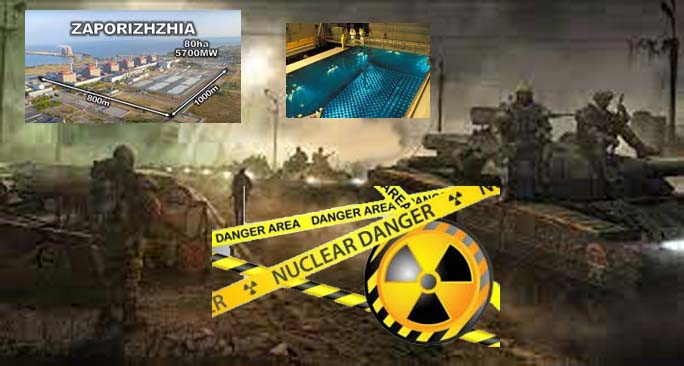
The Conversation, Najmedin Meshkati, 26 Aug 22, “…………………………………… What are the risks to a nuclear plant in a conflict zone?
Nuclear power plants are built for peacetime operations, not wars.
The worst thing that could happen is if a site is deliberately or accidentally shelled. If a shell hit the plant’s spent fuel pool – which contains the still-radioactive spent fuel – or if fire spread to the spent fuel pool, it could release radiation. This spent fuel pool isn’t in the containment building, and as such is more vulnerable.
Containment buildings, which house nuclear reactors, are also not protected against deliberate shelling. They are built to withstand a minor internal explosion of, say, a pressurized water pipe. But they are not designed to withstand a huge explosion.
As to the reactors in the containment building, it depends on the weapons being used. The worst-case scenario is that a bunker-buster missile breaches the containment dome – consisting of a thick shell of reinforced concrete on top of the reactor – and explodes. That would badly damage the nuclear reactor and release radiation into the atmosphere, which would make it difficult to send in first responders to contain any resulting fire. It could be another Chernobyl.
What are the concerns going forward?
The safety problems I see are twofold:
1) Human error……….
2) Power failure
The second problem is that the nuclear plant needs constant electricity, and that is harder to maintain in wartime.
Even if you shut down the reactors, the plant will need off-site power to run the huge cooling system to remove the residual heat in the reactor and bring it to what is called a cold shutdown. Water circulation is always needed to make sure the spent fuel doesn’t overheat.
Spent fuel pools also need constant water circulation to keep them cool, and they need cooling for several years before they can be put in dry casks. One of the problems in the 2011 Fukushima disaster in Japan was the emergency generators intended to replace lost off-site power got inundated with water and failed. In situations like that, you get “station blackout” – and that is one of the worst things that could happen. It means no electricity to run the cooling system.
In that circumstance, the spent fuel overheats and its zirconium cladding can create hydrogen bubbles. If you can’t vent these bubbles, they will explode, spreading radiation.
If there is a loss of outside power, operators will have to rely on emergency generators. But emergency generators are huge machines – finicky, unreliable gas guzzlers. And you still need cooling waters for the generators themselves.
My biggest worry is that Ukraine suffers from a sustained power grid failure. The likelihood of this increases during a conflict because power line pylons may come down under shelling, or gas power plants might get damaged and cease to operate. …………………….
How else does a war affect the safety of nuclear plants?
One of the overarching concerns about the effects of war on nuclear plants is that war degrades safety culture, which is crucial in running a plant……………………..
War adversely affects safety culture in a number of ways. Operators are stressed and fatigued and may be scared to death to speak out if something is going wrong. Then there is the maintenance of a plant, which may be compromised by lack of staff or unavailability of spare parts.
Governance, regulation and oversight – all crucial for the safe running of a nuclear industry – are also disrupted, as is local infrastructure, such as the capability of local firefighters. In war, everything is harder…………….. https://theconversation.com/imperiled-ukrainian-nuclear-power-plant-has-the-world-on-edge-a-safety-expert-explains-what-could-go-wrong-189429
Russia-Ukraine war: Ukraine announces mandatory evacuations
Guardian 27 Aug 22, Residents near the Zaporizhzhia nuclear power plant in Ukraine have reportedly been given iodine tablets, amid mounting fears that the fighting around the complex could trigger a catastrophe. It comes after the plant, Europe’s biggest nuclear power plant, was temporarily disconnected from Ukraine’s national grid after all lines to it were cut on Thursday.
……………..
- By Friday afternoon, Energoatom, Ukraine’s state nuclear agency, said one of the two working reactors had been reconnected to the grid. The one reactor is building up capacity, the agency said, thanking the plant’s working for “tirelessly and firmly” keeping “the nuclear and radiation safety of Ukraine and the whole of Europe on their shoulders”.
- ………………………….A team of inspectors from the UN nuclear watchdog are poised to make an emergency visit to the Russian-occupied Zaporizhzhia nuclear power plant in southeastern Ukraine, according to reports. Sources have told the Wall Street Journal that it is “almost certain” that a mission from the International Atomic Energy Agency (IAEA) will visit the plant early next week, although details are still being completed.
- EU energy ministers will gather for an urgent meeting as soon as possible to discuss the current energy crisis following Russia’s invasion of Ukraine, the Czech prime minister said. The Czech Republic currently holds the presidency of the European Council.
- Ukraine’s deputy prime minister, Iryna Vereshchuk, has announced plans to expand mandatory evacuations for civilians living on the war’s front lines. Speaking on national television, Vereshchuk said evacuating women with children and elderly people would be a priority from some districts of the eastern Kharkiv region and the southern Zaporizhzhia and Mykolaiv regions.
- …………………………………….. The German ambassador to the UK has acknowledged that there is a risk that public support for Ukraine could wane this winter as the energy crisis intensifies.
Bruce Gagnon Interview: An Objective Look at U.S. Foreign Policy

“Once weapons were manufactured to fight wars. Now wars are manufactured to sell weapons”.
BY JOHN RACHEL, 26 Aug 22,
Events continue to unfold at a quickening pace. Facing an alarming escalation in tensions around the world, we asked Bruce Gagnon for his most current thoughts.
Bruce Gagnon is the Coordinator of the Global Network Against Weapons & Nuclear Power in Space, and was a co-founder of the Global Network when it was created in 1992………………. He is currently an active member of Veterans for Peace.
……………Here is what Bruce had to say.
Q. We hear a lot of terms and acronyms bandied about. ‘Deep State’ … ‘MIC’ … ‘FIRE sector’ … ‘ruling elite’ … ‘oligarchy’ … ‘neocons’. Who actually defines and sets America’s geopolitical priorities and determines our foreign policy? Not “officially”. Not constitutionally. But de facto.
A. The banksters in London and Wall Street are the essential movers and shakers of US-UK-NATO foreign policy. The CIA is their primary arm of control. Add to them the burgeoning global military industrial complex and the political ‘mis-leaders’ they generously contribute to. The corporate controlled mainstream media are also accessories to the present day crimes. Together they add up to a formidable crew of what I call ‘pirates’ who are stealing the national treasures throughout the western capitalist world and using them to supress and colonize others across the Global South and here at home.
Q. We’ve had decades of international tensions. Recent developments have seen a sharp escalation in the potential for a major war. ……………….. war inevitable and peace impossible?
A. During the reign of George W. Bush in Washington, at the time of the US ‘shock and awe’ attack in Iraq, I was watching C-SPAN one evening. They introduced then Naval War College instructor Thomas Barnett (author of a book called ‘The Pentagon’s New Map’) and they announced that in the audience were hundreds of top-level Pentagon officers and CIA bigwigs. During his talk Barnett told the assembled that due to globalization of the world economy every nation would have a specific role to fill. In the US he said we won’t make ‘consumer products’ anymore because it was cheaper to send those jobs overseas. Our role in the US, Barnett said, would be ‘security export’. Thus it should be no surprise that the #1 industrial export product of the US today is weapons. When weapons are your #1 industrial export product, what is your ‘global marketing strategy’ for that product line?
Barnett (introduced as Rumsfeld’s ‘strategy guy’) also told the leading brass that the Pentagon would be endlessly fighting to take control of the ‘non-integrating gap’ around the globe – those parts of the world that were not submitting to the authority of corporate globalization. He instructed the audience to go and teach these ‘new concepts’ to those under their authority if they hoped to get promoted within the system in the years ahead.
For more than a year after this Barnett presentation I witnessed him being squired around Washington speaking to Republican and Democrat audiences on C-SPAN. It was evident to me that his ‘new doctrine’ was a bi-partisan plan. Since that time it has become quite clear that this is true as we now see the Democrats leading the proxy war on Russia – using Ukraine as the hammer in this dangerous and provocative attempt to force regime change in Moscow. Pelosi’s recent ill-fated trip to Taiwan also indicates the plan to force regime change in Beijing.
Imagine that Washington and its NATO allies, who limped out of Afghanistan after 20 years of brutal occupation there, are now planning for war with Russia and China. The absurdity is beyond imagination. It reveals much about their psychopathology.
As long as this reality persists then we will move from one war to another. Arundhati Roy says, “Once weapons were manufactured to fight wars. Now wars are manufactured to sell weapons”. She is right on the money…………………..
Q. Our leaders relentlessly talk about our “national interests” and our “national security”, warning that both are under constant assault. Yet, we spend more than the next nine countries combined on our military. Why does such colossal spending never seem to be enough?
A. When they talk about ‘national interests’ they are actually talking about the interests of the banksters. When they talk about ‘freedom’ they are talking about their freedom to steal the national wealth from nations with resources and the people around the world. Washington claims that Russia wants to re-create the former Soviet Union and take control of Europe. In 2022 Russia is spending $66 billion on their military. It is a defensive military to protect their vast border regions. The US this year is spending $800 billion plus. When you add up the hidden military spending in the other pots of gold – like the nuclear weapons spending inside the Department of Energy budget – the US total is around $1.2 trillion this year. They are robbing us blind and we keep handing over our hard-earned tax dollars. Why?………………………………………………….
- We need to convert the military industrial complex (the war machine) to build public mass transit systems, tidal power systems, solar, wind power and the like – all of which would create more jobs than weapons manufacturing does.
- We need to ban corporate funding of elections. We need to open up a multi-party system so that more voices can be heard by the voters.
- We need to end the massive poverty that exists (which will be worsening in the near future) by taxing the rich and corporations.
- Stop the massive corporate subsides – welfare for the rich.
- We need to close down the more than 800 US military bases around the world and cut the Pentagon budget by at least 80%.
- We only need a defensive military that protects our borders.
- Do all these things and we might have a chance if we don’t first perish from a red-hot nuclear war or climate crisis.We don’t have time to fool around.
- Folks need to get off their arses and speak out NOW. ………..
Biden Pledges Nearly $3 Billion To Ukraine In Largest U.S. Military Aid Package Yet

U.S. President Joe Biden has announced nearly $3 billion in new U.S. military aid for Kyiv as Ukraine marked its independence day six months after Russia invaded the country.
“On behalf of all Americans, I congratulate the people of Ukraine on their Independence Day,” Biden said in a statement on August 24.
“The United States of America is committed to supporting the people of Ukraine as they continue the fight to defend their sovereignty. As part of that commitment, I am proud to announce our biggest tranche of security assistance to date: approximately $2.98 billion of weapons and equipment to be provided through the Ukraine Security Assistance Initiative,” Biden said.
The financial package will allow Kyiv to obtain air-defense and artillery systems, ammunition, counter-unmanned aerial systems, and radars, the statement said…………….
Since Russia invaded Ukraine on February 24, the United States has provided $10.6 billion in military assistance to President Volodymyr Zelenskiy’s government.
On August 23, Germany said it will soon ship more than 500 million euros’ ($499.3 million) worth of weapons to Ukraine. https://www.rferl.org/a/biden-pledges-3-billion-military-aid-ukraine/32002639.html
All About Groundwater – Hanford part 2
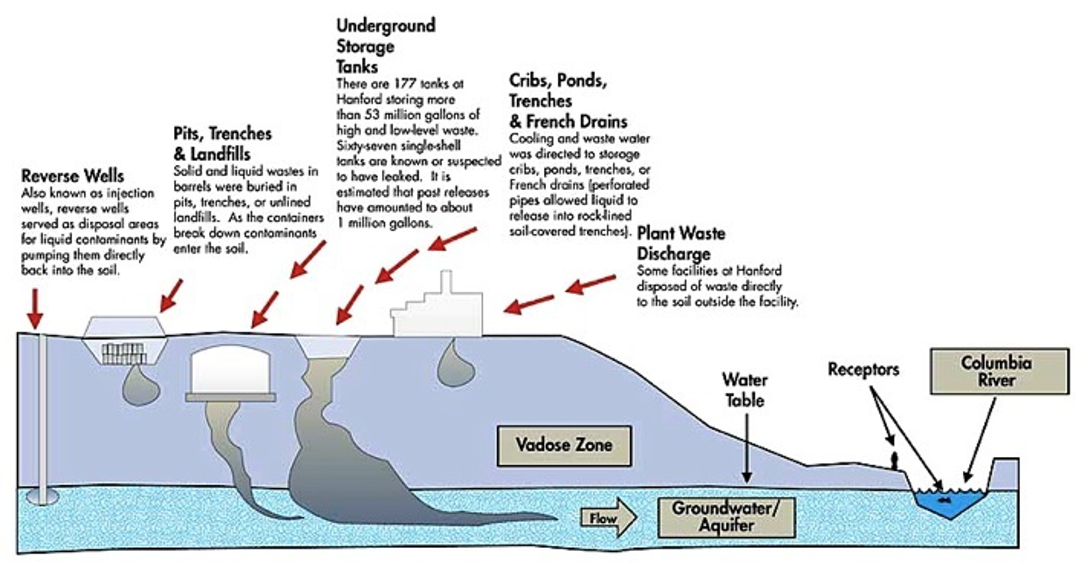
In Part 1 we covered the basics of the Pacific Northwest National Laboratory report, Adaptive Site Management Strategies for the Hanford Central Plateau Groundwater, that outlines an innovative strategy to tackle the challenge of groundwater cleanup. In Part 2 we’ll cover the history of Hanford’s soil and groundwater contamination, current cleanup strategies, and the various challenges to cleaning up the soil and groundwater.
Hanford’s history of soil contamination
The Hanford Site has a history of dumping radioactive and chemical waste directly into the ground on site. About 450 billion gallons of nuclear and chemical waste were dumped directly into the soil during the plutonium production years—the equivalent of more than 680,000 Olympic-size swimming pools. Manhattan Project workers dumped waste in unlined cribs, ponds, ditches, and trenches—four different types of holes in the ground used for disposing of waste. Injection wells pumped the toxic waste directly into the soil to dispose of it.
Workers constructed 177 underground tanks (149 single-shell tanks and 28 double-shell tanks) to hold the most dangerous, high-level waste. However, the soil contamination didn’t stop there. These enormous underground tanks were connected in a row of three or four tanks. The Manhattan Project workers used a process called cascading—which allowed them to fill up one tank with waste, and while the waste solids settled to the bottom, the liquids would flow from one tank to another. If too much waste was added to the final tank, it would overflow to the soil. “From 1944 through the late 1980s, Hanford generated nearly 2 million cubic meters (525 million gallons) of high-level tank waste. Liquid evaporation, discharge to the ground, chemical treatment, and tank leakage reduced this volume by 90%—to 204,000 cubic meters (54 million gallons).”[1]
Cascading wasn’t the only way that waste reached the soil from the tanks. The tank farms were backfilled under an 8-to-10-foot layer of soil before waste was added. Workers built the single-shell tanks between 1943 and 1964. As their name suggests, they only have one liner of carbon steel to contain the waste. Sixty-seven single-shell tanks are known or suspected to have leaked 1 million gallons of waste into the surrounding soil. Two single-shell tanks—B-109 and T-111—are currently leaking. The single-shell tanks were designed to contain the waste for 20-25 years, and they are now more than 40 years past their design life. As these tanks get older and older, they are more likely to fail—causing the waste to leak out into the soil. Once the waste gets into the soil it may remain there—making it very hard to remove—or it may travel with water through the soil and reach the groundwater.
Current cleanup of the groundwater
Today, the soil at the Hanford Site (particularly in the Central Plateau) remains heavily contaminated. Some radioactive and chemical contaminants are more mobile in water, which means a rainstorm may cause those contaminants to move with the water through the soil—reaching the groundwater and ultimately the Columbia River.
One of the cleanup methods to prevent contaminants from spreading and reaching the groundwater is to remove contaminated soil by digging it up and disposing of it in the Environmental Restoration Disposal Facility. Hanford Challenge is concerned that USDOE will decide that it doesn’t need to dig up all of the contaminated soil and will leave it in place—which would increase the risk of harm to future generations.
USDOE implements specific strategies for cleaning up the groundwater. One of those strategies is pump and treat. Pump and treat is the process of pumping contaminated water to the surface, filtering out some of the contaminants, and injecting the water back into the ground. Monitoring wells, extraction wells, and injection wells are interspersed throughout the Hanford Site to implement the pump and treat process. There are six pump and treat facilities on site.
Soil flushing is one strategy used to enhance the pump and treat process. Some contaminants remain in the soil and may take a long time to reach the groundwater. Until the contaminants hit the groundwater, they are impossible to capture with the pump and treat system. Soil flushing speeds up the process by using 225 gallons of water per minute to force—or flush—these hard-to-reach contaminants down to the groundwater where they can be brought up to the surface with the pump and treat system. USDOE has found success using soil flushing to push hexavalent chromium to the groundwater to treat it.
An additional strategy for meeting water quality standards is monitored natural attenuation. Contamination is left to naturally attenuate, which means letting the radiation decay over time. It sounds like a do-nothing approach, and it basically is.
Challenges to groundwater cleanup
USDOE faces many challenges when pursuing groundwater cleanup. As previously mentioned, there are hundreds of contaminated soil sites at Hanford due to past dumping practices and leaking underground tanks. The extent of groundwater contamination is vast.
- There are significant data gaps regarding the number of contaminants in the vadose zone (the area of soil between the ground surface and the water table), the depth and location of the contamination, and the risk the contamination poses to groundwater.
- Some hard-to-control, persistent contaminants, such as technetium-99, iodine-129, uranium, nitrate, and chromium, are located in the deep vadose zone and pose a long-term risk to the groundwater.
- There are extensive groundwater plumes with intermixed contaminants (or contaminants located together), making it difficult to accurately measure the total amount in the aquifer and the contaminant distribution.
Depending on the contaminant, one specific treatment may work better than another. When contaminants are intermixed, the treatment process becomes more complex. Multiple technologies used in tandem or various treatment methods may need to be used to effectively treat intermixed contaminants.- The soil underneath the tank farms is contaminated by tank leaks, accidental spills, and intentional releases, which creates an additional pathway for contaminants in the soil to reach groundwater. As tanks leak—potentially more frequently—they become an additional complexity in groundwater cleanup.
- A borehole is a circular hole drilled into soil or rock that draws samples from deep below ground. USDOE uses boreholes to characterize, or identify, the physical and chemical properties of the contaminants in the vadose zone. Unfortunately, deep borehole characterization is limited in certain areas due to the high price of drilling—contributing to the lack of information regarding the amount, location, and strength of contaminants in the soil.
Geological challenges to groundwater cleanup
Hanford’s geology poses unique challenges to groundwater cleanup. Manhattan Project managers chose the site partially for its geology and proximity to the Columbia River. The reprocessing facilities were sited in certain areas at Hanford because the gravelly soil allowed them to dump waste into the ground, where it percolated down and vanished without a trace. It was a handy way of disposing of the waste—it just disappeared—but the dumped waste now requires a complicated cleanup strategy.
The 200 Area in the Central Plateau contains a high hydraulic conductivity zone that consists of porous soils and rocks that allow contaminants to quickly move through the soil to groundwater and eventually to the Columbia River. USDOE doesn’t know the exact size and location of the hydraulic conductivity zone in the 200 Area, which means that the underground movement of liquids between the Central Plateau and the Columbia River is still an area of considerable uncertainty. On the other hand, some places at Hanford’s Central Plateau have less permeable soils that trap specific contaminants, making it difficult to separate the contaminants from the soil and treat them using the most common cleanup strategies.
Ancient lake beds are hidden underneath the surface and cause contaminants to move laterally (horizontally) instead of vertically down to the groundwater. Lake beds cause contaminants to take longer to reach the groundwater because they aren’t taking the most direct route straight down, and are instead moving sideways. USDOE uses models to predict when specific contaminants will reach groundwater. USDOE bases its models on the assumption that contaminants move vertically to the groundwater. However, ancient lake beds and the lateral flow of contaminants challenge that assumption and highlight the need for USDOE to update its models to better account for the geologic conditions underneath the site.
Perched water also complicates groundwater cleanup. Imagine a bird’s nest that is perched or sitting in a tree. Now, imagine that bird’s nest perched in a tree underground and filled with water. As contaminants move through the soil they can get caught and trapped in that underground bird’s nest. The underground nest creates a pocket of contaminants that is hidden and hard to reach. USDOE is aware of several contaminated perched water areas at Hanford, but lacks information about the size, what contaminants they hold, and how full the perched water areas are. USDOE must incorporate perched water areas into its strategies to ensure a comprehensive cleanup plan for groundwater.
Groundwater cleanup at Hanford is incredibly complex due to the history of waste disposal, the inherently dangerous nature of the contaminants, and the challenges created by the site’s geology. Hanford Challenge urges USDOE to update its groundwater models to include the intricacies of Hanford’s geology, such as ancient lake beds and perched water. Hanford Challenge also encourages USDOE to recognize, investigate, and resolve the uncertainties present in groundwater cleanup.
If you are interested in learning more about Hanford’s geology, check out Tim Connor’s presentation on the cataclysmic floods that shaped the Hanford Site and Vince Panesko’s presentation on the ancient lake beds that impact cleanup.
This blog post is funded through a Public Participation Grant from the Washington State Department of Ecology. The content was reviewed for grant consistency, but is not necessarily endorsed by the agency.
[1] Gephart, Roy. E. (2003). A Short History of Hanford Waste Generation, Storage, and Release. Pacific Northwest National Laboratory, PNNL-13605.
-
Archives
- February 2026 (228)
- January 2026 (308)
- December 2025 (358)
- November 2025 (359)
- October 2025 (376)
- September 2025 (258)
- August 2025 (319)
- July 2025 (230)
- June 2025 (348)
- May 2025 (261)
- April 2025 (305)
- March 2025 (319)
-
Categories
- 1
- 1 NUCLEAR ISSUES
- business and costs
- climate change
- culture and arts
- ENERGY
- environment
- health
- history
- indigenous issues
- Legal
- marketing of nuclear
- media
- opposition to nuclear
- PERSONAL STORIES
- politics
- politics international
- Religion and ethics
- safety
- secrets,lies and civil liberties
- spinbuster
- technology
- Uranium
- wastes
- weapons and war
- Women
- 2 WORLD
- ACTION
- AFRICA
- Atrocities
- AUSTRALIA
- Christina's notes
- Christina's themes
- culture and arts
- Events
- Fuk 2022
- Fuk 2023
- Fukushima 2017
- Fukushima 2018
- fukushima 2019
- Fukushima 2020
- Fukushima 2021
- general
- global warming
- Humour (God we need it)
- Nuclear
- RARE EARTHS
- Reference
- resources – print
- Resources -audiovicual
- Weekly Newsletter
- World
- World Nuclear
- YouTube
-
RSS
Entries RSS
Comments RSS
 nuclear-news