S. Korea renews concerns over possible release of tainted Fukushima water
The logo of the Ministry of Science and ICT at its main offices in the central city of Sejong, 130 kilometers south of Seoul, is shown in this undated photo provided by the ministry
September 22, 2020
SEOUL, Sept. 22 (Yonhap) — South Korea on Tuesday reiterated its concerns over Japan’s potential move to release radioactive water from its disabled Fukushima nuclear plant into the sea.
Japan has been mulling over options to discharge the water from the nuclear plant, which was devastated by a tsunami triggered by an earthquake in March 2011.
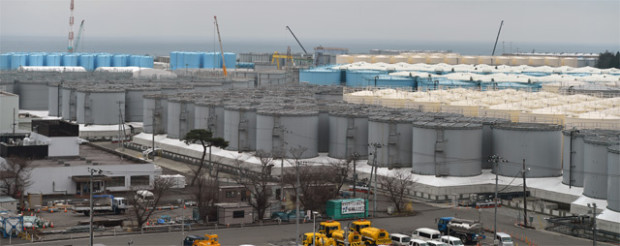
An estimated 1.1 million tons of tainted water is in temporary storage at the Fukushima plant.
South Korea’s Vice Minister of Science and ICT Jeong Byung-seon renewed concerns over Japan’s potential move in a recorded message at an annual conference of the International Atomic Energy Agency’s (IAEA), according to the science ministry.
The general conference of the U.N. nuclear watchdog was held partially online this year due to the coronavirus pandemic.
Jeong said releasing the tainted water would impact the global marine environment and that its method and long-term environmental risks need careful consideration through cooperation with global agencies, such as the IAEA.
The vice minister also called for an active role of the IAEA to facilitate transparency in the water’s disposal process, adding that Japan’s disposal plans should follow international law, such as the U.N. Convention on the Law of the Sea.
The science ministry said the vice minister will convey South Korea’s concerns to IAEA Director General Rafael Mariano Grossi in a separate meeting Wednesday.
The fallout of the damaged Fukushima nuclear plant has been a source of contention between the two neighboring countries, with South Korea imposing a ban on all seafood imports from eight Japanese prefectures near Fukushima in 2013.
https://en.yna.co.kr/view/AEN20200922007000320?section=national/diplomacy
Much at stake in picking a final nuclear waste disposal site
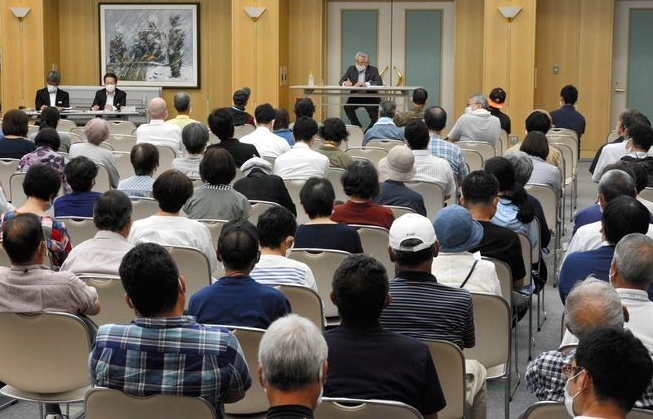
Local residents attend a meeting held Sept. 10 by the town government of Suttsu, Hokkaido, to explain plans to host a final disposal site for nuclear waste.
September 22, 2020
Two local communities in Hokkaido are considering pitching themselves as candidates for the site for final disposal of highly radioactive waste from nuclear power plants.
Last month, the mayor of Suttsu in the northernmost main island said the municipal government is thinking to apply for the first stage of the three-stage process of selecting the site for the nation’s final repository for nuclear waste.
During this period, past records about natural disasters and geological conditions for the candidate area are examined. Town authorities are holding meetings with local residents to explain its intentions.
In Kamoenai, a village also in Hokkaido, the local chamber of commerce and industry submitted a petition to the local assembly to consider an application for the process. The issue was discussed at an assembly committee. However, the assembly decided to postpone making a decision after further discussion.
Both communities are located close to the Tomari nuclear power plant operated by Hokkaido Electric Power Co. and struggling with common rural problems such as a dwindling population and industrial and economic stagnation.
The law decrees that when the first stage of the selection process starts, the municipality that is picked will receive up to 2 billion yen ($19.1 million) in state subsidies for two years.
But the Ministry of Economy, Trade and Industry and the Nuclear Waste Management Organization of Japan (NUMO), which are in charge of the selection process, have promised it will not move to the second stage if the prefectural governor or local mayor voices an objection.
Hokkaido Governor Naomichi Suzuki has already expressed his opposition.
A huge amount of spent nuclear fuel has been produced by nuclear plants in Japan, and it needs to be stored and disposed of somewhere in this country.
This policy challenge requires a solid consensus among a broad range of people, including residents of cities who have been beneficiaries of electricity generated at nuclear plants.
The two Hokkaido municipalities’ moves to consider applying for the first stage of the selection process should be taken as an opportunity for national debate on the issue.
The first step should be to establish a system for local communities to discuss the issue thoroughly from a broad perspective.
It is crucial to prevent bitter, acrimonious divisions in local communities between supporters and opponents.
The central government and other parties involved need to provide whatever information is needed from a fair and neutral position to help create an environment for healthy, in-depth debate.
There is also a crucial need to fix the problems with the current plan to build a final repository for radioactive waste.
Under the plan, which is based on the assumption that a nuclear fuel recycling system will eventually be established, the repository will be used to store waste to be left after spent nuclear fuel is reprocessed to recover and recycle plutonium and uranium.
But there is no prospect for the establishment of such a recycling system which would allow for disposing only of the waste from reprocessing and recycling.
Eventually, Japan, like most other countries with nuclear power plants, will be forced to map out plans for “direct disposal,” or disposing of spent fuel from nuclear reactors in underground repositories.
The central government has not changed its policy of maintaining nuclear power generation as a major power source. If nuclear reactors keep operating, they will continue producing spent fuel.
The government will find it difficult to win local support for the planned repository unless it makes clear what kind of and how much radioactive material will be stored at the site.
Many local governments are facing a fiscal crunch partly because of the impact of the COVID-19 pandemic.
Hokkaido Governor Suzuki has taken a dim view of the financial incentive offered to encourage local governments to apply for the first stage of the selection process, criticizing the proposed subsidies as “a wad of cash used as a powerful carrot.”
It takes tens of thousands of years for the radioactivity of spent nuclear fuel to decline to sufficiently safe levels.
Trying to stem local opposition by dangling temporary subsidies could create a serious problem for the future in the communities.
It is vital to ensure that the repository plan will secure a long-term policy commitment to the development of the local communities and ensure benefits for the entire areas.
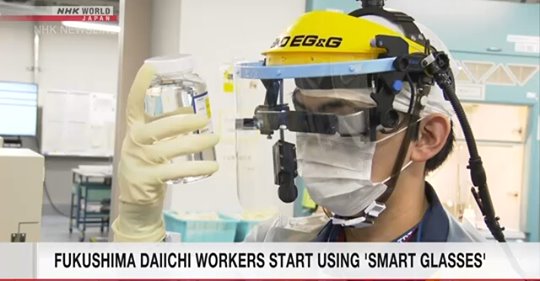
Fukushima Daiichi workers use ‘smart glasses’
Sept. 20, 2020
The operator of the crippled Fukushima Daiichi nuclear power plant has started using wearable electronic glasses to analyze water in and around the plant.
Tokyo Electric Power Company, or TEPCO, analyzes the concentration of radioactive substances and water quality and releases the data on a daily basis.
The “smart glasses” display information, such as work procedures and analytical graphs, on the liquid crystal screen.
When a QR code is scanned with the small camera, sampling locations and information on the person in charge are automatically recorded. Workers can also input the date and time by using their voices.
The data entry work has previously been carried out by hand with check sheets. TEPCO says the new glasses have made it possible for 30 of about 140 workers to be given other tasks. The utility says it plans to assign the 30 workers to analyze fuel debris.
A TEPCO official in charge of decommissioning the damaged reactors says it requires a lot of effort to input a huge amount of data by hand and there have been some errors, but the glasses should improve accuracy and productivity.
The official also says the company wants to accelerate the decommissioning process by helping employees to work more efficiently.
Japan fiddles with the idea of unleashing tainted water at Fukushima
September. 18, 2020
Concerns are resurfacing that the contaminated water from the Fukushima power plants could be discharged into the sea with Suga Yoshihide sworn in as new prime minister of Japan. Mr. Suga previously said whoever takes power next should tackle the issue of the radioactive contamination at Fukushima plant.
The Tokyo Electric Power Company (TEPCO) has embarked on the process of cutting the amount of the contaminated water currently stored at the premises of Fukushima power plants, down to the discharge level of radioactive substances set by the Japanese regulatory authorities. Some experts say that the state-run power corporation is preparing to let loose the water tainted with radioactive materials from Fukushima meltdown. Pundits argue that transparency of information is necessary to verify whether the radioactive nuclide density can be curtailed below the threshold as interned.
As of last year, the reactors at the Fukushima power plant site are belching an average 180 tons of contaminated water each day. This includes the massive amount of underground water that has been seeping into the nuclear reactors since 2013 in addition to the artificial influx of water. In February, the Japanese government reached the conclusion to unleash the water into the seas, with the storage capacity within the premises expected to reach the limit in August 2022.
TEPCO’s clean-up operation aims to reduce the discrepancy of radioactive density and cut the amount of discharging below standard for each type of nuclides. After upgrading and replacing the filters at multi-nuclide removal facility (ALPS), the process involves purifying the reservoir of the tainted water, checking the radioactive density, and processing the water again in the event density should exceed the threshold.
“The IAEA’s review has not found any issue with the performance of ALPS,” said Kim Yun-woo, a manager at the department of disaster prevention environment of the Nuclear Safety and Security Commission. “From a technical point of view, the purification process will likely bring down the density to meet the discharge standard, but in practice, we need to wait and see how much the water can get purified.”
The issue at hand is tritium. When the density is higher than a certain level, partial purification can be achieved through removal equipment. But the density of tritium in Fukushima water stands at 580,000 Bq per liter, impossibly low to remove with any equipment. Yet it is much higher than the discharge threshold at 60,000 Bq. There is known to be no effective technology to remove tritium under such circumstances.
Lifting Fukushima evacuation orders without decontamination should be limited
September 16, 2020
A new system in which evacuation orders can be lifted in “difficult-to-return” zones in Fukushima Prefecture in northeastern Japan without the national government decontaminating the zones will be set up, indicating a turnabout in the state’s recovery policy for the ongoing Fukushima Daiichi Nuclear Power Station crisis.
Since the onset of the nuclear disaster at Tokyo Electric Power Company Holdings Inc.’s Fukushima nuclear plant, the recovery policy had been premised on decontamination.
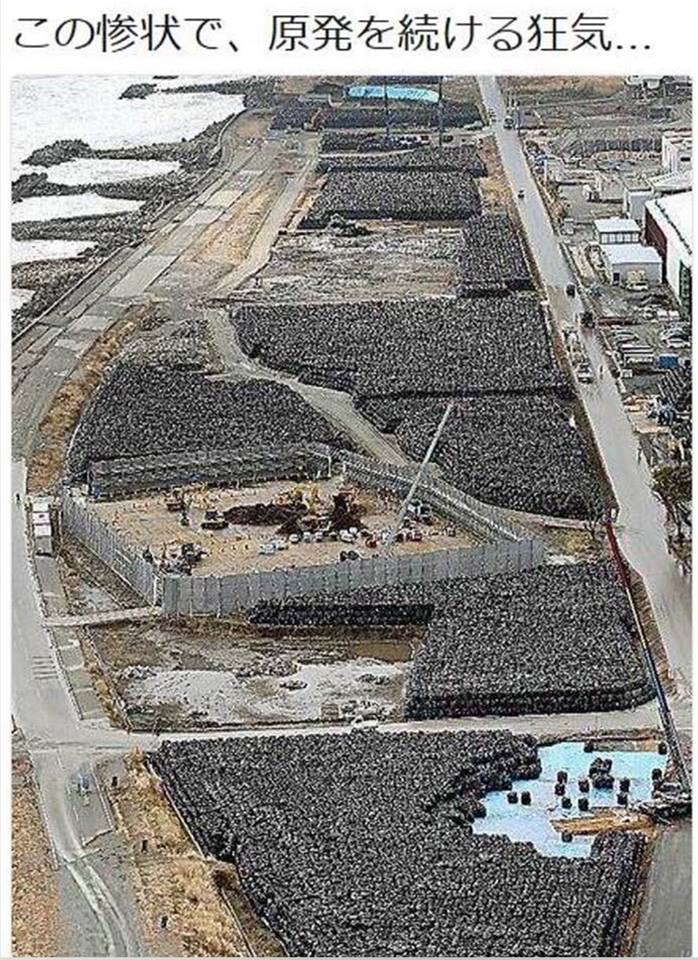
Of the difficult-to-return zones, there are six towns and villages that serve as “recovery bases,” which are former downtown areas and other types of land that are being decontaminated so that people can live there again. But such bases comprise just 8% of all difficult-to-return zones.
The new system will permit free entry into the remaining difficult-to-return areas on the condition that no one will live there, and that people will only use them as parks and other facilities.
While complete decontamination for such areas will no longer be required, the government plans to keep the criteria that radiation levels must go down before evacuation orders for these zones can be lifted. The Nuclear Regulation Authority has agreed with this plan.
What triggered this reversal in policy is a request submitted to the government by the Fukushima prefectural village of Iitate in February. Just a portion of the village is still under evacuation orders. Iitate sought the lifting of evacuation orders for the entire zone, without insisting on the decontamination of areas outside recovery bases.
The other five towns and villages are not following suit, however. Rather, some of them have voiced concerns that the government has no prospects of decontaminating areas outside recovery bases, and will force them to follow the “Iitate model.”
The new system must be considered an exception that can only be applied when a town or village seeks its application. It must not be extended.
The government must first indicate a policy on how it will proceed with the lifting of evacuation orders of areas outside recovery bases.
This is something that local towns and villages have long been seeking from the government.
The law stipulates that pollution resulting from a nuclear incident is the responsibility of the national government. If the new policy is implemented, that responsibility will likely become blurred.
It is probably the huge expense of decontamination that is slowing down the government. There are many residents who are still torn between going back to their hometowns in Fukushima and staying elsewhere. And one reason for that is the government’s lack of clear leadership. We must not allow decisions to be postponed any longer.
Nearly a decade has passed since the onset of the disaster, and the differences in circumstances by community are increasingly standing out. In some places where the majority of the land is difficult-to-return, reconstruction and recovery have only just begun.
The national government must proceed with its recovery policy while taking into consideration the circumstances and intentions of each and every community.
https://mainichi.jp/english/articles/20200916/p2a/00m/0na/013000c
The Fukushima Nuclear Disaster Recovery That Wasn’t
Outside of the photo friendly new train stations and town halls, the region has not seen the miracle recovery promised by Tokyo that would prove the disaster was a mere bump in the road.
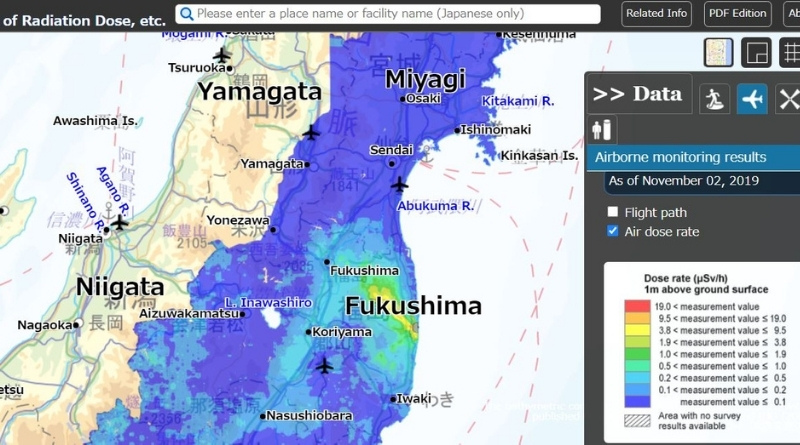
Areas that were part of the worst of the fallout zone have been reopened, in many cases being used to compel evacuees to return home.
Japan’s nuclear regulator has approved reopening residential areas in the difficult to return zone without prior decontamination work.
The disaster recovery base allows a section of a town to be decontaminated and some basic services built in that location.
While communities try to reopen and recover business activity, the region near the disaster site has been designated as a storage site for contaminated soil bags from all over Japan.
This is done with the assumption that residents will eventually return and need some basic town functions in order to do so.
In order for residents to live there, they will need to wear a dosimeter, have annual exposures below 20 mSv/year and decontamination work may need to take place.
In some towns, common areas were decontaminated down to desired levels while other parts of the town remained highly contaminated.
In Iitate, part of the “difficult to return zone”, a section of the town was listed as a “disaster recovery base“.
In Futaba, one of the two towns that host the Fukushima Daiichi disaster site, trial cultivation of vegetables is taking place.
Many communities in the region remain abandoned, damaged and degrading, even as the government moves to declare them reopened.
Naraha, one of the early towns to reopen, has seen about 60% of residents return in the last five years.
Reopening metrics have been problematic in other areas already reopened.
With almost 70% of the land based fallout from the disaster deposited in forest areas, the potential for re-contamination remains high.
Decontamination work would result in re-contamination as dusts and soils migrate back in from areas not decontaminated.
The city now wants to do the decontamination work on residential properties themselves to accelerate making the area available for residency.
Futaba plans to have residents to return by 2022.
Farmland, houses and forest areas near homes would need to be decontaminated at least once to pass review.
Futaba was part of the highest radiation fallout levels after the initial disaster.
The government still holds an annual exposure level of 20 mSv/year as the threshold for reopening an area.
The local police officer for Futaba mentioned to reporters that the area may be reopened but no one can live there.
Few have returned to decontaminate residential properties, something key to having residents return.
Futaba plans to reopen the entire town by 2022.
Further north in Minamisoma residents who remain deal with wild monkeys who have moved in due to the lack of people.
In Tomioka, the eastern half of the town has been reopened since 2017.
16-meter seawall planned for Fukushima Daiichi
September 14, 2020
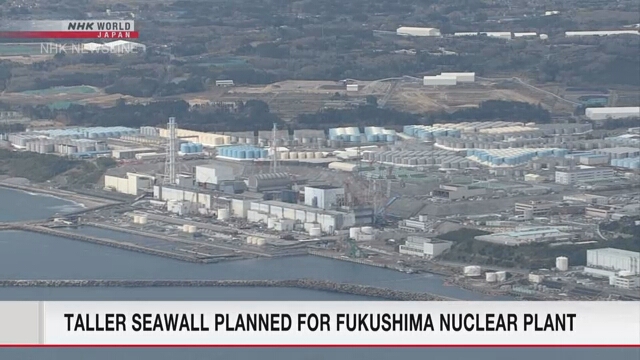
The operator of the damaged nuclear power plant in Fukushima, northeastern Japan, plans to build a taller seawall to help protect against future high seismic sea waves.
The move comes in response to the projection made in April by a government panel on the scale of tsunami that could be triggered by a massive quake along the Japan Trench in the deep sea off northeastern Japan.
The Tokyo Electric Power Company, or TEPCO, analyzed the projection and found that waves as high as 14.1 meters could engulf the Fukushima Daiichi plant compound, where the No.1 to No.4 reactors are located. It also found that waves of up to 15.3 meters high could hit south of the No. 4 reactor.
An 11-meter seawall is under construction on the ocean side of the plant compound. In an area south of the No. 4 reactor, another sea wall that is 12.8 meters high has already been completed.
TEPCO officials on Monday agreed to build another seawall measuring up to 16 meters high to protect these areas before the end of March 2023.
The wall is one of the anti-tsunami measures being taken by TEPCO as it decommissions the plant.
Work is under way to block the openings of the reactor buildings. Power supply vehicles are also deployed on higher ground to continue cooling spent nuclear fuel.
Nearly 1,000 tanks of radioactive wastewater are stored in the compound. TEPCO says the projected tsunami won’t reach the higher ground where these tanks are located.
Medical experts testify to court on Julian Assange’s precarious mental health
Medical evidence was produced in Julian Assange’s extradition hearing yesterday detailing the terrible harm done to the heroic journalist by a decade of state-orchestrated persecution.
The day was given over to the examination of Professor Michael Kopelman who testified to Assange’s mental health. Kopelman is a psychiatrist and Emeritus Professor of Neuropsychiatry at Kings College London. He has given expert evidence in multiple extradition cases on behalf of both the defence and the prosecution. In assessing Assange, he conducted seventeen visits in 2019 and additional visits in 2020, constructed a “full family history” and a “full personal psychiatric history,” and carried out “interviews with his family and lifelong friends.”
His findings constitute a clear bar to Assange’s extradition to the United States. Under Section 91 of the UK Extradition Act (2003), extradition is prohibited if “the physical or mental condition of the person is such that it would be unjust or oppressive to extradite him.”
Under Section 87, extradition is prohibited if it is incompatible with the European Convention on Human Rights (ECHR). Article 3 of the ECHR states, “No one shall be subjected to torture or to inhuman or degrading treatment or punishment.”
Medical evidence speaking to these bars has played a critical role in previous US-UK extradition hearings, for example in the case of Lauri Love. The risk of notoriously poor conditions in US prisons exacerbating mental illness is an important factor.
Assange’s case meets these criteria. The details in today’s WSWS coverage are being reported consistent with the “sensitivity” called for by defence lawyer Edward Fitzgerald QC, on behalf of his client. Nonetheless they make overwhelmingly clear the “unjust and oppressive” treatment to which Assange has already been subjected.
Assange, Kopelman told the court, has experienced periods of serious mental illness in his earlier life. Since being confined to the Ecuadorian Embassy and then Belmarsh maximum security prison, these issues have resurfaced and worsened. Assange has suffered symptoms of severe and recurrent depression. Those symptoms have included “loss of sleep, loss of weight, a sense of pre-occupation and helplessness” and auditory hallucinations which Kopelman summarised as “derogatory and persecutory.”
They have also included “suicidal preoccupations.” Kopelman told the court, “There are… an abundance of known risk factors in Mr Assange’s case” and that Assange has “made various plans and undergone various preparations.” He gave his opinion that there was a “very high risk of suicide.”
These symptoms and risks, Kopelman explained, are exacerbated by an anxiety disorder and Post Traumatic Stress Disorder (PTSD) and by a diagnosis of Asperger’s syndrome. Kopelman cited a paper by world-leading autism expert Dr Simon Baron-Cohen which found that the lifetime experience of suicidal thoughts in those with Asperger’s “was more than nine times higher than in the general population in England.”
Explaining the impact of the US government’s persecution, Kopelman said, “The risk of suicide arises out of the clinical factors of depression and the other diagnoses, but it is the imminence of extradition and/or an actual extradition that will trigger the attempt, in my opinion.”
If Assange were to be incarcerated in the US and segregated from other prisoners, Kopelman gave his opinion that the WikiLeaks founder would “deteriorate substantially” and see an “exacerbation” of his “suicidal ideas.” This would “amount to psychological harm and severe psychological suffering.”
Kopelman’s evidence confirms the warnings made since November 2019 by Doctors for Assange, representing hundreds of medical professionals from around the world, that Assange is suffering “psychological torture” and “could die in prison.” It underlines in distressing detail UN Special Rapporteur on Torture Nils Melzer’s comment regarding Assange’s treatment that “psychological torture is not torture-lite. Psychological torture aims to wreck and destroy the person’s personality and identity… to make them break.”
Assange’s year-and-a-half long incarceration at Belmarsh has been designed to achieve this objective. It has profoundly undermined, in numerous ways, his legal right to prepare his defence against extradition. Kopelman reported yesterday that Assange has repeatedly complained that the medication taken for his mental health has caused him “difficulty in thinking, in memorising [and] in concentration.”
During the morning’s cross examination, Kopelman forcefully rebuffed prosecution lawyer James Lewis QC’s challenge to his credentials. He said solicitors had called him several times in recent years saying that Lewis himself was “keen to have your services” in an extradition case.
In the afternoon, cross-examination continued, with Lewis challenging the veracity of Kopelman’s diagnosis, and claiming that Assange’s appearance was “wholly inconsistent with someone who is severely or moderately-severely depressed and with psychotic symptoms.”
Kopelman replied, “Could we go back a step?” Having seen Assange between May 30 and December [2019], “I thought he was severely depressed, suicidal and was experiencing hallucinations.”………….. https://www.wsws.org/en/articles/2020/09/23/assa-s23.html
Small modular nuclear reactors for Canada? – useless, expensive, untested, and a wasteful distraction
 NB Media Co-op 22nd Sept 2020,Premier Blaine Higgs has endorsed so-called “small modular nuclear reactors” or SMRs. SMRs represent an untested technology but what we know on the basis of technical characteristics and historical precedent is that they will be expensive and any electricity they generate will not be economical. The nuclear industry is pushing small reactors because large reactors are simply not economical. Constructing nuclear plants is just too expensive—as Ontario’s government found out after its call in 2008 for bids to build two more reactors at the Darlington site.
https://nbmediacoop.org/2020/09/22/no-business-case-for-new-nuclear-reactors-in-new-brunswick/
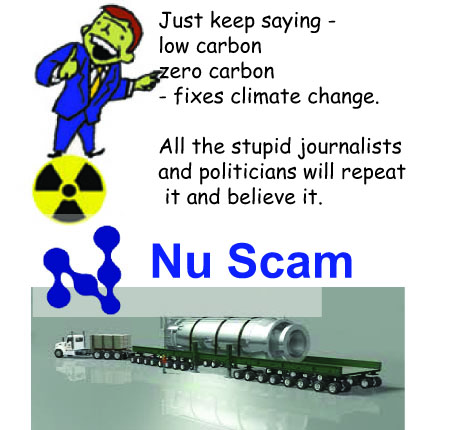 Sierra Club Canada (accessed) 23rd Sept 2020, No plan that gets us to net zero in a reasonable time frame includes new nuclear reactors. Nuclear is far too slow and expensive to deal with the climate emergency. Just like fossil fuel energy, nuclear produces wastes that pose unacceptable health hazards and economic costs.
The U.S. media’s resposibility to question Trump and Biden on nuclear arms control and nonproliferation

|
Whether President Trump or one of his challengers is sworn in as president on January 20, 2021, he or she will have the complete and unchecked authority to order the use of the approximately 4,000 nuclear weapons in the active US stockpile. When running for the highest office in the land, each presidential candidate is asking the American public to trust him or her implicitly with this singular responsibility. Given that reality, it is actually quite strange that plans and policies for the management of the most destructive force ever created are rarely discussed on the campaign trail. ………..with the exception of the Nov. 20, 2020 Democratic debate, television network hosts have largely avoided foreign policy questions in multi-candidate forums. Political reporters inside the Beltway and in the field rarely ask candidates about nuclear policy issues, despite the multiple nuclear crises unfolding around us in real time. There does not seem to be any acknowledgement that nuclear issues are inextricably linked to so many of the other issues being discussed. Relations with Russia, currently at a post-Cold War low, could slide from terrible to disastrous in the absence of verifiable, bilateral controls over the US and Russian nuclear arsenals. It is hard to envision a successful economic pivot to Asia that doesn’t involve a long-term solution to the North Korean nuclear crisis and a better strategic stability relationship between the United States and China. Getting the military budget under control is impossible without taking a hard look at the nearly $1.7 trillion (at least) that the United States is planning to spend on modernizing US nuclear forces. There is no “peace in the Middle East” without constraints on weapons of mass destruction in the region. Long-term solutions to climate change are all for naught if we ignore the other existential threat to humanity: nuclear war. The list could go on, but the point is that we ignore nuclear issues at our own peril. The next president will have to deal with many pressing questions on day one (or day 1,461), but few are as consequential as this one: Do we want to live in a world in which the number of nuclear weapons is going up or going down?……….. Despite the stated commitment to arms control and non-proliferation policies in the 2018 Nuclear Posture Reviewi, the Trump administration has mostly dismantled and dismissed standing nuclear agreements…….. No matter who sits behind the Resolute Desk on Jan. 20, 2021, he or she will have to scramble to triage the challenges left to them on the arms control and nonproliferation front. The most pressing challenge will be the possible end of the New Strategic Arms Reduction Treaty (New START), which is set to expire on Feb. 5, 2021. ………. While most Democratic candidates have affirmedv that they would extend the treaty as long as Russia remains in compliance, they should be asked to outline their plans for extension and how they would handle the broader strategic stability dialogue with Russia. ……… Plans to deal with the North Korean nuclear program are inextricably linked to other strategic security issues in the region. ………. The other major nonproliferation challenge for the candidates in 2020 will be the future of the Iranian nuclear program. The Trump administration’s decision to withdraw from the Joint Comprehensive Plan of Action (JCPOA) with Iran will affect the foreign policy landscape in 2021 and beyond. ………. With any of these matters, candidates should not be allowed to speak in bromides about the value of diplomacy. As uninspiring and tedious as the press may find it to focus on technical details, they should not buy into the idea that a quick-fix grand bargain is possible with Russia, Iran, or North Korea. Presidential candidates are asking for the privilege and responsibility of running American foreign policy, so it is completely reasonable to expect them to describe the mechanics of their proposals, even as they acknowledge that those proposals may need to change over time ………. The future president will also need to manage the growing unease between nuclear weapons states and non-nuclear weapons states. In particular, the United States will need to assess how it has related and will relate to signatories of the Treaty on the Prohibition of Nuclear Weapons, often known as the ban treaty, since the treaty will likely enter into force in the coming years. ……… Even with enhanced interest in and knowledge of nuclear policy, it is unlikely that reporters covering the 2020 presidential election will spend a significant amount of time on arms control and nonproliferation agreements. There are simply too many challenges facing the American public to expect hyper focus on any one policy area. That said, it would be extremely unfortunate to see the press ignore the subject of how we reduce nuclear risks—while gladly covering the president’s latest nickname for a rival or his challenger’s most memorable Trump put-down. For the past half-century, American presidents and administrations of both political parties have painstakingly built an intricate collection of arms control and nonproliferation agreements. They have brought the overall number of nuclear weapons in the world from almost 70,000 to around 14,000. They have prevented the mass spread of nuclear weapons, containing nuclear weapons programs to just nine countries. They have kept fear, mistrust, and the impulsive tendencies of fallible humans in check. As we approach the 75th year of the nuclear age, these hard-won agreements are disappearing. Americans will enter the voting booth on November 3, 2020 to select a leader who will either reverse that unfortunate trend or doom us to repeat the folly of the Cold War arms race. Let’s hope those voters they have all the information they need to make the right choice. https://thebulletin.org/premium/2020-01/what-the-presidential-candidates-should-be-asked-about-arms-control-and-nonproliferation/?utm_source=Announcement&utm_medium=Email&utm_campaign=Announcement09232020&utm_content=NuclearRisk_AskCandidates_01132020 |
|

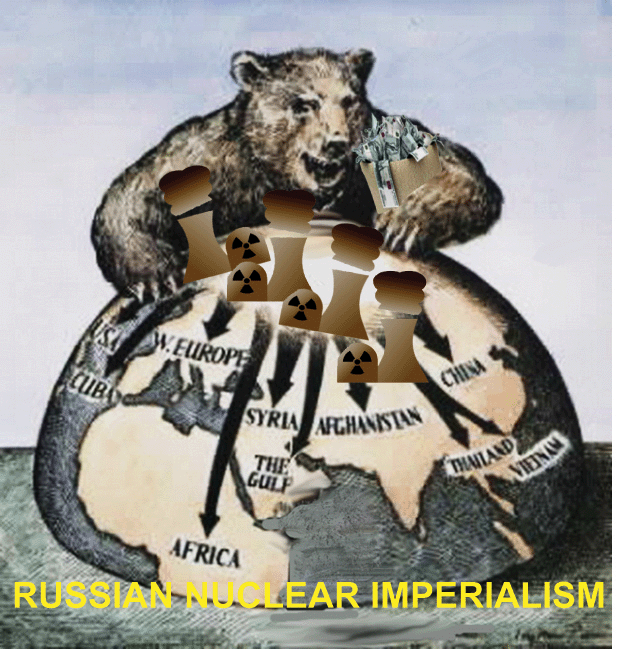
Power hungry Russia foisting nuclear power on Egypt – Africa – where it is not needed
|
Why Russia Is Pushing Unneeded Nuclear Power Plants On Egypt, Oil Price, By Haley Zaremba – Sep 22, 2020, In recent years, Russia and China have been facing off to spread their nuclear power dominion to a new, huge, and vastly untapped market: Africa. The two nuclear power giants have been in competition to corner the market, with Russia aiming to grow its position in a sector that China has historically dominated. Earlier this summer, German media company DW News reported on a new Russian-funded and -controlled nuclear center being developed in Kigali: “The Center of Nuclear Science and Technologies, planned for completion by 2024, will include nuclear research labs as well as a small research reactor with up to 10 MW capacity.” And the Rwandan plant is just the beginning. “Ethiopia, Nigeria and Zambia have signed similar deals with Rosatom, while countries such as Ghana, Uganda, Sudan, and DRC have less expansive cooperation agreements.”Now, there is a new forum for nuclear takeover in Africa: Egypt. As reported by AllAfrica this week, “Egypt’s venture into nuclear power has been planned from the top-down, with environmental groups and rights organizations expressing reservations, energy analysts questioning the need for the country’s first nuclear plant, and many details of agreements with Russia remaining murky.” ……….. The main issue at play here is water. In Egypt, most areas receive less than eighty millimeters of precipitation per year. Water, therefore, is an especially precious commodity. The top complaint, therefore, is about the massive quantities of water needed to keep nuclear reactors cool to avoid meltdown. Any concerns about public health due to radiation and high costs of construction are secondary to the issue of water usage.
Another common complaint is that nuclear is not really needed in Egypt, where considerable deposits of natural gas have been discovered off the coast – enough to account for an energy surplus. This raises questions about the purpose of the project – is it really to create more and greener energy, or is it ultimately about power relations and geopolitical attachments between the infamously opaque Egyptian Nuclear and Radiological Regulatory Authority and the infamously power-hungry Russian government? https://oilprice.com/Energy/Energy-General/Why-Russia-Is-Pushing-Unneeded-Nuclear-Power-Plants-On-Egypt.html |
|
Julian Assange dragged from embassy “on the orders of the president”
 Explosive evidence from Trump insider,Assange dragged from embassy “on the orders of the president”, WSWS, By Laura Tiernan and Thomas Scripps, 22 September 2020
Alt-right media personality Cassandra Fairbanks’ witness testimony was read out in court yesterday, providing evidence that Julian Assange’s April 2019 arrest at the Ecuadorian Embassy in London was politically motivated and directed by United States President Donald Trump.
Fairbanks testified that Arthur Schwartz, a wealthy Republican Party donor and key Trump ally, had told her that Assange was taken from the Ecuadorian Embassy “on orders from the president.” The conversation between Schwartz and Fairbanks occurred in September 2019 and was recorded by Fairbanks.
Schwartz, a frequent visitor to the White House and “informal adviser” or “fixer” to Donald Trump Jr., told Fairbanks the president’s orders were conveyed via US Ambassador to Germany Richard Grenell, who brokered a deal with the Ecuadorian government for Assange’s removal. Grenell was appointed acting director of national intelligence by Trump in February this year, holding the position until May.
Assange’s lawyer, Edward Fitzgerald QC, spelled out the significance of Fairbanks’ disclosures, telling Judge Vanessa Baraitser they were, “evidence of the declared intentions of those at the top who planned the prosecution and the eviction from the embassy.”
Fairbanks, who writes for the pro-Trump Gateway Pundit, is a prominent Assange supporter who visited the WikiLeaks founder at the Embassy on two key occasions. Her evidence was read into proceedings yesterday afternoon unopposed, with Fitzgerald explaining, “My learned friend [James Lewis QC for the prosecution] reserves the right to say ‘because she’s a supporter of Julian Assange you must take that into account in weighing her evidence.’ But we say [her evidence] is true.”
Given her close connections to leading figures in the Trump administration’s fascistic entourage, Fairbanks is uniquely positioned to expose key aspects of the politically motivated vendetta against the WikiLeaks founder. Throughout the extradition hearing, lawyers for the US government have repeatedly claimed the charges against Assange under the Espionage Act are motivated by “criminal justice concerns” and are “not political.”
Fairbanks’ evidence shreds the official narrative of the Department of Justice (DoJ) that Assange was arrested on April 11, 2019 in relation to “hacking.” In a phone call with Schwartz on October 30, 2018, he made clear that Assange would be arrested as political payback for his role in “the Manning case,” i.e., the disclosure by US Army whistle-blower Chelsea Manning of US war crimes in Afghanistan and Iraq……………
Speaking outside the court, Assange’s father, John Shipton, said, “Today we had the prosecution trying to prove that water runs uphill and up is down. … The defence replied and conclusively demonstrated that it was David Leigh [who caused the unredacted cables to be released]. We can only conclude from the amount of time that the prosecution spent defending David Leigh that David Leigh is a state asset.”
At the end of the hearing’s morning session, an exchange between District Judge Vanessa Baraitser and the legal teams pointed to further restrictions being imposed on the defence’s ability to present its case.
Seizing on the delays caused by a potential COVID-19 outbreak in the first week of the hearing, Baraitser insisted that the defence prepare a timetable that allowed the hearing to “finish within two weeks.” When the defence replied that this would leave no time for closing submissions, she reacted enthusiastically to the suggestion of prosecution lawyer James Lewis QC that these could be submitted in written form and summarised in just half a day each for the prosecution and the defence. A final decision is forthcoming.
The hearing continues today……… https://www.wsws.org/en/articles/2020/09/22/assa-s22.html
Compensation for some nuclear workers with mesothelioma .
|
Mesothelioma Compensation Center Urges the Family of a Navy or Civilian Nuclear Power Worker with Mesothelioma to Call Attorney Erik Karst of Karst von Oiste – Compensation Might Be in Excess of a Million Dollars, https://www.prnewswire.com/news-releases/mesothelioma-compensation-center-urges-the-family-of-a-navy-or-civilian-nuclear-power-worker-with-mesothelioma-to-call-attorney-erik-karst-of-karst-von-oiste—compensation-might-be-in-excess-of-a-million-dollars-301136249.html NEWS PROVIDED BY
Mesothelioma Compensation Center , Sep 23, 2020, HOUSTON, Sept. 23, 2020 /PRNewswire/ — The Mesothelioma Compensation Center is urging the immediate family of a Navy Veteran or civilian nuclear power worker who has just been diagnosed with mesothelioma to please call attorney Erik Karst of the law firm of Karst von Oiste at 800-714-0303. Compensation for a Navy Veteran or civilian nuclear power plant worker with mesothelioma could top the list when it comes to a financial compensation claim. Because many civilian nuclear power plant workers learned their craft on a nuclear-powered navy ship or submarine their asbestos exposure might have spanned decades. Financial compensation for a Navy Veteran or civilian nuclear power worker might exceed a million dollars.“We have endorsed, and we strongly recommend attorney Erik Karst because he and his amazing team at Karst von Oiste will work overtime for their clients. What Erik Karst and his team at Karst von Oiste do is ‘work a case’ which means they work overtime to answer the questions related to how, where and when the person with mesothelioma was exposed to asbestos. It is this vital information that becomes the basis for a mesothelioma compensation claim-and it is vitally important.”Do not let the Coronavirus stop a person with mesothelioma from pursing their financial compensation. Attorney Erik Karst and his colleagues now have the capabilities to work around the Coronavirus with conference calls and video conferences to make it easier on their client-and their client’s family. Erik Karst and his colleagues at the law firm of Karst von Oiste want their clients to receive the best possible financial compensation. For direct access to attorney Erik Karst of the law firm of Karst von Oiste please call 800-714-0303 anytime.” www.karstvonoiste.com/Some of the largest nuclear power plants in the US include:
For a list of all operating nuclear power plants in the United States please refer to the following website: https://www.nrc.gov/reactors/operating/list-power-reactor-units.html. The Mesothelioma Compensation Center specializes in assisting specific types of people who have been diagnosed with mesothelioma. The Center’s top priority is assisting US Navy Veterans, shipyard workers, oil refinery workers, public-utility workers, chemical plant workers, manufacturing workers, power plant workers, plumbers, welders, electricians, millwrights, pipefitters, boiler technicians, machinists, nuclear power plant workers, hydro-electric workers or oil and gas field production workers who have been diagnosed with this rare cancer caused by asbestos exposure. In most instances a diagnosed person with mesothelioma was exposed to asbestos in the 1950’s, 1960’s, 1970’s, or 1980’s. https://MesotheliomaCompensationCenter.Com According to the CDC the states indicated with the highest incidence of mesothelioma include Maine, Massachusetts, Connecticut, Maryland, New Jersey, Pennsylvania, Ohio, West Virginia, Virginia, Michigan, Illinois, Minnesota, Louisiana, Washington, and Oregon. However, a Nuclear Navy Veteran or a nuclear power worker with mesothelioma could live in any state including California, New York, Florida, Texas, Illinois, Kentucky, Tennessee, Mississippi, Georgia, Alabama, Wyoming, Colorado, New Mexico, Nevada, Utah, Arizona, Idaho, or Alaska. www.karstvonoiste.com/ For more information about mesothelioma please refer to the National Institutes of Health’s web site related to this rare form of cancer: Contact: |
|
Saudi Arabia may be able to produce its own nuclear fuel – with its uranium reserves
|
Revealed: Saudi Arabia may have enough uranium ore to produce nuclear fuel, Guardian
Emma Graham-Harrison, Stephanie Kirchgaessner and Julian Borger, 18 Sep 2020 Confidential Chinese report seen by the Guardian intensifies concerns about possible weapons programme, Saudi Arabia likely has enough mineable uranium ore reserves to pave the way for the domestic production of nuclear fuel, according to confidential documents seen by the Guardian.Details of the stocks are contained in reports prepared for the kingdom by Chinese geologists, who have been scrambling to help Riyadh map its uranium reserves at breakneck speed as part of their nuclear energy cooperation agreement. The disclosure will intensify concerns about Riyadh’s interest in an atomic weapons programme…….. The 2019 survey suggests that the reserves could potentially provide Saudi Arabia with both fuel for the reactors it wants to build, and surplus for export. ……. “If you are considering nuclear weapons development, the more indigenous your nuclear program is, the better. In some cases, foreign suppliers of uranium will require peaceful-use commitments from end users, so if your uranium is indigenous, you don’t have to be concerned about that constraint,” said Mark Hibbs, senior fellow in the nuclear policy program at the Carnegie Endowment for Peace. Another expert, Bruce Riedel at the Brookings Institution, said the information showed that the Saudis were “aggressively pursuing the prerequisites” for either an energy or weapons programme and that securing a domestic source of uranium would boost their effort……… The greatest international concern is over the kingdom’s lack of transparency. Under a 2005 agreement with the International Atomic Energy Agency (IAEA), Saudi Arabia avoided inspections through a small quantities protocol (SQP), which waives IAEA monitoring up to the point where fissile fuel is introduced into a reactor. The nuclear watchdog has been trying to convince the Saudi monarchy to now accept a full monitoring programme, but the Saudis have so far fended off that request. ……… https://www.theguardian.com/world/2020/sep/17/revealed-saudi-arabia-may-have-enough-uranium-ore-to-produce-nuclear-fuel |
Lawsuit: Ohio Attorney General sues to stop nuclear bailout money, and break up dark money groups

Ohio Attorney General Dave Yost sues to block nuclear bailout money from being paid, The lawsuit also seeks to dissolve the dark money groups involved in the bribery scheme. Author: WKYC Staff, Associated Press, 10TV Web Staff, September 23, 2020
COLUMBUS, Ohio — Ohio Attorney General Dave Yost filed a lawsuit on Wednesday to block the state’s nuclear plants from collecting fees on electricity bills that were authorized in a new law at the center of a $60 million federal bribery probe involving the former speaker of the Ohio House.
The suit was filed in Franklin County Court in Columbus against Energy Harbor, asking the judge to block payments to the company’s two nuclear plants near Cleveland and Toledo that were bailed out through the now-tainted legislation.
Energy Harbor is the former FirstEnergy Solutions, a onetime subsidiary of FirstEnergy Corp. The subsidiary filed for Chapter 11 bankruptcy in 2018 amid a mounting load brought on by the rise of competition from natural gas power in the East and Midwest.
HB 6, a roughly $1 billion financial bailout, was signed into law in July 2019. It added a new fee to every electricity bill in the state and directed over $150 million a year through 2026 to the plants in Lake and Ottawa counties. The fee will be added to every electricity bill in the state starting January 1.
Federal prosecutors allege that from March 2017 to March 2020, former Ohio House Speaker Larry Householder and others received millions of dollars in exchange for help in passing HB 6.
Wednesday’s lawsuit came hours after a House committee looking at repealing the law heard varying proponent testimony from energy lobbying groups and state office representing consumers. Governor Mike DeWine has said he supports a repeal of the law.
Yost had previously promised he would take the legal remedies necessary if the General Assembly could not do so in time.
The lawsuit also seeks to freeze the assets of former House Speaker Larry Householder’s $1 million campaign fund and dissolve the dark money groups involved in the bribery scheme, Yost said.
“Corruption like this doesn’t happen without cash, lots of cash,” he said.
Federal prosecutors in July accused Householder and four others of shepherding energy company money for personal and political use as part of an effort to pass the legislation, then kill any attempt to repeal it at the polls. All five men have pleaded not guilty………. https://www.wkyc.com/article/news/politics/attorney-general-dave-yost-sues-to-stop-nuclear-bailout-money-from-being-paid/95-431fd46c-44c0-440a-9076-46e1c9d23f8a
1 This Month

of the week – Shut Down Drone Warfare!


Tell the Ukrainian Government to Drop Prosecution of Peace Activist Yurii Sheliazhenko

Petition to revoke the licensing of the Near Surface Nuclear Disposal Facility (NSDF) at Chalk River. https://www.ourcommons.ca/petitions/en/Petition/Details?Petition=e-7247
To see nuclear-related stories in greater depth and intensity – go to https://nuclearinformation.wordpress.com
-
Archives
- April 2026 (68)
- March 2026 (251)
- February 2026 (268)
- January 2026 (308)
- December 2025 (358)
- November 2025 (359)
- October 2025 (376)
- September 2025 (257)
- August 2025 (319)
- July 2025 (230)
- June 2025 (348)
- May 2025 (261)
-
Categories
- 1
- 1 NUCLEAR ISSUES
- business and costs
- climate change
- culture and arts
- ENERGY
- environment
- health
- history
- indigenous issues
- Legal
- marketing of nuclear
- media
- opposition to nuclear
- PERSONAL STORIES
- politics
- politics international
- Religion and ethics
- safety
- secrets,lies and civil liberties
- spinbuster
- technology
- Uranium
- wastes
- weapons and war
- Women
- 2 WORLD
- ACTION
- AFRICA
- Atrocities
- AUSTRALIA
- Christina's notes
- Christina's themes
- culture and arts
- Events
- Fuk 2022
- Fuk 2023
- Fukushima 2017
- Fukushima 2018
- fukushima 2019
- Fukushima 2020
- Fukushima 2021
- general
- global warming
- Humour (God we need it)
- Nuclear
- RARE EARTHS
- Reference
- resources – print
- Resources -audiovicual
- Weekly Newsletter
- World
- World Nuclear
- YouTube
-
RSS
Entries RSS
Comments RSS
 nuclear-news