Aging nuclear plants: increased danger as U.S.utilities want their lives extended to 80 years
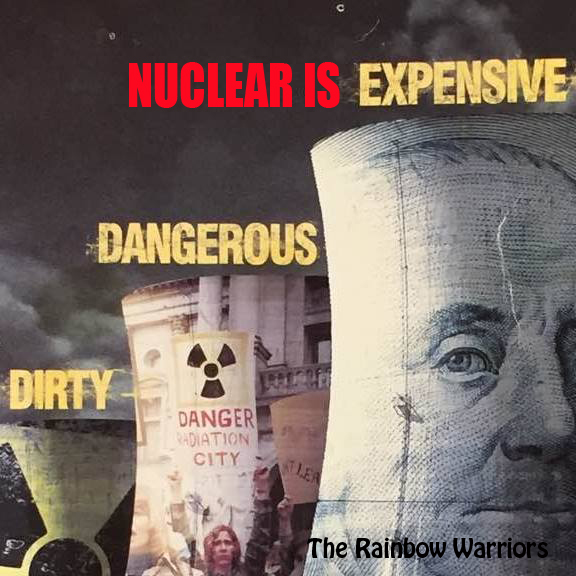
Bonnie Rippingille looked out at the wisps of steam curling from the Turkey Point Nuclear Power Plant across Biscayne Bay with a sense of dread. In December federal regulators approved Florida Power & Light Co.’s request to let the facility’s twin nuclear reactions remain in operation for another 20 years beyond the end of their current licenses. By that point they’ll be 80, making them the oldest reactors in operation anywhere in the world.
“That’s too old,” said Rippingille, a lawyer and retired Miami-Dade County judge. “They weren’t designed for this purpose.”
With backing from the Trump administration, utilities nationwide are preparing to follow suit, seeking permission to extend the life of reactors built in the 1970s to the 2050s as they run up against the end of their 60-year licenses.
“We are talking about running machines that were designed in the 1960s, constructed in the 1970s and have been operating under the most extreme radioactive and thermal conditions imaginable,” said Damon Moglen, an official with the environmental group Friends of the Earth. “There is no other country in the world that is thinking about operating reactors in the 60 to 80-year time frame.”
Indeed, the move comes as other nations shift away from atomic power over safety concerns, despite its appeal as a carbon-free [ whaaat?] alternative to coal and other fossil fuels. Japan, which used to get more than a quarter of its electricity from nuclear power, shut down all its plants in 2011 after a tsunami caused a nuclear meltdown at three reactors in Fukushima. Only a handful have restarted while others that can’t meet stringent new standards are slated to close permanently. Germany decided that year to shutter its entire fleet by 2022 and is now having trouble meeting its ambitious climate goals.
By contrast, the U.S. Nuclear Regulatory Commission is poised to decide this year on requests by subsidiaries of Exelon Corp. to extend the life of two nuclear reactors at its Peach Bottom Atomic Power Station in Pennsylvania and Dominion Energy Inc. to extend the life of two nuclear reactors at a power plant in Surry, Virginia.
Dominion has notified the commission it intends to ask permission to extend the life of two more reactors north of Richmond, Virginia. Duke Energy Corp. has said it plans to seek license extensions for its entire fleet of 11 nuclear reactors, starting with three in Seneca, South Carolina……
The nuclear industry has been buffeted by a wave of early reactor retirements in the face of competition from cheap natural gas and subsidized renewable power. Constructing a new nuclear plant – the only one being built in the U.S. is years behind schedule and over budget – can cost billions of dollars. Retrofitting an existing one is more likely to be in the hundreds of millions of dollars range. ……
Opponents such as Edward Lyman, a nuclear energy expert with the Union of Concerned Scientists, argue that older plants contain “structures that can’t be replaced or repaired,” including the garage-sized steel reactor vessels that contain tons of nuclear fuel and can grow brittle after years of being bombarded by radioactive neutrons. “They just get older and older,” he said. If the vessel gets brittle, it becomes vulnerable to cracking or even catastrophic failure.
Other concerns surround the durability of components such as concrete and electric cables, but an advisory board to the Nuclear Regulatory Commission, the independent government agency that gave Turkey Point the green light to operate into the 2050s, said those risks could be managed safely.
The commission’s decision doesn’t sit well with Philip Stoddard, mayor of South Miami, a city of 13,000 on about 18 miles away from the Turkey Point plant. He keeps a store of potassium iodide, used to prevent thyroid cancer, large enough to provide for every child in his city should the need arise.
“You’ve got hurricanes, you’ve got storm surge, you’ve got increasing risks of hurricanes and storm surge,” said Stoddard, 62. All of this not only increases the likelihood of a nuclear disaster, it also complicates a potential evacuation, which could put even more lives at risk…….
“They are going to be flooded,” Cox said. “If we are relicensing a major utility we need to be preparing for the impacts of sea level rise.”…….. https://www.goerie.com/business/20200209/our-aging-nuclear-plants
Natural Resources Defense Council: It’s Time to Pursue a Genuine Solution for Nuclear Waste
 NRDC: It’s Time to Pursue a Genuine Solution for Nuclear Waste NRDC: It’s Time to Pursue a Genuine Solution for Nuclear Waste
February 07, 2020 WASHINGTON — President Donald Trump bowed to reality as he said his administration would end its attempts to force nuclear waste into the unsafe Yucca Mountain site in Nevada.
Following is a statement by Geoff Fettus, senior attorney in the Nuclear Program at the Natural Resources Defense Council: “With this change of direction by the Trump administration, decades of unfortunate attempts to shove nuclear waste down Yucca Mountain officially come to an end. Congress must now move in a new direction, one based on sound science, the consent of the state and local citizens, and compliance with all environmental laws.” Please see this analysis for more information on this issue: https://www.nrdc.org/experts/geoffrey-h-fettus/final-resting-place-nuclear-waste The National Resources Defense Council (NRDC) is an international nonprofit environmental organization with more than 3 million members and online activists. Since 1970, our lawyers, scientists, and other environmental specialists have worked to protect the world’s natural resources, public health, and the environment. NRDC has offices in New York City, Washington, D.C., Los Angeles, San Francisco, Chicago, Bozeman, MT, and Beijing. Visit us at NRDC.org and follow us on Twitter @NRDC. |
|
Presidential nuclear decision by Twitter: Trump confuses about policy on Yucca for waste dump
|
Trump tweets reversal of push for Nevada nuclear waste dump, MyNorthWest, FEBRUARY 6, 2020 LAS VEGAS (AP) — PRESIDENT DONALD TRUMP ON THURSDAY APPEARED TO REVERSE HIS POSITION ON A PROPOSAL TO CREATE A NATIONAL NUCLEAR WASTE DUMP AT YUCCA MOUNTAIN IN NEVADA AFTER HIS ADMINISTRATION TRIED FOR SEVERAL YEARS TO REVIVE THE MOTHBALLED PROJECT. “Nevada, I hear you on Yucca Mountain and my Administration will RESPECT you!” Trump said in a tweet. “Congress and previous Administrations have long failed to find lasting solutions – my Administration is committed to exploring innovative approaches – I’m confident we can get it done! Adam Laxalt, Trump’s Republican re-election campaign chief in Nevada, said he believed the president was expressing support for opponents of the project, which was first proposed in the 1980s to entomb 77,000 tons (70,000 metric tons) of the nation’s most highly radioactive spent nuclear fuel in tunnels under an ancient volcanic ridge northwest of Las Vegas. Laxalt, a former state attorney general, fought federal efforts to resume work at the site using a wide range of objections revolving around safety, security and science. Yucca Mountain was among topics he said he discussed with the president last weekend at Trump International Golf Club in West Palm Beach, Florida. Laxalt on Thursday tweeted thanks to Trump, saying, “We are so fortunate that you listened to us.” “I know others have been speaking with him about Yucca Mountain,” Laxalt told The Associated Press. “We don’t support it. It’s not good for the state.” Trump administration officials and Nevada’s congressional delegation did not immediately have details to share about the president’s new position. The U.S. Department of Energy referred questions about the president’s tweet to the White House. The White House referred questions to the Office of Management and Budget, which did not immediately respond. State officials have argued that seismic activity and nearby Air Force testing would make the site about 100 miles (161 kilometers) from Las Vegas unsuitable to safely store radioactive material from elsewhere in the U.S. Nevada is a political swing state that Trump lost in 2016. His re-election campaign is targeting Nevada in 2020 as a battleground state it hopes to capture. As a presidential candidate, Trump was ambiguous about the Yucca Mountain project. Once he took office, his administration included requests for money to revive federal licensing for the project in his budget proposals, though Nevada’s congressional delegation successfully fought to keep the funding out of the budget…….. https://mynorthwest.com/1705762/trump-backs-away-from-push-for-nevada-nuclear-waste-dump/? |
|
French President Emmanuel Macron seeks leading role in post-Brexit EU nuclear strategy
|
Macron seeks leading role in post-Brexit EU nuclear strategy, Defense News, By: Thomas Adamson, The Associated Press PARIS (AP) 8 Feb 20,— French President Emmanuel Macron on Friday advocated a more coordinated European Union defense strategy in which France, the bloc’s only post-Brexit nuclear power, and its arsenal would hold a central role.
Addressing military officers graduating in Paris, Macron set out his country’s nuclear strategy in a bid to show leadership one week after nuclear-armed Britain officially exited the EU. PARIS (AP) — French President Emmanuel Macron on Friday advocated a more coordinated European Union defense strategy in which France, the bloc’s only post-Brexit nuclear power, and its arsenal would hold a central role. Addressing military officers graduating in Paris, Macron set out his country’s nuclear strategy in a bid to show leadership one week after nuclear-armed Britain officially exited the EU……. https://www.defensenews.com/smr/nuclear-arsenal/2020/02/07/macron-seeks-leading-role-in-post-brexit-eu-nuclear-strategy/ |
|
|
TV program just out — “Trump Space Force: Turning the Heavens Into a War Zone” — limitless life
Unless it’s stopped, Donald Trump will have opened space to war. Trump’s establishment of a U.S. Space Force as the sixth branch of U.S. armed forces has come despite the landmark Outer […]
via TV program just out — “Trump Space Force: Turning the Heavens Into a War Zone” — limitless life
Nuclear power and harm to animals — Beyond Nuclear International
New handbook reveals extent of impact
via Nuclear power and harm to animals — Beyond Nuclear International
Tigers may soon burn not so bright — Beyond Nuclear International
Indian uranium mines threaten reserve
via Tigers may soon burn not so bright — Beyond Nuclear International
Fukushima Thyroid Cancer Symposium live stream 3 February 2020
Reblog and edited. Here are some Lies? Read on!
“As it happened, South Korea had carried out a similar screening at around the same time in a population not exposed to Fukushima – and found very similar results. “It is very difficult to convince the public about this,” said Nollet. “And when we try we are seen as complicit in nuclear power.”


The Symposium is mostly in Japanese (awaiting translations for child cancer data)
Posted to Nuclear-news.net
Posted by Shaun McGee
Posted on 3 February 2020
Talks about the recommended treatment for Thyroid Cancer in Adults in different countries.
Partial removal advice, though an option, in most (Apart from one EU group) countries is generally ignored for full removal and resultant life long medication.
Some interesting notes I took From that part of the Symposium
3000 approx Thyroid cancers per year in the USA averaged (Pop 350 million) and 550 per year approx in China (pop 1.5 billion)
Higher rates of Adult Thyroid cancer in Korea and Japan for adults compared to rest of world. Korea has a slightly higher rate than Japan
Maybe the choice of total removal given is because of…
View original post 275 more words
Norways Nuclear Naughtiness – Censored Secrets and Haldens Hurtful History
5 February 2020
Out of respect to the Author of the article under unfair use I had to change the copy to fair use as requested. More changes may happen as the days, weeks and years go on depending on how fair use I am allowed. Takk!
“One of the documents TU has received “partial access” in. In addition to the email’s metadata, we can glimpse what might be the letter “d” in the upper left corner on page 4 of the document. (Illustration: Ole Petter Pedersen)”

The Norwegian nuclear reactor that recently shut down is estimated to cost some 20 billion Kroner. A lack of transparency overshadows the whole project against the recommendations of the IAEA`s report on the Failings of the Fukushima nuclear disaster.
On the January 29, Martiniussen and Peterson sent a complaint to the Civil Ombudsman requesting transparency and good practice be followed by giving details of the plans for a nuclear waste dump.
They were refused access to crucial documentation that should have been released to the public (Tax Paying funders) documenting a meeting between the Norwegian Minister of Industry and the Director-General of the OECD-NEA,
How to blank out history, the present and the future
The only major information to their request for data was the letter “d” on page 4.
The scary issue here is that Many countries including Russia funded aspects of the IFA nuclear experiments at Halden. The site was closed down in a furor of condemnation and suspicion. Was the nuclear industry allied to the Norwegian Salmon industry? Many questions remained to be answered!

Totally unrelated Salmon picture that didnt end up in Russia
Norway, having no experience in nuclear waste turned to the French nuclear company Orano and the Swedish company Studsvik,. Not the best idea in the world as these companies eyed an opportunity for profit and maybe, just maybe a few kilos of moldy farm salmon as well. But we will never know because of the Letter D (The only letter to be transparently offered to the FOI request by these 2 brave and intrepid sleuths).
Norway is now left with 17 tonnes of highly active, spent nuclear fuel thanks to those dastardly Russians and their American hug bunnies.
“All technical options are more or less known already, and NND’s general assessments of different directions cannot be kept secret”
But they are actually a secret of great National importance. So are the farmed Salmon deals that are also not to transparent (Possibly against OECD guidelines, but we will never know the truth!)
The Ministry of Trade and Industry claims that information must be kept secret for competition reasons. Luckily for the dodgy companies that will, may (we really dont know) be involved or how they will be involved. Shades of Fukushima radioactive Salmon perhaps?

Both the Minister of Industry and Employees in the Ministry of Trade and Industry Have decided to take a more top down anti democratic approach to transparency.
“That is why it is also crucial for TU’s social mission, to pursue cases where the authorities deny the citizens access. The Public Law is in practice the guarantee of the citizens that it is possible to control those we have given power and authority to carry out important social tasks.”
Must have a public conversation
The waste is dangerous and has a whole series of unknowns attached to it.
“Furthermore, the Norwegian nuclear fuel to be treated is of a metallic type that hardly any other country has. Therefore, there is no market for the treatment methods Studsvik investigates on behalf of NND. The treatment methods are specially designed for the Norwegian nuclear waste. The general methods Studsvik can offer were also publicly known through a report that was published in 2014.”
The request for data (More than the letter D) is nearly two years old.
“The Civil Ombudsman is the only body where it is possible to examine the ministry’s crush in unnecessary secrecy.”
So pre planning before the reactor was quickly ignored amongst the barrage of Russian troll bots and dubious bloggers highlighting the polluting and dangerous ways of the Halden reactor that proved that this should not be a private conversation only between two people.
“There are representatives at the highest level. In that case, the inhabitants must subsequently have the opportunity to gain insight into what is being discussed.”
Original article in full on the source url below
The ” task force” stage of Olympic cancellation ?

Tokyo Olympic coronavirus task force set up
February 6, 2020
The organizing committee for the 2020 Tokyo Olympic and Paralympic Games has launched a task force to respond to the spread of the new coronavirus.
The organizer told reporters on Thursday that it set up the task force on Tuesday headed by Director General Toshiro Muto.
It said officials already held a first meeting and talked about the need for cooperation with relevant organizations such as the central government and Tokyo metropolitan government, as well as the International Olympic Committee and the International Paralympic Committee over the virus outbreak.
They plan to discuss concrete measures to ensure the safety of athletes and spectators in the run-up to the torch relays that start in March, test events and the Olympic and Paralympic Games this summer.
Muto said he finds no problem in holding the Games, and his committee will closely monitor the situation in a calm manner, and take every step necessary to ensure safe conditions for athletes and spectators.
Tokyo 2020 Organisers set up task force to counter coronavirus
TOKYO (Reuters) – Tokyo Olympics organisers have set up a task force to coordinate with public health authorities on how to respond to the growing coronavirus epidemic.
Tokyo 2020 CEO Toshiro Muto said at a press briefing on Thursday that he chaired the newly created Novel Coronavirus Countermeasures Task Force, which held its first meeting on Feb. 4. A second briefing would be held as early as tomorrow, he said.
Muto said on Wednesday that the coronavirus spread could throw “cold water” over the 2020 Games momentum. At Thursday’s briefing, he pledged that the event “would go on as planned.”
Fukushima and the 2020 Olympics
by Shaun Burnie – 5 February 2020As 2020 is the year the Olympics and Paralympics come to Japan, this is an exciting time for sports and for the people of Japan. Amidst all the excitement however, there is the ongoing nuclear crisis in Fukushima prefecture. Labeled as the ‘Reconstruction Olympics’, Prime Minister Abe in 2013 declared that the situation at Fukushima Daiichi was under control. Seven years later there still remains a nuclear emergency at the nuclear plant and surrounding areas. In addition to the enormous challenges of how to safely manage over 1 million tonnes of contaminated water at the site and as much as 880 tonnes of molten nuclear fuel for which there is no credible solution, there remain wider issues regarding radioactive contamination of the environment, its effect on workers and Fukushima citizens, including evacuees and their human rights.
 Greenpeace radiation survey team in Fukushima, Japan
These issues were the subject of a 28 January 2020 documentary
broadcast by the U.S. network HBO as an investigative report by the program ‘Real Sports with Bryant Gumbel ’, the U.S.’s most-honored sports journalism series (with 33 Sports Emmy Awards, including 19 for Outstanding Sports Journalism) during the opening episode of its 26th season.
What does it mean to host the Olympics and Paralympics in the context of an ongoing nuclear disaster, the effects of which are still being felt by tens of thousands of Japanese citizens? What does it tell about the Japanese government and its commitment to respecting the values of transparency and the human rights of its citizens? These are some of the important questions raised by HBO and they warrant careful consideration in the months leading up to this year’s summer games.
 Greenpeace radiation survey team in Fukushima, Japan
Greenpeace Japan applauds Olympic values and spirit, while recognizing that the International Olympic Committee (IOC) has the responsibility to ensure the Olympic Games have a minimum impact on the environment and leave a positive legacy for those hosting the Games. The IOC has an opportunity to do this in a way that fulfills the ideals of the environment as the third pillar of Olympism – sustainability – by making the Games a showcase for environmental solutions. Simultaneously, we recognize that hosting the Olympics and Paralympics requires the Japanese Government to ensure absolute safety for athletes, international visitors, and the Japanese public alike.
The decision to host two sporting events in Fukushima city raises genuine and important questions over radiation risks. The route of the Olympic Torch relay in all the municipalities of Fukushima prefecture includes the districts of Iitate, Namie, and Okuma where Greenpeace Japan’s Nuclear Monitoring & Radiation Protection Team has discovered radioactive hotspots, both in the open areas as well as in the remaining radiation exclusion zones, that remain too high even by revised governmental standards. What does all this mean for the hosting of Olympic events, including for athletes and visitors?
 Greenpeace radiation survey team in Fukushima, Japan
By conducting extensive radiation investigations, Greenpeace Japan attempts to explain the complex radiological environment, where nothing is straightforward, and where judging precise risks to health at the individual level is near impossible. In an effort to better understand and explain the radiological situation in parts of Fukushima, as well as the ongoing issues of human rights for both Fukushima citizens and decontamination workers, Greenpeace Japan will be publishing its latest radiation survey results in early March 2020.
Shaun Burnie is Senior Nuclear Specialist at Greenpeace Germany.
https://www.greenpeace.org/international/story/28509/fukushima-and-the-2020-olympics/
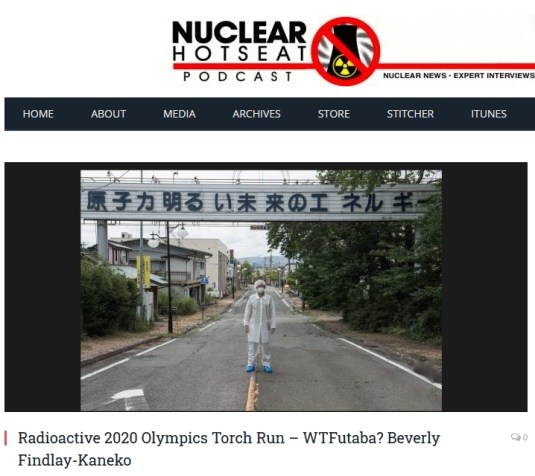
Radioactive 2020 Olympics Torch Run – WTFutaba? Beverly Findlay-Kaneko
February 5, 2020
Radioactive 2020 Olympics Torch Relay will run through Futaba, town next to Fukushima Daiichi, near former location of PR sign, “Nuclear Power: Energy for a Bright Future.” (pictured above) Runners and tourists will NOT be wearing decontamination garb, unless they’re smart – and if they’re really smart, they won’t be there..
This Week’s Featured Interview:
- Radioactive 2020 Olympics UPDATE: Beverly Findlay-Kaneko again joins us with on-the-ground information about the Olympics torch relay, including blog post interviews with former residents of Futaba, the town that hosted the Fukushima Daiichi nuclear facility, translated from the Japanese exclusively for Nuclear Hotseat.
A trip to the Fukushima Daiichi nuclear plant: Full-body suits and three layers of socks
This article is just another slick piece of propaganda, downplaying the dangerosity of the situation, a situation still not resolved that after 9 years of lies and cover-up, still not under control.
Among the many B.S. a very good example of its deceitful spin: ” Tepco officials later showed me containers of crystal clear water that had been through ALPS. They said it would be safe to release the liquid into the environment after mixing it with fresh water to meet regulations.”
Sorry Mister, crystal clear water does not make it safe when you’re talking about radioactive water, because remember radiation is invisible. Invisible indeed are the various types of radionuclides contained in that “crystal clear water” that they intend to dump into our ocean. Because as TEPCO admitted last year, their ALPS failed to remove all the Cesiums, Strontium and others, beside Tritium…
The Olympics are near… So the spinned propaganda is up in all japanese media trying to make us all believe how good everything is at Fukushima Daichi nuclear plant, and in contaminated Fukushima prefecture and Tokyo…
 Employees of Tokyo Electric Power Company Holdings Inc. wear protective suits and masks inside a radiation filtering Advanced Liquid Processing Systems (ALPS) at the tsunami-crippled Fukushima No. 1 nuclear power plant in January.
Feb 5, 2020
OKUMA, FUKUSHIMA PREF. – Reuters was recently given exclusive access to the Fukushima No. 1 nuclear plant, where three reactors melted down in 2011 after a powerful earthquake and tsunami overwhelmed the seaside facility.
It was my fourth visit to the plant since the disaster to report on a massive clean-up. Work to dismantle the plant has taken nearly a decade so far, but with Tokyo due to host the Olympics this summer — including some events less than 60 km (38 miles) from the power station — there has been renewed focus on safeguarding the venues.
Nearly 10 years into the decadeslong clean-up some progress has been made, with potentially dangerous spent fuel removed from the top of one damaged reactor building and removal underway from another.
But the melted fuel inside the reactors has yet to be extracted and areas around the station remain closed to residents. Some towns have been reopened farther away but not all residents have returned.
This time I was taken to the site’s water treatment building, a cavernous hall where huge machines called Advanced Liquid Processing Systems (ALPS) are used to filter water contaminated by the reactors.
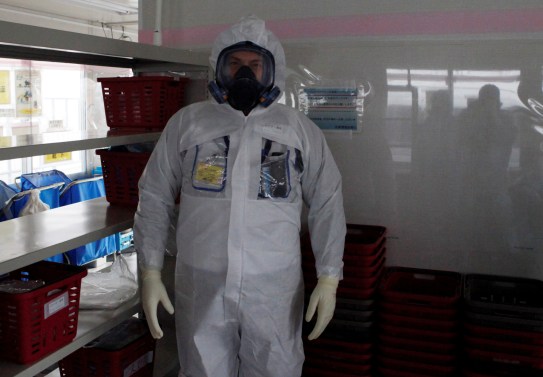 Journalist Aaron Sheldrick visits the Fukushima No. 1 nuclear power plant.
On my first visit in 2012 I had to wear full protective gear put on at an operations base located in a sports facility about 20 km south of the nuclear plant called J-Village, where the Olympic torch relay will start in March. Then I was taken to the site by bus.
This time I was driven by van from a railway station in Tomioka — a town that was re-opened in 2017 — about 9 km away, with no precautions. More than 90 percent of the plant is deemed to have so little radioactivity that few precautions are needed. Nevertheless, reporting from there was not easy.
Before entering the plant itself, which is about the size of 400 football fields, I was asked to take off my shoes and socks, given a dosimeter to measure radiation levels, three pairs of blue socks, a pair of cloth gloves, a simple face mask, a cotton cap, a helmet and a white vest with clear panels to carry my equipment and display my pass.
I put on all three pairs of socks and the rest of the gear given to me, later including rubber boots. I was to change in and out of different pairs of these boots many times — I lost count — color coded according to the zone we passed through, each time putting them in plastic bags that would be discarded after use.
After reaching the ALPS building in a small bus, I was decked out in protective equipment, a full-body Du Pont Tyvek suit along with two sets of heavy surgeon-like latex gloves that were taped fast to the outfit.
I also had to put on a full-face mask after taking off my glasses since it would not fit otherwise and told to speak as loudly as possible due to the muffling effect of the gear.
“Will you be able to see?” asked one official from Tokyo Electric Power Company Holdings Inc., the plant’s operator. I nodded with as much conviction as I could muster and we entered the building, which was quite dark, making it even harder to see.
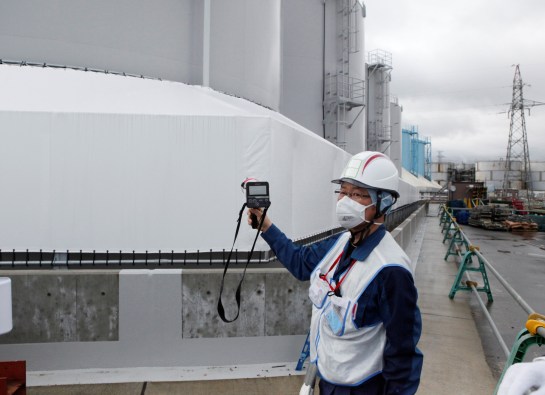 A Tepco employee uses a geiger counter next to storage tanks for radioactive water.
In the ALPS building I was taken up and down metal stairways that passed around piping, machinery, testing stations, changing in and out of the rubber boots as we crossed yellow and black demarcations, warning signs everywhere for areas that could not be entered.
As well as being dark, it was surprisingly quiet, given the machinery. My dosimeter alarm kept going off as the radiation levels rose. Tepco officials later showed me containers of crystal clear water that had been through ALPS. They said it would be safe to release the liquid into the environment after mixing it with fresh water to meet regulations.
About 4,000 workers are tackling the cleanup at Fukushima, including dismantling the reactors. Many wear protective gear for entering areas with higher radiation.
The plant resembles a huge construction site strewn in areas with twisted steel and crumpled concrete, along with cars that can no longer be used, while huge tanks to hold water contaminated by contact with the melted fuel in the reactors increasingly crowd the site.
Some wreckage is still so contaminated it is left in place or moved to a designated area for the radiation to decay while the important work on the reactor buildings is underway.
As we moved back into the so-called green zone we passed through a building where I was to take off the protective gear in a precise order in stages, with each piece going into a particular waste basket for each item. Gloves were first, then the facemask, after which the suit and socks were taken off at different locations until I was left with one pair for passing back through the various security cordons.
I was then given my external dosimeter reading, which was 20 microsierverts, about two dental x-rays worth.
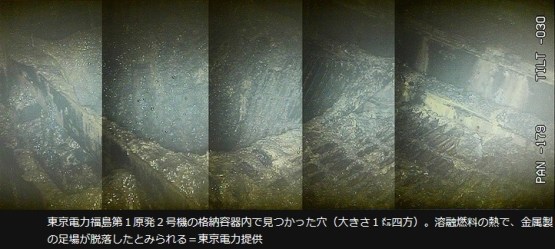
High-level radiation at Fukushima Daiichi No.2 reactor
February 4, 2020
Japan’s nuclear regulators say high-level radiation was detected last month in the No.2 reactor building of the crippled Fukushima Daiichi nuclear plant.
The Nuclear Regulation Authority last October resumed its probe into what caused the accident at the plant following the March 2011 earthquake and tsunami.
The results of a survey carried out last Thursday on the top floor of the building were disclosed at a meeting of commissioners and experts on Tuesday.
A meltdown took place at the reactor after the 2011 accident.
A robot on the floor directly above the reactor detected 683 millisieverts of radiation per hour.
The plant’s operator, Tokyo Electric Power Company, had also detected high levels of radiation there after the accident.
The site remains inaccessible to humans nine years later.
Commissioners and experts were also shown video of the No.4 reactor, which avoided a meltdown but experienced a hydrogen explosion. The video shows a steel frame believed to have been exposed by the blast.
The regulation authority plans to compile the data into a report this year, not only to determine the cause of the accident but also for work to decommission the reactors.
Japan tries to explain to embassies that releasing Fukushima Radioactive water into ocean is ‘safe’
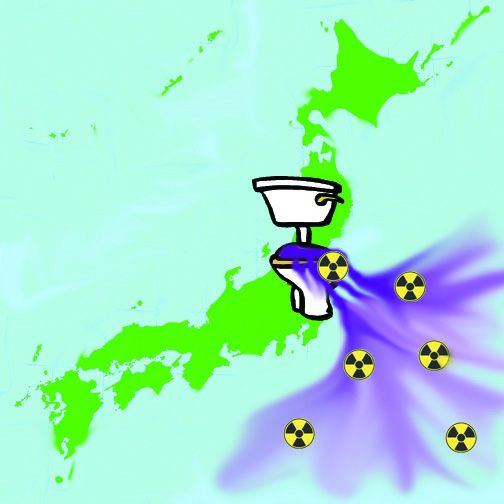
Japan assures diplomats tainted Fukushima water is safe
Feb. 3 (UPI) — The Japanese government said Monday the planned release of tainted water from Fukushima would have no impact on oceans.
During an information session for foreign embassy officials in Tokyo, the Japanese foreign ministry sent signals of reassurance regarding a plan to release tritium-tainted water from the Fukushima No. 1 nuclear power plant, the Mainichi Shimbun and Kyodo News reported.
A total of 28 diplomats representing 23 countries were in attendance, according to reports.
The water comes from Fukushima, where 170 tons of water is contaminated every day at the plant that was severely damaged during a catastrophic earthquake in March 2011. Water has been poured to cool the melted fuel, according to Kyodo.
Japan has been purifying the contaminated water using an advanced liquid processing system, or ALPS. The process does not remove tritium and leaves traces of radioactive elements.
Tokyo has defended its plan to release the water, but neighboring countries, including South Korea, are opposed to the measure.
On Monday, officials from Japan’s ministry of economy, trade and industry said they do not think there would be an impact on surrounding countries.
Japanese fishermen also oppose the measure. Releasing the water into the ocean could affect sales of local seafood, they say.
Japan is planning to release the tritium-tainted water at a time when it is taking stricter measures against travelers from China.
Jiji Press reported Monday Japan turned away five foreign nationals originating from Hubei Province following new restrictions at the border.
Foreigners who have stayed in the Chinese province in the past 14 days or who hold passports issued in the province are banned from entry, according to the report.
Japan has confirmed 20 coronavirus cases since the outbreak in China in December. Japanese airports have built new quarantine stations exclusively for travelers from mainland China, Hong Kong and Macau, according to local press reports.
Japan tries to explain to embassies merits of releasing Fukushima water into ocean
February 4, 2020
TOKYO – The Japanese government on Monday tried to impress upon embassy officials from nearly two dozen countries the merits of a plan to release radioactive water from the Fukushima Daiichi nuclear power plant into the ocean.
A briefing session was held at the Foreign Ministry in Tokyo to give an update on how more than 1 million tons of water that have been treated and kept in tanks at the crippled complex will be disposed of as storage space is quickly running out.
Both releasing the water into the Pacific Ocean and evaporating it are “feasible methods” as there are precedents for them in and out of Japan, though the former, in particular, could be carried out “with certainty” because it would be easier to monitor radiation levels, the government explained.
It has said the health risks to humans would be “significantly small,” as discharging the water over a year would amount to between just one-1,600th to one-40,000th of the radiation that humans are naturally exposed to.
But the discharge could cause reputational damage to the fishing and farming industries in the surrounding area, raising the need for countermeasures, the government said in the briefing, which came after the Ministry of Economy, Trade and Industry on Friday submitted a draft report on the methods to a subcommittee on the issue.
About 170 tons of water is contaminated at the Fukushima plant every day as it is poured onto the wreckage to cool the melted fuel or as it passes through as groundwater.
The contaminated water is being purified using an advanced liquid processing system, or ALPS, though the process does not remove tritium and has been found to leave small amounts of other radioactive materials.
Tanks used to store the treated water are expected to reach capacity by summer 2022.
Local fishermen have voiced opposition to releasing the water into the ocean out of fears that consumers would stop buying seafood caught nearby. Neighboring countries, including South Korea, which currently bans seafood imports from the area, have also expressed unease.
But no embassy officials voiced such concerns at Monday’s briefing, according to the industry ministry.
The briefing was attended by 28 embassy officials from 23 countries and regions — Afghanistan, Belgium, Benin, Brazil, Britain, Cambodia, Canada, Cyprus, East Timor, France, Germany, Italy, Indonesia, Jordan, Lebanon, Moldova, Panama, Russia, South Korea, Switzerland, Taiwan, Turkey and the European Union.
1 This Month
26 April – Chernobyl: Inside the Meltdown airs on National Geographic on Sunday 26th April from 4pm

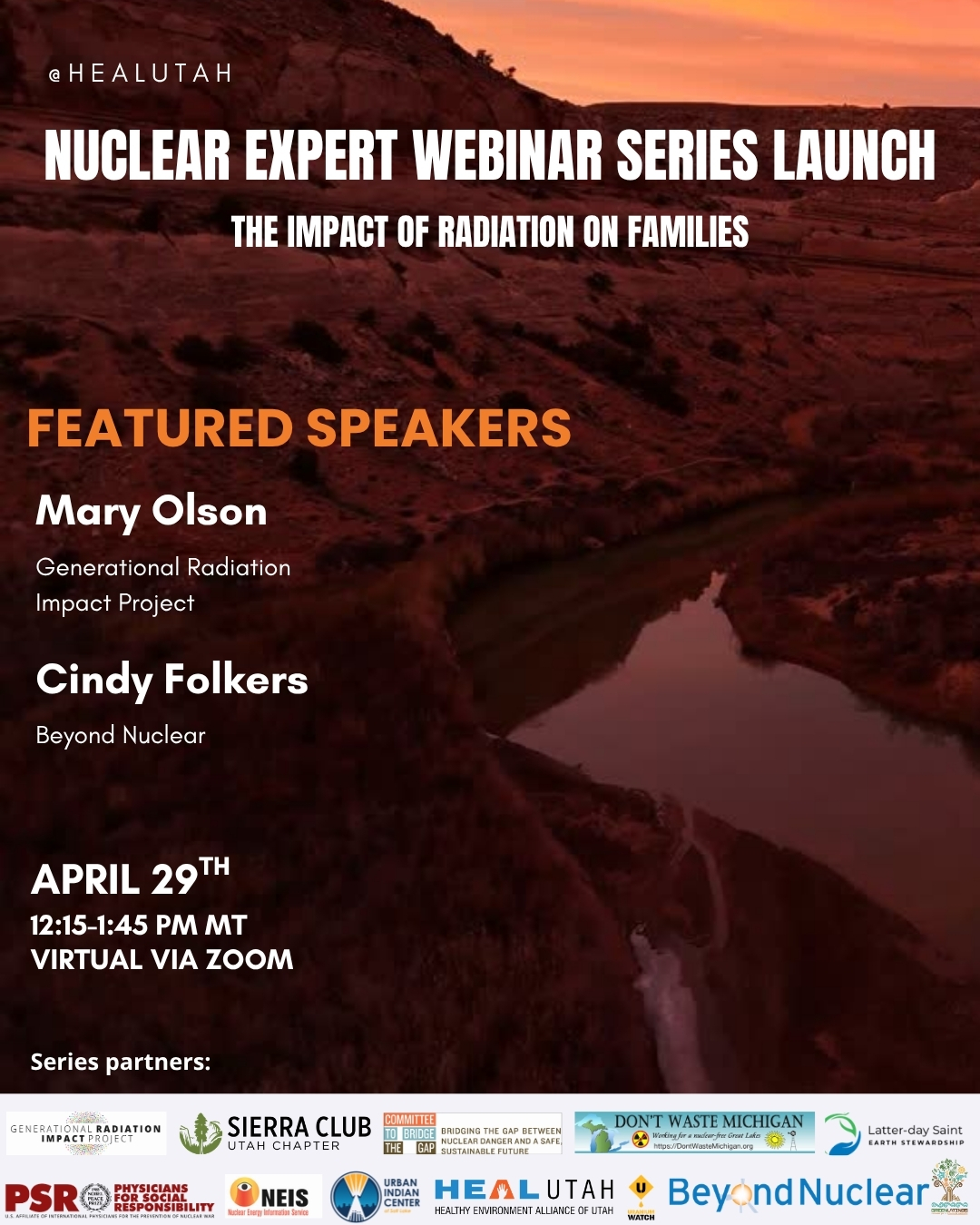
29 April – Nuclear Expert Webinar #1 – Radiation Impacts on Families with Mary Olson and Cindy Folkers
- 12:15 PM MT – 1:45 PM MT
- Location: Virtual – REGISTER TODAY

4 May -West Suburban Peace Coalition to discuss Iran war at May Educational Forum
Monday, May 4, 7:00 – 8:00 PM Central Standard Time
Title: : How Trump’s Narrative Tries to Shape the Reality of the War on Iran.
Contact Walt Zlotow, zlotow@hotmail.com 630 442 3045 for further information
14 May – online event From Bombs to Data Centres: the Face of Nuclear Colonialism

Pine Ridge Uranium is the real threat, not Tehran- Tell Burgum: Stop the Extraction.
Chernobyl: The Lost Tapes – A good documentary on Chernobyl on SBS available On Demand for the next 3 weeks– https://www.sbs.com.au/ondemand/tv-program/chernobyl-the-lost-tapes/2352741955560
To see nuclear-related stories in greater depth and intensity – go to https://nuclearinformation.wordpress.com
-
Archives
- April 2026 (300)
- March 2026 (251)
- February 2026 (268)
- January 2026 (308)
- December 2025 (358)
- November 2025 (359)
- October 2025 (376)
- September 2025 (257)
- August 2025 (319)
- July 2025 (230)
- June 2025 (348)
- May 2025 (261)
-
Categories
- 1
- 1 NUCLEAR ISSUES
- business and costs
- climate change
- culture and arts
- ENERGY
- environment
- health
- history
- indigenous issues
- Legal
- marketing of nuclear
- media
- opposition to nuclear
- PERSONAL STORIES
- politics
- politics international
- Religion and ethics
- safety
- secrets,lies and civil liberties
- spinbuster
- technology
- Uranium
- wastes
- weapons and war
- Women
- 2 WORLD
- ACTION
- AFRICA
- Atrocities
- AUSTRALIA
- Christina's notes
- Christina's themes
- culture and arts
- Events
- Fuk 2022
- Fuk 2023
- Fukushima 2017
- Fukushima 2018
- fukushima 2019
- Fukushima 2020
- Fukushima 2021
- general
- global warming
- Humour (God we need it)
- Nuclear
- RARE EARTHS
- Reference
- resources – print
- Resources -audiovicual
- Weekly Newsletter
- World
- World Nuclear
- YouTube
-
RSS
Entries RSS
Comments RSS
 nuclear-news