The dramatic melting of Arctic icebergs – in pictures
c thttps://www.theguardian.com/environment/gallery/2018/apr/04/the-dramatic-melting-of-arctic-icebergs-in-pictures
Photographer Francesco Bosso travelled to Greenland to capture images of the melting icebergs, which he describes as ‘gems of nature in danger of extinction’. The results are presented in his new book, Last Diamonds
Cumbria Trust gives advice on UK’s Community Consultation regarding nuclear waste dumping
there needs to be more honesty and openness about the negative aspects.
“Working With Communities” – Guidance notes for your own response to the consultation. April 8, 2018
“A baby that has no head is a baby that has no head.”
There is now hope that official research priorities will change. There is a continually growing movement to free up the World Health Organisation from its present inability to do medical research in Chernobyl and Fukushima. From 1959 until now, the World Health Organisation has been hamstrung by its agreement with the IAEA. On May 12, 2011 history was quietly made when the new WHO Director-General Margaret Chan said “There is no safe low level of radiation.”

“A baby that has no head is a baby that has no head.” – a different approach to the question of radiation and birth deformities, How do you find out if low levels of ionising radiation cause birth defects and genetic abnormalities? by Noel Wauchope, 23/10/12
The usual approach is to look at causes – at radiation as a cause. Scientists measure radiation levels in an area, and study or predict health results. Studies on small animal life in Chernobyl and Fukushima, have indicated genetic damage due to radiation.
Many reports have described birth defects linking them to radiation affected areas – Fallujah in Iraq, Chernobyl 2010 Paul Zimmerman http://www.globalresearch.ca/uranium-weapons-low-level-radiation-and-deformed-babies/16726 , 2009 Video and article http://www.guardian.co.uk/world/2009/nov/13/falluja-cancer-children-birth-defects
But, as the nuclear lobby loves to remind us – a link is not a proof And the World Health Organisation has remained silent on these matters. Why? Since 1959, an agreement signed…
View original post 1,386 more words
Who is being renditioned today? Shannonwatch report from Ireland
Edward Horgan added 3 new photos. (To Facebook Links)
At the Shannon peace vigil today we had the usual force of Gardai (police) providing security for Shannon airport for one hour, from peaceful non-violent peace activists. This charade occurs once a month for one hour on the second Sunday of each month from 2pm to 3pm. Access along the main road to the airport is restricted and peace activists are not allowed into airport, for one hour each month. At almost any other time, indeed from 3.30 pm this evening anyone who wishes, including the same peace activists can freely go the airport, as the Gardai will all have gone home or back to the Garda Barracks.
Today there were two US war-planes at the airport. One was an OMNI air chartered aircraft carrying up to 300 armed US troops to or from US wars in the Middle East. The other was a US air force executive jet, probably carrying US generals who of course would never travel in humble chartered aircraft together with their troops.
There are an average of about 720 hours in each month, so that means that for 719 hour in most months there is no Garda security on the main road into Shannon airport, and precious little real security up at the airport either, except when there may be a US military aircraft at the airport, and even then, security is very inadequate, given that Shannon airport is possible terrorist target. Do the Middle Eastern terrorist know the US military are using Shannon airport. Yes we do know that the Middle Eastern terrorist do know that the US military are using Shannon airport.
It is highly irresponsible of the Irish Government, firstly to allow the US military to use Shannon airport and even more so not to provide virtually any proper anti-terrorist security at Shannon airport. If or when a terrorist attack occurs at Shannon airport our Irish Government will of course say they took all necessary precautions, which will be a lie, and that such an attack could not have been foreseen, which will be another lie. Anybody killed or injured at Shannon airport will be just collateral damage.
For more information on how the USA uses Ireland for criminal and unconstitutional purposes see this link http://www.shannonwatch.org/
Dilution is not the Solution! Fukushima soil to be spread all over Japan and, ergo, in export food

Dilution is not the Solution! Fukushima soil to be spread all over Japan and, ergo, in export food
Do not use soil contaminated with radioactivity for public enterprise!
My name is Ohashi, a housewife living in Nipponmatsu, Fukushima Prefecture.
Demonstration project is going to be carried out for reusing polluted soil that was released to eliminate radioactive substances diffused in the environment due to TEPCO Fukushima Daiichi Nuclear Power Plant accident in public enterprise projects!
The place is our Nipponmatsu Ichihara District.
Radioactive contaminated soil decontaminated was promised to be transported to an intermediate storage facility. However, contrary to this promise, the Ministry of the Environment is about to transform the policy to reuse polluted soil in public enterprise nationwide.
They shall say after conducting a demonstration project in Nipponmatsu City, “Safety and usefulness have been confirmed.” To overlook this leads to using the contaminated soil in public use nationwide.
Therefore, we ask for your approval to ask the Minister of the Environment to withdraw the plan of “Dirty Soil Reuse Demonstration Project”. Please lend me your support! Thank you
Sign the petition here;
I dont want all Japanese imports to have radiation in them (Change.org petition)
Total tally for Fukushima decommission is $75 billion

Fukushima Jitters

Seven years on, radioactive water at Fukushima plant still flowing into ocean, study finds
Fukushima Daiichi still leaking radioactivity into Pacific Ocean. That expensive Ice wall turned out to be a slushy. Keep trying. Better yet, shut down before meltdown.

Russia lifts bans on Japanese seafood

Nuclear scientists not so well aware of the risks – theme for April 2018
Research has found disturbing differences in the attitudes of scientists in different areas, to health and environmental risks of the nuclear industry.
It is even more disturbing that policy-makers and politicians prefer to support and value the opinions and work of the very scientists who are least informed and least interested in those risks.

Politics and Scientific Expertise: Scientists, Risk Perception, and Nuclear Waste Policy, Richard P. Barke Hank C. Jenkins‐Smith. – To study the homogeneity and influences on scientists’perspectives of environmental risks, we have examined similarities and differences in risk perceptions, particularly regarding nuclear wastes, and policy preferences among 1011 scientists and engineers. We found significant differences (p0.05)in the patterns of beliefs among scientists from different fields of research. In contrast to physicists, chemists, and engineers, life scientists tend to: (a)perceive the greatest risks from nuclear energy and nuclear waste management; (b)perceive higher levels of overall environmental risk; (c)strongly oppose imposing risks on unconsenting individuals; and (d)prefer stronger requirements for environmental management.
On some issues related to priorities among public problems and calls for government action, there are significant variations among life scientists or physical scientists. We also found that–independently of field of research–perceptions of risk and its correlates are significantly associated with the type of institution in which the scientist is employed. Scientists in universities or state and local governments tend to see the risks of nuclear energy and wastes as greater than scientists who work as business consultants, for federal organizations, or for private research laboratories. Significant differences also are found in priority given to environmental risks, the perceived proximity of environmental disaster, willingness to impose risks on an unconsenting population, and the necessity of accepting risks and sacrifices. more https://onlinelibrary.wiley.com/doi/abs/10.1111/j.1539-6924.1993.tb00743.x
The week to April 7, in nuclear news
 While I’m supposedly focussed on nuclear news, it is really madness to ignore climate. The biosphere is being dramatically changed by human activities. Climate news has become ever more complicated. Last week, I struggled to explain the complexity of the Arctic currents of warm air, their effects on the polar vortex, and the extreme cold in Northern Europe and America.
At the same time, climate change is heating up the southern half of the globe.
Rapid Sea Level Rise Possible as Ocean Floods into Antarctica at up to 400 Meters Per Year. Antarctica’s great ice sheet being eroded by warm water circulating underneath. Drastic action on fossil fuels is needed, as the Poles melt – with unpredictable consequences.
Madeleine Allbright on the global threat of fascism, and Donald Trump
Chris Busby comments on the Skripal incident – Nuclear war an option?
Women, today and always, understand and fight the peril of nuclear war, nuclear pollution.
The world should be outraged at the silencing of Julian Assange.
The carbon footprint of huge digital data centres.
JAPAN. Powerful volcanic eruption at Mount Shinmoe, and more to come -ONLY 40 MILES FROM Sendai Nuclear power station. The end for Japan’s expensive Monju nuclear fast breeder dream. Closing down of Fukushima nuclear power plant has skyrocketed to US$75 billion. Problems with local consent hang over Japan’s proposed nuclear station restarts. Tepco facing huge costs in Fukushima disaster, but still plans to help fund restart of Tokai nuclear power station.
NORTH KOREA Kim Jong Un’s complete turnaround in tactics: will it result in peace, or not? Experts reject Japanese claim about North Korea preparing for a new nuclear weapons test. North Korea nuclear missile ‘could reach UK within months’ – but Kim Jong-un ‘too rational’ to use them.
SOUTH KOREA. Researchers from 30 countries call for boycott of South Korean university, in campaign against lethal autonomous weapons.
UK.
- Recovery of poisoned former Russian spy should help the police investigation. The Skripals and the unusual timing of Chemical warfare exercises near Salisbury.
- EDF says that proposed Sizewell C nuclear plant in Suffolk may not be feasible.
- British Nuclear Test Veterans Update.
- UK’s secret air transport of nuclear wastes – a cause for concern.
- Serious flaws in “community consultation” process for selecting a nuclear waste dump site in Cumbria.
- UK Inspector General’s report on Nuclear Safety and Radiation Protection 2017.
RUSSIA. The new arms race, as Russia tests its ‘Satan’ nuclear missile. – Novichok A234 – The facts .
USA.
- Donald Trump does not know what he’s doing, in lead-up to North Korea summit. Iran nuclear deal under threat, with Donald Trump’s new national security team.
- Could new U.S. tactical missile projects trigger a new nuclear arms race? Nuclear lobby no longer touts Peaceful Nuclear Power – now it’s Essential for Nuclear Weapons.
- Massive subsidy plan for New York’ s nuclear power could be stymied by new evidence. FirstEnergy files for bankruptcy for its uneconomic coal and nuclear subsidiaries.
- Isle de Jean Charles – America’s first climate refugees to evacuate.
CANADA. Canada’s so-called “medical”nuclear research reactor finally bites the dust.
CHINA. China expanding its nuclear marketing overseas, with the help of Bill Gates.
TURKEY. Nuclear energy is not coming to Turkey quickly. Cyprus to lodge complaint over Turkey Nuclear Power plant plans.
PAKISTAN. Submarines with nuclear weapons bring nuclear war closer for India and Pakistan.
MIDDLE EAST. Global nuclear power firms scrambling to market nuclear technology to Middle East countries.
FRANCE. Resurrected nuclear company Orano (formerly Areva) – still losing money-France’s EDF to spend 8 billion euros ($9.8 billion) by 2035 on energy storage.
BELGIUM. Belgium’s nuclear power to be ended by 2025.
SAUDI ARABIA. Crown Prince Bin Salman suggests war may happen between Saudi Arabia and Iran. Inside the vast web of PR firms popularizing the Saudi crown prince.
Powerful volcanic eruption at Mount Shinmoe, and more to come -ONLY 40 MILES FROM Sendai Nuclear power station

Another powerful eruption observed at Mount Shinmoe , Japan Times, 5 Apr 18 FUKUOKA – Another powerful eruption was observed at Mount Shinmoe in southwestern Japan early Thursday, with ash sent spiralling into a plume around 5,000 meters high, the Meteorological Agency said.
The eruption at the 1,421-meter volcano that straddles Miyazaki and Kagoshima prefectures was the largest since March 25, according to the agency.
Mount Shinmoe erupted violently for the first time in about seven years on March 6, and the agency said a week later that it was expected to continue explosive eruptions for several months or more……..https://www.japantimes.co.jp/news/2018/04/05/national/another-powerful-eruption-observed-mount-shinmoe/#.WsggQIhubIU
Madeleine Allbright on Donald Trump and the threat of fascism
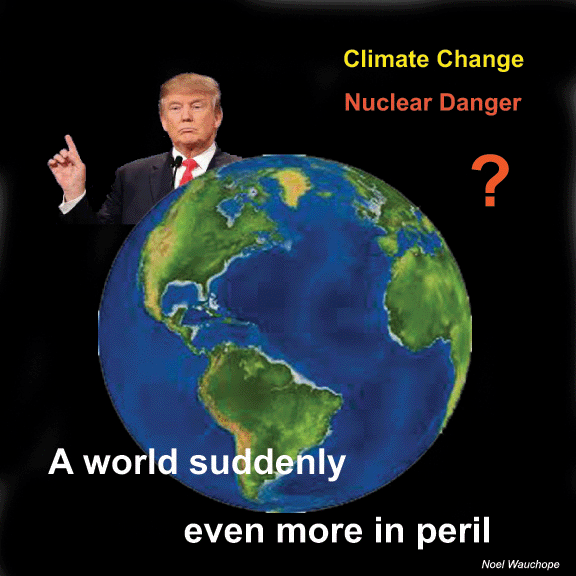 Will We Stop Trump
Before It’s Too Late? https://www.nytimes.com/2018/04/06/opinion/sunday/trump-fascism-madeleine-albright.html Fascism poses a more serious threat now than
at any time since the end of World War II.
On April 28, 1945 — 73 years ago — Italians hung the corpse of their former dictator Benito Mussolini upside down next to a gas station in Milan. Two days later, Adolf Hitler committed suicide in his bunker beneath the streets of war-ravaged Berlin. Fascism, it appeared, was dead.
To guard against a recurrence, the survivors of war and the Holocaust joined forces to create the United Nations, forge global financial institutions and — through the Universal Declaration of Human Rights — strengthen the rule of law. In 1989, the Berlin Wall came down and the honor roll of elected governments swelled not only in Central Europe, but also Latin America, Africa and Asia. Almost everywhere, it seemed, dictators were out and democrats were in. Freedom was ascendant.
Today, we are in a new era, testing whether the democratic banner can remain aloft amid terrorism, sectarian conflicts, vulnerable borders, rogue social media and the cynical schemes of ambitious men. The answer is not self-evident. We may be encouraged that most people in most countries still want to live freely and in peace, but there is no ignoring the storm clouds that have gathered. In fact, fascism — and the tendencies that lead toward fascism — pose a more serious threat now than at any time since the end of World War II.
Warning signs include the relentless grab for more authority by governing parties in Hungary, the Philippines, Poland and Turkey — all United States allies. The raw anger that feeds fascism is evident across the Atlantic in the growth of nativist movements opposed to the idea of a united Europe, including in Germany, where the right-wing Alternative für Deutschland has emerged as the principal opposition party. The danger of despotism is on display in the Russia of Vladimir Putin — invader of Ukraine, meddler in foreign democracies, accused political assassin, brazen liar and proud son of the K.G.B. Putin has just been re-elected to a new six-year term, while in Venezuela, Nicolás Maduro, a ruthless ideologue, is poised to triumph in sham balloting next month. In China, Xi Jinping has persuaded a docile National People’s Congress to lift the constitutional limit on his tenure in power.
Around the Mediterranean, the once bright promise of the Arab Spring has been betrayed by autocratic leaders, such as Abdel Fattah el-Sisi of Egypt (also just re-elected), who use security to justify the jailing of reporters and political opponents. Thanks to allies in Moscow and Tehran, the tyrant Bashar al-Assad retains his stranglehold over much of Syria. In Africa, the presidents who serve longest are often the most corrupt, multiplying the harm they inflict with each passing year. Meanwhile, the possibility that fascism will be accorded a fresh chance to strut around the world stage is enhanced by the volatile presidency of Donald Trump.
If freedom is to prevail over the many challenges to it, American leadership is urgently required. This was among the indelible lessons of the 20th century. But by what he has said, done and failed to do, Mr. Trump has steadily diminished America’s positive clout in global councils.
Instead of mobilizing international coalitions to take on world problems, he touts the doctrine of “every nation for itself” and has led America into isolated positions on trade, climate change and Middle East peace. Instead of engaging in creative diplomacy, he has insulted United States neighbors and allies, walked away from key international agreements, mocked multilateral organizations and stripped the State Department of its resources and role. Instead of standing up for the values of a free society, Mr. Trump, with his oft-vented scorn for democracy’s building blocks, has strengthened the hands of dictators. No longer need they fear United States criticism regarding human rights or civil liberties. On the contrary, they can and do point to Mr. Trump’s own words to justify their repressive actions.
 At one time or another, Mr. Trump has attacked the judiciary, ridiculed the media, defended torture, condoned police brutality, urged supporters to rough up hecklers and — jokingly or not — equated mere policy disagreements with treason. He tried to undermine faith in America’s electoral process through a bogus advisory commission on voter integrity. He routinely vilifies federal law enforcement institutions. He libels immigrants and the countries from which they come. His words are so often at odds with the truth that they can appear ignorant, yet are in fact calculated to exacerbate religious, social and racial divisions. Overseas, rather than stand up to bullies, Mr. Trump appears to like bullies, and they are delighted to have him represent the American brand. If one were to draft a script chronicling fascism’s resurrection, the abdication of America’s moral leadership would make a credible first scene.
Equally alarming is the chance that Mr. Trump will set in motion events that neither he nor anyone else can control. His policy toward North Korea changes by the day and might quickly return to saber-rattling should Pyongyang prove stubborn before or during talks. His threat to withdraw from the 2015 Iran nuclear agreement could unravel a pact that has made the world safer and could undermine America’s reputation for trustworthiness at a critical moment. His support of protectionist tariffs invites retaliation from major trading partners — creating unnecessary conflicts and putting at risk millions of export-dependent jobs. The recent purge of his national security team raises new questions about the quality of advice he will receive. John Bolton starts work in the White House on Monday.
What is to be done? First, defend the truth. A free press, for example, is not the enemy of the American people; it is the protector of the American people. Second, we must reinforce the principle that no one, not even the president, is above the law. Third, we should each do our part to energize the democratic process by registering new voters, listening respectfully to those with whom we disagree, knocking on doors for favored candidates, and ignoring the cynical counsel: “There’s nothing to be done.”
I’m 80 years old, but I can still be inspired when I see young people coming together to demand the right to study without having to wear a flak jacket.
We should also reflect on the definition of greatness. Can a nation merit that label by aligning itself with dictators and autocrats, ignoring human rights, declaring open season on the environment, and disdaining the use of diplomacy at a time when virtually every serious problem requires international cooperation?
NATO versus the Russia and China! April 2018 – The last Days?
Answering a question about Taiwan – Will there be a war with the USA? “We will see what will happen” said the Chinese Ambassador to the USA

Posted to nuclear-news.net by Shaun McGee 6th April 2018
Following up on the video posted by Chris Busby concerning the threat of nuclear war looming where he mentions the issue of xenophobic and threatening rhetoric from the UK and USA, he mentioned the Chinese Petro Yuan.
For your information there are some serious issues occurring, that might explain the ramping up of the rhetoric to both Russia and China concerning the blame game from NATO partners. The situation today is on a par with the Cuban Missile Crisis.

Firstly, in the UK and USA there is the mid term elections coming up and the local elections in the UK. This rhetoric will help the Governments of both countries pander to their home audience and distracting citizens from various embarrassing matters.
Secondly, The Chinese have made some incredibly strong statements not widely reported and have made some very public tactical moves. The Russian angry statements in recent weeks are well reported and I will not cover them here.
China`s head of the military went to Moscow in a very public way a couple of days ago;
Chinese defence chief says his visit to Moscow is a signal to the US General Wei Fenghe said his talks with Russian Defence Minister Sergei Shoigu reflected the growing military cooperation between the two former Communist rivals PUBLISHED : Wednesday, 04 April, 2018 http://www.scmp.com/news/china/diplomacy-defence/article/2140182/chinas-defence-chief-calls-his-moscow-trip-signal-us
A recent statement (2 days ago) on Trumps latest threat against China has just been responded too by a Chinese official;
Answering a question about Tawain – Will there be a war with the USA? “We will see what will happen” said the Chinese Ambassador to the USA (@19 mins approx) 4th March 2018 https://www.youtube.com/watch?v=giBRQ1q1yJg
In a stunning revelation China has made clear that the USA has not held any talks for some time now on trade. The recent Chinese officials statement (2 hours ago) from China is here;
MOFCOM: No bilateral talks held recently over trade friction between China, US https://www.youtube.com/watch?v=y9Wfe9hL410
Thirdly, behind the scenes and not very well reported have been recent moves within the EU to clamp down on Tax evasion and other more corrupt financial practices which much of the main stream media are not discussing in any great detail. It seems as though the USA Petro- Dollar model and UK financial industries are heavily under attack;
EU efforts to clamp down on tax evasion and financial corruption in the UK NOT being reported by the BBC etc , we see more reasons for a distraction from the real issues outlined on this article https://nuclear-news.net/2018/04/02/the-problem-with-the-bbc-and-brexit-response-to-scientists-for-the-eu/
And to support Chris Busby and other scientists from around the world that say radiation is far worse than the US Pentagon and the UK Ministry of Defence would ever admit thus rendering the outcome of a nuclear war far more disastrous (as much as 10,000 times more) than military planners have projected, this might be worth a read. How they cover up the real effects of radiation on the environment and human health;
“…So our new case is based on Uranium; it entirely by-passes all the argument about “dose” on which previous appeals were fought. It is the chemical composition and genetic effects of the internal Uranium which is now the issue. The Blake Determination is therefore irrelevant, except insofar as we can employ previous reports by both our experts and other experts to argue that there was Uranium contamination. And there is plenty of evidence for that U-235, the fissile isotope in the bombs was even measured in the south west coastal area by the New Zealand surveys in the 1980s, but was wrongly characterised as Radium dial material, a cover-up that continues. I trekked down to the Case management hearing in London on 31 st January, presided over by a new Judge, Fiona Monk. The MoD began by asking that Blake’s decision about what cancers could not be caused by radiation should be accepted by any new Tribunal. Amazingly, she refused: saying that each case must be re-heard on its merits. Then I said that we were bringing in a new argument—radiochemical genotoxicity….” https://nuclear-news.net/2018/04/05/british-nuclear-test-veterans-update-fissionline-54/
#Secrecy breeds distrust – Chris Busby comments on the #Skripal incident – #Nuclear war an option?

Dr Busby says a few words about the Russian Nerve Agent issue. He speaks as an expert in this area. Chris worked for several years at the famous Wellcome Research laboratories in Beckenham, London as a Senior Scientist in the Department of Physical Chemistry. His job, at the basic level, was to help determine the structure and origin of pharmaceutical compounds. So, he is an expert in this area. He also carried out similar work at Queen Mary College London for his first PhD and synthesised complex organic chemicals. From that, he relates that the synthesis of a specific small organic chemical like the supposed Novichoks is not very difficult. Most synthetic organic chemists could knock up small quantities of the 234 compound, given the structure.
Mainly, there is no way that the compound that was detected in the Skripal attack could be traced to a Russian laboratory (or any laboratory) by any lab unless the lab already had a sample known to come from the Russian laboratory (or the source laboratory).
The determination and identification methods mainly depend on mass spectrometric fragmentation patterns, and include the spectrum of stray molecular fragments from impurities associated with the synthesis route. This is how Wellcome located Patent jumping, and took this evidence ( from Busby and colleagues) into the courts. All chemists know this, and that is why the Porton head said what he said, as any chemist would have been able to raise this issue and show that he was lying, if he said anything else. It is basic physical chemistry.
So, the new headline in the Times, about a secret Russian laboratory is also bogus. What is also clear is that the mass spectrum of the A234 compound was put on the NIST database in 1998 by a worker from the USA chemical warfare laboratory. Chris therefore concludes that this whole affair is a tissue of lies and misdirection, rather like the WMD Iraq scenario and is aimed at creating a war with Russia that no one can win and where all life will lose. Why is this being done?
Because the only way for the rich and powerful to escape the coming US Economic catastrophe caused by the destruction of the petrodollar is to pull the house down and hope to escape in the general confusion and disaster from the wreckage.
-
Archives
- February 2026 (220)
- January 2026 (308)
- December 2025 (358)
- November 2025 (359)
- October 2025 (376)
- September 2025 (258)
- August 2025 (319)
- July 2025 (230)
- June 2025 (348)
- May 2025 (261)
- April 2025 (305)
- March 2025 (319)
-
Categories
- 1
- 1 NUCLEAR ISSUES
- business and costs
- climate change
- culture and arts
- ENERGY
- environment
- health
- history
- indigenous issues
- Legal
- marketing of nuclear
- media
- opposition to nuclear
- PERSONAL STORIES
- politics
- politics international
- Religion and ethics
- safety
- secrets,lies and civil liberties
- spinbuster
- technology
- Uranium
- wastes
- weapons and war
- Women
- 2 WORLD
- ACTION
- AFRICA
- Atrocities
- AUSTRALIA
- Christina's notes
- Christina's themes
- culture and arts
- Events
- Fuk 2022
- Fuk 2023
- Fukushima 2017
- Fukushima 2018
- fukushima 2019
- Fukushima 2020
- Fukushima 2021
- general
- global warming
- Humour (God we need it)
- Nuclear
- RARE EARTHS
- Reference
- resources – print
- Resources -audiovicual
- Weekly Newsletter
- World
- World Nuclear
- YouTube
-
RSS
Entries RSS
Comments RSS
 nuclear-news