Fukushima Will Go Down in History As the Biggest Coverup
They worship at the altar of the Japanese Yen.

Horizon Nuclear’s Wylfa nuclear plan will increase UK’s radioactive trash by 80%

 NFLA 15th Jan 2018, NFLA submission on radioactive waste elements of the reactor design for the
Wylfa B site – it could increase the UK inventory of radioactive waste by as much as 80%. The Nuclear Free Local Authorities (NFLA) Welsh Forum has submitted its views to Natural Resources Wales (NRW) on the radioactive
waste elements of the Advanced Boiling Water Reactor (ABWR) design proposed for the Wylfa site in Anglesey.
The NFLA Welsh Forum has taken a very close eye with the proposed development of Wylfa B and has raised a number oftimes that a new nuclear reactor in Anglesey is not required. In March 2017it raised in detail concerns over the design of the Advanced Boiling Water Reactor in reference to issues arising from the Fukushima disaster.
NRW is consulting on whether it will issue an environmental permit to Horizon Nuclear, wholly owned by Hitachi, for Wylfa B. This is concentrating now on issues around the radioactive waste that would be generated from such a
reactor, how it will be managed and stored and for how long it will remain on site.
NFLA Vice-Chair Councillor David Blackburn said: “This NFLA submission on Wylfa B’s radioactive waste programme has gone into much detail about the radioactive high burn-up fuel that would be produced from such a reactor, should it ever be built. Such waste would have to remain on site for as much as 160 years and Wylfa B alone could increase the current UK radioactive waste inventory by as much as 80%.
NFLA does not see such a waste burden being beneficial to the people of Anglesey or of Wales. There are far safer, less expensive alternatives that do not produce such hazardous materials as what Wylfa will generate. Wales would be far better off then to build solar, tidal, wind, hydroelectric and geothermal energy facilities instead, with energy efficiency and energy storage solutionsadequate to deal with intermittency issues.”
http://www.nuclearpolicy.info/news/nfla-submission-radioactive-waste-elements-reactor-design-wylfa-b-increase-uk-inventory-radioactive-waste/
Managing Radioactive Waste Safely (MRWS) search processes indicate Cumbria’s unsuitability for nuclear waste dumping
Cumbria Trust 15th Jan 2018, Tim Knowles, who chaired the last search process, known as Managing Radioactive Waste Safely (MRWS) has changed his view since 2013 and no longer supports the idea of geological disposal of nuclear waste in Cumbria. He appears to share Cumbria Trust’s view that Cumbria does not have suitable geology, and that there are much better sites elsewhere in the country.
It is interesting that we have now had 2 search processes in Cumbria and both the Lead Inspector of the first Nirex process, and now the Chair of the second MRWS process have reached the same conclusion – that the search should move to an area of simple geology in the east or south of the country. Both of them want Cumbria to not volunteer again.
In a few months the national geological screening report will be published before councils are asked to volunteer for the third search process. We know that the GDF developer, Radioactive Waste Management, has decided to take
control of this report by producing the narrative itself, and our concern is that they may manipulate the output to suit their intention to return to Cumbria for a third time.
https://cumbriatrust.wordpress.com/2018/01/15/a-change-of-view-for-tim-knowles/
What if there were a real attack on Hawaii?
Hawaii: Here’s what would happen if there was a real nuclear attack, ABC News
By Anne Barker, 16 Jan 18, Consider the following scenario: a nuclear missile is launched from North Korea on a direct path for Honolulu.
For at least five minutes, Hawaiians are blissfully unaware of the danger.
Suddenly, the US Pacific Command detects the missile in mid-air and sends an alert to Hawaii’s State Warning Point, which instantly activates its public warning system.
Sirens begin blaring across the state and an alert is sent to mobile phones, radio and television.
Panicked residents and visitors have no more than 15 minutes to find somewhere to find cover — but there are no public fallout shelters.
Twenty minutes after launch, a nuclear bomb detonates 1,000 feet above the Hawaiian capital, and thousands are killed and many more are left with burns and radiation poison.
That exact scenario is being seriously considered
It’s the very real scenario Hawaiian authorities are preparing for, laid out in a document about the US state’s preparedness for a nuclear attack.
Although Saturday’s missile warning was a false alarm, US authorities believe there’s a very high likelihood that Hawaii — particularly Honolulu and the island of Oahu — would be the primary target of a North Korean nuclear attack.
The “Emergency Preparedness” document, published in November by Hawaii’s Emergency Management Authority, warns that Hawaiian residents and visitors would have “less than 12 to 15 minutes” to seek shelter in the event of a real nuclear missile threat.
Such an attack would “likely occur without prior warning”, it warns.
What would the toll be?
It says that a single-kiloton range nuclear weapon detonated at 1,000 feet could kill almost 18,000 people and cause 50,000 to 120,000 trauma and burn casualties.
As well as widespread building collapses and structural fires, up to 30 per cent of survivors would suffer acute radiation syndrome.
The document, while offering advice to residents on how to survive a nuclear attack, also confirms that Hawaii has no public fallout shelters or shelter supply caches.
Instead, it advises people to seek shelter in a building away from windows, or lie flat on the ground.
Hawaiians are unprepared
The actions of many panicked residents after Saturday’s false alarm were a far cry from what authorities recommend, and show just how unprepared Hawaii is for a North Korean nuclear missile attack……. http://www.abc.net.au/news/2018-01-15/hawaii-what-would-happen-if-there-was-a-real-nuke/9330162
False alarm incident shows unpreparedness of Hawaii (and elsewhere?) for a nuclear attack
Missile-alert error reveals uncertainty about how to react, Hanford Sentinel, By JENNIFER SINCO KELLEHER and BRIAN MELLEY Associated Press, 15 Jan 18
Coal and nuclear industries still pushing for taxpayer bailouts, despite knock-back from Federal Energy Regulatory Commission’s (FERC)
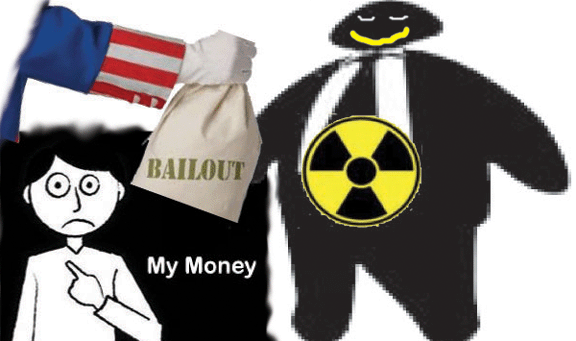
 FERC rejected Perry’s plan, but coal and nuclear are still asking for bailouts http://thehill.com/opinion/energy-environment/368814-ferc-rejected-perrys-plan-but-coal-and-nuclear-are-still-askingBY MARY ANNE HITT, — 01/16/18 This is set to be the year that America decides if it values clean, affordable energy or political cronyism in its electricity markets.
TheFederal Energy Regulatory Commission’s (FERC) recent rejection of Secretary of Energy Rick Perry’s plan to force electricity customers across the country to pay billions of dollars to prop up uneconomic coal and nuclear plants is only the tip of the iceberg in the fossil fuel industry’s bailout efforts.
Today, there are still numerous proposals making their way through state legislatures, public utility commissions, electric market operators, and Congress that will unfairly prop up fossil fuel plants that can’t compete in America’s modern energy markets.
These proposals are rooted in the entitled belief by fossil fuel billionaires that any competition that outperforms their lumbering, polluting power plants — especially clean energy resources like solar, wind, and energy efficiency — is somehow illegitimate.
The proposals themselves have gotten traction recently because over the past decade, clean energy resources have displaced hundreds of coal and nuclear plants as American customers have steadily cut down on their electricity usage and demanded cleaner, safer energy at a lower cost. As a consequence, these new resources have also created a vibrant clean energy economy that employs hundreds of thousands of workers.
Fossil fuel billionaires are fearful that this trend will create a permanent shift away from their dirty and dangerous energy, and are subsequently trying to force electricity customers to pay hundreds of millions, and sometimes billions, of dollars to prop up their plants.
The most egregious example of this political cronyism was Perry’s directive to FERC to create new rules that would have forced electricity customers to pay extra money for the energy produced by uneconomic coal and nuclear plants.
This expensive, foolish directive was rejected by FERC. Despite its failure, however, there are still numerous other proposals which are not as well publicized, but equally costly attempts by fossil fuel billionaires to prop up their plants.
Washington energy lobbyists, for example, have already been busy pushing coal tax credits and the extension of nuclear industry tax incentives in this year’s spending packages.
In Indiana, Sierra Club caught the state’s public utility commission approving a massive bailout of two coal-burning power plants for a local utility, NIPSCO, and is considering legal action to overturn it. The bailout came after uncontested NIPSCO data was revealed which showed that retiring the plants, instead of bailing them out, would save customers as much as $420 million.
In Ohio, FirstEnergy has tried for years, and is still trying, to get the state government to bail out its obsolete coal and nuclear plants that can’t compete with the Midwest’s legion of wind farms. Consumer and environmental advocates have defeated this bailout multiple times, but the utility keeps coming back to try again.
In the Great Plain states, reports show that throughout the region, utilities have been taking advantage of loopholes to force customers to bail out local coal plants to the tune of $300 million over a two year period in the Southwest Power Pool, home to abundant cheap wind power.
Electricity markets that are supposed to be competitive and open to all resources aren’t immune from efforts to rig the system against cleaner energy.
For example, on the same day FERC rejected Energy Department’s misguided proposal, New England’s market operator filed a proposal that would obstruct states’ rights to pursue cost-effective renewable energy projects and make it easier to prop up dirtier, costly power plants that should retire. PJM, which manages the electric system for much of the Mid-Atlantic and Midwest, has also threatened to override public policies for clean energy in order to raise consumer costs and bail out unnecessary power plants, despite a massive surplus of electric capacity.
This recent, ongoing wave of proposals to bailout coal and nuclear plants on behalf of billionaires is a very real threat that will stifle innovation, increase costs, and corrupt democratic processes that have served us well for decades.
The backlash against these bailouts has been overwhelming thus far, but it will only be effective if it can stop all of them in their tracks. A reliable, affordable, and clean energy future hangs on the decisions we make in 2018 and we must choose our decisions wisely.
Mary Anne Hitt is the director of Sierra Club’s Beyond Coal campaign.
China’s Fissile Material Production and Stockpile
IPFM 12th Jan 2018, IPFM’s new research report “China’s Fissile Material Production and
Stockpile” (PDF copy) by Hui Zhang uses information from newly available
Chinese public sources to provide a more detailed and documented
reconstruction of China’s production of highly enriched uranium (HEU) and
plutonium for nuclear weapons.
The report provides new evidence to constrain the operating histories for China’s Lanzhou and Heping gaseous
diffusion enrichment plants. Lanzhou stopped HEU production for weapons in 1980 and shifted to making low enriched uranium (LEU) for civilian power reactors and possibly for naval reactors. It was shut down on 31 December
2000 and in 2017 was demolished.
The Heping plant may still be operating but not producing HEU for weapons. China also has centrifuge enrichment
plants but they are believed not to produce HEU for weapons. The new report also offers new details on the operational experience of the Jiuquan and Guangyuan weapon plutonium production reactors. China also used these
reactors to produce tritium for weapons. The reactors were closed in the 1980s and have been undergoing decommissioning.
http://fissilematerials.org/blog/2018/01/chinas_fissile_material_p.html
Nuclear And Shale Are Wrecking Britain
Impact4All 11th Jan 2018, ‘Nuclear And Shale Are Wrecking Britain’, Says Top UK Solar Boss.
Jeremy Leggett is the founder of Solar Century, an international solar
solutions company, and chairman of the Carbon Tracker Initiative, a
financial-sector think-tank warning of carbon-fuel asset-stranding risk to
the capital markets.
Here, he tells Alicia Buller why he hopes the ‘great
renewable energy transition will help bring truth to the fore’. As a
businessperson I know that that I could – rightly – be sent to jail for
telling a single lie to my stakeholders. The first VW executive just been
jailed – rightly – for telling one big lie as part of an
institutionalised fraud.
Yet politicians, particularly rightist populist
politicians, tell lies on an almost daily basis, backed and echoed by
like-minded media organs such as the Daily Mail, and there is no meaningful
recourse for civil society, as things stand. That pains me and I want to
see it changed.
My hope is that the unfolding of the great global energy
transition, with its many intrinsic social benefits, will help in that
wider process of societal recasting, bringing community, equality, and
truth to the fore. http://impact4all.org/nuclear-shale-wrecking-britain-says-top-uk-solar-boss/
Pope voices nuclear war concerns at he begins Latin America trip
SANTIAGO: Pope Francis admitted on Monday (Jan 15) he was frightened by the prospect of an accidental nuclear apocalypse, as he began a week-long visit to Chile and Peru to bolster a local Catholic Church riven by sex abuse scandals.
“I think we are at the very edge,” the pope told reporters aboard his plane when asked about the threat of a nuclear war in the wake of a recent string of tests by North Korea and a false missile alert last week that sparked panic in the US state of Hawaii.
“I am really afraid of this. One accident is enough to precipitate things,” he said.
The pope landed in Santiago late on Monday on his first visit to Chile since becoming pope, and his sixth to Latin America.
The 81-year-old Argentinian pontiff will find a very different Chile than the one he first encountered as a student priest in the 1960s.
Socialist President Michelle Bachelet has presided over major change in the once deeply conservative country, decriminalising abortion, recognising civil unions for same-sex couples and introducing a bill to legalise gay marriage.
Preparations for the visit have been overshadowed by a recent report that almost 80 members of the Chilean clergy have been accused of the sexual abuse of minors since 2000, more than half of them convicted by a Vatican court.
Protests are expected over Francis’ appointment of a bishop in the southern city of Ororno who is accused of covering up for Fernando Karadima, an influential priest whom the Vatican convicted of abusing children in 2011.
In a sign of growing exasperation at Church inaction, activists from several countries meeting in Santiago on Monday launched a new global organisation, Ending Clerical Abuse (ECA).
The organisation “seeks to stop child sexual abuse by the clergy,” said one of its founders, Jose Andres Murillo.
The body aims to form a group of prosecutors “to bring to court these crimes against humanity,” said Sara Oviedo, former vice president of the UN Committee on the Rights of the Child.
PROTESTS PLANNED
During his three days in Chile, Francis will meet with victims of the military dictatorship of Augusto Pinochet, while there are no formal plans to meet victims of pedophile priests.
Bachelet, who will meet Francis on Tuesday, has called on Chileans to welcome the pope, though a positive reception may not be universal.
On Friday, five Catholic Churches in the capital were attacked – three of them with firebombs – by what police said was an anarchist group. Demonstrations are planned by feminist and gay rights groups.
The highlight of the three-day visit will be an open-air mass in a Santiago park on Tuesday.
At another mass at the airport in Temuco, the capital of the impoverished southern Araucania region, Francis is expected to draw attention on Wednesday to state persecution of the indigenous Mapuche people and also meet members of the community.
The Mapuche – some seven percent of the Chilean population – inhabited a vast territory before the arrival of Spanish colonists in 1541, and have long protested the loss of ancestral lands.
During his visit to Chile, the pope will also meet representatives of the poor and young people, as well as visit a women’s prison.
Authorities expect nearly a million Argentines, Bolivians and Peruvians to visit Chile to see the pope.
Francis sent “warm greetings” to his native Argentina in a telegram to President Mauricio Macri as he flew over the country on his approach to Santiago, though he made no mention of a much-awaited visit.
The former Archbishop of Buenos Aires has now visited all of Argentina’s neighbors except Uruguay on official tours – Brazil, Bolivia, Chile and Paraguay. Elsewhere in Latin America, he also travelled to Colombia and Ecuador.
The absence has raised questions in the Vatican and in Argentina.
Many consider that Francis’s homilies would be interpreted as carrying more political weight at home than may be acceptable, and – particularly given the pope’s defence of the poor – may be seen as pointed political attacks against Macri’s market-friendly austerity.
On Thursday, the pope will travel to Iquique in northern Chile, where he will preside over another open-air mass, on the shores of the Pacific Ocean, before travelling on to Peru’s capital Lima.
Peru is in the throes of a political crisis sparked by a controversial pardon for ex-president Alberto Fujimori, who was serving a 25-year sentence for human rights abuses, as well as another abuse scandal involving the clergy.
Source: Reuters
Read more at https://www.channelnewsasia.com/news/world/pope-voices-nuclear-war-concerns-at-he-begins-latin-america-trip-9863214
Vancouver meet may achieve little in addressing North Korea nuclear crisis
- Source
- Global Times
- Editor
- Li Jiayao
- Time
- 2018-01-16
The US and Canada are bringing together foreign ministers from around 20 nations on Tuesday in Vancouver to discuss security and stability on the Korean Peninsula. It’s strange that many of the countries invited are not stakeholders in the situation, but those who participated under UN Command during the Korean War (1950-53). Washington seems to be reviving the long-forgotten multinational military alliance.
Yet the international community harbors little hope that the meeting can bear fruit as China, Russia and North Korea are not invited. There is widespread speculation about what the US hopes to achieve out of such a meeting.
The US and Canada were abruptly announced as co-hosts of the meeting on December 19 during US Secretary of State Rex Tillerson’s visit to Canada. Washington apparently has more intentions than simply reflecting on the 1950s war by bringing together nations that sent troops to the peninsula over 60 years ago while bypassing those highly relevant nations amid tensions in the region.
First of all, Washington wants to pressure Pyongyang by signaling that it is indeed preparing to use force. Those invited countries, no matter how many troops they sent, were participants in the Korean War.
Attending this meeting, they may not mean to repeat their actions, but Washington can thus tell Pyongyang that they stand ready to follow the US onto the peninsula.
Having had China and Russia demand it talk to North Korea, the US wants to justify the high pressure it has exerted on North Korea and get others’ endorsement for its policy on the peninsula.
Among the invitees are traditional US allies like Britain, Australia and New Zealand, and nations that have no relation to the nuclear issue but can be easily manipulated by the US, such as Ethiopia and Columbia.
While the US finds it too hard to manipulate the UN Security Council, with the Vancouver meeting Washington wants to highlight its dominant role in resolving the North Korean nuclear issue and cripple the clout of China and Russia. Washington can say these 20-some nations stand for the international community to make its extremely hard-line stance against Pyongyang more legitimate.
But the meeting will likely accomplish little. Over the peninsula, only international decisions made under the UN framework are legal and valid. No one can stop the US from pressuring North Korea to the utmost, but Washington will eventually be held accountable if war breaks out or even worse, nuclear weapons are employed.
The Donald Trump administration may possibly be holding the Vancouver meeting for his domestic audience. With a more hawkish policy toward North Korea than previous administrations, Trump has pushed US-North Korea confrontation toward a high-stakes climax. Hawaii’s false missile alert on Saturday set off wide-scale panic. Washington needs more support for its policy from countries beyond Japan and South Korea.
The recent Seoul-Pyongyang détente over the Pyeongchang Winter Olympic Games has placed the Vancouver meeting in a somewhat awkward position. At such a meeting with ulterior motives and little authority, what attendees need to do is just clap their hands for the organizers.
http://english.chinamil.com.cn/view/2018-01/16/content_7909937.htm
Nuclear waste can cause high radiation levels and raise temperature levels.
Energy Business Review 12th Jan 2018,…..waste generated from nuclear activity can pose a
significant risk to the environment if it is not properly handled. The vast
amount of nuclear waste created by power plants can lead to high radiation
and raise temperature levels.
In recent years, many concerns have been raised over the disposal of radioactive waste and harmful radiations fromthe nuclear plants. The transmission of this radiation can cause a
potential damage to the surrounding atmosphere.
The cost of managing the nuclear waste is also high. The damage that could be caused by mishandling
of nuclear waste came into focus after the occurrence of Fukushima nuclear
disaster in Japan in 2011. Spent fuel rods were found to be one of the
major causes of the radioactive emission for the accident that took place
at the Fukushima Daiichi Nuclear Power Plant in Fukushima, Japan.
The nuclear accident is considered as the second worst nuclear disaster in the
world. The Kyshtym nuclear disaster also occurred as a result of a
radioactive contamination accident that took place on 29 September 1957 at
Mayak, a plutonium manufacturing facility Russia for nuclear fuel
reprocessing plant of the Soviet Union. A failure of the cooling system
used for one of the tanks containing about 70–80 tons of liquid
radioactive waste had led to the accident. The event resulted in hundreds
of deaths of the people staying in nearby villages to the production site.
The various types of nuclear waste include uranium tailings, transuranic
(TRU) waste, low-level nuclear waste, intermediate-level waste, high-level
waste and spent fuel rods.
http://nuclear.energy-business-review.com/news/major-types-nuclear-waste-that-produce-radioactivity-6027468
University of California grilled over Los Alamos nuclear lab safety issues
UC grilled over LANL safety issues, Lamonitor.com, By , January 15, 2018 Three university systems went before the Regional Coalition of LANL Communities Friday to tell the coalition once again why they would be the best candidate to take on the job of operating and managing the Los Alamos National Laboratory.
The University of California, Texas A&M made full presentations while the University of Texas System gave a short statement at the end of the meeting during the public comment portion.
All three systems submitted bids to the National Nuclear Security Administration before the administration’s deadline.
UC Vice President for National Laboratories Kim Budil faced some tough questions before the coalition from Coalition Chairman and Santa Fe Mayor Javier Gonzales.
The University of California has been a partner in the lab’s operation since it’s inception in 1943.
“Clearly there were a lot of mistakes made of the last couple of years in Los Alamos that led to the shut down of WIPP (Waste Isolation Pilot Plant) and the threat that ultimately posed to the community for those mistakes,” Gonzales said. “I’m interested in how the University of California during that time and what levels of assurance as communities we would get, if you were selected, that it wouldn’t happen again.”
Gonzales also wanted to know, after all the years the university has been a part of the management of the laboratory, why there are “still families struggling, there’s still big challenges in poverty and opioid addiction … all of these other things that you shouldn’t have to solve on your own as a contractor, but quite honestly donated money to a foundation and feeling that might be the end of an obligation is not necessarily what I would use as a good corporate citizen.”
Gonzales also wanted to know why the coalition often had to go alone to Washington, D.C. to ask for money every year without any help from UC……. http://www.lamonitor.com/content/uc-grilled-over-lanl-safety-issues
Russian nuclear torpedo is ‘threat to coastal cities’
Tom Parfitt, Moscow, January 16 2018, Russia is developing an underwater “nuclear drone” that could be used to devastate coastal cities, according to a leaked Pentagon document.
Uranium pollution dispels the grand illusion of “clean America”
 Ken commented on Navajo town remembers water pollution due to uranium mining – fears of new mines Uranium Miners Pushed Hard for a Comeback. They Got Their Wish. NYT, By HIROKO TABUCHIJAN. 13, 2018 “………The Navajo …
There are 10 or eleven towns in Colorado, Wyoming, Utah, Arizona, and New Mexicothat had Uranium mills, right in the middle of town. That means that Uranium dust, polonium, thorium, radium, and radon blew freely, thoughout thewe towns, 24 hours a day for years. Most of the water, drained into the Colorado ariver. Many of these towns were downwinder towns, from open air blasting of nucler bombs in Nevada from 1949 to 1962. Many, of the towns had the misfortune of having underground nuclear bombs detonated close to them as well, to try to track natural gas. Especially in New Mexico and Colorado. In the 60s Hilibutron was also tracking nuclear waste into areas in Nevada, and Wyoming. More recently there has been fracking for oil and gas in UtAh, Wyoming, Colorado, New Mexico, Arizona. This means the radioactive burden to their water tables has been increased again substantially , along with 60 years of radioactive burden on the Colorado River. There are also the 1000 or so uranium mines draining into the Colorado River and Green driver from Utah, the western slope, Shiprock New Mexico, Wyoming, The Grand Canyon Area.
I think Helen Caldicotts and Christina Macphersons estimates of a few million tons of radioactive sediment in Lake Mead and even lake Powell is wrong. https://nuclear-news.net/2017/12/22/uranium-tailings-pollution-in-lake-mead-and-lake-powell-colorado/
Consider underground nuclear destinations in Rangely Colorado and Northen New Mexico. I think it is more like a half billion or billions of ons of nuclear waste sediment in Lake Powell and lake mead..
There were Uranium Mills on the Navajo nation by Ship Rock and Halchita which is by the Colorado river. There were Uranium Mills right in the middle of town in Canyon City.Colorado, Moab.Utah, Uravan.Colorado, White Mesa.Utah, Monticello.Utah, by Grand Junction.Colorado. Many in Wyoming.
Uranium mining in Wyoming – Wikipedia
https://en.m.wikipedia.org/wiki/Uranium_mining_in_Wyoming.
There are dense cancer clusters in these little towns on the Navajo Nation, in Utah, in Nevada, in Colorado, in Wyoming, in New Mexico. There are Genetic mutations that should not exist. Some people, like those in St George or Monticello Utah got the mere pittance of 50,000 dollars, after having lived in downwinder areas and surviving cancer. Generations of families wiped-out in many instances. Clarke county Nevada, by Las Vegas has one of the highest incidences of cancer in the US. Is it any wonder, with all the radiation in their primary drinking water supplies?
Many little Colorado Plateau towns, in the west are hit with quintuple curses: bomb blasts above ground, bomb blasts below ground-poisoning their head waters, uranium mills and waste in town, their river water radioacively poisoned from inderground nuclear blasts, from uranium mines, from cold war nuclear bomb detonations.
There has recently, been a great deal of cracking in these areas, releasing radioactivity into their desert rivers and water tables.
Americans live in a grand delusion, thinking how clean the western United States, and the rest of the USA is, with a hundred rickety old nuclear plants belching tritium, into the environment. The United State is the most radioactive shithole in the world. How Trump has the gall to call other countries shitholes, is beyond me.
Hawaii false alarm dramatically highlights nuclear war risk with Trump
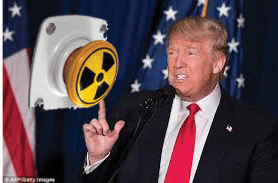 False Alarm Adds to Real Alarm About Trump’s Nuclear Risk , NYT, By THE EDITORIAL BOARD, JAN. 13, 2018 It was the sort of nightmare that had only ever been real for most people’s parents or grandparents — the fear of an impending nuclear attack. “Ballistic missile threat inbound to Hawaii,” read the emergency alert that residents of the Aloha State received on Saturday morning. “Seek immediate shelter. This is not a drill.”
The authorities quickly announced that the alert was a mistake. But it made tangible the growing fears that after decades of leaders trying to more safely control the world’s nuclear arsenals, President Trump has increased the possibility of those weapons being used.
At a time when many are questioning whether Mr. Trump ought to be allowed anywhere near the nuclear “button,” he is moving ahead with plans to develop new nuclear weapons and expanding the circumstances in which they’d be used. Such actions break with years of American nuclear policy. They also make it harder to persuade other nations to curb their nuclear ambitions or forgo them entirely.
Mr. Trump has boasted about the size and power of America’s nuclear arsenal, threatened to “totally destroy” North Korea, pushed for a massive buildup of an arsenal that already has too many — 4,000 — warheads and wondered aloud why the United States possesses such weapons if it isn’t prepared to use them.
Now, as he tries to force North Korea to abandon its nuclear weapons capability and ensure that Iran never acquires one, Mr. Trump is poised to make public a new policy that commits America to an increasing investment in those very weapons, according to a draft document made public by HuffPost and confirmed by The Times.
…….. The proposed nuclear policy says a more aggressive nuclear posture is warranted because the world is more dangerous, with China, North Korea and Iran cited as concerns. Yet blowing up the Iran deal would free Tehran to resume its nuclear activities and make the world less safe. In other words, Mr. Trump’s approach makes no sense.
Under the Nuclear Nonproliferation Treaty, signed in 1968, the United States and Russia promised to reduce the role and number of nuclear weapons. They made significant, although insufficient, progress. After reductions under a succession of past presidents, the American stockpile is 85 percent smaller than it was at the height of the Cold War. Negotiations on further reductions have stalled in recent years as Russia, threatened by America’s superior conventional arsenal, became more reliant on nuclear weapons, and there is no serious sign that Mr. Trump wants to revive the talks.
President Barack Obama made a down payment on a saner policy by narrowing to “extreme circumstances” the conditions under which nuclear weapons would be used and ruling out their use against most non-nuclear countries. Mr. Trump’s policy also talks about “extreme circumstances, ” but it dangerously broadens the definition to include “significant non-nuclear strategic attacks,” which could mean using nuclear weapons to respond to cyber, biological and chemical weapon attacks.
Until Mr. Trump, no one could imagine the United States ever using a nuclear weapon again. America’s conventional military is more than strong enough to defend against most threats. But Mr. Trump has so shaken this orthodoxy that Congress has begun debating limits on his unilateral authority to launch nuclear weapons. Expanding the instances when America might use nuclear weapons could also make it easier for other nuclear-armed countries to justify using their own arsenals against adversaries.
As the residents of Hawaii can tell you, it’s a risk the world cannot afford. https://www.nytimes.com/2018/01/13/opinion/sunday/trump-nuclear-weapons-war.html?smid=li-share
1 This Month

of the week – Shut Down Drone Warfare!


Tell the Ukrainian Government to Drop Prosecution of Peace Activist Yurii Sheliazhenko

Petition to revoke the licensing of the Near Surface Nuclear Disposal Facility (NSDF) at Chalk River. https://www.ourcommons.ca/petitions/en/Petition/Details?Petition=e-7247
To see nuclear-related stories in greater depth and intensity – go to https://nuclearinformation.wordpress.com
-
Archives
- April 2026 (68)
- March 2026 (251)
- February 2026 (268)
- January 2026 (308)
- December 2025 (358)
- November 2025 (359)
- October 2025 (376)
- September 2025 (257)
- August 2025 (319)
- July 2025 (230)
- June 2025 (348)
- May 2025 (261)
-
Categories
- 1
- 1 NUCLEAR ISSUES
- business and costs
- climate change
- culture and arts
- ENERGY
- environment
- health
- history
- indigenous issues
- Legal
- marketing of nuclear
- media
- opposition to nuclear
- PERSONAL STORIES
- politics
- politics international
- Religion and ethics
- safety
- secrets,lies and civil liberties
- spinbuster
- technology
- Uranium
- wastes
- weapons and war
- Women
- 2 WORLD
- ACTION
- AFRICA
- Atrocities
- AUSTRALIA
- Christina's notes
- Christina's themes
- culture and arts
- Events
- Fuk 2022
- Fuk 2023
- Fukushima 2017
- Fukushima 2018
- fukushima 2019
- Fukushima 2020
- Fukushima 2021
- general
- global warming
- Humour (God we need it)
- Nuclear
- RARE EARTHS
- Reference
- resources – print
- Resources -audiovicual
- Weekly Newsletter
- World
- World Nuclear
- YouTube
-
RSS
Entries RSS
Comments RSS
 nuclear-news