Nuclear Waste Crisis in Fukushima is a Human Rights Issue


90Sr specific activity of teeth of abandoned cattle after the Fukushima accident – teeth as an indicator of environmental pollution

Highlights
- •
-
90Sr in cattle teeth was determined after the Fukushima accident.
- •
-
90Sr was efficiently incorporated into the teeth at development stages.
- •
-
90Sr specific activity of aqueous extract was higher than that of soil.
- •
-
Water soluble 90Sr was incorporated into the cattle and accumulated.
- •
-
Sr transfer is eliminated compared to Ca in the migration route.
Abstract
90Sr specific activity in the teeth of young cattle that were abandoned in Kawauchi village and Okuma town located in the former evacuation areas of the Fukushima-Daiichi Nuclear Power Plant (FNPP) accident were measured. Additionally, specific activity in contaminated surface soils sampled from the same area was measured. (1) All cattle teeth examined were contaminated with 90Sr. The specific activity, however, varied depending on the developmental stage of the teeth during the FNPP accident; teeth that had started development before the accident exhibited comparatively lower values, while teeth developed mainly after the accident showed higher values. (2) Values of 90Sr-specific activity in teeth formed after the FNPP accident were higher than those of the bulk soil but similar to those in the exchangeable fraction (water and CH3COONH4 soluble fractions) of the soil. The findings suggest that 90Sr was incorporated into the teeth during the process of development, and that 90Sr in the soluble and/or leachable fractions of the soil might migrate into teeth and contribute to the amount of 90Sr in the teeth. Thus, the concentration of 90Sr in teeth formed after the FNPP accident might reflect the extent of 90Sr pollution in the environment.
http://www.sciencedirect.com/science/article/pii/S0265931X17307610
The Occupation and Glass Badges

Good news for a change this week – on nuclear and climate

Well, of course, it’s hard to find good news. I see that a “good news” media has just started up . I don’t like their chances –  but that’s only because good news isn’t really news. News is about something unusual happening. The vast majority of human beings are going about their lives, trying to care for their family and friends, trying to live a decent life. That’s just not news. Particularly at this time of year, people are mostly making an extra effort to be kindly to others, – with Christmas, Hanukka, and at least 12 other religious celebrations. So – it’s the much rarer bad incidents that are news.
On climate, so many millions of people, and so many organisations are trying to save this planet’s quite fragile environment. Intergovernmental efforts continue, with the recent Paris Summit. Renewable energy is taking off across the globe, especially in China, but also in America, despite Trump.
The global nuclear-free movement continues to have successes, exposing the nuclear industry, working for nuclear clean-ups, and for dismantling nuclear power, and for preventing new nuclear development
The much maligned United Nations continues its work, with a huge number of positive agencies, including many humanitarian ones. Non government agencies join in this work
The Nobel Peace Prize Award to ICAN might appear to be ineffective. But to have 122 of the UN member states adopting the Treaty on the Prohibition of Nuclear Weapons is a great symbolic start – in universal recognition that having nuclear weapons , planning to use them, and using them – are crimes against humanity.
Nuclear power began in America in the 1940s, with the Manhattan project to develop nuclear bombs. Of course it is till aligned with nuclear weapons, but now, “peaceful” nuclear power is dying in USA. France is moving away from nuclear power. In China, and India, as renewable energy booms, nuclear power slows.
The global movement for a nuclear free world is active everywhere, but faces huge challenges, especially where the industry is tax-payer funded, and exceptionally secretive – as in Russia and China.
One nice little news item – the early release from prison of brave anti nuclear activist Sister Megan Rice.

I suppose that next week – I will resume the dreary recitation of all the bad stuff – because that’s what news is. In the meantime, many millions of people are being kind to each other, and wishing for peace – not news, but true all the same.
Russia: no nuclear transparency, and still using Soviet style tactics against anti nuclear activists

CRACKDOWN IN RUSSIA: CRITICS ACCUSE NUCLEAR AUTHORITIES OF SOVIET-STYLE COVER-UPS AND HEAVY-HANDED TACTICS, Newsweek, BY When Russia’s FSB security service raided Fyodor Maryasov’s apartment in Siberia last year, the authorities seized his computer and a scathing report he had compiled about Rosatom, the Kremlin-owned nuclear corporation. Among other things, the authorities accused him of inciting hatred against nuclear industry employees, an unusual charge that carries a maximum sentence of five years behind bars. “They accused me of revealing state secrets in my report,” the 49-year-old environmental activist says. “But every single thing in it was taken from open sources.”
The raid came as activists are increasingly criticizing Rosatom over a range of issues, including the way it handles nuclear waste. This fall, for instance, critics alleged that one of its facilities was the source of a mysterious cloud of radioactive pollution that drifted across Europe.
Russian authorities have responded to these critics with tough tactics—including raids and smear campaigns—and in recent years, they’ve employed similar measures against other environmental groups. Rosatom says it was in no way trying to stifle dissent. “We strongly believe that every voice should be heard,” a spokesman for the nuclear agency tells Newsweek, “and we welcome open dialogue with civil society, including with those who are opposed to nuclear power.”
Maryasov says the crackdown is a continuation of the routine cover-ups of nuclear accidents and atomic pollution during the Soviet era and beyond—from the 1957 Kyshtym disaster to the meltdown at Chernobyl in 1986. “Trust in Rosatom and the authorities,” he says, “is at an absolute minimum.”
The activist’s recent troubles began after he spoke out against Rosatom’s plans for a permanent underground nuclear waste repository in his hometown of Zheleznogorsk, in eastern Siberia. If the project goes ahead, Russian authorities would likely begin storing hundreds of thousands of tons of radioactive waste at the site. Zheleznogorsk was built in 1950, under the supervision of Stalin’s secret police chief, Lavrentiy Beria, for the production of weapons-grade plutonium. Until 1992, plant employees regularly disposed of nuclear waste in the nearby Yenisey River, causing health problems for tens of thousands of people in the area. Russian authorities stopped the production of plutonium for nuclear weapons at the Zheleznogorsk plant in 2010.
But critics say the shadow of nuclear catastrophe still hangs over the region. In the event of a massive natural disaster or terrorist attack, the nuclear waste repository plan poses what Maryasov says is a threat to “every living thing” in the region. Zheleznogorsk is a mere 40 miles downstream from Krasnoyarsk, the regional capital, with a population of just over 1 million. And people in the area are concerned. More than 85,000 so far have signed a petition Maryasov drafted calling for Rosatom to scrap its plans for the repository.
The nuclear agency says it is building an underground lab at the Zheleznogorsk site to study the feasibility of its plans. It says those plans are open to public debate, and it points to similar storage sites currently operated in Finland, Sweden and the United States.
Critics, however, say it’s hard to access reliable information about Rosatom’s plans because many of its nuclear facilities are in so-called closed cities, like Zheleznogorsk. There are around 40 of these towns across Russia, the majority of which are sealed off from the outside world by barbed wire, fences and armed guards. Access is forbidden to foreigners, and even Russians who don’t live there have to receive special permission from the authorities to visit.
Those restrictions mean it’s easier for the authorities to ramp up the pressure against critics. Maryasov says he was the victim of a “vicious psychological campaign,” and he accuses the authorities of distributing fake news claiming he had advocated violence against atomic energy workers. The unrelenting pressure, he says, led to the breakup of his marriage of almost two decades.
“The constitution stipulates freedom of information and forbids censorship, as well as guaranteeing the right to everyone to information about the state of the environment,” Greenpeace said in a statement. “In order to realize those rights, someone has to seek out and make public this information, which is what Maryasov was engaged in doing.”
In recent months, critics have hammered Russia’s nuclear industry over allegations that Mayak, a notorious nuclear plant in Ozyorsk, a closed city in central Russia, was the source of radioactive pollution observed over Western Europe in late September. Mayak, which was built in 1948, produces components for nuclear weapons and stores and converts spent nuclear fuel. France’s Institute for Radioprotection and Nuclear Safety said the cloud that passed over Austria, France and other European countries was harmless, but it warned that the estimated level of radiation at the site of the suspected nuclear accident posed a serious threat to human health.
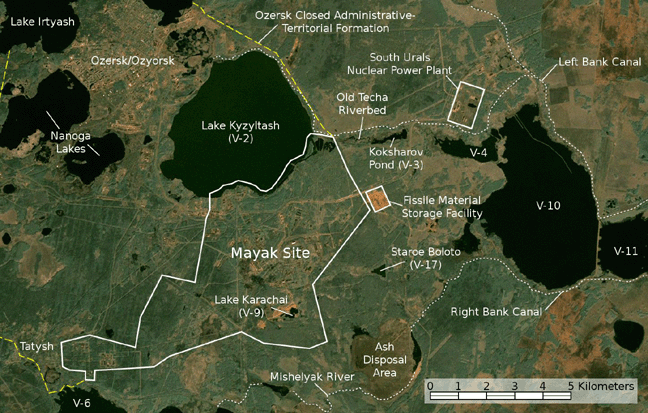
In November, Russian state meteorologists reported that high atmospheric concentrations of the radioactive isotope Ruthenium-106 had been detected around Mayak, triggering accusations that the secretive facility in Ozyorsk was the source of the pollution. However, Rosatom denied an accident had taken place there, said the levels detected by meteorologists were far below the admissible norm and insisted it had not carried out any operations that could have led to the isotope’s release into the atmosphere “for many years.”
Yet on December 13, Yuri Morkov, a senior executive at Mayak, admitted that Ruthenium-106 is routinely released as part of the plant’s processing of spent nuclear fuel. He insisted, however, that levels are so insignificant that there is no cause for concern.
Russian environmentalists are skeptical of his denials, in part because of Mayak’s history. Between 1949 and 1951, the factory dumped radioactive waste from the nuclear facility into the local river, polluting water supplies for tens of thousands of locals. In 1957, a storage tank containing highly radioactive nuclear weapons waste exploded at Mayak, exposing at least 272,000 people to dangerous levels of radiation. The accident was the third most serious nuclear disaster of all time, after far more famous accidents at Chernobyl and Fukushima. Eco-activists say the Soviets sent thousands of people, including some 2,000 pregnant women and hundreds of children, to clean up the disaster site with nothing more than rags and mops.
The atomic catastrophe was shrouded in secrecy: It wasn’t until 1989 that the USSR admitted it had taken place. Cancer rates in the worst affected areas around Mayak are between 2.5 and 3.5 times the national average, according to Greenpeace. In 2007, Russia’s constitutional court ruled that the unborn children exposed to radiation during the clean-up were not entitled to government benefits as adults, as they were not officially employed by the state.
This fall’s reports of the alleged nuclear leak at Mayak rekindled memories of the 1957 disaster. But Rosatom denies there have been any major incidents at its plants in recent years…….
There is no evidence suggesting Rosatom is directly responsible for the harassment of regional activists. A source close to the Russian nuclear industry tells Newsweekthat the “appalling and totally unacceptable” pressure is more likely coming from regional FSB officials trying to please their superiors in Moscow in the lead-up to Russia’s presidential election, a time when there’s increasingly less tolerance for dissent. Another possibility: lower-level officials who stand to benefit financially from Rosatom’s activities. “Russia is Russia,” the source says, asking for anonymity because of the sensitivity of the matter. “They play their own game as always.”
As for Maryasov, the Siberian activist faces an uncertain future as he continues his campaign against the nuclear waste repository. Finding a job has been hard because of his legal troubles, but he has no intention of moving.
“Too many people have put their trust in me,” he says, “I can’t let them down.” http://www.newsweek.com/crackdown-russia-critics-accuse-nuclear-authorities-soviet-style-cover-ups-and-755389
Hinkley point Nuclear Power – a bad deal in every way – obsolete before it ever starts working?

 Hinkley Point: the ‘dreadful deal’ behind the world’s most expensive power plant, The Guardian, 21 Dec 17 Building Britain’s first new nuclear reactor since 1995 will cost twice as much as the 2012 Olympics – and by the time it is finished, nuclear power could be a thing of the past. How could the government strike such a bad deal? By Holly Watt Hinkley Point, on the Somerset coast, is the biggest building site in Europe. Here, on 430 acres of muddy fields scattered with towering cranes and bright yellow diggers, the first new nuclear power station in the UK since 1995 is slowly taking shape. When it is finally completed, Hinkley Point C will be the most expensive power station in the world. But to reach that stage, it will need to overcome an extraordinary tangle of financial, political and technical difficulties. The project was first proposed almost four decades ago, and its progress has been glacial, having faced relentless opposition from politicians, academics and economists every step of the way.
With climate change, higher temperatures impede forest recovery after wildfires
 Forests destroyed in wildfires not recovering due to climate change,
  scientists reveal http://www.independent.co.uk/environment/forests-wildfires-climate-change-california-australia-not-recover-global-warming-regeneration-a8122501.html
Study suggests higher temperatures in the Rocky Mountains are preventing trees from growing back following wildfires Josh Gabbatiss Science Correspondent 21 Dec 17 A new study suggests hotter climates resulting from global warming may prevent forests from regenerating after wildfires.
Recent wildfires in California were the most destructive on record, with governor Jerry Brown warning climate change could make such fierce events “the new normal”.
In hot, dry climates like those found in the western US, wildfires are often a natural part of the environment, contributing to the cycling of nutrients and growth of new plants.
However, a new study published in the journal Ecology Letterssuggests increasing global temperatures may be preventing this natural cycling from taking place.The result could be long-term damage to areas of forest destroyed by wildfires.
Led by Dr Camille Stevens‐Rumann, an ecologist at Colorado State University, the study involved testing fire-struck areas of forest for signs of regeneration.
The scientists examined 1485 sites in the Rocky Mountains, all of which had been affected by fires between 1985 and 2015.
They looked for seedlings growing in the examined sites, comparing growth with nearby unburned forests to determine how well forests in each area were able to regenerate.
The team found the proportion of sites in which no post-fire tree regrowth had taken place increased from 19 to 32 per cent when comparing earlier years of the analysis to the more recent years.“Significantly less tree regeneration is occurring after wildfires in the start of the 21st century compared to the end of the 20th century,” the scientists wrote in their paper.
Comparing these findings with information on the region’s changing climate suggested increases in global temperatures were influencing forest regeneration, particularly in the driest regions.
“Dry forests that already occur at the edge of their climatic tolerance are most prone to conversion to non-forests after wildfires,” the scientists wrote. Natural disasters are increasingly being linked to climate change, and according to Todd Gartner, a senior associate at environmental think tank World Resources Institute, climate change is a “contributing factor” to the recent events in California.
Scientists have linked changes in temperature, levels of rain and soil moisture – all of which are influenced by global warming – to increased risk of wildfires.
This new study suggests the impact of climate change on wildfires may have longer term consequences as well.
“As scientists, managers and the public aim to understand and plan for increasing fire activity, our results suggest a high likelihood that future wildfires will facilitate shifts to lower density forest or non-forested states under a warming climate,” the scientists concluded.
Investigation finds that USA’s Nuclear Regulatory Commission downplays safety warnings
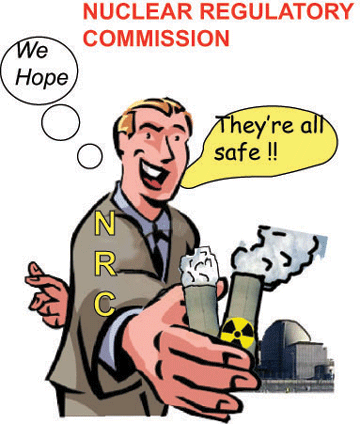 Nuclear Regulatory Commission downplays safety warnings, investigation finds, CBS News, 20 Dec 17, The federal agency responsible for safety at the nation’s 61 nuclear power plants routinely downplays warnings from plant workers and its own experts about problems, including some with potential for disaster, a Better Government Association investigation found.
Employees from U.S. nuclear power plants filed nearly 700 complaints with the United States Nuclear Regulatory Commission in recent years, claiming retaliation for raising safety concerns, records show. The agency found no wrongdoing.
NRC officials also overruled recommendations from their own technical experts on how to protect plants from potential catastrophe spurred by floods, equipment failures, power outages and other problems.
This article was provided to The Associated Press by the nonprofit news outlet Better Government Association.
Interviews with more than 20 current and former NRC and nuclear plant employees reveal a pattern of top officials dismissing safety warnings rather than impose costly fixes on plant operators. Some said careers suffered as potential threats were never fully addressed.
“It’s the NRC’s longstanding practice to consistently declare the plants are safe and to avoid directly answering any questions that might suggest otherwise,” said Lawrence Criscione, an NRC risk analyst.
NRC officials would not consent to an interview. But NRC spokeswoman Viktoria Mitlyng responded in writing to BGA questions……..
The nuclear industry, through its trade group and individual companies, often downplays the seriousness of problems highlighted by NRC experts. Exelon and others in the industry bat down potential rules and regulations by pleading to NRC’s top managers……….
The problem, say people who conduct government reviews, is that the NRC’s final rulings often don’t reflect warnings from its experts.
“Management tells you where they want the answer to go. If you push, you’re not going to get promoted again – there are other people who are willing to say it’s not a serious issue,” said Richard Perkins, one of Criscione’s NRC colleagues involved in exposing flooding concerns.
One case in point is the emergency safety valve issue at Exelon’s Byron and Braidwood plants……..
Underscoring that frustration is the NRC’s record of handling whistleblower complaints lodged by plant employees. From 2010 through 2016, workers filed 687 complaints. The NRC investigated just 235 and upheld none.
The largest number of complaints, 84, were filed by employees at the two nuclear plants operated in Georgia by Southern Nuclear, records show. Next were the 70 complaints lodged by nuclear workers in South Carolina, 58 by workers in Tennessee and 50 in California. Illinois ranked 12th, with 21 whistleblower cases filed. https://www.cbsnews.com/news/nuclear-regulatory-commission-downplays-safety-warnings-investigation-finds/
Survey finds strong support in France for renewable energy, not nuclear
 French people support energy transition, survey reveals, Energy Transition by Energiewende Team19 Dec 2017“……… It is often said that the French people strongly support nuclear energy as a jewel of the French industry. However, a survey commissioned by the French office of the Heinrich Boell Foundation and the French Think tank La Fabrique écologique, carried out by the research institute Harris Interactive, shows that the French people would rather like to pull up the anchor and set sail for a new model based on renewable energy.
Indeed, 91 % of interviewees consider the energy transition as “priority issue” (47%) or a “major issue” (44%). 63% see the energy transition as an opportunity rather than as a threat (11 %). But what should energy transition look like, according to them?
A clear preference for the development of renewable energy
The trend is very clear: 83 % of French people think France should prioritize investments in renewable energy. Only 12% of the interviewees prefer that investments go towards the modernization and life extension of nuclear power plants. 66 % of respondents come out against the construction of new nuclear power plants. It shows that the advertising and constantly repeated arguments that nuclear energy – often described as “clean energy” – is the only adequate solution when it comes to fighting climate change is not having the intended effect on French public opinion.
Also surprising is the fact that the actor in which the French people have the most confidence to lead the energy transition is neither the state (trusted by 49% of the interviewees) nor the energy producers and providers like the state owned EDF (trusted by only 46%). Rather, people trust citizen energy cooperatives (trusted by 78%), as well as NGOs and associations (trusted by 66 %).
A positive view of the Energiewende
Another salient point of the survey is the opinion of the French people about the German energy transition. Respondents perceived the German Energiewende much more positively than their economic and political elites……..
Over half of them see the Energiewende as “a good example for the energy transition.” Last but not least, the French people think France should work more closely with Europe (54%) and with Germany (51%) on energy issues……
The complete results of the survey (in French) are available here: Enquête “Le rapport des Francais à l’énergie” – Harris Interactive
In the press :
- FAZ: Die Franzosen wollen weniger Atomenergie
- Libération: Energie : les Français veulent plus de renouvelable et moins de nucléaire (französisch)
- Alternatives Economiques: Climat : la France est-elle vraiment exemplaire? (französisch) https://energytransition.org/2017/12/french-people-support-energy-transition-survey-reveals/?t=1&cn=ZmxleGlibGVfcmVjc18y&refsrc=email&iid=b0fd4fb85ba34dc690d233cf08200f82&uid=585629311&nid=244+293670920
Nuclear radiation: Russia has no transparent system for monitoring the state of its environment

Wake up and smell the ruthenium https://www.opendemocracy.net/od-russia/violetta-ryabko/wake-up-and-smell-ruthenium Violetta Ryabko is head of Greenpeace Russia’s press service. Russia’s recent ruthenium scare, which went viral around the globe, brought a serious problem to light: the absence in Russia of proper and transparent monitoring of its environment.
In early October, information about a leak of the radioactive isotope ruthenium-106 into the atmosphere appeared in western media. Germany’s radiation watchdog announced that the source of the leak was most probably in the southern Urals, and French experts confirmed that conclusion.

Russia’s state-owned nuclear corporation Rosatom, however, denied the claim, saying that according to Roshydromet, the country’s environmental monitoring body, tests for particulate pollutants carried out between 25 September and 7 October failed to find any traces of Ruthenium, apart from a single instance in St Petersburg.
However, at the end of November, Greenpeace Russia received a response to a query it had sent Rosgidromet. This confirmed the discovery of ruthenium-106 in late September in the Chelyabinsk region, just to the east of the Ural mountains. The element was detected near the Mayak complex, a facility for reprocessing spent nuclear fuel. Ruthenium was also found in the atmospheres of Tatarstan, Bashkortostan, and the Krasnodar, Volgograd, and St Petersburg regions.
Ukrainian scientists also published data about its presence in the Altai, Dubno, Kirov, and Yakutia regions. Roshydromet admitted that in late September and early October atmospheric conditions were right for active movement of air masses, including pollutants, from the southern Urals towards the Mediterranean area and then northern Europe.
This news triggered an instant sensation, with Russia’s media simultaneously advancing all kinds of theories: it wasn’t Mayak at fault, but another Rosatom facility; the ruthenium could have come from a crashed satellite (although no satellites crashed at the time), and you can’t launch a satellite unnoticed; the source of the leak was in Romania, Kazakhstan, China… One theory held that it was an attempt to discredit Russia in the eyes of the world. Instead of releasing information about the accident to the public, Rosatom instead lashed out at western media for daring to report it.
A few days later, Rosatom invited journalists to a press trip where they could have a sniff of Ruthenium and discover how perfectly safe it was. More than 200 took up the offer, but only 17 were admitted. This triggered general anger, especially as the selection criteria were unclear. Then Rosatom created an advert showing a little cartoon lump of Ruthenium with big eyes, declaring how harmless it was: “What have I done to you? There’s nothing bad about me!”
Rosatom’s website then announced that a commission would be established to determine the source of the radiation, but it is unclear when this would happen and who would do it. On 8 December the commission held a press conference, where journalists were once again told that Mayak could not be the source of the emission, and were handed copies of the commission’s conclusion that the culprit had to be an unidentified satellite. Greenpeace sent a petition to the Russian General Prosecutor’s Office: by the next day it had been signed by more than 10,000 people.
Under the carpet
The hype around the ruthenium leak is that Russia has no transparent system for monitoring the state of its environment.
Radiation monitoring is overseen by Rosgidromet, which answers to Russia’s Ministry of Natural Resources and the Environment. The Roshydromet site quotes monthly radiation figures prepared by the Taifun scientific development centre, but they are not very easy to find. Occasionally it publishes other information, but in reality, all you can see is background gamma radiation from a few automatically selected detector elements: you can’t discover anything about the presence of specific radionuclides.
Russia has an automated radiation monitoring system: in other words, all nuclear installations are surrounded by automatic sensors that measure a number of indicators, and Rosatom is responsible for reporting accidents. So, if an accident happens, staff are inevitably made aware of emissions.
Rosgidromet, on the other hand, is only responsible for measuring emissions, but it takes a very long time to process these measurements and in the case of a serious radioactive emission, the publication of the relevant data a month later won’t save anyone from its consequences. For example, we still don’t know what happened in late September near the ruthenium emission zone. And the reports that we do have contain incomplete and sometimes contradictory data, although in faraway France the list of monitoring stations and the measurements around them appeared very fast.
In Russia, by contrast, no one plans to search for the emission’s source, on the supposed grounds that the concentration of ruthenium was too small to monitor. Yet by this logic, we can never learn any lessons from the incident at all. By the time an emission of a larger concentration is detected, it will be too late to look for its source.
Keeping the public happy
It looks as though Russia’s nuclear monitoring and information system is inadequate for the country’s needs. Immediately after the Chernobyl accident in 1986, the Soviet authorities set up a body now known as the federal nuclear and radiation safety authority, a powerful enough watchdog at the time, which even managed to halt work at Mayak. However, in 2004 this body became just a subsidiary arm of Rostekhnadzor, the federal environmental, industrial and nuclear supervision service, thereby losing some of its powers.
Meanwhile, Rosatom goes from strength to strength: it is now responsible for the development of Russia’s North Sea Shipping Route and is expected to acquire yet more functions. But are monitoring organs and systems growing at the same rate? Apparently the opposite is happening, and it’s a dangerous tendency.
The very fact that the source of the ruthenium is still officially unknown reveals, at best, the inadequacy of the current radiation monitoring and public reporting systems and at worst, Rosatom’s ability to lobby for secrecy and lying to the public. The precedents for further problems down the road have already been set.
In 1993, Russia experienced its first nuclear accident after the fall of the Soviet Union. This took place at the Siberian Chemical Combine in Tomsk region, which released ruthenium-106. Greenpeace’s archive contains a telling document of the time: a report on the radiation situation compiled by the Commission of the State Committee on Civil Defence, Emergency Situations and Liquidating Natural Disasters. In the letter that accompanies it, Sergey Shoigu, the head of the committee, notes that “just like the Chernobyl disaster, the Atomic Ministry informed both the immediate area and the capital about the accident with a significant delay, which could have led to serious consequences.” That said, even when this delay had been noted, it wasn’t reflected in the Commission’s reports — “in order to calm public opinion”, according to Shoigu.
Books have been written about how the news of the Chernobyl disaster and the 1957 Mayak accident was kept secret. Time passes, but we still don’t know anything about the radiation situation in our own country.
Translated by Liz Barnes.
USA nuclear tests – a hidden weapon against its own people – radioactive milk
Five men at atomic ground zero
RADIOACTIVE MILK US nuclear tests killed far more civilians than we knew, Quartz, https://qz.com/1163140/us-nuclear-tests-killed-american-civilians-on-a-scale-comparable-to-hiroshima-and-nagasaki/21 Dec 17
The study, performed by University of Arizona economist Keith Meyers, uses a novel method (pdf) to trace the deadly effects of this radiation, which was often consumed by Americans drinking milk far from the site of atomic tests.
From 1951 to 1963, the US tested nuclear weapons above ground in Nevada. Weapons researchers, not understanding the risks—or simply ignoring them—exposed thousands of workers to radioactive fallout. The emissions from nuclear reactions are deadly to humans in high doses, and can cause cancer even in low doses. At one point, researchers had volunteers stand underneath an airburst nuclear weapon to prove how safe it was:
The emissions, however, did not just stay at the test site, and drifted in the atmosphere. Cancer rates spiked in nearby communities, and the US government could no longer pretend that fallout was anything but a silent killer.
The cost in dollars and lives
Congress eventually paid more than $2 billion to residents of nearby areas that were particularly exposed to radiation, as well as uranium miners. But attempts to measure the full extent of the test fallout were very uncertain, since they relied on extrapolating effects from the hardest-hit communities to the national level. One national estimate found the testing caused 49,000 cancer deaths.
Those measurements, however, did not capture the full range of effects over time and geography. Meyers created a broader picture by way of a macabre insight: When cows consumed radioactive fallout spread by atmospheric winds, their milk became a key channel to transmit radiation sickness to humans. Most milk production during this time was local, with cows eating at pasture and their milk being delivered to nearby communities, giving Meyers a way to trace radioactivity across the country.
The National Cancer Institute has records of the amount of Iodine 131—a dangerous isotope released in the Nevada tests—in milk, as well as broader data about radiation exposure. By comparing this data with county-level mortality records, Meyers came across a significant finding: “Exposure to fallout through milk leads to immediate and sustained increases in the crude death rate.” What’s more, these results were sustained over time. US nuclear testing likely killed seven to 14 times more people than we had thought, mostly in the midwest and northeast.
A weapon against its own people
When the US used nuclear weapons during World War II, bombing the Japanese cities of Hiroshima and Nagasaki, conservative estimates suggest 250,000 people died in immediate aftermath. Even those horrified by the bombing didn’t realize that the US would deploy similar weapons against its own people, accidentally, and on a comparable scale.
And the cessation of nuclear testing helped save US lives—”the Partial Nuclear Test Ban Treaty might have saved between 11.7 and 24.0 million American lives,” Meyers estimates. There was also some blind luck involved in reducing the number of poisoned people: The Nevada Test Site, compared to other potential testing facilities the US government considered at the time, produced the lowest atmospheric dispersal.
The lingering affects of these tests remain, as silent and as troublesome as the isotopes themselves. Millions of Americans who were exposed to fallout likely suffer illnesses related to these tests even today, as they retire and rely on the US government to fund their health care.
“This paper reveals that there are more casualties of the Cold War than previously thought, but the extent to which society still bears the costs of the Cold War remains an open question,” Meyers concludes.
December 21 Energy News

Opinion:
¶ “Hinkley Point: the ‘dreadful deal’ behind the world’s most expensive power plant” • Many British observers agree that the deal to build the Hinkley Point nuclear plant is ludicrously favourable to EDF – “a dreadful deal, laughable,” said one expert. But the irony is that by the time it eventually starts working, it may have become obsolete. [The Guardian]
 A view toward the Hinkley Point site in Somerset
(Photo: Deeplyvibed | Alamy Stock Photo)
¶ “Tesla’s big Powerpack battery just propped up a coal power station in another state” • Tesla’s giant battery is already proving its worth, bailing out a 560-MW coal power station nearly 620 miles (1,000 kilometres) away. The battery is powered by a wind farm. Ironic, isn’t it, that wind power bailed out a coal-burning plant? [Mashable]
World:
¶ Germany’s renewable electricity production is set to reach a record 36%…
View original post 769 more words
Australia’s Hot Ocean Blob Fuels Record Heat, Extreme Weather, Risk to Coral Reefs — robertscribbler

Between Australia and New Zealand there’s a kind of climate change fed thing on the prowl in the off-shore waters. It takes the form of an angry layer of far warmer than normal surface water. And it’s been lurking around since late November. (A hot, angry blob of much warmer than normal ocean temperatures has […]
via Australia’s Hot Ocean Blob Fuels Record Heat, Extreme Weather, Risk to Coral Reefs — robertscribbler
USA’s nuclear boondoggle Plant Vogtle costing $25 billion-plus – still gets regulators’ go ahead !

Troubled $25 Billion Nuclear Project Gets OK to Continue US News, By JONATHAN LANDRUM Jr., Associated Press ATLANTA (AP) 21 Dec 17  — Georgia‘s utility regulators are allowing construction to continue on two new nuclear reactors, despite massive cost overruns for the multibillion-dollar project.
Thursday’s unanimous decision by the state’s Public Service Commission will shape the future of the nation’s nuclear industry, partly because the reactors at Plant Vogtle were the first new ones to be licensed and to begin construction in the U.S. since 1978.
The project, co-owned by Georgia Power, Oglethorpe Power, MEAG Power and Dalton Utilities, has been plagued by delays and spiraling costs, compounded when the main contractor filed for bankruptcy. Westinghouse Electric Co., the U.S. nuclear unit of Japan’s Toshiba Corp., filed for bankruptcy in March.
Georgia Gov. Nathan Deal praised the PSC’s decision……
The Sierra Club, meanwhile, slammed the vote, calling the project a disaster. Ted Terry, director of the group’s Georgia chapter, said the project should have been halted……
Officials say the PSC vote means Georgia consumers will pay more for power, starting in 2021……
David Schlissel, a utility consultant and analyst who has previously testified against Vogtle, criticized Thursday’s vote, saying regulators were letting Georgia Power and its parent, the Southern Company, off the hook.
“The commission’s own monitors have identified that Southern mismanaged the project,” he said. “Now the commission is giving them unanimous approval to spend even more money.”
He added, “In Georgia, you apparently have commissioners who are fine having ratepayers shovel money into a bottomless pit.”…….
By May 2015, regulators said there was a “high probability” that construction would be delayed even longer than the three years already announced by the owners, according to an analysis obtained by The Associated Press. Estimates from regulators at that time put the utility company’s costs at $8.2 billion.
The rising construction costs hit an industry already under financial pressure, after 2011 a tsunami in Japan triggered meltdowns at the Fukushima Dai-ichi nuclear plant. Meanwhile, the price of natural gas dropped, lessening the incentive to build new nuclear power.
In South Carolina, Santee Cooper and South Carolina Electric & Gas Co. abandoned the construction of a similar nuclear project in July, blaming the decision primarily on the bankruptcy of lead contractor Westinghouse.
Under state law, Georgia Power’s customers will ultimately reimburse the state-regulated monopoly for the flagship plant as they pay their monthly electricity bills. That law allows Georgia Power to charge its customers now for the interest it pays on the borrowed money needed for the project. Under an older law, the utility had to wait until the plant was operating to collect those interest charges from its customers, a practice that meant the interest owed grew during the construction period.
Cost overruns were also an issue with the original reactors at Vogtle. The cost of building the existing reactors at the site jumped from $660 million to nearly $9 billion by the time they started producing power in the late 1980s.
Associated Press video journalist Robert Ray in Atlanta and reporter Jeff Amy in Jackson, Mississippi, contributed to this story. https://www.usnews.com/news/business/articles/2017-12-21/georgia-board-to-decide-fate-of-25-billion-nuclear-plant

Worse wildfires – the new climate normal
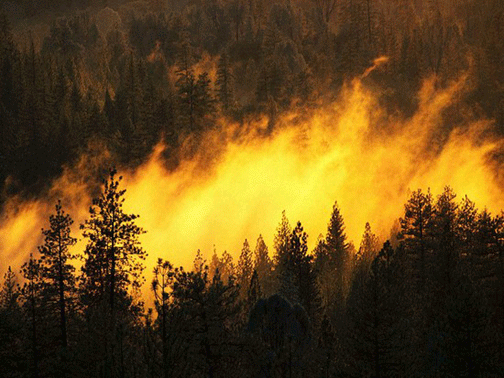 WILDFIRES MARK THE NEW REALITY OF CLIMATE CHANGE IN 2017
As fire conditions intensify around the globe, scientists are helping countries prepare for a fiery new normal. Pacific Standard, BOB BERWYN, DEC 20, 2017
1 This Month
Chernobyl: The Lost Tapes – A good documentary on Chernobyl on SBS available On Demand for the next 3 weeks– https://www.sbs.com.au/ondemand/tv-program/chernobyl-the-lost-tapes/2352741955560

of the week–London Campaign for Nuclear Disarmament

Tell the Ukrainian Government to Drop Prosecution of Peace Activist Yurii Sheliazhenko
To see nuclear-related stories in greater depth and intensity – go to https://nuclearinformation.wordpress.com
-
Archives
- April 2026 (126)
- March 2026 (251)
- February 2026 (268)
- January 2026 (308)
- December 2025 (358)
- November 2025 (359)
- October 2025 (376)
- September 2025 (257)
- August 2025 (319)
- July 2025 (230)
- June 2025 (348)
- May 2025 (261)
-
Categories
- 1
- 1 NUCLEAR ISSUES
- business and costs
- climate change
- culture and arts
- ENERGY
- environment
- health
- history
- indigenous issues
- Legal
- marketing of nuclear
- media
- opposition to nuclear
- PERSONAL STORIES
- politics
- politics international
- Religion and ethics
- safety
- secrets,lies and civil liberties
- spinbuster
- technology
- Uranium
- wastes
- weapons and war
- Women
- 2 WORLD
- ACTION
- AFRICA
- Atrocities
- AUSTRALIA
- Christina's notes
- Christina's themes
- culture and arts
- Events
- Fuk 2022
- Fuk 2023
- Fukushima 2017
- Fukushima 2018
- fukushima 2019
- Fukushima 2020
- Fukushima 2021
- general
- global warming
- Humour (God we need it)
- Nuclear
- RARE EARTHS
- Reference
- resources – print
- Resources -audiovicual
- Weekly Newsletter
- World
- World Nuclear
- YouTube
-
RSS
Entries RSS
Comments RSS
 nuclear-news