nuclear-news

The News That Matters about the Nuclear Industry Fukushima Chernobyl Mayak Three Mile Island Atomic Testing Radiation Isotope

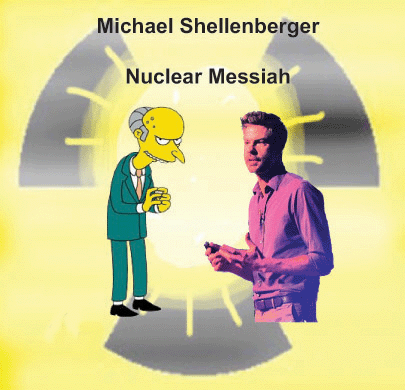
Michael Shellenberger uses disinformation to attack environmental groups

Exposing the misinformation of Michael Shellenberger and ‘Environmental Progress’ Jim Green, Nuclear Monitor Issue: #853 4689 30/10/2017

“…….Attacking environment groups

Shellenberger reduces the complexities of environmental opposition to nuclear power to the claim that in the 1960s, an “influential group of conservationists within Sierra Club feared that cheap, abundant electricity from nuclear would result in overpopulation and resource depletion” and therefore decided to campaign against nuclear power.4

If such views had any currency in the 1960s, they certainly don’t now. Yet EP asserts that Greenpeace and FOE “oppose cheap and abundant energy”3 and Shellenberger asserts that “the FOE-Greenpeace agenda has never been to protect humankind but rather to punish us for our supposed transgressions.”4 And Shellenberger suggests that such views are still current by asserting that the anti-nuclear movement has a “long history of Malthusian anti-humanism aimed at preventing “overpopulation” and “overconsumption” by keeping poor countries poor.”8 Again we see Shellenberger’s M.O. of relentless repetition of falsehoods in the hope that mud will stick.

In an ‘investigative piece’ ‒ titled ‘Enemies of the Earth: Unmasking the Dirty War Against Clean Energy in South Korea by Friends of the Earth (FOE) and Greenpeace’ ‒ Shellenberger lists three groups which he claims have accepted donations “from fossil fuel and renewable energy investors, as well as others who stand to benefit from killing nuclear plants”.4 FOE and Greenpeace don’t feature among the three groups even though the ‘investigative piece’ is aimed squarely at them.

Undeterred by his failure to present any evidence of FOE and Greenpeace accepting fossil fuel funding (they don’t), Shellenberger asserts that the donors and board members of FOE and Greenpeace “are the ones who win the government contracts to build solar and wind farms, burn dirty “renewable” biomass, and import natural gas from the United States and Russia.”4 Really? Where’s the evidence? There’s none in Shellenberger’s ‘investigative piece’.

In an article for a South Korean newspaper, Shellenberger states: “Should we be surprised that natural gas companies fund many of the anti-nuclear groups that spread misinformation about nuclear? The anti-nuclear group Friends of the Earth ‒ which has representatives in South Korea ‒ received its initial funding from a wealthy oil man …”45He fails to note that the donation was in 1969! And he fails to substantiate his false insinuation that FOE accepts funding from natural gas companies, or his false claim that natural gas companies fund “many of the anti-nuclear groups”.

Shellenberger’s ‘investigative piece’ falsely claims4 that FOE keeps its donors secret, and in support of that falsehood he cites an article8 (written by Shellenberger) that doesn’t even mention FOE. EP falsely claims that FOE has hundreds of millions of dollars in its bank and stock accounts.3

EP has an annual budget of US$1.5 million, Shellenberger claims, and he asks how EP “can possibly succeed against the anti-nuclear Goliath with 500 times the resources.”8

An anti-nuclear Goliath with 500 times EP’s budget of US$1.5 million, or US$750 million in annual expenditure on anti-nuclear campaigns? Shellenberger claims that Greenpeace has annual income of US$400 million to finance its work in 55 nations8 ‒ but he doesn’t note that only a small fraction of that funding is directed to anti-nuclear campaigns. FOE’s worldwide budget is US$12 million according to EP3 ‒ but only a small fraction is directed to anti-nuclear campaigns.

References:… https://wiseinternational.org/nuclear-monitor/853/exposing-misinformation-michael-shellenberger-and-environmental-progress

December 29, 2017 Posted by | spinbuster, USA | Leave a comment

Hinkley nuclear “strike price” of £92.50 per megawatt hour – time for UK to get out of nuclear

Paul Donovan: As renewable energy gets cheaper and cheaper, ministers minds are clouded by the ridiculously high guaranteed “strike price” of £92.50 per megawatt hour for Hinkley generated power, who can
be surprised?

The government should be looking to get out of nuclear power entirely and join the rest of the world in the renewables revolution. https://www.theguardian.com/environment/2017/dec/26/its-time-to-join-the-renewables-revolution

December 29, 2017 Posted by | general | Leave a comment

Protesters rally against TEPCO approval

Some asked why Tepco is being given approval when victims of the Fukushima disaster have not been given relief. Others said Tepco is unfit to operate nuclear reactors.
6 & 7 kashiwazaki-kariwa npp 27 dec 2017.jpg
Protestors have opposed the Nuclear Regulation Authority’s endorsement of safety measures taken at 2 reactors operated by Tokyo Electric Power Company.
About 20 people, including members of a citizen’s group opposed to reactor restarts, rallied on Wednesday in Tokyo in front of the building where the regulators were meeting.
They raised a banner that said the regulators shouldn’t encourage the restarts.
Some asked why TEPCO is being given approval when victims of the Fukushima disaster have not been given relief. Others said TEPCO is unfit to operate nuclear reactors.
The group handed out petitions to regulation authority employees, demanding that the reactors’ assessments not be approved.
Masahide Kimura of the citizens’ group said regulators must ask whether the public really wants TEPCO deemed capable of running reactors.
He said the regulators’ decision diverges from public opinion, and is not likely to be supported.

December 28, 2017 Posted by | Japan | , | Leave a comment

Fukushima Nuclear Waste Crisis Is Getting Bigger With Every Passing Day

Nuclear waste storages in Namie, Minamisoma and Iitate, Fukushima prefecture in Japan. Adopting a return to normal policy, the Japanese government undertook an unprecedented decontamination program for areas of Fukushima contaminated by the triple reactor meltdown in March 2011. Fukushima prefecture is 70 percent mountainous forest which has not and cannot be decontaminated, with decontamination efforts focussed along roads and in towns, farmland and in narrow areas around peoples houses. The result has been that the Japanese authorities have produced a nuclear waste crisis, with over 7 million tons of waste located in 147,000 locations (as of August 2017). The Japanese government is determined to force people back to their homes despite the on-going radiation risks and the vast volumes of nuclear waste.

December 28, 2017 Posted by | Fukushima 2017 | , | Leave a comment

TEPCO president gave order not to call 2011 crisis a ‘meltdown’

Tepco former president Masataka Shimizu 27 dec 2017.jpg
NIIGATA–An investigation committee is leveling the blame for the failure to use the word “meltdown” following the Fukushima nuclear accident in March 2011 at Tokyo Electric Power Co. President Masataka Shimizu.
Shimizu instructed TEPCO employees not to use the term on his own and was not following orders from the prime minister’s office, the committee’s report said on Dec. 26.
TEPCO did not publicly confirm that a meltdown had occurred until May 2011.
“There were no instructions (to TEPCO) from the prime minister’s office on whether to use the word ‘meltdown’ or not,” the panel said as to why the announcement was delayed for two months.
The committee was jointly set up by the Niigata prefectural government and TEPCO to investigate the cause of the accident at the Fukushima No. 1 nuclear power plant due to the Great East Japan Earthquake and tsunami of March 11, 2011.
The investigation is a prerequisite for the prefectural government starting discussions on whether to agree to the restart of the Kashiwazaki-Kariwa nuclear power plant, also operated by TEPCO, in the prefecture.
The description of the investigation committee’s report contrasted sharply with a report released in June 2016 by a third-party investigation committee set up by TEPCO.
According to the third-party committee’s report, Shimizu instructed then Vice President Sakae Muto through a TEPCO employee “not to use the word ‘meltdown’ at the direction of the prime minister’s office” when Muto held a news conference on March 14, 2011, three days after the nuclear accident ensued.
As Shimizu’s memory had faded, the third-party committee was unable to confirm details of the “instruction” from the prime minister’s office, but assumed that there was a directive from the prime minister’s office.
Whether an order had been issued by the prime minister’s office became a focus of the investigation of the Niigata prefectural government and TEPCO committee.
According to the joint panel’s report, Shimizu met with then Prime Minister Naoto Kan and then Chief Cabinet Secretary Yukio Edano of the Democratic Party of Japan-led government at the prime minister’s office on March 13, 2011, a day before Muto’s news conference.
In that meeting, Shimizu received instructions from Kan and Edano on sharing information.
Shimizu thought that since the definition of a “meltdown” is vague, an announcement that one had occurred could cause a panic unless the release of such news was made after reaching a consensus with the prime minister’s office.
Based on this reasoning, Shimizu instructed TEPCO’s employees “not to use the word ‘meltdown,’” on his own, he was quoted by the report as telling members of the investigation committee.

December 28, 2017 Posted by | Fukushima 2017 | , , , | Leave a comment

Two Niigata nuclear reactors run by Tepco clear new safety standards, a first for the company since the Fukushima crisis

6 & 7 kashiwazaki-kariwa npp 27 dec 2017.jpg
The Nuclear Regulation Authority gave its approval Wednesday to restart the No. 6 and No. 7 reactors at the Kashiwazaki-Kariwa nuclear power plant in Niigata Prefecture, the first reactors operated by Tokyo Electric Power Company Holdings Inc. to formally clear the stricter safety standards
TOKYO (Kyodo) — Two nuclear reactors on the Sea of Japan coast have become the first run by the operator of the crippled Fukushima power plant to formally clear the stricter government safety standards imposed after the 2011 crisis.
The Nuclear Regulation Authority endorsed Wednesday safety measures for the No. 6 and 7 reactors at Kashiwazaki-Kariwa power station in Niigata Prefecture, paving the way for their restart by Tokyo Electric Power Company Holdings Inc., known as Tepco.
The two reactors are boiling-water reactors, the same as those that suffered meltdowns in the Fukushima crisis caused by the massive earthquake and tsunami in March 2011. No such reactor types had previously cleared Japan’s tougher safety standards since the disaster, partly as they are required to conduct major refurbishment for added safety.
The NRA’s endorsement of the two units gives impetus to the Japanese government’s push to restart idled nuclear power plants that were taken offline after the world’s worst nuclear disaster since Chernobyl.
In addition to assessing technical requirements, the review by the NRA focused on whether Tepco is qualified to operate a nuclear power plant as it struggles with the scrapping of the Fukushima Daiichi complex — an effort expected to take until around 2051 — and in dealing with contaminated water around the crippled plant where radiation levels remain high.
Tepco, facing huge compensation payments and other costs stemming from the Fukushima crisis, has been keen to resume operation of its reactors to reduce dependence on costly fossil fuel imports for non-nuclear thermal power generation.
However, the process of restarting the two reactors straddling the municipalities of Kashiwazaki and Kariwa in Niigata could still require at least several more years as local governments need to give their consent to resumption.
Among them, Niigata Gov. Ryuichi Yoneyama has said it will take “at least three to four years” before deciding whether to give his approval to bringing them back online, citing the need to assess the causes of the accident at the Fukushima Daiichi nuclear complex.
The two reactors are the newest among the seven units at the Kashiwazaki-Kariwa plant. The complex is one of the world’s largest nuclear power plants, with a combined output capacity of 8.2 million kilowatts.
In a move not seen in the screening processes for other utilities, Tepco agreed to a request from the regulator to provide a pledge to carry through the scrapping of the Fukushima complex, leading the regulator to soften its position.
Tepco filed for safety assessments of the two reactors in September 2013.

December 27, 2017 Posted by | Japan | , , | Leave a comment

2 residents file request for temporary injunction against Oi nuke plant restart

3 & 4 reactors Oi NPP.jpg
OSAKA — Two people from Fukui and Kyoto prefectures filed a request with the Osaka District Court on Dec. 25 for a temporary injunction against the restart of reactors at the Oi nuclear power plant.
Operator Kansai Electric Power Co. is aiming to turn the No. 3 and 4 reactors at the plant in Oi, Fukui Prefecture, back on in spring 2018.
The restart is already being challenged in four other court cases filed by residents; three in district courts and one that has reached a high court branch. All four are lawsuits, not requests for provisional injunctions. Therefore, even if the plaintiffs win their cases, the Oi plant restart cannot be stopped until the verdict has been finalized through the appeals process.
With the reactors’ projected restart just months away, the pair from Kyoto and Fukui prefectures decided to file for the temporary injunction, which would take effect immediately if granted.
Kansai Electric declined to comment on the filing, saying a copy had not yet arrived at their offices.

December 27, 2017 Posted by | Japan | , , | Leave a comment

5 more minors in Fukushima Pref. at time of nuclear accident diagnosed with thyroid cancer

serveimage.jpg
FUKUSHIMA — Five more people in Fukushima Prefecture who were 18 and under at the time of the 2011 nuclear accident were diagnosed with thyroid cancer as of the end of September this year, a prefectural investigative commission announced at a Dec. 25 meeting.
Fukushima Prefecture established the commission to examine the health of residents after the March 2011 triple meltdown at the Fukushima No. 1 nuclear power plant. A total of 159 Fukushima prefectural residents who were aged 18 and under when the meltdowns occurred have now been diagnosed with thyroid cancer.
The commission stated on Dec. 25 that “it is difficult to think the cases are related to radiation exposure” from the disaster.

December 27, 2017 Posted by | Fukushima 2017 | , | Leave a comment

The Constitutional Democratic Party of Japan clarifies goal of eliminating nuclear power in policy draft

CDP draft 25 dec 2017.jpg
In this file photo taken on Dec. 16, 2017, Constitutional Democratic Party of Japan leader Yukio Edano delivers a speech in Aoba Ward, Sendai
The Constitutional Democratic Party of Japan (CDP), the largest opposition party in the powerful House of Representatives, specified its goal of eliminating nuclear power by 2040 in a draft of its basic policy that was revealed on Dec. 24.
The draft states that the CDP seeks to stop the installation of new nuclear reactors as the necessity for such facilities “cannot be recognized,” and will not agree on reactivation of idled nuclear reactors unless the national government works out effective evacuation plans, for which the state can be responsible.
It then pledges to stick to its goal of decommissioning all nuclear reactors by 2040 in principle, reinforcing its goal of achieving a society without atomic power as early as possible, which the party declared in its campaign pledge for the lower house election in October.
With regard to constitutional amendment, the draft says the party will consider clauses that actually require revisions from the standpoint of putting the brakes on the authorities and protecting the rights of the people.
Under the policy draft, the party regards the Japan-U.S. alliance as the linchpin of Japan’s diplomatic and security policy and pursues the sound development of the pact, while proposing revisions to the Status of Forces Agreement between the two countries to reduce the burden of hosting U.S. military bases.
On the economic front, the draft states that the party will seek to set mid- and long-term targets of achieving fiscal health and strengthen the system of redistribution of wealth through a review of the entire tax system, including the consumption tax. The policy draft also includes the goal of raising the minimum wage to at least 1,000 yen an hour, enacting legislation to ban corporate political donations while promoting individual political donations. The party also aims to lower the minimum age at which people can run for public office by 5 years.
The CDP is also poised to incorporate its goal of phasing out nuclear power in a draft of its platform to be compiled by the end of this year. The party aims to demonstrate originality in its draft platform using phrases such as “bottom-up politics” and “grass-root democracy,” which CDP leader Yukio Edano pledged to carry out when the party was launched.

December 27, 2017 Posted by | Japan | , , | Leave a comment

Town of Futaba kicks off radiation cleanup with eye on 2022 revival

Decontamination work begins in Futaba Dec 25 2017.jpg
Decontamination work begins Monday in the town of Futaba, Fukushima Prefecture, to make it habitable again by spring 2022 under a government-led reconstruction project.
FUKUSHIMA – Cleanup work kicked off Monday to make radiation-tainted Futaba, one of the towns hosting the meltdown-hit Fukushima No. 1 power plant, habitable again by around spring 2022 under a government-led recovery project.
Cleanup and demolition crews are trying to decontaminate the town, which was tainted with fallout from the plant’s triple core meltdown after the March 2011 mega-quake and tsunami. The plant’s operator, Tokyo Electric Power Company Holdings Inc., is shouldering the cost.
The work at Futaba marks the beginning of a series of government-led projects to make areas designated as special reconstruction zones livable again, with an emphasis on new infrastructure.
About 96 percent of Futaba has been designated as “difficult to return to” zone, and an evacuation advisory is still in place for the entire town, which hosts the stricken power plant with neighboring Okuma.
The cleanup will be concentrated in the special reconstruction zone, which covers 555 hectares accounting for 11 percent of Futaba.
“The reconstruction efforts will help motivate residents to return to their homes,” Futaba Mayor Shiro Izawa told officials involved in the project.
“We want you to carry out the work while thinking about the feelings of the citizens awaiting the day they can return,” he said.
Overseen by the Environment Ministry, the first steps will involve removing the top layer of soil in the area near Futaba Station, trimming grass along the streets, and dismantling nearly 60 houses and public facilities.
Along with Futaba, seven municipalities in Fukushima Prefecture have been designated as zones that are difficult to return to.
The government is aiming to lift the evacuation advisory near Futaba station by the end of March 2020, when the Joban Line plans to fully resume operation.
Some evacuees from Futaba had mixed emotions about the start of the work.
A 69-year-old woman residing in a temporary shelter in Iwaki said that her house is in the special reconstruction zone but that she had given up hope of returning because she evacuated over six years ago.
“If this was two or three years after the disaster, I might have a choice to return. But my house became run-down and I got old. Realistically speaking, I don’t think I can live there now,” she said.
On the other hand, Masamichi Matsumoto, who also fled to Iwaki, welcomed the project, saying, “I’m glad that a step has been taken to rebuild the town for the future.”
He said it is unlikely many citizens will return, partly because a nearby facility will be storing contaminated soil collected from the cleanup work.
“But I hope that Futaba will become a town where people can visit some day,” Matsumoto, 54, added.

Decontamination work begins in Futaba Dec 25 2017.jpg

December 27, 2017 Posted by | Fukushima 2017 | , , , | Leave a comment

Donald Trump’s Path to Nuclear War  – a 2017 Timeline

Timeline of Trump’s Path to Nuclear War https://www.globalresearch.ca/timeline-of-trumps-path-to-nuclear-war/5623937 By Walt Gelles Global Research, December 26, 2017 Donald Trump’s reckless policies, belligerence, volatile personality, and rejection of diplomacy have brought the world to the brink of war in Korea.  Such a war could rapidly turn nuclear, killing hundreds of thousands or millions of people, spreading deadly radiation across the planet, and likely involving China and Russia.  North Korea will never give up its nuclear and ballistic missile program under pressure, as it views the program as an indispensable bulwark against U.S. aggression.

December 27, 2017 Posted by | politics international, USA, weapons and war | Leave a comment

A recipe for global catastrophe? Nuclear power for Saudi Arabia

Financial Tribune (Iran) 26th Dec 2017 A lawmaker denounced the prospect of a US uranium enrichment deal with Saudi Arabia, predicting a “global catastrophe” should the oil kingdom mix
nuclear technology with its takfiri ideology.

In a recent talk with ICANA, Heshmatollah Falahatpisheh, a member of Majlis National Security and
Foreign Policy Commission, said, “Unfortunately, even human rights and international laws have not stopped the Saudi crimes in Yemen. Now, if Saudi Arabia is allowed the uranium technology, it would certainly use it in its military.” Takfiris are hardliners who accuse anyone, including Muslims, not following their extreme interpretation of Islam as infidels and apostates punishable by death.
https://financialtribune.com/articles/national/78650/us-nuclear-deal-with-saudis-could-lead-to-catastrophe

December 27, 2017 Posted by | politics international, Saudi Arabia, weapons and war | Leave a comment

New research shows that climate change is speeding up, and weather extremes worse than expected

Climate Change Is Happening Faster Than Expected, and It’s More Extreme
New research suggests human-caused emissions will lead to bigger impacts on heat and extreme weather, and sooner than the IPCC warned just three years ago.
BY BOB BERWYN, INSIDE CLIMATE NEWS DEC 26, 2017 IN THE PAST YEAR, THE SCIENTIFIC CONSENSUS SHIFTED TOWARD A GRIMMER AND LESS UNCERTAIN PICTURE OF THE RISKS POSED BY CLIMATE CHANGE.

When the UN’s Intergovernmental Panel on Climate Change issued its 5th Climate Assessment in 2014, it formally declared that observed warming was “extremely likely” to be mostly caused by human activity.

This year, a major scientific update from the United States Global Change Research Program put it more bluntly: “There is no convincing alternative explanation.”

Other scientific authorities have issued similar assessments:

  • The Royal Society published a compendium of how the science has advanced, warning that it seems likelier that we’ve been underestimating the risks of warming than overestimating them.
  • The American Meteorological Society issued its annual study of extreme weather events and said that many of those it studied this year would not have been possible without the influence of human-caused greenhouse gas emissions.
  • The National Oceanic and Atmospheric Administration (NOAA)said recent melting of the Arctic was not moderating and was more intense than at any time in recorded history.

While 2017 may not have hit a global temperature record, it is running in second or third place, and on the heels of records set in 2015 and 2016. Talk of some kind of “hiatus” seems as old as disco music.

‘A Deadly Tragedy in the Making’

Some of the strongest warnings in the Royal Society update came from health researchers, who said there hasn’t been nearly enough done to protect millions of vulnerable people worldwide from the expected increase in heat waves……..

One of the starkest conclusions of the Royal Society update is that up to 350 million people in places like Karachi, Kolkota, Lagos and Shanghai are likely to face deadly heat waves every year by 2050—even if nations are able to rein in greenhouse gas emissions enough to keep the average global temperature increase to 1.5 degrees Celsius, as per the Paris climate agreement.

There’s also an increasing chance global warming will affect a key North Atlantic current that carries ocean heat from the tropics toward western Europe, according to a 2016 study. It shows the Atlantic Meridional Overturning Current weakening by 37 percent by 2100, which could have big effects on European climate and food production.

Melting Ice and Risks to Oceans and Ecosystems

The Royal Society report also notes:

  • An increasing risk that ocean acidification will rapidly and significantly alter many ecosystems and food webs;
  • A concern that crops grown in high-CO2 conditions could be less nutritious, leading to mineral deficiencies;
  • That the commonly accepted wet-areas-wetter and dry-areas-drier scenario has regional nuances with important implications for local water management and food production planning; and,
  • That scientists are finding more links between melting Arctic sea ice and weather extremes like heat waves, droughts and blizzards.

The U.S. Global Change Research Program, an interagency group whose work went through exhaustive peer review and emerged from the Trump administration’s political review mostly unscathed, also cited several emerging conclusions that are much clearer today than five years ago…..https://insideclimatenews.org/news/26122017/climate-change-science-2017-year-review-evidence-impact-faster-more-extreme

December 27, 2017 Posted by | 2 WORLD, climate change | Leave a comment

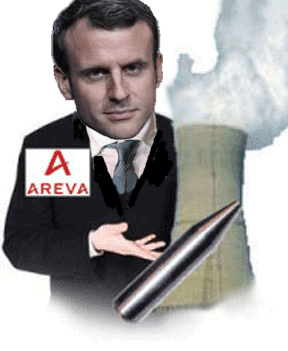
France’s President Emmanuel Macron to save France’s nuclear export industry?

Final negotiations for Areva reprocessing plant in China, Les Echos, Frédéric Schaeffer, Correspondant à Pékin, 26 Dec 17Areva’s president was in Beijing on Thursday. Paris hopes to sign an agreement during Emmanuel Macron’s visit to China in early January. The contract would be around ten billion euros for Areva……

“There have been  comprehensive  discussions with many Chinese officials  in France and French in Planned over 10 years.  This project could be agreed upon  during the visit of Emmanuel Macron early January in the Middle Kingdom. “We are accelerating the final negotiations in view of the President’s  visit” ….”the visit of Emmanuel Macron will mark a key stage” – French nuclear officials

…. The stakes are crucial for New Areva, the agency resulting from the restructuring of the French nuclear industry and now refocused on the fuel cycle. This could be the key – with  a contract of ten billion euros. …. CNNC originally chose the coastal city of Lianyungang to locate the plant. But that announcement had sparked violent protests last year, forcing a halt to preliminary work. Since then, CNNC and the government have examined several coastal sites but have been careful not to make their choice known.https://www.lesechos.fr/industrie-services/energie-environnement/0301060536871-ultimes-negociations-pour-lusine-de-retraitement-dareva-en-chine-2141002.php

December 27, 2017 Posted by | business and costs, China, France, politics | 2 Comments

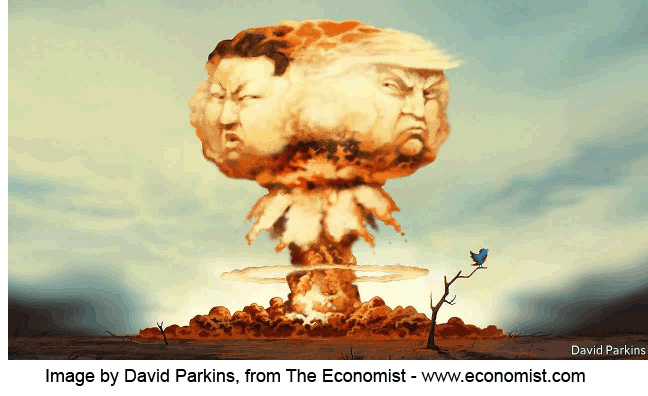
2017 – the year of the Trump – Kim nuclear standoff

‘Dotard’ vs. ‘Rocketman’: The Nuclear Standoff That Rattled 2017 http://www.huffingtonpost.com.au/entry/dotard-vs-rocketman-the-nuclear-standoff-that-rattled-2017_us_5a3e8bdce4b0b0e5a7a27be6 Days after Donald Trump was elected president of the United States, he received a stark warning from America’s outgoing leader.

 In their first and only meeting, Barack Obama told his successor that North Korea ― a volatile nation hellbent on nuclear proliferation ― would pose the biggest foreign challenge his administration would face.
Trump, who has dedicated much of his presidency to erasing Obama’s legacy, seemed to heed this advice, briefly. After rarely mentioning North Korea during his election campaign, he swiftly elevated the issue to his primary foreign policy concern (and later declared an end to Obama’s “era of strategic patience” with the rogue state).
But under Trump’s leadership, the past year has seen brewing tensions between Washington and Pyongyang soar to unprecedented levels with a specter of nuclear war. Economic sanctions in response to a series of North Korean missile launches escalated into a direct exchange of heated insults and threats between Trump and Kim Jong Un, the hermit kingdom’s hostile dictator.

Clashes between Donald Trump and Kim Jong Un dominated headlines this year. 

North Korea’s Nuclear Strides

The Pentagon’s efforts to stave off conflict with North Korea have been marred by a string of “decisive failures” this year, according to new analysis published this month from the Brookings Institution, a Washington-based think tank.

“The United States and [North Korea] have engaged in bellicose rhetorical brinksmanship, making war between the two states seem increasingly likely,” wrote Katy Collin, a post-doctoral fellow at the Brookings Foreign Policy program. “Public acceptance of the possibility of conflict within the United States has ballooned. Mechanisms to head off escalation caused by misunderstandings do not exist.”

North Korea made remarkable technological advances to its internationally condemned nuclear program throughout 2017. It conducted its sixth and most powerful nuclear teston Sept. 3, which the regime claimed was a hydrogen bomb loaded onto an intercontinental ballistic missile (ICBM). Subsequent analysis of seismic data revealed the test was approximately 17 times stronger than the blast that decimated the Japanese city of Hiroshima during World War II.

Pyongyang has also expanded the reach of its missiles this year: The entire continental U.S. is now believed to be within ICBM striking range. Experts have expressed concern at North Korea’s alarming progress, and worry that it is on track to outpace America’s abilities to defend itself and its allies in the region.

The regime’s most recent missile launch in late November exceeded 8,100 miles in range. As tested, such a rocket would be able to travel more than enough distance to reach Washington, D.C., or New York City, although it is unclear if it could transport a warhead that far.

“North Korea knows what they’re doing,” David Wright, a physicist and the co-director of the global security program at the Union of Concerned Scientists, told HuffPost at the time. “It’s hard to say if it’s six months or two years before they can deliver a nuclear warhead, but it’s heading in that direction.”

Donald Trump’s Fire And Fury

Yet Trump, undermining diplomatic efforts by his own Secretary of State Rex Tillerson, has repeatedly confronted North Korea’s provocations with aggravations of his own. He infamously vowed in August to meet the defiant country with “fire and fury,” prompting Pyongyang’s threat to launch a missile at the U.S. island territory of Guam.

Months later, Trump said the U.S. would “totally destroy” North Korea, which is home to an estimated 25 million people, if provoked. “Rocketman is on a suicide mission for himself and for his regime,” Trump said in his first speech before the United Nations General Assembly, referring to Kim.

In an extremely rare personal address, Kim responded by pledging to “tame the mentally deranged U.S. dotard with fire.” Soon after, North Korean Foreign Minister Ri Yong-ho said the regime might detonate an H-bomb in the Pacific Ocean.

As hostilities boiled over, experts urged the “America First” leader to “stick to the script” and avoid making incendiary comments about North Korea during his 12-day trip through Asia last month. But Trump couldn’t help himself:

The president’s taunts “create an incentive for the North Koreans to stage provocations to show him up,” Jeffrey Lewis, a nuclear weapons expert at the Middlebury Institute of International Studies, told HuffPost in November.

If the situation deteriorates into an acute crisis, such remarks from Trump could give North Korea the impression a military strike is imminent, Lewis added. “If that happens, my belief is the North Koreans would use their nuclear weapons first, in order to try to repel an invasion.”

A turbulent 2017 has stirred fears and uncertainty for the year ahead.

“Trump has been impatient with multilateral, diplomatic containment of nuclear proliferation,” Collin said. “While diplomacy, sanctions, and targeted engagement have been successful in preventing conflict on the Korean peninsula for decades, 2017 marks decisive failures in terms of North Korea’s nuclear capacities.”

December 27, 2017 Posted by | North Korea, politics international, USA | Leave a comment