Fukushima Decontamination Work Racket Yakuza Arrested
 Bags containing debris from decontamination work are piled up in a Bags containing debris from decontamination work are piled up in a tentative storing site in Naraha, Fukushima Prefecture. The location pictured is not where the workers in the article were operating.
Yakuza arrested in Fukushima decontamination work racket
Three men, including a yakuza gang boss affiliated with Yamaguchi-gumi, Japan’s largest crime syndicate, have been arrested on suspicion of illegally supplying workers for government-commissioned decontamination work related to the 2011 Fukushima nuclear power plant accident.
The three are yakuza group leader Hidenobu Maruta, 48, of Tokyo’s Katsushika Ward, construction company executive Shigeki Yamamura, 59, of Koriyama, Fukushima Prefecture, and Akio Kitano, 51, an unemployed resident of Saitama, Tokyo police announced Sept. 27.
All three deny the allegations of employment brokering without a license, a violation of the Employment Security Law, and intermediate exploitation, which is banned under the Labor Standards Law.
Maruta and Yamamura are accused of supplying two workers from January 2015 to March 2016 to a sub-subcontractor who carries out decontamination operations for the government project, and receiving 160,000 yen ($1,430) together in commission without consent from the labor ministry.
The cleanup work was conducted in Tomioka, Fukushima Prefecture.
Maruta and Kitano are suspected of taking commission amounting to about 920,000 yen from the wages of those two workers, according to the police department in charge of organized crime.
The three suspects are said to have shared cut of 2,000 yen to 3,000 yen from each of the workers’ 16,000-yen daily wage.
Further to the exploitation of the aforementioned two workers, the suspects are believed to have received about 10 million yen collectively through brokering about 10 other workers to the sub-subcontractor.
http://www.asahi.com/ajw/articles/AJ201709280045.html
3 nabbed over alleged illicit job mediation for Fukushima cleanup workers
Police on Sept. 27 arrested three people, including a high-ranking member of a gang affiliated with the Yamaguchi-gumi crime syndicate, on suspicion of illicitly introducing workers to other businesses to engage in Fukushima decontamination work.
The three suspects, including a gang member in his 40s, were arrested on suspicion of violating the Employment Security Act by mediating in paid work without permission. Police believe that the service charges the suspects received were being used to fund gang activities.
Investigators said that the three are suspected of having introduced decontamination workers to other businesses since 2014 and charging introduction fees, despite lacking permission from the Minister of Health, Labor and Welfare that is required by law.
A consulting company based in Tokyo’s Nerima Ward that was effectively run by the suspects’ gang dispatched workers to decontamination zones through other businesses. The workers reportedly engaged in decontamination work in Fukushima Prefecture.
In January 2013, Yamagata Prefectural Police arrested a high-ranking member of a gang affiliated with the Sumiyoshi-kai crime syndicate on suspicion of violating the worker dispatch law in connection with the dispatch of workers engaging in Fukushima-related decontamination work.
http://mainichi.jp/english/articles/20170927/p2a/00m/0na/015000c
EU to lift import curbs on rice from Fukushima, more deals likely
 A farmer plants rice seedlings in Minami-Soma, Fukushima Prefecture, in May
The European Commission is set to relax import restrictions on rice from Fukushima Prefecture that were imposed after the 2011 nuclear disaster, sources said.
The import curbs could be eased as early as this year and prompt other countries, including major markets like China, to follow suit, the sources added.
In addition to rice from Fukushima Prefecture, the EU is expected to remove restrictions on some seafood products from Iwate, Miyagi and other prefectures.
All restrictions on products from Akita Prefecture will likely also be lifted, thereby abolishing all curbs on rice grown in Japan.
The United States on Sept. 22 decided to allow imports of milk and dairy products from Fukushima, Iwate, Miyagi, Tochigi and Gunma prefectures without inspection certificates stating they are free of radioactive materials.
The EU move follows a general agreement on an economic partnership in July, during which EU officials informed Japan of plans to relax import restrictions on agricultural products. The two sides have been discussing the issue since then.
Thin Lichen Exhibits Remarkable Radioactivity Bioaccumulation in Iwate

Via Marco Kaltofen
From our sampling with Fairwinds in Iitate, Japan; thin layer of lichen exhibits remarkable bioaccumulation of environmental radioactivity.
Pictures show the tragedy of Russian villages contaminated by 1957 nuclear explosion
‘Left To Die As Guinea Pigs’: Tatar Village Struggles On, 60 Years After Nuclear Catastrophe https://www.rferl.org/a/russia-nuclear-mayak/28755780.html, September 28, 2017 An explosion at a Soviet nuclear plant 1,400 kilometers east of Moscow remains the world’s third-largest nuclear disaster, after Chernobyl and Fukushima. At the time, in 1957, it was the worst ever. Sixty years on, nearby Tatar villagers are still struggling for official recognition of their plight. (RFE/RL’s Tatar-Bashkir Service) TEXTS BELOW DESCRIBE EACH OF THE EXCELLENT PICTURES ON THE ORIGINAL
The sign says “Danger Zone.” An explosion on September 29, 1957, contaminated an area of 23,000 square kilometers and exposed more than 270,000 people to significant levels of radiation.
The village of Karabolka is 30 kilometers from the Mayak nuclear plant, where the explosion occurred. For decades afterwards, it did not appear on maps, only reappearing 20 years ago. But life there continued.
 Gulshara Ismagilova has lived in Karabolka all her life. She is campaigning for official recognition for the suffering of the villagers. Rates of cancer and genetic abnormalities here are significantly higher than the national average. “We are all handicapped here,” she says.
These are Ismagilova’s relatives who have died over the last 60 years. It includes an aunt, her mother, and her brother, who all died of cancer. Ismagilova herself has liver cancer.
In 1957, the village had about 4,000 residents; in 2010, just 423. The village had two distinct parts: a mostly Tatar part, which was not evacuated, and a mostly Russian part, which was. Some locals say they were used in an experiment on the effects of radiation.
The village has eight cemeteries. Seven of them are a resting place for residents who died of cancer. Children here are often born with cancer and die before reaching adulthood.
Only Muslims are buried here. Following their beliefs, some relatives prevent autopsies being performed. This can prevent some deaths being classified as cancer-related.
A pile of coffins at the ready. Families usually bury their dead by noon of the day following their death. “People don’t know what to eat and how to survive,” Ismagilova says. “They have been left here to die as guinea pigs.”
This house has a pile of firewood outside. In the 1990s, local people were warned that wood stored radiation and should not be used for burning. But the village was not connected to a gas supply until 2016.
A water pump outside a house. “The authorities prohibited drinking water from local wells but couldn’t arrange supplies of clean water. A couple of months later, they took samples and said the local water was good enough to drink,” says Ismagilova.
A Greenpeace report 10 years ago said the Mayak site was “one of the most radioactive places on Earth.” It added that thousands of people in surrounding towns and villages still lived on contaminated land
Britain’s hydrogen nuclear bomb tests in Pacific Kiribati not acknowledged – no compensation for affected islanders
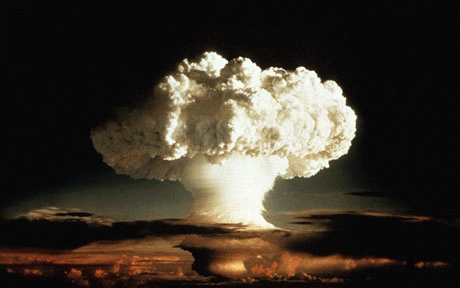 Author challenges British denial over Pacific nuclear legacy http://www.radionz.co.nz/international/pacific-news/340397/author-challenges-british-denial-over-pacific-nuclear-legacy The author of a new book on Pacific nuclear weapons testing says he hopes it will shed more light on Britain’s tests in the region. US and French nuclear tests at Bikini atoll in the Marshall Islands and Murorua and Fangataufa atolls in Tahiti feature regularly in discussions about the environmental and social legacy of Pacific nuclear testing.
But the author Nic McLellan says the fallout of Britain’s hydrogen bomb tests at Kiritimati island in Kiribati isn’t as well documented.
Mr McLellan says unlike the US and France, Britain refuses to accept any responsibility for the negative impacts of its tests on the health of local men, women and children as well as its own soldiers and those from Fiji and New Zealand who observed the tests.
“The British of course tested in my own country Australia with atomic weapons and yet the hydrogen bomb tests in Kiribati are not very well known. And so the book is compiling a lot of information gathered and presents portraits of people who are opposed to the tests. It is really important to recognise that in the 1950s there was widespread opposition to these tests going ahead.”
SanOnofre’s unique and dangerous state – of Stranded Nuclear Wastes
 Can $46 billion buy a permanent home for nuclear waste stored at San Onofre, other sites? http://www.ocregister.com/2017/09/27/can-46-billion-buy-a-home-for-nations-nuclear-waste-not-yet/ By TERI SFORZA | tsforza@scng.com | Orange County Register, 27 Sept 17, Congress members shifted on the dais during a meeting this week in Washington, D.C. on the long-term possibility of creating a national spot to store nuclear waste.
“To put it bluntly,” said Anthony O’Donnell, chair of the National Association of Regulatory Utility Commissioners, “the state and local governments have the federal government’s waste, and the federal government has our money.”
O’Donnell joined David Victor, chair of San Onofre’s Community Engagement Panel, and other experts in chiding a U.S. House Oversight and Government Reform subcommittee for the federal government’s failure to find a permanent home for nuclear waste, despite collecting $46 billion from electricity customers to do just that.
San Onofre’s unique and dangerous status – as a shuttered reactor with 3.6 million pounds of “stranded” waste, stored between the ocean and a highway, in a densely populated area, atop earthquake faults – was repeatedly raised as an impetus for action.
“People see the site being dismantled, but the waste remaining,” Victor said. “They think, ‘We paid the government to remove it, and it’s not being removed.’ That’s a palpable anger.”
Victor urged Congress to move swiftly toward licensing temporary storage sites and developing transportation plans and infrastructure for moving the waste, even as it gears up to revive Nevada’s Yucca Mountain as a permanent site.
“It’s really important not to put all our eggs in one basket,” Victor said, conjuring Nevada’s staunch opposition to becoming America’s nuclear waste dump. The state has no nuclear power plants.
Americans have spent billions with nothing to show for it, O’Donnell and others said.
Electricity ratepayers have poured that $46 billion into the Nuclear Waste Fund, and gotten nothing.
Taxpayers have paid out another $6 billion to utilities that have sued the federal government — and won — over the fed’s failure to haul away the waste as promised.
The Department of Energy says the legal bills for breach-of-contract could total $25 billion, but the nuclear industry estimates it could cost as much as $50 billion.
“The cost of inaction is high,” warned Chuck Smith, Aiken County councilmember and chair of the Energy Communities Alliance from South Carolina
Rep. Darrell Issa, R-Vista, stressed the need for swift action, as did Rep. William Lacy Clay, D-St. Louis. San Onofre is not alone in its peril, Clay said: In his district, radioactive waste is buried close to an active underground fire.
“This is a moral imperative,” Clay said. “The U.S. government created a nuclear waste problem 75 years ago. It has a clear and unavoidable responsibility to finally clean it up.”
After the hearing, Victor said that the stars were aligning to advance a nuclear waste disposal bill in the House over the coming weeks. Next, he said, will come the Senate.
Read Victor’s testimony, and that of the other witnesses, here.
Wind power is now cheaper than nuclear
– the energy revolution is happening, Guardian, John Sauven, 27 Sept 17 Far-sighted government policy means the cost of offshore wind energy has halved. The benefits in terms of climate change and UK jobs will be enormous “…….. the price of offshore wind energy has dropped by half in less than two years. By the 2020s, it will be as cheap or cheaper than any other form of power generation. It’s just become much cheaper than nuclear, even taking into account the additional costs associated with the wind’s intermittency. And in any case, this is less of an issue at sea where the winds are more constant……on the cusp of a quiet revolution. From being the most expensive form of renewable energy, offshore wind was fast becoming the cheapest form of large-scale, low-carbon generation bar none. ……..
This month’s contracts for the next round of offshore wind farms to be built in the North Sea should have the champagne corks popping in No 10. They mean billions more in foreign investment coming into the UK. They will be playing a major role in regenerating regions in the north-east of the country. And they will create a thriving export market in contracts for offshore wind developments. But we at Greenpeace are not sure the government has noticed the full potential that their policies have created.
To bring it to their attention, some of the world’s biggest players, including Vattenfall and General Electric, have come together alongside environmental organisations including WWF and the Marine Conservation Society. A campaign is being launched today at Westminster with the help of creative agency Mother, which is working pro bono. They explained to us that when you’re selling the future of energy generation at 50% off, all you really need to do is get this fact in front of your customers. MPs using Westminster tube station will find it hard to miss.
The UK needs affordable and secure energy. We have to replace our obsolete power stations and meet growing demand from the electric vehicle revolution. Offshore wind, alongside a smart energy system including storage and interconnectors, should be the backbone of how the UK generates its power in future. Short term, as part of the transition, gas back up might be required (but only when needed, unless it’s green like biogas). Such a system could help us meet our climate change commitments and speed up the move to a low-carbon economy. It could provide jobs and regional regeneration as well as provide export markets. It could be the cheapest form of large-scale power available. It’s shown to be wildly popular in all opinion surveys. We urge the government to come clean on this issue and publicly admit that they got this right! https://www.theguardian.com/commentisfree/2017/sep/26/offshore-wind-power-energy-price-climate-change
Pope francis tweets for a nuclear weapons -free world
Vatican at UN calls for nuclear-free world, Independent Catholic News,
In his Twitter message today, Pope Francis said: ‘Let us commit ourselves to a world without nuclear weapons by implementing the Non-Proliferation Treaty to abolish these weapons of death.’ Meanwhile in New York, Archbishop Paul Gallagher, Vatican Secretary for Relations with States addressed the United Nations General Assembly, urging governments to do more to prevent wars, protect human dignity and work for a nuclear-free world. ……..
Speaking of the Vatican’s concern for conflicts across Africa and the Middle East, as well as the violence in Venezuela, the foreign minister said civilians must be protected during warfare and the rights of migrants and refugees fleeing conflict must be respected…….
The full speech by Archbishop Paul Gallagher, Secretary for Relations with States, to the 72nd Session of the United Nations General Assembly follows:
‘Focusing on People: Striving for Peace and a Decent Life on a Sustainable Planet’….. http://www.indcatholicnews.com/news/33481
September 28 Energy News

Opinion:
¶ “The most effective clean energy policy gets the least love” • Though they aren’t as sexy as perpetually-discussed-but-rarely-passed carbon taxes, and they are flawed and insufficient in a number of ways, renewable portfolio standards have been the quiet workhorses of renewable energy deployment in the United States. [Vox]
 Renewable energy (Shutterstock image)
¶ “US Courts Taking Climate Change Seriously” • Hallelujah! The judicial branch of the federal government is finally getting serious about climate science. No longer can the executive branch and the legislative branches cave in to pressure to avoid the inconvenient truth that climate change adaptations will be hugely expensive. [Hartford Courant]
World:
¶ Major European carrier EasyJet announced that it is teaming up with US startup Wright Electric to build an all-electric airliner. The aircraft they have in mind would handle short routes of 335 miles or less – think New York…
View original post 743 more words
Climate Change Related Extreme Weather Rocks World, Weird Major Hurricane Forms East of Bermuda, Cyclone Energy Closing in on Records

Around the world, the litany of climate change related extreme weather events reached an extraordinary tempo over the past week. And it is becoming difficult for even climate change deniers to ignore what is increasingly obvious. The weather on planet Earth is getting worse. And human-caused global warming is, in vast majority, to blame…
Climate Change Related Extreme Weather Spans Globe
(Climate and Extreme Weather Events for September 17 through 24.)
Puerto Rico is still knocked out a week after Maria roared through. With Trump basically ignoring this worst in class blow by a hurricane ramped up by human-caused climate change, it will be a wonder if this territory of 3.4 million U.S. citizens ever fully recovers.
In other and far-flung parts, Brazil is experiencing an abnormally extreme dry season. Australia just experienced its hottest winter on record. In Teruel, Spain, thunderstorms forming in a much…
View original post 623 more words
September 27 Energy News
Science and Technology:
¶ In the first evaluation of evaporation as a renewable energy source, researchers at Columbia University find that US lakes and reservoirs could generate 325 GW of power, nearly 70% of what the US currently produces. The researchers’ calculations are outlined in the September issue of the journal Nature Communications. [Eurasia Review]
 Reservoir in Arizona (Photo: Central Arizona Project)
World:
¶ Research from Lappeenranta University of Technology, in Finland, concluded that developing countries with abundant renewable energy resources are in a position to bypass reliance on fossil fuels to increase living standards. India can transition to a fully 100% renewable energy system by 2050 while improving quality of life. [CleanTechnica]
¶ Record hurricanes and rains have struck throughout the world, bringing chaos to many places. There are many indications that more storms and persistent rainfall events are coming with climate change. But more accurate…
View original post 765 more words
Can’t we have an honest conversation about Vietnam?

The Ken Burns/Lynn Novick television series on the Vietnam War provides yet another example of the narrowness of “acceptable” political discourse in the United States. More than four decades past the end of that imperialist adventure, having a serious discussion about it remains taboo.
The series also provides a fresh example of how the narrowness of acceptable discourse is disguised through the appearance of a vigorous debate. I will confess here I have not watched Burns and Novick’s The Vietnam War, but the consistency of the many discussions of it I have read confirm what would have been expected: The liberal side of the “debate” on the Vietnam War, that an “honorable” effort was tragically miscarried because of “mistakes.”
The series has a long list of corporate sponsors, typical for a Public Broadcasting System production. One of the Koch Brothers, David H. Koch, provided funding, as did the…
View original post 1,706 more words
Centrale nuclear plant is built in a seismic risk zone and below the water level of the Mondragon Canal – France

Photo de Pierre Gleizes Nicéphore
Shutdown of the nuclear power plant! – Greenpeace reaction 28 September 2017
“this decision by l’ to edf shows once again that the operator is irresponsible by ignoring the risks that are clearly identified”, explains Yannick Rousselet, a nuclear campaign officer for Greenpeace France.
The Centrale plant is built in a seismic risk zone and below the water level of the-Mondragon Canal.
” in the event of breakage of the dam, the water of the canal would flood the plant, which could cause a major nuclear accident as confirmed by the ASN in its decision, continues Yannick Rousselet. It must be remembered that the Centrale and bogey plants are in the same situation. The same decision must therefore be imposed on EDF, in order to protect people and the environment. ‘
Greenpeace has been denouncing the dangers of the Centrale plant for more than five years, and it has also taken action in front of the plant to denounce this problem in November 2012.
More info here on the problem; http://www.dailymail.co.uk/wires/reuters/article-4929654/EDF-close-temporarily-Tricastin-nuclear-plant-flooding-risk.html?ITO=1490&ns_mchannel=rss&ns_campaign=1490
“#Sellafield still sells stuff to the soviets” – Nuclear Hotseat 327

Activist fightback against North UK (Lake District) Nuke Waste Storage at Sellafield with: Marianne Birkby.

Also Staislav Petrov RIP, “The Man Who Saved the World” from Nuclear Holocaust, Dies – Nuclear Hotseat 327 http://ow.ly/FHDI30fto62 #NKorea #DonaldTrump
1 This Month
Chernobyl: The Lost Tapes – A good documentary on Chernobyl on SBS available On Demand for the next 3 weeks– https://www.sbs.com.au/ondemand/tv-program/chernobyl-the-lost-tapes/2352741955560

of the week–London Campaign for Nuclear Disarmament

Tell the Ukrainian Government to Drop Prosecution of Peace Activist Yurii Sheliazhenko
To see nuclear-related stories in greater depth and intensity – go to https://nuclearinformation.wordpress.com
-
Archives
- April 2026 (126)
- March 2026 (251)
- February 2026 (268)
- January 2026 (308)
- December 2025 (358)
- November 2025 (359)
- October 2025 (376)
- September 2025 (257)
- August 2025 (319)
- July 2025 (230)
- June 2025 (348)
- May 2025 (261)
-
Categories
- 1
- 1 NUCLEAR ISSUES
- business and costs
- climate change
- culture and arts
- ENERGY
- environment
- health
- history
- indigenous issues
- Legal
- marketing of nuclear
- media
- opposition to nuclear
- PERSONAL STORIES
- politics
- politics international
- Religion and ethics
- safety
- secrets,lies and civil liberties
- spinbuster
- technology
- Uranium
- wastes
- weapons and war
- Women
- 2 WORLD
- ACTION
- AFRICA
- Atrocities
- AUSTRALIA
- Christina's notes
- Christina's themes
- culture and arts
- Events
- Fuk 2022
- Fuk 2023
- Fukushima 2017
- Fukushima 2018
- fukushima 2019
- Fukushima 2020
- Fukushima 2021
- general
- global warming
- Humour (God we need it)
- Nuclear
- RARE EARTHS
- Reference
- resources – print
- Resources -audiovicual
- Weekly Newsletter
- World
- World Nuclear
- YouTube
-
RSS
Entries RSS
Comments RSS
 nuclear-news