Taro Yamamoto of the Liberal Party, member of the House of Councilors, accused the double standard of the the public radioprotection policy during his questions at the Special Commission of Reconstruction of the House of Deputies on March 21, 2017. He compared the health examination scheme introduced by Ibaraki prefecture to its population after the JCO* criticality accident to that currently available to Fukushima residents. The result shows the utter deficiency of the latter in spite of the fact that the Fukushima accident is classified as level 7, much more severe than the JCO level 4 accident.
We are publishing here the transcription of Taro Yamamoto’s questions** as well as the soil contamination map of Kashima and Haramachi districts of Minamisoma where the evacuation order was lifted in July 2016. The map is provided by the civil measurement group called “Fukuichi*** Area Environmental Radiation Monitoring Project”**** composed mainly of residents of Minamisoma which has been taking measurements of soil contamination in the vicinity of the members’ neighborhoods and in residential areas since 2012. Taro Yamamoto has already used their maps during another session of the Special Commission of Reconstruction. Let us note that in the map uploaded here, there are only two rectangles where the contamination density is lower than 40,000Bq/m2, and that for the rest of Kashima and Haramachi districts, the density is amazingly higher. As Taro Yamamoto indicated during his questions on November 18 last year, according to the Ordinance on Prevention of Ionizing Radiation Hazards a zone is called a Radiation Control Zone when the surface density is over 40,000Bq/m2. In a Radiation Control Zone, following the Ordinance, it is prohibited to drink, eat or stay overnight. Even adults are not allowed to stay more than 10 hours. To leave the zone, one has to go through a strict screening. The map shows that most of the two districts of Minamisoma city are in this situation. But it is not classified as Radiation Control Zone. On the contrary, people are told to go back there to live, including children.

Measurement devices : scintillation radiometers
Hitachi Aloka TCS172B
Dose rate of airborn radiation at 1 m, 50 cm, 1 cm from the ground. Unit : µSv/h
Hitachi Aloka TGS146B
Calculation of the rate of surface contamination, 1 cm from the ground. Unit : cpm
Procedure for measuring soil samples
Ram a tube in the ground (diam. : 80 mm, h : 50 mm), collect the soil and measure.
For TCS172B/TGS146B, wait for stabilisation, measure 5 times,then take the average value.
Insert ★ where the soil was collected.
Analysis device:
Canberra NaI Scintillation Detector (10 or 20 min)
According to the Ordinance on Prevention of Ionizing Radiation Hazards and Industrial Safety and Health Law, places where the effective dose reaches 1.3mSv in 3 months (approximately 0.6µSv/h of airborne radioactivity) or 40,000Bq/m2, in terms contamination density, are designated as a ‘’Radiation Control Zone’’ and public entry must be severely restricted.
_____
Transcription of the questions of Taro Yamamoto
○Taro Yamamoto
In Japanese history, except for the TEPCO Fukushima accident, are there other cases of population evacuation due to a nuclear accident?
Government expert (Hiromu KATAYAMA)
Here is the answer. According to our understanding, as for the case of population evacuation due to a nuclear disaster in Japan, except for the cases of TEPCO Fukushima Daiichi and Daini that you pointed out, there is the case of the criticality accident of the JCO Tokai plant.
○Taro YAMAMOTO
Thank you.
That was 18 years ago, on September 30, 1999. The criticality accident occurred in a uranium reprocessing facility for the experimental fast breeder reactor fuel, operated by JCO, in the village of Tokai, Ibaraki Prefecture. The nuclear fission chain reaction continued for about 20 hours. The radiation went through the walls, reaching the surrounding environment. 150 people within a 350-meter radius were evacuated and the confinement recommendation was given to inhabitants and shops within a 10km radius. On the spot, since the central government delayed to react, the village mayor at the time decided to evacuate the residents upon his responsibility. This is the first case of population evacuation due to a nuclear accident in Japan. It was a severe accident where two workers died, and the rescue members as well as residents in the neighborhood area were irradiated.
Here is my question. How many people were recognized as being irradiated in this accident.
Government expert (Hiromu KATAYAMA)
Here is the answer. According to the report dated March 2000 by the Health Management Committee established by the Nuclear Safety Commission at the time, as for the civil population, there are 7 people for who we have a real value of irradiation, and 200 people for who the dose of radiation is estimated. Among these people, 119 people received more than 1mSv either measured or estimated.
○Taro YAMAMOTO
According the central government, it is 119 people. But Ibaraki prefecture, following the radio security administration of Ibaraki prefecture, reported 666 irradiated people including those who received less than 1mSv. This is more than 5 times of the figure reported by the central government. I suppose that the central government does not want to recognize as many. However, Ibaraki prefecture, recognizing that the local government caused the damaged to its population, reported this figure.
Thereafter, Ibaraki prefecture created a fund of ¥300,000,000 to allow the irradiated population or those who were in doubt to be irradiated access to a heath examination. It concerns around 500 people. Its characteristic consists of the fact that it covers those who are born in 1999, the year of the accident, until they reach 82 years old. In other words, it is conceived to assure free health exminations through their entire life.
Please look at page 2 of document A to see what kind of health examinations the neighboring population can take since the JCO accident. They are quite extensive. It has been the accepted Ibaraki prefectural policy after the JCO accident. Even cancer examinations have been added. These examinations are accessible to those who are not recognized as irradiated, and who were exposed to the additional radiation of under 1mSv. They are open to those who stayed there temporarily because of their work or school, or those who have evacuated from Ibaraki prefecture since the accident.
Please show the next Figure.
Please don’t talk about the circumstances. Please answer in terms of the accident level. In which level is the JCO accident classified? Likewise, in which level is TEPCO Fukushima nuclear plant accident classified?
○Government expert (Hiromu KATAYAMA)
Here is the answer. As for the JCO criticality accident, the Science and Technology Agency at the time evaluated the accident as level 4. Concerning the accident of the Fukushima Daiichi nuclear power plant, the Nuclear and Industrial Safety Agency as well as the Nuclear Safety Commission at the time evaluated the emission of radioactive substances and consequently rated the accident as level 7.
○Taro YAMAMOTO
Let’s go over this again. JCO is classed as level 4, it was a level 4 accident. The TEPCO Fukushima nuclear power plant accident is a level 7 accident. With the JCO accident of level 4, with the additional radiation of 1mSv, the authority promised a lifetime access to health examinations including cancer examinations. Yet, in the case of the TEPCO Fukushima nuclear power plant accident of level 7, the population is told to return to the region when the annual dose of radioactivity becomes lower than 20mSv/year, since it is then considered as safe. The housing aid is cut, since there is no necessity of evacuation.
To those who would say that they are not comparable, I would like to ask the following. Currently, in Japan, after a nuclear accident, with 1mSv of additional irradiation, are health examinations offered free during a lifetime? With an accident of level 4, you can have lifetime free examinations including cancer examinations. Yet, with level 7 accident, there aren’t. Look here! Which of these two accidents is more severe?
What is the reason, in the case of the TEPCO Fukushima Daiichi accident, not to offer free lifetime health examinations including cancer examinations with additional radiation of 1mSv? Is it because of financial reasons? Is it because it can be installed for a small number of the concerned population of Tokai village, but not in the case of TEPCO nuclear power plant accident, because there will be too many people to be examined and thus will cause financial problems, or even financial breakdown? Is it because it is not practically feasible? Is that why? Then, it is not a scientifically based judgment. This is a financially, efficiency based judgment.
After the dispersion of contamination due to the nuclear accident, Japan has adopted a new standard. It considers it normal to live an everyday life in the area if the dose of radioactivity is under 20mSv/year. The government says that it will make efforts to lower the level to 1mSv/year. Then I asked: how long does it take to lower the level of airborne radioactivity of the contaminated area to 1mSv/year? They are not even embarrassed to answer that they are not supposed to carry out such a calculation.
I asked if this was considered permissible before the accident, if it was allowed by the scientific standards before the accident. The bureaucrats’ answer was: “ this is a new challenge “. I think it is not a very elaborated approach for revitalization. It seems like the authorities have started cleaning up the damage to turn the page, to deny the accident. I suppose that there are people who say “that is not correct”. Some people might consider that the public support after the TEPCO accident is as solid as the support of the Tokai village aftermath, to make the people feel safe and secure.
Let us then see now what kind of medical support is available in Fukushima.
In the case of the Fukushima resident health investigations, only the thyroid cancer examination for those under 18 years old at the time of the accident, and a questionnaire survey for pregnant women are available to the population of Fukushima prefecture. Other than these two, health examinations are available only to those from evacuation zones. This includes a usual obesity examination offered to those over 40 years old all over Japan, plus blood tests including leukocyte fraction analysis.
Isn’t this health examination scheme too poor compared to the one of Tokai village? Besides, it is limited to those who are from the areas that have been classified as evacuation zones. In other words, if you are living in Fukushima prefecture, you can hardly have sufficient medical support, except for in limited areas. In the case of the JCO level 4 accident, one has a guarantee of a lifetime health examination at 1mSv of additional irradiation, and you still can have access to health examinations even if you are exposed to radiation under 1mSv. Yet in the case of the level 7 TEPCO Fukushima Daiichi accident, the support is so much inferior. Mr Minister, it seems to me that the difference of treatment is too much.
There are other things I would like to ask. So please give me a short answer. I think that the gap is too much. In terms of the accident level, Fukushima is more severe. But Tokai village offers a significantly more extensive support. On the other hand, the Fukushima support seems to be too feeble.
Sorry, I am running out of the time. I am going to skip that question, and go forward to other questions.
I would like to ask the following to the Minister. Who is responsible for this situation? The minimum compensation that the State and TEPCO, – who left the cause of the severe accident unattended -, should offer to the population should at least equal to the one offered in the Tokai village case. The central government should suggest it to Fukushima prefecture.
Besides, in the countries where there have been severe nuclear disasters, sanitary vacations are common practice. Their purpose is to reduce the internal irradiation. At least, we should invest in sanitary vacation programs open to the population of Fukushima prefecture.
Lastly, the end of the housing support for the auto-evacuees from the areas outside of the evacuation zones, which is in two weeks time, is the same as the order of forced return. It shouldn’t be just ‘’return’’ and ‘’should return’’. People ought to have the right to choose. The options are: remain or evacuate. In both cases, the State should give compensation and support.
Please give me your answer on the three points.
○Minister (Masahiro Imamura)
You mentioned the levels. I suppose that I don’t have to answer. I think it covers different viewpoints including the accident scale.
Concerning the health problem, Fukushima prefecture is carrying out the Fukushima resident health investigation using the allocation. We have the intention to guide the prefecture to use this efficiently so that we can avoid the health hazards.
About the housing aid, as I have already answered, in spite of specific circumstances, the big majority of people have already returned to Fukushima. As for those who have not returned yet, I suppose that they have their specific situations. We will back up the prefecture to listen to them and carry out the program.
- Chairman (Mitsuru Sakurai)
Your time is up.
○Taro YAMAMOTO
Yes, I conclude.
There are more than 25,000 empty apartments for public servants in Japan. I strongly suggest that they are offered to those who would like to continue the evacuation. Please maintain the housing aid. Mr Minister, I sincerely hope you do. I count on you. Thank you very much.
____
* formerly Japan Nuclear Fuel Conversion Co.
** Published in Taro Yamamoto’s official site :
参議院議員山本太郎オフィシャルサイト :
Footage of the question :
質問ビデオ :
***Fukuichi is short for Fukushima Daiichi
**** Fukuichi shûhen kankyôhôshasen monitoring project
https://fukushima311voices.wordpress.com/2017/04/24/the-scandalous-deficiency-of-the-health-scheme-in-fukushima/
April 25, 2017
Posted by dunrenard |
Fukushima 2017 | Fukushima, Health Scheme |
Leave a comment

Bags of radioactive soil in a temporary storage site in Iitate, Fukushima Prefecture, will eventually be transported to an interim storage facility.
MINAMI-SOMA, Fukushima Prefecture–The Environment Ministry is exploring the idea of reusing tons of radioactive soil as gravel to rebuild infrastructure in this disaster-stricken prefecture and beyond.
To gauge the feasibility of the project, it will conduct tests on whether contaminated soil can be securely contained without spillage while controlling the level of radioactivity.
The experiment is being conducted in a corner of a temporary storage site in the Odaka district here, just north of the crippled Fukushima No. 1 Nuclear Power plant.
If the tests go off without a hitch, the government is looking at reusing the soil as a construction material in recovery efforts.
Bags of soil gathered through decontamination efforts are kept at temporary storage sites around the Fukushima plant, which went into triple meltdown in the aftermath of the 2011 earthquake and tsunami disaster.
The first phase of the experiment involves 1,000 or so bags of contaminated soil that have to be sorted according to levels of concentration of radioactive cesium.
Radioactive soil with readings of about 2,000 becquerels per kilogram will be used for mock-up construction of seawalls and other structures. The soil will then be covered by fresh soil that is not contaminated.
The test will also explore practical safety management issues, including ways to prevent scattering of contaminated soil and keeping track of measurements of radioactivity of structures once they are completed.
Project workers began opening bags and sorting soil on April 24.
The volume of contaminated soil collected within Fukushima Prefecture amounted to a whopping 16 million cubic meters as of the end of January.
It will be kept at an interim storage facility that has been constructed within the jurisdiction of the towns of Futaba and Okuma in Fukushima Prefecture. Within the next 30 years, the soil is supposed to be transported outside the prefecture for final disposal.
The Environment Ministry said it hopes the tests will show that the plan to reuse radioactive soil in construction is safe. Projects under consideration include building foundations for seawalls and roads. The overall aim is to reduce the amount of soil that will need to be processed for final disposal.
http://www.asahi.com/ajw/articles/AJ201704250038.html
April 25, 2017
Posted by dunrenard |
Fukushima 2017 | Construction, Fukushima, radioactive Soil, Recycle |
3 Comments

Those who fled Fukushima Prefecture and those who stayed after the nuclear disaster get together at a community center in the Sasaya district of the prefectural capital of Fukushima last month.
FUKUSHIMA–Facing diminishing public support and increased scorn from their hometown communities, residents who fled Fukushima Prefecture after the nuclear disaster are now struggling with self-doubts about their decision to leave.
They are called “voluntary” evacuees because they left areas that were not subject to the central government’s evacuations orders after the tsunami slammed into the Fukushima No. 1 nuclear power plant in March 2011.
Since then, they have faced hardships in starting new lives and finding new homes. And persistent fears over radiation continue to prevent many from returning to their hometowns in the prefecture.
When the nuclear crisis was unfolding, Nahoko Hikichi, 44, took her infant and 4-year-old child to Asahikawa, Hokkaido, leaving behind her husband in an area of Koriyama, which was not ordered to evacuate.
Hikichi pored over library books to learn more about the situation in Fukushima, but some of the books dismissed safety concerns about radiation while others warned about health hazards.
“I only became more confused and worried after reading,” she said.
Hikichi said she is torn over whether she made the right choice to leave, but she added she will take no solace if her decision proves correct.
“I chose to flee because I did not want any future regrets over not evacuating,” she said. “If I become convinced that my decision was sound, it would come at a time when the impact of radiation has manifested among children who stayed in the prefecture.
“I am hoping for nothing like that to ever happen.”
Her husband later quit his job to join the family in Asahikawa, but his parents remain in Fukushima Prefecture.
The past month has been particularly tough on those who evacuated voluntarily since the prefectural government ended their free housing program.
At the end of March, 119 of about 12,000 households that evacuated voluntarily within or outside Fukushima Prefecture had not decided where to live, the prefectural government said on April 24.
Although prefectural officials would not disclose further details about their situation, some of the households reportedly cited financial difficulties as a reason for being unable to find new homes.
Fukushima Governor Masao Uchibori pledged to work closely with local governments where the evacuees’ old and new homes are located to help them.
People forced to flee under the evacuation orders are eligible to receive at least 8.5 million yen ($77,300) in compensation.
But those who evacuated voluntarily have received a fraction of that figure, and their free housing program has ended.
In terms of rebuilding from the nuclear disaster, Tokyo is now emphasizing self-reliance among evacuees without public support or compensation.
Voluntary evacuees and their supporters have criticized this policy, but the prefectural government shares the central government’s direction.
Tokyo’s evacuation orders forced around 81,000 people to leave their homes around the nuclear plant.
Since then, the central government has been lifting the evacuation orders in an effort to have people return to their homes. In fact, the orders had been lifted for all areas by spring this year with the exception of “difficult-to-return zones,” where radiation levels remain high.
That means more than 50,000 evacuees can return to their homes.
As of last autumn, voluntary evacuees who have not returned to their original homes totaled 26,000, or 30 percent of the overall evacuee population.
Some residents who remained in the prefecture after the nuclear accident are upset by evacuees who say that Fukushima is still too dangerous to live in.
“We reside in Fukushima Prefecture, and I would like them not to speak ill of the prefecture,” said a woman in her 40s who lives in the prefectural capital of Fukushima.
Efforts are under way to bridge the divide among those who remain volunteer evacuees, those who have returned to the prefecture, and residents who stayed in their communities.
A nonprofit organization opened a community center in a two-story house in Fukushima city in March 2015 to allow mothers with young children to share their daily concerns.
Some mothers wanted to know where to buy food ingredients. Others wondered if they have been overreacting to the radiation.
“Many mothers who have returned to the prefecture after fleeing outside are worried about whether they will be able to restore ties with their peers who did not evacuate,” said Megumi Tomita, 47, who heads the project.
Although the NPO does not offer specific problem-solving proposals, Tomita said it is important for anxious mothers to have a venue where they can pour out their feelings.
After the community center opened, the mothers, accompanied by experts, took part in a workshop to measure radioactivity levels of foodstuffs.
They also grow vegetables in nearby fields.
The NPO compiled a booklet in spring featuring messages from 31 mothers who have returned to the prefecture after deciding to flee. Their words are directed at those who remain in evacuation.
“I don’t think your choice is wrong,” said one mother.
“I will give you my moral support,” another message said.
Tomita said their messages summarize a shared feeling: “Those who have evacuated voluntarily have had to make countless decisions over the past six years. The mothers who have had such experiences feel that whatever the decisions the other mothers made, they are not wrong.”
http://www.asahi.com/ajw/articles/AJ201704250040.html
April 25, 2017
Posted by dunrenard |
Fukushima 2017 | Fukushima, Volontary Evacuees |
Leave a comment

Mothers who fled to the Itoshima, Fukuoka Prefecture, to escape radiation spewed by the March 2011 core meltdowns in Fukushima Prefecture say they are concerned about the safety of the Genkai nuclear plant in neighboring Saga Prefecture.
SAGA – A group of mothers who evacuated from the Kanto region to Fukuoka Prefecture after the 2011 Fukushima nuclear crisis is ramping up protests against efforts to restart the Genkai nuclear plant in neighboring Saga.
After meeting with Minister of Economy, Trade and Industry Hiroshige Seko on Saturday, Saga Gov. Yoshinori Yamaguchi is expected to approve the restart of two reactors in the town of Genkai as early as Monday.
Earlier this month, four of the moms gathered for a meeting in Itoshima in Fukuoka and discussed plans to send the city a document and an inquiry conveying their opposition.
As they racked their brains to deliver effective expressions, the meeting lasted for around six hours until their children returned home from school.
Three of the moms moved to Itoshima after becoming worried their children would be adversely affected by exposure to the fallout spewed by the triple core meltdown at the Fukushima No. 1 plant in Fukushima Prefecture in March 2011. The plant is run by Tokyo Electric Power Company Holdings Inc.
“I wanted to go far away for the sake of my unborn child,” said 39-year-old Fumiyo Endo, the leader of the group.
But the place she relocated to was within 30 km of the Genkai plant run by Kyushu Electric Power Co.
In March, she attended a meeting of residents to get explanations about the restart but was concerned whether safety would be ensured by sheltering indoors as instructed should an accident occur.
She also felt angry after hearing a utility official say that restarting the plant is necessary “for a stable supply of power.” She said it sounded as if the utility did not care about human lives.
But she did not decide to leave Itoshima because she wanted to keep living there, to stay close to the sea and mountains.
Another member of the group said it was important to keep resisting.
“It is significant to protest against nuclear plants near the plant sites,” said photographer Nonoko Kameyama, 40.
Kameyama, a mother of three, has published a photo book of mothers hoping to bring about a society without nuclear power plants.
A day after attending the residents’ meeting, Endo and other members called the Saga Prefectural Government to urge it to reject the restart.
When asked by a prefectural official during the call what the name of their group was, they came up with an impromptu title: “Mothers Who Want to Save Children’s Lives.” Dozens of people have recently joined in response to its Facebook post.
The group has submitted petitions to Saga Gov. Yamaguchi and Itoshima Mayor Yuji Tsukigata.
“Resuming operations only makes residents feel unsettled and we cannot see a bright future,” said Endo. “We want our leaders to understand such feelings.”
Yamaguchi is expected to approve the Genkai restart as early as Monday, after meeting with METI chief Seko on Saturday.
“The central government has shown a strong determination to work on nuclear energy policy in a responsible manner,” Yamaguchi said Saturday, adding he wants to convey his decision “as early as possible.”
The government is pushing for reactor restarts despite the triple core meltdown at Fukushima No. 1, saying nuclear energy is Japan’s key energy source.
In January, reactor Nos. 3 and 4 at the Genkai plant passed the tougher safety requirements introduced in the wake of the Fukushima crisis. On Feb. 24, a majority of the Genkai Municipal Assembly voted in favor of restarting the plant.
http://www.japantimes.co.jp/news/2017/04/23/national/moms-fled-fukushima-fallout-raise-pressure-genkai-plant-restart-saga/
April 25, 2017
Posted by dunrenard |
Japan | Fukushima Evacuees, Genkai NPP, Restart, Saga |
Leave a comment
FUKUSHIMA – Disabled people have been forced to move to various evacuation shelters since the March 2011 calamity due mainly to the shortage of barrier-free facilities, a survey conducted by support group showed Saturday.
Among the 147 physically and mentally disabled people surveyed, mainly in Fukushima Prefecture, 118, or 80 percent, were moved at least three times, the survey said. Around 40 percent complained that their disabilities got worse.
The survey was conducted between 2015 and 2016.
Given the acute lack of availability in shelters with welfare services and functions in 2011, four people transferred a total of nine times in search of a better environment.
Only 16, or 11 percent, stayed in the first evacuation shelters they landed in, typically public gymnasiums and community halls. On average, the disabled people surveyed were moved four times.
After the meltdown at the Fukushima No. 1 nuclear plant, Mieko Matsumoto, 58, moved to three evacuation shelters with her 26-year-old son, Yuta, in the space of four months.
Matsumoto said she could not feel relaxed because Yuta, who had cerebral palsy and was confined to a wheelchair, occasionally made loud noises and she always had to be mindful of the other evacuees.
Many respondents said they faced difficulty using the toilet or when they wanted to take a bath, since the shelters were not equipped to handle wheelchair users.
In 2013, the government compiled guidelines stressing the importance of having welfare evacuation shelters and installment procedures, urging municipalities across the nation to take steps in accordance with the lessons learned from mega-quake and nuclear crisis.
But similar problems emerged after Kumamoto Earthquake rocked Kyushu last April.
http://www.japantimes.co.jp/news/2017/04/22/national/lack-proper-facilities-forced-disabled-evacuees-move-shelter-shelter-311/
April 25, 2017
Posted by dunrenard |
Fukushima 2017 | Disabled Evacuees, Fukushima Daiichi, Nuclear Disaster |
Leave a comment
This article actually says that people observing from a nearby hill were exposed to only 150 microsieverts per hour. If that number is not a careless misprint, it’s actually a huge number. A person living on that hilltop would be exposed to 1,314 millisieverts per year (if I calculated correctly), way above the legal limit which was increased to 100 millisieverts per year after the accident.

Workers walk past cherry trees at the Fukushima No. 1 nuclear power plant on April 14. The plant operator said visitors do not need to wear special protection gear in most parts of the premises as radiation levels have fallen.
OKUMA, FUKUSHIMA PREF. – At the facility on the Pacific Coast, people in casual clothes stroll under cherry trees in full bloom.
Hot meals made with local ingredients are served for ¥380 at a cafeteria. Cold drinks, snacks and sweets are available at a convenience store.
This scene is not unfolding at a popular tourist site, but at the Fukushima No. 1 nuclear power plant, which was rocked by a magnitude-9 earthquake and the ensuing tsunami on March 11, 2011.
Accompanied by officials from Tokyo Electric Power Company Holdings Inc., a group of reporters was given access to the power station earlier this month.
Six years have passed since the world’s worst nuclear disaster since Chernobyl in 1986.
Efforts to remove radioactive debris and to cover tainted soil with materials like mortar have helped decrease the radiation at the plant, allowing workers to wear regular uniforms at about 95 percent of the site.
Tainted water has been moved to more secure welded tanks, replacing weaker ones made of steel sheets and bolts, reducing leaks.
Visitors can overlook the four reactor buildings from a hill about 80 meters from the facility, where core meltdowns hit reactors 1, 2 and 3. Hydrogen explosions heavily damaged the buildings for units 1, 3 and 4, which have since received new facades.
On the hill, the radiation in the air was 150 microsieverts per hour, less than the amount received during a round-trip flight between Tokyo and New York. Tepco says there is no health hazard here as long as you wear masks and helmets and keep your stay short. Workers once needed to change into tightly woven clothing at the J-Village soccer training center about 20 km away before entering the Fukushima complex. But that burden has been lifted.
About 7,000 workers — 6,000 from construction, electronics and machinery companies and 1,000 from Tepco — work at the power station to deal with the aftermath of the meltdown and decommission the reactors.
“Our near-term goal is to create a place where they can work without worries,” said Daisuke Hirose, a spokesman for Tepco’s Fukushima No. 1 Decontamination & Decommissioning Engineering Co.
There are now 400 cherry trees at the facility. Before the disaster, there were 1,200, and local residents were invited to enjoy cherry blossoms every spring, Hirose said. Now, workers walk with smiles under a tunnel of trees, greeting passers-by.
In May 2015, a nine-story rest house with meeting spaces and shower rooms opened. A convenience store was added last year.
At a 200-seat cafeteria, hot meals made with Fukushima produce are delivered from a central kitchen in the town of Okuma, about 9 km from the plant.
“I used to eat cold rice balls,” a worker on a lunch break said. “Hot meals make me happy and motivate me to work.”
The plant, which stands on a 3.5-sq.-km site about 230 km northeast of Tokyo, started up in 1971.
Since the radiation has dropped sharply at the facility, about 10,000 people per year, including journalists from the United States, Europe and Asian countries, have visited. Last year, high school students dropped by.
After the two-hour tour, a dosimeter carried by a reporter showed she was exposed to only 40 microsieverts, less than the amount from a chest X-ray.
Although the working environment has certainly improved, the fate of the plant is far from clear.
Decommissioning the crippled reactors is expected to take 30 to 40 years. The utility is aiming to begin removing fuel debris from one reactor by the end of 2021, but so far it has failed to even ascertain the condition inside the reactors.
A lot of rubble remains in many of the buildings on the seaside, keeping alive fears of a quake-tsunami catastrophe like the one that struck six years ago.
A frozen underground wall has seen only limited success in preventing groundwater from flowing into the reactor and turbine buildings, regulators have said, acknowledging that the facility is still a perpetual generator of tainted water.
Tepco is also struggling to dispose of tainted waste, such as used protective garments, gloves and socks. It has burned 1,500 tons of such waste while monitoring the radiation in the smoke. It still had 70,000 cu. meters of garbage as of the end of February.
“Through legislation, we are prohibited from taking radioactive contaminated garbage outside the facility even after we incinerate it. We have to continue the fight against garbage and ash,” Hirose said.
Public confidence in Tepco has been shaky in the wake of the meltdowns, and even now, nearly 80,000 residents are unable to return to their homes near the plant.
“We have caused it,” Hirose said. “We have to make every effort to create a place to which people want to return. Nobody wants to live where the safety and security of workers are not ensured.”
http://www.japantimes.co.jp/news/2017/04/22/national/six-years-later-workers-fukushima-nuclear-plant-say-can-without-protective-gear/
April 25, 2017
Posted by dunrenard |
Fukushima 2017 | Fukushima Daiichi, Radiation Protection, Workers |
Leave a comment
The evacuation orders of the most populated areas of Namie, Fukushima were lifted on March 31st this year.
“Fukuichi area environmental radiation monitoring project” has published airborne radiation measurements map and soil surface density map. The results are simply incredible. This is far much worse than in Radiation Control Zone. Any area becomes designated as such when the total effective dose due to external radiation and that due to radioactive substances in the air is likely to exceed 1.3mSv per quarter – over a period of three months, or when the surface density is over 40,000Bq/m2. In the Radiation Control Zone, it is prohibited to drink, eat or stay overnight. Even adults are not allowed to stay more than 10 hours. To leave the zone, one has to go through a strict screening.
Namie’s radio contamination is far over these figures! And people are told to go back to these areas.
Here is the posting of “Fukuichi area environmental radiation monitoring project” in their FB page on April 20th.
We are uploading the map of airborne radiation rate map measured by GyoroGeiger, the Android supported Geiger counter, during the 38th monitoring action between 3 and 7 April 2017. Dose rate is measured at 1m from the ground.
At 56 points over 100 measuring points, the dose rate was over 1µSv/h. These points are indicated in red. The highest measure was 3.71µSv/h. Conversion to annual dose gives 32mSv. Is it allowed to make evacuees return to such areas?

Here is the soil contamination map uploaded on April 15th. They even had to introduce 7 scales, for the contamination is so high and they couldn’t deal with the scales they were using before! It is a violation of human rights to let people live in such areas.

https://fukushima311voices.wordpress.com/2017/04/22/incredible-contamination-in-namie-fukushima/
April 25, 2017
Posted by dunrenard |
Fukushima 2017 | Contamination, Fukushima, Namie, radiation |
Leave a comment
The cold hard reality is there is no viable military option against North Korea. They have nuclear weapons, which they can respond with. They have formidable conventional artillery, which they can use to hit Seoul. A preventive strike may provoke the very action it is designed to prevent. As Bismarck warned, it is like committing suicide from fear of death.
A political settlement with Pyongyang is probably not plausible, so America and its allies have no choice but to contain North Korea as best we can. Deterrence and diplomacy have risks, to be sure, but the risks seem far lower than those involved in attacking or further isolating North Korea.
Of course North Korea wants nukes. We should learn to live with it
Deterrence and diplomacy carry risks, but attacking or further isolating North Korea could be worse. The Age , Tom Switzer, 23 Apr 17, “……I listen to the debates about North Korea’s nuclear ambitions. Once again, we are told that a rogue state is bent on developing nuclear weapons that threaten world peace and that either a preventive strike or regime change, or both, will disarm this strategic and moral threat.
But remember the realists were right about Iraq. Leave aside that Saddam’s regime did not even possess serious weapons of mass destruction capacity. Regime change was always fraught with the danger of unintended consequences. Iran and its Shiite militias acquired new influence within Iraq and the broader region while parts of Iraq fell into the hands of Sunni jihadists, who were even more fanatical than al-Qaeda.
Although anguish over a nuclear North Korea is understandable, it’s a fair bet the realists are also right today.
We are told Kim Jong-un is really a madman because he really has nuclear weapons. But although he is a nasty piece of work, the North Korean despot is not crazy. His primary goal is survival: the end of his regime means the end of Kim. From his perspective, it makes sense to develop nuclear weapons.
Why? Because nukes are the ultimate deterrent. North Korea is a minor power surrounded by three major powers – China, Japan, Russia – and with an outside power – the US – constantly threatening it with regime change. As Professor John Mearsheimer, the doyen of foreign-policy realism, told me recently, when Washington strikes Bashar al-Assad’s Syria, or helps topple Saddam’s Iraq or Colonel Gaddafi’s Libya, it gives Pyongyang a very powerful incentive to keep its nuclear weapons.
We are told that Beijing must force North Korea into giving up its nukes or at least not develop an intercontinental ballistic missile that can hit California and Darwin. Chinese co-operation would be ideal and Beijing’s leaders, as Malcolm Turnbull reiterated at the weekend, have some leverage with their communist comrade.
But China also needs North Korea for geopolitical reasons. It is a vital strategic asset. Remember that China entered the Korean War in late 1950 when the Americans crossed the 38th Parallel.
From Beijing’s standpoint, the collapse of North Korea would create a refugee crisis and mean a reunified Korea under a US nuclear security umbrella. If you think Russia is overly sensitive about Ukraine being a western bulwark on its doorstep, imagine how China would respond to a western bulwark on its doorstep. As unfashionable as it is to say, great powers still have spheres of influence.
We are told that regime change is an option in dealing with the North Korean menace. But if there is any hope of discouraging Pyongyang from using nuclear weapons, the West will need to stop threatening regime change and try to reach an accommodation with the Hermit Kingdom. The only way North Korea will jettison its nukes is if it feels relatively secure and has the sense that relations with the West are improving.
Alas, Donald Trump sounds tougher with Pyongyang than even Bush and Barack Obama. At the weekend, Vice-President Mike Pence told the Prime Minister the US will not relent until the Korean peninsula is free of nuclear weapons. That could box in Trump, limit his options, and force him on a path that could push him into a preventive war.
The cold hard reality is there is no viable military option against North Korea. They have nuclear weapons, which they can respond with. They have formidable conventional artillery, which they can use to hit Seoul. A preventive strike may provoke the very action it is designed to prevent. As Bismarck warned, it is like committing suicide from fear of death.
A political settlement with Pyongyang is probably not plausible, so America and its allies have no choice but to contain North Korea as best we can. Deterrence and diplomacy have risks, to be sure, but the risks seem far lower than those involved in attacking or further isolating North Korea. Just think of Iraq.
Tom Switzer is a Fairfax Media columnist and a presenter on the ABC’s Radio National. http://www.theage.com.au/comment/of-course-north-korea-wants-nukes-we-should-learn-to-live-with-it-20170423-gvqkbs.html
April 24, 2017
Posted by Christina Macpherson |
2 WORLD, politics international, weapons and war |
Leave a comment
North Korea issues nuclear warning to Australia, Camden Narellan Advertiser ,23 Apr 2017 Beijing: North Korea’s foreign ministry has lashed out at Foreign Minister Julie Bishop and warned Australia was “coming within the range of the nuclear strike”. The threats were reported by the North Korean state news agency KCNA as being made on Friday, in response to a radio interview given by Ms Bishop.
 According to a translation of the KCNA report, which was dated Friday, the same day US Vice-President Mike Pence arrived in Australia, Ms Bishop had said in the radio interview that North Korea seriously threatens regional peace and she supports the US policy that “all options are on the table”.
A spokesman for the Foreign Ministry of North Korea – officially the Democratic People’s Republic of Korea (DPRK) – was quoted as saying: “The present government of Australia is blindly and zealously toeing the US line. It is hard to expect good words from the foreign minister of such government.”….
“If Australia persists in following the US moves to isolate and stifle the DPRK and remains a shock brigade of the US master, this will be a suicidal act of coming within the range of the nuclear strike of the strategic force of the DPRK.”….
The KCNA report continued: “The Australian foreign minister had better think twice about the consequences to be entailed by her reckless tongue-lashing before flattering the US.”
Prime Minister Malcolm Turnbull on Saturday pledged support for the US policy on North Korea and again urged China to do more to place economic pressure on North Korea.
China has turned back coal shipments to North Korea in recent weeks, one of the regime’s few sources of funding. Chinese media have speculated the Chinese government is also considering cutting oil supplies.
There are renewed concerns that North Korea may conduct its sixth nuclear test on Tuesday, the 85th anniversary of its military, and China said this week it was “gravely concerned”.
China’s official People’s Daily newspaper on Saturday evening reported online that new satellite images of the North Korean nuclear test site had shown probable new trailer activity, citing US research website 38 North. http://www.camdenadvertiser.com.au/story/4614177/north-korea-issues-nuclear-warning-to-australia/?cs=5
April 24, 2017
Posted by Christina Macpherson |
AUSTRALIA, North Korea, politics international |
Leave a comment

A girl holds her petition to ask the education ministry to protect children from radioactive contamination at Fukushima prefecture during a rally at the Education Ministry in Tokyo on May 23, 2011. Some 400 civic group members, including 60 parents and children from Fukushima, demanded to review the radiation limit of 3.8 microsieverts per an hour as the education ministry has set a radiation limit to allow children in Fukushima. AFP PHOTO / Yoshikazu TSUNO
Incredible contamination in Namie, Fukushima where people are being forced to live! European News Weekly, April 22, 2017 by arclight2011part2 Mirrored, Source for article – https://fukushima311voices.wordpress.com/2017/04/22/incredible-contamination-in-namie-fukushima/
The evacuation orders of the most populated areas of Namie, Fukushima were lifted on March 31st this year.
“Fukuichi area environmental radiation monitoring project” has published airborne radiation measurements map and soil surface density map. The results are simply incredible. This is far much worse than in Radiation Control Zone. Any area becomes designated as such when the total effective dose due to external radiation and that due to radioactive substances in the air is likely to exceed 1.3mSv per quarter – over a period of three months, or when the surface density is over 40,000Bq/m2. In the Radiation Control Zone, it is prohibited to drink, eat or stay overnight. Even adults are not allowed to stay more than 10 hours. To leave the zone, one has to go through a strict screening.
Namie’s radio contamination is far over these figures! And people are told to go back to these areas……..https://europeannewsweekly.wordpress.com/2017/04/22/incredible-contamination-in-namie-fukushima-where-people-are-being-forced-to-live/
April 24, 2017
Posted by Christina Macpherson |
Fukushima continuing |
Leave a comment
But besides demanding North Korea give up its only trump card — no pun intended — some are pushing the administration to go even further: to consider launching a preemptive strike on Pyongyang.
What happens next is one of the worst military and human tragedies in history: Kim orders a nuclear strike on Seoul. While the missile lands four miles outside of the city thanks to a targeting error, millions of people are instantly killed with millions more poisoned by radioactive fallout. In a sheer panic, the millions of people who survive the attack rush south, creating a massive humanitarian crisis of the worst magnitude.
From here, things get even worse……the price of such a victory could be millions of people dead and large sections of Korea rendered uninhabitable for decades, if not longer.
No one wants to talk to the dictator of a nation with over 200,000 people or more in prison camps — but an attack that could lead to a conflict where millions could die in a nuclear war is far worse. The stakes are too great to at least not consider it.
 How a preemptive strike on North Korea could end up killing millions http://theweek.com/articles/692872/how-preemptive-strike-north-korea-could-end-killing-millions Harry J. Kazianis 21 Apr 17 While North Korea might not have tested another nuclear weapon in recent days, tensions in Asia keep rising — and Washington is at least partially to blame.
First, it seems the Trump administration is ready to take the toughest of lines when it comes to dealing with the Hermit Kingdom. In an interview with The Washington Post‘s Josh Rogin, Vice President Pence declared that North Korea must give up its nuclear and missile programs in exchange for nothing, not even talks.
As the piece points out, it is tough to tell at this point if this was just rhetoric, maybe a trial balloon of sorts, or a new Trump administration policy. The vice president, however, seemed clear: “I think the path of negotiations with North Korea has been a colossal failure now for more than 25 years.”
But besides demanding North Korea give up its only trump card — no pun intended — some are pushing the administration to go even further: to consider launching a preemptive strike on Pyongyang.
In an interview on the Today show, Sen. Lindsey Graham (R-S.C.) explained that if China would not stop North Korea from building a missile that can hit the U.S. homeland, Washington should use diplomacy, sanctions, and possibly “a military strike to stop their program.”
On the surface, both comments in isolation might not draw oodles of attention. But taken together with the facts that Washington will not negotiate with North Korea and that the Hermit Kingdom already has, according to most estimates, 10-20 nuclear weapons, the comments are nothing short of apocalyptic.
In order to appreciate the ramifications of such a policy, let’s game out what such ideas would look like in practice. Let us assume in the near future that Washington decides to push China hard into somehow “solving” the North Korea issue. Beijing, for its part, does cut back some food and fuel aid and does, to its credit, end all direct and indirect aid to Pyongyang’s various military programs. North Korea’s nuclear and missile programs continue to advance, but instead of racing towards a missile that can nuke America, the program is slowed dramatically.
The Trump administration is not satisfied. It threatens China, declaring that it must do more. But Beijing does not want to precipitate the possible downfall of the Kim dynasty. They fear Washington’s wrath, but they’re much more worried about millions of hungry North Koreans trying to seek refuge in China as well as potentially loose nuclear, chemical, and biological weapons. Combined with Beijing’s other great concern — that Seoul would eventually unite the Korean peninsula under its control and continue its military alliance with the U.S. — China decides to take its chances with America.
Washington is now faced with a dilemma. They have made substantial progress on curtailing the speed in which Pyongyang can pair a nuclear warhead with a long-range missile — but the threat does remain. So the Trump administration leaks to the press that it is considering military action, and begins to move its best military assets into the region — and this time it’s for real. President Trump orders B-2 bombers at the ready, with the ability to evade radar and drop large, bunker-buster bombs on North Korean nuclear facilities.
But North Korea is not to be deterred. It declares to the world that if the Trump administration decides to attack, Pyongyang will unload its full arsenal on South Korea and Japan. And considering North Korea’s large military — thousands of artillery pieces, rocket launchers, 4,300 tanks, 1.1 million men under arms, 200,00 special forces, and a dangerous offensive cyber warfare capability — it is a threat that can’t exactly be taken lightly
But Trump presses ahead. After moving three aircraft carrier battlegroups into the region and sending additional bombers and fighters to South Korea, Japan, and Guam, the administration warns North Korea that “it must decide whether it wants peace or war” and that “the Kim regime clearly can see that now we truly have all options on the table.” Trump then goes on Twitter, declaring, “I hope Kim makes the right choice!”
Kim Jong Un, North Korea’s third dynastic dictator, decides not to budge. He knows that if he gives up his nukes he has no leverage with America. And even worse, North Korea’s political elites will see him as weak — and regime change could occur from within. He makes the only choice he can, and hopes Trump is bluffing.
Unfortunately for Kim, and Asia, war is now inevitable.
Trump orders a massive assault on North Korea’s nuclear weapons and missile programs. The goal is simple: Destroy not only Pyongyang’s ability to create nuclear weapons and advanced missiles, but the current stockpiles they have. Washington launches what can only be described as a “shock and awe” campaign on steroids: over 1,000 cruise missiles in the first few hours alone, B-2 bombers flying around the clock from bases in Missouri with stealth F-22 Raptors leading the way.
The assault itself, according to every metric conceivable, is a success. North Korea’s nuclear and missile programs are set back a decade or more with most of Kim’s nuclear weapons and missile launchers destroyed. Republicans and Democrats alike applaud President Trump’s bold actions — acting when leaders of the past decided to do nothing.
There is however a catch to what seems like a resounding military success: The Kim regime’s nuclear deterrent was not completely destroyed. One weapon, buried deep underground, survived the attack. And since North Korea’s chemical and biological weapons were largely hidden underground as well, Kim has a terrible choice to make: Use the weapons he has now, or lose them in a potential second wave of strikes. He decides to use his full arsenal before it’s too late.
What happens next is one of the worst military and human tragedies in history: Kim orders a nuclear strike on Seoul. While the missile lands four miles outside of the city thanks to a targeting error, millions of people are instantly killed with millions more poisoned by radioactive fallout. In a sheer panic, the millions of people who survive the attack rush south, creating a massive humanitarian crisis of the worst magnitude.
From here, things get even worse. Kim launches dozens of chemical and biological weapons at South Korea and Japan. Sarin, VX ,and other toxins are lobbed at Tokyo, Pusan, and other large cities. Millions of people try to flee the impacted areas just as in Seoul — creating a panic not seen since World War II.
In just a few hours, hell is unleashed on the Korean peninsula. And while the United States and its allies would eventually win any war against North Korea, it is clear from the above — far from what could be the most extreme of examples of a Second Korean War — what damage the Kim regime could do in a military confrontation. Indeed, the price of such a victory could be millions of people dead and large sections of Korea rendered uninhabitable for decades, if not longer.
Yet, there is another path forward. It seems due time for President Trump to remember his own words from the campaign when it comes to talking to North Korea — and maybe even to Kim Jong Un directly: “I would speak to him. I would have no problem speaking to him.”
No one wants to talk to the dictator of a nation with over 200,000 people or more in prison camps — but an attack that could lead to a conflict where millions could die in a nuclear war is far worse. The stakes are too great to at least not consider it.
April 24, 2017
Posted by Christina Macpherson |
North Korea, politics international, USA, weapons and war |
Leave a comment
What would happen if a nuclear bomb hit Coventry? http://www.coventrytelegraph.net/news/coventry-news/what-would-happen-nuclear-bomb-12913136 The city centre would be turned into a 300m wide and 200m deep crater, BY JAMES RODGER, 23 Apr 17, Hundreds of thousands of people would be killed if a nuclear blast hit Coventry and Warwickshire.
Imagining the bomb went off at ground level in Broadgate, the city centre would be turned into a 300m wide and 200m deep crater, according to interactive data site Nukemap.
The map below shows the impact of a nuclear explosion in Coventry.

Fireball radius (orange)
Fatal levels of radiation would increase greatly if the nuke exploded at ground level.
The fireball radius (orange) would see the entire city centre including monuments such as the Cathedral, Broadgate and West Orchards Shopping Centre consumed by a nuclear fireball 3.2km wide.
This would stretch as far as the Ricoh Arena at one end, and Finham at the other.
The fatality rate is 100 per cent.
- Crater inside radius: 150 m (0.07 km²)
- Crater lip radius: 300 m (0.28 km²)
- Fireball radius: 0.71 km (1.56 km²)
- Air blast radius (20 psi): 1.67 km (8.8 km²)
- Radiation radius (500 rem): 2.26 km (16.1 km²)
- Air blast radius (5 psi): 3.52 km (39 km²)
- Thermal radiation radius (3rd degree burns): 8.95 km (251 km²)
-
Radiation radius (green)
Slightly wider than the fireball radius. Without medical treatment, expect between 50 per cent and 90 per cent mortality from acute effects alone. Dying takes between several hours and several weeks.
Air blast radius (red – 20psi)
The most intense air blast would have a radius of 4.75km and demolish heavily built concrete buildings in the University of Warwick campus, Binley Road, and Holbooks, among other areas. The fatality rate is still 100 per cent – or very close.
-
Air blast radius (grey – 5psi)
A lesser air blast radius would still cause the collapse of all residential buildings within a 10km radius. That means houses would collapse all the way out in Fillongley, Bedworth, Kenilworth and Ryton.Injuries are universal and fatalities widespread.
-
Thermal radiation radius (lighter orange)
The thermal radiation radius is 29.1km. This would mean third degree burns “throughout the layers of the skin”, which could cause severe scarring, disablement and even amputation. This radius covers Nuneaton, Hinckley, Sutton Coldfield, parts of Birmingham and Leamington Spa.
- The city would be dependent on outsiders and national agencies for help after the blast. In the fallout survivors would find dozens of hospitals and medical facilities would have been destroyed. A dozen fire stations would also have been wiped out.At the same moment around 200 schools and hundreds of churches, mosques, gurdwaras and temples could have been levelled or badly damaged.
April 24, 2017
Posted by Christina Macpherson |
Reference, UK, weapons and war |
8 Comments
Volleyball Over, North Koreans Go Back to Work at Nuclear Site, Analysts Say, NYT, By CHOE SANG-HUNAPRIL 22, 2017, SEOUL, South Korea — North Korea appears to have resumed work at its nuclear test site after a perplexing series of volleyball matches were held there, according to analysts who studied satellite images of the site, renewing concerns that a major weapons test could be imminent.
Many observers had feared that North Korea would test a nuclear device at the site around April 15, the birthday of Kim Il-sung, the North’s founding president and the grandfather of the current leader, Kim Jong-un. But Mr. Kim’s government celebrated the day instead with a military parade in Pyongyang, the capital, during which a fleet of missiles were rolled out, including what analysts believed were never-before-seen long-range ballistic missiles.
North Korea carried out a missile test on Sunday, but it was considered an embarrassing failure, with the projectile exploding immediately after liftoff.
But North Korea is preparing to celebrate another major holiday this coming week: Tuesday will be the 85th anniversary of the founding of the Korean People’s Army, and the North often uses such occasions to show off its military advances…….
On Friday, the analysts Joseph S. Bermudez Jr. and Jack Liu posted new satellite images of the nuclear test site in Punggye-ri, in northeastern North Korea, on 38 North, a website affiliated with the Johns Hopkins University School of Advanced International Studies……
Mr. Bermudez and Mr. Liu said it was unclear whether the latest activity from Punggye-ri reflected a “tactical pause” before a coming nuclear test, a prolonged “stand-down” from testing or normal operations at the site.
“Regardless, satellite imagery continues to indicate that the Punggye-ri nuclear test site appears able to conduct a sixth nuclear test at any time once the order is received from Pyongyang,” they concluded…..
On Saturday in Sydney, Australia, Mr. Pence said that an American naval strike group led by the aircraft carrier Carl Vinson was expected to be in the Sea of Japan, which borders the Korean Peninsula, by the end of April.
Senior aides to Mr. Trump have said that military options are not off the table in dealing with North Korea’s rapidly advancing nuclear and missile technologies. Those remarks prompted fears in the region that the new American president might order a pre-emptive strike at North Korea’s weapons sites, which could set off a war…….https://www.nytimes.com/2017/04/22/world/asia/north-korea-nuclear-test-preparations.html?_r=0
April 24, 2017
Posted by Christina Macpherson |
North Korea, weapons and war |
Leave a comment
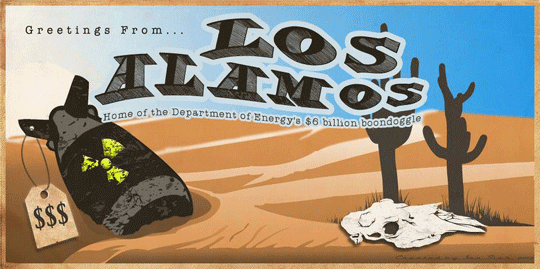
Area G, perhaps more than any other place at Los Alamos National Laboratory, represents the challenges that the U.S. Department of Energy faces in cleaning up the hundreds of waste sites at the lab while work continues to produce new or modernized nuclear weapons.
A report released this spring by the Energy Department’s Environmental Management Los Alamos Field Office says that out of 2,100 contaminated sites, including Area G, only about half of the cleanup at the lab has been completed after decades of work and billions of dollars spent.
If all goes as planned, it will take Los Alamos almost a century to clean up the remnants of the nation’s first generation of nuclear weapons. All the while, tiny, new nuclear bombs are being made.

LANL’s Area G at center of nuclear cleanup effort, http://www.santafenewmexican.com/news/local_news/lanl-s-area-g-at-center-of-nuclear-cleanup-effort/article_31af6d36-e24c-5d63-b131-7877f813d6be.html By Rebecca Moss The New Mexican, 23 Apr 17 LOS ALAMOS — To stand at one of the largest radioactive dumps in the nation requires a drive through two security checkpoints, a clearance badge and, for outsiders, a three-to-one guard by federal employees.
Visitors cross the final checkpoint on foot. There is just a metal gate, with stop signs and notifications that crossing this threshold means entering a nuclear facility.
The 63-acre Material Disposal Area G at Los Alamos National Laboratory holds radioactive and other hazardous waste generated by nuclear weapons production during the Manhattan Project of World War II and the Cold War that followed.
Just three feet below the dusty ground, there are nearly 40 pits and 200 shafts, containing somewhere between several hundred thousand and 11 million cubic feet of waste. Large, white structures, like joyless wedding tents, dot the mesa’s surface, holding drums of waste that are intended to be shipped to the Waste Isolation Pilot Plant near Carlsbad and disposed of forever.
Many of these drums are especially volatile. They belong to a waste stream that was improperly packaged, causing one drum to explode at WIPP in 2014, leaking radiation and shutting down the facility for nearly three years at a $2 billion cleanup cost.
Area G, perhaps more than any other place at Los Alamos National Laboratory, represents the challenges that the U.S. Department of Energy faces in cleaning up the hundreds of waste sites at the lab while work continues to produce new or modernized nuclear weapons.
The lab recently gave reporters a rare tour of Area G and other sites contaminated by waste generated before 1999, the year the Energy Department opened WIPP. It is the nation’s only permanent disposal site for transuranic waste, which includes soil, tools, gloves and other materials that have come in contact with highly radioactive elements like plutonium, which is used in weapons production. Before WIPP opened, Area G was where the lab disposed of its transuranic waste.
A report released this spring by the Energy Department’s Environmental Management Los Alamos Field Office says that out of 2,100 contaminated sites, including Area G, only about half of the cleanup at the lab has been completed after decades of work and billions of dollars spent.
The report says the initial investigation into the extent of contamination at those sites is 90 percent done, and 93 percent of the above-ground transuranic waste — 4,000 drums — has been removed from the lab since 2011.
But much of the buried waste at Area G is likely to stay there forever.
The lab could dig everything up, but “the federal government and the state don’t require it,” said a senior lab official who took the tour with reporters. Officials on the tour prohibited reporters from quoting them by name.
The circumstances that led to one of the costliest nuclear accidents in U.S. history began at Area G. A drum of waste improperly packaged with organic — rather than inorganic — kitty litter at Area G in 2013 and shipped to the Waste Isolation Pilot Plant overheated and burst underground in February 2014.
At Area G, there are 89 more drums similar to the one that burst. They are kept within the largest tent on the mesa, called the PermaCon.
Inside, the light takes on a yellowish-gray hue and the air is at least 15 degrees cooler than the April day outside. At the center of the space, behind a rope and a sign that reads “combustible restricted area,” the waste drums have been placed inside a refrigerated metal structure, like enormous eggs in an incubator.
They contain some of the most volatile waste at the site, a mix of nitric acids, kerosene, heavy metals, plutonium-239, uranium-238 and nitrate salt.
Sixty of the drums, like the one that burst at WIPP, contain the organic kitty litter. The rest of the 89 drums have the same waste but haven’t yet been mixed with an absorbent.
Before entering the tent, visitors must protect their eyes with plastic glasses and make sure their hands are devoid of wounds. Radiation is more easily absorbed into the body if it can slip through a cut. Visitors are told to avoid touching surfaces and their mouths, and to leave outside anything they don’t want to be surveyed for radioactive contamination.
Area G workers are told to make a habit of wearing gloves at all times, even at home, officials said. “Fight the way you train,” is how one person explained it.
Workers at the PermaCon wore purple gloves and were dressed head to boots in a yellow, plastic material that forms a protective hood and thick goggles.
A sign on a door leading to where the drums are kept informs workers that they will be exposed to 0.1 rem of radiation per hour. The average American receives 0.6 rem per year, according to the U.S. Nuclear Regulatory Commission.
The drums are kept at 57 degrees Fahrenheit and monitored daily to ensure the pressure and heat do not change. If a drum starts to heat, officials can open large vents added to the drums and reduce pressure, but releasing some radiation, too, within the PermaCon.
From Area G it takes just two minutes to walk onto San Ildefonso Pueblo land; The community of White Rock is one mile from the site.
As reporters and officials exited, workers traced radiation detection monitors slowly across palms and the soles of shoes.
By May, a 3-mile stretch of the road between Area G and a waste repackaging facility will be closed off daily as drums are transported uphill to the Waste Characterization, Reduction and Repackaging Facility, which looks like a series of oversized garages.
As reporters entered the facility, one worker whispered, “Hold your breath.”
Over roughly two months, lab workers will repackage the waste in two-hour shifts using a glove box — a large, sealed container. Inserting their hands into gloves attached to the box, the workers will open the drums.
The waste will be combined with water and zeolite — a fine, gray mineral mined in Western states, including New Mexico, and sold as absorbent cat litter — and stirred in an industrial kitchen mixer within the glove box. Once the waste is mixed, it will be funneled into new “daughter” drums and returned to Area G for later shipment to WIPP, officials said.
An official said zeolite was chosen as an absorbent in part because it eliminates any confusion about the type of kitty litter that can be used.
Tacked to the glove box is a printed sheet of paper with numbered instructions for how to mix the waste. It’s pinned just above the radiation detection panel that workers must press their hands against the moment they are removed from the glove box.
Area G is situated on a mesa between two canyons, and wildfire is a threat to the drums waiting for repackaging and shipment to WIPP.
In 2000, the Cerro Grande Fire burned through both canyons simultaneously, creating extremely high temperatures on the mesa. If this happened again, an official said, the lab would cover the drums with fire blankets but could not move them. They could only hope that the flames subside before the drums overheat and begin a reaction like the one that closed WIPP.
The Los Conchas Fire in 2011 burned within four miles of Area G.
The administrations of Govs. Bill Richardson and Susana Martinez have sought to expedite the removal of vulnerable canisters from lab property. But deadlines for the lab to do so, first by 2010 and then by June 2014, went unmet, in part because waste shipments to WIPP stalled following the radiation leak caused by the Los Alamos drum.
Waste disposal at Area G is expected to stop next year when the last open pit is filled. The lab’s newly constructed Transuranic Waste Facility, an outdoor storage site, will temporarily hold newly generated waste before shipment off-site. The lab also is seeking approval from the New Mexico Environment Department for temporary storage at the plutonium processing facility where pits, the triggers for nuclear weapons, are produced. Pits are similar to small atomic bombs.
But the Defense Nuclear Facilities Safety Board, an independent agency, and others have raised concerns about storing radioactive waste at these locations. New waste sites, even those intended to be temporary, increases the potential for dangerous waste to remain on lab property long term.
On the drive to Area G on a winding road within the national laboratory complex, in a lab “taxi” van playing 1980s rock, many buildings appeared more like prison structures than research facilities, with thick, glass windows — or no windows at all — and tall, barbed-wire fences.
One official remarked on the great irony of the work: The first atomic bomb took only 27 months to create, but like the myth of Pandora’s box, it unfurled a seemingly endless stream of deadly waste.
Last September, the Energy Department said the remaining scope of legacy waste cleanup is estimated to cost $3.8 billion, and it will take 24 more years to finish shipping the rest of the waste to permanent storage and decontaminating the land.
If all goes as planned, it will take Los Alamos almost a century to clean up the remnants of the nation’s first generation of nuclear weapons. All the while, tiny, new nuclear bombs are being made.
Kaitlin Martinez, a spokeswoman for the Environmental Management Los Alamos Field Office, said the “biggest priorities right now are the safety of the workers and the public as we execute our mission.”
April 24, 2017
Posted by Christina Macpherson |
USA, wastes |
Leave a comment

 Future of nuclear energy bleak in Korea All major candidates vow to stop building new reactors, Korea Times, By Jung Min-ho, 21 Apr 17, The future of nuclear energy looks bleak in Korea for whoever becomes the next president.
All major candidates have vowed to stop building new nuclear reactors and close down older ones in an effort to reduce the country’s dependence on nuclear energy.
Left-leaning Democratic Party of Korea (DPK) candidate Moon Jae-in, the frontrunner in the race, promised to cancel construction plans for two additional nuclear reactors ― Shin Kori 5 and 6. He believes Korea will have to phase out all of its remaining nuclear power plants over the next 40 years.
Ahn Cheol-soo of the People’s Party, the runner-up, also made the same promises, though he did not mention specifically by when he plans to remove all nuclear reactors. Korea has 23 nuclear reactors in operation, from which it gets about 30 percent of its power. Five more reactors are under construction.
Sim Sang-jeung of the minor Justice Party is taking the strongest stance against nuclear energy. She said she will immediately close down all the reactors under construction and rid the country of nuclear reactors by 2040.
The two right-wing candidates ― Yoo Seong-min of the Bareun Party and Hong Joon-pyo of the Liberty Korea Party ― are more cautious about the idea of removing all the nuclear reactors, but still, they are not far apart on the issue compared to other candidates.
Four of the candidates have also vowed to reduce the country’s dependence on coal power plants as well to resolve the issue of fine dust, which has become worse in recent years. Hong alone remains skeptical of doing so, but he said he will regulate their operations more strictly instead…….
Meanwhile, all the candidates vowed to increase investment into developing renewable energy sources. The two leading candidates said they will initiate the project to increase the country’s reliance on renewable energy to 20 percent by 2030.
“Compared with the previous presidential election, candidates have taken more progressive approaches over the issue,” said Kim Mi-kyung, a climate change activist at the environmental group Greenpeace. “We expect Korea to follow the global trends of nuclear-free, coal-free and more renewable energy.”
April 24, 2017
Posted by Christina Macpherson |
politics, South Korea |
Leave a comment









 nuclear-news