Show 10 – Fukushima 311 Watchdogs – Fukushima Disaster
Sorry folks for my thick french accent in this interview, but most important is the message itself, not the bearer. Plus this is quite new to me…

Link to the podcast show : http://ahk42.com/podcast/show-10-fukushima-311-watchdogs-fukushima-disaster/
About Herve Courtois:-
Because my 30-year-old Japanese daughter was living in Iwaki city, Fukushima Prefecture, on March 11 2011, the Fukushima Daiichi Nuclear plant disaster abruptly awoke me to the dangers of nuclear and also to the omnipresent omerta in the mainstream media exerted by the powerful international nuclear lobby and various governments.
Visiting my daughter in Iwaki just 3 months after the start of the catastrophe, I was surprised by how the people on location were kept ignorant about what was really taking place, about the gravity of the dangers they faced, and about the possible protective measures they should take to minimize the risks to their life.
After a one-month visit, returning home to France, I looked for information and knowledge on the Internet and on the social networks, then became active myself in sharing that information and knowledge with others, and active in the French and International Anti-Nuclear movements. 3 and a half years later, the Fukushima catastrophe is still ongoing, and its cover-up has been partly exposed, but we still have to struggle to make the truth prevail over their many lies. 3 years later I am still here sharing information.
From June 2011 to July 2012, I was the main administrator of the Fukushima 311 Watchdog FB group, its FB page and its first blog. In July 2012, after a very intensely active first year, I burned-out, so I closed the FB group and its Internet blog, keeping only its FB page going up to the present:
In August 2012 I founded a new group, The Rainbow Warriors FB group which is still active:
I chose the alias of D’un Renard (“from a fox” in French) so as to not be identified by the Japanese government for my anti-nuclear activities, and eventually blacklisted as an undesirable alien, which would prevent me from entering Japan and continuing to visit my daughter.
I believe it is time for me to open again a new Fukushima 311 Watchdogs blog now, as the Fukushima catastrophe still goes on, to reach more people with our information, for people to learn about Fukushima and its continued spitting of contamination into our environment worldwide through the Jet Stream, the constant dumping of radioactive contaminated water into the Pacific Ocean, and its contamination of our food chain, with all the health consequences that we may predict.
Governments are unwilling to learn the lessons from Chernobyl, Three Mile Island, and Fukushima. The people’s lives are always secondary to government priorities, economics and political expediency. People must learn to protect themselves as no one informs them of the true facts nor protects them.
Fukushima is here with us.
The Rainbow Warriors group on Facebook
The Fukushima 311 Watchdogs page on Facebook
Media for the show:-
The Facebook page about the documentary film Les voix silencieuses (The silent voices) they have 3 versions, one in Japanese, one in french, one in English. LINK
Silent Voices Website LINK
About the documentary film “Fukushima the silent voices” LINK
http://ahk42.com/upcoming-guest-fukushima-311-watchdogs-herve-courtois/
Fukushima’s Upcoming Olympics

Japan will hold soccer and baseball events in Fukushima Prefecture for the Tokyo 2020 Olympics. This is not a spoof. Effective March 2017, the Japan Football Association displaces Tokyo Electric Power Company’s emergency operations center at J-Village, the national soccer training center before the nuclear meltdown occurred.
To naysayers that say this is a joke, the answer is ‘no this is not a joke’. It is absolutely true Olympic events will be held in Fukushima Prefecture, thereby casting aside any and all concerns about the ongoing nuclear meltdown; after all that’s history.
Or, is it?
Here is the announcement as carried in The Japan Times some months ago: “The men’s and women’s national soccer teams for the 2020 Tokyo Olympics will use the J-Village national soccer training center, currently serving as Tokyo Electric Power Co.’s forward base in dealing with the Fukushima nuclear crisis, as their training base, the Japan Football Association revealed Saturday.”
For those who missed the past few classes, Fukushima is home to the worst industrial accident in human history as three nuclear reactors experienced 100% meltdown, the dreaded “China Syndrome.” Molten core, or corium, in all of the reactors, highly radioactive and deadly, frizzles robots. Tokyo Electric Power Company (TEPCO) says it may take 40 years to clean up the disaster zone, but that is a wild guess.
Nobody on planet Earth has any idea where the radioactive molten cores are, within the reactor containment vessels or burrowed into the earth, and/or what happens next, e.g., there’s speculation that Unit #2 is rickety and could collapse from another big earthquake (Japan is riddled with earthquake zones, experiencing an earthquake on average every day) thus collapsing, which leads to an untold, massive disaster, rendering the city of Tokyo uninhabitable.
According to Dr. Shuzo Takemoto, Engr. / Kyoto University, February 2017: “The Fukushima nuclear facility is a global threat on level of a major catastrophe… The problem of Unit 2… If it should encounter a big earth tremor, it will be destroyed and scatter the remaining nuclear fuel and its debris, making the Tokyo metropolitan area uninhabitable.”
Numerous efforts by TEPCO to locate the melted cores have been useless. As of recently: “Some Nuclear Regulation Authority members are skeptical of continuing to send robots into reactors in the crippled Fukushima No. 1 plant to collect vital data on the locations of melted nuclear fuel and radiation levels… investigations utilizing robots controlled remotely generated few findings and were quickly terminated” (Source: Nuke Watchdog Critical as Robot Failures Mount at Fukushima Plant, The Asahi Shimbun, March 24, 2017).
All of which inescapably brings to mind the following question: How could anybody possibly have the audacity to bring Olympic events to the backyard of the worst nuclear meltdown in history whilst it remains totally 100% out of control?
Answer: Japan’s PM Shinzō Abe and the International Olympic Committee (IOC).
According to Naohiro Masuda, the head of decommissioning, TEPCO does not know how to decommission the nuclear facilities. Meanwhile, ongoing radiation is a constant threat to air, soil, food, and water, e.g., state inspectors have discovered deadly high levels of cesium pooling at the base of Fukushima’s 10 big dams that serve as water reservoirs (drinking water and agriculture). For example, Ganbe Dam 27,533 Bq/kg and Mano Dam at 26,859 Bq/kg whereas Japan’s Environment Ministry’s safe limit for “designated waste” is set at 8,000 Bq/kg. That limit is for “waste,” not drinking water. (Source: High Levels of Radioactive Cesium Pooling at Dams Near Fukushima Nuke Plant, The Mainichi – Japan’s National Daily Since 1922, September 26, 2016.)
Japanese officials are ignoring the extraordinarily high levels of cesium at the bottom of the dam reservoirs because the top water levels do meet drinking water standards. The prescribed safe limit of radioactive cesium for drinking water is 200 Bq/kg. A Becquerel (“Bq”) is a gauge of strength of radioactivity in materials such as Iodine-131 and Cesium-137. As it happens, Cesium-137 is one of the most poisonous substances on the face of the planet.
Additionally, open storage and incineration of toxic and radioactive rubble is ongoing throughout the prefecture. In fact, the entire prefecture is a toxic warehouse of radioactive isotopes, especially with 70% of Fukushima consisting of forests never decontaminated, yet the Abe administration is moving people back to restricted zones that Greenpeace Japan says contain radioactive hot spots.
According to Greenpeace Japan, which has conducted 25 extensive surveys for radiation throughout Fukushima Prefecture since 2011: “Unfortunately, the crux of the nuclear contamination issue – from Kyshtym to Chernobyl to Fukushima- is this: When a major radiological disaster happens and impacts vast tracts of land, it cannot be ‘cleaned up’ or ‘fixed’.” (Source: Hanis Maketab, Environmental Impacts of Fukushima Nuclear Disaster Will Last ‘decades to centuries’ – Greenpeace, Asia Correspondent, March 4, 2016).
With the onset of the Fukushima Diiachi meltdown, the Japanese government increased the International Commission on Radiological Protection guidelines for radiation exposure of people from 1 millisievert (mSv) per year up to 20 mSv/yr. As such, according to the standards set by the International Commission on Radiological Protection, ICRP Publication 111, Japan’s Olympics will expose Olympians and visitors to higher than publicly acceptable levels of radiation. After all, the emergency guideline of 20 mSv/yr was never meant to be a long-term solution.
With the onset of Olympic venues in Fukushima, maybe that will open the way for the 2024 Olympics in Chernobyl. But, on second thought that will not work. Chernobyl’s Exclusion Zone is 1,000 square miles (off limits for hundreds, maybe thousands, of years) because of an explosion in one nuclear power plant that is now under control whereas Fukushima has three nuclear meltdowns that remain, to this day and into the unforeseeable future, radically out of control and extremely hazardous.
Mystifying and Confusing?
Yes, it’s mystifying and confusing, but the games go on.
http://www.counterpunch.org/2017/04/12/fukushimas-upcoming-olympics/
Fukushima’s Ice-wall Blossoming or Not?

Following the Fukushima nuclear disaster of 2011, it was rapidly discovered that owing to the unfortunate location of the plant and its construction, its buildings’ basements had become flooded by groundwater ingress, which subsequently became highly contaminated. In order to avoid reverse diffusion of the contaminated water into the environment, those managing the site were compelled to continually pump out and treat the contaminated water, at a rate commensurate with its inflow. It was anticipated or perhaps it would be better stated as ‘earnestly hoped’, that by keeping the water level in the flooded building basement below ground water levels that contamination would not defuse out of the flooded basement. Naturally as a consequence TEPCO are accumulating and endeavouring to store and decontaminate the net amount of water ingress each day.
To facilitate containment necessary for the safe decommissioning of the immediately contaminated reactor buildings in September 2013 TEPCO commissioned the construction of their controversial ‘ice-wall’.[1] Installation of the facilities to create the ice-wall commenced in June 2014 and was completed on February 9, 2016 at an estimated to cost some ¥34.5 billion (circa $339 million). Activation was on March 31, 2016, with commencement of the freezing of the seaward side wall. Freezing of the land-side wall commenced on June 6, 2016, with the secondary phase of sealing the last openings in the land side wall commencing on December 2, 2016. At this point we should note that the ice-wall in not penetrating to the depth of the aquifer, has no base to its containment, thus the wall is little more than a skirt, with water free to percolate in and out from below the contaminated site.
We now find ourselves in the spring of 2017, with the ice-wall’s chillier plant having run flat out for a year with seemingly little net impact on water ingress. Frustrated by this apparent lack of progress, on December 26, 2016 the Japanese Nuclear Regulatory Authority (NRA) citing “limited, if any effects,” advised TEPCO that the “frozen soil wall” should be relegated to a secondary role in reducing contaminated groundwater at the Fukushima No. 1 nuclear plant.[2] Yet TEPCO still persisted in asserting that the ice-wall was effective stating “We are seeing certain results.” Which begs the questions: What results were they seeing and as TEPCO’s response would suggest, have the NRA been too presumptive in dismissing the ice-wall’s impact and groundwater ingress? Or perhaps TEPCO’s engineers, being so bought into their radical ice-wall concept they don’t want to ‘lose face’ or perhaps they have simply lost the plot?
In a bid to head of criticising of their activities for being less than transparent and tardy in properly advising the public, TEPCO have conveniently put certain of their findings into the public domain, in the form of press releases.[3] From this data, it’s possible to get a rudimentary grasp of what’s going on beneath TEPCO’s ice-wall. Regular updates on volumes of contaminated waters pumped from drainage wells and the reactor buildings’ basement, along with local rainfall have been regularly published. These indicated the seasonal cycle of rainfall in the Fukushima area and further show a relationship between local rainfall and the volumes of water, (Figure 1).
Figure 1

Working on the basis of the limited available data and an anticipated lag between rain falling and its impact on groundwater, and assuming a direct relationship between water ingress and the total amount of water transferred or pumped out of the system, we can drive a relationship between the averaged daily water transfer (a measure of approximate water ingress) and the rainfall total for the prior month, (Figure 2). These criteria show very plausible cause effect linear correlation (i.e. of the type, y = mx + c), (Figure 3). Thus, we can envisage the contributions to groundwater flow within the aquifer beneath Fukushima being comprised of two portions (a) a large steady flow arising from rainfall which may have fallen years to decades ago on the mountains to the west of the site and equating to the linear equation’s constant and (b) a highly variable amount of flow arising from recent rainfall, predominantly within the last month.
Figure 2

Figure 3

Whilst the linear relationship between the phenomena is simplistic, on the available data application of 2nd or 3rd order polynomial curve fitting does not give any significant improved correlation coefficient (R). Given we have identified the correlation and observe seasonality, we can factor out the seasonality and project rolling annualised rainfall and water transfer (Figure 4).
Figure 4
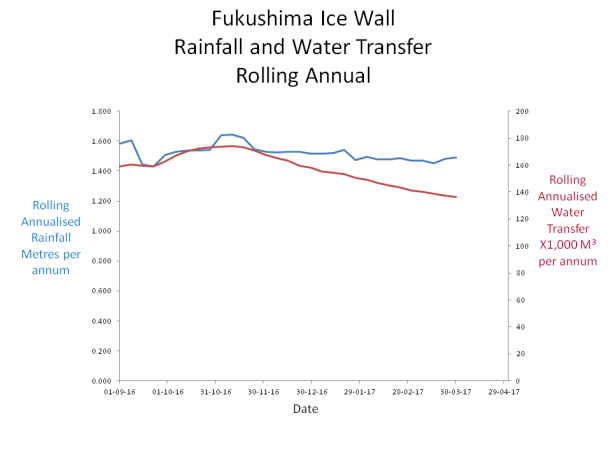
Within the scope of natural variance, the annualised rainfall at Fukushima shows no significant long term trend, being flat and circa 1.5 metres per year. The water transfer level does show some improvement and notwithstanding the slightly higher than average autumnal rains in 2016, water transfer levels are on the decline. Alas given the magnitude of that decline in relation to that hoped for by the ice-wall’s advocates to 50 tonnes per day, it was understandable that the NRA were rather less than impressed.
We also have to consider that our original correlation between rainfall and implied water ingress was conducted on all available data. The reality is several operational events were being executed over the period, such as the commencement of 24 hour pumping from inland relief wells with the aim of reducing groundwater around the stricken buildings, as well as the phased installation of the ice-wall itself. Thus our initial correlation is a composite of parallel events. If we reapply our linear relationship model on a rolling 12 monthly period, to exclude any rainfall seasonality, we see some interesting features, (Figure 5).
Figure 5

Had the ice-wall achieve a positive effect we should observed both a reduction in total amount of water transferred (y) being made up by a reduction in the overall basal flow (c) and of course a reduction in the recent rainfall component as reflected in a reduction of its independent variable (m). We see a reduction in apparent basal flow. As this reduction has occurred in isolation with the independent variable increasing over time, we can attribute reduction in ‘c’ in good measure to the impact relief wells. However, the overall amount of water being pumped out of the stricken buildings has remained high and it has done so because the aquifer has become more susceptible to the impact of recent rainfall. This suggests that the aquifer adjacent the site has become more porous and not less porous over the last few years. Had the ice-wall had a positive effect, a decline in the independent variable ‘m’ over time should be observed.
I would conjecture that if such is the case what could have caused this effect. It is possible that the installation of the coolant pipe-work has caused significant sub-soil disturbance, coupled with the degradation of the substrate rock texture by ground heave. The above should effectively have been self repaired when the ice-barrier froze. However, in this circumstance, owing to the size of the ice-wall and it lack of capacity to freeze the entire depth of the aquifer, it is likely that the aquifer disruption at its margins has resulted in increased porosity in the aquifer directly beneath the wall. Furthermore, given that the wall is incomplete and operating at the extent of its capacity, and that the site is subject to seasonal warming, and has had operational outages it is highly likely that the freeze thaw cycling peripheral to the ice-wall has cause deterioration to the aquifers subsoil texture and cohesion, thereby giving rise to localised increase porosity of the aquifer. As such I am not of the opinion that the installation of the ice-wall has had a ‘limited impact’. I believe it has had a ‘significant and negative impact’ on the porosity of the aquifer local to the site of contamination, and I believe it has added circa 20% to the volume of contaminated water generated since its installation.
But there again, that’s just one persons musings and opinion, and I dare say other will disagree and think I’m writing bollocks. Either way, I would be fascinated to see what “certain results” the TEPCO engineers saw. And if what they saw was good, I’d like a double of whatever they’d been drinking…
Kanpai
[1] 11 July 2016, ‘Fukushima’s Ice-Wall a Fridge Too Far’ Peter J. Hurley, Linkedin.com https://www.linkedin.com/pulse/fukushimas-ice-wall-fridge-too-far-peter-j-hurley
[2] December 27, 2016 Kohei T., The Asahi Shimbun ‘NRA: Ice wall effects ‘limited’ at Fukushima nuclear plant’: http://www.asahi.com/ajw/articles/AJ201612270056.html
[3] http://www.tepco.co.jp/en/nu/fukushima-np/handouts/index-e.html
New Study Points to Measurable and Significant Increase in Incidents of Thyroid Cancer

USA asks China “to take additional steps” to rein in the Kim Jong-Un regime.

 As N. Korea threatens nuclear attacks, U.S. calls on China ‘to take additional steps’ by WorldTribune Staff, April 11, 2017
As North Korea warned it has its “nuclear sight focused” on the United States, the Trump administration said it has called on China “to take additional steps” to rein in the Kim Jong-Un regime.
President Donald Trump tweeted on April 11: “I explained to the President of China that a trade deal with the U.S. will be far better for them if they solve the North Korean problem!”
Secretary of State Rex Tillerson, in an interview with ABC News on April 10, said: “I think we need to allow them (China) time to take actions and we will continue to be in very close discussions with them,” adding that the conversations between the two countries have been “very candid.”
North Korea’s official Rodong Sinmun newspaper said the country was prepared to respond to any aggression by the United States.
“Our revolutionary strong army is keenly watching every move by enemy elements with our nuclear sight focused on the U.S. invasionary bases not only in South Korea and the Pacific operation theatre but also in the U.S. mainland,” it said.
Pyongyang issued the warning as a U.S. Navy aircraft carrier strike group sailed towards the western Pacific……http://www.worldtribune.com/as-n-korea-threatens-nuclear-attacks-u-s-calling-on-china-to-take-additional-steps/
As Navy warships approach, North Korea threatens nuclear strike on USA
 North Korea threatens U.S. with #nuclear strike as Navy warships approach https://www.dailydot.com/layer8/north-korea-threatens-nuclear-attack/ David Gilmour—\Apr 11 2017, North Korea this week threatened to launch a nuclear attack on the United States at the first sign of aggression from the U.S. Navy strike group that President Donald Trump ordered to the Korean peninsula.
The importance of securing a deal on banning all nuclear weapons
 Why efforts to secure a deal on banning all nuclear weapons are so important https://theconversation.com/why-efforts-to-secure-a-deal-on-banning-all-nuclear-weapons-are-so-important-75484 The Conversation, April 10, 2017, Last week negotiations to ban nuclear weapons started in New York. The talks came as a result of United Nations General Assembly resolution adopted in December last year.
The resolution takes forward multilateral negotiations on complete nuclear disarmament.
States started negotiations on nuclear disarmament in 1946, a year after the atom bombs were dropped on Japan. But the talks faltered as the Cold War warmed up.
Fearing that the spread of nuclear weapons would make those states that had them even more reluctant to give them up, the Treaty on the Non-Proliferation of Nuclear Weapons was negotiated and entered into force in 1970.
The treaty was the first building bloc on the road to a world without nuclear weapons. It prevented states that didn’t have nuclear weapons before 1968 from acquiring them. And it prohibited states that had nuclear weapons from providing other states with them.
The non-proliferation obligation of the treaty has been exceptionally successful. Nuclear weapons have spread to only four other states since its inception. Today there are nine states with nuclear weapons: the original five, namely the US, Russia, the UK, France and China. The other nuclear armed states are India, Pakistan, Israel and North Korea. They are not members of the nonproliferation treaty.
The non-proliferation obligation of the treaty should be seen in the context of Article VI of that treaty, requiring all its members – including the five original nuclear weapon states – to negotiate in good faith general and complete disarmament of nuclear weapons, in other words, to negotiate a world without nuclear weapons.
This is the disarmament obligation of the treaty. Unfortunately, it stated no deadline for these negotiations. This legal loophole has been used by the nuclear weapon states to delay giving up their arsenals.
In fact, the treaty is disingenuously interpreted to suggest that the five original nuclear weapon states should be allowed to have these weapons, but not any other states. Continue reading
Russia’s plans for nuclear waste ships: but where will they dump the radioactive trash?
Breaking the ice with loads of nuclear waste https://thebarentsobserver.com/en/security/2017/04/breaking-ice-loads-nuclear-waste Russia will build special purpose ship for voyages with radioactive waste and spent nuclear fuel along the Northern Sea Route. By Thomas Nilsen April 07, 2017
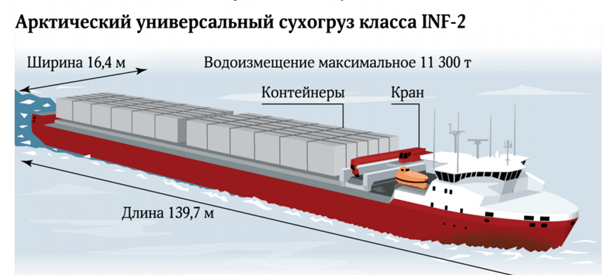
Construction starts in 2020 of the 140 meters long ice-classed vessel, approved for carrying irradiated nuclear fuel and High-Level radioactive waste, Izvestia reports.
Beneath the deck, it will be space for 40 to 70 special transport containers for spent nuclear fuel and the upper deck has space for containers with radioactive waste. The design, named INF-2, is made by Krylov State Research Centre in St. Petersburg, a design bureau that has Russia’s latest generation of nuclear powered icebreakers, submarines and warships on its list of merits.
In addition to sailing along the north coast of Siberia, the nuclear waste cargo vessel can make voyages up the Siberian Rivers like Ob and Yenisei, where several of Russia’s nuclear facilities are located, like the storage and planned reprocessing plant in Zheleznogorsk (former Krasnoyarsk-26).
Today, all transport of spent nuclear fuel from icebreakers, submarines and nuclear power plants from northwest Russia to the reprocessing plant in Mayak north of Chelyabinsk go by train through the most inhabited areas of Russia.
Where will the vessel sail?
Andrey Zolotkov, a nuclear expert and former head of the environmental group Bellona in Murmansk says the news that such cargo vessel will be built raises many questions.
«When stating that radioactive waste will be transported out of the Arctic and the Far East, where, interestingly will it then be taken?» asks Zolotkov. He does not immediately see an urgent need for transportation of spent nuclear fuel and radioactive waste, but agrees that transport to locations along the Siberian rivers could be an option.
«But, maybe they link this vessel to the plans for new floating and smaller nuclear power plants in the Arctic.»
Andrey Zolotkov, that earlier worked on board Atomflot’s service vessel «Imandra» says the icebreaker fleet will need a new service vessel as well in the future.
«Such vessel could very well replace «Imandra» for storage of spent nuclear fuel from icebreakers,» he says.
Floating nuclear power plant
Krylov State Research Centre says on its portal that one of the tasks for such vessel could be to transport the spent nuclear fuel from Bilibino nuclear heat power plant in Pevek on the Chukotka Peninsula. Bilibino is the world’s northernmost nuclear plant and shutdown procedure is likely to start in 2019. As a replacement, Russia’s first floating nuclear power plant, the «Akademik Lomonosov» will be placed in Pevek.
Another task for such new vessel, supposed to be operated in a consortium consisting of Rosatom and the military, could be to transport solid radioactive waste to a future repository. Location of such repository is yet to be decided; one option under consideration and approved by county authorities in Arkhangelsk is is the Arctic archipelago of Novaya Zemlya.
There are today stored tens of thousands of cubic meters of solid radioactive waste both on the Kola Peninsula, in Severodvinsk by the White Sea and at naval yards in the Far East.
On the Kola Peninsula, the Italian built vessel «Rossita» is later this year ready to start transport of containers with spent nuclear fuel out of the Andreeva Bay. The containers will be taken to Atomflot in Murmansk where they will be reloaded to railwagons for transport further to Mayak. «Rossita» is not suitable for voyages along the Northern Sea Route or into the river systems in Siberia.
Earlier, the Russian Northern Fleet had its own transport and storage vessels of the Malina-class (Project 2020) for spent nuclear fuel from submarines.
It was always a mistake, trying to turn nuclear bomb project into (costly) nuclear power
 Nuclear Power’s Original Mistake: Trying to Domesticate the Bomb, Bloomberg View, APRIL 8, 2017
Toshiba to dump UK Moorside nuclear project, in effort to stay afloat?
Toshiba considers sale of Moorside nuclear project in Cumbria as own survival in doubt in wake of £7bn losses http://www.telegraph.co.uk/business/2017/04/11/toshiba-questions-survival-warns-losses-could-hit-7bn/ 11 APRIL 2017
Toshiba is considering selling a stake in its nuclear project in Cumbria after warning it could struggle to remain in business as a result of expected annual losses of more than 1trn yen (£7bn).

The Japanese conglomerate, which makes everything from flash memory drives to laptops and semiconductors, admitted it is considering selling some or all of nuclear specialist NuGeneration to keep itself afloat.
NuGen currently owns 100pc of the Moorside site, after buying 40pc back from France’s Engie for $138.5m (£111m) earlier this month.That sale followed the Chapter 11 bankruptcy filing of Westinghouse, another Toshiba-owned company which is set to provide reactors for Moorside.
Asked what it would do with NuGeneration, a Toshiba spokesman said while no final decisions have been made “we would like to explore alternatives, including the sales of shares.”
He went on to explain that Toshiba is “carefully monitoring the situation in consultation with other stakeholders including the British Government.”Separately NuGeneration said it had been looking for investors prior to Westinghouse’s troubles and emphasised that the construction of Moorside was always going to be done by a third party.
But a spokesman acknowledged “there is no certainty” with regards to Westinghouse’s involvement in the development stage of the project.
Theoretically, Westinghouse’s AP1000 reactors, which have received regulatory approval, remain attached to the project but if a new investor were to come on board, it is unclear if different reactors may be proposed, potentially delaying the already behind schedule project yet further.
Samira Rudiga an energy fund manager at Guinness Asset Management, said the news was another nail in the coffin for the UK’s nuclear hopes.
“Nuclear does not make sense in the UK,” she said. “It takes 10 years to build and can take as long if not longer just to come to a decision to build a plant.”However, she expects the Government to still consider nuclear projects and thought there would be companies in Europe and Asia able to take on Toshiba’s stake in Moorside.
Greg Clark, the Business secretary, travelled to South Korea earlier this month in a bid to save the project, appealing to Korean nuclear giant Kepco to invest.
“For the reasons stated above, there are material events and conditions that raise the substantial doubt about the company’s ability to continue as a going concern,” Toshiba said.
At the end of 2016, the impending multi-billion-dollar write down triggered one of the worst-ever share fallsfor a major Japanese company, with ratings downgrades and investor pessimism erasing almost all of its 87pc rally so far that year. Toshiba delayed publication of its annual results twice prior to publication, and the company took the unusual step of publishing its accounts without sign-off from its auditor, PriceWaterhouseCoopers Aarata.
Toshiba said that while it had not yet fully determined the full cost of restructuring Westinghouse, its calculations suggested net income would fall by roughly 620bn yen.
Florida’s nuclear plans in doubt, as Toshiba corporation looks like crashing
 Toshiba casts doubt on ability to stay in business after nuclear power push falters, Tampa Bay Times, New York Times, April 11, 2017 Toshiba, a pillar of the modern Japanese economy whose roots stretch back to the country’s industrial stirrings in the 19th century, warned on Tuesday that a disastrous foray into nuclear power may have crippled its business beyond repair.
In a stock-market filing in Japan, Toshiba said losses associated with Westinghouse Electric, its troubled U.S. nuclear power subsidiary, had created “substantial uncertainty” over its ability to continue as a going concern. The declaration lifts the stakes as Toshiba seeks outside investors for its coveted microchip business, a portion of which it is selling off to raise cash and stave off disaster.
Westinghouse’s woes have a strong tie to Florida.
Plans for two reactors that were supposed to be built by Westinghouse in Levy County, north of the Tampa Bay market, were shelved in 2014 by owner Duke Energy after early construction delays and massive run-ups in the anticipated price tag that approached $25 billion to complete the nuclear power plants.
As approved by state legislators and regulators, Duke Energy is able to charge its Florida ratepayers for about $1.5 billion in early construction costs for the Levy plant even though it will probably never be built. Duke Energy spent just enough on the plant site to receive a federal license last fall to proceed with the Levy facility, though the odds of restarting its construction appear slim and will further fade in time.
Florida Power & Light, a giant utility which serves most of southern Florida, has also delayed its planned Westinghouse nuclear expansion at its Turkey Point site near Miami…
“We will do what we can to avoid being delisted from the stock exchange,” Satoshi Tsunakawa, Toshiba’s chief executive, said at a news conference after apologizing to shareholders for Toshiba’s latest worrying turn.
The company reported financial details for the quarter that ended in December after multiple delays and disputes with its auditors.
The financial problems are mounting.
The auditors have refused to certify Toshiba’s accounts — a highly unusual signal of doubt about the company’s ability to recover its financial health.http://www.tampabay.com/news/business/energy/toshiba-casts-doubt-on-ability-to-stay-in-business-after-nuclear-power/2319917
A warning to North Korea, from China, against conducting further nuclear weapons tests
Chinese tabloid warns N.Korea against test http://www.news.com.au/world/breaking-news/north-korea-warns-of-nuclear-strike/news-story/27dbacebb5390d5c95245bd82d538925 APRIL 12, 2017 North Korea should halt any plans for nuclear and missile activities “for its own security”, a Chinese newspaper says, warning that the US is making clear it doesn’t plan to “co-exist” with a nuclear-armed Pyongyang.
North Korean state media cautioned on Tuesday of a nuclear attack on the United States at any sign of American aggression, as a US Navy strike group steamed toward the western Pacific – a force US President Donald Trump described as an “armada”.
Trump, who has urged China to do more to rein in its impoverished ally and neighbour, said in a tweet that North Korea was “looking for trouble” and the United States would “solve the problem” with or without Beijing’s help.
The Korean Peninsula has not been so close to a “military clash” since North Korea conducted its first nuclear test in 2006, China’s influential state-run tabloid the Global Times said in an editorial.
“Not only Washington brimming with confidence and arrogance following the missile attacks on Syria, but Trump is also willing to be regarded as a man who honours his promises,” the paper, run by the ruling Communist Party’s official People’s Daily, said.
“The US is making up its mind to stop the North from conducting further nuclear tests. It doesn’t plan to co-exist with a nuclear-armed Pyongyang,” it said.
“Pyongyang should avoid making mistakes at this time.”
The Global Times, whose stance does not equate with Chinese government policy, said that Beijing would likely react strongly to any North Korean test.
“If the North makes another provocative move this month, the Chinese society will be willing to see the (UN Security Council) adopt severe restrictive measures that have never been seen before, such as restricting oil imports to the North,” the paper said.
Beijing has signed on to UN sanctions against North Korea, but it has repeatedly called for a return to dialogue to resolve the tensions.
A military parade is expected in Pyongyang to mark Saturday’s 105th anniversary of the birth of Kim Il-sung, North Korea’s founding father and grandfather of the current ruler. North Korea often marks important anniversaries with tests of its nuclear or missile capabilities.
South Africa’s new Finance Minister all set to rubber stamp nuclear build programme

 Rigorous review process needed for SA nuclear deal http://www.iol.co.za/news/opinion/rigorous-review-process-needed-for-sa-nuclear-deal-8625269 | 11 April 2017 New Finance Minister Malusi Gigaba has the rubber stamp of approval out that Pravin Gordhan kept locked away, writes Lauren Hermanus.
Toshiba warns that it might not survive its nuclear financial crisis
Toshiba warns over its survival as it forecasts £7bn losses Crisis creates concern about future of UK’s Moorside nuclear plant, in which subsidiary Westinghouse is a key player, Guardian, Angela Monaghan, 12 Apr 17, Toshiba, one of the biggest names in consumer electronics, has warned it is facing annual losses of more than £7bn and the future of the company is in doubt as a result of financial turmoil at its nuclear power plant construction business.
The Japanese company finally released third quarter results, after twice delaying publication while auditors attempted to quantify the scale of the problems at Toshiba’s US nuclear engineering subsidiary Westinghouse, which filed for bankruptcy last month.
Toshiba took the unusual decision to publish them on Tuesday without the approval of auditor PricewaterhouseCoopers Aarata. The company said PwC Aarata had been too uncertain about the financial impact of Westinghouse’s takeover of nuclear construction company CB&I Stone and Webster in 2015.
Westinghouse’s plight stems from a $6.1bn (£4.9bn) writedown because costs have overrun on the two plants CB&I is building in Georgia and South Carolina, the first new US nuclear power stations for decades.
The unaudited results showed Toshiba’s total losses widened by 53bn yen to 532bn yen (£3.9bn) in the nine months ending December 2016, adding that losses for the full year ending March could amount to more than 1tn yen (£7.3bn). It would be one of the biggest losses in Japanese corporate history.
Failure to file audited results fuelled speculation that the company could be forced out of the Tokyo Stock Exchange. Toshiba’s president, Satoshi Tsunakawa, called the auditor’s decision not to approve the figures “truly regrettable” and said he hoped the company would not be delisted.
The company’s escalating crisis also heightened fears about the future of Toshiba’s planned Moorside nuclear plant in Cumbria. Earlier this month it was forced to take full control of the venture behind the project, Nugen, after its previous partner, the French utility Engie, exercised the right to sell its 40% stakeunder an option triggered by Westinghouse’s bankruptcy filing.
Unite, Britain’s largest trade union, said it was fearful about what the latest developments at Toshiba would mean for the Moorside plant, and repeated its call on Greg Clark, the business and energy secretary, to intervene to safeguard the future of the project…….. https://www.theguardian.com/business/2017/apr/11/toshiba-losses-uk-moorside-nuclear-plant-westinghouse
Eskom says that South Africa has NOT signed any nuclear deal
 Eskom: SA has not signed nuclear deal http://northglennews.co.za/106808/eskom-sa-not-signed-nuclear-deal/ The power utility has not received any formal proposals from potential supplier SOUTH Africa has not signed any nuclear deal, Eskom recently said. Responding to last week’s media reports alleging that a nuclear deal has been signed, Eskom reiterated the remarks made by National Treasury that no deal has been signed.
“Eskom expects to issue a full Request for Proposal (RFP) to the open market once the Request for Information (RFI) has been assessed and the relevant approvals have been obtained,” said Eskom Chief Nuclear Officer, Dave Nicholls.
Nicholls said the power utility has not received any formal proposals from potential suppliers and has not signed any power plant procurement agreements.
“Eskom has not undertaken any pre-qualification assessment to date related to the potential respondents to a potential RFP,” he said.
South Africa plans to introduce 9 600 megawatts of nuclear energy to the grid in the next decade.
“The funding model of the project will be determined by the response received from the markets once bidders have responded to the RFP. This will also be done at a pace and scale that government can afford,” said the department.
1 This Month


Tell the Ukrainian Government to Drop Prosecution of Peace Activist Yurii Sheliazhenko

Petition to revoke the licensing of the Near Surface Nuclear Disposal Facility (NSDF) at Chalk River. https://www.ourcommons.ca/petitions/en/Petition/Details?Petition=e-7247


of the week – STOP SMALL MODULAR REACTORS IN CANADA
To see nuclear-related stories in greater depth and intensity – go to https://nuclearinformation.wordpress.com
-
Archives
- March 2026 (204)
- February 2026 (268)
- January 2026 (308)
- December 2025 (358)
- November 2025 (359)
- October 2025 (376)
- September 2025 (258)
- August 2025 (319)
- July 2025 (230)
- June 2025 (348)
- May 2025 (261)
- April 2025 (305)
-
Categories
- 1
- 1 NUCLEAR ISSUES
- business and costs
- climate change
- culture and arts
- ENERGY
- environment
- health
- history
- indigenous issues
- Legal
- marketing of nuclear
- media
- opposition to nuclear
- PERSONAL STORIES
- politics
- politics international
- Religion and ethics
- safety
- secrets,lies and civil liberties
- spinbuster
- technology
- Uranium
- wastes
- weapons and war
- Women
- 2 WORLD
- ACTION
- AFRICA
- Atrocities
- AUSTRALIA
- Christina's notes
- Christina's themes
- culture and arts
- Events
- Fuk 2022
- Fuk 2023
- Fukushima 2017
- Fukushima 2018
- fukushima 2019
- Fukushima 2020
- Fukushima 2021
- general
- global warming
- Humour (God we need it)
- Nuclear
- RARE EARTHS
- Reference
- resources – print
- Resources -audiovicual
- Weekly Newsletter
- World
- World Nuclear
- YouTube
-
RSS
Entries RSS
Comments RSS
 nuclear-news