April 13 Energy News

Opinion:
¶ “How a small tribe in Nevada shut down coal and built a solar farm” • President Donald Trump brags about bringing back coal jobs, but tends to gloss over the fuel’s negative health effects for workers and those who live nearby. The Moapa Band of Paiutes in Nevada know all about those harmful health effects. And they did something about it. [Inhabitat]
 Solar project of the Moapa Band Of Paiutes
¶ “President Trump, it’s time we left coal behind” • In the wake of President Trump’s latest executive orders to undo Obama’s efforts on climate and energy, it has become clear that climate science denial isn’t the only blind spot of this administration. It also suffers from what Australian commentator Waleed Aly calls “commercial denialism.” [The Guardian]
¶ “Understanding Trump’s Energy Plan: Three things to know” • By way of an executive order, US…
View original post 831 more words
Cruel Intentions — Opposition to Climate Change Response is Swiftly Becoming Illegal

“From 1957 onward, there is no doubt that Humble Oil, which is now Exxon, was clearly on notice” about rising CO2 in the atmosphere and the prospect that it was likely to cause global warming… — Environmental Law Center’s Director Carroll Muffett in The New York Times
*****
We’ve known for some time that failing to respond to climate change is a callous cruelty of the worst kind imaginable. That continuing to burn fossil fuels and to delay a necessary transition to renewable energy will not only melt ice caps, provoke extreme weather the likes of which none of us have seen, flood coastlines and island nations, and threaten global food production, but it will also ultimately set off a hothouse mass extinction that is likely to be as bad or worse than the Permian.
We’ve known for decades now that the best, most moral, choice for human…
View original post 1,361 more words
Florida Emergency Declared as More Than 100 Wildfires Burn Across the State
The effects of global warming on temperature, precipitation levels, and soil moisture are turning many of our forests into kindling during wildfire season. — The Union of Concerned Scientists
*****
Florida Governor Rick Scott declared a state of emergency yesterday as a deepening drought and above average temperatures sparked a large wildfire outbreak.
(Florida is now under a state of emergency due to widespread wildfires.)
Over 100 wildfires across the state have now burned 20,000 acres, destroyed 19 homes, and blanketed dense population centers like Orlando with smoke. Moderate to severe drought conditions cover 42 percent of the state. And the result is the worst fire season since 2011 — a record outbreak for Florida which burned over 200,000 acres during the year.
So far for 2017, about 2.5 times the area of land that burns during a usual wildfire season by mid April has already been consumed. Fires…
View original post 402 more words
Disastrous 2016 shows British butterflies are ‘failing to cope’ with climate change

GR:Butterflies and other pollinators seem to be in steep decline around my home in Dewey-Humboldt, Yavapai County, Arizona. Monarch, Morning Cloak, and Swallowtail numbers shrank over the past few drought years. Part of the explanation for butterfly decline here, as in Britain is pesticide use and habitat loss. However, global warming with its rising temperature, droughts, and storms, is probably becoming as important. We just had wet winter, and I hope that this summer and next spring butterfly numbers will rebound.
Butterflies are like the canary in the coal mine. If they die, are we in danger too?
 Two-tailed Tiger Swallowtail (Papilio multicaudata) Arizona’s butterfly.
In Britain: “Butterflies are “failing to cope” with climate change and the pollution of the British countryside, experts have warned after a disastrous year saw population declines in 40 out of 57 species.
“The UK Butterfly Monitoring Survey found it had been the…
View original post 85 more words
South Koreans Give Moorside the Cold Shoulder…and who can blame them!

South Korea’s KEPCO urged not to invest in new nuclear power at UK’s NuGen Moorside
Last edited 12 April 2017 at 11:27am
11 April, 2017
28 members of the National Assembly of the Republic of Korea ‘Caucus on Post-Nuclear Energy’ in South Korea are calling on KEPCO not to invest in new nuclear power or the UK’s NuGen Moorside nuclear project. This comes after Greg Clark travelled to South Korea last week to meet KEPCO and seek support for the Moorside project, following the bankruptcy of Toshiba Westinghouse and Engie pulling out of the NuGen venture.
At a press briefing at the National Assembly at 09.00 KST on Tuesday 11th April, the National Assembly ‘Caucus on Post-Nuclear Energy’ and Greenpeace South Asia gave a joint statement to media.
Hannah Martin, Head of Energy at Greenpeace UK, said:
“Every nuclear power station currently being built in Europe and the USA has…
View original post 314 more words
Earth’s melting permafrost threatens to unleash a dangerous climate feedback loop
GR: Here are some additional comments on the expanded permafrost-melt findings I reported this morning. That study did not project the effect on global temperature. The article below is by respected climate scientist Joe Romm. Perceptions of the permafrost threat has waxed and waned over the past few years, but I think it has permanently waxed this time. There is one correction. I thought permafrost carbon would be released largely as methane. Romm says there will be a substantial amount of methane, but that most of the gas will be CO2.
 In this so-called “drunken forest,” in Alaska, the trees tilt because the once-frozen ground (permafrost) is thawing. CREDIT: NSIDC.
“New permafrost study underscores the critical importance of ambitious climate targets, like the Paris agreement.
“Global warming will defrost much more permafrost than we thought, a new study finds. Every 1°C (1.8°F) of additional warming would thaw one-quarter of the…
View original post 213 more words
April 12 Energy News
Opinion:
¶ “States And Cities Are Fighting Climate Change, With Or Without Nations” • The Under2 Coalition counts more than 150 local and regional governments as members, including huge cities like Beijing and small, rural, developing counties like Laikipia, Kenya. It is just one of several such organizations fighting climate change. [Capital Public Radio News]
 Emissions (United Nations Photo | Flickr)
¶ “Power prices are at record highs – but there’s a pleasant solution to fix that” • Tony Abbott promised that Australia would become a low cost energy superpower, so the carbon price was abolished and the renewable energy target was cut. Now, wholesale electricity prices have doubled, and prices for solar and wind power keep dropping. [The Guardian]
Science and Technology:
¶ February 2017 was the second warmest February in 137 years of modern record-keeping, according to a monthly analysis of global temperatures by…
View original post 768 more words
IAEA chief urges global support for decommissioning Fukushima plant
“Efforts to scrap the nuclear plant “extremely difficult” an understatement for yet impossible.
This is an admission . After 6 years wasted in lies and obfuscation, they finally admit that the Fukushima Daiichi nuclear disaster is not resolved, far from being resolved, that they can’t handle it on their own, and need all the help they can get from the international community to find solutions to contain this major nuclear disaster.

International Atomic Energy Agency chief Yukiya Amano has called for international cooperation in the decommissioning of the crippled Fukushima No. 1 nuclear complex.
“It is important to gather as much knowledge as possible from around the world and engage in the (decommissioning) with the cooperation of the global community,” Amano said at a news conference in Tokyo on Tuesday, calling efforts to scrap the nuclear plant “extremely difficult.”
While reiterating his agency’s support for dealing with the Fukushima plant, he said getting the international community to work together will serve as a good “reference” in the event other countries carry out their own decommissioning work.
The Fukushima crisis, the world’s worst nuclear disaster since the 1986 Chernobyl disaster, resulted in meltdowns at three reactors after a powerful earthquake and tsunami on March 11, 2011.
Decommissioning the crippled reactors is expected to take 30 to 40 years and the total cost has been estimated by the Japan Center for Economic Research, a private think tank, at ¥11 trillion ($98.9 billion), while a government panel estimated the total cost at ¥8 trillion.
Amano also expressed concern over the threat to regional security posed by North Korea’s repeated nuclear tests and missile launches, saying the IAEA was ready to immediately send inspectors to North Korea, even for a brief period.
In 2009, North Korea kicked out the IAEA’s monitoring staff from its Yongbyon nuclear facility. Last year alone, North Korea conducted two nuclear tests and test-fired more than 20 ballistic missiles.
Show 10 – Fukushima 311 Watchdogs – Fukushima Disaster
Sorry folks for my thick french accent in this interview, but most important is the message itself, not the bearer. Plus this is quite new to me…

Link to the podcast show : http://ahk42.com/podcast/show-10-fukushima-311-watchdogs-fukushima-disaster/
About Herve Courtois:-
Because my 30-year-old Japanese daughter was living in Iwaki city, Fukushima Prefecture, on March 11 2011, the Fukushima Daiichi Nuclear plant disaster abruptly awoke me to the dangers of nuclear and also to the omnipresent omerta in the mainstream media exerted by the powerful international nuclear lobby and various governments.
Visiting my daughter in Iwaki just 3 months after the start of the catastrophe, I was surprised by how the people on location were kept ignorant about what was really taking place, about the gravity of the dangers they faced, and about the possible protective measures they should take to minimize the risks to their life.
After a one-month visit, returning home to France, I looked for information and knowledge on the Internet and on the social networks, then became active myself in sharing that information and knowledge with others, and active in the French and International Anti-Nuclear movements. 3 and a half years later, the Fukushima catastrophe is still ongoing, and its cover-up has been partly exposed, but we still have to struggle to make the truth prevail over their many lies. 3 years later I am still here sharing information.
From June 2011 to July 2012, I was the main administrator of the Fukushima 311 Watchdog FB group, its FB page and its first blog. In July 2012, after a very intensely active first year, I burned-out, so I closed the FB group and its Internet blog, keeping only its FB page going up to the present:
In August 2012 I founded a new group, The Rainbow Warriors FB group which is still active:
I chose the alias of D’un Renard (“from a fox” in French) so as to not be identified by the Japanese government for my anti-nuclear activities, and eventually blacklisted as an undesirable alien, which would prevent me from entering Japan and continuing to visit my daughter.
I believe it is time for me to open again a new Fukushima 311 Watchdogs blog now, as the Fukushima catastrophe still goes on, to reach more people with our information, for people to learn about Fukushima and its continued spitting of contamination into our environment worldwide through the Jet Stream, the constant dumping of radioactive contaminated water into the Pacific Ocean, and its contamination of our food chain, with all the health consequences that we may predict.
Governments are unwilling to learn the lessons from Chernobyl, Three Mile Island, and Fukushima. The people’s lives are always secondary to government priorities, economics and political expediency. People must learn to protect themselves as no one informs them of the true facts nor protects them.
Fukushima is here with us.
The Rainbow Warriors group on Facebook
The Fukushima 311 Watchdogs page on Facebook
Media for the show:-
The Facebook page about the documentary film Les voix silencieuses (The silent voices) they have 3 versions, one in Japanese, one in french, one in English. LINK
Silent Voices Website LINK
About the documentary film “Fukushima the silent voices” LINK
http://ahk42.com/upcoming-guest-fukushima-311-watchdogs-herve-courtois/
Fukushima’s Upcoming Olympics

Japan will hold soccer and baseball events in Fukushima Prefecture for the Tokyo 2020 Olympics. This is not a spoof. Effective March 2017, the Japan Football Association displaces Tokyo Electric Power Company’s emergency operations center at J-Village, the national soccer training center before the nuclear meltdown occurred.
To naysayers that say this is a joke, the answer is ‘no this is not a joke’. It is absolutely true Olympic events will be held in Fukushima Prefecture, thereby casting aside any and all concerns about the ongoing nuclear meltdown; after all that’s history.
Or, is it?
Here is the announcement as carried in The Japan Times some months ago: “The men’s and women’s national soccer teams for the 2020 Tokyo Olympics will use the J-Village national soccer training center, currently serving as Tokyo Electric Power Co.’s forward base in dealing with the Fukushima nuclear crisis, as their training base, the Japan Football Association revealed Saturday.”
For those who missed the past few classes, Fukushima is home to the worst industrial accident in human history as three nuclear reactors experienced 100% meltdown, the dreaded “China Syndrome.” Molten core, or corium, in all of the reactors, highly radioactive and deadly, frizzles robots. Tokyo Electric Power Company (TEPCO) says it may take 40 years to clean up the disaster zone, but that is a wild guess.
Nobody on planet Earth has any idea where the radioactive molten cores are, within the reactor containment vessels or burrowed into the earth, and/or what happens next, e.g., there’s speculation that Unit #2 is rickety and could collapse from another big earthquake (Japan is riddled with earthquake zones, experiencing an earthquake on average every day) thus collapsing, which leads to an untold, massive disaster, rendering the city of Tokyo uninhabitable.
According to Dr. Shuzo Takemoto, Engr. / Kyoto University, February 2017: “The Fukushima nuclear facility is a global threat on level of a major catastrophe… The problem of Unit 2… If it should encounter a big earth tremor, it will be destroyed and scatter the remaining nuclear fuel and its debris, making the Tokyo metropolitan area uninhabitable.”
Numerous efforts by TEPCO to locate the melted cores have been useless. As of recently: “Some Nuclear Regulation Authority members are skeptical of continuing to send robots into reactors in the crippled Fukushima No. 1 plant to collect vital data on the locations of melted nuclear fuel and radiation levels… investigations utilizing robots controlled remotely generated few findings and were quickly terminated” (Source: Nuke Watchdog Critical as Robot Failures Mount at Fukushima Plant, The Asahi Shimbun, March 24, 2017).
All of which inescapably brings to mind the following question: How could anybody possibly have the audacity to bring Olympic events to the backyard of the worst nuclear meltdown in history whilst it remains totally 100% out of control?
Answer: Japan’s PM Shinzō Abe and the International Olympic Committee (IOC).
According to Naohiro Masuda, the head of decommissioning, TEPCO does not know how to decommission the nuclear facilities. Meanwhile, ongoing radiation is a constant threat to air, soil, food, and water, e.g., state inspectors have discovered deadly high levels of cesium pooling at the base of Fukushima’s 10 big dams that serve as water reservoirs (drinking water and agriculture). For example, Ganbe Dam 27,533 Bq/kg and Mano Dam at 26,859 Bq/kg whereas Japan’s Environment Ministry’s safe limit for “designated waste” is set at 8,000 Bq/kg. That limit is for “waste,” not drinking water. (Source: High Levels of Radioactive Cesium Pooling at Dams Near Fukushima Nuke Plant, The Mainichi – Japan’s National Daily Since 1922, September 26, 2016.)
Japanese officials are ignoring the extraordinarily high levels of cesium at the bottom of the dam reservoirs because the top water levels do meet drinking water standards. The prescribed safe limit of radioactive cesium for drinking water is 200 Bq/kg. A Becquerel (“Bq”) is a gauge of strength of radioactivity in materials such as Iodine-131 and Cesium-137. As it happens, Cesium-137 is one of the most poisonous substances on the face of the planet.
Additionally, open storage and incineration of toxic and radioactive rubble is ongoing throughout the prefecture. In fact, the entire prefecture is a toxic warehouse of radioactive isotopes, especially with 70% of Fukushima consisting of forests never decontaminated, yet the Abe administration is moving people back to restricted zones that Greenpeace Japan says contain radioactive hot spots.
According to Greenpeace Japan, which has conducted 25 extensive surveys for radiation throughout Fukushima Prefecture since 2011: “Unfortunately, the crux of the nuclear contamination issue – from Kyshtym to Chernobyl to Fukushima- is this: When a major radiological disaster happens and impacts vast tracts of land, it cannot be ‘cleaned up’ or ‘fixed’.” (Source: Hanis Maketab, Environmental Impacts of Fukushima Nuclear Disaster Will Last ‘decades to centuries’ – Greenpeace, Asia Correspondent, March 4, 2016).
With the onset of the Fukushima Diiachi meltdown, the Japanese government increased the International Commission on Radiological Protection guidelines for radiation exposure of people from 1 millisievert (mSv) per year up to 20 mSv/yr. As such, according to the standards set by the International Commission on Radiological Protection, ICRP Publication 111, Japan’s Olympics will expose Olympians and visitors to higher than publicly acceptable levels of radiation. After all, the emergency guideline of 20 mSv/yr was never meant to be a long-term solution.
With the onset of Olympic venues in Fukushima, maybe that will open the way for the 2024 Olympics in Chernobyl. But, on second thought that will not work. Chernobyl’s Exclusion Zone is 1,000 square miles (off limits for hundreds, maybe thousands, of years) because of an explosion in one nuclear power plant that is now under control whereas Fukushima has three nuclear meltdowns that remain, to this day and into the unforeseeable future, radically out of control and extremely hazardous.
Mystifying and Confusing?
Yes, it’s mystifying and confusing, but the games go on.
http://www.counterpunch.org/2017/04/12/fukushimas-upcoming-olympics/
Fukushima’s Ice-wall Blossoming or Not?

Following the Fukushima nuclear disaster of 2011, it was rapidly discovered that owing to the unfortunate location of the plant and its construction, its buildings’ basements had become flooded by groundwater ingress, which subsequently became highly contaminated. In order to avoid reverse diffusion of the contaminated water into the environment, those managing the site were compelled to continually pump out and treat the contaminated water, at a rate commensurate with its inflow. It was anticipated or perhaps it would be better stated as ‘earnestly hoped’, that by keeping the water level in the flooded building basement below ground water levels that contamination would not defuse out of the flooded basement. Naturally as a consequence TEPCO are accumulating and endeavouring to store and decontaminate the net amount of water ingress each day.
To facilitate containment necessary for the safe decommissioning of the immediately contaminated reactor buildings in September 2013 TEPCO commissioned the construction of their controversial ‘ice-wall’.[1] Installation of the facilities to create the ice-wall commenced in June 2014 and was completed on February 9, 2016 at an estimated to cost some ¥34.5 billion (circa $339 million). Activation was on March 31, 2016, with commencement of the freezing of the seaward side wall. Freezing of the land-side wall commenced on June 6, 2016, with the secondary phase of sealing the last openings in the land side wall commencing on December 2, 2016. At this point we should note that the ice-wall in not penetrating to the depth of the aquifer, has no base to its containment, thus the wall is little more than a skirt, with water free to percolate in and out from below the contaminated site.
We now find ourselves in the spring of 2017, with the ice-wall’s chillier plant having run flat out for a year with seemingly little net impact on water ingress. Frustrated by this apparent lack of progress, on December 26, 2016 the Japanese Nuclear Regulatory Authority (NRA) citing “limited, if any effects,” advised TEPCO that the “frozen soil wall” should be relegated to a secondary role in reducing contaminated groundwater at the Fukushima No. 1 nuclear plant.[2] Yet TEPCO still persisted in asserting that the ice-wall was effective stating “We are seeing certain results.” Which begs the questions: What results were they seeing and as TEPCO’s response would suggest, have the NRA been too presumptive in dismissing the ice-wall’s impact and groundwater ingress? Or perhaps TEPCO’s engineers, being so bought into their radical ice-wall concept they don’t want to ‘lose face’ or perhaps they have simply lost the plot?
In a bid to head of criticising of their activities for being less than transparent and tardy in properly advising the public, TEPCO have conveniently put certain of their findings into the public domain, in the form of press releases.[3] From this data, it’s possible to get a rudimentary grasp of what’s going on beneath TEPCO’s ice-wall. Regular updates on volumes of contaminated waters pumped from drainage wells and the reactor buildings’ basement, along with local rainfall have been regularly published. These indicated the seasonal cycle of rainfall in the Fukushima area and further show a relationship between local rainfall and the volumes of water, (Figure 1).
Figure 1

Working on the basis of the limited available data and an anticipated lag between rain falling and its impact on groundwater, and assuming a direct relationship between water ingress and the total amount of water transferred or pumped out of the system, we can drive a relationship between the averaged daily water transfer (a measure of approximate water ingress) and the rainfall total for the prior month, (Figure 2). These criteria show very plausible cause effect linear correlation (i.e. of the type, y = mx + c), (Figure 3). Thus, we can envisage the contributions to groundwater flow within the aquifer beneath Fukushima being comprised of two portions (a) a large steady flow arising from rainfall which may have fallen years to decades ago on the mountains to the west of the site and equating to the linear equation’s constant and (b) a highly variable amount of flow arising from recent rainfall, predominantly within the last month.
Figure 2

Figure 3

Whilst the linear relationship between the phenomena is simplistic, on the available data application of 2nd or 3rd order polynomial curve fitting does not give any significant improved correlation coefficient (R). Given we have identified the correlation and observe seasonality, we can factor out the seasonality and project rolling annualised rainfall and water transfer (Figure 4).
Figure 4
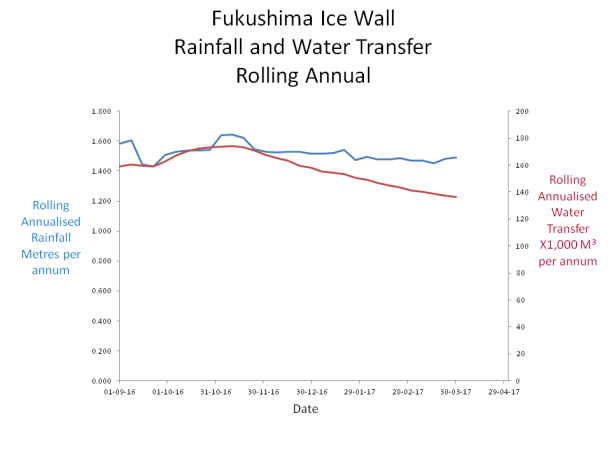
Within the scope of natural variance, the annualised rainfall at Fukushima shows no significant long term trend, being flat and circa 1.5 metres per year. The water transfer level does show some improvement and notwithstanding the slightly higher than average autumnal rains in 2016, water transfer levels are on the decline. Alas given the magnitude of that decline in relation to that hoped for by the ice-wall’s advocates to 50 tonnes per day, it was understandable that the NRA were rather less than impressed.
We also have to consider that our original correlation between rainfall and implied water ingress was conducted on all available data. The reality is several operational events were being executed over the period, such as the commencement of 24 hour pumping from inland relief wells with the aim of reducing groundwater around the stricken buildings, as well as the phased installation of the ice-wall itself. Thus our initial correlation is a composite of parallel events. If we reapply our linear relationship model on a rolling 12 monthly period, to exclude any rainfall seasonality, we see some interesting features, (Figure 5).
Figure 5

Had the ice-wall achieve a positive effect we should observed both a reduction in total amount of water transferred (y) being made up by a reduction in the overall basal flow (c) and of course a reduction in the recent rainfall component as reflected in a reduction of its independent variable (m). We see a reduction in apparent basal flow. As this reduction has occurred in isolation with the independent variable increasing over time, we can attribute reduction in ‘c’ in good measure to the impact relief wells. However, the overall amount of water being pumped out of the stricken buildings has remained high and it has done so because the aquifer has become more susceptible to the impact of recent rainfall. This suggests that the aquifer adjacent the site has become more porous and not less porous over the last few years. Had the ice-wall had a positive effect, a decline in the independent variable ‘m’ over time should be observed.
I would conjecture that if such is the case what could have caused this effect. It is possible that the installation of the coolant pipe-work has caused significant sub-soil disturbance, coupled with the degradation of the substrate rock texture by ground heave. The above should effectively have been self repaired when the ice-barrier froze. However, in this circumstance, owing to the size of the ice-wall and it lack of capacity to freeze the entire depth of the aquifer, it is likely that the aquifer disruption at its margins has resulted in increased porosity in the aquifer directly beneath the wall. Furthermore, given that the wall is incomplete and operating at the extent of its capacity, and that the site is subject to seasonal warming, and has had operational outages it is highly likely that the freeze thaw cycling peripheral to the ice-wall has cause deterioration to the aquifers subsoil texture and cohesion, thereby giving rise to localised increase porosity of the aquifer. As such I am not of the opinion that the installation of the ice-wall has had a ‘limited impact’. I believe it has had a ‘significant and negative impact’ on the porosity of the aquifer local to the site of contamination, and I believe it has added circa 20% to the volume of contaminated water generated since its installation.
But there again, that’s just one persons musings and opinion, and I dare say other will disagree and think I’m writing bollocks. Either way, I would be fascinated to see what “certain results” the TEPCO engineers saw. And if what they saw was good, I’d like a double of whatever they’d been drinking…
Kanpai
[1] 11 July 2016, ‘Fukushima’s Ice-Wall a Fridge Too Far’ Peter J. Hurley, Linkedin.com https://www.linkedin.com/pulse/fukushimas-ice-wall-fridge-too-far-peter-j-hurley
[2] December 27, 2016 Kohei T., The Asahi Shimbun ‘NRA: Ice wall effects ‘limited’ at Fukushima nuclear plant’: http://www.asahi.com/ajw/articles/AJ201612270056.html
[3] http://www.tepco.co.jp/en/nu/fukushima-np/handouts/index-e.html
New Study Points to Measurable and Significant Increase in Incidents of Thyroid Cancer

1 This Month

of the week – Shut Down Drone Warfare!


Tell the Ukrainian Government to Drop Prosecution of Peace Activist Yurii Sheliazhenko

Petition to revoke the licensing of the Near Surface Nuclear Disposal Facility (NSDF) at Chalk River. https://www.ourcommons.ca/petitions/en/Petition/Details?Petition=e-7247
To see nuclear-related stories in greater depth and intensity – go to https://nuclearinformation.wordpress.com
-
Archives
- April 2026 (7)
- March 2026 (251)
- February 2026 (268)
- January 2026 (308)
- December 2025 (358)
- November 2025 (359)
- October 2025 (376)
- September 2025 (257)
- August 2025 (319)
- July 2025 (230)
- June 2025 (348)
- May 2025 (261)
-
Categories
- 1
- 1 NUCLEAR ISSUES
- business and costs
- climate change
- culture and arts
- ENERGY
- environment
- health
- history
- indigenous issues
- Legal
- marketing of nuclear
- media
- opposition to nuclear
- PERSONAL STORIES
- politics
- politics international
- Religion and ethics
- safety
- secrets,lies and civil liberties
- spinbuster
- technology
- Uranium
- wastes
- weapons and war
- Women
- 2 WORLD
- ACTION
- AFRICA
- Atrocities
- AUSTRALIA
- Christina's notes
- Christina's themes
- culture and arts
- Events
- Fuk 2022
- Fuk 2023
- Fukushima 2017
- Fukushima 2018
- fukushima 2019
- Fukushima 2020
- Fukushima 2021
- general
- global warming
- Humour (God we need it)
- Nuclear
- RARE EARTHS
- Reference
- resources – print
- Resources -audiovicual
- Weekly Newsletter
- World
- World Nuclear
- YouTube
-
RSS
Entries RSS
Comments RSS
 nuclear-news