This short article is dedicated to a pro-nuke troll, whose alias is Octo.
Octo, should I indulge the reader, is usually present at the chat of the “Fukushima Diary” blog. He enjoys pushing his propaganda of how nuke is safe.
How Tepco is doing a terrific job at Fukushima Daiichi and is in total safety control of everything.
How radiation is now very low in Fukushima How the fish and seafood is now safe etc.
Everyone is believing his crap *cough*, but he, like all of the other bewildered, confused and baffled Japanese *experts? never gives up.
Watching this video, I am thinking about him and his continuous lies, and also all those other Japanese pro-nuke trolls that I encountered on internet in the past few years.
This video was shot last November 2016 South of Soma, it is the mountain trail to reach the Tetsuzan dam, a place approximately 20km from the Fukushima Daiichi nuclear plant.
I think all those disinformation spinners paid by Tepco, Dentsu or Government, whose job is to spread lies about the Fukushima disaster on blogs, forums and Facebook, should all go living up there, as they claim it is now completely safe.
They should breath the good air from Fukushima, eat everyday very safe Fukushima rice and vegetables, and of course eat also plenty of safe fish and seafood, and drink plenty Fukushima safe water.
I would give them only one word of advice :
“Don’t forget to smile,
Smile a lot everywhere and everyday, so that the radiation won’t affect you.”
Special credit to the Fukuichi Citizen Radiation Monitoring Project
Hitachi to take a 70 billion yen hit after U.S nuclear project fails, Asahi Shimbun By SATOSHI SEII/ Staff Writer February 2, 2017 Electronics giant Hitachi Ltd. is set to lose tens of billions of yen this fiscal year due to the withdrawal from a project to develop a new method of uranium enrichment by a joint venture in the United States.
The loss, forecast by Hitachi on Feb. 1, was disclosed shortly after Toshiba Corp. made a similar announcement last month of deficits brought on by its nuclear power business.
Hitachi is expected to report a 70 billion yen ($620 million) non-operating loss by the time books are closed for fiscal 2016 at the end of March, said Mitsuaki Nishiyama, a senior vice president of the Tokyo-based conglomerate, in a news conference on the company’s performance through the third quarter.
The deficit is largely attributed to the joint venture GE Hitachi Nuclear Energy Inc. withdrawing from the uranium enrichment project. Due to this decision, Hitachi no longer expects any profits from the North Carolina-based company, of which it owns 40 percent and the rest by General Electric.
After allocating the losses, the value of Hitachi’s share of the joint venture comes to only about 11 billion yen……
Hitachi and GE were expecting more nuclear power plants to be built when they launched the joint fuel enrichment business, but orders have been sluggish across the globe, forcing the project to be shelved……http://www.asahi.com/ajw/articles/AJ201702020042.html
US Congress orders review of Russian & Chinese leadership’s nuclear strike ‘survivability’ Rt.com 30 Jan, 2017 The US Congress has directed intelligence agencies and the Pentagon’s Strategic Command to evaluate the ‘survivability’ of Russian and Chinese leaders in the event of a nuclear strike on their aboveground and underground defense facilities.
The comprehensive study will be carried out by the US intelligence agencies as well as the Strategic Command, which is in charge of the American nuclear forces. They will evaluate whether the Russian and Chinese leadership could survive a nuclear attack and continue to operate in a post-strike environment, according to a little-reported section of the 2017 National Defense Authorization Act (NDAA). Read more
If we are in arms race, US started it by pulling out of ABM treaty – Putin
The review will include “an identification of which facilities various senior political and military leaders of each respective country are expected to operate out of during crisis and wartime,” as well as the “location and description of above-ground and underground facilities important to the political and military leadership survivability.
“Key officials and organizations of each respective country involved in managing and operating such facilities, programs, and activities” should also be identified, says the document, which is somewhat reminiscent of an elaborate war plan.
“Our experts are drafting an appropriate response,” Navy Captain Brook DeWalt, spokesman for the Strategic Command, said in an email to Bloomberg on Monday. While “it’s premature to pass along any details at this point, we can update you further at a later date.”
Although the study was ordered before Donald Trump took office, it appears to coincide with his statement that he would unconditionally support strengthening US strategic arsenals. In an incendiary tweet in December, Trump wrote that Washington “must greatly strengthen and expand its nuclear capability until such time as the world comes to its senses regarding nukes.”
Later in the month, Trump stunned arms control experts, reportedly telling Mika Brzezinski, co-host of MSNBC’s ‘Morning Joe’ program: “Let it be an arms race. We will outmatch them at every pass and outlast them all.”
Iran denies missile test breached nuclear deal,news.com.au 2 Feb 17IRAN has confirmed that it had tested a ballistic missile, but denied that was a breach of its 2015 nuclear deal with world powers.
The comments from Iran’s Defence Minister Hossein Dehghan came after the UN Security Council met on Tuesday to discuss the weekend test, which Washington described as “absolutely unacceptable”.
“The action was in line with boosting Iran’s defence power and is not in contradiction with the JCPOA (the nuclear deal) or Resolution 2231,” Mr Dehghan said.
He was referring to a UN Security Council resolution that bans Iran from developing missiles that can carry nuclear warheads.
“This test was in line with our ongoing programs,” Iranian media quoted him as saying.
“We have previously announced that we will execute the programs we have planned in production of defence equipment meant for our national interests and objectives. Nobody can influence our decision.
“We will not allow foreigners to interfere in our defence affairs.”
Iran’s ballistic missile program has been a bone of contention with the West since the nuclear deal took effect in January last year, triggering the lifting of international sanctions.
Iran says its missiles do not breach United Nations resolutions because they are for defence purposes only and are not designed to carry nuclear warheads………
The row comes against a backdrop of already strained relations between Washington and Tehran over US President Donald Trump’s travel ban on citizens from Iran and six other Muslim-majority countries.
Some 220 Iranian politicians signed a motion on Wednesday endorsing the boosting of Iran’s defence capabilities, the Fars news agency reported.
“The Islamic Republic of Iran’s only way to deter the enemy’s aggression is its missile power,” the motion said, calling the program “an unavoidable necessity” for protecting national security.
The European Union, which helped broker the nuclear deal, had appealed to Tehran to refrain from activities such as the missile tests, “which deepen mistrust.”
Visiting French top diplomat Jean-Marc Ayrault said on Tuesday he had made clear to Zarif his disquiet over the missile tests, calling them “contrary to the spirit” of the Security Council resolution.
Britain also said the test was “inconsistent” with UN resolutions, but stopped short of calling it a violation.
But Moscow, which is fighting alongside Tehran’s forces in Syria, leapt to its ally’s defence.
We are heading for a senseless nuclear Brexit – with no political or legal mandate https://www.theguardian.com/science/blog/2017/feb/01/brexit-nuclear-eu-euratom-treaty-clare-moody Clare Moody Our nuclear energy, safety and research must not be subjugated to already chaotic Brexit negotiations – the government must put the national interest first Clare Moody is Labour MEP for South West England & Gibraltar. 3 February 2017
Last week we learned just how hard and how ill-conceived Brexit looks like being. The two line parliamentary bill published by the government last Thursday contained no detail, no plan, and no check or balance on the prime minister’s possible negotiation as it progresses.
One thing that was included, albeit buried in the explanation notes, is a brief reference to also ending Britain’s membership of Euratom – an entirely separate treaty. The implications of this will be deep and far-reaching for the future of UK’s energy supply, science, industry and workers. There is no political or legal mandate for the UK to leave Euratom, in fact it was barely even a footnote in the referendum campaign, and yet we are heading for a nuclear Brexit.
Euratom matters for the UK. Signed in 1957 as the European Atomic Energy Community, it is a separate treaty from the EU with the purpose of creating a single market for nuclear knowledge and resources in the peaceful pursuit of science and nuclear energy.
Whilst currently its only full members are EU countries, it is in fact a legally separate organisation to the EU. The UK is a leading member of Euratom, and plays host to one of its most important research institutions – the Joint European Torus (JET), based in Culham, Oxfordshire. JET is performing extraordinary and groundbreaking research in the pursuit of fusion energy, and is part of an EU-wide project to deliver on the vision of this revolutionary, safe and clean energy source. On the way, new technologies, materials and expertise are being developed here.
Euratom also provides safeguarding inspections for all civilian nuclear facilities in the UK, including Hinkley Point B, Sizewell and Torness in Scotland. It is the legal owner of all nuclear material, and is the legal purchaser, certifier and guarantor of any nuclear materials and technologies that the UK purchases. This includes our nuclear trade with the United States.
This means that 21% of the UK’s electricity generation is based on our membership of Euratom. It means that EDF can rely on secure supply chains for construction at Hinkley Point C and it is responsible for safeguarding inspections. Whether people are in favour of nuclear fission power or not we can all agree we want it to be as safe as possible, which is why leaving Euratom makes no sense.
Our own regulating authorities are not equipped to take over all of Euratom’s safeguarding work in the UK, and any British scientist will tell you that their work depends on international collaboration that is facilitated by this treaty.
Given this, it is hard to overstate the effect leaving Euratom will have on the UK –and the British people did not give the government a mandate to leave Euratom.
I think this is a bad decision, poorly thought out and with no explanation as to how our safety will be protected. The government must start at some point to put the national interest ahead of narrow party interest and Euratom would be a good place to start. Euratom is a separate treaty and the government should have the gumption to treat it as such – it requires separate and detailed negotiations. Our nuclear energy, safety and research must not be subjugated to the already chaotic wider Brexit negotiations.
Staff ‘Overwhelmed’ at Nuclear Plant, but U.S. Won’t Shut It, NYT, 2 Feb 17 By KATHARINE Q. SEELYE, FEB. 1, 2017PLYMOUTH, Mass. — One by one, ordinary residents confronted the federal regulators, telling them during a three-hour meeting Tuesday night that the Pilgrim Nuclear Power Station here was not safe and should be shut down.
Europe should act fast to preserve the Iran nuclear deal, Bulletin of the Atomic Scientists, Ellie Geranmayeh, 2 FEBRUARY 2017 US President Donald Trump has stirred all kinds of controversy with European allies during his first fortnight in office. Now, his administration’s evolving policy on Iran is becoming another source of concern across the Atlantic. Europe has a crucial but short window to clearly outline its position on the Iran nuclear deal in ways that could influence policymakers in Washington. In doing so, Europe should focus on preserving the agreement under existing terms as enshrined by the United Nations, and charting a course that minimizes confrontation—whether intentional or accidental—between Iran and the United States in an already turbulent Middle East.
On Wednesday, new National Security Advisor Michael Flynn declared that the United States was “putting Iran on notice.” While it is not clear what exactly he meant, he also criticized Iran’s missiles tests and behavior in the region, calling Tehran’s actions “provocative” and staking out a US position distinctly different from those of Europe and Russia. Although Flynn didn’t directly attack the nuclear deal reached between Iran and six world powers in July 2015, a war of words could easily escalate in ways that threaten it.
The Iran nuclear deal, also known as the Joint Comprehensive Plan of Action (JCPOA), scaled back the country’s nuclear activities in exchange for sanctions relief. As a presidential candidate, Trump suggested he would “dismantle the disastrous deal” or renegotiate it. As president-elect he condemned the deal, but has since said he would “rigorously” enforce it. And during a White House briefing the same day as Flynn’s comments, US officials stressed “that they were not linking Iran’s missile and regional actions to the nuclear deal at this point,” as Al-Monitor reported. On Thursday, though, Trump tweeted that Iran “should have been thankful for the terrible deal the U.S. made with them.” Going forward, it seems likely that Trump’s calculations over the nuclear deal and sanctions will be influenced by developments on non-nuclear issues and also events abroad—among Russia, US allies in Europe, the Gulf Arab states, and Israel.
An early test of the US administration’s stance will come this spring, when the president is required to renew sanctions waivers that enable non-US companies to do business with Iran, in accordance with the terms of the nuclear deal. ……
The Iran nuclear deal steered the United States and its allies away from resorting to yet another futile military encounter in the Middle East. It was never intended to solve every problem between the West and Iran, and the two sides continue to take opposing views on a number of critical issues. However, the agreement has proven that Iran and the West have the capacity to resolve complex security challenges through a transactional relationship if there are mutually beneficial outcomes. Instead of watching Tehran and Washington relapse into the rhetoric of war and conflict, Europe should encourage them to build on this winning formula. http://thebulletin.org/europe-should-act-fast-preserve-iran-nuclear-deal10488
Iran tested nuclear-capable cruise missile: German newspaper http://www.reuters.com/article/us-iran-missiles-cruise-idUSKBN15H0WR?il=0Feb 2, 2017 Iran has tested a cruise missile called “Sumar” that is capable of carrying nuclear weapons in addition to test-firing a medium-range ballistic missile on Sunday, German newspaper Die Welt reported Thursday, citing unspecified intelligence sources.
No comment was immediately available from Germany’s BND foreign intelligence agency or from Iranian authorities.
The newspaper said the Sumar cruise missile was built in Iran and traveled around 600 km in its first known successful test. The missile is believed to be capable of carrying nuclear weapons and may have a range of 2,000 to 3,000 km, the paper said, citing intelligence sources.
Cruise missiles are harder to counter than ballistic missiles since they fly at lower altitudes and can evade enemy radar, confounding missile defense missiles and hitting targets deep inside an opponent’s territory.
But the biggest advantage from Iran’s point of view, a security expert told Die Welt, was that cruise missiles are not mentioned in any United Nations resolutions that ban work on ballistic missiles capable of carrying nuclear weapons.
International sanctions on Tehran were lifted in January last year under a nuclear deal brokered in 2015 by Britain, France, Germany, China, Russia and the United States.
Under the nuclear deal Iran agreed to curb its nuclear program in exchange for lifting of most sanctions. According to a 2015 U.N. resolution endorsing the deal, Iran is still called upon to refrain from work on ballistic missiles designed to deliver nuclear weapons for up to eight years.
News of Iran’s reported cruise missile test came hours after Washington said it was putting Iran “on notice” for its ballistic missile test and signaled that it could impose new sanctions.
Iran confirmed on Wednesday that it had test-fired a new ballistic missile, but said the test did not breach the Islamic Republic’s nuclear agreement with world powers or a U.N. Security Council resolution endorsing the pact.
(Writing by Andrea Shalal, Addirional reporting by Parisa Hafezi in Ankara; editing by Ralph Boulton)
DOOMSDAY DUNGEONS/ (PICTURES) Inside the nuclear bomb shelters being installed throughout Texas as residents prepare for global apocalypse. The bunkers range from £31,000 to £6.6million THE SUN, BY SAM WEBB 2nd February 2017
AMERICANS fearing that society is going to collapse or President Trump will spark a nuclear war have been investing in bunkers to ride out the apocalypse.
Sales of the mini-fortresses have spiked since the divisive billionaire took the reins – and terrified families are taking steps to survive Armageddon……..
Depending on the model, the shelters can offer basic amenities like a bed, kitchen, toilet and shower to an underground mansion with dozens of separate apartments, garden rooms for growing fresh fruit and veg, a games room, sauna, pool, power generator and gym…….
In recent months sales of the most luxurious bunkers have jumped 700 per cent.
Trump, Russia take a dangerous first step on nuclear arms control, The Hill, BY RICHARD NEPHEW AND ADAM MOUNT, 2 Feb 17In a recent interview with the the London Times, Donald Trump suggested that he would offer to lift U.S. sanctions over Russia’s invasion of Ukraine as part of a nuclear arms control agreement.
At a time when tensions between the two countries are growing, a verifiable and stabilizing new arms control agreement would be genuinely welcome. But a bad deal would only make matters worse.
The comments about sanctions relief raise real questions about whether the incoming administration is willing to pay any price to improve relations with Russia (and why).
Today, both countries are making investments to replace nuclear systems that were first fielded during the Cold War. An agreement to limit these modernization plans could save money, stabilize the nuclear balance, and be safer to maintain and operate.
Under President Obama, the United States found that it could meet its deterrence requirements after a further one-third reduction in deployed strategic warheads, beyond what was agreed in the New Strategic Arms Reduction Treaty (New START) in 2010, and offered this deal to Russia.
A new arms control agreement would be difficult to achieve today. Putin declined Obama’s one-third offer and has signaled that he is not willing to negotiate over his most dangerous systems, its vast and opaque stocks of low-yield and short-range weapons.
At the same time, Russia has violated the 1987 Intermediate-Range Nuclear Forces (INF) Treaty by developing a new prohibited cruise missile and indicated no real willingness to address the concerns of the United States and other treaty participants. Arms control accords are among the most consequential and the most difficult negotiations in the world, features that will surely attract Trump — but changing Putin’s position will be a very tall order. …….http://thehill.com/blogs/pundits-blog/foreign-policy/317403-trump-russia-take-a-dangerous-first-step-on-nuclear-arms
the nuclear manufacturers—Westinghouse and General Electric—.. refuse to participate in any project unless they are guaranteed to be free of any liability for any offsite accident consequences. If they believed the NRC risk calculations, they would have no difficulty in accepting the litigation risk—but they obviously don’t. In short, the organizations most highly knowledgeable about nuclear safety don’t trust the NRC’s probabilistic calculations………
A definition of risk that placed greater emphasis on avoiding large-consequence events would be more in line with the common sense of the public whom the NRC is supposed to be protecting. If nuclear power is to have any long-term future, it will have to go beyond even that level of protection….Just as the nuclear manufacturers don’t want to bet their companies on calculations of nuclear safety, neither do people at large want to bet their cities and countrysides.
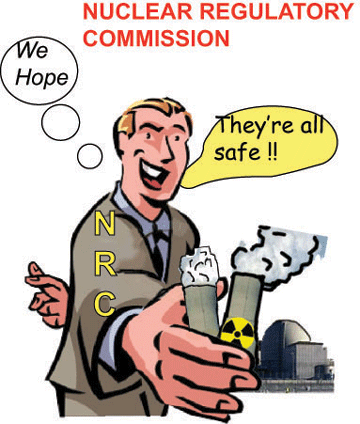
When 10,000 square miles of contamination is an acceptable risk: The NRC’s faulty concept, Bulletin of the Atomic Scientists, 9 JANUARY 2017 Victor Gilinsky In making safety decisions, the Nuclear Regulatory Commission uses accident probability calculations that are much more optimistic than anything that nuclear manufacturers like General Electric and Westinghouse actually believe. The result is weak public protection. A good example is the NRC commissioners’ rejection in 2014 of a proposal to limit the possible severe consequences of spent fuel pool fires in nuclear power plants because the proposal’s cost, however modest, exceeded the value of the expected reduction in “risk.”
Spent fuel pools are where highly radioactive (and thus thermally hot) used reactor fuel is stored after it is removed from the reactor core. If a pool loses its water supply, the spent fuel can overheat and eventually burn, releasing large quantities of radioactivity. The spent fuel pool issue gained prominence after the 2011 Fukushima accident. For a time during the accident the dominant concern was that spent fuel in Fukushima’s damaged Unit 4 pool might catch fire. It didn’t happen, but it could have multiplied the effects of the catastrophic Fukushima accident manyfold. The NRC staff told the commissioners in 2014 that a worst-case spent fuel pool fire in a US plant like those at Fukushima—of which there are nearly three dozen—could release 25 times more long-lasting radioactivity than escaped from the Fukushima reactor vessels, and perhaps even more. Such a release could render 10,000 square miles uninhabitable and (around the Pennsylvania nuclear plant the staff chose as an example) could require the evacuation of 4 million persons.
The specific proposal before the commissioners was to limit the amount of radioactive spent fuel in a pool and thus to reduce the consequences of a fire by a factor of ten. This would be accomplished by speeding up the transfer of radioactive spent (used) fuel from the pool into “dry cask” storage. The plant owners have to do this eventually, but earlier transfers increase the cost. The commissioners saw their role as deciding whether the safety benefit—the reduction in risk—warranted this cost increase.
In fact, they weren’t deciding anything. The commissioners lent an air of official seriousness to the proceeding, but the decision making was on autopilot. It involved calculating the average risk (R) of an accident by multiplying two numbers, the accident’s probability (P) and its consequence (C). If P is sufficiently small, the average risk (or P times C) will be negligible no matter how large the consequence. And, therefore, the possible reduction in risk will hardly be worth any expenditure. That is how it worked in the 2014 case of a possible spent fuel fire, and that is how it has worked in most cases involving protection against severe accidents.
Actually, most cases don’t get this far. The commission has a threshold for the staff to investigate a safety issue posed by a hypothetical accident. If the estimated probability of “prompt” deaths offsite is below 2 in 1 million per year, the NRC staff need not investigate further. This involves a kind of Catch-22. The NRC assumes effective evacuation of the surrounding area in the event of an accident, so there aren’t people to be irradiated, and even substantial accidents don’t exceed the commission’s threshold……..
Consider the implications of NRC’s risk definition for the risk of long-term land contamination: The NRC staff’s projection of about 10,000 square miles, when multiplied by the staff-estimated accident probability, becomes an annual risk of about one-thousandth of a square mile, or less than an acre per year. Since valuable farmland runs at several thousand dollars per acre, the NRC conclusion is that any safety improvement that costs more than that isn’t worthwhile in terms of saving land. Similarly, the risk of displacing persons, becomes about half a person displaced per year, perhaps at a cost of tens of thousands of dollars, and so, again, per NRC logic, it is not worth spending more than that to avoid long-term evacuations to protect against severe spent fuel pool fires. This isn’t the conclusion most people would arrive at for themselves or their home towns.
There are several things wrong with the NRC’s cost-benefit approach to nuclear safety. To begin with, neither factor in the risk formula—probability times consequence—can be calculated with any accuracy. For example, the consequences of an accident requiring the long-term, possibly permanent, evacuation of 4 million will surely not be limited to the expense of such an evacuation. It would, for example, almost certainly spell the end of nuclear power use in the United States and likely in many countries, with huge economic consequences. …….
Nor is the situation much better when it comes to estimating the accident probability. As there is little data on large accidents, the accident probability is a calculated number. The NRC staff relies increasingly on elaborate calculations that model the various failure modes of a nuclear plant. For outsiders, or for that matter the NRC commissioners themselves, the result essentially comes out of a black box. …..
Which brings us to a deep flaw in NRC’s safety methodology—its reliance on the average risk as the figure of merit. It is by no means the only possible measure of risk. We know that in many statistical situations the average is not the best choice to characterize the data. It works where there are well-established data on both probabilities and consequences as, for example, in considering measures to reduce auto accidents. It doesn’t make sense for high consequence/low probability events, for one thing, because the numbers are so poorly known. Also, using average risk doesn’t reflect what most people—the people the NRC is supposed to be protecting—want to achieve. They don’t want to risk losing a city, no matter what the calculated probabilities. That is how the nuclear manufacturers—Westinghouse and General Electric—see it, too. They refuse to participate in any project unless they are guaranteed to be free of any liability for any offsite accident consequences. If they believed the NRC risk calculations, they would have no difficulty in accepting the litigation risk—but they obviously don’t. In short, the organizations most highly knowledgeable about nuclear safety don’t trust the NRC’s probabilistic calculations………
Any change in the NRC’s approach to nuclear risk must come from the outside; the agency has too much invested in the current approach for internal reform to have a chance. When a witness at the 2014 Commission meeting on spent fuel pool fires, Clark University professor Gordon Thompson, questioned using the average risk as the figure of merit, only one commissioner took notice and that was to ridicule the notion. The commissioners should have paid more attention.
A definition of risk that placed greater emphasis on avoiding large-consequence events would be more in line with the common sense of the public whom the NRC is supposed to be protecting. If nuclear power is to have any long-term future, it will have to go beyond even that level of protection. A 2012 report of the American Society of Mechanical Engineers, a group heavily involved with the nuclear industry, called for a major step-up in nuclear safety and warned that severe accident impacts on people’s lives were “wholly inconsistent with an economically viable and socially acceptable use of nuclear energy.” Just as the nuclear manufacturers don’t want to bet their companies on calculations of nuclear safety, neither do people at large want to bet their cities and countrysides. http://thebulletin.org/when-10000-square-miles-contamination-acceptable-risk-nrc%E2%80%99s-faulty-concept10459
Swiss to vote on government’s anti-nuclear energy strategy, The Local, 2 Feb 17, The Swiss people will go to the polls on May 21st to decide whether the government’s ‘energy strategy 2050’ should go ahead.
The policy, which will instigate a gradual withdrawal from nuclear power in favour of renewable resources, is opposed by the right-wing Swiss People’s Party (SVP) which in October launched a campaign to gather enough signatures to force a referendum on the matter.
On Tuesday the government confirmed that the SVP had gathered 68,390 valid signatures, well over the necessary threshold of 50,000, reported news agencies.
Consequently, in May the Swiss people will get the chance to have their say on the government’s energy plans.
The Energy Strategy 2050 was devised following the Fukushima nuclear disaster in 2011 and is spearheaded by energy minister and current Swiss President Doris Leuthard.
Under the plans no new nuclear power plants will be built in Switzerland and the five that do exist – including the world’s oldest operating reactor, Beznau I – will be decommissioned at the end of their technically safe operating life.
Strong response on Nuclear – Eskom , AFRICAN NEWS AGENCY 1 February 2017 Johannesburg –Eskom said on Wednesday that it was receiving positive response from the market to the Request for Information (RFI) issued in relation to the proposed South African Nuclear New Build Programme.
The power utility said some 27 companies had stated that they intended to provide a response to the RFI, including major nuclear vendors from China (SNPTC), France (EdF), Russia (Rosatom Overseas) and South Korea (KEPCO).
Eskom’s interim group chief executive Matshela Koko said: “Eskom is looking forward to the information supplied to confirm our understanding of the key issues that impact the timing and affordability of a nuclear programme.”……
Eskom issued the RFI on its website in December 2016 and asked companies that felt they could provide relevant information to confirm by January 31 that they would be submitting a response to it.
Cabinet in June designated Eskom as the procurer, owner and operator for the multi-million rand nuclear build programme to initially provide 9.6 gigawatts of nuclear energy at least by 2030.
But according to the base case scenario in the Integrated Resource Plan unveiled by Energy Minister Tina Joemat-Pettersson in November, only 1 359 megawatt of nuclear power would be added to the country’s energy mix by 2037 and the volume of renewable energy would rise significantly.
¶ “Surge in electric cars may blindside big oil” • Oil companies are underestimating the global market for electric vehicles and could be caught unaware by weakened demand for petrol within a decade, according to a report, jointly issued by financial think tank Carbon Tracker and the Grantham Institute, both based in London. [Guardian]
¶ “Moving Backward On Fuel Economy Standards Is A Bad Deal For America” • Automaker CEOs apparently lobbied President Trump to weaken strong fuel economy standards during a White House summit. Moving backward on fuel economy standards, however, would threaten our health, energy security, jobs, and investments. [CleanTechnica]
¶ “New coal plants wouldn’t be clean, and would cost billions in taxpayer subsidies” • Major Australian energy companies have ruled out building coal plants. The Australian Energy Council sees them as “uninvestable.” Banks…
Although a court case against the project will not be heard until end February, the South African government has announced that Rosatom (Russia), KEPCO (S. Korea), EDF (France), China State Nuclear Power Technology – all majority owned by their respective governments- have expressed interest in a South Africa Nuclear Power project, demonstrating that nuclear power is non-competitive in a free market. Nuclear Power can, and has only, survived due to taxpayer and ratepayer subsidies. Although the South African government alleges that 27 companies have expressed an interest, probably most are either subsidiaries of the above companies, or other government owned nuclear entities. Additionally, this number might include contractors and subcontractors to the above. Japan’s Toshiba, which owns Westinghouse, has announced that it wants to get out of the nuclear power business. Toshiba is not government owned, and nuclear energy has proven a money-losing endeavor.











 nuclear-news