¶ “Not just Toshiba – the global nuclear industry is in crisis everywhere” • The collapse of Toshiba, the direct result of its failing nuclear ventures, is indicative of a crisis faced by nuclear contractors and utilities worldwide. Another sign of the poor outlook for the industry: no major commodity had a worse 2016 than uranium. [The Ecologist]
Moorside nuclear complex (Image: Nugen)
Science and Technology:
¶ As the global climate heats up, so do Alaskan ocean waters, meaning big changes for marine ecosystems and bad news for some species. Scientists gathered in Anchorage last week for the Alaska Marine Science Symposium to review new research probing those changes and what may be ongoing shifts in the marine ecosystem. [Homer Tribune]
World:
¶ A new report from The Economist Intelligence Unit has concluded that Europe’s coal consumption has been in long-term decline, and the region’s…
The local communities that will be most impacted when the Indian Point nuclear power plant closes in five years have been left with few answers regarding several critical issues including tax stabilization, job losses and environmental concerns. The Town of Cortlandt and local villages were blindsided by last month’s announcement that the plant would close more than a decade earlier than planned, and NY Governor Cuomo’s office has yet to present an action plan to address detrimental impacts to residents and businesses.
Town of Cortlandt Supervisor Linda Puglisi and Hendrick Hudson School District Superintendent Joe Hochreiter have expressed continued disappointment at not being given advanced notice about losing the largest tax payer in the area. “The Entergy [plant owner] CEO just told us that they needed to keep it confidential, not an adequate response to us since we are the main stakeholders,” Ms. Puglisi said in a statement.
Indian Point has the capacity to generate about 2,000 megawatts of electricity – about 25% of the power consumed by New York City and Westchester County – and employs 1,200 permanent workers, along with hundreds of contractors and part-time employees. The loss of these jobs will have knock-on effects for local businesses.
The Lasting Effects of Pope Francis’ Climate Change Edict
New research finds thinking about the pontiff changes the way we frame the issue.
By Tom Jacobs
(Photo: Gregorio Borgia/AFP/Getty Images)
Last fall, a study reported that Pope Francis’ much-discussed encyclical on climate change largely fell on deaf ears. Researchers from Texas Tech University found the appeal “failed to rally any broad support on climate change” among Americans, whether or not they were Catholic.
But newly published research suggests the pontiff’s call for taking care of the Earth has had a more subtle impact on American public opinion. It finds brief exposure to a photograph of the pope “increased perceptions of climate change as a moral issue.”
What’s more, this shift in how the issue is perceived was particularly strong among Republicans — a group that has traditionally been resistant to acknowledging the fact that humans are affecting the Earth’s climate in dangerous…
Throughout the record global heat of 2016 and on into 2017, the world’s sea ice has taken a merciless pounding.
In the Northern Hemisphere, extreme warming of the polar region pushed Arctic sea ice extents to record low daily ranges throughout the winter, spring and fall of 2016. And even today, after many months of daily record lows, sea ice in the Arctic remains more reduced (in most measures) than it has ever been for this time of year.
On the other side of the world, the story is much the same. For it now appears that the ocean region around Antarctica is about to experience an all-time record annual low for sea ice:
(JAXA Antarctic sea ice measure for all years since 1978 shows a strong challenge to the previous record low for extent set in 1997 [lower left hand corner of the graph]. With 2-4…
Toshiba – OUT OF INDIA
In India, Westinghouse has also been in talks with state-owned Nuclear Power Corporation of India about a contract to build six AP1000s, a project strongly backed by both Prime Minister Narendra Modi and former US President Barack Obama.
The three sources said that was now almost impossible.
“The Indian government was happy to have one sole counterpart, but this cannot continue,” the first source said, adding that either an Indian civil engineering group or a foreign, possibly American, group would have to step in to negotiate, oversee and eventually finance the project.
Westinghouse would instead just provide nuclear equipment, the source said.
Representatives for India’s state-run nuclear body and the Ministry of External Affairs did not immediately respond to requests for comment.
Westinghouse has traditionally been a builder of nuclear reactors, not entire nuclear power plants including steam turbines, generators and transformers.
But as tightening safety regulations following Fukushima made building nuclear plants more expensive, nuclear reactor builders and their shareholders have been increasingly forced to take on the civil engineering side too.
The source said Westinghouse will return to its roots as a nuclear specialist, while Toshiba will stop taking on projects to build entire nuclear plants just so that Westinghouse can sell its AP1000 reactors.
“Toshiba will withdraw from being a general contractor for nuclear plants,” the source said.
The nuke biz is going down like dominoes. Hitachi announces a nearly $6.2 billion loss on its U.S. uranium enrichment joint effort with GE.
Electronics giant Hitachi Ltd. is set to lose tens of billions of yen this fiscal year due to the withdrawal from a project to develop a new method of uranium enrichment by a joint venture in the United States.
The loss, forecast by Hitachi on Feb. 1, was disclosed shortly after Toshiba Corp. made a similar announcement last month of deficits brought on by its nuclear power business.
Hitachi is expected to report a 70 billion yen ($620 million) non-operating loss by the time books are closed for fiscal 2016 at the end of March, said Mitsuaki Nishiyama, a senior vice president of the Tokyo-based conglomerate, in a news conference on the company’s performance through the third quarter.
The deficit is largely attributed to the joint venture GE Hitachi Nuclear Energy Inc. withdrawing from the uranium enrichment project. Due to this decision, Hitachi no longer expects any profits from the North Carolina-based company, of which it owns 40 percent and the rest by General Electric.
After allocating the losses, the value of Hitachi’s share of the joint venture comes to only about 11 billion yen.
Despite the gloomy news, Nishiyama said that “there are no more large deficit risks.”
Hitachi and GE were expecting more nuclear power plants to be built when they launched the joint fuel enrichment business, but orders have been sluggish across the globe, forcing the project to be shelved.
Nevertheless, Hitachi will be sticking with its nuclear power business. The company said that it plans to proceed with its project to build a plant in Britain by ensuring costs are thoroughly managed.
The writing is on the wall. Ban uranium mining now: “Tepco’s termination of the contract would affect about 9.3 million pounds of uranium deliveries through 2028, worth about $1.3 billion in revenue.”
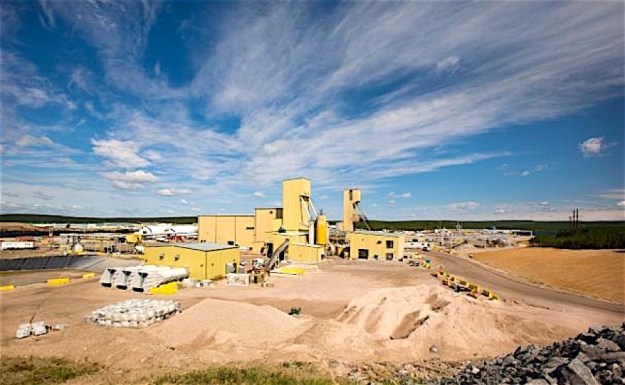
Cigar Lake, in northern Saskatchewan, Canada, is the world’s highest-grade uranium mine.
Uranium miner Cameco (TSX:CCO; NYSE:CCJ) is weighing its options after a key Japanese customer attempted to cancel its contract, which would mean $1.3 billion in lost revenue for the Canadian company.
Tokyo Electric Power Company Holdings (TEPCO), the operator of Japan’s wrecked Fukushima nuclear plant, issued a termination notice for a uranium supply contract on Jan. 24 and, earlier this week, it said it would not accept a delivery that was scheduled for Feb.1.
Such contract cancellation would affect about 9.3 million pounds of uranium deliveries through 2028, including about 855,000 pounds annually in 2017, 2018 and 2019, Cameco said.
Shares collapsed on the news. They were trading down 12.5% to Cdn$14.50 in Toronto at 1:00 pm, and 13.3% down in New York to $11.06 at 1:26 pm ET.
Cameco said the Japanese power company has cited forces beyond its control — specifically government regulations arising from the 2011 Fukushima nuclear accident — that have prevented the operation of its nuclear plants.
The Canadian firm insisted that there’s no basis for terminating the contract and considers TEPCO to be in default. It said it will pursue its rights — including binding arbitration.
“We are surprised and disappointed that TEPCO is seeking to terminate its contract given all the past productive discussions we have had to date,” Cameco’s president and CEO Tim Gitzel said in the statement.
The company noted it has sufficient financial capacity to manage any loss of revenue in 2017 as a result of the dispute.
Including income coming from TEPCO, Cameco expects 2017 earnings will range between $2.1 billion to $2.2 billion. More information on the uranium miner’s financial position will be released next week.
A recent study led by scientists at the Department of Energy’s SLAC National Accelerator Laboratory helps describe how the contaminant cycles through the environment at former uranium mining sites and why it can be difficult to remove. Contrary to assumptions that have been used for modeling uranium behavior, researchers found the contaminant binds to organic matter in sediments. The findings provide more accurate information for monitoring and remediation at the sites.
The results were published in the Proceedings of the National Academy of Sciences.
Uranium was removed from the sites as part of the cleanup process, and the former mines and waste piles were capped more than two decades ago. Remaining uranium deep in the subsurface under the capped waste piles was expected to leave these sites due to natural groundwater flow. However, uranium has persisted at elevated levels in nearby groundwater much longer than predicted by scientific modeling.
In an earlier study, the SLAC team discovered that uranium accumulates in the low-oxygen sediments near one of the waste sites in the upper Colorado River basin. These deposits contain high levels of organic matter—such as plant debris and bacterial communities.
During this latest study, the researchers found the dominant form of uranium in the sediments, known as tetravalent uranium, binds to organic matter and clays in the sediments. This makes it more likely to persist at the sites. The result conflicted with current models used to predict movement and longevity of uranium in sediments, which assumed that it formed an insoluble mineral called uraninite.
Different chemical forms of the element vary widely in how mobile they are—how readily they move around—in water, says Sharon Bone, lead author on the paper and a postdoctoral researcher at SSRL, a DOE Office of Science User Facility.
Since the uranium is bound to organic matter in sediments, it is immobile under certain conditions. Tetravalent uranium may become mobile when the water table drops and oxygen from the air enters spaces in the sediment that were formerly filled with water, particularly if the uranium is bound to organic matter in sediments rather than being stored in insoluble minerals.
“Either you want the uranium to be soluble and completely flushed out by the groundwater, or you just want the uranium to remain in the sediments and stay out of the groundwater,” Bone says. “But under fluctuating seasonal conditions, neither happens completely.”
This cycling in the aquifer may result in the persistent plumes of uranium contamination found in groundwater, something that wasn’t captured by earlier modeling efforts.
“For the most part, uranium contamination has only been looked at in very simple model systems in laboratories,” Bone says. “One big advancement is that we are now looking at uranium in its native environmental form in sediments. These dynamics are complicated, and this research will allow us to make field-relevant modeling predictions.”
The study combined the expertise of researchers at SLAC, Pacific Northwest National Laboratory and the Canadian Light Source. The research team used a blend of techniques to analyze samples of sediments in the experiment. They performed X-ray spectroscopy at SSRL to identify the chemical form of uranium. Capabilities at the Canadian Light Source and at the Environmental Molecular Science Laboratory (EMSL) at Pacific Northwest National Laboratory were used to map the locations of the elements in the samples at the nanometer scale. This additional information allowed the researchers to determine whether or not the uranium was bound to carbon-containing, or organic, materials. SSRL and EMSL are DOE Office of Science User Facilities.
The DOE Office of Science funded the project.
Citation: Bone et al., Proceedings of the National Academy of Sciences, 09 January 2017 (doi: 10.1073/pnas.1611918114)
SLAC is a multi-program laboratory exploring frontier questions in photon science, astrophysics, particle physics and accelerator research. Located in Menlo Park, Calif., SLAC is operated by Stanford University for the U.S. Department of Energy’s Office of Science.
SLAC National Accelerator Laboratory is supported by the Office of Science of the U.S. Department of Energy. The Office of Science is the single largest supporter of basic research in the physical sciences in the United States, and is working to address some of the most pressing challenges of our time. For more information, please visit science.energy.gov.
Russia is prepared to provide all of the funding required for Hungary’s Paks nuclear power plant expansion project, President Vladimir Putin told journalists in Budapest yesterday, following talks with Hungarian Prime Minister Viktor Orban. A transcript of the press briefing was posted on the Russian presidential website.
An inter-governmental agreement signed in early 2014 would see Russian enterprises and their international sub-contractors supply two new units at Paks – VVER-1200 reactors – as well as a Russian state loan of up to €10.0 billion ($11.2 billion) to finance 80% of the project.
“The project costs €12 billion, 80% of which was supposed to come from a Russian loan. I apprised the prime minister of other options. We are prepared to finance 100% of it, but then the terms and conditions of the agreement should be slightly different. We can do this as well,” Putin said, according to the transcript.
The project will create 10,000 “new well-paid high-tech jobs”, he said, adding it would improve Hungary’s energy security and help grow its economy.
Russia places “great importance”, he said, on the Paks II construction project, which is being managed by state nuclear corporation Rosatom.
Paks currently comprises four Russian-supplied VVER-440 pressurized water reactors, which started up between 1982 and 1987.
The existing Paks plant “has been operating for a long time in Hungary”, he said, “and today produces close to 40% of all electricity produced in that country”.
The launch of the two new units will “make it possible to double electricity production and satisfy the demand for electricity that is essential in order to develop new production facilities in Hungary”, he added.
The European Commission cleared Hungary’s award of a contract to Rosatom to build the two new units at Paks in November last year. It had been examining until recently two matters related to Paks II – procurement and whether funding of the project amounts to state aid. On 17 November, it closed the infringement procedure it had launched against Hungary over public procurement rules in connection with the project, but it is still investigating whether there is state aid.
Orban referred to the remaining EU approval required for the project.
“One issue remains open and we are waiting for an EU decision on it. We are convinced that our agreements are fully in compliance with EU requirements and we very much hope that this year we will be able to begin preparations and go ahead with construction in 2018,” he said.
“We are waiting for the construction work to finally begin, because what kind of nuclear power station is it that everyone is talking about but no one has seen? They haven’t even dug the first hole yet. We are waiting for work to start.”
But Orban also said that a review of the 2014 intergovernmental agreement “is not currently on the agenda”.
He added: “We want to go ahead with what President Putin and I signed previously.”
Project company MVM Paks II received an environmental licence in late September and in October submitted a site licence application for the two new units.
Pretoria – France has a “trump card” up its sleeve to help South Africa afford the planned giant nuclear power plant project – and therefore to help France win the bid.
Visiting French Minister of Economy and Finance Michel Sapin met his SA counterpart Pravin Gordhan on Friday.
He explained to Gordhan that “France has the capacity to finance and bring guarantees to the financing of this [nuclear] project.”
Sapin was asked at a press conference if Gordhan had told him that the fleet of reactors – which could be as many as six and could cost at least one trillion rand – was affordable.
Gordhan is believed to have strong reservations about the affordability of the project and this is thought to be a major bone of contention between him and President Jacob Zuma.
Sapin said it was legitimate that the SA government was asking questions about the affordability of the project. But if one assessed electricity consumption in the country it was clear there would be a need for more electricity in coming years.
The SA government had told him several companies had the capacity to answer the government’s “request for information” and its “request for proposals” to build the power plants.
He said he had reminded the SA government of the quality and the know-how of the French companies in nuclear energy sector.
“I explained to the minister that France has the capacity to finance and bring guarantees to the financing of this project. There are several important aspects of the French offer, its technical quality and also the way the French offer will fit into the South African socio-economic balance, and how it will respond to the needs of South Africa.”
He added that he had asked Gordhan to maintain “full transparency on the process” with France.
“France is not afraid of competition and is not afraid of transparency. The best for South Africa should win. And we have trump cards up our sleeve to be able to meet those challenges.”
Sapin’s request to Gordhan seemed to refer to the persistent rumours in South Africa that Zuma had already given the nuclear contract to Russia and that his government is just going through the motions of requesting bids from other countries.
But Sapin said he believed the competition for the contract was still open and still at the very beginning and that it would be fair.
He also explained that the two French companies involved in the bid, EDF (Electricité de France) and Areva, who were working on the project together, had not yet responded to the SA government’s request for information because the deadline for doing so had not yet expired. “But they will. And they have the will to win the contest.”
(Bloomberg) — Whoever succeeds Francois Hollande as France’s president may find one of their first tasks in office will be selling off some of the nation’s prized assets to prop up the state’s nuclear industry.
That’s because the government is as much as 3 billion euros ($3.2 billion) short of the 7.5 billion euros it has said it needs this year to fix the financial problems of Areva SA and Electricite de France SA, said two government officials with direct knowledge of the matter. Hollande will try to find an answer before he leaves office in June, one of the people said. If he can’t, his successor must decide how to plug the gap, said the other person.
France is preparing to rescue its nuclear industry after EDF was weakened by falling European power prices and Areva lost billions on a long-delayed project in Finland. The president must either increase the national debt or weigh politically sensitive privatizations of holdings in anything from automakers such as Renault SA to the former phone monopoly — a tall order with the first round of presidential elections just three months away.
“It’s not that simple to raise these funds, either because of market conditions or for strategic or social reasons,” said Senator Maurice Vincent, a member of the ruling Socialist Party who sits on the finance committee. “Half of the holdings are in the depressed energy sector which needs to be bailed out, and a quarter is in the defense sector where you have limited divestment leeway, so that doesn’t leave much wiggle room.”
While the government has enough in its privatization account for the 3 billion-euro stimulus it plans for EDF this quarter, it remains almost 3 billion euros short of the 4.5 billion euros it wants to help its near-bankrupt reactor maker, Areva, complete its restructuring and meet debt repayments this year, said the officials. Areva shareholders on Friday voted in favor of a 5 billion-euro state-backed bailout, which includes 500 million euros from Japanese investors.
Energy Security
France depends on nuclear reactors for about three-quarters of its electricity, and the two state-controlled companies were supposed to be leading the charge to export the technology around the world. All three leading presidential candidates have said they will support the nuclear industry, at least in the medium term, as the best guarantee of energy security and a low-carbon future.
Hollande’s spokesman didn’t answer messages seeking comment for this story. Representatives of Francois Fillon, the Republican Party candidate, Socialist Benoit Hamon and Emmanuel Macron, an independent, also declined to comment.
Marine Le Pen of the National Front wouldn’t sell state assets but instead ask state-controlled Caisse des Depots et Consignations to invest in Areva, her economic adviser Bernard Monod said in a text message.
The winner of the election runoff due May 7 faces a difficult choice between increasing the national debt or selling stakes in public companies, valued at a total of about 90 billion euros. While the government owns a piece of everything from the postal service to carmakers Renault and PSA Group, manufacturer of Citroen and Peugeot, its privatization options are constrained by shareholder pacts, politics and the financial circumstances of some of the companies.
Those holdings include an 11 percent stake in aircraft maker Airbus, which can’t be reduced without ceding some control to Germany, and a 26 percent stake in defense company Thales SA, which is bound by a shareholders’ pact with Dassault Aviation.
Orange, Renault
Similarly the government has been reluctant to sell down its stake in former phone monopoly Orange SA and would face obstacles to selling shares in airplane-engine maker Safran SA because of a pending deal.
In its haste to raise money, the government sold a stake in energy group Engie SA for 1.14 billion euros last month when the shares were near an all-time low. The state retains about 29 percent of Engie, but now “is the worst moment to sell,” said Regis Turrini, who ran the agency that manages government holdings in public companies from 2014 to 2015.
Hollande had pledged to reduce the government holding in Renault SA to about 15 percent from 19.7 percent. However, Renault’s share price remains lower than when the president increased the government’s stake in 2015.
A potentially more lucrative sale would be a 13.7 percent stake in Peugeot, but Hollande, who came to the rescue of Peugeot by buying an 800 million-euro stake in 2014, is unlikely to abandon the carmaker to market forces just before an election. On a visit to a factory last month, he promised not to sell the shares.
“Choices made by the state are sometimes curious,” said Herve Mariton, a Republican party lawmaker who also sits on the finance committee. “It’s selling Engie shares at a very low level, and taking a doctrinaire stance on Peugeot, which is a good candidate for divestment.”
[2/3/17] SPUTNIK– The US National Nuclear Security Administration (NNSA) is unable to quantify the results of $1 billion spent on projects to prevent nuclear proliferation during a four-year period ending in 2015, the General Accountability Office (GAO) said in an audit report on Friday.
The audit examined 88 projects in foreign countries, including 17 that resulted in transferring technology such as a uranium enrichment monitoring tool that is used in Iran, the report stated.
“By not consistently tracking and documenting technology transition and deployment outcomes, NNSA is unable to demonstrate the full results of its projects,” a press release explaining the report stated.
The audit also examined software used to analyze nuclear detonations, according to the report.
Six years after the Fukushima disaster, local government is working with private firms in one Japanese city to rebuild its economy
Tomatoes growing in Japan’s Wonder Farm as part of Iwaki City’s reconstruction efforts after the 2011 earthquake and tsunami.
It’s a cold January day in Iwaki City, 211km north of Tokyo. But here, in a balmy glasshouse, light and sunny, pop music is being piped in, and tonnes of tomatoes are ripening and being picked.
They’re not in the ground; they’re being grown from waist-high pots of coconut matting. These are no ordinary tomatoes. They are growing on Wonder Farm, an “integrated agricultural theme park”, run by Tomato Land Iwaki, which is part-funded by the local city council and the Fukushima prefecture.
But another of the Wonder Farm partners is train firm Japan Rail East, which sells the tomatoes via its own restaurants. Because these small red fruits are part of plans by the local city government and local businesses to reinvigorate the local Iwaki economy after the devastating impact of the March 2011 earthquake, tsunami and nuclear disaster at the Fukushima Daiichi reactor, a mere 50km up the coast.
After such a cataclysmic series of events, rebuilding an economy based on fishing, agriculture and tourism is not easy. It requires some innovative thinking. Luckily, that’s something with which this area is already familiar. Fifty years ago, another of its industries, coal mining, faced decline. Here in Iwaki City, the Joban coal mining company came up with a novel idea. It retrained coal miners’ daughters as hula dancers and created the Spa Resort Hawaiians, Japan’s first theme park, which from its opening in 1966 until the events of March 2011, attracted thousands of visitors a year to its array of pleasures, including golf, a huge swimming pool and hot springs centre, and, of course, hula dancing and fire knife displays.
“We were driven by the need to survive,” explains Yukio Sakamoto, a director at the Joban coal mining company. “Yes, it was a radical change, but it was a success because everyone in the company focused on the plan. It wasn’t about knowledge or expertise, but mindset.” The idea faced considerable opposition: “People said coal miners should just dig coal. But we trained the daughters of coal miners as professional dancers.”
That kind of ingenuity has been called for even more since 2011 in this part of Japan. It’s been hard work for everyone involved to try and get visitors back to the region and to restart the market for local food and produce. The city government has worked with regional and national bodies to measure radioactivity levels in local produce, and the figures are publicly available. But rebuilding trust that food from Fukushima is safe has been slow. The local fish market may be open, but almost all its stock is from elsewhere in the country.
Still, at least it is open and Senzaka Yoshio, one of the officers at the La Mew Mew fish market, which was badly damaged by the earthquake and tsunami, says visitor levels are now back up to 80% of the pre-disaster days.
Further along the quay from the fish market are more fish. Live ones, this time, in the spacious tanks of the Fukushima Aquarium. When the tsunami hit, this aquarium lost 90% of its creatures. It reopened just four months later, in July 2011, a feat possible, according to executive director Yoshitaka Abe, due to teamwork, local leadership and co-operation with other aquarium authorities, who sent specialists and volunteers to help with the reconstruction work.
The Fukushima aquarium, which reopened just four months after the tsunami of March 2011.
For Sakamoto, at the Spa Resort Hawaiians, overcoming the 2011 disaster has been about local people. The resort has brought more than 9,500 jobs to the area. On the day of the earthquake, there were 617 guests in the hotel. All got safely home. But many employees lost family members and homes. “We continue our operation thinking about the people who suffered,” he says. “Our main idea was not to fire people because of the difficulty in the business, but to redeploy them.”
The plaintiff helped build scaffolding to repair the damaged No 4 reactor at the Fukushima plant
A Japanese court has begun hearing the case of a man who developed leukaemia after working as a welder at the damaged Fukushima nuclear site.
The plaintiff, 42, is the first person to be recognised by labour authorities as having an illness linked to clean-up work at the plant.
He is suing Tokyo Electric Power Company, which operates the complex.
The nuclear site was hit by the earthquake and tsunami in 2011, causing a triple meltdown.
It was the world’s worst nuclear disaster since Chernobyl in 1986. An exclusion zone remains in place around the site as thousands of workers continue clean-up efforts.
‘Expendable labourer’
The man, from Japan’s Fukuoka prefecture, was a welder for a sub-contractor.
He spent six months working at Genkai and Fukushima No 2 nuclear plants before moving to the quake-hit Fukushima No 1 plant, where he build scaffolding for repair work at the No 4 reactor building. His cumulative radiation exposure was 19.78 millisieverts.
This is lower than official limits – Japan currently allows workers at the damaged plant to accumulate a maximum of 100 millisieverts over five years. A dose of 100 millisieverts over a year is seen as enough to raise the risk of cancer.
But in October 2015, a health ministry panel ruled that the man’s illness was workplace-related and that he was eligible for compensation.
“While the causal link between his exposure to radiation and his illness is unclear, we certified him from the standpoint of worker compensation,” a health ministry official said at the time.
There has been heated debate about the dangers of radiation from the plant
The man is now suing Tepco and the Kyushu Electric Power Company, which operated the Genkai plant, for JPY59m ($526,000, £417,000).
“I worked there [Fukushima No 1 plant] because of my ardent desire to help bring the disaster under control but I was treated as if I was a mere expendable labourer,” Kyodo news agency quoted him as saying.
“I want Tokyo Electric to thoroughly face up to its responsibility.”
When he filed the suit late last year, his lawyers said he had been “forced to undergo unnecessary radiation exposure because of the utilities’ slipshod on-site radiation management”.
Tepco and Kyushu Electric have asked the court to reject the suit, questioning the link between his radiation exposure and leukaemia, Kyodo reported.
Tens of thousands of workers have been employed at the Fukushima site since the disaster in March 2011. Late last year the government said estimates of clean-up costs had doubled to JPY21.5 trillion ($188bn, £150bn).
Ex-worker during Fukushima disaster sues Tepco, Kyushu Electric over leukemia
A former nuclear worker who developed leukemia after combating the 2011 Fukushima nuclear crisis demanded ¥59 million (around $524,000) in damages from two utilities Thursday at his first trial hearing at the Tokyo District Court.
The 42-year-old man from Fukuoka Prefecture is the first person to be recognized by labor authorities as having an illness linked to workplace radiation exposure since the triple core meltdown at the Fukushima No. 1 nuclear power plant.
The man-made disaster was triggered by the huge earthquake and tsunami on March 11, 2011.
“I worked there because of my ardent desire to help bring the disaster under control but I was treated as if I was a mere expendable laborer,” the plaintiff said.
“I want Tokyo Electric to thoroughly face up to its responsibility,” he said.
The defendants, Tokyo Electric Power Company Holdings Inc., which runs Fukushima No. 1, and Kyushu Electric Power Co., whose Genkai nuclear plant also employed the plaintiff, asked the court to reject the claim, questioning the connection between his radiation exposure and leukemia.
The man was engaged in welding operations at the Fukushima Nos. 1 and 2 plants and the Genkai complex in Saga Prefecture from October 2011 to December 2013. His exposure in operations subcontracted by the utilities consisted of at least 19.8 millisieverts, according to his written complaint.
The man was diagnosed with acute myeloid leukemia in January 2014 and later went into depression. Both ailments are recognized as work-related illnesses by the Health, Labor and Welfare Ministry.
He said he has been unable to go back to work and is therefore seeking compensation from the utilities.
The operator of the crippled Fukushima Daiichi nuclear plant says its latest estimation of the radiation level inside one of the reactors was extremely high and had the potential to be lethal to a human within a short period of time.
Tokyo Electric Power Company conducted an inspection inside the containment vessel of the plant’s No.2 reactor last month using a remote-controlled camera, as part of a survey to scrap the reactor.
An analysis of the images found that the radiation was up to 530 sieverts per hour at a concrete cylinder supporting the reactor.
The level is enough to be lethal to a human within a short period of time, despite a possible error margin of up to 30 percent.
A survey conducted 1 year after the nuclear accident at a different part inside the same containment vessel logged 73 sieverts per hour.
In the latest estimation inside the vessel, the area near its opening logged 50 sieverts per hour at maximum.
The operator officials say that there are no leaks of gas with radioactive substances from the containment vessel.
Officials suspect that fuel debris; a mixture of nuclear fuel and melted parts of the reactor’s facility, may be emitting strong radiation inside the vessel.
Some molten fuel penetrated the reactor’s bottom and has reached the containment vessel as fuel debris.
The company plans conduct further inspections with a robot. There is a risk that some parts of the grating where the robot will be moving may be damaged by the high heat of the molten fuel.
Record high fatal radiation levels, hole in reactor detected at crippled Fukushima nuclear facility
Record high radiation levels that’s lethal even after brief exposure have been detected at a damaged reactor at the Fukushima power plant in Japan. Specialists also found a hole, likely caused by melted nuclear fuel.
Radiation levels of up to 530 Sieverts per hour were detected inside an inactive Reactor 2 at the Fukushima Daiichi nuclear complex damaged during the 2011 earthquake and tsunami catastrophe, Japanese media reported on Thursday citing the plant operator, Tokyo Electric Power Company (TEPCO).
A dose of about 8 Sieverts is considered incurable and fatal.
A hole of no less than one square meter in size has also been discovered beneath the reactor’s pressure vessel, TEPCO said. According to researchers, the apparent opening in the metal grating of one of three reactors that had melted down in 2011, is believed to be have been caused by melted nuclear fuel that fell through the vessel.
The iron scaffolding has a melting point of 1500 degrees, TEPCO said, explaining that there is a possibility the fuel debris has fallen onto it and burnt the hole. Such fuel debris have been discovered on equipment at the bottom of the pressure vessel just above the hole, it added.
The latest findings were released after a recent camera probe inside the reactor, TEPCO said. Using a remote-controlled camera fitted on a long pipe, scientists managed to get images of hard-to-reach places where residual nuclear material remained. The substance there is so toxic that even specially-made robots designed to probe the underwater depths beneath the power plant have previously crumbled and shut down.
However, TEPCO still plans to launch further more detailed assessments at the damaged nuclear facility with the help of self-propelled robots.
Earlier this week, hopes for a more efficient cleanup at Fukushima were high, as the plant operator announced a portion of nuclear fuel debris responsible for a lot of the lingering contamination from six years ago may have finally been found.












 nuclear-news