Europe’s biggest nuclear construction project now hangs in the balance

The financial fog swirling around the Moorside new-build project in West Cumbria continues to thicken by the day.
The development consortium NuGen must inadvertently have added to the gloom with its recently published statement that:
“NuGen’s shareholders [Toshiba and Engie] are committed to the development of the Moorside project.”
Folks with longish memories will recall an identical statement (though with names changed) coming just a few short weeks before the widely predicted departure from NuGen of Scottish & Southern Energy (SSE) in 2011 and in 2013 when Spain’s Iberdrola also pulled out of the project.
Whether the current consortium partners of Toshiba and Engie will survive NuGen’s kiss of death message remains to be seen, but the omens are not good for NuGen or those who support the development.
For Engie itself, on record last December as “trying to abandon its nuclear projects in Turkey and Great Britain” in order to concentrate on decentralized energy and renewables, is the odds-on favourite to be next through NuGen’s seemingly ever revolving doors.
Is Toshiba’s AP1000 reactor finished?
Toshiba, dubbed as “ailing” by the Japanese media and still suffering the aftershocks of an accounting scandal in 2015 that rocked the corporate world, now has to contend with its wayward and wholly owned subsidiary Westinghouse purchased from British Nuclear Fuels (BNFL) in 2006 and which has now landed its parent with a multi billion dollar loss on reactor building projects.
Selling Westinghouse, or lowering its equity stake in the reactor business is an option currently being considered by Toshiba, as is selling off some profitable Westinghouse segments such as its nuclear fuel business which includes the Springfields site in Lancashire.
With Westinghouse and its AP1000 modular reactors selected for Moorside by NuGen in 2014, the turmoil surrounding the reactor builder is set to further undermine the future prospects for the West Cumbrian development.
Toshiba’s decision on the “corrective measures” it intends to take to sort out its corporate mess will not be published until mid-February, but it is widely reported by the international media that the Corporation will cease taking orders related to the building of nuclear power stations in a move that would effectively mark its withdrawal from the nuclear construction business.
Though it will continue work on the two twin-reactor AP1000 nuclear plants under construction in the United States, Toshiba is reported to be reviewing its investment in Moorside. There is no doubt that Moorside’s future currently hangs precariously in the balance, its survival dependent on whether or not Toshiba pulls the plug on any further involvement in overseas developments.
Should that be the case, NuGen faces the game-changer not only of losing its main consortium shareholder and its Westinghouse subsidiary (with Engie to follow?) but having to find one or more new partners prepared to nail their colours to a failing new build renaissance on a greenfield site acknowledged as being less than optimum for new-build construction and ridiculously remote from where its output of electricity is needed.
Korea’s KEPCO to the rescue?
One such potential partner whose interest in Moorside has been quietly simmering on the back-boiler for the last few years is South Korea’s Korea Electric Power Corp (KEPCO).
In terms of involvement in Moorside, the company appears to have just two options, the first being to take over some of Toshiba’s stake in the development and thereby help finance the project. Such a move however must surely bite the dust if Toshiba does decide in mid-February that it no longer wants any part of Moorside.
The second and only remaing option is for KEPCO to take on the development itself with or without other partners and ditching the US AP1000 reactors in favour of using its own reactor technology such as its Advanced Power Reactor APR1400 – the first of which, Shin Kori 3 in Ulsan, went on line in South Korea only last year having taken eight years to build.
In turning NuGen’s original plan completely on its head, the adoption of KEPCO’s APR1400 at Moorside would automatically put back NuGen’s current but overly-optimistic projection of a Moorside construction start around 2021 by several years as the South Korean reactor undergoes its Generic Design Assessment by the UK’s Regulators. Such a delay may seem a small price to pay by NuGen whose pet project, without the APR1400, would be facing oblivion.
Yet given its recent history, others may take a different view of KEPCO, which is part-owned by the South Korean government.
For like Toshiba, KEPCO is itself still emerging from a major scandal that surfaced in 2012 involving bribery, corruption and faked safety tests for critical nuclear plant equipment which resulted in a prolonged shut-down of a number of nuclear power stations and the jailing of power engineers and parts suppliers.
Or make the taxpayer finance the project upfront?
Without ‘friends like this’, and in the absence of any change of mind by Toshiba, it is difficult to see how else Moorside might be financed in the future, unless the UK Government itself rides to the rescue with taxpayers money.
The suggestion, floated by NuGen to a House of Lords committee just two months ago that some of what it described as non-nuclear elements of the project – the local transport infrastructure and the offshore cooling systems – might qualify for Government support.
After a decade of posturing over its West Cumbrian project, that the private consortium now feels the need for taxpayer support for Moorside underscores the extent of NuGen’s financial woes and highlights the unattractive face of new nuclear build to would-be global investors.
Picking the UK taxpayer pocket to support a technology past its sell-by date wholly undermines the Government’s erstwhile promise that the full costs of developing, constructing and operating new-build reactors would be borne by the developer and is not likely to go unchallenged.
Right on cue however is the GMB union’s view announced today that “the sensible thing is for the Government to step in and guarantee the funding, this will keep Moorside on track and push down the price we will all have to pay for the electricity it will produce.”
In truth, the ulterior motive behind the Union’s support for Moorside as a means of ‘keeping the lights on’ is the rank fear that, without the development – and with Sellafield’s commercial operations soon to end, the decades of West Cumbria’s unhealthy domination by the nuclear industry will be a thing of the past.
The nuclear power ‘renaissance’ … or a dead cat bounce?
 Not just Toshiba – the global nuclear industry is in crisis everywhere, Ecologist, Jim Green 3rd February 2017 “……..Global nuclear power
  capacity increased by 9.2 gigawatts (GW) in 2016. By contrast, renewable electricity capacity growth was 153 GW in 2015 and almost certainly greater in 2016.
In broad terms, nuclear power has been stagnant for the past 20 years. Using figures from the World Nuclear Association (WNA) and the International Atomic Energy Agency, global nuclear capacity has grown 12.7% over the past 20 years and 5.7% over the past decade. But those figures include idle reactors in Japan and the inclusion of those reactors is, as former WNA executive Steve Kidd states, “misleading” and “clearly ridiculous”.
The World Nuclear Industry Status Report (WNISR) excludes 34 idle reactors in Japan (and one each in Taiwan and Sweden) from its calculations of current nuclear capacity. Using WNISR figures, nuclear capacity has grown by 1.7% over the past 20 years and it has declined by 4.6% over the past decade.
| Year | Global nuclear power capacity |
| Dec. 1996 | 347 GW |
| Dec. 2006 | 370 GW |
| Dec. 2016 | 391 GW (WNA – including reactors in long-term outage)
353 GW (WNISR – excluding reactors in long-term outage) |
If we look more closely at recent figures, the picture is a little confusing. Global nuclear power capacity increased “slightly” in 2016 according to the pro-nuclear WNA while the anti-nuclear WNISR said that a “significant” number of new reactors came online. If there’s some confusion now as to the trajectory of nuclear power, that confusion is likely to grow in the next few years.
To explain, let’s first look at WNA figures on reactor construction starts:
| Year | Number of power reactors under construction |
| 2008 | 34 |
| 2011 | 63 |
| 2014 | 71 |
| 2017 | 60 |
The nuclear power ‘renaissance’ never materialised in the since that the number of ‘operable’ reactors has hovered between 430 and 450 for the past 20 years, with no clear trend in either direction. (The number of operating reactors is currently 406 according to the WNISR, which excludes reactors in long-term outage.).
But we can see the ‘renaissance’ manifest in the sharp increase in construction starts in the few years preceding the March 2011 Fukushima disaster. Those reactors are starting to come online, and more will come online in the next few years. Thus 10 reactors came online in both 2015 and 2016 (a number not previously reached since 1990). And the number of grid connections over the past five years (32 from 2012-2016) was considerably greater than during the five years before that (17 from 2007-2011).
How will this play out in the coming years? Here are predicted reactor start-up (grid connection) figures compiled by the WNA:
| Year | Number of anticipated reactor start-ups |
| 2016 | 12 (but only 10 actual start-ups) |
| 2017 | 18 |
| 2018 | 10 |
| 2019 | 8 |
| 2020 | 7 |
We may have been premature in declaring the nuclear renaissance dead. Indeed we’re right in the middle of the renaissance. It will likely span around three years and it will be more a dead cat bounce than a renaissance. Last year, 10 reactors were grid connected and four were permanently shut down. In 2017-18, the WNA anticipates 28 grid connections; the true number will fall short of that figure but grid connections will exceed permanent shut-downs.
But that’s as good as it gets for the nuclear industry. In truth, the industry is in a world of pain.
The reactor fleet is ageing; most reactors are late middle-aged – the average age of the world’s nuclear reactor fleet is 29 years. The number of permanent shut-downs is on the rise and that trend is certain to continue:
- The WNA estimates 132 shut-downs by 2035.
- The International Energy Agency anticipates a “wave of retirements of ageing nuclear reactors” and an “unprecedented rate of decommissioning” – almost 200 shut-downs between 2014 and 2040.
- According to a recent Nuclear Energy Insider article, up to 200 reactors are set to go offline in the next two decades.
Thus 6-10 reactors will need to be commissioned each year for the next 20-25 years just to maintain current nuclear capacity………..http://www.theecologist.org/News/news_analysis/2988607/not_just_toshiba_the_global_nuclear_industry_is_in_crisis_everywhere.html
Pentagon urges Trump to expand nuclear weapons, ready for “limited” atomic war.
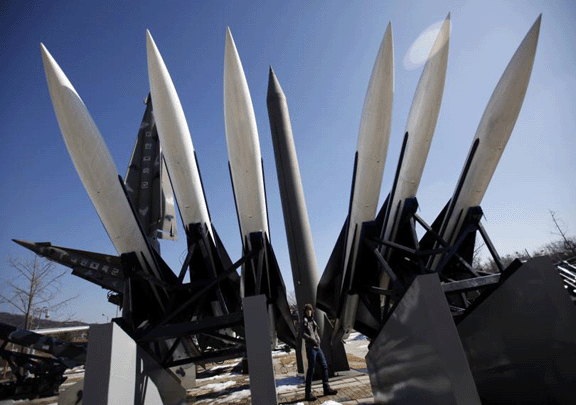 Pentagon Panel Urges Trump Team to Expand Nuclear Options Report suggests “tailored nuclear option for limited use”, Roll C all, John M. Donnelly, 1 Feb 17, A blue-ribbon Pentagon panel has urged the Trump administration to make the U.S. arsenal more capable of “limited” atomic war. The Defense Science Board, in an unpublished December report obtained by CQ, urges the president to consider altering existing and planned U.S. armaments to achieve a greater number of lower-yield weapons that could provide a “tailored nuclear option for limited use.”
The recommendation is more evolutionary than revolutionary, but it foreshadows a raging debate just over the horizon.
Fully one-third of the nuclear arsenal is already considered low-yield, defense analysts say, and almost all the newest warheads are being built with less destructive options. But experts on the Pentagon panel and elsewhere say the board’s goal is to further increase the number of smaller-scale nuclear weapons — and the ways they can be delivered — in order to deter adversaries, primarily Russia, from using nuclear weapons first.
Critics of such an expansion say that even these less explosive nuclear weapons, which pack only a fraction of the punch of the bombs America dropped on Japan in 1945, can still kill scores of thousands of people and lead to lasting environmental damage. They worry that expanding the inventory of lower-yield warheads — and the means for delivering them — could make atomic war more thinkable and could trigger a cycle of response from adversaries, possibly making nuclear conflict more likely. And, they say, such an expansion would cost a lot of money without necessarily increasing security.
The issue will gain greater prominence in the next several years as an up-to-$1 trillion update of the U.S. nuclear arsenal becomes the biggest Pentagon budget issue. That update, as now planned, mostly involves building new versions of the same submarines, bombers, missiles, bombs and warheads. Support for the modernization effort is bipartisan.
But any effort to create new weapons, or even to modify existing ones, in order to expand the arsenal of potentially usable nuclear weapons is likely to trigger opposition.
“There’s one role — and only one role — for nuclear weapons, and that’s deterrence. We cannot, must not, will not ever countenance their actual use,” said Sen. Dianne Feinstein, D-Calif. “There’s no such thing as limited nuclear war, and for the Pentagon’s advisory board to even suggest such a thing is deeply troubling.”
“I have no doubt the proposal to research low-yield nuclear weapons is just the first step to actually building them,” she added. “I’ve fought against such reckless efforts in the past and will do so again, with every tool at my disposal.”
Conservatives on the congressional defense committees generally support exploring new nuclear options………
Fears of expanded arms race
Those who oppose development or production of more small-scale nuclear weapons argue that U.S. conventional capabilities are unmatched. They also say there’s no reason to believe Russia, for all its bluster, would go nuclear in a conflict, because it would never assume the United States wouldn’t respond either with overwhelming conventional force or nuclear weapons.
Moreover, they say, the United States has or will have plenty of lower-yield nuclear bombs to drop if necessary. And, they add, there are few scenarios in which missiles would be needed to deliver such warheads, because aircraft will suffice, particularly if they can launch atomic-tipped cruise missiles from long distances.
There are potentially serious disadvantages to expanding the lower-yield arsenal, the critics also contend.
First, there’s the cost — expected to be in the billions………http://www.rollcall.com/news/policy/pentagon-panel-urges-trump-team-expand-nuclear-options
US Defence Secretary Jim Mattis warns NKorea against nuclear attack
 US warns NKorea against nuclear attack, http://www.sbs.com.au/news/article/2017/02/03/us-warns-nkorea-against-nuclear-attack SBS News, 3 Feb 17, Newly minted US Defence Secretary Jim Mattis has told North Korea that any attack on the US or its allies will attract an “effective and overwhelming” response.
Hollow victories for the global nuclear industry in 2016
Not just Toshiba – the global nuclear industry is in crisis everywhere, Ecologist, Jim Green 3rd February 2017 “…….The number of reactors under construction is slowly dropping. Using WNA figures, 71 reactors were under construction in January 2014 compared to 60 in January 2017. According to WNISR figures, the number is down from 67 to 55 over the same period. Again, that trend seems near-certain to continue because of a sharp drop in reactor construction starts: 50 from 2007-2011 compared to 31 from 2012-2016. Last year, there were just three construction starts.
Hollow, pyrrhic victories
Most of the nuclear industry’s wins in 2016 may turn out to be hollow and pyrrhic.
The decision to go ahead with two EPR reactors at Hinkley Point in the UK may be a blessing or a curse for the industry. Other EPR projects face mounting problems – long delays; spectacular cost increases; ongoing inquiries into the integrity of EPR pressure vessels; and in the case of the EPR under construction in Finland, litigation.
EDF faces additional problems as a result of Brexit, the UK’s impending withdrawal from the European Union, which will, significantly, include withdrawal from the Euratom treaty. The post-referendum fall in the value of Sterling will cut its income, while costs will remain roughly level; EDF’s ability to import skilled workers to build the reactors is also in doubt. And the Euratom exit creates a host of additional uncertainties.
And even if construction at Hinkley Point goes to plan and to budget, the obscene subsidies will turn the British public against nuclear power for decades to come. Eight of the UK’s 15 power reactors are scheduled to be shut down over the next decade, and it’s unlikely that new reactors will keep pace with closures.
Toshiba’s problems, meanwhile, are adding significant doubt to the future of the Moorside nuclear project next to the notorious Sellafield site in Cumbria, where the company is meant to be building three Westinghouse AP1000 units.
Last August, Russia announced plans for 11 new reactors but there is no likelihood that all will be built and every likelihood that few if any will be built. Already there is some backsliding from the August 2016 announcement.
In a November 2016 referendum, voters in Switzerland rejected a proposal to impose time limits on the operation of the country’s five power reactors. Nonetheless, pre-Fukushima plans for new reactors have been abandoned. Switzerland is tracking towards a nuclear phase-out by attrition. One of its five reactors is to be closed in 2019, and the others will likely all be closed by the end of the 2020s (or by 2034 according to Nuclear Energy Insider) … much the same outcome as that envisaged in the defeated referendum proposal.
The nuclear industry in Sweden certainly had some wins in 2016, but they may not amount to much. There is no longer an end-date for nuclear energy in Sweden other than a non-binding aspiration to exit the industry by mid-century and a (contradictory) aspiration to be 100% renewable-energy powered by 2040; existing reactors can be replaced with new ones (at the same sites); and a nuclear capacity tax will be abolished.
But there are no plans for new reactors and no likelihood of any in the foreseeable future. Keeping existing reactors operating is proving quite a challenge. One reactor closed in 2015 (leaving Sweden with nine), and three more closures are scheduled by the end of 2020.
‘South Africa formally launches new build programme’, Nuclear Engineering Internationalreported in December 2016. But in fact, plans to build new reactors have been deferred – the latest projection is 1.4 GW of new nuclear capacity by 2037 followed by more later – and plans for new reactors may be scrapped altogether once President Jacob Zuma is ousted.
Corruption has undermined South Africa’s nuclear new-build program and developments in a widespread kick-back and bribery corruption scandal in Brazil’s nuclear program was one of the biggest stories of 2016. Corruption has claimed numerous scalps – not least Othon Luiz Pinheiro da Silva, considered the father of Brazil’s nuclear program, who was sentenced to 43 years in prison in August 2016. The partially-built Angra-3 reactor remains frozen due to the corruption scandal and a lack of funding.
Belgium: 10-year extensions for two of Belgium’s seven reactors were approved in late-2015. But all reactors are still scheduled to closed by the end of 2025. There has been ongoing controversy over the safety of Belgium’s reactors – in particular Doel-3 and Tihange-2 – including strenuous efforts by politicians and the public in neighboring countries to force the closure of the reactors.
USA: The nuclear industry had a couple of wins last year, convincing state legislatures in New York and Illinois to stump up billions to keep ageing reactors operating. However the number of operable reactors has decreased from 104 to 99 in recent years and the pattern of slow decline is certain to continue – 44 out of the 99 reactors have been operating for 40 years or more.
Misery
In some other important nuclear countries, there were no victories for the nuclear industry last year, pyrrhic or otherwise … just misery.
France: The French nuclear industry is in its “worst situation ever”, former EDF director Gérard Magnin said last November. Just one reactor is under construction – the Flamanville EPR that is many years behind schedule and three times over-budget.
EDF will need to spend around €100 billion (US$107 billion) upgrading its fleet of 58 reactors by 2030, the country’s state audit office has said, to meet new safety requirements and to extend the lives of the units beyond 40 years.
In 2015, concerns about the integrity of some EPR pressure vessels were revealed, prompting investigations that are still ongoing. Last year, the scandal was magnified when the French Nuclear Safety Authority (ASN) announced that at least 400 of the 10,000 quality documents reviewed by Areva contained anomalies, affecting a range of reactor components in many countries.
Both Areva and EDF are financially stressed, to put it mildly – hence a taxpayer-funded bailout agreed last year. A government-led rescue of Areva and the wider nuclear industry may cost the state as much as €10-billion, Reuters reported in January 2017, and in addition to its “dire financial state, Areva is beset by technical, regulatory and legal problems.”
French finance authorities raided the offices of EDF in July 2016 as part of a probe into EDF’s disclosure of information to the market regarding domestic nuclear maintenance costs as well as planned reactors in the UK.
Last year, former Areva chief executive Anne Lauvergeon was placed under formal investigation for the “publication of inaccurate accounts” and the “spreading of false information” in relation to the acquisition of a number of African uranium mines.
Japan: Only two of the country’s 42 ‘operable’ reactors are actually operating. The future of Japan’s nuclear program remains a guessing game, but projections are being steadily reduced. According to the OECD’s Nuclear Energy Agency and the IAEA, installed capacity of 42.4 GW in 2014 could fall to as little as 7.6 GW by 2035 “as reactors are permanently shut down owing to a range of factors including location near active faults, technology, age and local political resistance.”
Another reactor was permanently shut down in 2016 (Ikata-1) in addition to five shut-downs in 2015 and the six Fukushima Daiichi reactors shut down in the aftermath of the March 2011 disaster. Japan also decided last year to permanently shut down the troubled Monju fast breeder reactor. For all the rhetoric about Generation IV fast reactors, and the US$100+ billion invested worldwide, only five such reactors are operating worldwide (three of them experimental) and only one is under construction (in India).
Late last year, Japan’s Ministry of Economy, Trade and Industry revised the estimated cost of decommissioning the Fukushima Daiichi nuclear plant, and compensating victims of the disaster, to around US$187 bnillion (€175 bn). The latest estimate is four times greater than estimates provided in 2011/12. Indirect costs (e.g. fuel imports, adverse impacts on agriculture and fishing, etc.) are likely to exceed the direct clean-up and compensation costs.
India has 22 operable reactors (6.2 GW capacity) and five under construction. In early 2015, India claimed to have resolved one of the major obstacles to foreign investment by announcing measures to circumvent a liability law which does not completely absolve suppliers of responsibility for accidents. But that hasn’t led to any construction starts; indeed the last construction start was in 2011.
Newcomer countries: The WNA claims that “over 45 countries are actively considering embarking upon nuclear power programmes.” Codswallop. Only two newcomer countries are actually building reactors – Belarus and the United Arab Emirates. Numerous potential newcomers have deferred or abandoned nuclear plans over the past two years, including Chile, Indonesia, Vietnam and Lithuania (which operated reactors until 2009).
Newcomers will be few and far between. Moreover, some countries – including Germany, Belgium, and Taiwan – are deliberately phasing out nuclear power, while nuclear power faces attritional phase-outs in some other countries (e.g. Switzerland).
The July 2016 World Nuclear Industry Status Report noted that over the past two decades, only two countries started power reactors for the first time (Romania in 1996 and Iran in 2011) while two countries closed theirs (Kazakhstan and Lithuania).
China: With 35 operable power reactors (up from 30 at the start of 2016), 22 under construction, and many more in the pipeline, China remains the only country with significant nuclear expansion plans. There are indications of a slow-down with only two construction starts in 2016. There were 25 construction starts from 2008-2010 and 15 in the six years since……….. http://www.theecologist.org/News/news_analysis/2988607/not_just_toshiba_the_global_nuclear_industry_is_in_crisis_everywhere.html
UK government’s work on Small Modular Nuclear reactors (SMRs) has slowed down
 Small Modular Reactors NuClearNewsNo92 February 2017 Scotland Engineering giant Rolls-Royce is teaming up with a host of rivals including Amec Foster Wheeler and Arup and nuclear specialist Nuvia to develop mini-nuclear reactors. Rolls Royce believes the so-called next generation technology could
 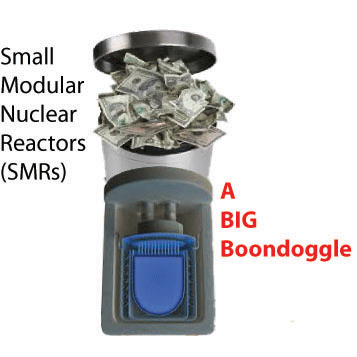 support as many as 40,000 jobs if the industry flourishes. The consortium is entering a £250m competition started last March by the Government, which wants to find the best SMR design for civil use. It is hoped the technology will be more cost-effective than conventional plants. (1) The companies believe SMRs will strengthen the UK’s energy security by reducing reliance on foreign gas imports and smoothing out the impact of ‘intermittent generation’ technologies.
In November 2015, the British government announced plans to invest at least £250 million over the next five years in a nuclear research and development program including a competition to identify the best value SMR design for the UK. Rolls-Royce submitted a paper to the Department of Business, Energy and Industrial Strategy, outlining its plan to develop a fleet of 7 GWe of SMRs with its partners. Other participants in the UK’s SMR competition include French-owned EDF Energy and its Chinese partner CNNC, Westinghouse and US developer NuScale Power. (2)
In the US NuScale has formally completed its design submission to the Nuclear Regulatory Commission. The 12,000-page application will now undergo a lengthy review by the NRC, which must approve the design before construction can begin. (3)
According to City AM the Government’s work on SMRs appears to have slowed down, and many companies were expecting mention of plans in the industrial strategy published in January, but there was nothing specific. (4)
- Telegraph 8th Jan 2017 http://www.telegraph.co.uk/business/2017/01/08/rolls-royce-partners-rivals-mininuclear-reactors/
- World Nuclear News 9th Jan 2017 http://www.world-nuclear-news.org/NN-Rolls-Royce-names-partnersfor-UK-SMR-09011701.html
- NPR 13th Jan 2017 http://www.npr.org/sections/thetwo-way/2017/01/13/509673094/miniaturized-nuclearpower-plant-u-s-reviewing-proposed-design
- City AM 8th Jan 2017 http://www.cityam.com/256579/rolls-royce-launches-partnership-engineering-giantsamec http://www.no2nuclearpower.org.uk/nuclearnews/NuClearNewsNo92.pdf
Delays, ballooning costs, stall Next-Generation Nuclear Reactors
Next-Generation Nuclear Reactors Stalled by Costly Delays, Bloomberg, by Stephen Stapczynski February 3, 2017,
-
Toshiba seen booking billions in impairment on nuclear unit
-
Shadows of Fukushima impair industry push on new age reactors
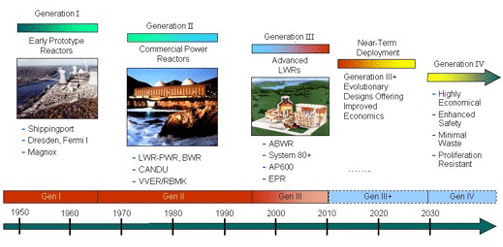
Costly delays, growing complexity and new safety requirements in the wake of the triple meltdown at Fukushima are conspiring to thwart a new age of nuclear reactor construction.
So-called generation III+ reactors were supposed to have simpler designs and safety features to avoid the kind of disaster seen in Japan almost six years ago. With their development, the industry heralded the dawn of a new era of cheaper, easier-to-build atomic plants.
Instead, the new reactors are running afoul of tighter regulations and unfamiliar designs, delaying completions and raising questions on whether the breakthroughs are too complex and expensive to be realized without state aid. The developments have left the industry’s pioneers, including Areva SA and Westinghouse Electric Co., struggling to complete long-delayed projects while construction elsewhere gains pace.
“The cost overrun situation is driven by a near-perfect storm of societal risk aversion to nuclear causing ultra-restrictive regulatory requirements, construction complexity, and lack of nuclear construction experience by the industry,” said Lake Barrett, a former official at the U.S. Nuclear Regulatory Commission.
Toshiba Corp., Japan’s biggest maker of nuclear power plants, is the latest to join a list of companies facing impairments in the pursuit of cutting-edge reactors…….
Ballooning Costs
In 2015, the investment cost to develop a new nuclear plant was $5,828 per kilowatt, up from $2,065 in 1998, according to a World Nuclear Associationreport. In Europe, construction of a new nuclear facility in France seen costing $7,202 per kilowatt, compared with $2,280……..
“I don’t know of any recent examples of new, large, complex technological construction projects that have come in on time and on budget,” Allison Macfarlane, a former chairman of the U.S. Nuclear Regulatory Commission, said by e-mail.
The industry has no agreed-upon definition for generation III+. Broadly, the reactors are expected to withstand an airplane strike and the cooling systems should operate for at least three days without electricity…….https://www.bloomberg.com/news/articles/2017-02-02/costly-delays-upset-reactor-renaissance-keeping-nuclear-at-bay
Uranium companies having ‘worst time ever’

 Not just Toshiba – the global nuclear industry is in crisis everywhere, Ecologist, Jim Green 3rd February 2017 “………..”It has never been a worse time for uranium miners”, said Alexander Molyneux from Paladin Energy in October 2016.
“No major commodity had a worse 2016 than uranium”, Bloomberg said in January 2017. “In fact, the element used to make nuclear fuel has had a pretty dismal decade.”
Uranium mining ramped up 5-10 years ago in anticipation of the nuclear renaissance that never materialised. Hence a glut, hence the low price. The price has fallen for seven of the past nine years. The spot price fell 41% in 2016, sinking to a 12-year low (US$18 / lb U3O8 in November).
The spot price averaged about $26 last year, and is expected to average just $23 in 2017 according to the median forecast of analyst estimates compiled by Bloomberg in December 2016. “I don’t think there’s a mine profitable at current spot prices”, Leigh Curyer from Canadian uranium miner NexGen Energy told Bloomberg.
The long-term contract price fell from $44 in January 2016 to $30 in December. It would need to double to encourage the development of new mines. KPMG noted in December that “uranium producers are expected to reduce production and cut costs through 2017 and 2018, with high cost mines likely to scale back or close. New projects are expected to remain on hold.” RBC expects the sector will be oversupplied until around 2024.
The uranium enrichment industry is in much the same place as uranium mining. The spot uranium enrichment price has fallen consistently since the 2011 Fukushima disaster, and it fell by a third between early 2015 and late 2016 to reach an all-time low.
And since cheap, abundant enrichment capacity can substitute for newly mined uranium (either by extracting more uranium-235 during uranium enrichment, or re-enriching tails), this has and will continue to keep uranium prices down. http://www.theecologist.org/News/news_analysis/2988607/not_just_toshiba_the_global_nuclear_industry_is_in_crisis_everywhere.html
American nuclear electric companies watching Toshiba Corp. with dismay
The costs of Hinkley nuclear project to Scotland
 NuClearNewsNo92 February 2017 Scotland and Hinkley A report, called ‘Scotland’s Wind’ (1), by Dr David Toke – Reader in Energy Politics at Aberdeen University and published by the Scottish Greens shows that UK, electricity consumers are set to pay around £16 a year for 35 years to subsidise Hinkley Point C. If Scottish consumers could go it alone their £16 levy could fund almost twice as much power from onshore and offshore wind farms.
The report says:
“If Scottish consumer s money was spent on supporting renewable energy rather than paying for their share of Hinkley Point C … then, even on conservative calculations, nearly double the amount of electricity would be generated from wind power as from Hinkley C”.
The costs of onshore windfarms and also offshore windfarms even on current prices need much less support from consumer surcharges to generate an equivalent amount of electricity compared to HPC. Wind power costs are falling rapidly, with some especially low prices being reported in Denmark and The Netherlands. Under such a programme organised by the Scottish Government the cheapest onshore windfarms could start generating in 2020 and offshore windfarms organised under a new, Danish-style framework, could be online in 2026.
The Scottish Government s own preference for renewable energy over nuclear power lends support to the suggestion that the Scottish Government should be able to use Scottish consumers money to pay for new renewable energy rather than new nuclear power. Moreover the best value for money for Scottish consumers in terms of generating non-fossil fuels is likely to come from the Scottish Government having powers to fund its own renewable energy programme from Scottish consumer bills. This is because the Scottish Government will be able to decide on what contract length to offer wind developers, for example offering to pay guaranteed prices for 20 years rather than 15 years as done by the Westminster Government now with renewable energy. Also, the Scottish Government will be able to organise a much more effective offshore windfarm programme than is being done by the Westminster Government. The Westminster Government’s methods are increasing the costs of offshore wind by leaving too much uncertainty to be dealt with by developers. The Scottish Government could organise a much cheaper offshore wind programme on the lines done by the Danish Energy Agency. This is likely to lead to lower costs and less confrontation in the courts over planning issues than is the case with the current offshore windfarm programme. (2)
In January the Scottish Government published
- A draft Climate Change Plan (RPP3) http://www.gov.scot/Publications/2017/01/2768
- A consultation of a Draft Scottish Energy Strategy: http://www.gov.scot/Publications/2017/01/3414
- A consultation on Fracking: http://www.gov.scot/Publications/2017/01/8538
- Scotland’s Wind by Dr Dave Toke 9th Jan 2017 https://greens.scot/sites/default/files/Scotland%2527s%20Wind.pdf 2.
Dave Toke’s Blog 9th Jan 2017 http://realfeed-intariffs.blogspot.co.uk/2017/01/how-scotland-could-doubleamount-of-low.html http://www.no2nuclearpower.org.uk/nuclearnews/NuClearNewsNo92.pdf
All Fukushima seafood samples pass safety tests for radioactivity
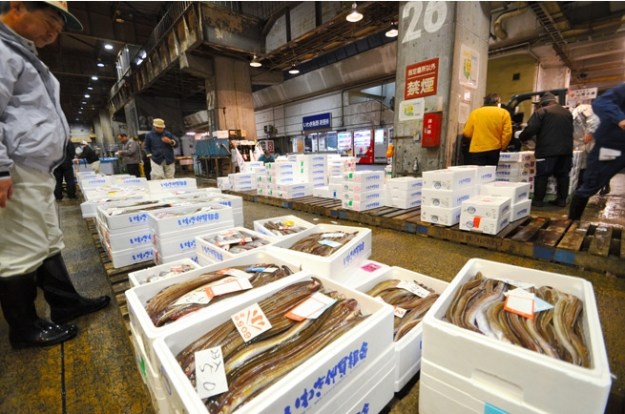
Fish caught during test fishing operations are sold at the Iwaki City Central Wholesale Market on Jan. 13. (Kazumasa Sugimura)
IWAKI, Fukushima Prefecture–For the first time, radioactivity levels were lower than the government’s safety limit in every seafood sample caught off Fukushima Prefecture for an entire year, officials said.
The Fukushima Prefectural Fisheries Experimental Station said 8,502 fish and shellfish samples were tested in 2016, and all recorded radioactivity readings under the safety standard of 100 becquerels per kilogram.
Ninety-five percent of them tested below the detection limit of around 15 becquerels per kilogram.
It was also the first time more than 90 percent of samples were below the detection threshold since the disaster at the Fukushima No. 1 nuclear plant started in March 2011, according to the officials.
People in the local fishing industry hope the numbers will help lead to a return to normal operations, although they say it is difficult to gauge the impact of harmful rumors about Fukushima seafood because prices depend on multiple factors, including quantity and quality.
“Test fishing is, after all, test fishing,” said Yuji Kanari, a managing director with seafood wholesaler Iwaki Gyorui KK. “Turning that into full fishing operations like before (the disaster) will emerge as a major challenge this year.
“I hope that local consumption of locally produced goods that was disrupted by the nuclear disaster will soon be back.”
The hauls from test fishing, which began in June 2012, have grown from year to year.
Preliminary figures show last year’s catch at 2,072 tons, up 560 tons from 2015, but still only 7.9 percent of the annual catch of 26,050 tons averaged over the decade preceding the 2011 disaster.
Ninety-four species are eligible for this year’s test fishing, which the Soma-Futaba fisheries cooperative association started on Jan. 10 and the Iwaki city fisheries cooperative association began on Jan. 12.
http://www.asahi.com/ajw/articles/AJ201702030003.html

Gov’t plan to cut back radiation tests on produce draws mixed reactions

The national government suggested it would scale back radiation tests on produce from Tokyo and 16 other prefectures affected by the Fukushima nuclear disaster, at a citizen-oriented event in Tokyo on Feb. 2, drawing mixed reactions from those in attendance.
A draft policy was put together by government bodies including the Ministry of Agriculture, Forestry and Fisheries and the Consumer Affairs Agency and calls for allowing reduction of the tests from the 2017 fiscal year. The plan was influenced by the fact that there are now almost no cases of agricultural products that exceed the regulatory limit for radioactive cesium of 100 becquerels per kilogram. Under the draft policy, the Tokyo Metropolitan Government or any of the affected prefectural governments whose agricultural products were at half or less of the limit for the past three years could choose to scale back their tests.
Representatives from consumer groups and Fukushima producers were present at the Feb. 2 meeting. There were many voices of opposition against the draft policy, saying it was too early to cut back the tests, or that the requirement for scaling them back should be stricter than half or less of the regulatory limit. On the other hand, another attendee said that over the last five years the tests had cost around 4 billion yen and the money should “be spent toward more meaningful goals.”
According to the testing results from fiscal 2011 through fiscal 2015, during the first two years the percentage of products like vegetables, fruits, tubers and meats from these areas with radioactive cesium in excess of the regulatory limit was between 0.1 percent and 5.9 percent, but since 2013 no excessive radiation has been detected.
The central government plans to hold an event to exchange ideas on the matter on Feb. 17 and get a better understanding of public opinion, before deciding on whether to actually downsize the testing.
http://mainichi.jp/english/articles/20170203/p2a/00m/0na/004000c
Fukushima radiation levels at highest level since 2011
Fukushima radiation levels at highest level since 2011 meltdown
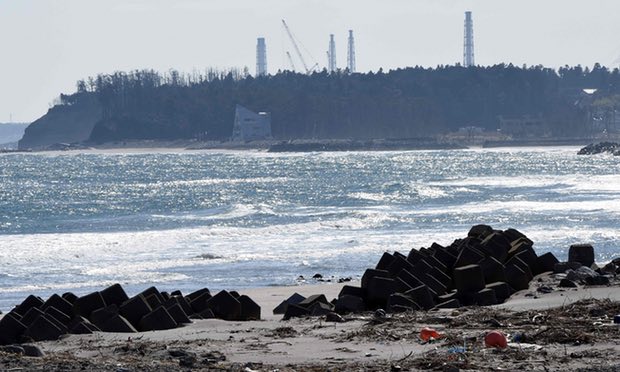
Cranes over the Fukushima Daiichi plant in February 2016. The decommissioning process is expected to take about four decades
Extraordinary readings pile pressure on operator Tepco in its efforts to decommission nuclear power station
Radiation levels inside a damaged reactor at the Fukushima Daiichi nuclear power station are at their highest since the plant suffered a triple meltdown almost six years ago.
The facility’s operator, Tokyo Electric Power (Tepco), said atmospheric readings as high as 530 sieverts an hour had been recorded inside the containment vessel of reactor No 2, one of three reactors that experienced a meltdown when the plant was crippled by a huge tsunami that struck the north-east coast of Japan in March 2011.
The extraordinary radiation readings highlight the scale of the task confronting thousands of workers, as pressure builds on Tepco to begin decommissioning the plant – a process that is expected to take about four decades.
The recent reading, described by some experts as “unimaginable”, is far higher than the previous record of 73 sieverts an hour in that part of the reactor.
A single dose of one sievert is enough to cause radiation sickness and nausea; 5 sieverts would kill half those exposed to it within a month, and a single dose of 10 sieverts would prove fatal within weeks.
Tepco also said image analysis had revealed a hole in metal grating beneath the same reactor’s pressure vessel. The one-metre-wide hole was probably created by nuclear fuel that melted and then penetrated the vessel after the tsunami knocked out Fukushima Daiichi’s back-up cooling system.
“It may have been caused by nuclear fuel that would have melted and made a hole in the vessel, but it is only a hypothesis at this stage,” Tepco’s spokesman Tatsuhiro Yamagishi told AFP.
“We believe the captured images offer very useful information, but we still need to investigate given that it is very difficult to assume the actual condition inside.”
The presence of dangerously high radiation will complicate efforts to safely dismantle the plant.
A remote-controlled robot that Tepco intends to send into the No 2 reactor’s containment vessel is designed to withstand exposure to a total of 1,000 sieverts, meaning it would survive for less than two hours before malfunctioning.
The firm said radiation was not leaking outside the reactor, adding that the robot would still prove useful since it would move from one spot to the other and encounter radiation of varying levels.
Tepco and its network of partner companies at Fukushima Daiichi have yet to identify the location and condition of melted fuel in the three most seriously damaged reactors. Removing it safely represents a challenge unprecedented in the history of nuclear power.
Quantities of melted fuel are believed to have accumulated at the bottom of the damaged reactors’ containment vessels, but dangerously high radiation has prevented engineers from accurately gauging the state of the fuel deposits.
Earlier this week, the utility released images of dark lumps found beneath reactor No 2 that it believes could be melted uranium fuel rods – the first such discovery since the disaster.
In December, the government said the estimated cost of decommissioning the plant and decontaminating the surrounding area, as well as paying compensation and storing radioactive waste, had risen to 21.5tn yen (£150bn), nearly double an estimate released in 2013.
Radiation level in Fukushima reactor could kill within a minute
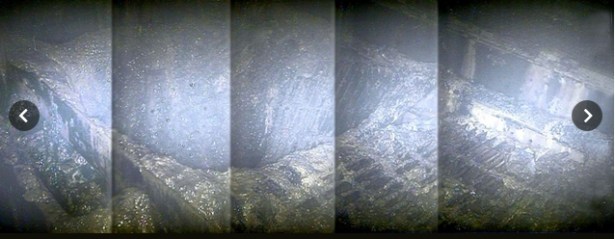
Images show black lumps on grating for maintenance work below the No. 2 reactor’s pressure vessel at the Fukushima No. 1 nuclear power plant. TEPCO says melted fuel likely caused at least two holes in the metal grating, including an opening measuring 1 meter by 1 meter. (Provided by Tokyo Electric Power Co.)
Radiation levels that can kill a person in a minute and holes created by melted nuclear fuel could further delay decommissioning operations at the No. 2 reactor of the Fukushima No. 1 nuclear plant.
Tokyo Electric Power Co., operator of the crippled plant, said Feb. 2 that the maximum estimated radiation level near what is believed to be melted fuel in the reactor was 530 sieverts per hour, the highest so far since the triple meltdown in 2011.
In its investigation into the interior of the No. 2 reactor, TEPCO also confirmed at least two holes on grating for maintenance work below the bottom of the reactor’s pressure vessel.

The images show the area at the bottom of the No. 2 reactor’s pressure vessel to the metal grating below.
“The holes were likely made when the melted nuclear fuel fell from the pressure vessel and melted the grating,” a TEPCO official said.
The findings were made by studying images taken from a video camera attached to a pipe that was inserted into the reactor on Jan. 30.
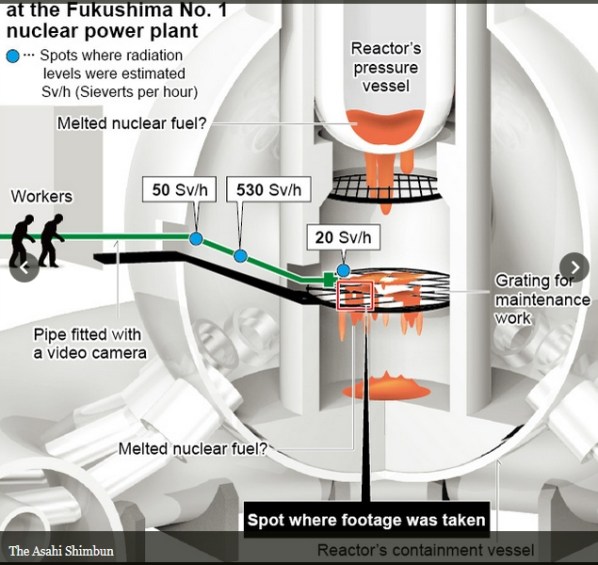
Radiation levels were estimated at 20 sieverts per hour, 50 sieverts per hour and 530 sieverts per hour at three spots inside the reactor’s containment vessel.
The company estimated the doses from the extent of disturbances in the images caused by radiation.
Although a TEPCO official said “there is a margin of error because radiation levels were not measured directly,” the company believes the scattered melted nuclear fuel inside the containment vessel was emitting high levels of radiation.
After a number of failed attempts, the remote-controlled camera took the first pictures of possible melted fuel at the plant.
However, closer inspection of the images have revealed additional problems for TEPCO, which had believed most of the melted fuel had remained inside the reactor’s pressure vessel.
TEPCO plans to send an investigative robot, called Sasori (scorpion), into the containment vessel this month to more accurately measure radiation doses at various spots and take additional footage of the scattered nuclear fuel.
The utility plans to use the data to determine a fuel-removal method.
But the robot was expected to use the circular grating, measuring 5 meters in diameter, to move around. One of the holes is 1 meter by 1 meter, a potential pitfall for the robot, which is 59 centimeters long and 9 cm high.
TEPCO said it will consider a different route for the robot in its survey.
Fumiya Tanabe, an expert on nuclear safety who analyzed the 1979 Three Mile Island nuclear accident in the United States, said the findings show that both the preparation for and the actual decommissioning process at the plant will likely prove much more difficult than expected.
“We have few clues on the exact locations, the sizes and the shapes of the nuclear fuel debris,” he said. “The planned investigation by the robot needs a rethink. Work to decommission the plant will require even more time.”
TEPCO said it will need 30 to 40 years to complete the decommissioning process. The utility plans to start work to remove the melted nuclear fuel at the No. 2 and two other stricken reactors in 2021 after deciding on a removal method in fiscal 2018.
TEPCO has yet to determine the location and the condition of the melted fuel in the other two reactors.
TEPCO to probe Fukushima reactor again to confirm nuclear debris

An executive of the operator of the crippled Fukushima Daiichi nuclear complex said Friday the company plans to probe inside the plant’s No. 2 reactor by the end of February to confirm whether the black mass spotted in a recent survey was nuclear debris.
Naohiro Masuda, the chief decommissioning officer at Tokyo Electric Power Company Holdings Inc. told Kyodo News it is “possible” to conduct the probe using a robot, the day after the operator announced it had detected extraordinarily high radiation levels inside the reactor.
The operator will be able to tell whether the deposits are nuclear debris from the March 2011 meltdown if new images and data such as the radiation levels and temperatures are obtained in the upcoming robot survey, he said.
Radiation in Fukushima reactor containment vessel at deadly level: TEPCO
Radiation inside the containment vessel of the No. 2 reactor at the Fukushima No. 1 nuclear plant measures as high as a deadly 530 sieverts per hour, the highest since the 2011 disaster, plant operator Tokyo Electric Power Co. (TEPCO) announced on Feb. 2.
TEPCO calculated the radiation dose from video noise on footage it took inside the containment vessel in late January, when a camera was inserted to examine conditions inside and scout a route for a scorpion-like observation robot scheduled to go into the vessel later this month.
Deployment of the robot is also being reconsidered after two gaping holes were found along the robot’s planned path over a 5-meter-wide circular walkway inside the containment vessel, close to where the 530-sievert radiation dose was detected.

A scorpion-like observation robot scheduled to go into the containment vessel of the No. 2 reactor at the Fukushima No. 1 nuclear plant.
The holes in the metal grate walkway — one of unknown size and the other measuring about 1 meter square — make both routes considered for the robot impassable.
“We will consider re-evaluating what observations we can take with the robot,” Yuichi Okamura, an acting general manager with TEPCO’s on-site nuclear power division, told reporters at a Feb. 2 news conference.
Piles of a black and dark brown substance several centimeters thick and thought to be melted nuclear fuel were also observed on the walkway, creating a further possible obstruction to the robot. Meanwhile, examination of the 1-meter-square hole suggests the walkway was struck with tremendous force, hinting that there may be a large amount of melted fuel below.
“It is possible that the nuclear fuel rods melted onto the control rods and then dripped down,” Tokyo Institute of Technology professor of nuclear engineering Yoshinao Kobayashi told the Mainichi Shimbun. “It’s highly likely that part of the bottom of the pressure vessel broke and the melted fuel flowed down (onto the walkway), and then the grating warped and gave way due to the fuel’s heat.”
http://mainichi.jp/english/articles/20170203/p2a/00m/0na/005000c
1 This Month

petition to oppose the rapid increase of space-military industry threatening Jeju Island and the region.
[Petition by April 19th (KST)] Stop the joint military-Hanwha Systems-Jeju Provincial Government Sea Launch!
World Nuclear Power. Reactors 1951-2026, 75 Years of Nuclear Power.
Interactive Map– https://dv.worldnuclearreport.org/

Chernobyl: The Lost Tapes – A good documentary on Chernobyl on SBS available On Demand for the next 3 weeks– https://www.sbs.com.au/ondemand/tv-program/chernobyl-the-lost-tapes/2352741955560

of the week–London Campaign for Nuclear Disarmament


Tell the Ukrainian Government to Drop Prosecution of Peace Activist Yurii Sheliazhenko
To see nuclear-related stories in greater depth and intensity – go to https://nuclearinformation.wordpress.com
-
Archives
- April 2026 (194)
- March 2026 (251)
- February 2026 (268)
- January 2026 (308)
- December 2025 (358)
- November 2025 (359)
- October 2025 (376)
- September 2025 (257)
- August 2025 (319)
- July 2025 (230)
- June 2025 (348)
- May 2025 (261)
-
Categories
- 1
- 1 NUCLEAR ISSUES
- business and costs
- climate change
- culture and arts
- ENERGY
- environment
- health
- history
- indigenous issues
- Legal
- marketing of nuclear
- media
- opposition to nuclear
- PERSONAL STORIES
- politics
- politics international
- Religion and ethics
- safety
- secrets,lies and civil liberties
- spinbuster
- technology
- Uranium
- wastes
- weapons and war
- Women
- 2 WORLD
- ACTION
- AFRICA
- Atrocities
- AUSTRALIA
- Christina's notes
- Christina's themes
- culture and arts
- Events
- Fuk 2022
- Fuk 2023
- Fukushima 2017
- Fukushima 2018
- fukushima 2019
- Fukushima 2020
- Fukushima 2021
- general
- global warming
- Humour (God we need it)
- Nuclear
- RARE EARTHS
- Reference
- resources – print
- Resources -audiovicual
- Weekly Newsletter
- World
- World Nuclear
- YouTube
-
RSS
Entries RSS
Comments RSS
 nuclear-news