Climate change: warnings have been given by scientists since 1880 or earlier
A 1912 news article ominously forecasted the catastrophic effects of fossil fuels on climate change http://qz.com/817354/scientists-have-been-forecasting-that-burning-fossil-fuels-will-cause-climate-change-as-early-as-1882/ Akshat Rathi 24 Oct 16, A short news clip from a New Zealand paper published in 1912 has gone viral as an example of an early news story to make the connection between burning fossil fuels and climate change.
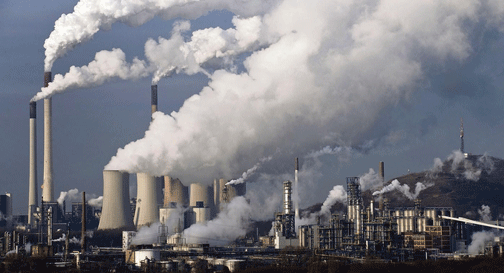
The French physicist Joseph Fourier had made the observation in 1824 that the composition of the atmosphere is likely to affect the climate. But Svante Arrhenius’s 1896 study titled, “On the influence of carbonic acid in the air upon the temperature on the ground” was the first to quantify how carbon dioxide (or anhydrous carbonic acid, by another name) affects global temperature. Though the study does not explicitly say that the burning of fossil fuels would cause global warming, there were scientists before him who had made such a forecast.
The earliest such mention that Quartz could find was in the journal Nature in December of 1882. The author HA Phillips writes:
According to Prof Tyndall’s research, hydrogen, marsh gas, and ethylene have the property to a very high degree of absorbing and radiating heat, and so much that a very small proportion, of say one thousandth part, had very great effect. From this we may conclude that the increasing pollution of the atmosphere will have a marked influence on the climate of the world.
Phillips was relying on the work of John Tyndall, who in the 1860s had shown how various gases in the atmosphere absorb heat from the sun in the form of infrared radiation. Now we know that Phillips was wrong about a few scientific details: He ignored carbon dioxide from burning coal and focused more on the by-products of mining. Still, he was drawing the right conclusion about what our demand for fossil fuels might do to the climate.
Newspapers around the world took those words published in a prestigious scientific journal quite seriously. ……..
Nichols found many examples between 1883 and 1912, where newspapers, including the Philadelphia Inquirer, Kansas City Star, and York Daily, wrote articles about what rising carbon dioxide levels would do the climate.
All through the 19th century, the increasing use of coal was hard to miss. Towns and cities across the world were becoming noticeably polluted because of factories, and later steam trains. In this light, it’s not surprising that a tiny New Zealand newspaper carried an article in 1912 about how the ever-increasing use of fossil fuels might change Earth’s climate. http://qz.com/817354/scientists-have-been-forecasting-that-burning-fossil-fuels-will-cause-climate-change-as-early-as-1882/
“Fake story” prompted Pakistan to issue a nuclear warning to Israel
 Pakistan issues nuclear warning to Israel in response to ‘fake news’ story Israeli Ministry of Defence forced to point out initial story ‘completely fictitious’, The Independent Matt Broomfield @hashtagbroom 25 Dec 16, The Defence Minister of Pakistan has issued a reminder to Israel of his country’s nuclear capability, in apparent response to a false news story.
Khawaja Muhammad Asif said in a tweet: “Israeli [Defence Minister] threatens nuclear retaliation presuming [Pakistani] role in Syria against Daesh. Israel forgets Pakistan is a Nuclear state too.”
Pakistan has remained relatively neutral in the Syrian civil war, though they have placed themselves on the side of the Assad regime, with their Foreign Secretary saying the world’s sixth-largest country is “against foreign military intervention in Syria.”
But a fake story published on the website AWDnews falsely suggested that Pakistan planned to “send ground troops to Syria as part of an international coalition to fight against Islamic State”.
The anonymously-authored story then features an apparently invented quote from former Israeli defence minister Moshe Yaalon, who resigned in May this year, sayig: “If, by misfortune, they arrive in Syria… we will destroy them with a nuclear attack.”
It is this story, which also includes a fabricated quote from the Pakistani Foreign Minister, which seemingly prompted Mr Asif’s tweet. The Israeli Ministry of Defence replied with a tweet of its own, pointing out the story was “completely fictitious”……. http://www.independent.co.uk/news/world/asia/pakistan-israel-nuclear-warning-fake-news-story-response-islamabad-syria-a7494961.html
Scientists now consider geoengineering, as well as curbing greenhouse gas emissions
 What’s Next for Climate Action?Prominent scientists say researchers and policy makers need to focus more on adapting to warming and on controversial geoengineering techniques to limit it By Annie Sneed on December 16, 2016 , Scientific American, SAN FRANCISCO—Despite President-elect Donald Trump’s distaste for the Paris climate agreement, countries around the world are already working to ensure that the global temperature rise stays below 2 degrees Celsius. This week at the American Geophysical Union (AGU) conference here, several prominent scientists discussed the critical steps researchers and decision makers need to take now. They said reducing carbon emissions is important, of course, but countries worldwide must also put more energy into adapting to changing weather that even moderate warming will bring, as well as consider the potential of controversial geoengineering techniques to keep warming in check.
One of the primary goals of the Paris accord is mitigation—cutting or preventing greenhouse gas emissions. To help countries meet their emissions pledges, the international community needs to analyze how it can achieve “deep decarbonization,” according to Margaret Leinen, director of the Scripps Institution of Oceanography and president of the AGU. This means determining what emissions-reducing technologies and strategies will work best for a given country. As Leinen explained at a conference panel session, “We need to be able to evaluate these technologies quantitatively in order to understand which ones work, which ones are scalable and for what countries and energy economies they work for.”
Another major detail that still needs to be sorted out: how to track nations’ emissions, to make sure they’re sticking to their reduction targets. “We need to start asking, ‘Okay, how will you prove that you actually did what you pledged to do?’” Leinen told Scientific American after the panel. To do that, countries will have to have some kind of monitoring system, and the international community has yet to agree on the guidelines for how that system will work.
It is up to scientists and engineers to design effective monitoring systems, or strengthen existing ones. ………..
Scientists should thoroughly assess geoengineering techniques and understand what their impact on the Earth’s systems might be, including any unintended consequences. They also need to consider logistical challenges—how to actually make geoengineering techniques work, in case the world decides to use them. Then there are political and governance issues, such as how countries should respond if, say, a nation starts injecting sulfate aerosols into the atmosphere on its own to cool the planet. Despite people’s general unease with geoengineering because of its potential for major unintended consequences, it is another tool countries may eventually need to use to combat climate change. “At this point, we need to keep all options open,” Busalacchi said. “We need to have a solid and robust understanding of what geoengineering can and can’t do, in case mitigation and adaptation fall short.” https://www.scientificamerican.com/article/what-rsquo-s-next-for-climate-action/
“Frightening news” says Noam Chomsky, about Donald Trump’s tweet on nuclear expansion
Donald Trump’s nuclear expansion tweet ‘one of the most frightening things’, says Noam Chomsky The US and Russia already own more than 93 per cent of nuclear warheads in the world, The Independent, Rachael Revesz @RachaelRevesz Friday 23 December 2016 One of the world’s most famous scholars said he was “frightened” by Donald Trump’s tweet on “strengthening and expanding” nuclear capabilities in the US.
Noam Chomsky, professor emeritus at the Massachusetts Institute of Technology, said Mr Trump’s tweet was “one of the most frightening things I’ve seen recently”. “Putin’s is bad enough,” Mr Chomsky told the Huffington Post, “but at least it has a defensive cast. It’s about Russia’s borders, not Mexico’s.”……..
Mr Trump’s tweet, limited to 140 characters, did not give national security experts and advisers much reassurance for anything other than his preference for heated rhetoric…….
John Noonan, a Republican national security expert who advised presidential candidates Jeb Bush and Mitt Romney, wrote on twitter: “But imagine having to turn launch keys not knowing if we were under attack or it if was b/c foreign leaders said a mean thing on twitter.”Mr Trump has done little to assure his critics that he has the presence of mind and the steadiness to make a quick decision regarding an imminent nuclear threat……..http://www.independent.co.uk/news/world/americas/donald-trump-nuclear-expansion-tweet-noam-chomsky-weapons-arsenal-twitter-a7491921.html
Even without subsidies Wind & Solar Are Cheaper Than Dirty Energy
Low Costs of Solar Power & Wind Power Crush Coal, Crush Nuclear, & Beat Natural Gas [this article on original is full of excellent charts and maps], Clean Technica, December 25th, 2016 by Zachary Shahan “……..
Wind & Solar Are Cheaper (Without Subsidies) Than Dirty Energy
The first point is the very basic fact that new wind power and/or solar power plants are typically cheaper than new coal, natural gas, or nuclear power plants — even without any governmental support for solar or wind.
Not only are they typically cheaper — they’re much cheaper in many cases. [good charts on original]
……..A study led by the former head of the Harvard Medical School found that coal cost the US $500 billion per year in extra health and environmental costs — approximately 9¢/kWh ($90/MWh) to 27¢/kWh ($270/MWh) more than the price we pay directly. To fool yourself into thinking these are not real costs is to assume that cancer, heart disease, asthma, and early death are not real.
The air, water, and climate effects of natural gas are not pretty either. On the nuclear front, the decommissioning and insurance costs of nuclear power — unaccounted for above — would also put nuclear off the chart.
On the renewable front, costs to overcome intermittency of renewable energy sources (basically, presuming a very high penetration of renewables on the grid) are also not included. Once that is a significant issue (at which point solar and wind will be even cheaper), low-cost demand response solutions, greater grid integration, and storage will be key solutions to integrating these lower-cost renewable sources to a high degree.
Back to Lazard’s assumptions, note that the IGCC and coal cost estimates do not include the costs of transportation and storage.
Given these assumptions unrealistically favoring fossil fuels and nuclear energy, including subsidies for solar and wind is actually an even better way to look at costs of these electricity options. However, if you included historical subsidies as well — coal, natural gas, and nuclear have received a ton (well, many, many tons of subsidies) — dirty energy options would again look worse. In any case, here’s Lazard’s cost comparisons with current subsidies: [chart on original]………
People Can Get Lower Prices But More Jobs With Solar & Wind
Whether American, British, Canadian, Australian, Indian, German, Dutch, French, Spanish, or [fill in the blank], solar and wind power don’t just mean lower prices — they also typically mean more jobs. Much of the price of dirty energy power plants is in the fossil fuel — the physical resource. When we buy that fuel, much of the money goes to the billionaires and multimillionaires who “own” the fuel — the coal mines and the natural gas wells.
Sunshine and wind, of course, are free, but distributed solar and wind power plants have to get built and installed — those are things humans do. When we pay for solar and wind power plants, we pay for human labor, and often help create or support local jobs.
We don’t actually have to choose between low prices or jobs or protecting our air, water, and climate — we get all of those things with renewable energy options like solar and wind energy…….https://cleantechnica.com/2016/12/25/cost-of-solar-power-vs-cost-of-wind-power-coal-nuclear-natural-gas/
Trump attacks NBC News: he claims that it purposely misquoted him
 Trump claims NBC ‘purposely’ misquoted nuclear comments, Politico, By CRISTIANO LIMA, 12/24/16
President-elect Donald Trump claimed Saturday that NBC News “purposely” misquoted his call for an expansion of the U.S. nuclear program earlier this week, despite reports to the contrary.
Trump on Thursday said the United States “must greatly strengthen and expand its nuclear capability until such time as the world comes to its senses regarding nukes.” Saturday he accused NBC of intentionally leaving out the latter, more measure portion of his statements……..
NBC News’ initial report covering Trump’s comments on nuclear expansion, however, cited his comments in full. And the Thursday broadcast of NBC’s “Nightly News with Lester Holt” displayed his comments in their entirety.
Trump’s claim of dishonesty in media coverage has been a calling card of his ascendance to the White House. Since winning the presidency, Trump has repeatedly attacked the media, broadly accusing them of inciting violence against him, singling out individual reporters and blasting the press as “crooked.”……http://www.politico.com/story/2016/12/donald-trump-nbc-nuclear-232960
Former House Speaker Newt Gingrich backs Donald Trump’s aim to build up nuclear weapons
 Gingrich endorses Trump’s nuclear arms buildup By POLITICO STAFF 12/25/16
Former House Speaker Newt Gingrich on Sunday supported President-elect Donald Trump’s remarks about a buildup of nuclear weapons, saying the strategy “is exactly right.”……..
Australia’s Lucas Height’s nuclear reactor security boss arrested for unauthorised documents and illegal gun
 SMH, 24 Dec 16, Eamon Duff. A security consultant who held a “top secret” government clearance inside Australia’s only nuclear facility has been arrested and charged with the
illegal possession of “official secrets” and an unauthorised weapon.
Until February last year, Anthony Rami Haddad was manager of security and operations at the Lucas Heights nuclear reactor, safeguarding the site against theft, diversion and sabotage.
However, following a stint in the Middle easrt where he worked on another nuclear security project, he returned hom eto Sydney, and last month became entangled in an unrelated investigation being run by the Australian Federal Police’s fraud and anti-corruption team.
A fortnight ago, Haddad appeared before Sydney’s Downi8ng Centre Local court, where he pleaded guilty to unauthorised receipt of official secrets under the Commonwealth crimes Act.
He has yet to enter a plea for a second charge, ppossessing an unauthorised prohibited firearm. His barrister, Nikolaos Siafakas, will apply to have the outstanding matter dealt with under section 32 of teh Mental Health Act……..
According to ANSTO documents, Haddad’s many responsibilities at Lucas Heights included the “mamagement of security operations” at the onsite Little Forest radioactive waste dump and its “seamless integration” into the facility’s “wider” protective security systems.
Haddad will reappear in court on February 7 http://www.smh.com.au/national/lucas-heights-security-boss-anthony-haddad-charged-over-official-secrets-gun-20161223-gthdwv.html
Nuclear Regulatory Commission keeping mum on the situation at Pilgrim Nuclear Power Station
|
Lawmakers concerned with Nuclear Regulatory Commission by Amid a week-long shutdown of the Pilgrim Nuclear Power Station, legislators from Plymouth say their greatest frustration is not with the plant’s latest closure but in trying to get the federal Nuclear Regulatory Commission to be more forthcoming about the aging nuclear plant and problems identified by their own inspectors.
On Thursday, Dec. 15, after conducting scheduled testing at the plant, a Pilgrim operator found a “small main steam line leak” and the plant’s “operators made the conservative, best practice decision to shut down the plant and repair the leak,” Patrick O’Brien, a spokesman for the plant’s owner Entergy, said in an email. The plant remained offline Wednesday, O’Brien said, as plant workers took “the time/opportunity to do maintenance that can’t be done otherwise when we are at full-power.” The steam line repairs have been completed, he said, and there was no threat to the safety of the plant’s staff or the public. But Sen. Vinny deMacedo and Rep. Mathew Muratore, both Republicans from Plymouth, said they are more concerned about the NRC’s apparent unwillingness to answer questions raised after the Cape Cod Times and other media outlets obtained an internal NRC emaildocumenting safety concerns found at the plant during an NRC inspection earlier this month. The email details problems such as “poor maintenance, poor engineering practices, and equipment reliability problems” at the plant, which can produce 680 megawatts of power using its boiling water reactor…….. a former Plymouth selectman, said the email contained “some alarming information” and the NRC has “not at all” done enough to allay the concerns the email brought to the forefront……. Sen. Dan Wolf of Harwich told the News Service this month that the email “validates” concerns that he said should be taken seriously by those in authority. “What is it going to take for this administration and for public safety officials in the Commonwealth of Massachusetts to understand that this is the biggest public safety threat that the citizens of the Commonwealth face?” asked Wolf, a Democrat and possible candidate for governor in 2018. Pilgrim opponents who favor its immediate shutdown have repeatedly called on Gov. Charlie Baker to recommend a shutdown. In turn, Baker has deferred to the federal government given its role as the chief regulator of the nuclear power industry. http://sherborn.wickedlocal.com/news/20161224/lawmakers-concerned-with-nuclear-regulatory-commission |
Taiwanese Say No to Japan Nuke Food Imports
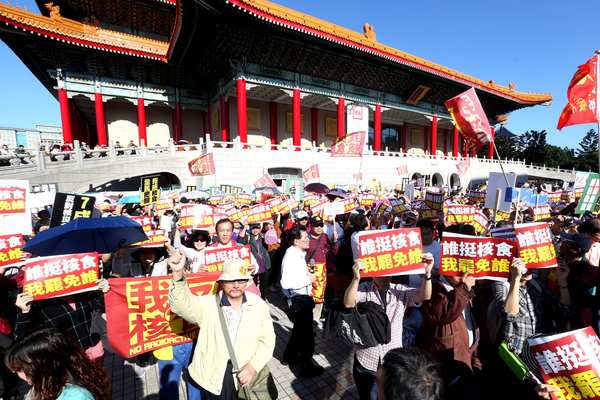
Thousands protest over ‘nuke food’
TAIPEI, Taiwan — Thousands took to the streets to protest the proposed lifting of a ban on food products from radiation-affected areas of Japan, following an inconclusive public hearing on the matter Sunday morning.
The Kuomintang (KMT)-organized march kicked off with remarks from KMT Chairwoman Hung Hsiu-chu (洪秀柱).
“We will not tolerate our children being endangered by food products contaminated by radiation,” Hung said.
Hung urged the crowd of protestors to convey their dissent to the government as they marched from Aiguo East Road near Chiang Kai-shek Memorial Hall and down Ketagalan Boulevard to the Ministry of Finance at Aiguo West Road.
Representatives from various demographics, including housewives, young parents and expecting parents, spoke out in turn before the march began.
The diversity of backgrounds represented at the march “reflected the 74 percent of all Taiwanese nationals who oppose lifting the ban on food imports from five Japanese regions affected by the 2011 Fukushima Daiichi nuclear disaster,” the march’s organizers claimed.
Expecting father Chen Hsiao-wei (陳孝威) expressed concerns that food imports from radiation-affected areas had already made their way into Taiwan.
Chen said he “did not understand any of the figures and numbers” presented by the government’s experts about the imports and only wanted to know why “Taiwanese people should eat these food products when the Koreans, Chinese, and Australians are not eating them.”
In a move that both served as a visual pun and was reminiscent of Latin America’s “pots and pans” protests, “new immigrants” — a term commonly used to refer to immigrants from Southeast Asia — attended the march with small pans and spatulas in hand to object to feeding their children potentially harmful food.
These mothers chose to “bravely speak out and bring their children to the march” to safeguard the welfare of the next generation, a representative of the new immigrant mothers told reporters.
A Failed Public Hearing
Earlier in the day, protestors and KMT legislators attended a public hearing at the Taipei Innovation City Convention Center in New Taipei City’s Xindian District.
The public hearing, which was intended to address the assessment and management of products from the five regions, failed to get past the explanation of the hearing’s rules after repeated outbursts from audience members.
Cabinet Spokesman Hsu Kuo-yung (徐國勇) later said that “some people deliberately showed up (to the hearing) to provoke hatred.”
After moderator Chu Tseng-hung (朱增宏) spent most of the morning asking for decorum, legislators and NGO representatives present decided it was best for the public hearing to be downgraded to an informal forum that would hold no legal weight.
KMT Legislator Kao Chin Su-mei (高金素梅) said procedures for the hearing were “unjust” and that incorrect information was being disseminated. “The government is using technical issues to continue to beat around the bush (on this issue),” Kao Chin said during the hearing.
KMT Legislator Wayne Chiang (蔣萬安) said people’s voices were being omitted. At the march in the afternoon, he told the crowds, “The public hearing was not conducted in accordance with the principle of procedural justice.”
Chiang questioned the need for a hearing on the import of food products from radiation-affected areas if the government had reiterated that it would not allow the import of any “nuke foods.”
Around noon it was decided that the hearing would be downgraded to an informal forum, which organizers of the march later called a “victory of the people.”
Hsu Fu (許輔), director of the Cabinet’s food safety office later said that the forum had achieved “real results” and hoped the format could be used in future policy discussions.
President’s Office Responds
The office of President Tsai Ing-wen office later accused the KMT of “twisting” the hearing.
Presidential Office spokesman Alex Huang (黃重諺) said a public hearing was one of the best “platforms for policy discussion” and that the KMT had managed to turn the hearing into “a show for their party’s own internal election.”
Huang stressed in his statement that the government had never wanted to open the country’s borders to radiation-contaminated food products. “Regardless of where the food products come from, the government holds the same attitude as every other country, which is that it would not import food contaminated by radiation.”
The presidential office spokesman further stated that the government would base their import policies on international professional standards and scientific evidence with no exception.
Radioactive Salmon in Canada
Earlier this month, a research team from Canada’s University of Victoria reported discovering radioactive salmon in the British Columbia region.
Research team leader Jay Cullen found that a sample of salmon from Okanagan Lake in British Columbia had tested positive for cesium 134, which is deemed “a footprint of Fukushima.”
In the years since the 2011 Fukushima disaster, there have been increasing concerns about radiation-contaminated food products originating from the region and contaminated water supplies from airborne radioactive fallout.
Last year, public outrage erupted after food from the Fukushima disaster site was found on British market shelves with false labels. The scare hit closer to home when Taiwan discovered that more than 100 radioactive food products, originating from Fukushima but falsely packaged as coming from Tokyo, had made it onto shelves in Taiwan.
With the issue of food from nuclear-affected regions under close scrutiny domestically, more and more countries and international media outlets are paying attention to the potential of radiation contamination from Fukushima.
At the march, KMT Vice-Chairman Hau Lung-pin (郝龍斌) took the opportunity to ask more people to sign the petition against lifting the food ban.
The petition has been signed by an estimated 78,000 people so far, with Hau stating in a previous interview that the number of signatures could reach 93,000 by year’s end.
KMT Legislator Lin Wei-jo (林為洲) said the brief suspension of plans to lift the ban was a direct result of nationals across Taiwan sending petitions in opposition.
http://www.chinapost.com.tw/taiwan/national/national-news/2016/12/26/487690/p2/Thousands-protest.htm
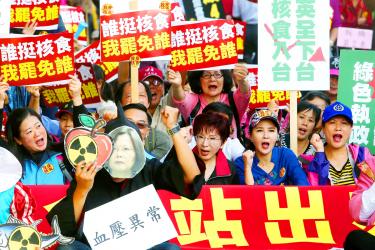
Chinese Nationalist Party (KMT) Chairwoman Hung Hsiu-chu, front third right, attends a demonstration along Taipei’s Ketagalan Boulevard yesterday against the proposed lifting of a ban on food imports from five Japanese prefectures.
KMT leads public protests over Japanese import ban
The Chinese Nationalist Party (KMT) yesterday took to the streets of Taipei, threatening to recall any lawmakers who voice support for the lifting of the nation’s import ban on Japanese food products from five Japanese prefectures, urging President Tsai Ing-wen’s (蔡英文) administration to provide the public with an explanation.
Taiwan imposed import restrictions on food products from Fukushima, Ibaraki, Tochigi, Gunma and Chiba prefectures following the meltdown at the Fukushima Dai-ichi nuclear power plant on March 11, 2011.
Addressing a rally against the relaxation of the ban outside the Chiang Kai-shek Memorial Hall MRT Station in the afternoon, KMT Chairwoman Hung Hsiu-chu (洪秀柱) accused Tsai’s administration of caving in to Japanese pressure and “forcing radiation-contaminated foods down the throats of Taiwanese.”
“We do not understand the Democratic Progressive Party’s [DPP] sudden flip-flop; we do not understand why the government is forcing people and their children to consume radiation-tainted food; and we do not understand … why we have to import radiation-contaminated food products just because of pressure from Japan,” Hung said.
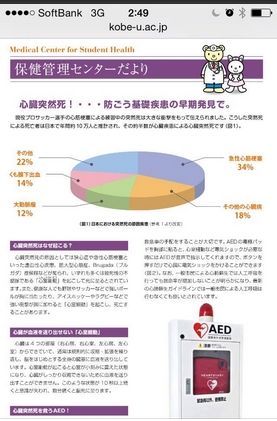
70,000 Sudden Cardiac Deaths per Year in Japan
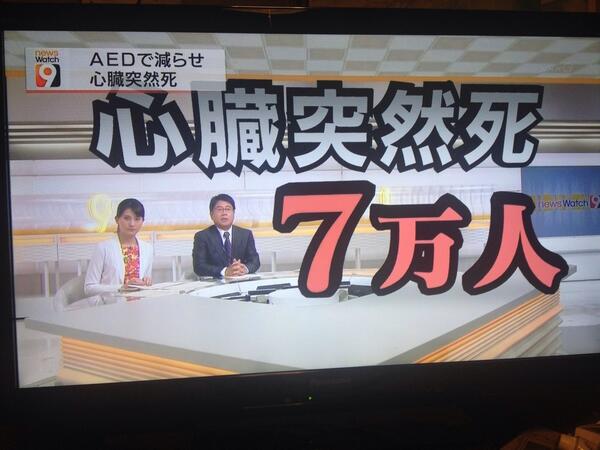
Sudden cardiac death seems to have increased to 70,000 per year in Japan. Previously it was said to be around 50,000 a year.
Is it the influence of radioactive contamination which is still leaking in the Fukushima Nuclear Power Plant ever since the March 2011 meltdowns and explosions?
https://twitter.com/kinmiraixx/status/812923365962825730
Mystery Blog posts (nuclear-news.net) censored to most people on Facebook. Evidence of a Post Truth society?

Here is video evidence of the blocking of “the blog” (link below and its name ) on Facebook. I have spent a couple of days taking a lot of video evidence of blocking and have edited the footage to under some 15 minutes. If you value Fukushima 311 Watchdogs that is closely connected to “the blog” and is run by Noel, Herve and Shaun please share and like this video if you can see it in the interests of freedom of speech and in a new post truth society. Sharing and/or liking this video will also enable us to see the extent of the blocking/hiding of “the blog” on Facebook and if this method of reaching you is more efficient.
The links to “the blog” are in the You Tube description which means you need to click on the title in Facebook and under the video in You Tube click more to expand the comments to get to the links to “the blogs” articles you missed.
I hope i don`t have to do another video showing my You Tube channel being blocked/hidden and if is we will have to communicate telepathically or come up with yet another way around it. I hope you had a great Christmas and will have a great New Years celebration and will get back to supporting our work in the coming year by bookmarking “the blog”. I will push the links further down the You Tube description (ie more Tab) to try and make sure FB doesnt pick the links up.. Oh what a web we weave!
Love from the team
Herve Courtois
Noel Wauchomp
Shaun Mcgee
And the other dedicated admins on F31 Watchdogs
Thank you
Here are the links;
UK Nuclear Test Veterans scrooged at Christmas by MOD and courts 2016
UK Nuclear Test Veterans scrooged at Christmas by MOD and courts 2016
or use this link http://bit.ly/2is0rok
Campaign to stop bad nuclear health practice in Fukushima concerning thyroid cancer epidemic 2016/2017
or this link http://tinyurl.com/gtem796
ISIS and nuclear Armageddon? – Exclusive to nuclear-news.net
ISIS and nuclear Armageddon? – Exclusive to nuclear-news.net
or this link http://tinyurl.com/jrakgoj
And here is a video I did in 2013 showing a reigional block in Europe whilst those outside of Europe could view the post on Naomi Wolf Facebook Page https://www.youtube.com/watch?v=Im-HKYhqEG0
or use this link http://tinyurl.com/j82erwy
The Cost of Cleaning up Fukushima
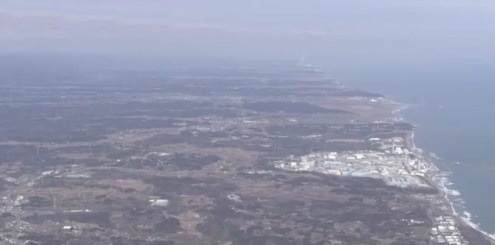
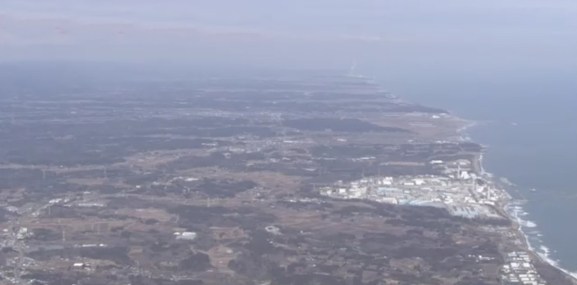
The Abe administration has decided to use taxpayer money for decontaminating areas in Fukushima Prefecture off-limits to people due to fallout of radioactive substances from the March 2011 meltdowns at Tokyo Electric Power’s Fukushima No. 1 power plant. The decision, which deviates from the current policy that Tepco should pay for the decontamination efforts, reflects a proposal put forward in August by the ruling coalition of Prime Minister Shinzo Abe’s Liberal Democratic Party and Komeito but never discussed by the government’s council of experts or in the Diet.
The government may want to justify the move as an effort to help accelerate evacuees’ return to their hometown communities. Still, it will be difficult for the administration to evade criticism that the measure is nothing but a taxpayer-funded bailout for Tepco, which is responsible for the nuclear fallout that affected so many people in Fukushima.
By proceeding with the decontamination work, the administration hopes to lift evacuation orders in some of the no-go areas in about five years. It is hoped these areas will serve as bases for activities to promote reconstruction from the nuclear disaster. As the first step, the government plans to set aside ¥30 billion in the fiscal 2017 budget. So far, no full-scale cleanup work has been carried out inside these zones, which straddle seven municipalities around the Tepco plant.
The government’s position is that it is safe for evacuees to return to their communities if the annual cumulative dose there is 20 millisieverts (mSv) or less, although the legal limit allowed for people in normal circumstances is 1 mSv. The millisievert is a measure of the absorption of radiation by the human body. In no-go zones, the annual dose tops 50 mSv and is not expected to fall below 20 mSv in the next five years.
Faithful to the standard polluter pays principle, which was also applied to the Minamata mercury poisoning disaster in the 1950s and ’60s, the special law to cope with the damage from the Fukushima disaster stipulates that Tepco should shoulder the cleanup cost, and when decontamination work is paid for by taxpayer money, the utility must later reimburse the government. Now the government plans to revise the special law on decontamination and other legislation so it can pay for the planned decontamination work in Fukushima. To counter possible criticism that the scheme is intended merely to help Tepco, the government argues that the planned work aims to improve public infrastructure in the no-go zones so evacuees can return. However, the work will include scraping off top soil and cutting down trees, making it no different than decontamination efforts in other areas.
To justify the use of taxpayer money, the government also says that Tepco has paid compensation to evacuees from the no-go zones on the assumption that they would not be able to return to their homes over an extended period. Thus, in a revised guideline for the reconstruction of Fukushima Prefecture, the government says it will pay for the planned decontamination without asking for reimbursement from Tepco.
Behind the government’s decision for the use of taxpayer money is the mushrooming expense of decontamination, with the latest estimate rising from the original ¥2.5 trillion to ¥4 trillion, which does not include the cost of cleaning up the no-go areas. The government expects the planned work in those areas to cost roughly ¥300 billion over five years, but the price tag could rise if the work becomes protracted. And the burden on taxpayers may further increase if the scope of government-paid decontamination in those areas is expanded.
In a related move, the Ministry of Economy, Trade and Industry has come up with an idea to pass part of the cost of Tepco’s compensation for Fukushima disaster victims on to consumers in the form of higher electricity bills, as the total estimated cost for decommissioning the Fukushima No. 1 plant, compensation and decontamination has swollen from the original ¥11 trillion to ¥21.5 trillion. These moves not only increase people’s financial burden but also blur the power company’s responsibility for the devastation it caused. The government may say the measures are necessary to help promote reconstruction in Fukushima. But they could distract public attention from the principle that it is Tepco which must pay for the decommissioning of its reactors, compensation for the victims and cleanup of the contaminated areas.
http://www.japantimes.co.jp/opinion/2016/12/23/editorials/cost-cleaning-fukushima/#.WF15Dlzia-c
Harassment of Evacuees by Prefectural Housing Authorities to evict them for March 2017
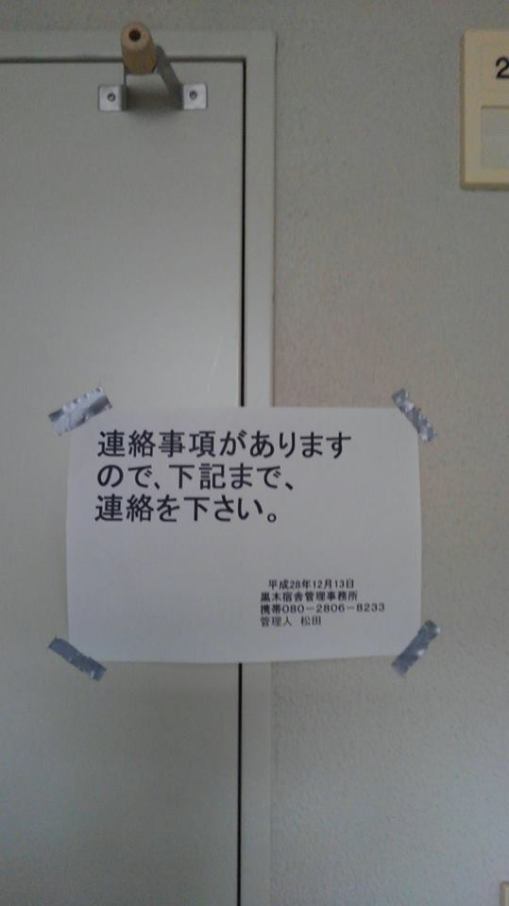
All the people evacuated in 2011 and who benefited of a housing compensation, are now suffering harassment from the various prefectures’ housing authorities, pressuring them to get out of those appartments before coming March 2017
This picture show the notice taped to the entrance door of an evacuee’s appartment, marking and stigmatizing the evacuee’s family to all the neigbors. Those evacuees are victims. Why treat in such manner people who are victims, already suffering plenty enough hardships and losses? What the hell is wrong with you? What are the sins of the victims?
The Japanese government, for the first time, is using state funds for decontamination work in areas affected by the 2011 nuclear accident in Fukushima Prefecture.
The environment ministry earmarked roughly 30 billion yen, or about 250 million dollars, in the fiscal 2017 budget plan, which was approved by the Cabinet on Thursday.
The allocation will be for cleaning up no-entry areas where radiation levels remain prohibitively high.
The government had so far made the plant operator, Tokyo Electric Power Company, pay for the cleanup, based on the principle that the entity responsible for the contamination should bear the cost.
If the Japanese Authorities can provide funds to help Tepco, the entity responsible for the contamination, why can they provide funds to help the victims, whose rights and needs should prevailed over those of the responsible corporation responsible for that nuclear disaster? Why the Japanese central government can coordinate with those various prefectures housing authorities for those evacuees to continue to live in a free-radiation environmnent?
The Japanese government decided to stop the evacuees housing compensation on March 2017 so as to force the evacuees’ return to live with radiation in the ghost towns now declared “safe” by the Japanese government. In preparation of the coming 2020 Tokyo Olympics, all must be back to normal, and is now declared “safe and clean”. Economics prevailing over scientific realities and people lives.
Japanese culture is looked upon as being a very refined, sophisticated, advanced culture. Is there no place for compassion in Japanese culture? Those victims are suffering from double-triple suffering already. Do you have to turn it into persecution?
Is not the right to live in a radiation-free environment a basic human right? To force them by all kinds of gimmicks to return to live in a contaminated territory, is then a violation of their basic human rights, their right to preserve their own health!
Alexandrov Red Army Choir – Kalinka (SUBTITLES) With respect for Russian loss
Concert at Tchaikovsky Concert Hall, Moscow, 2009
Andrey Fomin added 3 new photos.
Horrific tragedy took place off the Sochi coast this morning. The legendary #Alexandrov Red Army Chorus was crashed in an air accident on the way to #Hmeimim air base in #Syria minutes after departing from Sochi. The TU-154 belonging to the Russian MoD collapsed in the air for yet unknown reason and fell in the sea. The rescue teams are currently searching for possible survivors, but the chances are minimal…
There were all but three soloists of the Chorus, headed by the director Lieutenant General Valeriy Khalilov, as well as several instrumentalists, on board (64 in total). They were about to give the New Year concert to the Russian contractors in Syria.
A press team of 9 men from the First Channel and Zvezda Channel accompanied the Chorus.
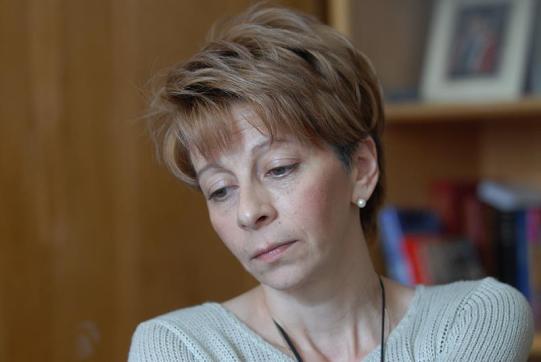
As a final shocking detail, it was reported that Elizaveta Glinka, the famous “Doctor Liza”, who became internationally known for providing critical humanitarian assistance in #Donbass since 2014 and chair of the humanitarian foundation “Fair Help”, was present on the same board attending the humanitarian cargo designated for the university hospital in Tishrin, Latakia.
1 This Month

of the week – Shut Down Drone Warfare!


Tell the Ukrainian Government to Drop Prosecution of Peace Activist Yurii Sheliazhenko

Petition to revoke the licensing of the Near Surface Nuclear Disposal Facility (NSDF) at Chalk River. https://www.ourcommons.ca/petitions/en/Petition/Details?Petition=e-7247
To see nuclear-related stories in greater depth and intensity – go to https://nuclearinformation.wordpress.com
-
Archives
- April 2026 (114)
- March 2026 (251)
- February 2026 (268)
- January 2026 (308)
- December 2025 (358)
- November 2025 (359)
- October 2025 (376)
- September 2025 (257)
- August 2025 (319)
- July 2025 (230)
- June 2025 (348)
- May 2025 (261)
-
Categories
- 1
- 1 NUCLEAR ISSUES
- business and costs
- climate change
- culture and arts
- ENERGY
- environment
- health
- history
- indigenous issues
- Legal
- marketing of nuclear
- media
- opposition to nuclear
- PERSONAL STORIES
- politics
- politics international
- Religion and ethics
- safety
- secrets,lies and civil liberties
- spinbuster
- technology
- Uranium
- wastes
- weapons and war
- Women
- 2 WORLD
- ACTION
- AFRICA
- Atrocities
- AUSTRALIA
- Christina's notes
- Christina's themes
- culture and arts
- Events
- Fuk 2022
- Fuk 2023
- Fukushima 2017
- Fukushima 2018
- fukushima 2019
- Fukushima 2020
- Fukushima 2021
- general
- global warming
- Humour (God we need it)
- Nuclear
- RARE EARTHS
- Reference
- resources – print
- Resources -audiovicual
- Weekly Newsletter
- World
- World Nuclear
- YouTube
-
RSS
Entries RSS
Comments RSS
 nuclear-news