On Nuclear Policy, Trump and Clinton Agree: Armageddon Is an Option
While you were up watching reruns of Seinfeld, the first presidential debate turned into Dr. Strangelove. The Nation , By Andrew J. Bacevich, 5 Oct 16,
You may have missed it. Perhaps you dozed off. Or wandered into the kitchen to grab a snack. Or by that point in the proceedings were checking out Seinfeld reruns. During the latter part of the much hyped but excruciating-to-watch first presidential debate, NBC Nightly News anchor Lester Holt posed a seemingly straightforward but cunningly devised question. His purpose was to test whether the candidates understood the essentials of nuclear strategy.
A moderator given to plain speaking might have said this: “Explain why the United States keeps such a large arsenal of nuclear weapons and when you might consider using those weapons.”
What Holt actually said was: “On nuclear weapons, President Obama reportedly considered changing the nation’s longstanding policy on first use. Do you support the current policy?”
The framing of the question posited no small amount of knowledge on the part of the two candidates. Specifically, it assumed that Donald Trump and Hillary Clinton each possess some familiarity with the longstanding policy to which Holt referred and with the modifications that Obama had contemplated making to it………
Cruelly, the moderator invited Trump to respond first. The look in the Republican nominee’s eyes made it instantly clear that Holt could have been speaking Farsi for all he understood……..
in the arcane theology of nuclear strategy, “first strike” and “first use” are anything but synonymous. “First strike” implies a one-sided, preventive war of annihilation. The logic of a first strike, such as it is, is based on the calculation that a surprise nuclear attack could inflict the “nuclear alternative” on your adversary, while sparing your own side from suffering a comparable fate. A successful first strike would be a one-punch knockout, delivered while your opponent still sits in his corner of the ring.
………..The Republican nominee promptly revoked his “no first strike” pledge by insisting, in a cliché much favored in Washington, that “I can’t take anything off the table.”……..
It was now Clinton’s turn to show her stuff…..
What followed was vintage Clinton: vapid sentiments, smoothly delivered in the knowing tone of a seasoned Washington operative. During her two minutes, she never came within a country mile of discussing the question Holt had asked or the thoughts she evidently actually has about nuclear issues……..
What do our presidential candidates talk about when they don’t want to talk about nuclear war? The one, in a vain effort to conceal his own ignorance, offers rambling nonsense. The other, accustomed to making her own rules, simply changes the subject.
Everybody’s patience with Russia has run out,’ Earnest says
Putin decree on arms treaty cites U.S. threats to ‘stability’
Ties between Russia and the U.S. deteriorated further after the Obama administration proclaimed bilateral peace talks over Syria dead and Moscow suspended a 16-year-old treaty meant to reduce the risk of nuclear proliferation.
Diplomacy Is Over As Russia and The U.S. Face Off
“Everybody’s patience with Russia has run out,” White House spokesman Josh Earnest said in Washington on Monday, blaming Vladimir Putin’s government for undermining the fight against Islamic State and for indiscriminate bombing that has killed civilians and targeted hospitals in Syria. “Russians have been complicit” in the Syrian tragedy, Earnest said, and “there is nothing more for the United States and Russia to talk about.”
The U.S. announced Monday it was withdrawing personnel who had been dispatched to the Middle East in anticipation that a Syrian cease-fire deal reached Sept. 9 would go into effect, a move that would have paved the way toward greater coordination between the U.S. and Russian militaries. That followed Putin’s decision earlier in the day to withdraw from a 2000 accord that committed both countries to eliminating stockpiles of plutonium used as the core material in some types of nuclear weapons.
‘Forced Measure’
While Washington’s decision causes “deep disappointment,” the U.S. never fulfilled a commitment to separate moderate Syrian rebels from terrorist groups, the Russian Foreign Ministry said in a website statement late Monday. “We urge the U.S. to assess the situation once more in light of how their actions appear before the world. The stakes are very high.”
Halting the plutonium pact is a “forced measure,” Russian Foreign Minister Sergei Lavrov said, according to the ministry’s website. Russia viewed the treaty as an “important step” toward nuclear disarmament, he said. Putin’s decree accused the U.S. of “unfriendly” actions that posed a “threat to strategic stability.”
Starting in the last years of the Cold War, Russia and the United States signed a series of accords to reduce the size of their nuclear arsenals, agreements that have so far survived intact despite a souring of U.S.-Russian relations under Putin.
But on Monday, Putin issued a decree suspending an agreement, concluded in 2000, which bound the two sides to dispose of surplus plutonium originally intended for use in nuclear weapons.
The Kremlin said it was taking that action in response to unfriendly acts by Washington. It made the announcement shortly before Washington said it was suspending talks with Russia on trying to end the violence in Syria.
The plutonium accord is not the cornerstone of post-Cold War U.S.-Russia disarmament, and the practical implications from the suspension will be limited. But the suspension, and the linkage to disagreements on other issues, carries powerful symbolism.
“Putin’s decree could signal that other nuclear disarmament cooperation deals between the United States and Russia are at risk of being undermined,” Stratfor, a U.S.-based consultancy, said in a commentary.
“The decision is likely an attempt to convey to Washington the price of cutting off dialogue on Syria and other issues.”
U.S. State Department spokesman John Kirby said in a statement on Monday that bilateral contacts with Moscow over Syria were being suspended. Kirby said Russia had failed to live up to its commitments under a ceasefire agreement.
Western diplomats say an end to the Syria talks leaves Moscow free to pursue its military operation in support of Syrian President Bashar al Assad, but without a way to disentangle itself from a conflict which shows no sign of ending.
Russia and the United States are also at loggerheads over Ukraine. Washington, along with Europe, imposed sanctions on Russia after it annexed Ukraine’s Crimea region in 2014 and backed pro-Moscow rebels in eastern Ukraine.
List of grievances
Putin submitted a draft law to parliament setting out under what conditions work under the plutonium accord could be resumed. Those conditions were a laundry list of Russian grievances towards the United States.
They included Washington lifting the sanctions imposed on Russia over Ukraine, paying compensation to Moscow for the sanctions, and reducing the U.S. military presence in NATO member state in eastern Europe to the levels they were 16 years ago.
Any of those steps would involve a complete U-turn in long-standing U.S. policy.
“The Obama administration has done everything in its power to destroy the atmosphere of trust which could have encouraged cooperation,” the Russian foreign ministry said in a statement on the treaty’s suspension.
“The step Russia has been forced to take is not intended to worsen relations with the United States. We want Washington to understand that you cannot, with one hand, introduce sanctions against us where it can be done fairly painlessly for the Americans, and with the other hand continue selective cooperation in areas where it suits them.”
The 2010 agreement, signed by Russian Foreign Minister Sergei Lavrov and then-U.S. Secretary of State Hillary Clinton, called on each side to dispose of 34 tonnes of plutonium by burning it in nuclear reactors.
Clinton said at the time that there was enough of the material to make almost 17,000 nuclear weapons. Both sides back then viewed the deal as a sign of increased cooperation between the two former Cold War adversaries.
Russian officials alleged on Monday that Washington had failed to honor its side of the agreement. The Kremlin decree stated that, despite the suspension, Russia’s surplus weapons-grade plutonium would not be put to military use.
Censored! This article is generally off topic for this blog but this article and nuclear-news.net post have been blocked from Google Search in Europe (and possibly further afield). Ireland based blogs and nuclear-news.net based in Australia are affected as far as I can ascertain. Also, Shannonwatch.org (An Irish peace group) have tried to get out a press release stating problems they are having in the Limerick area and this too has been banned! Could you share directly to any Irish people you know these banned articles.
Sellafield are having a meeting with Irish Stakeholders who have doubts as to the safety and transparency of the UK nuclear industry. This meeting is in the next week or so and it is vital that people are aware of alleged criminality to Parliament by Sellafield representatives. Many thanks for your support –
Evidence for the blocking and hacking over a few days can be found here;
Irish Security Services leak truths to the UK Press.
A recent article by The Sunday Times UK edition stated that the Irish Security Services (Likely the Irish Defense Force) have claimed that Gardai (Police ) in Athlone had been facilitating the distribution of heroin to local towns.
Due to Irish Laws the name of the whistle-blower has not been reported in Ireland but was on the Sunday Times UK edition on Sunday the 2nd of October 2016.
Why are the Irish “Security Services” leaking this fact to the UK Press? So, as to allow Irish readers the option of reading this article we will not name the brave whistle-blower who leaked the criminality in 2014 but it can be found on the Sunday Times article link ..
This is what the “Security Services were quoted as saying in the article;
“…Security sources say collusion between gardai and heroin dealers in the midlands town has been a significant factor in the area’s worsening drugs problem. The region has a growing population of heroin users and the town is now considered to be a pivotal point in the distribution of opiates to addicts in Longford, Westmeath, Offaly and Laois…..”
Earlier in the article the Times quotes also the “Security Sources” thus;
“…..According to security sources, the internal inquiry concluded that one Garda was in a relationship with a female heroin dealer in the town, which resulted in him compromising planned searches and raids. One witness told investigators he was present when this Garda alerted local criminals to a planned Gardai search the following day, ensuring they had time to dispose of incriminating evidence, including mobile phones. The witness refused to make a statement under caution or agree to testify, however…..”
It might be noted that a government report said that in 2014 the Irish Defense Force did not apply for any orders for surveillance on criminals. We here at Euroupeannewsweekly have been asking the question;
Who is doing surveillance now in Ireland? In 2014 a Gardai and Security Services operation against a dissident IRA group ended with a successful arrest of the whole group at a remote farmhouse, to name but one crime that was widely reported and would have required constant surveillance tactics.
Is there a connection between the ending of the use of the Security Services (or end any of transparency in Government reports) and the evidence that they were holding for the investigation?
We can not claim these last points to be fact, they are only questions posed because of the Irish Security Services leak to the UK. We can present the basic facts to you and let you make up your own minds though.
So what is at stake here? We know for a fact that the Irish Security Services are not happy and have released this information to the nearly 10 million Irish Diaspora in the UK but no publication has reported any of this in Ireland. Yet it is important for the real victims of this criminality that these facts become known and that some in the Government are not happy with this current situation. The security services were tapping all the phones and know all the connections of these criminal gangs and their enablers.
Here is a statement from a local ex Heroin user from Longford on the desperate situation that exists in this region and what funding opportunities for the proven victims of this criminality;
the real problem is that the nuclear industry lost its credibility almost at its inception, and has never recovered. It was hastily launched, endowed with the sort of government indulgence that breeds sloppiness, and has tried to conceal its faults through secrecy and legal bluster
GIL SCOTT HERON – WE ALMOST LOST DETROIT
50 years after ‘we almost lost Detroit,’ America’s nuclear power industry faces even graver doubts, LA Times, 5 Oct 16 Michael HiltzikContact ReporterThe history of nuclear power in the United States has been marked by numerous milestones, many of them bad — accidents, construction snafus, engineering incompetence, etc., etc. One anniversary of an incident that has cast a long shadow over the nuclear power industry’s claim for safety will be marked this week. On Oct. 5, 1966 — that’s 50 years ago Wednesday — Detroit Edison’s Fermi-1 nuclear plant suffered a partial meltdown, caused by a piece of floating shrapnel inside the container vessel.
One anniversary of an incident that has cast a long shadow over the nuclear power industry’s claim for safety will be marked this week. On Oct. 5, 1966 — that’s 50 years ago Wednesday — Detroit Edison’s Fermi-1 nuclear plant suffered a partial meltdown, caused by a piece of floating shrapnel inside the container vessel. Continue reading →
Rowe Board of Selectmen chair Marilyn Wilson said the town over the summer heard from Illinois Republican Rep. Robert J. Dold concerning a bill that would help towns that host a “stranded spent nuclear fuel storage site.”
A plainclothes guard with an assault-style rifle stood at the front gate. Reporters were told to point their cameras away from the facility.
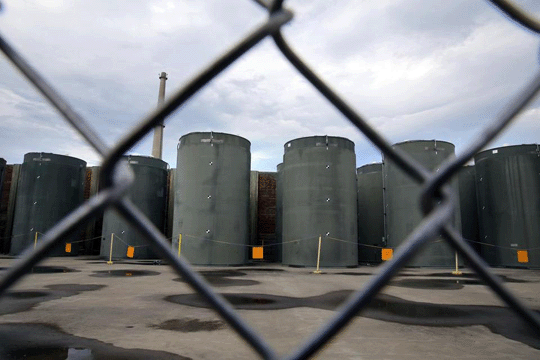
Rowe seeks federal compensation for hosting nuclear waste at former atomic power plant http://www.masslive.com/news/index.ssf/2016/10/rowe_seeks_federal_compensatio.htmlROWE — Yankee Rowe Nuclear Power Station shut down in 1992, and was demolished and decommissioned by 2007, but the fenced and isolated site on the upper Deerfield River still hosts 127 tons of spent fuel and high-level radioactive waste in 16 concrete casks under 24-hour security.
The tiny town of Rowe is one of about a dozen communities nationwide affected by the presence of nuclear waste, but no longer benefiting economically from the presence of a functioning reactor.
On Monday, U.S. Rep. Richard Neal and state Sen. Paul Mark (D-Peru) toured the site as guests of the Rowe Board of Selectmen. Mark is a member of the Yankee Rowe Spent Fuel Storage & Removal Citizens Advisory Committee. Neal, who represents the state’s 1st Congressional District, assured local officials that he supports bipartisan legislation in Washington that would compensate communities that are forced to store nuclear waste.
The “Interim Spent Nuclear Fuel Storage Compensation Act” would seek up to $100 million for 13 towns ranging from Zion, Illinois to Wiscasset, Maine.
“The federal government is obligated to provide mitigation costs to communities such as Rowe, considering that the Department of Energy failed to remove the waste as promised,” said Neal, a Democrat.
It was never the intention of the federal government for small towns such as Rowe to host spent fuel rods forever.
The Nuclear Waste Policy Act of 1982 directed the U.S. Department of Energy to take ownership of the nation’s nuclear waste. The plan was to build a repository at Yucca Mountain in Nevada, but the facility was never built. Capping decades of gridlock, the Obama administration withdrew support for the plan in 2011.
Various nuclear plant owners, who over the years paid into a Department of Energy Fund to handle their waste, repeatedly sued the government over the broken promise, and dozens of settlements to date have cost taxpayers a combined $4 billion.
Rowe Board of Selectmen chair Marilyn Wilson said the town over the summer heard from Illinois Republican Rep. Robert J. Dold concerning a bill that would help towns that host a “stranded spent nuclear fuel storage site.” She said the proposed bill recognizes that such communities have become de facto interim nuclear waste sites.
Wilson said when Yankee Rowe was fully operational, the company paid for the town’s police, fire, and emergency response budgets, on top of paying substantial property taxes. Now taxes are diminished and public safety expenses are borne by local taxpayers. The town continues to bear other plant-related costs, she said.
Event without the nuke, Rowe enjoys a solid tax base thanks to several hydro-electric facilities on the Deerfield River. With a population of 358, its own elementary school, and hundreds of acres of conservation land, the residential tax rate remains at $6.03 per thousand valuation. The commercial and industrial tax rate stands at $13.31. The tax history of the Yankee Rowe plant was not immediately available. The company owns more than 1,700 acres.
Members of the press, initially invited by Neal’s office to attend Monday’s tour, were blocked from attending by plant officials, who cited security reasons. A plainclothes guard with an assault-style rifle stood at the front gate. Reporters were told to point their cameras away from the facility.
Robert Capstick, a spokesman for Yankee Rowe, said he is as eager as town officials to see a solution. The company spends millions every year to host the waste that the government failed to remove, he said. In New England, other plants with stranded waste are Maine Yankee, Vermont Yankee, and Connecticut Yankee.
Meanwhile, the Department of Energy is considering privately-owned interim storage to overcome the impasse in Congress over authorizing a permanent site. Waste Control Specialists proposes an interim facility for 40,000 tons of nuclear waste in West Texas. Energy Secretary Ernest Moniz has said siting of interim facilities would be done under a “consent-based” model.
Moniz still acknowledges the need for an permanent, underground geological repository. About 2,000 metric tons of spent nuclear fuel is created every year.
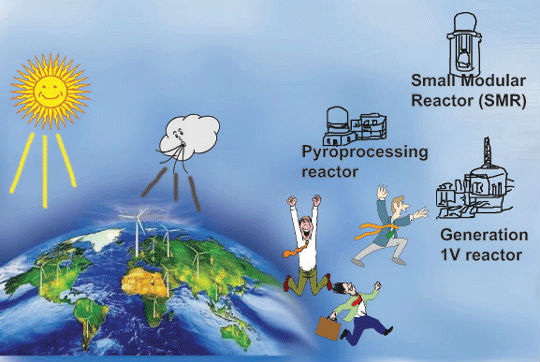
Generation IV ‘fast breeder’ reactors have long been promoted by nuclear enthusiasts, writes Jim Green, but Japan’s decision to abandon the Monju fast reactor is another nail in the coffin for this failed technology.
Fast neutron reactors are “poised to become mainstream” according to the World Nuclear Association. The Association lists eight “current” fast reactors although three of them are not operating. That leaves just five fast reactors ‒ three of them experimental.
Fast reactors aren’t becoming mainstream. One after another country has abandoned the technology. Nuclear physicist Thomas Cochransummarises the history: “Fast reactor development programs failed in the: 1) United States; 2) France; 3) United Kingdom; 4) Germany; 5) Japan; 6) Italy; 7) Soviet Union/Russia 8) U.S. Navy and 9) the Soviet Navy. The program in India is showing no signs of success and the program in China is only at a very early stage of development.”
The latest setback was the decision of the Japanese government at an extraordinary Cabinet meeting on September 21 to abandon plans to restart the Monju fast breeder reactor.
Monju reached criticality in 1994 but was shut down in December 1995 after a sodium coolant leak and fire. The reactor didn’t restart until May 2010, and it was shut down again three months later after a fuel handling machine was accidentally dropped in the reactor during a refuelling outage. In November 2012, it was revealed that Japan Atomic Energy Agency had failed to conduct regular inspections of almost 10,000 out of a total 39,000 pieces of equipment at Monju, including safety-critical equipment.
In November 2015, the Nuclear Regulation Authority declared that the Japan Atomic Energy Agency was “not qualified as an entity to safely operate” Monju. Education minister Hirokazu Matsuno said on 21 September 2016 that attempts to find an alternative operator have been unsuccessful.
The government has already spent 1.2 trillion yen (US$12bn) on Monju. The government calculated that it would cost another 600 billion yen (US$6bn) to restart Monju and keep it operating for another 10 years.
Decommissioning also has a hefty price-tag ‒ far more than for conventional light-water reactors. According to a 2012estimate by the Japan Atomic Energy Agency, decommissioning Monju will cost an estimated 300 billion yen (US$3bn).
India’s failed fast reactor program India’s fast reactor program has been a failure. The budget for the Fast Breeder Test Reactor (FBTR) was approved in 1971 but the reactor was delayed repeatedly, attaining first criticality in 1985. It took until 1997 for the FBTR to start supplying a small amount of electricity to the grid. The FBTR’s operations have been marred by several accidents.
Preliminary design work for a larger Prototype Fast Breeder Reactor (PFBR) began in 1985, expenditures on the reactor began in 1987/88 and construction began in 2004 ‒ but the reactor still hasn’t started up. Construction has taken more than twice the expected period. In July 2016, the Indian government announced yet another delay, and there is scepticism that the scheduled start-up in March 2017 will be realised. The PFBR’s cost estimate has gone up by 62%.
India’s Department of Atomic Energy (DAE) has for decades projected the construction of hundreds of fast reactors ‒ for example a 2004 DAE document projected 262.5 gigawatts (GW) of fast reactor capacity by 2050. But India has a track record of making absurd projections for both fast reactors and light-water reactors ‒ and failing to meet those targets by orders of magnitude.
Academic M.V. Ramana writes: “Breeder reactors have always underpinned the DAE’s claims about generating large quantities of electricity. Today, more than six decades after the grand plans for growth were first announced, that promise is yet to be fulfilled. The latest announcement about the delay in the PFBR is yet another reminder that breeder reactors in India, like elsewhere, are best regarded as a failed technology and that it is time to give up on them.”
Russia’s snail-paced program Russia’s fast reactor program is the only one that could be described as anything other than an abject failure. But it hasn’t been a roaring success either.
Three fast reactors are in operation in Russia ‒ BOR-60 (start-up in 1969), BN-600 (1980) and BN-800 (2014). There have been 27sodium leaks in the BN-600 reactor, five of them in systems with radioactive sodium, and 14 leaks were accompanied by burning of sodium.
The Russian government published a decree in August 2016 outlining plans to build 11 new reactors over the next 14 years. Of the 11 proposed new reactors, three are fast reactors: BREST-300 near Tomsk in Siberia, and two BN-1200 fast reactors near Ekaterinburg and Chelyabinsk, near the Ural mountains. However, like India, the Russian government has a track record of projecting rapid and substantial nuclear power expansion ‒ and failing miserably to meet the targets.
As Vladimir Slivyak recently noted in Nuclear Monitor: “While Russian plans looks big on paper, it’s unlikely that this program will be implemented. It’s very likely that the current economic crisis, the deepest in history since the USSR collapsed, will axe the most of new reactors.”
While the August 2016 decree signals new interest in reviving the BN-1200 reactor project, it was indefinitely suspended in 2014, with Rosatom citing the need to improve fuel for the reactor and amid speculation about the cost-effectiveness of the project.
In 2014, Rosenergoatom spokesperson Andrey Timonov said the BN-800 reactor, which started up in 2014, “must answer questions about the economic viability of potential fast reactors because at the moment ‘fast’ technology essentially loses this indicator [when compared with] commercial VVER units.”
China’s program going nowhere fast Australian nuclear lobbyist Geoff Russell cites the World Nuclear Association(WNA) in support of his claim that China expect fast reactors “to be dominating the market by about 2030 and they’ll be mass produced.”
Does the WNA paper support the claim? Not at all. China has a 20 MWe experimental fast reactor, which operated for a total of less than one month in the 63 months from criticality in July 2010 to October 2015. For every hour the reactor operated in 2015, it was offline for five hours, and there were three recorded reactor trips.
China also has plans to build a 600 MWe ‘Demonstration Fast Reactor’ and then a 1,000 MWe commercial-scale fast reactor. Whether those reactors will be built remains uncertain ‒ the projects have not been approved ‒ and it would be another giant leap from a single commercial-scale fast reactor to a fleet of them.
According to the WNA, a decision to proceed with or cancel the 1,000 MWe fast reactor will not be made until 2020, and if it proceeds, construction could begin in 2028 and operation could begin in about 2034.
So China might have one commercial-scale fast reactor by 2034 ‒ but probably won’t. Russell’s claim that fast reactors will be “dominating the market by about 2030” is unbridled jiggery-pokery.
According to the WNA, China envisages 40 GW of fast reactor capacity by 2050. A far more likely scenario is that China will have 0 GW of fast reactor capacity by 2050. And even if the 40 GW target was reached, it would still only represent aroundone-sixth of total nuclear capacity in China in 2050 ‒ fast reactors still wouldn’t be “dominating the market” even if capacity grows by orders of magnitude from 0.02 GW (the experimental reactor that is usually offline) to 40 GW.
Travelling-waves and the non-existent ‘integral fast reactor’
Perhaps the travelling-wave fast reactor popularised by Bill Gates will come to the rescue? Or perhaps not. According to theWNA, China General Nuclear Power and Xiamen University are reported to be cooperating on R&D, but the Ministry of Science and Technology, China National Nuclear Corporation, and the State Nuclear Power Technology Company are all skeptical of the travelling-wave reactor concept.
Perhaps the ‘integral fast reactor’ (IFR) championed by James Hansen will come to the rescue? Or perhaps not. The UK and US governments have been considering building IFRs (specifically GE Hitachi’s ‘PRISM’ design) for plutonium disposition ‒ but it is almost certain that both countries will choose different methods to manage plutonium stockpiles.
In South Australia, nuclear lobbyists united behind a push for IFRs/PRISMs, and they would have expected to persuade a stridently pro-nuclear Royal Commission to endorse their ideas. But the Royal Commission completely rejected the proposal, noting in its May 2016report that advanced fast reactors are unlikely to be feasible or viable in the foreseeable future; that the development of such a first-of-a-kind project would have high commercial and technical risk; that there is no licensed, commercially proven design and development to that point would require substantial capital investment; and that electricity generated from such reactors has not been demonstrated to be cost competitive with current light water reactor designs.
A future for fast reactors?
Just 400 reactor-years of worldwide experience have been gained with fast reactors. There is 42 times more experience with conventional reactors (16,850 reactor-years). And most of the experience with fast reactors suggests they are more trouble than they are worth.
Apart from the countries mentioned above, there is very little interest in pursuing fast reactor technology. Germany, the UK and the UScancelled their prototype breeder reactor programs in the 1980s and 1990s.
France is considering building a fast reactor (ASTRID) despite the country’s unhappy experience with the Phénix and Superphénix reactors. But a decision on whether to construct ASTRID will not be made until 2019/20.
The performance of the Superphénix reactor was as dismal as Monju. Superphénix was meant to be the world’s first commercial fast reactor but in the 13 years of its miserable existence it rarely operated ‒ its ‘Energy Unavailability Factor’ was 90.8% according to the IAEA. Note that the fast reactor lobbyists complain about the intermittency of wind and solar!
A 2010 article in the Bulletin of the Atomic Scientists summarised the worldwide failure of fast reactor technology: “After six decades and the expenditure of the equivalent of about $100 billion, the promise of breeder reactors remains largely unfulfilled. … The breeder reactor dream is not dead, but it has receded far into the future. In the 1970s, breeder advocates were predicting that the world would have thousands of breeder reactors operating this decade. Today, they are predicting commercialization by approximately 2050.”
Allison MacFarlane, former chair of the US Nuclear Regulatory Commission, recently made this sarcastic assessment of fast reactor technology: “These turn out to be very expensive technologies to build. Many countries have tried over and over. What is truly impressive is that these many governments continue to fund a demonstrably failed technology.”
While fast reactors face a bleak future, the rhetoric will persist. Australian academic Barry Brook wrote a puff-piece about fast reactors for the Murdoch press in 2009. On the same day he said on his website that “although it’s not made abundantly clear in the article”, he expects conventional reactors to play the major role for the next two to three decades but chose to emphasise fast reactors “to try to hook the fresh fish”.
So that’s the nuclear lobbyists’ game plan − making overblown claims about fast reactors and other Generation IV reactor concepts, pretending that they are near-term prospects, and being less than “abundantly clear” about the truth.
Dr Jim Green is the national anti-nuclear campaigner with Friends of the Earth Australia and editor of the Nuclear Monitor newsletter published by the World Information Service on Energy.
Companies may ease nuclear waste backlog, news.com.au, OCTOBER 4, 2016, Timothy Gardner. Reuters “…… The waste is now mostly held at power plants in dry cask storage or in spent fuel pools, said Moniz, a nuclear physicist who has run the department since 2013.
The US could start transferring that waste to interim sites, potentially including government and private
disposal sites, in the middle of the next decade until a permanent solution is developed.
“We would like to have the authority for publicly owned and operated (storage) facilities. We are also very much interested in the possibility of pursuing private storage,” Moniz said in an interview about the nuclear issues the next administration will face after President Barack Obama leaves office….
some of his [Obama’s] fellow Democrats have reservations about moving ahead with nuclear, which faces competition from natural gas, until the waste problem is solved.
Senator Diane Feinstein told Moniz at a recent congressional hearing she would not support new nuclear power projects unless the issue is dealt with.
Moniz said if companies take over storage, Congress will still need to act…….
Another thorny issue on nuclear waste has been an agreement with Russia to convert plutonium left over from the Cold War to nuclear plant fuel. Under the deal struck in 2000, each country is expected to convert 34 tons of the material into fuel pellets.
The federal government has spent about $US5 billion on a plant in South Carolina and associated facilities that would convert the material into MOX, or mixed-oxide pellets for reactors. But cost estimates for the project have soared, and now Moniz says the MOX method would cost up to $US50 billion over 50 years.
He wants the country to consider simply diluting the plutonium with inert materials and disposing the mix deep underground, such has been done for other nuclear materials in New Mexico…….
How to Think About 1.5 Degrees https://theconversation.com/how-to-think-about-1-5-degrees-66412Clive HamiltonProfessor of Public Ethics, Centre For Applied Philosophy & Public Ethics (CAPPE), Charles Sturt University October 3, 2016 Astonishment was universal last December when the Paris Agreement on climate change included the aspiration to limit warming to 1.5 degrees above pre-industrial levels, a much tougher target than the standard of 2 degrees, now seen as too risky.
It was a remarkable triumph for a long campaign by the small island states, proving that even tiny nations, armed with a powerful moral case, can change the world.
But what does a global aim of 1.5 degrees mean? Is it achievable? How much difference would it make? A conference at the University of Oxford two weeks ago brought together leading scientists to begin to answer these questions.
No one can give firm answers, but some surprising observations emerged at the conference. One thing is clear: given the vast quantity of carbon dioxide already in the atmosphere, with more still to come, limiting warming to 1.5 degrees will require ‘negative emissions’.
Negative emissions technologies aim to draw carbon dioxide out of the atmosphere and store it safely. Some proposed technologies include machines that extract carbon dioxide from the air, concentrate it and then somehow (the answers are vague) store it. At a scale to make a significant difference, a huge infrastructure of carbon-sucking machines, concentrating equipment and pipelines would need to be built.
The most commonly mentioned method of negative emissions entails generating electricity by burning biomass – mainly crop waste, wood waste, and crops grown for the purpose – capturing the carbon dioxide from the emissions and storing them underground.
It’s estimated that to make a substantial difference to global warming huge expanses of land would have to be given over to growing biomass crops. This risks depriving poor people of food crops and destroying ecosystems as swathes of land are converted to growing biomass for energy.
So here is the first troubling prospect. Although warming of only 1.5 degrees would result in much less harm to the climate than 2 degrees, it’s possible that the ecological damage caused by the negative emissions projects needed to get there may exceed the benefits, at least for some. The ecosystem costs of the emission reduction pathways may outweigh the benefits of lower warming.
So while the overall goal of climate negotiations is to avoid ‘dangerous climate change’, perhaps it needs to be changed so that the goal becomes to ‘minimize dangerous change to the Earth System as a whole’, a dramatic shift in how we think about the issue.
It must begin soon
For a 1.5-degree goal, large-scale negative emissions activity would need to begin soon, before 2030, and expand rapidly, so that by 2050 or sooner the amount of carbon sucked out of the atmosphere would have to exceed the amount emitted into it from fossil fuel burning.
No one is confident it can be done. Some suggest that when the Intergovernmental Panel on Climate Change has included negative emissions in its future emissions scenarios it is not much more than a ‘fudge factor’ to make the 2 degrees limit seem possible.
Apart from the cost, the biggest obstacle to negative emissions technologies is what to do with the captured carbon. Although it’s fairly easy to extract carbon dioxide from the air, no one has yet come up with a feasible and economic way of storing billions of tonnes of it. It must be done safely and it must stay there for thousands of years, without leaking out.
Some years ago governments became excited at the idea of pumping it into geological formations, but pilot projects around the world have been abandoned because they ran into technical problems and cost blowouts. Now it’s thought that storing carbon dioxide underground on a large scale is decades away.
Overshooting
The world has already warmed by 1 degree and momentum in the climate system will almost certainly see the world reach 1.5 degrees, perhaps as early as 2030. So if our goal is to limit warming to 1.5 degrees there will be an ‘overshoot’, taking warming to at least 2 and perhaps 3 degrees, before the average global temperature can be brought back down.
Here is the second troubling possibility. If the world warms by 2 or more degrees will feedback effects kick in – such as unstoppable melting of the Siberian permafrost, which could send more greenhouse gases into the atmosphere, making it virtually impossible to stabilize warming at 2 degrees, let alone 1.5.
And if we could overshoot and return to 1.5 degrees, would ecosystems and vulnerable plant and animal species be able to survive the period of perhaps three or four or five decades of overshoot. Scientists hope that ecosystems possess ‘temporary resilience’ during the overshoot period so that they can bounce back when cooler conditions return.
Equally troubling, for those creatures and ecosystems that do manage to adapt to an environment 2 or 3 degrees warmer, could they cope in a cooling environment as the global temperature is wound back to 1.5 degrees?
When the nations of the world in Paris adopted the 1.5 degree aspiration the politicians were well ahead of the scientists. Now the scientists are scrambling to catch up.
This article was first published by Scientific American.
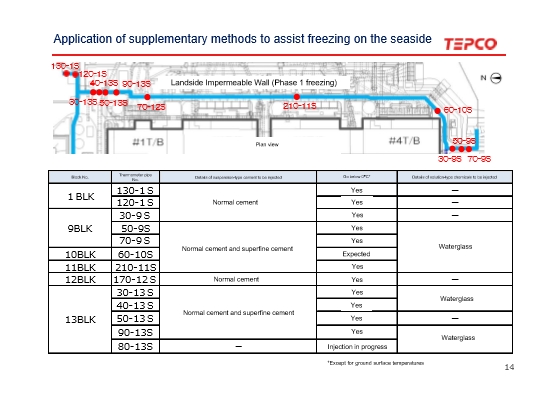
TEPCO also continues to inject concrete and a soil solidification substance in areas of the frozen wall that have been resistant to proper freezing.
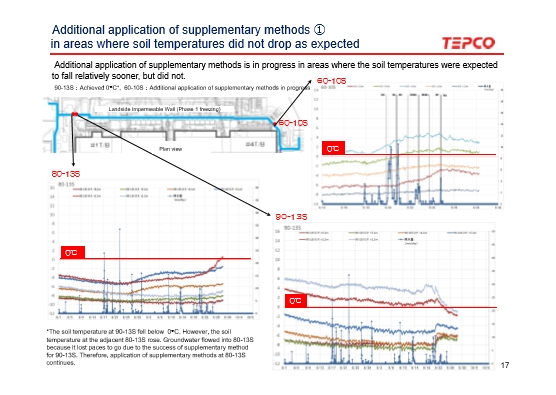
Groundwater levels inside the reactor areas has been on the rise due to more success freezing the sea side section of the wall.
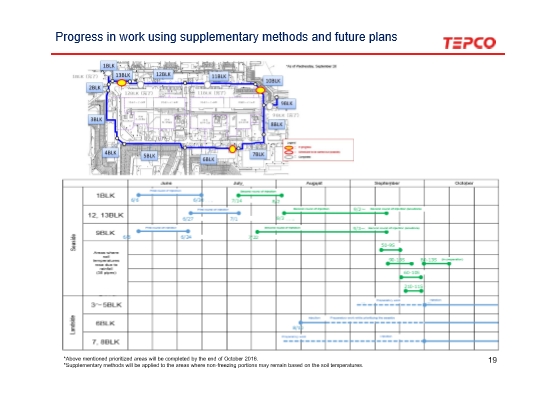
Therefore, application of supplementary methods at 80-13S continues.” Efforts to cement sections of the land side wall have begun and will take place through October.
They asked the NRA again within the last week for permission to freeze the remaining sections of the land side frozen wall sections.
TEPCO states that they have frozen 95 percent of the land side section of the wall.
TEPCO published a new report on the frozen wall dated September 29.
Another typhoon may hit Fukushima prefecture this week, if it does it may cause further problems with the frozen wall.
There was also a concerning note buried later in the report related to a section where they had used concrete to block the water flow.
So the concrete work just caused the water flow to divert to another part of the wall.
Progress of Landside Impermeable Wall freezing: Phase 2 of the first stage
○The purpose of the Landside Impermeable Wall construction lies not in freezing soil to form an underground wall but in keeping groundwater fromflowing into the reactor/turbine buildings and preventing new contaminated water from being generated.
○By closing less than 95 percent of the mountainside of the Landside Impermeable Wall inPhase2 of the first stage, it is expected that the amount of groundwater flowing into the areas around the reactor/turbine buildings will be reduced. This will help keep groundwater from being contaminated during the first stage.
○Throughout the first stage, how freezing of the Landside Impermeable Wall has progressed will be checked by monitoring thedifference in groundwater levels inside and outside of the wall and the amount of groundwater pumped up by the subdrain and groundwater drainsystems and the well point system.
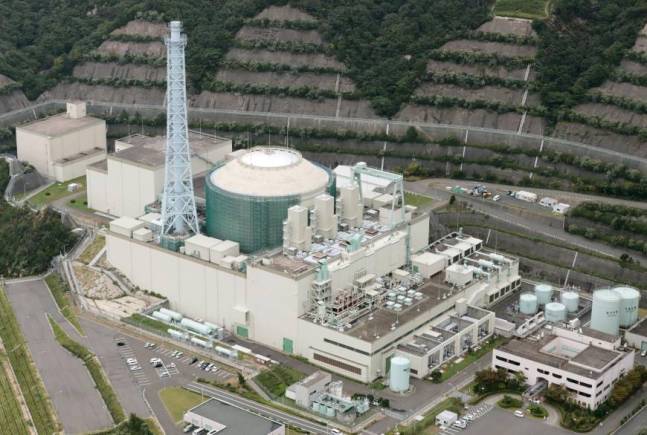
The ¥1 trillion Monju plant in Tsuruga, Fukui Prefecture, faces being scrapped after years of mishaps, cover-ups and waste. For decades, residents and businesses enjoyed the cash it brought in but now realize the contaminated debris needs storage.
KYOTO – In February 1983, Mayor Koichi Takagi of Tsuruga, Fukui Prefecture, spoke to residents in the town of Shiga, Ishikawa Prefecture, who were hoping the town would be chosen as the site for a new nuclear power plant.
Tsuruga already hosted two conventional reactors and, just a couple weeks before Takagi’s visit to Shiga, preparations began for the construction of a new fast-breeder reactor called Monju, named after the bodhisattva of wisdom. An old Japanese saying goes: “out of the counsel of three comes the wisdom of Monju,” meaning that, by putting their heads together, even those of ordinary intelligence can think up an idea as good as one from Monju.
Takagi, who also served as head of a nationwide group of mayors whose towns and villages hosted nuclear plants, had some sage advice for his audience. He said nuclear plants were a cash cow and that the media just sensationalized reports of mishaps.
Thirty-three years later, the Monju plant appears heading for the scrap heap. Its history has been one of controversy and scandals, including a 1995 sodium leak and fire, and subsequent cover-up attempt.
Last month, the government decided on an overhaul of the Monju project, looking to decommission the idle facility.
Tsuruga is unhappy that the cash cow, which meant billions of yen to the local economy over the decades, is drying up, while the central government faces questions about the entire future of Japan’s nuclear fuel cycle program.
Monju began as a policy decision made nearly a half century ago in reaction to what was seen as a worldwide problem in the conventional nuclear industry, a scarcity of uranium for conventional nuclear plants.
“According to the industry vision of the middle of the 1970s, plutonium-fueled breeder reactors were supposed to replace uranium-fueled light water reactors in order to save what was thought to be scarce natural uranium resources in a world with rapidly expanding nuclear power programs,” said Mycle Schneider, a Canada-based nuclear energy consultant.
“The International Atomic Energy Agency then forecasted over 4,000 conventional reactors in the world for the year 2000. In reality, only one-tenth of the plants was built, more uranium resources were identified, and the uranium price plunged.”
Decommissioning Monju is expected to take three decades, once it finally gets under way. But a host of fundamental questions remain about not only Monju but also Japan’s nuclear fuel-recycling program, in which Monju was to have played a critical role.
On a practical level, these questions begin with how much the entire decommissioning process will cost. In 2012, the Science, Education, and Technology Ministry estimated that it would require at least ¥300 billion.
But that estimate does not include how much the central government might have to spend in Tsuruga and Fukui Prefecture over the coming years on various forms of public works projects in exchange for smooth local political cooperation in scrapping Monju. Over ¥1 trillion has already been spent on the plant.
Fukui residents and politicians are sure to raise strong objections if the central government concludes the only viable option for the tons of high-level radioactive waste generated by Monju’s decommissioning process is to store at least part of it within the prefecture.
With three conventional nuclear reactors in the prefecture scheduled to be scrapped by midcentury, Gov. Issei Ishikawa has warned he will not tolerate having Fukui serve as a nuclear garbage dump. He has demanded that waste generated from decommissioning be disposed of outside the prefecture.
Adding Monju to the list of reactors to be decommissioned means seeking further local cooperation. That may only come after guarantees of more central government support, in the form of tax money, to help Fukui bear the burden of the decommissioning.
Meanwhile, question marks are cast over the remainder of Japan’s nuclear fuel recycling program, especially the Rokkasho Reprocessing Plant in Aomori Prefecture. However, experts say it is unlikely to get the ax anytime soon.
“Terminating Rokkasho and plutonium policy remains a long way off due to the vested interests and impacts this would have on nuclear power. But the Monju decision is a major step along that path,” said Shaun Burnie, senior nuclear specialist with Greenpeace Germany, who follows Japan’s nuclear power policy closely.
“In immediate terms, (Monju’s decommissioning) will not impact the use of MOX fuel in light water reactors. That’s more affected by the lack of operating reactors with Ikata No. 3 being the only MOX-fueled reactor operating; Rokkasho justification will be based on using MOX fuel in LWR’s most particularly at Oma.”
The Oma nuclear power plant in Aomori Prefecture, which is scheduled to start operating in fiscal 2024, will run 100 percent on MOX fuel.
For many in Fukui who have long opposed Monju, there are also concerns about not shutting down the entire nuclear fuel recycling program and suspicions that despite the government’s policy of not possessing, manufacturing or introducing nuclear weapons, Prime Minister Shinzo Abe’s government wants to keep that option open, as a diplomatic tool at least, via the fuel recycling program.
“Japan has about 48 tons of plutonium stockpiled domestically and in Europe, and we need to be careful. The plutonium could be converted into nuclear weapons, and we need to make sure it’s not used for this purpose,” said Tetsuen Nakajima, abbot of Myotsu-ji, a Shingon Omuro temple in Wakasa Bay in Fukui Prefecture, and a long-time anti-nuclear activist.
Such suspicions remain because Abe has in the past said he believes the possession of “small” nuclear weapons would not violate the Constitution. Members of his Cabinet, notably Defense Minister Tomomi Inada, who is from Fukui, have also argued previously for a national debate on the matter.
Finally, experts question what the government’s intentions are for a new committee on fast-breeder reactors it plans to form by year-end. The new committee will be centered in the Ministry for Economy, Trade and Industry, and the Education, Science and Technology Ministry, and will include nuclear power-related government agencies and representatives from the utilities and firms in the sector.
Keiji Kobayashi, a former nuclear physics instructor and fast-breeder expert at Kyoto University Research Reactor Institute, is a longtime opponent of Monju. He says Japan might not be done entirely with fast-breeder reactors.
“Plans for the committee include clarifying a goal on the development of a demonstration reactor and creating a detailed road (map) to achieving that goal,” he said. “Does that mean another reactor will be built? There are unanswered questions about what will happen to not only Monju but the fast-breeder reactor program in general.”
Kobayashi was referring to the possibility of Japan participating in France’s Advanced Sodium Technological Reactor for Industrial Demonstration (ASTRID) program to develop next generation fast-breeder reactor technology via research at a demonstration reactor for research purposes.
Burnie of Greenpeace Germany says ASTRID is still in the planning stage, over budget and behind schedule, and that the prospects for it being built in France are dim. In addition, while Japan’s METI backs the idea of a demonstration reactor with French cooperation, the education ministry is reportedly more skeptical, noting that France closed its Super Phoenix fast breeder reactor in 1997 after numerous accidents, including, like Monju, sodium leaks.
Watchdog Finds Flaws in Canada’s Nuclear-Safety Practices Audit recommendations focus on documenting and on conducting site inspections WSJ, PAUL VIEIRA Oct. 4, 2016 OTTAWA—Canada’s nuclear-safety regulator is facing criticism from the country’s environmental watchdog for failing to prove it conducted adequate power-plant inspections and falling short on staffing levels.
The shortcomings were highlighted in an independent audit released Tuesday by the Canadian Nuclear Safety Commission, which is tasked with ensuring the country’s nuclear power plants are operating safely……
Canada’s commissioner of the Environment and Sustainable Development looked at the nuclear agency’s operations over a two-year period ended March 31, 2015, and focused on whether the regulator adequately managed its site inspections.
“We concluded that the (Canadian Nuclear Safety Commission) could not show that it had adequately managed its site inspections of nuclear power plants,” Commissioner Julie Gelfand wrote. The audit issued five recommendations for the regulator to improve operations, focused largely on documenting and conducting site inspections……http://www.wsj.com/articles/watchdog-finds-flaws-in-canadas-nuclear-safety-practices-1475609449
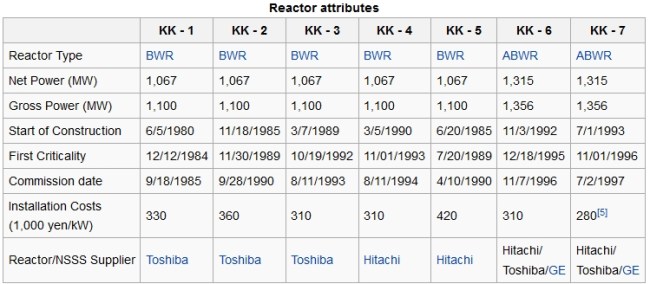
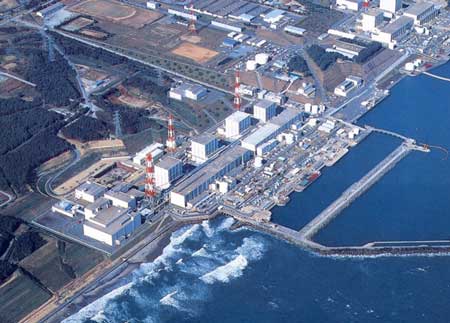
Kashiwazaki-Kariwa nuclear power plant is the largest nuclear plant in the world, owned by Tepco, Tepco will do anything to get it restarted.
Official campaigning for the upcoming Niigata gubernatorial election started on Sept. 29, setting the stage for debate on the safety of a nuclear power plant in the prefecture.
The issue of the safety of the Kashiwazaki-Kariwa nuclear power plant has gained even more traction as Niigata Governor Hirohiko Izumida, who has been cautious about approving Tokyo Electric Power Co.’s plan to restart the idled plant, has announced he will not seek re-election.
The Nuclear Regulation Authority’s safety inspections of the offline reactors, which the electric utility is seeking to bring back online, are in their final stages.
The election inevitably revolves around whether the new governor should allow TEPCO to proceed with the plan if the NRA gives the green light.
Four independent rookie candidates are running for the poll. But the race is effectively shaping up as a one-on-one battle between Tamio Mori, the former mayor of the city of Nagaoka in the prefecture supported by the ruling Liberal Democratic Party and its junior coalition partner, Komeito, and Ryuichi Yoneyama, a doctor backed by the Japanese Communist Party, the Social Democratic Party and the People’s Life Party & Taro Yamamoto and Friends.
Some 460,000 people live within 30 kilometers of the Kashiwazaki-Kariwa nuclear plant. The candidates should announce their proposals to protect the safety of these residents during campaigning for the Oct. 16 election.
Plans to ensure the safe and smooth evacuations of residents living around nuclear power plants when a serious accident occurs are described as the last safety net for nuclear power plants.
The governors of prefectures where nuclear plants are located, as the chiefs of the local governments, have to take on a huge responsibility for the safety of local residents.
Izumida has insisted that he wouldn’t start discussions on any plan to restart a reactor in his prefecture unless the 2011 disaster at the Fukushima No. 1 nuclear power plant, also operated by TEPCO, is fully reviewed and explained.
He has undertaken his own investigation of the catastrophic accident by setting up an expert committee within the prefectural government.
Izumida has also criticized the fact that the new nuclear safety standards introduced after the 2011 accident don’t require plans for evacuating local residents. He has been calling on the central government to improve the standards.
In 2002, it was revealed that TEPCO had covered up damage at its nuclear power plants including the Kashiwazaki-Kariwa plant. The magnitude-6.8 Niigata Chuetsu-oki offshore earthquake, which rocked Niigata Prefecture in July 2007, triggered a fire and resulted in small leaks of radiation at the plant.
Many people in the prefecture along the Sea of Japan remain deeply concerned about the safety of the nuclear plant and distrustful of TEPCO.
Izumida has responded to the concerns by raising issues about nuclear safety.
In the gubernatorial race, Yoneyama has cast himself as the candidate to carry on Izumida’s legacy.
“I will take over the (nuclear power) policy of Izumida and won’t start discussions on any reactor restart unless the Fukushima disaster is fully reviewed and explained,” he has said.
Mori, who has been critical of Izumida’s political approach, has taken a different stance toward the issue.
“I will put the top priority on the safety of people in the prefecture and rigorously examine the conclusion the NRA reaches (in its safety inspection),” he has said.
The difference in position on the issue between the two candidates is likely to be a key factor for Niigata voters at the polls.
The governors of prefectures hosting nuclear power plants have the “right to consent” to a plan to restart a reactor. But this is only a conventional right based on safety agreements with the electric utilities involved and has no legal basis.
When new Kagoshima Governor Satoshi Mitazono, who took office in July, asked Kyushu Electric Power Co. to suspend the operation of its Sendai nuclear power plant in the prefecture, he was criticized for undermining the central government’s energy policy.
But the criticism is off the mark. When a nuclear accident occurs, the local communities around the plant suffer the most.
To allay anxiety among residents in areas around nuclear plants, the local governments concerned, through negotiations with the operators of the plants, have established systems and rights that allow them to become involved in safety efforts.
The Fukushima disaster has only increased anxiety among residents around nuclear power plants.
The chief of the local government in an area home to a nuclear plant has every right to refuse to entrust the safety of local residents entirely to the utility and the central government.
Niigata Prefecture is not an area where TEPCO supplies power, but it has been bearing the risks involved in the operation of a massive nuclear power plant that generates electricity for the Tokyo metropolitan area.
The gubernatorial election will be a choice that directly affects the central government’s energy policy.
We are eager to see the candidates engaged in meaningful debate on the safety of the nuclear plant based on a national perspective.
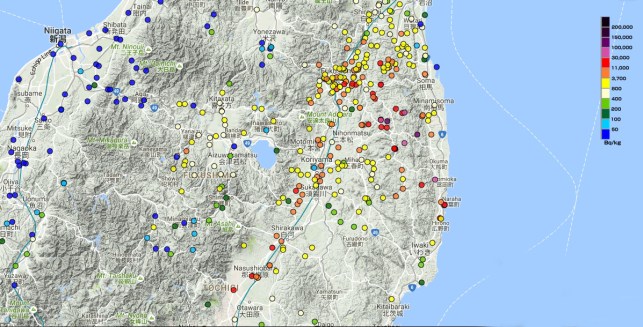
“Radiation damage spreading to Fukushima and other Tohoku Prefectures, and Kanto Prefectures Tokyo, Saitama, Chiba, is demonstrated. Perinatal mortality is increasing, it has been announced for the first time in peer-reviewed medical journals the Fukushima/Perinatal mortality link.”
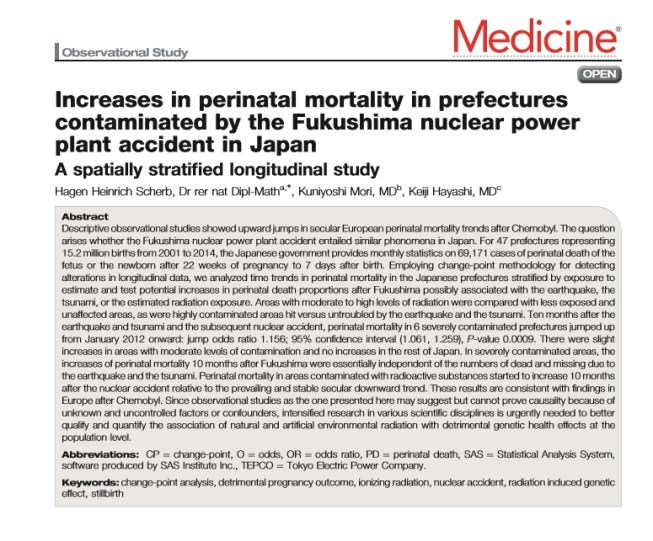
Abstract
Descriptive observational studies showed upward jumps in secular European perinatal mortality trends after Chernobyl.
The question arises whether the Fukushima nuclear power plant accident entailed similar phenomena in Japan.
For 47 prefectures representing 15.2 million births from 2001 to 2014, the Japanese government provides monthly statistics on 69,171 cases of perinatal death of the fetus or the newborn after 22 weeks of pregnancy to 7 days after birth.
Employing change-point methodology for detecting alterations in longitudinal data, we analyzed time trends in perinatal mortality in the Japanese prefectures stratified by exposure to estimate and test potential increases in perinatal death proportions after Fukushima possibly associated with the earthquake, the tsunami, or the estimated radiation exposure.
Areas with moderate to high levels of radiation were compared with less exposed and unaffected areas, as were highly contaminated areas hit versus untroubled by the earthquake and the tsunami.
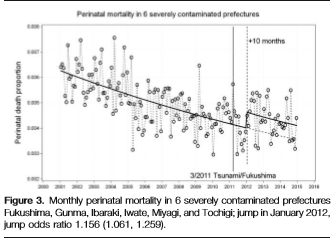
Ten months after the earthquake and tsunami and the subsequent nuclear accident, perinatal mortality in 6 severely contaminated prefectures jumped up from January 2012 onward: jump odds ratio 1.156; 95% confidence interval (1.061, 1.259), P-value 0.0009.
There were slight increases in areas with moderate levels of contamination and no increases in the rest of Japan.
In severely contaminated areas, the increases of perinatal mortality 10 months after Fukushima were essentially independent of the numbers of dead and missing due to the earthquake and the tsunami.
Perinatal mortality in areas contaminated with radioactive substances started to increase 10 months after the nuclear accident relative to the prevailing and stable secular downward trend.
These results are consistent with findings in Europe after Chernobyl. Since observational studies as the one presented here may suggest but cannot prove causality because of unknown and uncontrolled factors or confounders, intensified research in various scientific disciplines is urgently needed to better qualify and quantify the association of natural and artificial environmental radiation with detrimental genetic health effects at the population level.

























 nuclear-news