Tepco admits they concealed the fact of meltdown

On 5/30/2016, a director of Tepco, Anegawa admitted that Tepco concealed the fact of meltdown in 311.
He stated that in the press conference of that day. He says it was obviously meltdown, but Tepco avoided mentioning the term of “meltdown”. He thinks that was concealment.
In Tepco’s internal manual, meltdown is defined to be when over 5% of reactor core is damaged. However Tepco did not mention meltdown even though they knew 55 ~ 70% of the core was damaged by 3/14/2011.
Anegawa commented ordinary engineer would call such a state meltdown even without a manual.
At this moment, third-party inspection committee is investigating Tepco for its arbitrariness.
http://www.tepco.co.jp/tepconews/library/archive-j.html?video_uuid=y3a6i6b2&catid=61697
http://fukushima-diary.com/2016/06/tepco-admits-they-concealed-the-fact-of-meltdown/
Advisory lifted for most of evacuated village of Katsurao close to crippled Fukushima nuclear power plant
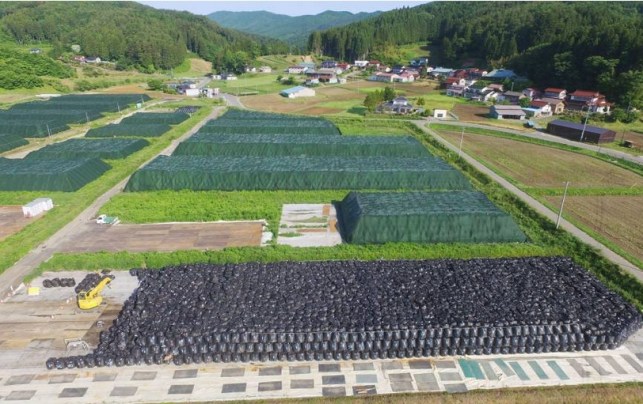
Radioactive waste contained in thousands of black plastic bags are placed in rice paddies in the village of Katsurao, Fukushima Prefecture, where an evacuation advisory was lifted for most of the village Sunday.
FUKUSHIMA – The government Sunday lifted its evacuation advisory for most of Katsurao, a village near the crippled Fukushima No. 1 nuclear power plant in Fukushima Prefecture.
This is the first time that an evacuation advisory has been lifted for an area tainted with relatively high levels of radiation with annual doses projected at between more than 20 millisieverts and less than 50 millisieverts.
The government’s move allows 1,347 people in 418 households to return home for the first time since the March 2011 disaster at the plant, operated by Tokyo Electric Power Company Holdings Inc.
But only a few people are expected to return home for the time being due to inconveniences in everyday life in the village. Municipal bus services remain suspended while shops have yet to resume operations.
The village government plans to offer free taxi services for elderly people so that they can go to hospitals and commercial facilities outside the village.
Earlier this month, the village’s chamber of commerce and industry started services to deliver fresh foods and daily necessities to homes.
The evacuation advisory remains in place for 119 people in 33 households from the remaining Katsurao area where annual radiation doses are estimated at over 50 millisieverts.
Japan report on Chernobyl disaster’s health effects to be publicly released
A 50-million-yen Japanese government report on the health effects of the 1986 Chernobyl nuclear catastrophe that was not released to the general public will be released in the near future, the secretariat of Japan’s nuclear watchdog said on June 7.
The Secretariat of the Nuclear Regulation Authority (NRA) indicated at a news conference on June 7 that the report would be released on the secretariat’s website. The secretariat will also comply with related requests for information disclosure that it had previously not accepted, it said.
The government’s investigation into the aftereffects of the Chernobyl disaster was budgeted by the Ministry of Education, Culture, Sports, Science and Technology. It was carried out between November 2012 and March 2013 — after the Fukushima meltdowns in 2011 — at a cost of 50 million yen.
The NRA secretariat, which took over the role of handling the survey in April 2013, placed it in the National Diet Library without publicly releasing it, drawing criticism from experts in information disclosure.
“It was inappropriate as a way of releasing it,” a secretariat representative said.
http://mainichi.jp/english/articles/20160608/p2a/00m/0na/017000c
The alarming hidden costs of nuclear power stations
 The scary hidden cost of building a nuclear power station, http://www.rdm.co.za/business/2016/06/13/the-scary-hidden-cost-of-building-a-nuclear-power-station
Even assuming that SA can find the funds, we would do well to take into account the non-negotiable costs of decommissioning and waste management BRENDA MARTIN
13 JUNE 2016 Consider decommissioning costs before committing to new nuclear power investment
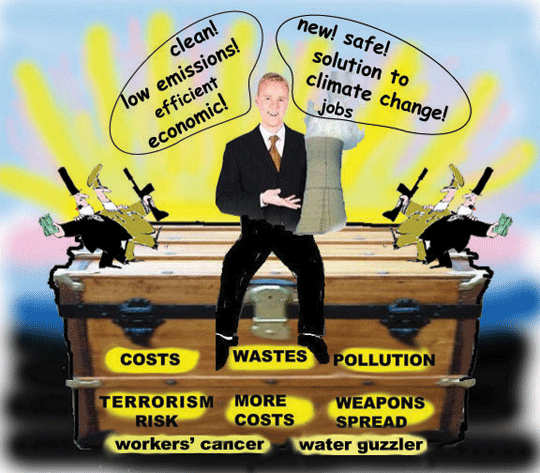
As South Africa prepares to invest in new nuclear power, we may do well to consider the other end of such investment: decommissioning. In the north of Germany, the Greifswald nuclear power plant (also known as Lubmin) has been undergoing the process of decommissioning since 1990. Before its closure, with a total planned capacity of 8 x 400MW plant built, but with only 5 reactors fuelled, Lubmin was to be the largest nuclear power station in East Germany prior to reunification. The reactors were of the VVER-440/V-230 type, or so-called second generation of Soviet-design. When it is concluded, the full process of decommissioning at Lubmin will have taken 30 years from first shutdown. In 1990 the company responsible for decommisioning this 8 x 400MW nuclear power plant, Energiewerke Nord, estimated a cost of half a billion DM per unit. Later this estimate was adjusted to 3.2 billion/unit. Today 4.1 billion/unit is a conservative final estimate (Energiewerke Nord, 2016).
More recently, early in 2012, following the Fukushima disaster in March 2011, the German government announced the immediate withdrawal of the operating licenses of eight German nuclear power plants and revived its plans to phase out nuclear power — by 2022. As this process unfolds, it will be possible to move beyond speculation, to actual data on costs, process and skills required for decommissioning.
What is involved in decommissioning a nuclear power plant?
Nuclear decommissioning is the process whereby a nuclear power plant site as a whole is dismantled to the point that it no longer requires measures for radiation protection to be applied. It is both an administrative and a technical process, including clean-up of all radioactive materials and then progressive demolition of the plant. Once a facility is fully decommissioned it should present no danger of radiation exposure. After a facility has been completely decommissioned, it is released from regulatory control and the plant licensee is no longer responsible for its safety.
The costs of decommissioning are spread over the lifetime of a facility and given that most nuclear power plants operate for over 40 years, funds need to be saved in a decommissioning fund to ensure that future costs are provided for.
What are the current estimates for nuclear power plant decommissioning?
This year, on April 28, an independent commission appointed by the German government (Kommission zur Überprüfung des Kernenergieausstiegs, KFK) presented its recommendations to the Ministry of Economics and Energy. The commission recommended that reactor owners — EnBW, EOn, RWE and Vattenfall — pay an initial sum of €23.3-billion ($26.4-billion) over the next few years, into a state-owned fund set up to cover the costs of decommissioning of the plants and managing radioactive waste. This sum includes a “risk premium” of around 35% to close the gap between provisions and actual costs.
According to the ministry, there will be approximately 10 500 tonnes of used fuel from 23 nuclear power plants, which will need to be stored in about 1 100 containers. A further 300 containers of high- and intermediate-level waste are also expected from the reprocessing of used fuel, as well as 500 containers of used fuel from research and demonstration reactors. In addition, some 600 000 cubic meters of low- and intermediate-level waste will need to be disposed of, including waste from industry, medicine and research.
Just before KFK started its work in October 2015, a study conducted by German audit firm Warth & Klein Grant Thornton for the Ministry of Economics and Energy had estimated the following costs for decommissioning 23 nuclear power plants, in 2014 money i.e. the cost if plants were to be decommissioned in 2014:
- Closure and decommissioning: €19.7-billion
- Containers, transport: €9.9-billon
- Intermediate storage: €5.8-billion
- Final low heat waste storage: €3.75-billion
- Final high active waste storage: €8.3-billion
i.e. a total of €47.5-billion.
However, decommissioning of all of Germany’s 23 nuclear power plants will not be undertaken at the same time. Most costs will be incurred in the future. Annexure 9 of the Warth & Klein Grant Thornton report provides an estimate of likely decommissioning costs when taking into account projected interest rate and inflation scenarios, as well as various likely nuclear-specific cost increases. Their conclusion? Total costs of decommissioning all nuclear power plants in Germany could reach up to €77.4-billion.
Given these emerging figures, even assuming that SA can find the necessary funds needed for new nuclear power investment, we would do well to take into account the increasingly known, non-negotiable related costs of decommissioning and waste management — of both old and new nuclear-related investment.
AREVA’s second biggest shareholder, Kuwait funds, wants to sell out of AREVA
 Kuwait fund wants to sell French nuclear group Areva stake -media, 13 June 16, ra ra http://www.reuters.com/article/us-areva-kuwait-idUSKCN0YZ19M Sovereign wealth fund Kuwait Investment Authority (KIA) has told French authorities it wants to sell its stake in nuclear group Areva (AREVA.PA), La Lettre de l’Expansion reported on Monday.KIA is Areva’s second-biggest shareholder with a 4.82 percent stake, according to ThomsonReuters data.
The newsletter said the Kuwaiti fund had complained that its investment in Areva, which is majority owned by the French government, was made based on incorrect company accounts.
French Industry Minister Emmanuel Macron and Areva declined to comment on the report. KIA was not immediately available for comment.
KIA paid 600 million euros ($676 mln) for the stake in 2010, but since then Areva shares have plunged by about 90 percent as the firm’s equity has been wiped out by years of losses. Areva will be rescued by a 5 billion euro state-funded capital increase and its nuclear reactor unit will be taken over by state-owned utility EDF (EDF.PA) later this year or early next year.
The French state holds about 87 percent of Areva’s capital.
KIA or other minority shareholders have never publicly complained about Areva’s accounts, but former Areva chief executive Anne Lauvergeon was put under formal investigation last month for her role in the 2007 acquisition of uranium mining firm Uramin.
In France, a formal investigation does not automatically lead to a trial but often does.
Lauvergeon has repeatedly denied any wrongdoing and has said that asset depreciations at Uramin were partly due to the collapse of uranium prices after the Fukushima nuclear disaster in Japan in March 2011.
Areva has had to write down billions of euros on Uramin, which contributed to years of losses and eventually wiped out its equity, leading to a state rescue package early this year.
($1 = 0.8875 euros)
(Reporting by Geert De Clercq, Michel Rose and Andrew Torchia; Editing by Susan Fenton and Alexander Smith)
Russians call US nuclear reactors a “white elephant” for India
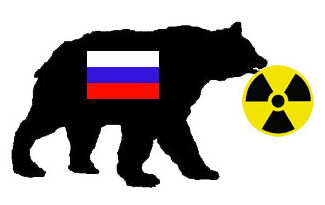 US Nuclear Reactors to Prove White Elephant for India. Sputnik News 13 June 16
  India’s latest move in the direction of implementing a nuclear energy pact with the US is gaining strong resentment as the US reactors are most likely to cost three times more than that of Russian reactors already well operational.
June 12 Energy News

Science and Technology:
¶ Solar Impulse 2, the largest solar-powered aircraft in the world, landed early Saturday in New York City. It is the 14th stop and the final US destination in its year-old trek around the world. It flew past the Statue of Liberty before landing at John F. Kennedy International Airport. [CNN]
 Solar Impulse 2 flies above the Statue of Liberty.
World:
¶ The heat of the sun is already scorching the era of oil and coal in the Philippine energy sector. A host of factors, including reduced prices of solar panels, new government policy, and growing reliability of solar power plants, is leading the increasing shift to renewable energy. [The Standard]
¶ Vast rainforests, which once covered more than half of Panama’s land surface, are shrinking, eaten away by development. In response, seven indigenous tribes, whose members live in autonomous zones, have…
View original post 578 more words
California Nuclear Power Stations and the Earthquake Rupture Forecast

“The Great 1857 Fort Tejon Earthquake: The Last “Big One”, Date/Time: January 9, 1857 about 8:20am PST, Magnitude Mw 8.0 approximately Location/Depth: 35.72N 120.32W, Descriptive location: 45 miles NE of San Luis Obispo, Faulting type: right-lateral strike-slip, Faults involved: San Andreas Fault, Length of surface rupture: about 225 miles (360 km), Maximum surface offset about 30 ft (9 meters)”
http://earthquake.usgs.gov/earthquakes/events/1857sca/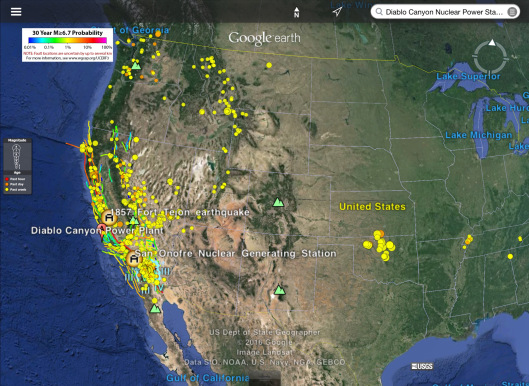
USGS Earthquakes over last week (dots), with earthquake hazard UCERF-3/USGS (lines), and Diablo Canyon Nuclear Power Station and San Onofre Nuclear Power Station (More detailed maps below)
“The San Andreas fault, which is more than 700 miles (1100 km) in length, is the boundary between the Pacific and North American tectonic plates…”
San Andreas Fault Photo by Scott Haefner, USGS
“On January 9, 1857, the M 7.9 Fort Tejon earthquake occurred just north of the Carrizo Plain. At Wallace Creek, in the Carrizo Plain…
View original post 1,143 more words
Evacuation lifted for Fukushima village; only 10% preparing return
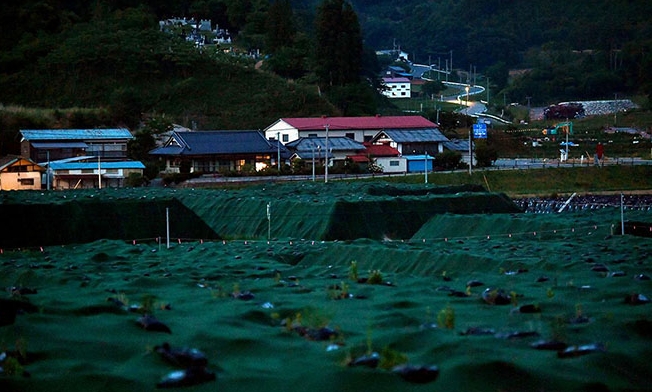
Lights appears at only a few houses in Katsurao, Fukushima Prefecture, on June 11, the eve of the government’s lifting of the evacuation order following the 2011 nuclear accident. Waste from decontamination operations is covered with sheets in the foreground. (Yosuke Fukudome)
The government on June 12 lifted the evacuation order for Katsurao, a village northwest of the crippled Fukushima No. 1 nuclear power plant, but most of the residents appear reluctant to return home.
The lifting of the order covers more than 90 percent of the households in Katsurao. The entire village was ordered to evacuate after the crisis at the Fukushima plant started to unfold on March 11, 2011.
Katsurao is the fourth municipality in Fukushima Prefecture that had the evacuation order lifted, following the Miyakoji district in Tamura, the eastern area of Kawauchi village and Naraha.
Government officials said cleanup and other efforts have reduced radiation levels in Katsurao to a point that poses little problem. The lifting of the evacuation order means that 1,347 people from 418 households, out of 1,466 people from 451 households in Katsurao, can return to their homes to live in the village.
But only 126 people from 53 households, or 10 percent of those eligible to return, have signed up for a program for extended stays in the village to prepare for their return, according to Katsurao officials.
The officials said they believe that many evacuees would rather go back and forth between temporary housing and their homes in Katsurao for the time being, given the situation in the village.
Medical institutions and shops have yet to resume operations in Katsurao. And nearly half of the rice paddies there are being used for the temporary storage of radioactive waste produced in the cleanup operation.
Local officials say they have no idea when the waste can be moved out of the village for permanent storage.
Among the Katsurao residents eligible to return are those with homes in the government-designated “residence restricted zone,” where the annual radiation dose was projected at more than 20 millisieverts and up to 50 millisieverts as of March 2012.
This was the first time evacuees from such a zone have been permitted to return home.
Only the “difficult-to-return zone” carries a higher annual radiation dose.
The government plans to lift evacuation orders for other parts of the prefecture by the end of March 2017, except for the “difficult-to-return zone,” where the annual radiation dose was estimated at 50 millisieverts or higher as of March 2012.
The additional lifting of the evacuation orders would allow 46,000 of 70,000 displaced residents to return to their homes to live.
Demolition work delay hinders Fukushima villagers’ homecoming
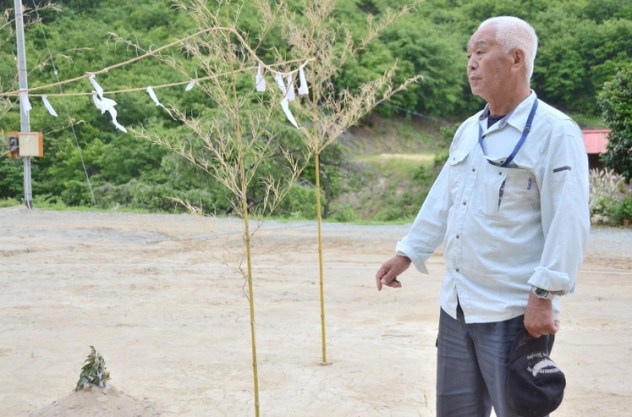
Farmer Hidenori Endo is seen at the empty lot where his home used to stand in Katsurao, Fukushima Prefecture, on June 6, 2016.
FUKUSHIMA — Though the nuclear disaster evacuation order for the Fukushima Prefecture village of Katsurao is set to be lifted on June 12, just 14 percent of demolition work needed before homes can be rebuilt has been completed.
The village currently comprises three evacuation statuses: “areas preparing for the lifting of evacuation orders” with annual accumulated radiation doses of 20 millisieverts or less; “restricted residency zones” with annual accumulated radiation doses from over 20 millisieverts to 50 millisieverts; and “difficult-to-return zones.” As of June 12, the 1,347 residents from 418 households in the former two categories will be allowed to move back home. A return schedule for the 119 residents from 33 households with homes in areas in the last category has yet to be determined as radiation levels remain high.
A survey by the village government showed that nearly 50 percent of residents wished to return home. However, as of June 8 only 126 people, or less than 10 percent of residents, had registered to stay overnight in preparation for their complete return.
The Environment Ministry began demolishing houses in 2012 for those who wanted to rebuild their homes in 11 Fukushima Prefecture municipalities subject to nuclear disaster evacuation orders. Of 347 demolition requests in Katsurao, only 14 percent have been completed. Officials say that field research and paperwork are taking time. Overall, a little less than 40 percent of requested work has been done in all 11 municipalities.
Eight municipalities — including Katsurao and the city of Minamisoma, where evacuation orders are to be lifted on July 12 — are requesting the central government to speed up demolition work as the delay is hindering residents’ return to their hometowns. A senior Katsurao village official says locals have been complaining about the demolition work not advancing as planned.
The Environment Ministry hopes to complete about 90 percent of demolition work by March 2017 by streamlining paperwork, but many residents are expected to be unable to return home even after evacuation orders are lifted, as it will take time to rebuild houses after the demolition is completed.
A ministry official explained that there are people who will be able to return home immediately after the evacuation order is lifted, and that it would be inappropriate to keep the orders in place until all the demolition work is done. At the same time, the official said that the ministry will give those who wish to return priority in the demolition work schedule.
Fukushima University social welfare professor Fuminori Tamba, who helped map out disaster recovery plans for municipalities under evacuation orders, pointed out that the lack of progress in demolitions is problematic, since securing housing is the minimum requirement for residents to return. He added that the availability of housing should be considered when lifting evacuation orders.
Katsurao farmer and cattle rancher Hidenori Endo, 74, applied for demolition of his decaying home and barn last summer. Tired of waiting, Endo paid a private firm nearly 10 million yen to tear down the buildings in May.
“I wanted to go home as soon as possible,” Endo said.
He now lives in a temporary housing unit in the town of Miharu, about 30 kilometers from his Katsurao home. Endo travels an hour by car daily to his property to restart his farming business, but taking good care of his cattle is difficult to do going back and forth. To reboot his business, Endo first needs to rebuild his home. Construction work is to begin this summer, but he does not yet know when the work will be completed, and will have to live in the temporary housing for at least another year.
The central government has set prerequisites, such as infrastructure development and operation of everyday services, for lifting nuclear crisis evacuation orders. However, housing is not included in these criteria.
“Even if I could go shopping, there isn’t much I could do if there was no place to live. It’s not right to be unable to return to home even with the evacuation order gone,” Endo lamented.
http://mainichi.jp/english/articles/20160611/p2a/00m/0na/016000c
Nuclear disasters and “normalization” of contaminated areas

Translated by Kingsley Osborn
Political, economic, health, democratic and ethical
The nuclear lobby is beginning to openly assert that the evacuation of populations affected by a major nuclear accident is too expensive, is the source of lots of hassles, accidents, despair families, ruin the local economy.
To some additional cancers it will not be worth it to impose populations.
Sezin TOPÇU is PhD in sociology of science and technology, she is a researcher at the National Scientific Research Centre (CNRS) and teaches at the School for Advanced Studies in the Social Sciences (EHESS). She is the author of “Nuclear France. The art of governing disputed technology “(Le Seuil, 2013) and co-edited the book” Another story of the postwar boom. Modernization and pollution disputes in France after the war “(with Christophe Bonneuil Céline and Pessis, La Découverte, 2013).
Here is the introduction to his analysis:
Minimizing impacts of a catastrophic nuclear accident is set to become a classic of our time, and not only in countries where the presence of nuclear installations is important, such as France, or in countries that have already undergone an accident, such as Japan and Belarus, but also in countries that do not. This minimization, which seems to impose forcefully, is the ability to “resilience” of specialists in nuclear, that is to say, industrialists, nuclear states, and certain regulatory bodies, both national and international.
How the specialists in nuclear-they managed to trivialize the radioactive wrong with that? By what means, strategies and watchwords governing bodies have managed to formulate the problem in terms of evacuation procedures and even its legitimacy, when we should collectively discuss the legitimacy to continue to make use of facilities that have potential for processing and destruction unparalleled in the territories, natural resources, living species, and human body?
from these questions, this paper aims to contribute to the emergence of a political debate and citizen which is long overdue, around the issue of contaminated territories in case of nuclear accident.
Three Mile Island? The French nuclear officials there saw immediately that an “incident” or a “glitch”. Chernobyl? In 1996 again, the World Health Organization (WHO) only accounted for 32 deaths. Fukushima? The disaster paradoxically accelerated the offensive of the Japanese nuclear industry for exports. No other sector causes, accident, such bitter controversy and permanent (with expertise, evidence / no-evidence, observations, assessments and also contrasting and contradictory), on health impacts experienced by affected populations.
Beyond the very serious consequences on the health of populations, whose proof or recognition are made difficult due to the latency that require radiation-induced diseases to manifest itself, but also the secret or active factory ignorance that often surround them, a nuclear accident also means the sacrifice of entire territories.
the challenge for specialists in nuclear, since the 1990s at least, is indeed to minimize the sacrifice in the eyes of public opinion. To ensure that the renunciation of land does not occur, or only take place only temporarily. A instrumentalize, for this suffering, certainly real but no singular evacuees to believe that those who remain on their land, even though they would offer more than enough healthy living conditions, suffer for nothing. A claim that may well “learn to live” with ambient radioactivity.
The first part of this note reviews the genesis of panel discussions, legal arrangements and managerial tools for the management of contaminated territories. This is to recall that the unmanageable nature of damage caused by a major nuclear accident has been recognized by the nuclear experts in the 1950s, which has historically conditioned the doctrine prevailing today, whereby post-accident measures (including the abandonment of contaminated areas) will necessarily be limited or should be optimized.
The second part of the note looks at how the contaminated territories have been effectively treated in post-Chernobyl and post-Fukushima. Socio-economic and geo-political criteria that influence how to design the future of the evacuated areas, their status, and they could not “return to normal” are analyzed here.
The last part of the note stresses the importance of official strategies to psychologizing disasters to minimize abandonment of contaminated land, but also to push into the background the prospect of a fair assessment of the health damage caused in the event accident.
To read the entire article: The Show as PDF (400KB) The view on the EPF website
The website of the Foundation for Political Ecology: http://www.fondationecolo.org/
Note:
We’ve been warned: the next nuclear accident, we will be strongly urged to stay or return to live on contaminated territories.
Catastrophes nucléaires et « normalisation » des zones contaminées
http://www.vivre-apres-fukushima.fr/catastrophes-nucleaires-et-normalisation-des-zones-contaminees/
Tepco to inject cement instead of frozen water wall

On 6/2/2016, Tepco reported to NRA (Nuclear Regulation Authority) that they need to inject cement to “frozen” water wall and NRA admitted it.
The feasibility of frozen water wall project was questioned since before the beginning. In the meeting of NRA, Tepco admitted the temperature remains nearly 10 ℃ at 4 “freezing” points to cause no improvement to stop contaminated groundwater. It has been in freezing operation for over 2 months.
These 4 points are situated between the reactor buildings and the sea. The volume of contaminated water to be pumped up has not been decreased regardless of the frozen water wall.
Tepco states the temperature remains over 0 ℃ because of the high speed of groundwater. They inject cement to slower the water.
Click to access handouts_160602_06-j.pdf
http://photo.tepco.co.jp/date/2016/201606-j/160606-01j.html
Another evacuation order lifted in Fukushima
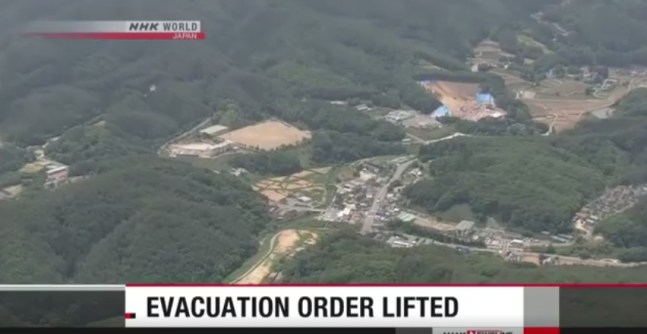
The Japanese government has lifted its evacuation order for most parts of a village near the crippled nuclear plant in Fukushima. Katsurao Village became the 4th such municipality after the 2011 nuclear disaster.
Officials lifted the restriction on Saturday midnight except some areas where the radiation level remains high. All of over 1,400 residents there were forced to evacuate. Now most of them are allowed to return home.
According to a survey the village conducted last year, nearly half of the respondents said all or at least parts of their family want to return home when the order is lifted.
Local authorities say they will work to ease concerns over radiation and provide medical services. They will also ask shops to reopen there to sell foods and everyday essentials.
The evacuation order remains in 9 municipalities in Fukushima. This is forcing more than 90,000 people to continue living away from home.
http://www3.nhk.or.jp/nhkworld/en/news/20160612_04/
Villagers divided over lifting of order
People from Katsurao have had mixed responses to the lifting of the evacuation order.
Residents who have decided to return to the village include Rinko Matsumoto and her husband.
Matsumoto planted corn seedlings on Sunday in front of her home. She used to eat home-grown corn with her children and grandchildren when they were all living together before the accident.
She says she is happy to be returning home, but that she will miss family members who have no plans of coming back anytime soon.
Akira Miyamoto and his wife spent the day tending roses in their garden and playing with their dog.
Miyamoto says this is the day Katsurao Village has come back to life. He says he wants to enjoy living there surrounded by nature.
Yoshio Matsumoto is one of the former residents who have decided not to return.
Matsumoto lives in temporary housing in another municipality. He says he is not going back home because he is worried about radiation and few of his neighbors are returning.
He says his home has been decontaminated many times, but windy or rainy weather causes radiation levels to rise.
New technologies using zeolite composite fibers to prevent radioactive cesium pollution in Fukushima rivers

The authors have developed and applied new technologies using zeolite composite fibers to prevent radioactive Cs pollution of water in Fukushima, Japan.
During approximately four years in the area, decontamination has been conducted to reduce radioactive cesium (Cs) in the field. However, water contaminated with extra-diluted radioactive Cs has prevented residence within about 30 km of the damaged nuclear facilities. Great efforts at decontamination work should be undertaken to alleviate social anxiety and to produce a safe society in Fukushima.
Decontamination using fiber-like decontamination adsorbents was examined in actual use for radioactive Cs in water in Date city in 2013 and in Okuma town in 2015.
This report describes preparation and properties of the fiber-like decontamination adsorbents. Furthermore, this report is the first describing results of radioactive Cs decontamination using a fiber-like adsorbent for water with extra-low-level concentrations of radionuclides.
Even four years after the accident, results strongly suggest the decontamination still distributed in Fukushima area, depending on the distance of the nuclear power plant. Evidence indicates the importance of preventing extension of radioactive Cs further downstream to human residential areas.
173 Children Thyroid Cancers in Fukushima Prefecture
As a reminder, elsewhere, children thyroid cancer occurs in only about one or two of every million children per year by some estimates. This shows an incidence of thyroid cancer multiplied by more than a hundred.
According to the latest Fukushima prefectural survey report, published on June 6, 2016, the number of childhood thyroid cancers increased from 163 three months and a half ago to 169 now, as 6 persons more were found affected with thyroid cancer.
Then the Fukushima Medical University professor Akira Ozuru verbally reported 3 additional cases, making now the number of thyroid cancers 172.
Therefore in the last 3 months and half, 9 additional cases have been further detected, which brings now the total number of children affected with thyroid cancer up to 172.
Here below in this first picture you may see the evolution of the number of children thyroid cancers and its evolving ratio to the Fukushima population from December 31, 2013 to March 31, 2016.

We can see that they are become higher at every announcement.
This time March 31, 2016 it became one in 1746 children.
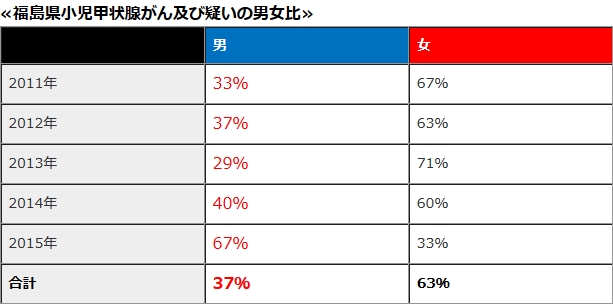
In the next picture we see the male-to-female ratio of Fukushima Prefecture childhood thyroid cancer and suspicion of thyroid cancer. The stats proving that girls (women) are indeed getting more affected than the boys (men) by radiation, as well expected.
As you may see in the next picture the thyroid cancer ratio to population differs depending on each municipality.
Red color – 1 in 999
Orange color – 1 in 1000 to 1999
Yellow color – 1 in 2000 to 2999
Green color – 1 in 3000 to 3999
Blue color – 1 in 4000 to 6999

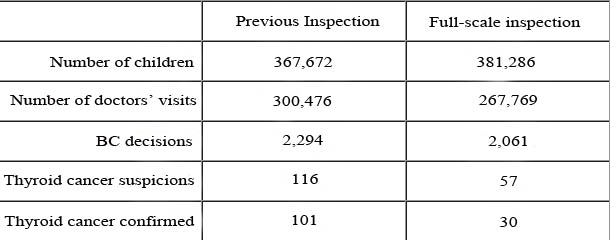
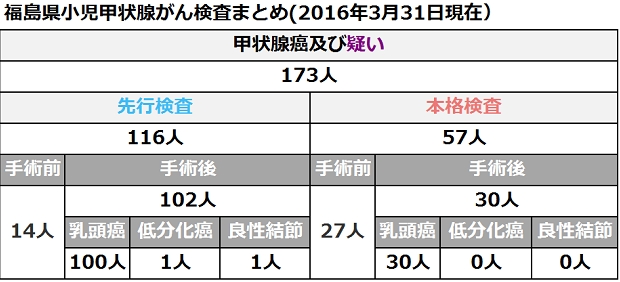
Source: http://www.sting-wl.com/fukushima-children9.html
Translated by D’un Renard
1 This Month
Chernobyl: The Lost Tapes – A good documentary on Chernobyl on SBS available On Demand for the next 3 weeks– https://www.sbs.com.au/ondemand/tv-program/chernobyl-the-lost-tapes/2352741955560

of the week–London Campaign for Nuclear Disarmament

Tell the Ukrainian Government to Drop Prosecution of Peace Activist Yurii Sheliazhenko
To see nuclear-related stories in greater depth and intensity – go to https://nuclearinformation.wordpress.com
-
Archives
- April 2026 (139)
- March 2026 (251)
- February 2026 (268)
- January 2026 (308)
- December 2025 (358)
- November 2025 (359)
- October 2025 (376)
- September 2025 (257)
- August 2025 (319)
- July 2025 (230)
- June 2025 (348)
- May 2025 (261)
-
Categories
- 1
- 1 NUCLEAR ISSUES
- business and costs
- climate change
- culture and arts
- ENERGY
- environment
- health
- history
- indigenous issues
- Legal
- marketing of nuclear
- media
- opposition to nuclear
- PERSONAL STORIES
- politics
- politics international
- Religion and ethics
- safety
- secrets,lies and civil liberties
- spinbuster
- technology
- Uranium
- wastes
- weapons and war
- Women
- 2 WORLD
- ACTION
- AFRICA
- Atrocities
- AUSTRALIA
- Christina's notes
- Christina's themes
- culture and arts
- Events
- Fuk 2022
- Fuk 2023
- Fukushima 2017
- Fukushima 2018
- fukushima 2019
- Fukushima 2020
- Fukushima 2021
- general
- global warming
- Humour (God we need it)
- Nuclear
- RARE EARTHS
- Reference
- resources – print
- Resources -audiovicual
- Weekly Newsletter
- World
- World Nuclear
- YouTube
-
RSS
Entries RSS
Comments RSS
 nuclear-news