USA nuclear stations’ disaster procedures and processes are inadequate
U.S. Nuclear Reactors Fall Short on Steps to Cope With Disasters http://www.bloomberg.com/news/articles/2016-05-20/u-s-nuclear-reactors-fall-short-on-steps-to-cope-with-disasters Jonathan Crawford JonNCrawford May 21, 2016
-
Report notes failings in securing spent fuel, plant security
-
Operators have already spent $4 billion on safety measures
-
More than five years after a tsunami struck Japan triggering one of the worst nuclear disasters in history, U.S. reactors and industry regulators haven’t done enough to prevent a similar catastrophe, a government-sponsored study found.
Reactor operators are falling short on measures to prevent spent nuclear fuel stored at the plant from overheating and releasing radiation into the atmosphere following an accident or natural disaster, according to a report Friday from the National Academies of Sciences, Engineering and Medicine. Operators should also upgrade plant security “to cope with extreme external events and severe accidents.”
- A March 2011 earthquake caused a tsunami that slammed into Tokyo Electric Power Co.’s Fukushima Dai-Ichi plant, causing a triple meltdown that sent a radioactive plume over surrounding communities. The loss of power that followed the tsunami exposed weaknesses in systems meant to secure the plant and its stock of spent fuel.
- “The 2011 Fukushima Dai-Ichi nuclear accident should serve as a wake-up call to nuclear plant operators and regulators,” the National Academies, a private research group that advises the government, said. A 2014 report from the group focused on the causes of the Fukushima Dai-Ichi accident.
The recommendations follow safety and security steps covering the nation’s 100 operating reactors mandated by the U.S. Nuclear Regulatory Commission in response to the Fukushima Dai-Ichi accident. Industry groups questioned the cost of the rules while environmental groups said they didn’t go far enough.
-
Terrorist Attacks
Plant operators have spent $4 billion on post-Fukushima safety enhancements, according to the Washington-based Nuclear Energy Institute, a trade group representing plant owners. Friday’s report calls on the industry to go further.
Operators must ensure that pools used to cool spent fuel rods can be maintained and monitored following accidents or terrorist attacks. Power sources serving security systems should be protected and backed up with redundant supplies. Regulators and plant operators must improve their ability to identify terrorist threats.
Regulators should also examine the risks and benefits of expediting the transfer of spent fuel from pools to drys casks.
Chelsea Manning appeals conviction in WikiLeaks case
http://www.armytimes.com/story/military/crime/2016/05/19/chelsea-manning-appeal-wikileaks/84585376/
Manning’s attorney, Vincent Ward, said the documents were filed Wednesday with the U.S. Army Court of Criminal Appeals at Fort Belvoir, Virginia.
Chief Deputy Clerk John Taitt said the document must undergo a review for classified information before it can be publicly released. Ward said he’ll wait until the review is complete before commenting.
Manning is serving a 35-year sentence at Fort Leavenworth, Kansas. The transgender soldier, formerly known as Bradley Manning, was convicted of espionage and other offenses for sending WikiLeaks more than 700,000 digital files including battlefield logs, diplomatic cables and video clips.
Outcome of United Nations open-ended working group on nuclear disarmament
U.N. nuclear disarmament talks , Japan Times, MAY 22, 2016 The United Nations open-ended working group on nuclear disarmament held its second session this month in Geneva, following its first gathering in February. What emerged from the latest meeting is a schism between countries seeking to create a treaty prohibiting nuclear weapons and those nations opposed to the idea, including nuclear weapons powers and those states relying on the protection of a nuclear umbrella.
While the Nuclear Nonproliferation Treaty recognizes five countries — the United States, Russia, Britain, France and China — as nuclear weapons states, it requires all parties to the treaty to pursue negotiations to achieve nuclear disarmament. Given the potential dangers posed by the accidental use of nuclear arms and nuclear terrorism, all states should support the effort to ban nuclear weapons.
The undercurrent of discussions in the working group’s meetings is the humanitarian impact of nuclear weapons. The consequences of a nuclear explosion would spread beyond national borders and have regional and global effects. It would indiscriminately kill or injure numerous civilians. Radioactive contamination would devastate the environment for generations, causing cancer and other deadly diseases. No nations would have the capability to adequately respond to the human suffering caused by nuclear weapons.
This aspect of nuclear weapons has raised concerns among many non-nuclear weapons states and civil society groups and led to the holding of three international conferences — in Norway in 2013 and Mexico and Austria in 2014 — to discuss the humanitarian consequences of nuclear arms. The discussions at these conferences served as the basis for the talks in the latest meeting in Geneva.
The Humanitarian Pledge, issued at the 2014 Vienna conference and endorsed by 127 states, calls for filling the “legal gap” in which nuclear arms are the only weapons of mass destruction that have not been explicitly banned by a treaty. The failure of the 2015 NPT review conference to adopt a final document also increased the concerns of non-nuclear weapons states over the lack of progress being made toward achieving nuclear disarmament. This situation has given birth to a movement to legally ban nuclear weapons on grounds of the humanitarian consequences of their use.
What is disappointing is that none of the five nuclear weapons states under the NPT and none of the four other nations that possess nuclear arms — India, Pakistan, Israel and North Korea — took part in the working group. The five nuclear weapons states maintain the position that nuclear arms play a role in the sphere of security and that parties calling for a ban on these weapons ignore that role’s significance.
Those states’ seeming indifference to the humanitarian consequences of nuclear weapons has prompted the formation of a majority opinion that discussions should be initiated on a legal framework to prohibit nuclear arms even if the nuclear weapons powers refuse to join the talks. At the Geneva meeting, 10 countries — Brazil, Mexico, Argentina, Costa Rica, Ecuador, Guatemala, Indonesia, Malaysia, the Philippines and Zambia — proposed that a conference be convened in 2017 to negotiate a legally binding instrument and that progress on the negotiations be reported to the U.N. high-level international conference on nuclear disarmament.
The nuclear weapons states need to realize that frustration and dissatisfaction are building over their unwillingness to abandon nuclear deterrence and start a process of disarmament as mandated by the NPT…….http://www.japantimes.co.jp/opinion/2016/05/22/editorials/u-n-nuclear-disarmament-talks/#.V0IhNDV97Gg
American and Japanese corporations to sell nuclear reactors to UK, in North Wales
 £14bn North Wales nuclear power station to be built by the Japanese and
 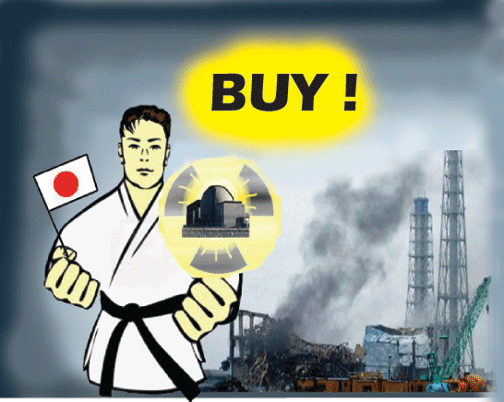 Americans 22 MAY 2016 BY SION BARRY
Menter Newydd is a joint venture between Bechtel Management Company and Hitachi Nuclear Energy Europe. A US-Japanese consortium has been established to build the £14bn Wylfa Newydd nuclear plant.
Horizon Nuclear Power has appointed Menter Newydd to help deliver the company’s lead nuclear new build project on Anglesey.
Menter Newydd is a joint venture of Hitachi Nuclear Energy Europe, US giant Bechtel Management Company and Japanese firm JGC Corporation (UK) and will be responsible for the construction of Wylfa Newydd, overseen by Horizon Nuclear Power…..http://www.walesonline.co.uk/business/business-news/14bn-north-wales-nuclear-power-11368974
Bluetack for nuclear cleanup
Tacky solution to Dounreay reactor core problem http://www.bbc.com/news/uk-scotland-highlands-islands-36340673 21 May 2016
Blu-Tack has been used to take samples from inside the core of a nuclear reactor, saving thousands of pounds in developing a specialist tool.
A team at Dounreay were faced with the challenge of retrieving small pieces of radioactive metal from inside the site’s Prototype Fast Reactor (PFR).
They came up with placing a blob of the tacky substance on a 10m (32ft) rod which was inserted deep into the PFR.
The metal sticks to the soft adhesive and can then be collected for analysis.
Can openers
Dounreay, near Thurso in Caithness, is being closed down at a cost of about more than £1bn.
Teams involved in the decommissioning and clean up work have frequently been asked to find cost-effective ways of dealing with hazardous radioactive material.
Other household items have been put to use at the site, including kitchen can openers and soup tin-sized cans that have held radioactive material for more than 30 years.
And a silver ironing board cover and a duvet have protected a robotic camera built to explore pipes inside the Dounreay Fast Reactor.
May 22 Energy Week

Science and Technology:
¶ Solar Impulse has landed in Ohio following the 12th stage of its circumnavigation of the globe. The zero-fuel aircraft arrived in Dayton at 21:56 local time having flown from Tulsa, Oklahoma. The 1,100-km journey took about 16 hours to complete, a relatively short hop for the plane. [BBC]
 Solar Impulse’s flight from Tulsa was fairly short, compared to some earlier stages. EPA.
World:
¶ Leaders of political parties in Sri Lankan parliament agreed to convert the Parliamentary complex from using grid power to solar power, the Government Information Department says. A Ministry of Power and Renewable Energy study found the conversion cost-effective. [Colombo Page]
¶ This fall, New Energy Corp Inc of Calgary will install a 25-kW EnviroGen hydrokinetic power system in the Winnipeg River for the Sagkeeng First Nation. The equipment does not require a dam and is anchored in the…
View original post 471 more words
US and S. Korea Nuclear Power Stations Impacted-Potentially Impacted by Defective Schneider Masterpact Breakers (Lists)

While several US nuclear power stations are known to have problems, which apparently stem from defective Schneider Electric Masterpact breakers, many more have these breakers, which could cause safety problems. These include two South Korean Nuclear Power Stations, as well as many US ones. These are the Schneider Electric Masterpact breakers provided via Nuclear Logistics Inc., so there may be more. Information about another Schneider Masterpact defect and the nuclear power stations involved is also provided below.
Problem Reported May 12, 2016: “PART 21 – INITIAL NOTIFICATION OF MASTERPACT BREAKER FAIL TO CLOSE… AZZ/NLI is providing written notification of the identification of a potential defect or failure to comply. “On the basis of our evaluation, it has been determined that there is sufficient information to determine if the subject condition is left uncorrected could potentially create a Substantial Safety Hazard or could create a Technical Specification Safety Limit violation…
View original post 1,144 more words
May 21 Energy News
World:
¶ HeliosAltas Corp, of Roseville, California, and DA Green Power Consulting, of the Philippines, announced their partnership to deploy Helios PowerWheel™ riverine energy technology in the Philippines. Helios said the agreement during the first four years is for a minimum of $16.2 million. [HydroWorld]
 Helios Powerwheel™
¶ Norway’s foremost institute for interdisciplinary climate research has launched a new initiative pairing scientists with leading investors to better explain climate risk. The Climate Finance Initiative will provide “a meeting place for climate scientists and leading global investors.” [CleanTechnica]
¶ Japanese companies Venti, Mitsubishi and C-Tech have agreed to develop a 66-MW wind farm in the north of the country. Construction on the 22-turbine plant is scheduled to start in September and finish in early 2019. It will supply electricity to Tohoku Electric Power Co. [reNews]
 Mitsubishi image.
¶ According to GlobalData, the uptake of smart…
View original post 454 more words
Schneider-Masterpact Breaker Role in Ft. Calhoun Nuclear Power Station Fire Appears Clear
The NRC said: “The finding stems from an NRC special inspection regarding an electrical fire that led to the declaration of an Alert at Fort Calhoun on June 7, 2011. The fire started in a replacement electrical breaker where poor alignment between components and inadequate maintenance increased the electrical resistance on some parts, causing them to heat up and fail. Soot and smoke from the resulting fire then knocked out power to a redundant electrical system used for distributing power to vital equipment needed for the safe shutdown of the plant. The plant was shut down at the time because of flooding along the Missouri River.
The fire resulted in the loss of spent fuel pool cooling for approximately 90 minutes and could have resulted in the loss of a safety function or multiple failures in systems used to mitigate a severe accident, had one occurred. In the…
View original post 796 more words
Japan vows to cooperate in French Olympic probe

Japan vowed to cooperate with a French probe into $2 million allegedly paid to help Tokyo secure the 2020 Olympics on Monday, as the son of ex-world athletics chief Lamine Diack denied receiving the money.

Prime Minister Shinzo Abe said he had ordered full cooperation with the French investigation into the payments, sent to a Singapore bank account which has been linked to Diack’s son, Papa Massata Diack.
Japanese officials have been swift to deny wrongdoing in what is the most serious in a series of problems to affect the 2020 Games, including over the main stadium’s design and the event’s official logo.
French prosecutors said last week they suspect the payments were intended to help secure the 2020 Olympics for Tokyo, which beat out competition from Istanbul and Madrid.
Japan’s Olympic chief last week insisted the payments were a “legitimate consultant’s fee”, while the top government spokesman insisted the bid was “clean”.
And Prime Minister Abe told parliament on Monday: “I have instructed the education and sports minister to fully cooperate in the investigation.”
“Education and sports minister Hiroshi Hase told the Japanese Olympic Committee and the former bid committee to cooperate in the investigation,” he added, according to Jiji Press.
French prosecutors said some 2.8 million Singapore dollars (1.8 million euros, $2 million) were paid to the now defunct Black Tidings consulting company, which Britain’s Guardian newspaper has linked to Papa Massata Diack.
Lamine Diack was an International Olympic Committee member in 2013 when Tokyo won the hosting rights for 2020. Diack and his son already face corruption charges in France.
– ‘Let them investigate’ –
The payments were discovered as part of an inquiry into allegations the Diacks organised bribes to cover up failed dope tests by Russian athletes, French prosecutors said. France became involved as the money may have been laundered in Paris.
But Diack’s son, Papa Massata Diack, speaking to Kyodo News agency in his native Senegal, insisted he hadn’t received any money from the Tokyo bid team.
“I haven’t got any money,” he said in Dakar. “Let them investigate… I have nothing to hide,” he added.
He added that he had been friends with Ian Tan Tong Han, formerly the sole proprietor of Black Tidings, since the 2008 Beijing Olympics. But he said he didn’t know Tan’s company was contracted by the Japanese bid team.
“I’ve been in this sports business for 25 years. I know the rules,” Diack said, adding that Tokyo’s bid “shouldn’t be tarnished” and had been done “very fairly”.
Tsunekazu Takeda, the Japanese Olympic Committee president who led Tokyo’s bid, said the money was for “professional services” for consulting work.
“I never knew there was a link (between the company and Papa Massata Diack),” Takeda told lawmakers in parliament on Monday. “Anyway, if it is in the realm of acquaintance there is no problem,” he added.
“Internationally it is quite common” to have a contract with an international consultant, Takeda added.
The controversy comes after Tokyo had to scrap its original main stadium design due to its eye-watering price tag, and also had to weather plagiarism accusations over the Games’ initial logo.

Up to 10,20 µSv in Ichinoseki, Iwate Prefecture 163km from Fukushima Dai-ichi
Ichinoseki, Iwate Prefecture. Way north of Sendai, adjacent to Kessenuma and Minamisanriku. 163km, (101 miles) from Fukushima Dai-ichi.
(part 3) Young woman from Fukushima speaks out
This interview was filmed on February 12, 2016, in Fukushima Prefecture. The young woman was 15 at the time of the nuclear meltdown in Fukushima, and we are releasing this interview with her permission. She is one of the 166 Fukushima residents aged 18 or younger at the time of the nuclear disaster who has been diagnosed with or suspected of having thyroid cancer (as of February 2016).
Fukushima residents who were 18 years old or younger at the time of the nuclear accident have been asked to participate in the voluntary thyroid ultrasound examination which is part of the Fukushima Health Management Survey. However, 18.8% of this age group were not tested in the 1st round of testing.* While the final results for the 2nd round of testing are not yet complete, every year the number of children participating in the official thyroid examinations is decreasing; the number of children who have not participated in the 2nd round of testing is currently 50.7%** For those young people aged 18-21 (as of April 1, 2014) and who were living in Fukushima at the time of the nuclear accident, 74.5% have not yet taken part in the official thyroid ultrasound examination.**
This young woman’s reason for speaking out is to motivate the families of children who have not yet received the thyroid ultrasound examination to have their children tested. However, in sharing her story about a topic which has become increasingly difficult to talk publicly about in Japan, she faces inherent risks which may include those to her work, community life and personal relationships. I therefore ask that her privacy is respected.
Ian Thomas Ash, Director
U.S. would back a rethink of Japan’s plutonium recycling program: White House

WASHINGTON – The United States would back a change to Japan’s nuclear fuel reprocessing program because there are concerns it may lead to an increase in its ally’s stockpile of unused plutonium, a senior White House official said.
If Japan were to change course “they would find the United States to be supportive,” Jon Wolfsthal, senior director for arms control and nonproliferation at the National Security Council, said in a recent interview.
Wolfsthal’s remark reflected concerns in President Barack Obama’s administration about the future of Japan’s large plutonium stockpiles, which can be used to make nuclear weapons.
Wolfsthal said the upcoming renewal in 2018 of a bilateral nuclear agreement with Japan “has the potential to become a very controversial issue.”
The 1988 pact authorizes Japan to reprocess used nuclear fuel when the fuel includes U.S.-produced uranium.
“There is no question that plutonium recycling in Japan has been expensive, that it is a challenging future for Japan,” Wolfsthal said.
In March, Foreign Minister Fumio Kishida defended the reprocessing of used nuclear fuel, saying the United States has approved it.
The United States and Japan have discussed what a decision to have large stockpiles of plutonium that “don’t have a dedicated pathway to use and disposition” means for global efforts to restrict reprocessing and enrichment, he said.
If Japan keeps recycling plutonium, “what is to stop other countries from thinking the exact same thing?” Wolfsthal said, apparently referring to concerns that other Asian countries such as China and South Korea may compete to get involved in similar projects.
Under the Japanese reprocessing program, plutonium extracted from used nuclear fuel is recycled to make plutonium-uranium mixed oxide fuel usable at nuclear power plants. Japan has licensed companies in foreign countries such as Britain and France to produce the so-called MOX fuel.
Japan came up with the plutonium recycling program in the face of potential international suspicion that a large stockpile of plutonium could encourage it to go nuclear.
But the plutonium recycling effort has hit a snag because most of Japan’s nuclear plants have suspended operations due to public safety concerns since the meltdowns at the Fukushima No. 1 plant following the giant earthquake and tsunami in 2011.
Obama has urged Japan and other countries to give up unused nuclear materials including plutonium as part of his efforts to strengthen control over the management of nuclear substances all over the world to prevent terrorists from obtaining them.
Japan had 48 tons of plutonium as of the end of 2014 and sent 331 kilograms of plutonium to the United States earlier this year.
NBC4 is revealing LA’s Nuclear Secret – investigative journalism spells it out

 LA’S NUCLEAR SECRET http://data.nbcstations.com/national/KNBC/la-nuclear-secret/
You really need to go to the link above and read the original article. It makes it easy for you to follow up aspects and find details
Years of mishandling dangerous radioactive materials and chemicals has also left a toxic legacy for generations of people living near the Santa Susana Field Laboratory. BY JOEL GROVER AND MATTHEW GLASSER
Tucked away in the hills above the San Fernando and Simi valleys was a 2,800-acre laboratory with a mission that was a mystery to the thousands of people who lived in its shadow. In a place called Area IV of the Santa Susana Field Laboratory (SSFL), there was a secret collaboration between the U.S. government and private companies to test the limits of nuclear power.
For decades, scientists and staff at SSFL experimented with new types of nuclear reactors, advanced rocket systems and futuristic weapons. While this research helped launch Americans into space and provided a better understanding of nuclear power, years of mishandling dangerous radioactive materials and chemicals has also left a toxic legacy for generations of people living near the site. The scientists are now gone, but acres and acres of radioactive and chemical contamination remains right above the neighborhoods of thousands.
The NBC4 I-Team spent a year investigating the story of the Santa Susana Field Lab. Our work involved interviews with whistleblowers, an intense review of more than 15,000 pages of government, academic and corporate documents, and interviews with dozens of community members, experts and public officials. We now know these families have been living in the shadow of one of the nation’s worst nuclear disasters in history and for the first time, NBC4 is revealing LA’s Nuclear Secret. Continue reading
1 This Month

of the week – Shut Down Drone Warfare!


Tell the Ukrainian Government to Drop Prosecution of Peace Activist Yurii Sheliazhenko

Petition to revoke the licensing of the Near Surface Nuclear Disposal Facility (NSDF) at Chalk River. https://www.ourcommons.ca/petitions/en/Petition/Details?Petition=e-7247
To see nuclear-related stories in greater depth and intensity – go to https://nuclearinformation.wordpress.com
-
Archives
- April 2026 (114)
- March 2026 (251)
- February 2026 (268)
- January 2026 (308)
- December 2025 (358)
- November 2025 (359)
- October 2025 (376)
- September 2025 (257)
- August 2025 (319)
- July 2025 (230)
- June 2025 (348)
- May 2025 (261)
-
Categories
- 1
- 1 NUCLEAR ISSUES
- business and costs
- climate change
- culture and arts
- ENERGY
- environment
- health
- history
- indigenous issues
- Legal
- marketing of nuclear
- media
- opposition to nuclear
- PERSONAL STORIES
- politics
- politics international
- Religion and ethics
- safety
- secrets,lies and civil liberties
- spinbuster
- technology
- Uranium
- wastes
- weapons and war
- Women
- 2 WORLD
- ACTION
- AFRICA
- Atrocities
- AUSTRALIA
- Christina's notes
- Christina's themes
- culture and arts
- Events
- Fuk 2022
- Fuk 2023
- Fukushima 2017
- Fukushima 2018
- fukushima 2019
- Fukushima 2020
- Fukushima 2021
- general
- global warming
- Humour (God we need it)
- Nuclear
- RARE EARTHS
- Reference
- resources – print
- Resources -audiovicual
- Weekly Newsletter
- World
- World Nuclear
- YouTube
-
RSS
Entries RSS
Comments RSS
 nuclear-news